1. Introduction
Terrestrialization – the colonization of land by living organisms – was a major event in the history of life, with profound implications for the chemistry (Kenrick et al. Reference Kenrick, Wellman, Schneider and Edgecombe2012) and sedimentology (Davies & Gibling, Reference Davies and Gibling2010) of our planet, and of course, for the history of life (Labandeira, Reference Labandeira2005) and macroevolutionary patterns (Deline et al. Reference Deline, Greenwood, Clark, Puttick, Peterson and Donoghue2018). The adaptation of life to continental environments is a topic of active research, but is one with a significant history, in which the Geological Magazine has played an important role. Indeed, this publication has charted our knowledge of terrestrialization and early complex land ecosystems from its infancy, and continues to provide regular new insights in this arena today. As such, a contribution on early terrestrial ecosystems is a fitting topic for this special issue. There have been multiple recent reviews and other significant works on terrestrialization (Vecoli et al. Reference Vecoli, Clément and Meyer-Berthaud2010; Garwood & Edgecombe, Reference Garwood and Edgecombe2011; Kenrick et al. Reference Kenrick, Wellman, Schneider and Edgecombe2012; Selden, Reference Selden2012; Dunlop et al. Reference Dunlop, Scholtz, Selden, Minelli, Boxshall and Fusco2013; Rota-Stabelli et al. Reference Rota-Stabelli, Daley and Pisani2013; Lozano-Fernandez et al. Reference Lozano-Fernandez, Carton, Tanner, Puttick, Blaxter, Vinther, Olesen, Giribet, Edgecombe and Pisani2016) which provide a comprehensive overview of the topic. Instead of duplicating these, here we focus on a singular Lagerstätte, the Rhynie chert. This early Devonian (407 Ma) site provides key insights into the origins of life on land, and the Geological Magazine published one of the first papers with insights into its terrestrial arthropod fauna (Hirst & Maulik, Reference Hirst and Maulik1926). It is also a century since the first description of fossils from the site (Edwards et al. Reference Edwards, Kenrick and Dolan2018). This anniversary has recently been celebrated with a special issue providing a range of new insights into Rhynie fossils (Edwards et al. Reference Edwards, Kenrick and Dolan2018). Given the depth of research into the site from this, earlier special issues (Trewin & Rice, Reference Trewin and Rice2004) and myriad stand-alone works, there is scope for a review article introducing the geology of the Rhynie chert, and its fauna and flora. Here we provide such a review: we first highlight the historical contributions in the Geological Magazine to our knowledge of early terrestrial ecosystems, and study of the Rhynie chert. We then introduce the geology of the Rhynie chert Lagerstätte, summarizing the work to date, before providing an overview of the flora and fauna of the site. Our aim is to provide a synthesis of the research to date to form a context and framework for further exploration of the literature, rather than an exhaustive account of all published studies: for the fossils especially, a comprehensive review is beyond the scope of this paper.
2. Geological Magazine and terrestrialization
Geological Magazine has a history of significant contributions towards our knowledge of terrestrialization, most notably that of animals. A significant factor in this was the body of work (and influence) of Henry Woodward, editor of the publication from 1865 to 1918 (Geological Magazine, 1921). Whilst the focus of Woodward’s work was Crustacea (Woodward, Reference Woodward1868, Reference Woodward1870; Jones & Woodward, Reference Jones and Woodward1899), his contributions also encompassed (what we now recognize to be) chelicerate phylogeny (Woodward, Reference Woodward1913 a), the origins of life (Woodward, Reference Woodward1874) and the then recently discovered Iguanodon (Woodward, Reference Woodward1885). Another significant aspect, especially of his later work, and the subject of a large number of papers in the Geological Magazine, was Palaeozoic terrestrial arthropods. These papers included: an overview of terrestrial deposits throughout the Phanerozoic (Woodward, Reference Woodward1871 c); and myriad insights into Carboniferous myriapods (Woodward, Reference Woodward1871 a, Reference Woodward1873, Reference Woodward1887 a), arachnids (Woodward, Reference Woodward1872, Reference Woodward1873) and insects (Woodward, Reference Woodward1887b , c, Reference Woodward1906) including an early report of a juvenile insect (Woodward, Reference Woodward1913 b), albeit misidentified as a branchiopod (Rolfe, Reference Rolfe1967). A key paper reported one of the first and best preserved trigonotarbid arachnids (Woodward, Reference Woodward1871 b) which has gone on to be the focus of further studies (Pocock, Reference Pocock1902; Garwood et al. Reference Garwood, Dunlop and Sutton2009; Dunlop & Garwood, Reference Dunlop and Garwood2014). This in turn attracted other workers in this area. Examples include: further works on Carboniferous arachnids (Pocock, Reference Pocock1903 a, b; Gill, Reference Gill1911); reports of Carboniferous deposit near Colne with both arachnid and myriapod fossils (Bolton, Reference Bolton1905); documentation of Carboniferous myriapods from the Sparth Bottoms deposit (Baldwin, Reference Baldwin1911; Jackson et al. Reference Jackson, Brade-Birke and Brade-Birke1919) and elsewhere (Brade, Reference Brade1928); an overview of Palaeozoic insects (Brongniart, Reference Brongniart1885), and a note on the similarities between European and American fossils in this group (Scudder, Reference Scudder1876); arachnids, myriapods and enigmatic, probably terrestrial, arthropods from the Tyne Coalfield (Gill, Reference Gill1924) that have also resulted in further study (Dunlop, Reference Dunlop1998; Garwood & Sutton, Reference Garwood and Sutton2012; Jones et al. Reference Jones, Dunlop, Friedman and Garwood2014); and Palaeozoic plant taphonomy (Kindle, Reference Kindle1913) and palaeobotanical discoveries (Arber, Reference Arber1907, Reference Arber1912, Reference Arber1913). These papers represent a significant body of work on terrestrial fossils at a time when the study of Palaeozoic land ecosystems was fragmented.
In the decades since these contributions, Geological Magazine has continued to publish a range of works on early land ecosystems and related topics. Examples include: Palaeozoic palaeobotanical papers such Silurian macroscopic plants (Edwards & Rogerson, Reference Edwards and Rogerson1979), Silurian–Devonian biostratigraphy within the Anglo-Welsh Basin (Wellman et al. Reference Wellman, Thomas, Edwards and Kenrick1998), British coal measures flora (Cleal, Reference Cleal1986), and Devonian lycopsids in Argentina (Cingolani et al. Reference Cingolani, Berry, Morel and Tomezzoli2002), China (Xu & Wang, Reference Xu and Wang2008) and Colombia (Berry et al. Reference Berry, Morel, Mojica and Villarroel2000); palynology studies with implications for the timing of terrestrialization in multiple groups (Marshall, Reference Marshall1991) and Silurian biostratigraphy (Gray et al. Reference Gray, Boucot, Grahn and Himes1992); Ordovician traces potentially recording terrestrial animals (Johnson et al. Reference Johnson, Briggs, Suthren, Wright and Tunnicliff1994) and Early Devonian traces recording myriapods or relatives (Smith et al. Reference Smith, Braddy, Marriott and Briggs2003); Palaeozoic terrestrial arthropods including arachnids (Dunlop & Horrocks, Reference Dunlop and Horrocks1997) and insects (Jarzembowski & Schneider, Reference Jarzembowski and Schneider2007); a new arthropod fauna from the Westhoughton open-cast coal pit (Anderson et al. Reference Anderson, Dunlop, Eagar, Horrocks and Wilson1999); and topics in Palaeozoic correlation (Rickards, Reference Rickards2000; Cocks et al. Reference Cocks, Fortey and Rushton2010).
The Geological Magazine was home to descriptions of some of the first animals reported from Rhynie. The earliest Rhynie arthropods were described by Hirst (Reference Hirst1923) who documented specimens now thought to represent two arachnid orders: mites and trigonotarbids, preserved in exceptional detail. A follow-up paper was published three years later in the Geological Magazine by Hirst & Maulik (Reference Hirst and Maulik1926) who provided further descriptions. In particular, this contribution highlights some exceptionally preserved trigonotarbids of the genus Palaeocharinus, including details of the lateral eyes of these extinct arachnids, the first reports of taxa now known to represent the enigmatic euthycarcinoid arthropods, and the first hexapods known from the site. The latter, in particular, are of note, being the oldest record of Hexapoda in the fossil record (Dunlop & Garwood, Reference Dunlop and Garwood2018). Rhyniella praecursor, a springtail (collembolan hexapod), has been the subject of significant research since its first publication (Tillyard, Reference Tillyard1928; Scourfield, Reference Scourfield1940; Whalley & Jarzembowski, Reference Whalley and Jarzembowski1981; Greenslade & Whalley, Reference Greenslade, Whalley and Dallai1986), whilst what has since been named as Rhyniognatha hirsti potentially represents the earliest winged insect (Engel & Grimaldi, Reference Engel and Grimaldi2004; but see also Haug & Haug, Reference Haug and Haug2017). As such, this paper was a significant milestone in the study of early terrestrial arthropods, and a fitting basis for the current review.
3. The Rhynie chert: overview
The Devonian Rhynie chert is a Konservat-Lagerstätte (a deposit renowned for its exceptional preservation of fossilized organisms) located in Aberdeenshire, Scotland, preserving an important early terrestrial ecosystem, including plant, fungi, bacteria and arthropod fossils (Fig. 1). The cherts (siliceous rocks) in which the fossils are found are present as lenses within sandstone and mudstone alluvial plain laid down in an intermontane basin, and are related to localized hot-spring activity. The exact age of the cherts is uncertain: spores within the shales indicate that they date from the middle Pragian to lower Emsian stages of the Lower Devonian (Wellman, Reference Wellman2006). Radiometric dates are in broad agreement with this, placing the Rhynie chert as either 407.6 ± 2.2 Ma or 411.5 ± 1.3 Ma (initially reported in Mark et al. (Reference Mark, Rice, Fallick, Trewin, Lee, Boyce and Lee2011) and Parry et al. (Reference Parry, Noble, Crowley and Wellman2011); modified and further discussed in Mark et al. (Reference Mark, Rice and Trewin2013) and Parry et al. (Reference Parry, Noble, Crowley and Wellman2013) respectively). The site was discovered in 1912 by William Mackie, a local physician with an interest in geology, who unearthed the first chert blocks in local fields and stone walls. Trenching followed, and a classic five-part work by Kidston & Lang (Reference Kidston and Lang1917, Reference Kidston and Lang1920 a, b, Reference Kidston and Lang1921 a, b) was the start of a century’s study on the site to date. Edwards et al. (Reference Edwards, Kenrick and Dolan2018) provide a history of study of the Rhynie chert.
The geological setting of the Rhynie cherts. (a) The location of Rhynie on a UK map. (b) A detailed map showing the northern half of the Rhynie Basin where the cherts are located. (c) An overview map of the basin as a whole showing its southern extent. After Rice & Ashcroft (Reference Rice and Ashcroft2003).

The fossils from Rhynie present a unique insight into life on land during the Devonian. Rhynie is valuable not just because of the exceptional preservation, but also because the terrestrialization of plants and arthropods occurred in the early Palaeozoic (Kenrick et al. Reference Kenrick, Wellman, Schneider and Edgecombe2012). It therefore provides an insight into these ecosystems fairly early in their history. Fossils are preserved in permineralized silica from sinter deposits surrounding hydrothermal vents. This amorphous silica derives from water saturated in silica from hot springs, which has, over time, altered to cryptocrystalline chert. In the process of doing so, it has three-dimensionally preserved a wide range of organisms living in this environment and potentially surrounding areas (Rice et al. Reference Rice, Ashcroft, Batten, Boyce, Caulfield, Fallick, Hole, Jones, Pearson, Rogers, Saxton, Stuart, Trewin and Turner1995). The preservation of terrestrial hydrothermal deposits is rare, making Rhynie an important geological site for studying fossil epithermal environments as well as its wider palaeontological importance (Fayers & Trewin, Reference Fayers and Trewin2003).
4. Geological setting
The Rhynie chert is located within the 21 km by 3 km Rhynie outlier of the Old Red Sandstone (Trewin & Rice, Reference Trewin and Rice1992; Rice et al. Reference Rice, Ashcroft, Batten, Boyce, Caulfield, Fallick, Hole, Jones, Pearson, Rogers, Saxton, Stuart, Trewin and Turner1995). The Rhynie Cherts Unit (RCU) is hosted by the Dryden Flags Formation (Figs 1, 2; Rice et al. Reference Rice, Trewin and Anderson2002; Rice & Ashcroft, Reference Rice and Ashcroft2003; Fayers & Trewin, Reference Fayers and Trewin2004).
Generalized stratigraphic column for the Rhynie Basin, focusing on the northern half (after Rice & Ashcroft, Reference Rice and Ashcroft2003; Parry et al. Reference Parry, Noble, Crowley and Wellman2011).

The chert was deposited within the Devonian (Lower Old Red Sandstone) Rhynie Basin. This narrow basin is north–south oriented, is faulted to the west, and the margins at the northern end of the basin are primarily fault-controlled, with evidence of strike-slip movement (Rice & Ashcroft, Reference Rice and Ashcroft2003), whilst towards the southern end of the basin the sediments are unconformable with the basin at the eastern margin (Fig. 1). In this region, and across the basin as a whole, the prevailing dip of the sediments is to the west, between 15 and 35°, although this is disrupted by open folding in the area (Rice et al. Reference Rice, Trewin and Anderson2002). As such, the basin is a half-graben. The basement lithology is the Ordovician Boganclogh intrusion (Busrewil et al. Reference Busrewil, Pankhurst and Wadsworth1973), which primarily comprises quartz–biotite–norite (an orthopyroxene-dominated gabbro) with minor serpentinite. This is intruded into the upper Proterozoic Dalradian metaturbidites of the Southern Highland Group. Associated with a major sinuous regional faulting at the west (the Rhynie Fault Zone, or RFZ) is a remnant hot-spring system (Trewin & Rice, Reference Trewin and Rice1992; Rice et al. Reference Rice, Ashcroft, Batten, Boyce, Caulfield, Fallick, Hole, Jones, Pearson, Rogers, Saxton, Stuart, Trewin and Turner1995, Reference Rice, Trewin and Anderson2002). The RFZ extends for 1.5 km and is 400 m wide in places (Rice et al. Reference Rice, Ashcroft, Batten, Boyce, Caulfield, Fallick, Hole, Jones, Pearson, Rogers, Saxton, Stuart, Trewin and Turner1995). It dips eastward at 35°, and is offset by cross-faults downthrowing to the north (Rice & Ashcroft, Reference Rice and Ashcroft2003).
A silicified breccia, along with slivers of basement and fault gouge, is present along much of this contact (Rice et al. Reference Rice, Trewin and Anderson2002). Fault-bounded slivers of Devonian sedimentary rocks and andesite occur within the RFZ, adjacent to the RCU (Mark et al. Reference Mark, Rice, Fallick, Trewin, Lee, Boyce and Lee2011), which show similarities to rocks stratigraphically below the chert-bearing succession, exposed at the eastern extent of the basin (Rice et al. Reference Rice, Trewin and Anderson2002). These blocks are hydrothermally altered, with two primary alteration facies: K-feldspar–quartz–illite, and illite/smectite–quartz–K-feldspar–chlorite–calcite (Baron et al. Reference Baron, Hillier, Rice, Czapnik and Parnell2003). The andesitic blocks host the former facies, which contains high levels of As and Au (100 ppb; Rice et al. Reference Rice, Ashcroft, Batten, Boyce, Caulfield, Fallick, Hole, Jones, Pearson, Rogers, Saxton, Stuart, Trewin and Turner1995; Rice et al. Reference Rice, Trewin and Anderson2002; Mark et al. Reference Mark, Rice, Fallick, Trewin, Lee, Boyce and Lee2011). The blocks are crossed by a number of quartz–K-feldspar veins, mostly oriented N–S to NE–SW, and dipping eastward at 35°, aligned with the RFZ, thus suggesting that the veins are related to fracturing during the development of the Rhynie Basin (Mark et al. Reference Mark, Rice, Fallick, Trewin, Lee, Boyce and Lee2011).
The lowest sediment in the Rhynie Basin stratigraphy is a sandstone formation. Based on cores, Rice et al. (Reference Rice, Trewin and Anderson2002) suggested that this White Sandstones Unit may correlate with the Quarry Hill Sandstone, the uppermost unit of the Tillybrachty Sandstone Formation (Fig. 2; Rice & Ashcroft, Reference Rice and Ashcroft2003). Fossils are found within the RCU. This is within the dark, muddy sandstones and laminated shales, which form the Windyfield Shales Member of the Dryden Flags Formation (Rice & Ashcroft, Reference Rice and Ashcroft2003).
The Rhynie fossils are found within a single discrete, 35 m thick sedimentary package – the RCU –– that Rice & Ashcroft (Reference Rice and Ashcroft2003) report as occurring towards the base of the Windyfield Shales Member, whereas Rice et al. (Reference Rice, Trewin and Anderson2002) suggest it separates the Upper from the Lower shales within this member (Fig. 2). The Windyfield Shales Member comprises over 50 chert beds, with interbedded shales, carbonaceous sandstones and locally abundant tuffaceous debris (Rice et al. Reference Rice, Trewin and Anderson2002). The unit is continuous for 80 m down dip and 90 m along strike, although individual chert beds are not continuous over distances greater than 20 m and show rapid lateral variation (often over less than 1 m; Trewin & Wilson, Reference Trewin and Wilson2004). The uneven nature of the cherts, which were originally deposited as sinters resulting from hot-spring activity, may result from regular flooding of a northward-flowing axial river (Trewin, Reference Trewin1994, Reference Trewin1996). This would have deposited the interbedded sands and muds, and potentially precluded sinter deposition periodically through dilution reducing the silica content of hot-spring water (Trewin & Wilson, Reference Trewin and Wilson2004). Retreating flood waters could have further exacerbated an uneven topography by allowing erosion of the sandy deposits. The chert beds preserve evidence of both subaqueous and subaerial environments. Chert ‘pods’ of less than 1 m lateral extent, and exhibiting a ‘clotted’ texture, were deposited subaerially, with various plant tissues, arthropods and spores preserved amongst the bacterially mediated clots (Trewin et al. Reference Trewin, Fayers and Kelman2003). The silica may also be directly precipitated onto the cuticle of plant surfaces as an amorphous bacterial coating, similar in composition and appearance to the clotted texture. Subaqueous environments are represented by filamentous chert meshworks. These most commonly form: laminated sheets between plant stems, which provided support to the plants; irregular meshworks with clots, growing within an organic mush; and straight filaments crossing voids created by gas bubbles or left after the decay of plant stems (Trewin et al. Reference Trewin, Fayers and Kelman2003). The clasts within some chert breccias located at the basin margin are coated with many layers of chert to form a ball breccia. This texture resembles geyserite, found at or near the surface of hot-spring systems (Rice et al. Reference Rice, Ashcroft, Batten, Boyce, Caulfield, Fallick, Hole, Jones, Pearson, Rogers, Saxton, Stuart, Trewin and Turner1995).
Overlying the Windyfield Shales is the Milton Flags and Shales Member which contains the Windyfield chert (Fig. 2) – another important lithified wetland ecosystem. This is stratigraphically younger than the other cherts (including the Rhynie chert), but not significantly so. It is laterally separated from the Rhynie chert by a distance of c. 700 m and a fault running NW–SE, and preserves subtly different environmental conditions (Fayers & Trewin, Reference Fayers and Trewin2004).
5. Development of the Rhynie Basin
The Caledonian Orogeny provides the geological context for the Rhynie outlier, having created the dominant metamorphic assemblages and structures in the upper Proterozoic Dalradian metaturbidites that form the basement of the outlier at its northern and southern extents. The Caledonian Orogeny initiated in the Early Ordovician with the microcontinent Avalonia separating from northern Gondwana. Crust beneath the Iapetus Ocean was subducted beneath Avalonia which drifted northwards towards a more northerly continent, Laurentia. The key event in the Rhynie area pre-dated the collision of Avalonia with this continent: the c. 475–460 Ma Grampian event resulted from convergence between a shallow-water carbonate shelf (the Laurentian margin; Lambert & McKerrow, Reference Lambert and McKerrow1976; Strachan et al. Reference Strachan, Smith, Harris, Fettes, Trewin and Trewin2003) and a volcanic arc (Dewey & Shackleton, Reference Dewey and Shackleton1984; Draut et al. Reference Draut, Clift, Amato, Blusztajn and Schouten2009; Strachan, Reference Strachan, Woodcock and Strachan2012). The arc–Laurentia collision resulted in the overthrusting of an exotic ophiolite nappe, and deformation plus associated Barrovian metamorphism of the Moine and Dalradian Supergroups (Dewey & Shackleton, Reference Dewey and Shackleton1984; Strachan et al. Reference Strachan, Smith, Harris, Fettes, Trewin and Trewin2003). The Rhynie outlier is a part of the resulting Grampian terrane (Stephenson, Reference Stephenson2000). Associated with the Grampian Event was widespread intrusion of gabbroic and granitic rocks into the Dalradian metasediments. In Aberdeenshire, the tholeiitic Newer Gabbros were intruded at c. 470 Ma, coincident with the peak of regional metamorphism, and overprinted the regional Barrovian zones with sillimanite contact metamorphism (Droop & Charnley, Reference Droop and Charnley1985; Stephenson, Reference Stephenson2000). Many plutons in Aberdeenshire follow the tholeiitic differentiation trend, as crystals within the chamber settle and form cumulate layers (Strachan et al. Reference Strachan, Smith, Harris, Fettes, Trewin and Trewin2003). Two of these intrusions possess faulted contacts with the Rhynie outlier, thus comprising the igneous portions of the basement. To the east lies the largest of the Aberdeenshire intrusions, the Insch Pluton, a 43 km long and 8 km wide intrusion of the ‘Younger Gabbros’ (Clarke & Wadsworth, Reference Clarke and Wadsworth1970; Lambert & McKerrow, Reference Lambert and McKerrow1976; Stephenson, Reference Stephenson2000). The westerly extension of the Insch Pluton, found to the west of the Rhynie Basin, is the Boganclogh Mass. By the Late Silurian, the Iapetus Ocean had closed, and Laurussia had formed through the collisions of Avalonia, Laurentia and a third continent, Baltica (Stephenson, Reference Stephenson2000), which collided with Laurentia in the c. 435–420 Ma Scandian event (Kinny et al. Reference Kinny, Strachan, Friend, Kocks, Rogers and Paterson2003; Strachan et al. Reference Strachan, Smith, Harris, Fettes, Trewin and Trewin2003). Whilst this event caused widespread ductile thrusting and folding of the Moine Supergroup and development of the Moine Thrust Zone, the Grampian terrane was located away from the main collision and did not undergo significant deformation.
The Rhynie Basin formed in the Early Devonian, at c. 25° S, on the SE margin of Laurussia (Wellman, Reference Wellman2018). In excess of 200 m of sediments and limited extrusive volcanics accumulated within a rapidly subsiding basin located within the Caledonian orogenic belt. Within this intermontane basin was a northward-flowing river, subject to regular flooding, resulting in fluvial and overbank deposits. The Rhynie Basin represents a half-graben with a low-angle listric fault zone at the western margin and a bounding unconformity to the east (Rice et al. Reference Rice, Trewin and Anderson2002). This could have resulted from regional extension, or alternatively as a pull-apart basin above a releasing bend or stepover within a strike-slip fault zone (Rice & Ashcroft, Reference Rice and Ashcroft2003; Parry et al. Reference Parry, Noble, Crowley and Wellman2011). The maximum depth at the centre of the basin is 600 ± 50 m (Rice et al. Reference Rice, Ashcroft, Batten, Boyce, Caulfield, Fallick, Hole, Jones, Pearson, Rogers, Saxton, Stuart, Trewin and Turner1995).
The hot springs, the source of the silica that formed the Rhynie chert, represent the late stages of andesitic volcanism. Their location was controlled by the intersection of the RFZ with the northern contact of the Boganclogh Mass (Parry et al. Reference Parry, Noble, Crowley and Wellman2011) (Fig. 3). This fault system became the main conduit for the hydrothermal fluids of the hot-spring system (Rice et al. Reference Rice, Trewin and Anderson2002). The magma (basaltic-andesite) providing the heat for the spring system likely formed due to decompression melting of the upper mantle as a result of the Early Devonian formation of the Rhynie Basin (Parry et al. Reference Parry, Noble, Crowley and Wellman2011): pull-apart basins, particularly those formed during transtension, produce deep conduits for mantle-derived magmas (Tosdal & Richards, Reference Tosdal and Richards2001). A plausible source of the fluids for the hydrothermal activity was surface-derived meteoric waters, with evidence for some limited fluids derived from a magmatic source (Rice et al. Reference Rice, Ashcroft, Batten, Boyce, Caulfield, Fallick, Hole, Jones, Pearson, Rogers, Saxton, Stuart, Trewin and Turner1995; Baron et al. Reference Baron, Hillier, Rice, Czapnik and Parnell2003; Channing, Reference Channing2018).
A schematic cross section of the Rhynie basin during hot-spring activity, and the deposition of the Dryden Flags Formation.

6. Palaeoenvironment of the Rhynie chert
The Tillybrachty Sandstone Formation was deposited during regional extension and initiation of the basin. The clastic sediments were dominantly locally derived conglomerates and sandstones (Rice et al. Reference Rice, Trewin and Anderson2002), with many clasts originating from the basement rocks of the Boganclogh Mass. The sediments are moderate to poorly sorted, and lack cross bedding or evidence of well-developed channels. Rare caliche nodules are present and indicative of a subaerial semi-arid environment, and a poorly developed soil profile (Trewin & Rice, Reference Trewin and Rice1992). The sedimentological evidence points towards rapid and sporadic deposition, with the sandstones and conglomerates deposited by a small alluvial fan (Rice et al. Reference Rice, Ashcroft, Batten, Boyce, Caulfield, Fallick, Hole, Jones, Pearson, Rogers, Saxton, Stuart, Trewin and Turner1995) up to 1 km wide. Sandstones with floating pebbles may be evidence of deposition by non-channelized flash floods, whereas rare cross-bedded facies preserve evidence of poorly channelized flows (Trewin & Rice, Reference Trewin and Rice1992).
Above the locally derived sandstones and conglomerates lies a discrete andesitic lava flow. The flow is up to 20 m thick and is traceable along strike for 350 m. Wherever the lava is exposed, it is overlain by sediments containing volcanic clasts not observed below the lava (Trewin & Rice, Reference Trewin and Rice1992). The source of this lava was likely volcanic centres at the margins of the basin, with lava production controlled by movement on major faults (Rice et al. Reference Rice, Ashcroft, Batten, Boyce, Caulfield, Fallick, Hole, Jones, Pearson, Rogers, Saxton, Stuart, Trewin and Turner1995; Rice et al. Reference Rice, Trewin and Anderson2002). Above the lava, tuffaceous beds are common and decrease up stratigraphy (Trewin & Rice, Reference Trewin and Rice1992).
Deposition of the Quarry Hills Formation, and later Dryden Flags Formation, occurred whilst the tuffs were erupted (Rice et al. Reference Rice, Trewin and Anderson2002). The Quarry Hills Formation consists of fine-grained sandstones and shales, with laminations and beds centimetres to millimetres thick (Trewin & Rice, Reference Trewin and Rice1992), deposited by a fluvial system running along the basin axis (Rice et al. Reference Rice, Trewin and Anderson2002). These beds contain varying quantities of volcanic debris, with highly vesicular volcanic clasts occurring as distinct, oversized grains within the sandstone. Only a few beds consist entirely of tuffaceous material. Some tuffaceous beds show normal grading and evidence of airfall deposition, though most are parallel and ripple-laminated from water transport after erosion from nearby tuff cones (Trewin & Rice, Reference Trewin and Rice1992).
The muddy sandstones of the Dryden Flags Formation were deposited by ephemeral lakes on an alluvial plain (Fig. 4). It is possible that the sediments were deposited on the floodplains of the Quarry Hills Formation (Rice et al. Reference Rice, Trewin and Anderson2002). Hot-spring activity occurred late in the basin development during the deposition of this formation. Hydrothermal fluids migrated along the basin margin fault zone from a source below and to the southeast of the basin, heavily altering lithologies in the hanging wall. The deposition of the cherts within the lacustrine shales and sandstones indicates that sinter deposition interrupted the usual alluvial plain depositional processes (Rice et al. Reference Rice, Trewin and Anderson2002) by disrupting drainage networks as silica was deposited (Trewin & Wilson, Reference Trewin and Wilson2004) and forming small pools (Fig. 4; Powell et al. Reference Powell, Trewin, Edwards, Friend and Williams2000). Desiccation cracks in the shales indicate periods of subaerial exposure of the mudflats, possibly due to seasonal variation in sediment supply (Trewin & Rice, Reference Trewin and Rice1992; Rice et al. Reference Rice, Ashcroft, Batten, Boyce, Caulfield, Fallick, Hole, Jones, Pearson, Rogers, Saxton, Stuart, Trewin and Turner1995, Reference Rice, Trewin and Anderson2002). Periodic flooding of the alluvial plain would likely cause breaks in the colonization of bacteria and deposit the sandstones and shales between cherts. Laminated cherts are evidence of deposition in sinter terraces (Powell et al. Reference Powell, Trewin, Edwards, Friend and Williams2000), and a loose chert block has been found with a texture characteristic of deposition in the splash zone around a hydrothermal spring (Trewin, Reference Trewin1994). There is further evidence for the presence of runoff streams, wet sinter aprons with cyanobacteria colonies, and wetland areas related to hot-spring outwash (Channing & Edwards, Reference Channing and Edwards2009 b). Plants are thought to have primarily colonized the sandy substrate at the edge of the lakes (Trewin & Rice, Reference Trewin and Rice1992), though they would also colonize bare sinter (Fig. 4; Powell et al. Reference Powell, Trewin, Edwards, Friend and Williams2000).
Palaeoenvironmental reconstruction of the Rhynie chert locality. Adapted from Trewin (Reference Trewin1994) and Preston & Genge (Reference Preston and Genge2010).

Plant axes have been found up to 15 cm in length, with growth support provided by bacterial mats (Trewin et al. Reference Trewin, Fayers and Kelman2003). Freshwater-filled hollows and pools would also house plants, as well as arthropods such as Palaeonitella and Lepidocaris (Powell et al. Reference Powell, Trewin, Edwards, Friend and Williams2000; Rice et al. Reference Rice, Trewin and Anderson2002). A modern analogue for the Rhynie chert depositional environment is Yellowstone National Park, USA, suggesting preservation of plants at temperatures ≤ 45°C in brackish water with a neutral to alkali pH (6.5–9.1 at Yellowstone) and containing silica at or above the saturation point (Channing & Edwards, Reference Channing and Edwards2009 a, b).
7. Taphonomy
The exceptional preservation of the Rhynie chert fossils makes them particularly valuable as a record of the early land biota. For example, the plant fossils preserve cellular details in three dimensions (Hetherington & Dolan, Reference Hetherington and Dolan2018 a, b; Strullu-Derrien et al. Reference Strullu-Derrien, Spencer, Goral, Dee, Honegger, Kenrick, Longcore and Berbee2018). The most exceptional preservation is indicative of extremely rapid silicification (Trewin et al. Reference Trewin, Fayers and Kelman2003), as supported by preserved fine structures in the soft tissues (book lungs) of a trigonotarbid arachnid (Claridge & Lyon, Reference Claridge and Lyon1961), spores in the process of germination (Lyon, Reference Lyon1957) and the release of sperm from a plant gametophyte (Remy et al. Reference Remy, Gensel and Hass1993). Such fossils are an exception in the deposit, and it is likely most of the sinters accumulated at a rate similar to that of modern-day hot spring systems (Trewin et al. Reference Trewin, Fayers and Kelman2003): for example, modern sinters at Yellowstone National Park accumulate at 1–5 cms per year (Channing, Reference Channing2018). As a result, fossils from the Rhynie chert are found in varying states of decay, even within a single bed (Powell et al. Reference Powell, Trewin, Edwards, Friend and Williams2000). Because both decaying leaf litter and in situ plants are found within the Rhynie chert, a single silicification event might record a transect through a full community of living plants and leaf litter above a primitive soil (Powell et al. Reference Powell, Trewin, Edwards, Friend and Williams2000). Similarly, arthropod preservation varies from complete individuals with cuticular structures such as setae/trichobothria still attached and internal anatomy preserved (Garwood & Dunlop, Reference Garwood and Dunlop2014) through to moults and cuticular fragments. The main factors dictating the quality of preservation are the degree of silicification, and the amount of decay and disarticulation that occurred prior to silicification. Decay resulted from fungi (Trewin, Reference Trewin1996), and also probably bacteria, as saprotrophs have been reported (Powell et al. Reference Powell, Trewin, Edwards, Friend and Williams2000). In general, fossils occur in cooler areas of the hot-spring system.
Taphonomic processes in Rhynie are best understood in the macroflora, which is outlined first herein, followed by the fauna. Living plants were not always completely silicified, in which case decay occurred after partial preservation. Because the outer cortex and xylem strands are more resistant to decay than the centre, hollow fragments of plant material are commonly found partially filled with sediment (Trewin, Reference Trewin1996). The best-preserved plants were flooded with hot-spring waters whilst still in life position growing on the sandy substrate (Powell et al. Reference Powell, Trewin, Edwards, Friend and Williams2000). Silicification progressed from the outside of the stem inwards, typically beginning with the coating of plant material by amorphous silica from the hot-spring waters. Individual plant cells were progressively filled or the contents replaced by silica, continuing until the stem was completely silicified (Trewin, Reference Trewin1996). After burial, this amorphous silica is converted to chert, preserving the plant structure (Powell et al. Reference Powell, Trewin, Edwards, Friend and Williams2000). Preservation through silica deposited directly onto the stem is most common, but some plants were only preserved after bacterial colonization of exposed surfaces (Trewin et al. Reference Trewin, Fayers and Kelman2003). Bacterial mats growing between plants may also have assisted in the silicification of plants in life position (Trewin et al. Reference Trewin, Fayers and Kelman2003).
Silicification of plants occurred in three main settings: after episodic surface flooding; from violent geyser eruptions; or from more sedate overflows from pools that form sinter terraces that disrupt and alter the direction of water flow. This flooding may also carry uprooted plants: plant axes have been found with a preferred orientation posited to be caused by the flow (Trewin, Reference Trewin1996) having been deposited as allochthonous material in sinter beds (Powell et al. Reference Powell, Trewin, Edwards, Friend and Williams2000). Additionally plants likely colonized vents abandoned due to changes in distribution channels, which were subsequently flooded (Trewin, Reference Trewin1996). Silicification may also have occurred on the banks of hot-spring pools, where temperatures were cool enough to sustain plant growth on the banks. Around these pools, plants would take up siliceous water, increasing preservation potential (Powell et al. Reference Powell, Trewin, Edwards, Friend and Williams2000). Silicification due to subsurface permeation also occurred (Trewin, Reference Trewin1996).
Arthropods in the Rhynie chert are preserved as complete animals and moults, or as disarticulated whole or fragmented elements (Anderson & Trewin, Reference Anderson and Trewin2003). The in situ arthropods are often extremely well preserved, with some showing setae, fine cuticular structures such as slit sense organs, gut contents (euthycarcinoids, myriapods) or respiratory organs (trigonotarbids; Dunlop & Garwood, Reference Dunlop and Garwood2018). Fragmentary remains represent allochthonous debris, and are associated with spores, plant fragments and occasional clastic grains. In part through comparison to the Windyfield cherts, the best-preserved arthropods were thought to be inhabitants of small, ephemeral freshwater pools within the hot-spring system, and were likely preserved when hot siliceous fluids percolated through the cool pools. The siliceous water then cooled and the silica precipitated, coated and permineralized organisms and their remains. As the aquatic organisms (such as Lepidocaris, a crustacean) already inhabited these freshwater pools, they were more likely to be preserved than terrestrial organisms that must fall into the pool before silicification (Anderson & Trewin, Reference Anderson and Trewin2003). The entrapment of arthropods may have been helped by the presence of mulm, an organic-rich product of decay found at the base of freshwater pools (Anderson et al. Reference Anderson, Crighton and Hass2003). In areas where the siliceous fluids flowed as thin sheets over subaerial sinters, arthropod preservation is poorer and disintegration of the cuticle is more likely. This may be due to drying and brittle fracturing from exposure during times of low fluid flow (Anderson & Trewin, Reference Anderson and Trewin2003). Arthropod remains are typically found in two distinct chert textures: sections with dense accumulations of plant material from flooding of in situ plant growth or plant litter; or sections of clear chert matrix with rare plant material, mulm clots, coprolites and charophyte axes deposited in shallow, cool-water pools (Anderson et al. Reference Anderson, Crighton and Hass2003).
8. Mineralization and geochemistry
A 150 m wide zone of intense hydrothermal alteration occurs at the Rhynie Basin margin in the RFZ, demonstrating this was the key pathway migrating fluids. These were dominated by neutral to weakly alkaline heated meteoric water, rising from depth along the fault zone (Baron et al. Reference Baron, Hillier, Rice, Czapnik and Parnell2003). Alteration primarily affects the sedimentary rocks, and a range of alteration textures is present: chert breccia with irregular and tabular cavities from dissolution of barite and/or calcite; sandstone breccia with chert cement; locally silicified and chert-veined sandstone; and green, massive, silicified and weakly pyritized chert breccia (Rice & Trewin, Reference Rice and Trewin1988; Rice et al. Reference Rice, Ashcroft, Batten, Boyce, Caulfield, Fallick, Hole, Jones, Pearson, Rogers, Saxton, Stuart, Trewin and Turner1995). The lavas are chert veined, with the intensity of alteration decreasing with depth, and with distance from the basin margin. Near the surface and adjacent to the fault zone is a high-temperature K-feldspar–quartz–illite facies (formed at 250–350 °C), the most heavily altered, followed by a laterally adjacent medium-temperature layered illite/smectite–quartz–K-feldspar–chlorite–calcite facies (formed at 150–200 °C) and a low-temperature layered illite/smectite–chlorite–calcite facies (formed at 100–150 °C). These have been juxtaposed through faulting (Baron et al. Reference Baron, Hillier, Rice, Czapnik and Parnell2003).
The finest-grained sediments (shales, thin sandstones and tuffaceous sandstones) are most heavily altered when next to chert beds. They have an alteration assemblage of calcite, haematite and chlorite/illite clays. Throughout the alteration zone, the rocks also contain disseminated fine-grained pyrite (Rice & Trewin, Reference Rice and Trewin1988; Rice et al. Reference Rice, Ashcroft, Batten, Boyce, Caulfield, Fallick, Hole, Jones, Pearson, Rogers, Saxton, Stuart, Trewin and Turner1995). The salinity and temperature of the hydrothermal fluids responsible for the basin margin mineralization and alteration have been determined through fluid inclusion microthermometry. The fluids had low salinity and ranged from 91°C to 360°C: comparable with other heated meteoric fluids from both ancient and modern hot-spring systems. Minor input of high-temperature hydrothermal fluids from magmatism also aided mineralization within the fault zone. Alteration, mineralization and cementation elsewhere in the basin resulted from low-temperature and low- to high-salinity fluids characteristic of basinal brines (Baron et al. Reference Baron, Hillier, Rice, Czapnik and Parnell2003).
The highly altered rocks in the feeder zone for the hot-spring system are notable for high levels of heavy metals, particularly As, Au and Sb (Rice & Trewin, Reference Rice and Trewin1988). Concentrations of As and Au are correlated (Rice et al. Reference Rice, Ashcroft, Batten, Boyce, Caulfield, Fallick, Hole, Jones, Pearson, Rogers, Saxton, Stuart, Trewin and Turner1995): much gold is housed within arsenian pyrite (Mark et al. Reference Mark, Rice, Fallick, Trewin, Lee, Boyce and Lee2011). Gold is also found in intensely altered (K-feldspar) and silicified lava, especially where brecciated (Rice et al. Reference Rice, Ashcroft, Batten, Boyce, Caulfield, Fallick, Hole, Jones, Pearson, Rogers, Saxton, Stuart, Trewin and Turner1995) and rarely as micron-scale particles on the surfaces of quartz and K-feldspar crystals (Rice et al. Reference Rice, Ashcroft, Batten, Boyce, Caulfield, Fallick, Hole, Jones, Pearson, Rogers, Saxton, Stuart, Trewin and Turner1995; Mark et al. Reference Mark, Rice, Fallick, Trewin, Lee, Boyce and Lee2011). The likely source of this gold is the andesitic magmatism occurring at Rhynie (Baron et al. Reference Baron, Hillier, Rice, Czapnik and Parnell2003; Mark et al. Reference Mark, Rice, Fallick, Trewin, Lee, Boyce and Lee2011).
Oxygen isotope analysis of the Rhynie chert lends further credence to a hot-spring source for the cherts. Trewin (Reference Trewin1994) reports δ18O varying in a sample between +13.1‰ and +16.5‰, values that are comparable to both fossil and recent sinters (Ewers, Reference Ewers1991) but differ from values typical of marine cherts (+31‰ to +37‰; Levitan et al. Reference Levitan, Dontsova, Lisitsyn and Bogdanov1975). Assuming a Devonian meteoric water source, the δ18O value suggests the temperature of sinter deposition is 90–120 °C (Rice et al. Reference Rice, Ashcroft, Batten, Boyce, Caulfield, Fallick, Hole, Jones, Pearson, Rogers, Saxton, Stuart, Trewin and Turner1995). This assumes pristine meteoric water: given it is known the water interacted with the sediments at Rhynie, this is best considered a minimum value, and the true temperature of precipitation was likely higher (Rice et al. Reference Rice, Ashcroft, Batten, Boyce, Caulfield, Fallick, Hole, Jones, Pearson, Rogers, Saxton, Stuart, Trewin and Turner1995).
Some geochemical analysis of Rhynie fossils has also been conducted. Preston & Genge (Reference Preston and Genge2010) used Fourier transform infrared (FTIR) spectroscopy and gas chromatography – mass spectrometry (GC-MS) to study the preserved plant matter to identify preserved biomolecules in the cherts, including alkanes, posited to result from degradation of fatty acids and other biological molecules within the organisms (Preston & Genge, Reference Preston and Genge2010). Boyce et al. (Reference Boyce, Cody, Feser, Jacobsen, Knoll and Wirick2002) demonstrate, using Scanning Transmission X-ray Microscopy (TEM) and X-ray absorption near-edge spectroscopy (XANES), zonation that reflects the deposition of lignin and structural polysaccharides within a stem lycopod (Asteroxylon mackiei) from Rhynie. This team has also mapped spores and tracheids using an electron microprobe (Boyce et al. Reference Boyce, Hazen and Knoll2001).
9. Biota of the Rhynie chert
The Rhynie chert flora is more diverse than its fauna, and is most famous for its land plants, but the biota also comprises numerous fungi and bacteria, algae, an amoeboid protist and a lichen. Rhynie is particularly important because it is a whole ecosystem, and thus interactions are preserved. These have been studied between fungi, bacteria, plants and animals, and have been a focus of work in recent years. Many interactions have yet to be fully interpreted (Taylor et al. Reference Taylor, Klavins, Krings, Taylor, Kerp and Hass2003).
9.a. Flora
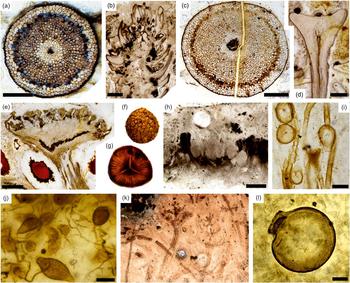
The terrestrial tracheophyte plant component of the Rhynie chert biota, first described in the five-part monograph by Kidston & Lang (Reference Kidston and Lang1917, Reference Kidston and Lang1920 a, b, Reference Kidston and Lang1921 a, b), comprises six monospecific sporophyte (spore-bearing phase) genera: Aglaophyton majus (Figs 5b, 6c; following Edwards et al. (Reference Edwards, Kenrick and Dolan2018) we correct spelling of the specific epithet of Aglaophyton from ‘major’ to ‘majus’ in accordance with article 23.5 of the ICN Shenzhen Code), Asteroxylon mackiei (Fig. 5e, 6b), Horneophyton lignieri (Fig. 5d), Nothia aphylla (Fig. 5a), Rhynia gwynne-vaughanii (Figs 5b, 6a) and Trichopherophyton teuchansii. At least two of the six species are placed within an extinct group, the rhyniophytes, one amongst the early lycopods, and one within the extinct zosterophyllophytes. In addition, a seventh Rhynie Basin species not included herein, Ventarura lyonii, has been described from the nearby Windyfield chert. Within the chert there are also four associated monospecific gametophyte (the sexual reproductive phase) genera: Remyophyton delicatum (Fig. 5h, i), Lyonophyton rhyniensis (Fig. 5j, 6d), Langiphyton mackiei (Fig. 5f) and Kidstonophyton discoides (Figs 5g, 6e).
Reconstructions of Rhynie chert sporophytes and gametophytes. Sporophytes (a–e): (a) Nothia aphylla. Scale bar 10 mm. (b) Rhynia gwynne-vaughanii. Scale bar 5 mm. (c) Aglaophyton majus. Scale bar 10 mm. (d) Horneophyton lignieri. Scale bar 5 mm. (e) Asteroxylon mackiei. Scale bar 10 mm. Note: Trichopherophyton teuchansii: due to its fragmentary nature, no reconstruction is presented here. Gametophytes (f–j): (f) Langiophyton mackiei. Scale bar 2 mm. (g) Kidstonophyton discoides. Scale bar 2 mm. (h) Remyophyton delicatum – male. Scale bar 2 mm. (i) R. delicatum – female. Scale bar 2 mm. (j) Lyonophyton rhyniensis. Scale bar 2 mm. Figures redrawn and modified from: (a) Kerp et al. (Reference Kerp, Hass, Mosbrugger, Gensel and Edwards2001); (b) Edwards (Reference Edwards1980); (c) Edwards (Reference Edwards1986); (d) Eggert (Reference Eggert1974); (e) Kidston & Lang (Reference Kidston and Lang1921 b); (f, g, j) Remy et al. (Reference Remy, Gensel and Hass1993); (h, i) Kerp et al. (Reference Kerp, Trewin and Hass2003).

Exemplars of the Rhynie chert biota. (a) Cross-section of Rhynia gwynne-vaughanii. Scale bar 500 μm. (b) Longitudinal section of Asteroxylon mackiei. Scale bar 2.5 mm. (c) Cross-section of Aglaophyton majus. Scale bar 1 mm. (d) Cross-section of gametophyte Lyonophyton rhyniense. Scale bar 1 mm. (e) Cross-section of gametophyte Kidstonophyton discoides. Scale bar 1 mm. (f) Common dispersed spore Dictyotriletes kerpii. (g) Common dispersed spore Emphanisporites edwardsiae. (h) Thallus of lichen Winfrenatia reticulata. Scale bar 500 μm. (i) Reproductive structures of the fungi Palaeozoosporites renaultii. Scale bar 38 μm. (j) Hyphae and fungal swellings of Retesporangicus lyonii. Scale bar 30 μm. (k) Branch of freshwater algae Palaeonitella cranii. (l) Testate amoebae Palaeoleptochlamys hassii. Scale bar 12 μm. Photographs reproduced with permission from: (a–e) Kerp (Reference Kerp2018). All copyright H Kerp; (f, g) Wellman (Reference Wellman2018); (h) Copyright H Kerp; (i) Strullu-Derrien et al. (Reference Strullu-Derrien, Wawrzyniak, Goral and Kenrick2015); (j) Strullu-Derrien et al. (Reference Strullu-Derrien, Spencer, Goral, Dee, Honegger, Kenrick, Longcore and Berbee2018); (k) Copyright H Kerp; (l) Strullu-Derrien et al. (Reference Strullu-Derrien, Kenrick, Goral and Knoll2019). Notes: see Wellman (Reference Wellman2018) for scales of (f, g); Taylor et al. (Reference Taylor, Klavins, Krings, Taylor, Kerp and Hass2003) for more information on (h); and Kelman et al. (Reference Kelman, Feist, Trewin and Hass2003) for more information on the algal specimens seen in (k).

All sporophytes were diminutive in size (<50 cm), but due to their ground-creeping horizontal axes, formed wide area colonies, with many of these plants displaying primitive rooting structures in the form of hair-like rhizomes along these axes (Fig. 5a–e). Recent work by Hetherington & Dolan (Reference Hetherington and Dolan2018b) has shown that A. mackiei possessed rooting organs lacking root caps – a defining feature of all modern vascular plant roots – but that they did possess a unique self-renewing root meristem with a continuous epidermis. This transition rooting organ shows that roots evolved in a stepwise fashion, and is consistent with the hypothesis that roots evolved multiple times within terrestrial plants (Kenrick & Strullu-Derrien, Reference Kenrick and Strullu-Derrien2014). All Rhynie chert plant taxa are superficially similar in morphology, being leafless with dichotomizing axes, with the exception of A. mackiei which bares veinless leaf-like outgrowths (Fig. 5e) (Kidston & Lang, Reference Kidston and Lang1921 b). Their arial axes consist of a relatively small proportion of vascular pathways, with the bulk composition made up of parenchymous tissue. The most common plant found in the chert, A. majus, has dichotomizing axes terminated by spindle-shaped sporangia (Fig. 5c) (Kidston & Lang, Reference Kidston and Lang1921 b). Similar, but smaller in stature, R. gwynne-vaughanii is defined by more extensive branching, vascular tissue with recognizable tracheids, and small axial projections (Fig. 5b) (Kidston & Lang, Reference Kidston and Lang1917). Horneophyton lignieri is c. 20 cm high and characterized by bulbous rhizomes and a unique branching sporangium; each lobe consists of a central axis of sterile tissue, analogous to the sporangia of modern hornworts (Fig. 5d) (Kidston & Lang, Reference Kidston and Lang1920 a; Barghoorn & Darrah, Reference Barghoorn and Darrah1938). N. aphylla (Fig. 5a) has been described as having aerial stems which were covered with oval ‘emergences’ formed by cell expansion (not by cell multiplication as seen in zosterophylls and trimerophytes), each bearing a single stoma (El-Saadawy & Lacey, Reference El-Saadawy and Lacey1979). T. teuchansii is the first zosterophyll to be described from fragmentary remains in the Rhynie chert. As such it is not as well understood, but did possess laterally attached valved sporangia, spinous hairs and exarch xylem (Lyon & Edwards, Reference Lyon and Edwards1991). For further discussion and additional references of Rhynie chert sporophytes see Kerp (Reference Kerp2018) and Mills et al. (Reference Mills, Batterman and Field2018).
Of the gametophytes, L. rhyniensis was the first with anatomical preservation to be described from the Rhynie chert (Remy & Remy, Reference Remy and Remy1980 a, b). R. delicatum (Fig. 5h, i), L. rhyniensis (Figs 5j, 6d) and L. mackiei (Fig. 5f) are the archegoniate- and antheridia-bearing gametophytes of R. gwynne-vaughanii, A. majus and H. lignieri respectively. In contrast, only the antheridia-bearing axis, K. discoides (Figs 5g, 6e), is known for N. aphylla. These gametophytes were small free-growing non-thalloid plants, with a vegetavative body plan resembling that of the sporophytes, with archegonia or antheridia near or at the apex terminal. For more details and references of Rhynie chert gametophytes see Kerp (Reference Kerp2018).
How typical this collection of macroplants really was remains debated: some authors suggest that these plant communities were highly adapted to hot-spring environments and therefore do not represent regional flora (e.g. Scott, Reference Scott1923, Reference Scott1924; Channing & Edwards, Reference Channing and Edwards2009 a, b). It is possible, however, these plant communities may have been pre-adapted to increased pH and salinity levels from habitation in more commonly found environments (e.g. salt-marshes, saline seeps and coastal estuaries; Channing, Reference Channing2018). Furthermore, whilst geothermal wetlands do constitute a unique environment, it is likely that they include habitats (and thus potentially biotas) more typical of the surrounding hinterland, and are thus distinguished by varied extremes of environment and rapid change between these on small spatial scales. However, comparison with modern systems suggests that the Rhynie taxa may not be representative of coeval regional floras and at best contain a subset of the whole flora (Channing, Reference Channing2018). Spore assemblages have been recovered from the cherts since the late 1960s (e.g. Richardson, Reference Richardson1967), but it was not until the mid-1990s and 2000s that significant palynological work was undertaken on borehole samples (Rice et al. Reference Rice, Ashcroft, Batten, Boyce, Caulfield, Fallick, Hole, Jones, Pearson, Rogers, Saxton, Stuart, Trewin and Turner1995; Wellman, Reference Wellman2004, Reference Wellman2006). Recent quantitative comparative studies of the in situ and dispersed palynological record preserved in Rhynie chert (e.g. Fig. 6f, g), its intermontane basin and surrounding floodplains suggests that only a small proportion of these plants were inhabiting the hot-spring environment (Wellman, Reference Wellman2018); the surrounding basin has a relatively high diversity of flora compared to the hot springs. Comparison of spore assemblages from the Rhynie basin with the coeval lowland floodplain deposits indicates the basin itself is a rarefied environment, with significantly lower diversity reported, but with some unique elements. Some plants (H. lignieri, R. gywnne-vaughanii and A. majus) are shown to be highly versatile, inhabiting both the hot-spring and basinal environments; moreover some (e.g. H. lignieri) were palaeogeographically widespread (Wellman, Reference Wellman2018).
This brief overview introduces the Rhynie flora. This is an active research area, and Rhynie plant fossils are providing key new insights into the evolution of plants: their life cycle (Kenrick, Reference Kenrick2018), physiology (Hetherington & Dolan, Reference Hetherington and Dolan2018 a; Kerp, Reference Kerp2018; Raven, Reference Raven2018), development (Kofuji et al. Reference Kofuji, Yagita, Murata and Hasebe2018) and interactions (Krings et al. Reference Krings, Harper and Taylor2018).
9.b. Fungi
Many of the macroplants are thought to be associated with fungi in an endomycorrhizal (also known as arbuscular mycorrhizal) symbiosis, which has been successfully demonstrated for A. majus (Taylor et al. Reference Taylor, Remy, Hass and Kerp1995 a), R. gwynne-vaughanii (Karatygin et al. Reference Karatygin, Snigirevskaya and Demchenko2006), N. aphylla (Krings et al. Reference Krings, Taylor, Hass, Kerp, Dotzler and Hermsen2007 b, c) and H. lignieri (Strullu-Derrien et al. Reference Strullu-Derrien, Kenrick, Pressel, Duckett, Rioult and Strullu2014). In modern ecosystems, these fungi are known to help define ecological niches, determine plant community composition, play a role in plant nutrition and soil fertility and contribute to soil weathering. The endomycorrhizal fungi found colonizing A. majus, R. gwynne-vaughanii and N. aphylla are of the genus Glomites (Glomeromycota). One species of Glomites that colonizes R. gwynne-vaughanii, Glomites sporocarpoides, displays clear pathogenicity in addition to symbiotic features: mycelium actively colonize plant axes, causing necrotic zones. Here fungal sporocarps (fruiting bodies) grow. The modern equivalent, Glomus, has lost the ability to form sporocarps, suggesting that through coevolution an increasingly mutualistic relationship between the fungi and plants has developed (Karatygin et al. Reference Karatygin, Snigirevskaya and Demchenko2006). H. lignieri is colonized by Palaeoendogone gwynne-vaughaniae and Palaeoglomus boullardii. The former has Mucoromycotina affinities, whilst the latter has Glomeromycota affinities. Strullu-Derrien et al. (Reference Strullu-Derrien, Kenrick, Pressel, Duckett, Rioult and Strullu2014) also report a symbiotic relationship between H. lignieri and the fungi and suggest on this basis that the fungal associations of early land plants were more diverse than initially thought.
The majority of documented fungal interactions with the Rhynie plants have been saprotrophic. Saprophytes including chytrids (Chytridiomycota) and ascomycetes (Ascomycota), alongside bacteria, are likely responsible for the great amounts of unidentifiable degraded plant matter in the Rhynie chert. Chytrids are the most common microbial organism in the Rhynie fossils: both unicellular and multicellular chytrids were present in the chert, and had saprophytic and/or parasitic relationships with the plants. They may have been the principal organic decomposers. Parasitic chytrids have been found associated with green macroalgae, such as Krispiromyces discoides on the stems of Palaeonitella cranii (Taylor et al. Reference Taylor, Klavins, Krings, Taylor, Kerp and Hass2003). They elicit a host response in the algae: infected cells display hypertrophy, growing up to ten times larger than uninfected cells (Taylor et al. Reference Taylor, Remy and Hass1992). Nodule-like swellings on the rhizoids of N. aphylla may also be evidence of chytrid infection points (alternatively, these swellings may be evidence of hyperplasia, an infection response). Ascomycetes are significant saprophytic consumers in modern ecosystems. They form pathogenic, beneficial and mutualistic relationships, and many have symbiotic relationships with arthropods. However, their fossil record is poorly understood (Taylor et al. Reference Taylor, Klavins, Krings, Taylor, Kerp and Hass2003). Parasitism in the group has been reported in Rhynie within A. mackiei, where the fungus Paleopyrenomycites devonicus has been reported in the cortex directly beneath the epidermis of the aerial stems and rhizomes (Taylor et al. Reference Taylor, Klavins, Krings, Taylor, Kerp and Hass2003). Parasitism has also been reported in the interactions of Palaeozoosporites renaultii, a fungus of uncertain affinity, and the rooting system of A. mackiei (Fig. 6i) (Strullu-Derrien et al. Reference Strullu-Derrien, Wawrzyniak, Goral and Kenrick2015). Mycoparasites in the Rhynie chert (fungi that obtain carbon via parasitism of other fungi) have also been reported (Hass et al. Reference Hass, Taylor and Remy1994). The recently described Retesporangicus lyonii is known to represent one of the earliest known fungi to produce multiple sporangia on an expanded hyphal network, and was a saprotroph within the Rhynie ecosystem (Fig. 6j; Strullu-Derrien et al. Reference Strullu-Derrien, Wawrzyniak, Goral and Kenrick2015).
9.c. Lichens
Approximately 20 % of modern fungi enter into obligate symbiotic relationships with green algae and/or cyanobacteria to form lichens. The most credible Palaeozoic lichen, Winfrenatia reticulata, is known from the Rhynie chert (Taylor et al. Reference Taylor, Remy, Hass and Kerp1995 b, 1997, Reference Taylor, Klavins, Krings, Taylor, Kerp and Hass2003). It is a three-parted lichen, consisting of filamentous and coccoid cyanobacteria and a mycobiont (Fig. 6h). The taxonomic affinity of the fungus is uncertain, but its morphology suggests it is related to the Glomeromycota. The filamentous cyanobacterium most closely resembles Archaeothrix contexta, though other filamentous cyanobacteria of the order Oscillatoriales have also been described. Though there are c. 500 modern lichens described constituting two photobionts and one mycobiont, no modern lichen are known to contain a glomeromycete fungus. W. reticulata is therefore a unique symbiosis, and may instead be an unstable association between a cyanobacterial colony and a parasitic fungus (Karatygin et al. Reference Karatygin, Snigirevskaya and Vikulin2009). As such, W. reticulata may in fact not be a true lichen, or it may represent a plesiomorphic form (Karatygin et al. Reference Karatygin, Snigirevskaya and Vikulin2009).
9.d. Amoeba
Amoebozoa are a major eukaryotic group that is sister to the clade that includes animals and fungi. Until recently, with the discovery of Palaeoleptochlamys hassii in the Rhynie chert by Strullu-Derrien et al. (Reference Strullu-Derrien, Kenrick, Goral and Knoll2019), the oldest widely accepted terrestrial amoebozoans from the fossil record dated from the upper Permian. P. hassii is described as a testate amoebozoan of the order Arcellinida, with a spheroidal-shaped test and a round apical opening defined by an internally reinforced collar (Fig. 6l). Its discovery provides the first tangible evidence of phagotrophic protists in early terrestrial environments and supports the idea that arcellinids colonized the land at the same time as early vascular plants started to transform the land surface.
9.e. Bacteria/algae
Primary producers (photoautotrophs) are vital components of modern aquatic ecosystems, producing oxygen, providing organic matter at the base of the food chain and potentially converting inert atmospheric N2 into nitrate or ammonia (Krings et al. Reference Krings, Kerp, Hass, Taylor and Dotzler2007 a). Cyanobacteria were therefore undoubtedly important in the Rhynie ecosystem, but extensive study of the fossilized bacteria is challenging. This is because the morphological features required for classification of algae and cyanobacteria are extremely difficult to identify in fossils. Consequently, it is rarely possible to identify the affinities of Rhynie photoautotrophs via comparison with extant analogues with any confidence. It has, however, been possible to identify distinct groups of bacteria from their structural features (Taylor & Krings, Reference Taylor and Krings2015). Rhynie cyanobacteria are motile benthic or planktonic: no strictly sessile cyanobacteria have been identified in the Rhynie chert (Krings et al. Reference Krings, Kerp, Hass, Taylor and Dotzler2007 a). The filamentous Archaeothrix contexta and A. oscillatoriformis (Kidston & Lang, Reference Kidston and Lang1921 a) were the first Rhynie cyanophytes to be identified (Edwards & Lyon, Reference Edwards and Lyon1983). These possess both discoid cells and heterocysts, with the broadest cells seen in A. oscillatoriformis. Kidstionella fritschii, Langiella scourfeldii and Rhyniella vermiformis were all identified by Croft & George (Reference Croft and George1959). The former two taxa are filamentous cyanobacteria assigned to the family Stigonemataceae (Cyanophyceae). Both contain multiple cells with evidence of intracellular masses, interpreted as the best-preserved residues of cellular contents witnessed in fossil cyanophytes: they provide an excellent example of naturally silicified, organelle-like artefacts (Oehler, Reference Oehler1977). The latter species is filamentous and heterocystous and has been assigned to the family Scytonemataceae (Taylor et al. Reference Taylor, Klavins, Krings, Taylor, Kerp and Hass2003). Croftlania venusata is a filamentous colonial cyanobacteria, of the order Oscillatoriales. It is aquatic and grew on sediments and submerged decaying plant matter. C. venusata filaments are associated with mat formation (Krings et al. Reference Krings, Kerp, Hass, Taylor and Dotzler2007 a). The most recently described Rhynie cyanobacteria are: Rhyniosarcina devonica, which comprises densely packed cubic, spheroidal or irregular colonies of up to several hundred cells (Taylor & Krings, Reference Taylor and Krings2015); Rhyniococcus uniformis which forms plate-like colonies and bears similarities to modern Merismopedia (Synechococcales) (Krings & Harper, Reference Krings and Harper2019); and Ryhyniotaxillus devonicus, which forms irregular to cuboid colonies of up to 64 gelatinously enveloped cells, the colony morphology resembles present-day Eucapsis (Synechococcales) and Entophysalis (Chroococcales), as well as the Precambrian fossil Eoentophysalis belcherensis (Krings & Sergeev, Reference Krings and Sergeev2019). There is no doubt that further cyanophytes will be identified from the Rhynie chert, to continue to develop our understanding of the Devonian terrestrial ecosystem as a whole.
Multiple algal species are known from Rhynie (Edwards & Lyon, Reference Edwards and Lyon1983). Rhyniococcus uniformis is a palmelloid and coccoid member of the family Chroococcaceae. It is colonial, and consists of a uniform, flat, one-cell-thick sheet of cells arranged in rows. Rhynchertia punctata and Mackiella rotundata comprise unbranched, unattached, uniseriate multicellular filaments. Most R. punctata vegativative cells have poorly defined walls, and either contain a single dark body (which may represent a single large organelle) or many small ovoid bodies (interpreted as being reproductive structures). The species’ affinities are still unknown (Edwards & Lyon, Reference Edwards and Lyon1983). M. rotundata (Ulotrichales) cells are largely uniform with fine granular material and a darker body. The relatively small freshwater charophyte Palaeonitella cranii is described as having multicellular furcating branchlets with antheridia attached to the parent plant by a pedicel (Fig. 6k). It has been compared to extant Characeae and inhibited the ephemeral freshwater pools and potentially provided food for detritivores (Kelman et al. Reference Kelman, Feist, Trewin and Hass2003). The earliest evidence of the genus Cymatiosphaera (Pyramimonadales), a prasinophycean alga, in a freshwater environment, has been identified from the Rhynie chert. These are solitary or in loosely clustered groups of two to ten individuals. In the chert matrix, they are associated with accumulations of decomposing plant matter, although a few examples are located within plant tissues (Dotzler et al. Reference Dotzler, Taylor and Krings2007). Two forms of Cymatiosphaera have been identified, distinguished by their surface ornamentation (Kustatscher et al. Reference Kustatscher, Dotzler, Taylor and Krings2014 a). The phycomata of another prasinophycean alga, Pterospermalla, has been recognized from the Rhynie chert. This species is similar to extant Pterosperma; the fossils are located within a loosely packed accumulation of fungal hyphae and land plant debris. The presence of three phycomata records in the Rhynie chert suggests that the ecosystem was home to a variety of prasinophyte algae (Kustatscher et al. Reference Kustatscher, Dotzler, Taylor and Krings2014 b).
9.f. Fauna
The animal component of the Rhynie chert fossils is limited to arthropods (chelicerates, crustaceans and hexapods; myriapods are reported from the Windyfield chert fauna), and a nematode worm – 11 genera in total. The Rhynie biota is largely associated with chert deposition in areas with a substrate or water temperature suitable for non-extremophile eukaryotes to thrive. For modern terrestrial and freshwater arthropods, vascular plants and mosses, the upper temperature limit is 45–50°C.
9.f.1. Arthropods
A significant component of the arthropod fauna comprises chelicerates. Of these the trigonotarbids of the genus Palaeocharinus, and the acariform mites currently placed within the genera Protacarus, Protospeleorchestes, Pseudoprotacarus, Palaeotydeus and Paraprotocarus, are currently in need of revision. Other arachnid taxa comprise the harvestman Eophalangium sheari, and enigmatic taxa Palaeocteniza crassipes and Saccogulus seldeni. E. sheari (Fig. 7a) is the oldest known harvestman (Opiliones; Dunlop et al. Reference Dunlop, Anderson, Kerp and Hass2003). Male and female specimens have been preserved: internal anatomy includes a penis and ovipositor, in addition to tracheae. The genital and respiratory structures are similar in appearance to that of modern harvestmen (Dunlop et al. Reference Dunlop, Anderson, Kerp and Hass2003, Reference Dunlop, Anderson, Kerp and Hass2004), although recent cladistic analysis has placed the taxon as sister group to a Carboniferous taxon as a stem group to an extant suborder (Garwood et al. Reference Garwood, Sharma, Dunlop and Giribet2014), or within an opilionid polytomy (Garwood et al. Reference Garwood, Dunlop, Knecht and Hegna2017; Wang et al. Reference Wang, Dunlop, Selden, Garwood, Shear, Müller and Lei2018). Among the most abundant arachnids are trigonotarbid arachnids of the genus Palaeocharinus (Figs 7e, 8a, g). Five species were initially identified (Fayers et al. Reference Fayers, Dunlop and Trewin2005), the first by Hirst (Reference Hirst1923) and Hirst & Maulik (Reference Hirst and Maulik1926); however, only two are probably valid (Dunlop & Garwood, Reference Dunlop and Garwood2018). The presence of trabeculae and lamellar spines in palaeocharinid book lungs is unequivocal evidence that the organisms were fully terrestrial (Kamenz et al. Reference Kamenz, Dunlop, Scholtz, Kerp and Hass2008). It has been suggested that P. crassipes is also a trigonotarbid; the poor preservation quality prevents further conclusions being drawn (Selden et al. Reference Selden, Shear and Bonamo1991). Similarly, S. seldeni – known from a single specimen showing mouth with potential filtering device – is of uncertain affinities (Dunlop & Garwood, Reference Dunlop and Garwood2018). The mites from Rhynie chert (Fig. 7f) represent the oldest unequivocal record of the order Acariformes. They were first described by Hirst (Reference Hirst1923), as a single species, before being split into an additional four (Dubinin, Reference Dubinin and Rodendorf1962): the latter was based on illustrations rather than restudy, and a taxonomic revision would be beneficial (Dunlop & Garwood, Reference Dunlop and Garwood2018).
Examples of the Rhynie chert fauna. (a) Eophalangium sheari, an opilionid arachnid – this specimen is a female. Scale bar 1 mm. (b) The nematode Palaeonema phyticum. Scale bar 100 μm. (c) Hexapod Rhyniella praecursor. Scale bar 100 μm. (d) Crustacean Castracollis wilsonae. Scale bar 0.5 mm. (e) A palaeocharinid trigonotarbid. Scale bar 1 mm. (f) An acariform mite. Scale bar 100 μm. (g) Rhyniognatha hirsti, a potential pterygote insect. Scale bar 100 μm. Photographs modified from: (a) Dunlop et al. Reference Dunlop, Anderson, Kerp and Hass2004; (b, c, f, g) Dunlop & Garwood Reference Dunlop and Garwood2018; (d) Fayers & Trewin Reference Fayers and Trewin2003; (e) Dunlop & Garwood Reference Dunlop and Garwood2014.

Reconstructions of Rhynie chert fauna. (a) A palaeocharinid trigonotarbid, based on members of the genus Palaeocharinus, which is in need of revision. Scale bar 1 mm. (b) The hexapod Rhyniella praecursor. Scale bar 0.2 mm. (c) The nematode Palaeonema phyticum. Scale bar 39 μm. (d) Heterocrania rhyniensis, a euthycarcinoid. Scale bar 1 mm. (e) The crustacean branchiopod Castracollis wilsonae. Scale bar 1 mm. (f) A univalve branchiopod crustacean Ebullitiocaris oviformis. Scale bar 0.5 mm. (g) Ventral view of a palaeocharinid trigonotarbid. Scale bar 1 mm. (h). The crustacean Lepidocaris rhyniensis shown in ventral, dorsal and then lateral aspect. Scale bars 1 mm. Figures modified after: (a, g) Garwood & Dunlop (Reference Garwood and Dunlop2010). (b) Grimaldi & Engel (Reference Grimaldi and Engel2005). (d) Anderson & Trewin (Reference Anderson and Trewin2003). (e) Fayers & Trewin (Reference Fayers and Trewin2003). (f) Anderson et al. (Reference Anderson, Crighton and Hass2003). (h) Scourfield (Reference Scourfield1926).

Heterocrania rhyniensis, first described by Hirst & Maulik (Reference Hirst and Maulik1926), is now known to be a euthycarcinoid (Fig. 8d) having previously been identified as a chelicerate from fragmentary remains (Anderson & Trewin, Reference Anderson and Trewin2003). H. rhyniensis likely inhabited isolated pools around the hot-spring system which suggests that by the Early Devonian some euthycarcinoids had begun to colonize isolated freshwater bodies on the continental interior after their initial Late Silurian colonization of fluvial environments (Anderson & Trewin, Reference Anderson and Trewin2003).
Three of the Rhynie arthropods – Lepidocaris rhyniensis, Castracollis wilsonae and Ebullitiocaris oviformis – are branchiopod crustaceans. L. rhyniensis (Fig. 8h) was the first crustacean to be described from Rhynie (Scourfield, Reference Scourfield1926). Both male and female specimens have been identified, in various ontogenetic stages. Whilst originally placed within the Anostraca, a lack of stalked eyes, and other morphological differences have resulted in the species being since placed in a monotypic class, Lipostraca (Scourfield, Reference Scourfield1926). Strullu-Derrien et al. (Reference Strullu-Derrien, Goral, Longcore, Olesen, Kenrick and Edgecombe2016) describe spinose structures that they interpret as resting eggs of Lepidocaris associated with a new species of Chytridiomycete fungus. C. wilsonae (Figs 7d, 8e) was described more recently. It is known from exuveae which are markedly different in morphology L. rhyniensis, and is classified as an incertae sedis calmanostracan branchiopod (Fayers & Trewin, Reference Fayers and Trewin2003). Because of a high concentration of Castracollis, specimens of different ontogenetic sequences have been found within a single, thin chert horizon, it is suggested that this is evidence of a short life cycle, similar to modern notostracans, with rapid development and moults after hatching (Fayers & Trewin, Reference Fayers and Trewin2003). The most recently discovered Rhynie crustacean is E. oviformis (Fig. 8f), a univalved diplostracan branchiopod (Anderson et al. Reference Anderson, Crighton and Hass2003), which authors suggest might have had desiccation-resistant eggs (as modern Cladocera do) due to their mode of life in ephemeral freshwater pools. All three branchiopods are aquatic, with fossils found in areas of the chert with a ‘clotted’ texture characteristic of organic matter in freshwater pools (Anderson et al. Reference Anderson, Crighton and Hass2003; Fayers & Trewin, Reference Fayers and Trewin2003).
There are also two Rhynie hexapod genera: Rhyniella praecursor and Rhyniognatha hirsti. R. praecursor (Figs 7c, 8b) has long been considered the oldest hexapod (Dunlop & Garwood, Reference Dunlop and Garwood2018). It is a collembolan (springtail), a flightless group closely related to insects, and is very similar to modern springtails (Tillyard, Reference Tillyard1928; Scourfield, Reference Scourfield1940; Whalley & Jarzembowski, Reference Whalley and Jarzembowski1981; Greenslade & Whalley, Reference Greenslade, Whalley and Dallai1986). It has been proposed that R. hirsti (Fig. 7g) is the earliest known winged insect based on its mandible morphology: these bear two pivots, or condyles (Engel & Grimaldi, Reference Engel and Grimaldi2004, but for an alternative interpretation see Haug & Haug, Reference Haug and Haug2017). Both genera are terrestrial (Dunlop & Garwood, Reference Dunlop and Garwood2018).
9.f.2. Nematodes
The only non-arthropodan Rhynie animal is a nematode worm, Palaeonema phyticum (Figs 7b, 8c). The 0.1–1 mm worm has been placed in the extinct family Palaeonematidae within an extant order, Enoplia. The fossils represent the oldest unequivocal nematode body fossil. They were identified within the stomatal chambers of Aglaophyton major, and because multiple ontogenetic stages of the species are found here, from eggs through to adults, it has been suggested the species reproduced within the plant tissue. This would represent one of the oldest examples of a relationship between an animal and a terrestrial plant (Poinar et al. Reference Poinar, Kerp and Hass2008; Poinar, Reference Poinar, Littlewood and De Baets2015).
9.f.3 Coprolites, trace fossils and palaeoecology
Further evidence regarding the Rhynie animals can be found through the numerous coprolite ichnofossils identified in the deposit. These suggest a range of feeding strategies, but one dominated by detritivory. Coprolites comprise plant spores, fungal spores and hyphae, macerated plant cells, mineral grain and amorphous organic materia (Habgood et al. Reference Habgood, Hass and Kerp2003). One specimen of the taxon Rotundafaex aggregata additionally contains arthropod remains. In general, coprolites appear to have been produced by detritivores (collembolans and myriapods being likely producers). In addition to this, Bacillafaex constipata coprolites are similar to the cluster pellets produced by modern microherbivores: Habgood et al. (Reference Habgood, Hass and Kerp2003) suggest these could have been produced by oribatid mites or collembolans. The nematode fossil outlined previously represents a potential herbivore. Spore and sporangia feeders have been suggested from the presence of spore-rich coprolites (Kevan et al. Reference Kevan, Chaloner and Saville1975), but the evidence for this remains inconclusive (Habgood et al. Reference Habgood, Hass and Kerp2003; Dunlop & Garwood, Reference Dunlop and Garwood2018). Sap-sucking by organisms, which pierce the axes of plants to extract the phloem, has been the suggested cause of wounds on plant axes (Kevan et al. Reference Kevan, Chaloner and Saville1975), but subsequent work has suggested that the cause of the damage remains ambiguous (Dunlop & Garwood, Reference Dunlop and Garwood2018). Based on functional morphology, rather than coprolite evidence, it is clear that predators were present. Dunlop & Garwood (Reference Dunlop and Garwood2018) provide an overview of the potential ecological role of the terrestrial Rhynie animals, and Haug (Reference Haug2018) uses functional morphology of the fossils to suggest the arthropods of the Rhynie ecosystem used a wide range of feeding strategies. A key outstanding question regarding the Rhynie fauna, as with its flora, is whether this is representative of a typical terrestrial fauna, or rather if it was a community specialized to the Rhynie hot-spring environment. Given the lack of contemporary terrestrial arthropod faunas, and lack of study of modern systems, providing a definitive answer regarding whether this was the case remains challenging (Dunlop & Garwood, Reference Dunlop and Garwood2018).
10. Conclusions and future research
Since its discovery a century ago, despite its lack of exposure, the Rhynie chert has provided a wealth of knowledge about early terrestrial ecosystems. This results from both the level of preservation of its fossils, and the timing of its deposition, during an interval when terrestrial fossils are otherwise rare, and seldom well preserved. Edwards et al. (Reference Edwards, Kenrick and Dolan2018) provide an excellent overview of potential future research directions on the study of Rhynie fossils. In general, it seems likely that with continued study and the development of novel imaging techniques such as confocal microscopy, new species from the deposit are likely to be discovered, and previously described ones better understood. For example, much of the work to understand the contribution of fungi and bacteria to the Rhynie ecosystem has been conducted in the last decade, propelled by electron microscopy, more widespread use of other novel techniques (e.g. confocal laser microscopy) and the observation that primary producers are key to the growth of modern ecosystems. Indeed, a key path for future research will be the interactions between the organisms preserved at Rhynie, allowing us to understand the ecosystem better. Here key questions remain, such as how representative Rhynie is of early Devonian ecosystems more generally. Another likely area for development is the application of novel geochemical analysis to Rhynie fossils. Preston & Genge (Reference Preston and Genge2010) demonstrated the potential for FTIR and GC-MS in understanding the organic composition of these deposits, and Abbott et al. (Reference Abbott, Fletcher, Tardio and Hack2018) have used X-ray photoelectron spectroscopy and time-of-flight secondary ion mass spectrometry to provide chemical maps. This approach of mapping of organic and inorganic compounds associated with the fossil material has the potential, as in other areas (e.g. Wacey et al. Reference Wacey, Battison, Garwood, Hickman-Lewis, Brasier, Brasier, McIlroy and McLoughlin2017), to have a transformative impact on our understanding of the taphonomy and physiology of Rhynie organisms.
Author ORCIDs
Russell J Garwood 0000-0002-2803-9471; Alan R T Spencer 0000-0001-6590-405X
Acknowledgements
We gratefully thank and acknowledge the numerous researchers, both past and present, who in studying the Rhynie chert have changed our understanding of early terrestrial ecosystems, and without whom this review would not have been possible. We thank Hans Kerp, Charles Wellman, Jason Dunlop, the Palaeontological Association and Christine Strullu-Derrien for providing photographs and permission to reproduce them herein. We are also grateful to Javier Ortega-Hernández, the Geological Magazine for inviting this submission, and to two anonymous reviewers whose comments improved the manuscript. This research received no specific grant from any funding agency, commercial or not-for-profit sectors.
Declaration of Interest
None.