Introduction
Firm reputation, defined as a stakeholder group’s overall perception of a firm’s favorability (Fombrun, Reference Fombrun, Pollock and Barnett2012), is valuable for firm success. The important role of CEO traits in shaping firm reputation has increasingly attracted scholarly attention (Harrison, Thurgood, Boivie, & Pfarrer, Reference Harrison, Thurgood, Boivie and Pfarrer2020). The major argument is that evaluators take CEO traits as indicators of a firm’s underlying quality to form their judgments. In this regard, Petrenko, Aime, Recendes, and Chandler (Reference Petrenko, Aime, Recendes and Chandler2019) recently found that CEO humility tends to result in a low firm reputation in the eyes of financial analysts, who perceive humble CEOs as weak leaders deviating from the US-based ideal archetype of bold, strong, and masculine leaders. However, others have argued that humble CEOs are highly qualified to lead respectable organizations (Argandona, Reference Argandona2015) and even that they are the ‘best’ CEOs (Dewar, Keller, & Malhotra, Reference Dewar, Keller and Malhotra2022; Heimann, Reference Heimann2021). Such inconsistency implies that beyond the weak-leader perception argument (Petrenko et al., Reference Petrenko, Aime, Recendes and Chandler2019), alternative explanations may exist underlying the relationship between CEO humility and firm reputation.
In the CEO humility literature, however, studies have largely focused on intrafirm behavioral and cognitive consequences, such as increasing top management team (TMT) integration (Ou, Tsui, Kinicki, Waldman, Xiao, & Song, Reference Ou, Tsui, Kinicki, Waldman, Xiao and Song2014) and enhancing green innovation (Sun, Zeng, Lin, Yu & Wang, Reference Sun, Zeng, Lin, Yu and Wang2023). With a few exceptions based on the research of market stakeholders in Western cultures (Petrenko et al., Reference Petrenko, Aime, Recendes and Chandler2019), there is little knowledge of how CEO humility affects external perceptions of the firm. This lack is problematic because humility is less valued in Western cultures (House, Hanges, Javidan, Dorfman, & Gupta, Reference House, Hanges, Javidan, Dorfman and Gupta2004) but is widely praised in Asian cultures such as China (Ma & Tsui, Reference Ma and Tsui2015). Also, humble CEOs generate weak-leader perceptions in the eyes of market stakeholders who have an overwhelming interest in firms’ economic indicators, but they may not deliver such images to nonmarket stakeholders (e.g., governments) who have multiple expectations (Argandona, Reference Argandona2015; Heimann, Reference Heimann2021). In this regard, the existing findings on the perceptual consequence of humble CEOs can be misleading. It is necessary to investigate how and when CEO humility may influence firm reputation differently.
In this study, we theorize on how and when humble CEOs can enhance firm reputation in the eyes of local governments in China. As important nonmarket stakeholders, Chinese governments influence the resource availability of firms (Jia, Li, Tallman, & Zheng, Reference Jia, Li, Tallman and Zheng2017; Nee & Opper, Reference Nee and Opper2012). Understanding how and when humble CEOs shape governments’ reputational judgments of their firms is of practical importance in China. The Chinese government expects firms not only to have reliable operations but also to maintain continuous growth and promote social welfare (Gao, Zuzul, Jones, & Khanna, Reference Gao, Zuzul, Jones and Khanna2017; Luo, Wang, & Zhang, Reference Luo, Wang and Zhang2017). This multidimensional prescription suggests that the Chinese government tends to rely on a firm’s character to form reputational judgments. Thus, the Chinese context offers an ideal setting in which a novel (i.e., positive) effect of CEO humility on firm reputation can be theorized and tested.
Organizational virtuousness, defined as the aspirational ethical values of a firm, manifests in both its members’ virtuous behaviors and its practices, processes, and policies that enable the members’ virtuous behaviors (Cameron, Bright, & Caza, Reference Cameron, Bright and Caza2004). Once observed, it can serve as a signal for governments to gauge how a firm fits their prescriptions (Connelly, Certo, Ireland, & Reutzel, Reference Connelly, Certo, Ireland and Reutzel2011; Meyer, Reference Meyer2018) and thus play an important role in explaining the relationship between CEO humility and firm reputation in the eyes of the government. Furthermore, as the signaling effect of organizational virtuousness manifests only when it can be observed by the government, we introduce government intermediary connection (Dutt, Hawn, Vidal, Chatterji, McGahan, & Mitchell, Reference Dutt, Hawn, Vidal, Chatterji, McGahan and Mitchell2016; Zhang & Li, Reference Zhang and Li2010), defined as the extent to which a firm connects with government intermediaries, as the boundary condition that influences the relationship between organizational virtuousness and firm reputation. We posit that high government intermediary connection allows the government to use a firm’s organizational virtuousness as a signal in forming reputational judgment about the target firm.
Building on the insights that CEOs shape organizational values (Schein, Reference Schein2004) and that evaluators use these values to form reputational judgments (Love & Kraatz, Reference Love and Kraatz2009; Mishina, Block, & Mannor, Reference Mishina, Block and Mannor2012), we propose that CEO humility has a positive effect on firm reputation in the eyes of the Chinese government via organizational virtuousness when government intermediary connection is high. Figure 1 shows our conceptual model.
Conceptual model

We conducted an on-site survey in the context of Chinese industrial towns, where local governments’ positive reputational assessments of firms are critical (Jia et al., Reference Jia, Li, Tallman and Zheng2017; Nee & Opper, Reference Nee and Opper2012). Our sample involves 195 firms using survey and archival data collected from a total of 1,099 respondents (975 firm top managers and 124 general government officers). The results of the empirical analysis support our theory.
Drawing on a fine-grained analysis of how and when humble CEOs can influence external stakeholders’ perceptions of their firms, we contribute to the literature in three ways. First, we push forward the research agenda on the perceptual consequences of CEO humility by showing its positive effect on firm reputation in the eyes of governments in China. This study thus extends the traditional focus of CEO humility research on its intrafirm behavioral and cognitive consequences (Ou et al., Reference Ou, Tsui, Kinicki, Waldman, Xiao and Song2014) to external stakeholders’ perceptions of the firm. Second, we introduce a new mechanism underlying the effect of CEO humility on firm reputation by highlighting the role of organizational virtuousness. This new perspective goes beyond the weak-leader perception of humble CEOs (Petrenko et al., Reference Petrenko, Aime, Recendes and Chandler2019) and offers new insights into how a firm may benefit from CEO humility by shaping its internal values. Third, we clarify when CEO humility can enhance firm reputation by highlighting government intermediary connection as the boundary condition. Our study thus extends the notion that humble CEOs avoid the limelight and may not draw external attention (Ou et al., Reference Ou, Tsui, Kinicki, Waldman, Xiao and Song2014). With enhanced government intermediary connections, humble CEOs can make their firms highly attractive to external stakeholders – the Chinese government.
Theoretical Background
CEO Humility
Humility, as a stable personal trait, is grounded in a self-view that something greater than the self exists (Nielsen & Marrone, Reference Nielsen and Marrone2018). Following Ou et al. (Reference Ou, Tsui, Kinicki, Waldman, Xiao and Song2014)’s self-based framework, we define CEO humility by involving three content domains. First, with reflexive consciousness, humble CEOs are willing to seek accurate self-knowledge and are open to feedback (Peterson & Seligman, Reference Peterson and Seligman2004; Tangney, Reference Tangney2000). Second, humble CEOs appreciate others’ strengths and contributions (Ou, Waldman, & Peterson, Reference Ou, Waldman and Peterson2018). Third, humble CEOs are less self-focused and more engaged in self-transcendent pursuits (Morris, Brotheridge, & Urbanski, Reference Morris, Brotheridge and Urbanski2005; Ou et al., Reference Ou, Tsui, Kinicki, Waldman, Xiao and Song2014). These features jointly form a coherent domain of humility, enabling humble CEOs to consistently manifest accurate self-knowledge, openness to feedback, and appreciation of others (Ou et al., Reference Ou, Tsui, Kinicki, Waldman, Xiao and Song2014).
Humility is distinct from related constructs such as modesty, lack of confidence, and weakness. Modesty refers to having a non-boastful presentation of oneself to others (Tice, Butler, Muraven, & Stillwell, Reference Tice, Butler, Muraven and Stillwell1995). Modest people underrepresent their talents and accomplishments to avoid being overestimated by others (Woodcock, Reference Woodcock2008). As humble people are willing to view themselves accurately, they acknowledge both strengths and weaknesses and thus do not seek to under- or overrepresent themselves (Nielsen & Marrone, Reference Nielsen and Marrone2018). As Ou et al. (Reference Ou, Tsui, Kinicki, Waldman, Xiao and Song2014) emphasized, while humility is based on a self-based framework, modesty is based on a self-presentation framework and is less about fundamental self-views. Lack of confidence refers to an individual’s uncertainty about whether his or her prediction is correct (Simon & Houghton, Reference Simon and Houghton2003). Humility is a multidimensional construct that differs from confidence or lack thereof (Heavey, Simsek, Fox, & Hersel, Reference Heavey, Simsek, Fox and Hersel2022). Furthermore, humility is about fundamental self-views rather than others’ perceptions of one’s abilities. People tend to perceive humble individuals as weak, but those humble individuals have an accurate opinion of themselves rather than a low one (Tangney, Reference Tangney2000).
Research has largely examined how humility helps CEOs generate positive outcomes through intrafirm dynamics (Chandler, Johnson, Jordan, Darren, & Short, Reference Chandler, Johnson, Jordan, Darren and Short2023). For instance, studies have shown that humble CEOs empower other executives, increase TMT integration (Ou et al., Reference Ou, Tsui, Kinicki, Waldman, Xiao and Song2014; Ou et al., Reference Ou, Waldman and Peterson2018), and promote organizational ethical culture (Cortes-Mejia, Cortes, & Herrmann, Reference Cortes-Mejia, Cortes and Herrmann2022). Also, humble CEOs are more likely to reduce conflicts in entrepreneurial teams (Li, Wei, Chen & Yan, Reference Li, Wei, Chen and Yan2020), emphasize staff development (Tsui, Zhang & Chen, Reference Tsui, Zhang and Chen2017), and develop an empowering organizational climate (Ou et al., Reference Ou, Tsui, Kinicki, Waldman, Xiao and Song2014). Top executive humility increases middle manager job satisfaction and decreases voluntary turnover (Ou, Seo, Choi, & Hom, Reference Ou, Seo, Choi and Hom2017). Most recently, Ou, Lu, Li, Chi-Nien, and Chen (Reference Ou, Lu, Li, Chi-Nien and Chen2024) found that humble CEOs are more likely to prevent corporate social irresponsibility incidents because they prefer to protect stakeholders’ interests.
In contrast, research on how humble CEOs may shape external perceptions of their firms is an emerging area. Petrenko et al. (Reference Petrenko, Aime, Recendes and Chandler2019) suggested that financial analysts tend to predict low performance for publicly traded firms led by humble CEOs because such CEOs are perceived as a deviation from the ideal archetype of bold, strong, and masculine leaders. However, humble CEOs are viewed as highly qualified to lead respected organizations (Argandona, Reference Argandona2015) or even as ‘the best’ CEOs in the eyes of some media (Dewar et al., Reference Dewar, Keller and Malhotra2022; Heimann, Reference Heimann2021). Such inconsistency raises the question of how and when humble CEOs may generate positive reputations for their firms.
Firm Reputation
Reputation reflects stakeholders’ overall perceptions of a firm’s favorability based on a set of attributes (Fombrun, Reference Fombrun, Pollock and Barnett2012). It is audience-specific (Fombrun, Reference Fombrun, Pollock and Barnett2012; Rindova & Martins, Reference Rindova, Martins, Pollock and Barnett2012). A firm faces multiple stakeholders who have various concerns, and these concerns influence which signals they pay attention to and how they process those signals to form their judgments of the focal firm (Bednar, Love, & Kraatz, Reference Bednar, Love and Kraatz2015; Pollock, Lashley, Rindova, & Han, Reference Pollock, Lashley, Rindova and Han2019). For example, Pontikes (Reference Pontikes2012) found that firms with ambiguous organizational forms are not attractive to consumers who value clarity; however, the same firms have a high reputation in the eyes of investors who value ambiguity. As Fombrun (Reference Fombrun, Pollock and Barnett2012: 101) emphasized that, reputation should ‘always be defined in terms of a specific stakeholder group and a specific reference group’, we specifically focus on firm reputation in the eyes of local governments in China for two reasons.
First, reputation in the eyes of the Chinese government is crucial for firms, yet research on this issue is relatively rare. Extant literature has largely paid attention to firm reputation in the eyes of market stakeholders such as analysts, creditors, and shareholders (McLeod, Moore, Payne, Sexton, & Evert, Reference McLeod, Moore, Payne, Sexton and Evert2018; Petrenko et al., Reference Petrenko, Aime, Recendes and Chandler2019). Therefore, research has been particularly attuned to the market implications of humble CEOs for the reputation of large and listed firms. The lack of examination of the effect of CEO humility on firm reputation in the eyes of government is problematic because governments are salient stakeholders (Mitchell, Agle, & Wood, Reference Mitchell, Agle and Wood1997). Especially in China, governments not only provide prescriptions that guide how a firm should operate but also involve themselves in a firm’s operation by allocating critical resources, including land, legal permits, infrastructure, and business opportunities (Jia et al., Reference Jia, Li, Tallman and Zheng2017; Luo et al., Reference Luo, Wang and Zhang2017). Building a good reputation in the eyes of governments thus is crucial for firm survival and success.
Second, the Chinese government has multiple expectations of firms, which implies a positive effect of CEO humility on firm reputation through a firm’s organizational virtuousness. Reputation in the eyes of the government involves a holistic evaluation that they make of a focal firm – its perceived quality, value, excellence, distinction, merit, and worth (Fombrun, Reference Fombrun, Pollock and Barnett2012). In contrast to market stakeholders who have an overwhelming interest in firms’ economic indicators, the Chinese government expects firms not only to have reliable operations but also to maintain continuous growth and to promote social welfare (Gao et al., Reference Gao, Zuzul, Jones and Khanna2017; Luo et al., Reference Luo, Wang and Zhang2017). These equally important expectations drive them to look for signals about a firm’s social and economic performance in forming a judgment of its reputation. In this case, a firm’s character – its organizational goals, preferences, and values – becomes salient (Love & Kraatz, Reference Love and Kraatz2009). Representing the ethical values of an organization, organizational virtuousness not only enables a firm’s prosocial behaviors but also enhances its financial performance (Caza, Barker, & Cameron, Reference Caza, Barker and Cameron2004). Therefore, it plays a critical role in explaining how humble CEOs may positively shape firm reputation in the eyes of the Chinese government by signaling desirable firm character.
Organizational Virtuousness
Defined as aspirational ethical values, organizational virtuousness represents that the firm as a whole unit has high virtues (Caza et al., Reference Caza, Barker and Cameron2004). Following previous studies (Cameron et al., Reference Cameron, Bright and Caza2004; Rego, Júnior, & Cunha, Reference Rego, Júnior and Cunha2015), we conceptualize organizational virtuousness through a five-dimensional structure consisting of purpose, integrity, trust, compassion, and forgiveness. Purpose represents the degree to which an organization is dedicated to doing good in addition to doing well. Integrity represents the degree to which honesty, trustworthiness, and honor pervade the organization. Trust reflects the degree to which organization members trust one another and are treated with consideration and respect. Compassion means that concern and caring for other people pervade the organization. Forgiveness means that mistakes are quickly forgiven and used as opportunities for learning in the organization. Purpose and integrity reflect the fundamental pursuits of a virtuous organization. Trust, compassion, and forgiveness capture the ethical values that govern interpersonal interactions among its members. These five dimensions constitute a coherent structure of organizational virtuousness and provide a representative conceptualization of what is considered as virtuous across different cultures (Meyer, Reference Meyer2018).
Organizational virtuousness manifests in both its members’ behaviors and its practices, processes, and policies (Cameron & Winn, Reference Cameron, Winn, Cameron and Spreitzer2012). Hence, external stakeholders may develop perceptions about a firm’s organizational virtuousness through observing its (un)virtuous strategies (Zachary, Connelly, Payne, & Tribble, Reference Zachary, Connelly, Payne and Tribble2023), employees’ (un)virtuous behaviors (Chun, Reference Chun2017), and public communications (Moss, Neubaum, & Meyskens, Reference Moss, Neubaum and Meyskens2015). That is, organizational virtuousness may shape external stakeholders’ perceptions by serving as signals about a firm’s unobservable character. For example, Payne, Moore, Zachary, and Bell (Reference Payne, Moore, Zachary and Bell2013) found that organizational virtuousness in the initial public offering (IPO) prospectuses conveys signals about firm quality to potential investors, reducing their perceived risk of investing in the IPO firm. Likewise, in the microfinance crowdfunding context, Moss et al. (Reference Moss, Neubaum and Meyskens2015) found that organizational virtuousness conveys positive signals about a borrower’s reliability to potential lenders, which reduces their perceived uncertainty in making investments.
However, organizational virtuousness, when it cannot be observed by external stakeholders, will fail to transmit information about a firm’s internal values (Payne et al., Reference Payne, Moore, Zachary and Bell2013). In such cases, external stakeholders cannot form reputational judgments about a firm through the signaling effect of its organizational virtuousness. For instance, while the IPO prospectuses (McLeod et al., Reference McLeod, Moore, Payne, Sexton and Evert2018) and letters to the shareholders (Zachary et al., Reference Zachary, Connelly, Payne and Tribble2023) are important channels through which a firm can signal its virtuous values, those firms lacking such channels may fail to use organizational virtuousness as signals to attract investments from their investors.
According to signaling theory (Connelly et al., Reference Connelly, Certo, Ireland and Reutzel2011), building signal channels and thus enabling a firm’s internal values to be observable by external stakeholders are crucial conditions for a firm to leverage the signaling effect of organizational virtuousness. In the current study, we introduce government intermediaries as important channels through which a firm can signal its organizational virtuousness to the government in China.
Government Intermediary Connection
As intrafirm values, organizational virtuousness serves as an efficacious signal shaping governmental judgments on firm reputation only when it can be observed. Connecting to government intermediaries is important to ensure its observability. In China, the government keeps a close eye on local businesses (Li, Tsang, Luo, & Ying, Reference Li, Tsang, Luo and Ying2016). It play an important role in controlling resources key to firms’ success (Jia et al., Reference Jia, Li, Tallman and Zheng2017). Typically, it works through agents to deploy resources, help firms extend market channels, increase firms’ communications with potential customers, and promote cooperation with various organizations (Armanios, Eesley, Li, & Eisenhardt, Reference Armanios, Eesley, Li and Eisenhardt2017; Wei, Zhou, Greeven, & Qu, Reference Wei, Zhou, Greeven and Qu2016). Such agents, which we conceptualize as government intermediaries, are operated by the government; they link economic entities with government-controlled information and resources, including infrastructure, technical, and networking services (Dutt et al., Reference Dutt, Hawn, Vidal, Chatterji, McGahan and Mitchell2016; Zhang & Li, Reference Zhang and Li2010). They present an important way through which the governments spur local economic prosperity. Governments are highly active in establishing and operating intermediaries to coordinate firms’ operations (Jia et al., Reference Jia, Li, Tallman and Zheng2017; Nee & Opper, Reference Nee and Opper2012).
Firms are also inclined to connect to government intermediaries because this is an important way they can acquire key information and resources. For instance, Armanios et al. (Reference Armanios, Eesley, Li and Eisenhardt2017) suggested that entrepreneurs in Chinese science parks engage with government intermediaries because they can obtain useful skills, training, and custom advice. Wei et al. (Reference Wei, Zhou, Greeven and Qu2016) suggested that firms from industrial towns in Zhejiang Province participate in government-based exhibitions to search for new customers and expand their markets. Firms in Chinese industrial towns often join public service platforms to gain access to important information and resources (Jia et al., Reference Jia, Li, Tallman and Zheng2017). Likewise, our fieldwork shows that firms actively rely on public service platforms launched by local governments to obtain timely information on policies, new technology, new markets, and so on. As government intermediaries facilitate interactions between governments and firms, they serve as channels through which governments can obtain information about firms. Therefore, a firm’s connection to government intermediaries constitutes an important condition that influences the observability of its organizational virtuousness.
Hypotheses Development
CEO Humility and Organizational Virtuousness
CEOs’ traits are critical to their strategic decisions (Holmes, Hitt, Perrewé, Palmer, & Molina-Sieiro, Reference Holmes, Hitt, Perrewé, Palmer and Molina-Sieiro2021). Also, their behaviors convey important signals about desired behavior in their firms, thereby influencing the behavior and attitudes of organizational members (Schein, Reference Schein2004). Following these two lines of reasoning, we argue that CEO humility fosters organizational virtuousness in two ways.
First, CEO humility enhances the purpose and integrity of the firm by promoting prosocial practices and personal honest activities on behalf of the firm. Rather than maximizing personal interests, humble people have less egoistic motives and consider the interests of others before coming to any decisions (Hilbig & Zettler, Reference Hilbig and Zettler2009; Morris, Brotheridge, & Urbanski, Reference Morris, Brotheridge and Urbanski2005). They are also more generous (LaBouff, Rowatt, Johnson, Tsang, & Willerton, Reference LaBouff, Rowatt, Johnson, Tsang and Willerton2012). Humble CEOs have strong preferences not only for protecting stakeholders’ interests but also for conducting more ethical business decisions for society (Ou et al., Reference Ou, Lu, Li, Chi-Nien and Chen2024). Therefore, they are more likely to pursue benefits beyond their own firms, leading to a strong prosocial orientation of those firms. Supporting this argument, studies reveal that humble CEOs act altruistically toward their business partners (Zhou, Bu, & Jia, Reference Zhou, Bu and Jia2022), take environmental issues into consideration in product development (Sun et al., Reference Sun, Zeng, Lin, Yu and Wang2023), and guard their firms against corporate social irresponsibility incidents (Ou et al., Reference Ou, Lu, Li, Chi-Nien and Chen2024). Noticing humble CEOs’ self-transcendent pursuits, other members of the firm will be motivated to consider the interests of the organization and society ahead of their own and embrace their responsibilities to other stakeholders (Cortes-Mejia, Cortes, & Herrmann, Reference Cortes-Mejia, Cortes and Herrmann2022). We, therefore, expect that humble CEOs promote prosocial practices and facilitate the formation of an organization-wide belief that the firm is dedicated to doing good in addition to doing well.
Moreover, given their willingness to accurately view themselves, humble CEOs recognize their mistakes without feeling threatened (Ou et al., Reference Ou, Tsui, Kinicki, Waldman, Xiao and Song2014). This enables them to publicly acknowledge their firms’ limitations, make sincere apologies, and accept the help needed to make improvements (Vera & Rodriguez-Lopez, Reference Vera and Rodriguez-Lopez2004). Their preference for protecting others’ interests heightens their attention to the harm their firms have inflicted upon others, driving humble CEOs to undertake corrective actions after such harm has occurred. Supporting this argument, research has shown that humble individuals score higher in integrity (Lee, Ashton, Morrison, Cordery, & Dunlop, Reference Lee, Ashton, Morrison, Cordery and Dunlop2008), and humble CEOs are positively associated with corporate social irresponsibility correction (Ou et al., Reference Ou, Lu, Li, Chi-Nien and Chen2024). Thus, we expect that humble CEOs can transform their firms into honest and trustworthy organizations, making integrity an organizational attribute (Palanski & Yammarino, Reference Palanski and Yammarino2009).
Second, CEO humility promotes virtuous behaviors across the firm through the role-modeling effect. On one hand, as humble CEOs acknowledge their own mistakes and show willingness to learn from others, they earn others’ trust (Oc, Daniels, Diefendorff, Bashshur, & Greguras, Reference Oc, Daniels, Diefendorff, Bashshur and Greguras2020; Ou et al., Reference Ou, Seo, Choi and Hom2017). This conveys signals that mistakes are acceptable and can be used as opportunities for learning. Thus, organizational members are willing to admit mistakes and handle them constructively (Rego et al., Reference Rego, Owens, Leal, Melo, Cunha, Gonçalves and Ribeiro2017). By modeling appreciation for others’ strengths and considering their concerns, humble CEOs convey signals that caring for others is valued in their firms. On the other hand, observing their CEOs’ humble behaviors, employees gain increased confidence in their capacity to engage in humble behaviors (Owens, Yam, Bednar, Mao, & Hart, Reference Owens, Yam, Bednar, Mao and Hart2019). Together, these promote virtuous behaviors regarding trust, forgiveness, and compassion across the firm. In contrast, CEOs who lack humility may avoid facing their mistakes, creating a milieu in which people tend to hide mistakes. Trust and integrity among organizational members will be difficult, and forgiveness will be rarely practiced. In sum, humble CEOs are more likely to transform their firms into virtuous organizations by infusing purpose and integrity into corporate practices and by promoting virtuous behaviors regarding trust, forgiveness, and compassion. Thus, we propose:
Hypothesis 1 (H1): CEO humility is positively related to organizational virtuousness.
Organizational Virtuousness, Government Intermediary Connection, and Firm Reputation
We posit that when government intermediary connection is high, organizational virtuousness enhances a firm’s reputation in the eyes of Chinese governments because it conveys signals about desirable goals and behaviors. According to signaling theory (Connelly et al., Reference Connelly, Certo, Ireland and Reutzel2011), signals are essentially snapshots at a given point in time, so continuous signaling is necessary (Janney & Folta, Reference Janney and Folta2006). As a firm connects with government intermediaries intensively, it is frequently exposed to the government. The government, hence, has more chances to understand its purpose, experience its integrity, and observe the virtuous behaviors carried out by its employees. Meanwhile, the credibility of organizational virtuousness is enhanced as multiple information cues from different intermediaries converge. As prior research has emphasized (Park & Mezias, Reference Park and Mezias2005), repetitive stimuli from different channels can make a signal more credible to its receiver. When government intermediary connection is high, a firm exhibits its virtuousness via multiple channels. This strengthens the government’s belief that the firm is truly acting following its prescriptions, enabling its use of organizational virtuousness as valid signals (Connelly et al., Reference Connelly, Certo, Ireland and Reutzel2011). Under this condition, organizational virtuousness will positively shape firm reputation in the eyes of governments in China.
First, organizational virtuousness enhances firm reputation by sending signals on the quality of its operation (Love & Kraatz, Reference Love and Kraatz2009). Firms with virtuous purpose and integrity are willing to reveal the reliable quality of their operation (Palanski & Yammarino, Reference Palanski and Yammarino2009), which helps governments better predict how the firm will honor its obligations and keep its promises to do well (Mishina et al., Reference Mishina, Block and Mannor2012). These firms earn high reputations because of the low perceived risk of the quality of their operation (Payne et al., Reference Payne, Moore, Zachary and Bell2013). In contrast, firms that lack integrity may misrepresent their actions (Love & Kraatz, Reference Love and Kraatz2009), increasing governments’ perception of risk in their operation. This will drive governments to form lower judgments about those firms’ reputations (Jensen & Roy, Reference Jensen and Roy2008).
Second, organizational virtuousness enhances firm reputation by signaling resilience (Cameron et al., Reference Cameron, Bright and Caza2004). In emerging markets such as China, high environmental uncertainty makes the ability to withstand shocks an essential requirement for good firms (Gao et al., Reference Gao, Zuzul, Jones and Khanna2017). High-virtuousness firms, whose employees display high levels of trust, compassion, and forgiveness, will demonstrate human vitality and vigor (Rego et al., Reference Rego, Júnior and Cunha2015). Also, employees develop a stronger commitment to firms with high virtuousness (Meyer, Reference Meyer2018), enabling these firms to survive in difficult times. For example, employees in two Chinese firms, Hometown Chicken and Cabin Barbecue, volunteered for salary cuts to reduce their firms’ financial pressure during the COVID-19 pandemic (Liu & Yin, Reference Liu and Yin2020). Signaling resilience, organizational virtuousness increases governments’ confidence that firms can cope with adversity and keep growing, thereby granting them high reputations.
Third, organizational virtuousness enhances firm reputation by signaling a genuine commitment to social betterment (Bright, Reference Bright2006). With a strong purpose, high-virtuousness firms commit to enhancing human flourishing and adopting environment-friendly operations. For example, rather than downsizing, high-virtuousness firms choose to protect their employees’ jobs even when they suffer substantive losses in a time of crisis (Gittell, Cameron, Lim, & Rivas, Reference Gittell, Cameron, Lim and Rivas2006). Also, our fieldwork shows that the virtuous firm worked hard to protect its employees’ jobs during the 2008 economic crisis and this effort helped it win the Advanced Employment Award of Jiangsu Province. Furthermore, virtuous firms tend to engage in environmental protection and contribute to society, both of which are highly advocated by the Chinese governments. In this sense, organizational virtuousness enables a firm to earn high reputation as it is dedicated to improving the welfare of society (Dawson, Reference Dawson2018).
In contrast, when government intermediary connection is low, a firm’s virtuousness is unobservable to the government. The government is unlikely to notice a firm’s internal value. As a result, organizational virtuousness will not be used as a valid signal shaping reputational judgment. Accordingly, we do not expect organizational virtuousness to be associated with firm reputation in the eyes of governments when government intermediary connection is low. Based on the above arguments, we propose:
Hypothesis 2 (H2): Government intermediary connection moderates the relationship between organizational virtuousness and firm reputation such that organizational virtuousness is positively related to firm reputation in the eyes of governments in China when government intermediary connection is high.
The Moderated Mediating Effect of Organizational Virtuousness
As noted, humble CEOs’ transcendent pursuits and honest activities enable firms to possess purpose and integrity, and their role-modeling processes encourage employees to practice virtuous behaviors. Both are following the prescriptions for a good firm advocated by the Chinese governments. When the firm’s connection to government intermediaries is high, its virtuousness will be observed and, accordingly, used as positive signals in evaluating the firm’s reputation. Therefore, the humbler a CEO is, the higher reputation his or her firm’s reputation in the eyes of government via promoting organizational virtuousness. We propose:
Hypothesis 3 (H3): Government intermediary connection moderates the relationship between CEO humility and firm reputation such that CEO humility is positively related to firm reputation via organizational virtuousness when government intermediary connection is high.
Methods
Sample
Data for this study were collected in 2015 as part of a large project involving 412 firms from 43 industrial towns in Jiangsu Province in China. We first asked the local governments to provide us with a comprehensive list of firms in their towns. Then, we randomly selected 10 firms from each list as our targeted samples, resulting in an initial sample set of 430 firms (43 towns × 10 firms each). With the help of local governments to arrange visits, we visited 412 firms in our on-site survey.
To minimize the potential for common method bias (Podsakoff, MacKenzie, & Podsakoff, Reference Podsakoff, MacKenzie and Podsakoff2012), we relied on different informants to provide information on the variables in our study (Appendix A). In each firm, we invited the whole TMT to complete questionnaires tailored to their areas of expertise. The average TMT size was 5.28. During our visit to each firm, we gathered the participants in one meeting room, explained the purpose of our study, exchanged business cards with each of them, and assured them that their answers were confidential. These procedures helped us to obtain high-quality data in the emerging economy.
In each town, we invited four general government officials who oversaw coordination with local firms to be our informants about firm reputation. In a typical Chinese industrial town, the local government provides (explicit or implicit) prescriptions that guide how a firm should operate (Jia et al., Reference Jia, Li, Tallman and Zheng2017). These government officials thus not only have relevant knowledge about local firms but also are highly qualified to evaluate their reputations. All respondents completed their questionnaires on-site, and we adopted the same arrangements during our visits to each local government department as we did at each firm.
We received completed surveys from 1,099 respondents, including 975 firm top managers and 124 general government officials. Most of the top managers were male (56.72%); they had an average work tenure of 6.05 years and were about 31–40 years old (46.90%). Most of the government officials were male (61.29%); they had an average work tenure of 6.67 years and were about 31–40 years old (44.82%). Therefore, our respondents have adequate knowledge about their work tailored to their areas of expertise.
After we matched the information for all variables, missing values reduced our final sample size to 195 firms. The effective response rate was 47.33% (195 of 412 firms). The multivariate analysis of variance test revealed no systematic differences between responding and nonresponding firms in terms of firm age, assets, number of employees, and affiliated industry (Wilks’ lambda = 0.98, p = 0.15), suggesting that nonresponse bias was not a major concern in our study. Most firms in our final sample were manufacturing (96%); the rest operated in information technology. On average, these firms had 660 employees and were 13.61 years old. Most of our sample firms were private (63%), with 65 (33%) foreign-owned firms and seven (4%) state-owned firms.
Measures
Dependent variable
We measured firm reputation using a seven-item survey scale (1 = very bad, 5 = very good) adapted from Fombrun & Shanley (Reference Fombrun and Shanley1990), which was based on the Fortune ‘Most Admired Companies’ survey of thousands of executives and analysts. Respondents were asked to assess a focal firm on its overall reputation; quality of management; quality of products or services; innovativeness; financial soundness; ability to attract, develop, and keep talented people; and community and environmental responsibility. The scale has been widely accepted as a valid evaluation of a firm’s overall reputation (Love, Lim & Bednar, Reference Love, Lim and Bednar2017), and it demonstrates good reliability and validity in the Chinese context (Lau, Lee & Cheng, Reference Lau, Lee and Cheng2018). In the current study, Cronbach’s α was 0.92, the AVE was 0.69, and the factor loadings ranged from 0.75 to 0.91. We obtained the firm reputation measure by aggregating the ratings of the four government officials, and this aggregation was supported: median r wg = 0.97; ICC(1) = 0.40; ICC(2) = 0.73 (Bliese, Reference Bliese, Klein and Kozlowski2000; James, Demaree, & Wolf, Reference James, Demaree and Wolf1984). Following the conceptualization and operationalization in prior research (Fombrun, Reference Fombrun, Pollock and Barnett2012), our measure is thus valid to capture the government’s overall perception of a firm’s favorability.
Independent variable
We used the 18-item scale developed by Ou et al. (Reference Ou, Tsui, Kinicki, Waldman, Xiao and Song2014) to measure CEO humility (1 = strongly disagree, 6 = strongly agree). Sample items include ‘My leader acknowledges when others have more knowledge and skills than him- or herself’ and ‘My leader is willing to learn from others.’ Following prior studies (Ou et al., Reference Ou, Tsui, Kinicki, Waldman, Xiao and Song2014; Ou et al., Reference Ou, Waldman and Peterson2018), we relied on the financial director and administrative director as our informants. The two directors have frequent communication with the CEO (Cao, Simsek, & Zhang, Reference Cao, Simsek and Zhang2010) and thus have adequate knowledge about CEO humility. Cronbach’s α was 0.93, and aggregation was supported: median r WG = 0.98; ICC(1) = 0.06; ICC(2) = 0.11.
Mediator
We measured organizational virtuousness with a 15-item scale adapted from Cameronet al. (Reference Cameron, Bright and Caza2004) (1 = strongly disagree, 7 = strongly agree). Sample items include ‘A sense of profound purpose is associated with what we do here’ and ‘Employees trust one another in this company.’ Following prior studies (Cortes-Mejia et al., Reference Cortes-Mejia, Cortes and Herrmann2022; Zhu, Jia & Li, Reference Zhu, Jia and Li2022), we relied on the human resources director and production director as our informants. These two executives have adequate knowledge about firm processes, policies, and practices and frequently communicate with employees. Cronbach’s α was 0.95, and aggregation was supported: median r WG = 0.99; ICC(1) = 0.32; ICC(2) = 0.48.
Moderator
Following prior research (Zhang & Li, Reference Zhang and Li2010), we adapted a four-item scale (1 = very low, 6 = very high) to measure the government intermediary connection. The financial directors were invited to be our informants because they have more experience and records about the resources invested in local communication. The four items reflecting the extent to which a firm connects with government intermediaries are (1) corporate social networking events such as counseling, training, meetings, salons, and forums; (2) information channels such as QQ, WeChat, and other online service systems; (3) local incubators such as infrastructure, factories, and office occupancy; and (4) public platforms such as software, equipment, and science and technology retrieval systems. Cronbach’s α was 0.89.
Control variables
We added multiple control variables. Following previous studies (Zhu et al., Reference Zhu, Jia and Li2022), CEO age was measured in nine intervals from 1 (under 26 years) to 9 (over 60 years), with 5 years included in each interval. As age increases, managers tend to develop better moral judgments (Sarros, Cooper, & Hartican, Reference Sarros, Cooper and Hartican2006). To further control demographics that may influence the strength of personal character (Evert, Payne, Moore, & McLeod, Reference Evert, Payne, Moore and McLeod2018), we included CEO gender by using a dummy variable (1 = male, 0 = female) and CEO education, which was measured in six intervals from 1 (junior high school diploma) to 6 (PhD).
We also included firm age (the number of years since establishment), firm size (the number of employees with natural log-transformed), and leading firm. Older and larger firms are deemed to be successful and thus likely garner a better reputation (Fombrun & Shanley, Reference Fombrun and Shanley1990). In addition, high-status firms are expected to act in conformity to culturally defined expectations (Jensen, Kim, & Kim, Reference Jensen, Kim, Kim and Pearce2011). Especially in China, governments often hold high expectations for a leading firm (long tou qi ye) to boost economic growth and to improve employees’ well-being (Tsui, Zhang, & Chen, Reference Tsui, Zhang and Chen2017), influencing their assessments of firm reputation. Thus, we included a dummy variable to control for leading firms (set to 1 if a firm was a leading firm and 0 otherwise). Information on this variable was accessed from the local government officials.
To control for firm input quality (Rindova, Williamson, Petkova, & Sever, Reference Rindova, Williamson, Petkova and Sever2005), we included human capital and two variables – innovation (total number of patents with natural log-transformed) and R&D intensity (the ratio of R&D expenditures to total sales) – that reflect technological advancement (Brammer & Pavelin, Reference Brammer and Pavelin2006). Following previous studies (DeWinne & Sels, Reference DeWinne and Sels2010), we used the percentage of employees with at least a bachelor’s degree to measure human capital. To control for firm ownership (Fombrun & Shanley, Reference Fombrun and Shanley1990), we used two separate dummy variables on whether a firm was state-owned (1 = yes, 0 = otherwise) or foreign-owned (1 = yes, 0 = otherwise), using private firms as the baseline. Last, we included manufacturing (1 = manufacturing industry, 0 = otherwise) to control for industry characteristics (Winn, MacDonald, & Ziestsma, Reference Winn, MacDonald and Ziestsma2008).
Confirmatory Factor Analysis
We conducted confirmatory factor analysis (CFA) to assess the validity of our four latent variables (i.e., firm reputation, CEO humility, organizational virtuousness, and government intermediary connection). Model 1 in Table 1 shows CFA results for the hypothetical four-factor measurement model. It reveals good model fit indices: χ 2869 = 1193.89, p < 0.001; CFI = 0.95; TLI = 0.95; RMSEA = 0.05; SRMR = 0.06. We assessed the discriminant validity by comparing model 1 with seven alternative models (Table 1). Specifically, model 2 is a one-factor model that combines all four latent variables, assuming that all these variables are indistinguishable. Models 3–8 depict three-factor models that combine two latent variables at a time. All alternative models fit our data less well than the hypothetical four-factor model, providing support for the discriminant validity of our measures.
Confirmatory factor analysis results

Notes: CFI = comparative fit index; TLI = Tucker Lewis Index; RMSEA = root-mean-square error of approximation; SRMR = standardized root-mean-square residual; ∆χ 2 = difference in chi-square compared with model 1; FR = firm reputation; OV = organizational virtuousness; HUM = CEO humility; GIC = government intermediary connection.
*** p < 0.001.
Common Method Variance Check
We integrated procedural methods and statistical techniques to address the potential issue of common method variance (CMV). Regarding procedural methods, we relied on multiple respondents when collecting our data (Appendix A). Our independent, mediating, and dependent variables were reported by different respondents. Respondents on our dependent variable were psychologically and physically separated from those on the independent variable. In addition, our deliberate on-site arrangements with clear instructions and confidential commitments also helped to attenuate the problem of CMV (Podsakoff et al., Reference Podsakoff, MacKenzie and Podsakoff2012).
Regarding statistical techniques, we adopted Harman’s one-factor test and the CFA marker variable analysis to check for the presence of CMV. Factor analysis showed that the first factor without rotation accounted for 28.04% variance, suggesting that CMV unlikely exists (Podsakoff et al., Reference Podsakoff, MacKenzie and Podsakoff2012). Following the CFA marker procedures (Williams, Hartman, & Cavazotte, Reference Williams, Hartman and Cavazotte2010), we first built the CFA model to allow a complete set of correlations among the four substantive latent variables and the marker latent variable. Then, we built the baseline model to allow the four substantives to be correlated but have an orthogonal marker latent variable whose indicators had fixed factor loadings and error variances. Next, we allowed the other items to be loaded on the marker with the equality constraint to build the method-C model and let these items be freely loaded on the marker to build the method-U model. Comparison of the baseline model and the method-C model yielded an insignificant chi-square difference of 0.19 (p > 0.05), indicating a lack of congeneric method variance. Comparison of the method-C model and the method-U model yielded an insignificant chi-square difference of 42.46 (p > 0.05), indicating a lack of non-congeneric method variance. Together, these results suggest that CMV is not an issue in this study.
Analytical Strategy
To correct the potential sample selection bias, we conducted a Heckman two-stage sample selection analysis (Heckman, Reference Heckman1979). The first-stage model involved a large sample of firms that were traded on China’s ‘New Third Board’ market (N = 7,257). Firms traded on this market are small and medium companies from all provinces in China (Zhu et al., Reference Zhu, Jia and Li2022). There were three predictive variables in the first-stage analysis: (1) a firm’s geographic distance from Beijing, (2) the GDP growth rate of a firm’s headquarters province, and (3) the market development index of a firm’s headquarters province. These variables satisfied the exclusion restriction requirement and had significant effects on selection (results available upon request). We included the inverse Mills ratio generated by the first-stage analysis in our second-stage analysis to correct for sample selection biases (Certo, Busenbark, Woo, & Semadeni, Reference Certo, Busenbark, Woo and Semadeni2016).
Because firms in our sample were nested within towns, we adopted the multilevel modeling approach in the second-stage analysis to test our hypotheses (Aguinis, Gottfredson, & Culpepper, Reference Aguinis, Gottfredson and Culpepper2013; Enders & Tofighi, Reference Enders and Tofighi2007). The null model revealed that the estimated variance of firm reputation at town level was 0.114 (95% confidence interval [CI] = [0.068, 0.192]), and the likelihood-ratio test resulted in a significant χ 2(1) value of 190.75 (p < 0.001), indicating that the firm reputation nested within towns in our study, and thus the multilevel modeling strategy is appropriate. The moderated mediation model (H3) was tested following the integrated analytical procedure (Hayes, Reference Hayes2018). The joint significance test suggests the existence of mediation when both coefficients are significantly nonzero. We then calculated the product term of these coefficients and tested the significance based on the Monte Carlo CIs (10,000 samples).
Results
Hypotheses Testing
Table 2 shows descriptive statistics and correlations of our variables. Variable means and standard deviations (SDs) are actual values before transformation. Table 3 presents the results of the second-stage Heckman sample selection models. For each dependent variable, we first ran a regression with control variables only, then we added one hypothesized variable each time in the next step. Models 1 and 2 present results of Heckman sample selection models on organizational virtuousness, and models 3–6 present results of Heckman sample selection models on firm reputation.
Descriptive statistics and correlations

Notes: N = 195. Coefficients with absolute values larger than 0.14 are significant at p < 0.05.
Results of second-stage Heckman sample selection models

Notes: N = 195. Standard errors are in parentheses. Two-tailed tests. LR = likelihood-ratio; OV = organizational virtuousness; GIC = government intermediary connection.
* p < 0.05, ** p < 0.01,*** p < 0.001.
H1 predicts that CEO humility is positively related to organizational virtuousness. Model 2 of Table 3 shows that the coefficient of CEO humility on organizational virtuousness was positive and significant (β = 0.419, p < 0.001). The likelihood-ratio test resulted in a significant χ 2(1) value of 21.43 (p < 0.001), suggesting that model 2 fits our data better than model 1. H1 is thus supported.
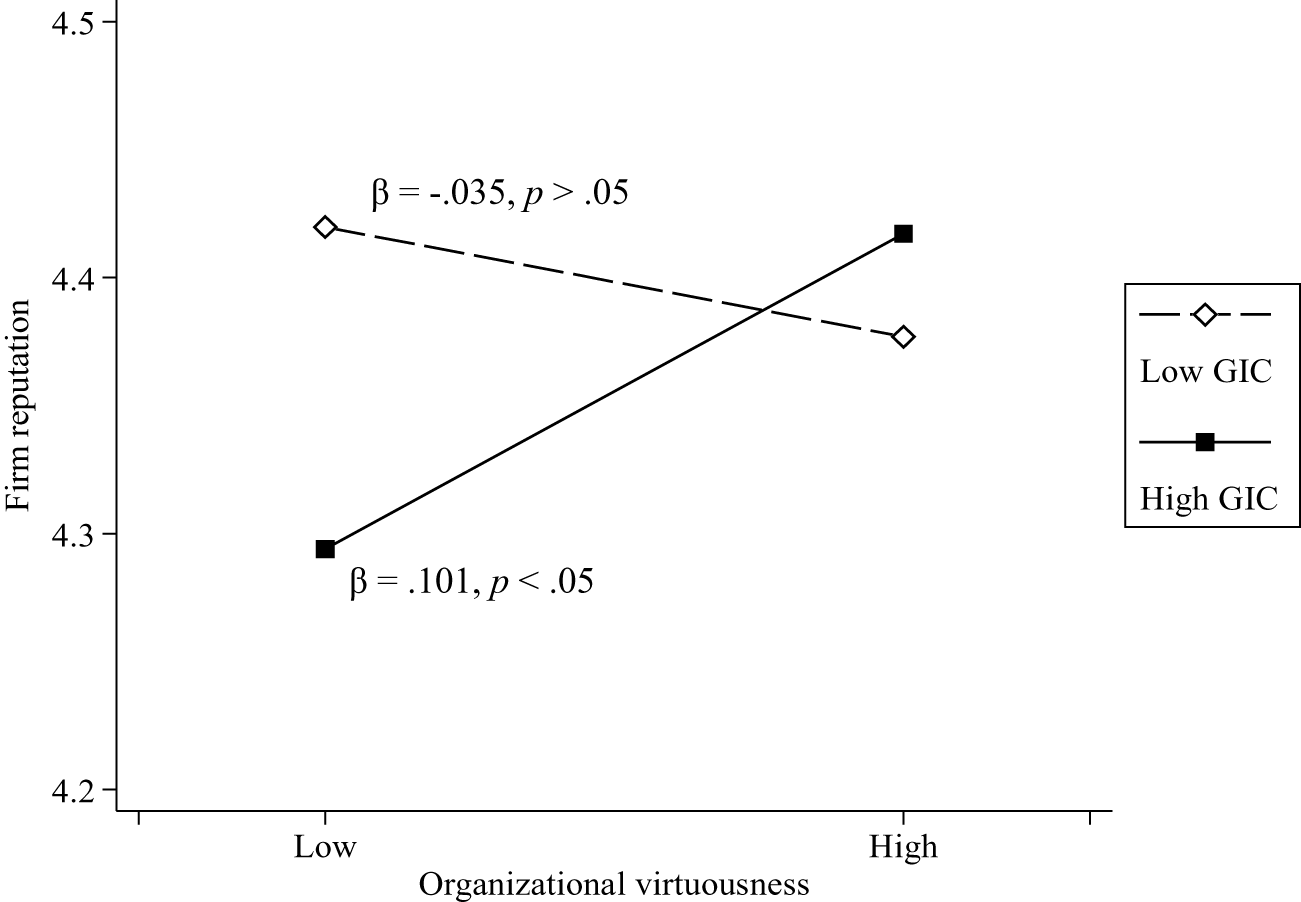
H2 predicts that the relationship between organizational virtuousness and firm reputation will be contingent on government intermediary connection. In Table 3, model 6 shows that the coefficient of the interaction term of organizational virtuousness and government intermediary connection on firm reputation was positive and significant (β = 0.074, p < 0.05). The likelihood-ratio test was a significant χ 2(1) value of 6.43 (p < 0.05). H2 is supported. To better understand the nature of this interaction, we conducted simple slopes analysis at high (1 SD above the mean) and low (1 SD below the mean) levels of government intermediary connection (Aiken & West, Reference Aiken and West1991). As shown in Figure 2, organizational virtuousness was positively and significantly related to firm reputation when government intermediary connection was high (β = 0.101, p < 0.05), but not related to firm reputation when that was low (β = − 0.035, p > 0.05).
Moderating effect of government intermediary connection (GIC)

H3 predicts that the positive effect of CEO humility on firm reputation via organizational virtuousness will be contingent on government intermediary connection. We tested this hypothesis by calculating the index of moderated mediation based on models 2 and 6 in Table 3 (Hayes, Reference Hayes2018). The index of moderated mediation was 0.031 (0.419 × 0.074), with the 95% Monte Carlo CI excluding zero (0.007, 0.062). H3 is thus supported. To further understand this moderated mediation, we examined the indirect effects of CEO humility on firm reputation via organizational virtuousness at high (1 SD above mean) and low (1 SD below mean) values of government intermediary connection, with the 95% bootstrap (2,000 replications) CIs (Hayes, Reference Hayes2018). When government intermediary connection was high, the indirect effect was 0.037, with the 95% CI excluding zero (0.034, 0.040). When government intermediary connection was low, the indirect effect was −0.020 and statistically different from zero (95% CI = [−0.023, −0.017]). The difference (0.057) between the indirect effects at high and low values of government intermediary connection was significant (95% CI = [0.052, 0.063]).
Additional Analyses
We conducted three additional analyses. First, as there is a potential reverse causality issue between CEO humility and organizational virtuousness, we conducted a two-stage instrumental variable regression to address this concern (Semadeni, Withers, & Certo, Reference Semadeni, Withers and Certo2014). In the first stage, we used CEO’s conscientiousness and agreeableness as our instruments. Both variables were reported by the administrative director using the four-item scales (1 = strongly disagree, 6 = strongly agree) of Big Five personality trait measurement (Donnellan, Oswald, Baird, & Lucas, Reference Donnellan, Oswald, Baird and Lucas2006). Prior research suggests that conscientiousness manifests in politeness and scrupulousness, while agreeableness manifests in cooperativeness and warmth (Hu & Judge, Reference Hu and Judge2017). Thus, CEO humility should be highly correlated with these two personalities (Exline & Hill, Reference Exline and Hill2012). However, extant studies have revealed that neither CEO conscientiousness nor CEO agreeableness has a significant effect on organizational virtuousness (Holmes et al., Reference Holmes, Hitt, Perrewé, Palmer and Molina-Sieiro2021). Our results show that both CEO conscientiousness (β = 0.251, p < 0.001) and CEO agreeableness (β = 0.156, p < 0.001) were positively and significantly related to CEO humility. Neither CEO conscientiousness (β = 0.071, p > 0.05) nor CEO agreeableness (β = 0.116, p > 0.05) was related to organizational virtuousness. Moreover, the first-stage F statistic was 38.44, above the critical value of 10 (Stock, Wright, & Yogo, Reference Stock, Wright and Yogo2002). Our instruments were valid both theoretically and empirically (Wooldridge, Reference Wooldridge2010).
In the second stage, we regressed organizational virtuousness on the predicted value of CEO humility obtained from the first-stage regression, in addition to all exogenous explanatory variables that were used in the first stage. As expected, the second-stage results showed that CEO humility was positively and significantly (β = 0.451, p < 0.01) related to organizational virtuousness. The insignificant χ 2 statistic of Sargan’s (0.687) and Basmann’s (0.629) tests indicated that our instruments were valid. The insignificant Durbin–Wu–Hausman’s tests (χ 2 = 0.222, F = 0.203, p > 0.05), again, indicated that our independent variable was exogenous. Together, the reverse causality issue was not a concern in our study.
Second, given that virtuous firms are likely to develop high government intermediary connections, organizational virtuousness in our study might be endogenous. Following Poppo, Zhou, and Li (Reference Poppo, Zhou and Li2016), we adopted a three-stage approach to address this issue. In stage 1, we regressed organizational virtuousness against government intermediary connection and control variables to obtain the predicted value of organizational virtuousness. We then obtained the residuals of organizational virtuousness (hereafter, OVresidual) that were free from the influence of government intermediary connection. In stage 2, we regressed firm reputation against OVresidual. Results from stage 2 revealed that OVresidual was not related to firm reputation (β = 0.020, p > 0.05). In stage 3, we added the interaction term of OVresidual and government intermediary connection to test the moderation effect. Untabulated results show that the coefficient of the interaction term of OVresidual and government intermediary connection was positive and significant (β = 0.077, p < 0.05). These results were consistent with those in our main report, suggesting that the potential endogeneity between organizational virtuousness and government intermediary connection was not an issue.
Third, the key motivation of the current study is that a high reputation in the eyes of Chinese governments can bring valuable resources and thus contribute to firm performance. Although it goes beyond our main theorization, we conducted an additional analysis by regressing firm performance against reputation with the inclusion of all control variables. Following Li and Atuahene-Gima (Reference Li and Atuahene-Gima2001), we invited CEOs and administrative directors to report how their firms had performed (from 1 = very low to 7 = very high) in the past year in terms of total profits, total sales, sales growth, and market share (Cronbach’s α was 0.87). We used the averaged ratings of our two respondents as the measure of firm performance: ICC(1) = 0.40; ICC(2) = 0.56. Untabulated results revealed that firm reputation was positively and significantly (β = 0.846, p < 0.05) related to performance, supporting the assumption that building high reputation in the eyes of government can be a valuable asset for firms in China.
Qualitative Inquiry and Evidence
Following existing studies (Fang, Wu, & Clough, Reference Fang, Wu and Clough2021; Xu, Ou, Park, & Jiang, Reference Xu, Ou, Park and Jiang2024), we conducted a qualitative inquiry of 32 semi-structured interviews to complement the understanding of our quantitative results. Specifically, we interviewed government officers from departments such as the Economic Service Center, the Science and Technology Bureau, the Street Working Committee, and the Charity Association in the industrial towns. These officers are highly familiar with local businesses and thus help us to develop a deep understanding of the dynamics between firms and governments. To understand the manifestations of organizational virtuousness, the effects of CEO humility, and how a firm may connect to government intermediaries and thus achieve a high reputation, we interviewed CEOs, top executives, and employees from firms in our research context. All interviews were conducted onsite and recorded and transcribed when permitted. The information about the interviewees is summarized in Appendix B.
The qualitative evidence supports and augments our quantitative findings. We summarize them in Appendix C. For H1, we find evidence that humble CEOs foster organizational virtuousness by promoting a firm’s purpose and integrity (e.g., Interviewees #17 and #27). For example, the CEO of D company told us,
We must approach business with the heart of a career pursuit. A significant lag in our country’s science and technology is the integrated circuit industry, which our company is a part of. We thus established a dedicated R&D department to focus on research in this area. (Interviewee #19)
As D company grows after years of development, other industrial parks have invited it to establish operations there and have offered significant support. However, the company declined these invitations because its CEO highly values the support from the current park and is dedicated to the implicit agreement of remaining and consistently contributing to the park’s development. The CEO explained,
We can’t move [to another park]. Our park has supported us so much. We can’t forget our roots. Once, an industrial park displayed our logo there. One time, I happened to go there and saw the logo. Why our logo was here? That’s a bad joke! They can’t display our logo as we were not moving in. (Interviewee #19)
Our interviewees also confirm that humble CEOs promote virtuousness across the firm through the role-modeling effect (e.g., Interviewees #29 and #31). For example, in G company, the CEO’s concern for others creates high compassion and trust. An employee said,
We don’t use fingerprint time attendance systems or cameras. There was a suggestion to install cameras, but our CEO remarked, ‘Why would we do that? When a camera is present, even if you haven’t done anything wrong, having someone watching you, how would you feel’? The absence of cameras in our company reflects a commitment to humanistic care, reducing employees’ psychological stress and removing the fear of being judged or reported to the boss. Everyone is very sincere, and we trust each other. (Interviewee #30)
For another example, the administrative director of M company stated,
Our CEO organizes us to learn during the weekly production meetings. The learning is substantial. He shares vivid examples of what happens around us because he frequently visits workshops and interacts with employees. He often tells us the problems that employees have raised with him and talks about his conversations with workshop managers regarding solutions to these issues. For new employees, he oversees their accommodation arrangements and checks if the dormitory facilities are adequate. He often instructs me to visit the dormitory personally to ensure the accommodations are convenient arrangements. (Interviewee #29)
The director further explained, ‘By maintaining continuous communication with employees and caring about their well-being, the company fosters a work environment marked by mutual respect and understanding. This improves employees’ sense of belonging and significantly lowers the company’s turnover rate.’
Regarding H2, a firm’s virtuousness is visible as it manifests in its prosocial practices, virtuous processes, policies, and operations. For instance, K company is highly regarded by the government due to its prosocial practices and exemplary employment policies. One government officer remarked,
The expansion of the tap water supply, road construction, and bus routes, the [K company] paid for all of that… it also supported many underprivileged students. Each year, approximately 80 to 90 students receive assistance. From primary school through middle school, high school, and ultimately college, the [K company] provided support until they graduated. If they wish to work for the [K company] after graduation, that is acceptable. (Interviewee #11)
K company ‘loves’ its employees ‘as if they were its own kids’ as its Vice CEO said,
The matters concerning employees are more important than anything. The smallest issue for an employee is a significant matter. For instance, if an employee is late for work, I will inquire about the details. It’s not merely, ‘you’re late, you’ll be fined’. After my investigation, if I discovered that he was late because his mother fell at home that morning or his bike broke down on the way to the office, he would not be fined. This is our corporate culture. (Interviewee #26)
Also, a firm’s virtuousness is visible as it manifests in its operations. In F company,
The boss understands that quality inspectors are essential. Inspectors conduct daily rounds in workshops, which have always been a part of our operations. If this function is not performed properly, how can we guarantee product quality? We cannot offer consumers defective items. (Interviewee #27)
These manifestations of a firm’s virtuousness are observable to the government when the firm’s connection to government intermediaries is high. Our interviewees confirm that government intermediaries serve as channels through which the government can obtain information about firms (e.g., Interviewees #3 and #4). One government officer stated,
As the government, we heavily rely on a number of intermediaries to assist our work. There are many intermediaries in our jurisdiction. We offer services through them and receive information about local firms. Through these intermediaries, we can bring these firms into our view. (Interviewee #2)
First, government intermediaries such as the local Labor Union and Charity Association serve as vital channels through which a firm identifies potential recipients and engages in prosocial activities such as building roads, making donations, and helping poverty:
Building roads and sponsoring underprivileged students involve intermediaries like the Labor Union and the Charity Association who offer information about the recipients that need assistance and how many people are involved, and to coordinate [between sponsors and recipients]. Those in need of help are unlikely to approach companies directly; they need a platform to facilitate this… Every year, the Labor Union releases information about underprivileged students… then companies voluntarily sponsor them. They cannot independently search for potential recipients. For strangers facing financial difficulties, no one truly knows their situation. What if they are faking it? These intermediaries serve as channels through which companies learn about underprivileged students. (Interviewee #9)
Through these channels, a firm’s prosocial activities become visible to the government, signaling its commitment to improving social welfare. For instance, B company often assists the underprivileged elderly via the Elderly Association and earns a good reputation:
We approached the Elderly Association to help the underprivileged elderly. They suggested, ‘You may donate some teacups and mahjong machines, which would cost between 1,000 and 2,000’. However, I proposed installing air conditioners (ACs) in all rooms. They responded, ‘No. That would be an issue because no one would pay the electricity bill after installation’. Consequently, we not only had ACs installed but also contributed some cash to help cover future electricity bills. This event received a very positive response from the government. (Interviewee #17)
On the contrary, without such intermediaries as valid channels, firms may have difficulty identifying recipients in need of assistance. As the CEO of A company told us,
The intermediaries send out information about people in extreme poverty. Then, we sponsor them. Because we don’t have information about these people. We may find information on the internet, but we don’t know whether the information is true. The intermediaries act as brokers. Otherwise, we wouldn’t know who needs help and whether his/her situation is real. We don’t have the time to investigate. (Interviewee #16)
Firms also may carry out prosocial activities without using governmental intermediaries as channels. In this scenario, however, governments cannot be aware of them. Our interviews confirm the importance of government intermediary connections as a crucial condition for firms to demonstrate virtuousness in social arenas. Therefore, it is a prerequisite for governments to recognize their virtuousness. As one government officer said,
Some companies may not act through the Charity Association. They may directly contact potential recipients to make donations or provide physical or monetary support. Some companies donate money anonymously. In those cases, the government would not know who they were and what they did. (Interviewee #8)
Second, a high connection with government intermediaries facilitates frequent interactions with the government, ensuring the observability of a firm’s internal virtuousness. According to our interviewees, the services provided by government intermediaries cover multiple aspects, including human resources management and internal operations. ‘We are like the babysitter; we conduct on-site training… help coordinate and assist firms in recruiting workers… we also aid firms in addressing legal issues (Interviewee #3)’. These services ‘are ongoing and available and allow firms to receive support for several years (Interviewee #24).’ In such circumstances, a firm’s internal virtuous operations become visible to the government. For instance, L company’s commitment to its employees is visible when it consults governmental intermediaries about its employee incentive plan:
We strongly emphasize recognizing the value of our employees. We are adopting an incentive plan similar to the Employee Stock Ownership Plan, which requires legal support. We consult with the Town’s Enterprise Service Center [governmental intermediary] for any matters that need clarification, and they always provide timely and comprehensive responses. (Interviewee #28)
Similarly, connecting with labor unions can make a firm’s concerns for its employees highly visible to the government. As the Vice CEO of K company mentioned,
Each of our employees receives work uniforms and food subsidies, among other benefits. This increases their willingness to stay here. Our local Labor Union reported this as an excellent example of employee welfare practices to the Labor Union of Jiangsu Province, which then conveyed this to the General Labor Union of China. Through the latter’s meetings, CCTV covered this story, which eventually caught the attention of the Central Propaganda Department of China and the Party Committee of Jiangsu Province. (Interviewee #26)
Once a firm’s virtuousness is recognized by the government, the firm gains a good reputation. First, our interviewees confirm that governments ‘encourage a firm’s commitment to social betterment’, ‘a firm is a good firm if it enhances local employment’, and ‘firms who bring social value or make progress in social domains are viewed as good (Interviewees #3 and #5)’. Signaling a genuine commitment to social betterment, therefore, a firm’s virtuousness that manifests in prosocial practices, such as supporting road construction, assisting the poor, and engaging in charity, helps the firm earn a good reputation (e.g., Interviewees #12 and #26). One government officer said,
Companies like [K company]… the government is very supportive of them. Why? Because they excel not only in economic indicators but also in their generous contributions to public goods. They are willing to invest significantly in supporting underprivileged students, engaging in charitable activities, and serving the community. (Interviewee #10)
Doing charity via the local Charity Association can significantly enhance a firm’s reputation.
At the Charity Award Ceremony, the municipal government and the municipal Party Committee will attend to commend the outstanding with official documents, medals… The provincial government will also be present. (Interviewee #8)
Second, our interviewees confirm that governments ‘are concerned about the ethics of a firm. Problematic operations or management are very risky (Interviewee #6).’ As a firm’s virtuousness signals its reliable operations, it helps the firm earn a high reputation (e.g., Interviewees #20 and #23). For example, F company earns a high reputation for its reliable operations, which stem from its strong purpose and integrity. The CEO stated,
The local industry has thrived for centuries, supported by successive generations. We aim to uphold this legacy… We are committed to building a globally recognized brand and nurturing national pride. Throughout these years, we have never replicated other brands. (Interviewee #21)
One government official confirmed the above statement and stated, ‘F company has never been involved in any disputes or lawsuits over trademarks or patents. Never! (Interviewee #14)’ As another example, C company enjoys a high reputation due to its integrity. After receiving support for the green product, the company consistently provides updates:
Improve the prototype instead of reporting verbally or presenting a brochure or PowerPoint to them [the government intermediary] is important. We also let them know what we are missing as we move forward. This way, we convey to them that we are truly committed to this project. (Interviewee #18)
Third, we find evidence that firms demonstrating trust, compassion, and forgiveness can earn high reputations by signaling resilience (e.g., Interviewees #2 and #7). ‘Governments are concerned about a firm’s potential growth, driving the development of its surrounding area and ultimately promoting the prosperity of the industrial economy (Interviewee #1)’. For instance, K company’s deep concern for and respect toward its employees allow it to maintain stable operations and rally its workforce to engage in product innovation during the global economic crisis, thereby enhancing its resilience. As one government officer stated:
[K company] was actively engaging in ‘open-innovation’. The new materials and models they developed pushed technology forward, helped the surroundings improve… While it appeared that the company was undergoing a downturn, in reality, it was accumulating energy for future development. (Interviewee #11)
By demonstrating its ability to survive and even thrive during challenging times, K company has earned a high reputation in the eyes of government. As one government officer recalled,
At that time, the Secretary of the Political and Judiciary Committee of Jiangsu Province visited here. He gave a thumb-up and said, ‘[K company] navigated all the difficulties and safeguarded 1,800 workers’ jobs in the face of this global crisis. It is truly remarkable’! Achieving that was quite a challenge back then. (Interviewee #9)
Together, the qualitative evidence substantiates and supports our theorization that CEO humility increases a firm’s reputation in the eyes of Chinese governments through organizational virtuousness when the firm’s government intermediary connection is high.
Discussion
Theoretical Implications
Our study makes three major contributions. First, by showing that humble CEOs help firms enhance their reputations in the eyes of governments, our study pushes forward the research agenda on the perceptual consequences of CEO humility. Previous research on CEO humility has largely paid attention to its intrafirm behavioral and cognitive consequences (Chandler, Johnson, Jordan, Darren, & Short, Reference Chandler, Johnson, Jordan, Darren and Short2023). With few exceptions, research on the perceptual consequences of CEO humility has revealed that humble CEOs negatively influence financial analysts’ evaluations of their firms (Petrenko et al., Reference Petrenko, Aime, Recendes and Chandler2019). This limited view neglects the reality that a firm has multiple stakeholders (Bednar et al., Reference Bednar, Love and Kraatz2015; Pollock et al., Reference Pollock, Lashley, Rindova and Han2019), and stakeholders whose concerns are different from those of financial analysts may evaluate firms led by humble CEOs differently. Governments are salient stakeholders in China, and we found that humble CEOs help firms gain positive reputations in the eyes of Chinese governments, which value a firm’s long-term development and contributions to societal improvement. In so doing, our study adds new insights into the perceptual consequences of CEO humility by supporting its positive role in shaping the perceptions of a new and important stakeholder group: the Chinese governments.
Second, our study offers a new perspective to understand how humble CEOs may positively shape a firm’s reputation. Drawing on the implicit leadership theory, Petrenko et al. (Reference Petrenko, Aime, Recendes and Chandler2019) argued that evaluators interpret humble CEOs as a deviation from the archetype of bold, strong, and masculine leaders. This drives the evaluators to underestimate humble CEOs’ leadership and thus their firms’ reputations. In this view, the formation of firm reputation is highly dependent on the congruence between a CEO’s traits and the archetype of an effective leader in a certain context. As there is no such bias against humble CEOs in the Chinese culture (Ma & Tsui, Reference Ma and Tsui2015), the existing mechanism limits our understanding of the effect of CEO humility on firm reputation in China. By highlighting that Chinese governments have multiple prescriptions for a good firm, our study reveals that evaluators may rely on a firm’s character (rather than the CEO archetype) to form reputational judgments. Conveying a set of desirable signals on both economic and social indicators, organizational virtuousness serves as the new mechanism through which CEO humility may enhance firm reputation. In this regard, we offer a new perspective to understand the path through which humble CEOs may draw external attention to their firms.
Third, our research clarifies when CEO humility can enhance firm reputation by highlighting government intermediary connection as the boundary condition of the signaling effect of organizational virtuousness. Studies on organizational virtuousness have largely assumed that it presents desirable signals to a firm’s external stakeholders (McLeod et al., Reference McLeod, Moore, Payne, Sexton and Evert2018; Payne et al., Reference Payne, Moore, Zachary and Bell2013). However, we theorize that, as a firm’s internal values, organizational virtuousness serves as effective signals only when it can be observed by external stakeholders. Specifically, we found that a firm’s intensive connection to government intermediaries constitutes a crucial prerequisite for the observability of its organizational virtuousness in the eyes of governments. While prior research suggests that humble CEOs avoid the limelight and may not draw external attention (Ou et al., Reference Ou, Tsui, Kinicki, Waldman, Xiao and Song2014), our fine-grained analysis indicates that, with enhanced signaling effect of organizational virtuousness under the condition of high government intermediary connection, humble CEOs can help their firms gain positive external evaluations. In so doing, we offer new insights and evidence on the condition under which humble CEOs, who often prefer staying away from the limelight, can still positively affect significant external stakeholders’ perceptions of their firms.
Practical Implications
Our study has two major practical implications. First, governments play an important role in supporting firm operations in China (Jia et al., Reference Jia, Li, Tallman and Zheng2017), so earning a high reputation from the government is important. Building organizational virtuousness may convey the signal that firms meet their multiple expectations. As humble CEOs are important agents who can engender organizational virtuousness, the selection of a humble CEO should be taken seriously. Decision-makers should be aware that in China a humble CEO will not lower external evaluators’ perceptions of a firm’s favorability. Rather, by turning his or her own trait of humility into desirable firm characteristics, a humble CEO may help a firm to gain favorable perceptions from Chinese governments.
Second, managers should be aware that whether firms can benefit from CEO humility, and thus organizational virtuousness, is contingent on the signaling environment. We found that organizational virtuousness helps a firm gain a good reputation in the eyes of governments only when government intermediary connection is high. Thus, maintaining frequent interactions with government intermediaries can help to transform a firm’s internal virtuous value into salient signals that generate positive reputational judgments by the governments. This is particularly important for firms that are less visible to governments: engaging with government intermediaries is an effective way to promote the recognition of their virtuousness and thus governmental favorability in China.
Future Research Directions
The current study also has limitations that may provide some directions for future investigations. First, given that firm reputation is audience-specific, future research can explore the relationship between CEO humility and firm reputation in the eyes of governments in other countries or of other stakeholders. Humble CEOs may enhance firm reputation through building firms into virtuous organizations and making their firms observable. This finding may hold in countries whose governments play a similar role to governments in China – having multiple expectations for firms and playing an important role in controlling resources. However, the role of governments and their expectations can vary across countries. It is thus important to know whether and how CEO humility may still enhance firm reputation in the eyes of governments in other countries, where market exchanges are well developed and the governments’ expectations for firms are less comprehensive. In such cases, new mechanisms underlying the relationship between CEO humility and firm reputation are warranted. Also, future research can explore the boundary condition of CEO humility’s positive effect on firm reputation. While Chinese governments are highly active in establishing intermediaries, this may not be the case in other countries. Exploring new moderators that influence the observability of organizational virtuousness and, accordingly, the effect of CEO humility on firm reputation in other countries is necessary.
Given that different stakeholders have different expectations for firms, how CEO humility may shape firm reputation in the eyes of nongovernmental stakeholders remains an open question. For instance, it is reasonable to expect that humble CEOs may enhance employees’ evaluation of firm reputation by building organizational virtuousness. This line of inquiry may facilitate dialogue between studies on CEO humility’s behavioral consequences and perceptual consequences. Also, as organizational virtuousness may enhance a firm’s distinctiveness in the market (Chun, Reference Chun2017), it is reasonable to expect that CEO humility may positively influence firm reputation in the eyes of consumers. This inquiry potentially generates new understandings of the perception-based benefits of humble CEOs. In addition, future research can compare how CEO humility may shape firm reputation differently across governmental and nongovernmental stakeholders, such as suppliers and the local community where the firm operates (Mitchell et al., Reference Mitchell, Agle and Wood1997).
Second, future research can explore other mediators and moderators that may shape the relationship between CEO humility and firm reputation. On one hand, as prior research has shown that CEO humility can bring benefits such as increasing green innovation (Sun, Zeng, Lin, Yu, & Wang, Reference Sun, Zeng, Lin, Yu and Wang2023) and correcting corporate social irresponsibility (Ou et al., Reference Ou, Lu, Li, Chi-Nien and Chen2024), future research can investigate whether and how CEO humility may influence firm reputation through corporate social responsibility behaviors. On the other hand, given that humble people have downsides under certain conditions (Owens & Hekman, Reference Owens and Hekman2012), one direction is to explore the factors that may negatively moderate the relationship between CEO humility and organizational virtuousness. For example, future research can investigate whether a firm’s hierarchical structure may weaken a humble CEO’s role-modeling effect (Owens & Hekman, Reference Owens and Hekman2012) or whether a competitive environment may influence a humble CEO’s engagement in promoting prosocial practices; both of these may influence how humble CEOs shape organizational virtuousness and thus their effects on firm reputation.
Third, although the current study has reported several additional analyses, the cross-sectional nature of the data limits our ability to claim causality. Future research could adopt longitudinal designs to investigate the complex dynamics underlying our theory. Additionally, the current study uses survey data and relies on organizational members as informants on organizational virtuousness. Future research could include outsiders such as government officials as informants on organizational virtuousness. Alternatively, to develop an objective measure of organizational virtuousness, researchers could obtain unobservable data and use text-based analysis (Moss et al., Reference Moss, Neubaum and Meyskens2015) as an extension of the current study.
Conclusion
The current study theorizes on how and when humble CEOs can positively shape government evaluation of their firms in China. We found that CEO humility has a positive effect on organizational virtuousness and hence increases firm reputation in the eyes of the government when a firm’s connection with government intermediaries is high. We thus offer a new perspective to understand the perceptual consequences of CEO humility.
Data availability statement
Data are available on request from the authors.
Acknowledgements
We would like to thank Jiatao Li, Kevin Zheng Zhou, Yan Jiang, and Guoguang Wan for providing comments on previous versions of the manuscript.
Funding statement
This research was supported by the National Natural Science Foundation of China (Grant Numbers 72372020 and 72372068) and the Postgraduate Education Reform Project of Liaoning Province (LNYJG2024308).
Appendix A. Informants for variables

Appendix B. Description of interviewees

Appendix C. CEO humility, organizational virtuousness, government intermediary connection, and firm reputation summary of the underlying mechanisms for each hypothesis and supporting empirical evidence

Fangmei Lu (lufm@xmu.edu.cn) is an assistant professor of management at the School of Management of Xiamen University. Her research examines how processes of organizational change and adaptation unfold, and the strategic decision-making of top executives and entrepreneurs. Her recent work focuses on the emergence of architectural innovation in China.
Shuyang You (youshuyang008@163.com) is an associate professor at the School of Business Administration, Dongbei University of Finance and Economics. His research interests include strategic leadership and firm innovation in China. He has published papers in the Journal of Product Innovation Management, Management and Organization Review, and Journal of Business Research, among others.
Liangding Jia (jldyxlzs@nju.edu.cn) is a professor at the Business School of Nanjing University. He earned his PhD at Nanjing University. His research interests focus on top management teams and firm strategy, professionalism and professionalization, and employment relationships in the Chinese context. His work has appeared in the Academy of Management Journal, Journal of Applied Psychology, and Management and Organization Review, among others.