Introduction
The present article seeks to write a history of the organized mobilization among footpath ‘hawkers’Footnote 1 in post-colonial Calcutta, in an attempt to contribute to the literature on the politics of the ‘urban poor’ in the ‘global South’. It traces how, over the past five decades, the hawkers have navigated the governmental space and how the histories of government and mass political formation in Calcutta are closely connected to the saga of their everyday struggle for existence. The article demonstrates the ways in which the hawkers, over the years, have devised a number of overlapping strategies to negotiate the market and state forces. They, for example, formed city-based, regional, and national federations of the associations/unions of the hawkers, developed a vocabulary of sangram (struggle) in convergence with some of the globally circulating terms associated with the informal economy,Footnote 2 preserved records and tactically deployed them in what I have elsewhere called the ‘state-union complex’,Footnote 3 and participated in mechanisms of neighbourhood control spearheaded by local clubs in the patronage of political parties. They have also used some landmark judicial decisions to their benefit. In some Indian cities, in the recent past, the hawkers have been seen to assume an active role in formal electoral processes. However, as the article demonstrates, the ‘vote bank’ thesis appears to be less applicable to the case of the hawkers, which prompts us to take up other modalities of mobilization in this article.
This article does not provide a collage of all these forms of mobilization or assemble these in a neat chronological sequence, but considers three periods. One is between the late 1960s and the mid 1970s, when hawkers emerged in Calcutta as a group capable of organizing themselves to resist eviction. Another is the period of Operation Sunshine in Calcutta in 1996–97, when the hawkers retaliated by forming an umbrella federation called the Hawker Sangram Committee that, over the next two decades, emerged as a powerful political force in the city and an alternative of sorts to mainstream trade unions. The third is the era of the nationalization of the category of the hawker/street vendor and of the hawkers’ movement with the debate on the National Policy on Urban Street Vendors, 2004, which resulted in the Street Vendors (Protection of Livelihood and Regulation of Street Vending) Act 2014 (Street Vendors Act).
Although focused on a particular group that is embedded in the cultural economy of a specific city, this article's scope is not restricted to the urban politics of Calcutta; by connecting the specific political articulations of a post-colonial locale, it contributes to the literature on the politics of the ‘urban poor’ in the global South.
The current conjuncture
In the first half of 2014, the ‘hawker’ came to receive much media attention in India. This was the result of two events. One was the celebration of Narendra Modi's exceptional career: he rose to be the prime minister of India, having started as a humble chaiwalah (tea seller)—the ordinary urban everyman. The other was the enactment of the Street Vendors Act.
Modi's party—the Bharatiya Janata Party—connected hundreds of tea stalls across the country through digital media.Footnote 4 This was part of its strategy for the election campaign. Modi interacted with the public at the interface of digital media and the ‘traditional’ tea stall—the much-touted ‘informal’ platform for political opinion formation in India. The campaign was given a name: Chai pe Charcha (conversation over tea). While initiating such an interface in Gujarat, his home state, Modi said ‘[A] tea stall is like a footpath parliament; all topics under the sun are discussed.’Footnote 5
Certainly, the Street Vendors Act promises some amount of certainty to the tenuous existence of one segment of the lower rung of the petty bourgeoisie in the Indian urban scene, ironically through spatial zoning. The Modi campaign, on the other hand, introduced a new political figure—the hawker/street vendor—through autobiographical reckoning: ‘I have myself learnt a lot while selling tea. Sometimes there were insults also. It was a very special experience.’Footnote 6 Interestingly, the hawker/street vendor, with whom India's prime minister identifies himself, is not the peasant or the working class or even the middle class of the twentieth century; it is a new ‘national category’,Footnote 7 and speaks for a mass phenomenon associated with the street of the twenty-first century's rapidly urbanizing India.
Several associations and unions of the hawkers had, since the late 1990s, been lobbying for central legislation in their favour to end the extortions from the bribe-seeking ‘predatory state’, and expected it to ‘empower’ them to withstand the ‘everyday experience of vulnerability’ from state functionaries (especially the police and civic officials), corporate players in the retail economy, and middle-class activist civic bodies (such as resident welfare associations) in many Indian cities. In 2001, the Ministry of Urban Development and Poverty Alleviation formed a national task force to deliberate on the Street Vendors Act. The task force comprised members of the Government of India, state governments, municipal bodies, street vendors’ unions, and experts.Footnote 8 The Street Vendors Act, as we have already noted, came into being in 2014.
The hawkers seem happy overall. Both the National Alliance of Street VendorsFootnote 9 and the National Hawker FederationFootnote 10—the two major bodies of street hawkers—claimed credit for the Act, and congratulated the United Progressive Alliance government and its chairperson, Sonia Gandhi. Leaders of both bodies published pictures with Sonia Gandhi and Rahul Gandhi on their websites and Facebook pages.
The Street Vendors Act introduces four important regulations that have long-term implications for street vendors. First, it divides the public space of the entire city into a vending zone and a non-vending zone. But there is also a clause of ‘public purpose’, for which a vending zone can be made a non-vending zone for ‘greater public good’. Second, it articulates the basic framework of ‘participatory’ management of street vending in the vending zones. The Town Vending Committee is the participatory body, and is supposed to mediate between the local state and the civil society. It has representatives of the state, street vendors, banking sector, NGOs, and citizens’ bodies (like the resident welfare associations and the Consumers’ Forum). The Town Vending Committee is mandated to recruit at least 40 per cent of its members from among registered street vendors; they are to have voting rights to elect their representatives. Thus, street vendors have the right to elect only a section of the members in the Town Vending Committee, a crucial decision-making body, and that section does not even constitute the majority of its members. Thus, the term ‘participation’, like in all other instances of ‘participatory democracy’, conceals more than it reveals. Third, the Town Vending Committees must develop zoning norms, based on consensus among stakeholders, and demarcate and micromanage vending and non-vending zones; they must consider traffic, public health, and environmental issues to balance usable space and the number of vendors. If the government wants to make any changes to zoning norms, it has to consult the concerned Town Vending Committee and experts in the pre-implementation phase. In the vending zone, both stationary and mobile registered vendors can vend with legitimacy as long as they observe certain disciplines of sanitation and public health and pay periodic fees to use public resources. Fourth, the Street Vendors Act mandates municipal governments to undertake a periodic census of street vendors, register them based on this census, and allow them to vend at designated locations in the vending zone. The business of enumeration and registration is to be conducted entirely by municipal governments with the help of associations/unions of street vendors.
This leads us to ask one of the oldest questions of labour studies—what happens to those who do not belong to any association/union that represents the worker's voice in government? What happens if the associations/unions decide to restrict the inflow of aspiring street vendors and push them out through a cumbersome bureaucratic process of enumeration and registration, which, as the Street Vendors Act itself suggests, is to be undertaken every five years? What happens to the existing street vendors when every five years the government identifies a reserve army of labour at the doorstep of the city willing to be registered as street vendors? The space available in any city is finite, and such a situation will bring the rent-seeking, predatory state back into the scene; existing vendors will have to bribe the police and municipal authority to retain their coveted positions. This also means that the existing army of registered vendors can be regulated through a database, by the logic of scarcity of available space and through the deployment of a classic mechanism of blackmail of the loss of employment in the hand of putative excess—the reserve army of labour. Thus, the Town Vending Committee maintains a sort of employment bank, and the use of the law not only codifies the street vendor but also creates a regulated excess for its tactical deployment.
The deliberations on the Street Vendors Act will shape the politics of street hawking in at least four significant ways. First, the Act signals a concerted effort by the Indian state to govern the informal economy in general and to integrate the street vendors’ question with concerns regarding urban spatial planning.Footnote 11 Second, it has augmented the pace at which street hawkers form associations. My evidence hints at the formation of social-group-specific unions within the National Hawker Federation in accordance with the Street Vendors Act's mandate to have representations from women,Footnote 12 Scheduled Castes, and Scheduled Tribes. The National Hawker Federation is a federal body of several associations/unions of street vendors and can therefore easily accommodate the micro-fragmentation of its member organizations. This also suggests that the vocabulary of the association might undergo some changes in the course of the implementation of the Act. Third, the promulgation of ‘public sector’-like reservation norms in managing hawkers’ representation in the Town Vending Committee and the treatment of street hawking as a transitory employment bank seem to suggest the greater influence of the government in structuring street hawking.
Fourth, the Act formally resolves a central paradox associated with any kind of formal recognition of ‘stationary’ street vendors, or the privatization of public space. The footpath, it is argued, is primarily for the pedestrian, one who does not loiter around, but moves from one point to the other. Any kind of formal, legal recognition of stationary street vendors means the violation of the very foundation of the bourgeois notion of property distributed neatly between the domains of the private and the public. Given this, it seems that the Street Vendors Act permits street vending in a limited and restricted space by considering it an acceptable exception to the rule of property. Unlike the abstract pedestrian's rights, which are fundamental to the law of public space in a bourgeois city, the street vendor's rights are founded on a series of exceptions and contingent legality. That is why the Street Vendors Act is so invested in articulating the conditions under which the street vendor's rights are realizable.
Setting the agenda
The position of the Street Vendors Act is not unique. In a series of cases on street vending between the 1980s and the 2000s, the opinions of different high courts and the Supreme Court of India have been similar and consistent:Footnote 13 members of the public can use the street as a right, balanced and constrained by the similar right of other members of the public. The state must, as the trustee of the public property, protect all the rights of the public by imposing constraints on every user of the street. Under what consideration can the hawker be allowed to occupy space on streets in violation of their basic ‘public purpose’? Arguably, then, it is the spatial aspect of street hawking, and not the trade aspect, that comes under general state regulation.
The Street Vendors Act is thus much more concerned with the sedentary (read stationary) hawkers than the nomads (read peripatetic and mobile vendors), and ensures that the sedentary hawker does not develop a long-term legal claim on vending space by erecting any kind of permanent/semi-permanent structure. What will happen to the political posture of law-bringing, law-implementing, and law-abiding street hawkers’ associations that once placed themselves with the promise of transgressing the rule of property justifying violation as a moral claim?Footnote 14
The present article seeks to historicize this transitional moment by closely observing the making of the organized mobilization Footnote 15 among footpathFootnote 16 hawkers in Calcutta from the 1960s. Much of the literature on the politics of the informal economy in the global South emphasizes the collective act of the ‘informal poor’, but not the organizational aspects of the collective.Footnote 17 Thus, Jonathan S. Anjaria presents a very important and sensitive political ethnography of street hawkers in Mumbai in the early 2000s, but does not analyse the operation of associations or unions.Footnote 18 This article, then, is an intervention to the literature on the politics of the ‘urban poor’, where it is commonplace to perceive the protagonists as just the ‘individual respondents’ of ethnography that represent an undifferentiated collective.
In urban India, the members of this undifferentiated poor who work in the informal economy and usually live in illegal settlements are seen as important political players who can assert their collective electoral ‘choice’ to gain concessions from the government. This is how, it is largely believed, they maintain a claim on the basic means of social reproduction in a bourgeois city. This article challenges some of the important traits of this formulation and churns out an analogous—yet different, more historically nuanced, and ethnographically validated—understanding of the organization and mobilization of this particular section of the ‘urban poor’, and seeks to demonstrate that the ‘vote bank’ thesis does not apply to hawkers in a majority of cases. Though specific, such an understanding may help us make a few general conclusions about the ways in which different constituencies of the urban poor operate in the governmental space.
Footpath hawkers as ‘vote bank’
While referring to the politics of the governed in urban India in the post-EmergencyFootnote 19 era, Partha Chatterjee writes:
Competitive electoral mobilisation of the poor in the 1970s and 1980s afforded them a new strategic resource. They could now exercise, or threaten to exercise, a choice. If one leader or party could not get things done for them, they could threaten to switch sides and vote for the rival party in the next election. This, in fact, has happened on numerous occasions in the big Indian cities.Footnote 20
Chatterjee inserts the hawkers in this general formula of the voters’ combined electoral choice. While talking about Operation Sunshine in Calcutta in 1996–97, he writes:
The vendors were still organised. Sensing that they were being abandoned by the Left, they now turned to the opposition parties. They did not resist physically; there were no violent confrontations. But the political balance having turned against them, they had to yield their place on the streets and wait until the promises of rehabilitation materialised.Footnote 21
Again, Ananya Roy, whose early work on Calcutta talks at length about hawkers, compares two hawker eviction drives that took place in Calcutta at two historic moments: one in 1975, called ‘Operation Hawker’, and the other in 1996–97, called ‘Operation Sunshine’. Roy compares these two drives to exemplify how the official attitude of the Communist Party of India (Marxist) towards the city's informal sector has changed. There is a difference between these two moments: in 1975, the Communist Party of India (Marxist) was in the opposition, but in 1996 it had set the record for heading the longest-serving Communist government in a democratic system. Roy writes:
Site One, Moment Two. In the winter of 1996, the city of Calcutta was remade. In the watery light of winter, the city's caretakers launched Operation Sunshine. Officers of the Calcutta Municipal Corporation and cadres of the dominant local CPI(M) [Communist Party of India (Marxist)], along with police battalions, demolished the sidewalk stalls of thousands of petty traders, commonly known in the city as ‘hawkers’ . . . as they progressed, hawkers staged daily protests . . . mobilised by opposition leaders . . . they also tried to return to the sidewalks with baskets of goods. But the CPM [Communist Party of India (Marxist)], as leader of the region's ruling coalition, the Left Front, remained firm in its opposition.
Moment One. The Calcutta Municipal Corporation and Calcutta Metropolitan Development Authority launched Operation Hawker, a demolition drive meant to eradicate [the] hawker problem. The hawkers, however, are organised in active protest by the CPM—then an opposition party. This, and other mobilisations, ensures the CPM's electoral victories against the Congress Party a few years later, and as the Left Front consolidates power, hawkers continue to be an important source of political support, while party coffers fill with revenue extracted from them through a complex web of police, unions and cadres.Footnote 22
From the other end of the political spectrum, one finds the same sets of assumptions working as prevailing common sense. Thus, The Telegraph, an English-language daily newspaper, ran a daily column against the hawkers’ occupation on the footpaths just before the state general elections in 2006, between 12 April and 10 May. Here are the headlines of some of the columns: ‘Freedom of movement for sale’ (12 April); ‘Ballot clue to hawker call’ (10 May); ‘Lip service to poll needs’ (19 April); and ‘Ploy to grab more votes’ (26 April).Footnote 23
The prominence of the urban poor in electoral processes is part of a larger consensus on the evolution of political history in post-colonial India. The standard historical explanation is that there existed bipolarity in the pre-Emergency era between the governing elite, divided into several corporations sharing the power of the state, and the mass of vanguard labour. In social life, nationalism still had the currency to mobilize votes in favour of the self-sacrificing leader. The Emergency broke the oligopoly of the governing class and concentrated power in a particular corporation. This was Indira Gandhi's betrayal, which was responded to vehemently by political parties from the Left and the Janata Party cluster through endless regional formations. This process dissolved the old vanguard labour, destroyed its polarizing function and ultimately reconfigured the existing relation between the party and the trade union. All these happened through a spectacular expansion of biopolitical-governmental technologies in the social body. The nationalist leadership gave way to a more provincial and sectarian leadership who resembled the characters we confront in Emma Tarlo's description of Welcome Colony in Delhi and Chatterjee's explication of political society in a squatter colony in Calcutta. In our case, we find such a character in the activities of Saktiman Ghosh—the then general secretary of the Hawker Sangram Committee—a federation of footpath hawkers that emerged in 1996 in the crucible of Operation Sunshine in Calcutta.
While my work also maintains the validity of this narrative, I seek to find a space of negotiation between the state and the population groups outside the ‘vote bank’ framework. I intend to do this by presenting an account of the development of political organizations among hawkers and the micro-geography of evictions in Calcutta between 1972 and 1996–97. I then proceed to analyse the politics of the Hawker Sangram Committee, which now hosts more than 65 hawker unions in Calcutta.
I develop a few propositions. First, to a considerable extent, anti-street hawker drives are contingent to the operation of local economies of the streets and of complex relationships between different economic and political actors. Second, these drives are often the manifestation of factional rivalry between different mid-to-low-ranking regime functionaries of ruling parties and their personalized calculations. Third, street hawkers resist such operations by virtue of a complex patronage network involving the local state functionaries, ruling parties and the opposition. These relationships can hardly be reduced to electoral calculations, as street hawkers do not form a clustered urban vote bank like slum dwellers and squatter groups.Footnote 24 Fourth, in many cases, hawkers operate in a particular street in agreement with neighbourhood political actors and commercial interest groups. Often, these agreements are contextual and have nothing to do with another set of agreements on another street. This explains why drives like Operation Hawker and Operation Sunshine did not encompass the entire city. In understanding the geographies of Operation Hawker or Operation Sunshine, I argue, it is more helpful to look at small histories of such transactions. The stories of a radical transformation of the city's political economy and of a policy reversal of the ruling party often fail to answer the particularities of such drives.
I develop the narrative of the present article by triangulating the relevant ‘Daily Notes Files’ of the Special Branch of the Calcutta Police between 1972 and 1975,Footnote 25 newspaper reports on the subject, and my own field notes, collected over a period of six years, on what I call the ‘archival practices’ of the Hawker Sangram Committee.
Operation Hawker in 1975
In Calcutta, the history of unionization of the footpath hawkers dates to the early 1950s. In 2007, an old trade unionist belonging to the Bengal Hawkers’ Association of the Trade Union Coordination Committee of the Forward Bloc recollected the formation of his association with Muslim greengrocers (known as subzifrosh) who had the surname Raie.Footnote 26 In the late 1950s, when hawking turned out to be one of the viable livelihood options for unskilled or semi-skilled refugee migrants from East Pakistan, the labour wings of many other Left parties active in Calcutta started footpath hawkers’ associations/unions.
The Hindu-Bengali refugees lacked easy entry to the Barabajar credit networks run by the upcountry Hindu and Jain trading communities. My respondent in the Bengal Hawker Association explained to me how the newly established associations/unions created a link between informal financial infrastructure and the refugee hawkers.
These associations/unions were the offshoots of the established trade unions belonging to the Congress, the Communist Party of India, the Revolutionary Socialist Party, Forward Bloc, and the Communist Party of India (Marxist). From the very beginning, the Communist Party of India (Marxist) had some difficulty in organizing hawkers. Interviews with leaders belonging to the Centre of Indian Trade Unions, the Communist Party of India (Marxist)'s labour wing, reveal that the party could never determine the hawkers’ class position; it classed them along with either the petite bourgeoisie or the lumpen proletariat.
The political landscape of Calcutta in the 1960s and 1970s
After the Communist Party of India split in 1964, the Left parties, especially the Communist Party of India (Marxist), significantly strengthened their political credibility and organizational structure by mobilizing peasants (in the case of the Communist Party India (Marxist), through its peasant wing, Krishak Sabha) and the working classes (through its Centre of Indian Trade Unions). Other Left-leaning political parties (such as Workers’ Party, Revolutionary Socialist Party, Communist Party of India, and Forward Bloc) developed a significant rural and urban mass base in the 1960s. However, the Congress Party dominated the state legislature until 1967, when the United Front, the first non-Congress alliance, came to power with the Communist Party of India (Marxist) as one of its major constituents.
The years between 1967 and 1972 were politically unstable. Two United Front governments were formed and dismissed, and president's ruleFootnote 27 was imposed more than once. In the 1971 Lok Sabha elections, the Communist Party of India (Marxist) won 20 seats, while the Congress won only 13;Footnote 28 but afterwards the balance of power changed so dramatically and so rapidly that in the 1972 Assembly elections, the Congress–Communist Party of India alliance decimated the Communist Party of India (Marxist), and the Congress assumed absolute majority. Siddhartha Shankar Ray became the chief minister, and a new brand of Youth Congress leaders entered the cabinet. Arguably, the youth and student wings of the Congress were at the vanguard of their party's revival. During the 21 months of the Emergency, West Bengal witnessed the severest forms of state crackdown on Naxalite rebels and the mainstream Left led by the Communist Party of India (Marxist). All significant Communist leaders were either jailed or were absconding and clandestinely organizing the masses in rural and urban areas.
The Youth Congress emerged as an aggressive cadre-based organization centred on local clubs; it took over many governmental functions and invested clubs with these functions. These clubs maintained strong networks with the street economy to develop their own financial structures. Footpath hawkers entered into the local economies of power through these clubs and through social and cultural events. The prominent Youth Congress leaders like Subrata Mukherjee in Gariahat and Somen Mitra in Sealdah, and their sub-contractors in other places, played a crucial role in forging links among Congress-sponsored clubs, pujas (Hindu worship ceremonies), and the street economy. While many of the funds meant for developmental work started to be channelled through these clubs, the street remained a real source of revenue for such clubs, which proved very effective in establishing a surveillance and espionage mechanism and also in supplying volunteers in factional or inter-party skirmishes. The clubs depended on hawkers to maintain their rent-seeking financial structure. Between 1967 and 1972, different political parties and Congress factions competed among themselves to claim important intersections of the city.
The hawkers often had reciprocal relationships with neighbourhood householders, regular passengers waiting in rail stations and other transit points, and college students residing in private hostels (popularly known as mess bari). Thus, in the sultry late evening of 20 August 1960, a significant street fight took place at the intersection of Harrison Road (now Mahatma Gandhi Road) and Circular Road, facing the Sealdah station, between the city police, students, passers-by, and hawkers when the city police arrested a food hawker who allegedly blocked the smooth movement of vehicular traffic. At least 40 persons were injured, including some policemen, which led to the arrest of 12 students.Footnote 29 This reciprocal relationship that hawkers enjoyed with the public could be found after Operation Sunshine at Gariahat, where the hawkers returned, claiming they had the moral support of residents, traders, and everyday visitors.
In 1972, the Calcutta Municipal Corporation came under the rule of the ‘administrators’ (usually highly placed executives from the cadre of the Indian Administrative Service). The authority of elected democratic bodies was suspended. This situation lasted until 1985. During this time, the Ministry of Urban Affairs directly supervised the operation of the Calcutta Municipal Corporation. By the time of the Emergency (1975–76), the bureaucracy of either the state or central government controlled the municipal governance of all major metropolitan cities. During the Emergency, the authoritarian Delhi Development Authority demolished slums and squatter colonies in vast parts of Delhi in the name of urban sanitization. At Turkman Gate in Old Delhi, Sanjay Gandhi (the younger son of Indira Gandhi) allegedly ‘bulldozed a slum into a waste land’.Footnote 30 In Calcutta, the slum dwellers, the squatters, and the hawkers could resist sanitization projects because the competition for power among different factions within the ruling Congress Party allowed them spaces of manipulation at the neighbourhood level. Many eviction operations were not completed because these faction leaders wanted to increase their share of informal rent by first evicting the hawkers and then allowing them to resettle, under a new agreement. And settled groups of hawkers were often happy about a well-informed raid, as periodic evictions thinned out the competition posed by new entrants.
Hawker eviction drives, 1969–75
Three significant hawker eviction drives took place between 1969 and 1975. In 1969, the second United Front government evicted refugee hawkers in Gariahat, south Calcutta. The hawkers returned under the leadership of the Ballygunge Hawkers’ Association, then affiliated to the Workers’ Party, which had been a part of the ruling United Front.Footnote 31
In 1972, a second eviction drive was carried out in parts of central Calcutta around the Esplanade area, spanning roughly three neighbouring wards of the Calcutta Municipal Corporation: 44, 53, and 62.Footnote 32 Frequent entries in the Daily Notes Register were made between 5 March 1972 and 11 June 1972 under the subtitle ‘West Bengal Hawkers’ Associations’ on six hawkers’ unions, whose titles and affiliations were also asserted. The unions included the Nationalist Hawkers’ Association (Congress-R), Ballygunge Hawkers’ Association (Congress-R), Chowringhee Hawkers’ Association (Congress-R), Bengal Hawkers’ Association (Forward Bloc), Calcutta Hawkers’ Congress (Socialist Party), and Jai Hind Calcutta Hawkers’ Union (Congress-R). These entries were also reproduced along with some more documents pertaining to the political activities of these associations in a file titled ‘Copy of SB Secret Report Dated: 29.7.72 on West Bengal Hawkers’ Associations’.
It is interesting that there is no entry on the activities of the Centre of Indian Trade Unions, the labour union of the Communist Party of India (Marxist), on hawkers’ issues. One possible explanation might be that affected hawkers found it more convenient to negotiate with the government by expressing allegiance to the ruling party, or to a party that was not its staunchest opponent. Even many local hawker associations shifted their allegiance during the drive. We have already noticed that during the United Front government, the Ballygunge Hawkers’ Association operated through the Workers’ Party, then part of the ruling front. This association successfully resisted the anti-hawker drive at Gariahat in 1969. However, as the Daily Notes of Special Branch in its entry on 8 April 1972 informs, the leaders of the aforementioned unions met at a ‘katra Footnote 33 opposite to Gariahat Market on the afternoon of 6.4.72’Footnote 34 where they ‘decided to merge with the INTUC’.Footnote 35 Facing serious differences of opinion within the party, the government soon took a soft stand and hawkers returned to their original locations, but the operation made hawkers increasingly dependent on unions.
A third eviction drive, called Operation Hawker, was conducted a month before Prime Minister Indira Gandhi promulgated the National Emergency in 1975. The hawkers, as in 1972, were organized by street-based hawkers’ associations that regularly conducted protest rallies and press conferences and fasted in public spaces; they also submitted letters, memoranda and proposals of resettlement on behalf of their client hawkers.Footnote 36 Finding it difficult to negotiate with an organized state machine hostile to hawkers, many associations soon came together and formed an umbrella organization called the Coordination Committee of Calcutta Hawkers. The first entry reporting on the activities of the said committee in the Daily Notes occurred on 24 March 1975, in which the organization is cited as consisting of the labour cell of West Bengal Pradesh Congress Committee-R and the Socialist Party.Footnote 37 The second entry on 2 April in the Daily Notes indicates the addition of a third organization called National Federation of Independent Trade Unions.Footnote 38 A third entry on 5 April, however, indicates the further addition of the Muslim League to the Committee.Footnote 39 This shows the increasing tendency among the hawkers to unionize themselves—undermining caste, ethnic, and religious cleavages. The members of the Coordination Committee started fasting in public below Lenin's statue in Esplanade's old tram goomty (depot) and continued for more than two weeks. A Gandhian technique of pressurizing the state machine was thus observed below the statue of Lenin, possibly indicative of the growing Marxist inclination of the unions. In the politically explosive environment of Calcutta in 1975, in the context of the Emergency, such a combination was itself politically suggestive.
Second, the committee raised two slogans in its rallies: Sara prithvir hawker ek hao (Hawkers of the world, unite), and Goriber devi Indira Gandhi amar rahe (Long live the goddess of the poor, Indira Gandhi). This combination was also politically suggestive. While the first sermon invoked the popular Left jargon of an internationally united struggle of workers against class oppression, the second declared the committee's conformity to the Congress and Prime Minister Indira Gandhi, who represented the Indian state during the Emergency.
Third, the Committee developed a critique of the secularist claim of the Indian state by indicating that Operation Hawker deliberately targeted Muslims and members of Scheduled Castes.Footnote 40 On 5 April 1975, addressing a rally organized by the Committee, prominent Muslim League leader and Member of Legislative Assembly Sikandar Ali Molla asked the hawkers to ‘start a crusade (jihad) against the government’Footnote 41 (ORS 4679–80, SW 636/75, 82). On 9 April, the Calcutta District Committee of the Muslim League organized a meeting at the crossing of Tantibagan Lane and Cantopher Lane, at which the speakers criticized the state government, as the Daily Notes records, for ‘allegedly showing step-motherly attitude towards the Muslim hawkers, while other non-Muslim hawkers in Sealdah, Gariahat and Kalighat area were not yet disturbed’.Footnote 42
Discourses of associations/unions
Between 1969 and 1975, hawker unions justified occupancy in three ways. First, they expressed loyalty to the ruling party or the ruling coalition. In 1969, for example, the Workers’ Party leader, Jyoti Bhattacharyya, claimed that Gariahat hawkers were loyal to the ‘Left’ and therefore a left-wing government should reconsider its stand on hawker eviction at Gariahat. Similarly, we have seen that during Operation Hawker, the Coordination Committee expressed its allegiance to the Congress and Prime Minister Indira Gandhi. Second, both in 1969 and 1975, the unions claimed that their clients were poor, honest, and industrious. They were the victims of partition, deindustrialization, and agrarian impoverishment and therefore deserved an exception from the government. Third, they hardly claimed that their illegal occupation was right. They rather professed readiness to move out if they were given viable rehabilitation.Footnote 43
In the context of many such drives, several hawkers’ associations/unions submitted petitions to the government. These petitions narrated the hawkers’ problem as a manifestation of wider political and economic issues (such as the problems of refugees and unemployment) and presented it in relation to the ‘honesty’ of the ‘self-employed hawkers’ who maintained their families and never drifted to ‘antisocial’ vocations.
At the height of the hawker eviction drive in 1972, the Bengal Hawkers’ Association submitted a letter to the chief minister on 6 May to remind him of the government's goal of poverty alleviation (garibi hatao), and that hawker eviction represented a reversal of that policy. It said:
If the government is determined in evicting them from footpath, then from today, the state government shall have to take the entire responsibility to feed and to give shelter to all the affected hawkers including their families . . . .
It proposed:
A temporary dala or tray system (3 ft by 3 ft) should be introduced at once till the final arrangement of permanent economic settlement is made. In order to solve the problems of the hawkers in West Bengal especially in Calcutta, the representatives of different registered Hawkers’ associations must be consulted and their opinions and collaborations must be sought in implementing the hawkers’ settlement plans (i.e. their representatives should be included in project committees).
These documents show that hawkers’ associations had mastered the modern clerical and bureaucratic language and technical economic terms and that they used them to engage with the government. The associations/unions rarely used any terms in their documents that could go against the constructive, argumentative, and alternative-providing image of the ‘poor hawker’. These documents form a moral critique of the establishment (which failed to look after its poor citizens), and justify hawkers’ trade on the footpath as an honest survival alternative to the condition of abject poverty without putting an extra burden on the government. The only demand these made of the government was to be allowed to continue their usual trade on the footpath. Although the associations/unions showed readiness to vacate the public space once they were offered viable resettlement options, this was precisely the time at which hawkers built semi-permanent stalls with brick and bamboo structures. At some intersections, they also managed to buy generators to light stalls. Many lower-level employees in the state government and the Calcutta Municipal Corporation used to own stalls as well, and provided information on any impending eviction drive to their comrades on the footpaths.
Organizing hawkers in the Left Front regime
Two decades before Operation Sunshine
In 1977, the National Emergency was withdrawn, and the Indian electorate ousted the Congress from the seat of power in the Centre and most states. In West Bengal, the Communist Party of India (Marxist) won the elections to the Legislative Assembly with a huge mandate. Other Left parties such as Forward Bloc, Revolutionary Socialist Party, and Communist Party of India subsequently joined the government as the constituents of a ruling coalition known as the Left Front, which would rule the state for close to 35 years and create a record in the annals of Indian democracy. The Communist Party of India (Marxist)'s coming to power reactivated many of the dreams of refugees and other marginalized groups who waited for decades to see it rule West Bengal.
In the initial years of the Left Front government, the Communist Party of India (Marxist) sought to establish and consolidate incumbency by strengthening and restructuring various patronage networks, but without further radicalizing the poorer social groups. The realistic step for the party was to consolidate benefit distribution through its affiliated labour unions by restricting new membership after 1977. Consequently, the government declared that no hawkers who had occupied the footpath after 1977 would be given vending licences (which were never issued); the implication was that violators would not be granted resettlement if eviction took place in the future. The post-1977 hawkers found it easier to negotiate with the government and political parties while remaining outside Calcutta Street Hawkers’ Union, a branch organization of the Centre of Indian Trade Unions. Most of them took membership of hawkers’ unions affiliated to parties constituting the Left Front other than the Communist Party of India (Marxist). Between 1981 and 1986, membership of the Bengal Hawkers’ Association (affiliated with the Forward Bloc) and Calcutta Hawker Men's Union (affiliated with the All India Trade Union Congress of the Communist Party of India) increased.Footnote 44 These parties were in the government, but not the Communist Party of India (Marxist), and were therefore more acceptable to the opposition. This was important for them, as the vending spaces often fell simultaneously under the constituency of two or more elected representatives belonging to different political parties (for example, a street can fall under the constituency of a municipal councillor belonging to Party A and also under the constituency of a legislator in the state assembly belonging to Party B).
The state government considered 1977 the benchmark year for steps taken with regard to hawkers up to 1996.Footnote 45 In 1983, Chief Minister Jyoti Basu ordered police officials to identify hawkers who entered the business after 1977,Footnote 46 and Communist Party of India (Marxist) leader and Member of Legislative Assembly Saral Deb presented a petition on the situation arising from the ‘unauthorised occupation of pavement/streets/roads by hawkers’.Footnote 47 On the basis of this petition, the ‘Committee on Petition’ formed by the representatives of all the parties present in the legislature presented in the ninth Legislative Assembly a ‘Report in the Matter of Framing Suitable Laws for Controlling and Regulating the Unauthorised Occupation of Public Lands and Thoroughfares by the Hawkers and Others in this State’.Footnote 48
The report revealed that the state government wanted neither to evict hawkers completely nor let them proliferate uncontrolled. The proposal recommended the creation of hawking and non-hawking zones in the city and the rehabilitation of hawkers in low-cost market complexes. Such recommendations were completely in accordance with rulings in various high courts and the Supreme Court of India from the mid 1980s. Several hawker unions had moved the courts, which had ruled in accordance with Article 19 (1)(g) of the Constitution of India. The article guarantees citizens the right ‘to practise any profession, or to carry on any occupation, trade or business’. The courts, as we have seen, usually suggested some spatial norms of managing hawking and acknowledged the legitimacy of trading licit goods and services as a matter of fundamental right.Footnote 49
By 1993–94, the situation began to change. In early 1994, the Left Front government published a supplement in Financial Times, London, outlining the forthcoming industrial policy for the state of West Bengal. In the preamble, it declared its agenda:
The Govt. recognises the need in improvement in roads, communication and development of Growth Centres. Since these programmes require massive investment, the Govt. proposes to undertake projects for development of industrial infrastructure through the Private Joint Sector also, whenever feasible.Footnote 50
Its impact on the international business community proved considerable. According to state government sources, the government approved 36.42 per cent more proposals in the first nine months than in the same period the previous year. The Central Committee of the Communist Party of India (Marxist) approved the new industrial policy and affirmed that trade unions’ rights had to be preserved and that the state had to interfere positively in specific core areas. Subsequently, the new industrial policy was debated within the state committee of the Communist Party of India (Marxist); its resolution overrode the discontent of sceptic Party hardliners, accepted the Central Committee's decision, and called for modernizing trade unions.Footnote 51 The Party maintained its antagonism to the overall liberalization strategy of the Government of India, but agreed to liberalize West Bengal's economy as a matter of ‘federal compulsion’. The effect was immediate. The Confederation of Indian Industries launched its centenary celebrations from Calcutta. Several ministers and high-level delegates from the United Kingdom, United States, and Japan visited.Footnote 52 The rulers felt it necessary to rebuild Calcutta as an investment-friendly city, mobilizing the bhadralok (middle-class/gentlemanly) sentiment of ‘pristine Calcutta’Footnote 53 and the powerful party machine. Operation Sunshine, which was carried out between the winters of 1996 and 1997, was a product of this remaking of communism in Calcutta. Around 21 major streets in the city were chosen for the operation—all of them fell between Shyambajar in the north and Gariahat in the south.
Operation Sunshine
In a well-planned and coordinated action spanning over a week, the Calcutta Municipal Corporation's bulldozers destroyed thousands of street-side stalls, and Communist Party of India (Marxist) party cadres and employees of the Calcutta Municipal Corporation and the Public Works Department widened the streets in many places by cutting down the width of footpaths. In some other places, they planted trees and reclaimed space. The government and the Communist Party of India (Marxist) spokespersons justified Operation Sunshine by drawing a correlation between the concentration of hawkers at busy street crossings, traffic congestion, and air pollution. The twin logic of circulation and sanitization was deployed to reclaim the streets from the decadence of quotidian practices, restoring it to its ‘proper use’—pedestrians would walk on pavements and automobiles would run relentlessly on streets.
Around four major rehabilitation centres (one in Galiff Street, one at Ultadanga Market, one near Bijan Setu in Ballygunge, and the fourth near Gol Park) were hastily created to rehabilitate hawkers. In many cases, as Ananya Roy reports, evicted hawkers were selected for rehabilitation by mid-ranking functionaries of the Communist Party of India (Marxist). Subhas Chakrabarty, the transport minister, was the mastermind of Operation Sunshine; Kanti Ganguly, an associate, was in charge of rehabilitating the evicted garment hawkers at Gariahat.Footnote 54 He chose a plot of land down the Sukanta bridge at Santoshpur (in south Calcutta) where he had substantial control over the real estate market and squatter colonies. He designed the rehabilitation project to disaggregate the hawkers’ resistance into numerous subterranean pockets.
The entire eviction drive was conducted in such a manner that the distinction between the party and the government was dissolved. The city's bhadralok, on the other hand, was mobilized to aestheticize Operation Sunshine. Soon, an anthology in Bengali named Operation Sunshine came out, in which well-known poets, essayists, novelists, journalists, and educationists justified the move to sanitize the city streets and congratulated Subhas and Kanti for their courage to rise above the everyday compulsions of ‘party politics’. They set pen to paper to save the pedestrian—the common man (sadharan manush) of the bourgeois city. In flashback, they returned to the pristine city of their childhood—clean, green, and civil. Thus, the moment of Operation Sunshine was also a moment of autobiographical reckoning, of expressing powerful desires to reclaim Calcutta after being captive for so long in the prison of a refugee city.Footnote 55
But the state functionaries overlooked the low economic viability of the resettlement sites. As a result, when the tide of Operation Sunshine receded, the resettled hawkers returned to the street crossings, mobilized by the newly emerged Hawker Sangram Committee.Footnote 56 Along with sensational protest rallies—using innovative means, such as carrying 18 coffins, to remember the mass suicide of hawkers that followed Operation Sunshine—the Hawker Sangram Committee leaders used the difference of opinion within the Left Field and the top-level bureaucracy. It was well known that the city wing of the Communist Party of India (Marxist) viewed Operation Sunshine as an unnecessary assertion from the leaders belonging to the District Committees of North and South 24 Parganas,Footnote 57 and that the mayor himself did not know its exact blueprint. Despite the difference of opinion within the Communist Party of India (Marxist), the party could mobilize its party machine and the Centre of Indian Trade Unions to support the operation. Forward Bloc leader Asok Ghosh openly supported the hawkers and even led them to reclaim their lost spaces in Shyambajar. Asim Barman, the municipal commissioner (and chief executive of the Calcutta Municipal Corporation), was in favour of evicting hawkers, but Tushar Talukdar, city police commissioner, and lower-level workers of the Calcutta Municipal Corporation favoured the regulated continuation of hawking. The difference within the bureaucracy and coalition partners hampered sustained, coordinated action against the hawkers. By June 1997, the hawkers started returning to their locations, and the Hawker Sangram Committee played a major role in redistributing footpath space among hawkers after Operation Sunshine ended.
Operation Hawker and Operation Sunshine in a comparative scale
Operation Hawker
Established byabsayi samatis (retailers’ organizations) supported and fuelled Operation Hawker where their business interests conflicted with those of hawkers. Consider the revenue situation of Calcutta Municipal Corporation-run retail markets in 1975 as described by Shivaprasad Samaddar, erstwhile administrator of the Calcutta Municipal Corporation and mastermind of Operation Hawker. The income margins of the Calcutta Municipal Corporation from the markets it owned began declining in 1965–66. From 1971–72, these markets were in severe crisis. The downward trend was equally visible in the College Street market (the second largest municipal market in the city). The situation of small markets like those of Entally, Lansdowne, New Alipore, and Allen was more precarious. Only the Gariahat market could earn a decent surplus of Rs. 100,000 in 1975–76 (which is close to USD 1,199, as in 1975 the value of the Indian Rupee was pegged at 8.39 against the USD). Samaddar held the ‘hawker menace’ responsible for the sorry plight of the municipal markets. In 1975, the situation of the Hogg Market (New Market) deteriorated further. The situation at the New Market (which contributed 50 per cent of the Calcutta Municipal Corporation's total income from markets) might have enraged an activist administrator like Samaddar. During his tenure as Calcutta Municipal Corporation administrator, the Calcutta Metropolitan Development Authority came up with a plan to upgrade and extend the municipal markets. Although there were some minor differences between the two agencies in the matter of the plan, both of them agreed that before the expansion of the markets it was essential to ‘identify and quantify’ and ‘if necessary to evict’ the hawkers, especially in front of the legal retail markets.Footnote 58
Nandini Dasgupta's careful observation reveals a pattern in Operation Hawker. She shows that the eviction was planned in two phases. The first phase would cover Chittaranjan Avenue (from Madan Street Crossing to Lenin Sarani Junction), parts of Bentinck Street (from its crossing with R. N. Mukherjee Road to the junction of Lenin Sarani and Jawaharlal Nehru Road), parts of Jawaharlal Nehru Road (from its crossing with the Lenin Sarani up to its crossing with Lindsay Street), and also certain portions of the Esplanade East (from the crossing of Lenin Sarani to Old Court House Street). The geographic area for eviction in the first phase corresponded to the bulk of the major commercial areas of the city bordering the wholesale markets of Barabajar—the Mechua Bazaar and New Market area. The majority of the hawkers in these areas were non-Bengali Muslims.Footnote 59
It was decided that a second or third phase of the ‘operation’ would be undertaken in the Gariahat-Ballygunge and Sealdah and Shyambajar areas respectively, which had been the strongholds of Bengali Hindu refugees.Footnote 60 It is important to note that the operation in 1972 targeted these three regions first and faced stiff resistance from the hawkers.Footnote 61 Although, theoretically, Operation Hawker targeted these areas again, evidence shows that these regions were not touched again, taking into consideration ‘existing political expediencies’.Footnote 62
Operation Sunshine
Operation Hawker did not affect the hawkers at the intersections at Shyambajar in the north and Gariahat in the south, where established garment retailers often have complementary relations with hawkers, but Operation Sunshine targeted precisely these two intersections, because these are vital entry points to the city, and new traffic rules were about to be introduced. In 1996–97, Calcutta was trying to compete with other cities to attract foreign capital, and Operation Sunshine was seen as the Left's attempt to build an investment-friendly entrepreneurial image of the city. Predictably, the media celebrated the new move of the Left as a rupture in the city's history. Thus, Newsweek wrote:
It used to be described as India's Black Hole by the British in the 18th Century, when the industrial revolution was at its peak in the country . . . Things began to change about six months ago, just before the British Prime Minister John Major was due to visit the city. In a rapid-fire campaign, the civic administration and the West Bengal government evicted hundreds of hawkers and roadside shop owners entrenched in several prestigious neighbourhoods.Footnote 63
In the aftermath of the eviction, the Calcutta Municipal Corporation and the Public Works Department started widening the carriageways in many streets by cutting down the width of footpaths. In some other places, they planted trees and reclaimed space. Soon, Operation Sunshine became a sign of the end of Left exceptionalism in West Bengal, while the hawkers’ return became an oft-quoted instance of the operation of political society in a post-colonial democratic space.Footnote 64
The Hawker Sangram Committee as a federation
A couple of months before the official declaration of Operation Sunshine in 1996, the non-Centre of Indian Trade Unions hawker unions (at least 24, with an approximate strength of 80,000 hawkers) decided to form the Hawker Sangram Committee. Mobilized by opposition leaders like Mamata Banerjee, and Left Front leaders like Ashoke Ghosh (of Forward Bloc), its members successfully returned to the footpaths with baskets of goods. Since 1996, the Hawker Sangram Committee has been the largest and the most powerful federation of hawker associations/unions in Calcutta. The Hawker Sangram Committee maintains links with many contemporary movements in India, like the National Alliance of People's Movements. It was the nodal organization of the National Movement for Retail Democracy, which spearheaded massive protests against corporate retailing in Indian cities. It soon became the nodal organization of the National Hawker Federation.
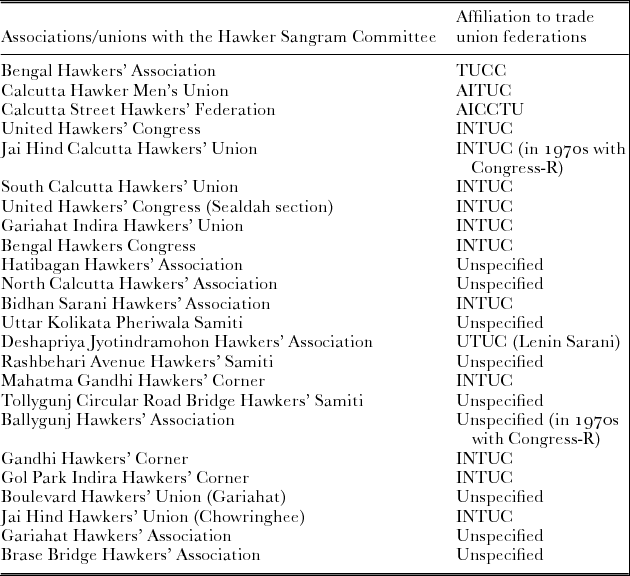
Recently, Koyel Lahiri harnessed considerable evidence of the federal structure of the Hawker Sangram Committee.Footnote 65 A comparison between some of my older archival materials and Lahiri's research findings gives a preliminary idea of the Hawker Sangram Committee's internal operational structure. On 26 January 1997, the Hawker Sangram Committee wrote and petitioned the city mayor for a planned rehabilitation scheme for hawkers. The petition lists the names of 24 hawkers’ associations/unions affiliated to the Hawker Sangram Committee; the list mentions the partner trade union and the political affiliation of each contributing association/union of the Hawker Sangram Committee. The list displayed in Table 1 below.
The initial constituents of the Hawker Sangram Committee.

Source: Petition to the mayor of Calcutta Corporation by the Hawker Sangram Committee, 26 January 1997, retrieved by the author from the ‘petition’ file of the Hawker Sangram Committee on 17 July 2007. The petition contains no reference number. Note: I have occasionally compared this list with the list of six hawkers’ unions specified in the Daily Notes, referred to in footnote 25.
This list makes clear that the Hawker Sangram Committee started a coalition of several associations/unions affiliated to major trade unions of the Congress Party, Forward Bloc, Revolutionary Socialist Party, and the Communist Party of India, and mentions the location of these smaller associations/unions in the city map, as many of them contain the place name in their titles (such as Gariahat Hawkers’ Association). At least three of the hawkers’ associations/unions (Jai Hind Calcutta Hawkers’ Union, Bengal Hawkers’ Association, and Ballygunj Hawker's Association) found a prominent location during the anti-eviction mobilization in the 1970s. This hints at the lifespan of dissent of at least some of the constituent members of the Hawker Sangram Committee.
Lahiri found an incomplete mobile telephone directory tagged onto the notice board of the Hawker Sangram Committee's office in 2012. She calls it the ‘master list’. It contains the location of the contact person of each association/union. To unravel the internal logic and stratification of the Hawker Sangram Committee, Lahiri follow some of the names in the list, and ended up with several interesting observations. First, she holds that by 2012 the number of affiliated associations/unions rose to at least 42. Second, the new entities are located both in the old city areas such as Gariahat, Lake Market, Kalighat, Esplanade, Hatibagan, Shyambajar, and Sealdah, and in the new areas of the city along the Eastern Metropolitan Bypass, Salt Lake, Kestopur, New Town, and Dhapa. In the 1997 list, as one can see from the above table, the activities of the Hawker Sangram Committee remained restricted only to the old city areas.
Third, when hawkers had to negotiate with questions of the representation of a large number of hawkers in the governmental space, and at times of protest against issues of national and global dimensions (such as protests against foreign direct investment in the retail sector), the identity of the Hawker Sangram Committee as a strong organization prevailed; Lahiri convincingly establishes this point. Individual associations/unions of hawkers used their own identities in dealing with the local state and in maintaining relations with political parties—which is why the Hawker Sangram Committee could become an organization where conflicting party interests converged—and in recruiting and expelling individual candidates at the local level. It seems, then, that the Hawker Sangram Committee hardly micromanages its federation members, although its member units adhere to some propositions of the Hawker Sangram Committee. They, for example, maintain spatial norms as decided by the Hawker Sangram Committee, which is usually occupying one-third of the footpath in a single row facing the established shops. Also, they do not use party banners if the occasion is organized by the Hawker Sangram Committee. The Committee seems to keep them united and retains its political legitimacy through the logic of an unceasing sangram (struggle) against the state and the corporate capital. It commemorates the sangram through a series of events, actions, and rallies where the federation members supply the viewers and listeners.
Today, the Hawker Sangram Committee is to be kept in full confidence before any regulation on hawkers is implemented. It actively produces a certain kind of disciplined self among its adherents while enabling them to navigate the difficult spaces of everyday government and the market. The calculus of self-discipline is structured by the hawkers’ claim to entrepreneurialism, coupled with civic responsibility. By the 1990s, the hawkers could justify their occupancy of public spaces by mobilizing their entrepreneurial skills to survive the competition. Now when they face the threat of destruction from the side of the market, they turn back on the state with a critique of neo-liberal trends in the state and the economy. The entrepreneur (the hawker) is more a consummate claim-maker on the state than a recipient of welfare (the pavement dweller).
Elsewhere, I have shown how the emergence of the entrepreneurial hawker as a governmental category in the 1990s is associated with the decline of the pavement dweller, which until the end of the 1980s was a ubiquitous figure in rural–urban migration literature, poverty tourism, and charity.Footnote 66 The question on the ‘proper use’ of the footpath gradually came to be framed by the ‘right’ of the pedestrian and the ‘encroachment’ by the hawker. The hawkers contest such a binary by claiming reciprocal relations with the pedestrian. They have invented an entire cosmos where their claim on space becomes a claim to enter the society's structures of obligation: ‘We are here as poor pedestrians require us to be here. We are also here to create the pedestrian.’ This is how a study of the footpath becomes a study of the hawker and of the pedestrian—each mirrors the other.
Politics of archiving
I have referred to such initiatives on the part of hawkers as politics of archiving. I argue that by arrogating to itself a certain archival function—which is conventionally associated with the state—sections of the population can become successful in their endless negotiations and tussles with the government. The state seeks to manage populations by mapping them in every possible way, and successfully mobilized groups intervene in the process by acting as a crucial filter. In the context of post-colonial democracy, the archive has turned out to be a contested field of political negotiation. Let me present three instances of the Hawker Sangram Committee's politics of archiving in connection with its inculcation of self-control and self-discipline in its members.Footnote 67
Instance 1
In April 2005, I visited the office of the Hawker Sangram Committee at College Street for the first time. Murad Hussain, then in charge of the Hawker Sangram Committee's office, assured me partial access to their archive, adding that some sensitive records would remain secret, as otherwise they would reveal the ‘internal contradictions of the Committee’. Murad said that those documents could be made public only if the Hawker Sangram Committee resolved to document their own history in the future. Murad was acutely aware of the public nature of the act of writing history, and he was not willing to allow me authorship of the Hawker Sangram Committee story. His ability to mark the border between secrets and revelation sparked my imagination regarding the meaning of secrecy in the life of the record. The secret archive of the Hawker Sangram Committee can be constructed to stand beside, or even compete with, state archives, but it can also be a hiding space in which subversive memories are stored and preserved for possible future disclosure. Notably, when Murad denied my request to see the secret archive, he revealed a tension, or discomfort, with those records (note the Marxist term ‘inner contradiction’ in Murad's statement). Murad knew that those documents might contradict the official position of the Hawker Sangram Committee. So, this secret archive is not only the strength of the Hawker Sangram Committee; it is also a constant source of discomfort, if not threat. Thus, the Hawker Sangram Committee preserves the right to write its autobiography and to disclose its own ‘secrets’.
Instance 2
In December 2005, the Calcutta Municipal Corporation decided to ‘identify and quantify’ hawkers on the streets and footpaths of the municipal area of Calcutta to benchmark the year 1977 to evict hawkers who joined the trade after 1977—the year the Left Front captured the Writers' Buildings. The Hawker Sangram Committee made two interventions. First, its members began to follow the surveyors around and eventually challenged the accuracy of their assessment. If, for example, a stall was found vacant, and the Corporation surveyor was on the verge of omitting it from the survey register, Hawker Sangram Committee workers told them who the owner of the stall was and how long he had been trading there. The surveyor had to depend on local knowledge to avoid the heightened administrative burden of the survey. Second, the Hawker Sangram Committee undertook a counter-survey, including a sample of 2,350 hawkers distributed along the 21 intersections. This pilot self-survey became the seed for all subsequent surveys on hawkers in Calcutta. Using its own survey, the Hawker Sangram Committee mobilized the benefits of the ‘low-circuit economy’ in Calcutta by documenting how hawkers sell the products of small primary producers and thereby sustain the small economy of the poor.
Instance 3
In 2005, the mayor of the Calcutta Municipal Corporation formed a municipal consultative committee. The Hawker Sangram Committee is a member of this committee. Between 2005 and 2009, the committee met five times in the mayor's office. On each occasion, I found Saktiman Ghosh, the Hawker Sangram Committee leader, at the meeting. Ghosh had files and papers containing some sort of database of hawkers, the earliest court orders in favour of hawkers, as well as the latest court order, and paper documents that he claimed were picked up from the office of an important government official in New Delhi or even a cabinet minister. Though suspicious about the government, he never forgets to disclose his intimacy with its functionaries in the upper echelon, who often update him with new government secrets.
When the Corporation decided to evict hawkers from Park Street, Saktiman presented a map showing the exact location of the Hawker Sangram Committee's affiliate hawkers in the Park Street area, and claimed that his clients had been operating there since the early 1970s. He presented the past eviction records—attested by the Corporation—and records of police raids and of the confiscation of hawkers’ wares. A police official told me that the Police Department keeps records of confiscation, release, and ‘minor crimes’ for five years and then destroys them. The counterfoils of the old records with the Hawker Sangram Committee give a counter-argument, because government functionaries cannot produce those documents but cannot ignore them either, as they contain the signatures of officials. To the best of my knowledge, neither the Corporation nor the Police Department has ever made any centralized documentation of every operation and raid, but individual hawkers preserve what they receive from the government—be it an eviction certificate, or a release order of confiscated goods. The papers contain dates, signatures of officials, and stamps. Often these records change hands along with the site of vending, which suggests that the Hawker Sangram Committee's archive is not a frozen entity awaiting a historian; rather, it is an archive in constant circulation, enabling the Hawker Sangram Committee to function well in the governmental space. The Hawker Sangram Committee's archival function enables it to convert the record of transgression to the record of legitimation.
The state archive and the hawkers’ archive
In my search of the terms and tenures of the autonomy of what I call ‘archiving from below’, I deliberately posit the problematic of archive with the processes of everyday survival of forms of informality. There is a significant paradox, which makes the case of the Hawker Sangram Committee different from the archival purpose of the state: most mobilizations in the informal economy that make demands on the state are founded on a sidestepping, suspension, and violation of the law;Footnote 68 yet, the archive is law—as Foucault says, it is the law of what can and cannot be said.Footnote 69 It is the place from which order is given to pasts and presents, where—as Derrida says—men and gods command, where violence institutionalizes itself as law. It represents a principle that, in Derrida's words, is ‘in the order of commencement as well as in the order of commandment’.Footnote 70 If the archive represents ‘order’, ‘principle’, and ‘law’, then does the Hawker Sangram Committee's politics of archiving, in an intermediate space between ‘formality/legality’ (when all laws and regulations are complied with) and ‘criminality’ (when acts are performed clearly against official laws, basic morality, and the public interest), bring with it the notions of an alternative ordering, law, or principle? My answer to this question is optimistic. I see in the Hawker Sangram Committee's politics of archiving the seed of a process of institutionalization of informality that could not be explained through the binary registers of formalization and informalization.
Judicialization of politics and the politicization of the court
The first line of Partha Chatterjee's essay ‘Are Indian Cities Becoming Bourgeois, At Last?’ has a secret subtitular function: ‘Or, if you prefer, we could exclaim: Are Indian cities becoming bourgeois, alas?’Footnote 71 This deliberate note of indecision between mourning and non-mourning is kept alive until the very end of the essay, when Chatterjee wonders: ‘Will political society provide the instruments for negotiating a controlled transition to a new urban regime or will it explode into anarchic resistance?’Footnote 72 Chatterjee suggests that from the mid 1990s, members of the middle class began to assert themselves powerfully to sanitize the city space for ‘proper citizens’. Being estranged from the arena of electoral politics, the middle class of the 1990s and 2000s took refuge to the court and to the bureaucracy. They started influencing their decisions. Chatterjee appears to suggest that if the civil society, peopled by the middle class, embraces the activist judiciary to reclaim space, then popular politics (read political society) holds sway over the legislature.
In contemporary rural West Bengal, Chatterjee confirms that the ubiquitous presence of the ‘party’ in managing life and labour signals the dominant ‘social preference’ against taking recourse to formal institutions such as the police and the court in resolving disputes. Such institutions, Chatterjee tells us, are generally seen as ‘expensive, time-consuming, corrupt and insensitive to the specific demands of fairness in a particular case that only those intimately familiar with local histories and peculiarities could be expected to know’.Footnote 73 Overall, Chatterjee's findings confirm the dominant trend in South Asian historiography, which for a long time has viewed the relationship between subaltern politics and legal institutions as marked by apathy, apprehension, distance, and exclusion.Footnote 74 On the contrary, our evidence suggests that the last three decades witnessed a steady ‘judicialization’Footnote 75 of the politics of street hawkers in many important Indian cities. They have taken refuge in the court while continuing their anti-eviction struggle on the ground. In most rulings, both high courts and the Supreme Court bolstered the cause of livelihood while restricting the radical spatial claims of the street hawkers. The Hawker Sangram Committee maintains strong connections with activist and progressive lawyers’ collectives. If an eviction happens, its lawyers process hundreds of petitions by hawkers and file them at once in the court, making it difficult for its officials to maintain its everyday routine. To bolster the case of evicted vendors, Hawker Sangram Committee members clog the court entrance, so that the judges come to know their moral and numerical strength.Footnote 76 This is how judicialization of the Hawker Sangram Committee's politics politicizes the physical space of the court and disrupts its normal operation. There is no denying that by supporting the basic tenets of the Street Vendors Act the Hawker Sangram Committee has succumbed to the bourgeois logic of spatial order.
The battle does not end here. We are yet to see how the Street Vendors Act opens new possibilities of subversion when it is taken to the court and the street. Their success will depend on how the hawkers are able to bring other, poorer social groups into the fold of their movement, and also on how they come to terms with the bhadralok of the city. It might be simplistic to think that state agencies—with strong moral support from the bhadralok—have been aggressively evicting hawkers only since the liberalization of the economy. In several cases, the bhadralok embraced the hawkers and urged the government to preserve them as part of the great heritage of the city. No doubt, the heritage parts of the famous College Street restricted certain display habits of the book hawkers. But the heritage city sought to preserve the ‘bibliophilic’ character of College Street. While starting the initiative of ‘model food vending zones’ in some of the touristy parts of the city, Saktiman Ghosh opined that ‘if properly regulated’ (note that state functionaries use this exact phrase) and ‘trained’, the hawkers of Kolkata could become the destination of the tourists. The ‘world-class city needs the world-class hawker’.Footnote 77 A dialectical reading of this statement reveals its two sides: hawking can become a spectacle of consumption in the sanitized and well-preserved world-class city, and that the aspiring world-class city has accumulated an enormous debt to the hawker. Thus, the hawker has the right to use the city space. This article is an invitation to rethink the hawkers’ question in Calcutta, which, I expect, will lead us to rethink the ‘politics of the poor’ in the global South.
Conclusion
One major impact of the debate on the Street Vendors Act in the past 14 long years is the nationalization of the hawkers’ question premised on a global discourse of informality. The emergence of the National Alliance of Street Vendors and the National Hawker Federation in the late 1990s and the early 2000s also signalled an aggregation of disparate anti-eviction movements in different cities within a frame of comparative interrogation of diverse local laws, movements, and the condition of the street vendors in different Indian cities. The National Hawker Federation was quick to devise a technique of policy interrogation by using one city context to ask questions of another, with occasional reference to the condition of street vendors in New York, Bangkok, Mexico City, Bogota, Durban, and so on. Thus, the National Hawker Federation thrives on potentially new configurations of urban and regional knowledge. Like the media, the academe soon became part of this new archive. The present article is part of such an exercise. Accordingly, it bears the traces of the conflictual conjuncture that simultaneously pushes the poor to the ever-expanding margins of the city and ensures their social reproduction through strategic deployment of welfare schemes. Thus, we are not surprised that, after the publication of Kalyan Sanyal's important book in 2007,Footnote 78 the state—while reconfiguring its very foundation in the principles of the market—is seeking to address street vending in terms of social security and inclusion in national accounting, et cetera, with a view towards a greater intensification of the government through institutionalization. Indeed, as I have shown in one of my earlier articles, the street vendors are not replaced by the shopping malls, but rather regroup around them, catering to the needs of those who come to the mall to visit as a ritual, participating in the spectacle of the world-class city, but who cannot afford to purchase anything, and also to those who work in the malls.Footnote 79 In this context, the Street Vendors Act sets the terms under which the street vendors must operate. Their services beneath the mall subsidize the wage of the workers in the high-end shops.
Overall, our evidence on the history of organization among the footpath hawkers of Calcutta appears to support some of the long-term, macro trends in the informal economy as indicated by Amitabh Kundu and his interlocutors. First, it is observed that in order to survive in the globally competitive market, there has emerged a move for the standardization of labour relations and commodity chains within the informal economy. Further, scholars have noticed a dramatic decline in the growth of casual employment since the beginning of the new century, while there has been a corresponding growth in the number of regular workers and self-employed within the informal sector.Footnote 80 Second, there has been a significant increase in organizational activities outside the scope of official trade unions in both the formal and the informal sectors. Two kinds of unionization have been reported by scholars: the extension of the already registered trade unions, accommodating the workers in the informal economy or providing affiliation for the new unions in the informal economy; and unions organized by the informal workers themselves outside the fold of the existing legal trade union complex. Both types of unions are seen to combine the issues of labour rights and representation with the concerns of economic and business development.Footnote 81 In short, the three major attributes of informal economy—namely, the existence of a casual labour force, paralegality, and lack of organization—are now called into question.
The unions and associations within the informal economy are generally seen to target the government and not the employers to earn vital state-supported welfare benefits.Footnote 82 This does not, however, mean that the workforce in the informal economy is well integrated into a universal social security fold, as a large majority of them cannot afford to make their contribution under the system. Given this, the role of labour organizations in maintaining state–capital–labour relations in the informal economy has become crucial. It is a matter of much satisfaction that the National Hawker Federation has recently demanded the inclusion of the street vendors in the Employees’ State Insurance Scheme and some other facilities available to the populations below the poverty line. However, it should be noted that with the coming of a relatively privileged section from within the labour force, organizations like the National Hawker Federation are seen to play increasingly important roles in managing the existing labour force, insulating them from the ‘population-in-waiting’. Although it is difficult to make a clear separation between the owner of capital—the employer—and the labourer in the informal economy, our evidence shows that at least in the case of street vendors in India, the organizations represent the former segment.
Are we then witnessing, as we did between the 1930s and the 1960s, a wider process of institutionalization and inclusion of labour? Are we witnessing a second phase of formalization? If the answer turns out to be in the affirmative, what does that say about the current situation and the project of the state? What currency does the ‘formal’ carry when informalization sets in at the heart of the ‘formal sector’? How, then, are we to envision the future of the informal sector and the politics of the informal workers?
Let us go back to the title of this article: ‘Institutionalizing Informality’. Apparently, it talks of a process—indeed a transition from mobilization to institutionalization. My reader will hardly miss a historicist tang to it—small-scale mobilizations over the decades morph into larger regional-national and international constellations through the organization of the bureaucracy, archive, a regular cadre base, division of labour, professionalization, differentiation among the stake-holders, and the vital capacity of the organization to socially reproduce this asymmetric structure—a destiny that the new social movements since the late 1960s sought to avoid. My reader will easily recognize the spectre of ‘the iron law of oligarchy’Footnote 83 in the story of the hawkers’ mobilization. Also, it is not difficult to identify how this argument is neatly structured along the temporal span of the history of post-colonial India, starting with Nehru and his regional incarnations and maturing in the emergence of the vernacular leaders like Saktiman Ghosh. The politics of the informal workers is, then, predictably set in the graveyard of the vanguard labour. Is the hawker, then, a new historical subject being progressively monumentalized in the autobiography of none other than the current prime minister of India?
I conclude this article by citing instances from two pamphlets that were circulated during the recent state legislature (Vidhan sabha) election campaigns in support of the Communist Party of India candidate ‘Comrade Jagram Gautam (Chacha)’ from Badkhal 87 Vidhan Sabha Constituency in Faridabad, Haryana. A local veteran labour organizer called Ram Shankar Tripathy sent to me the pamphlets written in Hindi with an email introducing Jagram as a ‘migrant’ from rural Haryana, a ‘street vendor extremely popular among 5000 street vendors and their families’ all of whom would ‘vote for Chacha’.
Below is an excerpt from Pamphlet I:Footnote 84
Dear friends, respected mothers, sisters, elders and youth,
I, an ordinary citizen, pavement hawker and a middle class person, am contesting this assembly election with the promise to serve you all. I am a worker and a small businessman, and also an active member of the hawkers’ union. I am always eager to do some social work. With my friends, I regularly meet the people from administration—the policemen, district authorities of the municipal corporation—to demand the prevention of all kinds of oppression and ensure public interest.
The excerpts from Pamphlet II are as follows:Footnote 85
Dear pavement hawker friends,
With your cooperation and on your advice, I contest from this Vidhan Sabha constituency. My constituency is the Badhkal Vidhan Sabha. The Haryana Hawkers’ Union is in mutual agreement with AITUC and thus supported by AITUC and other workers’ Unions.
Dear friends, we all are members of the Haryana Hawkers Union. You have nominated me as the president of the Faridabad Union. As you all know very well, from time to time I have joined with you in all your struggles. I have saved you from the tortures of police and corporation. Nobody from the administration, nether the police nor the corporation people, can disturb you anymore. They cannot evict you or confiscate your properties. A law has now been passed in favor of the formation of a town voting committee, issuance of licences, cards and your health and social securities. The National Hawkers’ Federation is also with us. We have decided to move to the Supreme Court in order to safeguard our rights. Along with my friends, I have met the Chief Minister, the Governor and all district officials to discuss our rights.
Friends, it is time that we come forward and take our demands for the interest of the workers to the Vidhan Sabha. To make this functional and under your insistence, I contest for this Vidhan Sabha election.
I appeal to all hawkers (pavement hawkers) to come forward and vote for me and elect me for this Vidhan Sabha to carry on their movement.
On several counts, Jagram's narration of the self is well known to the students of Indian politics in the post-Emergency era. Striking is the way in which Jagram emerges as a combination of contradictory and conflictual identities: a hawker, a worker, a small businessman, an ordinary citizen, and a member of the middle class. We have seen in the course of this article that even beyond the obvious contradiction between the middle class and the worker, there are layers of contradiction among the rest of the categories, too (for example, between hawkers and small businessmen). What, then, are the institutional mechanisms of repression of contradictions through which the wholesome identity of the hawker emerges? This question awaits a book-length project.