Introduction
Spontaneous intracranial hypotension occurs in approximately 1 in 50 000 individuals.Reference Miller, Tami and Pensak1 It is a rare diagnosis, and an even rarer presentation to the ENT surgeon. It is often misdiagnosed due to its broad range of presenting symptoms. The diagnosis is often one of exclusion, but the characteristic features are the presence of an orthostatic headache in combination with low cerebrospinal fluid (CSF) pressure and diffuse pachymeningeal enhancement on cranial magnetic resonance imaging (MRI).
In this case report, we present a patient with symptoms suggestive of ENT pathology, such as Ménière's disease or vestibular schwannoma, who was later found to have spontaneous intracranial hypotension.
Case report
A 60-year-old woman presented with a two-month history of unsteadiness, occurring in 30-minute episodes, and tinnitus, which was initially intermittent and mild but had evolved to a pulsatile, daily pattern. The patient also complained of a worsening occipital headache, which was more prominent on standing and relieved by lying down. There was no accompanying diplopia, visual blurring or facial numbness.
Audiography revealed a low-level, 10-dB, sensorineural hearing loss in the right ear. Although this hearing loss was minimal, all asymmetrical hearing loss warrants further investigation to rule out vestibular schwannoma.
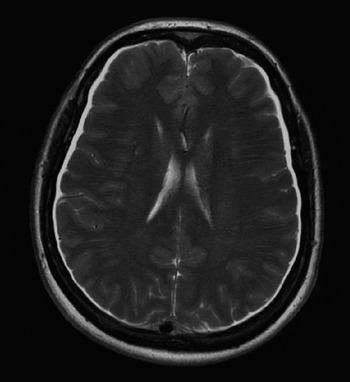
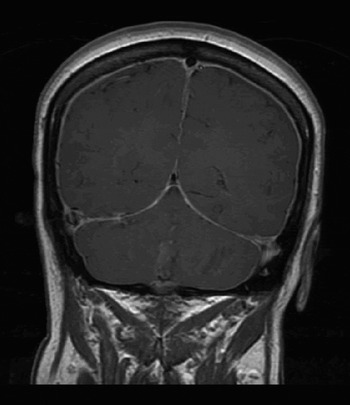
Magnetic resonance imaging (Figures 1 and 2) showed normal internal auditory canals, but there was obvious, diffuse, subdural fluid and intense, uniform enhancement of the dura after intravenous contrast was introduced. Other subtle changes were noted: extremely small lateral ventricles, cerebellar tonsils which descended to abut the foramen magnum and increased venous markings. These changes were highly suggestive of intracranial hypotension.
Axial, T2-weighted magnetic resonance image at the level of the lateral ventricles, which are small, showing high signal intensity of the subdural fluid surrounding the brain.

Coronal, post-gadolinium, T1-weighted image showing low density subdural fluid and intense enhancement of all dural surfaces, including the tentorium cerebelli and falx.

Further investigation with an isotope CSF flow study did not reveal the site of CSF leak in the spinal canal or the brain. However, the CSF opening pressure was extremely low, in keeping with intracranial hypotension.
This patient was managed conservatively with a two-week period of bed rest, plus advice on caffeine use and a high fluid intake as adjuncts. She responded well to this approach, and her follow-up MRI scan at two months showed reasonable resolution of the dural and subdural changes. Further follow up a year after initial presentation revealed completely normal MRI scans. The patient reported minimal residual tinnitus but no other symptoms.
Discussion
Mechanism
Spontaneous intracranial hypotension was first described in 1938.Reference Schaltenbrand2 An occult spinal CSF leak leads to a decreased CSF volume and lumbar puncture pressure, usually 60 mmH2O or less.Reference Huang, Chuang, Lee, Lee and Lin3
The cause is probably an underlying structural weakness of the meninges, usually at the cervical or cervicothoracic level. This weakness predisposes to diverticulae or tears, allowing CSF to leak out of the thecal sac.Reference Malone and Love4
In approximately one-third of patients, there is a history of minor trauma. It has been noted that there is an association between this condition and connective tissue disorders, such as Marfan's syndrome, Ehlers–Danlos syndrome and neurofibromatosis. In 2004, Schievink et al. found evidence of connective tissue disorders in 67 per cent of patients with spontaneous intracranial hypotension.Reference Schievink, Gordon and Tourje5
Symptoms
The most common presenting symptom of spontaneous intracranial hypotension is orthostatic headache, which may be frontal, occipital or diffuse, is not relieved by basic analgesia, and is aggravated by processes which increase intracranial pressure (e.g. sneezing, coughing or straining). The headache generally develops within 15 minutes of assuming an upright position and improves within 30 minutes of lying down.Reference Malone and Love4
Patients with spontaneous intracranial hypotension present with headache because the brain is normally cushioned by CSF within the cranium, and as the CSF volume is depleted the brain is displaced downward, causing irritation of the meninges. In the upright position, downward displacement of the brain is worsened due to the added effects of gravity, hence the orthostatic nature of the headache.Reference Huang, Chuang, Lee, Lee and Lin3 It is believed that orthostatic headache is induced when the CSF volume is reduced by as little as 10 per cent.Reference Malone and Love4
Altered or reduced hearing commonly occurs in conjunction with spontaneous intracranial hypotension, often accompanied by tinnitus and disturbed balance, although profound hearing loss is rare. These symptoms are thought to be due to transmission of the abnormal CSF pressure across Reissner's membrane to the perilymph of the cochlea.Reference Blank6
Visual field defects, facial numbness or pain, facial weakness, and other cranial nerve palsy symptoms (including bulbar palsy) may be explained by traction on the cranial nerves during downward displacement of the brain.Reference Malone and Love4
Parkinsonism, ataxia, quadriplegia and local pain at the leakage site have also been recorded, although their aetiology is unknown.Reference Miller, Tami and Pensak1
Investigation
The ‘gold standard’ for diagnosing spontaneous intracranial hypotension is gadolinium-enhanced MRI and measurement of lumbar CSF opening pressure.
Magnetic resonance imaging
In cases of spontaneous intracranial hypotension, the most characteristic findings on cranial MRI include the presence of diffuse dural enhancement, subdural fluid collections and significant downward displacement of the brain.Reference Murakami, Matsuno, Nakashima, Tanaka, Katayama and Nagashima7 Meningeal enhancement has been seen on MRI as early as three weeks after the onset of spontaneous intracranial hypotension symptoms.Reference Blank6 Unlike the meningeal enhancement seen in inflammatory or infectious disease, the enhancement seen with spontaneous intracranial hypotension involves only the dura and is diffuse, linear, prominent and symmetrical rather than focal or nodular.
Dural enhancement occurs due to compensatory dilatation of the vascular bed. This is explained by application of the Monroe–Kellie hypothesis, which states that the volume within an intact skull is constant and is composed of the brain volume plus the CSF volume plus the intracranial blood volume. Therefore, a reduction in CSF volume, as occurs in spontaneous intracranial hypotension, requires the intracranial blood volume to increase in order to maintain a constant intracranial volume. This increase is conducted via the venous system; thus, venous engorgement is seen on MRI and can be used as a marker of CSF hypovolaemia.Reference Schievink8 Increased venous pressure also leads to subdural effusions.
Lumbar puncture
Patients with spontaneous intracranial hypotension usually have a CSF opening pressure of 60 mmH2O or less on lumbar puncture. However, the CSF opening pressure can be normal if the patient had been recumbent for a long period of time prior to the procedure. Further examination of the CSF may show a mildly elevated protein level or cell count, or xanthochromia; however, the CSF may be entirely normal.Reference Malone and Love4
Cerebrospinal fluid myelography
If it becomes necessary to identify the site of CSF leak, myelography is the study of choice. This is performed with iodinated contrast followed by computed tomography of the entire spine. The leak may vary from a small amount of contrast seen along a single nerve root to extensive, bilateral, paraspinal collections. The majority of CSF leaks are found at the cervicothoracic junction or along the thoracic spine.Reference Schievink8
• Spontaneous intracranial hypotension is a rare diagnosis
• This paper describes a patient with tinnitus, hearing loss and headache
• Magnetic resonance imaging revealed the characteristic findings of spontaneous intracranial hypotension. The patient's symptoms resolved with conservative management alone, except for a mild residual tinnitus
Management
The least invasive treatment is bed rest in the horizontal position, which reduces CSF pressure and allows a spontaneous tear in the dura to heal. This bed rest may, on occasion, be prolonged and carries its own risks, e.g. deep vein thrombosis which in older and sedentary patients is a real risk. In the case discussed, such treatment was sufficient. If conservative treatment fails, it becomes necessary to identify the site of the leak using radioisotopes. A ‘blood patch’ is an invasive technique whereby extradural blood is introduced epidurally in an effort to seal the leak. Radiographic guidance is used when placing thoracic and cervical blood patches, but leaks occurring in the lumbar region tend to be addressed without radiographic control. The risks are not great in the lumbar region; however, there are technical difficulties in the thoracic region, where significant complications could arise if the needle were introduced into the wrong place. Surgical repair of the dura is a major undertaking which is rarely required.Reference Miller, Tami and Pensak1
Conclusion
Spontaneous intracranial hypotension is a rare and often misdiagnosed syndrome. It is a difficult diagnosis due to its heterogeneous presentation, and some patients may present without any complaint of the characteristic orthostatic headache. The diagnosis is made when low CSF pressure and diffuse pachymeningeal enhancement on cranial MRI are found. The current case highlights the fact that spontaneous intracranial hypotension, although a rare otological presentation, must be included in the differential diagnosis of symptoms more often associated with such ENT pathologies as Ménière's disease and vestibular schwannoma.