



Recent analysis of changing urban and rural industrial spaces has provided fresh insight for historians into social, political, and economic developments in the past. Within the context of the continuing scholarly interest in the nature, purpose, and effect of charity and philanthropy, this article contributes to the debate by offering a fresh and unique spatial approach to entrepreneurial philanthropy. Alice Shepherd and Steven Toms have argued that differential attitudes towards philanthropy were demonstrated by entrepreneurs in the cotton textile industry during the industrial revolution, and that moral behaviour was intimately connected with changes in the competitive process over time between 1815 and 1860. They define entrepreneurial philanthropy as ‘the creation of new social relations, in the form of opportunity and moral obligation, to meet an expressed need’.Footnote 1 This article builds on their claim by demonstrating that the extent and nature of philanthropy intended, implemented, and experienced at three entrepreneurial projects – Cromford, Quarry Bank, and Saltaire mills – was determined by site-specific factors with unique effects in space and time. Prominent among those factors were ones related to availability of capital, acquisition and retention of labour, and the welfare needs of the community.
In this context, I define ‘philanthropy’ as active effort to promote the physical and mental welfare of workers and their families. ‘Entrepreneurial’ refers to the characteristic of financial risk-taking for intended profit; the entrepreneurs Richard Arkwright, Samuel Greg, and Titus Salt took risks to establish these mills in rural locations, at Cromford in Derbyshire, Quarry Bank in Cheshire, and Saltaire in the West Riding of Yorkshire respectively. I develop a conceptual framework to examine the creation, development, and experience of ‘philanthropic space’, a term which I use to refer to social spaces of philanthropy that were created at the three sites, such as buildings used as mills, houses, schools, and churches, and open spaces such as market squares and parks. Henri Lefebvre argued that conception by planners and designers is an important component of the production of space.Footnote 2 I develop the concept of planned and unplanned philanthropic space, which I argue is a valuable tool in providing an understanding of philanthropic intent at the outset of an entrepreneurial philanthropist’s design and plan for their business projects. Ted Kilian contended that power relationships exist within space, and that owners have a controlling influence over rights to access and exclusion.Footnote 3 This is particularly evident where the owner is both employer and landlord, and therefore has control over both work and living space, as in the settlements considered here. Control and discipline were ostensibly paradoxical, yet established and essential, features of philanthropic space. However, as Doreen Massey argued, it is people that dwell and move within these spaces and places, who negotiate social relations, and who therefore engage continuously in the construction of space.Footnote 4 Adopting a comparative spatial approach, through the notion of philanthropic space, this article fills a gap in the existing literature through a novel analysis of entrepreneurial philanthropy and its associated social transformation both within these new industrial communities and also between them across time.
The article uses evidence from letters, diaries, apprentice indentures, testimonies recorded by magistrates, newspaper and journal articles, and the Saltaire: our memories, our history booklet (1984), which contains autobiographical accounts of the memories of people who lived and worked in Saltaire. This evidence allows analysis of the characteristics and effects of entrepreneurial philanthropy. The article suggests that the welfare of children, demonstrated by the increasing provision of education, was intimately connected with and indicative of philanthropic behaviour. Emma Griffin has suggested that education provided opportunity for self-improvement for the working classes during this transformative period, albeit often acquired at the end of a hard day’s labour.Footnote 5 Indeed, hard labour was typical for many children. Katrina Honeyman asserted that children, in the form of parish apprentices, constituted around 70 per cent of the labour force of the early mills.Footnote 6 Although Arkwright and Salt did not employ parish apprentices, children still made up a substantial proportion of their labour force. The article therefore closely examines the extent and effect of philanthropy in relation to children.
Historians have divergent views on the impact of such philanthropic projects. Edward Thompson, for example, lamented the decaying condition of the urban industrial environment, but acknowledged that there were examples of mill owners who did provide houses for their workers. Nevertheless, he commented: ‘These may well lead us to think better of human nature: but they do no more than touch the fringe of the general problem.’Footnote 7 The problem, according to Robert Gray, was the intensification and commodification of labour, which impacted on working and living conditions.Footnote 8 Jane Humphries argued that a particular problem for working people and their vulnerable families during the industrial revolution was social and economic turbulence associated with war and urban migration. The breadwinner adult male was often missing or deceased, and survival of families depended on children working to support the family budget.Footnote 9 Equally, welfare provision might have to be sought from kin and the extended family.Footnote 10
Although entrepreneurial philanthropists could not completely insulate their communities from the effects of such unpredictable events, they did seek to improve working and living conditions in these unique rural industrial settlements. Lorna Davidson and Jim Arnold have described how the businessman, philanthropist, and social reformer Robert Owen deliberately planned and implemented new social and educational reforms at his New Lanark mills in the first two decades of the nineteenth century, transforming the conditions and experience of the labour force.Footnote 11 Such social transformations within rural industrial mill settlements occurred within a changing society which, according to Griffin, was far more complex and unequal than that which it replaced.Footnote 12
This article explores the creation, development, and experience of philanthropic space. The first section examines the background of the entrepreneurial philanthropists and the values and ideas which influenced their attitudes towards their business ventures at these three locations. It assesses the extent to which philanthropic space was intended at the outset of their endeavours. The second section focuses on the development of philanthropic space and the level of active promotion of physical and mental welfare within the mills and their respective communities. Finally, the third section considers the experience of people who lived and worked within such philanthropic spaces. This article argues that entrepreneurial philanthropy at Cromford, Quarry Bank, and Saltaire mills was influenced by both market competition and philanthropy, to the extent that active welfare provision was dependent on profitable enterprise and the creation of wealth, as new industrial social relations between mill owner and labour force were formed in space and time.
I
David Harvey has argued that the rise of capitalism as a socio-economic system was the outcome of the construction of new mental conceptions and consequent material practices, which in turn led to a radical reorganization of space relations.Footnote 13 This section examines the extent to which Richard Arkwright, Samuel Greg, and Titus Salt deliberately intended to radically reorganize space relations by creating philanthropic space when they embarked on their entrepreneurial business projects. Ideas of philanthropy in the eighteenth century are associated with the work of John Howard, the prison reformer who visited prisons across Britain, Ireland, and the continent from 1773 onwards. He was consistently described as a philanthropist and moved in circles of rational dissent, which was a dominant force in eighteenth-century Enlightenment philanthropy.Footnote 14 Samuel Johnson’s 1755 Dictionary of the English language defined philanthropy as ‘a love of mankind; good nature’.Footnote 15 It is important to consider the extent to which ideas of philanthropy were influential in the creation of social space at the three mill sites and, in particular, whether they were prominent at conception and how far they determined the planning of philanthropic space at the outset.
The purpose and intent of Richard Arkwright in his business project at the remote location of Cromford are indicated in a letter from him to one of his partners, Jedediah Strutt, dated 2 March 1772, written only a few months after Arkwright and his partners had signed the lease for the land on 1 August 1771. He made his ambition and vision clear when he wrote: ‘I cant think of stoping this Con[c]ern hear as that at nottingm. his [not] or ever will be aney thing in comparison to this.’Footnote 16 Arkwright was not a wealthy man, having previously made a living as a wigmaker and publican in Bolton.Footnote 17 However, he became increasingly fascinated by the development of a machine to spin cotton, and perfected the crucial method of spinning with rollers at different speeds, with the cotton being drawn out via a system of weights.Footnote 18 He had an ability to persuade others to invest both time and money in his enterprising and innovative ideas, exemplified by his initial partnership in May 1768 with John Smalley and David Thornley, who were both distant relations, as he himself had no capital to invest.Footnote 19 This allowed him to complete the invention and secure a patent. He later sought additional partners in the businessmen Samuel Need and Jedediah Strutt as more finance was required for the mill development.Footnote 20 The lease agreed in 1771 had an annual rent of £14 for a twenty-one-year lease with a potential extension for a further sixty-three years.Footnote 21
Arkwright said that the reason he chose Cromford was because of the availability of both water and a working population with small children.Footnote 22 A potentially plentiful supply of labour came from the established lead mining industry in Derbyshire. During the eighteenth century the lead market was particularly volatile, which meant that workers were looking for stable alternative employment in other industries such as textiles.Footnote 23 There is no evidence that at this stage Arkwright had any intent to create a planned philanthropic space. He was focused simply on trying to establish a profitable business.
The expiry of Arkwright’s protective and profitable licence fees, which initially became due in 1783 but were finally settled in court in 1785, allowed Samuel Greg to take advantage.Footnote 24 Greg was born in Belfast and joined his uncle’s firm of Hyde and Co. in Manchester in 1766. When Robert Hyde died in 1782, Greg inherited £10,000 and took over the firm.Footnote 25 From Arkwright’s model, he knew that the water-powered spinning process worked and was potentially profitable. In 1784 he therefore started building a cotton spinning mill at Quarry Bank in a remote rural valley a few miles south of Manchester. The local agriculture-based economy, unlike that at Cromford, encouraged Greg to grasp a business opportunity by utilizing the factory parish apprentice system, importing labour and ensuring the supply of a cheap and reliable labour force. His primary motivation for building a mill was to ensure a steady and regular supply of yarn for the weaving shed at Eyam, Derbyshire, to maintain output.Footnote 26 As with Arkwright, at this stage there was no evidence of intent to create philanthropic space at Quarry Bank.
However, a significant moment in the creation of philanthropic space at Quarry Bank came when Greg married Hannah Lightbody in November 1789. It was her philanthropic vision which initiated social change. She was the well-educated daughter of Adam and Elizabeth Lightbody, textile merchants from Liverpool, who were Presbyterians and dissenters or religious nonconformists.Footnote 27 In Lightbody, Samuel Greg had met an independently minded woman, full of ideas and aware of the advantages of her education. As she wrote of a conversation with a friend, Miss C, on the afternoon of Sunday 19 May 1787: ‘I ought not to throw away all the advantages of such an education … and that I would never marry a Man who did not value them in a wife.’ Moreover, she argued that ‘a woman who merely provided her husband with the conveniences of a clean house and a good table, while he sought abroad the pleasures of Society, was no better than a slave’.Footnote 28 These ideas fed into her later plans to educate not only her own children but also the apprentice children who worked at the mill. By 1800 she was active in her role of educating and caring for the apprentices working at the mill.Footnote 29
Around the time that Samuel Greg was expanding his mill in Cheshire, Titus Salt was born in Morley in the West Riding of Yorkshire, on 20 September 1803. His political ideas developed as a young man as he attended meetings with his father, a liberal radical and dissenter, and heard debates about Catholic emancipation and parliamentary reform.Footnote 30 Trading on his own account from 1834, he made his money through experiment and innovation with alpaca, a long-fibred wool imported from Peru. This was initially difficult to work with, but Salt demonstrated innovative techniques to overcome these problems and create a new lustrous and attractive cloth which became highly profitable. Consequently, the growth of his Bradford-based business continued apace and he established several mills.Footnote 31
By the late 1840s, when he was in his late forties, he had become a wealthy man. At the same time, living and working in urban and industrial Bradford had become increasingly unhealthy. The population of Bradford had grown rapidly: in 1801 it was 13,000 but by 1851 it was over 100,000, having became the fastest-growing industrial town in England through its profitable production of worsted cloth.Footnote 32 These poor living conditions meant that there was a high death rate from diseases such as smallpox and tuberculosis, with average life expectancy in the 1840s being around twenty years, the lowest in Yorkshire. Moreover, infant mortality was fifth highest in the country.Footnote 33 These living conditions and health-related issues were reflected in societal concerns expressed by Thomas Carlyle’s ‘Condition-of-England question’ at the height of the Chartist movement in 1839.Footnote 34 They illustrate the general context as Titus Salt considered his plan to build a new mill and village in a rural location a few miles north of Bradford.
During the grand opening of this new mill on 20 September 1853, Salt said he had instructed his architect ‘that nothing should be spared to render the dwellings of the operatives a pattern to the country’. He said he wanted people to be well paid, happy, and contented, while offering the qualification that ‘If his life was spared by divine Providence, he hoped to see comfort, satisfaction, and happiness around him.’Footnote 35 Salt’s instruction to his architect confirmed his intent for a planned philanthropic space at the outset. Figure 1 shows an undated architect’s plan for Saltaire: the complex’s integrated, planned spatial arrangement is discernible, with the main arterial road connecting the community in their houses with the mill, park, and other facilities. These inspirational ideas at conception suggest that the physical and mental welfare of Salt’s labour force and families was on his mind as he contemplated the creation of philanthropic space as an integral part of his new business venture.
An undated plan of Saltaire by Lockwood and Mawson, the original architects employed by Titus Salt. Source: by kind permission of West Yorkshire Archive Service, Bradford, reference BMT/SH/7/1/186.

Access to capital was a crucial prerequisite for the creation and planning of philanthropic space. Initially, Richard Arkwright lacked sufficient funds when creating his mill and he was reliant on a financial partnership to get his experimental business venture at Cromford off the ground in 1771. However, in 1774 his and his partners’ successful challenge to the law on excise duty for British cotton calicos reduced duty against imported Indian products and led to British cloth prospering and hugely increasing its market share.Footnote 36 Consequently, imports into Liverpool increased from 5 million pounds of fibre in 1775 to 6.7 million pounds on average over the next five years, and doubled each year after 1781.Footnote 37 As a result, the development of philanthropic space became increasingly possible for Arkwright after 1774, when production and profits grew exponentially. Equally, while Samuel Greg did have capital to invest in the mill at Quarry Bank, it was not until the advent of war with France in 1793 that new market opportunities emerged in America and the colonies, at which point he began to contemplate expansion (including philanthropic space) at Quarry Bank, eleven years after its original build.Footnote 38 Titus Salt, on the other hand, responded to global supply problems of long-fibre wools by successfully introducing alpaca from Peru. This specialization enabled him to capture a niche market, particularly in women’s dresses, and was the springboard for his business success and great wealth in the 1840s.Footnote 39 It was this wealth, and its potential use, that allowed the idea of a planned philanthropic space at Saltaire to germinate. Thus we can see that an essential factor in the creation of philanthropic space at these three mills, whether it was planned at the outset or not, was the availability of capital.
Arkwright’s philanthropic tendencies became increasingly apparent over time, through the development of an industrial community based on families who lived and worked within a new form of social relations. However, it was not until the mid-1770s that mill expansion initiated the necessary creation of family living space and community spaces such as the market square and the inn. R. S. Fitton and A. P. Wadsworth argue that all the buildings and facilities were ‘deliberately created’ in order to attract and keep the labour.Footnote 40 For Arkwright, philanthropic intent was a pragmatic response to simple business needs.
While capital growth and an enlarged labour force encouraged Arkwright to consider philanthropic spaces for his workers, Samuel Greg was influenced by broader social and political concerns. He, like John Howard, moved in rational dissenting circles and established himself as a liberal reformer during the 1790s. He added his name to a petition which was published in The Sun on 12 December 1795. This followed ‘the most Numerous MEETING of the INHABITANTS of MANCHESTER and the Neighbourhood, ever assembled in the Town’, and petitioned against ‘a direct Invasion of the Constitutional Rights and Liberties of the People’ with respect to two bills proposed by parliament to prevent seditious meetings and practices.Footnote 41 Greg publicly affirmed his concern for the rights and welfare of people, a concern which became increasingly evident in the unfolding development of philanthropic space at his Quarry Bank Mill and the related hamlet of Styal.
Titus Salt, a congregationalist like Howard, and a liberal reformer like Greg, was actively involved in local politics in Bradford. His reformist, liberal views were exemplified by his involvement with the Bradford United Reform Club. As chairman, he presided over a significant meeting in May 1842 in which the resolution stated that the ‘conductors’ of the Leeds Mercury ‘have made an unkind, ungenerous, and unfair representation of the conduct of those who are honestly endeavouring to effect a reconciliation between the middle and the working classes’.Footnote 42 Thus, post-Chartist concern for the working classes was an influential factor in the build-up to Salt’s unfolding vision of philanthropic space at Saltaire.
The intention to create philanthropic space was therefore not only dependent on the availability of capital but also inspired by other factors. The need to attract and retain labour, as well as social, cultural, and political ideas associated with the desire to improve the welfare of others, were influential determinants. It is apparent that Salt had both the capital and rational intent at the outset to create a planned philanthropic space at Saltaire. Neither Arkwright nor Greg, for different discernible business reasons, was initially able to contemplate such philanthropic development at Cromford and Quarry Bank. For them, this would commence later. Arkwright was an Anglican, not a nonconformist like Greg and Salt, but, as he was ‘one of the biographical enigmas of the eighteenth century’, his political and religious values are not known.Footnote 43
II
Consideration of the development of philanthropic space over time demonstrates the extent of active effort made to promote the physical and mental welfare of workers and their families within the context of the prerequisite concern for market competition and profitability. Examining such development enables an understanding of how space is changed, reflecting both business and philanthropic needs. For Massey, space is continuously altered over time and is in a continuous state of production. Space and place are constructed and emerge through active material practices.Footnote 44
The cotton spinning industry grew exponentially following Arkwright’s successful experimental project at Cromford in 1771. In 1819 there were 337 cotton mills in Great Britain, employing 57,323 people; as Table 1 shows, most of these mills were built in towns in Lancashire.Footnote 45 The proliferation of urban mills occurred as textile mill owners freed themselves from the Arkwright system in the 1780s, successfully challenging his patents and then installing steam engines rather than water wheels. This meant that factories could be built in towns and there was no need to build settlements for workers.Footnote 46 However, resulting migration led to overcrowding, urban squalor, insanitary living conditions, and disease. Arkwright, Greg, and Salt, in contrast, and for different reasons, selected undeveloped rural spaces in which to enact their visions. These provided an opportunity not only for business growth but also for the development of philanthropic space.
Distribution of cotton mills and employees in Great Britain, c. 1819

Source: Matlock, Derbyshire Record Office, D978/MB/16, table 32.
These parallel developments reveal the crucial and necessary characteristic of discipline within new social relations. Disciplined labour was enforced to ensure maximum productivity and profit, while disciplined living was encouraged as essential to improvement in well-being. Thompson has argued that discipline was a key requirement of factory work, and that the adoption of methodological habits, attention to instructions, and working to time were therefore obsessive demands from mill owners.Footnote 47 But Honeyman sees discipline as the most crucial element of training a largely young labour force. Poor children were provided with general life skills, particularly after the 1802 Health and Morals of Apprentices Act which stipulated teaching of reading and writing during the first four years of indenture.Footnote 48 These skills would provide a platform for future opportunity and self-improvement.
The gradual development of philanthropic space at Cromford occurred in parallel with several phases of business growth that reflected a successful commercial and competitive strategy. The experimental phase, following acquisition of the lease in 1771, was illustrated in the letter from Arkwright to Jedediah Strutt of 2 March 1772. He saw great improvements every day as he experimented with the spinning machine, discovering that ‘what the do [sic] with five operations can do with one’ as he refined the twisting process. His enthusiasm and determination to succeed were evident, as he was certain that within four months he could spin ‘2000 Hanks a Day’.Footnote 49 However, it was not until four years later, in 1776, that a major expansion of both production and, significantly, welfare facilities took place. A second mill was built: seven storeys high and 120 feet long, it was powered by two larger water wheels in a pit 20 feet deep.Footnote 50 Arkwright was by now a domineering, self-sufficient man who was becoming very wealthy.Footnote 51 And he had capital to invest.
His investment was not only in the physical structures of the mills but also in a disciplined labour force. A fundamental characteristic of new social relations was discipline, which restrained the use of space in time. Thus, in his evidence to the Select Committee on the State of Children Employed in the Manufactories of the United Kingdom in 1816, Archibald Buchanan, who worked at Cromford in the 1780s, described a twelve-hour working day, with an hour for dinner, and the operation of a shift system, with preparation work during the day and spinning at night.Footnote 52 This was a highly disciplined system of working, driven by newly invented automation. Equally, the essential characteristic of discipline, as embedded within new social relations in space, is demonstrated by the location of Rock House, which was home to Richard Arkwright from 1776, a year of expansion. Figure 2 illustrates its commanding position, high above the mill yard on a rocky precipice, giving Arkwright a dominant, paternalistic view and creating a panopticon effect with the establishment of power relations.Footnote 53 Power was exercised over the actions of others, allowing control of behaviour.Footnote 54 Social relations were constructed in this new kind of industrial space to facilitate a disciplined workforce, which was crucial to productivity and profitability.
Rock House from the mill yard at Cromford, showing its dominant view. Source: photograph by D. Yates, September 2020.
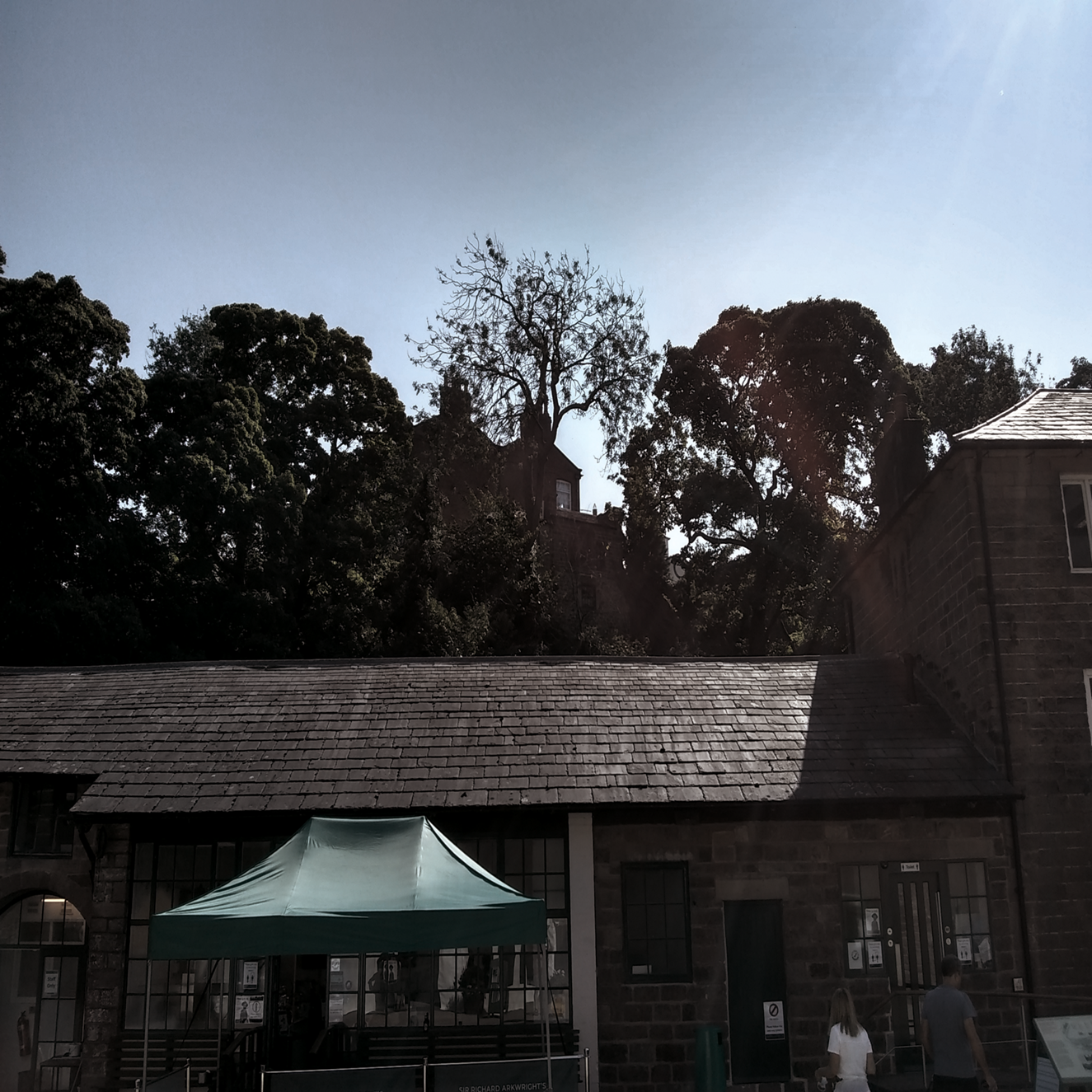
Equally, however, it was a space where retention of the labour force was vital. Given the growth of capital, the workforce’s environment could now be enhanced through the construction of living and community spaces for them and their families. Initially, twenty-seven cottages were built in 1776 in North Street, each with living room, bedroom, and attic.Footnote 55 More cottages, a chapel, a market square, and the Greyhound Inn were built in subsequent years to provide community facilities within this philanthropic space. The creation of educational space, although an important development, was limited to Sunday school attendance, which Arkwright established at Cromford in 1785. This school, as the Manchester Mercury reported on 15 February 1785, was attended by 200 children, both boys and girls. The newspaper praised Arkwright for his ability to combine power and philanthropy: ‘Pleasing it is to the friends of humanity, when power like his is so happily united with the will to do good.’Footnote 56
Arkwright developed a disciplined, highly automated production space within his mills over time. However, it was not a consciously planned philanthropic space. This significant point is supported by the custodians of the Derwent Valley Mills website, which states, in relation to 1789, when Arkwright purchased the estate: ‘Nor is it possible until that time to discern any element of conscious planning in the community’s development.’Footnote 57
Just as Arkwright had done, Samuel Greg implemented the development of philanthropic space in stages, following the building of the mill at Quarry Bank in 1784. The first phase of development was slow, and little happened in the first twelve years.Footnote 58 Due to the remote location, Greg was reliant on parish apprentice child labour to supplement the local labour of women and children he was able to recruit. Social relations were characterized by discipline, just as at Cromford; this was exemplified by the bell tower, positioned on top of the mill (Figure 3). The bell rang at 5.00 am each day to proclaim the start of work at 5.30 am; any latecomers could be fined. The working day did not finish until 8.00 pm, inclusive of breaks.Footnote 59 The construction of a production space incorporating a cheap, largely reliable labour force of children made good business sense, ensuring a competitive edge in the market. By 1800 there were up to ninety parish apprentices – sixty girls and thirty boys – working in the mill, constituting around 50 per cent of the total labour force.Footnote 60
The bell tower on top of Quarry Bank Mill. Source: photograph by D. Yates, December 2020.

New markets and business success allowed for further investment and development to take place at Quarry Bank in 1796, with an extension to the factory, doubling its length, and the addition of a further storey. Greg’s businesses continued to prosper, so that by 1811 he had become very successful.Footnote 61 Consequently, a new four-storey mill was added in 1819, expanding production space. However, in the same year, the Cotton Mills and Factories Act, prohibiting children under nine working in mills, was enacted.Footnote 62 Greg now had to change his business strategy and, like Arkwright, but for different reasons, he sought to build a community in a developing philanthropic space to attract and retain a new labour force, which grew from 252 to 346 in the 1820s.
The provision of dedicated living space at Quarry Bank had begun in 1790, with the building of an apprentice house which was just a five-minute walk from the mill, and which provided food, clothes, and a bed in return for labour.Footnote 63 Significantly, it was here that Hannah Greg began to construct an educational space, outside of the daily twelve-hour grind of labour, to cultivate the minds of the children. Along with her own children, she developed a keen interest in the apprentices. Hannah Barker pointed out that one of the manuscripts written by Hannah Greg was entitled ‘Sermons for the apprentices’, which provided religious instruction from the Bible, imparting suggested lessons for life.Footnote 64 Life skills such as sewing and gardening were also taught.Footnote 65 Greg’s teaching of the apprentices, largely at weekends, started before the 1802 Factory Act made it a legal requirement to provide daily learning. Teachers were hired for weekday evenings, so that by 1806 they were teaching groups of boys on five or six nights a week.Footnote 66 It is notable that, even though girls were the larger element within the child labour force, it was boys who were provided with evening classes, in line with gendered expectations at the time. As Humphries found, it was usually boys and young men, despite the hard, long hours of labour, who could take advantage of any available education to improve themselves during the industrial revolution. Schooling had to be cheap to make it affordable for the working classes.Footnote 67 Through Hannah Greg’s work, the provision of welfare in the form of the discipline of education became central to the development of philanthropic space at Quarry Bank.
Samuel Greg’s desire to develop a production space with a healthy labour force was enhanced by his purchase of Oak Farm in 1802, at the hamlet of Styal, near the mill. This subsequently provided meat, grain, vegetables, and dairy products for his workers. The construction of living space expanded rapidly in the 1820s; by 1822 forty-two new houses had been built on Greg’s land near Oak Farm, providing comfortable living space with two bedrooms, parlour, back kitchen, yard, and the benefit of a garden.Footnote 68 Francis Collier argued that there were advantages for Greg’s workers, with life in Styal offering ‘pleasant surroundings … steady work and social ties formed by living in a small self-contained community’.Footnote 69 In contrast, in 1795 the operatives of McConnel and Kennedy lived in the centre of industrial Manchester in back-to-back houses where water was carried from wells, there was no garden or yard, and heaps of refuse were left on unpaved streets. Here, disease and fever were prevalent.Footnote 70
Other social spaces created in Styal in this period included a chapel, a shop, and a village school, which was built in 1823. Hannah Greg’s effect on the welfare of the community was also evident in her support of the women’s club (which began in 1816), the sick club (established in 1817), and the female society (launched in 1827).Footnote 71 While legal changes to child labour had an impact on the planning and development of philanthropic space, her influence in the promotion of the physical and mental welfare of both the apprentices and the developing community had a significant bearing on the construction and modification of social relations within space and over time.
Yet the protracted and fragmented development of philanthropic space at Quarry Bank stands in contrast to the carefully planned range of philanthropic spaces that populated Saltaire from its inception. Titus Salt built the mill at Saltaire in 1853 and immediately began the development of a planned philanthropic space, which took shape over the next twenty years or so. Its deliberately planned nature is evident from an article in the Bradford Observer dated 1 March 1855, only two years after the mill’s opening, and based on a factory inspector’s report of 20 December 1854. The article described how ‘a town will be erected for the accommodation of the factory hands and their families, which it is calculated will form a population of at least 8,000 persons’. It stated that the town would be provided with water and gas services and would contain a church, schools, a public dining hall and kitchen, baths and wash houses, and a recreation ground.Footnote 72 Moreover, the design was to comply with Salt’s instruction for housing and facilities, which would promote a happy and contented labour force.
The mill itself represented the construction of a huge industrial production space which combined most manufacturing processes on one site and was designed to provide work for around 3,000 people, producing 30,000 yards of cloth each day. It contained 1,200 looms in its weaving shed and was powered by four steam engines.Footnote 73 Workers benefited from welfare facilities such as well-ventilated and well-heated work rooms, a dining hall opposite the mill offices, and a sickness insurance scheme to which the firm contributed.Footnote 74
In compliance with the intended programme, the development of living space at Saltaire began almost immediately. By October 1854, 163 houses and boarding houses had been completed and 1,000 people were already living there.Footnote 75 Building continued progressively over the years until, by the 1871 census, there were forty shops serving a population of 4,300, who lived in 824 completed houses.Footnote 76 At the same time, Salt’s requirements for discipline and order were designed into the spatial arrangements at Saltaire and the development reinforced his presence and his values. The streets were arranged in parallel, with access to the main arterial Victoria Road which led to the mill, and were named after Salt and his family; and the Salt crest was positioned strategically over various buildings.
The implementation of discipline to stimulate self-improvement and mental well-being was also evident in the centrality of educational buildings within the geographic space of Saltaire. A new school building was opened on Whit Tuesday in 1868, and a report in the Bradford Observer dated 7 October 1868 stated: ‘Whatever art could invent, or money supply, has been brought together here; and every aid has been lent to the sacred cause of education that was possible to be obtained.’ The report mentioned that the schools were for boys, girls, and infants and were ‘without doubt, equal, if not superior, to any other schools in England’.Footnote 77 By 1874, there were 806 half-time pupils and 454-day scholars.Footnote 78 The development of educational space continued in 1869, with the completion of the institute, on Victoria Road (like the school), at a cost of £18,000, which was designed to provide for education and social functions.Footnote 79 Thus, Salt demonstrated his liberal reforming character by encouraging self-development through the discipline of education within philanthropic space.
Physical hygiene was also important to those like Salt who encouraged Victorian virtues; as dirt and disease induced moral depravity, counter measures had to be taken.Footnote 80 To that end, Salt built bath and wash houses in the village in 1863.Footnote 81 Furthermore, every house had its own privy in the back yard.Footnote 82 ‘But the greatest achievement yet accomplished at Saltaire remains to be mentioned’, according to the Bradford Observer report. This was the completion of forty-five ‘beautiful and commodious’ almshouses for poor widows, fatherless children, and old work people.Footnote 83 Although these private living spaces contrasted with the harsh non-segregated public spaces of the Poor Law Union workhouses, social control was often applied in their establishment.Footnote 84 Salt insisted that only those of ‘good moral character’ qualified for residence.Footnote 85 This planned philanthropic space encouraged discipline and order by design for the benefit of the business and the whole community. It also actively promoted physical and mental welfare to ensure a healthy, productive labour force. However, education was the fulcrum, enabling self-improvement in the period after Chartism.
Analysis of the spatial development of the three mills enables a comparison of the progressive construction of space for production and welfare purposes over time. Moreover, the geographic centrality of certain distinctive social spaces within each accentuates the focal point of welfare provision within the development of philanthropic space. These were individual spatial developments within a specific social context and time period, and Lefebvre has argued that every social space has a history which is unique, and specific characteristics which are the product of social activities.Footnote 86 Across the three sites, differing forms of welfare became central within the emerging philanthropic space: the market square with its inn and opportunity for fostering a sense of community-based provision at Cromford; the apprentice house at Quarry Bank, midway between the mill and the village of Styal, a space for active welfare of the child apprentices under the influence of Hannah Greg; and the elaborate, acclaimed educational buildings at Saltaire, which provided a vehicle for self-improvement and opportunity.
Improvement was not typical elsewhere in the textile industry. Robert Peel, a factory owner in Manchester, giving evidence to the select committee in 1816, believed that fourteen- or fifteen-hour days were too general and that only a small proportion of factory children in Manchester attended Sunday schools. Similarly, William Dean, a surgeon from Slaithwaite, who had practised for fifty years, reported that children in cotton factories suffer from ‘glandular’, ‘swellings of the extremities’, and ‘deformities of the spine, thorax, and lower extremities’. He believed this was due to protracted hard labour, heat, want of ventilation, and lack of opportunities for exercise.Footnote 87 Children were cruelly exposed in some factories to appalling working conditions, with little or no educational opportunity. Yet, as early as 1785, Arkwright had introduced a separate educational space for children within the community at Cromford in the form of a Sunday school, in line with their embryonic growth across the country. Thompson argued that Sunday schools were an essential part of the educational process to instil discipline into the labour force.Footnote 88 And Samuel and, particularly, Hannah Greg recognized that they had a moral and social duty to educate their apprenticed children in advance of legal obligations such as the Health and Morals of Apprentices Act 1802. Moreover, Hannah Greg pressed for and ensured the establishment of a school in Styal for the education of children and the local community.
Attitudes towards child labour were further challenged by the entrepreneurial philanthropist Robert Owen at his New Lanark Mills, when, in 1815, he established a policy whereby no child under the age of ten would be employed in the factory.Footnote 89 Elsewhere, it was not until the passage of the 1833 Factory Act that it became illegal for children under nine to work in textile factories; the act also stipulated that children had to be educated for two hours a day. Significantly, the effectiveness of the law was enhanced by enforcement through a salaried inspectorate.Footnote 90 Transformative ideas about the purpose of childhood were promoted in the early nineteenth century by educational reformers such as James Kay-Shuttleworth, who saw the creation and proliferation of schools as essential for both individual and societal improvement, against the backdrop of an increasingly decadent urban and industrial society.Footnote 91 Although education had to be paid for by hard-working families, working long hours, as West pointed out, the number of day schools in Manchester, for example, increased from only 95 in 1820 to 549 in 1834.Footnote 92 These changes can be seen as part of the process of industrialization, which Griffin argued expanded the mental horizons of many.Footnote 93 Titus Salt, following Owen’s model, and in accord with his liberal reformist values, made education of children and the community central to his plan for self-improvement within the disciplined, ordered, and planned philanthropic space at Saltaire.
III
To obtain a nuanced understanding of the extent and nature of philanthropy, and its effects, it is vital to consider the experience of people who worked and lived within these social spaces. This section considers the extent to which the experience of philanthropic space over time demonstrates active effort by the entrepreneurial owners to promote the physical and mental welfare of workers and their families within the context of the prerequisite concern for market competition and profitability. The importance of considering the experience of people in space was emphasized by Massey’s argument that it is people who actively form places, through daily negotiation and contestation; at the same time, their constituent identities are changed as specific practices develop within these places.Footnote 94 Discovering the voices of experience can be challenging for historians. This is particularly the case where those voices are sought from three relatively small places and within a limited time frame. Nevertheless, listening carefully to such accounts is vital to gain understanding of how people saw themselves in a changing world.Footnote 95
Physical and mental welfare was not the experience of many factory workers during the latter part of the eighteenth century. Indeed, as Robert Peel indicated to the select committee in 1816, quoting from a report considered by Dr Percival of the Manchester Board of Health on 25 January 1796, the experience of many labourers during that period was coloured by poor working conditions, lack of educational opportunities, and exposure to disease. At the same time, he noted, ‘It should be known to the Committee … the profits arising from the machinery of Sir Richard Arkwright were so considerable … the machinery was employed the whole four-and-twenty hours … you cannot work the children more than eleven hours, which is much less than they work at present.’Footnote 96
There were opportunities for workers to experience self-improvement within Arkwright’s new industrial workspace. Francis Stanley, who wrote a long, articulate letter to Arkwright’s son, also Richard, in 1795 asking for a review of his wages, described first-hand experience of working for the elder Arkwright. He stated that he had worked in the mills for between four and five years, before leaving to work in the mines for two years. He remarked that, while working in the mines, ‘if I should to meet him upon the road he frequently asked me if I was not tired of working at the mines, and whether I would not work for him again’. Stanley eventually relented, following various ‘promises’ by Arkwright, who said ‘he meant to do me good or else he should not have been at so much trouble about me’. Arkwright made him superintendent of Cromford mill for a short time before, following illness, ‘he said if I had rather be in the counting house’.Footnote 97
Archibald Buchanan was educated in the spinning business with Arkwright at Cromford in the 1780s. But by 1816, when he appeared before the select committee, he was ‘employed in the management of cotton mills in Scotland’. He recounted children working at Cromford and experiencing the demands of a twelve-hour day, six days a week, in what was a twenty-four-hour operation.Footnote 98 These were children of local families, as Arkwright did not employ parish apprentices. However, he did employ people as apprentices in various trades, as his advert from the Derby Mercury in 1781 confirmed: ‘Boys and young Men may have Trades taught them’. Indeed, in that year, Cromford had fifty-four apprentices, its highest ever number.Footnote 99 Simeon Cundy told the factory commission enquiry of 1833 that he was employed from six years old at Arkwright’s Bakewell factory, served a seven-year apprenticeship, and eventually left in 1793 to become a manager at William Young’s mill in Manchester.Footnote 100 The Bakewell mill was part of the expanding Arkwright empire, and the labour force experienced similar welfare benefits there, such as the substantial cottage houses built in 1782.Footnote 101 Thus, despite the demanding working conditions, there were opportunities for people to demonstrate agency and experience self-improvement within philanthropic space.
The welfare and condition of the labour force of children can be gleaned from The Farington diary. Farington was a leading landscape artist who toured Britain and wrote his famous diary between 1793 and 1821. On 22 August 1801 he described children coming from their work at the end of the day: ‘I was glad to see them look in general very healthy and many with fine, rosy, complexions.’Footnote 102 This suggests that the children’s experience of disciplined social space was not discernibly detrimental to their health and physical condition.
Beyond the mill gates, the experience of living in Cromford did, from 1785, include an element of education for children. During his visit, Farington visited the church at Cromford, where he found a gallery of about fifty boys seated. He wrote: ‘These children are employed in Mr. Arkwrights work in the week-days, and on Sundays attend a school where they receive education. They came to Chapel in regular order and looked healthy & well & were decently cloathed & clean.’ Farington pointed out that both boys and girls attended chapel and school on a Sunday and that ‘The whole plan appears to be such as to do Mr Arkwright great credit.’Footnote 103 These children were now in receipt of an elementary education, which was at a premium in the late eighteenth and early nineteenth centuries. Humphries argued that a Sunday school education helped to maintain standards while eliminating opportunity costs, such as lost family income from a child’s earnings, for the working classes.Footnote 104 It provided an opportunity for self-improvement at Cromford as children engaged with the discipline of regular attendance within philanthropic space.
Expressions of community and celebration were central to the experience of philanthropic space at Cromford. Annual ‘candle-lighting’ festivals were held, as that in 1776 for example, involving parades round the village and a feast which included buns, ale, nuts, and fruit, with music and dancing.Footnote 105 The village market was held in the village square, which was overlooked by the imposing Greyhound Inn (Figure 4). The square provided a central, community space which at times was filled with celebrations such as the annual prize giving for the best trader. The inn, built by Arkwright, not only represented a symbol of his wealth, power, and control but was also a philanthropic space where his workers experienced balls that were held to celebrate their achievements.Footnote 106 A culture of paternal acceptance and appreciation was evident in local verse attached to the inn door:
The village square at Cromford, with the Greyhound Inn in the background. Source: photograph by D. Yates, September 2020.

In contrast with the family-centred labour force at Cromford, the one at Quarry Bank, at least in the early years, was almost exclusively based on the parish apprentice system. Analysis of indentures aids understanding of the working conditions which children experienced. The agreements committed children to a twelve-hour working day, six days a week, and therefore a minimum seventy-two-hour week. One example, dated 10 January 1785, concerns the employment of three girls who may have been sisters: Mary, Ann, and Sarah Lea from Ringway. The incentivized contract was for a three-year term; each was to be paid four shillings per week in the first year rising on a scale to five shillings per week in the last year. Significantly, if they ‘Behaves whell and mind theare work during the term of three years that the[y] are to have 5/6 p week the last Half year’.Footnote 108 Another indenture, dated 20 October 1790, concerned John Owen of Nantwich, whose terms reflected those of a parish apprentice. His wage was only one penny per week, but he was to be provided with ‘meat, drink and apparel’.Footnote 109 Discipline was a fundamental characteristic of social relations experienced by the workforce, and the indentures stated that, if workers were absent from work without consent, then wages may be reduced ‘in a double Proportion’.Footnote 110 As at Cromford, these were long, hard days in a noisy, grimy, and dangerous environment.
Experience of philanthropic space did not deter some who, for whatever reason, wished to escape and explore the world beyond. They were willing to demonstrate agency and break their contract. The absconder Thomas Priestley’s statement to magistrates included the words: ‘I had no reason to be dissatisfied with my situation … I have been in Town 5 weeks in Hackney workhouse, and am very willing to go back again.’Footnote 111 This suggests that he may have thought the philanthropic space at Quarry Bank was not necessarily a bad future prospect. However, it is recorded that more than a hundred children ran away from Quarry Bank between 1785 and 1847, and thirty of these were never heard of again.Footnote 112 This number of absconders can be measured against a total number of about a thousand apprentices who worked at the mill in this period; 10 per cent is not an insignificant proportion.Footnote 113 Although power within social relations of space was in the hands of those who had the greatest power of access and exclusion, relationships could be contested.Footnote 114
Following a long day at the mill, the children would walk back to the apprentice house (Figure 5). Living conditions there are described by Thomas Priestley and Joseph Sefton, aged thirteen and seventeen respectively, in their testimonies after they ran away from Quarry Bank in the summer of 1806. Sefton described how the girls and boys slept in separate rooms that ‘were very clean the floors frequently washed the rooms aired every day white washed once a year our beds were good we slept two in a bed and had clean sheets once a month’. They were provided with clothes for work and enjoyed a diet which included bread, porridge, milk, meat, potatoes, and vegetables.Footnote 115
The apprentice house at Quarry Bank. Source: photograph by D. Yates, December 2020.

Welfare in the form of education became an increasingly prominent aspect of the experience of philanthropic space at Quarry Bank. Sefton, for example, evidently valued school, which was provided in the evenings and on Sundays, but was prevented from attending more often by the overseer: ‘I wanted to go oftener to school than twice a week including Sundays but Richard Bamford would not let me go’.Footnote 116 Although market demands of the mill seem to have conflicted with the welfare of the young labourer, this is evidence that practices of place can change people and their aspirations, as Massey has argued.Footnote 117 Quarry Bank was a disciplined, tightly controlled space, yet the children and young people did experience attention to their welfare within the living space of the apprentice house, while education began to gradually have an impact on their identities and ambitions.
Discipline, hard work, and opportunity for improvement were equally characteristic of the experience of philanthropic space at Saltaire, sixty-five years later, although on a different scale. Charles Dickens Junior visited Saltaire in January 1871 and explored the huge, noisy, industrial mill space. He concluded with this assessment of the labour force: ‘All looked prosperous and happy, and so properly do the colonists appreciate their good fortune.’Footnote 118 He wrote that ‘colony’ was a better word than ‘factory’ to describe Saltaire because it ‘deserves the grander name’; its use here appears to reflect a cultural association with Britain’s imperial endeavours.Footnote 119 This was a generally loyal, stable workforce: of 450 families living in Saltaire in 1861, more than 40 per cent were still there a decade later.Footnote 120
A glimpse of the experience of living and working within the philanthropic space created and developed by Titus Salt, albeit several decades later, is provided in the booklet Saltaire: our memories, our history. Until 1921–2, there was still a cultural expectation that a twelve-year-old child would work in the mill under the half-time system. Bessie Burke recalls how, as a twelve-year-old in 1918, she left full-time education to work at the mill and ‘go half-time’ because ‘Everyone went. It were a way of life.’ While working at the mill in the morning and going to school in the afternoon was an expected spatial practice, there was some resistance, as ‘teacher naturally didn’t want you to go half-time’.Footnote 121 Yet Bessie, who spent ‘56 years working for Salt’s’, wrote that she ‘really enjoyed it’ and ‘never altered my liking for it’.Footnote 122 Nellie Holdsworth recalls ‘feeling really frightened’ on her first day as a spinner but ‘as the day wore on I think I began to shape a bit’.Footnote 123 Jessie Blenkinsop worked in the spinning department, ‘graduating from a bobbin ligger to a fully-fledged cap spinner’.Footnote 124 There was continuity of employment and also opportunity for advancement. James Rushton started as a wool sorter working for Salt in 1834, but by 1871 he was manager of the wool sorting department, and he achieved fifty years’ service in 1884.Footnote 125 People were encouraged to improve themselves through discipline and hard work.
These cultural values, it can be argued, were inculcated simply through the experience of living in Saltaire. The space was educational in that the mill and its output provided a sense of purpose. Equally, meritocracy was promoted by the establishment of distinct types and sizes of houses according to status. But, above all, the educational facilities of the schools and the institute encouraged people to experience progress in their lives. Dickens wrote: ‘We have seen how the children are taught and reared, and how admirably the bodily and mental welfare of the adult population is looked after at Saltaire.’Footnote 126 Furthermore, the expanding educational experience within philanthropic space was evident in 1875, as both art and science subjects were taught at the institute and, during the day, works produced by the art students were on display. The results of the science examinations that year had been very encouraging: twenty-six students had passed first class and gained Queen’s prizes, compared with thirteen the year before.Footnote 127
Experience of philanthropic space at Saltaire also included community-based events, such as the annual Saltaire horticultural and pig show.Footnote 128 Musical concerts were another feature, attended by a ‘large and fashionable audience’.Footnote 129 Indeed, it was ‘the social events that made Saltaire such a memorable place to grow up in’.Footnote 130 The factory worker Lilian Binns remembered the annual conversazione in the Victoria Hall: ‘I used to enjoy going to the Conversaz … It was the event of the season, was the Conversaz.’Footnote 131 People engaged with these cultural activities as they sought opportunities to enhance their lives and build their community.
Self-development activity and achievement necessitated discipline, which was always a fundamental ingredient of the experience of living in Saltaire. Extracts from the park rules issued in 1871 showed that no ‘intoxicating’ drinks were to be consumed; no music, singing, or public meetings were allowed ‘without written sanction of the Firm’; and no games were allowed, except on the cricket ground and bowling greens.Footnote 132 Susie L. Steinbach has argued that parks were perceived as a green space with health benefits but also a space of discipline, whereby middle-class values and behaviours could be transmitted to the working classes.Footnote 133 Yet, although many things made ‘Saltaire special’ for people living and working there, for Ken Bell, the cricket club, formed in 1864, won ‘first prize’.Footnote 134 People like Ken were involved in shaping and building a thriving, aspirational, disciplined, and settled industrial community. However, the adoption of both individual and communal discipline was an essential ingredient for maintaining physical and mental well-being, as people negotiated with written and unwritten rules within philanthropic space.
The idea of labourers enjoying self-determination was similarly addressed by Griffin, who argued that, although the experiences of men, women, and children in the industrial revolution were diverse, and less advantageous for women and children, autobiographers saw themselves as in control of their destiny. Moreover, the industrial revolution was the beginning not of a ‘darker period’ but of the ‘dawn of liberty’.Footnote 135 Griffin argued that the poverty and misery of the autobiographer John Lincoln were caused by the lack of industry in rural Suffolk and Norfolk where he lived.Footnote 136 However, industrialization has often been associated with poverty, disease, and moral deprivation. Thompson, for example, described the new cotton mills as ‘centres of exploitation, monstrous prisons in which children were confined, centres of immorality and of industrial conflict’.Footnote 137
The experience of some in factory production spaces may support Thompson’s argument. Honeyman, for example, has described how the lives of parish apprentices at the George Merryweather mill in Burley in Wharfedale deteriorated significantly due to the firm’s financial difficulties, following its relocation to Manchester in 1810.Footnote 138 Changing market conditions thus affected and altered the social space of production. The effect was seen in the declining physical and mental welfare of the child labour force. These experiences were not unique. Table 2 shows that children were widely employed in other industries, and that working between twelve and fifteen hours a day was common practice.
Hours of work of trades and employment of children, c. 1819

Source: Matlock, Derbyshire Record Office, D978/MB/16, table 34.
In contrast, the philanthropic spaces at Cromford, Quarry Bank, and Saltaire were the product of largely successful businesses with dominant market positions and profitable results. The experiences of people working within these disciplined social spaces show that attention to physical and mental welfare was received across time and space. The changing relationship between child labour and education of children illustrates a progressive transformation. Indeed, as Nicola Whyte has argued, social and cultural processes of work evolve over time.Footnote 139 Moreover, the mills within these three philanthropic spaces, although demanding discipline and hard work, could not be likened to Thompson’s description of some mills as ‘monstrous prisons in which children were confined’.Footnote 140
People living and working in these philanthropic spaces were not simply passive but were active in the production of space, as they shaped their communities with their village markets, celebrations, schools, annual shows, conversaziones, and sporting activities. As Whyte argued, places are produced through multiple contingent social processes, and people participate in their production.Footnote 141 Moreover, as Griffin asserted, industrial growth did provide opportunities for those at the bottom of the social pile.Footnote 142 In these mill communities, as they engaged with the expected discipline, they experienced both increasing opportunities for self-improvement, particularly within educational spaces, and better living and working conditions.
IV
This article has shown how entrepreneurial philanthropy at Cromford, Quarry Bank, and Saltaire mills, with its new social relations, was influenced by both market competition and philanthropy to the extent that active welfare provision was dependent on profitable enterprise and creation of wealth. There was discontent among the working classes during the industrial revolution, but the creation, development, and experience of philanthropic space enabled capital and welfare to co-exist successfully, with mutually beneficial effects for mill owners and labourers.
Richard Arkwright and Samuel Greg both had limited funds initially, meaning that their business plans developed gradually. On the other hand, Titus Salt had the capital to invest in a planned philanthropic space at the outset. Moreover, it could be argued that Salt, through deliberate intent, at fifty years old became an entrepreneurial philanthropist, whereas Arkwright and Greg perhaps could be better described as philanthropic entrepreneurs.
A solution to the ‘Condition-of-England question’ for Carlyle was ‘universal education’.Footnote 143 This article has suggested that the discipline of education provided an opportunity for self-improvement in these philanthropic spaces. Moreover, it has demonstrated the gradually transforming role of children both within these communities and in the broader population. Indeed, as Humphries pointed out, child labour declined from the mid-nineteenth century, and changing social norms increasingly recognized the important association between the schooled child, later working, and working-class respectability.Footnote 144
Arkwright, Greg, and Salt were first and foremost businessmen who took commercial risks with the market in the textile trade and had great success. While inculcating a culture of discipline and control, they all actively promoted the physical and mental welfare of their labour forces, with unique effects in space and time. As people within these communities participated in the production of philanthropic space, they experienced opportunity for self-improvement.
Acknowledgements
The author is grateful to the anonymous reviewers for their expert comments and suggestions, enabling revision of this article, and to Dr Elodie Duché and Dr Gary Rivett at York St John University for their earlier reviews, along with helpful comments. The author is also appreciative of the work of Dr John Gallagher and the editorial team at the Historical Journal.
Competing interests
The author declares none.



