Throughout the world, interest groups attempt to influence policy making though a wide variety of activities. Popular strategies include lobbying legislators and bureaucrats, drafting policies, testifying at hearings, donating to political campaigns, mobilizing voters, working with political parties, and organizing protests (Baumgartner and Leech Reference Baumgartner1998, 152; Beyers, Eising, and Maloney Reference Beyers2008). Often forgotten in this mix is the role that organizations play in the legal system. Indeed, rather than being above the political fray, research indicates that courts often serve as battlegrounds in which opposing interests attempt to etch their policy preferences into law, whether that be through direct litigation or by injecting their perspectives as amici curiae or interveners (Truman Reference Truman1951; Vose Reference Vose1958; Scheingold Reference Scheingold1974; Handler Reference Handler1978; Harlow and Rawlings Reference Harlow1992; Brodie Reference Brodie2002; Cichowski Reference Cichowski2006; Collins Reference Collins2008; Kochevar Reference Kochevar2013).
This research addresses the latter litigation strategy, examining the levels of amicus curiae and intervener participation in 11 high courts (courts of last resort) throughout the world from 1969 to 2002. Through these third-party briefs, interest groups that are not direct parties to litigation are enabled to advocate for their causes, thus providing a mechanism for organized social movement input into the legal system.Footnote 1 Our theoretical approach is institutional in its nature in that we are concerned with how “institutions both constrain and enable behavior” (Hodgson Reference Hodgson2006, 2). The novelty of our approach is to explore organized litigation in a cross-national context, which allows us to see variation in institutional features such as bills of rights, judicial review, and court rules and examine empirically how these features influence the level of third-party briefs. Institutional features such as these have been cornerstones of the constitutionalization that has taken place in both civil and common law countries over the past 30 years and have played an important role in the creation of a “juristocracy,” in which the judiciary, in particular high courts, plays an increasing role in politics and policy making (Hirschl Reference Hirschl2004). Our findings reveal that the level of third-party briefing is indeed shaped by the institutional elements of the courts and nations in which the litigation takes place. This research thus contributes to the extensive debates about how institutional design affects the behavior of legal and political actors (e.g., March and Olson Reference March1984; Hodgson Reference Hodgson2006) and shows the fruitfulness of studying these issues cross-nationally.
We are motivated to conduct this comparative investigation into the levels of amicus and intervener participation for a variety of reasons. First, this research sheds new light on where and why interest groups turn to the courts in their efforts to influence policy change. Though there has been a great deal of research investigating why, and to what effect, interest groups utilize amicus curiae and intervener briefs, this literature focuses almost entirely on American and Canadian courts (e.g., Krislov Reference Krislov1963; Brodie Reference Brodie2002; Hansford Reference Hansford2004; Collins Reference Collins2008; Alarie and Green Reference Alarie2010). As a result, our knowledge of interest group litigation via third-party briefs is limited by the extent to which we can generalize from these two cases.Footnote 2 Rather than focus on a single court in a lone country, we provide a first-of-its-kind multinational investigation of third-party briefing in 11 high courts across 10 countries in an attempt to provide a broader view of interest group engagement with the judicial system.
In so doing, this research also has the potential to inform our understanding of legal development from a comparative perspective. Though scholars continue to debate the effectiveness of litigation as a means to foster social change (Scheingold Reference Scheingold1974; Handler Reference Handler1978; Rosenberg Reference Rosenberg1991), the fact remains that there is evidence that third-party briefs have played a significant role in shaping judicial outcomes (Brodie Reference Brodie2002; Collins Reference Collins2008; Alarie and Green Reference Alarie2010). For example, in one of the few studies of third-party briefs outside of the American and Canadian contexts, Heywood (Reference Heywood2001) demonstrates how the Treatment Action Campaign, as amicus curiae, successfully opposed the efforts of the Pharmaceutical Manufacturers’ Association to challenge the South African Medicines Act, which was intended to make medications more affordable. By providing an initial look into interest group engagement with the high courts in 10 nations, this research can be used to motivate future studies of group effectiveness by illuminating where, and under what conditions, organizational litigation is most commonly observed.
Finally, this research provides additional insight into democratic influences on electorally insulated judiciaries. As with most national high courts (Driscoll and Nelson Reference Driscoll2015), all of the judges in the courts under analysis here are appointed, not elected, which frees them from direct electoral accountability. While such selection systems have the potential to result in counter-majoritarian rulings (Bickel Reference Bickel1962), one mechanism that ensures democratic input into such judiciaries is third-party briefs (Garcia Reference Garcia2008). Through these instruments, electorally insulated judges become the recipients of a wide range of information that both supports and challenges the existing status quo. Frequently, this information provides judges with alternative perspectives on case outcomes, including how their decisions will affect those beyond the direct parties to litigation (Collins Reference Collins2008). Though the presence of these briefs does not guarantee democratically accountable decisions, amicus and intervener briefs have the potential to improve the quality of judicial decision making by enabling judges to consider a wider range of perspectives in their deliberations than those presented by the litigants. Additionally, the regular circulation of ideas and jurisprudence among high courts means that this input may have even more far-reaching effects than in a single national context (Slaughter Reference Slaughter1994).
In the section that follows, we provide a brief discussion of the third-party briefs under analysis. Next, we provide our theoretical expectations for understanding variation in the levels of third-party briefs, focusing on how the presence or absence of various institutional features of courts and nations is predicted to shape the levels of third-party briefing. Subsequently, we describe the data and methods used to examine group litigation, followed by a presentation of our empirical results. We close with a discussion of the implications of this research for understanding organized litigation.
Third-Party Briefs
The interest group briefs under analysis here take a single form but are referred to by two different names in the courts included in our sample. Several courts, including the South African Constitutional Court and the US Supreme Court, refer to third-party briefs as amicus curiae briefs, which is the Latin for “friend of the court” (Krislov Reference Krislov1963). Other courts, including the Canadian Supreme Court and the UK Appellate Committee of the House of Lords, refer to third-party briefs as intervener briefs. Note that these briefs are functionally equivalent to one another across the courts in our sample.Footnote 3 Under either name, these briefs allow interested entities who are not direct parties to the litigation to inform the court of their interest in the case, take a position as to its outcome, and present persuasive argumentation supporting their preferred position.
The practice of third-party participation in courts is an old one, with its roots in Roman law. In its original form, amici were typically courtroom observers without a direct stake in the outcome of a case. In an effort to aid judicial bodies in avoiding erroneous decisions, these third parties would occasionally provide judges with their expertise, such as information about the death of a party, evidence of collusion, or new legal developments (Krislov Reference Krislov1963; Angell Reference Angell1967). This often took the form of extemporaneous oral communication or nonbinding written opinions (Harris Reference Harris2000, 4). As the law moved away from being conducted primarily via oral communication to utilizing the written word, so too did the involvement of third parties in litigation (Collins Reference Collins2008, 38). In contemporary times, nonparties with an interest in the outcome of a case participate by filing amicus curiae or intervener briefs. This can occur separate from or in coordination with the parties to litigation (e.g., Larson and Devins Reference Larson2016).
Through these briefs, interest groups can supply judges with a wide array of information. For example, organizations can provide citable legal authorities not addressed by the parties to litigation, alternative interpretations of the facts surrounding a dispute, treatments of relevant statutes and case law, discussions of the broader policy implications of a decision, and scientific information regarding the outcome of a case (Brodie Reference Brodie2002; Collins, Corley, and Hamner Reference Collins2014). From the standpoint of the interest group, the primary purpose in providing this information is to obtain an outcome consistent with the group’s overarching policy goals (Hansford Reference Hansford2004; Collins Reference Collins2008, 28–35). Thus, far from being neutral advisors, interest groups use third-party briefs to further the legal and policy goals of the organization.Footnote 4
Explaining the Levels of Third-Party Briefs
Our general theoretical framework posits that groups utilize third-party briefs in an effort to influence judicial decisions and address organizational maintenance concerns and will base their decisions to file on the institutional features of the courts and nations in which the litigation takes place. Amici and interveners can look to these features to determine whether the presence or absence of certain institutional elements will maximize their ability to influence policy (e.g., March and Olsen Reference March1984; Hodgson Reference Hodgson2006).Footnote 5 In addition to this, organizations can leverage third-party briefs to address organizational maintenance (e.g., Walker Reference Walker1983; Hansford Reference Hansford2004; Solberg and Waltenburg Reference Solberg2006). That is, by filing amicus or intervener briefs, groups can demonstrate to their members, patrons, and other constituencies that they are active on important matters of public policy. This can help them maintain their support base while attracting additional support from those outside of the organization. Though organizational maintenance is primarily a concern of membership-based groups (Hansford Reference Hansford2004), other types of organizations, such as corporations or regional governments, might also consider how filing third-party briefs can garner added support for their causes.
Given this theoretical framework, we believe that we will observe higher levels of third-party briefs when the institutional environment is favorable for influencing policy and maintaining or expanding organizations’ bases of support. To the extent that groups believe that the institutional environment is favorable for influencing policy and organizational maintenance, we expect to see higher levels of third-party briefing. Conversely, if groups believe that the institutional environment is not ripe for affecting policy change or organizational maintenance via amicus or intervener briefs, we believe that there will be lower levels of third-party briefing as groups will pursue other strategies in the pursuit of their policy and maintenance goals.
We begin our analysis with a consideration of whether the high courts under examination have the power of judicial review. The ability of courts to hold the actions of other branches of government unconstitutional (and therefore unenforceable) has expanded in recent years with the constitutionalization of rights and the establishment of stand-alone constitutional courts in countries around the world (Schor Reference Schor2008). Armed with the power of judicial review, these high courts have made far-reaching decisions affecting the separation of powers, executive authority, and rights enforcement (Hirschl Reference Hirschl2002). Scholars see judicial review, on the one hand, as an important way to hold the executive and legislative bodies accountable to the constitution and as a significant counterweight to protect minority rights. On the other hand, scholars have long worried that giving so much power to unelected decision makers can result in counter-majoritarian decisions and politicization, while not necessarily ensuring that judges make better decisions than their legislative counterparts (compare, e.g., Waldron [Reference Waldron2006], Fallon [Reference Fallon2008], and Tushnet [Reference Tushnet2010]).
We speak to the ongoing discussion about the global expansion of judicial review (Hirschl Reference Hirschl2002) by investigating an additional reason why judicial review has the potential to be so powerful: its ability to encourage third-party participation in the legal system. We believe that high courts with the power of judicial review will attract more third-party participation as interest groups will perceive courts with this power as coequal policy-making institutions. By participating in these courts, groups can pursue both their policy and organizational maintenance goals since these courts adjudicate high-profile cases with potentially large public policy implications. These courts are likely to be viewed as particularly important venues for mounting challenges and defenses to policies that originated in another branch of government because their decisions can constrain, or outright overrule, the actions of the other branches of government (Olson Reference Olson1990). In this way, groups might view high courts with judicial review as important venues for protecting gains won in the legislative or executive branches or as significant venues for challenging their opponents’ victories in those institutions (Collins Reference Collins2008, 22). In contrast, courts without the power of judicial review might be less attractive institutions since organizations lack the opportunity to mount challenges to, or defenses of, executive or legislative achievements. Accordingly, we expect to observe higher levels of third-party briefs in courts with the power of judicial review.Footnote 6
We are also interested in examining how the rules governing third-party briefing relate to the levels of interest group engagement with courts. This allows us to contribute to the enduring debate regarding the extent to which formal rules shape the behavior of legal actors (e.g., Frank Reference Frank1930; Hart Reference Hart1961; Friedman Reference Friedman1967; Sunstein Reference Sunstein1995). On the one hand, some argue that legal rules are highly significant because they serve to direct and constrain the behavior of legal actors, thus limiting or enabling certain types of behavior. On the other hand, rule skeptics argue that the effect of legal rules is more limited, particularly as the “rules on the books” are sometimes ignored or inequitably enforced (e.g., Pound Reference Pound1910; Friedman Reference Friedman1967). Our analysis allows us to wade into this debate by considering the extent to which interest group engagement with the judiciary is shaped by the formal rules governing their involvement.
The primary distinction pertaining to the rules for third-party briefing in the courts under analysis here involves whether the potential third parties must initially obtain the consent of the court or the consent of the parties to participate. Those courts that require the potential amicus or intervener to obtain the permission of the judges (or a subset of judges) are argued to have more restrictive requirements for two reasons (Corbally, Bross, and Flango Reference Corbally2004). First, by requiring potential third parties to obtain the permission of the court, judges might closely scrutinize the briefs to determine if they add anything of value to the litigation. If it is determined that they do not, judges might deny permission to file (Collins Reference Collins2008, 41–45; Alarie and Green Reference Alarie2010). Second, rules requiring the consent of the court to participate authorize a single actor to limit participation with no opportunity to appeal that actor’s judgment. In other words, there is no recourse if a court denies permission to file: the potential third party simply cannot participate (Corbally et al. Reference Corbally2004).
In contrast to this, several courts in our sample use a two-step rule to determine whether a third party can participate. Initially, the potential amicus or intervener must obtain the permission of the parties. If both parties consent, then leave to file is automatically granted. If, however, one or both of the parties deny permission to file, then the third party can seek out the permission of the court to file. Compared to rules in which the permission of the court is absolutely required, this is a less restrictive filing requirement since it does not require judges to scrutinize all applications and authorizes the use of an additional actor (the court) to prohibit or allow participation if permission of the parties cannot be obtained. Moreover, this rule takes the initial burden of granting leave to file off of the judges, which reduces their workload, while at the same time making the court appear more welcoming to potential third parties (O’Connor and Epstein 1983). Given this, we expect to observe higher levels of third-party briefs in courts that initially require party consent for participation.
We also believe that interest group litigation will be affected by the types of cases on a court’s docket. To be sure, the dockets of the courts under analysis here vary substantially. Some courts, such as the Philippine Supreme Court, are very accessible to the public at large and thus hear a large proportion of cases involving routine criminal appeals and private economic matters (Haynie Reference Haynie1994). Other courts, such as the US Supreme Court, are far less accessible to the general public since they are very selective in the types of cases they hear and tend to focus on highly salient civil rights and liberties cases (Spaeth Reference Spaeth2007). Because interest groups are primarily concerned with influencing the broad public policies announced by courts in their opinions (Hansford Reference Hansford2004; Collins Reference Collins2008, 28–35), they may be less interested in participating in courts that primarily decide more routine matters that may not implicate those beyond the direct parties to litigation. Moreover, participating in judiciaries that handle high-profile cases also enhances organizations’ ability to maintain and expand their bases of support since more routine cases are not likely to be on the radar of the public.
Consequently, we expect that courts that hear a relatively large number of civil rights and liberties cases will be viewed by potential third-party interveners as broader public policy-making institutions and thus more attractive venues for pursuing interest group goals. Moreover, while interest groups specialize in a wide array of issue areas—including criminal, economic, and technological matters—a large proportion of organizations are specifically interested in using the courts in pursuit of rights claims (Epp Reference Epp1996, Reference Epp1998). To do this, it is essential that courts hear a sufficient number of rights claims to make their participation worthwhile. Thus, we expect to observe higher levels of third-party briefs in courts with relatively large civil rights and liberties dockets.
In addition to these court-specific factors, we also examine two country-level features in our analysis: the presence of a bill of rights and whether the country’s political system operates in a federal structure. Investigating the relationship between the levels of interest group litigation and the existence of a bill of rights allows us to inform the debate regarding the extent to which bills of rights promote legal mobilization (e.g., Epp Reference Epp1996, Reference Epp1998; Urribarri et al. Reference Urribarri2011; Songer, Johnson, and Bowie Reference Songer2013). On the one hand, there is evidence that rights litigation increases after the adoption of a bill of rights, suggesting that bills of rights can have a direct effect on group litigation (Urribarri et al. Reference Urribarri2011; Songer et al. Reference Songer2013). On the other hand, the extent to which a bill of rights increases organizational litigation might be limited by the existence of a support structure for legal mobilization (Epp Reference Epp1996, Reference Epp1998). That is, rather than having a direct effect on rights litigation, the extent to which bills of rights influence rights litigation might be dependent on the ability of rights-oriented litigants to use the courts in an effort to influence social change.
We contribute to this debate by examining whether a bill of rights increases the levels of third-party briefing. A bill of rights acts as a formal institutional structure that interest groups can mobilize around, and indeed, studies show that organizations often base their rights claims on provisions contained in a bill of rights (e.g., Brodie Reference Brodie2002; Collins Reference Collins2008, chap. 3). In essence, a bill of rights provides a basis from which interest groups can organize their litigation campaigns and press for social reforms. Conversely, interest groups operating in countries that lack a bill of rights are compelled to turn to other, typically more narrow, foundations for their lawsuits, or might avoid litigation altogether and instead seek policy change in legislatures (Morton Reference Morton1987). Thus, a bill of rights provides a broad footing from which a variety of interest groups can litigate rights claims. Accordingly, we expect to observe higher levels of third-party briefs in countries that have a bill of rights.
Finally, we explore the extent to which interest group litigation varies depending on whether the country functions in a federal system. In countries operating in a governmental structure in which power is shared between a national unit and subnational governments, it is common for interest groups to mobilize at both the subnational and national levels and press their claims at both levels of the judicial system (e.g., Epstein Reference Epstein1994). In such systems, disputes between different governmental levels are often adjudicated by the national court of last resort (Jackson Reference Jackson2004). As a result, high courts are given substantial policy-making authority over not just national politics but also subnational politics. Because they arbitrate national and subnational disputes, these courts attract some organizations that are primarily national in scope and others that are primarily subnational in scope. Moreover, it is not uncommon for representatives from subnational governments to mobilize and file third-party briefs to make their interests known to the high court (e.g., Gleason and Provost Reference Gleason2016). Thus, a wide range of third parties, including subnational interests, national organizations, and governmental units, are attracted to high courts operating in federal systems. Accordingly, we expect to observe higher levels of third-party briefs in federal countries.
Data
To investigate the levels of third-party engagement in various courts, we utilize data from the High Courts Judicial Database (Haynie et al. Reference Haynie2007). This database contains information on the decisions handed down by 11 high courts from 1969 to 2002 in 10 countries: Australia (High Court, 1970–2002), Canada (Supreme Court, 1969–2002), India (Supreme Court, 1970–2002), Philippines (Supreme Court, 1970–2002), South Africa (Supreme Court of Appeal, 1970–2002, and Constitutional Court, 1995–2000), Tanzania (Court of Appeal, 1983–98), United Kingdom (Appellate Committee of the House of Lords, 1969–2002), United States (Supreme Court, 1969–2002), Zambia (Supreme Court, 1973–97), and Zimbabwe (Supreme Court, 1989–2000).Footnote 7
These courts were chosen for inclusion for several reasons. First, they all operate in Anglo-American or common law legal systems and conduct their proceedings in English and therefore share a similar jurisprudential heritage.Footnote 8 Second, they all have a similar method for third-party participation in their cases via the amicus curiae or intervener brief. Third, they offer a good amount of variation on both the dependent and independent variables and thus provide an opportune set of judiciaries to examine differences in the levels of third-party briefing. Finally, because these courts constitute the sample of courts in the High Courts Judicial Database, future scholars can utilize intuitions gained from this study to pursue more in-depth analyses of interest group litigation in particular courts (or subsets of courts) included in this research.
Because our guiding theoretical perspective concerns the institutional features of the courts and nations under analysis, we are interested in the aggregate levels of interest group involvement in the form of amicus and intervener briefs. Accordingly, the unit of analysis is the court-year. This means that each observation corresponds to one of the 11 courts identified above for each year in which the court is included in the data.Footnote 9 To capture the levels of third-party engagement with these courts, the dependent variable measures the percentage of cases accompanied by amicus curiae or intervener briefs. This is a common and useful approach to operationalize the levels of interest group activity in that it represents how frequently organizations participate in the business of a court (e.g., O’Connor and Epstein 1983; Collins Reference Collins2008; Alarie and Green Reference Alarie2010). The percentage of cases with third-party briefs per court-year ranges from zero to 96, with a mean of 15.4 and a standard deviation of 24.9.
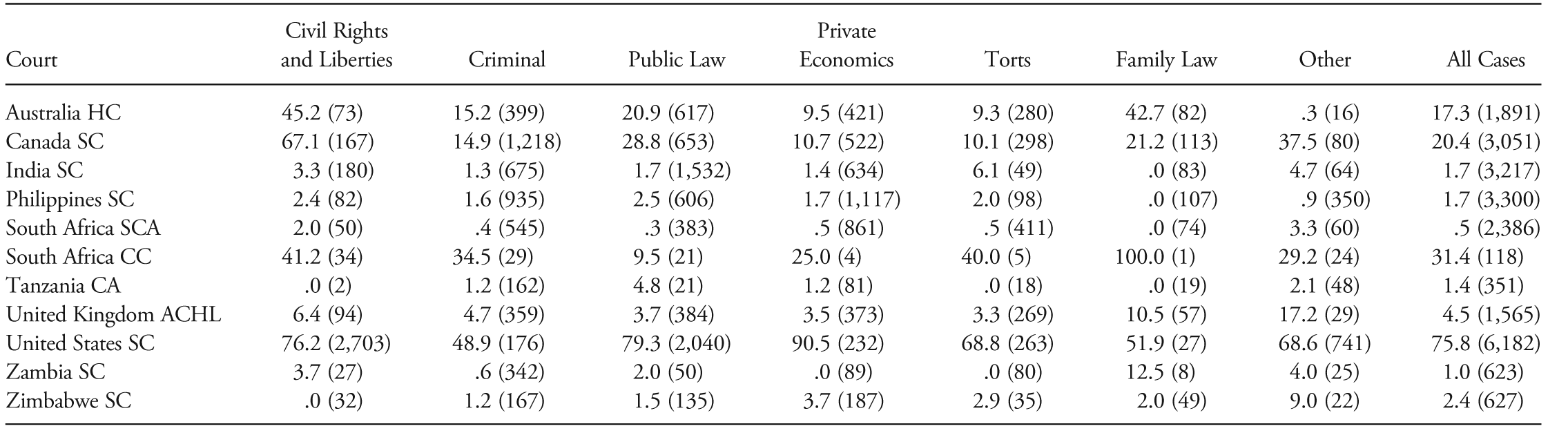
Table 1 provides information on the frequency of amicus curiae and intervener participation for each of the courts under analysis during the entirety of each court’s appearance in our data. This is broken down by the seven issue areas identified in Haynie et al. (Reference Haynie2007). Civil rights and liberties cases include disputes involving discrimination claims; freedoms of speech, press, and assembly; privacy claims; and religious rights (among others). Criminal law involves a range of alleged criminal violations, including violent and nonviolent crimes, and government corruption. Public law cases include disputes relating to government regulation, taxation, immigration, and election law (among others). Private economics cases involve creditor-debtor disputes, contracts, landlord-tenant relations, labor-management disputes, and corporate law (among others). Torts relate to cases pertaining to motor vehicle accidents, medical or legal malpractice, product liability, and libel or defamation (among others). Family law involves marriage, divorce, inheritance, and probate matters (among others). The “other” category involves cases that do not fit into the other six issue areas discussed. The “all cases” category reports the percentage of cases with third-party briefs across all of the issue areas. The entries are the percentage of cases with third-party briefs. The entries in parentheses indicate the overall number of cases in each category. Our purpose here is to provide a more specific context for understanding third-party briefing, particularly with regard to whether their presence is common across issue areas or is more pronounced in some issue areas than in others (e.g., Caldeira and Wright Reference Caldeira1990; Epstein Reference Epstein1994; Collins Reference Collins2008). Such an analysis can help inform future studies by identifying both the issue areas and courts on which scholars might focus their attention.
Amicus Curiae and Intervener Participation in 11 High Courts, 1970–2002
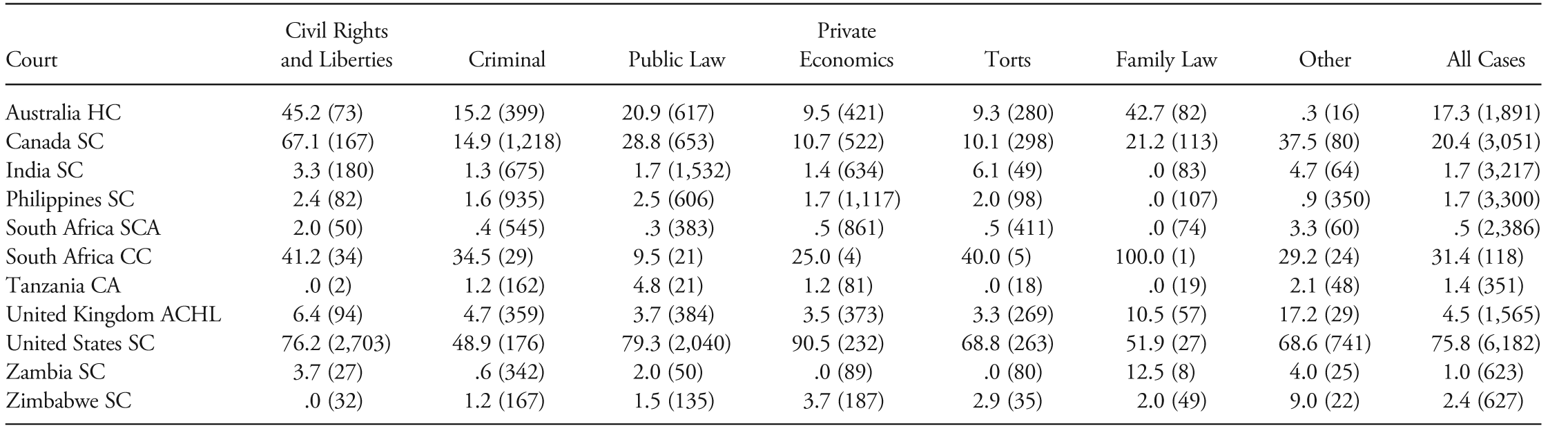
Note.—Entries are the percentage of cases with amicus curiae or intervener briefs over the entire time period in which each court is included in the data. Entries in parentheses indicate the overall number of cases in each category. The all cases category indicates the overall percentage of cases in each court in which an amicus curiae or intervener brief was filed. The number of cases in this category may not necessarily be the sum of the cases within each issue area because of missing data in the High Courts Judicial Database pertaining to the issue area of each case. HC = High Court; SC = Supreme Court; SCA = Supreme Court of Appeals; CC = Constitutional Court; CA = Court of Appeal; ACHL = Appellate Committee of the House of Lords.
Several interesting findings emerge. First, for most courts, third-party briefs are most commonly filed in civil rights and liberties cases. This is one of the top three most frequent issue areas for third-party briefing for all of the courts under analysis, with the exception of the Tanzania Court of Appeals and the Zimbabwe Supreme Court. This provides some preliminary evidence for our theoretical argument that organizations are particularly attracted to civil rights and liberties cases as these cases are often particularly good vehicles for the pursuit of their policy and organizational maintenance goals. Second, criminal cases are among the least common issue areas for third-party participation for most of the courts. Indeed, this is a top three issue area for a single court—the Tanzania Court of Appeals—and is a bottom three issue area in terms of third-party participation for six of the courts. This may reflect a relative dearth of organizations focused on criminal law, as well as the possibility that many of these cases do not raise issues that have broad effects beyond the parties to litigation in some of the courts. Finally, this table reveals that there is a good deal of variation among the courts for the other five issue areas. For example, public law cases receive the highest percentage of third-party briefs in the Philippine Supreme Court and the Tanzania Court of Appeals but the lowest percentage of third-party briefs in the South African Constitutional Court. Similarly, tort cases receive the highest percentage of third-party briefs in the Indian Supreme Court but the lowest percentage in the Canadian Supreme Court and the UK Appellate Committee of the House of Lords. This suggests that third-party participation in particular issue areas is likely affected by the broader sociolegal and cultural environment in each country, including the extent to which a nation’s high court prioritizes certain issue areas over others. This is certainly an area ripe for further investigation.
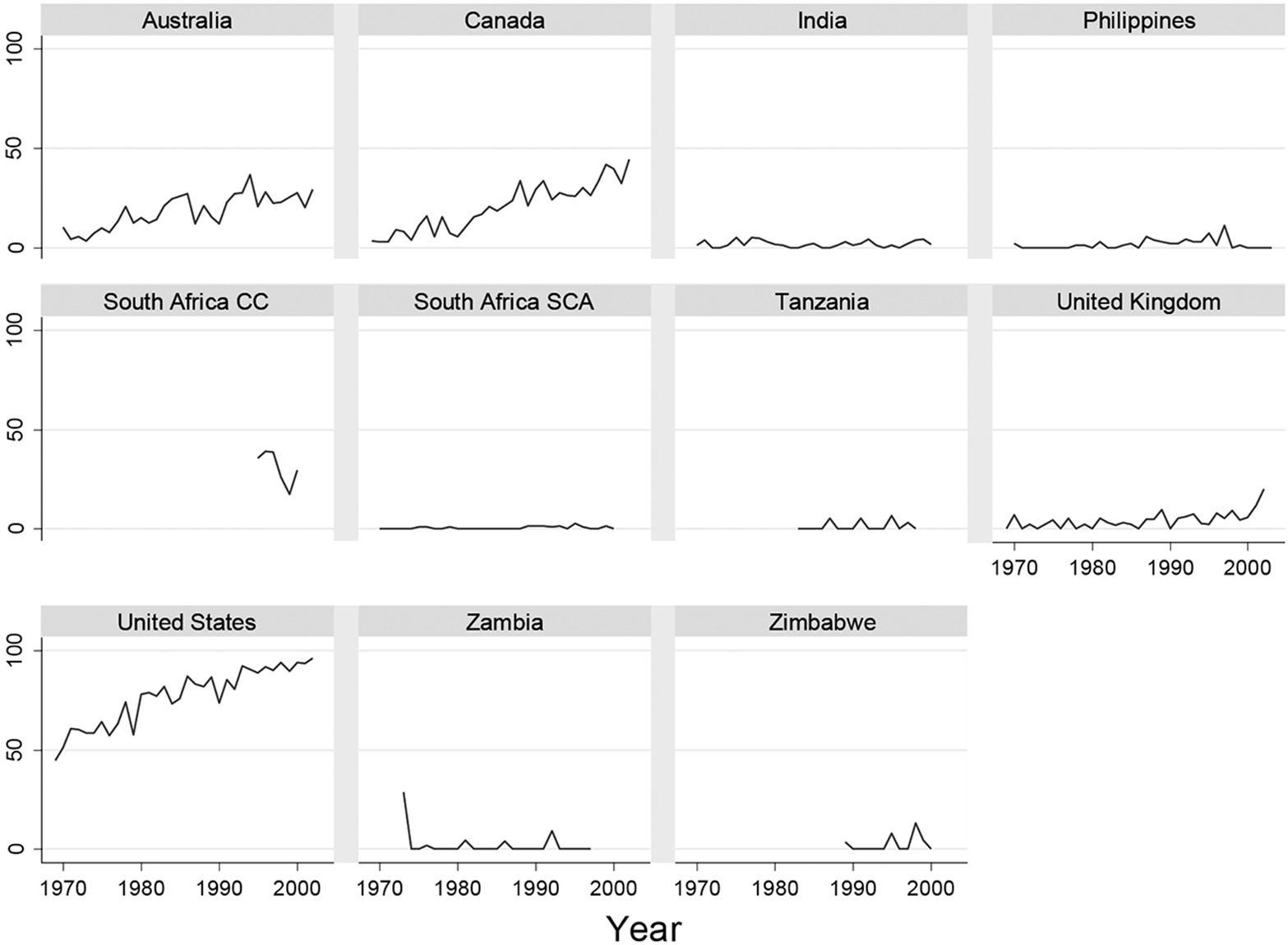
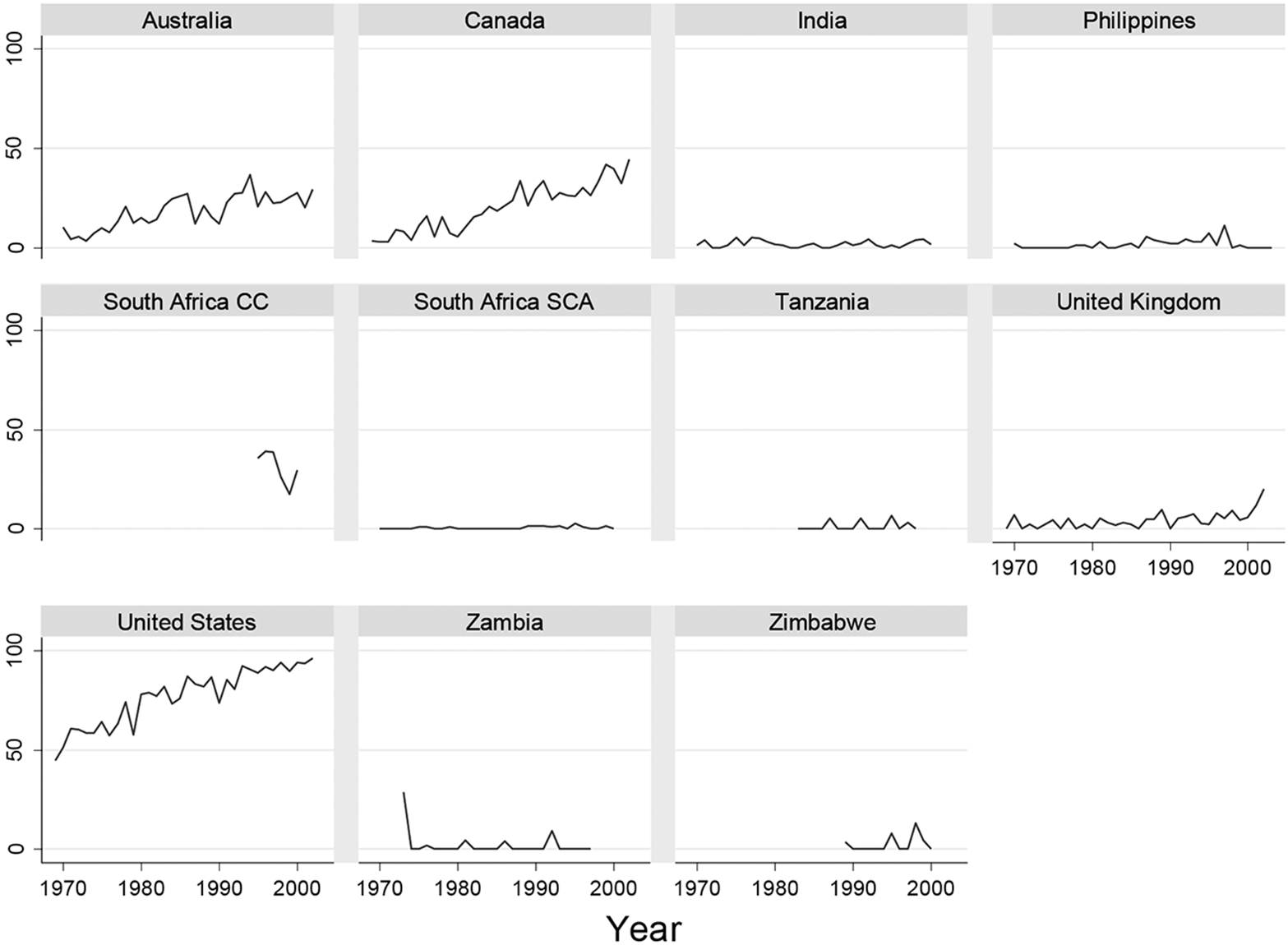
Figure 1 plots the dependent variable over time for each court in our sample, revealing several important findings. First, all countries in the data have experienced some level of third-party briefing in the time frame under analysis. This indicates that interest groups are active participants in all of the courts in our sample. Second, there is a good deal of variation regarding the levels of interest group engagement among the courts. Third-party briefs are most common in the US Supreme Court, with an average of 76% of cases accompanied by amicus briefs, followed by the South African Constitutional Court (an average of 31% of cases) and the Canadian Supreme Court (an average of 20% of cases). Interest group participation is least frequent in the South African Supreme Court of Appeal (an average of 0.5% of cases), the Tanzanian Court of Appeal (an average of 1.4% of cases), and the Philippine Supreme Court (an average of 1.7% of cases). Third, some courts exhibit fairly steady temporal increases in the percentage of cases with third-party briefs. This is most noticeable in the cases of the US Supreme Court and the Canadian Supreme Court. Yet other courts witness no similar increases in interest group engagement over time. For example, while there is year-to-year variation with respect to the Indian Supreme Court, the Philippine Supreme Court, and the South African Supreme Court of Appeal, there is little evidence of an increasing amount of organized activity in these institutions over time. Taken as a whole, figure 1 is significant in that it reveals where interest groups most commonly engage the judiciary via amicus and intervener briefs. This information can help guide future studies of the effectiveness of these briefs by highlighting where third-party briefs are most and least common, thus shedding light on the frequency with which judges encounter interest group participation.
The percentage of cases with third-party briefs
Given our dependent variable and on the basis of model diagnostic tests, we employ an ordinary least squares regression model with robust standard errors. Most significantly, the results of a Breusch-Pagan Lagrange multiplier test indicate that the ordinary least squares regression model is preferable to a random-effects regression model. A Wooldridge (Reference Wooldridge2010, 282) test for autocorrelation in the panel data fails to provide evidence of serial correlation, indicating that the inclusion of a lagged dependent variable is unnecessary.Footnote 10 A Fisher test for panel unit root, based on an augmented Dickey-Fuller test, indicates no unit root.
We operationalize our independent variables as follows. Judicial Review is scored 1 if the court has the power to review and invalidate the actions of another branch of government, and 0 otherwise. Courts with the power of judicial review in our sample are the Australian High Court, Canadian Supreme Court, Indian Supreme Court, Philippine Supreme Court, South African Constitutional Court, and US Supreme Court. This variable is based on information found in Kritzer (Reference Kritzer2002) and official court or government webpages.Footnote 11 We expect that this variable will be positively signed, indicating that there is more interest group engagement in courts with the power of judicial review.
Party Consent is scored 1 if the court’s official rules encourage third-party participation by authorizing potential third parties to obtain the permission of the parties in order to participate (and request the permission of the court only if one or both of the parties deny permission to file), and 0 otherwise. The excluded category is those courts that either require the court’s permission to participate or do not have explicit rules governing third-party engagement (which means that potential third parties would be required to obtain the consent of the court in order to participate). Courts that first require party consent are the South African Constitutional Court, the South African Supreme Court of Appeals, and the US Supreme Court. This variable is based on information contained in each court’s official rules. We expect that this variable will be positively signed, indicating that there is more interest group participation in courts with less restrictive rules for filing amicus and intervener briefs.
Civil Rights Docket captures the percentage of each court’s docket that involves civil rights and liberties cases and is based on information in the High Courts Judicial Database (Haynie et al. Reference Haynie2007). Civil rights and liberties cases include those involving civil rights claims by prisoners; equal treatment under the law; voting rights; speech, press, assembly, and the right to petition; religious rights; privacy (including abortion); access to public information; civil rights of juveniles; the rights of indigenous peoples; and miscellaneous civil rights claims. We expect that this variable will be positively signed, indicating that there is more interest group engagement in courts with a relatively large caseload of civil rights and liberties claims.Footnote 12
Bill of Rights is scored 1 for those countries that have a formal bill of rights, and 0 otherwise, as reported in Kritzer (Reference Kritzer2002). Countries in the data with a bill of rights are Canada, India, Philippines, South Africa, United Kingdom, United States, Zambia, and Zimbabwe. Note that the bills of rights in Canada, Philippines, and South Africa were adopted during the time period under investigation.Footnote 13 We expect that this variable will be positively signed, indicating that there is more interest group participation in nations with a bill of rights.
Federal is scored 1 for countries operating under a federal system of government, and 0 otherwise, on the basis of information in the Political Handbook of the World (2014). The federal nations in the data are Australia, Canada, India, South Africa, Tanzania, and the United States. We expect that this variable will be positively signed, indicating that there is more interest group engagement in federal countries.
In addition to these variables, we incorporate three control variables into the model that allow us to capture other factors that might shape the levels of interest group litigation. First, we include a Docket Size variable that measures the number of cases on each court’s docket for each year the court appears in the data. This information was obtained from the High Courts Judicial Database (Haynie et al. Reference Haynie2007) for all courts except the Supreme Courts of India and the Philippines. Because a random sample of these courts’ cases appears in the High Courts Judicial Database, we identified the size of their dockets on the basis of information from the Supreme Court of India (2006, 58–59) and the Chan Robles Virtual Law Library in the Philippines (http://www.chanrobles.com/cralawscdecisions.htm). We expect to observe lower levels of third-party briefing in high courts with relatively large dockets since those courts hear many routine cases (e.g., landlord-tenant disputes) that are unlikely to attract the attention of organized interests and because judges will presumably be more limited in the time they can spend on each case (e.g., Haynie Reference Haynie1994, 756). Thus, we expect this variable to be negatively signed, indicating that there is less interest group third-party briefing in courts with relatively large dockets.
Second, we include each nation’s Democracy Score, which is calculated as the country’s Polity2 score (Marshall, Gurr, and Jaggers Reference Marshall2014). These scores are based on attributes of a nation’s electoral competitiveness, citizen participation, and checks on executive power. We expect that countries with higher levels of democracy will have more opportunities for citizens to join interest groups and will have a longer history of interest group engagement with the political and legal systems. Because higher scores on this variable indicate more democratic nations, we expect that this variable will be positively signed, indicating that there is more interest group participation in countries that rank high on measures of democracy.
Finally, we include a Per Capita GDP variable that measures each country’s gross domestic product per capita in constant US dollars (World Bank 1993, 2015), divided by 1,000 to make the size of the coefficient more easily interpretable. This variable is an imperfect proxy for the interest group density in each country in light of the fact that counts of interest groups across time and space do not exist. The logic of this variable is that, in countries where individuals enjoy relatively high socioeconomic status, they will have more time and money to devote to political engagement, including forming and joining interest groups (e.g., Brady, Verba, and Schlozman Reference Brady1995). Thus, we expect to see more interest groups in countries with relatively high per capita GDP levels, a point that has been corroborated in previous cross-national studies (e.g., Murrell Reference Murrell1984; Coates, Heckelman, and Wilson Reference Coates2007). We expect that this variable will be positively signed, indicating that there is more interest group engagement with courts in wealthier nations.
Results
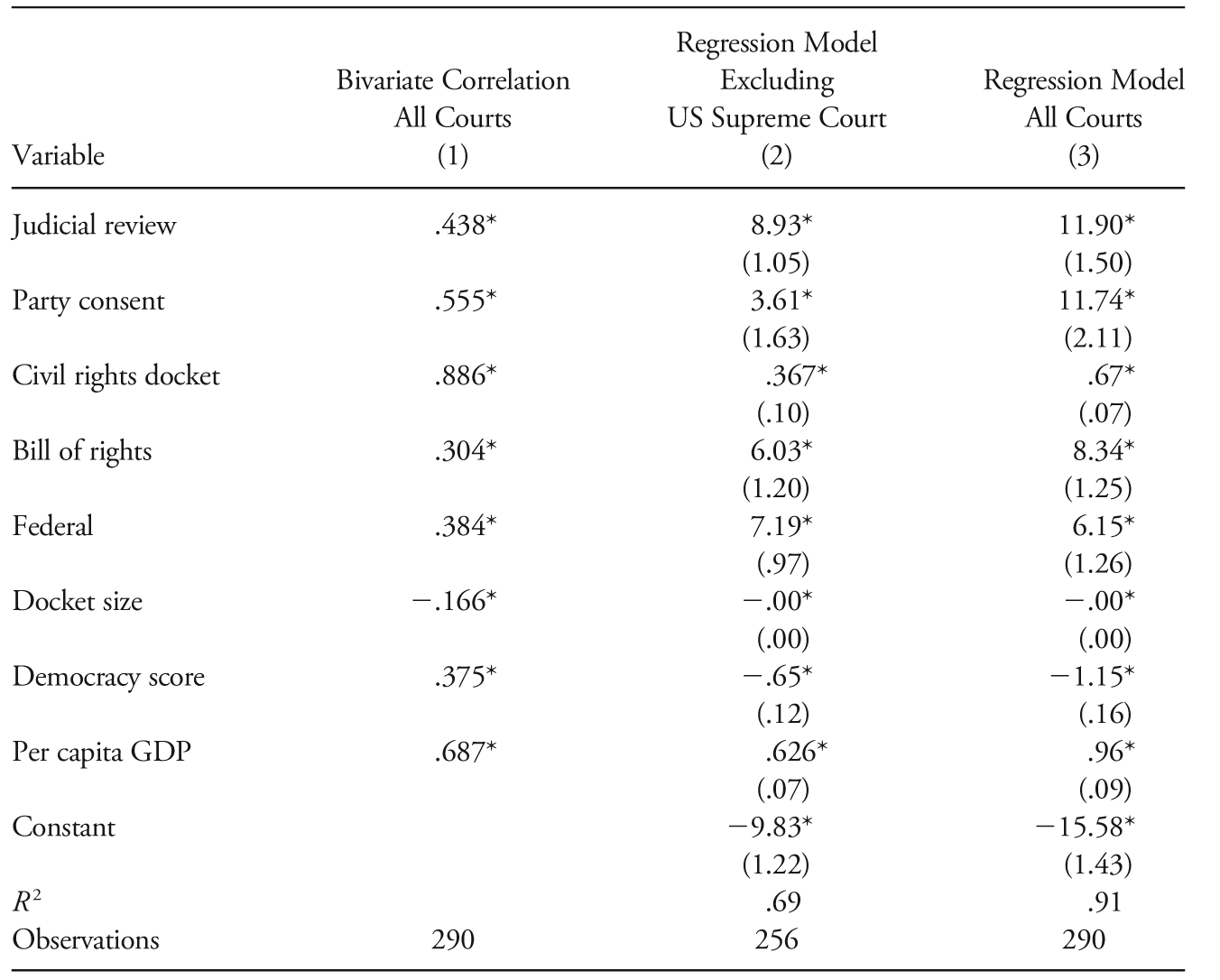
Table 2 contains three analyses. The first column reports the bivariate correlations between each of the independent variables and the dependent variable. This reveals that all of the independent variables are statistically significantly correlated with the dependent variable in the predicted direction. Below, we return to a discussion of these bivariate correlations with respect to the Democracy Score variable. The second column contains the results of an ordinary least squares regression model that excludes the US Supreme Court. We report the results of this model to demonstrate the robustness of our results since the US Supreme Court is a clear outlier in terms of the percentage of cases with third-party briefs among the courts in our sample, as indicated in figure 1. The third model reports the results of an ordinary least squares regression model on the full sample of courts under analysis. As a comparison between the full model and the model that excludes the US Supreme Court indicates, the results are quite robust to the exclusion of the US Supreme Court. In fact, all of the variables retain their statistical significance across the two models, although the size of the coefficient on the Party Consent variable is much smaller in the model that excludes the US Supreme Court, compared to the full model.
Third-Party Briefing in 11 High Courts, 1969–2002
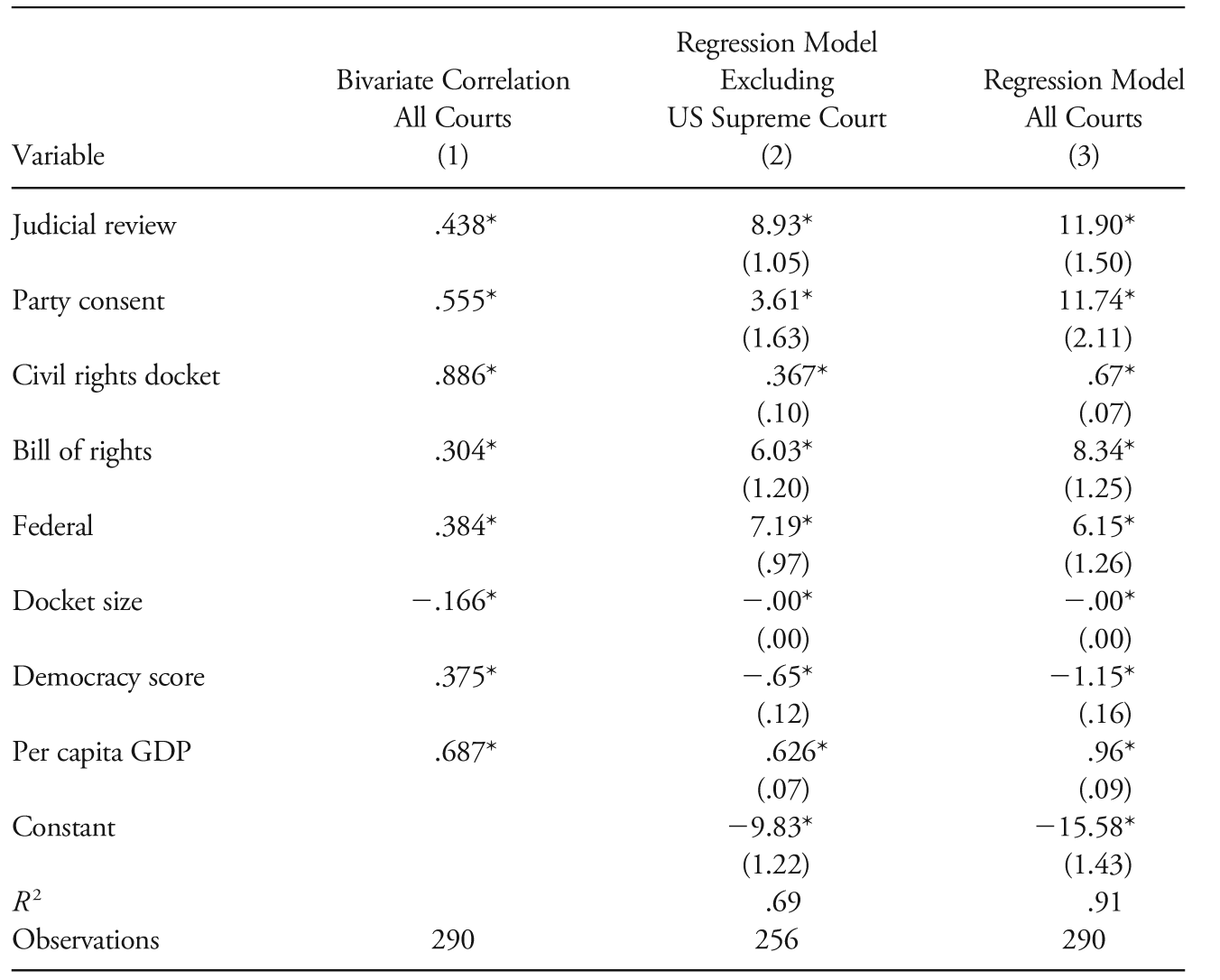
Note.—The unit of analysis is the court-year. The dependent variable is the percentage of cases with third-party briefs. Entries in col. 1 are bivariate correlation coefficients. Entries in cols. 2 and 3 are coefficients from an ordinary least squares regression model. Column 2 excludes the US Supreme Court. Robust standard errors appear in parentheses.
*. p < .05 (one-tailed tests).
Given the robustness of the findings, we focus our attention on the third model, including all courts, in our interpretation of the results. The R-squared value is a respectable .91, indicating that the model is a good fit for the data. Most importantly, the model provides support for all of our hypotheses, indicating that there is systematic variation in the levels of third-party briefs in the 11 high courts under analysis. What is more, the sizes of the coefficients associated with our key hypothesis tests are generally quite large, indicating substantive, in addition to statistical, significance. Thus, these results confirm that the levels of third-party briefing are shaped in large part by the institutional features of the courts and nations under analysis.
First, we find higher levels of third-party briefs in courts that have the power of judicial review. Substantively, third-party briefs are filed in about 12% more cases in courts with judicial review, relative to those without this power. This corroborates our expectation that interest groups view courts with judicial review as coequal branches of government and utilize these courts to mount challenges to their opponents’ executive and legislative gains, in addition to defending their own executive and legislative victories in these institutions. This allows organizations to pursue their policy goals while maintaining and possibly expanding their bases of support by participating in these institutions.
Second, our results show that court rules governing third-party briefs matter. We find that third-party briefs are filed in about 12% more cases in courts that initially require party consent, relative to those that initially require the consent of the court. This indicates that less restrictive filing requirements play an important role in shaping the level of interest group engagement with a court. Moreover, it provides important evidence that legal rules matter.
Third, table 2 reveals that the types of cases on a court’s docket are associated with interest group litigation. For example, a 15% increase in the percentage of civil rights and liberties cases on a court’s docket (which is about a one standard deviation increase) corresponds to a 10% increase in the percentage of cases with amicus or intervener briefs. This finding supports our argument that civil rights and liberties cases tend to act as broad policy-making vehicles for interest groups and thus garner more attention from litigating organizations. Moreover, because many civil rights and liberties cases tend to be high-profile, groups can highlight their participation in such cases to demonstrate to their members that they are active on salient matters of public policy and use these cases to attract additional support for their causes.
Fourth, we find higher levels of interest group participation in countries with a bill of rights. More specifically, there is an 8% increase in the percentage of cases with third-party briefs in countries with a bill of rights compared to those without. Thus, it appears that bills of rights act as important formal mechanisms that interest groups can leverage to press their rights claims in the legal system.
To more clearly see the impact of a bill of rights on organization litigation, consider Canada, which adopted the Charter of Rights and Freedoms in 1982.Footnote 14 The charter provided Canadians a variety of constitutional protections, as well as a mechanism that authorized judicial review in cases initiated by individuals. Among others, the charter outlines the freedoms of religion, expression, and the press; the right to vote; and protections from unreasonable searches and seizures; it also guarantees the equal protection of the laws. Given its importance, the impact of the charter has been of great scholarly interest, and researchers have reached some contradictory conclusions with respect to its impact (e.g., Epp Reference Epp1996; Brodie Reference Brodie2002; Urribarri et al. Reference Urribarri2011; Songer et al. Reference Songer2013).
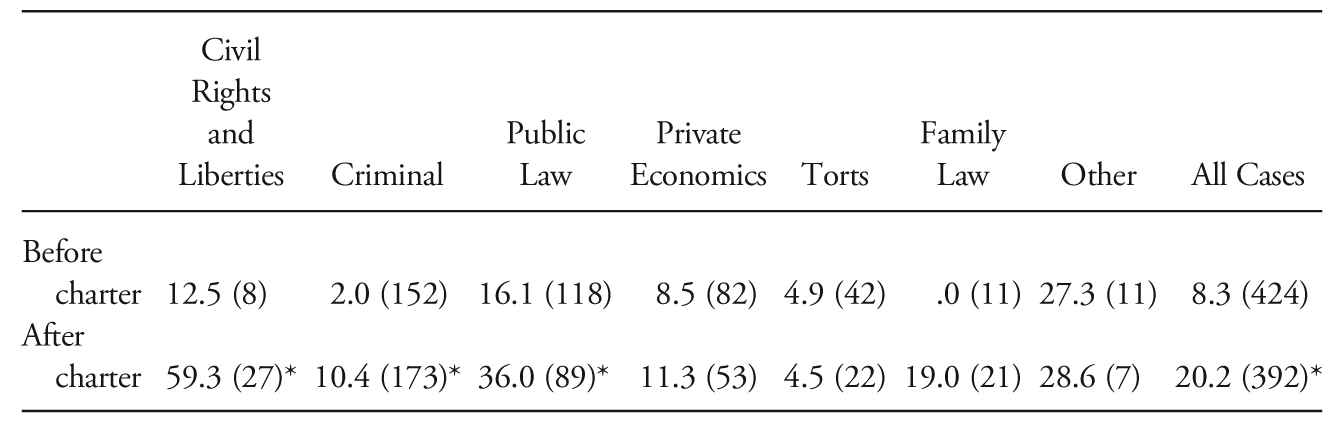
To add to this important debate, table 3 provides information on the percentage of cases with intervener briefs for the Canadian Supreme Court across seven issue areas discussed above with respect to table 1. These issue areas are delineated by the 5 years before the adoption of the charter (1977–81) and the 5 years following the adoption of the charter (1983–87). If the charter had an impact on intervener participation, we expect to see an increase in the percentage of cases with intervener briefs. Table 3 indeed shows that there was a substantial increase in intervener participation following the adoption of the charter. Beginning with the “all cases” category, 8% of cases in the 5 years prior to the adoption of the charter were accompanied by intervener briefs. This increased to 20% in the 5 years after the adoption of the charter, a substantively and statistically significant difference. This difference is most pronounced in the civil rights and liberties issue area: prior to the charter, intervener briefs were present in 13% of these cases, compared to 59% in the 5 years after the adoption of the charter. It is also observed in the criminal law issue area. In the 5 years prior to the charter’s adoption, intervener briefs were filed in 2% of criminal cases, compared to 10% in the post-charter era. This corroborates our argument that the adoption of a bill of rights can mobilize interest groups to participate in courts by providing them with a formal institutional structure to mount rights-based claims. Interestingly, there is also evidence for the charter’s effect in public law cases, which primarily involve government regulation, taxation, immigration, and election law, areas that do not necessarily implicate the charter’s primary focus on civil rights and liberties. Prior to the charter, 16% of public law cases had intervener participation. In the 5 years after the charter was ratified, this increased to 36%. However, there are no statistically significant increases in the percentage of cases with intervener briefs in the other issue areas in table 3. Thus, while the charter’s main effect on intervener participation involves issue areas at the core of the charter—civil rights and liberties and criminal rights—it also stimulated intervener participation in public law cases. This suggests that the adoption of a bill of rights can have an impact on the issue areas most closely associated with the rights and freedoms outlined in the document and that its impact can spread to other issue areas.
Amicus Curiae and Intervener Participation Before and After the Adoption of the Canadian Charter of Rights and Freedoms
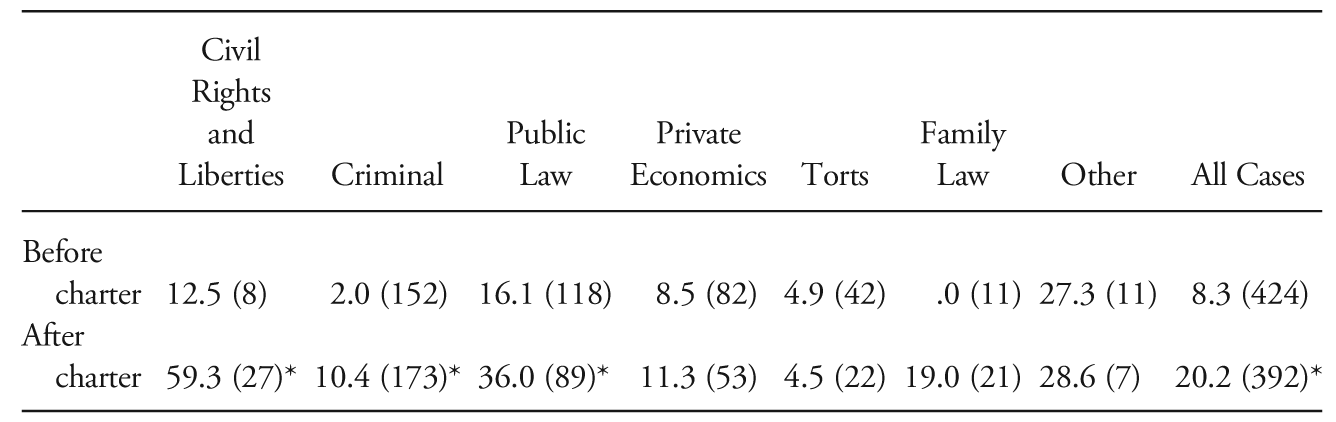
Note.—Entries are the percentage of cases with intervener briefs in the Canadian Supreme Court for 5 years before and 5 years after the adoption of the Charter of Rights and Freedoms in 1982. Entries in parentheses indicate the overall number of cases in each category. The all cases category indicates the overall percentage of cases in which at least one intervener brief was filed.
*. A statistically significant difference in the percentage of cases with intervener briefs before and after the adoption of the charter at the .05 level.
Returning to table 2, we find that countries that operate in federal systems have higher levels of organizational litigation. Compared to unitary systems, courts in federal systems witness a 6% increase in the percentage of cases with amicus or intervener briefs. Because courts in federal nations are often charged with resolving disputes between the national and subnational governments, such cases tend to attract the attention of a diverse assortment of interest groups that operate at both levels. This, in turn, results in more interest group engagement with those judiciaries.
Turning now to the control variables, the model fails to provide support for the idea that the size of a court’s docket is negatively related to the levels of third-party briefing as the coefficient associated with this variable, while statistically significant, is substantively negligible. However, the model does reveal that the other two control variables achieve statistical significance, although the Democracy Score variable is signed in the opposite direction of what we expected. The negative sign of this variable indicates that there is a smaller percentage of third-party briefs in more democratic countries (although the substantive effect of this variable is small relative to the other variables in the model). Investigating this more closely, it appears that this variable flipped signs as a function of high levels of collinearity (e.g., Mela and Kopalle Reference Mela2002). In particular, this variable is correlated with the Per Capita GDP variable at .62. Rather than run the risk of omitted variable bias by excluding it from the model, we note that there is a weak, but positive, relationship between a country’s democracy score and the level of third-party briefs. As the bivariate correlation in table 2 reveals, there is a positive and significant correlation between the Democracy Score variable and the dependent variable, and it is statistically significant and positively signed in a bivariate regression model.Footnote 15 The Per Capita GDP variable reveals that there are higher levels of interest group litigation in wealthier countries. As this variable was intended to be a proxy—albeit an imperfect one—for interest group density within a country (e.g., Murrell Reference Murrell1984; Coates et al. Reference Coates2007), it suggests that there is more organizational litigation in wealthier countries that tend to have a relatively large number of pressure groups.
Conclusions
The purpose of this article was to shed new light on interest group litigation by investigating it in a cross-national context. To do this, we examined the levels of amicus curiae and intervener briefs across 11 high courts in 10 countries. These briefs represent an important form of democratic input into the judiciary, acting as a mechanism for organizations to participate in public debates, while advancing their causes in an effort to further their policy goals and address organizational maintenance concerns (Hansford Reference Hansford2004; Cichowski Reference Cichowski2006; Collins Reference Collins2008; Garcia Reference Garcia2008). Our results reveal systematic variation in interest group engagement with these courts, indicating that organizational litigation can be successfully studied in a cross-national context. Moreover, this research informs our understanding of a number of significant legal and political debates and suggests profitable directions for future research.
First, we have contributed to the study of interest group litigation by demonstrating that it is far from a uniquely American or Canadian phenomenon. Though most research to date on third-party briefs focuses on these two nations, we reveal that interest groups participate in a number of courts across the globe. This is an important finding in its own right as it can be used to spur further research into interest group engagement. Perhaps most obviously, it will be important to explore the effectiveness of amici curiae and interveners in terms of their ability to etch their policy preferences into law. Further, examining other forms of organized litigation, such as interest groups bringing suits as direct litigants, will add to our understanding of how pressure groups use the courts in pursuit of their goals.Footnote 16
This research has also informed our understanding of how institutional design shapes the behavior of political actors, particularly with regard to debates about bills of rights, judicial review, and court rules. With regard to the importance of bills of rights, we join a number of scholars who have demonstrated that the presence of a bill of rights can have important implications (e.g., Urribarri et al. Reference Urribarri2011; Songer et al. Reference Songer2013). Our findings reveal that, indeed, countries with a bill of rights have higher levels of interest group engagement in the courts. Regarding judicial review, our findings indicate that interest groups are particularly attracted to courts with this power, suggesting that they see such judiciaries as coequal with the elected branches of government. In so doing, this work has added to our understanding of the global spread of judicial review and its consequences (e.g., Hirschl Reference Hirschl2002). Our finding that the level of interest group engagement is associated with the restrictiveness of the rules governing third-party participation is important because it provides evidence that laws on the books matter (e.g., Pound Reference Pound1910; Friedman Reference Friedman1967). Thus, this study of interest group litigation is capable of informing wider debates in the sociolegal and political science communities.
Of course, as the first work comparing the use of third-party briefs in high court cases across multiple countries, this study has only scratched the surface of thinking about the importance of this form of democratic participation and engagement in judicial systems around the world. Future work could examine the prevalence and correlates of third-party brief submission in Roman law–based countries to see whether our insights about the importance of institutional design hold in these polities, some of which have recently adopted bills of rights and judicial review mechanisms (Stone-Sweet 2000; Hirschl Reference Hirschl2002; Ginsburg Reference Ginsburg2003) and others with long traditions of high courts. Over the past several decades, many civil law countries have allowed third parties to participate in legal proceedings in their highest courts, either by amending their laws to authorize participation or unofficially accepting third-party briefs, and evidence suggests that groups are taking advantage of this opportunity (Kochevar Reference Kochevar2013).Footnote 17 Further, it will be useful to investigate how attributes of cases influence the levels of third-party briefing by focusing at the case level (e.g., Salzman et al. Reference Salzman2011). This will allow for an examination of how amici and interveners coordinate with litigants and each other to support their causes (e.g., Larson and Devins Reference Larson2016). Moreover, while we have followed existing studies by including third-party briefs filed by governmental entities in our sample (e.g., Epstein Reference Epstein1994; Brodie Reference Brodie2002; Collins Reference Collins2008), it will be important for future studies to investigate whether governmental amici and interveners have motivations for participating that differ from more traditional membership-based interest groups (e.g., Provost Reference Provost2011). In addition, more country-specific work on third-party briefs could offer rich insights into the conditions under which third parties participate. For example, in an effort to provide a generalizable look into interest group litigation, we were compelled to gloss over some major domestic changes in the countries under analysis here, such as those that took place after the dismantling of apartheid in South Africa. Likewise, it will be important to investigate the support structures for organizational litigation at the country level (e.g., Epp Reference Epp1998). By looking more closely at such domestic factors, we are confident that much can learned about the evolution of interest group litigation. Taken as a whole, we view this research as an important first step toward thinking about interest group litigation in a global perspective and hope to see additional research on this significant topic.