Introduction
Post-stroke behavioral and psychological symptoms are common and can affect quality of life, clinical outcomes, and rehabilitation of stroke survivors (Carson et al., Reference Carson2000; Rasquin et al., Reference Rasquin, Lodder and Verhey2005). Previous research has shown that patients exhibiting such symptoms are at increased risk of cognitive (Rasquin et al., Reference Rasquin, Lodder and Verhey2005) and functional decline (Robinson et al., Reference Robinson, Bolduc and Price1987). Additionally, these symptoms have a negative impact on carers and family members (Franzen-Dahlin et al., Reference Franzen-Dahlin, Billing, Nasman, Martensson, Wredling and Murray2006). In people with other neurological conditions, such as Alzheimer's disease and epilepsy, the emergence of such behavioral and psychological symptoms have been associated with worse clinical outcome (Strauss et al., Reference Strauss, Lee and DiFilippo1997).
A variety of purported causes of post-stroke behavioral and psychological symptoms are discussed in the literature, including biological factors, such as damage to the emotional control centers of the brain (Carson et al., Reference Carson2000; Kim et al., Reference Kim, Choi, Kwon and Seo2002) or reduced serotonin levels (Bryer et al., Reference Bryer, Starkstein, Votypka, Parikh, Price and Robinson1992). Psychological factors, such as grief or distress caused by pain and disability, have also been implicated (Bozikas et al., Reference Bozikas2005; Morrison et al., Reference Morrison, Pollard, Johnston and MacWalter2005; Nys et al., Reference Nys, van Zandvoort, Van Der Worp, de Haan, de Kort and Kappelle2005). Finally, premorbid personality traits, especially neuroticism, have been associated with the development of post-stroke depression (Aben et al., Reference Aben, Denollet, Lousberg, Verhey, Wojciechowski and Honig2002a; Morris and Robinson, Reference Morris and Robinson1995; Storer and Byrne, Reference Storer and Byrne2006). Aben and colleagues found that on self-rated scales, patients with high premorbid neuroticism scores were 4.6 times more likely to have developed symptoms of depression one year post-stroke (Aben et al., Reference Aben, Denollet, Lousberg, Verhey, Wojciechowski and Honig2002a). High neuroticism scores have been associated with emotional instability, hostility, anxiety, and self-conscious behavior (Costa and McCrae, Reference Costa and McCrae1992). Archer and colleagues (Reference Archer2007) found that agitation, apathy and irritability are associated with premorbid low agreeableness in patients with mild to severe late-onset Alzheimer's disease.
Angelelli and colleagues (Reference Angelelli2004) assessed 124 stroke patients using the neuropsychiatric inventory (NPI), and found that next to depression, irritability, agitation, apathy and anxiety were prevalent among these patients. Little is known about whether premorbid personality traits contribute to modulate the expression of these other behavioral and psychological symptoms in stroke survivors.
This study sought to identify associations between specific premorbid personality traits (neuroticism, extraversion, openness, agreeableness, or conscientiousness) and post-stroke behavioral and psychological symptoms. The effects of potential covariates such as patient age, gender, lesion side, history of stroke, history of psychiatric problems, apolipoprotein E (APOE) genotype, post-stroke functional level (instrumental activities of daily living; IADL), and post-stroke cognitive ability were also investigated. The APOE genotype was included in the analysis as the presence of the APOE ɛ4 allele has been previously associated with an increased risk of behavioral and psychological symptoms in dementia (Scarmeas et al., Reference Scarmeas2002). Additionally, cognition was also assessed as a covariate as previous research has shown that patients with post-stroke behavioral and psychological symptoms are at increased risk of subsequent cognitive impairment (Rasquin et al., Reference Rasquin, Lodder and Verhey2005).
Methods
This was a prospective, observational, three-month follow-up study of stroke survivors, conducted between May 2003 and January 2005 at the Royal Perth Hospital (RPH) Stroke Unit. Study protocols were approved by the Royal Perth Hospital Ethics Committee. All participants and informants gave written informed consent.
Participants
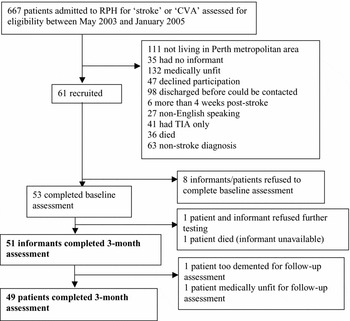
From 667 potential participants who were admitted to RPH with a diagnosis of stroke or cerebrovascular accident, we recruited 61 who were admitted to the stroke unit with a clinical diagnosis of stroke that was supported by brain imaging, and who met the inclusion criteria and gave informed consent. The clinical diagnosis of stroke was made if the patient manifested a clinical syndrome characterized by an acute loss of focal cerebral function with symptoms lasting more than 24 hours and which was thought to be due to either spontaneous hemorrhage into the brain substance (hemorrhagic stroke) or inadequate cerebral blood supply to a part of the brain (ischemic stroke) as a result of low blood flow, thrombosis or embolism associated with diseases of the blood vessels (arteries or veins), heart or blood (Warlow et al., Reference Warlow2008). Figure 1 shows the flow diagram of recruitment and retention in the study. Inclusion criteria were: confirmation of diagnosis of stroke (ischemic or hemorrhagic) according to ICD-10 criteria, living in the Perth metropolitan area, and having a suitable informant available. The informant had to either live with the patient or have face-to-face contact with the patient at least three days per week prior to the stroke, as well as having known the patient before the index stroke and any other previous cerebrovascular event in the past. Exclusion criteria were: presence of significant aphasia, non-English speaking, unstable medical condition, significant visual or hearing impairment, or unable to give informed consent.
Flow chart of recruitment of participants and reasons for exclusion or withdrawal.

Measures
Outcomes of interest
Our primary outcome variable was the Neuropsychiatric Inventory-carer distress version (NPI, (Kaufer et al., Reference Kaufer1998). This informant-rated scale lists 10 neuropsychiatric symptoms and two neurovegetative symptoms and rates the frequency, severity and level of distress caused to the carer by each symptom. Each neuropsychiatric symptom has a composite score of frequency × severity, which when added make the total NPI score (Kaufer et al., Reference Kaufer1998). The sum of distress scores for each neuropsychiatric symptom results in a total carer distress score. This scale has been used previously to assess behavioral and psychological symptoms in stroke patients (Angelelli et al., Reference Angelelli2004).
Our secondary outcome variable was the self-rated Hospital Anxiety and Depression Scale (HADS) at three-month follow-up (Zigmond and Snaith, Reference Zigmond and Snaith1983). This is a 10-item multiple choice questionnaire with five items referring to symptoms of anxiety and five for depression. Each item is rated on a 0–3 point scale of severity giving a total possible score for each symptom from 0 to 15. This scale has been validated for inpatient/outpatient and non-patient use (Herrmann, Reference Herrmann1997) and for detecting post-stroke depression (Aben et al., Reference Aben, Verhey, Lousberg, Lodder and Honig2002b).
Explanatory Variable: Personality Scale
Informants rated patients’ personality traits that were present prior to the index stroke with the NEO Personality Inventory-Revised (NEO PI-R; Costa and McCrae, Reference Costa and McCrae1992). This rating took place within four weeks of the index stroke. This 240-item questionnaire is designed to rate normal personality on the five-factor model: neuroticism, extraversion, openness, agreeableness, and conscientiousness. Each factor produces a continuous variable with a theoretical range of 0–192. This scale has been validated for use in older adults and the informant-rated version is strongly correlated with self-report versions (Costa and McCrae, Reference Costa and McCrae1992). A shorter (60-item) self-rated version of this scale has been successfully used in studies of stroke patients (Aben et al., Reference Aben, Denollet, Lousberg, Verhey, Wojciechowski and Honig2002a).
Other measured factors
Information on patient age, marital status, gender, medical details of the index stroke, history of mental health problems, Mini-mental State Examination (MMSE), baseline HADS, and APOE genotype were collected at recruitment. Apolipoprotein E genotyping was performed using polymerase chain reaction (PCR), as described by Hixson and Vernier (Reference Hixson and Vernier1990).
Medical history was obtained from medical notes, patients and informants. The location of the stroke lesion was obtained from medical notes or directly from neuroimaging scans viewed by two of the authors (OA and NL).
At follow-up, information about instrumental activities of daily living was obtained from informants using the IADL scale from the Multidimensional Functional Assessment Questionnaire (Duke University Center for the Study of Aging and Human Development, 1978). This scale assesses whether the patient is (a) independent, (b) needs assistance, or (c) is dependent in the following tasks: using a telephone, travelling, shopping, meal preparation, housework, handling medications, and controlling finances. We assigned a dichotomous IADL level according to whether the patient was (a) fully independent on all items, or (b) needed assistance or depended on others on at least one item.
Cognitive outcomes were assessed in patients at follow-up with the Cambridge Examination for Mental Disorders of the Elderly – Revised, cognitive section (CAMCOG; Roth et al., Reference Roth1986).
Procedure
Eligible participants were recruited and baseline measures (NEO PI-R, medical and demographic variables, APOE) were collected within four weeks of the participant's index stroke by research staff. Informants were asked to rate the NEO PI-R based on the patients premorbid (or “normal”) personality, that is, prior to the current stroke and any previous stroke or recent cognitive symptoms. Follow-up assessments (CAMCOG, NPI, IADL) were conducted three months (plus or minus two weeks) after the patient's index stroke. When rating a patient's behavior on the NPI, informants were asked to consider symptoms that had occurred within the last month.
Statistics
Non-parametric analyses were used to analyze NPI total and distress scores as the distribution of the data was not fit for parametric analyses. Spearman's rank coefficient was used to analyze the relationship between ordinal variables, whilst Mann-Whitney U-tests were used to investigate between-group differences. Binary logistic regression was used to further analyze the relationship between the presence of select NPI symptoms and personality variables divided into high-low groups according to the median. Alpha levels on univariate tests were set to 0.01 (two-tailed) to allow for the effect of multiple comparisons. Data management and analysis was conducted with SPSS version 14.0 for Windows.
Results
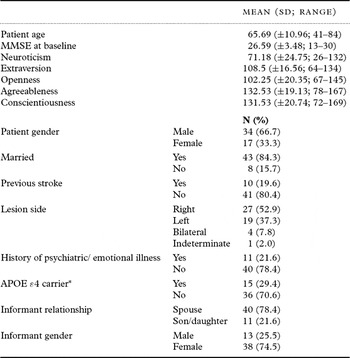
Table 1 shows the baseline characteristics of patients and informants who completed the follow-up. Two patients were too ill to be assessed on the HADS/CAMCOG at follow-up (see Figure 1) but their informants were still able to complete the follow-up NPI and IADL assessments. Analysis of withdrawals by Mann-Whitney U-test indicated that the 10 patients lost to follow-up were not significantly different from analyzed cases on patient age (U = 240, p = 0.77), baseline MMSE (U = 233, p = 0.66), baseline HADS anxiety (U = 193, p = 0.22 or baseline HADS depression (U = 214, p = 0.42). There were more male than female patients. Our sample was relatively young, with the average age 65.69. Most of the informants were spouses, with all other informants being either sons or daughters. Most informants were women. More than half of the patients had right-sided lesions. About a fifth of our sample had suffered a previous stroke, with a similar percentage having a previous history of psychiatric or emotional disorder.
Baseline sample characteristics for participants analyzed at follow-up (N = 51)

*One refused test.
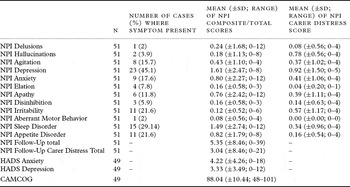
Depression was the most common neuropsychiatric symptom observed in this group at follow-up (n = 23, 45.1%). The prevalence of other follow-up NPI symptoms is shown in Table 2. Of those with depression symptoms present on the NPI, 10 patients additionally had either aggression or irritability present, indicating that symptom co-morbidity was relatively common.
Summary of follow-up behavioral/psychological and CAMCOG results

CAMCOG = Cambridge Examination for Mental Disorders of the Elderly – Revised; NPI = Neuropsychiatric Inventory; HADS = Hospital Anxiety and Depression Scale.
Association between personality and behavioral and psychological symptoms
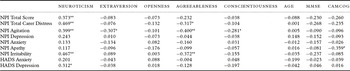
Table 3 shows the Spearman's correlation coefficients between the personality scores and NPI total, NPI carer distress, and NPI symptom composite scores that had more than five patients with symptoms present (as fewer cases would have not produced meaningful correlations), and HADS scores. Cross-correlations with age, baseline MMSE and follow-up CAMCOG scores are also shown. Both NPI total and carer distress scores were correlated with premorbid neuroticism. Irritability and agitation composite scores were also correlated with neuroticism. Premorbid agreeableness showed an inverse correlation with irritability and agitation composite scores. Interestingly, NPI depression did not significantly correlate with neuroticism or with any other personality factor; however, there was a trend towards a positive correlation with neuroticism. Depressive symptoms rated by the patient (HADS) showed a positive correlation with neuroticism which failed to reach the 0.01 level of significance. HADS anxiety also had a weak positive correlation with neuroticism that was not statistically significant. Other correlations with personality also did not reach significance at the 0.01 level. Age and cognitive performance were not significantly associated with neuropsychiatric symptoms.
Spearman's correlations between psychological and behavioral scoresa at follow-up and Personality Factors, age and cognitive scores (N = 51 for NPI scores/N = 49 for HADS/CAMCOG).

a:Composite scores for delusions, hallucinations, elation, disinhibition and aberrant motor behavior have been excluded from this analysis as the number of patients with the symptom present was less than 5.
NPI = Neuropsychiatric Inventory, MMSE = Mini-Mental State Exam, CAMCOG = Cambridge Examination for Mental Disorders of the Elderly – revised, cognitive section.
* p < 0.05; ** p < 0.01
Table 4 shows the results of univariate analyses comparing the effects of other measured factors on NPI total score and NPI total distress score. The only significant association that we observed was with having a prior history of psychiatric/emotional illness.
Differences in NPI total score and NPI carer distress score by patient/informant characteristics (Mann-Whitney U-tests)

*This analysis excluded four patients with bilateral and one patient with indeterminate lesion location.
NPI: Neuropsychiatric Inventory; IADL: Instrumental Activities of Daily Living; APOE: Apolipoprotein E.
Four logistic regressions were carried out to explore the predictive value of premorbid neuroticism or agreeableness on the presence/absence of agitation/aggression or irritability. The personality factors were divided into high/low groups by the median for these analyses. In all four regressions the covariate “history of psychiatric/emotional illness” was entered into the model as well. Patients with low agreeableness were more likely to show symptoms of agitation (OR: 11.18, CI: 1.18–105.18, Model χ2 = 7.93, p = 0.019) and irritability at follow-up (OR: 17.35, CI: 1.65–182.17, Model χ2 = 17.04, p < 0.001). Conversely, patients with low neuroticism were less likely to have agitation/aggression (OR: 0.126, CI: 0.014–1.141, Model χ2 = 6.052, p = 0.049), and irritability (OR: 0.078, CI: 0.008–0.723, Model χ2 = 15.5, p < 0.001).
Discussion
In this study, premorbid neuroticism and agreeableness traits were associated with neuropsychiatric symptoms and carer distress scores. We showed that high neuroticism and low agreeableness were specifically related to agitation/aggression and irritability three months post-stroke.
The prevalence of NPI symptoms recorded in our sample was lower than shown in other studies; e.g. Angelelli et al. (Reference Angelelli2004) found that 61% of their post-stroke patients had depression, 33% showed irritability and 28% showed agitation. The lower prevalence in our sample may reflect recruitment bias, as patients with severe behavioral and psychological symptoms may have been less willing to take part in the study.
Interestingly, Archer et al. (Reference Archer2007) found that lower agreeableness was also associated with agitation and irritability in patients with Alzheimer's disease, and suggested that low agreeableness may be a life-long risk factor for agitation and irritability, particularly when the person is placed under stress. Low agreeableness is associated with a tendency to be egocentric, antagonistic, sceptical, and competitive rather than cooperative (Costa and McCrae, Reference Costa and McCrae1992): such traits could have a negative impact on patients’ rehabilitation, future quality of life, and interpersonal relationships. Unlike Archer and colleagues (Reference Archer2007), however, we found that high neuroticism was also associated with agitation/aggression and irritability. Our findings also showed that a prior history of psychiatric/emotional problems was significantly associated with behavioral and psychological problems, suggesting that these people may be less well equipped to deal with adverse circumstances associated with stroke.
Unlike the findings of Aben et al. (Reference Aben, Denollet, Lousberg, Verhey, Wojciechowski and Honig2002a), this study showed no significant relationship between premorbid neuroticism and depression. This may be due to lack of power in our small sample, to relatively mild depressive symptom severity, or to the effects of comobidity (almost half the patients with depressive symptoms also had symptoms of aggression/agitation or irritability) which may overshadow the effects of depression.
In addition, our results suggest that premorbid high neuroticism is associated with post-stroke carer distress. This is similar to the findings of Ruiz et al. (Reference Ruiz, Matthews, Scheier and Schulz2006), who found that premorbid neuroticism predicts higher prevalence of depressive symptoms amongst the carers of patients recovering from coronary artery bypass surgery. Future research could further explore this relationship between patient personality traits and carer burden by using burden-specific scales (independent of patient neuropsychiatric symptoms) and whether carer personality influences this association.
In our sample, the presence of the APOE ɛ4 allele was not associated with neuropsychiatric symptoms, which is in contrast to the findings of Scarmeas (Reference Scarmeas2002) who found that Alzheimer patients with an APOE ɛ4 allele had a higher prevalence of delusions. This study probably lacked the power to identify relationships with low effect size, but it may also be that this relationship in Alzheimer's disease is mediated by cognitive impairment (which was rare in our sample), or only applies to severe psychotic symptoms.
The findings of this study are limited by a relatively small sample size and healthy recruitment bias (i.e. it is likely that sicker/more psychologically ill patients or their informants refused to participate). This may limit the generalizability of the findings and might have served to reduce the statistical power of the study. We also acknowledge that the ratings of informants may have been influenced by the presence of concurrent psychological and behavioral symptoms, and this may have had implications for the findings of the study. We attempted to minimize this possibility by ensuring that personality ratings were completed during the acute phase post-stroke (usually while the patient was still hospitalized), so that the presence of behavioral and psychological symptoms would be less likely to bias the ratings of personality traits. It is also possible that the informant's ratings of the patient were affected by their own personality and/or current distress, and focusing on the personality of the informant could offer valuable new information. Finally, one of the merits of this study was the use of the full version of the NEO PI-R rather than the less precise abbreviated version (NEO-FFI; Costa and McCrae, Reference Costa and McCrae1992) used in previous studies (e.g.Aben et al., Reference Aben, Denollet, Lousberg, Verhey, Wojciechowski and Honig2002a).
In summary, our findings suggest that certain premorbid personality traits (high neuroticism and low agreeableness) are associated with the presence of post-stroke behavioral and psychological symptoms of irritability, agitation and aggression, as well as carer distress. There results indicate that people with high neuroticism and low agreeableness may benefit from early interventions to optimize rehabilitation and reduce the risk of caregiver distress associated with the development of post-stroke behavioral and psychological symptoms.
Conflict of interest
None.
Description of author's roles
K. Greenop assessed participants and collected data, performed the data analysis and took the lead in writing the paper. O. Almeida, G. Hankey, F. van Bockxmeer and N. T. Lautenschlager participated in the design of the study, data analysis and writing of the paper. N. T. Lautenschlager was the lead investigator on the grant application.
Acknowledgments
This study was funded by a University of Western Australia Research Grant. The authors thank Isabelle Valk and Laurel Collin for assistance with recruitment and assessment of participants, Joanna Brisbane for DNA analysis, Tricia Knox for coordinating blood tests, the staff of the Royal Perth Hospital stroke unit, and the patients and their informants for their assistance with this study.