Halyomorpha halys (Stål) (Hemiptera: Pentatomidae) is an important invasive pest with a large host range that includes many economically important fruits, vegetables, and row crops (Rice et al. Reference Rice2014). Native to Asia, H. halys was first detected in North America in 1998 and since has become established in British Columbia, Québec, and Ontario in Canada and 44 states in the United States of America (Gariepy et al. Reference Gariepy, Fraser and Scott-Dupree2014; Anonymous 2017; Leskey and Nielsen Reference Leskey and Nielsen2018). Halyomorpha halys feeding damage has the potential to cause economic losses in many cropping systems (Nielsen and Hamilton Reference Nielsen and Hamilton2009; Zobel et al. Reference Zobel, Hooks and Dively2016). Furthermore, H. halys is a nuisance pest in urban areas, where it overwinters in large numbers in human-made structures (Gariepy et al. Reference Gariepy, Fraser and Scott-Dupree2014; Leskey and Nielsen Reference Leskey and Nielsen2018).
Basic phenological information for insect pests, such as voltinism (the number of generations of an organism per year), is important for the timing of pest management activities (e.g., scouting and monitoring, insecticide application). In parts of its native range, H. halys may have four to six generations per year (Hoffman Reference Hoffman1931), whereas in the mid-Atlantic region of the United States of America, H. halys may have one or two generations per year (Nielsen et al. Reference Nielsen, Hamilton and Matadha2008, Reference Nielsen, Fleischer, Hamilton, Hancock, Krawczyk and Lee2017; Leskey et al. Reference Leskey, Wright, Short and Khrimian2012). In southern Ontario, H. halys has at least one generation per year with the possibility of a partial second generation (Gariepy et al. Reference Gariepy, Fraser and Scott-Dupree2014). Clarifying the number of generations of H. halys that occur in Ontario will help contextualise field observations and inform regional H. halys management programmes. Furthermore, clarifying the phenology of this pest near the northern end of its invasive range in North America will help inform the management of H. halys in Canada.
To determine the number of generations of H. halys in Ontario, we assessed the reproductive development of 714 field-caught adult females. H. halys were collected in 2016 and 2017 from pheromone traps baited with a lure attractive to H. halys (Distributions Solida, Saint-Ferréol-les-Neiges, Québec, Canada) or from host plants located near the pheromone traps. In 2016, from June to September, we collected 152 H. halys from traps located in Hamilton, Ontario, an urban hot spot for H. halys since it was first detected in Ontario (Gariepy et al. Reference Gariepy, Fraser and Scott-Dupree2014). In 2017, from April to November, we collected 562 H. halys from 31 traps located in orchards and vineyards throughout the Niagara Region and two traps located in central Hamilton. Traps were checked weekly and all collected H. halys were stored at −20 °C. Regional temperature data for each year were downloaded from Environment Canada, and degree days (DD) were calculated with a sine-wave function and a lower threshold set to 14.17 °C (Nielsen et al. Reference Nielsen, Hamilton and Matadha2008, Reference Nielsen, Fleischer, Hamilton, Hancock, Krawczyk and Lee2017).
To assess H. halys reproductive development, adult females were dissected under a stereoscope and ranked according to ovary development using the scale developed by Nielson et al. (Reference Nielsen, Fleischer, Hamilton, Hancock, Krawczyk and Lee2017): rank 1, previtellogenic (one immature oocyte per ovariole); rank 2, previtellogenic (more than one oocyte per ovariole); rank 3, vitellogenic (at least one mature oocyte per ovariole); rank 4, vitellogenic (mature oocytes and at least one oocyte in the lateral oviducts); and rank 5, post reproductive (distended ovaries and oviducts with inconsistent number of oocytes).
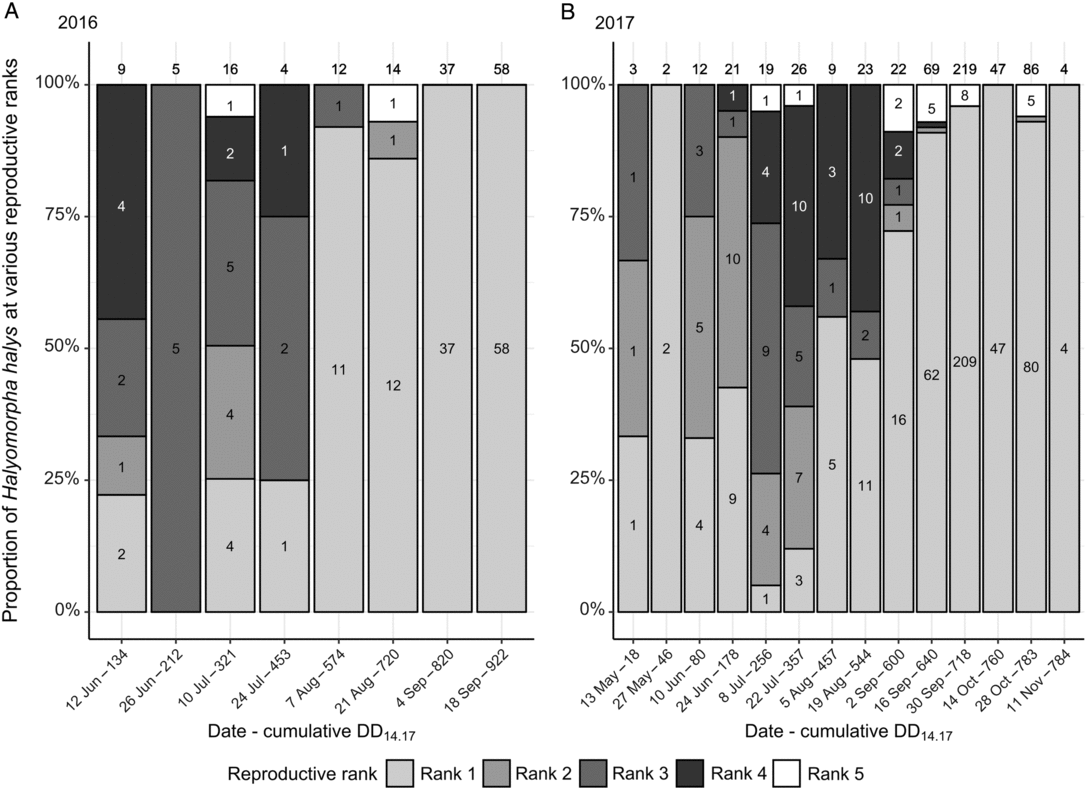
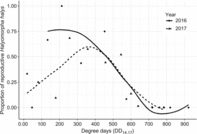
In 2016 and 2017, the majority of individuals were captured after 500 DD14.17, which occurred late July or early August (Fig. 1). The proportion of individuals at a given reproductive rank varied across time in both years (Figs. 1–2). In both years, collections occurring after approximately 600 DD14.17 were dominated by previtellogenic (rank 1) individuals, similar to patterns observed in the mid-Atlantic region in the United States of America (Nielsen et al. Reference Nielsen, Fleischer, Hamilton, Hancock, Krawczyk and Lee2017). These previtellogenic individuals caught in the fall likely comprise the cohort that will enter diapause and overwinter. Conversely, rank 2, previtellogenic individuals were caught before 600 DD14.17 and likely represent individuals that have emerged from overwintering sites from the preceding year. Importantly, the rank 3 and rank 4 vitellogenic, or reproductively active, individuals were caught as early as May and peaked between July and August, between 250 and 550 DD14.17 (Figs. 1–2).
The reproductive rank of adult female Halyomorpha halys captured in 2016 (A) and 2017 (B) by calendar date and cumulative DD14.17. Numbers on top of each bar are total H. halys captures for a sampling period, while numbers superimposed on each bar are totals for each reproductive rank (rank 1 = previtellogenic (one oocyte); rank 2 = previtellogenic (more than one oocyte); rank 3 = vitellogenic (one mature oocyte); rank 4 = vitellogenic (more than one mature oocyte); and rank 5 = post reproductive (Nielsen et al. Reference Nielsen, Fleischer, Hamilton, Hancock, Krawczyk and Lee2017)).

The proportion of reproductively active (vitellogenic, rank 3 and rank 4 (Nielsen et al. Reference Nielsen, Fleischer, Hamilton, Hancock, Krawczyk and Lee2017)) adult female Halyomorpha halys captured in 2016 (n = 155) and 2017 (n = 562) by cumulative degree days (DD14.17).

The overall pattern in ovary development we observed is consistent with a single generation per year of H. halys in Ontario. For example, rank 2 – previtellogenic individuals were primarily caught prior to August. If multiple generations were present, we would expect to capture a larger proportion of rank 2 individuals throughout the season, as newly emerged adults become reproductively active.
We admit our sample sizes are small and geographically limited, and therefore, we cannot exclude the possibility that H. halys has strongly overlapping generations. Regardless of whether they represent one or two generations, reproductively active H. halys were caught as early as May and continued to early September and peaked between 250 and 550 DD14.17. In the United States of America, patterns of H. halys reproductive development varied by region owing to differences in temperature and photoperiod (Nielsen et al. Reference Nielsen, Fleischer, Hamilton, Hancock, Krawczyk and Lee2017). Our data appear similar to H. halys populations in North Carolina and Oregon, as these regions had peaks in reproductively active individuals prior to 500 DD14.17 and after 600 DD14.17 and collections were dominated by rank 1, previtellogenic individuals (Nielsen et al. Reference Nielsen, Fleischer, Hamilton, Hancock, Krawczyk and Lee2017). Variability in reproductive development between populations of H. halys highlights the importance of local data in designing H. halys monitoring and management programmes. The pattern of development observed here should be taken into consideration when designing H. halys monitoring and management in the Niagara Region of Ontario and possibly other areas of Canada where H. halys is present.
Acknowledgements
Funding for this study was obtained through the Ontario Agri-Food Innovation Alliance – Emergency Management and Production Systems – Plants, with additional financial support from the Niagara Peninsula Fruit and Vegetable Growers Association, Ontario Apple Growers, and discretional funds allocated to the Bayer Chair in Sustainable Pest Management. We would like to thank all the growers and summer students who participated and contributed to this study.