Introduction
In the Animalia kingdom, males sometimes have ornamentation of different size and shape, such as that of red deer and peacocks (Huxley et al. Reference Huxley, Strauss and Churchill1993). In invertebrates, especially insects, males sometimes evolve in an exaggerated manner as in stag beetles and stalk-eyed flies (Emlen and Nijhout Reference Emlen and Nijhout2000). Females are usually larger than males in the order Orthoptera (Hochkirch and Gröning Reference Hochkirch and Gröning2008) and sexual dimorphism is common among crickets. For example, male Velarifictorus longifrons (Chopard) (Orthoptera: Gryllidae) has a long horn at the vertex and male Sciobia (Thliptoblemmus) natalia Gorochov (Orthoptera: Gryllidae) has a strongly elongate head. Several hypotheses have been proposed to explain this sexual dimorphism. One hypothesis states that females prefer larger males or their sexual characteristics (Borgia Reference Borgia1981). Conversely, larger females are chosen by males (Hieber and Cohen Reference Hieber and Cohen1983; Johnson and Hubbell Reference Johnson and Hubbell1984). A second hypothesis is based on male competition, because large males or males with large weapons have advantages in fighting (Green Reference Green1992; Dale et al. Reference Dale, Dunn, Figuerola, Lislevand, Székely and Whittingham2007). The third hypothesis states that sexual dimorphism is a result of intersexual niche differentiation: females may maximise their offspring by attaining larger sizes, as this allows them to lay more and/or larger eggs (Shine Reference Shine1989; Hochkirch et al. Reference Hochkirch, Gröning and Krause2007).
Allometry is often described in terms of allometric slope (k), based on the equation (Y=bX k ), where X=general body size and Y=trait size (Huxley et al. Reference Huxley, Strauss and Churchill1993). Allometry is classified as negative allometry, isometry, or positive allometry. Generally, relative trait size is constant for all body sizes when b=1 (isometry), decreases with body size when b<1 (negative allometry), or increases with body size when b>1 (positive allometry) (Bonduriansky Reference Bonduriansky2007b). For calculation, raw data is usually translated into Log form and regression line can be calculated as LogY=k×LogX+Logb, k and b is same to Y=bX k . There is a belief that sexual traits such as weapons and display structures exhibit positive allometry, because weapons have advantages in male competition and large displays are preferred by females (Bonduriansky Reference Bonduriansky2007b; Whitman Reference Whitman2008). Allometry in male heads is reported in Velarifictorus aspersus (Walker), Acheta domesticus (Linnaeus), and Gryllus pennsylvanicus Burmeister (Ingrisch Reference Ingrisch1998; Judge and Bonanno Reference Judge and Bonanno2008; Walker et al. Reference Walker, Roberts, Adame, Collins and Lim2008).
In the genus Loxoblemmus Saussure (Orthoptera: Gryllidae) the face of males is flattened and oblique (Chopard Reference Chopard1969). The facial structures could be the result of sexual selection or male competition (Green Reference Green1992). For classification of the species belonging to this genus, facial structure is always mentioned as the key distinguishing feature (Yin and Liu Reference Yin and Liu1995; Ichikawa et al. Reference Ichikawa, Ito, Kano, Kawai, Tominaga and Murai2006). However, whether these structures or features are stable within a single species has not been verified. Orthoptera are well known for the environmental colour determination (Iba et al. Reference Iba, Nagao and Urano1995; Hochkirch et al. Reference Hochkirch, Deppermann and Gröning2008). Environmental determination of wing dimorphism is also known (Tanaka et al. Reference Tanaka, Matsuka and Sakai1976; Hochkirch and Damerau Reference Hochkirch and Damerau2009). The facial structures of Loxoblemmus crickets also may be affected by these environmental factors.
We collected nymphs of Loxoblemmus angulatus from Vietnam and subsequently reared them in laboratory conditions under different photoperiods. We found that the head shape of males varied. Generally, the bigger the body size, the bigger the head, with more obvious horn. In this study, we ask the following questions: (1) how do environmental factors influence body size, and (2) what relationship exists between body size and head form?
Materials and methods
Nymphs of L. angulatus were collected from Babe, Vietnam (22.2°N, 105.6°E), in March 2010 and imported with special quarantine permission from the Kobe Branch of the Plant Protection Service, Japan. They were reared at 25 °C under 16:8 light:dark photoperiod for egg collection (light was provided from a 20 W fluorescent lamp controlled by an electric timer). The eggs oviposited into wet soil were transferred into a walk-in constant-temperature room at 27.5 °C (NK SYSTEM Experimental Laboratory, LP-1/2/3PH, Osaka, Japan). Eggs began to hatch soon after translocation. Totally 48+60+69+20+5+2+5+1 nymphs hatched 15–22 days after oviposition. Thirty nymphs were selected on day 15 and randomly separated in three transparent plastic cups (10 cm in diameter×10 cm in height, holes were drilled for ventilation) of 10 individuals per cup under 16:8, 14:10, or 12:12 light:dark photoperiod at 27.5 °C. The same step was repeated on day 16 and 17. A total of 90 individuals in nine cups with 10 individuals per cup were reared under three photoperiods. They were fed with rodent food (MF, Oriental Yeast Co. Ltd., Tokyo, Japan) and supplied until nymphs reached adult stage. Fifty microlitre centrifugal tubes (15 cm in length) were filled by water plugged with tissue paper inverted and positioned at a 45° angle in each rearing cup. This method kept the tissue paper wet, but helped rearing cup keep dry and clean. The water tubes could sustain the water supply for at least one month and was refreshed if necessary.
The nymphs were checked everyday between 9 and 11 a.m. Adults were removed from the culture in order to prevent cannibalism. Adults were kept separately in small plastic cups. These adults were dried at 60 °C overnight after they died. This also made it easy to separate one hind leg from the body for measurement. A vernier scale was used for measuring the maximum width of head (HW), pronotum (PW), and the lengths of the hind femur (HFL), forewing (FL), and hindwing (HL). The degree of sexual dimorphism was calculated by the mean male trait/mean female trait. The relative degree was calculated by the (mean male trait/mean male PW)/(mean female trait/mean female PW), because PW loads most strongly in PC1 in females and second strongly in males, see result (Fig. 3).
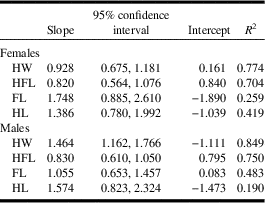
The SPSS 12.0 statistical package was used for the calculations. Raw data were transformed into logarithmic scale for allometric calculation and RMA software package was used to performance the regression lines with the reduced major axis regression (Bohonak Reference Bohonak2002). The 95% confidence interval of slope was given, and when the minimum value is larger than 1, it is defined as positive allometry.
Result
A total of 15, 15, and 19 individuals emerged under 12:12, 14:10, and 16:8 light:dark photoperiod, respectively (mortality 50%, 50%, 36.7%, respectively). There was no effect of different photoperiods on survival, χ 2 (2, n=90)=1.434, P=0.488. Some individuals were injured just after moulting and some pairs were used for reproduction. In total 8 (5♂, 3♀), 11 (5♂, 6♀), and 15 (8♂, 7♀) individuals were used for morphometric measurements.
Photoperiod and developmental rate
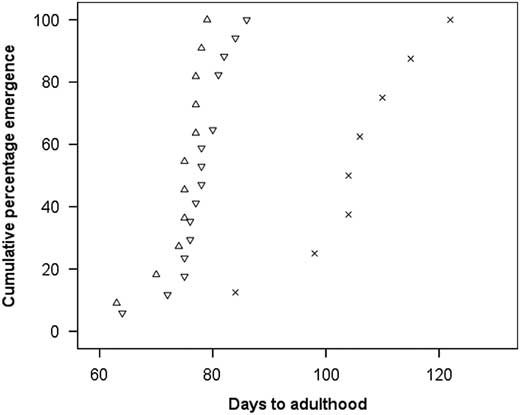
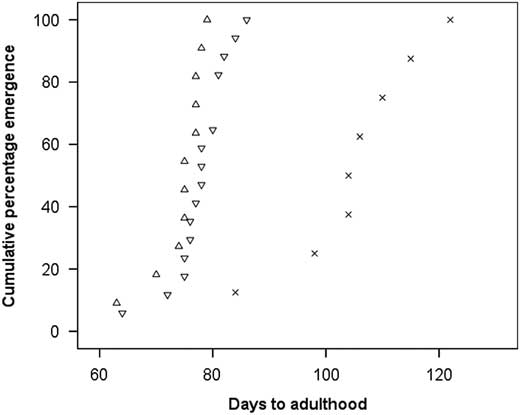
Under 12:12 light:dark photoperiod, the average female development time±SD was 104.00±19.08 days, that of the male was 106.20±6.50 days, and no differences were observed in development time between the sexes t(6)=0.246, P=0.814. Under 14:10 light:dark photoperiod, the average female development time±SD was 76.67±1.86 days, that of the male was 72.00±5.66 days, and no differences were observed, adjusted for inequality of variances, t(4.7)=1.77, P=0.141. Under 16:8 light:dark photoperiod, the average female development time±SD was 78.43±3.82 days, that of the male was 76.63±6.37 days, and no differences were observed, t(13)=0.652, P=0.526. A one-way analysis of variance was used to test development time among three photoperiods in both sexes. In females, development time differed significantly across the three photoperiods, F(2,13)=13.32, P=0.001. Tukey post-hoc comparisons of the three groups indicated that individuals under 12:12 light:dark photoperiod had longer development days and developmental days had no significant difference between 16:8 and 14:10 light:dark photoperiod. In males, the result was similar. Development time differed significantly across the three photoperiods, F(2,15)=46.70, P<0.001. Tukey post-hoc comparisons indicated that individuals under 12:12 light:dark photoperiod had longer developmental days. Developmental days against cumulative emergency are shown in Fig. 1.
Cumulative emergence of Loxoblemmus angulatus under different photoperiods, cross, 12:12 light:dark photoperiod; inverted triangles, 14:10 light:dark photoperiod; triangles, 16:8 light:dark photoperiod. 27.5 °C.
Body size and developmental rate
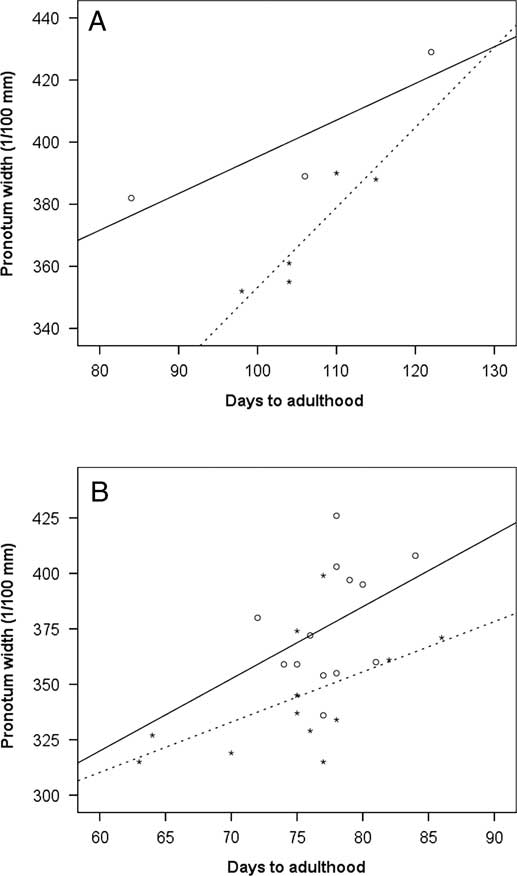
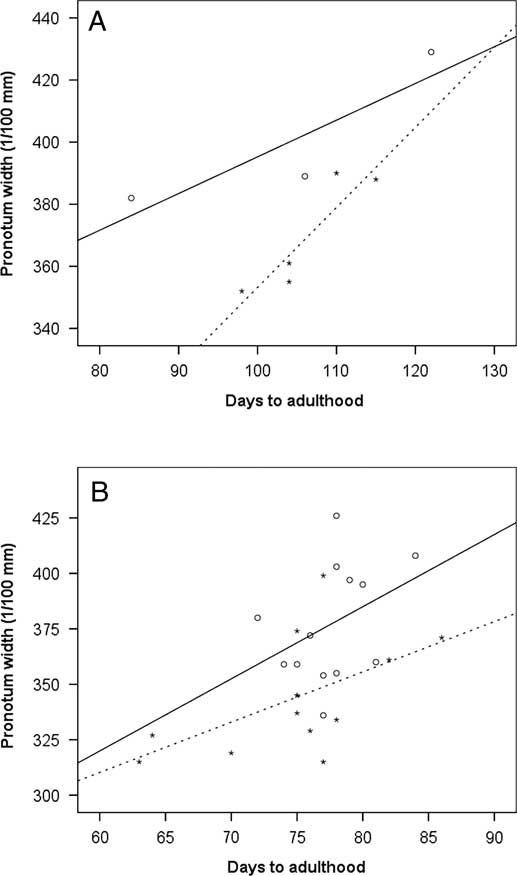
Data under 14:10 and 16:8 light:dark photoperiod were pooled, because developmental days did not show a significant difference. PW was selected for representing body size (see result 3 for PCA). When PW and development time was compared, PW had a positive relationship with development time only in males (Fig. 2a: 12:12 light:dark photoperiod, y=2.576x+95.647, R 2=0.829, P=0.032; Fig. 2b: 14:10+16:8 light:dark photoperiod, y=2.267x+174.260, R 2=0.310, P=0.048; where x is development time and y is PW), but had no effect on females (Fig. 2a: 12:12 light:dark photoperiod, y=1.181x+277.143, R 2=0.790, P=0.303; Fig. 2b: 14:10+16:8 light:dark photoperiod, y=3.251x+124.877, R 2=0.144, P=0.200; where x is development time and y is PW).
A scatter diagram for development time and pronotum width in Loxoblemmus angulatus. Open circles, females; asterisks, males at 27.5 °C. (A) 12:12 light:dark photoperiod; (B) 14:10+16:8 light:dark photoperiod).
Sexual dimorphism
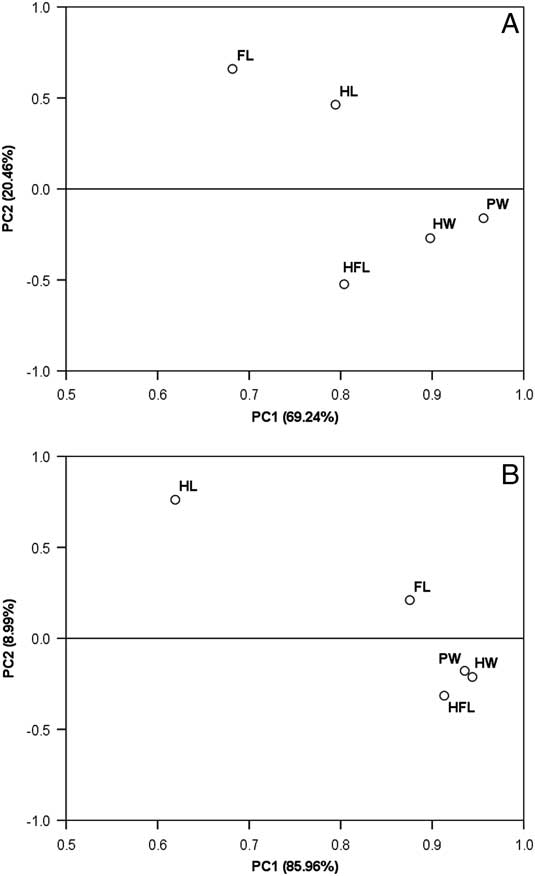
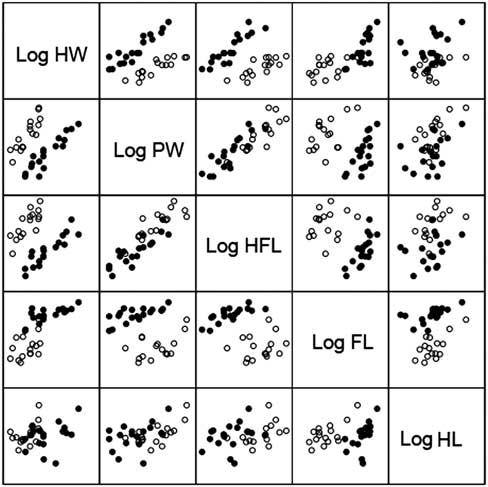
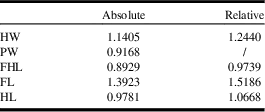
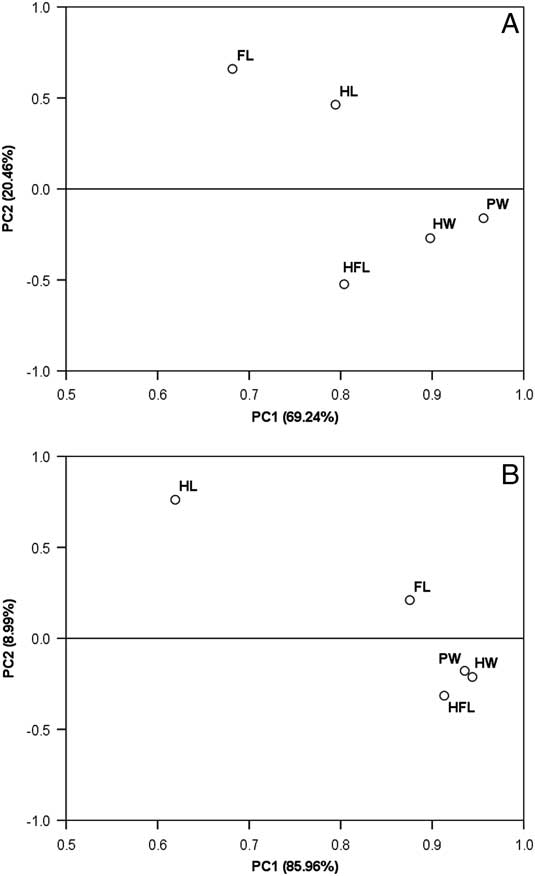
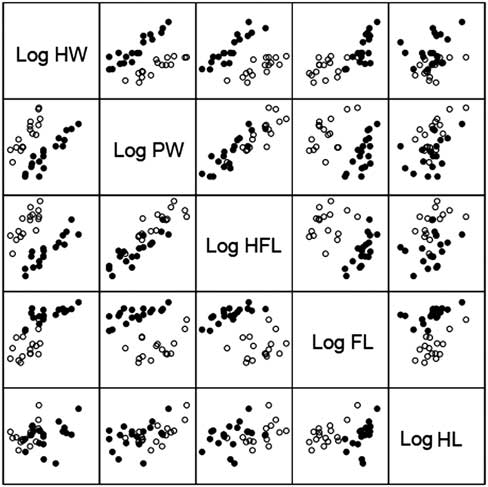
Principal components were computed for examining five different body traits. PW in females loaded most strongly in PC 1, followed by HW and HFL (see Fig. 3a). In males, HW loaded most strongly and closely followed by PW and HFL (see Fig. 3b). The degree of sexual dimorphism value showed that HW and FL had large differences between sexes (see Table 1), but only HW in male was allometric according to the 95% confidence interval. The average slope of Log HW against Log PW is 1.464 (1.162, 1.766), (see Table 2, Fig. 4).
Ordination plots for five morphological traits in Loxoblemmus angulatus (A) female; (B) male.
Matrix of scatterplots for the log transformed morphological traits in a sample of 16 females (circle) and 18 males (solid circle) in Loxoblemmus angulatus.
Degree of sexual dimorphism in Loxoblemmus angulatus.

Absolute: mean male trait/mean female trait; relative: (mean male trait/mean male PW)/(mean female trait / mean female PW).
HW, width of head; PW, width of pronotum; HFL, length of the fore-leg; FL, length of forewing; HL, length of hindwing.
Static allometries in Loxoblemmus angulatus by reduced major axis regression against PW.
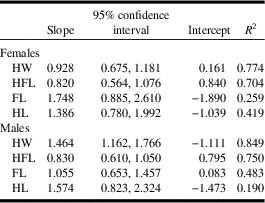
HW, width of head; HFL, length of the hind femur; FL, length of forewing; HL, length of hindwing.
Discussion
Environmental factors and body size
Numerous studies have found sexual dimorphism in secondary sexual traits function as courtship signals and/or weapons, where condition-dependent expression was observed (Masaki and Walker Reference Masaki and Walker1987; Iba et al. Reference Iba, Nagao and Urano1995; Bonduriansky Reference Bonduriansky2007a). We reared crickets at the same temperatures, humidity, food supply, and density to test the effect of photoperiod on development and body size. Results indicate that L. angulatus develops slower under shorter day length. This phenomenon has been documented in several other crickets, such as Modicogryllus siamensis Chopard (Orthoptera: Gryllidae) and Teleogryllus occipitalis (Serville) (Orthoptera: Gryllidae), which enter diapause to overwinter in the nymphal stage (Walker and Masaki Reference Walker and Masaki1989; Tanaka et al. Reference Tanaka, Arai and Tanaka1999). Loxoblemmus angulatus has the same photoperiodic responses, which suggests that photoperiod is an important factor in determining whether this species emerges as an adult or enters diapause. PW was narrow when male crickets spent fewer days in development. Plaistow et al. (Reference Plaistow, Tsuchida, Tsubaki and Setsuda2005) also found that male horned beetles were hornless if they had limited time to develop. Masaki (Reference Masaki1963, Reference Masaki1966, Reference Masaki1972) demonstrated that body size increased with nymphal developmental day in several egg overwintering crickets. Our results suggested that male L. angulatus also grew larger after longer developmental days, although it probably overwinters in the nymphal stage. Similar results were found in M. siamensis where head width increased with developmental days in both sexes (Tanaka et al. Reference Tanaka, Arai and Tanaka1999). Esperk et al. (Reference Esperk, Tammaru, Nylin and Teder2007) showed that females added larval instars and grew larger. This may also occur in males because conspecifics can experience different instar numbers according to photoperiod or food quantity (Walker and Masaki Reference Walker and Masaki1989). However, the pronotum width was not relative to developmental days in females. Body size in females may be relatively stable in this species.
Body size and head form
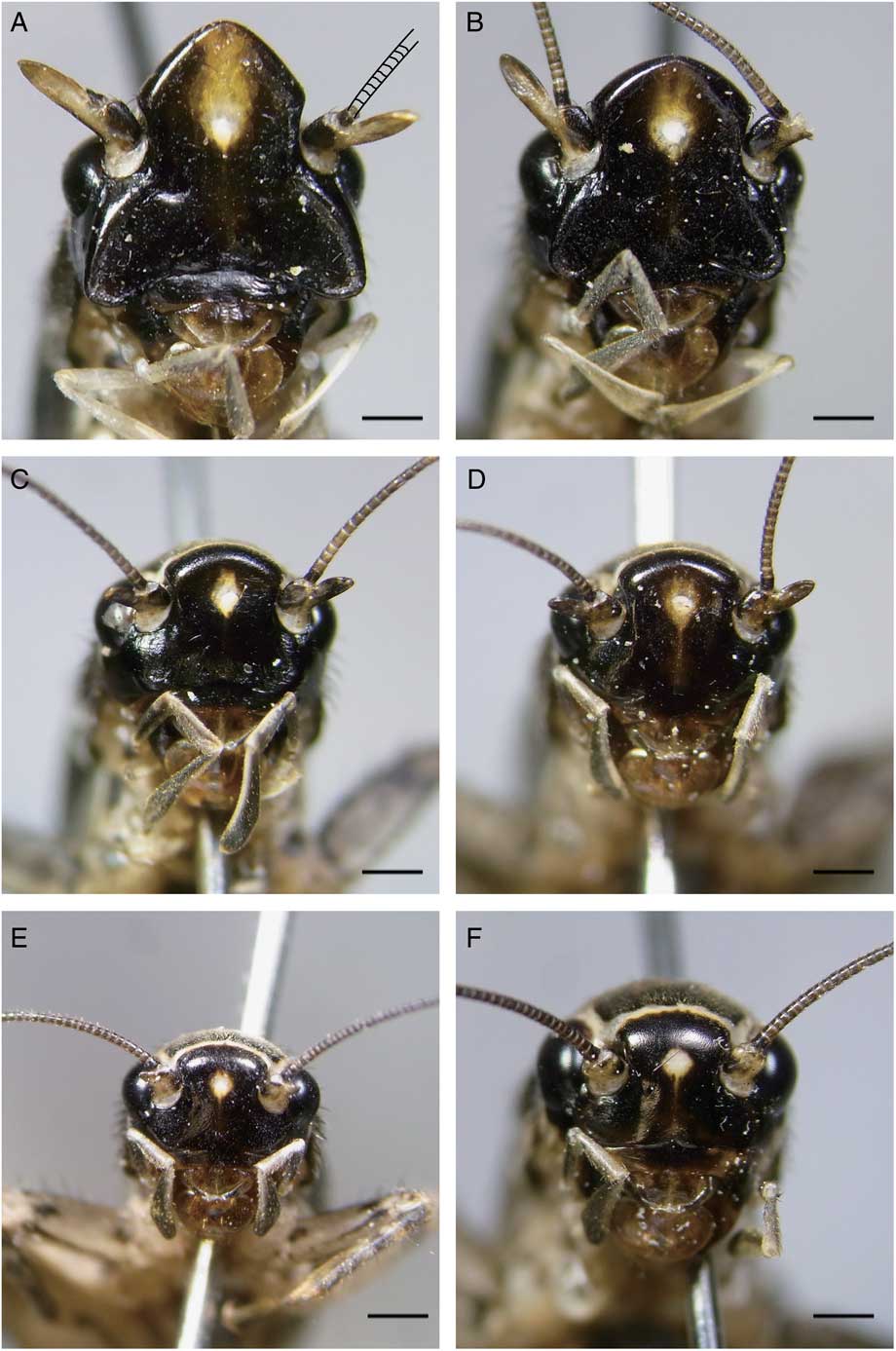
Some traits related to competition or courtship increase allometrically versus body size, such as antlers in deer and fore-leg in Euchirus longimanus (Linnaeus) (Coleoptera: Scarabaeidae) (Huxley et al. Reference Huxley, Strauss and Churchill1993). We compared sexual differences and found that HW and FL were larger in males. Male crickets usually have specular forewings for producing songs, while forewings in females are sometimes shorter or absent. Male heads are usually larger than female heads (Judge and Bonanno Reference Judge and Bonanno2008). However, only the minimum value of 95% confidence interval slope in male HW was larger than 1, which means it is allometric, and that of forewing showed no significant difference with isometry. Although the slope of FL in females and HL in both sexes was larger than 1, neither of them had significant differences with isometry (y=x) according to their 95% confidence interval. Females can discriminate males by their songs (Wagner et al. Reference Wagner, Murray and Cade1995; Gray Reference Gray1997), and forewing structures effects songs (Montealegre-Z et al. Reference Montealegre-Z, Windmill, Morris and Robert2009). Results showed that FL was poorly correlated with PW (R 2<0.5), although it could be a sexual trait. Thus FL is not an important trait selected by females. Further studies on forewing structures, such as mirror area, should be tested. Another sexual trait, HW, is allometric. Walker et al. (Reference Walker, Roberts, Adame, Collins and Lim2008) found that males had larger heads and allometric relationships between head size and body size in Acheta domestica (Linnaeus) (Orthoptera: Gryllidae) crickets. Judge and Bonanno (Reference Judge and Bonanno2008) found that the males with large weapons have advantages in male–male competition. In L. angulatus, large-headed males usually have larger horns on the vertex and two obvious angles under the eyes, while small-headed males had similar face features as females without horn (see Fig. 5). Differences in resource holding potential (RHP) are one of the important effects on the outcome of contests and body traits are often used as an indicator of RHP (Parker Reference Parker1974). The advantage of a big head in competition or attractiveness to females is unknown. Kim et al. (Reference Kim, Jang and Choe2011) found that horns did not affect the results of fighting in Loxoblemmus doenitzi. We tried to observe male fighting behaviour in L. angulatus. However, the males we observed were not aggressive, even though Gorochov (Reference Gorochov1983) observed face butting in some species of Loxoblemmus. In our observations, L. angulatus only exchanged aggressive songs when encountering rivals, but one quickly retreated. On one occasion, neither side retreated and both sides confronted each other and placed their heads together. The maxillary palpi and labial palpi were horizontally stretched. However, this looked more like a display than a fight because they did not actually bite or wrestle, before one side finally retreated. It appears that horns are not physically engaged in fighting. A previous study had shown that density might affect fighting behavior; i.e., isolated males were more aggressive (Iba et al. Reference Iba, Nagao and Urano1995). We reared individuals until they moulted, which may have influence on their fighting behaviour. Examining why species of Loxoblemmus have exaggerated head forms is our future goal. Large headed males may be more attractive, but smaller males are more agile and have better survival or are more stealth, as shown in dung beetles (Blanckenhorn Reference Blanckenhorn2000; Moczek and Emlen Reference Moczek and Emlen2000).
Frontal aspects of the male head in Loxoblemmus angulatus (A–E), females, (F). Scale bar=1 mm.
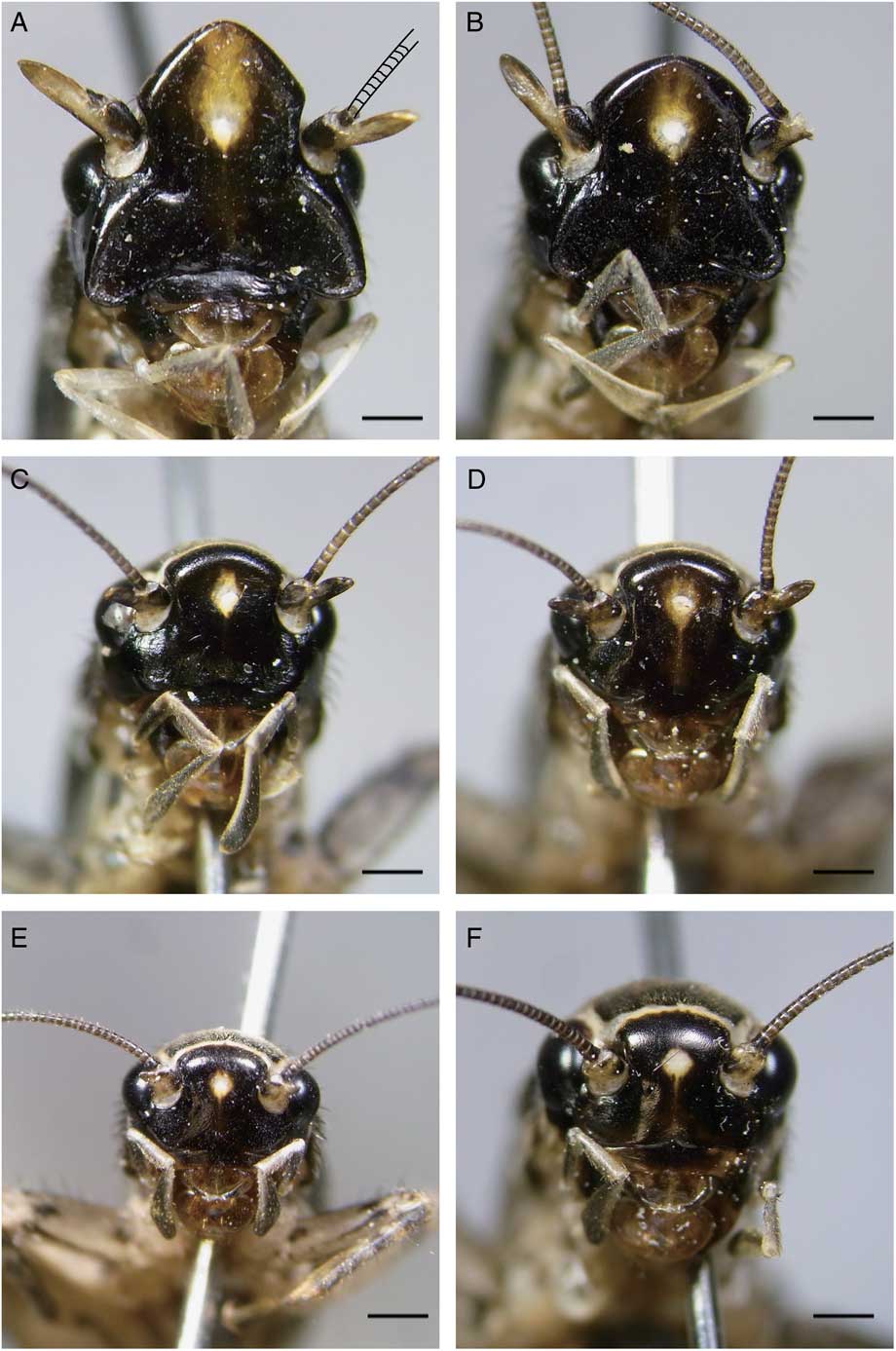
Gorochov (Reference Gorochov2001) mentioned that facial structures varied in Loxoblemmus and indicated that the shape of the head was round or nearly round to distinctly oblique within a single species. Our results support this hypothesis, which cautions using the morphology of the head for classification in this genus.
Acknowledgements
The authors thank Watanabe Kyohei for the photographs. They are indebted to the Kobe Plant Protection Station for the permission (Permit No. 23–207) to import live crickets. Two anonymous reviewers kindly provided many valuable suggestions on previous drafts.