Introduction
The mosquito Aedes aegypti (L.) (Diptera: Culicidae) is the principal vector of dengue fever and urban yellow fever in several tropical regions. Its growing resistance to organophosphate and pyrethroid insecticides, frequently used in its control, has been registered in various countries (Wirth and Georghiou, Reference Wirth and Georghiou1999; Rodriguez et al., Reference Rodriguez, Bisset, Ruiz and Soca2002). In Brazil, the resistance problem has become critical over the last few years (Macoris et al., Reference Macoris, Andrighetti, Takaku, Glasser, Garbeloto and Bracco2003; Carvalho et al., Reference Carvalho, Caldas, Degallier, Vilarinhos, Souza, Yoshizawa, Knox and Oliveira2004; Cunha et al., Reference Cunha, Lima, Brogdon, Moya and Valle2005).
Alternative control using insect growth regulators (IGRs) such as diflubenzuron (a chitin synthesis inhibitor) and methoprene (a juvenile hormone analogue) (Mulla, Reference Mulla1995) has been extensively adopted. In Brazil, where some populations of A. aegypti are already resistant to the organophosphate temephos, methoprene is currently being recommended by the Health Ministry as an alternative (FUNASA, Reference FUNASA2001).
When an insecticide is used to control a particular pest, part of the population may survive due to exposure to sublethal concentrations of the chemical, as a result of several factors. These include low effectiveness of the insecticide, natural peculiarities of the targeted population, and local environmental conditions limiting the use of application techniques. Exposure to sublethal concentrations of a chemical stressor may compromise the target insect's fitness, reducing its ability to reproduce or decreasing its longevity (Robert and Olson, Reference Robert and Olson1989; Reyes-Villanueva et al., Reference Reyes-Villanueva, Juárez-Eguia and Flores-Leal1990; Vasuki, Reference Vasuki1999; Silva et al., Reference Silva, Mendes and Lomônaco2004). It can also promote the build-up of resistance to the chemical.
The fitness of an insect population may be assessed by examining the size, biomass and symmetry of individuals. Size and biomass are usually related to fecundity or reproductive success, while asymmetry relates to phenotypic variations caused by environmental noise (Bjorksten et al., Reference Bjorksten, Fowler and Pomiankowski2000; Lomônaco and Germanos, Reference Lomônaco and Germanos2001; Mpho et al., Reference Mpho, Holloway and Callaghan2001; Silva et al., Reference Silva, Mendes and Lomônaco2004). The relationship between symmetry and fitness of insect populations exposed to insecticides has been investigated in terms of economic, ecological and epidemiological significance (Clarke and Ridsdill-Smith, Reference Clarke and Ridsdill-Smith1990; Mpho et al., Reference Mpho, Holloway and Callaghan2001; Silva et al., Reference Silva, Mendes and Lomônaco2004).
The study reported here was conducted to examine the effects of sublethal concentrations of the IGRs diflubenzuron and methoprene on some fitness components of an A. aegypti population in Uberlândia, State of Minas Gerais, south-eastern Brazil. Our hypothesis was that exposure to sublethal concentrations of both IGRs would reduce the size, fecundity, fertility, biomass and symmetry of the mosquito populations.
Materials and methods
Aedes aegypti population
Mosquito egg captures were performed in three districts of Uberlândia city using egg traps containing Duratex® palettes. The captures were carried out every 15–30 days between February 2003 and March 2005. Traps were set in the field for 5 days and then taken to the laboratory where egg trap palettes containing A. aegypti eggs were individually transferred to transparent glass bottles (14 cm diameter × 8 cm height). To stimulate larval emergence, the palettes were submersed in water for 48 h. Following this period, 30 mg of crumbled rodent ration (Nuvilab CR1, Nuvital® S/A, Colombo, PR, Brazil) were added to each glass bottle as food for the larvae. The bottles were covered with organza and kept at room temperature until emergence of the adults (F0 generation), which were then transferred to entomological cages.
Every 3 days, one rodent Rattus norvegicus Wistar was presented to the females for their blood meals and a sugar–water solution was offered ad libitum to the adult mosquitoes, being renewed every 5 days. An egg trap was placed in the cage to collect the eggs, which were subsequently submitted to the same procedure applied to the field-collected eggs. The adults obtained (F1 generation) were released into other cages and their progeny (F2) were used for experiments. Additional field-collected individuals were introduced frequently to maintain the genetic variability of the laboratory colony during the experimental period.
Effects on physiological fitness components of A. aegypti
Six replicates of 20 fourth instars of A. aegypti (n = 120) were exposed separately to 20 ppb methoprene (commercial formulation Altosid XR-G® 1.5% a.i.) and 3 ppb diflubenzuron (technical formulation 99.4% a.i., Champion Farmoquimico Ltda, Anapolis, Goias, Brazil), both concentrations close to the LC50 values (Silva and Mendes, Reference Silva and Mendes2007). Respective control groups were also constituted and monitored (n = 120). Adult survivors were released into entomological cages in a 1:1 sexual proportion (12 males and 12 females in each cage), and males and females were kept together for a minimum of 5 days. Females were weighed individually immediately after emergence to evaluate body biomass. These individuals had ad libitum access to a rodent for 8 h, for their blood meals.
After 2 days, two egg traps were placed into each cage for 48 h with the females left over from the treated groups (n = 38 for diflubenzuron and n = 36 for methoprene) and from the control groups (n = 46 for diflubenzuron and n = 51 for methoprene). The experimental cages were kept inside the laboratory at room temperature. Collected eggs were maintained for 7 days in a climate chamber at 25 ± 1 °C and 65 ± 5% humidity, before being submersed in water.
Fecundity was estimated as the mean number of eggs produced per female within 24 h of the egg traps being inside the cages. Fertility was evaluated as the proportion of larvae hatched within 48 h after the eggs were submersed in water. Longevity was estimated as the mean daily number of live individuals inside each cage, from the day of adult emergence. Following fecundity and fertility data collection, the mosquitoes were fed exclusively on a sugar–water solution, renewed every 5 days until the death of the last individual.
Comparisons between weights of females in treatments and controls were made utilizing the Mann–Whitney test. For fecundity and longevity comparison, the original data were log10 transformed before being submitted, respectively, to a t-test and ANOVA. Similarly, an arcsine transformation was performed on the fertility data (i.e. proportion of larvae hatched) before the t-test (Zar, Reference Zar1984). All statistical procedures were performed using Systat for Windows, version 9.0 (Systat, 2002).
Effects of sublethal concentrations of the IGRs on morphological traits
Stock solutions of technical diflubenzuron 99.4% (Champion Farmoquimico Ltda) and methoprene 94.7% (Novartis Saúde Animal, Ltda, São Paulo, SP, Brazil) were prepared using absolute acetone as a solvent, and from these, concentrations of 2, 3 and 3.5 ppb diflubenzuron and 5, 10 and 20 ppb methoprene were prepared using distilled water as a solvent (Silva and Mendes, Reference Silva and Mendes2007). Control solutions had only water added to the respective solvent aliquots.
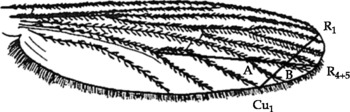
Samples of 90 surviving individuals from each IGR treatment (15 males and 15 females per treatment) and 30 control individuals were randomly selected for morphometric analysis. All individuals had their wings (right and left) detached and dry-mounted on slides with a coverslip. The slides were photographed using a digital camera DP70 with 12 megapixels resolution attached to an Olympus microscope (4 × magnification). Using the image analysis software Image J 1.35s (2006), the digital photographs were amplified 20 times and measurements taken of two segments: A = distance between the bifurcation point of the CuA vein in CuA1 and CuA2 and the extremity of the R4+5 vein at the wing edge; and B = distance between the finding point of the R1 distal extremity and the extremity of the CuA1 vein at the wing edge (Fig. 1). Each one of these segments was measured three times. The wing veins provide many well-defined morphological markers in an essentially plane structure, and are commonly used in morphological analysis (Klingenberg and McIntyre, Reference Klingenberg and McIntyre1998).
Schematic of a mosquito wing showing ‘A’ and ‘B’, the two morphological characters measured (figure modified from Tripleton and Johnson, Reference Tripleton and Johnson2005).

Measurements of bilateral traits were obtained from both sides of the body to elaborate an index of fluctuating asymmetry (FA), which describes asymmetric phenotypic variations caused by developmental noise. FA was calculated as the mean difference between the right (R) and the left (L) side, i.e. FA = [Σ|(R − L)|/n] (Palmer and Strobeck, Reference Palmer and Strobeck1986). A two-factor ANOVA was used to determine whether the between-sides variation was significantly larger than the measurement error (Woods et al., Reference Woods, Hercus and Hoffmann1998). A t-test was performed to detect the occurrence of directional asymmetry (Perfectti and Camacho, Reference Perfectti and Camacho1999). FA dependence of size was tested for each sample by regressing the absolute difference of the right minus left measurements on trait size (Palmer and Strobeck, Reference Palmer and Strobeck1986). Babbit et al.'s (Reference Babbit, Kiltie and Bolker2006) explanation of the non-obligation of normal adjustment for FA was adopted. Subsequently, differences in FA values between treatments and controls were verified using the Kruskal–Wallis test and multiple comparisons were made using the Tukey-type test (Zar, Reference Zar1984).
The first of the three measurements was used in the principal component analysis (PCA) to obtain a multivariate general body size index, estimated using a correlation matrix of the original characters (Manly, Reference Manly1994). Subsequently, the transformed data were submitted to the Kruskal–Wallis test (Zar, Reference Zar1984).
Results
Physiological effects
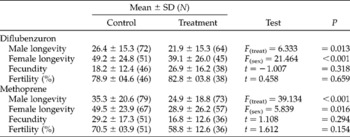
Longevity was significantly affected by the diflubenzuron and methoprene treatments (Table 1). Females had a significantly longer lifespan than males, independent of treatment, for both IGRs (F sex*treat = 0.151, df = 1, P>0.698 for diflubenzuron and F sex*treat = 2.062, df = 1, P>0.152 for methoprene). Fecundity and fertility did not differ significantly between treatments and controls (Table 1).
Longevity, fertility and fecundity of Aedes aegypti mosquitoes treated with sublethal concentrations of diflubenzuron and methoprene (two-way ANOVA results for longevity)

The mean weight of females treated with diflubenzuron (1.876 ± 0.453 mg (SD), n = 72) did not differ significantly from the control group (1.838 ± 0.416 mg (SD), n = 68; U = 2284.5, df = 1, P = 0.494). Similarly, the weight of females treated with methoprene (1.871 ± 0.334 mg (SD), n = 93) did not differ significantly from controls (1.973 ± 0.381 mg (SD), n = 92; U = 4974.0, df = 1, P = 0.054).
Morphological effects
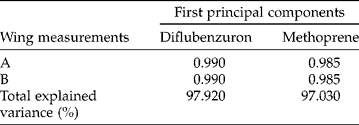
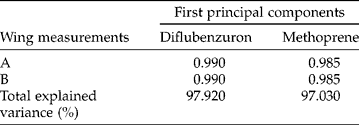
Since the two original morphological variables were significantly correlated (r Difl = 0.958, P < 0.001, n = 116 and r Meth = 0.941, P = < 0.001, n = 107), the PCA was considered adequate to estimate the multivariate index of size. The first component, related to the axes that exhibited greatest variance among individuals, explained 97.92% of the total variance of the measurements of the mosquitoes treated with diflubenzuron and 97.03% of those treated with methoprene (Table 2). The Kruskal–Wallis test, however, did not confirm significant size differences between the treatments and the controls (H = 2.049, df = 3, P = 0.562). Males exposed to each of the treatments were significantly smaller than females (H Difl = 3360.00, df = 3, P < 0.001 and H Meth = 56.515, df = 3, P < 0.001).
First principal component extracted from the phenotypic correlation matrix of two morphological characters measured in Aedes aegypti males and females treated and non-treated with sublethal concentrations of the IGRs diflubenzuron (n=117) and methoprene (n=106)
IGR, insect growth regulator.
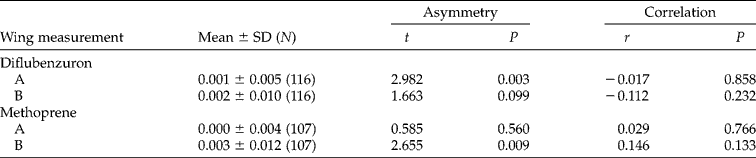
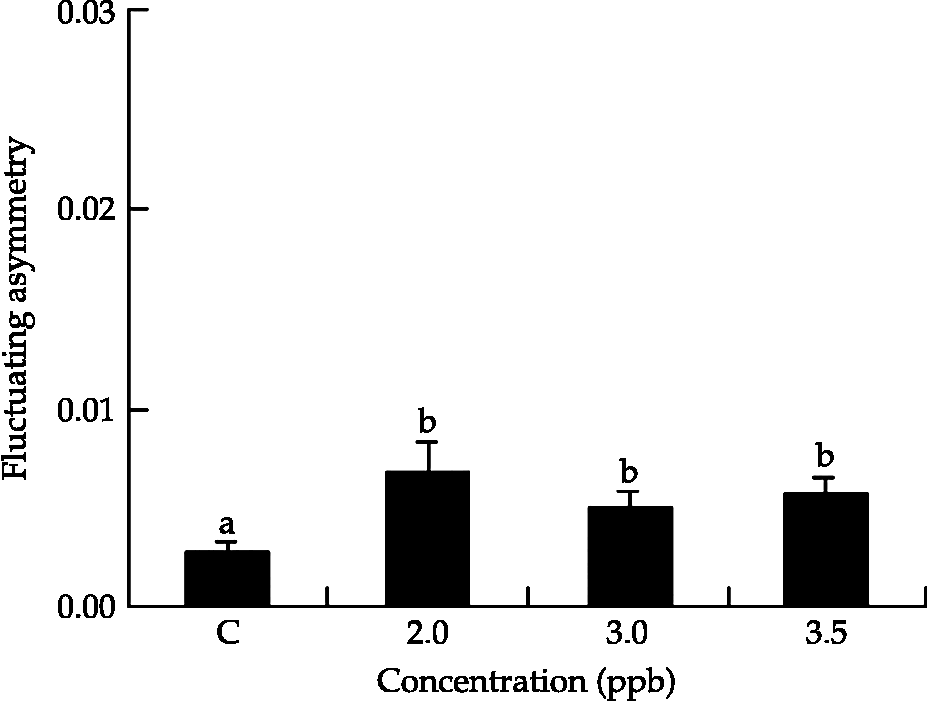
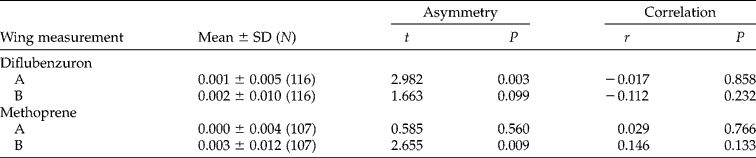
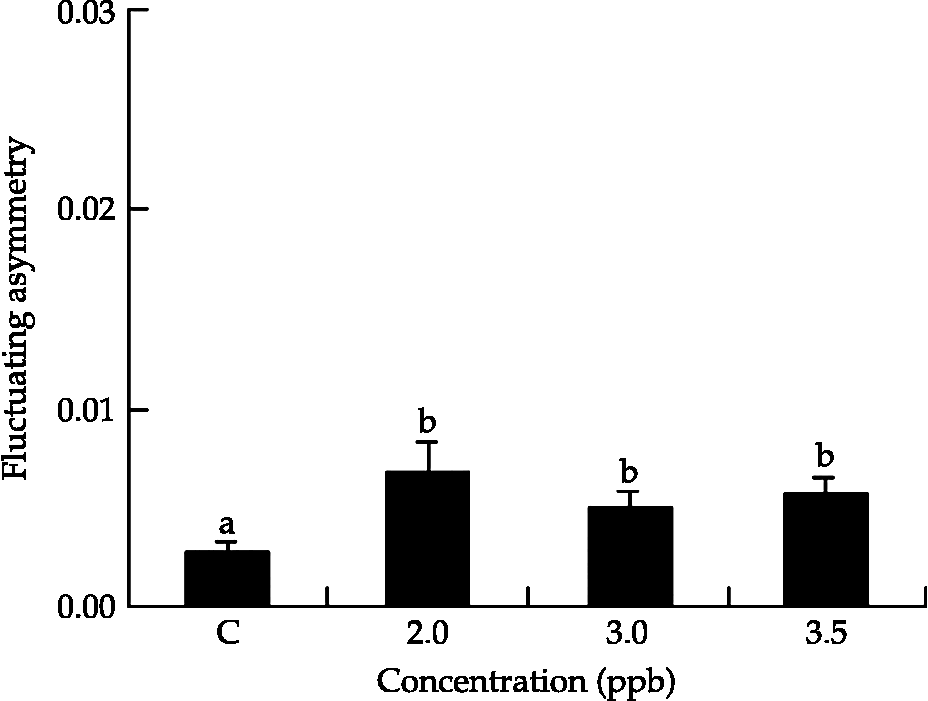
Length ‘A’ in individuals treated with diflubenzuron and length ‘B’ in those treated with methoprene were omitted from further analysis because their distributions showed directional asymmetry (Fig. 1, Table 3). The Mann–Whitney test did not confirm differences in symmetry levels between sexes (U Difl = 1421.50, df = 1, P = 0.151 and U Meth = 1295.50, df = 1, P = 0.408). Differences among treatments were significant for ‘B’ in individuals treated with diflubenzuron (H = 9.063, df = 3, P = 0.028), but not for ‘A’ in individuals treated with methoprene (H = 5.273, df = 3, P = 0.153). The Tukey-type multiple comparison test demonstrated that diflubenzuron-treated individuals were less symmetric than individuals from the control groups (Fig. 2).
Asymmetry and fluctuating asymmetry correlation with size for two wing characters of Aedes aegypti treated with sublethal concentrations of diflubenzuron and methoprene
Fluctuating asymmetry in adult Aedes aegypti treated with sublethal concentrations of diflubenzuron (C = control group). Different letters indicate significant differences according to the Tukey-type test.
Discussion
Sublethal concentrations of diflubenzuron and methoprene had negative effects on the longevity of the A. aegypti population studied. These IGRs produced distinct effects on individual symmetry. Diflubenzuron caused asymmetry in the mosquito, while methoprene had no impact on body symmetry.
The influence of methoprene in reducing mosquito longevity has been previously reported by Robert and Olson (Reference Robert and Olson1989) for Culex quinquefasciatus Say (Diptera: Culicidae). Sawbi et al. (Reference Sawbi, Klowden and Sjogren1992) also recorded reduced longevity, but only for A. aegypti females treated with methoprene in a population where female longevity was significantly greater than male longevity. Reyes-Villanueva et al. (Reference Reyes-Villanueva, Juárez-Eguia and Flores-Leal1990) registered an increase in longevity in A. aegypti females treated with temephos. Our study represents the only record of the negative influence of diflubenzuron on A. aegypti longevity.
A decrease in male longevity may reduce opportunities for mating, while short-lived females tend to have fewer gonotrophic cycles and thus fewer progeny. These effects could reduce the number of blood meals taken and diminish pathogen transmission by treated individuals.
The IGRs may have produced a selection of individuals able to sacrifice one fitness component for others that are more relevant for early maturity, such as fecundity and fertility (Ueno, Reference Ueno1994). The loss of one or more fitness components in the tolerant individuals has a negative impact on the target species' population dynamics, and may initially facilitate its control.
A negative relationship between asymmetry and fitness components such as reproductive potential, longevity and growth rate has been observed in many studies (Palmer and Strobeck, Reference Palmer and Strobeck1986; Leary and Allendorf, Reference Leary and Allendorf1989). However, there are also circumstances in which this association was not detected (Ueno, Reference Ueno1994; Antipin and Imasheva, Reference Antipin and Imasheva2001).
There are several explanations for the absence of FA in fly populations. According to Floate and Fox (Reference Floate and Fox2000), the symmetry of populations of Musca domestica (L.) (Diptera: Muscidae) was not affected by Ivermectin (a macrocyclic lactone) due to the fly's relatively superior capacity to maintain its developmental programme or ability to avoid or minimize exposure to the insecticide. Lomônaco and Germanos (Reference Lomônaco and Germanos2001) also highlighted the role of metabolic adjustments able to reduce negative effects on the homeostatic stability of this species. Antipin and Imasheva (Reference Antipin and Imasheva2001) attributed the lack of FA in Drosophila melanogaster (Diptera: Drosophilidae) treated with an organophosphate to a differential mortality of more asymmetric individuals in their early stages of development.
Body size and body biomass are both closely related to numerous aspects of mosquito biology, including longevity and haematophagic success. Aedes aegypti female biomass is very relevant for egg maturation and development; a single blood meal is sufficient for a complete oogenesis cycle (Bedhomme et al., Reference Bedhomme, Agnew, Sidobre and Michalakis2003). Armbruster and Hutchinson (Reference Armbruster and Hutchinson2002) observed that in Aedes albopictus (Skuse) (Diptera: Culicidae) and Aedes geniculatus Olivier fecundity increased with increases in pupal weights and wing widths.
Silva et al. (Reference Silva, Mendes and Lomônaco2004) observed a decline in body size of Haematobia irritans (L.) (Diptera: Muscidae) after exposure of immatures to diflubenzuron. The decrease in biomass was directly proportional to the IGR concentration used. Other researchers have observed changes in body size of C. quinquefasciatus when exposed to methoprene (Robert and Olson, Reference Robert and Olson1989; Gelbic et al., Reference Gelbic, Olejnícek and Grubhoffer2002) and temephos (Mpho et al., Reference Mpho, Holloway and Callaghan2001).
The effects of IGRs on the fecundity and fertility of dipteran species have shown mixed results. Research involving A. aegypti found that fecundity and fertility were not affected by diflubenzuron (Fournet et al., Reference Fournet, Sannier and Monteny1993) or methoprene (Braga et al., Reference Braga, Mello, Peixoto and Valle2005). By contrast, with these and our findings, Robert and Olson (Reference Robert and Olson1989) presented evidence of a reduction in fertility and fecundity in C. quinquefasciatus exposed to an LC50 concentration of methoprene. Vasuki (Reference Vasuki1999) observed that females of C. quinquefasciatus, A. aegypti and Aedes stephensi Liston (Diptera: Culicidae) exposed to hexaflumuron (a chitin synthesis inhibitor) had reduced fecundity. According to Reyes-Villanueva et al. (Reference Reyes-Villanueva, Juárez-Eguia and Flores-Leal1990), A. aegypti females treated with temephos were able to produce eggs for only two gonotrophic cycles; untreated females had three cycles.
Many other studies have demonstrated IGRs' negative effects on mosquitoes' reproductive success, reducing fertility and fecundity and altering the male's ability to find a suitable mate (O'Donnel and Klowden, Reference O'Donnel and Klowden1997; Vasuki, Reference Vasuki1999). Individuals also may be expressing a response that would, in the future generations, manifest itself as resistant to current lethal dosages. A better comprehension of the dynamics of these events, and implications for pest control, are of fundamental importance from ecological and epidemiological standpoints.