Heart failure is an important global public health concern.Reference Cook, Cole and Asaria 1 In the United States, it is currently estimated that greater than five million adults have heart failure,Reference Go, Mozaffarian and Roger 2 and worldwide it is estimated that over 23 million people are living with heart failure.Reference Mozaffarian, Benjamin and Go 3 , Reference Ambrosy, Fonarow and Butler 4 The costs associated with heart failure are staggering. The total annual cost of heart failure in the United States is estimated to be nearly $70 billion by 2030, with the majority of these costs arising from hospital care.Reference Mozaffarian, Benjamin and Go 3 – Reference Heidenreich, Albert and Allen 5 As a chronic condition, heart failure is characterised by acute exacerbations leading to hospitalisations. These acute events will be the focus of this review.
Epidemiology and outcomes of acute heart failure
Commonly accepted definitions of acute heart failure include acute symptoms that result from abnormalities of heart function.Reference Adams, Fonarow and Emerman 6 – Reference Butler, Forman and Abraham 8 The European Society of Cardiology defines acute decompensated heart failure as “the rapid onset of, or change in, symptoms or signs of heart failure. It is a life threatening condition that requires immediate medical attention and usually leads to urgent admission to the hospital”.Reference McMurray, Adamopoulos and Anker 9 For the purpose of this review, acute heart failure is essentially hospitalisations for the treatment of heart failure.
Acute heart failure is one of the most important pathophysiological syndromes in industrialised nations in terms of overall mortality, morbidity, and cost.
It is also a relatively common and serious condition in children. There were nearly 14,000 heart failure-related hospitalisations in 2006 in the United States, from all aetiologies, corresponding to a prevalence of 15–18 admissions/100,000 children.Reference Rossano, Kim and Decker 10 To place this in context, severe sepsis has a reported prevalence in the order of ~50 admissions/100,000 children.Reference Watson, Carcillo and Linde-Zwirble 11 Thus, when one considers serious acute onset diseases of childhood, heart failure is among the more prevalent. Most of the admissions are of patients with CHD, although ~15% have a cardiomyopathy or myocarditis. The disease also carries substantial morbidity and mortality. Paediatric heart failure-related hospitalisations have an over 20-fold increase in the risk of death compared with admissions without heart failure.Reference Rossano, Kim and Decker 10
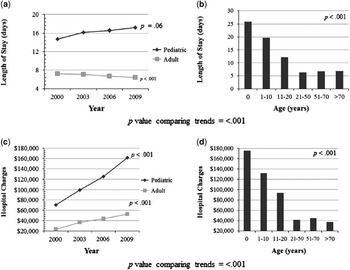
The incidence of acute heart failure among patients with newly diagnosed cardiomyopathies has been described as 0.87/100,000 children <16 years of age.Reference Andrews, Fenton and Ridout 12 Acute heart failure in patients with cardiomyopathies appears to be a significantly more morbid condition in children as compared with adults. Children have greater mortality, length of hospital stay, and hospital charges when hospitalised with heart failure.Reference Wittlieb-Weber, Lin and Zaoutis 13 It is striking that hospital length of stay and hospital charges are greater for every age group of children compared with every age group of adults. This trend is also true for hospital mortality, with the exception of children >10 years and adults >70 years of age (Fig 1).Reference Wittlieb-Weber, Lin and Zaoutis 13 In addition, the use of advanced heart failure therapies such as extracorporeal membrane oxygenation, heart transplantation, and ventricular assist devices are also significantly more common in paediatric versus adult hospitalisations.Reference Wittlieb-Weber, Lin and Zaoutis 13 Thus, acute heart failure in children is common, morbid, and associated with worse outcomes compared with adults with heat failure.
Comparison of paediatric and adult hospital length of stay ( a ) by year and ( b ) by age and hospital charges ( c ) by year and ( d ) by age. Reproduced with permission from Wittlieb-Weber et al.Reference Wittlieb-Weber, Lin and Zaoutis 13

Categorisation of heart failure
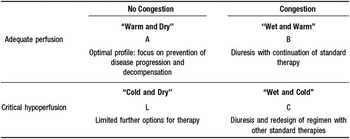
Symptoms of acute heart failure generally result from a congestion and/or decreased perfusion. As such, one useful method for categorising acute heart failure was proposed by Grady et alReference Grady, Dracup and Kennedy 14 , and it categorises patients based on the presence or absence of congestion (wet or dry) and based on poor versus adequate perfusion (cold or warm) (Fig 2), with the ideal state of compensated heart failure being warm and dry. Categorising patients in this manner is not only a useful tool for medical management, but it also has prognostic information about adults with acute heart failure.Reference Nohria, Tsang and Fang 15 When a patient is admitted to the hospital with acute heart failure, there are several important goals for the hospital admission, including maintaining adequate perfusion, establishing the underlying aetiology for the heart failure, patient and family education, and discharge from the hospital is a stable condition.
Model for categorising patients with acute heart failure. The letter L represents the group with low output without congestion. Patients frequently progress from profile A to profile B. When that occurs, profile C commonly occurs after profile B. For the less-common profile of low output without congestion, the letter L was chosen rather than the letter D to avoid the implication that this profile necessarily follows profile C or is a less-desirable profile than C. Reproduced with permission from Grady et al.Reference Grady, Dracup and Kennedy 14

Maintaining adequate perfusion
Patients with congestion but adequate perfusion: “warm and wet”
Many patients with acute heart failure are well-perfused on presentation, but have elevated atrial pressures contributing to pulmonary and systemic congestion.Reference Macicek, Macias and Jefferies 7 , Reference Andrews, Fenton and Ridout 12 , 16 For these patients, vasodilators and diuretics can lead to rapid symptomatic improvement, although these medications do not likely affect the long-term outcome. 16 – Reference Felker, Lee and Bull 19 It is important to note that diuretics and volume depletion can lead to increased activation of the renin–angiotensin–aldosterone system, which can be detrimental in heart failure.Reference Mentz, Stevens and DeVore 20 In addition, aggressive diuresis can lead to decreased renal function, which is associated with increased mortality in heart failure patients.Reference Butler, Forman and Abraham 8 , Reference Price, Mott and Dickerson 21 – Reference Klein, Massie and Leimberger 26
For these patients with maintained perfusion, inotropic agents may not be necessary, and indeed may be harmful. Among adults with chronic heart failure, a randomised controlled trial found milrinone use to be associated with increased mortality.Reference Packer, Carver and Rodeheffer 27 In addition, the short-term use of milrinone for acute heart failure in adults was found in a randomised trial to be associated with sustained hypotension and new atrial arrhythmias with no survival benefit compared with placebo.Reference Cuffe, Califf and Adams 28 There are also multiple other non-randomised studies that describe a strong association between inotrope use and worse outcomes in adult heart failure patients, although this association may be more prominent in ischaemic versus non-ischaemic cardiomyopathy.Reference Costanzo, Johannes and Pine 29 – Reference Felker, Benza and Chandler 31 There are limited data on the safety and efficacy of inotropic medications for children with acute heart failure, although they are frequently utilised medications.Reference Shamszad, Hall and Rossano 32 , Reference Price, Towbin and Dreyer 33 In one multi-centre study, vasoactive medications were used in over 85% of heart failure admissions to the ICU. Importantly, the use of vasoactive medications was associated with increased hospital mortality.Reference Shamszad, Hall and Rossano 32 In another single-centre study, the use of dopamine was independently associated with death or the need for mechanical circulatory support in paediatric heart failure patients.Reference Price, Mott and Dickerson 21 Thus, for patients with adequate perfusion, inotropic mediations should be used with caution, and ideally withdrawn after a period of clinical stability. Chronic heart failure medications can be initiated or modified during these hospital admissions, generally after demonstration of adequate perfusion.
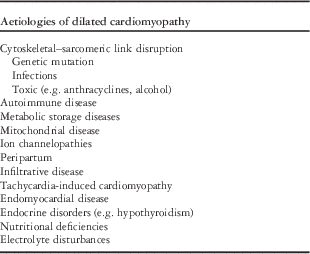
Understanding the aetiology of heart failure is important, as it may have important implications for prognosis and treatment. Overall, ~50% of patients with dilated cardiomyopathy will die or undergo heart transplantation within 5 years of their diagnosis.Reference Towbin, Lowe and Colan 34 Nevertheless, there are multiple aetiologies that can lead to a dilated and dysfunctional left ventricle, many of which have disease-specific therapy and superior outcomes with proper therapy – for example, in infants with coarctation of the aorta or anomalous left coronary artery from the pulmonary artery can lead to a phenotype similar to dilated cardiomyopathy. Careful attention to arch and coronary artery imaging is of paramount importance, as these diseases have excellent long-term survival with appropriate surgical therapy.Reference Azakie, Russell and McCrindle 35 , Reference Fesseha, Eidem and Dibardino 36 There are multiple other aetiologies of dilated cardiomyopathy, including myocarditis, metabolic/mitochondrial disorders, tachycardia-induced cardiomyopathy, and endocrinopathies that should be part of the diagnostic evaluation (Table 1).Reference Jefferies and Towbin 37 An important part of the diagnostic evaluation is the consideration of cardiac catheterisation and endomyocardial biopsy. Although cardiac MRI in increasing utilised in heart failure patients and can be useful in assessing the presence of myocarditis, endomyocardial biopsy can be helpful in challenging cases.Reference Friedrich, Sechtem and Schulz-Menger 38 – Reference Bennett, Gilotra and Harrington 45 The risk of this invasive procedure must be carefully considered; however, in experienced centres, it can be performed safely even in critically ill patients.Reference Daly, Marshall and Vincent 46 – Reference Zhorne, Petit and Ing 48 Importantly, these findings may lead to changes in management in a significant number of patients.Reference Bennett, Gilotra and Harrington 45
Aetiologies of dilated cardiomyopathy.
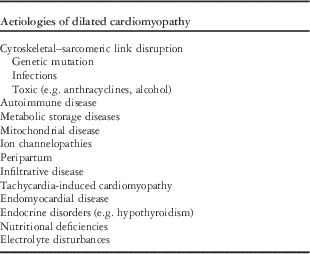
Adapted from Jefferies et alReference Jefferies and Towbin 37
Patients with poor perfusion: “cold and wet” & “cold and dry”
Acute heart failure patients with poor perfusion constitute a significant proportion of children admitted to the hospital.Reference Macicek, Macias and Jefferies 7 , Reference Andrews, Fenton and Ridout 12 , Reference Shamszad, Hall and Rossano 32 These patients are generally admitted to the ICU where the immediate priority is to improve the perfusion and stabilise the circulation. Inotropic medications are utilised in essentially all of the patients, with wide variability among centres as to the preferred vasoactive medications of choice. Commonly utilised inotropic medications for these patients include milrinone, dopamine, dobutamine, and epinephrine.Reference Shamszad, Hall and Rossano 32 There are few data to guide clinical practice with regard to the optimal intotropic agent for acute heart failure. Our practice is to use milrinone as the first-line agent, for patients without hypotension. For patients with hypotension or an inadequate response to milrinone, catecholamines such as dopamine or epinephrine are added. In the setting of escalating medical therapy, intubation with mechanical ventilation and mechanical circulatory support may be needed.Reference Shamszad, Hall and Rossano 32 , Reference O’Connor and Rossano 49 , Reference Wilmot, Morales and Price 50
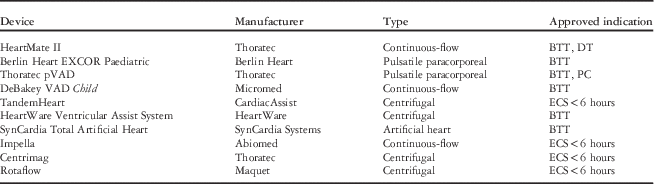
There are a variety of options available for short- and long-term mechanical circulatory support in children (Table 2).Reference O’Connor and Rossano 49 – Reference Cabrera, Sundareswaran and Samayoa 52 Short-term mechanical circulatory support with either extracorporeal membrane oxygenation or a temporary ventricular assist device can be effective for patients in whom the ventricular function is expected to recover in a relatively short period of time – for example, acute rejection in a heart transplant recipient or fulminant myocarditis.Reference Wilmot, Morales and Price 50 , Reference Morales, Braud and Price 53 , Reference Teele, Allan and Laussen 54 These devices can also be used as a bridge to a more durable ventricular assist device if the patient requires longer duration of mechanical support. Of note, extracorporeal membrane oxygenation is of limited utility for long-term mechanical circulatory support. In the Berlin Heart Trial, no one was alive on extracorporeal membrane oxygenation by 30 days of support, and the use of extracorporeal membrane oxygenation as a bridge to heart transplant remains one of the strongest risk factors of post-transplant mortality.Reference Fraser, Jaquiss and Rosenthal 55 – Reference Dipchand, Kirk and Edwards 57
Commonly used and approved ventricular assist devices by the United States Food and Drug Administration.
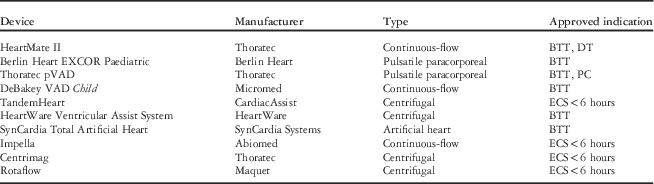
BTT=bridge to transplant; DT=destination therapy; PC=post-cardiotomy support; ECS<6 hours=extracorporeal support of <6 hours duration
Adapted with permission from O’Connor and RossanoReference O’Connor and Rossano 49
Long-term mechanical circulatory support can be achieved with a high degree of success with the use of either pulsatile or continuous-flow ventricular assist devices.Reference Cabrera, Sundareswaran and Samayoa 52 , Reference Fraser, Jaquiss and Rosenthal 55 , Reference Almond, Morales and Blackstone 58 , Reference Morales, Almond and Jaquiss 59 The best outcomes of long-term ventricular assist device support are obtained in older children with dilated cardiomyopathy. Small children, especially those <5 kg, and those with complex circulations remain a challenging group to provide long-term support.Reference Rossano, Woods and Berger 60 – Reference Weinstein, Bello and Pizarro 63 Among adult heart failure patients, continuous-flow ventricular assist devices have essentially replaced older-generation pulsatile pumps, although size limitations preclude their use in infants and small children. The use of these device has allowed some children to be discharged from the hospital while on support. For the vast majority of these patients, durable ventricular assist devices are used as a bridge to transplantation; however, some patients will be able to have the device explanted after myocardial recovery.Reference Cabrera, Sundareswaran and Samayoa 52 , Reference Lowry, Adachi and Gregoric 64 – Reference Kirklin, Naftel and Pagani 66 Rarely, these devices are utilised as destination therapy – ventricular assist device implantation without the expectation of transplant or myocardial recovery.Reference Amodeo and Adorisio 67
Road to discharge
In the present era, there are many pathways to home for a child with acute heart failure. The patient may be stabilised with inotropic therapy, transitioned to an oral regimen, and be discharged home in a compensated state. The patient’s condition may also deteriorate on medical therapy and can be placed on mechanical circulatory support. Although on support, the patient may have the device explanted after myocardial recovery, be transplanted during that hospital admission from a ventricular assist device, or be discharged home on the ventricular assist device. Alternatively, the patient may be stable, but inotropic-dependent. These patients may be transplanted during that hospitalisation or discharged home on inotropic medications.Reference Price, Towbin and Dreyer 33 , Reference Birnbaum, Simpson and Boschert 68
Patient and family education are crucial during these hospitalisations. For many patients, the heart failure hospitalisation may be the initial presentation of heart disease, especially in young persons who were thought to be healthy. Not only are there significant risks of morbidity and mortality for heart failure hospitalisations, but there are also significant risks of morbidity and mortality after discharge. It is important that the family understands the risks associated with the disease, the medical regimen, concerning symptoms, follow-up plans, and who to call with questions or concerns. Most of the serious adverse events occur within the 1st year of the diagnosis.Reference Towbin, Lowe and Colan 34 A multi-disciplinary team able to provide comprehensive care and family support is a critical factor for success. It is important to note that a significant number of patients will have meaningful improvement and even normalisation of systolic function during the first 2 years after the diagnosis of dilated cardiomyopathy;Reference Everitt, Sleeper and Lu 69 – Reference O’Sullivan, Roche and Crossland 71 however, long-term follow-up is still needed as recurrent heart failure and death can occur, even among patients who have normalised ventricular function.Reference Everitt, Sleeper and Lu 69
Conclusion
Acute heart failure is a common and serious complication of congenital and acquired heart disease in children. It is associated with significant morbidity, mortality, and cost. Advanced therapies including mechanical circulatory support and ventricular assist devices are frequently needed, and a multi-disciplinary comprehensive team approach to these complicated patients can help assure optimal outcomes.