I. INTRODUCTION
During the past years, many borates were chosen as host lattices for phosphors because of their large band gap, high thermal stability, high luminescence efficiency, and low cost.Reference Liu, Wang, Wu and Kuang1,Reference Cavalcante, Sczancoski, Albarici, Matos, Varela and Longo2 Aluminum borate material with excellent mechanical properties and chemical inertness is a suitable host material for high efficiently optical materials.Reference Elssfah and Tang3 So many researchers have used some aluminum borates as the host lattices for phosphors, like M2Al2B2O7 (M = alkali metals),Reference Pekgözlü, Taşcıālu and Menger4 Al18B4O33,Reference Sun, Shimaoka, Fujii, Nitta, Mizuhata, Yasuda, Dekiand and Hayashi5 and MAl3(BO3)4 (M = Y, Gd),Reference Jia, Shao, Lüd, Tian and Han6 and so on, which were activated by trivalent rare-earth ions. Among the trivalent rare-earth ions, Eu3+ ion is an excellent activator in a great amount of phosphors which exhibit high quantum efficiency in red region.Reference Liao, Huang, You, Qiu, Li, Qiu and Wen7
The hydrous aluminoborate K2[Al(B5O10)]·4H2O was synthesized under hydrothermal conditions, and its structure is characterized as an anionic [Al(B5O10)]n2n− open framework constructed by B5O10 units and AlO4 tetrahedra.Reference Rong, Yu, Wang, Zheng, Pan, Deng and Yang8 As far as we know, aluminum borate Al5BO9 was prepared by conventional solid-state reaction,Reference Fisch, Armbruster, Rentsch, Libowitzky and Pettke9 and there is only one report on the Al5BO9 based phosphor, namely Al5BO9:Sm3+ phosphor prepared by the sol–gel method.Reference Kumar and Ponnusamy10
If the host material and the activator concentration are fixed, the photoluminescence (PL) efficiency strongly depends on the physical properties of phosphor materials, such as the surface area, the crystallinity, the phase purity, and the distribution of activator in the host matrix. Such physical properties are influenced by the preparation method and reaction parameters.Reference Jung, Lee and Kang11 Since Al5BO9 is a chemically and thermally stable matrix, developing a new preparation method that can enhance its PL behaviors is especially significant for its luminescence application.
In this work, we report a facile thermal conversion method for the preparation of a novel red-emitting phosphor Al5BO9:Eu3+. To enhance the luminescence intensity, prepared conditions were also investigated and optimized. It was found that the Al5BO9:Eu3+ phosphor prepared by this method exhibited higher R/O ratio than that synthesized by conventional high temperature solid-state method.
II. EXPERIMENTAL
A. Preparation of precursor of K2[Al(B5O10)]·4H2O:Eu3+
The precursor K2[Al(B5O10)]·4H2O:Eu3+ was synthesized by a facile hydrothermal route referring to the literatureReference Rong, Yu, Wang, Zheng, Pan, Deng and Yang8 except for 0.0093 g of Eu2O3 being added, which made the Eu3+ doped concentration to be 5 mol% of total molar numbers for Al3+ and Eu3+. All reagents and solvents used in the synthesis were commercially available and used without further purification. The obtained precursor sample was washed with distilled water and absolute alcohol several times and dried at 40 °C for 24 h for further characterization.
B. Preparation of Al5BO9:Eu3+ phosphor
Al5BO9:Eu3+ phosphor was prepared by a novel thermal conversion method using the above K2[Al(B5O10)]·4H2O:Eu3+ sample as the precursor at various temperatures ranging from 500 °C to 1400 °C. The pure Al5BO9:Eu3+ phosphors with good crystallinity were obtained through a heat treatment of the K2[Al(B5O10)]·4H2O:Eu3+ precursors at 1300–1400 °C in air for 5.5 h, and subsequently washing off the dissoluble components of B2O3 and K2B4O7 with the hot distilled water (60 °C).
The possible thermal conversion reactions are expressed as follows:
 $$5{{\rm{K}}_2}[{\rm{Al}}({{\rm{B}}_{\rm{5}}}{{\rm{O}}_{{\rm{10}}}})] \cdot 4{{\rm{H}}_{\rm{2}}}{\rm{O}}:{\rm{E}}{{\rm{u}}^{{\rm{3}} + }}\buildrel {{\rm{1300-1400}}\,^\circ {\rm{C}}} \over \largerightarrow{55} {\rm{A}}{{\rm{l}}_{\rm{5}}}{\rm{B}}{{\rm{O}}_{\rm{9}}}:{\rm{E}}{{\rm{u}}^{{\rm{3}} + }} + {\rm{4}}{{\rm{H}}_{\rm{2}}}{\rm{O + }}2{{\rm{B}}_{\rm{2}}}{{\rm{O}}_{\rm{3}}} + 5{{\rm{K}}_{\rm{2}}}{{\rm{B}}_{\rm{4}}}{{\rm{O}}_{\rm{7}}}\quad .$$
As a comparison, the sample of Al5BO9:Eu3+ (1300 °C, S) was also synthesized by conventional high temperature solid-state reaction using Al2O3, B2O3, and Eu2O3 as the source materials, in which the Eu3+ doped concentration is 5 mol% of total molar numbers for Al3+ and Eu3+. The mixture of all materials in stoichiometric proportion was ground in an agate mortar, and then transferred to platinum crucible, which was heated at 1300 °C for 5.5 h under ambient atmosphere, followed by cooling to room temperature.
C. Powder characterization techniques
The phase composition, purity, and crystallinity of the samples were characterized by Fourier transform infrared spectroscopy (recorded over the 400–4000 cm−1 region on a Nicolet NEXUS 670 spectrometer [Nicolet Corporation, Madison, Wisconsin] with KBr pellets at room temperature), x-ray powder diffraction (XRD; Rigaku D/MAX-C, Rigaku Corporation, Tokyo, Japan Cu Kα radiation at 40 kV and 40 mA) and energy dispersive x-ray spectrometer (EDS; JEOL-6700F, JEOL Ltd., Tokyo, Japan), respectively. The morphologies and sizes of the products were investigated by scanning electron microscopy (SEM; Quanta 200, FEI Company, Hillsboro, Oregon). The PL spectra were recorded on a molecular fluorescence spectrometer (FL-4600, Hitachi Limited, Tokyo, Japan) equipped with a xenon lamp as the excitation source at room temperature. The luminescent decay lifetime test was carried out using a FLS920P Edinburgh Analytical Instrument apparatus (Edinburgh, United Kingdom) equipped with a 450 W xenon lamp and a mF900H high-energy microsecond flash lamp as the excitation sources. Quantum yield of the sample was measured in FLS920 based on the absolute method. Excitation at 266 nm and emission at 615 nm were selected. All of the measurements were performed at room temperature.
III. RESULTS AND DISCUSSION
A. Phase identification and morphology
The crystallinity and phase purity of the products were examined by powder XRD and EDS. The EDS patterns of K2[Al(B5O10)]·4H2O:Eu3+ and Al5BO9:Eu3+ (1300 °C) samples are shown in Figs. 1(a) and 1(b). The elements K, Al, B, O, and Eu exist in Fig. 1(a), and no other elements were found except Au which is from the process of pretreatment (spraying gold for the sample to enhance the conductivity of the sample). The elements Al, B, O, and Eu exist in Fig. 1(b), and no other elements were found except Au.
EDS patterns of samples: (a) K2[Al(B5O10)]·4H2O:Eu3+ and (b) Al5BO9:Eu3+.

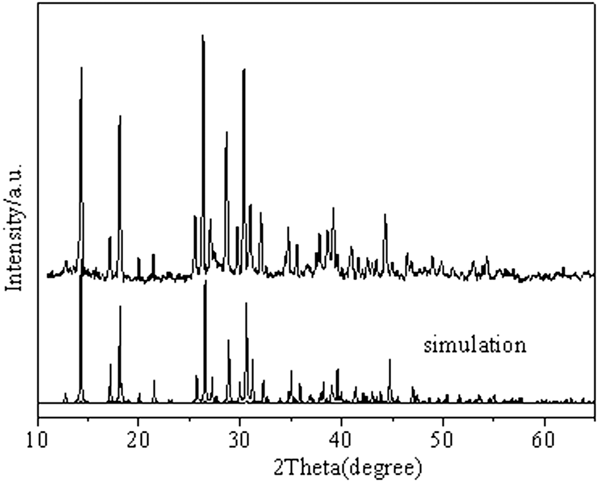
The powder XRD pattern of K2[Al(B5O10)]·4H2O:Eu3+ sample and the simulated pattern (obtained by a software of Diamond Crystal and Molecular Structure Visualization) on the basis of single-crystal structure of K2[Al(B5O10)]·4H2O are shown in Fig. 2. The diffraction peaks on patterns corresponded well in position, which indicated that the Eu3+ ions doped K2[Al(B5O10)]·4H2O precursor was prepared successfully, and the doping of Eu3+ did not change the structures of the K2[Al(B5O10)]·4H2O.
XRD patterns of sample K2[Al(B5O10)]·4H2O:Eu3+.
Figure 3 shows the XRD patterns of prepared Al5BO9:Eu3+ samples by calcining the precursors at various temperatures. It can be seen that the crystallinities of the thermal conversion products gradually improve from 500 °C to 1400 °C, and the Al5BO9:Eu3+ phosphors with good crystallinity were obtained at 1300–1400 °C. It can be seen that all the diffraction peaks were in good agreement with JCPDS file No. 77-0395 for Al5BO9, and no peaks of impurities were observed. From these results, we can conclude that the Eu3+ ions doped phosphor Al5BO9:Eu3+ was prepared successfully by calcining the precursor, and the doping of Eu3+ did not change the structure of the product. So, the doping of Eu3+ had not changed the XRD patterns of the sample. It is known that the ionic radii (r) of Eu3+, Al3+, and B3+ (CN = 3) are 0.95, 0.54, and 0.21 Å, respectively. As the ionic radius of B3+ is too small, it is difficult for Eu3+ to replace B3+ in the Al5BO9. Hence, in this study, it is believed that Al5BO9:Eu3+ phosphor was generated by the substitution of Eu3+ on Al3+ in the forming process of K2[Al(B5O10)]·4H2O:Eu3+ precursor.
XRD patterns of samples calcined at various temperatures: (a) 500 °C, (b) 900 °C, (c) 1000 °C, (d) 1100 °C, (e) 1200 °C, (f) 1300 °C, and (g) 1400 °C.
Figure 4 shows the FT-IR spectra of Al5BO9/Al5BO9:Eu3+ (1300 °C)/Al5BO9:Eu3+ (1400 °C) samples. It can be seen that they are almost identical. Their absorption bands were assigned referring to the literature.Reference Fisch, Armbruster, Rentsch, Libowitzky and Pettke9 The weak band at 1637 cm−1 is the stretching mode of O–H, which may be caused by the little surface adsorption water. The bands at 1427, 1332, 1261, and 893 cm−1 might be asymmetric and symmetric stretching mode of B(3)–O in the triangular BO3 unit, respectively. The bands at 728 and 671 cm−1 are assigned as out of plane bending of B(3)–O. These assignments are consistent with previously reported structure that it only contains BO3 unit.Reference Fisch, Armbruster, Rentsch, Libowitzky and Pettke9
FT-IR spectra of samples: (a)Al5BO9, (b) Al5BO9:Eu3+ (1300 °C), and (c)Al5BO9:Eu3+ (1400 °C).
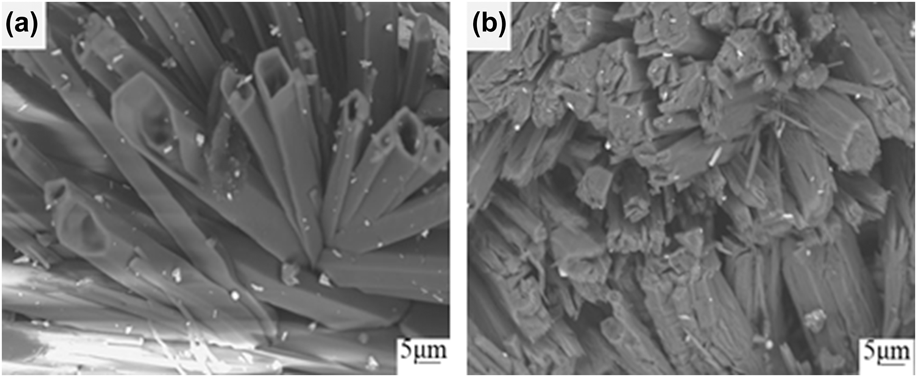
Figure 5 shows the SEM images of Al5BO9:Eu3+ (1300 °C) and Al5BO9:Eu3+ (1400 °C) samples. The Al5BO9:Eu3+ (1300 °C) sample exhibits the uniform tube-like morphology. The Al5BO9:Eu3+ (1400 °C) sample consists of lots of the uniform stick-like morphology. It can be seen obviously that Al5BO9:Eu3+ (1300 °C) has better dispersion and more smoother surface than Al5BO9:Eu3+ (1400 °C).
SEM images of samples: (a) Al5BO9:Eu3+ (1300 °C) and (b)Al5BO9:Eu3+ (1400 °C).
B. The excitation and emission spectra of Al5BO9:Eu3+
Figure 6 shows the excitation and emission spectra of Al5BO9:Eu3+ (1300 °C) and Al5BO9 samples. The excitation spectrum (interpolation) consists of a strong broad band with maximum peak at 266 nm in the shorter wave length region due to the charge transfer between O2− and Eu3+.Reference Lian, Liu, Wang and Sun12 For sample Al5BO9:Eu3+ (b), the f–f transition lines of Eu3+ were observed in the longer wave length region, which were assigned to 7F0–5H3 (318 nm), 7F0–5D4 (361 nm), 7F0–5L7 (380 nm), 7F0–5L6 (391 nm), 7F0–5D3 (412 nm) and 7F0–5D2 (466 nm).Reference Parchura and Ningthoujam13 Upon excitation into the f–f transition of Eu3+ at 266 nm, the emission spectrum involves the characteristic emission lines originating from 5D0 low energy transfer of Eu3+, corresponding to 5D0–7F1 (591 nm), 5D0–7F2 (615 nm), and 5D0–7F4 (705 nm). In general, when the Eu3+ ion is located at the crystallographic site without inversion symmetry, its hypersensitive forced electric-dipole transition 5D0–7F2 red emission dominates in the emission spectrum. If the Eu3+ site possesses an inversion center, 5D0–7F1 orange emission is dominant. In this, the peak at 615 nm assigned to the electro-dipole transition 5D0–7F2 of Eu3+ is the dominant transition, indicating that the Eu3+ does occupy the crystallographic site without inversion symmetry in the host lattice according to the Judd–Ofelt theory.Reference Parchura and Ningthoujam13
Excitation spectra (λem = 615 nm) and the emission spectra (λex = 266 nm) of samples: (a) Al5BO9 and (b) Al5BO9:Eu3+ (1300 °C).
C. The luminescent decay lifetime and quantum efficiency of Al5BO9:0.05Eu3+
The luminescent decay curve of Al5BO9:0.05Eu3+ sample prepared by sintering the precursor at 1300 °C for 5.5 h (Fig. 7) can be well fitted into the following double exponential function instead of a single exponential function.
 $$I = {I_1}\exp ( - t/{\tau _1}) + {I_2}\exp ( - t/{\tau _2})\quad ,$$
where I 1 and I 2 are the intensities at different time intervals, while τ1 and τ2 are their corresponding lifetimes. The average luminescent decay lifetime is 0.461 ms, and the luminescent decay curve can be well fitted into the double exponential function, and the goodness of parameter is found to be 0.98305. The value of the parameter goodness is well enough and the double exponential fitting is satisfactory. In addition, the quantum efficiency of this sample was measured up to 40.37%.
The luminescent decay curve of Al5BO9:0.05Eu3+ (1300 °C).
D. Effect of the doping amount of Eu3+ on the luminescence properties of Al5BO9:Eu3+
The luminescent intensity of the phosphor is strongly influenced by the activator concentration.Reference Yu, Lin, Wang, Fu, Wang, Zhang and Han14,Reference Li, Cao, Li and Huang15 The luminescent intensity of Al5BO9:Eu3+ (1400 °C) varies with the amount of doped Eu3+ ion, as shown in Fig. 8. The emission intensity increase with the concentration of Eu3+ ion when the amount of Eu3+ ion is low, and it goes to the maximum when the concentration of Eu3+ ion reaches 5 mol%. After that, the intensity goes down. This concentration quench of Eu3+ ion in EuxAl5−xBO9 occurs obviously. The ionic radius of Eu3+ ion is a little larger than that of Al3+ ion, thus when the amount of Eu3+ ion exceeds its critical limits, the lattice structure of EuxAl5−xBO9 is distorted and unstable. Moreover, when excess Eu3+ ion is in the host, the extra Eu3+ ion has to stay in the interstitial site of lattice rather than the site of Al3+.Reference Kim, Kim, Chun, Cho, Jung and Kang16 Therefore, the energy transfer between Eu3+ ion in lattice site and Eu3+ ion in interstitial site occurs. This energy transfer results in the increase of nonradiative transition between the Eu3+ ions due to the electric multiple–multiple interactions, which is distance-dependent according to Dexter's theory,Reference Liu, Lin and Lin17 and then leads to the concentration quench of Eu3+ ion. Thus, the content of Eu3+ is fixed at 5 mol% in the following contrast experiments.
Emission spectra of Al5BO9:Eu3+ (1400 °C) phosphors with various concentrations of Eu3+ excited by a 266 nm UV light: (a) 1 mol%, (b) 5 mol%, (c) 9 mol%, and (d) 13 mol%.
E. Effect of calcination time of precursor on the luminescence properties of Al5BO9:Eu3+
Theoretically, the PL intensity increases with prolonged reaction time because the longer the reaction interval, the better the crystallization and the luminescence properties.Reference Lei, Yan, Chen and Zhao18 It can be seen from Fig. 9 that the luminescence intensity enhances with the increasing reaction time and reaches a maximum at 5.5 h, however the intensity decreases dramatically when the reaction prolongs to 8 h. The reason is that the long calcination time results in the agglomeration, which leads to the increase of surface defects and decrease of exciting surface area.Reference Wang, Liang, Huang and Liu19 So the best calcination time is determined to be 5.5 h.
Emission intensity of Al5BO9:Eu3+ prepared by calcining the precursor at 1300 °C for various times: (a)3.5 h, (b)5.5 h, and (c)8 h.
F. Effect of calcination temperature of precursor on the luminescence properties of Al5BO9:Eu3+
Figure 10 shows the emission spectra of Al5BO9:Eu3+ phosphors prepared at 1300 and 1400 °C, respectively. Although the major peak positions in the emission spectra are identical to each other, the luminescence intensity relatively decreases with the increase of calcination temperature, which might be resulted from the more dispersive, more smoother surface, and larger particle size of prepared Al5BO9:Eu3+ (1300 °C) sample compared with Al5BO9:Eu3+ (1400 °C) sample, as shown in Fig. 5.
Emission spectra (λex = 266 nm) of Al5BO9:Eu3+ prepared by calcining the precursor at different temperatures: (a) 1300 °C and (b) 1400 °C.
G. Comparing study of Al5BO9:Eu3+ prepared by precursor method and solid-state reaction method
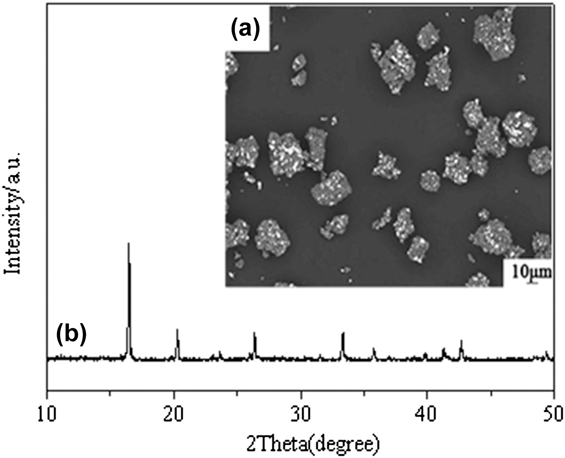
Figure 11 shows the XRD pattern and the SEM image of Al5BO9:Eu3+ (1300 °C, S) sample prepared by conventional solid-state reaction method at 1300 °C for 5.5 h, respectively. It can be seen that the Al5BO9:Eu3+ (1300 °C, S) sample exhibits collective block-like morphology, and its XRD pattern is almost the same as that of prepared by precursor method at 1300 °C.
SEM image (a) and XRD pattern (b) of Al5BO9:Eu3+ sample prepared by conventional solid-state reaction method at 1300 °C.
From Fig. 12, we can see that the PL of Al5BO9:Eu3+ (1300 °C) and Al5BO9:Eu3+ (1300 °C, S) samples show different profiles though their main emission peak positions are almost the same. This observation may relate to the different symmetries around Eu3+ in the hosts, which resulted from their different prepared methods.
Emission spectra (λex = 266 nm) of Al5BO9:Eu3+ prepared by different methods: (a) precursor method at 1300 °C and (b) conventional solid-state reaction method at 1300 °C.
We can see that the Al5BO9:Eu3+ (1300 °C, S) phosphor prepared by conventional solid-state reaction method has the dominant transition at 591 nm assigned to 5D0–7F1 of Eu3+, indicating the Eu3+ occupy the crystallographic site with inversion symmetry in the host lattice siteReference Parchura and Ningthoujam13; while the Al5BO9:Eu3+ (1300 °C) phosphor prepared by present precursor reaction method has the dominant transition at 615 nm assigned to 5D0–7F2 of Eu3+, indicating that the Eu3+ does occupy the crystallographic site without inversion symmetry in this host lattice.Reference Parchura and Ningthoujam13 In Al5BO9 crystal structure, there exists three different kinds of Al3+ coordinated surroundings, namely AlO6 octahedron, AlO5 bipyramid, and AlO4 tetrahedron.Reference Fisch, Armbruster, Rentsch, Libowitzky and Pettke9,Reference Gatta, Rotiroti, Fisch and Armbruster20 Bond distances and angles show that AlO6 octahedra and AlO4 tetrahedra are not regular, but bipyramidal units are strongly distorted.Reference Gatta, Rotiroti, Fisch and Armbruster20 It is obvious that AlO5 bipyramid has the inferior symmetry. So, we deduce that the Eu3+ cations in Al5BO9:Eu3+ phosphor prepared by conventional solid-state reaction method occupied the AlO6 and/or AlO4 sites, while the Eu3+ cations in Al5BO9:Eu3+ phosphor prepared by present precursor method occupied the AlO5 position.
From Fig. 12 inset for the red-orange ratio of samples, it is obvious that the color purity is prominently enhanced by the present precursor method, indicating that this product could serve as a new potential red phosphor. The improvement of R/O value might be ascribed to the lower preparation temperature of precursor and its uniform tube-like morphology with better dispersion and more smoother surface.
IV. CONCLUSIONS
In summary, a new red phosphor of Al5BO9:Eu3+ has been successfully prepared for the first time by the precursor method. Its luminescent intensities are dependent on the calcination time and temperature of precursor. PL studies reveal that Al5BO9:Eu3+ phosphor with maximum luminescent intensity and the highest R/O ratio was obtained by sintering the precursor at 1300 °C for 5.5 h. Besides, the luminescent decay lifetime and quantum efficiency of this phosphor were measured. It is also found that the prepared method influences the luminescent behavior, and the red color purity is prominently enhanced by the present precursor method comparing with the conventional solid-state reaction method. It can be predicted that this product could serve as a potential red phosphor.
ACKNOWLEDGMENT
This project is supported by the National Natural Science Foundation of China (No. 21573142).