Introduction
Tinnitus is a complex and poorly understood heterogeneous disorder causing a ‘phantom’ sound in the ear without an external stimulus.Reference Henry, Dennis and Schechter1 It is extremely common, with approximately 7 million people in the UK suffering from it and roughly 10–15 per cent of people experiencing severe impacts on their quality of life.Reference Shargorodsky, Curhan and Farwell2 This can be a consequence of tinnitus affecting hearing, sleep and thought processing.Reference Nondahl, Cruickshanks, Huang, Klein, Klein and Nieto3
Current National Institute for Health and Care Excellence guidance on the management of tinnitus is limited to amplification devices for those who are experiencing hearing loss along with their tinnitus and tinnitus-related cognitive behavioural therapy for those with tinnitus-associated distress.4
In recent years, there has been growing interest in internet- and smartphone-based technologies in healthcare.Reference Flodgren, Rachas, Farmer, Inzitari and Shepperd5 This was emphasised in the coronavirus disease 2019 pandemic, where there was a focus on limiting the number of face-to-face interactions with patients to limit the spread of the virus.Reference Iyengar, Upadhyaya, Vaishya and Jain6 In addition, in the majority of countries, the ability to provide necessary audiology services is problematic because of shortages, and internet- and smartphone-based applications may offer a solution.Reference Saunders7 However, more studies are needed to ascertain the true benefit of telemedicine techniques in treating tinnitus.
The literature is limited to systematic reviews on one type of therapy and in-person treatments, and there is limited inclusion of studies because of when the studies were performed. A meta-analysis has not been performed before on the existing literature surrounding all telemedicine options in tinnitus treatment focusing on higher-quality studies, such as randomised, controlled trials.
Aims
The aim of this study is to review the literature on comparing telemedicine therapy options to conventional in-person options in the management of primary subjective tinnitus and to statistically analyse the impact each has on the burden of tinnitus experienced by individuals. Secondary outcomes looked at the impact telemedicine has on common co-morbidities, such as anxiety, depression, insomnia and quality of life. Another aim was to identify the benefits and challenges of different therapeutic modalities in targeting tinnitus long term.
Materials and methods
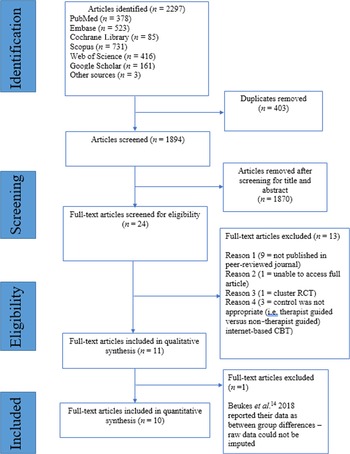
The study was registered with Prospero and conducted according to Preferred Reporting Items for Systematic Review and Meta-Analyses (‘PRISMA’) guidelines (Fig. 1). A literature search of abstracts as recent as February 2022 in PubMed, Embase, Cochrane Library, Google Scholar, Scopus and Web of Science was conducted. Other sources included reference scanning of linked studies. The following search terms were used and adapted for each database: tinnitus AND (smartphone OR mobile OR telephone OR cellular phone OR mobile apps OR mobile applications OR automated OR telemedicine OR internet).
A Preferred Reporting Items for Systematic Review and Meta-Analyses (‘PRISMA’) flow chart showing the key steps in the study. RCT = randomised, controlled trial; CBT = cognitive behavioural therapy

Inclusion criteria were randomised, controlled trials in English involving human participants with a diagnosis of chronic primary subjective tinnitus using any telemedicine approach (mobile, internet, telephone, book) to manage their tinnitus. All types of controls were allowed in the initial literature review which included face-to-face controls, waiting list controls and hybrid delayed-intervention controls. Only studies that measured tinnitus burden by a questionnaire that allowed for quantitative scores before and after each treatment arm were included. The Cochrane Collaboration tool for assessing risk of bias was used by two reviewers (AH and Monica H).Reference Higgins, Chandler, Cumpston, Li, Page and Welch8 Where there were discrepancies, a third reviewer (Maria H) was involved to reach a conclusion by consensus and discussion.
Abstracts were screened by two separate authors, and in cases of discrepancy, a third author was involved. Baseline characteristics, including country location of study, age, tinnitus duration and gender split were extracted. Study arms, type of randomised, controlled trial, attrition rates, and mean and standardised deviation of tinnitus burden scores before and after a period of time for both the intervention and control groups were also extracted. Where multiple types of questionnaires were used, there was an aim to keep extracted scores as consistent as possible by ensuring similar questionnaires or scales. Long-term primary outcomes were extracted, and studies with data reporting of equal to or more than six months’ follow up were included. Secondary outcomes, such as anxiety, depression, insomnia and quality of life scores, were extracted from studies and compared where studies or questionnaire types were as similar as possible. Data were analysed using Cochrane Review Manager (version 5.1.0). A random effects model was used to look at standardised mean differences between intervention and control groups. Cochrane's formula (below) based on Table 1 was used for imputing standard deviations where this was not reported using correlation co-efficients calculated from a study (Henry et al.Reference Higgins, Chandler, Cumpston, Li, Page and Welch8) that was very rigorous in its reporting of data. This was made plausible by ensuring as much as possible that the data extracted used the same measurement scale, had a similar time interval between baseline and post-intervention and a similar population. A z-statistic was used to measure the statistical significance of the summary effect size.Reference Sullivan and Feinn9,Reference Dohoo and Stryhn10


Details of numbers collected for Cochrane's standard deviation formula

Heterogeneity (X2) was calculated in relation to effect sizes using Cochran's Q statistic (significance level of 0.05) and I2 index. Funnel plots were used to investigate publication bias by visual inspection. For secondary outcomes, Cochrane's imputation method was possible for anxiety and depression. However, because of substandard reporting in Henry et al. 2019, insomnia and quality of life secondary outcomes were not analysed similarly, but rather within-group effect sizes were compared between studies that had similar outcomes.Reference Beukes, Manchaiah, Allen, Baguley and Andersson11 When excluding high risk of bias studies, a score was calculated based on the Cochrane Collaboration's tool assigning 1 point for each low risk, 0 points for each unclear risk and −1 for every high risk. Studies with a score equal to or less than 2 points were regarded as having high bias and were excluded in one stage of the meta-analysis. Where there was high heterogeneity, a subgroup analysis was performed to see if potential outlying studies could be excluded from the meta-analysis.
Results and Discussion
This systematic review and meta-analysis is the first, to our knowledge, that evaluates all randomised, controlled trials comparing telemedicine approaches to conventional measures in reducing tinnitus burden in isolation as opposed to grouping them with vestibular and hearing disorders. Many previous studies have never truly performed a comparison with controls but rather have looked at between time-point differences in the intervention groups.
Eleven studies met the inclusion criteria, and 10 studies were available for quantitative analysis consisting of 1194 adult participants. These highlighted three main methods of telemedicine intervention: internet-based cognitive behavioural therapy (n = 9), telephone-based therapy (n = 1) and self-help books (n = 1). Unfortunately, no randomised, controlled trials that looked at smartphones met the inclusion criteria, although some were excluded because they were unpublished. This is disappointing because the scope for smartphones in medicine is well documented and could be a very effective on-the-go option for treating tinnitus.
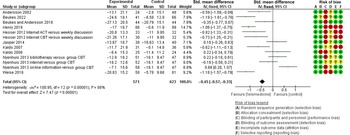
The data presented by the 11 studies was very heterogeneous (chi2 = 100.95; I2 = 88 per cent; p < 0.00001), which was also evident because of the varying number of participants, types of interventions and the controls, and the way of reporting the primary outcome. The test for overall effect (Z = 2.38; p = 0.02) favoured telemedicine techniques in reducing tinnitus burden in adults suffering with chronic tinnitus (Fig. 2; Table 2).
Forest plot showing the effect sizes of studies comparing telemedicine-based interventions of any type to a control (face-to-face, waiting list, weekly discussion) where tinnitus burden is the primary outcome investigated. SD = standard deviation; IV = inverse variance; CI = confidence interval; Std. = standardised; ACT = acceptance and commitment therapy; CBT = cognitive behavioural therapy

Eleven included studies and their baseline characteristics

SD = standard deviation; RCT = randomised, controlled trial; CBT = cognitive behavioural therapy; THI = Tinnitus Handicap Inventory; HADS = Hospital Anxiety and Depression Scale; ISI = Insomnia Severity Index; TFI = Tinnitus Functional Index; GAD-7 = Generalised Anxiety Disorder 7; PHQ-9 = Patient Health Questionnaire-9; SWLS = Satisfaction With Life Scale; TRQ = Tinnitus Reaction Questionnaire; VAS = visual analogue scale; ESS = Epworth Sleepiness Scale; ACT = Acceptance and Commitment Therapy; QoLI = Quality of Life Index; EQ-5D-5L = EuroQuol Quality of Life Questionnaire
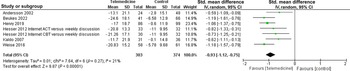
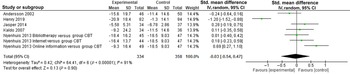
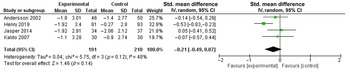
Subgroup analysis of telemedicine techniques with face-to-face controls showed less heterogeneous data (I2 = 67 per cent; p = 0.01) and overall effect (Z = 0.80; p = 0.42) suggesting that face-to-face cognitive behavioural therapy may be better at reducing tinnitus burden post-intervention than telemedicine techniques (Fig. 3). Visual inspection of funnel plots (Figs 4 and 5) indicated variances were all about the same, and the distribution was roughly symmetrical suggesting no obvious publication bias, although this would ideally be performed with more studies than used in the sub-group analysis. This may be in keeping with face-to-face interventions being more involved and resulting in participants being actively engaged, whereas it is hard to ensure they are getting the most out of their telemedicine approaches. When conducting a subgroup analysis removing high risk of bias studies, telemedicine may have a benefit over any type of control in reducing tinnitus burden (z = 1.09; p = 0.27), although this was not statistically significant and the studies were of moderate statistical heterogeneity (Fig. 6). In addition, when performing a sub-analysis that removed studies looking at active controls, such as face-to-face interventions, the data showed (Fig. 7) an I2 value of 21 per cent with a chi-square of 7.64 (p = 0.27) suggesting low statistical heterogeneity. The test for the overall effect showed a z-value of 9.87 (p < 0.00001), favouring telemedicine approaches in reducing tinnitus burden when compared with controls. This is in agreement with Hoare et al., who also reported significant benefit to tinnitus symptoms when using internet-based cognitive behavioural therapy.Reference Hoare, Kowalkowski, Kang and Hall23 Similarly, Beukes et al. were able to demonstrate an increased effect size for internet-based interventions in managing tinnitus burden when compared with the effect size for control groups.Reference Beukes, Manchaiah, Allen, Baguley and Andersson11
Forest plot showing the effect sizes of studies comparing telemedicine-based interventions of face-to-face controls where tinnitus burden is the primary outcome investigated. SD = standard deviation; IV = inverse variance; CI = confidence interval; Std. = standardised; CBT = cognitive behavioural therapy

Funnel plot to assess for publication bias by relating effect sizes of the studies to standard errors for telemedicine versus all controls where tinnitus burden is the primary outcome investigated. SE = standard error; SMD = standardised mean error

Funnel plot to assess for publication bias by relating effect sizes of the studies to standard errors for telemedicine versus face-to-face controls where tinnitus burden is the primary outcome investigated. SE = stand- ard error; SMD = standardised mean error

Forest plot showing the effect sizes of studies comparing telemedicine-based interventions of any type to a control (face-to-face, waiting list, weekly discussion) where tinnitus burden is the primary outcome investigated removing higher risk of bias studies. SD = standard deviation; IV = inverse variance; CI = confidence interval; Std. = standardised

Forest plot showing the effect sizes of studies comparing telemedicine-based interventions of any type to a passive control (waiting list, weekly discussion) where tinnitus burden is the primary outcome investigated removing studies that account for high statistical heterogeneity. SD = standard deviation; IV = inverse variance; CI = confidence interval; Std. = standardised; ACT = acceptance and commitment therapy; CBT = cognitive behavioural therapy

When looking at the long-term impact (Fig. 8) on tinnitus burden, the data are very statistically heterogeneous (I2 = 91 per cent; chi2 = 64.1; p < 0.00001). The test of overall effect showed a z-value of 0.13 (p = 0.90), suggesting no overall benefit of using telemedicine interventions compared with all controls. Follow up becomes very crucial with such a symptom that is uncurable because clinicians hope that interventions can suppress the burden over a longer time period. It is apparent from the forest plot that Henry et al. was the only study that had a statistically significant reduced tinnitus burden in the follow-up data. However, this study was one of the few that reported six-month data with a longer intervention period, whereas several others had only one-year data available, which could imply that the closer the data is collected to the end of the intervention period, the more likely the participants are going to experience a positive reduction in their tinnitus burden and that over a longer period this may not be sustainable. The literature is very clear in that participants were limited to using the interventions throughout the period of time allocated to help with standardisation. However, in reality the benefit of telemedicine interventions is that they can be accessed in the absence of an audiologist; thus, if participants were able to continuously access their internet-based cognitive behavioural therapy modules for example, they may have experienced a reduction in their tinnitus burden at the long-term follow up.
Forest plot showing the effect sizes of studies comparing telemedicine-based interventions of any type to a control (face-to-face, waiting list, weekly discussion) where tinnitus burden is the primary outcome investigated and where long-term follow up data (equal to or greater than 6 months) were used. SD = standard deviation; IV = inverse variance; CI = confidence interval; Std. = standardised; CBT = cognitive behavioural therapy

In a previous review of randomised, controlled trials on tinnitus interventions, Dobie was unable to show significant benefit of interventions over what he described as typically large placebo effects. Although this study was in 1999 and several rigorous randomised, controlled trials have since come out, he suggested that studies in the literature were too dissimilar to allow for an accurate meta-analysis.Reference Dobie24 The main differences between prior trials was that outcome measures and sample sizes were vastly different, but a recent consensus has been achieved among the tinnitus research community with validated measures to limit variability.Reference Langguth, Goodey, Azevedo, Bjorne, Cacace and Crocetti25 In this review, the most widely used tinnitus questionnaire was the tinnitus handicap inventory, appearing in 6 out of 11 studies. All 11 studies used a power calculation when estimating the required sample size to demonstrate a statistically significant effect, thus making the quality of the available evidence better.
Depression and anxiety have been shown to have a strong association with tinnitus: the severity of tinnitus is related to the likelihood of developing these co-morbidities.Reference Bhatt, Bhattacharyya and Lin26 Figure 9 shows anxiety data to be statistically moderately heterogeneous (I2 = 46 per cent; chi2 = 5.75; p = 0.12). The test for overall effect was (z = 1.46; p = 0.14), suggesting a slight benefit of telemedicine options over all control groups in terms of reducing anxiety. Figure 10 shows data for depression to again be statistically moderately heterogeneous (I2 = 46 per cent; chi2 = 5.60; p = 0.13). The test for overall effect gave z = 1.47 (p = 0.14), suggesting slight benefit of telemedicine options over all control groups in terms of reducing depression. The reason why this may not be completely evident is that anxiety and depression questionnaires do not totally correlate with tinnitus burden questionnaires. Hesser et al.Reference Hesser, Weise, Westin and Andersson27 reported that cognitive behavioural therapy improved combined anxiety and depression, but Hoare et al. found that two of seven studies improved depression whereas one of three improved anxiety.Reference Hoare, Kowalkowski, Kang and Hall23 Although reducing tinnitus in these participants may indirectly contribute to reduction in anxiety and depression scores, it is likely that these diagnoses will require prolonged periods of tinnitus treatment and other focused talking therapies. There is also a theme among several studies that floor effects explained the changes in depression and anxiety outcomes in these randomised, controlled trials because of a low baseline score, although this could be because more distressed individuals are less likely to opt in to a clinical trial. The counter should also be considered in that perhaps depression and anxiety having a high co-morbid prevalence with tinnitus is less common than suggested in the literature.Reference Adoga, Adoga and Obindo28
Forest plot showing the effect sizes of studies comparing telemedicine-based interventions of any type to a control (face-to-face, waiting list, weekly discussion) where anxiety is the secondary outcome investigated for studies that have control comparisons at 6–12 month follow ups. SD = standard deviation; IV = inverse variance; CI = confidence interval; Std. = standardised

Forest plot showing the effect sizes of studies comparing telemedicine-based interventions of any type to a control (face-to-face, waiting list, weekly discussion) where depression is the secondary outcome investigated for studies that have control comparisons at 6–12 month follow ups. SD = standard deviation; IV = inverse variance; CI = confidence interval; Std. = standardised

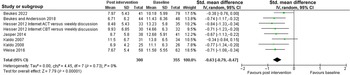
Insomnia is another co-morbidity that has a strong relationship with tinnitus as severity of tinnitus can predispose people to sleep disturbances.Reference Aazh and Moore29 Figure 11 showed low statistical heterogeneity (I2 = 0 per cent; chi2 = 4.45; p = 0.73). The test for overall effect showed a z-value of 7.79 (p < 0.00001), suggesting telemedicine options may be effective in reducing insomnia burden. Beukes et al. also found insomnia to be statistically significantly reduced by internet-based interventions.Reference Beukes, Manchaiah, Allen, Baguley and Andersson11
Forest plot showing the effect sizes of studies comparing within telemedicine-based intervention group changes over time where insomnia is the secondary outcome investigated. SD = standard deviation; IV = inverse variance; CI = confidence interval; Std. = standardised; ACT = acceptance and commitment therapy; CBT = cognitive behavioural therapy

Quality of life becomes an important measure to consider as tinnitus is also associated with a poorer quality of life.Reference Bhatt, Bhattacharyya and Lin26 Figure 12 was generated using inter-time point intervention group data because Cochrane's imputation method was not possible. The data had low statistical heterogeneity (I2 = 0 per cent; chi2 = 2.60; p = 0.46). The test for overall effect showed a z-value of 1.95 (p = 0.05), suggesting telemedicine options have no clear benefit on quality of life. This was also replicated in a study by Beukes et al.,Reference Beukes, Manchaiah, Allen, Baguley and Andersson11 which was hypothesised to be because of the lack of appropriate measurement scales for quality of life specifically relating to tinnitus, thus making valid measurements difficult to make.
Forest plot showing the effect sizes of studies comparing within telemedicine-based intervention group changes over time where quality of life is the secondary outcome investigated. SD = standard deviation; IV = inverse variance; CI = confidence interval; Std. = standardised; ACT = acceptance and commitment therapy; CBT = cognitive behavioural therapy

Of the 11 studies identified, 8 were considered as having higher risk of bias. One of the main reasons was the inability to blind participants to the intervention as this can be difficult with these types of studies. In addition, there are obvious ethical limitations to delivering cognitive behavioural therapy in a way that is ‘placebo’ or ‘wrong’ in order to more accurately assess telemedicine approaches. Another recurring theme was that not blinding investigators created a source of bias that could be easily avoided. Although a common issue with randomised, controlled trials like these is the high attrition rates, this can be avoided by ensuring techniques carry out intention-to-treat analyses with multiple imputation methods to replace missing data as well as not selectively reporting certain data.
The reporting of outcomes was not universal among studies because many reported both clinical as well as statistically significant changes. Where the latter was only reported, this may have no real meaning in the clinic setting, which is ultimately the main aim of evidence-based clinical research. Rief et al.Reference Rief, Weise, Kley and Martin30 reported significant improvements compared with waiting-list controls using the Tinnitus Questionnaire and achieving a 5-point reduction, and Dohrmann et al.Reference Dohrmann, Elbert, Schlee and Weisz31 were able to show that a 5-point difference between two repeated measures is actually within the expected variability of this measurement of tinnitus burden.
The use of Cochrane's imputation method for pooled estimates of standard deviations is a limitation despite efforts trying to make sure the extracted data were as similar as possible. Previous meta-analyses have opted for looking solely at intervention groups and comparing outcome scores between different time points as was performed in this study for insomnia and quality of life as secondary outcomes. Although this can offer some insight into how telemedicine can impact these outcome scores, it is not as rigorous as comparing this with a control or more conventional method of treating tinnitus. Ideally, the imputation method should be cross-referenced with multiple co-efficient values generated from well-reported randomised, controlled trials followed by sensitivity analyses if co-efficients are hugely varying to ensure that the results achieved could be somewhat replicated. Because there was only one study that was well reported,Reference Henry, Thielman, Zaugg, Kaelin, McMillan and Schmidt19 this was not possible. The total number of studies included in some of the quantitative analyses was somewhat limited because the more studies that are involved, the more confident you can be in drawing conclusions about telemedicine interventions. Some studies had different lengths of treatment period for each study arm, such as Nyenhuis et al.,Reference Nyenhuis, Zastrutzki, Weise, Jager and Kroner-Herwig18 where the intervention group had 12 weeks whereas one control arm had 4 weeks; this leads to a disproportionate amount of exposure to a certain intervention and could skew the results in favour of the intervention. A few of the included studies documented participants dropping out half-way through the intervention period but still filling out the post-assessment questionnaire, which is in itself a source of error as they may not have achieved enough exposure to warrant a positive effect from the treatment.
It is important to note that some studies, such as Beukes et al.,Reference Beukes, Andersson, Allen, Manchaiah and Baguley14 did not use cognitive baseline as a patient characteristic to which they stratified each arm of the randomised, controlled trial. There is a chance that cognitive flexibility is a predictor of outcome, and if one arm of the trial has participants who are more educated, for example, their ability to engage with the interventions may be more skewed, especially when considering the average age of some of the participants and the main interventions being internet-delivered. The fact that the majority of the literature is skewed towards internet-based cognitive behavioural therapy makes generalisations to other telemedicine options difficult.
Conclusion
Conceptually, telemedicine techniques have multiple benefits, but more research will be needed to conclusively say that it is better than face-to-face interventions in the long term. High dropout as well as non-compliance rates continue to be the major challenge of telemedicine-based randomised, controlled trials. Future randomised, controlled trials should investigate smartphone-based treatments because they can offer patient-tailored methods that may be more readily accessible throughout the day. Unfortunately, there is an ongoing need to improve the quality of the research conducted on tinnitus despite previous efforts at introducing standardised protocols.
Competing interest
None declared.