INTRODUCTION
Infants discriminate sets of one from sets of more than one – indicating that they detect the distinction between the perceptual forms of singular and plural (e.g. Cordes & Brannon, Reference Cordes and Brannon2009; Feigenson, Carey & Hauser, Reference Feigenson, Carey and Hauser2002; Van de Walle, Carey & Prevor, Reference Van de Walle, Carey and Prevor2000). Learning the language that maps to these different sets, however, is a piecemeal process. Children acquire parts of the plural morphosyntactic system before others – knowing some but not all linguistic forms well before coming to a full productive and receptive mastery of the system in all appropriate perceptual contexts (de Villiers & de Villiers, Reference de Villiers and de Villiers1973; Wagner, Swensen & Naigles, Reference Wagner, Swensen and Naigles2009; Wood, Kouider & Carey, Reference Wood, Kouider and Carey2009; Zapf & Smith, Reference Zapf and Smith2008). Clark and Nikitina (Reference Clark and Nikitina2009) reported that two- and three-year-old children, although already capable of producing the English plural marker in many instances, found that children sometimes did not mark the plural in the noun (e.g. dogs), and would, rather, use ‘unconventional plural markers’ to express that the set contained more than one – for example, by using the numeral two + the noun in the singular (e.g. two dog) or repeating the noun and pointing to each individual of the set. Research also focused on English plural acquisition has suggested that children understand phrases with multiple cues to plurality at earlier ages than noun morphology alone (Kouider, Halberda, Wood & Carey, Reference Kouider, Halberda, Wood and Carey2006). There are a couple of possibilities that may account for such results. One possibility is that children need several cues in order to notice plurality (verb, modifier, noun morpheme) and that this may be true regardless of the language system being learned. Another possibility is that individual plural cues (verb, noun, surrounding modifiers) vary in strength, and the observed pattern is due to the varying degrees of comprehension of the different linguistic cues in a phrase. This would mean that children do not necessarily need multiple cues but understand certain of those cues before others (i.e. children may understand verb cues before plural allomorphs). If this is the case, which of the cues are learned before others likely depends on several factors including the statistical regularity and frequency in the linguistic environment as well as their phonological make-up and therefore will vary from language to language.
The studies presented in this paper are an initial investigation of the linguistic cues that children learning Spanish comprehend as meaning ‘more than one’. We present data from the Mexico City dialect of Spanish – henceforth Mexican Spanish – in which the plural is reliably and consistently marked in determiners, nouns, and adjectives with the final morpheme -s which is generally produced as a voiceless [s]. In two experiments, we demonstrate that (like their English peers) children learning Spanish understand that, in the absence of other social or pragmatic cues, plural syntax refers to sets of ‘more than one’. Further, we show that children learning this dialect of Spanish have a working knowledge of the noun morpheme in their language by age 2;0 – a younger age than documented with English-speaking children in similar novel-label novel-object comprehension tasks. The results have implications for understanding children's mastery of plural morphosyntax mapping to the perceptual environment and provide a basis for a hypothesis for how morphosyntax is acquired. Before presenting the main experiments, we briefly review relevant literature on plural acquisition.
For both English- and Spanish-speaking children, the production of plural markers emerges between 1;9 and 3;0. Early number morphology production has been considered to be a stage of unanalyzed use, showing varying levels of mastery for different cues (Bel, Reference Bel1988; Marrero & Aguirre, Reference Marrero, Aguirre, Montrul and Ordóñez2003). For example, children learning Spanish – a language that pluralizes determiners, adjectives, and nouns – tend to pass through a period of producing the morpheme on only the determiner or the noun, but not both, and often produce the less frequent Spanish /-es/ allomorph incompletely as /-e/ (Marrero & Aguirre, Reference Marrero, Aguirre, Montrul and Ordóñez2003), and find it easier to pluralize novel nouns requiring /s/ rather than /es/ (Pérez-Pereira, Reference Pérez-Pereira1989). Similarly, English-speaking children produce the /-s/ form more frequently than the /-es/ form when pluralizing novel words (Berko, Reference Berko1958) and often show less production of plurals in stop clusters (e.g. t/d) than other simpler clusters (Kirk & Demuth, Reference Kirk, Demuth, Beachley, Brown and Conlin2003), indicating that phonological constraints play a role in early plural production.
Incomplete mastery of the system is also the result of an incomplete mapping of all the appropriate morphosyntactic cues to the meaning ‘more than one’. According to some researchers, children use nominal plural morphology to distinguish ‘one’ from ‘more than one’ by 3·5 years of age (Munn, Miller & Schmitt, Reference Munn, Miller, Schmitt, Bamman, Magnitskaia and Zaller2006). Early on, morpheme use may be the result of lexically stored items rather than an understanding of the morphemes and its mapping to conceptual meaning (see Grinstead, Cantú-Sánchez & Flores-Ávalos, Reference Grinstead, Cantú-Sánchez and Flores-Ávalos2008; Wagner et al., Reference Wagner, Swensen and Naigles2009). Consistent with this idea, laboratory studies have shown that Spanish-speaking children produce plurals more frequently with familiar than novel nouns (Pérez-Pereira, Reference Pérez-Pereira1989), and in English the plural is produced more frequently with particular kinds of noun or set sizes (Zapf & Smith, Reference Zapf and Smith2008). In a comprehension study with English speakers (Kouider et al., Reference Kouider, Halberda, Wood and Carey2006), it was found that children aged 2;0, but not those aged 1;8, correctly identified novel target sets when speaker reference was indicated by plural–singular morphosyntax (‘look! there are some blickets!’). However, children aged 2;0 were unable to do so when the phrase contained noun morphology alone (‘look at the blickets!’) suggesting that knowledge of noun morphology is fragile; children do not show robust knowledge that the plural morpheme -s (in the absence of other cues or familiar contexts) maps to multiple object sets until age 3;0.
Why might children – at least in English – not fully understand noun morphology as an indicator of ‘more than one’, but successfully interpret verb or modifier cues as indicative of plurality? Much research in language learning demonstrates that children are sensitive to the statistics of linguistic input (Lany & Saffran, Reference Lany and Saffran2011; Marchman, Plunkett & Goodman, Reference Marchman, Plunkett and Goodman1997) and that the frequency, redundancy, and distributional properties of linguistic cues impact on their learnability (Bates & MacWhinney, Reference Bates, MacWhinney and MacWhinney1987; Billman & Knutson, Reference Billman and Knutson1996). Cues that are presented less frequently or that are not the exclusive predictors of an event in the environment may take longer to map to their respective meanings (see Bates & MacWhinney, Reference Bates, MacWhinney and MacWhinney1987, for a discussion). The statistical regularity of linguistic cues depends in part on language structures. The English plural, for example, has three allomorph forms, /-s/, /-z/, and /-əz/, and these are unevenly distributed in children's early language environment; an early inability of young English-speaking children to fully acquire and comprehend noun morphology may in fact be a reflection of the difficulty of learning three different linguistic form inputs for the same perceptual form of ‘more than one’. Phonology also plays a role in plural production and comprehension – in particular, coda complexity. Simple codas, vowel–consonant word endings, are produced earlier than complex codas, consonant–consonant word endings (Hellmold, Reference Hellmold2008; Lleó, Reference Lleó2003; Prieto & Bosch-Baliarda, Reference Prieto and Bosch-Baliarda2006; Song, Sundara & Demuth, Reference Song, Sundara and Demuth2009). The English plural system is dominated by complex codas: 75% of early learned nouns form complex codas when pluralized, which may contribute to difficulty in production. The ease of production directly impacts on the morphemes that children understand; children not only produce but also comprehend simple coda plurals earlier (Ettlinger & Zapf, Reference Ettlinger and Zapf2011).
The Spanish plural morpheme system may in fact present phonology and statistics that lead to greater ease of acquisition of the noun morphology. First, in Spanish, the two plural allomorphs /-s/ and /-es/ form simple codas. The dominant /-s/ plural is typically added to the singular form of the words (e.g. taza-s ‘cup-s’); /-es/ is only added to nouns ending in consonants and stressed vowels (e.g. reloj-es ‘clock-s’). According to the MacArthur Spanish inventory employed to measure the vocabulary size of children learning Mexican Spanish (Jackson-Maldonado, Thal, Marchman, Newton, Fenson & Conboy, Reference Jackson-Maldonado, Thal, Marchman, Newton, Fenson and Conboy2003), approximately 84% of the nouns in children's Spanish vocabularies take on the -s morpheme; 13% are marked with -es and the rest do not take any morpheme; although in some cases, the /-s/ and /-es/ allomorphs will be pronounced as [z] and [ez] when they are followed by a voiced consonant, see below. Consistent with the statistical make-up of plural occurrence in the language, Spanish-speaking children show – for novel words – an earlier systematic production of /-s/ in development than /-es/ (Bedore & Leonard, Reference Bedore and Leonard2001; Kernan & Blount Reference Kernan and Blount1966; Pérez-Pereira, Reference Pérez-Pereira1989). Thus, a child learning Spanish must learn two rather than three cues; in addition the statistical distribution of the cues in early vocabulary presents children with one dominant cue to learn -s, and the cue is the easier-to-produce (and comprehend) simple coda.
regularity of input matters for acquisition. Studies on unreliable input have shown that English-speaking children who are exposed to an input in which the third person singular marker is optionally produced are delayed in their ability to attend to and use the marker in comprehension tasks (Johnson, Reference Johnson2005). Similarly, four-year-old Mexican children exposed to a dialect that reliably and consistently produces the plural [s], use the morpheme on nouns and determiners (unos/unas) significantly more than Chilean children who are exposed to adult speech in which the plural is not always marked (Miller & Schmitt, Reference Miller and Schmitt2010).
Mexican Spanish offers a highly regular and redundant system: all determiners and adjectives are marked along with the noun to indicate plurality and gender (e.g. la-s manzana-s roja-s ‘the red apple-s’), creating a phrase with multiple, consistently correlated, and redundant cues. Adult and child research indicates that redundancy in languages – the co-occurrence of multiple cues – may strengthen associations and influence acquisition of individual cues (Billman & Knutson, Reference Billman and Knutson1996; Lew-Williams & Fernald, Reference Lew-Williams and Fernald2007;Yoshida & Smith, Reference Yoshida and Smith2005). In sum, the regularity and redundancy in the Mexican Spanish plural system may make it a system that is easily learned and which individual cues may gain strength more quickly than in other less redundant language structures.
A reviewer queried our proposal that Mexican Spanish-speaking children are exposed primarily to the /s/ allomorph, pointing out that in some cases, the morpheme -s is produced as a voiced [z], for example, when followed by a voiced consonant (e.g. b, such as the -s on the determiner in los bebés ‘the babies’). Thus, children learning Spanish are exposed in some instances to two plural sounds. However, voicing assimilation in Spanish is not consistent; it depends on the speaker's speed and stress. In accelerated speech, the voiced [z] is more likely to be produced, when a voiced consonant follows, than in slow speech, as pauses create a scenario resistant to voicing (File-Muriel & Brown, Reference File-Muriel and Brown2011). Many authors agree that assimilation in the voicing of -s is a tendency rather than a mandatory process and acknowledge that its realization is not consistent (Hammond, Reference Hammond2001; Schmidt & Willis, Reference Schmidt, Willis and Alvord2011). In a sample from Mexico City speakers, Schmidt and Willis (Reference Schmidt, Willis and Alvord2011) found a 37% absence of voiced assimilation in contexts where it was expected to occur, concluding that the voicing assimilation process is far from categorical in its occurrence. Thus, voicing assimilation is not categorical but variable. In this sense, voice assimilation may not be relevant for children learning Mexican Spanish as it is, for example, for children learning French (e.g. poison [poizon] versus poisson [poison]), in which case the voiceless/voiced distinction involves a change in meaning where poison means a ‘killing substance’ and poisson means ‘fish’. In Mexican Spanish, [unasperas] and [unazperas] are both considered in comprehension as exactly the same phrase; [s] and [z] are indistinguishable sounds. Thus, despite the occasional use of a voiced [z], we maintain that Mexican Spanish provides a redundant and regular plural system that should be easily and quickly learned.
In the present empirical studies we ask two questions. First, do young Spanish-speaking children demonstrate knowledge of how plural–singular syntax maps to the perceptual environment (e.g. do they understand phrases with multiple cues to plural or singular and how they map to sets of one and sets of more than one)? Second, is the noun morphology cue presented without other cues to number (on the verb or modifier) sufficient for this mapping? We predict that children learning Mexican Spanish – like English-speaking children have previously shown – will demonstrate knowledge of plural morphosyntax and its meaning of ‘more than one’; furthermore, we predict – based on the hypothesis that statistical regularity, redundancy, and phonology matter – that Mexican children will demonstrate early knowledge of the morpheme alone. We tested children aged 2;0 – an age at which, according to previous studies, children are still on the cusp of acquiring plural morphosyntax (Jolly & Plunkett, Reference Jolly and Plunkett2008; Kouider et al., Reference Kouider, Halberda, Wood and Carey2006). We tested children in a procedure similar to that used by Kouider et al. (Reference Kouider, Halberda, Wood and Carey2006) in which children's understanding of how language maps to perceptual sets is tested. Experiment 1 tested comprehension of the plural when multiple cues to number are provided. Experiment 2 tested comprehension of noun morphology cues alone.
EXPERIMENT 1: PLURAL MORPHOSYNTAX MAPPING TO PERCEPTUAL SETS
METHOD
Participants
We tested 27 children (10 females) with a mean age of two years and four days; range 1;11·20–2;01·03. The data from two children were excluded due to experimental error (n = 1) and inattention (n = 1). Infants had normal vision and were not born premature nor had any auditory problems. They were recruited from playgroups and via printed adverts in Mexico City. Mexican Spanish was the only language spoken at home for all participants.
Stimuli
Auditory stimuli
Sixteen two-syllable novel words, eight feminine (-a ending) and eight masculine (-o ending), were created. We decided to use novel nouns to guarantee that the only cue that children could employ to infer the correct target was the singular/plural distinction, but not any previous semantic knowledge they already had about the items. This control also allowed us to test children's ability to generalize their grammatical number knowledge to novel words. The syllables used were highly frequent in written Spanish by children (Justicia, Santiago, Palma, Huertas & Gutiérrez, Reference Justicia, Santiago, Palma, Huertas and Gutiérrez1996). The plurals form simple codas ending in -as for feminine and -os for masculine. The novel words (bama, lipa, mita, pona, sela, soca, taga, teba, deco, mego, pamo, piro, polo, pono, sado, vipo) which followed the most common structure CVCV in early vocabularies (Jackson-Maldonado et al., Reference Jackson-Maldonado, Thal, Marchman, Newton, Fenson and Conboy2003), three carrier phrases (mira, ve, wow; ‘look’, ‘see’, ‘wow’), and two verb–determiner frames (esun-a, son un-os/as; ‘there is a’, ‘there are some’) were recorded by a Mexico City female native speaker of Spanish in child-directed speech. The multiple-cue frames (verb + determiner + noun) were embedded in the carrier phrases; the sentences were mira/ve/wow + es + un-a + X ‘look/see/wow + there is + a + X’ for singular and mira/ve/wow + son + un-os/as + X-s ‘look/see/wow + there are + some + Xs’ for plural. Each of the four parts of the sentence – carrier phrase, verb, determiner, and noun – was recorded separately to avoid articulatory cues and to be able to guarantee that the onset of the plural cues was exactly the same in all sentences. This manipulation meant that in all cases, the plural sound in the determiners was always a voiceless [s] regardless of being presented before a voiceless or voiced consonant. According to the spectrograms obtained for all of the recorded stimuli, the speaker never aspirated the final -s either in the determiners unos/unas or in the novel words, and she always produced the voiceless [s] sound for the plural.
Visual stimuli
The novel images originally used in Kouider et al. (Reference Kouider, Halberda, Wood and Carey2006) were employed here. In addition, four more novel images were used in our studies for a total of 16 novel objects. For each object, there were two presentations: 1-object array and 8-object array. The singular and plural arrays were matched approximately for total surface area and visual spread on the screen (800 × 600 pixels).
Design
For each of 12 trials, two images were displayed simultaneously, a one-object array and an eight-object array, one on each monitor. On each trial, the singular and plural arrays were of different objects in order to more clearly interpret looking behaviour: if both sets are of the same object, then asking a child to look at the blickets could result in looking to both displays, as all objects could be correctly identified as blickets. The objects remained static during the seven seconds presentation; they were visible in silence for about 1900–2100 ms before sentence onset depending on the arrangement necessary to guarantee that the onset of the number cue was always at 3500 ms. For half the trials, the sentence described a single object (Mira, esun-a X) and in the other half the plural array (Mira, son un-os/as Xs). Trials were divided into a pre- and a post-cue phase, each of the same duration of 3500 ms. The pre-cue phase served as a measure of baseline image preference. The onset of the first plural information (i.e. es/son) was heard at 3500 ms; the post-cue phase served to confirm that children associated the singular or plural description to the correct novel object(s). The sentences in Experiment 1 ended at 4500–4800 ms. All objects and novel nouns were counterbalanced across trials to create eight different presentation sets. An equal number of children were tested in each presentation set. These different presentations allowed us to equally distribute the target-side in terms of its grammatical gender and number. In a given set, the first eight trials presented the sixteen different images and eight of the novel words: four in the singular and four in the plural, of which half were masculine and half were feminine. During the last four trials, eight of the images were repeated but paired differently and within a different number array; children heard four target labels different from the ones heard during the first eight trials. Note that each infant heard only twelve of the novel words. To maintain children's attention, every four trials a ringing sound or an image of a cartoon character was presented for a few seconds.
Procedure
The Intermodal Preferential Looking procedure was employed. Children sat centrally on the caregiver's lap in front of two monitors measuring 17 inches each. A loudspeaker positioned centrally above the monitors presented the auditory stimuli and three hidden video cameras, one mounted centrally and two side by side immediately above each monitor, recorded children's looking to the displays. The images were shown at the child's eye level at a distance of approximately 80 cm. Parents were instructed to remain quiet and close their eyes to avoid biasing the child's looking behaviour. The experimenter remained out of the child's sight during the task.
RESULTS
Looking to the left or right screen was coded off-line by an experimenter, blind to the experimental condition, in a frame-by-frame (every 33 ms) system to determine the direction and duration of each fixation during the pre- (baseline) and the post-cue (test-comprehension) phases of the trials. The post-cue phase started at the onset of the verb es or son. Reliability coding assessments with 15% of the data (coded by two different experimenters) yielded a Pearson's correlation coefficient of r = .98, p < ·001.The proportion of total looking time (PTL) which is the proportion of target looking time divided by total looking time at the target and at the distracter [t/(t + d)] for both the pre- and post-cue phases and the longest looks (LLK) were calculated for the seven seconds of picture presentation. LLK calculates the difference (t–d) between the single longest look to the target (t) and to the distracter (d) for both trial phases. Although similar results were obtained with both measures, for the sake of brevity and because previous research indicates that for relatively long trials the LLK measure provides a more sensitive index of infants’ comprehension (Mani & Plunkett, Reference Mani and Plunkett2007; Meints, Plunkett & Harris, Reference Meints, Plunkett and Harris1999; Schafer & Plunkett, Reference Schafer and Plunkett1998), we decided to present our main statistical analyses with the LLK measure. Nonetheless, we report PTL results when comparing our results with Kouider et al. (Reference Kouider, Halberda, Wood and Carey2006), as this work is an immediate antecedent of ours.
Preliminary analyses with the LLK measure revealed no effects or interactions with grammatical gender of the novel nouns or block of presentation; therefore, those variables were omitted from subsequent analyses. This was also true for Experiment 2. A two-way repeated-measures analysis of variance with the within-subjects factors of Cue phase (pre-cue vs. post-cue) and Number (Singular vs. Plural) revealed a significant effect of both Cue phase (F(1,24) = 9·43, p < ·01, η 2 = ·28) and Number (F(1,24) = 13·92, p < ·01, η 2 = ·37) as well as an interaction between Cue phase and Number (F(1,24) = 6·40, p < ·01, η 2 = ·21). Mean comparisons on this interaction indicated that when children were asked to look at the plural target, their longest look in milliseconds to the eight-object array increased significantly from pre- (M = 113; SD = 344) to post-cue phase (M = 830; SD = 1068; t(24) = 3·40, p = ·002, d = 0·90); however, when asked to look at the singular target, their pre- (M = −57; SD = 362) to post- (M = 3; SD = 627) target longest look did not increase significantly (t(24) = 0·42, p = ·68).
As in Kouider et al. (Reference Kouider, Halberda, Wood and Carey2006), and for the sake of an indirect comparison, a PTL difference score was also calculated subtracting baseline target preference from target comprehension (see Figure 1). Success on the task consists of a positive difference score. Planned t-tests comparing the difference scores to the chance level (0) revealed significant target preferences on plural trials (M = 0·10, SD = 0·17; t(24) = 2·95, p = ·007, d = 1·20), but not on singular trials (M = 0·01, SD = 0·14; t(24) = 0·50, p = ·62).
Mean (± 1 SE) proportion of total looking time difference score (i.e. test minus baseline) to the target screen for singular and plural trials for Experiments 1 and 2 (significantly different from chance ** p < ·01).

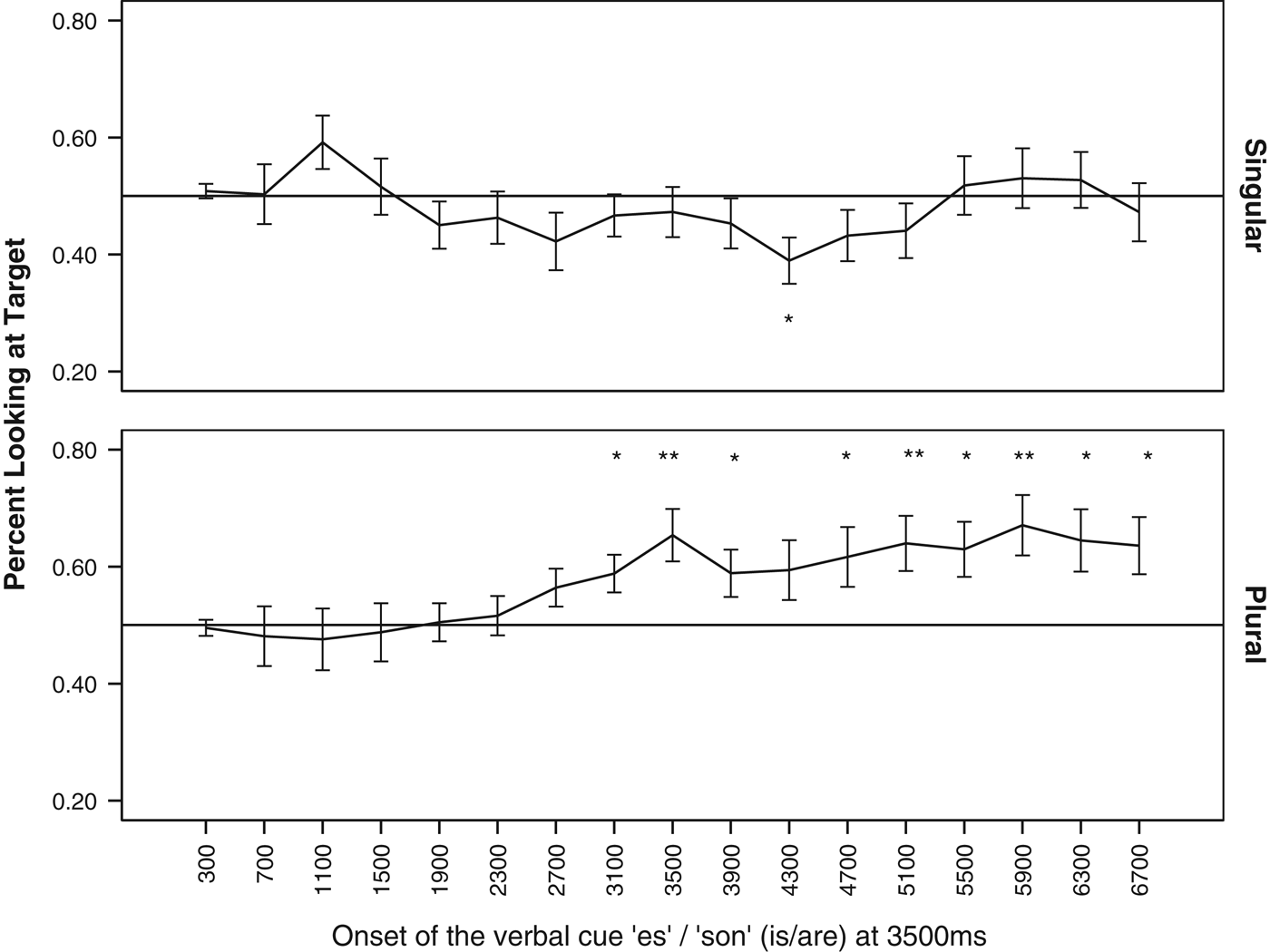
We also display timecourse data with the aim of following children's looking patterns in detail. Children's preference to the eight-object array increased significantly from the onset of the plural cues (see Figure 2). Importantly, infants did not increase looking beyond baseline to either screen during singular trials, suggesting that their increase in target looking to the multiple objects during pluralized label trials was indeed indicative of plural comprehension and not overall visual preference. PTL comparisons across the singular/plural conditions confirmed that children looked significantly more (t(24) = 3·15, p = ·004, d = 0·98) to the plural array after hearing the plural verbal cues (M = 0·64, SD = 0·16) than they did after hearing the singular verbal cues (M = 0·50, SD = 0·12). Thus, the plural array preference is a result of the children increasing their looking towards the plural array after hearing the plural cues, and not a preference to look at more objects.
Target preference in Experiment 1 (the horizontal line at 0·5 indicates looking at chance level; significantly different from chance * p < ·05 and ** p < ·01).
In sum, Experiment 1 shows that Spanish-speaking children comprehend plural syntax; these results serve as the baseline for Experiment 2: Do young Spanish-speaking children understand that plural morphology -S references sets of more than one when presented alone on the noun?
EXPERIMENT 2: PLURAL NOUN MORPHOLOGY MAPPING TO PERCEPTUAL SETS
METHOD
Participants
We tested 27 children (14 females) with a mean age of two years and one day; range 1;11·13–2;0·24. The data from one participant were excluded due to excessive crying. Children had the same characteristics as for Experiment 1 and none of them had previously participated.
Stimuli
The visual and auditory stimuli were the same as for Experiment 1, except that in Experiment 2 the sentences contained only the carrier phrase and the novel word mira/ve/wow … X-s. In accordance with Experiment 1, only the [s] plural form was employed; moreover, because the phrases ended with the plural allomorph, changes in the pronunciation of such ending (voicing) are not expected to occur, and accordingly in our stimuli did not occur.
Design and procedure
The design and procedure were identical to Experiment 1. The objects remained static during the seven seconds presentation; they were visible in silence for about 900–1200 ms before sentence onset depending on the arrangement necessary to guarantee that the onset of the number cue (plural noun morpheme) occurred at 3500 ms, as in Experiment 1. The sentences in Experiment 2 ended at 3500 ms for singular and around 3800 ms for plural sentences.
RESULTS
The trials were also divided into a pre- and post-cue phase which started at the offset of the singular nouns, and at the onset of [s] for the plural nouns. As for Experiment 1, a two-way repeated analysis of variance with the LLK measure was performed with Cue phase (pre-cue vs. post-cue) and Number (Singular vs. Plural) as within-subjects factors, and revealed a significant effect of Cue phase (F(1,25) = 5·57, p < ·05, η 2 = ·48) and Number (F(1,25) = 22·79, p < ·01, η 2 = ·18) and an interaction between the two factors (F(1,25) = 15·25, p < ·01, η 2 = ·38). Mean comparisons of this interaction indicated that children's looking preferences in milliseconds from pre- (M = −31; SD = 661) to post-cue phase (M = −373; SD = 652) were not systematic when asked to look at a singular target (t(25) = 1·80, p = ·08). In contrast, when children were asked to look at the plural target, they significantly increased their preference to the eight-object array from the pre- (M = 104; SD = 527) to the post-cue phase (M = 978; SD = 901; t(25) = 4·50, p < ·001, d = 1·18).
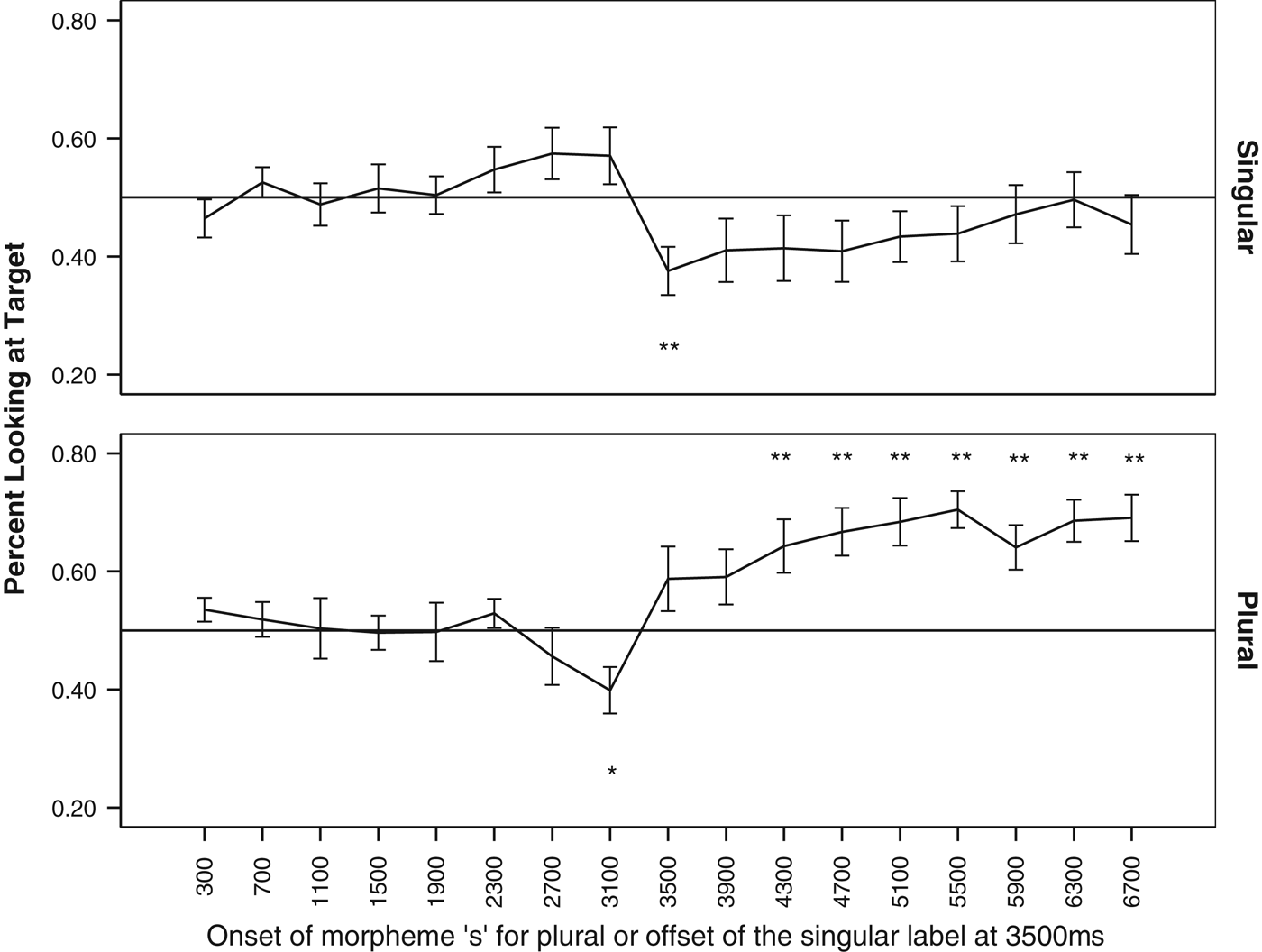
PTL target difference scores (subtracting baseline target preference from target test-comprehension, as in Kouider et al., Reference Kouider, Halberda, Wood and Carey2006) were significantly different from chance for plural trials (M = 0·14, SD = 0·16; t(25) = 4·22, p < ·001, d = 1·69), but not for singular trials (M = −0·06, SD = 0·18; t(25) = 1·71, p = ·10; see Figure 1). Timecourse analyses (see Figure 3) confirmed these results. PTL comparisons across the singular/plural conditions indicated that children looked significantly more (t(25) = 3·11, p = ·005, d = 0·53) to the plural array after hearing the plural morpheme (M = 0·66, SD = 0·15) than they did after hearing the singular noun (M = 0·58, SD = 0·15). Thus, the plural array preference in plural trials is the result of hearing the plural morpheme.
Target preference in Experiment 2 (the horizontal line at 0·5 indicates looking at chance level; significantly different from chance * p < ·05 and ** p < ·01).
Experiment 2 indicated that Mexican Spanish-speaking children aged 2;0 comprehend the plural -s, and do so when no other cue to plurality is presented in the phrase. This is the first demonstration of an early novel referent comprehension using a plural morpheme in Spanish-speaking children.
DISCUSSION
The present results show that Mexican Spanish-speaking children aged 2;0 understood plural morphosyntax meaning and how it maps to the perceptual environment, and did so when noun morphology alone was used (Experiment 2), indicating that children this age learning Spanish dialects that overtly mark the plural with the [s] sound understand that the morpheme means ‘more than one’. Previous production studies have detected children's ability to pluralize some familiar words around the second year of life; however, the current research serves as a first demonstration that children learning Mexican Spanish can use noun morphology alone, as well as multiple cues, for the purposes of novel referent identification. Our design did not allow us to test whether the [z] sound is also indicative of plural; nonetheless, the multiple-cue sentences provided three plural cues: the es/son ‘is/are’ distinction, the ending sound [s] in the determiners, and in the novel nouns. Nevertheless, future research may explore the possible effects of the contrast [s] and voiced [z] in Mexican Spanish plural acquisition, regardless of its non-categorical realization.
The results do not conclusively indicate that language structure is the only driving force behind the trajectory on which the plural morpheme is acquired, but they are certainly consistent with the hypothesis. The Spanish speakers in our study demonstrated successful comprehension of noun morphology at age 2;0 – a year earlier than English-speaking children have shown in previous studies using a similar task, a result that would be predicted based on the allomorph structure of the Spanish language (meaning the high frequency of the /-s/ in contrast to the /-es/ endings in early plural vocabulary), redundancy of the cues, and the phonological make-up (simple codas) in the morpheme system, although it is not yet clear if one of these factors matters more than another, and this is thus something that future work may investigate. The allomorph /-s/ is frequently weakened, aspirated, or lost in many Spanish dialects (Lipski, Reference Lipski, Gutierrez-Rexach and Martinez-Gil1999; Miller & Schmitt, Reference Miller and Schmitt2010), but the Mexico City dialect always pronounces it (Miller & Schmitt, Reference Miller and Schmitt2010, Reference Miller and Schmitt2012).Thus, our findings converge with Miller's work showing differences in acquisition for children learning different dialects of Spanish with differing levels of regularity in the allomorphs and morpheme presence.
Although children in our study showed understanding of plural morpheme cues alone, the present data do not indicate that Mexican Spanish speakers acquire noun morphology before other cues to plurality; the results only suggest that this is a salient cue for children at ages younger than demonstrated in English. It is entirely possible that Spanish-speaking children – like English-speaking children – show an earlier reliance on other cues to plurality (such as verbs or modifiers) but that our study's age window did not capture this stage of acquisition, and in fact we are currently conducting studies in our laboratory to explore these questions. Children may undergo the same trajectory of acquisition in which they initially rely on multiple cues of plurality (or other cues); nonetheless, our data suggest that Spanish speakers (learning a dialect in which the -s plural marker is consistently produced in the input) leave this stage earlier than English-speaking children.
Interestingly, although the children in our study showed successful looking to the correct novel object array when plural cues were used, they did not do so when singular cues were used – and this was true for both experiments when multiple cues and noun morphology alone were presented. Other studies have shown that children have a tendency to look at displays with more objects (Carey, Reference Carey, Campbell and Smith1978; Jolly & Plunkett, Reference Jolly and Plunkett2008). Our similar finding here could be due to a bias to look at displays of more items. It is also possible that children's looking to both displays for singular trials is the result of children singling out individual objects in the set of one as well as the set of eight; thus, the lack of increased looking to the singular target array could be because children interpret either of the displays as plausible referents for a set of one. The visual preference to look more at eight objects instead of one object in the baseline phase of the singular and plural trials has serious implications for understanding our results. This visual bias means that in singular trials they would have to switch their looking in order to respond to the singular cue. In plural trials, children needed only to increase their looking at the plural scene. This effortful switching may explain the lack of an effect in singular trials. The baseline bias to look at the plural scene cannot explain the ‘plural’ results since the children looked at the plural scene after plural verbal stimuli significantly more than they looked at it after hearing the singular verbal stimuli. Although there are various explanations, we also do not discard the possibility that children did not look at the correct single object display during these trials because they simply do not fully know the relevant cues to singular object referents. Children learning the Spanish plural–singular syntactic system may first learn cues to plural (noun inflection as well as verb and quantifier cues) and later learn the relevant cues to singular.
Finally, the present results are suggestive, but do not conclusively indicate, that children might use plural morphosyntax to bootstrap learning of new words. Kouider et al. (Reference Kouider, Halberda, Wood and Carey2006) suggested that English-speaking children this age may comprehend the -s noun morpheme (though the previous study did not show a robust effect of comprehension); however, even if English-speaking children comprehend the -s morpheme, this morpheme is not as frequent in early pluralization in English as in Spanish, and therefore comprehension in Spanish of this allomorph may have a larger impact in terms of allowing young children to bootstrap into novel word learning. Children in our study correctly directed attention during the plural cue trials; however, it is not clear if they were learning the novel object names. Jolly and Plunkett (Reference Jolly and Plunkett2008) demonstrated that English speakers aged 2;6, but not those aged 2;0, were able to use plural cues to disambiguate referents and to later demonstrate retention of this association. Because the Spanish speakers in our study showed successful attention to the correct novel referent at age 2;0 with noun morphology alone, however, it is possible that young Spanish speakers use plural cues at early ages to map novel nouns to objects in ambiguous contexts (but, based on the results presented, they may be unable to do so when singular cues are used). This idea is testable and indeed is one that may be explored in future research. In sum, these results are a first step in understanding what young Spanish speakers understand in plural–singular syntax – how such syntax maps to the perceptual environment – and will likely lead to future research that will help shed light on what factors matter for acquiring the individual cues to plurality.