The coronavirus disease 2019 (COVID-19) pandemic has had a devastating impact on US nursing homes (NHs).Reference Grabowski and Mor1,Reference Bagchi, Mak and Li2 Pandemic policies that restricted visitation meant that NH staff were the likely source for bringing severe acute respiratory coronavirus virus 2 (SARS-CoV-2) from the community into NHs.Reference Chen, Chevalier and Long3 Thus, measures to ensure the health of NH staff have been critical to resident safety. Such measures include national recommendations for daily symptom and temperature screening to detect overt disease, mandatory weekly testing of staff to detect unrecognized cases that could cause NH outbreaks, and vaccines.4–Reference Nanduri, Pilishvili and Derado6
Although these strategies are well conceived, their success is complicated by social, financial, and personal factors that could limit their impact on prevention. Understanding potential barriers to COVID-19 prevention in NHs requires examination of the NH workforce. The majority of NH care is provided by certified nursing assistants (CNAs) and licensed vocational nurses (LVNs), with only a limited number of registered nurses (RNs).Reference Geng, Stevenson and Grabowski7 NHs also rely on support staff to perform housekeeping, maintenance, dietary, and administrative duties. These NH workers earn low wages and minimal sick days; they commonly work multiple jobs, are underinsured, and often receive some form of public assistance.Reference Kezia Scales8–Reference Silver, Boiano and Li11 In addition, supervisors experience pressure to address high staff turnover and marginal staffing, leading to intentional and unintentional influence to dismiss mild illness to ensure a full complement of staff each shift.Reference Werner and Coe12,Reference Chiu, Black and Yue13 Thus, NH staff face significant economic and job-related pressures that may influence their willingness to report potential COVID-19 symptoms.
We evaluated symptom reporting perceptions and behaviors among SARS-CoV-2–positive NH staff in Orange County, California, the sixth most populous US county.14 Using confidential telephone surveys, we sought to discern the frequency of under-reported symptoms, barriers to symptom reporting, and the perceived value to staff of possible solutions. Understanding the frequency and drivers of underreported symptoms among NH staff will enable more effective strategies to prevent the spread of contagious disease in NHs.
Methods
Survey development
We designed a 40-item structured survey to evaluate symptom reporting behavior among NH staff. Survey constructs and questions were developed based upon confidential conversations with NH staff through our ongoing role as the Orange County NH COVID-19 Prevention Team.15 Although we did not use formal “grounded theory” methods,Reference Glaser16 we performed a review of the relevant literature and used a modified Delphi approach to formulate item content through iterative discussion, comment, and revision. Many NH staff disclosed to us that they had not reported ill household contacts or COVID-19–like symptoms to their supervisors. Staff often conveyed longstanding concerns with finances, stigma of missing work, reprisal from supervisors, as well as fears of known and unknown consequences of COVID-19. These conversations led us to examine 8 discrete constructs related to symptom reporting, including 4 barriers (ie, fear of COVID-19, lack of knowledge, monetary barriers, logistic barriers) and 4 potential solutions (ie, encouragement from supervisors/coworkers, adequate staffing, access to a confidential helpline, lack of stigma from coworkers for having COVID-19). Construct-specific items were developed to be scored on 5-point Likert scales. We also assessed participant demographics, health status, course of COVID-19 illness, frequency of participation in COVID-19–exposing activities, likelihood of seeking care when ill, and trust in COVID-19 vaccines. This work was approved by the University of California–Irvine Institutional Review Board.
Initial testing
Prior to launch, we asked 10 NH staff to complete and comment on the survey using cognitive interviewing techniques.Reference Willis17 We asked respondents about the appropriateness of survey language, word choice, format, time required to completion, and understandability of questions. Based on these responses, we modified survey language, format, and ordering of response options. The survey instrument is provided (Supplementary Material online).
Survey recruitment and administration
We conducted telephone-based surveys of NH staff in Orange County, California, from December 2020 through February 2022, with the goal of recruiting 120 participants. The survey was rolled out in 2 phases: wave 1 during the first pandemic wave and wave 2 during the subsequent SARS-CoV-2 δ (delta) and (omicron) waves. During this time, NHs were conducting routine and symptom based testing of staff. Recruitment of SARS-CoV-2–positive staff was facilitated via posters shared with all 70 NHs in the county, weekly outreach to NHs with known COVID-19 staff cases based upon publicly reported data,18 and referrals from NH leadership. We applied the following inclusion criteria: a positive SARS-CoV-2 test within the prior 8 weeks, current employment in 1 of the 70 NHs in the county, at least 18 years of age, and willingness to participate.
Each participant received a $50 electronic gift card for completing the 20–30-minute phone-based survey. Surveys were administered in English and Spanish. Participants were reassured that their participation and responses would remain confidential and would not be shared with public health, coworkers, or supervisors. Data were recorded by trained study staff using a standardized instrument in the Research Electronic Data Capture (REDCap) system.Reference Harris, Taylor and Minor19
Hypotheses
Due to expanding information and access to COVID-19 vaccines over time, we expected that staff would be more likely to disclose symptoms earlier in the pandemic versus later in the pandemic and that barriers and facilitators of symptom reporting would change over time. Additionally, given differences in job duties and level of training among staff, we expected that symptom reporting behaviors would differ between CNAs, nurses (LVNs and RNs), and nonfrontline staff (eg, environmental services, dietary, administrative). We expected that frontline workers would be more likely to disclose symptoms given their greater level of interaction with NH residents and that monetary barriers would be less important for higher paid staff (eg, RNs/LVNs) compared to CNAs and nonfrontline staff.
Analysis
Characteristics of the survey participants and responses were summarized using descriptive statistics. The Cronbach α was computed to assess internal consistency and reliability for responses within each construct; α = 0.7 was the benchmark for acceptable reliability.Reference Cronbach20
Multiple-item scales were developed within the 8 constructs using simple algebraic sums of the Likert-scaled items for each construct. For example, 4 questions were related to the construct of “fear of known or unknown consequences of COVID-19.” To create a composite scale, 5-point Likert-scaled responses to the 4 questions were summed together, with a minimum score of 4 and a maximum score of 20. Composite scales for each construct were then transformed to range from 0 to 100 by subtracting scale means from theoretical-scale minimums and dividing the result by the difference between the theoretical-scale maximum and minimum and multiplying that result by 100. Higher scale scores indicated that the barrier or facilitator was more important when deciding whether to report possible symptoms.
To assess construct validity, we calculated single-item summary scores within each of the 8 constructs. To assess discriminant validity, we used t tests and analysis of variance to compare responses among subgroups (1) by time of positive SARS-CoV-2 test, comparing surveys conducted earlier versus later in the pandemic (eg, wave 1 vs wave 2), and (2) by NH staff job role (frontline vs nonfrontline). All data were analyzed using SAS version 9.4 software (SAS Institute, Cary, NC).
Results
Overall, 120 NH staff completed the survey, which represents 5% of staff COVID-19 cases countywide across the survey period. Participant characteristics are summarized in Table 1. Moreover, 49% of surveys were completed during wave 1, the 2020–2021 winter wave, and 51% were completed during wave 2, from June 2021 through February 2022 during the SARS-CoV-2 δ (delta) and (omicron) waves. Staff distribution of survey respondents was reasonable: 44 CNAs, 44 LVNs/RNs, and 32 nonfrontline staff. Most participants were female (67%), and the median age was 39.6 years. The median length of time working in NHs was 6.3 years. CNAs were more likely to hold >1 NH job and had fewer years of experience working in NHs compared with nurses and nonfrontline staff.
Characteristics of Nursing Home (NH) Staff Survey Participants

Note. NH, nursing home.
a Wave 1 represents surveys completed during the 2020–2021 winter wave. Wave 2 represents surveys completed during the SARS-CoV-2 δ (delta) and (omicron) waves in 2021–2022.
b Subsets by job role include certified nursing assistants (CNAs), nurses, and nonfrontline staff (eg, environmental services, dietary, administrative). The survey cohort included 4 rehabilitation staff (3 respiratory therapists and 1 rehab manager) that were categorized as direct care staff and grouped with LVNs/RNs. Higher score indicates.
c Better self-reported health.
d More likely to engage in activity.
e Greater level of trust.
Reason for COVID-19 testing
Of 120 COVID-19 cases among staff, 85 (71%) were identified during mandatory weekly NH surveillance testing: 27 (23%) were identified after disclosing symptoms to a supervisor, and 8 (7%) were identified after disclosing a COVID-19 exposure. During wave 1 versus wave 2, significantly more cases were detected via symptom-based testing (31% vs 15%; P = .04) and significantly fewer cases were detected via mandatory testing (81% vs 59%; P = .006). Reasons for testing were similar across job roles. A nonsignificantly greater proportion of cases were detected via symptom-based testing among frontline staff (CNAs, 30%; LVNs/RNs, 23%) versus nonfrontline staff (13%; P = .11).
Symptom reporting at time of testing
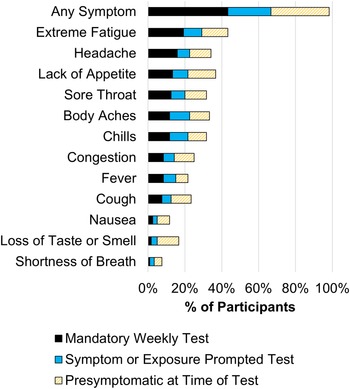
Overall, 80 (67%) of 120 staff with COVID-19 were symptomatic at the time of testing (Fig. 1). Among symptomatic staff, only 27 (34%) of 80 disclosed their symptoms to a supervisor prior to testing. The most common symptoms present at testing and not reported to a supervisor were extreme fatigue, headache, and lack of appetite. Among cases identified by mandatory weekly testing, 52 (61%) of 85 were symptomatic at the time of testing and did not disclose symptoms to a supervisor prior to their test (Fig. 1, black bars).
Symptoms present at the time of COVID-19 testing. Bars are sorted by symptoms present at the time of mandatory weekly testing (black bars). Overall, 118 participants (98.3%) are shown in the graph; 80 participants (66.7%) had at least 1 symptom prior to testing; 38 participants (31.6%) developed symptoms after testing; and 2 participants (1.6%) never developed symptoms.

Likelihood of reporting hypothetical symptoms to a supervisor
In a hypothetical question, participants were asked on a scale of 1–5 how likely they would be to report specific symptoms to a supervisor, not all of which were related to COVID-19. Responses are summarized in Table 2. Across all participants, the mean likelihood of reporting any symptom was 67.5 of 100. Overall, participants were more likely to report symptoms such as fever, chills, cough, shortness of breath, loss of taste or smell, and nausea, diarrhea or vomiting (likelihood scale score >75) compared to symptoms such as fatigue, headache, cramps, muscle spasms, body aches, or lack of appetite. Likelihood of reporting was significantly greater during wave 1 versus wave 2 (likelihood scale score 75 vs 60; P = .01) and was nonsignificantly greater among frontline versus nonfrontline staff (69 vs 65; P = .53).
Likelihood of Reporting Hypothetical Symptoms to a Supervisor

a Responses to the question “If you had one of the below symptoms (not all of which are COVID-19 symptoms), how likely would you be to report it to an immediate supervisor?” were recorded on a scale of 1–5 with 1 being “extremely unlikely” to report and 5 being “extremely likely” to report. Responses were transformed to a 0–100 scale. A higher score indicates that staff are more likely to report a given symptom.
b Wave 1 represents surveys completed during the 2020-2021 winter wave. Wave 2 represents surveys completed during the SARS-CoV-2 δ (delta) and (omicron) wave (wave 2) in 2021–2022.
c Subsets by job role include certified nursing assistants (CNAs), nurses, and nonfrontline staff (eg, environmental services, dietary, administrative). The survey cohort included 4 rehabilitation staff (3 respiratory therapists and 1 rehabilitation manager) that were categorized as direct care staff and grouped with LVNs/RNs.
Drivers of symptom reporting
Responses were consistent across the 8 discrete survey constructs related to symptom reporting (Table 3). Overall, fear and encouragement from supervisors were the most salient factors for speaking up about COVID-19 symptoms, with importance values >80 on a scale of 100 (Table 4).
Reliability of Responses by Survey Construct

Note. N/A, not available.
a Cronbach α values of 0.7 or higher indicate “acceptable” internal consistency.Reference Cronbach20 Cronbach α not reported for constructs with only one question.
Barriers and Facilitators of Symptom Reporting Among Nursing Home Staffa

Note. Bold indicates statistical significance.
a To assess discriminant validity, t tests were performed comparing responses among subgroups expected to differ by time of positive COVID-19 test and NH staff job role (frontline versus nonfrontline).
b A higher score indicates that the construct matters more for symptom reporting.
c Wave 1 represents surveys completed during the 2020–2021 winter wave. Wave 2 represents surveys completed during the SARS-CoV-2 δ (delta) and (omicron) waves in 2021–2022.
d Subsets by job role include certified nursing assistants (CNAs), nurses, and nonfrontline staff (eg, environmental services, dietary, administrative).
As hypothesized, barriers and facilitators of symptom reporting differed between waves 1 and 2. Fear (P < .01) and lack of knowledge (P = .004) were greater drivers of symptom reporting during wave 1 versus wave 2, but monetary barriers were less important during wave 1 versus wave 2 (P < .001). Encouragement from supervisors (P = .02) and access to a confidential helpline (P < .001) were greater drivers of symptom reporting during wave 1 versus wave 2, while adequate staffing (P < .001) and lack of stigma from coworkers were less important during wave 1 versus wave 2 (P < .001).
In contrast, barriers to and facilitators of symptom reporting were mostly similar between frontline and nonfrontline staff. Lack of knowledge about known or unknown consequences of COVID-19 (P = .004) and encouragement from supervisors (P = .02) were more important drivers of symptom reporting for frontline versus nonfrontline staff, but adequate staffing was a less important driver for frontline versus nonfrontline staff (P = .008). Although not statistically significant, we found that monetary barriers were less important for RNs/LVNs compared to CNAs and nonfrontline staff (importance score, 63.1 for RNs/LVNs vs 71.0 for CNAs and 74.5 for nonfrontline staff; analysis of variance P = .23).
Discussion
Nursing homes are high-risk settings for COVID-19 and other contagious disease threats. Ensuring that staff report potential symptoms and stay home when ill is crucial for outbreak prevention and resident safety. In our study, two-thirds of symptomatic NH staff failed to disclose their symptoms to a supervisor, with fatigue, headache, and lack of appetite being the most commonly underreported symptoms. We also identified early and late pandemic drivers of symptom reporting. Specifically, fear and lack of knowledge were important early drivers, whereas adequate staffing and sick days were important later drivers of symptom reporting as fear and knowledge improved with time.
As expected, frontline staff were more likely to disclose symptoms to a supervisor, prompting testing, compared to nonfrontline staff. Although this was not a statistically significant finding, it suggests that staff who are directly involved with resident care more readily report symptoms and seek testing. We were surprised to find that barriers and facilitators of symptom reporting were mostly similar between frontline and nonfrontline staff. Despite not being statistically significant, the fact that monetary barriers were scored as more important by CNAs and nonfrontline workers versus RNs and LVNs aligns with our hypothesis that financial pressures influence symptom reporting, especially among lower-paid workers.
This study had important limitations. First, although we used a novel survey instrument for this study, our main goal was to generate inferences relevant to NH infection prevention rather than validate a new survey tool. Second, our findings may have been affected by social desirability bias, in which respondents are more likely to give socially desirable answers despite assurance of confidentiality. This may explain the discordance between the high likelihood (67.5 of 100) of reporting hypothetical symptoms versus the fraction of symptomatic staff that actually disclosed their COVID-19 symptoms to a supervisor (only 34%). Third, participants were a convenience sample of NH staff in a single region and were more likely to be long-term employees (median, 6 years NH experience), which may limit the generalizability of our findings. Fourth, our survey was conducted during a pandemic and may not be indicative of drivers of symptom reporting for seasonal illness or routine colds.
This study also had several strengths. Notably, we identified actionable targets for improving NH infection prevention by encouraging symptom reporting and staying home while ill. The most effective factor promoting symptom reporting was supervisor encouragement (importance factor, 89). This is particularly important given the conflict of interest that supervisors feel because sending an ill worker home results in short staffing. Establishing nonpunitive policies, improving sick-leave benefits, improving staffing coverage options, and improving worker health and resiliency should be explored to strengthen NH infection prevention and control efforts. Importantly, our findings reinforce the value of mandatory symptom screening and weekly surveillance testing of NH staff during a pandemic, confirming the presence of many factors that drive reluctance to speak up about potential symptoms.
In conclusion, failure to disclose symptoms remains pervasive among NH staff even during a high-risk pandemic period. When fear was high early in the pandemic, staff were more willing to report symptoms. As fear was mitigated, mandatory weekly testing became more important for identifying NH staff COVID-19 cases. Supervisor encouragement, confidential helplines, improved staffing levels, and allayment of fears are positive factors that may promote symptom reporting among NH staff and improve NH safety.
Supplementary material
For supplementary material accompanying this paper visit https://doi.org/10.1017/ice.2023.51
Acknowledgments
We thank Karina Gordeychev for her assistance with data entry and Jenny Mai for her help formatting the survey instrument.
Financial support
This work was funded by the Centers for Disease Control and Prevention (grant no. 75D30121C10376 to S. Huang).
Conflicts of interest
All authors report no conflicts of interest relevant to this article.