INTRODUCTION
Numerous researchers indicate that today's medical education curriculum must include longitudinal follow-up of patients across different transitions of care (Christakis, Reference Christakis1995; Whitcomb, Reference Whitcomb2005; Dooley-Hash, Reference Dooley-Hash2010; Irby et al., Reference Irby, Cooke and O'Brien2010; Hirsh et al., Reference Hirsh, Gaufberg and Ogur2012). As all patients will eventually face the end of life, new educational models need to incorporate formal training in hospice care to enable novice healthcare professionals to successfully address the medical, emotional, and spiritual needs of dying patients (Aulino & Foley, Reference Aulino and Foley2001; Bui Reference Bui2012; Goldsmith et al. Reference Goldsmith, Wittenberg-Lyles and Shaunfield2011; Jacoby et al., Reference Jacoby, Beehler and Balint2011; Meo et al., Reference Meo, Hwang and Morrison2011). In the past decade, several studies have proposed innovative solutions to teach medical professionals about the end of life (Fineberg et al., Reference Fineberg, Wenger and Forrow2004; Liao et al., Reference Liao, Amin and Rucker2004; Sullivan et al., Reference Sullivan, Lakoma and Billings2005; Back et al., Reference Back, Arnold and Baile2007; Sanchez-Reilly & Ross, Reference Sanchez-Reilly and Ross2012). However, the Accreditation Council for Graduate Medical Education (ACGME) to date does not require goals and objectives or a written curriculum for elective clinical experience in palliative care during the internal medicine residency training (ACGME, 2012).
Given the current lack of emphasis on end-of-life care in medical education, far too many terminally ill patients face death without the benefits of hospice. In the United States, one out of every five patients dies in an intensive care unit (ICU) (Angus et al., Reference Angus, Barnato and Linde-Zwirble2004). Moreover, over half (58%) of all individuals who died in 2010 were not enrolled in a hospice program (National Hospice and Palliative Care Organization [NHPCO], 2012). Recent research suggests that palliative care in the emergency department is necessary, but a paradigm shift will be required to make it a more fundamental component of overall medical care (Gisondi, Reference Gisondi2009; Quest et al., Reference Quest, Asplin and Cairns2011). Because of the nature and unpredictability of the dying process, not all deaths can occur in hospice; however, there are clearly vast opportunities to increase the proportion of terminally ill patients and families who can benefit from hospice services. These opportunities must be taught to the new generation of physicians.
In the world of acute care, ICUs are specifically geared to aggressively sustaining life, but not necessarily to alleviating all symptoms. A study by Mularski et al. (Reference Mularski, Heine and Osborne2005) found that family members of patients who died in an ICU reported insufficient management of symptoms for their loved ones, including alleviating pain and ensuring that they were breathing comfortably. Unbeknownst to many family members, and to many medical professionals delivering care to terminally ill patients, hospice care can be delivered in a variety of settings, from home to the ICU. In the United States, the majority (66.7%) of patients enrolled in hospice die in the comfort of their own homes, surrounded by their family (NHPCO, 2012).
The benefits of hospice also extend to family members. Hospice offers families a greater level of support and provides programs such as bereavement services to survivors of all ages, from children to older adults.
An additional objective of the hospice curriculum is to fully understand the importance of timing of the hospice referral. In an effort to gauge patients' family members' perceptions of the timing of hospice referral, Teno et al. (Reference Teno, Casarett and Spence2012) found that 41% of families feel that the process should have been initiated earlier.
Physicians-in-training also need to appreciate the financial benefits related to hospice use. The majority of United States patients (>83%) who received hospice services in 2010 were covered under the Medicare Hospice Benefit enacted in Congress in 1982 (NHPCO, 2012). Conversely, the cost of care for patients in ICUs is staggering, reaching as much as 15–25% of all United States hospital costs (Himmelstein et al., Reference Himmelstein, Thorne and Warren2009). Some of these expenditures can transfer to patients' families. If the deceased family member incurs hospital- related debt, then assets will be used to pay for medical debts before the family receives their inheritance.
With so many studies demonstrating the benefits of hospice care for terminally ill patients, regardless of care site, why are there still such large numbers of eligible patients not receiving hospice care? And why is hospice simply not accepted as a transition of care in medical curricula? Are physicians only trained to save lives (Morrison et al., Reference Morrison, Morrison and Glickman1994)?
A number of studies have sought to investigate the multifarious barriers impeding healthcare professionals from referring their patients to appropriate end-of-life care. In one study, Brickner et al. (Reference Brickner, Scannell and Marquet2004) found that the vast majority (84%) of physicians reported feeling unable to initiate a hospice referral as they were unable to predict death to within 6 months. In another study, Morrison et al. (Reference Morrison, Morrison and Glickman1994) conducted a survey among internal medicine residents and attending physicians and found that physician lack of understanding regarding appropriateness, time constraints, and discomfort with the topic were all found to be barriers to end-of-life care conversations with patients. Feeg and Elebiary (Reference Feeg and Elebiary2005) conducted a survey of experts attending a national conference on palliative care, confirming that the greatest barriers to hospice referral were: physician reluctance, lack of familiarity with end-of-life care, and hospice being associated with death as opposed to getting patients healthier.
In fact, teaching about end-of-life care actually results in greater student satisfaction with their medical education. In a national survey of 1455 fourth year medical students at 62 medical schools, Billings et al. (Reference Billings, Engelberg and Curtis2010) found that respondents reported feeling more prepared and rated their end-of-life care education higher with greater exposure to formal and informal palliative curricula. Billings et al. (Reference Billings, Engelberg and Curtis2010) concluded that “medical students' sense of preparedness for end-of-life care… is greater with more coursework and bedside teaching. By contrast, the hidden curriculum conveying negative messages may impair learning. Our findings suggest that implicit messages as well as intentional teaching have a significant impact on students' professional development”.
The primary purpose of the present study is to investigate potential barriers that prevent physicians, particularly those in training, from referring their terminally ill patients to hospice. We sought to measure physicians' level of training and experience, as well as attitudes, beliefs, knowledge, education, and behaviors as they relate to appropriate hospice referral for patients at end of life.
METHOD
A cross-sectional study was conducted using an anonymous self-administered survey after obtaining institutional review board (IRB) approval (#11-265B). The survey was distributed during academic grand rounds held between October 2011 and January 2012 to a sample of 600 physicians from five internal medicine departments in a large health system located in the New York metropolitan area. The questionnaire was given to physicians at different professional levels including: those in postgraduate year (PGY) 1, 2, and 3; fellows; attending physicians/internists; specialists; and other healthcare professionals.
The survey instrument was constructed using knowledge and comfort questions from scales utilized by Ogle et al. (Reference Ogle, Mavis and Wyatt2002) and Meo et al. (Reference Meo, Hwang and Morrison2011), respectively. Survey questions queried physician preferences, beliefs, and knowledge regarding eligibility for hospice. The final survey tool consisted of 23 questions with a five point Likert-type scale.
Data analysis was conducted using SAS software version 9.2 (SAS Institute, Cary, NC). Responses to survey questions were summarized and frequencies and proportions were calculated. Demographic comparisons were performed using the χ2 test and Fisher's exact tests. When multiple comparisons were made, significance level was properly adjusted. Spearman correlations were calculated to determine if professional status and experience were associated with comfort and knowledge discussing end-of-life topics with terminal patients.
RESULTS
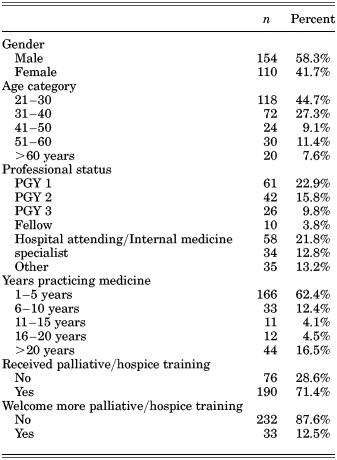
The sample consisted of 280 participants (response rate: 46.7%). There were more male respondents (58.3%) than female ones (41.7%), and most (44.7%) were in the 21–30-year-old age category. Reported respondent training levels were as follows: 22.9% were PGY1s, 15.8% were PGY2s, 9.8% were PGY3s, and 3.8% were fellows. Most respondents had been practicing medicine between 1 and 5 years (62.4%), followed by > 20 years (16.5%). The majority (71.4%) stated that they had received palliative/hospice training and would not want to obtain more training (87.6%) (Table 1).
Respondent demographic characteristics

An overwhelming majority (87.7%) either “strongly agreed” or “agreed” that hospice care was an important competence for internal medicine physicians; 62.1% stated that ascertaining patient preferences at end of life was “very important” and 43% expressed that discussing advance directives was “essential.” However, over half (53.2%) either “agreed” or “strongly agreed” that the emergency room (ER) attending physician was actually responsible for sorting out patient/family wishes regarding advance directives. Furthermore, 27.3% stated that the palliative care team generally initiated hospice discussion.
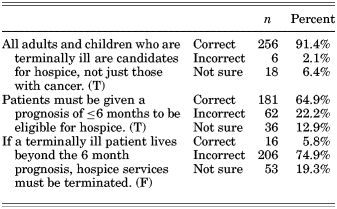
Among the questions designed to tap knowledge of palliative/hospice care, 35% of physicians disagreed (incorrectly), or were unsure, with the statement that patients must have a 6 month prognosis to be eligible for hospice. Another 25% agreed, or were unsure (incorrectly), with the statement that hospice services must be terminated for terminally-ill patients who live beyond 6 months. Finally, 8.6% disagreed, or were unsure, with the statement that all adults and children with terminal illness are candidates for hospice care (Table 2).
Respondents' knowledge about end-of-life care
T = True, F = False
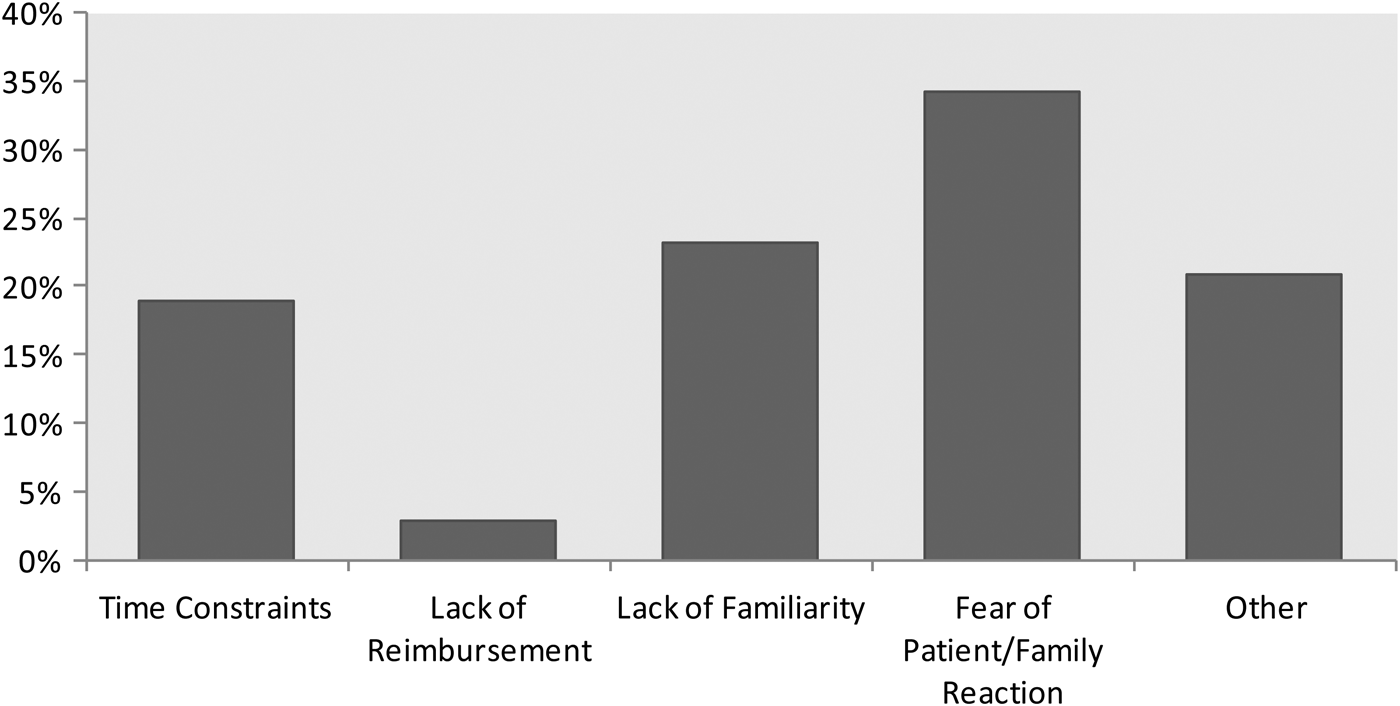
The most frequently identified barriers to hospice referral were fear of patient/family reactions (34.3%), lack of familiarity (23.2%), and time constraints (18.9%) (Fig. 1). However, up to 96% of physicians either “never,” “sometimes,” or “rarely” reported actually experiencing anger from their patients when mentioning hospice. In fact, there was no association (r = −0.03, p < 0.63) between the absence or presence of anger from a patient or family member regarding hospice referral and physician level of training.
Physician Reported Barriers to Recommending Hospice for Terminally-ill Patients.
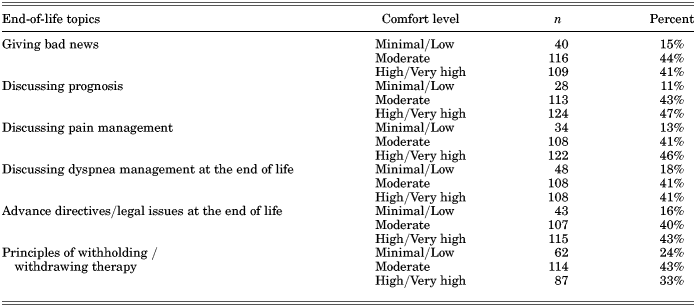
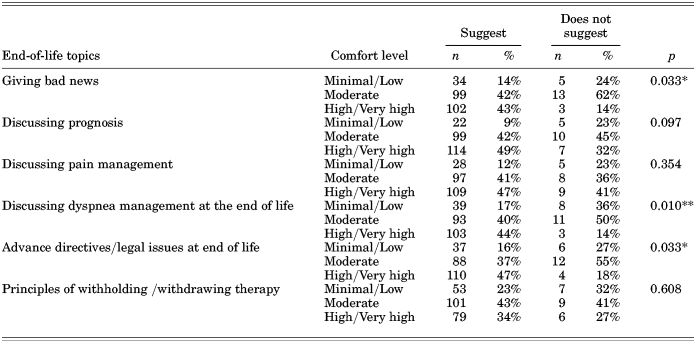
Table 3 shows respondent-reported level of comfort regarding particular topics related to end-of-life conversations with patients. The three most frequent areas that physicians reported discomfort discussing were: principles of withholding or withdrawing therapy, dyspnea management, and advance directives/legal issues at end of life. Table 4 presents the results of the association between physician referral to hospice and comfort levels in discussing end-of-life care. Specifically, comfort with giving bad news (p < 0.033), comfort with discussing dyspnea management at the end of life (p < 0.010), and comfort discussing legal issues at the end-of-life (p < 0.033) were all significantly associated with physician referral patterns.
Level of comfort discussing end-of-life topics
Level of comfort discussing end-of-life topics and suggesting versus not suggesting hospice referral
*p < 0.05.
**p < 0.01.
We found a significant correlation between years in practice and level of comfort discussing end-of-life care, including: giving bad news (r = 0.19, p < 0.002), discussion of prognosis (r = 0.16, p < 0.008), pain management (r = 0.22, p < 0.000), advanced directives (r = 0.18, p < 0.004), and principles of withholding/withdrawing therapy (r = 0.13, p < 0.038). There was also a significant relationship between educational level and hospice referral patterns (p < 0.010).
There was a significant association between knowledge of hospice eligibility criteria and the more clinical aspects of dying: comfort with discussion of prognosis (p < 0.05), pain management (p < 0.03), and dyspnea management at the end of life (p < 0.004). Interestingly, there was no significant association between knowledge of hospice eligibility criteria and existential palliative discussions: giving bad news (p < 0.2), advance directives (p < 0.1) and withholding/withdrawing therapy (p < 0.06).
DISCUSSION
The literature consistently shows that healthcare professionals do not discuss end-of-life care frequently enough with their terminally ill patients, whether dying from cancer, chronic obstructive pulmonary disease, heart failure, or dementia (Quill, Reference Quill2000; Pfeifer et al., Reference Pfeifer, Mitchell and Chamberlain2003; Boyd et al., Reference Boyd, Merkh and Rutledge2011; Lind et al., Reference Lind, Lorem and Nortvedt2011; Pekmezaris et al., Reference Pekmezaris, Walia and Nouryan2011; Reinke et al., Reference Reinke, Slatore and Uman2011). This study explores the association of physician knowledge, training status, and level of comfort with referral patterns of terminally ill patients to hospice care.
In general, we found that most participants reported having received training, and agreed that palliative care was an important competence for physicians. However, many still relinquished end-of-life care to ER physicians and palliative care consultants. Furthermore, our study indicated that experienced physicians (attending and faculty) were more comfortable discussing hospice referral than were physicians in training. These findings suggest that the training physicians received in general was not sufficient enough to instill confidence about approaching terminally ill patients. It would be important to know whether cumulative experience alone is the basis for this enhanced comfort, or whether specific hospice training in residency would provide similar results.
Fear of angering patients and families was reported to be a hindrance in hospice referral. Regardless of the number of years of their training, physicians rarely experienced animosity from the terminally ill patient. Exploring preconceived and unfounded fears of patients and/or family anger in reaction to hospice referral needs to be integrated into a palliative care teaching curriculum.
A surprising result of this study was that physicians reported that they would not welcome more palliative care training, even though a noteworthy proportion failed to answer basic knowledge questions correctly. Unfortunately, the present study did not seek to identify specifics with regard to the amounts, quality, timing, and mode of palliative care training. However, we did uncover a critical finding: respondents were much more comfortable with the clinical aspects of palliative medicine than with existential aspects, such as discussing advance directives.
CONCLUSION
Clearly, we have successfully trained a generation of physicians in the daily management of dying patients (e.g., dyspnea and pain management). We have not succeeded in incorporating the existential aspects of dying into the teaching curriculum for today's physicians. Future studies should focus on delivering the right amount of end-of-life care training, at the right time, within the medical school and residency curriculum.
ACKNOWLEDGMENT
The authors thank Jill Cotroneo for her administrative support.