Introduction: The Post-Armistice Currency Conundrum (1918–1920)
The introduction of new currencies played a key role in solidifying, legitimating, or undermining frequent sovereignty changes and political transitions in Europe in the twentieth and twenty-first centuries. The most recent examples include German monetary reunification in 1990, when according to economist Horst Siebert the “political need for quick unification clearly overrode the economic rationality …,” as the Federal Republic of Germany converted on a par the wages and even some of the savings of the former citizens of East Germany despite the depreciated value of the DDR's currency.Footnote 1 Recent debates surrounding the Greek debt crisis point to the extent to which a potential currency conversion has far-reaching repercussions on the entire continent while pointing to the limited power of a national government regarding its own financial matters.
Yet historians have paid little attention to the importance of currency conversions after the collapse of Austria-Hungary and Germany even though these policies resulted in the first manifestation of disillusionment with successor states. After World War I, the phasing out of imperial currencies affected the lives of more than 80 million people, mostly living on formerly Austro-Hungarian and German territories in east-central and southeastern Europe, but the conversion of enemy money caused a series of problems for France and Belgium as well.Footnote 2 Pacifists like Norman Angell warned both before and after the Great War that “conquest would assure the conqueror no profit.”Footnote 3 As it turned out, dismantling empires and annexing territories came with a huge price tag born by victorious governments and their populations, and monetary transitions featured among the costliest expenses of sovereignty change.
Although the financial integration of new territories cost postwar treasuries dearly, it also provided a unique opportunity for the successor states of empires to create and solidify ties with new citizens and loyal business elites as large sections of the population in central and east-central Europe looked to postwar governments to remedy their economic plight, caused by war, inflation, and state collapse. Yet the conversion of imperial currencies was also a tool in the hands of governments to redefine inherited social hierarchies.
The desire among ordinary people and policymakers to return to the stable currencies of the prewar era was fueled by the threat of downward social mobility among broad sections of the central and east-central European middle classes in the aftermath of the Great War. This anxiety has often been overshadowed in the literature by the larger social transformations during and after the Second World War. Although the mid-twentieth century brought about the wholesale obliteration and replacement of the bourgeoisie in eastern and east-central Europe, the collapse of empires after 1918 threatened the social status of ethnic minorities in successor states, especially Germans and Hungarians who lost their jobs in imperial administrations, some of whom even faced the expropriation of their land and factories. Although the Bukovina-born writer Gregor von Rezzori's complaint that his “grandfather's legendary fortune” in Austro-Hungarian crowns had been reduced to “nothing more than its zeros” in Greater Romania speaks primarily to the problem of post-1918 inflation, it clearly illustrates the long-standing memory of anxieties that connected devaluation of currencies with the loss of social status.Footnote 4
Yet the negative economic shock of imperial collapse could not be limited to undesirable populations as rapid inflation affected even populations dear to successor states. In response to these fears, postwar states strived to “recast bourgeois Europe,” as Charles Maier noted and “to recapture, somehow, the certainties and the security of the prewar years,” as Tony Judt emphasized.Footnote 5 The return to a stable currency through phasing out depreciated paper monies of defunct empires fit into the agenda of re-creating what Hannah Arendt and Stefan Zweig called the “golden age of security” of the prewar decades.Footnote 6
Seen from the longue durée of the “age of extremes” starting in 1914, the conversions of imperial currencies featured as important steps in state-led attempts to manipulate the social composition of European societies.Footnote 7 By setting a rate of exchange for imperial currencies, postwar governments were able to signal which populations they preferred and which were unwelcome in the emerging financial communities of successor states.Footnote 8 In the months after the armistices, the cost of currency conversions was overshadowed by expectations in both western and east-central Europe that vanquished empires and their central banks would foot the bill for currency conversion. Furthermore, the Entente's eastern European allies counted on France and other victorious great powers to provide financial assistance, and these expectations informed their policies as well.Footnote 9 In addition, the suspension of the gold standard in August 1914 and its selective reintroduction starting in the mid-1920s allowed for the manipulation of currency value; diverging from the set exchange rates dictated by the “golden fetters” of the prewar period had become a possibility.Footnote 10 As a consequence, postwar governments had several options to settle the issue of enemy currencies on territories that they had annexed after November 1918. Yet all of these alternatives came at the cost of hurting or benefiting the economic interests of some sections of the population and all cost treasuries dearly.
States could take the last available exchange rate as a yardstick or let markets decide on the conversion rate. Given the rapid wartime and postwar inflation of the German and Austro-Hungarian currencies, both alternatives hurt the interests of broad sections of the population on territories that had changed sovereignty. In addition, governments could also offer a lower rate for new populations, as in the case of Greater Romania, to economize on the cost of conversion. Yet all these options threatened to erode the popularity of successor states. Losing the loyalty of new populations was politically detrimental, as many Alsatians, Transylvanians, Bohemians, and other populations that found themselves under new governments had high expectations of their new states and were already plagued by economic hardships after the armistices.Footnote 11
Alternatively, successor states could provide a better conversion rate for new citizens to cement their loyalty. Yet this required sacrifices from taxpayers on the home front. The preferential treatment of populations on newly incorporated territories raised several paradoxes and moral dilemmas because people on some of these territories had fought against the “motherland” in the Great War, as in the case of Alsace-Lorraine, Eupen-Malmédy, Transylvania, Voivodina, the Banat, the Austrian Littoral, or western Thrace. Unlike its eastern allies, the French government also had the option to discriminate among populations in Alsace and Lorraine and offer different conversion rates for people based on ethnic background.
No matter which of the alternative policies postwar governments pursued, the complete phasing out of imperial currencies took several years and contributed to economic turmoil both locally on annexed territories and in postwar states more generally.Footnote 12 This article compares the first and one of the last currency conversions in the aftermath of the Great War by examining how the French and Romanian governments phased out German and Austro-Hungarian banknotes, respectively, and how populations in the former Alsace-Lorraine and Transylvania reacted to and maneuvered to benefit from these policies. The results are surprising. The comparison reveals that a major west European power, France, pursued more radical policies of ethnic and financial discrimination against ethnic minorities than Greater Romania, despite the Bucharest government's nationalist and antisemitic agendas.Footnote 13 The contrast between the ethnic discrimination against the German minority by the French administration and the lack of corresponding Romanian policies of ethnic discrimination compares well to Tara Zahra's argument on policies of national classification in post-1918 France and Czechoslovakia; she maintained that “France, rather than Czechoslovakia, implemented a more radical and racist policy of forcible national classification.”Footnote 14
When compared to the market rate of conversion between the French franc and the German paper mark, the Paris government offered a premium to Alsatians and Lorrainers whose families had lived in the region prior to its annexation by the German empire in 1871; in sharp contrast to this generosity, the incoming government provided a lower rate for Germans who had immigrated to the region after that date. The Bucharest government, in the meantime, discriminated among its citizens based on geographic origin by giving preference to its prewar populations over the economic interests of those in annexed territories, including ethnic Romanians who made up half of Transylvania's population. By December 1918, in Transylvania, which Romania had annexed from Hungary, the Bucharest administration offered a temporary conversion rate that halved the value of the Austro-Hungarian crown. The new Romanian government thus undercut its own antiminority rhetoric by pursuing financial policies that disregarded ethnic differences. Paradoxically, by the time of the final conversion in September 1920, even this lower exchange rate proved to be a generous subsidy to the mostly Hungarian, Jewish, and German bourgeoisie of Transylvania given the rapid inflation of the crown, which dipped below one-fifth of its prewar value in the two years following the Great War.
Margaret MacMillan, Robert Gerwarth, and others have demonstrated that east-central Europe became the “problem child” of the Versailles settlement, in part because the peace conference left several issues of economic and commercial cooperation unresolved while borders solidified later than in most of western Europe.Footnote 15 As Mark Mazower emphasized, “minority-rights treaties did not work very well, and failed to prevent ill-feeling and discrimination”Footnote 16 among Hungarians, Germans, Jews, and other populations who became ethnic minorities after 1918. Yet currency conversion in Transylvania showed that the belated solidification of state sovereignty and the belated conversion of currencies also had positive repercussions for at least some sections of the local population including ethnic minorities in east-central Europe. Some of these minorities even maneuvered to profit from uncertainties surrounding financial transition and benefited economically from the establishment of successor states whose legitimacy and sovereignty they otherwise contested. Ironically, even some of the former Austro-Hungarian banks managed to turn a profit from the process despite the intention of the Bucharest treasury to favor bankers from the prewar kingdom of Romania.
Although states had to solve the problem of imperial currencies individually, there were many east-central Europeans at the time who regarded West European currency conversions as models on which postwar financial stabilization would rest; this warrants a comparative investigation.Footnote 17 Transylvanian Romanian economist and peasant-party politician Horia Maniu contrasted the Romanian conversion practices to French and Italian counterparts, and he lamented that “in Alsace and in the Italian Trento region the motherlands considered it to be a national obligation not to let the new co-nationals suffer the consequences of the devaluation of their former currencies. [By contrast] in our Transylvania, not only were we not protected, but on the contrary, the new country created a worse situation.”Footnote 18
Information about western currency conversions, however, only arrived selectively to southeastern Europe, which allowed Maniu and others to refer to France and Italy as models to emulate rather than fiascos to avoid. In fact, the phasing out of the paper mark in Alsace and Lorraine was among the costliest and least efficient monetary transitions in Europe and also rendered the region's German populations destitute.Footnote 19 The result of the process was especially staggering as monetary transition in Alsace was the most well prepared of all European currency conversions, subject to a series of studies by French experts since 1914.
Wartime Origins, Postwar Failures: The Genesis of French Policies on the Paper Mark
The French bureaucracy first encountered the conundrum posed by the paper mark in August 1914, when French soldiers reached the westernmost villages of Alsace and entrenched themselves in a small territory around the township of Thann.Footnote 20 In December 1914, the commander of the French occupation army, the Lorraine-born general Gabriel Putz (1859–1925), wanted to extend “an act of extreme benevolence” to local populations when he established a favorable exchange ratio of gold marks and paper marks, 1.23 and 1.02 francs for 1 mark, respectively; this was very close to the prewar ratio (1.25 French francs to 1 gold mark) and thus disregarded the sharp decline in the value of paper marks since the outbreak of the First World War due to massive issuing of paper marks and reduced German exports.Footnote 21
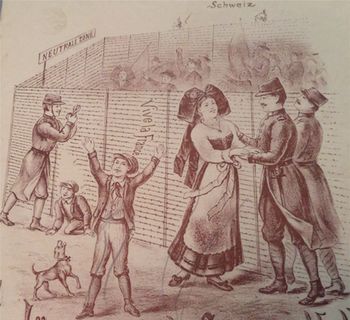
During the war, the issue touched only the inhabitants of a handful of towns under French occupation; military authorities restricted conversions to 50 francs per person per day in 1914 and 1915, and as a result only around 1.7 million francs worth of currency was exchanged between 1914 and 1916, a small fraction of prewar business transactions.Footnote 22 Furthermore, as an internal military report admitted in 1916, a large proportion of the converted German money went missing because military units that administered the conversion shifted in and out of Alsace and neither the civilian government nor the army commanders held them accountable for sums exchanged.Footnote 23 At the same time, the conversion of German money at a favorable rate provided a venue for the Paris administration and army to make this small sliver of land into the poster child of French reconstruction at a relatively low price, an attractive alternative to the situation facing Alsace-Lorrainers still under German rule (figure 1).
The “redemption” of Alsace-Lorrainers from German rule by the French army. Poster of a theater performance (1918), La Contemporaine, Bibliothèque, Archives, Musée des Mondes Contemporains (BDIC), “Tracts français concernant l'Alsace-Lorraine,” 4 Δ 1511.

The most important advisory board of the Paris government on matters related to the region was the Conference of Alsace-Lorraine (Conférence d'Alsace-Lorraine), which prepared background studies on the region's economic administration and education starting in 1915.Footnote 24 The government and the general staff were free to ignore the committee's suggestions, even though its members had years of expertise in the affairs of the imperial territory (Reichsland) of Alsace-Lorraine. The committee's president was former Prime Minister Louis Barthou, while its members included Jules Cambon, the head of the political section of the French foreign ministry, and other diplomats, politicians, and top-ranking military officers. Francophile Alsace-Lorraine politicians who had fled to France in 1914, such as the Catholic Center Party's Émile Wetterlé and the liberal Daniel Blumenthal, also featured prominently among the committee's members. The conference met every Monday in the palace of the French foreign ministry at the Quai d'Orsay.Footnote 25
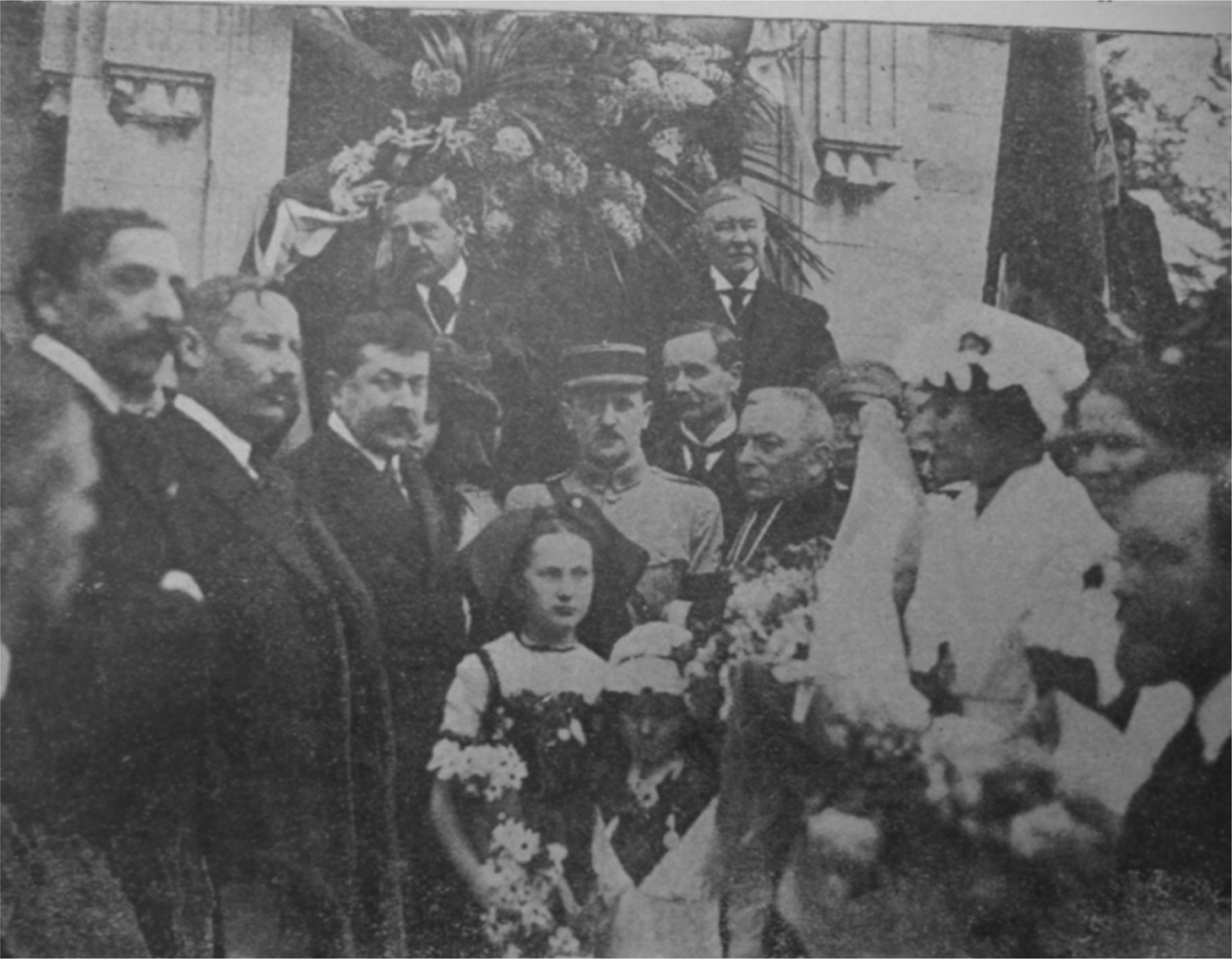
The committee suggested a paternalistic solution to the issue of paper marks that built on decades of tradition in Alsatian politics, in which the paternalism of industrialists toward workers and of governing politicians toward the general population was common and where dominant political parties functioned as elite clubs.Footnote 26 At the same time, the committee's Parisian members and the government also harbored paternalistic attitudes toward Alsace-Lorraine's population. French propaganda tracts depicted Alsatians and Lorrainers as the children of the French nation, forcefully torn away from the famille française by Germany in 1871 (figures 2–3).
Celebration by the Interallied Parliament and the Friendly Union of Alsace-Lorraine in front of the statue of Strasbourg on May 6, 1917, in Paris. Alsace-Lorraine is represented by two young girls wearing the traditional Alsatian and Lorrainer headdresses, surrounded by Maurice Barrès (second left), abbé Émile Wetterlé (center right), and others. BDIC, “Tracts français concernant l'Alsace-Lorraine,” 4 Δ 1510.

The representation of the liberation of Alsace in a wartime French propaganda pamphlet. BDIC, “Tracts français concernant l'Alsace-Lorraine,” 4 Δ 1510.

The sole representatives of the region's population in French propaganda tracts were children and young women, the latter of the two eagerly waiting for the embrace of the poilus (figures 1 and 3).Footnote 27 The French army also interned more than one thousand Alsace-Lorraine civilians whom it deemed suspicious. The interned included both Germans and autochthonous populations; most of them remained confined in the citadel of Besançon and other fortresses in the interior of France under dire circumstances until the end of the Great War.Footnote 28 Franco-Alsatian relations were thus riddled with paradoxes and conflicts during the First World War, which explained the Paris government's special treatment of the region's population when it came to exchanging their currencies.
The paternalistic attitudes of French and Alsatian political elites converged during wartime discussions on the fate of the German paper money at the conference. Members agreed with Paris law professor Auguste Souchon's suggestion that the rate of exchange should leave “a small profit with the population so that they benefit from a little favor [extended by France].”Footnote 29 By March 1915, however, the wartime German currency, the paper mark, had depreciated considerably to around Ff 1.10 and it continued to lose value as the war dragged on, which increasingly turned a “little favor” to a big one because the German paper mark depreciated faster than the French franc.Footnote 30
Some of the suggestions voiced by members of the conference on the conversion of the German paper mark showed careful consideration, and ironically, also showed that experts at the foreign ministry compared Alsace-Lorraine's situation to administrative problems in French colonies.Footnote 31 Albert Kammerer, a top official at the Paris foreign ministry suggested that the occupying administration should periodically publish the conversion rate, reflecting changes in the ratio, just like French consuls did in China.Footnote 32 Wetterlé, for instance, proposed a conversion rate that reflected the depreciation of the paper mark, so that 1.10 paper marks equaled one franc, which would still have provided Alsatians with a small benefit. Multiple members suggested a flexible and varying exchange rate that reflected the fluctuation of the two currencies. The socialist deputy Georges Weill opined for the obvious: using the international exchange rate in nearby neutral Basel, Switzerland, as a yardstick. Yet the Alsatian politician Paul Helmer, likely motivated by national pride and concerns with France's financial sovereignty, found it “unacceptable” for the Paris government to adhere to an exchange rate established in a different state.Footnote 33 The committee agreed that Alsatians would be allowed to pay their taxes in both paper marks and French francs, and that the periodically varying exchange rate had to be established by “competent authorities.”Footnote 34
The committee, however, had no executive power, which eventually enabled the occupying military administration to step in as competent authority. The military prepared no background studies on currency conversion and disregarded the conference's considerations, which could have alleviated pressures on the French budget.Footnote 35 The French army found it easier to adhere to the prewar exchange rate as a yardstick, that is the rate used during the gold standard era, despite the massive depreciation of the paper mark. This ratio, 1 paper mark equaling 1.25 Ff, became the official rate throughout the war in occupied Alsace. Moreover, this exchange rate was never changed during the war, despite the continuing depreciation of the paper mark.Footnote 36 The sidelining of the Conference of Alsace-Lorraine showed that the French administration marginalized the region's Francophile political elites as early as the First World War, even though centralization measures only became a common complaint in the 1920s.Footnote 37
Will Germany Pay?
On November 19, 1918, French troops marched into Strasbourg and occupied the entire territory of Alsace-Lorraine as stipulated in the Compiègne armistice that had been signed just one week before. On November 26, Prime Minister Georges Clemenceau ordered the conversion of the paper mark at the ratio in force during the war, with one paper mark equaling Ff 1.25.Footnote 38 Clemenceau's decree dismissed French legislative practices as it bypassed the chamber of deputies. Thus, debate on its stipulations was not possible, even though the conversion required funds from the French budget.Footnote 39
The prime minister's main goal was to secure French sovereignty over Alsace and Lorraine as soon as possible at all costs because there was no consensus among the allies in November 1918 that the region would automatically return to France without a plebiscite.Footnote 40 A rapid currency conversion was the most effective means for the establishment of French sovereignty over the region as it immediately gave Alsace-Lorraine's population a financial interest in the permanence of French rule, especially as discontent among Alsatian populations could have imperiled the legitimacy of French rule in the eyes of allied diplomats and the international press.Footnote 41 Furthermore, the measure also compensated Alsace's and Lorraine's Francophile bourgeoisie, which lost out politically after the French government abolished the restricted administrative autonomy that the Reichsland had enjoyed within the German empire and nominated bureaucrats from the French interior to key administrative positions.
There was one important exception to the generosity of the French government in Alsace and Lorraine: the favorable exchange rate was available to only about 1 million of the region's 1.8 million population.Footnote 42 Clemenceau's decree confirmed that only “Alsatians and Lorrainers” and citizens of allied and neutral states who had lived in the region before 1914 were able to benefit from the phasing out of paper marks. Subsequent measures of the French administration made it clear that the region's Germans did not count as “Alsatians and Lorrainers” and that they were not eligible for this generous exchange rate. As Laird Boswell pointed out, “French bureaucrats and military officials came armed with an ethnic vision of the borderland.”Footnote 43
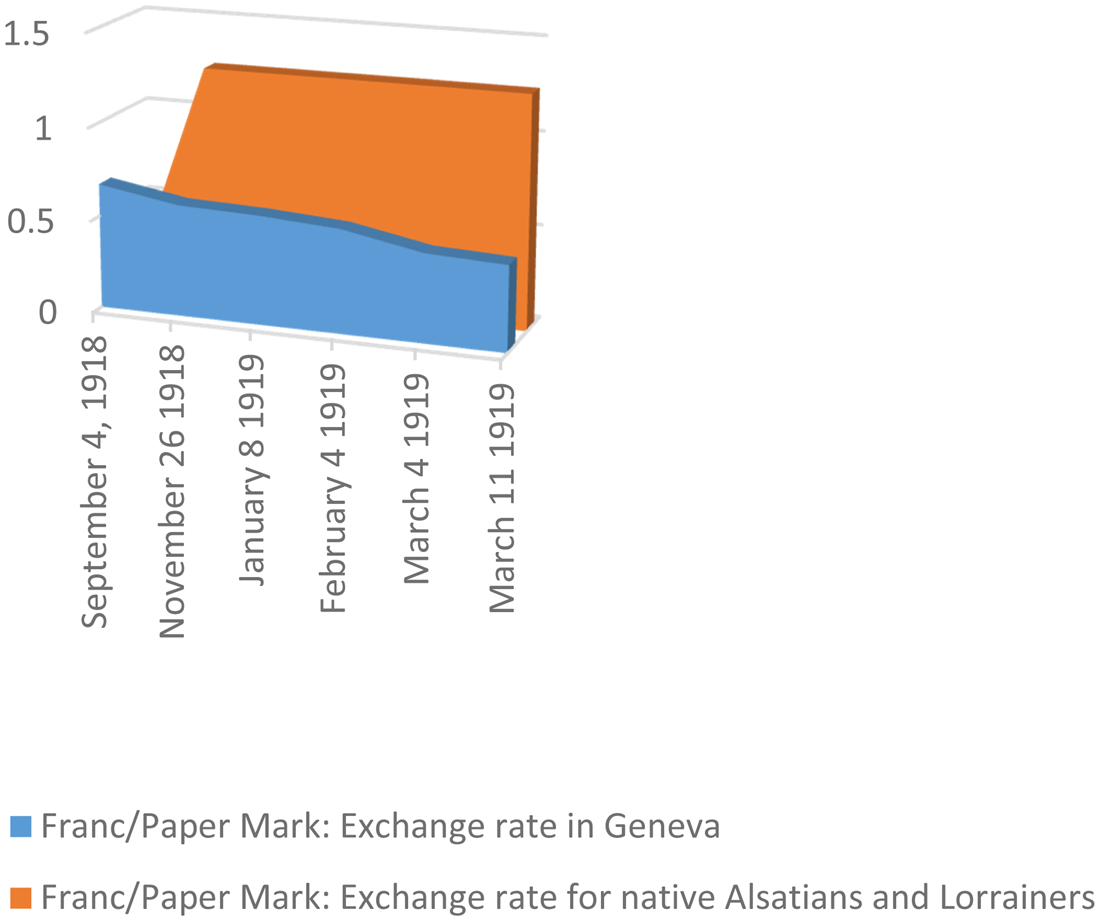
A few weeks after its establishment in Alsace and Lorraine, the French administration handed out four different types of identity cards to the reannexed region's population.Footnote 44 Those with no German ancestors received the advantageous Card A, while those who were born in German federal states or whose ancestors stemmed from there had to make do with Cards B, C, or D. Populations that the French administration categorized as German and those with mixed parentage only received francs at the daily rate, which was disadvantageous given the inflation of the paper mark as compared to the French franc (figure 4).Footnote 45 Yet Germans had to acquire francs on the free market to pay their taxes and creditors, which meant that their obligations in French currency increased substantially due to the inflation of the paper mark. As a German government correspondence pointed out, if an initial debt of 10,000 marks was converted into a 12,500 franc debt, it equaled as much as 55,000 paper marks by 1920.Footnote 46
The conversion rate of the paper mark to French franc for native Alsatians and Lorrainers (1.25 to 1) and the market rate of conversion available for Germans. Differences between the two shaded areas indicate the premium in excess of the market rate paid out by the French treasury for privileged populations. Source: Raphael Milliès-Lacroix, Annex to the Minutes of the March 18, 1919 session of the Sénat, ANF, F 12 8044.

Despite the rapidly depreciating paper mark, French politicians, from President Raymond Poincaré to his political rival, Prime Minister Clemenceau, believed Allied loans to France would continue to flow and eventually German reparations would prop up the French treasury.Footnote 47 The finance minister of the Clemenceau government, Louis-Lucien Klotz, proposed an election budget for 1919 that refused to raise taxes and expected the United Kingdom and the United States to finance French expenditures until German reparation payments were transferred.Footnote 48 As Klotz explained to the financial committee of the Senate and to the chamber of deputies on January 30, 1919, “The government estimates that Germany should reimburse, at a rate of 1.25, [the cost of] the monetary reform.”Footnote 49 At a time when France's allies were reluctant to offer any more loans, the Bolsheviks renounced the repayment of their debt to French creditors, and Germany sabotaged its reparation payments, Klotz's unfounded expectation and small budget were at best naive.Footnote 50 Furthermore, the Weimar government contested the legitimacy of reparations and started an international campaign to prove that the Weimar Republic was unable to pay, which also overshadowed French prospects of a large reparation bill.Footnote 51
Unlike in 1871, when the French government had paid to the last sou the extraordinarily high (5 billion franc) indemnity to Germany because reparations were the precondition of ending the German occupation of northeastern France, the Paris government had no comparable leverage on Germany after the Compiègne armistice.Footnote 52 The French government never used the expropriation and expulsion of Germans from France as leverage to receive reparations and passed anti-German decrees as early as November 1918, while the German government tacitly renounced Alsace-Lorraine and treated the expropriation of the Reichsland's Germans as a marginal issue, much to the dismay of German conservatives and the expelled. Little wonder, the conservative politician Arthur von Posadowsky-Wehner lamented in 1919 in the Reichstag that “it is remarkable how quickly people in Germany have accepted the cession of Alsace-Lorraine, apparently in silence.”Footnote 53
Clemenceau himself regarded finances as secondary to his major goal, the reintegration of Alsace and Lorraine on French terms as soon as possible.Footnote 54 Voices of resistance within the government were soon sidelined or possibly never even reached the ministers in charge: Clemenceau and Klotz. It was the foreign ministry of Stephen Pichon that attempted to marshal expert opinion in favor of a lower exchange rate. A highly critical note reached the desk of Pichon on November 23, 1918, which claimed that the intended exchange rate reflected “a more than benevolent decision that no one has asked for, one that Alsace-Lorrainers did not even expect”; the report accused the administration of giving a “present” to the region's “400,000 Germans” and reminded that “in reality Germany will not be able to pay [for the cost conversion] or even if it would, its other obligations would suffer.”Footnote 55 The fact that the author was not informed about the pending expulsion of Germans from Alsace and Lorraine and that the report's stipulations were ignored shows that, as soon as the war was over, the foreign ministry lost its authority over the former Reichsland. The region became administered as core French territory in an effort to transform an international issue into a matter of French domestic politics. Unsurprisingly, the Conference of Alsace-Lorraine that operated within the foreign ministry was soon dissolved as well.
In Klotz's defense, Belgium also adopted the exact same (high) ratio when it ordered that 1.25 Belgian francs were to be exchanged for 1 paper mark. The measure shows how deep-seated beliefs were in Paris and Brussels that Germany would fully compensate the victors for the costs of financial transition.Footnote 56 The French radical socialist senator Raphaël Milliès-Lacroix summarized the government's dilemma that led to sidelining concerns similar to the foreign ministry's: “Can one leave this loss on the accounts of Alsatians and Lorrainers in possession of German currency? The government did not consider that option at all: it deemed it an injustice to make our Alsatian-Lorrainer compatriots bear the burden of this depreciation [of the paper mark]. It wanted to avoid the development of the feeling that Alsatian and Lorrainer populations have to bear the burden of German defeat, and that they have to pay with a [financial] loss for their reintegration in the French unity.”Footnote 57
In a similar vein, Georges Delahache, Francophile historian and chronicler of Alsace's postwar transition, reasoned that the unrealistic exchange rate in the decree “stemmed from the moral obligation of France to take back the German bills from Alsatians and Lorrainers.”Footnote 58 The conversion of the paper mark, however, gave rise to other political and moral issues as well: Should the government prefer Alsatians and Lorrainers, who had fought on the side of Germany against France, at the expense of French taxpayers? Should it strengthen the position of the region's industrialist families, who featured disproportionately among the beneficiaries of the process?
Critics and Beneficiaries of the Exchange Rate
French currency conversion measures benefited the majority of Alsace-Lorrainers, but industrialists, bankers, and wealthy peasants were among its biggest beneficiaries. The region's traditional bourgeoisie profited doubly as the Paris government expelled their German competitors and converted their marks at a lower rate while providing reintegrated industrialists with a favorable conversion rate.Footnote 59 Currency conversion came at the right time for the region's business elites; in the fall of 1918, insecurities about the financial consequences of the French takeover were enormous among the circles of industrialists and bankers who had reaped profits during the First World War. The first annual report of the largest bank in Alsatian hands, the Alsatian General Bank (Allgemeine Elsässische Bankgesellschaft), shows how economic elites viewed the favorable exchange rate of the paper mark as a key component in preserving their business positions. As this report stated:
Indeed, we faced some difficult problems after the conclusion of the armistice. The most important question that we posed to ourselves was the following: how will it be possible to extend the necessary financial support for our customers, businessmen and industrialists after the changed circumstances? The French government ended this uncertainty in a generous manner . . . From one moment to the next, our financial life was put in a full harmony with that of France.Footnote 60
The managerial board, then, exhorted shareholders: “Given the plight that would have been caused by not exchanging the mark [at a favorable rate], we recognize it as our duty to ask you to express your gratitude to the French government along with us.”Footnote 61
The years 1918 and 1919 were indeed years of thanksgiving for the AEB and other financial, commercial and industrial companies. The AEB was the poster child for what the favorable exchange rate, continued access to German markets, and cash flows from Paris were able to achieve for an Alsatian or Lorrainer company after the French takeover. The bank increased its turnover from 376 million paper marks (470 million francs) in 1918 to 870 million francs in 1919 as it reopened its branches in major German cities.Footnote 62 Had the French administration not applied the advantageous ratio or had it delayed the conversion, the bank's 1919 turnover would likely have shown stagnation or decrease due to the rapid inflation of the paper mark.
Most French politicians in the French interior were less contented with Clemenceau's currency conversion policies. The economist Henri Hauser, who worked closely with the French government and advised it on Alsace's and Lorraine's new economic administration, lamented that the measure benefited only rentiers, the bourgeoisie that owned and “rented apartment buildings,” as well as “peasants, who have already become tremendously rich [during the war],” while “small business owners and consumers have become its victims,”Footnote 63 due to price hikes, rising wages, and concomitant firings of workers. With French industrial production stagnating at 55 percent of 1913 levels, an enormous increase in real wages precipitated by the currency conversion was at best unrealistic and contributed to the massive firing of miners and steelworkers, followed by a large wave of strikes in 1919 and 1920.Footnote 64 Hauser himself had proposed the Ff 0.65 to 1 paper mark exchange rate, which was almost half of what the Paris government ended up providing for Alsace-Lorrainers with longstanding ties to the region.Footnote 65
As for the region's population, the ethnic discrimination that accompanied monetary transition alienated many families given that its effects could not be neatly limited to Alsace's and Lorraine's ethnic Germans due to the high rate of intermarriage, which reached 42 percent in Strasbourg and 58 percent in Metz among Germans.Footnote 66 Almost every Alsatian and Lorrainer family had a member with the disadvantageous B, C, or D identity cards. Ethnic categorization thus sent shockwaves through the region's society. The decree of November 26, 1918, on exchanging the paper marks also left numerous issues unresolved, which hindered Alsace's and Lorraine's commercial and financial life by temporarily blocking credits and pushing banks that could not obtain the necessary amount of francs to the brink of insolvency.
Even the French propagandist Delahache noted that the coupling of ethnic discrimination with currency conversion slowed down monetary transition and created problems; no wonder, given that many Alsatians and Lorrainers contested their ethnic categorization or could not prove their ancestry by the time they had to declare the amounts to be converted. There were 15,000 contested cases, which represented around 70 million paper marks or 8 percent of the 900 million paper marks reported for exchange by December 1918.Footnote 67 The sheer number of these problematic cases prompted the French administration to set up a special commission to process them.Footnote 68
The fate of bank deposits illustrated especially well the financial instability and uncertainty that the pegging of the exchange ratio to ethnicity precipitated; the measure negatively affected even bankers who were loyal to France and its nationalist agenda. Given that the deposits, credits, and bonds of Germans as well as autochthonous Alsatians and Lorrainers converted at different ratios, banks had to face mismatches and confusion while German-owned companies operated with massive losses, fueling unemployment and political instability. As early as December 1918, an artillery commandant in charge of the German-owned Adler and Oppenheimer tannery in Strasbourg alerted the French regional administration that the firm was heading toward insolvency because workers’ wages had to be paid on the basis of the higher rate while the management was only able to convert the company's cash flow in paper marks by resorting to the low rate reserved for Germans; as a result, the factory had fired forty to fifty workers daily.Footnote 69
A decree of April 4, 1919, issued by the top civilian official or general commissioner of Alsace and Lorraine, Alexandre Millerand, specified that ethnic Germans had to repay their debts at the high rate. At the time, the paper mark was undergoing rapid inflation, dropping from 60 to 46 centimes between November 1918 and January 1919.Footnote 70 The decrees intensified discrimination against Germans. Many Germans refused to pay or were unable to do so, and as a result, the French treasury had to bail out savings banks and the Alsatian and Lorrainer Mortgage Credit Institute, which were especially exposed to German obligations.Footnote 71
As a result of a shortage of French francs, the region's banks resorted to blocking deposits and savings and extended credit at an extraordinarily high rate of 6 percent, as opposed to the prewar 3 to 4 percent.Footnote 72 Lack of cheap credit slowed down the economic recovery of Alsace and Lorraine considerably at a time when industrial companies needed capital to readjust to French markets. As in the case of the bank imbalances, the French treasury had to step in to solve the issue.Footnote 73 The Senate and the chamber of deputies had no other choice but to approve, on April 23, 1919, a law that opened up a brand-new item in the state's budget that injected capital to Alsace's and Lorraine's banks and provided for the expenses of currency conversion.Footnote 74
Only during the debate leading up to the law of April 23 did the enormity of expenses become clear to the Parisian political elite.Footnote 75 The withdrawal of the paper mark from Alsace and Lorraine at a generous exchange rate almost bankrupted the French treasury. It cost close to 2 billion francs ($250 million)Footnote 76 (table 1), more than the 1.780 billion francs in revenue generated by the extraordinary war profit taxes levied throughout France in 1918.Footnote 77 Furthermore, two weeks after the law was passed, the final peace terms to Germany made it clear that France's vanquished eastern neighbor would not be forced to pay for the cost of currency conversion in the former Reichsland.Footnote 78 Article 72 of the Versailles Treaty maintained that in regard to prewar debts, the “rate of exchange . . . shall be the average rate quoted on the Geneva Exchange” in the month before the armistice, 0.8134 instead of 1.25, or 35 percent less than the rate desired by the French government.Footnote 79
The Cost of Alsace's and Lorraine's Reintegration

Sums expressed in 1,000 French francs. Source: Commissaire Général to the Garde des Sceaux, November 26, 1923. ANF, AJ 30, 180
Diplomats at the peace conference rendered a pan-European problem the issue of individual governments and did not try to intervene retroactively in currency conversions because the financial claims of successor states in western, central and east-central Europe were interconnected and mutually exclusive. States on the winning side mutually limited one another's maneuvering capacity during peace negotiations on reparation payments and monetary transition. As one of France's chief diplomats at the peace conference André Tardieu explained, the French and Belgian governments were unable to persuade their allies to make Germany pay for the cost of exchanging paper marks to French francs in Alsace and Lorraine. The reason was that the Allies wanted “to avoid the contingent effect of such a principle in central and east-central Europe, where Germany had abused the compulsory circulation of her currency to an even greater extent.”Footnote 80 In other words, France was unable to demand that Germany pay for the cost of converting paper marks in Alsace and Lorraine because comparable eastern European claims on Germany would have bankrupted the Weimar Republic, let alone the governments of Austria and Hungary. Tardieu and Clemenceau were thus unable to convince their Entente allies to make Germany pay for the generous exchange ratio that Clemenceau had already made available to most Alsatians and Lorrainers.
Because the coupling of ethnic discrimination with monetary policies came with an enormous price tag, senators and deputies from the interior of France were angry at the government regardless of party preference as they realized that it was their constituents who were to foot the bill.Footnote 81 The René Viviani government named the reannexation of Alsace and Lorraine as France's major war aim as early as November 22, 1914.Footnote 82 Four years later, 1.4 million French men, or 17 percent of those drafted between 1914 and 1918, had been killed working toward this goal.Footnote 83 Those who survived had to indirectly bear the burden of incorporating Alsace and Lorraine, whose population had fought on the other side of the trenches for four years, into France.
The first currency conversion in postwar Europe thus proved to be a financial disaster. Most international observers, like the Transylvanian Maniu, only perceived the benefits extended to some Alsatians and Lorrainers, and thus cast the measure as a model to emulate. Henri Hauser's report, which pointed out that an unlikely combination of Francophile industrialists, bankers, and wealthy farmers benefited most from the process, did not even reach the highest echelons of the Paris government. True, ordinary Alsatians and Lorrainers benefited as well, but the controversial ethnic categorization of the region's society, the appointment of bureaucrats from the interior of France to key positions, and the radical remaking of Alsace's and Lorraine's administration resulted in considerable malaise that canceled out the effects of the favorable exchange rate.Footnote 84 The coupling of ethnic discrimination with economic discrimination set dismal precedents for Nazi measures in the region during the Second World War, when former expellees received top administrative positions, such as Robert Ernst, who became Strasbourg's mayor in the early 1940s.Footnote 85
The Afterlife of Austro-Hungarian Crowns in Greater Romania
Almost two years after the conversion of paper marks in Alsace and Lorraine, many of the same blunders accompanied the process of converting the former enemy's currency in Transylvania. Some of the main actors involved in monetary transition were also similar in the two regions: an economically incompetent military leadership that vindicated the right to introduce a temporary exchange rate; a central government that thought it would regulate the issue according to its own political agenda on annexed territories; regional business elites whose social status and economic positions hinged on the outcome of monetary transition; finally, bankers, entrepreneurs, and wealthy peasants who all maneuvered to reap profits. Furthermore, the Bucharest administration also expected the Paris government's aid in the form of credits to absorb the shock of conversion, which also contributed to the prolongation of the conversion process.Footnote 86
Differences in currency conversion stemmed from the poverty of the Romanian treasury, the sheer size of territories it needed to integrate, the prolonged stabilization of borders, and continued issuing crowns by the Viennese Central Bank after the armistice, which resulted in massive delays in currency conversion. Romania had followed the Entente's prompt and had entrusted the entirety of its gold reserves, worth $62.5 million, to Russia in 1916 before joining the war against Austria-Hungary and Germany.Footnote 87 It was no secret to Entente powers that the Bolsheviks confiscated their eastern ally's gold reserves in 1917, while most of the country remained under the harsh occupation regime of the Central Powers until November 1918.Footnote 88 Consequently, Greater Romania lacked a sufficient base to stabilize the leu after the war, to say nothing of financially integrating the new territories.
Although the Austro-Hungarian crown was the most important foreign paper money in the enlarged state, there were three other currencies, which presented further obstacles for the government. The so-called General Bank lei were issued by the German occupying army in Bucharest in 1917 and 1918, whereas the rubles of the tsarist regime and the Russian revolutionary governments counted as official means of payment in Bessarabia, a territory that Romania annexed from the defunct Russian empire. Monetary unification required fixed borders, which were lacking in most of east-central and eastern Europe in the late 1910s, and Transylvania was no exception in this regard. Despite the Belgrade armistice in November 1918 and the presence of the French Armée d'Orient in Transylvania, a war flared up between Hungary and Romania in spring and summer 1919, which prolonged further the solidification of Greater Romania's western borders and enabled the inflow of crowns from abroad.Footnote 89
The size of Transylvania's population presented yet another obstacle for monetary unification. The region had more than 5.5 million inhabitants as compared to the 7.5 million of prewar Romania and Greater Romania's 17.5 million.Footnote 90 Given the sheer number of citizens involved in the currency conversion process, it seemed more convenient for the Bucharest administration to gamble on a favorable solution of this tremendous crown conundrum through the Austro-Hungarian central bank or French diplomats at the peace conference, instead of embarking on monetary unification “prin noi inșine” (by ourselves), which became the slogan of protectionist economic policies directed against foreign capital and ethnic minorities in the 1920s by the governing national liberals.Footnote 91
Before the war, the Romanian and Austro-Hungarian currencies were almost on a par given that 100 crowns were worth 106 Romanian lei. In early 1919, the Romanian army artificially reduced the value of the crown by 50 percent, and this rate served as the official yet temporary exchange rate until the final phasing out of the crown in September 1920. When it was first introduced, the measure created discontent in Transylvania. Yet by 1920, this temporary rate had become a generous premium for the region's populations given the inflation of the crown.
Adding to the confusion surrounding the temporary conversion rate, the Romanian state railways in Transylvania used an even more distorted ratio, of 4 crowns for 1 leu.Footnote 92 Following behind Czechoslovakia and the kingdom of Serbs, Croats, and Slovenes, the Bucharest government stamped the crowns in circulation in Transylvania in summer 1919 in order to differentiate domestic currency from the inflow of crowns from other successor states.Footnote 93 The Romanian administration's decision to reduce the value of the crown by 50 percent did not count as an extreme measure at the time, and represented a middle ground between practices by the Prague and Belgrade governments.Footnote 94 In Czechoslovakia, the exchange rate between the old and new currencies was one to one, yet the state withheld half of the converted amount in a forced loan that yielded a meager 1 percent and was unredeemable by citizens. In the kingdom of Serbs, Croats, and Slovenes, the exchange rate of the crown and the dinar amounted to four to one, in practice five to one.Footnote 95 Yet, as Romania's two western neighbors started conversions in 1919, their treasuries were less exposed to the inflation of the crown than Romania's, which finally converted to Austro-Hungarian currency in September 1920. The tardiness to convert crowns cost the Romanian treasury billions because they ended up paying a premium over the actual market rate just like the French government had two years earlier without the added benefit of pleasing populations in new territories. Unwillingly, the Romanian administration thus ended up subsidizing populations in territories such as Transylvania and southern Bukovina, which were the least ethnically Romanian.
Waiting for the Peace Conference: A New Lease on Life for Austro-Hungarian Crowns in Greater Romania
The halving of the crown's value by the incoming Romanian administration triggered enormous discontent among Transylvanians, even among ethnic Romanians like Horia Maniu, whom the Bucharest administration cast as its preferred ethnic group in the region. Maniu noted bitterly that the new state served the interests of Transylvanian Romanians less than the defunct Austro-Hungarian monarchy.Footnote 96 A group of Transylvanian Romanian elites started a grassroots propaganda campaign for the conversion of the crowns and the leu on a par and distributed anonymous pamphlets on the Făgăraș–Sibiu train, replete with complex economic arguments set in a small type, likely aimed at Romanian notaries, wealthy peasants, teachers, and members of the provincial intelligentsia. The pamphlet used the language of Transylvania's “equalization” (egalizarea) and “liberation,” common demands of the Romanian national movement before 1918, and adapted it to the situation of the region's Romanians in Greater Romania purportedly suffering under “criminal exploitation” due to the inferior exchange rate of the crown.Footnote 97
The Austrian peace treaty signed at Saint-Germain-en-Laye offered a warning in September 1919 that Greater Romania would receive no aid for the conversion of the crown in Transylvania. Article 206 of the treaty stipulated that the government had to convert crowns in circulation in Bukovina, a territory annexed by Romania from Austria, and that the Romanian government would assume a portion of Austrian state debt.Footnote 98 The treaty also declared that the Austro-Hungarian central bank would be liquidated, and it made no reference to the bank's or the Austrian government's obligation to exchange crowns or compensate for the cost of this conversion carried out by successor states.
Given the inflation of the crown, Transylvanian elites realized earlier than the Bucharest government that even though the problem of defunct imperial currencies was an international one, its solution had to come from individual states. Tardiness in face of inflation hurt populations that transitioned from empires to successor states as their savings were worth less and less. Little wonder that Transylvanian deputies exhorted the Bucharest government to stop delaying conversion until the protracted conclusion of the peace treaty between the Allies and Hungary. The conversion of sharply depreciating German paper marks in Pomeralia to inflated Polish marks in November 1919 also showcased how belated currency conversion could impoverish populations in annexed territories while the simultaneous circulation of prewar and postwar currencies in Upper Silesia led to speculation and ultimately proved untenable after the hyperinflation of the German paper mark.Footnote 99 The Transylvanian economist and politician Ion I. Lapedatu delivered a long speech in the Bucharest chamber of deputies on February 16, 1920, and pressed for an immediate conversion of crowns to leu. He cited at length the Austrian treaty to make it clear, “We are obliged to withdraw and reimburse all banknotes of the Austro-Hungarian bank on our territory, regardless whether these circulate in Transylvania, Bukovina, the old [prewar] kingdom [of Romania] or Bessarabia.”Footnote 100 Lapedatu also warned against unfounded claims that Romania would enjoy the same economic privileges that France had received in the Versailles peace treaty regarding Alsace and Lorraine. He called attention to the “decisive sway of France at the peace conference” as opposed to Romania's minor influence and exposed the circumstances that “enabled France to pursue [policies] that other states did not have the power to pursue.”Footnote 101
The Treaty of Trianon, finally concluded between the Entente and Hungary in June 1920, copied verbatim the stipulations of the Austrian peace terms in regard to the stamping and exchange of the crown in Transylvania. Article 189 even referred back directly to Austrian treaty when it maintained, “within twelve months of the coming into force of the Treaty with Austria, each one of the States to which territory of the former Austro-Hungarian Monarchy is transferred, … shall replace, as it may think fit, the stamped notes referred to above by its own or a new currency.”Footnote 102 The peace treaty thus obliged the Romanian government to convert the crown by September 1920 at the latest. Unlike France, which did not have to count on the oversight of the Reparation Commission that adjudicated Austrian and Hungarian reparation claims, the Treaty of Trianon obliged the exchange rate introduced by Romania and other successor states to subsequent vetting by this Reparation Commission.Footnote 103
Both Transylvanian and Bucharest-based Romanian politicians often referred to the victimization of Greater Romania by the Allies who meddled in the country's internal affairs.Footnote 104 Yet the enormous cost of the currency conversion was not exclusively due to lack of intervention by Western powers.Footnote 105 In fact, the Bucharest government also contributed to the rapid inflation of the crown and the increase of its own expenses during the final conversion by passing laws that increased the crown's inflation. Given that the crown was only accepted as a means of payment in Transylvania, and not in the rest of Romania, its market value soon fell below the army's exchange rate.Footnote 106 Every time Transylvanian businesses wanted to purchase goods from Bucharest, they needed to buy lei, which generated a demand for that currency, and prompted a flight from the crown. Banks and speculators from the territory of prewar Romania acquired an advantageous position on Transylvanian markets because they were able to acquire goods at a cheaper price than on the territory of prewar Romania. “As we have a highly depreciated currency when compared to the leu, it is normal that all the speculators of prewar Romania will swoop down on everything that is for sale in Transylvania and transport these goods to the Old Kingdom. The consequence: the emptying out of Transylvania of all commodities that we will then have to procure for expensive leu in Bucharest,” warned one of the leading officials of Transylvania's Romanian regional administration, the Directing Council (1918–1920).Footnote 107 Nonetheless, the council's temporary ban on free trade between Transylvania and prewar Romania could not stop the crown's depreciation. In the meantime, speculators were ready to exploit fluctuations in the exchange rate of the crowns and the leu.
“The Familiarity of Strangers”: Bankers of Transylvania, Prewar Romania, and the Big Postwar Crown Speculation
Currency was easily transported, smuggled, and transferred among cities, counties, and regions, unlike other commodities or labor. Between November 1918 and September 1920, the crown's unofficial exchange rates varied city by city, which enabled speculators to amass fortunes from this arbitrage, or from the exploitation of widely different exchange rates for the same currency in different localities. No wonder Transylvania's financial life had been on fire since November 1918.Footnote 108 Although historiography has correctly emphasized the protracted solidification of the new state administration in Transylvania and the numerous legacies of the Austro-Hungarian empire in the region and east-central Europe more generally, in regard to finances, Transylvania and prewar Romania became intertwined relatively early, starting November 1918.Footnote 109 The leu thus became the most visible and tangible manifestation of Romanian sovereignty over the region, at a time when resistance by the pre-1918 civil service, Hungarian street signs, and Austro-Hungarian imperial insignia on public buildings continued to question Romanian sovereignty over Transylvania.Footnote 110
Profits from arbitrage trading attracted an unlikely combination of speculators, established banks, and politicians, regardless of ethnicity. Even smugglers from Budapest exploited the protracted conversion of the crown and entered Romania's porous western borders with fortunes to be exchanged: Henrik Friedländer and Jenő Schwarz were among the Budapest smugglers whom the Romanian police intercepted. The two men had 1 million crowns in cash on them.Footnote 111 On top of that, well-informed speculators from prewar Romania had scared peasants about a low final exchange rate and subsequently bought up their crowns at 20 to 30 percent of the value at which these crowns were finally redeemed in 1920. While the crown was not even the official means of payment in the territory of prewar Romania, one in six crowns was presented for conversion in Bucharest.Footnote 112 Apart from speculation, this also indicated increased trading activity between Transylvania and prewar Romania between 1918 and 1920.
Ironically, the region's mostly Hungarian- and German-owned banks also profited from the extension of the Budapest government's wartime legislation into the post-armistice period by the incoming Romanian administration. Namely, the provision that individuals were allowed to withdraw only a limited amount of their deposits, capped at 2,000 crowns, equaling about Ff 250 at the time.Footnote 113 Banks thus possessed enormous surpluses of capital and cash at a time when it was relatively easy to reap profits from the exploitation of currency fluctuations. The limitation of currency exchange licenses to banks that had operated before the First World War aimed to curb speculation, but it also inadvertently helped well-established Hungarian and German banks, as well as Romanian-owned banks close to the Directing Council, such as Banca Albina.Footnote 114
As a result, cash-rich banks with branches in multiple Transylvanian cities, such as the Budapest-based Pest Hungarian Commercial Bank (PHCB), easily exploited these differentials to stockpile goods and currencies at one location and sell for a profit at another.Footnote 115 While the Romanian administration accused Hungarian banks of bankrolling Hungarian nationalist organizations, an improvised vetting of the PHCB's books by the Directing Council revealed instead that the various Transylvanian branches of this bank fought an internecine battle over exploiting exchange rate differentials. What is more, the bone of contention between the Brașov and Sibiu branches of this Hungarian bank was not even the exchange of crowns, but that of the “General Bank lei” introduced by the German army in the territory of occupied prewar Romania.
At the same time, the bank's former director and one of Hungary's wealthiest industrialists, Henrik Fellner pushed for a rapid financial Romanianization of Transylvania through the phasing out of the crowns in order to cut his losses stemming from inflation. As he confided in private correspondence to Transylvanian mine's owner Ferenc Chorin Sr., in case Chorin needed to sell his mines to French and British investors to protect these assets from Romanian nationalization, “it would be more advantageous—in fact decisive—if I could assure [Western investors] that Transylvania's future currency would be the Romanian leu.”Footnote 116 Some Hungarian business elites with investments in the region thus preferred stability under Romanian sovereignty to the rule of a post-revolutionary Hungary mired in high inflation and political instability. This preference pointed to the limits of national loyalty when it came to personal financial interest.
Unlike some business elites, most of Transylvania's more than 4 million peasants, pensioners, and above all civil servants were on the losing side of the currency exchange process because they had neither the geographic mobility nor the necessary information to exploit the fluctuating value of the crown. Shortages of small denomination leu notes also artificially inflated the value of the crowns, as was the case with French francs after the paper mark had been phased out of Alsace and Lorraine; these shortages especially burdened the poor.Footnote 117 Pensioners and civil servants lost out on the currency conversion because the army's exchange rate reduced their payments by half, while ongoing crown inflation threw them further into poverty.
The disadvantaged parties of the crown conversion found an ally to plead their cause: the low-level officials of the Directing Council. One official amplified his claim for an increase in pensions by referring to the plight of “orphans and war widows, these most faithful populations of the fatherland, reduced to a state of extreme poverty” by currency conversion.Footnote 118 The official did not specify which fatherland he meant because it was likely that he, together with the families on whose behalf he had intervened, had fought for the Austro-Hungarian “homeland”—against Romania between 1916 and 1918. His petition showed that the unfavorable exchange rate undermined the legitimacy of the Romanian administration, which had no means of winning over Transylvanian populations with a favorable rate, unlike comparable French practices in Alsace and Lorraine.
The Last Breaths of the Austro-Hungarian Crown
After waiting in vain for the peace conference to force Austria and Hungary to compensate other successor states for the cost of converting the former empire's crowns, the Bucharest government's official publication, the Monitorul Oficial, announced the upcoming exchange of the crowns on August 14, 1920. The publication, however, did not specify the exchange rate of the Austro-Hungarian currency, which further increased crown speculations in the last two weeks before the conversion. The circle of speculators from prewar Romania was broad, and many of them were close to the government and the director of its financial policy, Take Ionescu himself. Ionescu was nominally foreign minister but dominated financial issues through his protégé, the minister of finance, Nicolae Titulescu. Ionescu offered misleading clues about the final exchange rate during summer 1920, which further increased the speculative buying of crowns.Footnote 119 Even though he claimed in the chamber of deputies less than two months before the final conversion, “I cannot tell you the final exchange rate until the day has come,” he added that “since June [1920] we have been paying the salaries of Transylvanian civil servants on the basis of three crowns for a leu,” suggesting that the final rate of exchange would be 3 to 1, instead of the army's rate of 2 to 1.
Although Ionescu was secretive about the final exchange rate, he also served as a board member of private banks, such as the Bucharest-based Marmorosch, Blank & Co. Bank, which presented considerable amounts of crowns for exchange. Alexandru Marghiloman, the ousted wartime prime minister, had just returned from taking the waters in Karlsbad to his Bucharest home on the day of the conversion. The politician was taken aback by crown speculation among Romania's political elite. “Everyone is in utmost excitement by the fantastic crown transactions,” wrote the “germanophile” Marghiloman in his French-language diary.Footnote 120 “One would buy them at twenty and thirty centimes [sic];Footnote 121 some well-informed journals predicted further falling rates…. The young Xenopol, chief of Take Ionescu's staff—in utmost secrecy—for himself alone, changed 13 million crowns, and for his family, another 3 million.”Footnote 122
The former prime minister thus implied that corruption had permeated even the highest government circles, including the “father” of the conversion, Ionescu. Marghiloman did not limit his stupefaction to his diary. “It is an open secret today,” he exclaimed in the Bucharest chamber of deputies on August 14, 1920, “that everybody is speculating; people keep asking each other: and you, how many crowns have you heaped up?”Footnote 123 Ionescu did not refute these accusations, but he also blocked the establishment of a committee that was to investigate speculative crown purchases by multiple banks, including the Marmorosch, Blank & Co. Bank, where Ionescu himself served as a board member at the time.Footnote 124 Ionescu's role in the conversion process suggests that the phasing out of the crowns entrenched the positions of the prewar doyens of Bucharest's political and financial life, while providing a secondary role for Transylvanian middle classes and business elites when it came to profiting from the formation of Greater Romania.
The Monitorul Oficial announced the final exchange rate of the crown and leu on September 1, 1920. The decree confirmed the army's 1918 exchange rate. Two crowns were thus exchanged for one leu, which amounted to enormous losses for Transylvanian companies and capitalists when compared to their 1918 financial positions. Nonetheless, by 1920, one leu was worth three to six crowns on Romanian markets. The crown inflation in 1919 and 1920 thus considerably reduced the negative impact of the government's exchange rate.
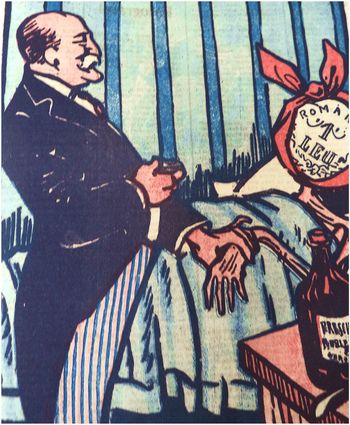
Satirical papers of the Romanian capital were quick to react to the financial upheaval produced by the phasing out of crowns (figure 5). The cover of Veselia showed Ionescu as a medical doctor who administered the “drug” of “ruble and crown conversion” to his emaciated patient, the Romanian leu. Although the skeleton-like patient was just about to die, the doctor seemed optimistic and diagnosed “the pulse seems to be alright.”Footnote 125 The caricature pointed to the hypocrisy of a government that denied its involvement in currency speculation and attempted to assure the general population, the management of the Romanian National Bank that provided credits for the process, as well as stock exchanges that the leu would survive the ruble and crown conversion unscathed.
The impact of the conversion of imperial currencies on the Romanian leu; “Doctor and Patient,” Veselia, Revista Umoristica XXVI/29 (August 24, 1920): 1.

Soon after the conversion was over, by early 1921, the government ran into the same problem as the Paris government in regard to the conversion of Alsace's and Lorraine's paper marks: the amount presented for exchange surpassed all expectations. Finance Minister Constantin Argetoianu estimated that 1.5 billion crowns were in circulation in Transylvania after the armistice.Footnote 126 When the stamping of Austro-Hungarian currency took place in summer 1919, however, populations presented more than 3.5 billion crowns to the ad hoc “stamping committees” that went from city to city in Romania.Footnote 127
“It is not within my powers to estimate how many rubles and crowns circulate in our country,” admitted Ionescu shortly before he announced the final exchange rate. Between the stamping and the final conversion, billions of crowns were smuggled into Romania from neighboring states, while populations that sat out the 1919 stamping also declared the crowns in their possessions. As a result, the Romanian government was in charge of exchanging almost 9 billion crowns (table 2), more than any other successor state of the former monarchy, including Hungary, which came second with 8.5 billion.Footnote 128 The incorporation of Transylvania and Bukovina into Greater Romania thus burdened the cash-strapped Bucharest government with a 4 billion lei ($50 million) debt by the end of the conversion process in 1920.Footnote 129 The 41 million gold crowns that Romania eventually received in the 1920s after the dissolution of the Austro-Hungarian Bank hardly compensated for the expenses of phasing out the bank's bills of exchange.Footnote 130 Nonetheless, the 8.7 billion crowns (table 2), did not indicate the full amount of crowns presented for conversion in Greater Romania. The “commissions for monetary unification” that the Romanian National Bank established at each major town obstructed the process by bureaucratic means, such as by only accepting bills that were in mint condition or by refusing to accept unstamped crowns or 10,000-crown bills.Footnote 131 Irregularities around the implementation of monetary transition suggest that Romanians in rural areas, Hungarian and German minorities, and socially marginal populations without connections to local bureaucracies, powerful banks, and the government lost out in the process.
The Cost of Currency Exchange in Greater Romania

Source: Krițescu, Sistemul bănesc al leului, volume 2, 288.
Although the Romanian government was unable to copy French measures of discrimination against the German minority during currency conversion, it resorted to covert forms of ethnic discrimination. For instance, unlike Czechoslovakia, the Bucharest administration refused to convert the Austro-Hungarian war loans contracted in crowns by mostly Hungarian, Jewish, and German Transylvanians between 1914 and 1918.Footnote 132 The value of war loans amounted to more than 2.2 billion crowns, about the amount of crown in circulation at the time of the armistice in Transylvania.Footnote 133
The botched currency conversion contributed to the rise of regionalism in Transylvania as the government carried it out by disregarding the interests of the region's prewar political elites. The phasing out of the Austro-Hungarian crowns rekindled discussions among Transylvania's Romanian middle classes and elites about the economic “exploitation” of the region by outsiders. The target of these accusations, however, was no longer the Hungarian government or bourgeoisie, as before 1918, but the Bucharest administration that nonetheless portrayed itself as the liberator of Transylvania from the “Hungarian yoke.”Footnote 134
Disillusionment with the successor state led to the revival of interethnic political networks among the region's Hungarian and Romanian middle classes that had been prevalent before 1914 yet were overshadowed by policies of ethnic discrimination by the wartime Hungarian and the postwar Romanian administrations.Footnote 135 One such example of cross-ethnic political cooperation was a joint delegation that members of the region's chambers of commerce, mostly Hungarian Jews and Germans, and representatives of the Romanian Directing Council sent to Bucharest to jointly protest what they perceived as a low conversion rate of the crowns.Footnote 136 The existence of the delegation highlighted what Gábor Egry has described as “the importance of a [shared] pre-1918 middle-class social background, socialization and traditions” among Transylvania's Hungarian and Romanian strongmen, which fueled political mobilization against the Bucharest government.Footnote 137
The consensus emerged among Transylvania's Romanian, German, and Hungarian politicians that the central government intended to use currency conversion to systematically favor prewar Romania's business elites over those in the annexed territories in order to solidify their economic hegemony over a hugely expanded state. “With the exchange of currencies, prewar Romania has gained the upper hand in the financial life of Transylvania and the Banat,”Footnote 138 noted Transylvanian Hungarian politicians Elemér Jakabffy and György Páll in the interwar period. The Romanian Maniu warned in the same vein that “this ever-intensifying operation [of currency conversion] will establish the permanent monetary inferiority of the new provinces within their own state.” A Banat-based economist, the Romanian Traian Nichici, argued that “the new provinces had the impression that they were being exploited (secătuit)” by the unfavorable exchange rate.Footnote 139 The Banat German politician, Gaspar Muth, claimed in the Bucharest chamber of deputies, “We, the populations of Banat and Transylvania, have been rendered underlings of Bucharest's and Galați's financiers. Given the artificial and unfavorable exchange rate of the crown and the leu, millions [of crowns] have left Transylvania for the Old [prewar] Kingdom of Romania.”Footnote 140
Arguably, regionalism captured the imagination of contemporaries because at least at the beginning of the currency exchange process, the army's exchange rate discriminated against Transylvania as a whole, and unlike the French government in Alsace and Lorraine, the Romanian administration did not and was unable to prevent regionalist mobilization by financially favoring ethnic Romanians in newly incorporated territories. Given that inflation and the solidification of borders were in part beyond the control of the Romanian administration, it would, however, be a mistake to attribute excessive powers and agency to the Bucharest government in the manipulation of the crown's gradually depreciating value. The intentionalist interpretation that concentrates on how Bucharest followed through on a plan to systematically discriminate against Transylvania, as contemporary regionalists believed, is far from the full picture. Rather, it is remarkable how the Romanian government was just one, albeit the most important one, among the many actors that tried to influence the process. Due to rapid inflation, extensive currency smuggling, war with Hungary, and speculation, the government lost control over the process by early 1919 and ultimately ran out of options by September 1920; by then, it had to stick to its own temporary exchange rate even though it represented a premium over the market value of the sharply depreciated crown.
Ultimately, all Transylvanians who could afford to wait until the final conversion were among the beneficiaries of the process in 1920 because the government paid a higher rate than the one available earlier on the open market. Greater Romania was thus saddled with deep financial problems and unfulfilled expectations of social mobility for Romanian populations, which contributed to its unstable domestic politics and the rise of anti-Democratic, extreme right movements around A. C. Cuza and Corneliu Zelea Codreanu as early as the 1920s.Footnote 141
Imperial Currencies—Interwar Legacies: Conclusions
Unlike the fate of eastern Europe's ethnic minorities, which became a pan-European concern at the peace conference and precipitated multilateral treaties and supervision by the League of Nations, the conversion of imperial currencies remained the problem of individual states.Footnote 142 This was in part understandable because by the time the League of Nations was established and the Versailles, St. Germain, and Trianon peace treaties came into force, the fate of imperial currencies had largely been decided “on the ground.” Surprisingly, however, the cash-strapped French government left the states of the future “Little Entente” to solve the riddle of imperial currencies on their own despite the ambition of the Paris administration to create an economic empire in east-central Europe; as for Greater Romania, the deployment of French financial expertise thus did not follow the deployment of the Armée d'Orient in 1918.Footnote 143
Despite the numerous repercussions of the process and the economic plight of central and east-central Europe, the “founding fathers of the League of Nations,” initially had no intention to “contribute to economic reconstruction,” as Patricia Clavin has recently stressed. Rather, the mission of the League of Nations as an organization of financial aid emerged as late as the mid-1920s.Footnote 144 Instead of the propagation of a pan-European or global solution to the currency crisis, the League of Nations's Economic and Financial Section conveniently reduced the scope of its action to individual states in central and eastern Europe, reproducing the split between west European great powers and the small states of eastern Europe familiar from the minority rights regime adopted in 1919 at the Versailles peace conference.Footnote 145
By the late 1920s, the financial troubles that the conversion of imperial currencies, inflation, and lack of capital precipitated in east-central Europe necessitated foreign assistance. While in the aftermath of the Great War, France emerged as an unquestioned hegemon in east-central Europe, by the late 1920s, it needed to demonstrate its financial prowess through the extension of loans in light of competition from the League of Nations and the Bank of England; as such, according to Kenneth Mouré, the “stabilization of the Romanian leu turned into a test case for French political influence in the region.”Footnote 146 Ironically, the same French “money doctors,” Charles Rist and Pierre Quesnay, orchestrated the stabilization of the French franc and the Romanian leu.Footnote 147 While France devalued its currency by 80 percent to stabilize it, Romania resorted to French loans.Footnote 148 At the end of the Great War, however, both France and Romania proceeded on their own with currency conversions, which left considerable space for divergence and maneuvering for both administrations and local populations, banks, and business elites.Footnote 149
A further similarity in the fate of imperial currencies after the fall of the German and Austro-Hungarian empires was the inefficiency and collateral damage produced by state apparatuses in their handling of currency conversions not just in eastern but also in western Europe. This is notable given the works of Charles Maier, Richard Kuisel, and Quinn Slobodian have convincingly pointed out how the aftermath of the Great War was a heyday of ambitious economic planners and technocrats such as Louis Loucheur, Étienne Clémentele, Ernest Mercier, and Ludwig van Mises.Footnote 150 The conversion of paper marks in Alsace and Lorraine by the French government was also the first and most overlooked warning following the end of the First World War that the return to the exchange rates of the prewar gold standard era came at a steep price.Footnote 151
What is more, the enormous investments of postwar governments into monetary transition turned out to be an ineffective means for winning over large swaths of populations on newly annexed territories, despite the successful maneuvering of some local actors to exploit the exchange process. Currency conversion policies even alienated people who had otherwise been favorably disposed to their new governments because the measure became tightly bundled together with measures of administrative centralization and discrimination that were highly unpopular.Footnote 152 It showed the extent to which the legitimacy of the Versailles peace settlement as well as the internationalism ushered in by the formation of the League of Nations hinged upon the financial reconstruction of the continent.
Even though the victorious powers regarded the withdrawal of imperial currencies as key to the breakup of defunct empires and the economic unification of successor states, measures of currency conversion ironically reproduced the geographical fragmentation normally associated with empires and amplified the legal, economic, and ethnic differences among the populations in the successor states.Footnote 153 Apart from the financial integration of annexed territories, the introduction of new currencies often brought about new layers of differences among the populations of postwar states, based on ethnicity, as in France, or on geography, as in Greater Romania. The end result of the process was that both France and Greater Romania resembled the ethnic and economic diversity of empires they had successfully defeated.Footnote 154