The number of legal and nonlegal ethical regulations in the biomedical field has increased tremendously, leaving present-day practitioners and researchers in a virtual crossfire of legislations and guidelines. Judging by the production and by the way these regulations are motivated and presented, they are held to be of great importance to ethical practice. This view is shared by many commentators. For instance, Commons and Baldwin write that, within the nursing profession, patient care can be performed unethically or ethically depending on the professional standards the nurses have set for themselves. They also hold that such standards are set when nurses become aware of the ethical codes available. As nurses are often not familiar with the codes, they do not all conform to them. Commons and Baldwin argue that nurses' ability to deal with ethical dilemmas is effectively secured with education on guidelines, creating a “barrier” between personal and professional values (p. 5).1
Commons L, Baldwin S. Ethical policy guidelines development for general hospital nurses. International Journal of Nursing Studies 1997;34:1–8.
This paper questions the premise that laws and ethical guidelines are as useful for ethical decisionmaking as is often assumed. Similar points have been made before in other contexts.2
Davis M. Thinking Like an Engineer. Oxford: Oxford University Press; 1998; Evers K. Standards for ethics and responsibility in science. An analysis and evaluation of their content, background and function. Paris: International Council for Science; 2001; Ladd J. Collective and individual moral responsibility in engineering: some questions. In: Weil V, ed. Beyond Whistleblowing: Defining Engineers' Responsibilities. Proceedings of the Second National Conference on Ethics in Engineering, March 1982. Chicago: Center for the Study of Ethics in the Professions, Illinois Institute of Technology; 1983:102–3; Luegenbiehl H. Code of Ethics and the Moral Education of Engineers. Business and Professional Ethics Journal 1983;2(summer):41–61; Meulenbergs T, Verpeet E, Schotsmans P, Gastmans C. Professional codes in a changing nursing context. Journal of Advanced Nursing 2004;46:331–6; Pattison S. Are nursing codes of ethics ethical? Nursing Ethics 2001;8:5–18; Pritchard J. Codes of ethics. In: Chadwick R, ed. Encyclopedia of Applied Ethics, Vol 1. Orlando, FL: Academic Press; 1998:527–533.
Eriksson S, Helgesson G, Höglund AT. Being, doing, and knowing: Developing ethical competence in health care. Journal of Academic Ethics 2007 (in press); advance online publication, 5 Feb 2007; URL: http://dx.doi.org/10.1007/s10805-007-9029-5.
Informed consent is a central and much discussed theme in bioethics, and it is also an important and well-established topic in most ethical guidelines. If ethical regulations are action guiding at all, they can be expected to be so regarding informed consent. The purpose of this paper is to analyze a variety of ethical guidelines with respect to their treatment of informed consent to see whether and, if so, to what extent they face the three problems listed, and in the light of these results discuss their proper role. We will argue that the content of ethical guidelines is too meager to be action guiding, that the multitude of guidelines and regulations adds to the interpretational problems, and that an increase in legal regulations results in an unfortunate change in the perception of ethics.
It is assumed throughout this paper that legal regulations and ethical guidelines are intended to guide and steer scientific or professional behavior. Against this it is sometimes claimed that guidelines do not actually set that task for themselves; rather they just serve as reminders, or convenient checklists, of what an ethical person should do. Two things can be said about this. First, if guidelines are intended to serve as reminders of ethical principles or a correct professional attitude, what is the point unless this in turn is meant to guide action? Even though a number of uses of ethical guidelines can be imagined apart from guiding action,4
Petersson B. Forskning och etiska koder: en introduktion till forskningsetik. Nora: Nya Doxa; 1994.
The Three Problems
Three problems with various regulations will be examined here: the interpretation problem, the multiplicity problem, and the legalization problem. The interpretation problem has at least three aspects: (1) There will always be a gap between the rules and the practice they are meant to regulate. An agent must always interpret the rules in order to assess their applicability in a particular situation.5
Lovibond S. Wittgensteinian Ethics [Online]. In: Craig E, ed. Routledge Encyclopedia of Philosophy. London: Routledge; 1998. Available from: URL: http://www.rep.routledge.com/article/L114SECT3.
The multiplicity problem has to do with the great number of ethical codes, guidelines, and values professionals in healthcare and medical research encounter. Apart from personal moral ideals, various oaths and proclamations, and the ethics propelled by the profession, there is a multiplicity of guidelines of both ethical and legal nature pulling in different directions. Also here at least three different aspects can be noted: (1) To whom are they directed and how does that affect how the individual is to relate to them? (2) What is the status of the guidelines? How do they relate to each other, and do some have priority over others? (3) Most importantly, different guidelines may give different recommendations regarding how to handle a situation. One way for this to happen is that an individual gets different and incompatible recommendations from different guidelines. Another way for this to happen is that different professions get different recommendations because different guidelines apply to them, recommendations that turn out to be incompatible in a situation where they have a common problem to solve. What to do then?
The legalization problem has to do with the fact that ethical concern takes a legal form. In recent years, in addition to a continued production of ethical guidelines, a common response to ethical challenges in research and healthcare has been to develop new legislation. Yet the role of legislation is rarely discussed. However, this development has consequences for (1) how ethical problems are conceived, (2) by which procedures they are handled, and (3) people's perception of the role regulation can play in ethical decisionmaking.
First, there is a risk that ethical problems tend to be understood as legal problems; “What should be done?” is then interpreted as “What is legally required/permissible?” Second, because researchers and laymen are often not competent to interpret legal regulations, there is a risk that a procedure of legal interpretation, performed by experts, replaces ethical reflection. Last, this legalistic development might lead to a different understanding of existing guidelines. Their character of rules comes to the forefront, and the formulated rule tends to be understood as the final word on what to do. This might lead people to think that the rules promoted in ethical guidelines will “do the job” for them; thus, a replacement of responsibility occurs. In single-mindedly stressing the regulatory framework, there is a risk that we forget that it is the researcher or doctor/nurse who has the final moral responsibility.
Method
We have analyzed a number of ethical guidelines, guided by a protocol in the form of a checklist of questions (see Table 1) constructed with the purpose of making concrete and specifying the aspects covered by the interpretation problem, the multiplicity problem, and the legalization problem. The content analysis of the guidelines has been carried out in the tradition of modern analytic philosophy,6
Kagan S. Normative Ethics. Boulder, Col.: Westview Press; 1998.
Callow K. Man and Message. A Guide to Meaning-Based Text Analysis. Lanham, Md.: Summer Institute of Linguistics and University Press of America; 1998.
Walton D. Fundamentals of Critical Argumentation. Cambridge, U.K.: Cambridge University Press; 2006.
Checklist of Questions Raised in the Analysis of the Guidelines

We have also performed a situational analysis of the various guidelines, that is, studied what situations, norms, and instruments each guideline describes or implicitly starts out from.9
Huckin T. Context-sensitive text analysis. In: Kirsch G, Sullivan P, eds. Methods and Methodology in Composition Research. Carbondale: Southern Illinois University Press; 1992:84–104.
Eight different ethics regulations were selected. Some of the most influential and widespread guidelines have been included. The main focus is on guidelines that seem typical of their kind, and a variety of kinds of ethical regulations are included: professional ethical guidelines, guidelines backed up by large international organizations, a legal regulation, and a document backed up by a religious organization—all of which arguably have a nonnegligible authority and support. For convenience, we refer to all these as ethical guidelines.
We have chosen to study the following documents: The Swedish Act concerning the Ethical Review of Research Involving Humans,10
Act (SFS 2003:460) on Ethics Review of Research Involving Humans. Stockholm: Ministry of Education; 2003.
Council of Europe. Convention for the Protection of Human Rights and Dignity of the Human Being with Regard to the Application of Biology and Medicine: Convention on Human Rights and Biomedicine, CETS No. 164. Oviedo: Council of Europe; 1997.
World Medical Association. Declaration of Helsinki. Ethical Principles for Medical Research Involving Human Subjects, adopted by the 18th WMA General Assembly, Helsinki, Finland, June 1964, latest revision by the WMA General Assembly, Tokyo 2004. Ferney-Voltaire, France: World Medical Association.
UNESCO. Universal Declaration on the Human Genome and Human Rights, adopted unanimously and by acclamation at UNESCO's 29th General Conference on 11 November 1997. Paris: UNESCO.
UNESCO. Universal Declaration on Bioethics and Human Rights, adopted by acclamation on 19 October 2005 by the 33rd session of the General Conference of UNESCO, Paris, 2005. Paris: UNESCO.
The Swedish Medical Association. Läkarförbundets etiska regler [Ethical Guidelines of the Swedish Medical Association]. Stockholm: The Swedish Medical Association; 2002.
International Council of Nurses. The ICN Code of Ethics for Nurses. Geneva: International Council of Nurses; 2006.
European Society of Human Genetics. Data storage and DNA banking for biomedical research: Technical, social and ethical issues. European Journal of Human Genetics 2003;11(Suppl. 2):S8–10.
Pontifical Academy for Life. Proposal of an Ethical Commitment for Researchers in the Biomedical Field. The Vatican: Pontifical Academy for Life; 2003.
Results: The Interpretation Problem
No Specific Instructions
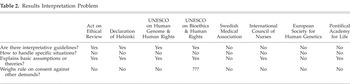
As shown in Table 2, none of the investigated guidelines says anything specific about how to handle particular situations where some kind of ethical dilemma or decisional problem arises. This is not to say that they do not particularly address certain kinds of research specifically. Several guidelines do specify how to handle informed consent in research involving incompetent persons or minors. However, even here the instructions are general and never get into detail or specify actions for specific situations. We can also see that the investigated guidelines do not give any advice regarding how to weigh rules of consent against other ethical interests. In other words, their advice is on a very general level and never down to earth in the sense that they specify a recommended action in a particular case.
Results Interpretation Problem

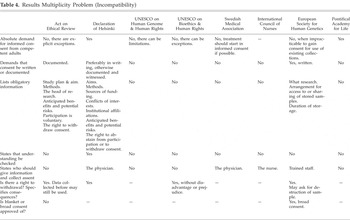
It is noteworthy that “Data Storage and DNA Banking for Biomedical Research,” the one guideline that is written in response to a particular set of problems (specific to biobank research), exhibits a set of deviations from the other guidelines investigated. For example, it allows for broad consent and demands written consent (see Table 4, below). This suggests that attention to specific contextual considerations leads to the creation of rules that diverge from more general guidelines. When a guideline tries to evade the interpretation problem by giving more specific and contextually sensitive guidance, its compatibility with other guidelines diminishes. Thus it seems that if one tries to evade the interpretational problem, the multiplicity problem is accentuated instead.
Four out of the eight investigated ethical regulations provide some additional form of explanation as to how they are to be interpreted. In the case of the Swedish Act on Ethical Review there is preparatory work where the argumentation in support of the legislation is spelled out in some detail. There is in addition an ordinance and also directives/general counsel from the Swedish Research Council. The Declaration of Helsinki is complemented with an ethics manual issued to reinforce and strengthen the ethical mindset and practice of physicians and provide tools to find solutions to ethical dilemmas.19
Williams JR. Medical Ethics Manual. Ferney-Voltaire, France: World Medical Association; 2005.
UNESCO. Explanatory Memorandum on the Elaboration of the Preliminary Draft Declaration on Universal Norms on Bioethics (21 February 2005) [Online]. Available from: URL: http://portal.unesco.org/shs/en/ev.php-URL_ID=1883&URL_DO=DO_TOPIC&URL_SECTION=201.html.
This Declaration is to be understood as a whole and the principles are to be understood as complementary and interrelated. Each principle is to be considered in the context of the other principles, as appropriate and relevant in the circumstances. (Article 26)
Nothing in this Declaration may be interpreted as implying for any State, group or person any claim to engage in any activity or to perform any act contrary to human rights, fundamental freedoms and human dignity. (Article 28)
For the Universal Declaration on the Human Genome and Human Rights a resolution provides an interpretational background.21
UNESCO. Implementation of the Universal Declaration on the Human Genome and Human Rights. Resolution Adopted on the Report of Commission III at the 25th Plenary Meeting, on 16 November 1999 [Online]. Available from: URL: http://portal.unesco.org/shs/en/ev.php-URL_ID=2409&URL_DO=DO_TOPIC&URL_SECTION=201.html.
However, even regarding those four ethical regulations, the guidance does not give help concerning how to act in specific situations, nor does it say much about the ethical interpretation of the guidelines. The WMA ethics manual, for example, cannot (and was never issued to) be used as a reference guide to the declaration, and furthermore the general guidance it gives on how the WMA thinks about ethics was soon contested and debated in the bioethics community.22
Nortvedt P. Medical ethics manual: Does it serve its purpose? Journal of Medical Ethics 2006;32:159–60; Holm S. The WMA on medical ethics—Some critical comments. Journal of Medical Ethics 2006;32:161–2; Tsai DFC. The WMA Medical Ethics Manual. Journal of Medical Ethics 2006;32:163.
Basic Assumptions and Theories
All investigated guidelines except the ESHG guidelines and the professional guideline issued by the Swedish Medical Association do address the issue of underlying ethical assumptions and theories. However, this is done in a way that is not particularly clarifying. First, the comments relating to underlying ethical assumptions are brief and open to different interpretations. Second, several values and interests are included but little is said about how to balance them when they conflict. Let us give an example of each.
In the Pontifical Academy for Life's Proposal of an Ethical Commitment for Researchers in the Biomedical Field, a Kantian approach is taken: “I will treat each person who submits to an experiment as a free and responsible subject and never as a mere means to achieve other ends.” It is explicitly taken to imply that one should never involve people in scientific experiments unless a free and informed consent has been obtained. However, the Pontifical Academy also defends an idea of a true common good that transcends private interests and national boundaries. What this is remains unspecified. Nor is it explained why a person can never both be treated as an end and be included in research without a previous consent. Arguably such an inclusion can take place in the interest of the true common good and in the interest of the person herself.
The ICN Code of Ethics for Nurses states in the preamble that “respect for human rights, including the right to life, to dignity and to be treated with respect” are inherent in nursing. Included is also the right to “make informed decisions about how to manage [one's] own health.” The code also states that “Nurses have four fundamental responsibilities: to promote health, to prevent illness, to restore health, and to alleviate suffering.” All these claims stand by themselves, without any additional clarifications. And they are open for potential conflicts, for instance, between efforts to restore health and to alleviate suffering. Similarly respect for the individual's informed decision might go against the responsibility to promote and restore health. The other guidelines exhibit a similar variety of values, norms, and principles. For example, the Universal Declaration on Bioethics and Human Rights evokes, in the words of Häyry and Takala, a “staggering number of values.”23
Häyry M, Takala T. Human dignity, bioethics, and human rights. Developing World Bioethics 2005;5:225–33.
Incompatibility within Guidelines
There is also a problem regarding interpretation when different demands set in one document need to be reconciled with one another in an interpretative process. A few examples will suffice to illustrate the general problem.
Although the guideline of the Swedish Medical Association clearly states that the health interest of the patient is the primary goal for physicians, the fourth point of the guideline establishes that a physician is not allowed to use his or her authority to interfere with a patient's right to self-governance. What to do in cases where patients decide for a line of action that compromises their health is not stated (except that it is not allowed to hasten a patient's death). Potential value conflicts are easily found also in the other examined guidelines.
Informed consent is a very important issue in all the guidelines, but what if the consent comes with conditional demands? For example, if a person leaves a biological sample to a biobank for research on the condition that it is only used in research that promotes national goals and ends, then it is unclear how one should reconcile respect for that person's autonomy with paragraphs in the guidelines talking of the importance of dissemination of research results to all countries and of equitable access to medical and scientific developments.
The Multiplicity Problem
Instructions for Whom?
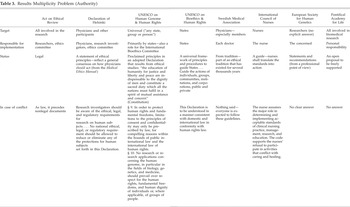
Table 3 shows some differences between the guidelines regarding the multiplicity problem. One aspect of concern is that the guidelines address different people. Not every guideline purports to speak to everyone involved. What speaks with authority to one person involved will perhaps not do so for another. The Declaration of Helsinki and the guidelines from the Swedish Medical Association are guidelines constructed from the perspective of medical doctors, based on the tradition from Hippocrates. It is not obvious how other professions are to understand the rules contained in these documents. For instance, nurses have their own guidelines stating what is special to the professional role of nurses. That different guidelines give different instructions to different groups of people might lead to conflicts when these groups do things together—then the guidelines might recommend different courses of action.
Results Multiplicity Problem (Authority)

Relative Status
Another aspect of the multiplicity problem concerns the uncertainty about the relative status of the guidelines discussed. It is not always clear what status various guidelines have. Sometimes this is an inherent property of the guideline, that is, it does not in itself give clear guidance as to what status it has. For example, the Declaration of Helsinki, on the one hand, says that it is a statement of ethical principles that reflects a general consensus on how physicians should act, but on the other hand, it consists of protections so important that national law has to stand back in case of conflict. Sometimes it is the relation to other guidelines that is unclear or they may contain contradictory statements. Most of the guidelines examined in the study do not say very much about their relationship to various other guidelines. The UNESCO Declaration on the Human Genome and Human Rights, on the one hand, consists of proclaimed ethical principles, but on the other hand, limitations to the principles of consent and confidentiality may, according to the declaration, only be prescribed by law for compelling reasons. What are we to make of this? The Declaration of Helsinki claims to have priority over national legislation. This is of course not accepted in Swedish law. Thus, there is clear disagreement on the relative status of the two.
Incompatibility between Guidelines
A major part of the multiplicity problem is that different ethical guidelines often express different ideals and values, and they can indeed be in conflict in certain situations. When they are, the problem arises of which one to follow.
How do the guidelines stand scrutiny when it comes to informed consent? Clearly they do not speak in a uniform voice (for an overview, see Table 4). For example, they do not agree on whether there is an absolute demand for informed consent from competent adults, on the extent of information one should give, on whether understanding must be checked, and as noted above, on whether broad consent is acceptable.
Results Multiplicity Problem (Incompatibility)

Thus there is a possibility of disagreement. It is, for example, part of nurses' professional role, according to their code, to treat patients according to values that are intrinsically connected to nursing: “Inherent in nursing is respect for human rights, including the right to life, to dignity and to be treated with respect” is one characteristic phrase in the document. Whether such respect entails that informed consent should always be part of a research project involving capable patients is not explicitly stated, but is perhaps implied in the statement that the nurse “ensures that the individual receives sufficient information to permit informed consent.” The nurses' code does support the nurses' refusal to participate in activities that conflict with such caring and healing that lie at the heart of nursing. In the tradition based on the Declaration of Helsinki it is not uncommon to accept assumed consent, or antecedent consent, in studies that are not possible to perform otherwise. So, what should a nurse do if patients involved in a study are not properly informed and if she feels that her professional code obliges her to inform the patients? Should she refuse to participate? If she is a Catholic and adheres to the Pontifical Academy's Ethical Commitment she is bound by the code that “I will never let a person be involved in an experiment unless he/she has given his/her free and informed consent.” The dilemma is of course emphasized by nurses being subordinate to physicians.
To successfully handle conflicts between different ethical guidelines, the principles or rules need to be ordered in some hierarchy or applied according to some more fundamental ethical principle, but nothing like that is found in the investigated guidelines.
The Legalization Problem
The legalization problem appears in a number of different forms in the material (exemplified below): (1) legal statements of how things are to be done, without arguments or explanations as to why these restrictions are set up or these priorities are made, (2) examples of guidelines whose main objective seems to be to state ethical principles hoped to be included in national and international legislation, and (3) guidelines whose authors have felt it necessary to underline that ethical requirements can be more important than legal claims.
In the Swedish Act on Ethical Review—the only legal document included in our study—it is, for instance, stated, without any rationale why, that the research group must inform a research subject about the identity of the head of research. However, the research group does not need to inform about potential conflicts of interests, which arguably is a more important requirement in most respects. Another example of something that is stated in this Act without any rationale is that a research subject may withdraw consent whenever he/she likes but that data collected before the withdrawal may be further used. A last example is that the Act specifies the age when a minor might be of sufficient maturity to have his say about research participation to 15 years of age. This does seem arbitrary from an ethical point of view. Why should not someone at age 14 and of the same maturity as the 15-year-old have the same opportunity to have a say? In conclusion, it is possible that researchers judge it more important to follow the principles stated in the law than to adhere to an ethical principle that is not backed up by law. Crucially, the ethical principle may nevertheless be of greater ethical importance.
A second manifestation of the legalization problem is seen in the UNESCO declarations, where it is explicitly stated that UNESCO wants the declarations to be implemented in member states by legal enactment. So, although UNESCO says that a declaration is a “universal framework of principles and procedures to guide States,” these principles are not primarily issued as ethical principles to be used as such. Rather they are understood by the UNESCO as the starting point for a legal regulation of research. The potential problems with this were pointed out above.
Third, in several guidelines there are ethical demands that the authoring parts deem more important than law. The UNESCO, the Pontifical Academy, and the World Medical Association each state or imply that their respective documents include principles or guidelines of greater importance than mere adherence to law. For UNESCO, implementing principles of human rights is a “sacred duty,” and genetic research should never prevail over respect for human rights, fundamental freedoms, and human dignity. For the Pontifical Academy, there are spiritual realities that make demands on each and every person involved in research, and an individual's commitment to such dimensions of human existence transcends mere law. For the World Medical Association, and probably for the Swedish Medical Association as well, there exist ethical demands of a professional nature that may be considered more fundamental than the law. Thus the Declaration of Helsinki states that no national law should be allowed to reduce or eliminate any of the protections for human subjects set forth in the Declaration.
Discussion: Lessons to Learn
Our results clearly show that a person in need of guidance from ethical guidelines is in for a hard time. Interpretation problems regarding individual guidelines are easily encountered but not always easily resolved. An ethical baseline, in the light of which to evaluate the situation, is much needed in difficult situations in order to reach a conclusion. Ethical guidelines are far too meager to supply this. As recent bioethics debate has reminded us, the supreme standards and values mentioned are often too general and not sufficiently distinct to be of much help.24
Macklin R. Dignity is a useless concept. British Medical Journal 2003;327:1419–20; Ashcroft RE. Making sense of dignity. Journal of Medical Ethics 2005;31:679–82; Häyry M. Another look at dignity. Cambridge Quarterly of Healthcare Ethics 2004;13:7–14;
This raises a number of questions: Should the production and/or use of ethical guidelines be abandoned? Is it reasonable to increasingly regulate ethics legally, as is done today? What is the most reliable way out of the interpretational mess?
Clearly legislation cannot, by itself, solve the ethical problems in relation to healthcare and biomedical research. If we replaced all ethical documents with legal counterparts, we would transform ethics into legal interpretation, thereby depriving the professionals of any reasonable chance to assume responsibility for their actions, which would turn both healthcare and biomedical research into bureaucratic nightmares. The question is if legislation has a role to play. We believe that it does, namely, to lay down those general rules that are to be followed without exception; that is, for instance, to state what clearly should be forbidden. Another possibility is to center on procedural justice in legalization, thus putting focus on the fairness and transparency of the procedure rather than on detailed regulations. However, if legislation is too detailed and definite in ethical matters, then problems arise because legal regulations do not have the context sensitivity that ethical decisionmaking requires. Then it will add to the problem rather than contribute to the solution.
Is the production of new ethical guidelines meaningful? Should new forms be developed or should the entire project be abandoned? And how should one relate to existing guidelines? A serious flaw of the present approach is that most new guidelines are produced with the pretension that there are no other guidelines around. If these guidelines really are concerned with guiding behavior and not simply with making some kind of political statement or competing for ethical authority, it would be a much better policy to explicitly address the pluralism and to tell what the new guidelines are meant to add to previous ones and to what extent they simply agree with their predecessors.
It might also be argued that there is something seriously wrong about the present form because ethical guidelines give so little guidance regarding how they are to be understood. Sometimes such vagueness is seen as a plus because that is what makes them possible to apply to a certain case. But how can ethical rules claim superiority over individual ideals and legal rules if they are intrinsically vague? To accept such vagueness is to accept that ethical codes at most serve as inspiration to ethical decisionmaking. Could ethical documents then be supplemented by interpretative guidelines? Interpretative rules risk being of little help because they will only be the first stepping stone to an infinite regress unless the reader along the way is given the tools to ground the rules in basic ethical theories or ideas understood in the light of ethical practice. Ethical decisionmaking is context dependent. Regardless of one's universalistic or particularistic inclinations, the relevant information can vary very much from case to case. Seemingly similar cases may nevertheless require different treatment because of the relevant differences. This means that ethics generally speaking is very difficult to regulate. A reasonably short and manual-like guideline (or law) can never contain such a degree of complexity and sensitiveness to detail. There is not enough space. Therefore ethical guidelines in whatever form can not be expected to explicitly guide behavior. Thus, there is little point in developing new ones with that purpose. At most they can function as a starting point for debate, a place where ethical thinking can get a fresh start in a new and unexplored area rather than a place where ethical thinking ends.
There simply are no quick fixes in the world of ethical decisionmaking.25
Eriksson S, Helgesson G, Segerdahl P. Provide expertise or facilitate ethical reflection? A comment on the debate between Cowley and Crostwaite. Medicine, Healthcare & Philosophy 2006;9:389–92.
Conclusions
The eight ethical guidelines examined in this paper are written with the explicit purpose to guide behavior. Data on their treatment of informed consent clearly shows that users looking for ethical guidance run into three serious problems: the interpretation problem, the multiplicity problem, and the legalization problem. This shows that regulations do not, by themselves, suffice in facilitating ethical behavior. We conclude that a new approach to ethical guidelines is needed.