Introduction
A high prevalence of overweight has been observed in the adult population in Brazil. Data published by Research VIGITEL (Surveillance System for Risk and Protective Factors for Chronic Diseases by Telephone Survey) (Ministério da Saúde, Reference Canella, Duran and Claro2019) showed a 55.7% prevalence of overweight in the general population in 2018 – slightly higher than the data from 10 years before, when the prevalence was 48% (Ministério da Saúde, Reference Ministério2010).
It is well known that overweight and obesity are risk factors for several chronic non-communicable diseases (Duncan et al., Reference Duncan, Chor, Aquino, Bensenor, Mill and Schmidt2012). However, classic risk factors, based on biological and behavioural approaches, have not been sufficient to explain the increasing prevalence rate. Hence, studies have aimed to identify environmental factors that may exert an influence on overweight outcomes in a population, mainly in high-income countries (Mejia et al., Reference Mejia, Lightstone, Basurto-Davila, Morales and Sturm2015; Kwarteng et al., Reference Kwarteng, Schulz and Mentz2016; Halpern et al., Reference Halpern, Arena and Royce2017). These studies investigated characteristics of the environment around participants’ homes: that is, in their neighbourhood. According to Boclin et al. (Reference Boclin, Faerstein and Leon2014), ‘neighbourhood’ can be defined as a ‘demarcated geographical space in which residents share daily life conditions’. Characteristics like social connections among neighbours (social cohesion) and local security and violence levels are constituents of a neighbourhood and, as such, are the main focus of the present study (Diez-Roux & Mair, Reference Diez-Roux and Mair2010).
Social cohesion is defined as the network of relationships, values and norms shared by residents of the same neighbourhood (Brisson, Reference Brisson2014). It is considered a protective factor against obesity, as studies have shown an association between greater social cohesion and lower obesity rates (Carter & Dubois, Reference Carter and Dubois2010; Suglia et al., Reference Suglia, Shelton, Hsiao, Wang, Rundle and Link2016). The hypotheses raised so far are that neighbourhood social relations favour practices involving physical activity, encourage a healthier diet and mitigate the development of depression and anxiety – the former as a protective factor, and the latter as a risk factor for obesity (Echeverria et al., Reference Echeverria, Diez-Roux, Shea, Borrell and Jackson2008; Cradock et al., Reference Cradock, Kawachi, Colditz, Gortmaker and Buka2009).
On the other hand, exposure to violence and feelings of insecurity are associated with a higher prevalence of overweight and obesity (Mendes et al., Reference Mendes, Nogueira, Padez, Ferrao and Velasquez-Melendez2013; Tung et al., Reference Tung, Wroblewski, Boyd, Makelarski, Peek and Lindau2018). Exposure to violent acts is a psychosocial stressor, which triggers feelings of fear and insecurity. This has been associated with a series of behavioural changes that lead individuals to adopt risk behaviours for chronic diseases and obesity, such as smoking, consumption of alcohol and other drugs, physical inactivity and poor eating habits (Wright, Reference Wright2006; Astell-Burt et al., Reference Astell-Burt, Feng, Kolt and Jalaludin2015).
Certain socio-demographic characteristics are well-known determinants of obesity (Canella et al., Reference Canella, Duran and Claro2019), and these could influence perception of social cohesion, security and violence. A recent study found that women who lived in neighbourhoods with low social cohesion and who had a high perception of violence were more likely to develop obesity than men (Chaparro et al., Reference Chaparro, Pina and de Oliveira Cardoso2019). Age is also an important factor since older populations who perceive more social cohesion (Uchida et al., Reference Uchida, Swatt, Solomon and Varano2013) have greater odds of having obesity than their younger counterparts (Halpern et al., Reference Halpern, Arena and Royce2017). When it comes to socioeconomic status and skin colour, low-income and black individuals suffer most from exposure to violence and discrimination (Waiselfisz, Reference Waiselfisz2014). Both factors have been associated with a greater chance of increased central adiposity and obesity (Kwarteng et al., Reference Kwarteng, Schulz and Mentz2016).
Studies on this theme are still scarce in low- and middle-income countries such as Brazil. The influence of social environment perception on health outcomes could show different outcomes in low- and middle-income countries than in high-income countries since these have more significant social and health inequalities (Niessen et al., Reference Niessen, Mohan, Akuoku, Mirelman, Ahmed and Koehlmoos2018), and different patterns of association between socio-demographic characteristics and nutritional status (Pampel et al., Reference Pampel, Denney and Krueger2012). Therefore, the aim of this study was to assess the association between social environment perception (social cohesion, security and violence) and overweight in adults of the city of Porto Alegre, Brazil. The associations between socio-demographic characteristics and social environment perception were also explored.
Methods
Study sample
It cross-sectional population-based study was carried out in the territory covered by a basic health unit (UBS) in the central area of the city of Porto Alegre in the state of Rio Grande do Sul, Brazil. The population assigned to the studied UBS encompass approximately 12,000 families (IBGE, 2011). About 250 of these families lived in four areas that were lower income (average per capita income of US$340). In contrast, the rest of the families live in areas of higher income (average per capita income of US$800) (PNUD, 2010). This work is a product of the research project ‘Social and environmental determinants of food and nutrition: an ecosocial approach’.
The following parameters were adopted for sample size calculation: 95% confidence level, 80% statistical power, 1.35 relative risk; unexposed ratio: exposed 1:2, overweight prevalence among the unexposed 43% and exposed 58%, based on Mendes et al. (Reference Mendes, Nogueira, Padez, Ferrao and Velasquez-Melendez2013). For exposure, individuals with lower income were considered to be exposed to overweight, and individuals with higher income were classified as unexposed. A sample of 419 individuals was estimated. The software Epi Info version 7 (Centers for Disease Control and Prevention, Atlanta, USA) was used to calculate the sample size. The final sample was composed of 400 individuals, with 201 from lower-income areas and 199 from higher-income areas.
The sample was divided into two parts to guarantee the different socioeconomic and environmental strata intended in the study. In the low-income areas, with 250 families, all eligible participants who agreed to participate in the study were included. In areas of higher income, the same number of individuals was included to maintain sample proportionality. Individuals aged between 20 and 70 years of both sexes were eligible for inclusion in the study. Those who had any physical or mental limitations that prevented data acquisition and pregnant women were not included. Only one individual per household was included; when more than one person in the household met the inclusion criteria, one was selected randomly. An effort was made to alternate the sex of the participants for each household included, i.e. whenever a woman was included, an attempt was made to include a man in the next household, and vice versa.
Data collection
Data collection was carried out between October 2018 and June 2019 by a trained team composed of nutritionists and nutrition students. The interviews were conducted at the participant’s home or at the UBS when the participant requested this.
The study outcome was overweight, defined as having a body mass index (BMI) of ≥25 kg/m², calculated by dividing body weight (kg) by height (m) squared, and classified using cut-off points defined by WHO (1998), indicating the nutritional status of individuals. Two measurements of weight (kg) and height (m) were made and the mean used to calculate an individual’s BMI.
A calibrated electronic balance (Marte®, model PP 200) was used to weigh participants, without shoes and with as few accessories and clothes as possible. Participants stood upright in the centre of the balance, distributing their weight equally between both feet (WHO, 1995). A portable stadiometer (Secca®, model 213) was used measure participants’ height. Measurements were made without shoes and accessories on the head, with the individual positioned so that their calf, buttocks, shoulders and head touched the vertical surface of the instrument wherever possible. Facing forward, as in the Frankfurt Plan, the support was positioned over the head so that it only pressed the hair. The measurement was recorded immediately (WHO, 1995).
Exposure variables
The exposure variables were self-reported measures of participants’ neighbourhood social environment, including perceptions of social cohesion, security and violence. A validated instrument was applied that included these three characteristics (Mujahid et al., Reference Mujahid, Diez-Roux, Morenoff and Raghunathan2007), cross-culturally adapted to the Brazilian population (Santos et al., Reference Santos, Griep, Cardoso, Alves, Fonseca, Giattii and Chor2013).
Individuals were asked to consider their neighbourhood as the environment around their homes where they shared everyday life conditions with other residents. Their social cohesion perception was based on their responses to five statements about their neighbourhood: (1) this is a close-knit neighbourhood; (2) people around here are willing to help their neighbours; (3) people in this neighbourhood do not get along with each other; (4) people in this neighbourhood do not share the same values; and (5) people in this neighbourhood can be trusted. Participants were asked their agreement level for these items using a 5-point Likert scale ranging from 1=completely agree to 5=completely disagree. Thus, the total score ranged from 5 to 25. The response code was inverted so that higher scores always indicated a higher perception of social cohesion.
Neighbourhood security perception was based on three items: (1) I feel safe walking in my neighbourhood, day or night; (2) violence is a problem in my neighbourhood; and (3) my neighbourhood is safe from crime. The participants reported their agreement level with these items following the same 5-point Likert scale as above. The total score ranged from 3 to 15. The response codes for items 1 and 3 were reversed so that a higher score indicated a higher perception of security.
Perceived neighbourhood violence was assessed based on five items, referring to the previous 6 months: (1) How often was there a fight in this neighbourhood in which a weapon was used? (2) How often was there a violent discussion between neighbours? (3) How often was there a gang fight? (4) How often was there a sexual assault or rape? and (5) How often was there a robbery or mugging? Response options ranged from 1=frequently to 4=never. The total score ranged from 5 to 20. A higher score representing lower perceived violence.
On all scales, a higher score meant something positive: higher social cohesion, higher perceived safety and lower perceived violence. Total scores for each scale were created then converted into tertiles, which were dichotomized into a higher tertile (tertile 3 – a group with a more positive perception) and lower tertiles (tertiles 1 and 2 – groups with a less positive perception). This method followed Secretti’s et al. study (Reference Secretti, Nunes, Schmidt, Stein and Santos2019).
Covariates
Demographic and socioeconomic covariates were also included in the analysis. These included participant’s sex (self-reported female/male), age (reported in complete years), skin colour/race (self-reported according to the categories proposed by the Brazilian Institute of Geography and Statistic (IBGE): white/black/brown/yellow/indigenous and Asian), education (incomplete elementary school/complete elementary school/complete high school/complete higher [university] education), relationship status (collected as married, domestic partnership, single, divorced or widowed, and classified as ‘having a partner’ [married or domestic partnership] or ‘not having a partner’ [single, divorced or widowed], religion (no religion/Christian/African origin), monthly family income (minimum wage [MW]: <MW/1–2 times the MW/2–3 times the MW/3–4 times the MW/4–5 times the MW/>5 times the MW), social benefits (non-recipient/Cash Transfer Programme [CTP]/retirement pension, pension or social assistance benefit [SAB]/other) and ‘neighbourhood time’, i.e. participant’s time of residence in their house/neighbourhood (in years). The amount received for social benefits was included in the estimated monthly family income.
The study utilized the variable ‘skin colour/race’ according to the Brazilian Demographic Census, as promoted by the Brazilian Institute of Geography and Statistics (IBGE, 2011). Since 1991, the colour/race question in the official census has been: ‘What is your colour or race?’ Respondents can answer with just one of the following five options: white [branco], brown [pardo], black [preto], yellow [amarelo] or indigenous [indígena]. It is worth noting that, in contrast to the US and other countries, Brazilian censuses (and the dynamics of racial prejudice and discrimination) rely heavily in colour/race as physical appearance, not racial origins or ancestry. Thus, social inequalities are much more linked to the colour phenotype than ancestry, especially of the black population, impacting health outcomes (Barata, Reference Barata2009; Secretaria de Políticas de Ações Afirmativas, 2011).
Analyses
Analyses were performed in Stata 12.0 (Stata Corp., College Station, USA) software. Sample characteristics were described in absolute and relative frequencies; differences between socio-demographic characteristics according to living area were evaluated using Pearson’s chi-squared test or Fisher’s test. The association between socio-demographic variables, social environment (social cohesion, security and violence) and overweight was explored using Pearson’s chi-squared test. Poisson regression was used to estimate unadjusted and adjusted prevalence ratios (PR) and 95% confidence intervals (95% CI). Multivariable analyses of the association between social cohesion, security and violence with overweight were controlled for demographic and socioeconomic variables that presented a significance level of up to 20% in the unadjusted analysis. All covariates were included in a single block and p-values equal or less than 0.05 were considered significant.
Results
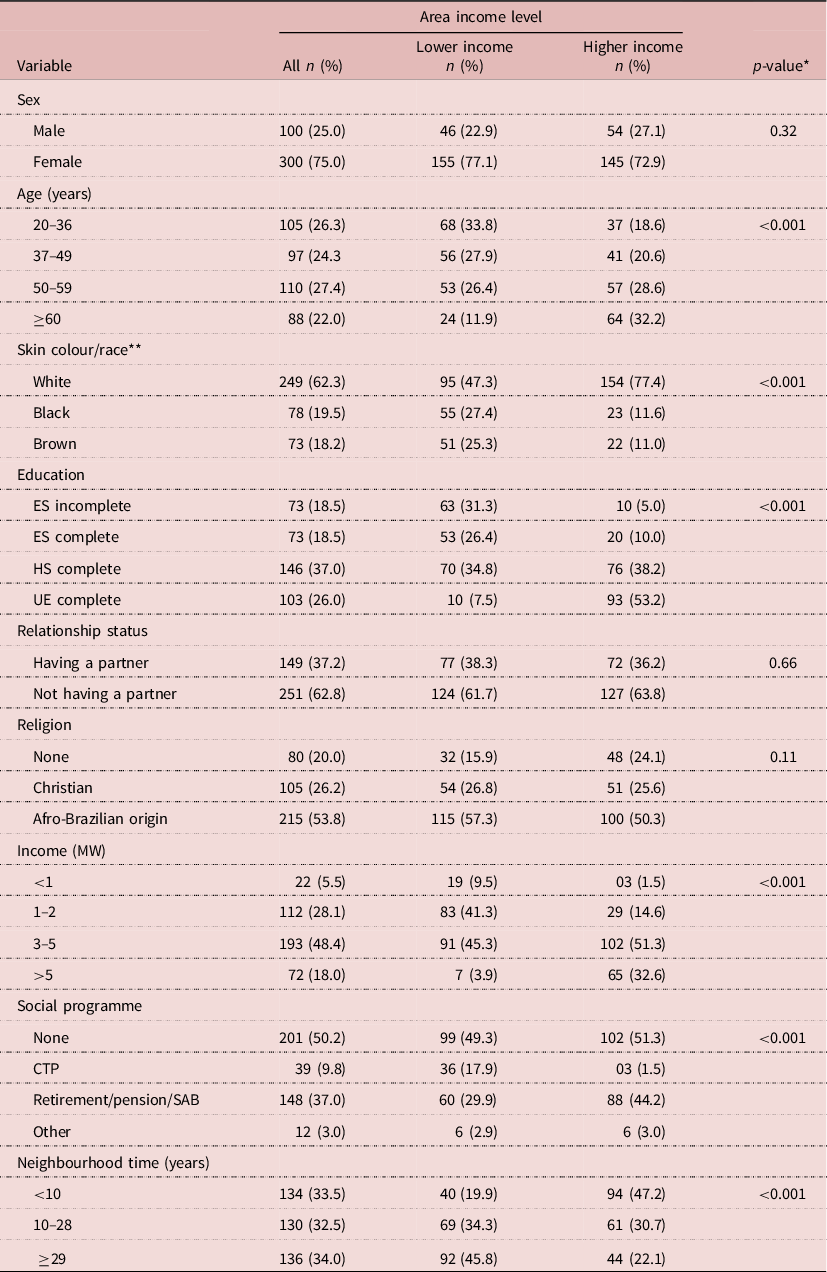
Of the total 400 participants, 201 were surveyed in lower-income areas and 199 in higher-income areas. Participants were predominantly female (75%), with an average age of 47 years (SD=13.98). Most had white skin colour (62.3%), had completed high school (37%), lived without a partner (62.8%) and had an Afro-Brazilian religion (53.8%). The most frequent family income was 3–5 times the minimum wage (48.4%) and half received some type of social benefit (49.7%). The majority (66.5%) had lived in their neighbourhood for more than 10 years. When compared with higher-income areas, lower income areas have younger residents, with brown and black skin colour, less education, lower family income, more beneficiaries from social programmes and more ‘neighbourhood time’ (see Table 1). Regarding nutritional status, 68.8% (95% CI 64.0–73.2) of all participants were diagnosed as being overweight (data not tabulated).
Sample characteristics according to living area income level

ES=elementary school; HS=high school; UE=university education; MW=minimum wage; CTP=Cash Transfer Programme; SAB=Social Assistance Benefit.
* Difference between groups tested by Pearson’s chi-squared test, significant if p<0.05.
** There were no yellow/indigenous or Asian people in the sample.
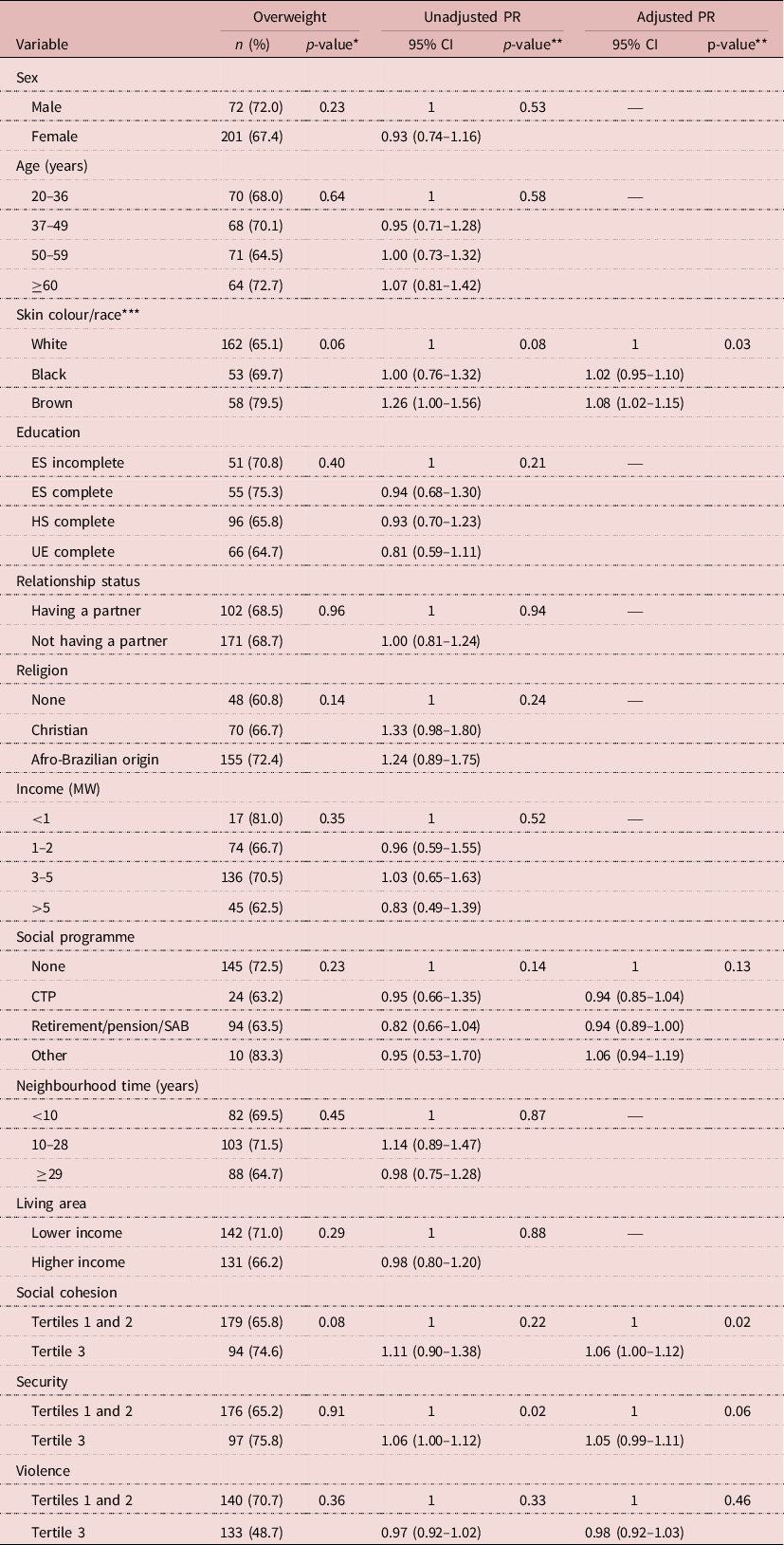
The results for the association between socio-demographic variables, social environment scores and overweight are described in Table 2. After adjusting for confounding factors, those who have a high positive perception of social cohesion in their neighbourhood and brown individuals had a higher prevalence of overweight (PR=1.06; 95% CI, 1.00–1.12, p=0.02; PR=1.08; 95% CI, 1.02–1.15, p=0,03, respectively). There was no statistically significant association between overweight and the other primary exposures investigated in the study (security and violence).
Unadjusted and adjusted analyses of association between socio-demographic characteristics and perception of social cohesion, security and violence with overweight (N=398)

ES=Elementary School; HS=High School; UE=University Education; MW=Minimum Wage; CTP=Cash Transfer Programme; SAB=Social Assistance Benefit; PR=Prevalence Ratio; CI=Confidence Interval.
* Difference between groups tested by chi-squared test.
** Multivariate analysis performed using Poisson Regression with robust variance, Wald test for heterogeneity of proportions (categorical variables) and linear trend (ordinal variables). Significant if p<0.05.
*** There were no yellow/indigenous or Asian people in the sample.
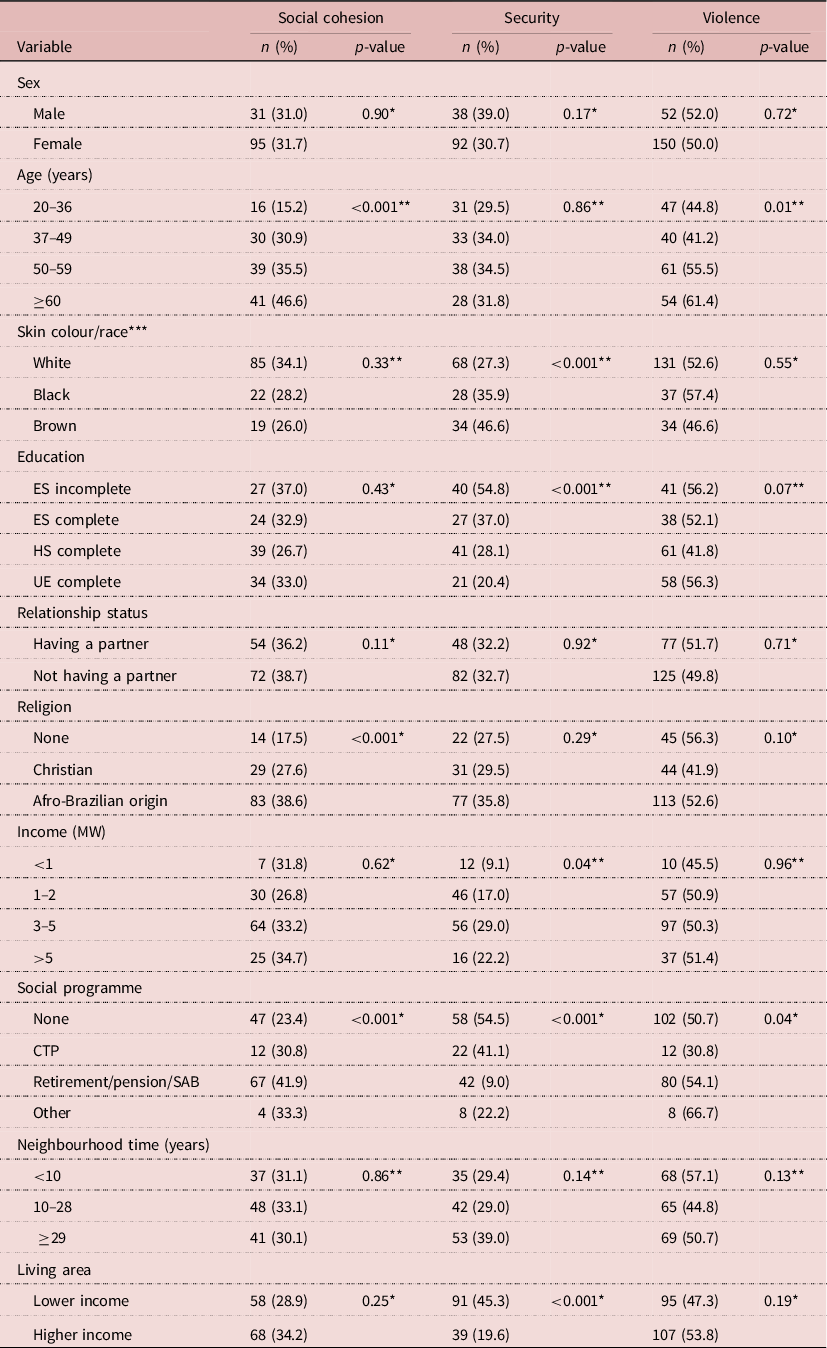
Table 3 presents the associations between socio-demographic characteristics and social cohesion, security and violence scores. Individuals who were over 60 years of age, of Afro-Brazilian religion and who received retirement pension, pension or social assistance benefits had a significantly more positive perception of social cohesion in their neighbourhood. Brown people, those who have not completed elementary school, those who earned 3–5 times the minimum wage, non-receivers of any benefit and those living in lower-income areas had a better sense of security in the neighbourhood than their counterparts. Those over 60 years of age and who did not receive social benefits had a better perception of violence, i.e. were less likely to perceive their neighbourhood as violent.
Socio-demographic and socioeconomic characteristics according to high positive perception (3rd tertile) of social cohesion, security and violence

ES=Elementary School; HS=High School; UE=University Education; MW=Minimum Wage; CTP= Cash Transfer Programme; SAB=Social Assistance Benefit.
* Difference between groups tested by Pearson’s chi-squared test, significant if p<0.05.
** Difference between groups tested by the chi-squared test of linear association, significant if p<0.05.
*** There were no yellow/indigenous or Asian people in the sample.
Discussion
The principal aim of this study was to identify the relationship between social environment perception (social cohesion, security and violence) and overweight. The main study finding was that individuals with a more positive perception of social cohesion, and brown individuals, had a higher prevalence of overweight. In addition, socioeconomic and demographic variables were found to be significantly associated with perceptions of the social environment, including age, religion, whether receiving social benefits, skin colour, education and income.
The prevalence of overweight in the study sample was relatively high (68.8%) – approximately 14 percentage points higher than that last published by VIGITEL (55.7%) (Ministério da Saúde, Reference Ministério2019). A possible reason for this difference is that the average age of this study sample (47 years) was higher than in these other studies.
The relationship between social cohesion and obesity has been studied for about 20 years, but results remain controversial. Some studies pointed to an inverse proportional association between social cohesion and obesity (Yoon & Brown, Reference Yoon and Brown2011; Glonti et al., Reference Glonti, Mackenbach, Ng, Lakerveld, Oppert and Bárdos2016), while others found no association between the two (Christian et al., Reference Christian, Giles-Corti, Knuiman, Timperio and Foster2011; Chia-Yuan, Reference Chia-Yuan2017).
Some studies demonstrated a positive association between social cohesion and obesity, where the former is seen as a protector for the latter. Others have suggested that social cohesion can influence the practice of physical activity, encourage more traditional and culturally healthy diets and reduce stress and depression, which are risk factors for obesity (Echeverria et al., Reference Echeverria, Diez-Roux, Shea, Borrell and Jackson2008; Cradock et al., Reference Cradock, Kawachi, Colditz, Gortmaker and Buka2009; Carter & Dubois, Reference Carter and Dubois2010; Suglia et al., Reference Suglia, Shelton, Hsiao, Wang, Rundle and Link2016). However, social cohesion can also contribute to unhealthy behaviours, such as the more frequent consumption of unhealthy foods and alcoholic beverages at bars or community events (Portes, Reference Portes2014; Villalonga-Olives & Kawachi, Reference Villalonga-Olives and Kawachi2017).
There is evidence that black people are more likely to be overweight in Brazil, due to race/skin colour health inequities, food consumption and the local environment in which they live (Paradies et al., Reference Paradies, Ben, Denson, Elias, Priest and Pieterse2015; Canella et al., Reference Canella, Duran and Claro2019). Cunningham et al. (Reference Cunningham, Berkman, Kawachi, Jacobs, Seeman, Kiefe and Gortmaker2013) demonstrated that there was a significant increase in waist circumference and BMI in black women who reported more frequent racial discrimination over a period of 8 years. In addition, a systematic review by Canuto et al. (Reference Canuto, Fanton and Lira2019) found that regular consumption of fruit and vegetables was higher among whites in Brazil, and that blacks consumed more meat and milk with high-fat content. It is common for black people to live in territories with low socioeconomic conditions, which may be associated with lower access to fruit and vegetables, a greater consumption of ultra-processed foods and less opportunity for physical activity (Boone-Heinonen et al., Reference Boone-Heinonen, Roux, Kiefe, Lewis, Guilkey and Gordon-Larsen2011; Filomena et al., Reference Filomena, Scanlin and Morland2013; Mook et al., Reference Mook, Laraia, Oddo and Jones-Smith2016).
Another hypothesis to explain these results is that social cohesion functions as a tool for access to food, aiming to mitigate a possible situation of Food and Nutrition Insecurity (FNI) among vulnerable groups, such as in black communities. Briefly, FNI refers to the lack of regular and permanent access to quality food in sufficient quantity (Consea, 2004). A relationship has been demonstrated between overweight and the purchase, receipt or donation of cheaper foods, which typically have a higher energy density, and lower consumption of fruit and vegetables (Valásquez-Melendez et al., Reference Valásquez-Melendez, Schlussel, Brito, Silva, Lopes-Filho and Kac2011; Mazur & Navarro, Reference Mazur and Navarro2015). This could explain the association found in the present study between brown and black individuals and higher FNI (data not shown in the results).
Older adults and adherents to the Afro-Brazilian religion had a greater perception of social cohesion in their neighbourhood, in line with what has been previously documented in the literature (Pfeiffer, Reference Pfeiffer2002; Marks et al., Reference Marks, Nesteruk, Swanson, Garrison and Davis2005;). Neighbourhoods play an important role for the elderly, due to their free time and functional limitations to move beyond these proximal spaces. They frequently establish lasting friendships and interact more with the local places of public life (Gardner, Reference Gardner2011). Social participation and feelings of belonging to a certain group are also related to the strengthening of the meaning of one’s life and their value in society, reducing stress and biomarkers related to inflammation (Glei et al., Reference Glei, Goldman, Ryff, Lin and Weinstein2012; Tomioka et al., Reference Tomioka, Kurumatani and Hosoi2015). A study of a cohort of older Brazilian adults showed that those who did not participate in groups or social associations had a higher risk of death, equivalent to more than twice than that observed among their counterparts (Gontijo et al., Reference Gontijo, Firmo, Lima-Costa and Filho2019).
Religion also may contribute to greater socialization and inclusion of individuals in a community space, since they share social assets that support and protect them. A study carried out in Mozambique showed that religious institutions offer social support and promote communities of mutual aid and protection in areas of insecurity, inequality and economic and social conflicts (Pfeiffer, Reference Pfeiffer2002). Marks et al. (Reference Marks, Nesteruk, Swanson, Garrison and Davis2005) highlighted that adherence to ethical-religious norms and belonging to religious groups can protect against urban violence, reduce risky behaviours and increase quality of life.
Regarding the perception of security and violence, no association was found with the main outcome (overweight), but brown skin colour, low education, not receiving social benefits and residing in areas of lower socioeconomic status were associated with the perception of a safe and non-violent neighbourhood. Interestingly, such characteristics are similar to the profile of individuals who suffer the most from urban violence in Brazil. According to the Brazilian Atlas of Violence (IPEA, 2019), black and low-educated individuals are the main victims of homicides.
Economic crisis, social inequalities and the consecutive degradation of the determinants of life quality have turned low-income neighbourhoods (which have greater concentrations of black individuals with low education) into places without infrastructure and which are conducive to urban violence (Cara & Gauto, Reference Cara and Gauto2007). A probable explanation for the more positive perception of security in this study is that, although they live in vulnerable communities, these areas are located in the city’s central area, increasing their access to public and private services and resources.
A study by Simão et al. (Reference Simão, Amorim and Guedes2016) found that individuals did not recognize their neighbourhood as violent, despite identifying their own city as violent. The authors raised three hypotheses for this puzzling result, which can also explain the result of the present study: (1) the spatial alterity of violence – that is, the perceived violence occurs outside, and not within, the neighbourhood; (2) the introjection of violence reported and localized with little experience of violence; and (3) the spatial concentration of violence in specific locations in the city, occurring in the urban peripheries, not in central areas.
The results of this study should be interpreted in the light of some limitations. As it was a cross-sectional study, the presence of temporality between exposures and outcomes could not be guaranteed. Moreover, the study was conducted in a health area population. The sample was not representative of the general population, but nonetheless, the associations can be generalized to other groups considering that the causal mechanisms are similar. However, the study results can help to understand the influence of neighbourhood perception on nutritional status and on the health of adult individuals living in central areas of large cities of low- and middle-income countries, including those living in areas of low socioeconomic status. The study’s unprecedented data are on a theme that is still little discussed in Brazil.
This study has shown a positive association between the perception of social cohesion and overweight. In addition, it found that certain socioeconomic variables, i.e. age, religion, receiving social benefits, skin colour, education and income, were associated with the perception of at least one of the characteristics chosen to define social environment (social cohesion, security and violence). Social cohesion outstands as an important factor in the condition of overweight. Therefore, these findings highlight the importance of considering social factors (and citizens’ perception of these factors) when planning actions and policies for the prevention and control of overweight.
Funding
This research received no specific grant from any funding agency, commercial entity or not-for-profit organization.
Conflicts of Interest
The authors have no conflicts of interest to declare.
Ethical Approval
This work was approved by the Ethics and Research Committee of the Federal University of Rio Grande do Sul under number CAAE 46934015.3.0000.5347. The individuals only participated in the study after signing a free and informed consent form.