In April 2018, Janelle Monáe released Dirty Computer, a group of eight music videos with interlaced material. An Afrofuturist forty-six-minute narrative shown mostly on YouTube, the work extends the story of Monáe's alter ego Cyndi Mayweather Metropolis, who had previously appeared on her albums The ArchAndroid (2010) and The Electric Lady (2013). Critical reception was enormously positive, including claims that Dirty Computer is “a milestone not just as a work of art … but as the perfect celebration of queerness, female power, and self-worth,” an “extravaganza by a female black panther,” and “more personal than the android dared.”Footnote 1
Concept video albums are a new phenomenon, enabled in part by technological and economic changes: streaming services, such as Apple Music and Tidal, have invested sizable budgets in music video–like “tentpole productions” to attract subscribers. Billboard's charting of YouTube's music video views has also contributed to increased revenue. Each of these long-form, music video-oriented works tends to foreground a new twist. Frank Ocean's Endless (2016) flaunts pop and avant-garde through a fluttering exploration of a single space, and Kanye West's My Beautiful Dark Twisted Fantasy (2010) combines highbrow aesthetics with hip hop, but with a Matthew Barney verve. Beyoncé’s Beyoncé (2013) and Lemonade (2016) are the most spectacular examples. Her audiovisual albums place large swathes of African American culture and history in relation to her marriage.
Smaller scaled than Beyoncé’s works, Dirty Computer also spans larger social configurations and personal narrative. Its music videos explore editing, narrative, gesture, and timbre with a sureness about the genre's unique affordances. Its progressive edge, which derives in part from its celebration of pansexuality and the LGBTQIA community, also contributes to its allure. Three singles released before the album, “Make Me Feel,” “Django Jane,” and “Pynk,” sparked curiosity among fans and critics. How might these be folded into a soon-to-be-released narrative?
Our collective of musicologists and media scholars are excited to write on Dirty Computer because we feel we need new forms of scholarship to respond to today's media swirl.Footnote 2 Audiovisual aesthetics—the ways sound, image, and lyrics can be placed in relation—remains relatively unexplored. Short-form genres also remain under examined, and they contain their own aesthetics. We participate in an audiovisually intensified media landscape, and we believe that skills gained through interpreting music videos can help citizens become more discerning about Cambridge Analytica ads, Instagram teasers, blockbuster film trailers, and Fox News segments.
It seems crucial to further democracy at our current moment for faculty members to cross between visual arts and music. The analyst must feel comfortable with addressing the music, the images (including moving bodies, cinematography, and editing), the lyrics, and the relationships amongst them. (This might include looking at a dance gesture against a harmonic shift and an edit and asking how these might relate to one another.) We care deeply about the music video genre for four reasons:
1. It has a cultural centrality today. It remains among the most popular forms of moving media. It is also the most viewed content on YouTube; music videos are the most common way for audiences to consume popular music, more than through CDs, radio, iTunes, or blogs.Footnote 3
2. Its aesthetics have seeped into nearly every form of moving and visual media, from Transformers and Hunger Games, to Bollywood, to television shows like Game of Thrones.
3. It is a genre with its own conventions and its own ways of carrying a narrative, eliciting emotions, conveying space and time, and deploying performers, settings, and props. It has unique ways of drawing relations between sound and image; it has unique ways of conveying brief states of bliss.Footnote 4 It is dependent on the ephemerality of color, movement, and sound. Like popular music, music video possesses motifs, rhythms, grain, and fine details that carry weight. It resides somewhere between advertising and art.
4. It is a genre that's always in transition. It is but thirty-five years old, but it has shape-shifted countless times in response to dramatic technological, aesthetic, institutional, and audience pressures. Monáe's Dirty Computer reflects this sense of constant change.
We were drawn to Monáe's Dirty Computer because it seemed both aware of the genre's history and formal possibilities and, at the same time, committed to breaking preexisting models (many contemporary artists feel pressured to do so as they attempt to stand out on the web). The film's music was strong and engaging, and our students liked the film's progressive politics, both in its support for queer communities and in its vision of a more humane world less fettered by capitalism. We wrote alongside the release of the first two clips—“Make Me Feel” and “Django Jane”— and our essays are primarily focused on these two. With the film's staggered release, we hoped to generate critical interest, mirroring Monáe's project. We preceded this JSAM media review with publications in two online journals, In Media Res and Pop Matters, and we hope to continue to point back to these publications, thereby encouraging not only musicologists but also a wider audience to read our responses to Monáe's work.
Our essays are short (from 400 to 1,800 words), which we feel is well suited to music video. Attentive readers can feel each of us attempting to follow along with Monáe, her music, and her unfolding imagery, slowing down and speeding up, as each author entrains to a clip. Music videos, like pop songs, are heterogeneous forms with many details appearing simultaneously. Each of us tries to catch hold of both big moments and small details as they unfold in time. A question to keep in mind: how do our backgrounds, trainings, and subject positions—as well as the individual aesthetic parameters like rhythm, voice, and gesture with which we engage—shape our reception of a clip? Each of us seems drawn to single features: Ellis and Leal to the voice, Oore to rhythm, Suechting to arrangement, Sterbenz to gesture, Vernallis to repetition and the progress toward key moments, Lochard to gender identity, and Shaviro to cinematography, experience, and point of view. But describing these elements pulls the analyst's attention toward supporting and adjacent features. Similar moments will be glanced off of by our authors, but along different paths. What path might a reader prefer, and why?Footnote 5 We also hope to give a deeper reading of what critics have already noted—Monáe's intimacy and elusiveness, as well as her dense allusions to communities and histories, including the LGBTQIA community and her mentors, both real and imagined.
Steven Shaviro considers some of the special points of attraction in Alan Ferguson's video for Monáe's “Make Me Feel.”
When I watch and listen to Alan Ferguson's music video for Janelle Monáe's song “Make Me Feel” (2018), pretty much everything delights me. The song/video is so beautiful, and so wondrously overloaded, that I can only give a somewhat disconnected, and necessarily incomplete, account of some of the features that grab me.
The song is driven by a slinky, funky, hot, and sexy groove—one that is clearly reminiscent of Prince (many commentators have mentioned “Kiss” in particular).Footnote 6 This groove runs throughout the song. Initially, the groove is just a bass twang and percussive clicks. Other layers of instrumentation and voice are added and subtracted in the course of the song—as Robin James notes, a familiar procedure in recent dance music, which is based in rhythm and timbre rather than grounded in harmonic progressions.Footnote 7 Particularly noteworthy among the song's varied musical textures is the guitar rave-up in the pre-chorus and then again during the bridge. At times, we see Monáe playing the guitar, surrounded by backup dancers, and wearing a spangled outfit, with a beaded veil covering her face.
Monáe's vocal inflections include a number of exclamations and grunts, recalling James Brown. She yells out “Good God! I can't help it!” during the guitar storm in the bridge. Monáe's dancing is reminiscent of Michael Jackson, as she spins, grabs at her crotch, and even tries a sort of moonwalk for a few steps. The beaded veil echoes one worn by Prince in his video for “Violet the Organ Grinder.”Footnote 8 Monáe pays homage to her precursors, at the same time queering them with her “emotional, sexual bender.”
The song features cuts or breaks (also reminiscent of James Brown) that twice interrupt the music with a moment of silence (3:08, 3:28). The music pauses, energy checked just as it is ready to spring. Monáe mutters words (“Damn!”) that are spoken instead of sung. We are left for a moment in suspense; all the better to be pumped up again once the music resumes. Ferguson marks these moments visually, the first by suspending the action and then cutting to a shot that slowly tracks in towards Monáe's bead-veiled face and the second by actually panning back and forth over a momentarily still image. The pause, or hesitation, allows us, like Monáe, to savor a plenitude of erotic possibilities without the need to definitively choose.
Indeed, the song as a whole is a cry of sexual rapture. But the music expresses this rapture as an enduring, vibrating condition, a field of intensity—rather than as a narrative buildup to a peak that would inevitably be followed by deflation. That is to say, it is a female orgasm (or multiple female orgasms), rather than a (more traditional in Western music) male orgasm.Footnote 9 But this actually fits well within the whole African American musical tradition to which Monáe belongs and which she expands and renews. The funk just goes on.
The video gives us a continual back-and-forth between two locations. The first is the space of the club. At the start of the video, Monáe and Tessa Thompson emerge from a dark corridor, coming through a squeaky door, and sashay into a crowded bar or club space. The song proper has not yet begun, but we hear faint pre-echoes of the bass line and some of the singing, together with the murmurs of the crowd. We see alternating shots of Monáe and Thompson moving through the space and of the space from their point of view. There are a number of alcoves or rooms: one with a bar, another with video game consoles, and several with small groups of people standing apart.
The second location—or more properly, series of locations—is, in contrast to the first, entirely abstract and stylized. This is the space of Monáe's performance of the song. The song proper starts at 0:20, but we don't see Monáe actually singing until 0:35. She is sitting splayed out in a purple chair wearing a blonde wig, sunglasses, a colorfully patterned jacket and pants, and high-heel boots (one red and one white). She seems to be holding a lime-green water pistol. There is a checkered pattern on the floor, a wall behind her with artfully inscribed graffiti, and the black-clad figures of backup dancers moving in slow motion.
At first, the shots of Monáe singing in the performance space are juxtaposed with shots of spectators, sitting or standing still and looking directly towards the camera, which slowly pans in on them. This suggests a shot–reverse shot structure; we are being presented with spectators who are actually watching Monáe's performance. These figures (who include Monáe and Thompson themselves in the club at one point) are proxies for our own gaze as spectators of the video.
But this is only in the first minute or so of the video. The last of these spectatorial shots is at 1:07. For the rest of the video, we get an alternation between shots of action in the club and shots of Monáe's performance in increasingly abstract and disconnected spaces. Monáe's own figure is correspondingly split or doubled. She appears in one series of shots always dressed the same, as a club goer; in another, in an amazing series of costumes as the performer. At one point, however, the two Monáes, from the two series of images, meet in the same shot. Janelle Monáe contains multitudes; her ideal performing self reaches out to her fleshly incarnation.
In the club sequences, Monáe and Thompson both flirt with others and then come back to one another. As Thompson engages with a butch-looking woman wearing a checkered jacket and a shaven head with multicolored tattoos (or are they colored patches of short hair?), Monáe quickly walks over, looking a bit jealous. The other woman holds up her hands in a disclaiming gesture and walks away. Later, Monáe meets a man at the bar and they embrace. In the remaining club scenes, Monáe moves back and forth between this man and Thompson, both of whom seem to be erotically claiming her. She eventually ends up sandwiched between them as they alternately reach out for her.
Meanwhile, the performance sequences show Monáe singing, dancing, and playing guitar on a sort of stage, frontally facing the camera. She is flanked by identically dressed backup dancers. Both the stage itself and the wall behind it are brightly lit, highly abstract color fields. This suggests that Monáe is not performing in any concrete location but is singing and dancing in an idealized, magical Elsewhere—or perhaps, everywhere and nowhere at once.
The colors in these sequences are highly saturated and often come in complementary pairs. At times, Ferguson adopts the pattern of what has come to be known as bisexual lighting: “deep blue lights on one side and saturated magenta lights on the opposite.” This formal pattern “correlates to the colors of the bisexual pride flag”Footnote 10 and thereby parallels the content of the video. It resonates with the red and white boots cited earlier, as well as with a half-white and half-black jacket that Monáe wears and spins around in, at one point. It is also worth noting that during the bridge with its guitar rave-up—arguably the closest that the song comes to a passage of maximum intensity—Thompson and the man, all still wearing their clothes from the club, appear alongside Monáe in the abstractly lit performance space. She runs frantically back and forth between the two of them, reflecting and hyperbolizing what happens in the club sequences.
Two particular visual details stick out for me and transfix me, even though I cannot assign either of them any particular meaning. They are both excessive. Roland Barthes famously wrote of what he called the punctum of a still photograph, the single point that can attract and compel, or even “arrest,”Footnote 11 the viewer's gaze. “A photograph's punctum is that accident which pricks me (but also bruises me, is poignant to me).”Footnote 12 Barthes associates the punctum with the fatality of time passing, and hence ultimately of death. Music videos can also have points of fascination and excess like this, but they do not work the same way as in still photographs. For they are fleeting instances, caught up in duration and passage; I am struck by them, but I cannot keep hold of them, as they appear and disappear according to the rhythms of both music and visual editing. Instead of Barthes's sense of irreparable loss, I feel a kind of quickening movement: something that both awakens my desire and eludes my grasp.
The first detail that catches and affects me in this way is Monáe's amazing polka-dot lipstick. In a few shots, she looks directly towards the camera, her face in the center of the frame. She is wearing lipstick with white dots evenly spaced against the red outlining her lips. In these shots, she is not standing; she crawls around on the floor, bumping and undulating. She is framed against, behind, and between the outstretched legs of the backup dancers—legs clad in fluorescent-colored tights. The effect of these lips is festive, with a heightened artifice. Makeup, like clothing, works both to conceal the naked body and to accentuate its sexual allure. Seeing Monáe with this lipstick, I feel disquieted and exultant at once.
The second detail is a brief shot that appears at around 3:39, and again at 3:42, very close to the end of the song. Monáe's body is outlined, or trapped, beneath a bright pink sheet of what seems to be latex or plastic. As the voice continues on the soundtrack, singing the final chorus, this body writhes as if seeking to emerge, to break free. But we cut to another shot of Monáe frantically singing before it does. The song is ending, but I remain entranced by the suggestion of incipience. The only thing I can do is watch the video again.
Maeve Sterbenz considers the complementary personae that are expressed in the first two videos released from Dirty Computer, focusing on how movement and setting help the viewer to interpret the music.
The visual dimension of Monáe's output and presentation has been a crucial part of her work throughout her musical career. The two pre-released videos from Dirty Computer—an explicitly visual album—present no exception. What interpretive possibilities do the videos offer that are not available in the songs alone? In Janelle Monáe's “Django Jane” and “Make Me Feel” videos, visual and aural components converge to offer two complementary takes on contemporary femininity, both of which are unequivocal and unapologetic in their assertion of black women's power. Monáe's personal self-determination features centrally in this assertion in both videos, but although “Django Jane” offers cool implacability and forcefulness, “Make Me Feel” is unencumbered, lighthearted, and celebratory. Many of the body movements and visual elements that shape these two videos are familiar from her earlier works, often with similar effects on our musical experiences. Here, I offer a few specific comparative observations about how music and image work together to create new meanings in these two videos.
Initially, I am drawn to points of overlap and contrast between the videos’ brief introductions. The two works open in a similar way: the viewer is guided through a slow approach to a conference with Monáe, who delivers the first few lines of each song from a stationary, seated post. Her relative stillness and elegant, confident postures give very strong initial impressions of self-assurance and poise. You have to come to her; she is not going to work to draw you in. The two approaches are rather different, though. In “Django Jane,” the viewer gets a taste of the formality and confidentiality of Monáe's dark “palace” before encountering the artist herself. The camera advances through a dim hallway toward closed doors that open to reveal the silhouette of stiff, prohibitive guards, and only on the basis of their approval is the viewer granted entry. The brief musical introduction, which is thick in texture with lush EQ sweeps that envelop Monáe's smooth vocal timbre, saturates the scene. All of this works to set the tone for a video that thematizes Monáe's uncompromising display of vigor and authority. At different moments in the video, her attitude towards the viewer is alternately confrontational and inclusive. At times the camera angles upwards, firmly placing us in a subordinate position, or lurches sideways, tilting us off balance. At other times, we are lured in by her conspiratorial sideways glance (“and we gon’ start a motherfuckin’ Pussy Riot”), or by her supple movement (“let's get caught downtown in a whirlwind”). The music, too, offers both graspable and disorienting elements. The strings stand out of the mix in a flash of clarity amidst the murky, quicksand-like bass lines. Over all this, Monáe, in impeccable dress, delivers the rap with strength and composure. Her might radiates from the center of the shadowy, mystical scene.
“Make Me Feel” on the other hand, indulges in a warmer, more playful side and invites the viewer to join the party. In the video's opening, Monáe's slightly more timid and curious alter ego travels through the vibrant bar along with the viewer. The music is at first faint enough to feel diegetic to the club scene, but it suddenly snaps into its rightful place as the auditory focus of the video. The introduction foregrounds just two components of the instrumental track—the warm, bouncy synth and the crisp snaps and tongue clicks—which give a vivid sense of physicality and proximity. Monáe's own physical presence, when we encounter her perched resolutely in a chair, provides an arresting contrast to the punch of the track. It doesn't take long, though, before she shows us just how danceable the song can be. The video offers a variety of movement styles that play up different dimensions of the music. Just after Monáe emerges from the inner room, she and her backup dancers draw attention to the song's sharp, irregular rhythmic profile and acute timbres with precisely timed movements of their shoulders and heads. Later, in the second chorus, their choreography brings out a change in harmony; Monáe, now in dazzling rhinestones, switches step patterns at the move from I7 to IV7. In another moment, the fluid movement of her hips in transparent “denim” draws our ears to the rubber band stretch and snap of the synth. Over the course of the video, Monáe's movement style progresses from controlled and minimal to wild and reckless, highlighting the variety of attitudes that are available in the song, all of which collaborate to draw us in to this defiant and approachable celebration of queer female sexuality.
Taken together, the two videos present a persona that can hardly be described better than Monáe's own pre-chorus: “powerful with a little bit of tender.”
Dani Oore explores the ritual technologies found in “Dirty Computer” through the lineage of auditory and visual elements in its first two outputs: “Make Me Feel” and “Django Jane.”
Among the most up-voted comments on Janelle Monáe's “Make Me Feel” music video are the following two succinct approvals:
Mher Khachatryan: “PRINCEss”
m a: “PRINCE BE SMILIN’ FROM HEAVEN FOR SURE”Footnote 13
Some commentators confess that they can't identify exactly which Prince song “Make Me Feel” evokes. Numerous others respond assuredly “Kiss” but offer no further explanation. Why “Kiss”? We know Prince helped Monáe with the larger project.Footnote 14 What inspirations does it make me feel?
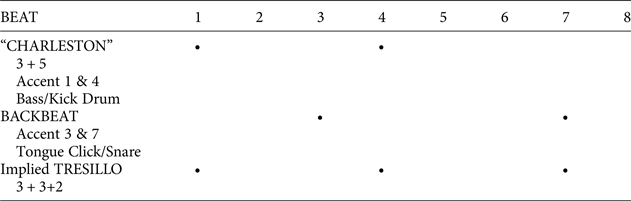
How do the rhythms, grooves, and timbres of “Kiss” and “Make Me Feel” compare? “Kiss” and “Make Me Feel” each have a strong 3+3+2 accent pattern (counted as “1-2-3 1-2-3 1-2”) that is itself produced by the interaction of two distinct eight-beat rhythms: a 3+5 pattern, also known as a “Charleston rhythm” (where accents fall on the “1”s of a “1-2-3 1-2-3-4-5” cycle, which can also be written as accents on the “1” and “4” of “1-2-3-4-5-6-7-8”) and backbeat accents (on beats “3” and “7” of “1-2-3-4-5-6-7-8”). (See Table 1.)
Two rhythms, a 3 + 5 “Charleston” and a backbeat, and the composite 3 + 3+2 (tresillo) pattern that their combination implies, heard in both “Kiss” and “Make Me Feel.”

The composite 3+3+2 pattern (that here emerges from the combination of the 3+5 and backbeat cycles) is found in dance musics around the globe. In Klezmer music, for example, we find the Bessarabian bulgar rhythm, in Ghanaian Ewe music we find the Gahu rhythm, and in Afro-Caribbean musics we find the xaxado rhythm and Afro-Cuban tresillo (meaning “little three” or “triplet”). The tresillo also forms the first three accents of the son clave and in American popular musics we find this clave in Bo Diddley's eponymous rhythm. The tresillo (or what Jelly Roll Morton called the “Spanish tinge”) appeared early in New Orleans and jazz traditions, and later, in part due to the “Latin music explosion,” continued in 50s rockabilly. The Caribbean versions of the 3+3+2 took new form in Jamaican 70s dancehall music, developed into the dembow riddim of 90s reggaeton, and fed back into American pop, infusing the 3+3+2 into contemporary hits from Ed Sheeran to Beyoncé and beyond.Footnote 15 Why did this rhythm find its way into “Kiss” and then “Make Me Feel”? Does it contain some optimal flow of syncopation and stability to elicit movement? If rhythm is a physio-psycho-social tool, the 3+3+2 pattern is an ancient technology, whether passed from one generation to the next, taken across cultures, or perhaps rediscovered by moving bodies.
In both “Kiss” and “Make Me Feel,” the 3+5 accent pattern is produced by low frequency kick drum or bass accents. In “Kiss” the backbeat is produced by a skin-slapping snare sound, and in “Make Me Feel” the backbeat is produced by a sensual tongue clicking. (The tresillo and backbeat patterns in Dirty Computer’s “PYNK” feature the same contrasting timbres.) The combination of lower frequency thuds and higher frequency slaps evokes music made of foot stomps and hand claps and might be traced to the similar use of these bodily sounds in ring shout rituals.Footnote 16 The two songs share very similar tempos: “Kiss” throbs at just under 112 beats per minute, with “Make Me Feel” at 115. In each song, the groove is juxtaposed rather starkly against the vocals. Minimalist synths and rhythm guitar add depth, with the latter being the only musical instrument (in addition to the singer) depicted in both music videos; even unplugged, the electric guitar is a technological symbol of liberation and desire.Footnote 17
“Kiss” and “Make Me Feel” also each embody their honest expression of Eros in a distinctly African American song form: the blues. The marriage (and tension) of blues harmony and tresillo bass is an innovation developed in New Orleans.Footnote 18 Both songs’ harmonic progressions get comfortable in the safety of the I chord, raise the stakes by briefly stepping up to the IV chord (which then shifts to the vi chord in “Make Me Feel”), and regain our trust by returning home to the I chord, before climaxing on a V chord and falling to a IV chord, a release that both songs extend either through repetition (“Kiss”) or variation (“Make Me Feel”). Each song has three of these harmonic climaxes; temporality is simultaneously linear and cyclical, masculine and feminine.
“Make Me Feel” also recalls “Musicology,” Prince's homage to his own studied inspirations. Each music video depicts that initiated space where sensual musical motion—and a strong backbeat—is celebrated. The space is sanctified with signifyin’ organs (0:36 in “Make Me Feel” and 2:42 in “Musicology”). Prince praises the spirits of masters like Jimi Hendrix and James Brown through the dancing body and electric guitar. Monáe channels Brown (“Good God…” and “I feel like…”) and particularly Prince (and his guitar) to explore her sexuality. In her live performances, Monáe ends “Make Me Feel” down on her knees and then gradually rises up as the “Make Me Feel” lyrics and harmonic progression are rearranged into James Brown's “I Got the Feelin’.” In this way, Monáe summons her creative inspiration through his rhythms, melodic contours, articulations, horn shots and bass lines, cries and hollers, and fleet-footed dance moves. Communion and communication with ancestral spirits is prevalent across many cultural practices (including many African cultural practices), and this connection seems to be an important aspect of Monáe's Afrofuturism.Footnote 19 Her “Tightrope” music video, for instance, describes and then depicts subversive magical dance rituals, and in interviews about the video, she mentions the “superpowers” invoked by setting her video in an asylum where Jimi Hendrix, Charlie Parker, and other greats were institutionalized.Footnote 20
“Make Me Feel” invokes significant visual connections to precedents by Prince and others. In the “Make Me Feel” music video, the oppositional nature of Monáe's sexuality is intensified through Alan Ferguson's complimentary magenta-green and red-cyan palettes. Rebecca Blake's “Kiss” video uses very similar (if more orange-blue) palettes. Ferguson's video plays with another tension—also found in Prince's work—between the seen and unseen. In “Make Me Feel,” reflective aviator glasses, sheer black flower embroidery, and a latex-wrapped body recall the aviator glasses, black veil, and semi-naked bodies behind translucent glass in “Kiss.” A beaded face veil in “Make Me Feel” nods to Prince's “Violet the Organ Grinder.” Monáe's polka-dotted lips are comparable to the dots seen on Prince's outfit in “Kiss,” to Nigerian face painting dots as seen in Laolu Senbanjo's designs on Beyoncé in “Sorry,”Footnote 21 and to the dots painted on naked bodies in Yayoi Kusama's “Homosexual Wedding” and “Grand Orgy.” Each of the elements in “Make Me Feel” amplifies Monáe's sensual body by simultaneously highlighting and gently obscuring its form. When used to invoke spirits of mentors or ancestors, each element also functions as a ritual costume or mask.
In Monáe's second Dirty Computer release, “Django Jane,” we are brought through another set of gates into another sanctuary: a palace where oppression is being transcended, where dignity—specifically of women and Black people—is actively reclaimed. Just before the middle of the video (at 1:26) Monáe spits the lyric “black girl magic.” On the word “black,” her hands thrust forward and snap back. Monáe and members of her squad repeat this snapback gesticulation on the first downbeat of each of the next five measures (i.e., every four beats for a total of five kinesthetic accents). “Hip hop hands,” as Charles Mudede explains, are communicative, not decorative.Footnote 22 Monáe's decisive gestures here are consistent with my theory that precisely such accented short-long patterns occur in emotionally and socio-politically charged contexts.Footnote 23 Recall Monáe's accented short-long vocal snap in her 2015 “Yoga”: “You cannot po-LICE-this, so get off my areola” (the short-long snap pair is underlined and the initial accented short is capitalized); with it, she reclaims and decolonizes the Other: the Black, female, and “android” body.
In Andrew Donoho's “Django Jane” video, the intensity of Monáe's first snapback shakes the entire video image into a corollary rhythmic aftershock, momentarily snapping us out of the mediated fantasy. In “Make Me Feel” (at 2:37), Ferguson synchronizes a shaky cam effect with a rhythm guitar tremolo to metaphorize the magnitude and range of Monáe's emotions. Monáe's across-the-floor choreography here, moving between sexual polarities, recalls that found (at 2:10) in “Kiss.” This Dirty Computer runs a venerable operating system; it glitches vulnerably and powerfully with technologies that make me feel.
Jonathan Leal addresses the “public interior” of Monáe's “Make Me Feel,” focusing on how musical homage, latrinalia, and digital doubling dramatize an argument for ameliorative outreach and self-study.
Janelle Monáe's “Make Me Feel” is by most standards a new bi anthem. It is also, musically and visually, a public display of interiority.
Musically, the tune is compact, measured, and geometrically exact. It features echoes of Prince (especially his 1986 hit “Kiss”): spaceship synths, transparent beats, signature guitar scratches, and tight bass lines all form a sturdy scaffolding around Monáe's versatile voice. Bubbly and danceable, the song preserves the intimacy of Monáe's mentorship by leaning into familiar funkiness—a gesture as smart as it is sweet. And at the level of the voice, we can hear the track's unifying intimacy in at least a few ways. The prominence of Monáe's vocals in the mix—almost close-mic relative to the other musical elements—gives one the impression that Monáe is right next to you, speaking into your ear above the bustle of a crowded bar. This closeness is reiterated in the chorus by way of Monáe's whispered, unpitched responses to the sung melody, drawing listeners close enough to catch a quiet affirmation.
The video, too, plays with this sense of closeness in unexpected ways. Beginning with Monáe and Tessa Thompson walking into a bar, the pair, curious and excited, round a corner and lock eyes with another Monáe—likely her android doppelgänger—sitting on a throne. Rather than one of iron or gold, however, Monáe's perch is one of implied porcelain, the checkered tile and gray brick completing an impression of a bathroom. And as one might expect (unless the bars one frequents are routinely power washed), there's writing on that bathroom wall: “girl u like this one and the same.”
This writing is, truly, background, obscured in this and subsequent shots by bodies, objects, and frame edges; it is also an intimate forum: a site of debate, defacement, signature, and outreach. It is as much an opacity as a mirror: a barrier between people, a technology of self-constitution, a sign of shared experience. If, as sociologist Pamela Leong puts it, the graffiti in bathroom stalls (or, charmingly, latrinalia) is “aimed at future occupants” and, historically, written “for the eyes of the same sex,” in Monáe's video, the scrawl reaches further, queering the space by placing a statement of bisexual acknowledgement and affirmation—“girl u like this one and the same”—on view for any willing to read. A public display of interiority.
One might also connect this sense of a public interior to the video's two Monáes. (At 2:13, when they actually share the screen, the aristocrat seduces the visitor.) This doubled presence—their differences of gesture and dress, posture and position—not only dramatizes Monáe's own conscious construction of an artistic persona (and not only pokes at public wonderings about her sexual preferences) but also allegorizes the ways individuals strive toward self-consonance. Their encounter—in the bar, on the couch—is a public display of inner drama.
What we get out of all of this, I suggest, is that the intimacy, desire, and community in the mix and on display in “Make Me Feel” clarify Monáe's lasting concern with the state of relationships: to oneself, to romantic partners, to cherished mentors. Today, reflecting on those relationships feels especially urgent. Tomorrow, the day after, and in the chromatic future Monáe envisions, it will be just as pressing: a continual acknowledgement that although our private feelings “can't be explained,” we owe it to ourselves to try.
Gabriel Ellis focuses on a meaningful shift in Monáe's visual and musical aesthetics, suggesting that she continues to offer a powerful and complicating model of Donna Haraway's “Cyborg.”
Look at the covers of Janelle Monáe's previous albums. The singer appeared clad in metallic armor, with her wiring exposed or her wrist adorned with a glowing screen. She was playing the role of Cindi Mayweather, an android sent back in time to free the repressed citizens of Metropolis. Now, look at the cover of Dirty Computer, where only a jeweled veil comes between us and Monáe's exposed face and shoulders. She appears at her most intimate and—crucially—her most human form. Why the change? What happened to our shiny, silver savior?
I'm not asking just about the album's cover; this embrace of the “human” unites every aspect of Dirty Computer. Nowhere is this clearer than in “PYNK,” where endless repetitions of the song's title unite a host of references to sex and the human body: “Pink like your fingers in my…/Pink where it's deepest inside…” The bubblegum-pop production is so catchy that it is easy to miss moments when “pink” becomes a symbol for something greater, like “the folds of your brain,” the “sun going down,” and “where all of it starts.” By juxtaposing the private language of sex with these glimpses at universality, Monáe reminds us that the human experience is still an emphatically biological one. In other words, she proposes that the experience of having and living in a body is one of precious few things that still unites us.
The album's production also emphasizes the intimate. On earlier albums, Monáe's voice was only one part of expansive sonic tapestries: The Electric Lady saw her ceding ground to backing choirs, huge rhythm sections, and big-name collaborators like Erykah Badu and Esperanza Spalding. At times, she was almost buried in the crowded mix, like when she rapped on The ArchAndroid’s “Dance or Die.” Now, sonic spaces are dramatically flattened, while minimalist, bass-heavy backing tracks carve out space for Monáe to speak directly to us. The only voice we hear is hers, and we hear it everywhere, endlessly duplicated. She harmonizes with herself on “Make Me Feel”; she performs her own hype-woman interjections on “Django Jane.”
But has Monáe actually abandoned her android aesthetic? No and yes.
No, because even if Cindi Mayweather doesn't appear on the album, Dirty Computer is still powered by her disruptive energy. It has now been more than thirty years since Donna Haraway, in A Cyborg Manifesto, proposed that the metaphor of the cyborg could be a powerful weapon in the fight against racial, sexual, and economic oppression. The source of this creature's political power, she argued, was its ability to break down binaries like organism/machine and male/female. Monáe has embraced this power since day one, and as the other contributions to this collection show, she wields it more powerfully than ever on Dirty Computer. Always both one and many, both rapper and singer, and human, machine and goddess, she remains cyborg as long as she defies reification.
But yes, because in its desire to escape racial and sexual binaries, Haraway's cyborg ran the risk of turning away from the body itself. Haraway argues, “The cyborgs populating feminist science fiction make very problematic the statuses of man or woman, human, artefact, member of a race, individual entity, or body.” Although Monáe questions many of these labels on Dirty Computer, she refuses to give up others. By doing so, she offers a powerful challenge to Haraway's model. Consider the thumping, all-rapped battle cry “Django Jane,” where she celebrates “black girl magic” while inviting oppressors to go and colonize “a whole ’nother planet.” Taken together with “PYNK,” the message is clear: although racial and sexual differences can be superficial (“deep inside, we're all just pink”), they still matter—especially in today's political climate.
On Dirty Computer, Monáe no longer speaks to us from the distance of a fictionalized past or future. Instead, she concerns herself with America's here and now. If her album reminds us of the continued power of the cyborg, it also reminds us how far we are—and may always be—from Haraway's futurist fantasy. By unapologetically placing herself at the forefront of Dirty Computer, Monáe makes a powerful argument for a model of the cyborg that embraces, rather than effaces, racial, sexual, and human identity. She refuses to be lost in the mix.
Max Suechting explores how the relationship between performance and genre modulates Monáe's adoption of hip-hop, and discusses the fractious history of “authenticity” in and around rap music.
Janelle Monáe's musical career, and especially her music videos, constitute a long-running, self-conscious, and highly stylized meditation on the various genres of African American music. The Cyndi Mayweather saga explores the double-edgedness of performance, and specifically of African American musical performance: in videos for “Dance Apocalyptic” and “Many Moons,” Monáe-as-Mayweather is embedded in an entertainment-industrial complex which controls and exploits her performance until her expression becomes so powerful, so passionate that it can only be released by violence. In “Many Moons,” Cyndi performs a dance so ecstatic that she is electrified into a kind of living death, and in “Dance Apocalyptic,” she and her band smash their instruments—their means of production—in a fit of ecstatic exultation. Through her dramatic adoption of genres, Monáe suggests the irony of the twenty-first century's relentless commodification of difference: what was once an expression of resistance is converted into a look, a uniform, a code, a command. And yet, for Monáe, those genres nevertheless retain some of their revolutionary potential. Music and dance, even when they take the form of racialized commodities, still offer at least a partial reprieve from the travails of white supremacy, patriarchy, capitalism.
The video for “Django Jane” is an interesting contribution to Monáe's oeuvre. Until now, Monáe has largely not engaged with conventional, contemporary hip hop, but “Django Jane” does so with its simmering 808s, reversed piano attacks, and gentle guitars. It seems likely that the song was at least partially produced with an eye toward Monáe's crossover potential—a rap song that would appeal to Monáe's longtime fans as well as to urban radio stations not interested in playing thoughtful, self-aware indie rock. (In this respect it recalls “Yoga,” Monáe's 2015 radio-friendly and trap-inflected collaboration with label-mate Jidenna, the video for which features a host of dancers first crowding into and then taking over a diner.) In “Django Jane,” Monáe and her fellows are dressed in spectacularly fashionable reworked versions of Black Panther–era Oakland style—black leather jackets, sunglasses, red fezzes—and Monáe delivers her manifesto-like lyrics straight to the camera, rarely losing eye contact as her dancers weave and kick around her. The rap queenpin persona doesn't quite fit her: her gestures seem slightly studied, her references a bit calculated, her delivery a touch practiced. Monáe is too sympathetic a performer to entirely pull off the disaffected stunting that makes someone like Future or Cardi B so magnetic. She seems, ironically, slightly too human; like Young Thug's experiments with country music or Nicki Minaj's sugary, glittery pop anthems, the generic misalignment produces an exciting friction, a chemical imbalance which makes Monáe seem both indubitably present and yet also strangely absent.
That imbalance is part of the song's charm and perhaps also part of its point. Placed in this context, “Django Jane” differs from Monáe's previous work insofar as it is an explicit comment on race and gender rather than a reflexive, quasi-satirical performance of it. So, it is interesting that Monáe has chosen contemporary rap—itself deeply mediated, derided for its materialism and emptiness—to present what seems to be an unabashed and fairly earnest statement of values: femme the future, black girl magic, vagina monologues. Black musical performance has historically signified authenticity, emotion, and feeling to white audiences and critics; the composer Anthony Braxton refers to this as “the myth of the sweating brow,” a way of measuring black musicians by their outward performance of their labor. Rap, maybe because of its contemporaneity, or because of many artists’ simple refusal of the demanded performance, is called inauthentic, empty, shallow, stupid, and so forth.Footnote 24 If Monáe's past works critiqued the relationship between discourses of authenticity and performance in African American music, then “Django Jane” is an out-and-out celebration of Monáe's power to summon and channel the inauthentic, the performative, and the artificial. Not Sambo, but Django.
Carol Vernallis makes a claim for Alan Ferguson as a music video auteur. She traces local and large-scale audiovisual patterns in “Make Me Feel,” and wonders about the clip's sexiness.
How would we describe the stylistic features that distinguish Monáe's video, “Make Me Feel”? Director Alan Ferguson is key. In collaboration with Monáe, he creates a look and feel that favors careful attention to sonic details. With an MFA from Howard and training in classical guitar, Ferguson likes to track songs closely. Elements like the song's main hook-line, assertive electric guitar, close-miked tongue clicks and finger-to-cheek pops, and rubbery mid-range sound can encourage viewers’ proprioceptive participation. These sounds also offer Ferguson a chance to foreground musical and visual details. Monáe and her girlfriend slowly glide into the club and then spy a white-gloved man seated at a distance at the bar who flips his oversized glasses at them. I feel something here—a sense of reaching toward him and getting snapped into place in the song's mix. This audiovisual moment can help us note some of what differentiates a music-video director from directors of fiction film or documentary: a music video director glosses the relations between image, music, and lyrics. In “Make Me Feel,” all these elements—and parameters like dancing, costumes, makeup, and props—interpolate us into the song and video. This includes everything from the overturned deer-headed legs from the alcove's table; Monáe's shifting fingernail polish, hair color, eye shadow, and lipstick; the swiftly changing lighting effects; the off-the-beat sighs and whispers; and the darting synthesizer motive.
Here is an example of how a director and artist can help us hear a song. The tongue clicks and finger-to-cheek pops are striped across the track without changing much. They disappear during brief pauses, when much else in the mix gets pulled back as well, and change direction halfway through (from high-to-low to low-to-high—like the colorful lighting effects, a trying on of sexualities?). But for me as a viewer, their presence feels most strongly foregrounded at 3:00, when Monáe turns her feet while her backup dancers dip and sway. (Much within the frame has turned silvery, like Monáe's high-heeled boots, which may echo the white gloves). This appearance of the oral/aural sound effects comes with a twist: like a revving truck, the electric guitar powers down and up through the mix; the bass drum enters, with a pattern like an excited heartbeat; and Monáe sings “I'm powerful with a little bit of tender.”
Contemporary pop music, it could be claimed, often instantiated on digital platforms like Logic and ProTools, is riven with repetitions and subtle alterations of material.Footnote 25 Directors often use these repetitions/variations in service of audiovisual rhymes, sometimes direct and sometimes freer. Some of Monáe's and Ferguson's audiovisual tracings are direct, like when Monáe sings “pow” as she spreads her legs and when she reminisces about a “sexual bender” while her finger traces a wavy downward figure. More freely, Monáe's “pow” could be said to be picked up by her fluorescent water gun, her hand forming a gun; and the wind milling of her arm as it is montaged against her girlfriend's unraveling a fan. In music video, cause and effect can be multiple and mysterious. Does this string of audiovisual rhymes converge to form a phantasmagorical phallus? And I should call out the equally affirmatively resolute shapes suggestive of yonic forms, like the recesses formed by dancers and the urinal/alcove, and Monáe threading herself among her dancers’ V-positioned legs. How might this content give energy to Monáe's exclamations of “pow”? The song's multitemporality is also celebrated: models’ heads, moving upward together in slow motion, contrast with nervous flurries, added in post-production. Watching the video multiple times allows a viewer to choose the gestures and lines she most wishes to follow.
Ferguson's direction also takes us to new places in a video. In Monáe's “Q.U.E.E.N,” the background suddenly compresses in the song's bridge. Dressed in white furs, Erykah Badu escorts a giant poodle before a bank of clocks. Time distends and her rapping feels funky. This technique functions more subtly in “You Make Me Feel,” but at 1:45, something shifts: the colors deepen, blend, and blur.Footnote 26 We're now in a more abstract, performative space. How did we get here? And how did the mural on the wall acquire the shape of a blue chevron? Many factors contribute to this effect, like the song's now denser arrangement. A brighter rhythm guitar is now foregrounded, and Monáe's singing moves her toward a sound like Prince's spirited twin (“Good God!” Monáe holler-shouts, calling for a redirection; perhaps she's channeling the message on the mural behind her). The mural's abstract design has been formed by a sudden compression of previously appearing larger and smaller squares, including the club's checkered floors, models with Mondrian-patterned chests, and larger blocks of colorful fluorescent lights. Even a visitor's hair is inked with colored squares and triangles. Perhaps the chevron's sharp edges are now underscored by the deep latex red of Monáe's dancers, the star's rose-patterned pants, and even her soon-appearing white dotted lips (from the milky white secretions of the snapped rose's stem and thorns, “mess me up,” sings Monáe). Things have gotten a bit edgier. We might reach toward Monáe, the video seems to say, if she says yes. One can seek out favorite gestures in this new section—I like the way Tessa Thompson drops her coat and herself for Monáe.
The song ends suddenly, and so does the video. I'm curious now: Monáe describes herself as a “sexual bender,” and celebrates the pleasures of another. Are there audiovisual moments that reflect this? Much has caught my eyes and ears (the video's turn toward silver, and a synthesizer that darts in and out), but now I find myself following the hot-pink dabs (especially a tuft of a visitor's hair crowning Monáe). I've embraced a few places in the clip. This is what is lovely about Ferguson's work: there is material for each of us to find our own paths through a clip, to perhaps discover new modes of embodied engagement.
Gabrielle Lochard pulls at uncanny threads in Monáe's work to get at relationships in these videos between auteurism, irony, exuberance, and identity politics.
Dirty Computer is shot through with doubles. In a classically psychoanalytic turn, the double is, throughout Dirty Computer, an unsettling mark of the subconscious made visual (“Django Jane,” “I Like That,” “Make Me Feel”). Given that she has long identified herself and her fans as androids, Monáe's work with doubles compels analysis through the lens of the uncanny.Footnote 27 She has consistently veered towards the playful and familiar end of uncanny imagery.Footnote 28 However, androids and doubles have also been a way for her to conceptualize marginalized difference, riffing on the sometimes-uneasy semantic overlap between queerness, alterity, and the sense of unsettling alienation central to this aesthetic category.
The profusion of doubles in Dirty Computer recalls the video for “Q.U.E.E.N,” from her second album Electric Lady, released in 2013. Here, doubles populate a minimalist, mod, futuristic black-and-white box. Monáe mostly appears in a combination of revolutionary regalia and her signature tuxedo, but every now and then she is dressed like her mod backup dancers, in a frame crowded with uncannily similar faces surrounded by black and white stripes.
“Q.U.E.E.N.” is an infectious funk-inflected dance track that addresses, if less explicitly, queer self-identification. The central question in “Q.U.E.E.N” is “Am I a freak?” which allows Monáe to move with zany energy between pump-up slogans (“Am I am freak for dancing around? Am I a freak for getting down?”) and more ambivalent questions of desire, pleasure, punishment, and condemnation:
The song, which features Erykah Badu, ends with a fierce appeal to black pride. But she has admitted, however slyly, that her community and their God might reject her; melancholy runs through it.
Dirty Computer takes up and amplifies this tension. For instance, “Django Jane” echoes, in long form, the end of “Q.U.E.E.N,” working with a similar nexus of personal origin story, broader racial narrative, kings-and-queens black pride, and black girl magic. Another point of comparison is Beyoncé’s “Formation,” from the visual album Lemonade (2016). “Formation” resembles Monáe's work in the sumptuous reds and claustrophobic verve of some of the dance numbers in the video, as well as the homage to the Black Panthers in her 2016 Super Bowl performance. Generally, Lemonade and Dirty Computer share a common technical foundation but diverge in the surface vocabularies they use to shape audiovisual odes to black history and identity. Both include noteworthy samples of spoken text (“Formation,” “Crazy, Classic Life,” “Americans”); both combine focus on their central divas with diverse facial portraits of others (“Crazy, Classic Life” and “All Night”); and both are nostalgic, Lemonade in its penchant for nineteenth-century creole iconography, and Dirty Computer in its loving embrace of an ’80s-inflected sci-fi futurism. But although in Lemonade, Beyoncé uses these elements to project herself as representative of implicitly straight black womanhood, sweeping through an implausibly large swatch of black iconography, Dirty Computer is from the outset interested in a radically exuberant queerness, as utopian in its vitality as its repression is nightmarishly dystopian.
In the subconscious dreamscape of “Django Jane,” the narrative of identity falls inwards and through the looking glass.Footnote 29 As it has in much of her past work, the cool and pristine beauty of Monáe's face dominates. This is perhaps most striking in the video for “Cold War” (2010), which Shana Redmond argues is “an incisive critique of binaries and uncritical identity consolidation through the introduction of not one, but multiple, blacknesses.”Footnote 30 “Surrealism,” Redmond writes, “is one … maneuver Monáe employs in her aesthetic choices and in her insistence on the mind as a site of struggle and elevation.”Footnote 31
In “Django Jane,” Monáe anchors black pride to a highly individual and slyly boastful form of auteurist self-presentation, with her face as a constant point of reference. She works with doubles to make visible a prismatic form of self-multiplication that veers towards the high, puckish side of uncanny. The subconscious interior is guarded by mannequin-like figures, who usher us into an underground populated by Monáe look-alikes, costumed and moving in unison. When the mannequins come back in “I Like That,” higher resolution and ensconced in hair, doubling reaches its most literal extreme and Monáe sings surrounded by exact copies of her digital image. The guardian figures in “Django Jane” open the doors onto an interior in which Monáe is at once robot, human, mannequin, puppet master, isolated body part, and infinitely reflected image. In touring the space of her auteurist vision, the video offers up that perhaps we've found a woman who locates identity as much in community as in the cool, faced mirrors of her imagination.
Sonically, the uncanny peak in “Django Jane” comes when Monáe cues the “violins and violas,” which dizzily slide as her doubles move in mechanical union. Visually, though, the psychoanalytic power of the uncanny double waxes most full when her vagina speaks through her head, isolated in a mirror. “Make Me Feel” features a similarly abrupt yonic detail when, near the end of the video, there are two flashes of a humanoid form struggling against pink latex. This echoes many shots in “PYNK,” whose yonic imagery is similarly elliptical but less unexpected. It is particularly reminiscent of the flash of a pink sheet wrung by clenched hands. The latex shot points towards a zany, free-associative chaos that energizes the transition from queer sociality in the nightclub to a brightly stylized and schematic vision of queer desire, often framed by isolated day glow legs. Both “PYNK” and “Make Me Feel” combine the visual language of memory and dream, where body parts turn into lines and shapes. This journey into abstraction tracks alongside a turn inwards, where as Monáe's image and voice double themselves, so does the volume of her heartbeat.
At the beginning of the video, “Make Me Feel” is playing in the background of a nightclub scene. Muted, it sounds like a heartbeat that orchestrates itself as the song surges into the foreground of the memory. In “Outside Ravel's Tomb,” Abbate reads Beethoven's Symphony No. 7 as an uncanny object, a music box cylinder “sprouting new pins” with repetition.Footnote 32 A similar effect is at work in the second verse of “Make Me Feel” with the addition of a funk guitar. In the bridge, as Monáe rushes between objects of desire in a black and white jacket, the heart begins to beat twice as fast, gesturing towards the fallacy of bisexual “double vision.” Perhaps we're hearing two heartbeats tugging at each other in her frenetic run between poles of sexual identity created and forced apart by the cultural primacy of monosexuality. The sonic image begins to break, and it is here that it is most difficult to see her. The exuberant closing choruses end abruptly with Monáe's mostly occluded face staring at the camera (a 2016 interview with Jimmy Fallon drives home that she loves to play with an uncanny set of eyes, even in her hair).Footnote 33 The intrusion of the latex shots in this video hints at a subliminal crisis: of coming out and into being, of finding organic, bounded, and unified form, against the hegemonic conceit that you are torn and in flight, between two imagined minds, bodies, and hearts.
Conclusion
We hope our readings have deepened the reader's relations with these music videos. These clips can offer an opportunity for a participant to chart her own path. Some details might seem especially meaningful—how does one feel about the moment with the pink latex, or Monáe before the latrinalia? Which rhythmic strata might one want to attend to? What about Monáe's voice and gaze, and the figures who perform with her? We hope the process is as transformative for the reader as it has been for us, potentially offering new possibilities for affiliation, identity, and community, which might even be brought out into the world.