Significant outcomes
∙ Lower levels of brain-derived neurotrophic factor (BDNF) in subjects suffering from personality disorder (PD) and adjustment disorder (AD) with suicide attempts.
∙ Psychopharmacotherapy and BDNF levels are a significant predictor for suicide attempts.
Limitations of the study
∙ The study included subjects taking psychopharmacotherapy made up of various medications within the same psychopharmic group, or medicines from different psychopharmic groups, and for this reason the subjects were divided into groups of those taking medications and those not taking medications.
∙ Though all groups of subjects belong to the same age range, the group of healthy subjects is of a younger age than the group of affected subjects, which could impact the obtained results; however, no correlation was found between age and BDNF level.
∙ BDNF levels were measured in the systemic circulation, and it still cannot be determined with certainty the extent to which serum levels reflect BDNF levels in the central nervous system.
Introduction
It is known that BDNF plays a key role in growth, differentiation and survival of neurons of the central and peripheral nervous systems. It is an important factor in regulating the migration and phenotypic differentiation of neurons, in the growth of axons and dendrites, shaping of synapses and in the control of neurogenesis (Reference Benraiss, Chmielnicki, Lerner, Roh and Goldman1–Reference Zigova, Pencea, Wiegand and Luskin7). In recent years, studies on the role of BDNF in the aetiology, pathophysiology and treatment of mental disorders has attracted significant interest of researchers (Reference Dwivedi8). Reduced levels of BDNF have been detected in those affected by schizophrenia, depression, bipolar affective disorder, eating disorders, post-traumatic stress disorder, Huntington’s disease, Alzheimer’s disease, autism and in those addicted to psychoactive substances (Reference Ciammola, Sassone and Cannella9–Reference Van De Kerkof, Fekkes, Van Der Heijden and Verhoeven19). Karege et al. (Reference Karege, Perret, Bondolfi, Schwald, Bertschy and Aubry20) found reduced BDNF levels in those suffering from depression, which was later confirmed by Shimizu et al. (Reference Shimizu, Hashimoto and Okamura21), Gervasoni et al. (Reference Gervasoni, Aubry and Bondolfi22), Piccinni et al. (Reference Piccinni, Marazziti and Catena23), Aydemir et al. (Reference Aydemir, Yalcin and Aksaray24), Yoshimura et al. (Reference Yoshimura, Mitoma and Sugita25), Monteleone et al. (Reference Monteleone, Serritella, Martiadis and Maj26) and many others researching the association of these phenomena. According to literature data, BDNF increase at the physiological level after antidepressive medications (Reference Dwivedi8,Reference Aydemir, Yalcin and Aksaray24,Reference Castrén and Rantamäki27–Reference Serra-Millas, Lopez-Vilchez and Navarro35).
Post-mortem brain study of BDNF in drug-free suicide victims regardless of diagnosis, and study on mRNA and protein levels of BDNF in prefrontal cortex and hippocampus in suicide victims, indicate the possibility of a relationship of suicidal behaviour and reduced BDNF function (Reference Dwivedi, Rizavi, Conley, Roberts, Tamminga and Pandey36,Reference Karege, Vaudan, Schwald, Perroud and La Harpe37). It is possible that the reduced function of BDNF is associated with suicidal behaviour, independent of mental disorders, and that improvements of its function during treatment arise independently of an improvement of the clinical status of the mental disorder. Kim et al. (Reference Kim, Lee and Won38) found reduced BDNF levels in the plasma of patients suffering from depression with suicide attempts, in comparison with those depressive patients without suicide attempts and in comparison with the phenotypically health control group. Similar findings were obtained in other studies on depressive patients (Reference Deveci, Aydemir, Taskin, Taneli and Esen-Danaci39–Reference Schenkel, Segal, Becker, Manfro, Bianchin and Leistner-Segal42).
Preclinical studies have also indicated that stress leads to changes in BDNF levels (Reference Dwivedi8,Reference Pivac, Kozaric-Kovacic and Grubisic-Ilic16). Smith et al. (Reference Smith, Makino, Kvetnansky and Post43) first reported the reduction of mRNA BDNF in the hypocampus of animals after exposure to stress in the form of immobilisation. Similar results were obtained for other brain regions with the application of a variety of stress-inducing models (Reference Rassmuson, Shi and Duman44). Traumatic events play an important role in the development of borderline PD. Considering the impulsiveness and aggressiveness fall within the key clinical characteristics of borderline PD, their association with altered BDNF levels is possible as a consequence of early traumatic experiences (Reference Savitz, Van Der Merwe, Stein, Solms and Ramesar45).
As stated above, numerous studies have shown an association between altered BDNF function and its receptors at various levels with suicidal behaviour, though it can be assumed that reduced BDNF function in persons with suicidal behaviour is independent of mental disorders. In the research to date, there are no data on the association of BDNF levels with suicide attempts among persons suffering from PDs and ADs.
Aims of the study
The objective of this study was to examine the association between serum BDNF levels as a possible peripheral indicator of brain BDNF in subjects suffering from depression, PDs and ADs with or without suicide attempt; in comparison with serum BDNF levels in phenotypically health control groups of subjects.
Materials and methods
Material
This research included 232 male and female subjects between the ages of 18 and 65, divided into four groups: (1) those with diagnosed depression [recurrent depressive disorder (RDD), current episode severe, without psychotic symptoms – F 33.2; n=51]; (2) those with diagnosed PD (emotionally unstable PD – F 60.3, n=59); (3) those with diagnosed AD – F 43.2, n=62; and (4) phenotypically health control group, n=60. The affected groups were further classified into subgroups of subjects that had attempted suicide and those who had not attempted suicide. The diagnosis was made by specialist psychiatrists based on the criteria of the ICD-10 (International Classification of Diseases and Related Health Problems 10th Revision), through a semi-structured psychiatric interview, or the diagnosis was confirmed according to the same criteria for those subjects who had previously been treated for the same diagnosis in other psychiatric institutions (46). Other psychiatric diagnoses were excluded by MINI (Mini-International Neuropsychiatric Interview) questionnaire based on DSM-IV and ICD-10 criteria (Reference Sheehan, Lecruiber and Sheehan47). It is a short structured clinical interview, which enables diagnoses of psychiatric disorders (Reference Shvartzman, Weiner, Vardy, Friger, Sherf and Biderman48). An addition criterion for inclusion into the subgroup of subjects with attempted suicide: at the time of admittance into hospital according to the criteria of the ICD-10 had a diagnosed suicide attempt in one of the following methods: intentional self-poisoning by and exposure to antiepileptic, sedative-hypnotic, antiparkinsonism and psychotropic drugs, not elsewhere classified (X61), intentional self-harm by hanging, strangulation and suffocation (X70), intentional self-harm by sharp object (X78) and intentional self-harm by drowning and submersion (X71). An additional inclusion criterion in the subgroup of those affected subjects without suicide attempts was that they were currently not suicidal (last 6 months before inclusion in the study showed no suicidal behaviour which, logically, includes suicide attempts). Pregnant subjects were not included in the study. We also excluded all subjects with somatic diseases by general medical examination.
In the group of subjects with RDD, PD and AD, 126 of the total 172 (73%) subjects took some form of psychopharmacotherapy, which was most often an antidepressive from the group of selective serotonin reuptake inhibitors, anxiolitics, antipsychotics and hypnotics; according to the treatment algorithms for RDD, PD and AD (Reference Garlow, Purselle and D'orio49–Reference Taylor, Paton and Kapur51).
The phenotypically health control group (C, n=60), was a group of voluntary blood donors from the Croatian Institute for Transfusion Medicine. The criteria for blood donation excluded somatic diseases and pharmacological therapy. Psychiatric disorders were excluded by MINI questionnaire. The study was conducted in compliance with ethics principles and with the approval of the Ethics Committee of the Sveti Ivan Psychiatric Hospital, with a signed consent form for the study, after receiving written and verbal explanation of the purpose and objectives of the research. For the phenotypically healthy control group of subjects, the research was approved by the Ethics Committee of the Croatian Institute for Transfusion Medicine, and subjects signed the subject’s information form as a sign of their consent to participate in the study.
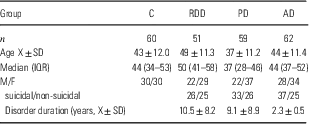
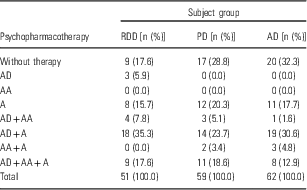
The distribution of subjects according to the ICD-10 diagnosis, gender, age and suicide attempt is shown in Table 1, whereas the distribution of psychopharmacological therapy taken by subjects is outlined in Table 2. No statistically significant differences were found in the representation of a single gender in the different subject groups (χ2=2.00; ss=3; p=0.579). There was no statistically significant difference in the median age of subjects between the control group of health subjects and subjects with diagnosed AD (Mann–Whitney U=1773; Z=−0.44; p=0.658). Subjects with diagnosed depression were significantly older (Mann–Whitney U=1126; Z=−2.39; p=0.017). Subjects with diagnosed PD were statistically significantly younger than healthy subjects from the control group (Mann–Whitney U=1269; Z=−2.66; p=0.008). In addition, there was a statistically significant difference in the median age between subjects who had attempted suicide and those who had not attempted suicide (Mann–Whitney U=2724; Z=−2.73; p=0.006). Subjects who had attempted suicide had a lower average age (median=42 years, interquartile range=31–51 years) than those subjects who had not attempted suicide (median=47 years, interquartile range=39–54 years). However, no statistically significant correlation was found between the BDNF levels and subject age (Spearman ρ=0.079; p=0.247). No statistically significant difference was found in the prevalence of suicide attempts between the RDD, PD and AD groups of subjects (χ2=3.917; df=2; p=0.146). No statistically significant differences were found in the prevalence of suicide attempts between men and women (χ2=1.14; df=1; p=0.286).
Distribution of subjects according to diagnosis, age, sex and suicide attempt
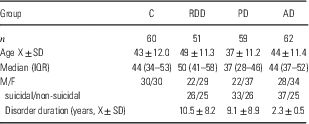
AD, adjustment disorder; C, healthy control group; IQR, interquartile range; n, number of subjects; PD, personality disorder; RDD, recurrent depressive disorder; SD, standard deviation; X, arithmetic mean.
Distribution of psychopharmacotherapy by subject group
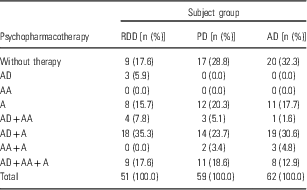
A, anxiolytic; AA, atypical antipsychotic; AD, antidepressant; n, number of subjects; PD, personality disorder; PP, adjustment disorder; RDD, recurrent depressive disorder.
Methods
Blood samples in all subjects have been collected during the usual laboratory treatment, by the standardised process, on the second fasting day upon patient’s hospitalisation in the Sveti Ivan Psychiatric Hospital. Blood samples from blood donors have been collected at Croatian Institute for Transfusion Medicine and transferred by the standardised supervised procedure to the Department of Laboratory Diagnostics, where laboratory analysis was conducted. All of the samples have been centrifuged (4500 g) for 10 min at room temperature and the serum was stored frozen at −25°C until analysis performed. The determination of serum BDNF levels was performed by enzyme immunochemical methods, using commercially available sets and according to manufacturer’s instructions (RayBiotech Inc., Norcross, GA, USA) on an Elisys Uno Analyser (Human, Wiesbaden, Germany). This assay employs an antibody specific for human BDNF coated on a 96-well plate. Standards and samples are pipetted into the wells and BDNF present in a sample is bound to the wells by the immobilised antibody. The wells are washed and biotinylated antihuman BDNF antibody is added. After washing away unbound biotinylated antibody, HRP-conjugated streptavidin is pipetted to the wells. The wells are again washed, a TMB substrate solution is added to the wells and color develops in proportion to the amount of BDNF bound. The Stop Solution changes the color from blue to yellow, and the intensity of the color is measured at 450 nm. The minimum detectable dose of BDNF is <80 pg/ml.
Statistical analysis of data
The normal distribution of variables expressed on an interval scale was tested using the Kolmogorov–Smirnov test. Considering that the majority of variables determined that there is a statistically significant deviation of the distribution from the theoretically expected normal distribution, non-parametric tests and the appropriate measures of central tendencies and distribution were applied – median and interquartile dispersion – while for normal distribution the arithmetic mean and standard deviation were applied.
Statistical significant associations between two variables with two or more categories were tested using the χ2-test.
In determining statistically significant correlations of two continuous variables, the Spearman ρ correlation rank coefficient was used. Logistical regression analysis was performed to determine whether there is a relationship between BDNF levels, gender, age and therapy with suicide attempt.
Results
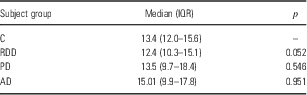
Due to abnormal variable distribution as the result of Kolmogorov−Smirnov test, the Kruskal−Wallis test pointed no statistically significant difference between the three group of affected subjects. The Mann−Whitney U-test did not establish a statistically significant difference in the level of BDNF between the phenotypically health control group of subjects and the affected subjects from the study groups based on the diagnosis of mental disorders. The BDNF levels are shown in Table 3.
Level of BDNF (ng/ml) in phenotypically healthy subjects and all affected subjects
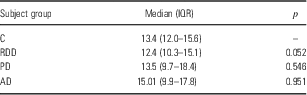
AD, adjustment disorder; BDNF, brain-derived neurotrophic factor; C, control healthy group; IQR, interquartile range; p, statistical significant difference between test groups; Mann–Whitney U-test; PD, personality disorder; RDD, recurrent depressive disorder.
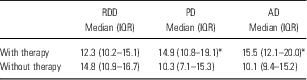
Considering that there are a small number of subjects within each individual taking a specific type of therapy (monotherapy or simultaneous combination of medicines), for the purposes of testing, we pregrouped those subjects not taking psychopharmacotherapy and those taking psychopharmacotherapy. For those subjects suffering from RDD, there was no statistically significant difference in BDNF levels between those taking and those not taking psychopharmacotherapy (Mann−Whitney U=120; Z=–1.379; p=0.163). For subjects with PD, a statistically significant differences for BDNF levels was found with regard to taking therapy (Mann−Whitney U=169; Z=–2.253; p=0.022; AUC=0.3), as was the case for subjects with AD (Mann−Whitney U=196.5; Z=–2.978; p=0.002; AUC=0.26). In both groups, those subjects taking psychopharmacotherapy had, on average, higher BDNF levels. The results of determining the BDNF levels in individual groups of subjects taking psychopharmacotherapy in comparison with those not taking psychopharmacotherapy are shown in Table 4.
Level of BDNF (ng/ml) in relation to taking psychopharmacotherapy
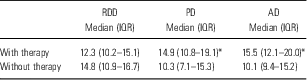
AD, adjustment disorder; BDNF, brain-derived neurotrophic factor; IQR, interquartile range; PD, personality disorder; RDD, recurrent depressive disorder.
* p<0.05 – statistically significant difference in relation to BDNF levels of subjects not taking psychopharmacotherapy, using Mann–Whitney U-test.
A statistically significant difference was found in the level of BDNF between subjects in all three groups together with regard to their psychopharmacotherapy (ANOVA, F-ratio=3.654; df=6, p=0.002).
Addition post-hoc tests confirmed a statistically significant difference for the level of BDNF between the subjects in all three groups together without any therapy and the group of subjects simultaneously taking an antipsychotic and anxiolytic (Bonferroni post-hoc test, p=0.035), and between the group without any therapy and the group of subjects simultaneously taking an antidepressive, antipsychotic and anxiolytic (Bonferroni post-hoc test, p=0.01). In both groups, the subjects without any therapy had a statistically significantly lower level of BDNF.
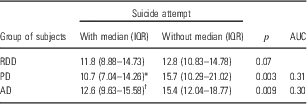
The BDNF levels in groups of affected subjects according to the criteria of whether they had or had not attempted suicide were shown in Table 5. In those affected with RDD, there was no statistically significant difference in the BDNF levels between those who had and those who had not attempted suicide (Mann−Whitney U=190.5; Z=−1.802; p=0.07). For those affected with PD, subjects who had attempted suicide had, on average, lower BDNF levels than those without suicide attempts (Mann−Whitney U=157.5; Z=−3.0; p=0.003; AUC=0.31). The same result was found in the group of those suffering from AD, that is, subjects with suicide attempts had, on average, lower BDNF levels than those without suicide attempts (Mann−Whitney U=254.5; Z=−2.616; p=0.009; AUC=0.3).
Level of BDNF (ng/ml) in affected subjects, according to suicide attempts
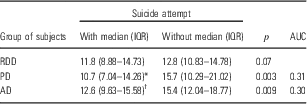
AD, adjustment disorder; AUC, standardised area under the curve; BDNF, brain-derived neurotrophic factor; IQR, interquartile range; p, Mann–Whitney test of statistical significance of differences; PD, personality disorder; RDD, recurrent depressive disorder.
* p=0.003 in relation to test group PD without suicide attempt.
† p=0.009 in relation to test group AD without suicide attempt.
Logistical regression analysis was performed to determine whether there is a relationship between BDNF levels, gender, age and therapy with suicide attempt. The results indicated that taking psychopharmacotherapy and BDNF levels were statistically significantly associated with suicide attempt, in the consideration of gender, taking therapy, age, BDNF levels and the mutual relations of those variables. The results obtained showed that subjects taking therapy had a 91% lower likelihood of suicide attempt than those not taking therapy (odds ratio=0.09; 95% CI: 0.03–0.269). Also, every unit increase of the serum level of BDNF reduced the likelihood of a suicide attempt by 11.4% (odds ratio=0.886; 95% CI: 0.819–0.958). Gender and age did not prove to be significant predictors of suicide attempt.
Discussion
The results of this research shows that there are no differences in BDNF serum levels between the different test groups, but that there are differences within groups of subjects with PD and AD with regard to suicide attempts, that is, subjects who had attempted suicide had lower BDNF levels. In both groups (PD and AD), those subjects taking psychopharmacotherapy had, on average, higher BDNF levels.
Over the past decade, numerous studies have been conducted on the association between BDNF and depression. Despite its name, BDNF is in addition to the nervous system found in various tissues and cell types. It is synthesised in the neurons of the brain and spinal cord, Schwann cells, endothelial cells, smooth muscle, and it is also found in the retina, kidney cells, prostate, platelets, leukocytes, liver cells and salivary glands (Reference Dwivedi8). Although the role of BDNF in circulation is not completely clear, it is assumed that changes in its level in the blood may reflect changes in its level in the brain (Reference Hashimoto52).
Most studies have shown reduced BDNF levels in those suffering from major depressive disorder (Reference Karege, Perret, Bondolfi, Schwald, Bertschy and Aubry20–Reference Yoshimura, Mitoma and Sugita25,Reference Jevtovic, Karlovic, Mihaljevic-Peles, Seric, Vrkic and Jaksic53,Reference Zhang, Wang, Sha, Zhou and Zhang54). Research of BDNF levels in plasma of those affected by depression and with suicide attempt in comparison with those with depression but without suicide attempt and in comparison with the phenotypically healthy control group, show reduced BDNF levels in those with depression and with suicide attempt (Reference Kim, Lee and Won38,Reference Deveci, Aydemir, Taskin, Taneli and Esen-Danaci39,Reference Lee, Kim, Park and Kim41). Similar findings were obtained in research of the expression of BDNF mRNA in those suffering from depression, which was lower in subjects with suicide attempt than in those without suicide attempt, all of which were lower than in the healthy control group (Reference Lee and Kim40,Reference Schenkel, Segal, Becker, Manfro, Bianchin and Leistner-Segal42). However, in the present study, no differences were found in BDNF levels between depressed subjects with or without suicide attempt, and there were no statistically significant difference in BDNF levels with regard to whether they were or were not taking psychopharmacotherapy. One of the explanation is that the majority of depressed subjects were taking psychopharmacotherapy (antidepressants are the most common) and literature data suggest that antidepressants increases the level of BDNF (Reference Huang, Lee and Liu2,Reference Dwivedi8,Reference Yoshimura, Mitoma and Sugita25,Reference Castrén and Rantamäki27–Reference Dwivedi, Rizavi and Pandey29,Reference Satomura, Baba, Nakano, Maeshima, Suzuki and Arai33–Reference Serra-Millas, Lopez-Vilchez and Navarro35,Reference Ninan, Shelton, Bao and Guico-Pabia55). Moreover, in our study, subjects suffering from depression had slightly lower BDNF level in comparison with the phenotypically health control group, and those depressed subjects with suicide attempt had lower BDNF level in comparison with those without suicide attempt, but the difference was not statistically significant. In addition, logistic regression analysis showed that not taking pharmacotherapy, and lower BDNF were associated with attempted suicide, so in our group of RDD patients is a small proportion who do not take pharmacotherapy (17.6%) compared with PD (28.8%) and AD (32.3%) group and BDNF concentration was lower in the entire group, regardless of the suicide attempt compared with control, PD and AD group (but not statistically significant) and therefore it can be the reason that it does not result in a statistically significant difference in the concentration of BDNF between RDD patients with and without suicide attempts, as obtained from other examined groups.
It is possible that if the sample size had been larger, this differences might have been statistically significant but with sample group that we had we cannot conclude that the BDNF level is specific to depression or suicide attempt.
Post-mortem studies show significantly reduced BDNF levels in the hypocampus and prefrontal cortex in suicide victims, regardless of the mental disorder they suffered from (Reference Dwivedi56,Reference Dwivedi, Rizavi and Zhang57). Clinical research of BDNF in the peripheral circulation of suicidal patients, post-mortem studies of the brain of suicide victims with and without a history of depressive disorder, and genetic studies correlating BDNF with suicide, indicate the possible correlation of suicidal behaviour with reduced BDNF function. It is assumed that an increase in the brain BDNF level that is seen during therapy with antidepressive medications strengthens the neural integrity and stimulates the recovery of functioning in mental disorders, and it appears as though this could prevent suicide attempts. It is possible that reduced BDNF function is associated with suicidal behaviour, regardless of mental disorder, and that an improvement in its function during treatment is independent of an improved clinical status of the mental disorder.
As stated above, numerous studies have shown an association of disturbed BDNF function and its related receptors at various levels with suicidal behaviour, though it can be assumed that the reduced function of BDNF in persons with suicidal behaviour is independent of mental disorders.
In the present study, logistic regression analysis showed a statistically significant correlation of psychopharmacotherapy (OR=0.09; 95% CI: 0.03–0.269) and BDNF level (OR=0.886; 95% CI: 0.819–0.958) with suicide attempt. The BDNF level and mutual relations of the tested parameters support the earlier data from the literature on the association of reduced BDNF levels with suicidal behaviour.
Conclusions
The lower levels of BDNF in subjects suffering from PD and AD with suicide attempts, and the result of the predictive model in which psychopharmacotherapy and BDNF levels are a significant predictor for suicide attempts, in conjunction with the literature data, indicate a correlation of BDNF with suicide attempts, independent of the mental disorder.
Acknowledgements
The authors would like to thank the staff of the Psychiatric Hospital ‘Sveti Ivan’, as well as staff of the Croatian Institute for Transfusion Medicine. M.G. for substantial contributions to conception and design of manuscript drafting the article, final approval of the version to be published; M.M. for substantial contributions to conception and design, revising it critically for important intellectual content, final approval of the version to be published; R.N. for drafting the article, acquisition of data, analysis and interpretation of data, revising it critically for important intellectual content, final approval of the version to be published; B.R.P. for substantial contributions to conception and design, drafting the article, final approval of the version to be published; M.S. for acquisition of data, revising it critically for important intellectual content, final approval of the version to be published; and J.S. for acquisition of data, revising it critically for important intellectual content, final approval of the version to be published.
Financial Disclosure
This work has been supported by the Ministry of Science, Education and Sport, grant number 278-0000000-0071.