Introduction
In 2016, 37.8 million adults in the USA (15.5%) reported current cigarette smoking (Jamal et al., Reference Jamal, Phillips, Gentzke, Homa, Babb and King2018). Among adult smokers, 68% reported their intention to quit smoking, and 55% of them attempted to quit (Babb, Malarcher, Schauer, Asman, & Jamal, Reference Babb, Malarcher, Schauer, Asman and Jamal2017). Accordingly, there are a number of effective smoking cessation treatments available including behavioral interventions and both over-the-counter (OTC) and prescription-level pharmacological treatments (Babb et al., Reference Babb, Malarcher, Schauer, Asman and Jamal2017).
As the prevalence of smartphone use has increased from 35% of Americans in 2011 to 77% in 2018 (Pew Research Center, 2018), more mobile technologies have been applied in the domain of smoking cessation (Burns et al., Reference Burns, Begale, Duffecy, Gergle, Karr and Giangrande2011; Krishna, Boren, & Balas, Reference Krishna, Boren and Balas2009; Kumar et al., Reference Kumar, Nilsen, Abernethy, Atienze, Patrick and Pavel2013; Patrick et al., Reference Patrick, Rabb, Adams, Dillon, Zabinski and Rock2009; Quinn et al., Reference Quinn, Shardell, Terrin, Barr, Ballew and Gruber-Baldini2011; Riley et al., Reference Riley, Rivera, Atienze, Nilsen, Allison and Mermelstein2011). Smartphones have enabled their users to access and interact with health care professionals from any place at any time (Patrick, Griswold, Raab, & Intille, Reference Patrick, Griswold, Raab and Intille2008; Riley et al., Reference Riley, Rivera, Atienze, Nilsen, Allison and Mermelstein2011). Among mHealth approaches, smartphone mobile applications (apps) for smoking cessation promise to increase access to smoking cessation services for consumers and their healthcare providers.
Prior studies examined smoking cessation mobile apps in Brazil, China, South Korea, Australia, the UK, and the USA (Bennett et al., Reference Bennett, Toffey, Dickerson, Himelhoch, Katsafanas and Savage2015; BinDhim, McGeechan, & Trevena, Reference BinDhim, McGeechan and Trevena2014; Bricker et al., Reference Bricker, Mull, Kientz, Vilardaga, Mercer and Akioka2014; Buller, Borland, Bettinghaus, Shane, & Zimmerman, Reference Buller, Borland, Bettinghaus, Shane and Zimmerman2014; Cheng, Xu, Su, Fu, & Bricker, Reference Cheng, Xu, Su, Fu and Bricker2017; Choi, Noh, & Park, Reference Choi, Noh and Park2014; Formagini et al., Reference Formagini, Ervilha, Machado, Bottaro de Andrade, Gomide and Ronzani2017; Thornton et al., Reference Thornton, Quinn, Birrell, Guillaumier, Shaw and Forbes2017; Ubhi, Michie, Kotz, Wong, & West, Reference Ubhi, Michie, Kotz, Wong and West2015). For example, Haskins, Lesperance, Gibbons, and Bourdreaux, (Reference Haskins, Lesperance, Gibbons and Bourdreaux2017) evaluated smoking cessation apps mentioned in the health science literature, and Ferron et al. (Reference Ferron, Brunette, Geiger, Marsch, Adachi-Mejia and Bartels2017) conducted a review on the usability and usefulness of these apps among smokers with mental health disorders. Some studies have considered behavior change techniques (e.g., feedback, self-monitoring and reinforcement) as a standard against which to evaluate the merit of these apps (Michie et al., Reference Michie, Richardson, Johnston, Abraham, Francis and Hardeman2013; Ubhi et al., Reference Ubhi, Kotz, Michie, van Schayck, Sheard and Selladurai2016a, Reference Ubhi, Michie, Kotz, van Schayck, Selladurai and West2016b). Further, the US Public Health Service guideline for treating tobacco use and dependence (Fiore et al., Reference Fiore, Jaen, Baker, Bailey, Bennett and Benowitz2008) has been utilized as a standard for the review of smoking cessation apps (Abroms, Padmanabhan, Thaweethai, & Phillips, Reference Abroms, Padmanabhan, Thaweethai and Phillips2011, Abroms, Westmaas, Bontemps-Jones, Ramani, & Mellerson, Reference Abroms, Westmaas, Bontemps-Jones, Ramani and Mellerson2013; Ferron et al., Reference Ferron, Brunette, Geiger, Marsch, Adachi-Mejia and Bartels2017). The US Public Health Service guideline provides evidence-based recommendations for clinical interventions on smoking cessation. Among those recommendations, it highlights a 5As model representing five major steps for a brief intervention for smoking cessation, particularly in health care settings. The 5As model includes (1) ‘Ask’ the patient about tobacco use; (2) ‘Advise’ the patient to quit tobacco use; (3) ‘Assess’ willingness to quit smoking; (4) ‘Assist’ those who are willing to quit tobacco use; and (5) ‘Arrange’ for a follow-up appointment to prevent relapse.
However, limited information exists on the quality and content of available apps for increasing access to smoking cessation services. In the current study, we review the quality and content of contemporary smoking cessation mobile apps and examine whether they adhered to the US Public Health Service guideline for treating tobacco use and dependence (i.e., ‘5As’). Therefore, our aim was to provide a contemporary review of currently available smoking cessation apps for the benefit of consumers and health professionals. In addition to evaluating the content and quality of apps using a standardized instrument, we considered the US Public Health Service guideline as a framework to evaluate smoking cessation apps and discuss its implications on the development of smoking cessation apps in the future. Although the US Public Health Service guideline was originally developed for clinical settings, it is the most widely accepted guideline for smoking cessation, and has been applied in the past to evaluate both computer-mediated (Bock et al., Reference Bock, Graham, Sciamanna, Krishnamoorthy, Whiteley and Carmona-Barros2004) as well as mobile-based smoking cessation programs (Abroms et al., Reference Abroms, Padmanabhan, Thaweethai and Phillips2011, Reference Abroms, Westmaas, Bontemps-Jones, Ramani and Mellerson2013).
Methods
A sample of 180 apps was downloaded for the two leading smartphone operating systems from the App Store (Apple, n = 90) and Google Play Store (Android, n = 90) in January 2018. The top-ranking 30 apps were retrieved for each of the following three smoking cessation-related search terms (‘smoking cessation’, ‘quit smoking’, ‘stop smoking’) in both the App Store and Google Play Store. The top-ranking 30 apps were selected for practical reasons and given that ranking of apps is partly determined by user popularity (Thornton et al., Reference Thornton, Quinn, Birrell, Guillaumier, Shaw and Forbes2017). Apps that were duplicate (n = 84), were not free (n = 23) or were inaccessible (e.g., required registration or dead link) (n = 6) were excluded from the study. Reviewers were trained to score each app based on previously determined scales as part of content coding (Paige, Alber, Stellefson, & Krieger, Reference Paige, Alber, Stellefson and Krieger2018; Thornton et al., Reference Thornton, Quinn, Birrell, Guillaumier, Shaw and Forbes2017). A total of 67 smoking cessation apps (37.2%) were reviewed in full and included in the final analyses (See Figure 1). The list of included smoking cessation apps is available in Appendix.
Mobile Apps Selection Flowchart.

Measures
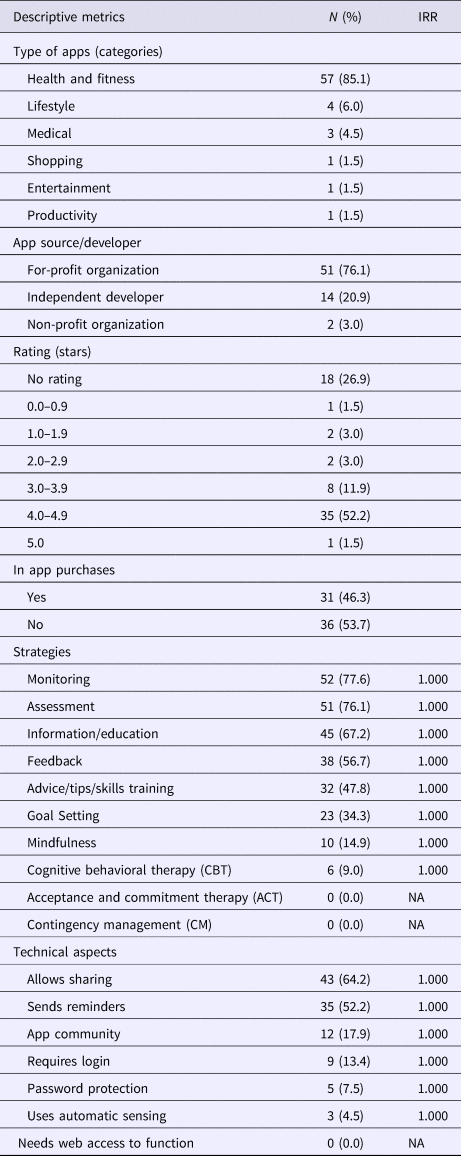
Two reviewers (AL, II) independently coded the 67 apps. The two reviewers were trained to rate smoking cessation apps prior to coding the technical quality of the apps using the Mobile Application Rating Scale (MARS) (Stoyanov et al., Reference Stoyanov, Hides, Kavanagh, Zelenko, Tjondronegoro and Mani2015) and the adherence of apps to the US Public Health Service guideline for treating tobacco use and dependence. The following descriptive categories were coded: (1) app categories (i.e., health and fitness, lifestyle, medical, shopping, entertainment, or productivity); (2) app source/developer (i.e., for-profit organization, independent developer, or non-profit organization); (3) user-rating (5-point star); (4) in-app purchase (i.e., additional content or subscriptions that customers can buy in apps such as upgrade to pro-edition and removal of ads); (5) strategies (e.g., monitoring, feedback, information/education); and (6) technical aspects (e.g., allows sharing, app community, password protection). For a complete list of categories, see Table 1. These descriptive categories were determined based on previous studies (Paige et al., Reference Paige, Alber, Stellefson and Krieger2018; Thornton et al., Reference Thornton, Quinn, Birrell, Guillaumier, Shaw and Forbes2017).
Characteristics of included smoking cessation apps (n = 67)

Note: Scores were coded dichotomously (Yes/No) and the inter-rater reliability (IRR) was estimated for Cohen's kappa.
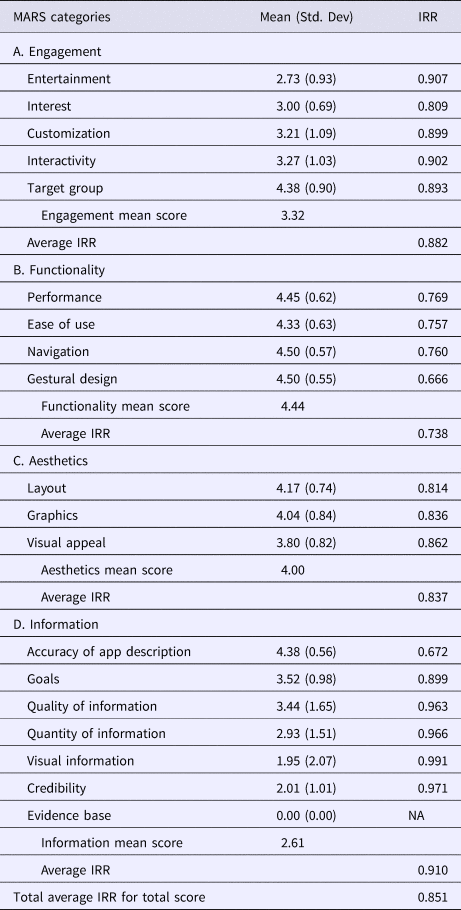
The technical quality of the included apps was rated using the Mobile Application Rating Scale (MARS) (Stoyanov et al., Reference Stoyanov, Hides, Kavanagh, Zelenko, Tjondronegoro and Mani2015), which includes four domains: (1) Engagement (e.g., fun, interesting, customizable); (2) Functionality (e.g., easy to learn, navigation); (3) Aesthetics (e.g., graphic design, overall visual appeal); and (4) Information (e.g., text, feedback, measures, references). Each category of MARS was scored on a five-point scale (i.e., 1 = Inadequate; 2 = Poor; 3 = Acceptable; 4 = Good; 5 = Excellent).
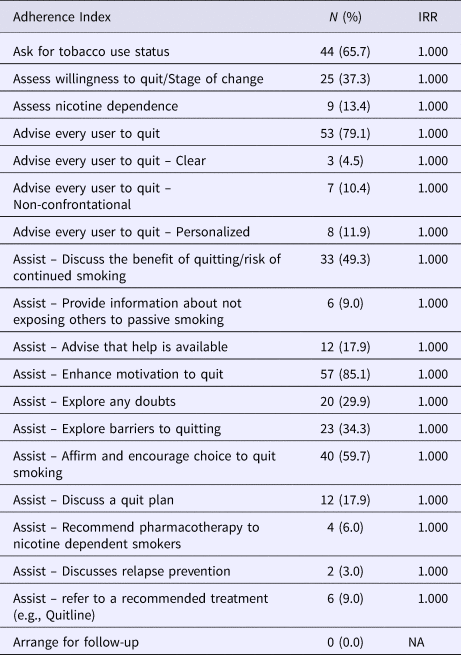
Apps were also reviewed for whether they adhered to the 5As (i.e., Ask, Assess, Advise, Assist, and Arrange) (Fiore et al., Reference Fiore, Jaen, Baker, Bailey, Bennett and Benowitz2008), which has been previously applied in reviewing web-based smoking cessation treatments (Bock et al., Reference Bock, Graham, Sciamanna, Krishnamoorthy, Whiteley and Carmona-Barros2004) as well as smoking cessation apps (Abroms et al., Reference Abroms, Padmanabhan, Thaweethai and Phillips2011, Reference Abroms, Westmaas, Bontemps-Jones, Ramani and Mellerson2013). Each category included the following subsets: (1) ‘ask for tobacco use status’; (2) ‘assess willingness to quit/stage of change, and assess nicotine dependence’; (3) ‘advise to quit clearly, advise to quit non-confrontationally, and advise to quit in a personalized manner’; (4) ‘assist to discuss the benefit of quitting and risk of continued smoking, provide information about not exposing others to passive smoking, advise that help is available, enhance motivation to quit, explore any doubts, explore barriers to quitting, affirm and encourage choice to quit smoking, discuss a quit plan, recommend pharmacotherapy to nicotine-dependent smokers, discuss relapse prevention and refer to a recommended treatment (e.g., Quitline)’; and (5) ‘arrange for follow-up.’
Results
Inter-rater reliability (IRR)
The IRR was estimated and indicated in each table. The characteristics of descriptive categories of included smoking cessation apps (n = 67) and adherence to the US Public Health Service guideline was coded dichotomously (no/yes) and the IRR was estimated using Cohen's kappa. As for the MARS, scores in each category were coded continuously from 1 (inadequate) to 5 (excellent) and the IRR was estimated for the intraclass correlation coefficient (ICC). The ICCs were estimated using SPSS statistical package version 25.0 (IBM Corp., 2017) based on average measures, absolute-agreement, two-way mixed effects models. The IRR with ICC for total MARS scores between the two primary reviewers was 0.85, indicating ‘good reliability’ (Koo & Li, Reference Koo and Li2016).
Characteristics of smoking cessation apps
Apps were organized according to specific features of interest and their counts were presented in Table 1. Out of the total 67 apps, 52 apps contained ‘monitoring’ (77.6%), 51 apps contained ‘assessment’ (76.1%), 45 contained ‘information/education’ (67.2%), 38 contained ‘feedback’ (56.7%), 32 contained ‘advice/tips/skills training’ (47.8%), and 23 contained ‘goal setting’ (34.3%). Among the 67 included apps, 43 qualified under ‘allows sharing’ (64.2%), 35 allowed for ‘sending reminders’ (52.2%), 12 allowed an ‘app community’ (17.9%). However, there was relatively low utilization of password protection (7.5%) and evidence-based therapeutic strategies such as cognitive behavioral therapy (CBT) (9.0%), acceptance and commitment therapy (ACT) (0.0%), and contingency management (CM) (0.0%).
Technical quality of the smoking cessation apps
Mobile application rating scale (MARS)
Across the 67 included apps (Table 2), the average score for MARS was 16.2/19.0, distributed as follows: 1) Engagement (3.3/5.0); 2) Functionality (4.4/5.0); 3) Aesthetics (4.0/5.0); and 4) Information (2.6/5.0). The average score for Visual Information (1.95) was lower than the average score for the overall Information domain in MARS (2.61) or the overall average score for MARS (3.59).
Summary of mobile application rating scale (MARS) Scores (n = 67)

Note: MARS Scale: 1 = Inadequate; 2 = Poor; 3 = Acceptable; 4 = Good; 5 = Excellent.
MARS scores are averaged for the two reviewers.
The inter-rater reliability (IRR) was estimated for intraclass correlation correlation (ICC).
Adherence to US Public Health Service guideline
The number of included apps that adhered to the US Public Health Service guideline was counted by adherence index. The ‘Assist – Enhance motivation to quit’ was adhered to the most (n = 57; 85.1%), followed by ‘Advise every user to quit’ (n = 53; 79.1%), and ‘Ask for tobacco use status’ (n = 44; 65.7%). The least adhered to index was ‘Arrange for follow-up’ (n = 0, 0.0%), followed by ‘Assist – Discusses relapse prevention’ (n = 2; 3.0%) and ‘Advise every use to quit in a clear manner’ (n = 3; 4.5%). The 5As features were included in the reviewed apps as follows: Ask (n = 44), Advise (n = 54), Assess (n = 30), Assist (n = 62), and Arrange (n = 0) (See Table 3). These counts were indicated when there was one or more adherence measure included for each construct.
Summary of adherence to the US Public Health Service Guideline (n = 67)

Note: Scores were coded dichotomously (Yes/No) and the inter-rater reliability (IRR) was estimated for Cohen's kappa.
Discussion
The objective of this review was to evaluate the quality and content of free mobile apps for smoking cessation and examine whether they adhered to the US Public Health Service guideline for treating tobacco use and dependence. Overall, we found that even though many smoking cessation apps included monitoring, assessment, education, and feedback strategies, they typically lacked several characteristics including: (1) recommendations for pharmacotherapy and behavioral treatments; (2) evidence-based therapeutic strategies such as CBT, ACT, and CM; (3) data protection; (4) sufficient visual information; and (5) discussion of relapse prevention.
The findings on adherence to the US Public Health Service guideline were consistent with previous results that showed low levels of adherence to this guideline (Abroms et al., Reference Abroms, Padmanabhan, Thaweethai and Phillips2011, Reference Abroms, Westmaas, Bontemps-Jones, Ramani and Mellerson2013; Ferron et al., Reference Ferron, Brunette, Geiger, Marsch, Adachi-Mejia and Bartels2017). For example, Ferron et al. (Reference Ferron, Brunette, Geiger, Marsch, Adachi-Mejia and Bartels2017) documented that smoking cessation apps have consistently failed or poorly adhered to referring users to evidence-based smoking cessation treatments (e.g., Quitline or approved medications). In the present study, whereas more than 50% of included smoking cessation apps adhered to one or more components of ‘Assist’, ‘Ask’ and ‘Advise’, none adhered to all 5As. Even though some elements of the guideline may be less applicable to the mobile application setting (e.g., ‘Arrange’), overall adherence to the guideline should be considered in future apps development. For example, scheduling a follow-up text message or automated phone call notification for a specific time (e.g., preferably in the first week after the quit date) may be a method to improve adherence to the ‘Arrange’ component (Fiore et al., Reference Fiore, Jaen, Baker, Bailey, Bennett and Benowitz2008).
None of the smoking cessation apps in our study utilized ACT or CM strategies and only six apps (9.0%) employed CBT strategies. Bricker et al. (Reference Bock, Graham, Sciamanna, Krishnamoorthy, Whiteley and Carmona-Barros2014) found that a smoking cessation app using ACT (SmartQuit) showed higher engagement and higher quit rates among participants compared with another smoking cessation app (QuitGuide) (Bricker et al., Reference Bricker, Mull, Kientz, Vilardaga, Mercer and Akioka2014). Even though the study by Bricker et al. (Reference Bricker, Mull, Kientz, Vilardaga, Mercer and Akioka2014) was a pilot study and long-term outcomes have not demonstrated the effectiveness of using ACT in web-delivered smoking cessation interventions (Bricker, Mull, McClure, Watson, & Heffner, Reference Bricker, Mull, McClure, Watson and Heffner2018), the integration of behavior change techniques into smoking cessation apps should be further considered. CM is another strategy to improve engagement within smoking cessation apps (Zeng, Vilardaga, Heffner, Mull, & Bricker, Reference Zeng, Vilardaga, Heffner, Mull and Bricker2015) and has been previously tested in a feasibility trial of at least one smoking cessation app (Hicks et al., Reference Hicks, Thomas, Wilson, Calhoun, Kuhn and Beckham2017). While including evidence-based therapeutic strategies in smoking cessation apps may require more complex programming and resources, utilization of evidence-based therapeutic strategies such as ACT and CBT for future app development may increase the quality of smoking cessation apps.
Further, the failure to address relapse prevention presents another area for improvement. National data indicate that cigarette smoking has shown a higher risk of relapse among former smokers within their first year of abstinence (Garcia-Rodriguez et al., Reference Garcia-Rodriguez, Secades-Villa, Florez-Salamanca, Okuda, Liu and Blanco2013). This raises the concern of sustainability of smoking abstinence when relapse-prevention strategies are lacking in smoking cessation apps. For future app development, adding content specific to relapse prevention may be beneficial for long-term abstinence among smoking cessation app users.
Finally, the lack of visual information was identified in MARS. A similar trend was also found in the previous literature. Ferron et al. (Reference Ferron, Brunette, Geiger, Marsch, Adachi-Mejia and Bartels2017) found that smoking cessation app users identified text-dense content in reviewed smoking cessation apps, which may be unappealing and unengaging for app users. Given that regular use of smoking cessation apps may increase the success of smoking cessation (Backinger & Augustson, Reference Backinger and Augustson2011), improving visual information may elevate user interests and engagement with smoking cessation apps; and in turn, may increase the success of smoking cessation. Even though there were some areas for improvement among currently available free smoking cessation apps, these weaknesses can be improved upon in future app development. It is therefore recommended that future apps include a focus on the following measures to improve upon existing apps: effective use of visualization, incorporating evidence-based therapeutic content, using data protection, and adding relapse prevention content.
This study included some limitations. First, for practical reasons, only the top-ranking 30 apps were retrieved for three smoking cessation-related search terms from the App Store and Google Play Store. Since many factors such as advertising, frequency of app updates, and keyword searching (i.e., familiarity of app title) may affect the ranking of the apps (Thornton et al., Reference Thornton, Quinn, Birrell, Guillaumier, Shaw and Forbes2017), we cannot rule out the possibility that there may have been other apps that were not ranked among the top 30 for the phrases searched, but included higher quality content and adhered to the US Public Health Service guideline. Second, this review only included the smoking cessation apps available at the time of the app search. Thus, this up-to-date smoking cessation app review may be beneficial for future research studies. Third, we cannot rule out whether personal information was collected across all apps, and therefore data protection may not be required for some apps. Finally, we only included free smoking cessation apps in the present study. It is possible that apps that require payment are more likely to be grounded in the evidence-based strategies. Future studies should consider including paid smoking cessation apps in the content analysis.
Conclusions
In summary, this study provides an updated evaluation of smoking cessation app quality and adherence to the US Public Health Service guideline, concluding that most smoking cessation apps have areas for improvement, such as the lack of therapeutic strategies, relapse intervention, and adherence to all components of the guideline. Even though more resources are needed to implement therapeutic strategies in smoking cessation apps (i.e., requiring more complex programming) and despite practical limitations to guideline adherence in the mobile app environment (e.g., the ‘arrange’ component), those limitations should be considered and addressed in future app development. Given the growing availability of smoking cessation apps as potential cessation aides, future efforts should focus on improving the technical quality of these apps and their adherence to evidence-based guidelines for treating tobacco use and dependence.
Acknowledgement
None.
Author contributions
RS designed the study and supervised data collection and analysis. JL wrote the first draft of the manuscript. II, AL, and SJ conducted data collection and analysis. All authors critically reviewed and contributed the manuscript.
Financial support
Ms. Ibe and Ms. Joseph received support as trainees from the Research Training Opportunities for Outstanding Leaders (ReTOOL) Program, sponsored by the National Cancer Institute Award # R25CA214225. Drs. Salloum and Huo were mentors in ReTOOL.
Conflict of interest
None.
Appendix. Included Smoking Cessation Apps and Adherence to the US Public Health Service Guideline