


The prevalence of obesity and overweight is increasing in both adult and childhood populations in most Western countries(1). Current estimates on the prevalence of overweight and obesity in adults in developed countries vary from 70 % of adults in the USA to 29 % in Japan(1). Dramatic increases in obesity prevalence in the last two decades have been reported in the USA, the UK, Australia and China(2–Reference Bell, Ge and Popkin5). The prevalence of excess weight or obesity is much lower in Japan and Korea and in some European countries, although it is important to note that the incidence is increasing(6).
Excess adiposity presents a major risk to health through its association with a wide range of chronic disease such as type 2 diabetes, CVD and also some cancers(Reference Willett, Manson, Stampfer, Colditz, Rosner, Speizer and Hennekens7). The WHO has recommended that the prevention of overweight and obesity should begin early in life and target adults even while BMI is still within an acceptable range. A sustainable healthy lifestyle, combining a nutritionally adequate diet of lower energy density with a reduction in sedentary behaviour, is critical(1).
The rising prevalence of obesity has resulted in a significant response from governments. Responses have until now focused on treatment but recently government priorities have shifted to the prevention of excess weight gain. As a result, community organizations are prioritizing the development of health policies and strategies to prevent weight gain. These interventions will need to address socio-environmental factors, the planning and design of communities to support activity and healthy eating, social marketing as well as equipping the population with skills to manage a changing environment. There is little evidence available to inform successful strategies or interventions.
Previous reviews on the prevention of obesity have noted few successful interventions. A systematic review by Hardeman et al., aimed specifically to identify weight gain prevention interventions in adults and children, used broad search criteria and found only two interventions in adults(Reference Hardeman, Griffin, Johnston, Kinmonth and Wareham8). Since 2000, further interventions have been published. A review by Lemmens et al. included interventions where weight maintenance was a secondary outcome following changes in dietary intake, physical activity or both(Reference Lemmens, Oenema, Klepp, Henriksen and Brug9). Brown et al. reviewed interventions for both the prevention and treatment of obesity. The majority of studies were aimed at treatment, confirming the lack of high-quality interventions to prevent weight gain and in particular the lack of interventions targeted at the general population living in the community(Reference Brown, Avenell, Edmunds, Moore, Whitaker, Avery and Summerbell10).
Interventions designed specifically to prevent weight gain will be distinctly different from those aimed at the treatment of obesity or at the effect of changing a single component of behaviour. Single-component interventions aimed at diet or those aimed at physical activity behaviour change often report the effect of the intervention on weight or body composition as a secondary outcome after a focused intervention(Reference Howard, Manson and Stefanick11). This is of interest in determining the mechanism for weight change, but they are of limited applicability at a population-based level.
There are limitations in comparing the work on treatment directly with programmes for the prevention of weight gain. Weight-loss treatment programmes tend to attract motivated individuals with a specific reason to lose weight. Substantial weight gain is likely to affect an individual’s motivation and adherence to weight-loss maintenance strategies, compared with those who have never experienced the related health problems commonly felt by the overweight or obese. Population data clearly show sustained weight gain, reported to be approximately 0·7 kg per year, in adults. It is clear that sustained change to energy balance will result in weight change. What is not clear is how this advice should be delivered, the frequency of contact, the key behavioural components, the nature and the mode of support. As cost is an important consideration in population-based interventions, it is important to determine potentially successful behavioural strategies with the least intensive delivery mode that are also practical and feasible. There is, therefore, a need for an up-to-date systematic review on prevention of weight gain that compares interventions with the similar aim of preventing weight gain.
The aim of the present review is to describe controlled weight gain prevention interventions in adults. Specifically we wanted to investigate the key components that are related to both positive and negative outcomes in order to inform the development of effective, low-cost, community interventions to prevent weight gain. We therefore have focused on a comparison of components, intensity and delivery modes as well as effect size.
Methods
Criteria for considering studies for review
Interventions were included if: the primary outcome was to prevent weight gain in adults; the study design included a comparison group, randomized or not; the study duration was greater than 3 months; and the study included a follow-up of greater than 3 months. Family studies were included if aimed at adults as well as children.
Interventions were excluded if they aimed to recruit only overweight or obese participants, or if they targeted subgroups with diabetes, pre-diabetes or CVD, weight gain in pregnancy or a diagnosed obesity-related factor such as smoking. Interventions were also excluded if they aimed at changes to diet or physical activity and assessed the effect of the intervention on weight as a secondary outcome. Interventions were excluded if they included pharmacological or surgical interventions.
The rationale for the exclusion criteria was to capture high-quality interventions aimed at general populations.
Search strategy
The search strategy was adapted from that used by Hardeman et al.(Reference Hardeman, Griffin, Johnston, Kinmonth and Wareham8). The following electronic databases were searched: Medline, Psychinfo, Embase, EBM reviews (including DARE, Cochrane DSR, clinical trial registry, Cochrane library, CENTRAL, ACP journal club) and CINHAL. The reference lists of review articles were hand searched in order to find other potentially eligible studies. The abstracts from the most recent scientific meetings (2007 and 2008) of the International Association for the Study of Obesity and the Obesity Society were also searched, as potentially they contain studies not yet published. The search strategy is shown in Table 1.
Search strategy for the present reviewFootnote *

exp, experimental; ADJ, adjacent; RCT, randomized controlled trial.
* Note: limited to human subjects, English language, years 1998–2008; as key words or phrases unless specified.
Results
Identification of papers
Papers identified from each database were cross-checked manually and duplicates removed. Fifty papers were downloaded for consideration. Articles were rejected on an initial screening if the reviewer could determine from the title and abstract that the article did not meet the inclusion criteria for the review. Most rejections occurred because the primary aim was weight loss or tested diet or physical activity manipulation not explicitly aimed at the prevention of weight gain. Also, many interventions were aimed at children or at one or more weight-related factors such as smoking, pregnancy or schizophrenia. Full text versions of papers were obtained if there was doubt regarding eligibility.
Data synthesis
The combined search strategy identified ten manuscripts suitable for inclusion. However, two studies were based on the same data. In this case, related papers were checked to extract as much information as possible. Pilot studies were excluded if a full report on the same study population was available. Overall, nine separate trials are included in the present review.
Description of interventions
Delivery mode, intensity and outcome
Eiben and Lissner (2006) completed a study on forty women (mean age 22 years) who each had a parent whose BMI was >40 kg/m2. Parents were taking part in an obesity study which included a surgery option. Key components were: one individual session; customized support package; regular personalized contact via telephone and email; group sessions; special-interest lectures; and visits to a dietitian over 1 year. The attendance rates at these additional sessions were not reported. The intervention was small and having a parent contemplating obesity surgery may have influenced participation, motivation and outcomes. There was a difference in adjusted weight between groups after 1 year: 4·5 kg (P = 0·04), much of this due to weight gain in the control group(Reference Eiben and Lissner12).
Hivert et al. (2007) delivered a programme to young medical students (mean age 19 years). The intervention was reasonably intensive for participants although easy to deliver, comprising twenty-three seminars delivered over 24 months. The intervention was delivered by an endocrinology resident and a physical education graduate. Key components were: seminars based on physical activity, diet and behaviour; the use of specialists to deliver information; the simple delivery in a college setting; and targeting a healthy population. There was no additional individual support offered to participants. The control group was weighed six times in 24 months and this may have had an unintentional intervention effect. It is possible that contamination of the control group may have occurred as some students lived together in dormitories. There was a significant difference in weight between groups of 1·3 kg at 24 months (P = 0·04) but with limited generalizability as participants were college students with above-average health knowledge and attendance was poor(Reference Hivert, Langlois, Berard, Cuerrier and Carpentier13).
The Pound of Prevention trial, reported by Jeffrey and French (1999), was a low-intensity community-based study. The intervention group received mailed education materials (monthly newsletter) delivered over 3 years principally to women, with themes related to paying attention to weight and making small changes to diet and physical activity habits. Additionally, half of the intervention group were offered an incentive if they returned report cards. Community-based activities were offered every 6 months, but were poorly attended. Key components included mail-based delivery, in a healthy community, and specific recruitment of women with low socio-economic status. Self-monitoring of weight, eating and physical activity was targeted. However, this low-intensity mail-based intervention did not show a significant difference in weight change, compared with controls, at any time point over 3 years(Reference Jeffery and French14).
In a small brief study in sixty-four women, related to that of Levine et al. (2007)(Reference Levine, Klem, Kalarchian, Wing, Weissfeld, Qin and Marcus15), Klem et al. (2000) used three levels of intensity to determine acceptability of treatment formats: weekly group meetings for 10 weeks, ten mailed lessons over 10 weeks or a brochure. Moderate weight loss was encouraged initially, and diet and physical activity goals individually prescribed. There was no significant difference between groups at a 6-month follow-up(Reference Klem, Viteri and Wing16).
Leermarkers et al. (1998) compared a clinic-based and a home-based intervention with a no-treatment control in preventing weight gain in sixty-seven highly educated men, aged 25–40 years, recruited from a university. This 4-month intervention focused on exercise. Men attended twelve meetings in 16 weeks and sessions included supervised activity, fat intake and exercise goals. Both clinic-based and home-based intervention groups lost on average 1·6 kg more than controls at 4 months in this small short-term study(Reference Leermarkers, Jakicic, Viteri and Wing17).
Levine et al. (2007) compared three different intervention intensities: a clinic-delivered intervention of fifteen visits over 24 months, a correspondence course of fifteen lessons over 24 months and a control group receiving written information only. The intervention in 275 women (mean age 35·6 years) was conducted over 2 years with a further year of follow-up. Key components included encouraging regular monitoring of weight (participants were weighed at each session in the intervention, but weighed themselves in the mail-only group). Participants were given goals for energy intake and energy expenditure. Extensive support was offered to the clinic group, including individual counselling if weight gain occurred. Support was also offered to the mail group through mailed individualized support packages. There was a trend towards weight gain in the control group and small weight loss in the intervention group, but no significant difference between groups at any time point up to 3 years(Reference Levine, Klem, Kalarchian, Wing, Weissfeld, Qin and Marcus15).
Lombard et al. (2009, 2008) recently reported a robustly designed, low-intensity trial in 250 community-based women (mean age 40 years). This intervention reported the successful prevention of weight gain in women who were a generally healthy, representative sample of mothers of young children. The intervention consisted of four group behaviour change sessions followed by monthly remote contact by SMS text message for 1 year. Key components included a theory-based behaviour change strategy with clear messages on diet change and physical activity change, and self-monitoring of weight. Delivery occurred in the community setting in local primary schools. This low-intensity intervention, combining group contact and monthly support, resulted in a difference of −1·01 kg (P = 0·03) between the intervention and control groups after 1 year(Reference Lombard, Deeks, Jolley and Teede18, Reference Lombard, Deeks, Jolley, Ball and Teede19).
Rodearmel et al. (2006) reported a study in parents and children. Parents (n 159) taking part needed to have at least one overweight or obese child. This study had two simple aims, to increase steps and to increase cereal intake daily. The control group also attended three meetings over the 13 weeks. Pedometers were provided to both groups and both were required to keep daily diaries of intake and steps. Having a child take part in the intervention may have affected motivation and outcomes. In this short-term intervention mothers lost weight (−1·04 kg, P = 0·02) but fathers did not lose weight(Reference Rodearmel, Wyatt, Barry, Dong, Pan, Israel, Cho, McBurney and Hill20).
Kuller et al. (2001) and Simpkin-Silverman et al. (2003) conducted a labour-intensive intervention, the Women’s Healthy Lifestyle Project. This prescriptive intervention in women (mean age 47 years) included fifteen meetings in the first 20 weeks, then once or twice per month for 14 months, and regularly to 5 years. Their approach to prevention was to keep weight below baseline by study end, by encouraging a modest weight loss initially. Participants were also offered refresher programmes, cooking demonstrations and tasting sessions, exercise classes, group walks and dance classes, plus incentives and group competitions. Individual and small group consultations, delivered by psychologists, were offered to participants who were lapsing or gained weight. After 5 years the intensive intervention induced a weight change of −0·1 kg while the control group gained 2·4 kg (difference P < 0·001)(Reference Kuller, Simkin-Silverman, Wing, Meilahn and Ives21, Reference Simkin-Silverman, Wing, Boraz and Kuller22).
Quality, attendance and process
Table 2 describes the interventions, their intensity and mode of delivery, target behaviours, target group inclusion criteria and baseline characteristics. All nine interventions were randomized controlled trials although one study used a modified randomization(Reference Klem, Viteri and Wing16). The unit of randomization was individuals (seven studies), families (one study) or schools (one study). One study adjusted appropriately for a clustering effect created by the randomization method(Reference Lombard, Deeks, Jolley and Teede18, Reference Lombard, Deeks, Jolley, Ball and Teede19). Five studies reported on intention-to-treat analysis(Reference Eiben and Lissner12, Reference Jeffery and French14, Reference Levine, Klem, Kalarchian, Wing, Weissfeld, Qin and Marcus15, Reference Lombard, Deeks, Jolley, Ball and Teede19, Reference Simkin-Silverman, Wing, Boraz and Kuller22) and two(Reference Jeffery and French14, Reference Lombard, Deeks, Jolley, Ball and Teede19) reported weight data using multivariate models adjusted for confounding baseline variables. Intervention length varied from 13 weeks to 5 years. Three interventions were for 16 weeks or less(Reference Klem, Viteri and Wing16, Reference Leermarkers, Jakicic, Viteri and Wing17, Reference Rodearmel, Wyatt, Barry, Dong, Pan, Israel, Cho, McBurney and Hill20), two interventions were for 1 year(Reference Eiben and Lissner12, Reference Lombard, Deeks, Jolley and Teede18), two were for 2 years(Reference Hivert, Langlois, Berard, Cuerrier and Carpentier13, Reference Levine, Klem, Kalarchian, Wing, Weissfeld, Qin and Marcus15), one was for 3 years(Reference Jeffery and French14) and one was for 5 years(Reference Simkin-Silverman, Wing, Boraz and Kuller22). Overall, the interventions included 375 men and 1595 women.
Intervention description, intensity and mode of delivery, target behaviours, target group inclusion criteria and baseline characteristics of participants

RCT, randomized controlled trial; %E, percentage of energy.
Attendance or process information is important to assess if the intervention was delivered as intended, as well as the popularity of components, but this was not always reported (Table 3). Simpkin-Silverman et al.(Reference Simkin-Silverman, Wing, Boraz and Kuller22) reported outcome measures on 93 % of women originally randomized. However, no information was provided on attendance, either in the intensive phase or the follow-up phase, or on how many attended the additional groups, sessions or classes offered. Jeffrey and French(Reference Jeffery and French14) reported that 72 % completed all data collection visits and 80 % reported reading the newsletter, but only 25 % participated in the extra activities available. Lombard et al.(Reference Lombard, Deeks, Jolley and Teede18) reported that all information was delivered to all participants. If participants did not attend they were contacted and alternative arrangements made, with 86 % returning for final data collection. Hivert et al.(Reference Hivert, Langlois, Berard, Cuerrier and Carpentier13) reported that 56 % of students attended more than 60 % of seminars in year 1 and 26 % attended more than 60 % in year 2, and outcome measures were available in 83 % of participants. Leermarkers et al.(Reference Leermarkers, Jakicic, Viteri and Wing17) reported complete data available in 92 %, although a mean of 70 % of sessions were attended, 30–50 % of food diaries were completed and 60–70 % of exercise diaries were completed, according to home-based or clinic groups, respectively. Levine et al.(Reference Levine, Klem, Kalarchian, Wing, Weissfeld, Qin and Marcus15) reported final weight data were available in 72 %, Rodearmal et al.(Reference Rodearmel, Wyatt, Barry, Dong, Pan, Israel, Cho, McBurney and Hill20) in 78 % and Eiben and Lissner(Reference Eiben and Lissner12) in 75 %, but no information was available on attendance in these studies. Klem et al.(Reference Klem, Viteri and Wing16) did not report on attendance or completion rates. Only Lombard et al.(Reference Lombard, Deeks, Jolley and Teede18) reported recruitment rates.
Intervention measurements and attendance
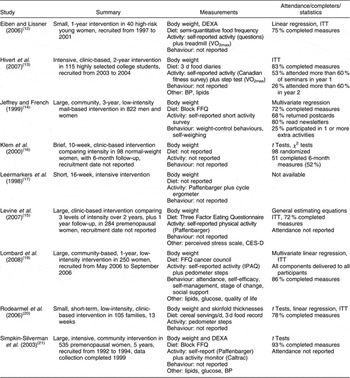
DEXA, dual-energy X-ray absorptiometry, BP, blood pressure; CES-D, Center for Epidemiologic Studies Depression Scale; IPAQ, International Physical Activity Questionnaire, ITT, intention to treat.
Outcomes
Weight
Weight difference between treatment groups was small, as is expected in prevention studies. Table 4 summarizes studies including five that showed a significant difference in weight between groups(Reference Eiben and Lissner12, Reference Leermarkers, Jakicic, Viteri and Wing17, Reference Lombard, Deeks, Jolley, Ball and Teede19, Reference Rodearmel, Wyatt, Barry, Dong, Pan, Israel, Cho, McBurney and Hill20, Reference Simkin-Silverman, Wing, Boraz and Kuller22). Four reported no significant difference(Reference Hivert, Langlois, Berard, Cuerrier and Carpentier13–Reference Klem, Viteri and Wing16).
Summary of interventions and weight outcome

*Significant difference between groups.
Diet
Dietary measures used included a validated FFQ(Reference Jeffery and French14, Reference Lombard, Deeks, Jolley and Teede18, Reference Simkin-Silverman, Wing, Boraz and Kuller22), the Three Factor Eating Questionnaire(Reference Levine, Klem, Kalarchian, Wing, Weissfeld, Qin and Marcus15), 3 d records(Reference Hivert, Langlois, Berard, Cuerrier and Carpentier13, Reference Rodearmel, Wyatt, Barry, Dong, Pan, Israel, Cho, McBurney and Hill20) or a semi-quantitative FFQ(Reference Eiben and Lissner12). Two studies did not measure energy intake(Reference Klem, Viteri and Wing16, Reference Leermarkers, Jakicic, Viteri and Wing17). Only one study showed a significant decrease in energy intake (−669 kJ, −160 kcal) and fat intake compared with controls. This was measured by FFQ(Reference Simkin-Silverman, Wing, Boraz and Kuller22).
The nature of the dietary advice varied from general dietary change messages(Reference Jeffery and French14, Reference Lombard, Deeks, Jolley, Ball and Teede19), such as eating more fruit, eating more vegetables and reducing high-fat foods, to a prescriptive diet where participants were advised to reduce fat intake to 25 %, saturated fat to 7 %, dietary cholesterol to 100 mg daily and to follow a diet providing 5460 kJ/d (1300 kcal/d)(Reference Simkin-Silverman, Wing, Boraz and Kuller22). Participants in these intensive trials were given extensive support to achieve these goals. However, this type of prescriptive diet is not usually acceptable in the longer term. Fat was the nutrient most frequently nominated in dietary procedures and measured in outcomes, and was restricted in some form in all interventions. One study advised a fat intake of 20 % of total energy(Reference Leermarkers, Jakicic, Viteri and Wing17). Other frequently specified dietary changes were to increase fruit and vegetables, reduce saturated fat, reduce energy consumption, avoid fried food and reduce the frequency of snacks.
Physical activity
Measurements of physical activity also varied widely. Fitness was measured in two studies using a treadmill fitness test or the Canadian home step test(Reference Eiben and Lissner12, Reference Hivert, Langlois, Berard, Cuerrier and Carpentier13). Usual physical activity was measured using the Canadian Fitness Survey (one study(Reference Hivert, Langlois, Berard, Cuerrier and Carpentier13)), the International Physical Activity Questionnaire (IPAQ; one study(Reference Lombard, Deeks, Jolley and Teede18)) and the Paffenbarger Questionnaire (three studies(Reference Levine, Klem, Kalarchian, Wing, Weissfeld, Qin and Marcus15, Reference Leermarkers, Jakicic, Viteri and Wing17, Reference Simkin-Silverman, Wing, Boraz and Kuller22)) or an adapted questionnaire (two studies(Reference Jeffery and French14, Reference Simkin-Silverman, Wing, Boraz and Kuller22)), while four studies used pedometers or motion sensors(Reference Leermarkers, Jakicic, Viteri and Wing17, Reference Lombard, Deeks, Jolley and Teede18, Reference Rodearmel, Wyatt, Barry, Dong, Pan, Israel, Cho, McBurney and Hill20, Reference Simkin-Silverman, Wing, Boraz and Kuller22). Multiple measures of physical activity were used in three studies(Reference Hivert, Langlois, Berard, Cuerrier and Carpentier13, Reference Lombard, Deeks, Jolley and Teede18, Reference Simkin-Silverman, Wing, Boraz and Kuller22).
Prescriptive advice on activity was used in three studies which aimed for an energy expenditure of 4200–6300 kJ/week (1000–1500 kcal/week) or to walk or run four times weekly, and were coupled with ongoing consultation or support to help achieve the activity goals(Reference Levine, Klem, Kalarchian, Wing, Weissfeld, Qin and Marcus15, Reference Leermarkers, Jakicic, Viteri and Wing17, Reference Simkin-Silverman, Wing, Boraz and Kuller22). Two studies gave general advice similar to population guidelines, with an emphasis on walking(Reference Jeffery and French14, Reference Lombard, Deeks, Jolley and Teede18) or steps(Reference Rodearmel, Wyatt, Barry, Dong, Pan, Israel, Cho, McBurney and Hill20). In other studies, the activity advice was not clearly reported(Reference Eiben and Lissner12, Reference Hivert, Langlois, Berard, Cuerrier and Carpentier13, Reference Klem, Viteri and Wing16). Three studies reported no significant difference in physical activity between groups(Reference Hivert, Langlois, Berard, Cuerrier and Carpentier13–Reference Levine, Klem, Kalarchian, Wing, Weissfeld, Qin and Marcus15). One reported no change in fitness but a change in self-reported physical activity(Reference Eiben and Lissner12). Three studies showed a limited change in physical activity(Reference Lombard, Deeks, Jolley, Ball and Teede19, Reference Rodearmel, Wyatt, Barry, Dong, Pan, Israel, Cho, McBurney and Hill20, Reference Simkin-Silverman, Wing, Boraz and Kuller22). These studies used the Paffenbarger Questionnaire, the IPAQ and pedometers.
Behaviour
All studies incorporated a behavioural component although most were not based on any explicit behavioural theory. The behavioural component varied and was not always clearly described or assessed. Two interventions described the behavioural theory(Reference Lombard, Deeks, Jolley and Teede18, Reference Simkin-Silverman, Wing, Boraz and Kuller22). The behaviour modification strategies employed most commonly were goal setting, problem solving, relapse prevention and self-monitoring. Self-monitoring of weight was a component of three interventions(Reference Jeffery and French14, Reference Levine, Klem, Kalarchian, Wing, Weissfeld, Qin and Marcus15, Reference Lombard, Deeks, Jolley and Teede18). Four interventions used self-monitoring of diet or physical activity, but the form or reason for monitoring was not always clear(Reference Hivert, Langlois, Berard, Cuerrier and Carpentier13, Reference Klem, Viteri and Wing16, Reference Leermarkers, Jakicic, Viteri and Wing17, Reference Rodearmel, Wyatt, Barry, Dong, Pan, Israel, Cho, McBurney and Hill20). Other studies did not report monitoring. Lombard et al.(Reference Lombard, Deeks, Jolley, Ball and Teede19) and Jeffrey and French(Reference Jeffery and French14) were able to show an association between frequent self-monitoring of weight and weight change.
Discussion
Interventions aimed specifically at the prevention of obesity are rare. Despite the enormity of the problem, only nine randomized controlled trials have been reported in the past 10 years. All reported weight gain prevention interventions were comprehensive and included physical activity, dietary change and a behaviour change component. The nature of these components, the length of interventions and the intensity varied, making them difficult to compare. For example, some interventions were prescriptive for diet and physical activity, while others delivered more general messages and information. The interventions varied from 13 weeks to 5 years. The content of the psychological components was distinctly different, and measurement tools varied between studies.
Weight gain prevention needs to reach a broad cross-section of the population, even those individuals who are relatively healthy and have no immediate or urgent need to change behaviour(1). For most of the population weight gain occurs in small increments over many years. The annual mean weight gain is estimated to be 0·7 kg and much of the population is likely to be unaware of the long-term dangers of a small energy imbalance. The majority of interventions described targeted known high-risk populations. Recently, however, reports have indicated overweight and obesity prevalence is increasing in all age groups. Young women, for example, have been reported to be gaining weight at a higher rate than women in midlife. This rapid weight gain is concerning and indicates that interventions are needed across broad population groups. Most interventions reported only small differences in weight between treatment groups, largely due to weight gain in the control group. Overall, the difference in weight between groups in successful interventions equated to about 2–5 % in participants. The clinical relevance of this is demonstrated from data from the Nurses’ Health Study, which reported that the risk of CHD increased by 3·1 % for each kilogram of weight gained from age 18 years(Reference Willett, Manson, Stampfer, Colditz, Rosner, Speizer and Hennekens7). One intervention should be highlighted because the control group gained 2·6 kg in 1 year, confirming that children of obese parents are a high-risk target group for future obesity(Reference Eiben and Lissner12).
A number of studies not included in the current review have reported successful weight maintenance as a secondary outcome following changes to diet, physical activity or both. In our review we aimed to capture interventions specifically designed to prevent weight gain, which will differ markedly in theory, intensity, delivery and content from interventions aiming to improve a single health-related behaviour. A review of exercise and health by Asikainen et al. describes a range of interventions of which some resulted in weight loss or maintenance as a secondary outcome when their primary aim was to improve fitness(Reference Asikainen, Kukkonen-Harjula and Miilunpalo23). The Women’s Health Initiative Dietary Modification Trial reported a difference in weight between groups of 1·9 kg in the first year, but the aim was to assess the impact of a low-fat diet on health, not prevent weight gain(Reference Howard, Manson and Stefanick11). Other trials have reported successful weight maintenance when they were actually unsuccessful at weight loss. Prevention interventions that require modest changes to behaviour are likely to appeal to a different audience than prescriptive, single-component, intensive interventions. Although we recognize that environmental factors can impact on weight gain, there were no studies in adults identified. It is possible however that we have omitted interventions which may be applicable in a prevention context.
Owing to the variability of intervention design, delivery, length, target group and outcome measurement tools used, it is difficult to identify effective components. Even among the successful interventions length varied from 13 weeks to 5 years. Successful interventions included face-to-face contact and individualized advice, plus regular contact throughout the intervention. However, one study provided all of these factors, but showed no difference in weight compared with controls receiving a brochure(Reference Levine, Klem, Kalarchian, Wing, Weissfeld, Qin and Marcus15). Frequent contact is a consistent theme in obesity treatment, but is not considered feasible in broad populations for obesity prevention because of cost. Mail-based interventions are low-cost but have not been successful unless combined with additional individualized support and targeted selected high-risk subgroups(Reference Hivert, Langlois, Berard, Cuerrier and Carpentier13). There is evidence that low-intensity interventions are successful and therefore feasible, potentially lower-cost and applicable to broad populations(Reference Eiben and Lissner12, Reference Lombard, Deeks, Jolley, Ball and Teede19).
All interventions aimed to improve activity and reduce energy intake. It is still unclear if the weight difference noted was due to an energy shift caused by changes to diet, physical activity or a combination of the two. Both prescriptive interventions and those with more general messages were successful in weight change, but often failed to demonstrate a significant change in diet and physical activity behaviours. This lack of success in demonstrating changes in these key behaviours, even when there is weight change, is disappointing and has been attributed to the lack of sensitivity and accuracy of the measurement tools in detecting small changes in energy balance(Reference Lombard, Deeks, Jolley, Ball and Teede19), and should be addressed in future studies.
Monitoring
Few studies have examined self-monitoring or weighing within interventions to prevent weight gain, although it has been used in obesity treatment and prevention of weight regain. Frequent monitoring may allow participants to detect small but manageable changes to weight and initiate strategies to avoid having to deal with larger regains, which are known to be more difficult to control. Self-monitoring may be one component of cognitive restraint and successful maintainers show higher levels of dietary restraint(Reference Wing and Phelan24). The two prevention studies that specifically included self-weighing as a component showed an association between self-weighing and weight(Reference Jeffery and French14, Reference Lombard, Deeks, Jolley, Ball and Teede19). On the other hand, monitoring of diet and physical activity had poor adherence and was not associated with weight change(Reference Leermarkers, Jakicic, Viteri and Wing17).
Delivery
Attendance figures or process information is important in order to determine the effectiveness of interventions. Particularly, it is important to know if those who were randomized received the intervention as intended. Attendance figures are particularly important, especially in intensive interventions when a range of activities is provided, as frequent contact may affect outcomes in a way that is not clearly understood. It also informs us regarding the popularity and feasibility of activities offered. Despite their value, attendance figures were rarely reported and where they were, the activities offered were not well attended. Klem et al. reported that even women who expressed interest in attending a group course did not attend as desired(Reference Klem, Viteri and Wing16). However, based on the small amount of data reported here, a mail-only intervention is less likely to be successful than one that at least provides some personal contact.
Conclusion
The present systematic review found that there are still relatively few trials aimed specifically at the prevention of weight gain, and even fewer have been targeted at the general population. Low-intensity interventions hold the most potential and can prevent the small annual weight gain seen in most populations. Multi-factorial interventions combining diet, physical activity and behaviour change components, which include self-monitoring of weight, general messages or more personalized advice, can be successful. Considering the rapid increases in overweight and obesity prevalence, large community-based intervention trials targeted at the general population as well as high-risk groups are urgently needed. The information gathered from such trials would be enhanced if they were based on a clear theoretical foundation, used more sensitive, comparable measures of physical activity or energy intake, reported recruitment and attendance, and measured the psychological constructs. This would provide investigators with a basis for comparison to determine successful intervention components. At present, when interventions have been unsuccessful it is difficult to generalize on the primary determinants of ineffectiveness. It is recognized, however, that in complex community-based interventions it is difficult to separate out the effects of specific components, and each may have a small influence that is effective only cumulatively.
Acknowledgements
This work received no specific grant from any funding agency in the public, commercial or not-for-profit sector. C.B.L. is supported by a Monash University publication grant. H.J.T. is supported by a fellowship from the Australian National Health and Medical Research Council. The authors have no conflict of interest to declare. C.B.L. collected and collated the data, and drafted the manuscript. All authors assisted in writing the manuscript and interpreting the data.



