INTRODUCTION
‘Dawn, and as the sun breaks through the piercing chill of night on the plain outside Korem it lights up a biblical famine, now, in the twentieth century.’ With these words, journalist Michael Buerk famously alerted the world that a famine was happening in the Horn of Africa in October 1984. He set into motion a huge response, foremost consisting of food aid for the starving people of Ethiopia. Since that time, for more than twenty years, emergency appeals have invited massive food aid to the country, targeted to more than 5 million people every year, and many more in years of extreme drought such as 2002 and 2003 (GoE 2004: 1). There is no doubt that many people in Ethiopia are alive today thanks to the contribution of food aid. Yet, ironically, throughout this period of massive international support, most research maintains that food security in Ethiopia has been deteriorating. Food production is now less than what it was in 1984, and subsistence farmers today are poorer than they were then. Nearly half of the population continues to be undernourished (WFP 2006: 3–6). In the early years of this century, a consensus grew between the Ethiopian government, donors and I/NGOs that decades of interventions had not led to sustainable assets at household or community level, and that it was time to develop new policies to change this situation (GoE 2004: 1; Raisin Reference Raisin2001; Sharp et al. Reference Sharp, Devereux and Amare2003: 129–39). This resulted in an integrated food security programme, of which the Productive Safety Net Programme (PSNP) is one element. The other two elements are the Voluntary Resettlement Programme and Other Food Security Programmes.
Safety nets are social assistance programmes for poor people hit by structural adjustment and economic transition (Subbarao et al. Reference Subbarao1997: 1–14). Safety net policies were subsequently developed by the World Bank to assist the poor against asset depletion and prevent harmful coping practices. Safety net policies have been implemented in the former Soviet Union, Poland and Ukraine (ibid.: 24–67). They are a permanent feature of social policy, not a temporary response to crisis, and take several forms, such as cash transfers, subsidies-in-kind (e.g. food), public works, and subsidies for housing or energy needs. The Ethiopian PSNP is directed at food security, and is modelled after similar programmes in Bangladesh. The government launched it in January 2005, in collaboration with the World Bank, donors, UN and implementing agencies. By integrating interventions, including food aid and food-for-work, it aimed to attain food security for 5 million chronically food-insecure people by 2009. This paper is especially concerned with the question of how selection procedures affected the primary target group of the most vulnerable people. It examines only the first phase of implementation of the PSNP, which is used to illustrate the local implementation processes of the policy. For evaluations of the subsequent implementation see Gilligan et al. Reference Gilligan, Hoddinott and Taffesse2008.
The paper examines early experiences with the PSNP in one of the drought-affected highland regions of Ethiopia, and describes and analyses what happened during the initial phase of the programme during the second half of 2004, when preparations for the programme were made and beneficiaries selected. It is based on ethnographic fieldwork of four months in Selam Sefer and Fikre Selam, two villages in Wag Hamra district (Amhara Region),Footnote 2 where the policy shift to the PSNP was taking place.
Selam Sefer has been a pilot area for the Save the Children-UK (SCF-UK) Relief to Development (R2D) programme. Fikre Selam at the time of research was a non-intervention area for SCF-UK, but did get support from regular governmental services. Sekota woredaFootnote 3 was chosen for this research because of the on-going relief operations and because of the high level of destitution and food insecurity. The presence of a SCF-UK project, besides being a subject of study, also made the area accessible for fieldwork and facilitated the arrangement of research permits from the Woreda Bureau of Agriculture.
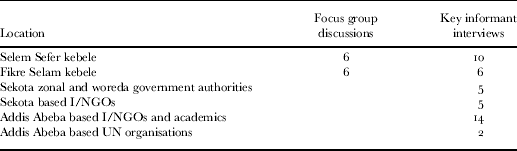
The paper is based mainly on ethnographic research, using qualitative methods of primary data gathering such as participant observation. In addition, Participatory Rural Appraisal (PRA) techniques were used such as focus group discussions. Using random sampling for selecting the participants, focus group discussions were held separately with men and women from the three wealth groups: poor, mid and better-off. Key informant interviews were held with members of local institutions, woreda and zonal officals, I/NGO workers, women's associations and local development committees, and with various societal groups such as the landless, female-headed households, the elderly and the handicapped (see Table 1). A number of key informant interviews were held in the capital Addis Ababa with representatives of donors, INGOs, UN organisations, embassies and universities.
Methods of primary data gathering
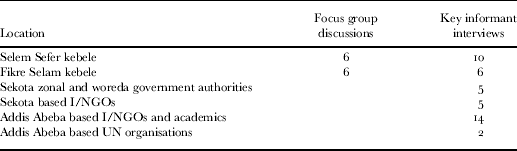
Our study of the PSNP allows us to unravel the dynamics of policy implementation between relief and development. We view the PSNP as a far-reaching attempt to link food aid to food security, and hence as a major embodiment of the desire to link relief to development, which has been a dominant theme in the humanitarian agenda since the early 1990s. We are interested in the everyday politics of policy implementation, examining how policy resources, ideas and activities are internally and externally controlled and allocated throughout the implementation process. One of the themes that we touch upon is how policy does not take place in a void, and cannot be analysed apart from adjacent policies. In the early days of the PSNP in Ethiopia this was especially true for the Voluntary Resettlement policy, by which the Ethiopian government aimed to relocate people from the highlands to the lowlands. As we will see, local authorities at the time and place of our research were geared to making the PSNP instrumental to their bigger ambition to create a pool of volunteers for resettlement. The other main theme we discuss is the importance of discourse on food security. The ways in which actors framed problems of food insecurity co-shaped the ways in which they defined solutions. The key finding of the research is that everyone in the poorest wealth group in the case-study area was excluded from the PSNP as an ‘incentive’ to resettle.
The paper starts with an elaboration of our notion of policy and the way we study policy in practice through ethnography. We then briefly summarise four discourses about food security. The centrepiece of the paper analyses what happened with the beneficiary selection of the PSNP, and how the responses of different actors can be understood with reference to these four frames. Our findings suggest that much more attention should be paid to the institutional connections on which linking of relief and development is conditioned.
ANALYSING FOOD SECURITY POLICY IN PRACTICE
Food insecurity is the concern of many different actors and institutions. The ways in which these parties position themselves in the process is not a simple function of their political–economic interests. Interests are usually neither clear nor consistent, and even rights are often contradictory and subject to interpretation. The way people act in their everyday politics is largely conditioned by institutional, social and cultural patterns (Keeley & Scoones Reference Keeley and Scoones2003). Policy can thus be seen as the result of a pattern of interaction between different participants, who try to shape the process in ways that fit their own perspectives of the problem and goals (Colebatch Reference Colebatch2002). To unravel these processes, we approach the field through ethnography.
The ethnographic study of policy concerns the entire aid-chain (from policy to practice, and from donor to recipient), its surrounding networks, and the contexts in which the interventions take place (Gould & Marcussen Reference Gould and Marcussen2004; Long Reference Long, Long and Long1992; Mosse Reference Mosse2005). The first dimension of the ethnographic approach involves what may be called the social life of policy, which means that policy is socially defined by the actors involved. Policy is the outcome of negotiation, and it cannot be taken for granted that it is meant to be implemented according to its stated intentions. It is the result of interaction between different stakeholders, who try to make policy fit their own perspectives of the problem and goals. The second dimension concerns the question of how policy gets translated in implementation. It steps away from the policy cycle model that views policy as the systematic pursuit of goals and the end result of a purposive course of action (Colebatch Reference Colebatch2002). Instead, we view programmes as processes (Mosse Reference Mosse2005) or emergent properties: the outcome of social negotiation in which involved actors aim to appropriate the project according to their own understanding, interests and ambitions.
Discourse analysis is an important aspect of ethnography, because discourses are shapers of the ways in which actors understand and respond to ideas, situations and actions. Discourses are more or less coherent sets of references that frame the way we understand and act upon the world around us. They are an ensemble of ideas, concepts, and categories through which meaning is given to phenomena (Apthorpe & Gasper Reference Apthorpe and Gasper1996: 2). Foucault has paved the way to study discourse as closely interweaving knowledge and power. Its effect is that certain ways of understanding society, including its organisation and the distribution of power, become excluded, whereas others attain authority. In Foucault's work, discourse appears as a structure that imposes itself on reality. It can indeed become dominant and operate as a mindset that informs policy in unrecognised ways. Leach and Mearns (Reference Leach, Mearns, Leach and Mearns1996) have for instance demonstrated how environmental policy is driven by widely perceived and powerful images of environmental change.
However, Norman Long (Reference Long, Long and Long1992: 25) has pointed out that there are always multiple discourses at work. ‘Since social life is never so unitary as to be built upon one single type of discourse, it follows that, however restricted their choice, actors always face some alternative ways of formulating their objectives, deploying modes of action and giving reasons for their behaviour’. Hence, there is a duality of discourse: it has an ordering role, yet actors can strategically choose and use discourse in defining their policies and practices (Hilhorst Reference Hilhorst2003). It is through this duality that we are able to study how discourses work in practice, to review why and how they become important, and to see how they order the practice of food security policies. One important aspect to take into account is the way in which responses to policy are conditioned by experiences with historical and parallel policies and interventions. When policies are managed separately, they meet at the interface of intervention, where actors interpret them as an ensemble. People's memory of previous interventions tends to affect the way they imagine development relations, and shape them accordingly (ibid.).
This article takes this up by analysing the early days of the Ethiopian safety net policy. It aims to demonstrate how local responses to food security policies are informed by institutional patterns, discourses around food insecurity and the articulation of policy with adjacent policy practices.
FRAMING FOOD SECURITY
Until the 1970s, food insecurity was basically addressed as an agricultural problem, requiring adequate and regular food supplies to be produced to feed the world's population. Although technical questions concerning soil quality, water supply and crop productivity remain important, and are regaining attention in view of threats posed by climate change, alternative socio-political understandings of food insecurity have since complemented this concern. Food insecurity is a complex phenomenon where people have to cope with an unfavourable contextual environment and are made vulnerable by a range of socio-economic and governance processes. Different discourses have developed, shedding a different light on the problem of food insecurity. We distinguish four policy frames: ‘humanitarian’, ‘developmental’, ‘psychological’ and ‘political’. Although in reality the different frames are partly complementary and intertwined, it is useful for analytical purposes to draw them apart. While they can all be attributed partial explanatory power, for the purpose of this paper we are not primarily interested in their analytic value but in the way they are embraced by actors engaged in the social negotiation of what causes and solves food insecurity.
Humanitarian frame
In the classic humanitarian frame, food insecurity is viewed as a short-term problem that must be addressed by bringing in food supplies. This perspective on food insecurity, although few would condone it theoretically, continues to be determinant for food aid practices (Barrett & Maxwell Reference Barrett and Maxwell2005). In reality, the situation in Ethiopia where food aid has been a constant feature for more than twenty years represents a more typical crisis than the short-term episodes that the humanitarian system is designed for. This misconception, of food insecurity as an event, has hampered effective and timely interventions to relieve chronic food insecurity (Raisin Reference Raisin2001).
Faced with the yearly recurring food shortages in Ethiopia, humanitarian budgets for the country have quickly outgrown development aid. The humanitarian system was not equipped to solve food insecurity, because it lacks planning tools for development, is not allowed by mandate to engage in structural programming or capacity building, and operates with all the limitations that come with short-term funding cycles. Aid reforms through food-for-work programmes in the 1990s could not overcome these obstacles, and have been criticised for being ineffective and depoliticising (Edkins Reference Edkins2000). New trends in humanitarian aid, such as the provision of cash relief or the support for livelihoods, aim to further overcome the artificial distinction between humanitarian aid and development (Longley et al. Reference Longley, Christoplos and Slaymaker2006).
Development frame
The development frame views food insecurity primarily as a lack of development. The basic ideas of Amartya Sen (Reference Sen1981), that households need entitlements to food and that this is related to questions of governance, feed well into this idea. In the 1990s, development actors incorporated more consistently the idea that crises recur and are intertwined with development processes, and started to build interventions on concepts that could apply to crises as well as ‘normal’ situations, in particular ‘livelihoods’, ‘vulnerability’, and ‘linking relief to development’ (Buchanan-Smith & Maxwell Reference Buchanan-Smith and Maxwell1994; Hilhorst & Bankoff Reference Hilhorst, Bankoff, Bankoff, Frerks and Hilhorst2004).
Food insecurity in a developmental perspective is a complex issue caused by a range of natural and human factors, including unemployment in urban contexts, unreliable rainfall and climate change, soil depletion, lack of agricultural inputs in rural economies, and lack of credit facilities. Addressing food insecurity in a development frame requires integrated policy in which a multitude of measures linking different domains of policy are integrated throughout the chain of implementation (FAO 1999). This leads to sophisticated approaches that can be criticised for being overly technocratic (Duffield Reference Duffield2002).
Psychological frame: the dependency syndrome
Barbara Harrell-Bond (Reference Harrell-Bond1986: 283) described a dependency syndrome as ‘the real and apparent lack of support for each other, the refusal to co-operate under conditions where co-operation appears advantageous, and the prevalence of destructive and anti-social behaviour … [dependency syndrome is] a blanket term used for all the undesirable social behaviour found in the refugee settlements’. Although Harrell-Bond did see unsociable behaviour and also symptoms of mental illness among the Ugandan refugees whom she studied, she concluded that the problem was not dependency syndrome, but the fact that individuals and individual needs were completely neglected by the aid agencies working in the refugee settlements, largely because of the pressure these agencies felt to deal with the large streams of refugees.
The notion of dependency syndrome has been challenged by Gaim Kibreab (Reference Kibreab1993), among others, demonstrating that refugees tend to use all the means at their disposal to cope with and improve their situation. Kibreab concluded that the dependency syndrome was a widespread myth and stereotype. Sharp (Reference Sharp1998) likewise stresses the difference between having a dependency syndrome and being dependent, where being dependent is not an attitude but an economic condition. Nonetheless, the notion of a dependency syndrome continues to play a major role in food security policy (Lentz et al. Reference Lentz, Barrett and Hoddinot2005). Other theories that link food insecurity to the mental state of people are post-traumatic stress syndrome (Ingleby Reference Ingleby2005) and, lately, aspiration failure (Tanguy et al. Reference Tanguy, Taffesse and Dercon2008).
Political frame of governance
A political perspective on food insecurity or famine starts with the analysis of its causes. It has been argued that famine is not in the first place a failure of some kind (of food-supply, livelihood, or climate), but the normal (and functional) outcome of economic and political processes. David Keen (Reference Keen1994; see also Duffield Reference Duffield1993) starts his analysis of food crises in Sudan by asking about the beneficiaries of famine: its perpetrators and bystanders. This approach moves away from asking how households cope or do not cope with their food insecurity, to probing the complex processes by which social actors create the conditions in which food security is denied to people.
Alex de Waal (Reference Waal1997) brought this approach powerfully home by labelling famine as a crime. He attributes a major role to political regimes that breach the social contract with their citizens and let or even make famine happen. Devereux likewise states: ‘The problem of famine [in sub-Saharan Africa] is political in nature and requires explicitly political solutions’ (Devereux & Maxwell Reference Devereux and Maxwell2001: 148). This political frame can be associated with solutions to food insecurity that are rights-based (FAO 2005).
THE PRODUCTIVE SAFETY NET POLICY IN ETHIOPIA
In the 1990s the Government of Ethiopia and the international community developed a National Policy of Disaster Preparedness and Management (NPDPM), which aimed to link relief to development by using food aid to mobilise labour for public works in soil and water conservation. Public works as a strategy for delivering food relief seemed a good way of bridging relief to development, but became problematic in practice. Productivity and quality of outputs on public works have generally been low and maintenance inadequate. The policy was evaluated as successful in the objective of saving lives, but failing to create sustainable assets at household or community level (Raisin Reference Raisin2001).
The Ethiopian Food Security Programme (FSP) was developed to replace the NPDPM. It is the outcome of negotiation between the government of Ethiopia, UN organisations such as UN-OCHA, the donor community (notably big donors such as the USA and the EU), and international NGOs. The principle of the Ethiopian PSNP corresponds to the social security systems of developed countries: to provide a safety net against sudden income shocks. It is meant to prevent the poor from losing their assets and becoming destitute. It is organised as a permanent feature of government social services, hence brought under the development budget instead of the emergency budget. The support must be predictable, guaranteed and timely, so that vulnerable households do not need to resort to harmful coping measures that restrict their future options, such as selling their tools and assets, and are encouraged to take economic initiatives. Beekeeping, for instance, requires a relatively high investment for a potentially high return, but is risky because it depends on rainfall. The PSNP is designed to enable households to take such risks, by providing an income opportunity to fall back on in case the new livelihood initiative fails. The PSNP takes a decidedly developmental approach to relief that is intended to move away from the yearly emergency responses Ethiopia has known since the 1980s.
The difference between the PSNP and other social security systems is that this programme is not financed from the national public spending, but relies on international support. Its budget is set for US$107 million yearly. The PSNP is embedded in the FSP as part of the World Bank and IMF-supported Ethiopian Poverty Reduction Strategy. It contains many components directed at local development; block grants are made available to woredas for activities like water harvesting, irrigation, feeder roads and household agricultural packages (GoE 2004). The FSP also includes a voluntary resettlement programme to alleviate some of the pressure on the depleted highlands without adding pressure on the city of Addis Ababa which attracts most of the spontaneous migrants.
The PSNP was planned to be operational in 262 districts, with a total of 5 million chronically food-insecure people included in 2005. These 5 million people are taken out of the annual humanitarian appeal for Ethiopia and addressed through the PSNP, with the aim to reach food security for this group by the year 2009. Direct support is budgeted for the elderly, the handicapped, and pregnant or lactating women. Those not eligible for direct support can participate for a maximum of five days a month in a labour-based programme, at a wage of 6 birr a day. This is slightly less than the minimum average wage.
Because the PSNP is meant for a specific category of households, targeting is very important. Whether a family is chronically food-insecure is assessed through a mixture of administrative guidelines and community knowledge. During community targeting exercises, the people from a village come together in a public building to discuss the wealth status of community members. To validate the process, the proposed list of PSNP participants must be displayed in public for at least one week, to be endorsed by a general meeting of villagers (GoE 2004: 23).
The PSNP is not meant to cover acute large-scale food insecurity, which continues to be addressed by the Disaster Prevention and Preparedness Commission (DPPC). While the PSNP is about predictable needs, the DPPC response is about exceptional humanitarian needs. In a bad year, many households who are not PSNP beneficiaries, but live in chronically food-insecure areas, will become temporarily food-insecure and will be given relief through the DPPC. This also means that the implementation structures of food-related policies have become more complex, with the Ministry of Agriculture and Rural Development responsible for the PSNP, and the DPPC for acute emergencies.
THE RESEARCH AREA IN SEKOTA
This paper is based on fieldwork in the food-insecure north-eastern highlands of Ethiopia, in the Amhara Region bordering Tigray. In Sekota, the rural areas used to consist of scattered households throughout the hillsides. However, given the efforts at villagisation during the Derg regime between 1974 and 1987, and the current policy to centralise services, people are increasingly grouped together in villages of twenty to sixty households. Most people in Sekota are small-scale farmers, mainly growing staple crops such as tef (a highly valued Ethiopian staple), barley, wheat and beans. Communities in Sekota are structurally food-insecure. Sekota is a marginal area that produces just enough for survival in a good year. Roughly 50% of households rely on food aid to cover 30% of their annual food requirements even in an average year of production (Chapman et al. Reference Chapman, Hailekiros, Kahsay and Getachew2001). Destitution in Sekota has been increasing over recent decades, because of a complex array of factors such as land degradation, soil erosion, deforestation and more unpredictable rains (Sharp et al. Reference Sharp, Devereux and Amare2003: 174).
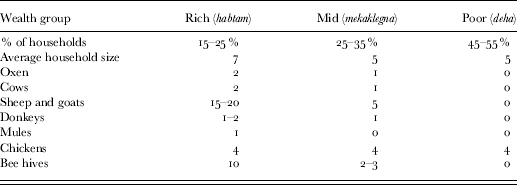
Sekota consists of rugged mountains and only 15% of land is plain. Due to growing population pressure, increasingly steep slopes have been converted to agriculture, which has led to high levels of environmental degradation. Most households have fragmented land holdings with two parcels of land: one close to the village and the other on the more marginal slopes. Access to land is declining because of increasing population pressure; land is divided into smaller and smaller parcels, often too small to support a family and therefore also known as ‘starvation plots’. After a bad harvest all households suffer, as better-off households, who have livestock, struggle to find fodder. Apart from land, wealth in Sekota is based on four criteria: ownership of livestock and pack animals, availability of labour within the household, ownership of capital which can be invested or lent out, and ownership of bee hives or bee colonies (see Table 2). Today, there are fewer better-off people, eroding an important coping practice of the really poor, who normally use their linkages with the better-off to survive. Migration in search of employment, even to areas as distant as Addis Ababa, is common, especially in the hunger season (July to mid September prior to the main harvest. In case of acute food shortages, people tend to travel on foot to the lowlands to do day labour or to beg.
Local criteria for wealth
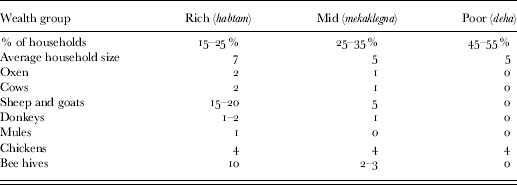
Source: Chapman et al. Reference Chapman, Hailekiros, Kahsay and Getachew2001: 6.
The local administration maintains a relatively strong presence in rural parts of Sekota, although, at the time of fieldwork, 70% of positions were vacant because few educated people want to work in remote areas, and those who do prefer better remunerated employment with NGOs. The lowest administrative unit in the villages is an elected council, the mengistawi budin. One level up is the kebeleFootnote 4 council, in which representatives of different villages are elected. This council communicates directly with the woreda line offices in Sekota town. At the time of the research, several governmental and non-governmental organisations had programmes in Sekota in distributing relief, rural development or a combination of both. These included the Organisation for Relief and Development in Amhara (ORDA, an Ethiopian NGO responsible for relief channelled through the government's DPPC), Cooperazione Internazionale (COOPI) and SCF-UK (both INGOs).
Although INGOs played an important role in Sekota during the time of this fieldwork, their relations with the government were often tense. INGOs have been accused of bypassing local governments, competing for funds, and poaching staff. INGOs, for their part, have found the government incapable of taking over their role and programmes. In response, INGOs like SCF started to include authorities in capacity building programmes.
AID, AUTHORITIES AND PEOPLE IN SEKOTA
The PSNP followed decades of food security interventions. How has this affected the relations between local authorities and people in Sekota? This research found that the authorities' perception of poor people was mainly a variation of dependency thinking. Woreda officials maintained that food aid recipients are food-insecure because of their mentality. Food aid recipients were seen as lazy, resistant to change, ignorant and unreceptive to modernisation. The notion that local people thwart their own development is much older than the rhymes of relief. In 1965, Levine (Reference Levine1965: 90–2) observed a similar attitude among officials and noted:
The view of Amhara peasant culture as incorrigibly recalcitrant and reactionary is a rather shallow one. Amhara peasant culture contains potentialities for change that are as real as its most rigid beliefs and its substantial antipathy to change …. Modern-educated Ethiopians consider the peasant primarily an object for manipulation and coercion who is often regarded as so backward that the only way we can bring progress to them is through coercion and authoritarian manipulation.
To sustain their claim that peasants suffer from a dependency mentality, woreda officials stated that they observed how food aid recipients stopped weeding their fields because they counted on food aid, and that they did not organise the necessary maintenance of public works built with food-for-work programmes. People's narratives, however, were different. In interviews Sekota peasants explained that they did not weed their fields because they needed to find agricultural day labour in the fields of wealthier families to cope with short-term food needs. They also explained that they needed the food-for-work programmes for their survival, and therefore had to wait until maintenance of public works was organised as an income-generating project.Footnote 5
Poor people related that food aid and other projects were unreliable and not sufficient to provide sustainable survival. As a farmer and food aid recipient in Selam Sefer said: ‘We only believe that food aid is going to arrive when we have it in our hands.’ Due to the large needs in the country, varying but declining international donations, and the deliberate reduction by the Ethiopian government of food aid budgets for fear of dependency, food aid was spread thinly and rations were a far cry from the 1980s. In 2004, an elderly lady from Selam Sefer kebele reported:
The current level of relief does not help; the payment [for Food For Work] is too little, too late. From five children, four will be hungry. This year the harvest failed and if it continues like this we are on our way to death (Focus group discussion, women from poorest wealth group, Zondebai village, November 2004)
It is against this backdrop of local state–society relations, where people found themselves coping within their limits and still going hungry, while local authorities blamed poverty mainly on the attitudes of the vulnerable people themselves, that the PSNP in Sekota started to be implemented in 2004.
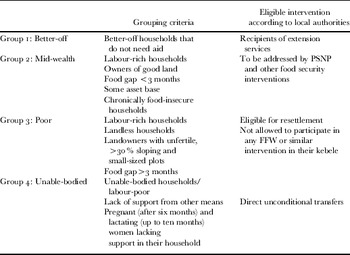
Long before the actual implementation of the PSNP, rumours started to circulate about its aims and possible implications. The late availability of project documents and lack of accompanying training in the form of policy familiarisation created confusion about aims and contents of the PSNP, which in turn created room for the local authorities to arrive at their own interpretation of the policy. According to the national policy, all chronically food-insecure households were included in the PSNP. However, as targeting criteria were passed down from the woreda, a situation was created whereby large numbers of families fell outside the scope of the programme. The authorities defined four wealth groups: better-off, mid and poor wealth groups, and a fourth group consisting of people eligible for direct transfers (see Table 3). It was made clear that only the mid-wealth group was going to participate in the PSNP.
Grouping criteria and proposed intervention

Source: personal communication, INGO programme officer, February 2005.
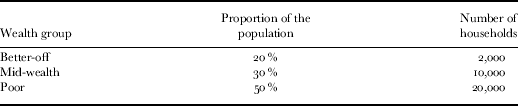
The actual distribution of households over the wealth groups as shown in Table 4 was carried out by the Community Food Security Task Force (CFSTF) in a meeting that lasted several days.Footnote 6 The meeting became very conflictual, as the stakes were high. Ironically, when people were placed in the poor group, they would fall outside the PSNP, so everybody struggled to be classified as mid-wealth. As the table shows, 50% of the households in these three categories were defined as poor. The large proportion of poor households was partly due to the fact that the authorities had just started implementing a land reform that declared all slopes of over 30% steepness as unfit for agriculture. This dispossessed many families from their land, and they were consequently categorised in the poorest wealth group. During the meeting, the mid-wealth group was told to show some ‘development’ in the next two to three years or else they would be reclassified as poor. This message could not be found in PSNP policy papers, and was devised by the local authorities.
Wealth ranking for the PSNP in Sekota (Community Food Security Task Force)
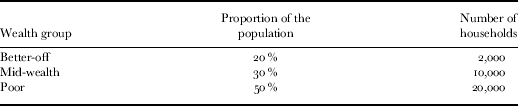
Source: personal communication, Productive Safety Net Specialist, December 2004.
The approach to targeting in Amhara appeared to be in complete contradiction to the rationale behind the Productive Safety Net Policy. It was reasoned that the policy should be limited to those members of the community who could graduate from the programme (i.e. break though their dependency on food aid within three years), and who could be considered productive. This led to the exclusion of the poorest and chronically food-insecure households. This translation of the PSNP was apparently related to the voluntary resettlement policy that was simultaneously taking shape as part of the Food Security Programme. A consultant stated in December 2004: ‘The regional government has passed a directive to exclude the above-mentioned category of households from any benefits, including humanitarian aid, so as to force them to go to resettlement sites.’
This corresponded with the experience of Gwosana, a woman who visited the hut of the researcher during the meeting where beneficiaries were classified. She had walked out of the meeting angrily because she was put in the poor wealth group for being landless. However, in her opinion she was not poor because she had three cows. She also lamented that at the same time she had been fired from her job at the tree nursery of the irrigation scheme because, as the project leader at the irrigation scheme explained to her, ‘all landless households were supposed to resettle’.
The key to understanding the way the PSNP was shaped in Sekota could be found in the resettlement policy more than in the objectives of the safety policy itself. Resettlement from the north-eastern highlands to the relatively fertile and less densely populated lowlands of Ethiopia, sefera in Amharic, has been a key strategy of the government for addressing food insecurity. The first large-scale resettlement and villagisation scheme in Ethiopia was implemented under the Derg regime between 1984 and 1986. People were then forced to relocate, often at gunpoint. The resettlement policy accompanying the Food Security Programme, which also embodies the PSNP, is based on voluntary participation. It aims to resettle people of the same ethnic and language groups together to avoid conflict. In Amhara Region, a pilot voluntary resettlement project started in 2002 and included 170,000 people. In the following years, the programme slowed down because the number of participants became very low.
At the time of fieldwork, few people were interested in resettlement. They based their decision mainly on the stories of people who came back from resettlement sites. Large numbers of people were so disappointed that they returned to their home lands (FSS 2006). In Sekota there were many returnees, whose living standard was often lower than before they left. People's disinclination to resettle was also informed by their sense of identity and belonging to the highlands, as an elderly man from Fikre Selam explained:
They call us to resettle. If we won't resettle, we will not get relief and we know that we cannot eat stone. We are not forced as such, but pressure is put on us, especially on young people. The woreda will say, ‘if you don't resettle you will die of starvation on your fields, as you will not get relief in the future’. We are peasants but we know that we cannot exist here without relief. The people who resettled before us did not succeed; many of them came back, others died of malaria. After seeing that, the people from this village didn't want to resettle anymore. We simply love our village. Good rain is much hoped for, rain will help us to achieve food security. (interview, 21.10.2004, May-Lomin, Fikre Selam kebele)
The government targeted resettlement from Amhara at 2·2 million people before the end of 2006. This was not possible, but even the more modest target of 50,000 households that the Amhara Region set for 2005 could not be met, and ‘only’ 20,000 families were resettled in that year (Pankhurst & Piguet Reference Pankhurst and Piguet2004). The local authorities were thus put under pressure to recruit as many volunteers as possible. Woreda officials who failed to fill their resettlement quota were held accountable, as ‘unconvincing leaders’, and feared losing their position, or thwarting their chances of promotion to a regional town. They also received a salary according to their performance. Success or failure in recruiting people for resettlement was thus directly felt by officials in their job security, status and salary.
Recruitment was partly done by ‘resettlement sensitisation’. From the second half of 2004, officials from woreda line offices carried out resettlement sensitisation in Sekota, using influential people in the communities like teachers, health workers and development agents to speak at sensitisation meetings. During these compulsory meetings, a rosy picture was painted of the resettlement areas as green and fertile, and where grain only costs 60 birr per sack instead of 175 as in Sekota. Information about resettlement was in the meetings mixed with information about the PSNP, and people were informed that the poor wealth group would no longer receive food aid under the programme.
Officials justified their actions by claiming that beneficiaries could not always see what was best for them (see also Scott Reference Scott1998), and consequently had to be shown the right way by the relevant authorities to lead them from dependency on aid to self-sufficiency. They also found justification in the idea that people had developed a dependency attitude. ‘When the poor go home, there is no food there. If we don't get people to work hard for the development of this area, the only other way is resettlement’ (interview, 3.11.2004, Selam Sefer).
The ORDA project coordinator in Sekota, responsible for relief distributions, said (interview, 14.10.2005): ‘One of my greatest concerns is dependency syndrome. The farmers are expecting food relief, and refuse to go to resettlement areas because they expect that they will be able to survive on humanitarian aid here in Sekota. I expect the Safety Net policy to solve the food aid targeting problems we are facing.’
As a result, people from the poorest wealth group, ‘group three’ as they were referred to in the community, were given the impression that they had no option but resettlement. Even though the officials told visiting donor missions that both group two and three were eligible for the PSNP,Footnote 7 in practice they seemed to use the PSNP to exclude people and create a pool to recruit volunteers for the resettlement programme.
LOCAL AUTHORITIES AND NGO PROGRAMMES
One of the biggest INGOs in Sekota at the time of fieldwork was SCF. This NGO had been present in the region since the famine of 1984, with a wide range of programmes including food security monitoring and support to early warning systems. It took the position that a major strategy for households to overcome their food insecurity was through diversification of their livelihood activities. Coupled with small-town development, this could in their view considerably enhance the carrying capacity of the region. In 2004, SCF started the Relief to Development Initiative (R2D) for Sekota woreda. Livelihood interventions within this programme included goat restocking, loans with training for beekeeping, and grain banks, for which the R2D project provided materials and a starting capital of grain. The grain stored in the grain bank was mostly consumed in the dry season from August to September (the hunger gap), although farmers could decide to sell it for instance when the market price for grain is best.
SCF's strategies differed from those of the government, which preferred resettlement for people with ‘insufficient’ access to land. This contributed to problems over the R2D programme, which enabled some families to stay in Sekota and not to participate in the resettlement. This created friction between the Sekota woreda authorities and the R2D programme staff. In 2004, the woreda authorities ordered the end of the goat restocking programme. A SCF-UK employee in Sekota (interview, Sekota, 2.12.2004) said: ‘My assumption is that goat restocking was halted because the Relief to Development project stands in the way of the resettlement strategy, as it enables farmers to become independent from food aid. The farmers have been known to say that they have support from the Relief to Development project and therefore prefer to stay in Wag Hamra instead of resettling.’ A further indication for this was the subsequent measure to stop food for work programmes and food distributions during governmental campaigns to promote resettlement in the first half of November 2004 (INGO employee, interview, Sekota, 4.11.2004).
During the shift to the Safety Net programme, several joint government and donor ‘readiness missions’ were carried out in Amhara in order to monitor the progress made in preparing for the policy shift. The mission members included donor representatives from World Food Programme, UN-OCHA, World Bank and USAID, with representatives of the governmental Food Security Coordination Bureau (FSCB). The December 2004 readiness mission returned to Addis Ababa with alarming results, and stated (Joint Mission 2004): ‘The Mission identified serious misinterpretations of the Programme Implementation Manual (PIM) in Amhara Region. Recognizing that the government took immediate action, nevertheless there needs to be follow up to ensure that remedial actions have been implemented. The situation highlights the need for further clarification and adherence to the principles underscoring the PIM.’ A donor representative visiting Sekota in March 2005 reported that although the woreda authorities claimed that both the mid and the poor wealth groups were included in the Safety Net, at the kebele level the Development Agents told her that the poor wealth group was only included in resettlement. In an email dated 19 April 2005, an INGO worker in the case-study area confirmed the exclusion of the poor wealth group from the Safety Net.
The Ethiopian Productive Safety Net Programme is a far-reaching attempt to achieve food security for vulnerable people who have been dependent on food aid for more than twenty years without improving, and even eroding, their asset base or productivity. The PSNP steps away from the ad hoc and disintegrated set-up of relief-oriented assistance towards an integrated approach that combines emergency measures with incentives for development. It is a sophisticated programme that integrates policy domains and depends for its implementation on the effective linkages of different ministries and administrative units and layers. While this is already a daunting challenge for any professional apparatus, this process was complicated by surrounding political processes and hindered by prevailing notions about dependency.
This paper about the early implementation of the PSNP in Sekota, Amhara Region, showed how in the case-study area the poor 50% of the community were going to be excluded from the programme. The implementation of the PSNP was, locally, derived more from the bureaucratic need to enhance resettlement than inspired by the objective of the policy itself. Due to targeting and sanction systems whereby local officials' salaries, reputations and job perspectives were bound to the number of families they persuaded to resettle, officials had a personal interest in prioritising resettlement over PSNP. Their practices were geared towards denying relief as well as development opportunities to the poorest households, other than the road towards resettlement. Although nobody was literally forced to resettle in the duration of the case study, people felt they were brought to a position where they had no option. The practices of the officials were justified by appealing to the notion of dependency mentality. By claiming that poor people had brought their misery on themselves and blaming their poverty on their laziness, officials could justify steering people towards resettlement. As a result, the benefits of the PSNP, which was designed to include chronically food-insecure people, were reserved by local officials to the mid-wealth group.
Similar experiences to those discussed here for Sekota were noted in other parts of Ethiopia and were a matter of concern for donors and INGOs at the time of research. The Ethiopian government needed donor support for its resettlement policy, as resettlers had to be supported with food aid at least until their first harvest. Donors were committed to the package of the Food Security Programme, including resettlement, but made their support conditional upon the voluntariness of participation (Hammond Reference Hammond, Long and Oxfeld2004; Wilson Reference Wilson, Folke and Nielsen2005). But what is voluntary where people depend on aid for their survival? (Hammond Reference Hammond2008) INGOs in places like Sekota faced the dilemma whether to continue their programmes, even when they were denied access to the people most in need. SCF-UK considered that it was still possible for the most vulnerable people in Sekota to achieve food security through a relief to development strategy, coupled with small-town development. Their analysis competed with the governmental policy that viewed resettlement as an unquestionable necessity.
It is not clear how the linkages between national and local policy implementation operated. The level of state control over policy implementation at the local level is not exactly known. According to Keeley and Scoones (Reference Keeley and Scoones2003: 74), Ethiopia has always had a tendency ‘towards authoritarianism, hierarchy, centralized rule and lack of transparency’. Since the year 2000, however, the decentralisation strategy of the Government of Ethiopia rendered lower administrative levels (woredas) more power and relative independence. Keeley and Scoones observed (ibid.: 91) that ‘in many areas the federal level has become less important, and it is in the regions that policy agendas are set, decisions taken and projects implemented’. In Sekota, officials transformed the central policy for participation in the PSNP into a strategy of coercive incentives for resettlement.
The Productive Safety Net Programme is potentially very important for the targeted beneficiaries of the PSNP (growing to 7·5 million in 2009). It will also generate valuable lessons for linking relief to development by achieving a linkage between food aid and food security. This paper demonstrated that it remains crucial to monitor and follow the implementation of such policies in practice. A major concern is how policies that reflect the complexity of needs and realities of food insecurity can be translated into programmes that are suitable to the capacities of local bureaucracies. The other concern is to analyse how policies get translated along the chain of implementation. These translation processes as we have shown can be heavily affected by related political issues, in this case regarding resettlement, by the historically developed perceptions that actors have about their situation, each other and themselves, and by the politicised relations between implementers and the people they are supposed to serve. It is only in the everyday realities of policy implementation that these dynamics become visible, and it remains highly important to follow closely how these processes unfold.