Introduction
Early in the 1840s, Carl von Martius, professor of botany at the Ludwig-Maximilian University of Munich, published ‘How to write the history of Brazil’, winning first prize in a contest organized by the Instituto Histórico e Geográfico (Historical and Geographical Institute) in Rio de Janeiro. In his essay, Martius emphasized that an understanding of the new South American nation’s history should be connected to the history of the exploitation of a tropical Asian tree. Although this assertion may have sounded strange to national historiographers, Martius was right. After all, Brazil was a country named after a dye of Asian origin, brazilin, which was obtained from a highly valued tree of the species Caesalpinia sappan. As it was used in the manufacture of European luxury textiles in early modern times, its economic importance led to the search for alternative species in other continents and eventually to the commercialization of the South American brazilwood (Caesalpinia echinata), a tree discovered by the Portuguese along the coast of present-day Brazil.
With his remark, Martius demonstrated that he had mastered a real understanding of his world: the foundation of Brazilian historiography could not be achieved without paying attention to the circulation of goods on a global scale, as well as to the impact that the world trade in natural history products had on the configuration of modern nations. As a botanist, Martius was well aware that nature and history were bound together and that Brazil’s nature was in some way related to Asia through the work of history.Footnote 1
Martius’ assessment had a clear message: the history and natural history of the Americas, and therefore the history of the world and of nineteenth-century nature, were the result of the crossroads of intellectual and commercial pursuits as well as the circulation of natural products on a global scale. As part of the transfer and commercialization of natural products for industry, medicine, and agriculture, dyes, hides, furs, flowers, roots, horns, and precious and semi-precious stones had connected continents and people, transferring not only names, uses, and virtues from one place to another, but also the practices and beliefs associated with them. This article argues for a new investigation into the global and transdisciplinary dimension of objects that is not limited to exclusively local traditions, and may instead reflect the living remains of a long history of exchanges, translations, and transfers that, as Martius had suggested, de- and re-functionalized the natural world in evolving geographies over several centuries.
Well before the creation of the Linnaean system, functional classification and commerce had already related natural species from different regions on the basis of common properties. Far from just being a function of analogy, this was the result of the expansion of industrial and medical applications in a context characterized by a kind of zoological and botanical shock: namely, the sixteenth-century confrontation with new flora and fauna, entirely different from those known in Europe, a process that Roger French and Miguel de Asúa have already studied.Footnote 2 This novelty, however, did not prevent the analogizing of Old World and New World animals, plants, and minerals. Neither did it prevent transferring the names and properties of medical substances or materia medica – that is, the body of collected knowledge about the therapeutic properties of any substance used for healing – to the New World’s animals, plants, and minerals. Materia medica, as is well known, was a kind of ever-changing annotated palimpsest, shaped by the reception and transfer of ancient, Jewish, Arabic, and Persian sources. In the context of medical substances, one can say that the fauna, flora, and minerals from the Americas were incorporated into a globalized medical universe and into a novel ordering of knowledge which, as Lorraine Daston, Katharine Park, and José María López Piñero demonstrated more than two decades ago, was also being modified by the world of new data arriving from the other side of the Pillars of Hercules.Footnote 3
This article discusses a case history in the realm of animal medical substances, namely the emergence in the seventeenth century of the great beast, an animal whose hide was described as bulletproof, while its ‘nail’ (the so-called nail of the great beast) was reputed to be a remedy against epilepsy. The denomination gran bestia, as the elk was called in Spain and Italy, expanded to the African antelope and to the South American tapir and, as with the name, similar curative and industrial properties became attached to animals that are now classified as belonging to different families.Footnote 4 Whether this was due to the circulation of books and drugs, semantic changes, or, as Claude Lévi-Strauss proposed, a kind of structural relationship of nature/culture that crossed and connected different peoples and cultures is a question that requires further research. This article should thus be read as a preliminary panoramic survey in mapping the historical distribution of the names and properties of a cluster composed of an illness, a hoof, and an animal. Analysing the emergence of the ‘great beast’ as the source of a remedy for epilepsy, it describes the characteristics of this ‘global’ illness as well as the problem of naming natural objects. It then considers the transfer of animal names as described by nineteenth-century zoologists once natural history separated from medicine. Paraphrasing Wolf Lepenies, the article shows that traditional natural history survived not only in literature, but also in the practices of other medical traditions.Footnote 5
Central to the discussion is the association between epilepsy and several animal species. Specific attention is accorded to the species known today as Alces alces, the largest extant, semi-domesticated species in the deer family; Tapirus terrestris, a large herbivorous feral mammal that inhabits jungle and forest regions in South America; and the subgenus Asinus, in particular the ass or donkey, a domesticated member of the horse family genetically identical to the wild donkey, a single-hooved grazing animal that has been used as a working animal for at least 5,000 years. The article reflects on how those names carried with them the medicinal virtues and properties implied in the name of the substance they designated but also on how the story of nature is intimately bound up with the story of trade and eventually with the history of nation-making. These complex and interwoven processes should not therefore be confined to neatly bordered disciplinary fields.
Animal substances, animal names
Plant, mineral, and animal remedies were central to early modern therapeutics; indeed, up to the eighteenth century the whole of the natural world seemed to comprise a repository of remedies: ‘The Earth is God’s Pharmacopolion’, as the Hesse Paracelsian alchemist and physician Oswald Croll (1563–1609) put it.Footnote 6 While much attention has been paid to botanical remedies, the same cannot be said for those of animal or mineral origin, despite the fact that they were also commonly used as charms or made into medicines to be inhaled, consumed, or applied. The status of drugs made from animals declined in European pharmacopoeia of the second half of eighteenth century, but they continued to play an important role in other medical systems, especially in China, where this is still the case. Most studies of the current uses of wild animals for traditional medicine have focused on Asia or Africa, where, far from disappearing, their use is increasing and is being carried by emigrants to new destinations. This topic, connected with the debate on how such practices affect animal conservation, has produced a vast literature. At stake is the use of such animal parts as tiger bones and rhinoceros horn, and the consumption of seahorses in Southeast Asia and especially among Chinese communities, both at home and overseas.Footnote 7 Research on this topic is also connected with bio-piracy and the ongoing identification of animals that can be used in the pharmaceutical industry.Footnote 8
In what is today called ‘traditional’ Chinese medicine, about 85% of remedies are derived from plants, 13% come from animals, and 2% are mineral-based, all representing a considerable volume in terms of global commerce. These figures have such a profound impact on wild fauna that conservationists regard them as a real catastrophe for the preservation of endangered species. Historical written sources from Chinese medicine also show that the list of products used has evolved throughout the centuries. While the earliest-known pharmacopoeia, dating from the first century BCE, lists 365 different plants, animals, and minerals, by the late 1990s, the number had grown to 11,559.Footnote 9 This reflects the continuous addition of substances, products, and species to the remedies list (and their removal), as well the expansion of their complex and interactive history. As the story of the great beast reveals, very few items in the commerce of remedies can be described as ‘traditional’, a term that, in fact, masks the complexity of historical developments. If materia medica is a palimpsest of remedies and use, ‘traditional’ medicine as such becomes a meaningless concept. Rather than appealing to some dichotomy between modernity and tradition, this article suggests that a much more complex process of exchange, substitution, and transfer of things and knowledge about things was going on.
Until the second half of the eighteenth century, the art of healing in Europe was not divorced from the practices of natural history; both involved the description of animals’ morphologies, their inherent medicinal properties, and the study of their use by the classical authorities. Animals were, indeed, a source of remedies, commodities, and advantages for humankind. An animal was not only an organized body, endowed with sensation, and spontaneous movement, but was also the custodian of intrinsic and hidden healing virtues. In the kind of medicine championed by alchemists, it was believed that God had endowed natural objects with the keys to the mysteries of disease in a system of symbols or signatures. Through specific physical qualities, a plant, a mineral, or an animal revealed an affinity with a particular star, organ, or disease. There was a mutual analogic sympathy and harmonious concordance of natural objects with the parts of the human body. It was the physician’s job to trace the resemblances between symptoms of disease, on the one hand, and the matching virtues of natural objects, on the other, for these similarities were the signatures, the signs and symbols provided by nature, that would guide him in the search for cures. Signatures not only revealed to which part of the body certain substances were to be applied, but also demonstrated that humans could discover the true medicine for any particular ailment if only they were able to make the correct connection.Footnote 10 Understanding the signatures enabled the individual to give the right name to things, as a way of regaining an Adamic language of nature. Affixing an appropriate name to a certain creature was a crucial part of natural history, which is why lexicography, exegesis of ancient texts, and philology became central to the study of nature and physics.
Nature, however, was far from being pristine for either the ancients or the moderns. The two groups shared the problem of the ‘correctness of names’.Footnote 11 But in the sixteenth and seventeenth centuries it was critical to reconcile the tensions between classical, medieval Christian, and Rabbinic scholarship and the zoologies arriving in the Old World in the wake of new geographical discoveries. Resolving ambiguity, synonymy, and obscurity was part of a praxis that implied the understanding of the properties of substances as expressed in different languages and stemming from different traditions.
Transfer of names
In the case of the elk, we can consider the entry under Cervus alces in Philipp Andreas Nemnich’s Allgemeines Polyglotten-Lexicon der Natur-Geschichte (Universal polyglot dictionary of natural history, published between 1793 and 1798). The hooves of this animal, said to be found in northern Europe, Asia, and America, had been used in the past as a charm or as a remedy against epilepsy. With some hesitation, Nemnich remarked that some naturalists claimed to have also found the elk in the tropical forests of South America, where it was called Danta by the Spaniards and Portuguese, Vagra in Peru, Tapiira in Brazil, and Maipouru in Guiana. According to Nemnich, some others spoke of the existence of an African elk, namely the Nokoko, Dante, or Lante from Congo. He was very cautious about this claim, remarking on the difficulty of proving that the elk was the same animal called alke or alce by the ancients. Neither the older descriptions nor those coming from Africa and South America were sufficiently precise to assess the regions that the elk actually inhabited.Footnote 12
From a nineteenth-century zoologist’s point of view, the practice of reassigning botanical or zoological designations represented a real challenge. The German Baltic biologist Karl von Baer referred to it as Namen-Übertragungen (‘name transfers’), namely the transfer by travellers, hunters, seamen, soldiers, naturalists, and so forth of the vernacular name of an animal living in a particular region to another seen as analogous but from another part of the world.Footnote 13 This transfer created relationships among animals on the basis of human interactions with local fauna, revealing how classifications worked before we became used to the idea that animals and plants should be grouped on the basis of their internal anatomical characteristics. The early modern world made recourse to function as the criterion for grouping animals. As a result, one name could serve as a category for grouping together different animals and plants. The way these names travelled, over time and space, both to identify and to produce knowledge about objects of the natural world, reveals a ‘decentralized’ geography of knowledge.
As Nemnich’s example shows, the transfer of names occurred not only across regions but also over time. Both in literary sources and in real life, the name of one species that had disappeared from a region was given to another that was perceived as analogous. Names thus passed from one animal to another, with a logic that was shaped by human interaction with nature in general, and with animals in particular. An animal or class of animals was defined and named by human uses of nature. If this animal was inserted into a circuit of commerce or exchange, it is not surprising to find that a common name was created to operate in the hubs where the trade (in the sense of exchange) occurred. Vernacular names continued to exist, as they still do today, but their use was restricted to a region or a linguistic context. The global trade networks required the creation of ‘trading names’ to communicate in the shared space of commerce.
In this framework, the transfer of animal names from one linguistic or cultural tradition to another followed the circuits of trade. Examples of this abound in the realm of animal–mineral medicinal substances: objects called serpent stones, bezoar stones, and eagle-stones were found throughout the Andes, and thunderstones (stone or bronze axes) connected China, Europe, and the Americas. Unlike the classification system of contemporary scientific disciplines, in the world of commerce and trade a product was defined by its use and value of exchange rather than its composition, which may have varied locally even when the name was the same.Footnote 14
The particular case explored in this article indicates that there were several etymological clusters for the animal under discussion. One of them was the ‘great beast’, a name that appears in German (großte Bestie, actually ‘greatest beast’), Italian (grand-bestia, grand-animale), Spanish (gran bestia), and Portuguese (gram-besta). In the German/Dutch/Nordic countries, the term used refers to the miserable character of the animal (elende Bestie, Elend, Elend Tier). The other name used in Spain, South America, and Portugal seems to be of Arab origin: anta or danta. These differences were the result of the late medieval transfer of words and properties: according to several authors, anta and the several versions of this word came from the Arab lamt or lamta, which denoted the Saharan Oryx, a kind of antelope, namely what Nemnich quoted as nokoko.
In Asia, according to Nemnich, bulan was used in the Turkic languages for the elk. In various Altaic languages, this term (bulān, with phonetic variants such as pulan and bolan) means ‘elk’, ‘stag’, ‘moose’, ‘deer’, and, as Sanping Chen remarks, ‘a large wild animal … with one horn’. Sanping Chen posits the Altaic bulān as the origin of the Chinese proper feminine name ‘Mulan’. In turn, this could also be included in another semantic chain, which connected a powerful mythological hero to a large member of the Cervidae family and to other herbivore ruminants that were used both as pack animals and to supply medicinal substances. From ancient times the Chinese had regarded the unicorn as a highly respected symbol and token of auspiciousness, and its horn was used against epilepsy.Footnote 15 One can hypothesize that the transfer of the virtues and properties of the several animals denoted by these terms was historically articulated in the trading zones where these worlds encountered each other. Moreover, the terms did not travel in one single direction; rather, they suggest a network of movement across time.
Nineteenth-century zoologists saw the difference in vernacular and trading names as an example of the confusion resulting from the linguistic fragmentation of the natural world before the adoption of Linnaeus’ natural system late in the eighteenth century. For those interested in either the evolution or the distribution of species, these names not only created confusion; as Nemnich remarked, they expanded the geographical distribution of certain animals, connecting what today are considered as belonging to different species, genera, and even families. The following sections of this article show how the commercialization of a remedy against epilepsy, the burnt or pounded hoof of a series of animals, contributed to the creation of an animal that in the pharmacological world of the seventeenth century was known as the ‘great beast’.
Epilepsy and animal medical substances
Epilepsy, also known as the ‘falling sickness’, was one of the world’s most intriguing maladies, characterized by the sudden onset of convulsion and seizures. Historians highlight the disease as one that for thousands of years ‘had received more attention than any other individual ailment’.Footnote 16 According to historians of medicine, few diseases are clinically as clear throughout the ages as epilepsy, to the extent that it ‘has come to command over as large a host of traditions as has the universally known sensation of toothache or the equally universal process of childbirth’.Footnote 17 While there was universal consensus on the seizure as a symptom of the illness, its name and treatment varied locally, as did the understanding of its nature and origins. Often seen as mystical, epilepsy was described as combining spiritual causes (possession, an effect of the devil or of a divine, mystical power) with natural ones (symptom of a brain disorder). According to the Hippocratic medical tradition, epilepsy was humoral, caused by an excess of phlegm that rushed into the blood vessels of the brain and filled the ventricles, creating pressure, which was released via a seizure. Epilepsy was considered to be cold and moist and its treatment required hot and dry substances. In the seventeenth century, when belief in the properties of the great beast’s nail spread through Europe, Asia, and the Americas, iatrochemistry proposed that epilepsy was caused by chemical forces, such as acid vapours irritating the animal spirits contained in the spinal cord and in the brain, which could be counterbalanced by the application of basic salts.
The names of epilepsy, as analysed by Kanner, also reflect the features linked to the disease, spanning everything from its capacity to arouse fear and dread to the deification of the epileptic. For example, ‘Grimm, in his German Mythology gives this list of terms for epilepsy: Jammer (misery), Elend (wretchedness), böses Wesen (bad being), Staupe (scourge), Unkraut (weed)’.Footnote 18 In fact, many European languages associated epilepsy with misery and misfortune, a characteristic also attributed to the animals related to its cure, such as the ass/donkey and the elk (elende Bestie).Footnote 19 For Kanner, Lucius Apuleius from Madaura, the author of the Golden Ass, was one of the first to describe the occurrence of epileptic seizures in animals, in this case donkeys. Later, the elk was also described as being affected by that disease, and in 1732 Johann Zedler’s Universal lexicon clearly stated that the elk was given the name ‘Elend’ because it suffered daily from the falling sickness (‘Der Name Elend aber soll ihm gegeben worden sein, weil es täglich die fallende Sucht bekommt’). Some claimed, however, that the elk was able to cure itself by putting the hoof of its left hind leg into its ear.Footnote 20 The logic followed that, if the nail cured its owner, it could also cure humans who ingested it or wore it as an amulet.
There were, of course, many other treatments for the ‘falling sickness’, which included personal care and ancient pharmaceutical therapies. Pedanius Dioscorides’ Materia medica, the first extensive European pharmacopoeia, dating from the first century and translated frequently throughout the centuries that followed, mentioned forty-five remedies for epilepsy. Of these, twenty-eight were found in the contemporary arsenal of remedies and seventeen belonged either to magic or to what late in the seventeenth century was called Dreckapotheke (literally ‘dirt pharmacy’, specifically the use of human and animal excrements and other substances of animal origin, such as pus, blood, mucus, mumia, bones, nails, and hair, to cure internal or external diseases). Over time, pharmacological treatises added new products as new geographies were incorporated into the commerce of remedies. The well-known De materia medica (originally a Greek manuscript, translated into Arabic in the tenth century and later into Latin) was a compilation of existing remedies from different origins. Its second book describes animal-derived remedies, including those from seahorses, elephant tusks, and worms. Subsequent editions in modern European languages refer to the hooves and roasted liver of asses as substances that could be used to treat the falling sickness, or gota coral, as it was called in Spanish. Specifically, a daily drink made of vinegar, horse spavins (excrescences of bony growth), and two spoonful of the ass’s burnt hoof was said to cure epilepsy.
The book’s Spanish translations by Andrés Laguna in 1555 and by Francisco Suárez de Ribera in 1733 are full of the translators’ own comments and marginalia, including Greek words, comments on the animal name, and questions about terminology.Footnote 21 Translation implied comparing vernacular or ancient animal names with the known local species and substances, a task that was often elusive. For that reason, translators listed names in order to link the ‘unknown’ term (namely, a word arriving from another cultural context and/or language) with the depiction of a ‘real’ creature or object – one which belonged to the actual or potential experience of the reader. However, in the chapter called ‘De las uñas de los asnos y de las cabras’ (‘On the nails of the asses and goats’), Laguna seemed certain about the meaning of the term used in the existing manuscripts and previous printed versions. It was the ass, that hapless animal (asno desventurado), which even after death continued to serve man.Footnote 22
As the paradigmatic beast of burden, the ass was a pack animal but also the symbol of the exploitation of the poor. A suffering animal, the humble, sober, obedient, and industrious ass worked hard to avoid a destiny of penury.Footnote 23 As Juan Cascajero reminded his readers, the ancient world was a world of asses, since the animal was an essential component of Roman and Greek economic and family life. The donkey tended to be overexploited as a beast of burden while alive, so its bones, meat, tails, and nails were used for a variety of purposes other than consumption once it died. On the other hand, the ass’s hide, at least in the Spanish world, was associated with the bravery of soldiers, since the stretched hide was used to make drums and encourage men in war. In the words of the liberal cleric and journalist Pérez Ramajo (1772–1831), ‘El pellejo del Asno hace guerreros: ser un héroe tan solo pende a veces del rumor de la piel de un Asno muerto’ (‘The hide of the ass makes warriors: to be a hero at times only depends on the noise of the skin of a dead ass’).Footnote 24
In early modern societies, many animal, mineral, and vegetable substances were reputed to be antiepileptic remedies. Of animal origin, the hoof of the ass was joined by earthworms, powdered human skull, scrapings of human vertebrae, human brain, unicorn horn, and burnt ivory.Footnote 25 These substances were mentioned in books; as objects, they were found in every curiosity cabinet or druggist’s shop of the period, such as the Jan van der Mere museum of Delft and the apothecaries of Lewes and Saxony. Although learned physicians in the eighteenth century denounced these remedies as useless, many remained in use.Footnote 26 However, neither the elk nor the tapir (nor the great beast) can be found in Dioscorides’ early modern editions. The transfer of the antiepileptic properties of the ass’s nails and the properties of the ass in general to the elk and other animals is a story that took another path.
The emergence of the great beast
Early in the 1580s, the Milanese physician Apollonius Menabenus, former protomedico of John III Vasa of Sweden, published a treatise in Latin to discuss the anatomy and virtues of the elk, which, according to him, deserved the name of magnum animal or great beast. The elk, mentioned by Caesar in De bello Gallico, was an animal that few early modern naturalists and physicians from southern Europe had seen with their own eyes.Footnote 27 Abundant in Scandinavia, the Baltic regions, Prussia, and Russia, it was one of ‘the wonders of the North’, those lands only vaguely known to the sixteenth-century learned Mediterranean world.Footnote 28
The appellation ‘elk’ was, as Menabenus discussed, of ambiguous meaning, and it is also evident that there were innumerable names for designating what today is considered to be a single type of animal. This prolific nomenclature was so extreme that when Wilhelm Blasius, professor of zoology at Braunschweig, published a monograph on the animal in 1887, the first nine pages were dedicated to listing all of the names that had been used to designate the elk since Caesar’s time.Footnote 29 Blasius remarked that the Swedish naturalist Olaus Magnus (1490–1557), one of the most important early modern authorities on this animal, in his History of the northern peoples (printed in Rome in 1555), called the elk a wild ass or onager. This analogy and name could explain the transfer to the elk of the virtues that Dioscorides and Pliny attributed to the ass.Footnote 30 Previously, Solinus had remarked that in Germania there was ‘also a beast called Alce much resembling a Mule, with such a long vpper lippe, that he cannot féede but he must goe backward’.Footnote 31
Vera Nigrisoli Wärnhjelm suggests that the facts narrated by Magnus could have stimulated Menabenus to write about the elk, an animal that in Sweden had been placed under the king’s protection and was considered royal game.Footnote 32 Aware of the potential commercial interest in Swedish natural objects, considered exotic and curious things, as commodities, Menabenus promoted the medicinal uses of the elk’s hoof to treat epilepsy, as previously described by Conrad Gessner (1551).Footnote 33 Referring to his own first-hand experience, Menabenus published his Treatise on the great beast in Latin in Milan and Cologne (1580 and 1581). A few years later, it was translated into Italian (1584) and was consequently quoted extensively by other Italian physicians and naturalists, such as Ulisse Aldrovandi (1522–1605) and Andrea Bacci (1524–1600). In particular, Bacci’s Discorso della gran bestia detta alce da gli antichi, translated into Latin (1598) and Spanish (1678), popularized both the name and the virtues of the great beast’s nails and bones, which began to be exhibited or stored in the most important Italian cabinets of curiosities.Footnote 34 In 1600, Bacci’s Italian version of 1587 was exported to New Spain, together with Andrés Laguna’s Dioscorides, and several books on Paracelsian and Galenic medicine and pharmacopoeia.Footnote 35
As a result of the Italian trade in books and the commerce in hooves that the books activated, the ‘great beast’ as a name for a product proliferated far beyond the Scandinavian countries. Thus, by the seventeenth century, the general category of gran bestia subsumed at least seven or eight animals: the elk (Alces alces) and animals that today are known as the African genus Oryx, the Irish deer (Megaloceros giganteus), and three animals from the Americas: the tapir (genus Tapirus), the moose (Alces alces), and the wapiti (Cervus canadensis).Footnote 36 One can say that long before the creation of the Linnaean system, in a context of an epistemology of resemblance, names such as gran bestia connected animals from different regions on the basis of common virtues and properties, such as strength and size, the presence of hooves, the vast magnitude of the antlers, or their use in handicrafts.
The moose, for example, was part of the natural world of New France described by the Jesuits. In their descriptions, it was said that the hoof of the left leg of the moose, called the great beast by the natives, was used to cure epilepsy, whether applied to the breast, where the heart was throbbing, or placed in the bezel of a ring and worn upon the fourth finger of the left hand. From late in the seventeenth century, the moose’s left hoof was reported as part of the local pharmacopoeia of the Abnaki.Footnote 37 A century later, when the Jesuit order was expelled from Spain and the Americas in 1767, nails of the great beast were recorded in apothecary’s shops throughout the continent, including the Jesuit Botica from Santiago de Chile.Footnote 38 That object was not, however, the nail of a Canadian moose.
Had these remedies filtered down through university medical chairs, religious orders, hospitals, pharmacies, and home care manuals in Spanish America? As multiple studies from all over the world have shown, the missionary pharmacies articulated a network of exchange in natural products, as objects, depiction, and/or text.Footnote 39 José María López Piñero’s team and, later, Asúa and French analysed how sixteenth-century Spaniards were confronted with elements of a new fauna, entirely different from that known in Europe and in ancient times, which arrived almost daily at their ports.Footnote 40 This sharp zoographic separation induced them to analogize Old World and New World animals and plants. Fauna, flora, and various petrifactions of the Americas were incorporated into a new order of knowledge where signs and names were also part of things.Footnote 41
In Spanish America, as already mentioned, the name gran bestia was given to the region’s most impressive mammal, now known as the tapir. The name was taken from the Tupi, the lingua franca in the Portuguese domains, and expanded to European languages as the general term for this kind of animal. Today the name includes five extant species, including one from Malaysia (Tapirus indicus), which was first described early in the nineteenth century, proving that this animal hitherto considered as being specific to the New World was also common in the forests on the Malay peninsula.Footnote 42 However, no medical use of the Asian tapir was recorded; its discovery was framed in the new disciplines of the nineteenth century.
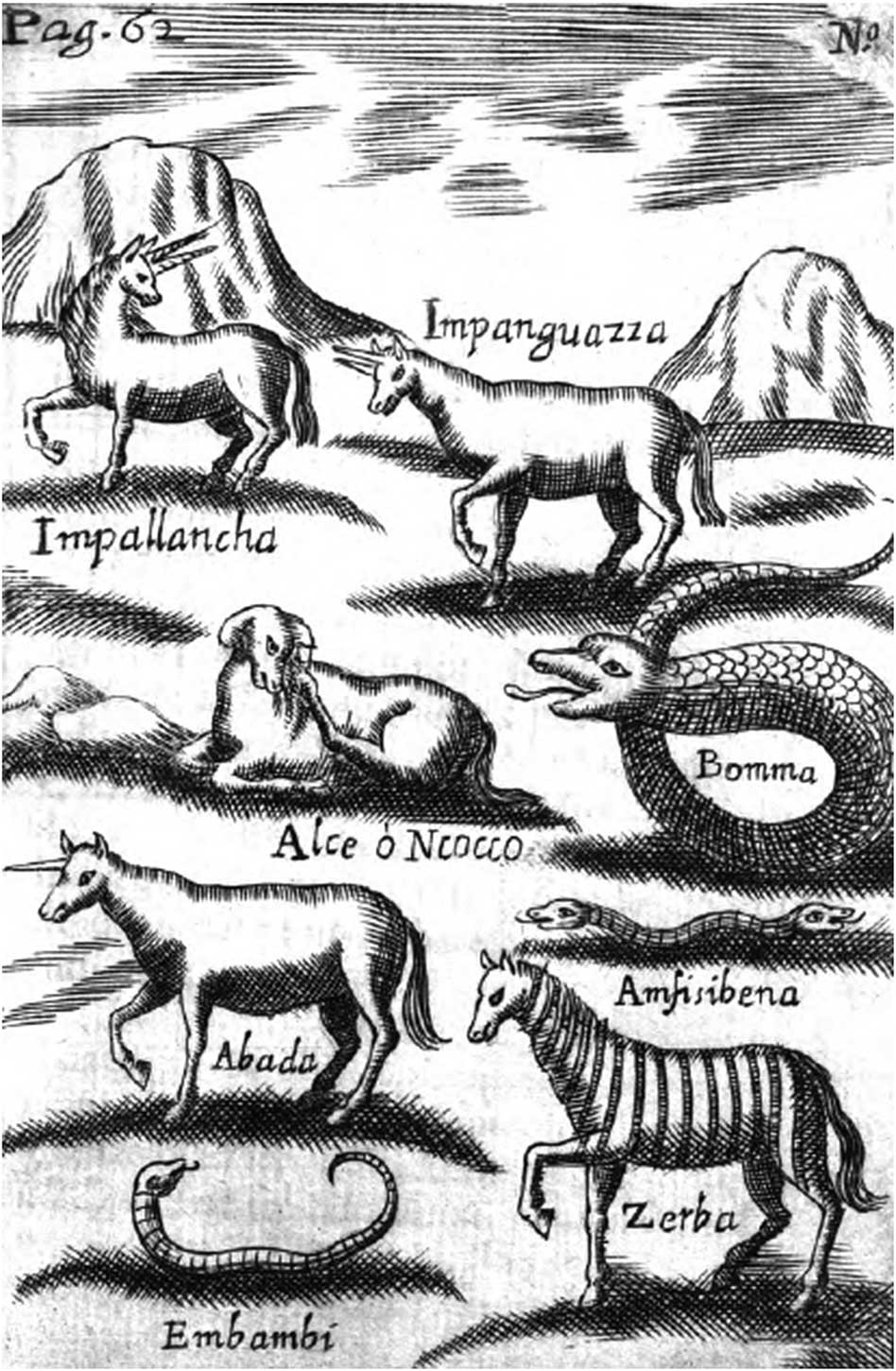
While the name ‘tapir’ was first used in the second half of the sixteenth century, the Spaniards had mentioned this animal before, comparing it to elks, cows, tigers, and asses; in such analogies, it was called vaca, vaca montés, tigre tanta, vaca danta, sachavaca, vaca mocha, and anteburro, the last one showing that the tapir was seen as a combination of elk (anta) and ass (burro).Footnote 43 Those appellations coexisted with the native names, such as vagra (Peru), beori (New Spain), maipouri (Guiana), and the Guaranese mborebi. The Spaniards and Portuguese started calling the animal anta, adanta, danta, or gran bestia, which were the Spanish and Portuguese names for the elk. It is not completely clear when the American tapir became known as the gran bestia. The sources indicate that the proliferation of this kind of analogy happened during the seventeenth century; that hypothesis, however, still needs further research. What we do see in that century is a burgeoning interest in this beast, the propagation of its virtues in the literature, and the commerce of drugs in a geographical span that included the Americas, Europe, and East Africa. In Africa, the terms ‘great beast’ and alce were used in the seventeenth century for the Congolese animals that the Portuguese called macoco and the locals referred to as ncocco or néollo (antelopes, Oryx).Footnote 44 According to the Italian missionaries to East Africa, the nails of the right foot of these beasts had particular virtues (Figure 1).Footnote 45
The African great beast or African elk, known as ncocco or macoco in the Bantu languages of present-day Angola. Traded by the Portuguese, it was marketed as part of materia medica indica. Source: Merolla and Piccardo, Relatione del viaggio, p. 62.

Early in the twentieth century, anthropologists recorded that Afro-Puerto Rican santeros or magic men wore the nail of the great beast, supposedly a tapir’s hoof, tied in a packet of tinfoil inside a cloth around the neck as protection. J. Walter Fewkes, probably unaware of the multiple traditions and exchanges involved in the history of the great beast, said that it was difficult to distinguish charms and amulets of Native American origin from those of African descent.Footnote 46 In the context of a decentralized geography of knowledge, the Americas played an important role, not just as producers of prime materials and products (as more traditional narratives have claimed) but also as shapers of the direction of trade and of knowledge. Things, names, and knowledge about things moved in convoluted and complex ways.
Trade in materials: the nail and the hide of misery
The transfer or loan of names is, in fact, a very complex phenomenon. It also implies the corollary of the transfer of the inherent properties and virtues in animals by means of commerce and trade on a global scale.Footnote 47 Natural histories of the elk report that humans utilized every single part of the animal (meat, hooves, antlers, nerves, and bones), which resisted all attempts at domestication. Prior to the use of their nails for remedies, elk had been highly valued for their hides, which were used for payments, tributes, and war indemnities. The Russians obtained them from the Siberian Khanty and Nentsy peoples, trading in hides with China.Footnote 48 In the seventeenth century, elk was one of the most popular hides in Muscovy.Footnote 49 Considerable stocks of elk skins from Siberia and the Yug river region were transported through the Dvina to Arkhangelsk for local trading purposes. In the 1670s, the market at Arkhangelsk received around 5,000 Siberian hides annually. In 1671, Arkhangelsk imported forty-two tanned elk hides from abroad.Footnote 50
The trade in elk skins from Russia and Livonia was partly managed by the Dutch, who transported them to Spain and Portugal, where anta, as mentioned before, became the general name for the elk, the buffalo, and all animals ‘which had an armour’, namely animals whose skins, reputed for their quality, were used for crafting shields, armour, breeches, and jackets for soldiers. Arab geographers in the Middle Ages referred to the large Berber tribe of the Lamta, who were particularly famous for the light and solid shields they made from an animal by that name and which were offered to the kings of the Mahgrib and al-Andalus.Footnote 51 As mentioned in some glossaries, ‘Anta’ or ‘Danta’ was the generic name for animals from whose hide shoes, bibs, and so forth were made, and that is why they were called ‘ante skin’. ‘Anta’ or ‘ante hide’ referred not only to the hide of the tapir, but also to that of the buffalo, moose, fallow deer, and deer, which were prepared with oil.Footnote 52
Many sources have referred to this craft. Topsell mentioned that elk hides were dressed by tanners with the fat of fishes and alum to make breastplates and rain shelters.Footnote 53 Oil-tanned elk hide was highly prized for clothing since it was considered bulletproof, like that of the rhinoceros, the African ncocco, and the American tapir. Friedrich Schiller in Wallenstein camp, set in the first half of the seventeenth century, mentions this property in his description of the hero’s attire: ‘He wears a jerkin of elk-skin tough, through which no bullet may find its way’ (‘Er trägt ein Koller von Elendshaut, das keine Kugel kann durchdringen’). Not surprisingly, the Spanish naturalist Félix de Azara (1746–1821) was still attributing this property to the Paraguayan tapir as late as the late eighteenth century, emphasizing that ‘the gun never succeeds in killing them’.Footnote 54 As previously mentioned, the ass’s hide also had a reputation for encouraging soldiers in the battlefield. So, the great beast, in all its forms, combined two properties expressed in two different materials that were both objects of trade: a bulletproof skin, suitable for shields and armour, and a sickly nature, which held an intrinsic therapeutic virtue.
The promotion of the elk’s virtues was such a success that Lithuania became the centre of an industry in healing amulets that used the elk’s hoof, its traffic extending as far as Italy and Spain, as displayed by the aforementioned inventories.Footnote 55 Baltic artisans specialized in elk bones, antlers, and hooves; rings were made from the hoof’s keratin and worn on the ring finger of the left hand. Pieces of the hoof were set in rings of gold and worn so that the curative medium would be in contact with the skin.Footnote 56 In early modern Russia, however, the antler and horn sector was an exotic one; the commodities were few and possessed by few, probably harvested in Belorussia or in western Muscovy.
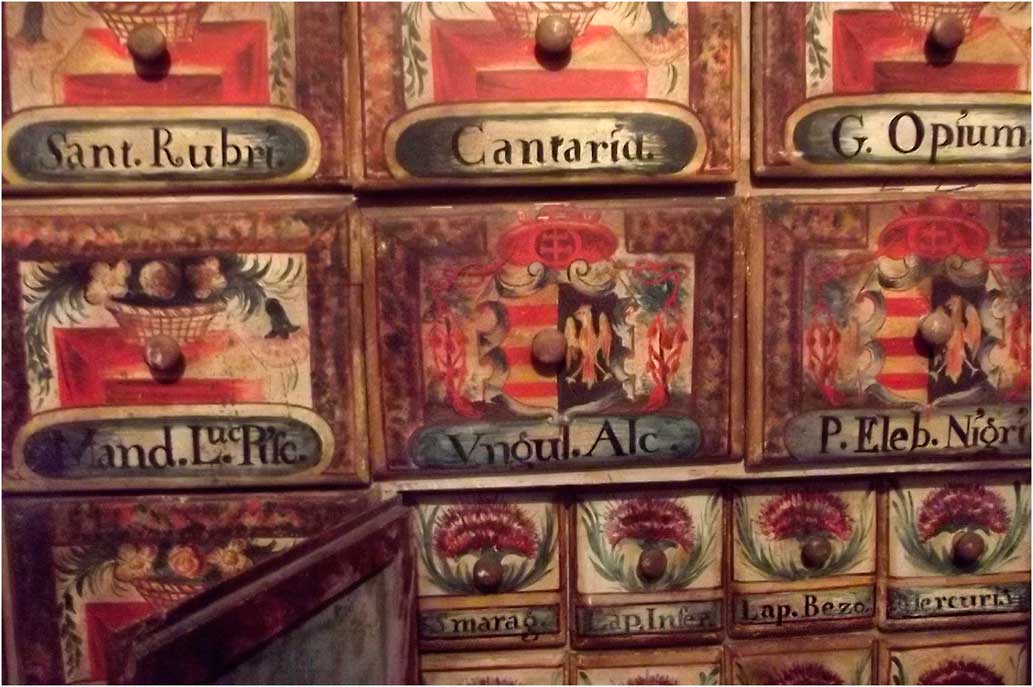
Russian commerce in animal by-products was substantially affected by trade in very few and expensive specimens, such as medicinal narwhal and rhinoceros horns.Footnote 57 In early modern Russia, antlers were of negligible importance commercially. The really significant sector of trade connected to mammals was that of hides and leathers; in addition, the trade in elk hooves was very active in the seventeenth century. Apothecaries and mountebanks from all over Europe sold and traded elk in its different forms, as charms, amulets, or chemical products. In Paris, pied d’élan and ongle d’élan were offered early in the 1700s; German apothecaries from the second half of the seventeenth century sold Elchsklauen, either as a powder, as a preparation, or in calcined or untreated form.Footnote 58 Apothecaries also offered elk’s fat (Axungia alcis) and antlers (Alcis cornu). The hoof was sold under the name of ungula alcis/alcis ungulae (Figure 2).Footnote 59
A pharmacy chest from Spain, including a drawer for ungula alcis. It would originally have contained powdered elk’s hoof to prevent seizures from epilepsy. Source: courtesy of the Museo de la Farmacia Hispana–Patrimonio Histórico, Universidad Complutense de Madrid. Photographer: Isabel Martínez Navarrete.

In 1663, the German alchemist Johann Joachim Becher described the three different forms that druggists offered: ungula, magisterium, and destillatum. Ungula praeparata was the result of grinding the hooves on a marble stone or mortar and mixing the resulting fragments with aqua primulae veris (extract of primrose flowers), then, once dried, shaping them into pearls. In distillation, the essence of the hoof was extracted in the form of a liquid, concentrating the specific properties of the supposed active ingredient into a small volume.Footnote 60 Becher, an expert in promoting projects and objects (and himself), was working on the principles of the chemical theory of essences, the ‘virtue’ of a remedy and its chemical composition. There was thus no real contradiction between the morphological principle of signatures and Paracelsus’s chemical theory of the ‘quintessence’ – the effective extract of a plant, animal, or mineral without shape or form. So the elk hoof, as an alchemical distillate, charm, or powder, was incorporated into what were called the chemical-Galenic pharmacopoeias that proliferated from the seventeenth century onwards.
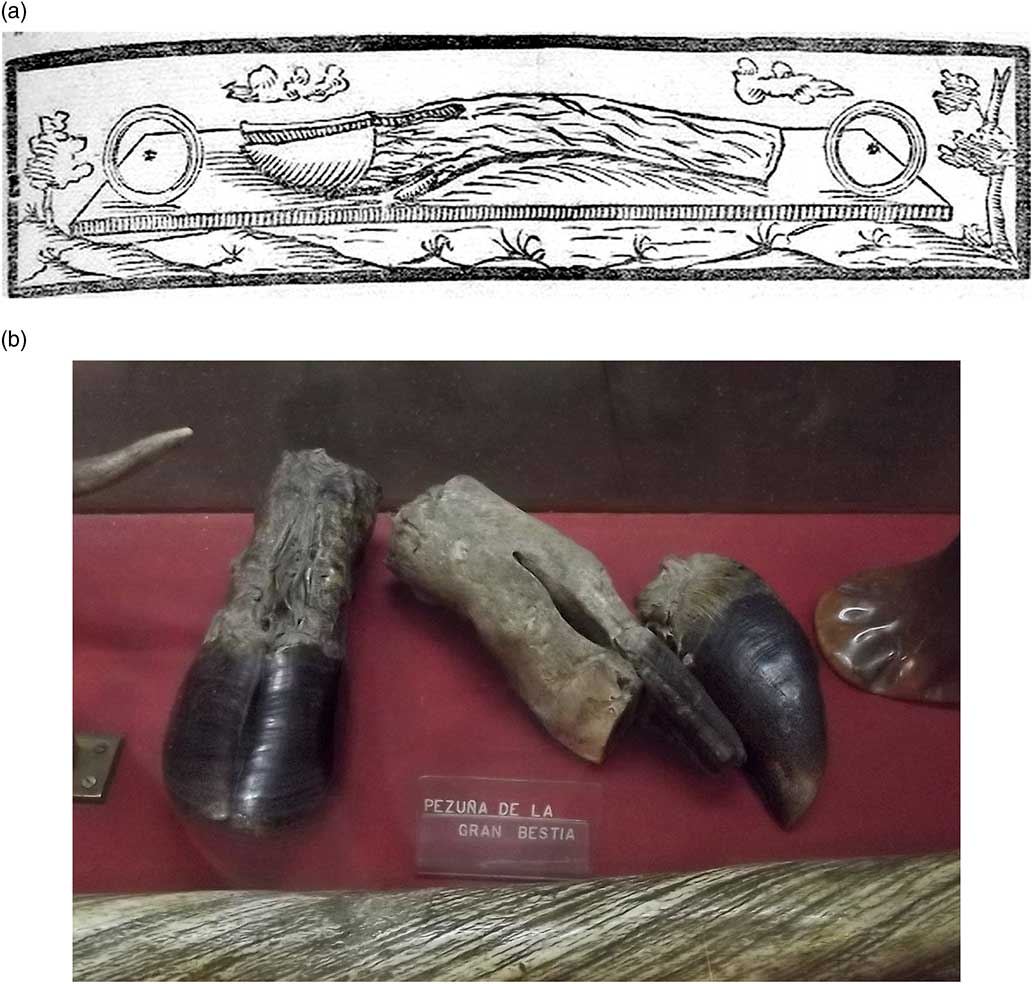
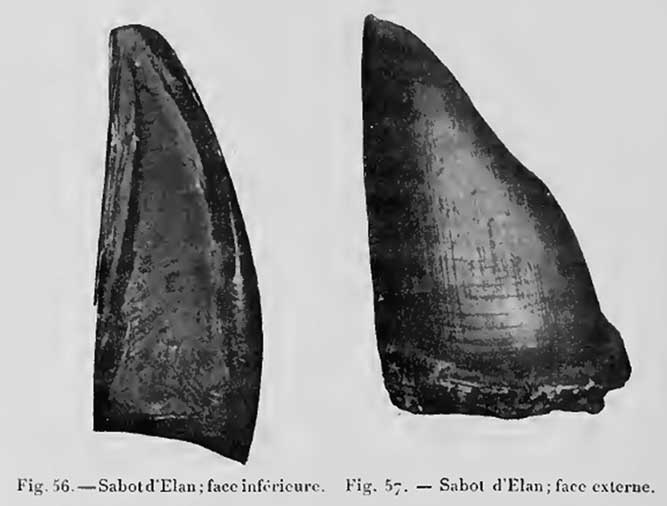
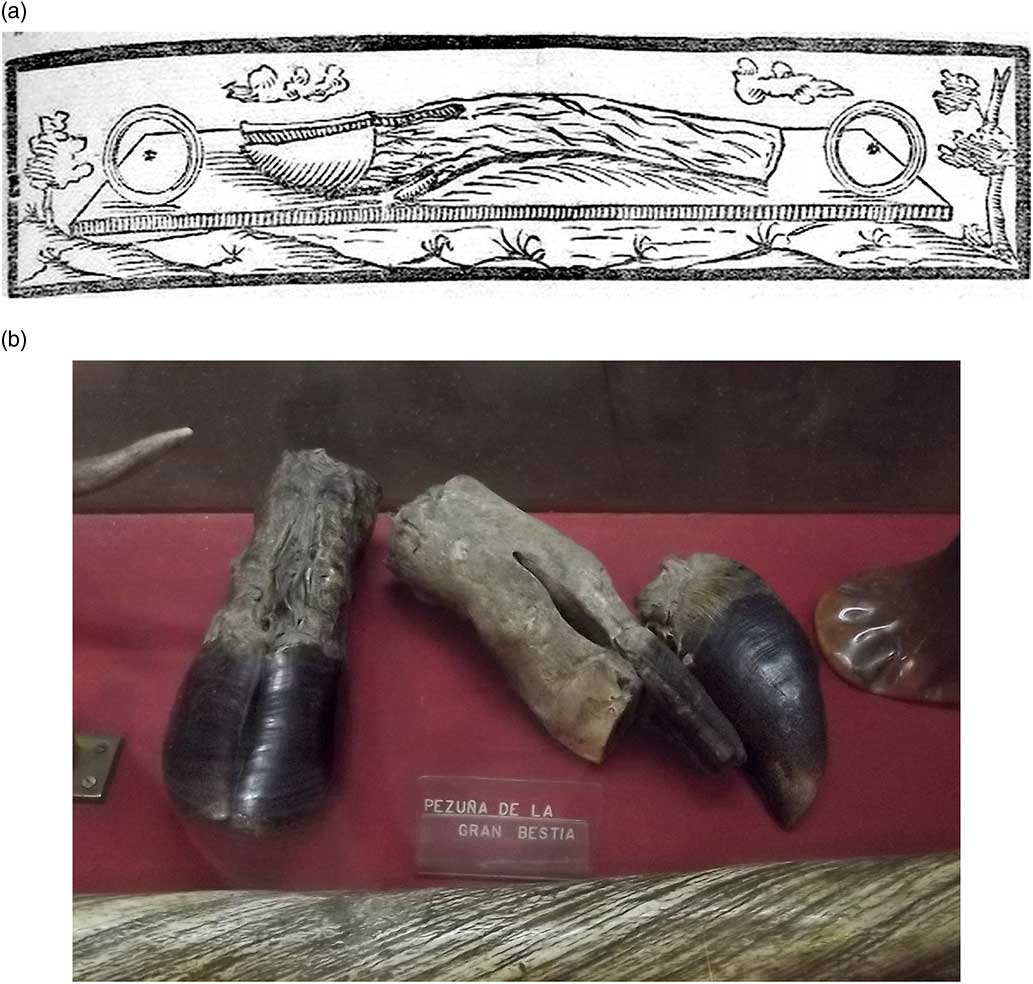
The nail appears as a component of several recipes to fight epilepsy, such as the so-called poudre de gouttete, a recipe used in England early in the eighteenth century that mixed amber, elk claws, and human skull in powder. Ungula alces, vulgarly called the elk claw, was a cloven hoof that was moderately large, shiny black, very hard, and quite heavy. The druggist generally took care to have a part of the leg of the animal displayed with it to show that it truly was the hoof of an elk and not some similar animal (see Figures 3a, 3b, and 4).
The nail of the great beast as it was sold in the seventeenth century. The foot of the elk had to be displayed in order to prove that the hoof on sale belonged to that animal and was not obtained from any other animal. a. elk’s foot. Source: Andrea Bacci, Virtudes y maravillosas calidades de la uña de la gran bestia, 1675. b. Hoof of the great beast. Source: courtesy of the Museo de la Farmacia Hispana–Patrimonio Histórico, Universidad Complutense de Madrid. Photographer: Isabel Martínez Navarrete.
Elk’s nail. University pharmacological collections amassed examples of animals linked to materia medica. While these were maintained by the Universidad Complutense de Madrid, other university museums discarded what were viewed as ‘useless objects’. The Parisian Musée de Pharmacie (Musée François Tillequin – collections de matière médicale) dismantled its animal collections in the 1970s and most of the collected objects were lost. This image, however, records the existence of elk’s hoof in the Paris collection early in the twentieth century. Source: H. Bauregard. Matière médicale zoologique: histoire des drogues d’origine animale, Paris: Naud, 1901.

From the other side of the Atlantic, Félix de Azara, describing the tapir or mborebi, remarked that ‘to the nails of their toes ground down and taken in powder, is attributed the power of curing epilepsy’.Footnote 61 It appears that he did not himself observe or register this kind of practice, but was simply quoting the observations of others. But he was neither the first nor the only one: every time that the tapir was described, the virtues of its toenails were also mentioned. For instance, in 1731, the Jesuit priest Father José Gumilla (1686–1750) reported from the Orinoco missions on the medical use of the great beast among the Achagua nation. Antas, which Gumilla described as an animal similar to a donkey (jumento), were hunted by Spaniards for their hides and hooves.Footnote 62
Gumilla’s observations would be incorporated into European remedy books, and become included in the eighteenth-century Spanish translation of the Charitable remedies of Madame Marie Mapéau Fouquet, that ‘hotchpotch of traditional pharmacy (excrement, animal oils, echoes of old astrological medicine) and the fashionable remedies from the seventeenth century (mercury, antimony)’.Footnote 63 When originally published in French in 1675, Fouquet’s book said nothing about either South American tapirs or the great beast. However, the French edition from 1696 listed the so-called poudre merveilleuse as one of the many recipes for curing epilepsy. This ‘wonderful powder’ was the classical composite of human skull mixed with elk hoof, oak viscum, and cinnabar/mercury.Footnote 64 Translated into Spanish in 1739, the collection of recipes incorporated the gran bestia twice. The first came in the translation of the formula quoted above, where the ongle d’élan was translated as uña de la gran bestia (the skull, in this case, should come from a convict who had been beheaded rather than strangled).Footnote 65 Secondly, Father Gumilla observes that the gran bestia was defined as the anta in Venezuela. Similarly, in Spanish dictionaries from the late eighteenth century, the elk was replaced by the South American tapir. One can say that, wherever the gran bestia went, so did the virtues of its hooves and hides. This was not only a function of analogy but also a practical result of the expanding virtues of the preparations that travelled back and forth between the Americas and Europe, together with the trade in books and animal and natural history products.
In the late eighteenth century, Spain continued to trade in all kinds of medicinal stones and animal drugs, as can be traced in the commerce almanacs published between 1795 and 1808 in Madrid by Diego María Gallard, lawyer to the Royal Council, with the support of the Spanish crown.Footnote 66 These almanacs included lists of imports and exports, the taxes levied on them (about half the pages were dedicated to this section), and information on the Peninsular and Spanish American marketplaces. Sold in Madrid, Cádiz, Malaga, Seville, Valencia, Barcelona, Pamplona, Bilbao, and some Spanish American cities, the almanacs were conceived as a tool to promote commerce in a context of political and commercial reform, representing a reliable source for economic history. Gallard, who compiled this information thanks to his extensive network of correspondents, listed – among many other goods – the national and foreign drugs traded in Spain, including medicinal stones and animal substances, such as the ‘manos, pies y uñas de la gran bestia’ (‘hands, feet, and nails of the great beast’).
According to the almanacs, all gran bestias passing through customs were ‘foreign’, namely not ‘native’ of ‘these Kingdoms’ (Spain, Spanish America, and the Philippines). The term ‘foreign’ included Portugal and countries in friendship and alliance with Spain, as well as the rest of the world. This could mean that there was no trade in tapir hooves between South America and Spain, and that the medical use of tapir remained local, a use that continued into the nineteenth and twentieth centuries. The Chuntaquiro (or Piro People), who lived in the Madre de Dios River in the Peruvian Amazon in the mid 1830s, came 200 leagues upriver annually to barter with the inhabitants. They brought parrots and other birds, monkeys, cotton robes, wax, balsam, and hooves of the gran bestia, which they exchanged for hatches, knives, scissors, needles, and buttons.Footnote 67 Until recently, the Kallawaya and the Cholas from Bolivia and Peru included the tapir hoof as part of their pharmacopoeia.Footnote 68 In Ecuador, a portion of the tapir’s toe is even today believed to cure all ills, while a scrap of hide, a fragment of bone, or a tooth may still be purchased on village street corners as a talisman to guarantee success in love and business.Footnote 69 Today, the use of tapir’s hoof and hide for medical purposes is mentioned only in relation to the mountain species (Tapirus pinchaque) as one of the factors that encourages hunting and contributes to its endangerment.Footnote 70
The almanacs do not indicate where the manos de la gran bestia originated, but do indicate that they were taxed at 0.30 maravedíes each.Footnote 71 While this price indicates that the manos (hands) were not very valuable, the sources confirm that early in the nineteenth century there was still an active market for medical items that had already been discarded from the universe of learned physicians and naturalists. Moreover, the listing as manos indicates that the ‘nails’ were traded with the entire foot, as evidence that they belonged to the real great beast and were not counterfeit. One such elk’s hoof is still on display in the Museo de Farmacia at the Universidad Complutense de Madrid (see Figure 3b). Further research into this trade could yield other published sources that could be mined to determine, for instance, the country of origin and the volume of the great beast traded in the years of political and cultural reform, just before South American independence and the outbreak of the Napoleonic wars.
Dense descriptions reconstruct the circuits of knowledge on a case-by-case basis. Working at different scales of analysis, the great beast helps in reinserting America, especially Latin America, into this global picture by studying it as one protagonist, among others, that participated actively in the making and circulation of knowledge. Often-forgotten actors – missionaries, commercial agents, artisans – are part of this story.
Conclusions
In examining the case of the entrenched European belief that elk’s hooves could cure epilepsy, this article has related that belief to similar practices regarding the tapir in the Americas. It first analysed how the transfer of a name between continents involved the associated transfer of medical properties, and second considered how, long before Linnaeus, global commerce in medicines, hides, and other animal products contributed to associating different animal kinds from distinct continents and cultural worlds, creating ‘local products’ whose convoluted and transregional history is today forgotten.
Late in the 1990s, the cultural-historical geographer Daniel W. Gade published ten essays under the title of Nature and culture in the Andes. Here he discussed the relevance of trajectories, namely how ‘people, plants, animals, the land, and everything else on earth are interlaced in singular and sometimes dysfunctional ways’.Footnote 72 He also referred to the intellectual challenges posed by the ‘enigmatic configuration of the nature/culture gestalt’, in particular to the reconstruction of ancient patterns from fragments of evidence and inferences.Footnote 73 As a paradigmatic case of such a configuration, he analysed the strong connection in Andean cultural history between the tapir and human epilepsy, a connection that, according to Gade, resulted from the crossroads of shamanic pre-Columbian practices, the meaning of tapirs in tropical South America, and the post-sixteenth-century transfer of Old World ancient pharmacopoeia into the Andes. His essay showed how objects, words, and animals from different traditions were recombined, creating new objects and transferring medical virtues to New World animals – in this case, to the hoof of the South American tapir, imbued with the same curative powers and pedigree that elk’s hooves had in the Old World as a cure for epilepsy.
Whereas contemporary zoologists admit that they do not know where ‘this superstition’ came from, Daniel Gade’s essay recalled that folk medicine, or what today is called ‘ethno-medicine’, is a configuration that has a very complex history that can be written and recovered, including the history of folklorization in Europe of early modern pharmacopoeias and the transfer of names and therapeutic virtues from one natural object to another.Footnote 74 At issue is the general notion about the environmental relationship between animals, people, and diseases, but also the universalization of the different medical systems into which the ‘foreign’ drugs were incorporated.
Animal remedies were ‘part of the story of the Renaissance retrieval of ancient medicine, coupled with its confident assertion of present-day knowledge … They also form part of the commercial justification for exploration and settlement, being seen as precious commodities.’Footnote 75 Searching for analogies between animals from different continents was not independent of the possibility of trading in those remedies and amulets propagated by the new printing culture. Promoted by both Europeans and New World natives, this culture went hand in hand with the transfer to the natives of the Americas of the sixteenth-century trope that ‘the common people possessed “secrets” … a body of natural knowledge unknown to the savants’.Footnote 76
More than twenty years ago, the Spanish historian of science José María López Piñero underscored ‘the mestizo (hybrid) cultural condition of the so-called Scientific Revolution’.Footnote 77 Although he was specifically referring to the impact that the hybrid work by Francisco Hernández had on early modern science, this article contributes to his proposition as an analysis of the more complex panorama that emerges from accepting the hybrid nature of knowledge. To paraphrase James Secord: the less local and specific knowledge becomes, the harder it is to see how it travels.Footnote 78
The case of the great beast, far from being unique, could be understood as one of the many examples of this process. One can say that, in a context of epistemological resemblance, names such as gran bestia connected animals from different regions on the basis of common virtues and properties. This not-exceptional situation characterized the hybridization process that accompanied the conquest of the Americas. The present article assumes that the transfer of names and the creation of analogies happened more than once and involved regions far beyond Spanish America and the Iberian Peninsula, thus placing the question in the realm of global history. Indeed, the article describes the various scenarios, chronologies, and trading zones that should be taken into account to understand the global uses and transfer of remedies. In particular, it considers the articulation between the Spanish and Portuguese centres – hubs of the commerce with the Indies and Africa, centres of interaction between trade, book printing, propagation of products, and knowledge – and Fennoscandia, propelled in part by the Dutch merchants through the Baltic Sea.Footnote 79
These remedies should be studied not only in the longue durée but also in relation to the intricate networks of commerce and the disciplines that structure our current comprehension of human knowledge. Relevant bibliography is scattered through different fields of study: art and archaeology, geology, mineralogy, medicine, alchemy and chemistry, astronomy and astrology, philology, and literature. For this reason, the present article argues for a new investigation into the global and transdisciplinary dimension of objects that may reflect the living remains of a long history of exchanges, translations, and transfers.
Irina Podgorny is permanent research scholar from CONICET and director of the Historical Archive of La Plata Museum, Argentina. Her research interests include natural history museums, quackery, and the history of palaeontological collections. With Phil Kohl and Stefanie Gänger, she co-edited Nature and antiquities: the making of archaeology in the Americas (University of Arizona Press, 2014).