Introduction
Maize (Zea mays L.) is a versatile crop and has greatly contributed to the world's economy. Being a C4 plant with very high yield potential, it is also called the ‘queen of cereals’ (Saritha et al., Reference Saritha, Ramanjaneyulu, Sainath and Umarani2020). It is the third most important cereal crop after wheat and rice in the world's agricultural economy (FAO, 2020). Maize is required by various sectors from poultry, animal husbandry to value-added products for human consumption and also is a major source of industrial raw materials for starches, acids and alcohol production (Galani et al., Reference Galani, Orfila and Gong2020). Thus, to meet the increasing demand, improvement in yield and resiliency to climatic fluctuation is the priority area of maize improvement programme (Keimeso et al., Reference Keimeso, Abakemal and Gebreselassie2020). Grain yield is a complex trait, highly dependent and determined by various independent component characters. Optimizing the expression of yield contributing traits through genetic manipulation is probably the best way to enhance maize yield. Therefore, there is a need for integrated approach for improvement of the traits related to plant morphology (Wang et al., Reference Wang, Yang, He, Qu and Zhang2008a, Reference Wang, Duan, Xing and Zhao2008b; Ramstein et al., Reference Ramstein, Larsson, Cook, Edwards, Ersoz, Flint-Garcia, Gardner, Holland, Lorenz, McMullen, Millard, Rocheford, Tuinstra, Bradbury, Buckler and Romay2020).
Morphological traits related to flowering behaviour (i.e. days to anthesis, days to silking, anthesis-silking interval) are considered important yield traits under stress conditions particularly under drought (Westgate and Bassetti, Reference Westgate, Bassetti and Wilkinson1990; Edmeades et al., Reference Edmeades, Bänziger, Elings, Chapman, Ribaut, Kropff, Bouma, van Laar, Teng, Aggarwal, Bouman and Jones1997; Sah et al., Reference Sah, Chakraborty, Prasad, Pandit, Tudu, Chakravarty, Narayan, Rana and Moharana2020) and are also important for the development of varieties with variable maturity duration suited for growing under variable climatic conditions. Traits related to leaf morphology namely, flag leaf length and flag leaf width are considered important from the yield point of view. Leaf size is dependent on leaf width, leaf length and leaf area, can significantly influence canopy morphology, lead to higher photosynthetic activity and may result in higher grain yield (Zhang et al., Reference Zhang, Lv, Li, Wang, Yu, Li, Du, Diao, Wang and Weng2020). Similarly, plant height, node bearing first ear and ears per plant are important traits concerning lodging tolerance (Li et al., Reference Li, Dong, Niu and Cui2007), as well as yield (Motto and Moll, Reference Motto and Moll1983). Therefore, understanding the genetics of these traits is essential to breed varieties with good yield potential as well as resilient to climatic changes.
Yield and various yield-associated traits are polygenic in nature and their effective utilization in breeding depends on their dissection into simply inherited traits using the approach of quantitative trait locus (QTL) analysis. QTLs have been analysed in many investigations using population derived from biparental crosses between the contrasting maize inbred lines for flowering behaviour (Guo et al., Reference Guo, Su, Zhang and Wang2008; Liu et al., Reference Liu, Cook, Melia-Hancock, Guill, Bottoms, Garcia, Ott, Nelson, Recker, Balint-Kurti, Larsson, Lepak, Buckler, Trimble, Tracy, McMullen and Flint-Garcia2016a), leaf morphology (Agrama et al., Reference Agrama, Zakaria, Said and Tuinstra1999; Liu et al., Reference Liu, Chu, Cai, Mi and Chen2010; Ku et al., Reference Ku, Zhang, Zhang, Guo, Liu, Zhao, Yan and Chen2012; Zheng and Liu, Reference Zheng and Liu2013; Yang et al., Reference Yang, Dong, Li, Wang, Shi and Zhou2015), plant height (Guo et al., Reference Guo, Su, Zhang and Wang2008; Yang et al., Reference Yang, Lu, Zhang, Zhou, Qu and Xie2008; Nikolic et al., Reference Nikolic, Jelkovic, Dodig and Ignjatovic-Micic2011), ear per plant (Veldboom and Lee, Reference Veldboom and Lee1994) and node bearing ear (Nikolic et al., Reference Nikolic, Jelkovic, Dodig and Ignjatovic-Micic2011; Zhu et al., Reference Zhu, Chen, Li, Zhang, Huang, Zhao, Song and Liu2013; Li et al., Reference Li, Irfan, Zhang and Lin2014a, Reference Li, Zhang, Wu, Sun and Liu2014b). Large-scale QTL mapping performed by Tian et al. (Reference Tian, Bradbury, Brown, Hung, Sun, Flint-Garcia, Rocheford, McMullen, Holland and Buckler2011) for leaf length and leaf width concluded that the genetic architecture of the leaf traits was governed by numerous minor QTLs. Such QTL studies in teosinte (Z. mays subsp. parviglumis Iltis and Doebley) derived maize population are limited. In fact, cultivated modern maize is a finished product that may not contain numerous alleles, which have been lost during the course of domestication followed by selection and trait-specific breeding (Vigouroux et al., Reference Vigouroux, Mitchell, Matsuoka, Hamblin, Kresovich, Stephen, Smith, Jaqueth, Smith and Doebley2005; Tenaillon et al., Reference Tenaillon, U'Ren, Tenaillon and Gaut2004; Warburton et al., Reference Warburton, Reif, Frisch, Bohn, Bedoya, Xia, Crossa, Franco, Hoisington, Pixley, Taba and Melchinger2008; Singh et al., Reference Singh, Kumar, Chandra, Pal and Verma2017; Tian et al., Reference Tian, Wang, Xia, Wu, Xu, Wu, Li, Qin, Han, Chen, Jin and Tian2019). Hence, many desirable alleles required for improvement in yield as well as climatic resiliency are limited in elite maize germplasm (Tarter et al., Reference Tarter, Goodman and Holland2004; Le Clerc et al., Reference Le Clerc, Bazante, Baril, Guiard and Zhang2005). However, wild relatives are expected to still possess the desirable and diverse allelic variants that were lost during the process of domestication (Liu et al., Reference Liu, Cook, Melia-Hancock, Guill, Bottoms, Garcia, Ott, Nelson, Recker, Balint-Kurti, Larsson, Lepak, Buckler, Trimble, Tracy, McMullen and Flint-Garcia2016a; Mammadov et al., Reference Mammadov, Buyyarapu, Guttikonda, Parliament, Abdurakhmonov and Kumpatla2018; Tian et al., Reference Tian, Wang, Xia, Wu, Xu, Wu, Li, Qin, Han, Chen, Jin and Tian2019; Joshi et al., Reference Joshi, Adhikari and Singh2021; Sahoo et al., Reference Sahoo, Adhikari, Joshi and Singh2021) and such wild alleles can be re-domesticated through introgression or pre-breeding approaches. Teosinte, the wild progenitor of maize, is distinct from maize in several aspects; namely, flowering behaviour, plant morphology, ear traits and yield (Smith and Lester, Reference Smith and Lester1980; Doebley, Reference Doebley2004; Singh et al., Reference Singh, Kumar, Chandra, Pal and Verma2017; Adhikari et al., Reference Adhikari, Joshi and Singh2019, Reference Adhikari, Joshi, Sahoo and Singh2020; Fu et al., Reference Fu, Xu, Chen, Wang, Chen, Huang, Li, Xu, Tian, Wu, Lu, Li and Tian2019; Yang et al., Reference Yang, Samayoa, Bradbury, Olukolu, Xue, York, Tuholski, Wang, Daskalska, Neumeyer, Sanchez-Gonzalez, Romay, Glaubitz, Sun, Buckler, Holland and John2019). Despite dramatic morphological differences, the sexual compatibility between maize and teosinte is well documented (Singh et al., Reference Singh, Kumar, Chandra, Pal and Verma2017; Kumar et al., Reference Kumar, Singh, Adhikari and Joshi2019). Therefore, lines with desirable traits can be generated and multiple traits can be mapped together by targeting a single mapping population. Many investigators have used teosinte-introgressed populations for QTL analysis of different traits (Calderón et al., Reference Calderón, Yandell and Doebley2016; Liu et al., Reference Liu, Cook, Melia-Hancock, Guill, Bottoms, Garcia, Ott, Nelson, Recker, Balint-Kurti, Larsson, Lepak, Buckler, Trimble, Tracy, McMullen and Flint-Garcia2016a, Reference Liu, Garcia, McMullen and Flint-Garcia2016b; Karn et al., Reference Karn, Gillman and Flint-Garcia2017; Fu et al., Reference Fu, Xu, Chen, Wang, Chen, Huang, Li, Xu, Tian, Wu, Lu, Li and Tian2019). Our research is focused on diversification of maize germplasm resources as the variability in maize inbreds and landraces is less in comparison to the wild subspecies teosinte. Therefore, in the present investigation, we intended to analyse a population comprising 169 backcross inbred lines (BILs) derived from maize and teosinte hybridization to elucidate the genetic basis of plant architecture-related traits, to assess genetic variability in the population, and to identify superior teosinte-introgressed maize inbred lines with desirable traits to be used in maize breeding programmes.
Materials and methods
Generation of materials
Materials for the investigation consisted of 169 BC1F5 lines derived from crossing wild progenitor teosinte (Z. mays ssp. parviglumis Iltis and Doebley) and a maize inbred line DI-103. Teosinte parviglumis was locally collected and maintained by controlled pollination for five successive generations. The maize inbred line used as seed parent was crossed with teosinte used as pollen parent to produce F1s. The maize line was crossed with F1 individuals to generate backcross, BC1F1 seeds. The BC1F1 seeds were sown in the next season and selfed to generate BC1F2 seeds. Subsequently, selfing was continued for three more generations to produce BC1F5 seeds. Thus, the 169 BC1F5 BILs constituted the population for the present investigation.
Experimental layout and trait evaluation
The 169 BILs of maize were sown in a randomized complete block design with two replications in two different environments (artificially inoculated with banded leaf and sheath blight causing fungal pathogen Rhizoctonia solani (E1) and uninoculated (E2)) in the Kharif season (June to October) 2018. Each line was planted in a 2 m long row separated at 75 cm from other rows. The 169 BILs were evaluated for eight plant architecture traits, namely, days to 50% anthesis (DA), days to 50% silking (DS), anthesis-silking interval (ASI), flag leaf length (FLL), flag leaf width (FLW), plant height (PH), ear per plant (E/P) and node bearing first ear (NBE). For recording observations, three plants were randomly selected under both the environments, scores to different characters were assigned and finally average of three plants was calculated and used for statistical analysis.
DNA extraction, SSR assay and scoring of genotyping data
For genomic DNA isolation, leaves were collected from 30 days old seeding and DNA was extracted by CTAB (cetyl trimethyl ammonium bromide) method (Doyle and Doyle, Reference Doyle and Doyle1990) with some modification. The quality and quantity of DNA were assessed using electrophoresis (0.8% agarose gel) and spectrophotometer (Systronics PC Based Double Beam Spectrophotometer 2202), respectively. Then stock DNA was diluted to obtain working concentrations of 200 ng/μl. Polymorphism between maize inbred line DI-103 and teosinte-parviglumis was investigated using 168 microsatellite markers that were distributed throughout the maize genome. PCR reactions were performed in 13.8 μl reaction mixture containing 1.5 μl reaction buffer with 15 mM MgCl2 (10 ×), 3 μl (200 ng/μl) genomic DNA, 0.35 μl dNTPs mix (2.5 mM each), 1.5 μl each forward and reverse primer (40 ng/μl), 0.25 μl Taq DNA polymerase (3 U/μl) and 7.2 μl deionized water. The PCR cycle was performed as: the flow for the first cycle was initial denaturation (94°C for 5 min), denaturation (94°C for 40 s), annealing (55–68°C for 40 s) and elongation (72°C for 1 min). The cycle from denaturation to elongation was repeated 35 times, followed by a final elongation (10 min at 72°C). The amplified PCR profile of each BIL with each marker was resolved on 3% agarose gel and visualized and captured using PC-based gel documentation system (Alpha Innotech Corporation, San Leandro, CA USA). The amplification profile of each marker was compared with a standard DNA ladder of 100 bp and allelic size was determined. The SSR data of each line were scored separately by using the following coding symbols.
Scoring of SSR banding pattern in BC1F5 population

Statistical analysis and QTL mapping
R statistical software was used to perform analysis of variance (ANOVA). Ten superior lines that showed higher average estimates among the environments for all the studied traits were identified and they were classified based on the UPGMA (unweighted pair group method with arithmetic averages) method of PAST (PAleontological STatistics) software (Hammer et al., Reference Hammer, Harper and Ryan2001) and a dendrogram was generated by using Jaccard dissimilarity matrix. Polymorphism information content (PIC) value of each marker was calculated by using the formula given by Smith et al. (Reference Smith, Chin, Shu, Smith, Wall, Senior, Michell, Kresovick and Ziegle1997) ${\rm PIC} = 1\,-\,\sum\nolimits_i^n {fi^2}$ where fi is the frequency of the ith allele. The PIC calculation was performed using Microsoft Excel. The single-marker analysis method of Win QTL Cart 2.5 software was used to perform QTL analysis (Wang et al., Reference Wang, Basten and Zeng2012). It is the quickest method that scans linkage between the trait of interest and a single marker at a time. Based on genotyping data of each marker, individuals were grouped in different genotypic classes, and the mean value of targeted traits for each class was estimated by summing up the estimates of each individual of that particular class. Further t-tests were performed to compare the mean value of each genotypic class if the difference is significant then the marker based on which individuals were classified in different genotypic classes is likely to be linked with the trait of interest.
Results
Phenotyping of plant architecture traits and identification of superior lines
ANOVA revealed significant variation among 169 lines for all the traits which reflect differential allelic introgression from teosinte leading to variation in BC1F5 maize lines (Table 1). The range of different plant architecture-related traits in both control (E2) and banded leaf and sheath blight disease stress (E1) environments is presented in online Supplementary Table S1 and Figs S1–S8. Days to anthesis and days to silking of the maize inbred line DI-103 were 52.50 and 55.00 days in E1, and 54.50 and 56.50 days in E2, respectively. However, teosinte did not differ for days to anthesis (81.50 days, E1) and days to silking (78.00–78.50 days, E2) in both the environments. In BC1F5 maize lines, the DA and DS ranged from 45.00 to 67.00 days and 43.00 to 66.00 days in E1, and 47.00 to 68.00 days and 44.00 to 67.00 days in E2, respectively. In the case of teosinte and maize inbred line DI-103, ASI was nearly the same (under both the environments +3.00 to +3.50 and −2.00 to −2.50 days). However, in BC1F5 lines ASI varied from −5.00 to +4.00 days and −4.00 to +5.00 days under E1 and E2, respectively. Maize inbred line DI-103 showed FLL and FLW of 29.51 and 4.53 cm in E1, and 30.78 and 4.66 cm in E2, respectively. The observations noted on FLL and FLW were 26.00 and 3.88 cm, and 23.75 and 3.50 cm when teosinte was investigated in E1 and E2, respectively. The data on FLL in BC1F5 lines varied from 9.90 to 59.45 cm and for FLW from 1.01 to 6.56 cm under E1 whereas under E2 FLL and FLW varied from 9.40 to 60.88 cm and 2.80 to 7.60 cm, respectively. The average PH noted for maize inbred line DI-103 and teosinte was 97.20 and 241.00 cm in E1, and 97.39 and 242.00 cm in E2, respectively. In BC1F5 lines variation for PH ranged from 90.60 to 248.00 cm in E1 and 88.00 to 229.33 cm in E2. Among BILs, the average E/P and NBE varied from 1.00 to 4.00 and 3.00 to 7.60 in E1 and 1.00 to 5.50 and 2.60 to 7.60 in E2, respectively. In the case of maize inbred line DI-103, E/P and NBE were 1.10 and 4.50 in E1, and 1.16 and 4.16 in E2, respectively. However, in the case of teosinte, E/P was 242.33 and 263.50, and NBE was 6.16 and 5.83 in E1 and E2, respectively.
Analysis of variance (ANOVA) for different characters in teosinte-introgressed BILs of maize

DA, days to 50% anthesis; DS, days to 50% silking; ASI, anthesis-silking interval; FLL, flag leaf length; FLW, flag leaf width; PH, plant height; E/P, ears per plant; NBE, node bearing first ear.
** 1% level of significance.
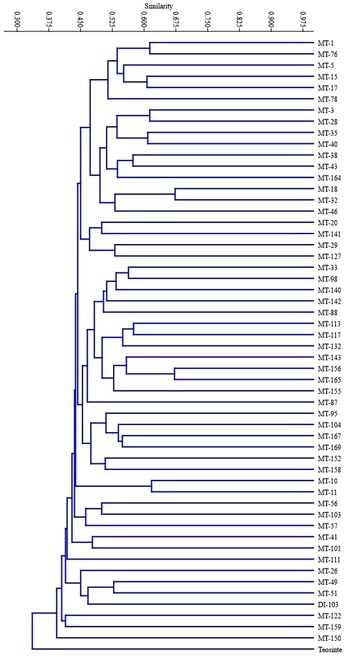
The data on the different parameters across both the environments were averaged and the top 10 superior lines were selected (Table 2). Of the total of 53 selected lines, two lines namely MT-32 and MT-142 were found superior for four different traits followed by five lines namely MT-17, MT-40, MT-88, MT-95 and MT-169 which were superior for three traits. Ten lines namely MT-10, MT-11, MT-26, MT-28, MT-29, MT-33, MT-103, MT-141, MT-152 and MT-167 were found superior for two traits whereas the remaining lines were superior for one trait only. Further clustering of these selected lines was performed by UPGMA to know the extent of diversity among lines and select diverse parents for desirable trait accumulation. The cluster analysis with UPGMA using Jaccard's similarity coefficients grouped the 55 lines (53 BILs plus maize inbred parent (DI-103) and teosinte) into 12 clusters based on molecular data with 76 SSR markers (Fig. 1, Table 3). The pair-wise genetic dissimilarity between the lines varied from 0.326 to 0.768. Teosinte clustered independently in cluster I and showed maximum divergence from MT-26 with dissimilarity value 0.768 and from MT-49 with dissimilarity value 0.766 of cluster V. With 0.675 dissimilarity value, teosinte showed divergence with MT-159 that was clustered independently in cluster III. But MT-18 and MT-32 were quite similar (67.33%) with the minimum dissimilarity value of 0.326 and both belonged to cluster 12, followed by MT-156 and MT-165 with dissimilarity value 0.328, grouped in cluster 9. Distribution patterns of lines among clusters were not uniform. Maximum 19 lines were grouped in cluster IX followed by 16 in cluster XII. Clusters V and XI consist of four lines each. In cluster VIII, three lines were present and both clusters VII and X were composed of two lines each, whereas a minimum of one line was present in clusters II, III, IV and VI.
Clustering pattern of 55 promising BILs of maize (including parents) based on 76 SSR markers data.

Trait-wise list of top 10 superior BILs of maize

DA, days to 50% anthesis; DS, days to 50% silking; ASI, anthesis-silking interval; FLL, flag leaf length; FLW, flag leaf width; PH, plant height; E/P, ears per plant; NBE, node bearing first ear.
Clustering patterns of 55a superior BILs of maize

a Includes parental lines DI-103 and teosinte.
Genotyping of mapping population
A total of 76 SSR markers that were identified as polymorphic between parents were utilized for genotyping of 169 BILs. The details of primers including the number of alleles, product length and PIC value were presented in online Supplementary Table S2. Genotyping of mapping population with 76 polymorphic SSR primers led to the identification of 207 alleles with an average of 2.7 alleles per locus. Allele size ranged from 80 bp (umc1622, bnlg197, bnlg389, umc1215, umc1546, umc1428, umc2635 and umc1673) to 600 bp (umc2392). With an average of 0.64 PIC, primer bnlg197 portrayed a minimum PIC value of 0.29 whereas the maximum value of 0.86 was recorded in the case of bnlg615 and umc1726.
Identification of genomic regions for plant architecture-related traits
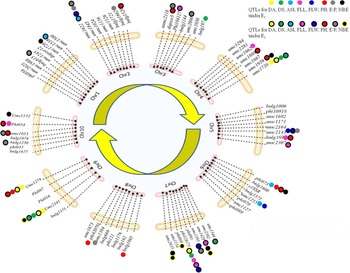
The single-marker ANOVA revealed a total of 66 QTLs for eight plant architecture-related traits spread over 10 different chromosomes. The observed phenotypic variation explained by each QTL varied from 2.29 to 13.97%. Of the total 66, 16 QTLs accounted for more than 10% of phenotypic variation in the trait whereas the remaining 50 QTLs had <10% contribution in the respective trait. Out of 66 QTLs, 29 QTLs were identified in the artificially inoculated environment (E1) whereas 37 QTLs were identified in the un-inoculated environment (E2). Eleven common QTLs were identified across the two environments. Trait, environment and chromosome-wise number of QTLs identified in the BC1F5 population are presented in online Supplementary Table S3 and Fig. 2 whereas stable QTLs along with linked markers and phenotypic value are presented in Table 4. For days to anthesis, two major QTLs, qDA-1 and qDA-2 were identified on chromosome 9 that were linked with markers umc2341 and umc1279 accounted for 12.84 and 12.81% phenotypic variation in E1 and 11.79 and 13.97% in E2, respectively. In addition, one minor QTL in E1 and two minor QTLs in E2 were also identified for days to anthesis. qDA-1 and qDA-2 and a minor QTL qDA-3 were considered common and stable QTL in the two environments. One major QTL qDS-1 linked to umc1720 and located on chromosome 4 was responsible for 13.91% (E1) and 12.88% (E2) phenotypic variation for days to silk emergence. In addition, three QTLs (on chromosomes 3, 7, 9) in E1 and two QTLs (on chromosomes 7 and 9) in E2 having less than 10% phenotypic effect on days to silk emergence were also identified. For anthesis-silking interval (ASI) two minor QTLs linked with markers phi075 and umc1215 were identified on chromosome 6 in E1 which jointly explained 5.63% phenotypic variation. Another two minor QTLs linked with umc1622 (6.06%) and umc1538 (2.60%) were identified on chromosomes 2 and 1, respectively, in E2. None of the QTLs was found common across the environments for ASI. A total of four QTLs linked with markers umc1662, bnlg389, phi328175 and phi054 on chromosomes 4, 5, 7 and 10, respectively, in E1 were identified for flag leaf length (FLL). Among these, phi328175-linked qFLL-1 contributing 12.74% of the phenotypic variation for flag leaf length was considered to be a major QTL. In E2, four QTLs linked with markers phi104127 (2.76%) on chromosome 3, umc2307 (2.74%) on chromosome 5, umc1428 (2.34%) and phi328175 (12.29%) on chromosome 7 were detected. The qFLL-1 was the QTL identified for flag leaf length across both environments.
Environment-wise chromosomal location of QTLs identified using 169 BILs of maize.

Consistent QTLs identified across the environments in BILs of maize

E1 = artificially inoculated environment; E2 = control environment; DA, days to 50% anthesis; DS, days to 50% silking; FLL, flag leaf length; FLW, flag leaf width; PH, plant height; E/P, ears per plant; NBE, node bearing first ear.
A QTL, qFLW-1, linked with marker umc2143 contributing 13.10% variation in flag leaf width was identified on chromosome 5 along with a minor QTL on chromosome 6 (umc1215-linked, 3.88%) in E1. A total of four QTLs were detected, one each on chromosomes 2 and 5 and two on chromosome 7 for FLW in E2. Maximum phenotypic variation of 12.62% was explained by umc2143-linked QTL, FLW-1 whereas the remaining QTLs together explained 11.41% variation for the trait. For plant height under E1, one major phi075-linked QTL qPH-1 on chromosome 6 accounting for 12.98% variation was identified. Apart from the above, three minor phi420701, bnlg1065 and umc1279-linked QTLs were also observed on chromosomes 8 and 9, respectively. Nine QTLs distributed over chromosomes 2, 3, 4, 5, 6, 9 and 10 were detected for plant height in E2. The QTLs linked with bnlg1520, dupssr5, umc1869, umc1939, bnlg389, umc1279, phi054 and umc1053 accounted for phenotypic variation from 2.50 to 4.99% whereas 12.60% variation in plant height was explained by qPH-1. Two QTLs linked with markers phi075 and umc1279 were detected under both the environments. For ear per plant, four QTLs linked with marker umc1622, bnlg1662 on chromosome 2, umc2143 on chromosome 5 and umc1304 on chromosomes 8, were detected in E1 explaining phenotypic variation ranging from 3.71 to 12.90%. Under E2, seven QTLs were identified that were linked with markers bnlg615, umc1622, dupssr5, umc2000, umc1393, umc1053 and bnlg1250. Out of these seven QTLS, two QTLs were detected on chromosomes 3 and 10 and the rest three QTLs were mapped on chromosomes 1, 2 and 7. These QTLs accounted for phenotypic variation from 2.32 to 13.66%. One of these QTLs, qEP-1 linked with marker umc1622 was consistent under both the environments. On chromosomes 1, 4, 6, 7, 8 and 10, a total of six QTLs were identified for node bearing first ear in E1. The QTL linked with umc1428, qNBE-1 had maximum contribution of 13.83% in phenotypic variation of node bearing first ear followed by QTLs linked with markers umc1726 (3.81%), umc2635 (3.49%), umc1939 (3.21%), umc1152 (3.12%) and phi075 (2.49%). In E2, one major QTL, qNBE-1 (11.69%) along with three minor QTLs were identified for node bearing first ear on chromosomes 7 and 9. Two QTLs that were linked with markers umc1428 and umc2635 on chromosome 7 were found common across both the environments.
Overlapping QTLs among traits
Of the total 66 QTLs identified for different characters, 16 were noted to influence two or more than two traits (online Supplementary Table S4). Among 16 common QTLs, phi328178-linked QTL was simultaneously affecting four traits namely DA, DS, FLL and FLW. Three QTLs linked with markers umc1622 (ASI, FLW and E/P), umc2341 (DA, DS and NBE) and phi075 (ASI, PH and NBE) influenced three characters each. Remaining 12 QTLs, bnlg1662-linked (FLL, EP), dupssr5 and umc1939-linked (PH, NBE), umc1720-linked (DA, DS), umc2143 and umc1393-linked (FLW, E/P), bnlg389 and phi054-linked (FLL, PH), umc1215-linked (ASI, FLW), umc1428-linked (FLL, NBE), umc1279-linked (DA, PH) and umc1053-linked (PH, E/P) simultaneously affected two characters each. In addition, these traits showed a significant correlation with each other either in the positive or negative direction as mentioned in online Supplementary Tables S5 and S6. DA was significantly correlated with DS, ASI, FLW, FLW and E/P whereas DS showed a significant correlation with ASI, PH and E/P. Likewise, ASI was correlated with FLL, FLW, PH and E/P and FLL showed a significant association with FLW, PH, E/P and NBE. Similarly, FLW and PH showed significant association with PH, E/P and NBE respectively. Hence, the molecular association among traits was also validated at the morphological level through correlation studies.
Discussion
In several studies, teosinte was investigated/identified as a source of resistance to biotic and abiotic stresses (Mano and Omori, Reference Mano and Omori2013; Kumar et al., Reference Kumar, Singh, Adhikari and Joshi2019; Stanley et al., Reference Stanley, Menkir, Paterne, Ifie, Tongoona, Unachukwu, Meseka, Mengesha and Gedil2020; Joshi et al., Reference Joshi, Adhikari and Singh2021; Shaibu et al., Reference Shaibu, Badu-Apraku and Ayo-Vaughan2021; Adhikari et al., Reference Adhikari, Joshi, Kumar, Singh, Jaiswal, Jeena, Singh and Pandey2021a). However, integration of teosinte in maize breeding programme is limited and only a few reports are available on utilization of teosinte in maize germplasm diversification and yield improvement (Cohen and Galinat, Reference Cohen and Galinat1984; Wang et al., Reference Wang, Yang, He, Qu and Zhang2008a, Reference Wang, Duan, Xing and Zhao2008b; Liu et al., Reference Liu, Cook, Melia-Hancock, Guill, Bottoms, Garcia, Ott, Nelson, Recker, Balint-Kurti, Larsson, Lepak, Buckler, Trimble, Tracy, McMullen and Flint-Garcia2016a; Singh et al., Reference Singh, Kumar, Chandra, Pal and Verma2017; Akaogu et al., Reference Akaogu, Badu-Apraku, Gracen, Tongoona, Gedil, Unachukwu, Offei, Dzidzienyo, Hearne and Garcia-Oliveira2020; Adhikari et al., Reference Adhikari, Joshi, Kumar, Singh, Jaiswal and Jeena2021b). In the present study, the teosinte-introgressed BC1F5 population consisting of 169 BILs were phenotyped for eight plant architecture traits and significant variation was observed for all the traits. The bewildering array of variation for several morphological traits in the teosinte-introgressed maize population was also observed by Singh et al. (Reference Singh, Kumar, Chandra, Pal and Verma2017), Kumar et al. (Reference Kumar, Singh, Adhikari and Joshi2019), Adhikari et al. (Reference Adhikari, Joshi, Sahoo and Singh2020), Wang et al. (Reference Wang, Jiang, Liao, Xie, Zhang, Lan, Hu, Xu, Feng, Wu, Liu and Lu2020), Adhikari et al. (Reference Adhikari, Joshi, Kumar and Singh2021c). The observations noted by us in the investigation are in close agreement with the work of Magoja (Reference Magoja1991), who evaluated progeny of teosinte-introgressed BC1F5 maize population and reported a range for anthesis (47–67 days) and silking (46–63) duration as well as an average of three days anthesis-silking interval. In a recent experiment based on two RIL populations derived from a cross between maize and two subspecies of teosinte (Z. mays subsp. nicaraguensis Iltis and Benz and Z. mays subsp. parviglumis Iltis and Doebley), a wide range of variation for 31 morphological traits was recorded (Wang et al., Reference Wang, Jiang, Liao, Xie, Zhang, Lan, Hu, Xu, Feng, Wu, Liu and Lu2020). Similarly, in Zea diploperennis Iltis, Doebley and Guzman introgressed maize inbred lines, significant variation for yield traits was recorded (Akaogu et al., Reference Akaogu, Badu-Apraku, Gracen, Tongoona, Gedil, Unachukwu, Offei, Dzidzienyo, Hearne and Garcia-Oliveira2020). For getting optimum grain yield under abiotic stresses, flowering traits particularly anthesis, silking duration and ASI are considered to be the most critical parameters. Teosinte-introgressed maize BILs possessed unique blend of earlier silking and shorter ASI and therefore may serve as potential genetic resources in maize yield maximization under abiotic stress conditions (Bänziger et al., Reference Bänziger, Edmeades, Beck and Bellon2000; Ngugi et al., Reference Ngugi, Cheserek, Muchira and Cheminingwa2013). Increasing plant density is now a proven concept for increasing the productivity of maize. Reduced leaf area is considered an important parameter for high-density planting due to more light penetration particularly in the ear region that facilitates translocation of photosynthetic assimilates in the ear (Huang et al., Reference Huang, Gao, Li, Xu, Tao and Wang2017). Since the wide range of variation for leaf parameters is observed in 169 BILs, the possibility exists to utilize differential leaf morphology in the development of lines that are expected to perform better in different targeted environments. Prolificacy is the typical feature of teosinte and teosinte-introgressed maize populations derived by limited backcrossing (1–2 generations) with maize (Singh et al., Reference Singh, Kumar, Chandra, Pal and Verma2017; Kumar et al., Reference Kumar, Singh, Adhikari and Joshi2019; Adhikari et al., Reference Adhikari, Joshi, Sahoo and Singh2020). Magoja (Reference Magoja1991) noted variation for E/P from 1.91 to 4.4 with an average of 3.05 E/P in teosinte-introgressed BILs whereas in modern maize lines E/P is normally one but may vary from 1 to 2 E/P. Prolificacy significantly contributes towards yield enhancement and therefore, is a desired trait in maize (Motto and Moll, Reference Motto and Moll1983). Prolificacy is considered important for baby corn breeding as more ears help in earning more economic returns. These prolific lines could be targeted for the development of baby corn or prolific maize varieties. Clustering analysis based on molecular profile resulted in 12 groups that depicted wider variation among selected superior lines. Clustering of derived lines in more groups in contrast to previous studies based on maize germplasm (Enoki et al., Reference Enoki, Sato and Koinuma2002; Patto et al., Reference Patto, Satovic, Pêgo and Fevereiro2004; Adu et al., Reference Adu, Awuku, Amegbor, Haruna, Manigben and Aboyadana2019) demonstrated diversification of maize germplasm through teosinte allelic introgression. In the present study, 12 groups were reported which were more than earlier reports as given by Akaogu et al. (Reference Akaogu, Badu-Apraku, Gracen, Tongoona, Gedil, Unachukwu, Offei, Dzidzienyo, Hearne and Garcia-Oliveira2020) who observed four groups by targeting teosinte-diploperennis introgressed maize inbred lines. The possible reason may be the difference in teosinte species used. Also they performed two generations of backcrossing with maize parent which may have resulted in more allelic contribution from maize parent. In addition, they made selection for striga resistance, low soil nitrogen and drought condition during population development and as selection increases the frequency of targeted allele thereby fitness of individual but reduces overall genetic diversity (Alachiotis and Pavlidis, Reference Alachiotis and Pavlidis2016) which might be the probable reasons for less number of clusters. Teosinte grouped independently in cluster I and differed from maize as well as the introgressed lines due to distinct morphological features. The lines from different clusters can be selected for accumulation of desirable traits. If superior lines for different traits are hybridized to accumulate desirable traits by considering their molecular diversity, chances of recovery of desirable recombinants are more as opposed to random selection of parents based on morphological estimates only.
The number of alleles per marker varied from 2 to 6 and a similar range was also recorded by Nikhou and Ebrahimi (Reference Nikhou and Ebrahimi2013). The average alleles detected in the present experiment (2.7) are in close agreement with the work of Wietholer (Reference Wietholter2008) but varied from the findings of Legesse et al. (Reference Legesse, Myburg, Pixley and Botha2007), Wasala and Prasanna (Reference Wasala and Prasanna2013), Li et al. (Reference Li, Irfan, Zhang and Lin2014a, Reference Li, Zhang, Wu, Sun and Liu2014b) and Abdel-Rahman et al. (Reference Abdel-Rahman, Bayoumi and Barakat2016) who have observed average alleles per locus of 3.85, 3.85, 2.45 and 2.3, respectively. The total alleles detected in the present study are much larger than the alleles detected by Legesse et al. (Reference Legesse, Myburg, Pixley and Botha2007), Xiao et al. (Reference Xiao, Liu, Wu, Warburton and Yan2017), Maniruzzaman et al. (Reference Maniruzzaman, Islam, Hossain and Rohman2018) and Shayanowako et al. (Reference Shayanowako, Shimelis, Laing and Mwadzingeni2018) who reported 104, 145, 48 and 191 alleles, respectively. Differential allelic numbers observed in the present investigation as compared to the previous studies may probably be due to the genetic constitution of experimental materials and the number of markers used. The markers used in the present experiment had a wider range of PIC (0.29–0.86), therefore, it can be interpreted that there is wider distribution of alleles in the introgressed maize population and ample allelic variation among marker loci. While working with SSR primers in maize, similar range of PIC estimates were also observed by Sserumaga et al. (Reference Sserumaga, Makumbi, Ji, Njoroge, Muthomi, Chemining'wa, Si-Myung, Asea and Kim2014), Gazal et al. (Reference Gazal, Dar, Lone, Shikari and Habib2016) and Adu et al. (Reference Adu, Awuku, Amegbor, Haruna, Manigben and Aboyadana2019). PIC is also known as the power of discrimination and according to Botstein et al. (Reference Botstein, White, Skolnick and Davis1980) markers with >0.5 PIC are considered more informative. All the markers except three (umc1988, umc1245, bnlg197) used in the investigation had PIC >0.5 and therefore, these markers were assumed to have strong discriminatory power.
QTL analysis using 76 SSR markers enabled the identification of 66 QTLs. Maximum QTLs were localized on chromosomes 7 and 9 followed by chromosomes 4, 10, 5, 6, 2, 3, 1 and 8. Guo et al. (Reference Guo, Su, Zhang and Wang2008) also observed maximum QTLs for morphological traits on chromosomes 9 and 1. They also identified eight QTLs for DA on chromosomes 2, 4, 5, 6 and 8. While working with a teosinte-introgressed maize population consisting of 928 NILs, Liu et al. (Reference Liu, Cook, Melia-Hancock, Guill, Bottoms, Garcia, Ott, Nelson, Recker, Balint-Kurti, Larsson, Lepak, Buckler, Trimble, Tracy, McMullen and Flint-Garcia2016a) detected three QTLs for DA on chromosomes 8 and 9. We have identified genomic regions governing silk emergence duration on chromosomes 3, 4, 7 and 9 whereas Guo et al. (Reference Guo, Su, Zhang and Wang2008) noted QTLs on chromosomes 2, 4, 5, 6 and 10 while working with RILs derived from the cross 5003 × p138. The QTLs linked with the umc1538 marker for ASI in present investigations are in close agreement with the results of Szalma et al. (Reference Szalma, Hostert, LeDeaux, Stuber and Holl2007) who have detected one QTL for ASI linked with marker loci umc1538. Similarly, many QTLs, accounting phenotypic variation from 1.69 to 9.07% in ASI, were also observed earlier by Guo et al. (Reference Guo, Su, Zhang and Wang2008). Semagn et al. (Reference Semagn, Beyene, Warburton, Tarekegne, Mugo, Meisel, Sehabiague and Prasanna2013) noted a large number of QTLs, distributed over all 10 chromosomes without any specific pattern. In our experiment, the genomic regions influencing ASI are located on chromosomes 1, 2 and 6, whereas Zhao et al. (Reference Zhao, Peng, Zhang, Fang and Wu2018) reported QTLs for ASI on chromosomes 4 and 7 and Ribeiro et al. (Reference Ribeiro, Badu-Apraku, Gracen, Danquah, Garcia-Oliveira, Asante, Afriyie-Debrah and Gedil2018) on chromosomes 6 and 10. Observations of the present investigation indicate that genomic regions for leaf traits were dispersed over seven chromosomes (2, 3, 4, 5, 6, 7 and 10). Earlier observations also indicated localization of QTLs for leaf morphology over all the 10 chromosomes (Agrama et al., Reference Agrama, Zakaria, Said and Tuinstra1999; Liu et al., Reference Liu, Chu, Cai, Mi and Chen2010; Nikolic et al., Reference Nikolic, Jelkovic, Dodig and Ignjatovic-Micic2011; Ku et al., Reference Ku, Zhang, Zhang, Guo, Liu, Zhao, Yan and Chen2012; Zheng and Liu, Reference Zheng and Liu2013; Guo et al., Reference Guo, Ku, Qi, Tian, Han, Zhang, Su, Ren and Chen2015). Fu et al. (Reference Fu, Xu, Chen, Wang, Chen, Huang, Li, Xu, Tian, Wu, Lu, Li and Tian2019) carried out QTL analysis for FLL in teosinte-introgressed maize population and detected 17 minor QTLs distributed over nine chromosomes 1, 2, 3, 4, 5, 6, 7, 8 and 9 with phenotypic variation ranging from 1.2 to 6%. The results of Fu et al. (Reference Fu, Xu, Chen, Wang, Chen, Huang, Li, Xu, Tian, Wu, Lu, Li and Tian2019) are in agreement with the outcome of our investigations as four QTLs in E1 and four in E2 were identified on five chromosomes (3, 4, 5, 7 and 10) for FLL. Liu et al. (Reference Liu, Meng, Zheng, Kong, Yuan and Lübberstedt2017) detected 17 QTLs for leaf width across chromosomes 1, 2, 5, 7, 8 and 9.
By meta-analysis (statistical analysis of independent studies of QTL mapping) Wang et al. (Reference Wang, Xu, Deng, Ding, Bian, Yin, Wu, Zhou and Zhao2016) identified several QTLs for PH distributed over all the 10 chromosomes of maize. In our investigation, we noted QTLs on chromosomes 2, 3, 4, 5, 6, 8, 9 and 10 influencing plant height. Many earlier reports also indicate similar localization of QTLs for PH on chromosome 1, 2, 3 4, 5 and 6 (Lima et al., Reference Lima, de Souza, Bento, De Souza and Carlini-Garcia2006; Yang et al., Reference Yang, Lu, Zhang, Zhou, Qu and Xie2008; Nikolic et al., Reference Nikolic, Jelkovic, Dodig and Ignjatovic-Micic2011; Wassom, Reference Wassom2013; Zhu et al., Reference Zhu, Chen, Li, Zhang, Huang, Zhao, Song and Liu2013; Zhao et al., Reference Zhao, Peng, Zhang, Fang and Wu2018). Our observations on QTLs for ear numbers are supported by Veldboom and Lee (Reference Veldboom and Lee1994) who have detected two QTLs on chromosomes 3 and 6 each explaining 5.4% phenotypic variation. Lima et al. (Reference Lima, de Souza, Bento, De Souza and Carlini-Garcia2006) identified eight QTLs for ear numbers distributed on chromosomes 1, 2, 5, 6 and 8. The presence of genomic region controlling ear number on chromosome 1 was supported by Ribeiro et al. (Reference Ribeiro, Badu-Apraku, Gracen, Danquah, Garcia-Oliveira, Asante, Afriyie-Debrah and Gedil2018) and on chromosome 8 by Mendes-Moreira et al. (Reference Mendes-Moreira, Alves, Satovic, Dos Santos, Santos, Souza, Pego, Hallauer and Vaz Patto2015). Previously Wills et al. (Reference Wills, Whipple, Takuno, Kursel, Shannon, Ross-Ibarra and Doebley2013) carried out an experiment targeting teosinte for mapping of QTLs for ear numbers by developing maize-teosinte BC2S3 RILs and identified eight QTLs on the first chromosome with phenotypic variation 0.86–6.05%.
In this investigation, QTLs for ear position were identified on chromosomes 1, 4, 6, 7, 8, 9 and 10. QTLs for ear position have also been noted earlier on chromosome 6 by Nikolic et al. (Reference Nikolic, Jelkovic, Dodig and Ignjatovic-Micic2011), on chromosomes 1, 8 and 10 by Zhu et al. (Reference Zhu, Chen, Li, Zhang, Huang, Zhao, Song and Liu2013), on chromosome 1 by Li et al. (Reference Li, Irfan, Zhang and Lin2014a, Reference Li, Zhang, Wu, Sun and Liu2014b), and on chromosomes 4, 6 and 7 by Zhao et al. (Reference Zhao, Peng, Zhang, Fang and Wu2018). Lima et al. (Reference Lima, de Souza, Bento, De Souza and Carlini-Garcia2006) identified nine minor QTLs with phenotypic variation ranging from 1.02 to 8.92% distributed over chromosomes 2, 3, 4, 7, 9 and 10 whereas the similar distribution of 23 QTLs was recorded by Dong et al. (Reference Dong, Zhang, Shi, Wang, Zhou, Deng, Ma, Qiao and Li2015). In the present mapping experiment, some genomic regions are common with previously mapped regions but the majority of the regions regulating targeted traits are novel. The genome size significantly varied among cultivated maize and teosinte. The average genome of maize (1.095) was significantly smaller (P < 0.001, Kruskal–Wallis test) than the average genome size of teosintes (1.129). Several scientific reports reveal that the difference in genome size of maize and teosinte is associated with both gene content (Swanson-Wagner et al., Reference Swanson-Wagner, Eichten, Kumari, Tiffin, Stein, Ware and Springer2010) and transposable element (TE) (Wang and Dooner, Reference Wang and Dooner2006). Illegitimate recombination, transposon-derived unequal homologous recombination and double-strand break repair are the most leading causes of genome shrinkage in cultivated maize (Schubert and Vu, Reference Schubert and Vu2016). The bigger genomes of teosinte tend to have more genes, more and longer introns and more transposable elements than modern maize with smaller genomes. The difference in genome size and allelic state may be the probable cause for mapping of the more novel genomic regions. Among detected QTLs, 16 QTLs were co-associated with various traits. Previous researchers also identified co-localized QTLs for PH and NBE (Lima et al., Reference Lima, de Souza, Bento, De Souza and Carlini-Garcia2006; Wang et al., Reference Wang, Liu, Liu, Dong, Guo, Li, Chen, Gao, Zhu, Zheng, Chen, Chen, Song, Hauck and Lai2018), PH and flowering time (Durand et al., Reference Durand, Bouchet, Bertin, Ressayre, Jamin, Charcosset, Dillmann and Tenaillon2012), ASI and E/P (Ribaut et al., Reference Ribaut, Fracheboud, Monneveux, Banziger, Vargas and Jiang2007; Wang et al., Reference Wang, Xu, Deng, Ding, Bian, Yin, Wu, Zhou and Zhao2016), PH, NBE and leaf parameters (Yi et al., Reference Yi, Hou, Liu, Zhang, Zhang, Liu, Hu, Yu, Li and Huang2019). The molecular associations among traits are also consistent at the morphological level as significant correlation among the traits was also reported during due course of investigation. Hence the probable reason for co-localization of QTLs could be either tight linkage or pleiotropy (Lima et al., Reference Lima, de Souza, Bento, De Souza and Carlini-Garcia2006; Durand et al., Reference Durand, Bouchet, Bertin, Ressayre, Jamin, Charcosset, Dillmann and Tenaillon2012; Hu et al., Reference Hu, Meng, Wang, Liu and Chen2012). These genomic regions could be introgressed in different combinations for modelling maize plants that produce optimum yield under a targeted environment. Such as umc1720-linked (DA, DS) and umc1622-linked (ASI, FLW, and E/P) regions could be utilized for designing maize plants suited for drought-prone areas because anthesis, silking, anthesis-silking interval and ear per plants are important drought-adoptable traits (Ngugi et al., Reference Ngugi, Cheserek, Muchira and Cheminingwa2013; Ross et al., Reference Ross, Di Matteo and Cerrudo2020). Plant height and leaf parameters are important under high-density planting (Lambert et al., Reference Lambert, Mansfield and Mumm2014; Huang et al., Reference Huang, Gao, Li, Xu, Tao and Wang2017). Hence phi054-linked (FLL, PH) region could be utilized for the development of maize plants that would be suited well under high-density planting. For lodging tolerance and mechanical harvesting, PH and ear position are important parameters (Josephson and Kince, Reference Josephson and Kince1977; Li et al., Reference Li, Dong, Niu and Cui2007) and umc1939-linked (PH, NBE) and phi075-linked (ASI, PH, and NBE) regions could be introgressed for simultaneous improvement of these traits. Therefore, it could be possible to incorporate and improve several traits together by harnessing co-localized QTLs either through marker-assisted selection or map-based cloning strategy.
Supplementary material
The supplementary material for this article can be found at https://doi.org/10.1017/S1479262122000223.
Acknowledgement
The authors gratefully acknowledge All India Coordinated Research Project on Maize of Indian Council of Agriculture Research, New Delhi and Directorate of Experiment Station, G. B. Pant University of Agric. & Tech. Pantnagar for extending financial and infrastructural support during the course of the investigation.