


Introduction
Using cover crops in concert with reduced tillage is a promising approach to increase ecosystem services in organic cropping systems (Bernstein et al., Reference Bernstein, Posner, Stoltenberg and Hedtcke2011; Mirsky et al., Reference Mirsky, Ryan, Curran, Teasdale, Maul, Spargo, Moyer, Grantham, Weber, Way and Comargo2012; Rivers et al., Reference Rivers, Mullen, Wallace and Barbercheck2017; Crowley et al., Reference Crowley, Van Es, Gómez and Ryan2018). One system that is gaining popularity among organic farmers involves using winter annual cover crops that are mechanically terminated in spring using a roller–crimper. The roller–crimper is a steel cylinder (41–51 cm diameter) with metal slats welded perpendicular to the cylinder and arranged in a chevron pattern to reduce vibration. The slats crimp the vascular tissue of the cover crop, which reduces transpiration and kills the cover crop. In this system, the main crop is no-till planted into the cover crop either during or after cover crop termination. Much of research surrounding roller-crimping has focused on soybean (Glycine max) production and the impact of management practices on cover crop termination, weed suppression and soybean yield (e.g., Mirsky et al., Reference Mirsky, Curran, Mortensen, Ryan and Shumway2011, Reference Mirsky, Ryan, Teasdale, Curran, Reberg-Horton, Spargo, Wells, Keene and Moyer2013; Reberg-Horton et al., Reference Reberg-Horton, Grossman, Kornecki, Meijer, Price, Place and Webster2011; Wells et al., Reference Wells, Brinton and Reberg-Horton2016; Liebert et al., Reference Liebert, DiTommaso and Ryan2018). Unlike mechanical weed management, the use of cover crops moderates soil temperature, reduces erosion, conserves soil moisture and creates a favorable environment for beneficial insects (Rivers et al., Reference Rivers, Mullen, Wallace and Barbercheck2017). Crowley et al. (Reference Crowley, Van Es, Gómez and Ryan2018) reported increased soil respiration, soil aggregate stability, water infiltration and reduced labor requirements in organically managed soybean that was no-till planted into rolled–crimped cereal rye compared with soybean that was planted into tilled soil without a cover crop. In conventional soybean production, rolled–crimped cereal rye can also help farmers manage populations of herbicide resistant weeds (Price et al., Reference Price, Balkcom, Duzy and Kelton2012; Webster et al., Reference Webster, Simmons, Culpepper, Grey, Bridges and Scully2016).
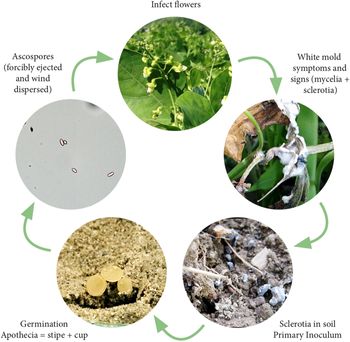
One of the most devastating diseases of soybean and other leguminous crops is Sclerotinia stem rot (approximately white mold) caused by the fungus, Sclerotinia sclerotiorum (Bolton et al., Reference Bolton, Thomma and Nelson2006). The disease also causes major losses to other field crops including sunflower (Bolton et al., Reference Bolton, Thomma and Nelson2006). Disease symptoms include bleached and necrotic lesions on the pods and stems, canopy lodging and wilting (Peltier et al., Reference Peltier, Bradley, Chilvers, Malvick, Nueller, Wise and Esker2013). Signs of the pathogen that form on the diseased plant parts include white, cottony mycelia which form black sclerotia that survive in the soil for many years and serve as the initial inoculum for the disease (Bolton et al., Reference Bolton, Thomma and Nelson2006). Following conditioning of the sclerotia through exposure to cold temperatures for several months, carpogenic germination (hereafter referred to as sclerotial germination) results in the emergence of a small mushroom-like fruiting body called an apothecium, within which ascospores are produced. Ascospores are the primary inoculum for white mold epidemics and solely infect flowers (Abawi and Grogan, Reference Abawi and Grogan1975, Reference Abawi and Grogan1979). The fungus subsequently spreads within and between plants when infected senescing flowers fall onto other plant parts (Fig. 1; Natti, Reference Natti1971; Purdy, Reference Purdy1979). Direct losses result from reductions in the number of pods from premature abscission and fungal colonization on those that remain attached to the plant. Infections of the stems cause the canopy to collapse, making the remaining pods difficult to harvest. Moreover, complete crop loss can occur when white mold incidence is high (Bolton et al., Reference Bolton, Thomma and Nelson2006).
Lifecycle of S. sclerotiorum, the cause of white mold of bean.

White mold is difficult to manage due to the long-lived sclerotia produced on diseased plants (Abawi and Grogan, Reference Abawi and Grogan1975; Reference Abawi and Grogan1979; Adams and Ayers, Reference Adams and Ayers1979), the plurivorous nature of the pathogen (Boland and Hall, Reference Boland and Hall1994) and the absence of appreciable host resistance in commercial leguminous crop varieties (Peltier et al., Reference Peltier, Bradley, Chilvers, Malvick, Nueller, Wise and Esker2013; Schwartz and Singh, Reference Schwartz and Singh2013). Cultural control strategies for mitigating white mold risk, such as increased distance between rows (Steadman et al., Reference Steadman, Coyne and Cook1973), decreasing plant populations (Blad et al., Reference Blad, Steadman and Weiss1978), judicious use of nitrogen and irrigation (Phillips, Reference Phillips1994) and selection of upright varieties to manipulate canopy architecture (Steadman et al., Reference Steadman, Coyne and Cook1973; Blad et al., Reference Blad, Steadman and Weiss1978), are generally insufficient alone, and inversely correlated with crop yield (Grau and Hartman, Reference Grau, Hartman, Hartman, Sinclair and Rupe1999; Peltier et al., Reference Peltier, Bradley, Chilvers, Malvick, Nueller, Wise and Esker2013).
Results of studies examining the interrelationships between tillage, sclerotial viability and white mold incidence have been mixed. For example, deep tillage has been shown to reduce the number of apothecia produced by burying sclerotia (Williams and Stelfox, Reference Williams and Stelfox1980; Mueller et al., Reference Mueller, Harman and Pedersen2002). However, sclerotia can remain viable for at least 3 years even when buried at depths of 20–25 cm and in fields with high inoculum densities, and therefore regular tillage may deliver a new population of sclerotia to the surface for the succeeding crop (Peltier et al., Reference Peltier, Bradley, Chilvers, Malvick, Nueller, Wise and Esker2013). Conversely, in no-till systems, white mold incidence was reduced compared with conventional tillage systems (Workneh and Yang, Reference Workneh and Yang2000; Kurle et al., Reference Kurle, Grau, Oplinger and Mengistu2001). This may be attributed to higher degradation rates of sclerotia on the surface because of exposure to more wetting and drying cycles and the absence of delivery of new sclerotia to the soil surface by tillage (Peltier et al., Reference Peltier, Bradley, Chilvers, Malvick, Nueller, Wise and Esker2013). Reductions in inoculum density may be achieved in small increments by rotation to non-host crops (e.g., cereals), but are complicated by the broad host range of the pathogen that enables survival of inoculum on a broad range of crop and weed species (Boland and Hall, Reference Boland and Hall1994).
In conventional soybean and dry bean (Phaseolus vulgaris) production, white mold control is often achieved through synthetic fungicides for the protection of flowers from infection by ascospores (Tu, Reference Tu1989; Peltier et al., Reference Peltier, Bradley, Chilvers, Malvick, Nueller, Wise and Esker2013; McCreary et al., Reference McCreary, Depuydt, Vyn and Gillard2016). However, white mold control using prophylactic application of synthetic fungicides is often suboptimal due to factors such as fungicide tolerance (Lehner et al., Reference Lehner, Kikkert, Gugino and Pethybridge2017), poor fungicide timing (Pethybridge, unpublished data) and application coverage due to dense canopies and/or low spray volumes. Moreover, synthetic fungicides are prohibited in organic production and white mold is a substantial barrier to the production of organic soybean and dry bean (Hartman et al., Reference Hartman, Pawlowski, Herman and Eastburn2016). Although numerous experiments have been conducted to evaluate the weed suppressive effects of cereal rye mulch in soybean, no research to date has evaluated the effect of cereal rye residue on white mold incidence in soybean or other leguminous crops. Therefore, the objective of this research was to evaluate the effect of rolled–crimped cereal rye residue on white mold development in soybean and dry bean production. In addition to quantifying the incidence of white mold, we also assessed the effect of the cereal rye residue on germination of S. sclerotiorum sclerotia, weed density and biomass and main crop agronomic attributes including plant populations, biomass and pod yield.
Materials and methods
Site description and experimental design
Two field trials were conducted in 2016–2017 (Year 1) and repeated in 2017–2018 (Year 2) at the Research North Farm of Cornell AgriTech at The New York State Agricultural Experiment Station, Cornell University, Geneva, NY, USA (42.52°N, 77.13°W). The fields used in each year were separated by 30 m of perennial ryegrass and clover mix. The soil type of both fields was a Honeoye silt loam. In August 2016 and 2017 prior to the establishment of the cereal rye cover crop, soil pH was 7.4 in each field, and organic matter content was 2.7 and 2.3%, respectively. The cropping history of the field used in Year 1 was light red kidney bean (2016). The field used in Year 2 was planted to snap bean in the previous year. Each field had a history of white mold (10–25% incidence) in the previous year's crop.
The experimental design was a completely randomized block with four replications of two treatments: (i) rolled–crimped cereal rye cover crop and no-till planting (herein referred to as rye residue) or (ii) no cover crop control and planting into tilled soil (herein referred to as control). The fallow areas were shallowly tilled to a depth of 2.5 cm using a field cultivator (Perfecta II, Unverferth Manufacturing, Kalida, OH, USA) to remove crusting and early season weed control. In Year 1, the rye residue and control plots were 15 m long and 39 m wide. In Year 2, plots were 12 m long and 62 m wide. Plot size varied between the two years to ensure the experiment encompassed the entire field for ease of management. The field in each year was split and half was used for the soybean experiment and the remainder for the dry bean experiment.
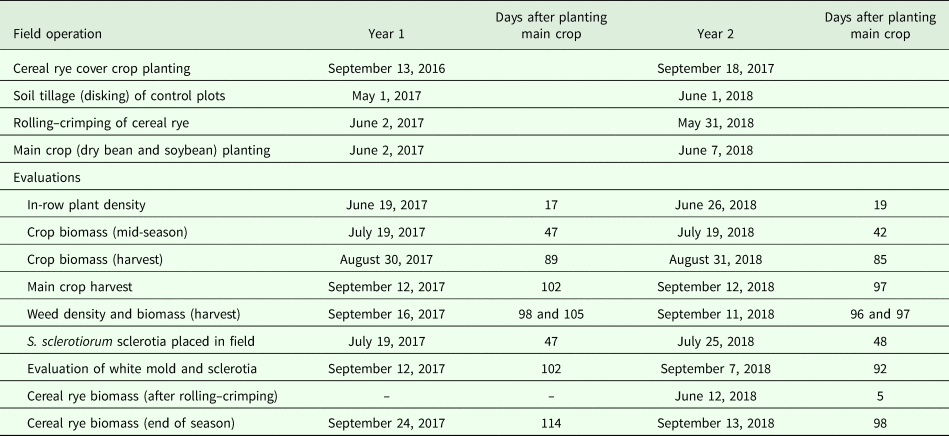
Prior to planting of the rye cover crop in fall 2016 and 2017, fields were prepared with two passes of a field cultivator. The cereal rye cover crop (cv. Aroostook) was planted using a 3.05-m wide John Deere no-till drill (Model 1560, Deere & Company, Moline, IL, USA) in mid-September (Table 1) at a row spacing of 19 cm, depth of 2 cm and seeding rate of 188.3 kg ha−1. The cover crop was terminated in spring when the cereal rye had reached 75% anthesis to soft dough stage (Table 1). The cereal rye was rolled and crimped using a 3-m wide roller–crimper (I & J Manufacturing, Gordonville, PA, USA), in a perpendicular direction to that of planting. Control plots were disked on May 1, 2017 (Year 1) and June 1, 2018 (Year 2) for seedbed preparation prior to planting of the main crops (Table 1). Planting of the main crops occurred on the same day as rolling–crimping of the rye cover crop in Year 1, and 7 days after rolling–crimping of the rye cover crop in Year 2 due to heavy rain. Both main crops were planted using a two-row NG Plus Pneumatic Planter (Monosem Inc., Edwardsville, KS, USA). Soybean (var. Viking 1722N) was planted at 76-cm row spacing at a density of 656,150 seeds per ha. Dry bean (vars. Eclipse and Zenith in Years 1 and 2, respectively) was planted at 76-cm row spacing at a density of 346,450 seeds per ha. Locally adapted black bean varieties were selected because these are often directly harvested with a combine and the rye residue remaining at the end of the season is likely not to interfere with harvest. Other dry bean varieties such as light red kidney bean require additional steps of swathing (i.e., cutting and windrowing) and then drying prior to removal from the field, which may make harvesting with rye residue challenging. Main crop plots were 15 m wide × 15 m long in Year 1, and 31 m wide × 12 m long in Year 2. The pre-emergence herbicide, S-metolachlor (as Dual Magnum at 2.1 L ha−1; Syngenta Corporation, Greensboro, NC, USA) was applied to the entire field on the day after planting in Year 1 only. No supplemental weed control was used for the remainder of the cropping seasons in both years. In Year 2, the entire field received 56 kg ha−1 of ammonium nitrate (Phelps Fertilizer Supply, Phelps, NY, USA) in a broadcast application. Although the herbicide application in Year 1 and the fertilizer application in Year 2 would be prohibited in organic production, it is unlikely they affected white mold development.
Dates of field operations in replicated field trials conducted in Year 1 (2016/17) and Year 2 (2017/18) and evaluations of the effect of rolled–crimped cereal rye residue on soybean and dry bean crop attributes, weed and white mold suppression at Geneva, New York

Sampling and data collection
In each of the main crops (soybean and dry bean), the effect of rye residue on agronomic attributes (in-row plant density, crop biomass and yield components), white mold control (disease incidence and germination of S. sclerotiorum sclerotia) and weed suppression was quantified (Table 1). Subsamples (n = 4–6) within each plot accounted for spatial heterogeneity in the response variables and were averaged within plots for analysis of treatment effect. Subsample locations were arbitrarily selected within each plot, avoiding 2 m from the plot boundaries.
Weather
On-site average monthly temperature and precipitation data were obtained from the Northeast Regional Climate Center (NRCC; http://climod2.nrcc.cornell.edu/). Data were compared with the long-term averages (LTA) (1981–2010) (Northeast Regional Climate Center, 2018). Growing degree days (GDD10) calculated with a base temperature of 10°C were also obtained from the NRCC and compared with the LTA.
Main crop agronomic attributes
In-row plant density (number of plants per m) was evaluated by counting the number of plants in four 1-m row lengths soon after crop emergence (Table 1). Main crop biomass (g m−1) was quantified at mid-season and harvest (Table 1). All main crop vegetation was clipped at the soil surface within each of four 1-m row lengths. Plant material was dried at 60°C for 7 days, and weighed. The effect of rye residue on yield components, pod weight (g m−1) and pod density was assessed by removing pods by hand from plants from all plants from four 1-m sections within each plot (Table 1).
Cereal rye biomass
The dry weight of the rye residue was quantified at 114 days after planting (DAP) the main crop in Year 1, and 5 and 98 DAP in Year 2 (Table 1). Evaluation of the cereal rye biomass was conducted in both years at the end of the main crop growing season to quantify the amount remaining and contributing to the effects on germination of S. sclerotiorum sclerotia and subsequent white mold suppression. At each assessment, all cover crop biomass in a 1-m2 quadrat from each plot was clipped at the soil surface, sorted to remove any main crop or weeds, dried at 60°C for 7 days and weighed.
White mold and S. sclerotiorum sclerotia
White mold incidence was assessed in four 1-m row sections within each plot at the end of the cropping seasons (Table 1). In each 1-m row section, the number of healthy plants and diseased plants were counted to quantify incidence (%). Diseased plants had either white mold symptoms or signs of S. sclerotiorum (mycelia or sclerotia) on stems or at least one pod.
To quantify the effect of rye residue on germination of S. sclerotiorum sclerotia, pots (6.4-cm diameter and 6.4-cm deep) with sclerotia produced in the laboratory and pasteurized sand were placed in holes dug in each plot to ensure the top of the pot was level with the soil surface. Sand was placed into the pots to a depth of 5.4 cm. For pots in the rye residue plots, the residue was carefully moved to one side while the hole was prepared and pot put in place. The rye residue was then replaced to ensure minimal disturbance.
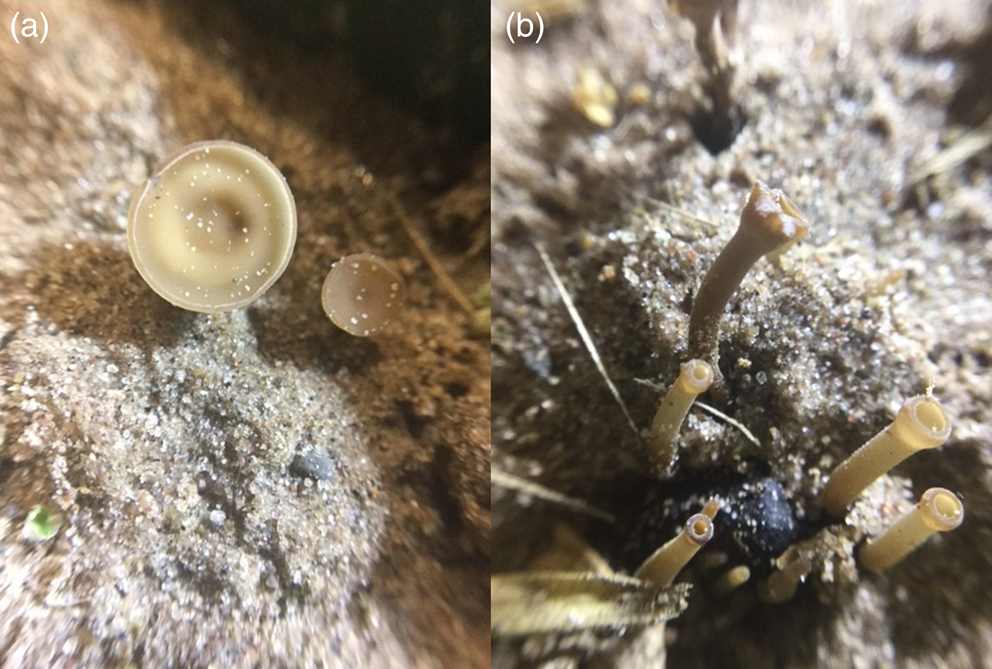
Sclerotia were produced and conditioned in the laboratory to ensure their suitability for germination in the field (Pethybridge et al., Reference Pethybridge, Cobb and Dillard2015). In brief, 10-mm mycelial plugs of a local S. sclerotiorum isolate were placed on surface-disinfested (wiped with 10% ethanol) cut butternut squash (Cucurbita moschata) pieces in humid boxes at 20°C to promote mycelial growth and production of sclerotia. Sclerotia were removed from the diseased squash, washed and dried before being placed in cheesecloth bags. Bags were then left in a bucket with aerated water at 7°C for 4 months, followed by storage at room temperature for an additional 4–6 weeks before placement in the field in pots. Only sclerotia with a diameter between 1 and 2 cm were included as sclerotial size may influence germination (Dillard et al., Reference Dillard, Ludwig and Hunter1995). Six conditioned sclerotia were pushed ~5 mm into moist sand in each pot at mid-season (Table 1). For both soybean and dry bean, this was ~1 week prior to the appearance of the first flowers. Six pots were monitored every 2–3 days to evaluate the optimal time to quantify the incidence of carpogenic germination. After 55 and 44 days in the field, pots were removed and sclerotia excavated carefully for evaluation. An apothecium consists of a stipe (initial stalks that emerge first from the sclerotium) and a cup receptacle with a flat to concave hymenial layer lined with rows of asci containing ascospores that are forcibly discharged (Bolton et al., Reference Bolton, Thomma and Nelson2006). Therefore, for an apothecium to be functional and contribute ascosporic inoculum, the cup receptacle must be formed (Fig. 2A). As a sclerotium may produce more than one stipe and/or apothecia, the number of sclerotia with at least one fully formed apothecium (stipe + cup) were counted to determine percent germination. Alternatively, nonfunctional germination was quantified by counting the number of sclerotia that produced at least one stipe but no fully formed apothecia (Fig. 2B).
Rolled–crimped cereal rye residue no-till planted with soybean or dry bean was associated with reductions in the germination of S. sclerotiorum sclerotia resulting in (A) functional apothecia (stipes + cup) and (B) an increase in nonfunctional apothecia (stipe without cup), compared with fallow (control) plots, in two replicated field trials conducted at Geneva, New York in Year 1 (2016/17) and Year 2 (2017/18).

The incidences of sclerotial germination within the same S. sclerotiorum population deployed in pots within the field experiments in each year were tested in a growth chamber exposed to optimal conditions (20°C with a relative humidity of 30% and 12 h photoperiod with an intensity of 1100 lux) (Pethybridge et al., Reference Pethybridge, Cobb and Dillard2015). Six S. sclerotiorum sclerotia were placed into each of ten pots (n = 60 sclerotia per year). The incidence of sclerotial germination was calculated by counting those that had germinated to produce at least one functional apothecium (stipe + cup) after an equivalent period to the field-deployed sclerotia (50 days) in each year.
Weed suppression
Weed density and biomass were measured in September of each year prior to crop harvest (Table 1). At four locations within each plot, weeds within a round quadrat (0.64 m2) were counted, clipped at the soil surface, sorted by species and then dried for 14 days at 45°C before weighing.
Data analysis
In each of the main crops (soybean and dry bean) and year, the effect of rye residue on agronomic attributes (in-row plant density, biomass and pod yield components), white mold (disease incidence) and germination of S. sclerotiorum sclerotia and weed density and biomass was analyzed using generalized linear modeling with treatment as a fixed effect and replication as a random effect using Genstat (Version 17.2; VSN International, Hemel Hempstead, United Kingdom). Exploratory data analysis detected significant differences among the means between datasets from trials with like treatments using the Anderson–Darling goodness-of-fit test (Anderson and Darling, Reference Anderson and Darling1954), and nonhomogeneous variances using the Fisher F-test (Markowski and Markowski, Reference Markowski and Markowski1990). Data from the individual trials were therefore analyzed separately to evaluate treatments.
Results
Weather and field conditions
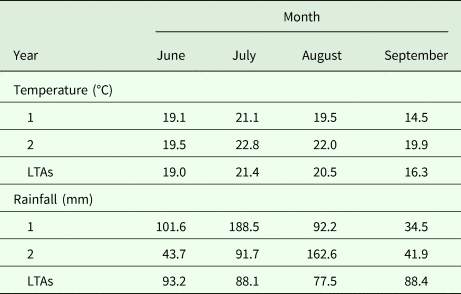
Monthly precipitation, temperature and GDD10 within the main crop growing periods between the two years differed (Table 2; Geneva Weather Station; Northeast Regional Climate Center 2018). In Year 2, monthly temperatures were between 0.5 and 3.6°C warmer in each month than the LTA. These differences were reflected in the cumulative growing season GDD10 of 2312.4 and 2758.9 (LTA = 2289) in Years 1 and 2, respectively. Compared with the LTA, the trial in Year 1 received an additional 69.6 mm, and Year 2 was deficient by 7.4 mm.
Monthly precipitation and temperature within the main crop growing periods in Year 1 (2016/17) and Year 2 (2017/18) at Geneva, New York

Effect of rye residue
Main crop agronomic attributes
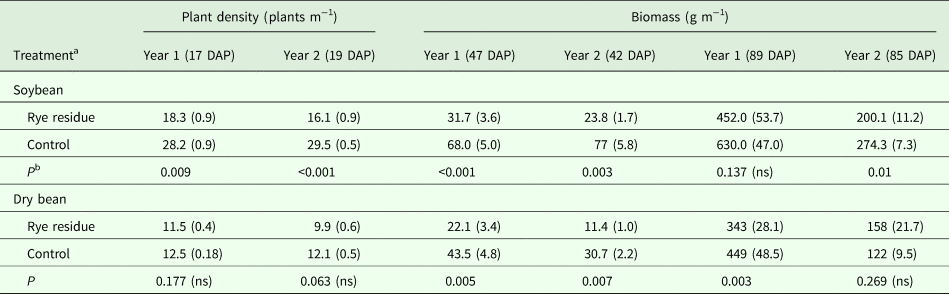
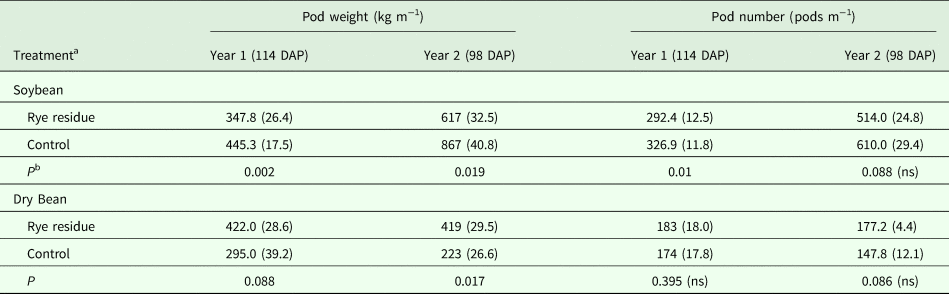
In soybean, crop density was 35.1% lower in rye residue plots in Year 1 and 45.4% lower in rye residue plots in Year 2, compared with control plots (Table 3). Lower crop density is likely a contributing factor in the reductions in soybean biomass in rye residue plots at mid-season in both years. At harvest, soybean crop biomass was not affected by rye residue in Year 1, but reduced in rye residue plots by 27.1% compared with control plots in Year 2 (Table 3). Pod weight was reduced in rye residue plots by 21.9 and 28.8% in Years 1 and 2, respectively. Pod number was also reduced by 10.6% in rye residue plots in Year 1 but not different between treatments in Year 2 (Table 4).
Effect of rolled–crimped cereal rye residue on soybean and dry bean plant density and biomass at mid-season and harvest in replicated field trials conducted in Year 1 (2016/17) and Year 2 (2017/18) at Geneva, New York

DAP, days after planting.
Treatment means are presented with SE in parentheses.
a Rye residue treatment was a rolled–crimped rye cover crop. Control plots were fallow prior to planting.
b Probability values <0.05 were significant.
Effect of rolled–crimped cereal rye residue on soybean and dry bean yield components (pod weight and number) in Year 1 (2016/17) and Year 2 (2017/18) in replicated field trials conducted at Geneva, New York

DAP, days after planting.
Treatment means are presented with SE in parentheses.
a Rye residue treatment was a rolled–crimped rye cover crop. Control plots were fallow prior to planting.
b Probability values <0.05 were significant.
In dry bean, rye residue had no effect on crop density but inhibited crop growth resulting in lower crop biomass at the mid-season sampling in both years (Table 3). In Years 1 and 2, dry bean biomass was reduced by 49.2 and 62.9% in plots with rye residue compared with the control plots. The inhibitory effect of rye residue on dry bean biomass persisted in Year 1 and at harvest was 23.6% less in rye residue plots than in control plots (Table 3). At harvest in Year 2 however, dry bean biomass was not different between the rye residue and control plots (Table 3). In Year 2, pod weight was 87.9% greater in rye residue compared with control plots (Table 4).
Rye mulch
In Year 1, at the end of the season, 687 g m−2 [standard error (SE) = 47 g m−2] of rye residue remained. In Year 2, the average dry weight of rye residue at 5 DAP was 855 g m−2 (SE = 51 g m−2), and at harvest, 685 g m−2 (SE = 32 g m−2) of cereal rye residue remained.
White mold suppression
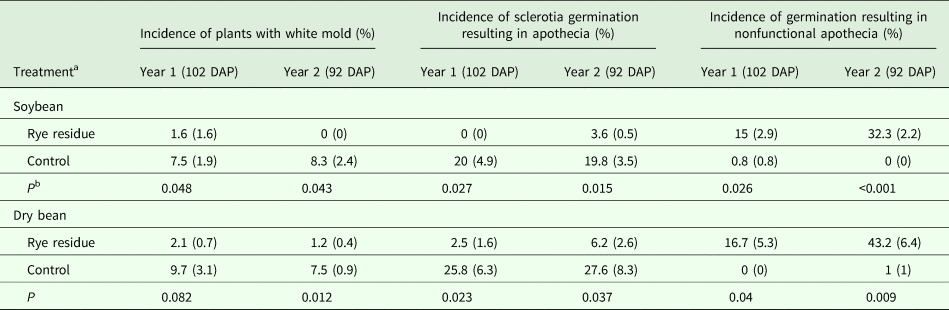
In Year 1, white mold incidence in rye residue plots was reduced by 78.7% in soybean; however, no treatment effect was observed in dry bean (Table 5). In Year 2, white mold incidence was reduced by an average of 92% in rye residue plots compared with the controls in both the soybean and dry bean experiments (Table 5).
Effect of rolled–crimped cereal rye residue on incidence of white mold (caused by S. sclerotiorum) and germination of sclerotia resulting in apothecia (stipe + cup) and nonfunctional apothecia (stipe without cup) in soybean and dry bean in Year 1 (2016/17) and Year 2 (2017/18) at Geneva, New York

DAP, days after planting.
Treatment means are presented with SE in parentheses.
a Rye residue treatment was a rolled–crimped rye cover crop. Control plots were fallow prior to planting.
b Probability values <0.05 were significant.
Rye residue also affected the incidence of germination of sclerotia resulting in functional apothecia (stipe + cup; Fig. 2A) that was consistent across main crops and years (Table 5). Germination of sclerotia was reduced in rye residue plots planted to soybean in both years (Table 5). In Year 1, sclerotial germination was completely inhibited in rye residue, and in Year 2 it was reduced by 81.8% compared with control plots (Table 5). In dry bean, sclerotial germination was reduced in rye residue plots across both years by an average of 83.9%. In contrast, germination resulting in nonfunctional apothecia was greater in rye residue in both years and main crops (Fig. 2B; Table 5).
The average incidence of germination of sclerotia placed under optimal conditions over the same period was 60 and 65% in Years 1 and 2, respectively. All sclerotia that germinated under optimal conditions resulted in functional apothecia.
Weed suppression
In both years, the most common weed species in both main crops included common chickweed [Stellaria media (L.) Vill.], common lambsquarters (Chenopodium album L.), dandelion (Taraxacum officinale F. H. Wigg.), redroot pigweed (Amaranthus retroflexus L.) and volunteer cereal rye. In 2018, barnyard grass [Echinochloa crus-galli (L.) P. Beauv.], common purslane (Portulaca oleracea L.), common ragweed (Ambrosia artemisiifolia L.) and hairy galinsoga [Galinsoga ciliata (Raf.) S. F. Blake], were also present. Note that volunteer cereal rye was present in the rye residue plots. In 2017, the density of volunteer cereal rye plants was 7.0 and 7.1 seedlings m−2 in soybean and dry bean, respectively, and in 2018 the density of volunteer cereal rye plants was 78.6 and 43.0 seedlings m−2 in soybean and dry bean, respectively. However, cereal rye requires vernalization in order to reproduce and thus these plants remained small and posed no risk of producing seed. In 2017, the biomass of volunteer cereal rye seedlings was 0.6 and 22.8 g m−2 in soybean and dry bean, respectively and in 2018 the biomass of volunteer cereal rye seedlings was 1.4 and 3.5 g m−2 in soybean and dry bean, respectively. Despite the relatively high density of volunteer cereal rye, biomass was very low indicating the volunteer cereal rye likely had no effect on soybean growth. Therefore, volunteer cereal rye was excluded from the analysis of weed density and biomass.
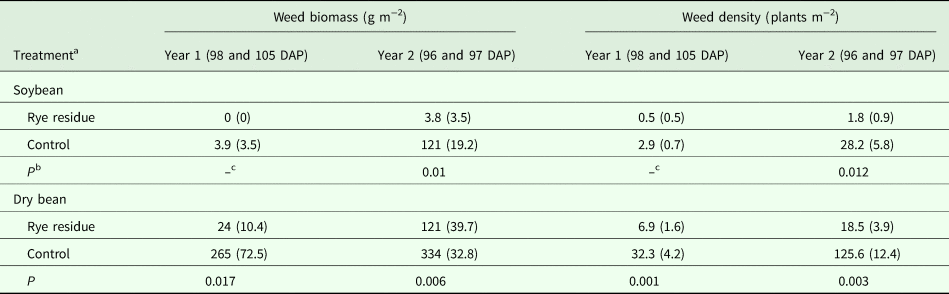
In both main crops, weed biomass and density were lower in rye residue plots compared with control plots in both years with the exception of soybean in Year 1 when weed biomass and density were low in both treatments (Table 6). Weed biomass was 117% lower in soybean in Year 2, and 64–91% lower in dry bean. Weed density was 94% lower in soybean in Year 2, and 79 and 85% lower in dry bean in Years 1 and 2, respectively (Table 6).
Effect of rolled–crimped cereal rye residue on weed suppression in soybean and dry bean plots in Year 1 (2016/17) and Year 2 (2017/18) at Geneva, New York

DAP, days after planting.
Treatment means are presented with SE in parentheses.
a Rye residue treatment was a rolled–crimped rye cover crop. Control plots were fallow prior to planting.
c Probability values <0.05 were significant.
dWeed biomass and density data in soybean in Year 1 (2016/17) were not analyzed due to there being no weeds in three of the four replicates for the rye residue treatment.
Discussion
This study quantified the benefits and trade-offs associated with using rolled–crimped cereal rye residue for no-till production of soybean and dry bean. In soybean, plant populations in rye residue were lower which led to lower crop biomass at mid-season. At harvest, the negative effects of rye residue on biomass and soybean yield components persisted. Soybean pod weight was lower in the rye residue plots in both years indicating a trade-off between white mold suppression and soybean yield.
In contrast, dry bean populations were not affected by rye residue. However, crop biomass was lower at mid-season and harvest in rye mulch plots in both years. The mechanism associated with the reduced crop growth in dry bean and soybean in rye residue plots is unclear but could include extended periods of soil moisture conducive to fungal root rots and compounding deleterious effects on root function and volume, decreased soil temperature, as well as enhanced rates of nitrogen draw-down affecting availability for continued plant growth. In dry bean in both years, the reduction in crop biomass did not affect the number of pods produced and in Year 2, rye residue resulted in increased pod weight. This effect may have been due to the preserved soil moisture in the rye residue plots in Year 2 being advantageous to crop growth when growing conditions were hotter and drier, reflected in greater accumulations of degree-days. Overall, to the best of our knowledge, this is the first study to document the potential of rye residue for no-till production of directly harvested dry bean varieties in the northeastern USA.
Documenting significant white mold suppression from rye residue is an important first step in the development of robust management guidelines for organic and conventional farmers who struggle with this recalcitrant soilborne disease. In monitoring the effects of the rye residue on sclerotial germination, we provided some insights into the mechanisms that may have resulted in white mold suppression. Rye residue reduced the incidence of sclerotial germination but also increased the incidence of nonfunctional germination (stipes only). Sclerotia are only able to germinate once and if this does not result in viable inoculum (i.e., stipe + disk) the sclerotia die (Bolton et al., Reference Bolton, Thomma and Nelson2006). The inhibition of sclerotial germination is particularly interesting because of the potential to reduce the primary inoculum (ascospores) that may infect the flowers. The majority of inoculum for white mold is from apothecia produced within the same field and usually the spatial distribution of white mold is highly heterogeneous and positively correlated with the position of apothecia under the canopy (Workneh and Yang, Reference Workneh and Yang2000; Pethybridge et al., Reference Pethybridge, Hay and Gent2010). The enhancement of nonfunctional germination of sclerotia is of substantial significance as this is likely to result in energy exhaustion and reduction in inoculum over time. This effect will have immediate benefits on disease incidence and temporal benefits to reduce risk for future susceptible crops in no-till production where a new sclerotia population is not regularly delivered to the surface through tillage. This discovery is analogous to that described for the control of other sclerotial fungi (e.g., Sclerotium cepivorum – cause of white rot in onion) that germinate in response to root exudates and has been used to exhaust sclerotial soilborne inoculum for disease control through application when the host is absent (Coley-Smith, Reference Coley-Smith1960; Hovius and McDonald, Reference Hovius and McDonald2002). S. sclerotiorum does not germinate in response to root exudates or other volatiles (Bolton et al., Reference Bolton, Thomma and Nelson2006; Peltier et al., Reference Peltier, Bradley, Chilvers, Malvick, Nueller, Wise and Esker2013), and hence these findings are remarkably promising, potentially as a function of the extended soil moisture under cereal rye residue, as a means to promote energy exhaustion and reduce sclerotial inoculum over time. An additional factor likely to be involved in these sclerotial responses is the effect of the rye residue on light penetration to the soil. Light is an inducer or inhibitor of many processes in fungi (Yu and Fischer, Reference Yu and Fischer2019), including germination in S. sclerotiorum. For example, light is required for apothecial formation and intensity and quality can influence the shape and functionality of stipes produced (Thaning and Nilsson, Reference Thaning and Nilsson2000).
The rye residue also offered substantial benefits in weed suppression (biomass and density) in both soybean and dry bean, in accordance with previous work (Mischler et al., Reference Mischler, Curran, Duiker and Hyde2010; Reberg-Horton et al., Reference Reberg-Horton, Grossman, Kornecki, Meijer, Price, Place and Webster2011; Ryan et al., Reference Ryan, Curran, Grantham, Hunsberger and Mirsky2011a, Reference Ryan, Mirsky, Mortensen, Teasdale and Curran2011b). The rapid canopy closure in soybean in both treatments in Year 1 also likely affected the overall low-weed populations and the absence of differences in weed biomass between rye residue and control plots. In both years, volunteer cereal rye, which sprouted from rye that matured prior to cover crop termination was present at harvest. However, the biomass of these volunteers was minimal and unlikely to pose a risk of producing seed prior to vernalization (Nuttonson, Reference Nuttonson1958). Moreover, in some cases, such self-seeding of cereal rye might be considered beneficial (Singer et al., Reference Singer, Kohler and McDonald2007).
Further research should focus on optimizing the rolled–crimped cereal rye system and reducing trade-offs between pest suppression and crop yield. Although high-planting densities of cereal rye have been recommended for weed suppression in organic soybean that are no-till planted in rolled–crimped rye residue, lower crop densities are recommended as a cultural practice for white mold suppression. More research is also needed to better understand the mechanisms responsible for effects of rye residue on sclerotial germination and the long-term impact on soilborne inoculum.
Conclusion
Using rolled–crimped cereal rye as residue in no-till planted soybean and dry bean offers benefits and trade-offs. Soybean establishment and growth of both main crops was lower in rye residue plots compared with the control. However, the benefits in white mold and weed suppression could outweigh these drawbacks, particularly in organic production where disease and weed management practices are limited. Additional research is needed to optimize management and develop comprehensive guidelines for farmers.
Author ORCIDs
Sarah J. Pethybridge, 0000-0003-3864-4293
Acknowledgements
This research was supported by the United States Department of Agriculture National Institute of Food and Agriculture Hatch project NYG-625424 managed by Cornell AgriTech, Geneva, New York, USA, the New York State Dry Bean Council, and New York State Department of Agriculture and Markets Soil Health Initiative. We thank Carol Bowden, Sean Murphy, Chris Pelzer and Alex Silva (listed alphabetically by surname) for excellent technical support.