


%20--%3e%3c!DOCTYPE%20svg%20PUBLIC%20'-//W3C//DTD%20SVG%201.0//EN'%20'http://www.w3.org/TR/2001/REC-SVG-20010904/DTD/svg10.dtd'%3e%3csvg%20version='1.0'%20id='Layer_1'%20xmlns='http://www.w3.org/2000/svg'%20xmlns:xlink='http://www.w3.org/1999/xlink'%20x='0px'%20y='0px'%20width='64px'%20height='64px'%20viewBox='5.5%20-3.5%2064%2064'%20enable-background='new%205.5%20-3.5%2064%2064'%20xml:space='preserve'%3e%3cg%3e%3ccircle%20fill='%23FFFFFF'%20fill-opacity='0'%20cx='37.785'%20cy='28.501'%20r='28.836'/%3e%3cpath%20fill='%23595959'%20d='M37.441-3.5c8.951,0,16.572,3.125,22.857,9.372c3.008,3.009,5.295,6.448,6.857,10.314%20c1.561,3.867,2.344,7.971,2.344,12.314c0,4.381-0.773,8.486-2.314,12.313c-1.543,3.828-3.82,7.21-6.828,10.143%20c-3.123,3.085-6.666,5.448-10.629,7.086c-3.961,1.638-8.057,2.457-12.285,2.457s-8.276-0.808-12.143-2.429%20c-3.866-1.618-7.333-3.961-10.4-7.027c-3.067-3.066-5.4-6.524-7-10.372S5.5,32.767,5.5,28.5c0-4.229,0.809-8.295,2.428-12.2%20c1.619-3.905,3.972-7.4,7.057-10.486C21.08-0.394,28.565-3.5,37.441-3.5z%20M37.557,2.272c-7.314,0-13.467,2.553-18.458,7.657%20c-2.515,2.553-4.448,5.419-5.8,8.6c-1.354,3.181-2.029,6.505-2.029,9.972c0,3.429,0.675,6.734,2.029,9.913%20c1.353,3.183,3.285,6.021,5.8,8.516c2.514,2.496,5.351,4.399,8.515,5.715c3.161,1.314,6.476,1.971,9.943,1.971%20c3.428,0,6.75-0.665,9.973-1.999c3.219-1.335,6.121-3.257,8.713-5.771c4.99-4.876,7.484-10.99,7.484-18.344%20c0-3.543-0.648-6.895-1.943-10.057c-1.293-3.162-3.18-5.98-5.654-8.458C50.984,4.844,44.795,2.272,37.557,2.272z%20M37.156,23.187%20l-4.287,2.229c-0.458-0.951-1.019-1.619-1.685-2c-0.667-0.38-1.286-0.571-1.858-0.571c-2.856,0-4.286,1.885-4.286,5.657%20c0,1.714,0.362,3.084,1.085,4.113c0.724,1.029,1.791,1.544,3.201,1.544c1.867,0,3.181-0.915,3.944-2.743l3.942,2%20c-0.838,1.563-2,2.791-3.486,3.686c-1.484,0.896-3.123,1.343-4.914,1.343c-2.857,0-5.163-0.875-6.915-2.629%20c-1.752-1.752-2.628-4.19-2.628-7.313c0-3.048,0.886-5.466,2.657-7.257c1.771-1.79,4.009-2.686,6.715-2.686%20C32.604,18.558,35.441,20.101,37.156,23.187z%20M55.613,23.187l-4.229,2.229c-0.457-0.951-1.02-1.619-1.686-2%20c-0.668-0.38-1.307-0.571-1.914-0.571c-2.857,0-4.287,1.885-4.287,5.657c0,1.714,0.363,3.084,1.086,4.113%20c0.723,1.029,1.789,1.544,3.201,1.544c1.865,0,3.18-0.915,3.941-2.743l4,2c-0.875,1.563-2.057,2.791-3.541,3.686%20c-1.486,0.896-3.105,1.343-4.857,1.343c-2.896,0-5.209-0.875-6.941-2.629c-1.736-1.752-2.602-4.19-2.602-7.313%20c0-3.048,0.885-5.466,2.658-7.257c1.77-1.79,4.008-2.686,6.713-2.686C51.117,18.558,53.938,20.101,55.613,23.187z'/%3e%3c/g%3e%3c/svg%3e)
%20--%3e%3c!DOCTYPE%20svg%20PUBLIC%20'-//W3C//DTD%20SVG%201.0//EN'%20'http://www.w3.org/TR/2001/REC-SVG-20010904/DTD/svg10.dtd'%3e%3csvg%20version='1.0'%20id='Layer_1'%20xmlns='http://www.w3.org/2000/svg'%20xmlns:xlink='http://www.w3.org/1999/xlink'%20x='0px'%20y='0px'%20width='64px'%20height='64px'%20viewBox='5.5%20-3.5%2064%2064'%20enable-background='new%205.5%20-3.5%2064%2064'%20xml:space='preserve'%3e%3cg%3e%3ccircle%20fill='%23FFFFFF'%20fill-opacity='0'%20cx='37.637'%20cy='28.806'%20r='28.276'/%3e%3cg%3e%3cpath%20fill='%23595959'%20d='M37.443-3.5c8.988,0,16.57,3.085,22.742,9.257C66.393,11.967,69.5,19.548,69.5,28.5c0,8.991-3.049,16.476-9.145,22.456%20C53.879,57.319,46.242,60.5,37.443,60.5c-8.649,0-16.153-3.144-22.514-9.43C8.644,44.784,5.5,37.262,5.5,28.5%20c0-8.761,3.144-16.342,9.429-22.742C21.101-0.415,28.604-3.5,37.443-3.5z%20M37.557,2.272c-7.276,0-13.428,2.553-18.457,7.657%20c-5.22,5.334-7.829,11.525-7.829,18.572c0,7.086,2.59,13.22,7.77,18.398c5.181,5.182,11.352,7.771,18.514,7.771%20c7.123,0,13.334-2.607,18.629-7.828c5.029-4.838,7.543-10.952,7.543-18.343c0-7.276-2.553-13.465-7.656-18.571%20C50.967,4.824,44.795,2.272,37.557,2.272z%20M46.129,20.557v13.085h-3.656v15.542h-9.944V33.643h-3.656V20.557%20c0-0.572,0.2-1.057,0.599-1.457c0.401-0.399,0.887-0.6,1.457-0.6h13.144c0.533,0,1.01,0.2,1.428,0.6%20C45.918,19.5,46.129,19.986,46.129,20.557z%20M33.042,12.329c0-3.008,1.485-4.514,4.458-4.514s4.457,1.504,4.457,4.514%20c0,2.971-1.486,4.457-4.457,4.457S33.042,15.3,33.042,12.329z'/%3e%3c/g%3e%3c/g%3e%3c/svg%3e)
While our main concern here is with the social consequences of Brexit (“life after”), it is not possible to dissociate these entirely from its causes (“life before”), as social life comprises a constant flow of attitudes, identities, and relationships. Political events can of course change the direction of a flow in dramatic ways, but to do that they have to be both momentous in their impact on daily life, and to force a change of direction. Brexit, I shall argue here, has not, at least to date, had a momentous effect on British daily life—or at least, its potential momentousness has been concealed; nor has it changed in any major way the direction of flow already being taken by that life. To continue the analogy, it has been more like a rock in a stream, disturbing and affecting its flow, but not fundamentally changing it.
These two contentions—that Brexit has not been visibly momentous, and that it has not so much changed as rather reinforced existing tendencies in British society—will inform the following discussion. Before investigating these, it is necessary to explore why the United Kingdom has been the only country to leave the European Union (EU), despite the level of xenophobia within the country being no higher than elsewhere. There are two potential explanations: a narrow political science answer, and a more complex sociopolitical one. Both have something to teach us.
First, the explanation from political science. The British “first past the post” electoral system has traditionally made it very difficult to start new political parties. This is becoming increasingly untrue; there are currently 14 parties or groups represented in the House of Commons, though most of these represent geographical entities, something that is in fact facilitated by the electoral system. However, in general, it is easier to launch a new strand within politics by working within an existing party to get one’s approach adopted than it is to try to start from scratch. There is a more extreme version of this in the United States, where forming a new party at federal level is virtually impossible, leading to such developments as the takeover of the Republican Party by supporters of Donald Trump. In the UK there have been both strategies: the formation of a new xenophobic party, currently called Reform UK, and a more-or-less successful takeover of the Conservative Party by people with a similar ideology. It was in a doomed attempt to resolve the divisive internal struggle between traditional Tories and the new nationalists that prime minister David Cameron called the Brexit referendum in 2016. Had the new nationalists been able to make more progress within Reform UK’s predecessor (the United Kingdom Independence Party, UKIP), they would probably not have bothered with the Conservative Party, which had historically been far more committed to EU membership than had the Labour Party. Absent an internal struggle within the Conservative Party, there would have been no referendum. A mirror image of the situation had occurred in 1975, after a Conservative government had taken the UK into the then European Economic Community (EEC) two years previously. The Labour Party took over government after an election in 1974, and was deeply divided over whether the UK should remain a member of the EEC. The prime minister, Harold Wilson, resolved the internal party debate by holding a referendum on the issue, which resulted in a large majority for the UK retaining its membership. There is no formal place for referenda in British politics, but the 1975 event provided a precedent for 2016.
Second, the deeper explanation starts from the fact that neither the political class nor the general public in the UK ever really embraced membership of the EU or its predecessors as anything other than a loose trading relationship. The only party with a long-term commitment to the European project was the Liberal Party (later the Liberal Democrats), then a minor party. Britain decided not to participate in the original postwar founding of European trading organizations, and it can be argued that no British government ever developed a policy of long-term engagement in the European project [Westlake Reference Westlake and Outhwaite2017]. Successive governments often tried to achieve their goals within the European institutions by attempting to set France and Germany against each other rather than work to achieve positive-sum European aims. The European flag was virtually never flown from public buildings, apart from a few local council offices. The UK never accepted membership of the Schengen Agreement, never joined the single currency, insisted on having a rebate on its membership contributions to the EU budget, and secured opt-outs from much European social and especially labour legislation. During its 40 years of membership of the EU, the UK was rarely more than an “awkward partner” [George Reference George1990].
The idea of even a trading relationship had itself been rejected by much of the Labour Party, the left wing of which saw free trade as a capitalist concept; in 1987 the party returned briefly to being officially committed to leaving the organization—without a referendum. Conservatives did embrace free trade, but rejected the strategy pursued by Jacques Delors when he was president of the European Commission: that creation of the single market required a balancing social policy. His argument was based on sound Polanyian grounds—the theory that the extension of markets causes disruption to many people’s lives, which has to be offset with compensatory social policy [Polanyi Reference Polanyi1944; Crouch Reference Crouch2013]. Conservative prime minister Margaret Thatcher, who with good reason saw herself as a major architect of the single market, utterly rejected the social policy consequences. That began opposition to the wider European project among Conservatives, which by 2016 had hardened into rejection of the single market itself.
When parts of the Conservative political elite turned their backs on Europe and sought geography-defying relationships in the Indo-Pacific region as a replacement, they were exhibiting a long-term tendency. Having played a prominent role in the conservative coalition (with Austria, Prussia, and Russia) that defeated Napoleonic France, and in the consequent Treaty of Vienna of 1815, Britain’s leaders had turned their backs on Europe and set about constructing their highly successful global empire. The country had to turn back to Europe in the two world wars, but did so as the head of an empire, standing equally alongside the United States as the saviours of a free world. After 1945, Labour and then Conservative governments accepted that empire had to end, the latter wanting explicitly to turn instead to Europe. But certain legacies of the past remained, both among the political class and in the minds of some sections of the public.
First, although treasuring their history as head of a vast empire, mainland Britons paradoxically like to see their country as an “island nation” that can easily cut itself off from the rest of the world. The phrase is often used, though it is only partly true; the partition of Ireland in 1924 left the UK with the provinces in the north-east of that island. There is therefore a land border with the Republic of Ireland, which now constitutes a UK land border with the EU. Blindness to this fact caused considerable trouble in negotiating Brexit, and which still remains partly unresolved. The myth of the island nation is also prominent in the particularly virulent rhetoric against illegal immigrants arriving in “small boats” and thus transgressing the supposed impermeability of the sea border.
Second, memory of and nostalgia for empire lead many Britons to see themselves as part of a far larger entity than the EU itself or any of its individual members. They see their country as equal in status to the United States, which is its preferred ally in all matters. Every new British prime minister visiting the US president has waited for him to use the words “special relationship” to describe US/UK relations, and this is duly reported by the mass media. Many British people routinely refer to the Atlantic Ocean as “the pond”, implying a very small body of water, and thereby stressing the closeness of the two countries. Although the idea that the UK ranks equally with the United States has been absurd since the end of World War II, the idea of a special relationship is not without foundation. The two countries, along with the three other predominantly white, Anglophone nations (Australia, Canada, and New Zealand) have many close links, especially the shared “Five Eyes” espionage network, whose activities from time to time include commercial espionage against EU states.
Third, and related to the previous point, because the English language has become the global lingua franca, British people have few incentives to learn other European languages, and the teaching of those languages in schools has declined massively over the past forty or so years. This means that it is much easier for the British to develop friendships with people in Anglophone countries that are geographically far further away than Europe. Britain’s shared cultural history with the rest of Europe in art and music belongs largely to an increasingly remote past, and is part of a minority “elite culture”. Meanwhile, the popular cultural heritage for much of the world since the mid-20th century has been predominantly American. This is another factor drawing Britain away from its neighbours and towards the other side of the Atlantic “pond.”
The only other European country that can make similar claims to a residual global status is France; the UK and France are the only European states to be members of the United Nations Security Council and to possess nuclear weapons. In the early years of the original EEC, there were occasions when France behaved not so differently from the UK at the time of Thatcher. There was in particular the episode of the “empty chair” in 1965, when General de Gaulle boycotted meetings of the then-six member states because of a perceived slight to national governments by the Commission. But France, a continental country with a lengthy shared border with its former antagonist, Germany, could not long sustain the fiction that it had no need of a close relationship with its neighbours.
Both the UK and France had been made to realize that the days of imperial greatness were over in 1956, when the US government opposed their joint military exercise with Israel to prevent Egypt from nationalizing the Suez Canal. They accepted the implications of that lesson over the following decade, and divested themselves of their colonies, as did the other main European colonial powers, Belgium and the Netherlands. Portugal did not follow suit until the fall of its dictatorship in the 1970s. The UK seemed finally to have accepted its geographical limitations in the 1960s, when it formally abandoned its attempt to maintain a naval presence “East of Suez”, as the limit was generally known; the phrase was first used by Rudyard Kipling (1865–1936), a leading imperialist poet.
Like France and one or two other European countries, the UK has maintained some small outposts far beyond its home territory, but these had little or no domestic political significance until 1982, when the Argentinian dictatorship invaded one of them: the Falkland Islands, located off the Argentinian coast. The Thatcher government launched a naval task force that successfully reclaimed the islands, creating an atmosphere of national fervour. People in many parts of the country spontaneously flew flags from their houses and held celebratory street parties when victory was declared. They seemed ready to welcome a reassertion of national power in far-off territories. Gradually, the UK returned to basing naval ships east of Suez. Although no one made the point at the time, the seeds of Brexit may have been sown by the Falklands War and its potential solution to what Gilroy [Reference Gilroy2005] has called “post-colonial melancholia.”
A further event occurred in 2003, when, under the premiership of Tony Blair, the UK joined the US invasion of Iraq, without the support of NATO, the UN, or the EU, though some other EU member states made token contributions. The message of the invasion was that the United States and the UK would together use military force, irrespective of the views of international organizations and the norms of international law. There was far less domestic consensus around the Iraq invasion than around the Falklands, and Blair himself was a strong supporter of the EU. Nevertheless, two ideas were thereby reinforced: first, that the UK could and would act militarily around the world as it had done in the 19th century; and second, that its alliance with the United States was by far its most important relationship. These can be seen as developments that eventually helped to create the sentiment that the country would be better off not sharing sovereignty with its continental neighbours.
Otherwise, there was little to differentiate British society from virtually all others in Europe on relevant issues in the run-up to the Brexit referendum. Nearly all member states had seen an increase in income inequality, though the UK has long had one of the highest levels of that inequality among European economies, as measured by the Gini coefficient, only Lithuania having a higher levelFootnote 1. All EU member states had in particular suffered the shock to expectations of growing prosperity following the financial crisis of 2008, which led many people to become pessimistic about the future and therefore resentful of persons from other countries immigrating in order to share what prosperity remained. Many member states, including the UK, had suffered acts of Islamic terrorism, which intensified suspicion and fear of “foreigners”. All had experienced a growing remoteness from the institutions of the EU, as these pursued an increasingly neoliberal course, doing little that seemed to have much positive relevance to the lives of ordinary people, and after 2010 behaving in a particularly high-handed way towards citizens of the debtor nations in south-western Europe and Ireland. Xenophobia was spreading across Europe—also the United States and other parts of the democratic world—taking two forms: first, hostility to immigrants and foreigners of various kinds; second, hostility to engagement with international organizations that required member states to seek collective gains by pooling sovereignty. The UK was just tipped a little further over the edge, aided considerably by an unresolved nostalgia for its imperial past.
The relative lack of visible momentousness
In the years since the referendum British society has seen increased racial tension, a legitimation of language hostile to immigrants and ethnic minorities among “respectable” political leaders, and growing general xenophobia. Brexit did not therefore lance the boil of xenophobia, but further emboldened its advocates. In the years since 2016, they have turned their attention from hostility to European immigrants to those from dark-skinned parts of the world, especially Muslims. In order to strengthen the country’s ability to deter and expel immigrants, they have insisted that it is necessary to leave the Council of Europe and its European Court of Human Rights (ECHR). As with Brexit, hostility is expressed both to minority groups of people and to membership of a European international organization.
To assess the size of Brexit’s impact, it is necessary to examine it from various disciplinary perspectives: the economic, political, and social.
The economic impact of Brexit
The economic impact is extensive. The government’s Office for Budget Responsibility (OBR) estimated that the country would suffer a long-term decline of 4% in national productivity as a result of losing membership of the European single market and the customs union [OBR 2024a; reaffirmed in OBR 2025]. The same reports estimated that both exports and imports would decline by 15%. For a country with a poor record of economic growth, and one that needs growth to remedy deteriorating infrastructure, this is non-trivial. To offset this, pro-Brexit UK governments have pursued and secured membership of the Comprehensive and Progressive Agreement for Trans-Pacific Partnership (CPTPP). Since the UK is not located anywhere near the Pacific Ocean, and geographical propinquity is normally considered a valuable part of trading relationships, which usually tend to be regionally based, it is not expected that this will remotely offset the loss of EU membership. OBR estimates place it as bringing a 0.04% boost to the country’s trade over 15 years [OBR 2024b]. Membership of the Pacific bloc was seen by Brexit advocates as a major reason to leave the EU, as individual national trade agreements are not permitted to EU member states. Since a change of government in July 2024, the new Labour government has made new trade agreements with the United States, India, and the EU itself. The US agreement was necessitated only by President Donald Trump’s imposition of tariffs on most of the world, but the UK was certainly able to secure more favourable tariff levels than the EU. The Indian deal is estimated to be worth 0.13% of gross domestic product (GDP) to the UK economy “in the long run.” The agreement with the EU was only made necessary because the UK had left it.
The Brexit policymakers’ economic thinking in seeking this shift in the country’s orientation was that Europe is ageing and no longer at the forefront of technological development. In contrast, Singapore, Taiwan, Indonesia, and the largest one of all, China are youthful economies better able to grasp the future. (China was part of this strategy at the time of Brexit planning, but is no longer seen as an appropriate partner.) These facts are valid and constitute a major problem for the EU, but it remains questionable whether the UK can “escape” into Asia. To understand this argument one might have recourse to the analogy of an ageing man who notices that his wife is ageing too, and decides that he would himself be rejuvenated if he left her for a younger, exotic Asian woman. But eventually he must find that it is not possible to reverse one’s own ageing by clinging to the young. More seriously, it was argued that, in the age of the Internet, physical distance would become irrelevant. Proponents of this argument failed to observe that, while any firms or individual can relate to the world through the Internet, only those nested in relations with their neighbours can benefit from the dense interactions of propinquity.
By 2024 there was evidence that a majority of voters were experiencing “buyer’s remorse” about Brexit, telling opinion pollsters that they would not vote for it today. It is however unlikely that negative economic consequences and reactions to them will have any major political effect, because of the omertà around the subject that has developed among almost all political parties. In the UK general election of July 2024, Brexit was one of a number of elephants in the room, unmentioned by all except the separatist Scottish National Party (SNP), which supports membership of the EU for the independent Scotland that it hopes one day to achieve. (It is important to note that 62% of Scottish voters voted to remain in the EU.) The reasons for this silence will be discussed below when considering the longer-term political consequences of Brexit. It has certainly served to conceal the negative economic consequences from view.
Meanwhile, firms engaged in exporting and importing to and from Europe have faced increases in their costs as a result of various tariff and non-tariff barriers. Artists and musicians have encountered significant restrictions on their ability to perform in Europe. The same is true of young British people wanting to travel around Europe easily, and this is a generation that is less likely to have voted for Brexit. These are important disadvantages. Others are more trivial, such as the need for a passport stamp every time one enters the EU, replaced towards the end of 2025 by a requirement to provide fingerprints. It is an irony that one of the complaints made against the EU by those campaigning to leave it was about its “bureaucracy.” Many firms, organizations, and individuals have discovered that the bureaucracy of not being part of the single market or customs union is far greater than that of being part of them. These issues were raised during the referendum campaign, and the leading supporters of Brexit developed a curious phrase in answering them. They acknowledged that firms “still wishing to trade with Europe” would face difficulties. The clear if implicit meaning was that they envisaged firms and other British organizations gradually withdrawing from trade with Europe. Britain would become, in their favourite phrase, “Singapore on Thames”: a virtually unregulated capitalist state enmeshed in the growing new world of Asian high-tech economies. So far, this has not occurred.
The political consequences of Brexit
The political consequences have been more complex. After the referendum, Nigel Farage, a leader of the Brexit campaign and of the party then called UKIP, declared that a revolution had been achieved without “a shot being fired.” That was not entirely true. A few days before the vote, Jo Cox, a Labour MP and strong advocate of remaining in the EU, was shot and stabbed to death by an extreme Brexit supporter in her constituency. In the immediate aftermath of the referendum there were lesser, isolated acts of violence against some European and indeed non-European immigrants, or people who “looked like” immigrants.
More generally, some raw divisions opened. One of the key factors explaining why voters took up different positions in the referendum was age. The average Brexit supporter was considerably older than the average opponent. This led to considerable conflict within families, as ageing parents voted to leave the EU, while their children and grandchildren tended to support Remain. Initially there were also cross-party divisions, as supporters of both Conservative and Labour parties could be found on both sides of the debate. (Liberal Democrats, Greens, and Scottish and Welsh nationalists tended to be more wholeheartedly hostile to Brexit.) A factor explaining this was the strong effect of education on voting in the referendum; the higher a citizen’s level of educational achievement, the less likely they were to vote Leave. This factor is partly related to the age variable, since (as in all advanced economies) the proportion of the population achieving a given level of higher education has increased over time, meaning that young voters are also more likely to be educated voters [Alabrese et al. Reference Alabrese, Becker, Fetzer and Novy2019; Becker, Fetzer and Novy Reference Becker, Fetzer and Novy2017; Hearn Reference Hearn and Outhwaite2017].
Historically, higher levels of education had been associated with higher levels of income and with Conservative voting, while lower levels of education were associated with lower income and with Labour voting. Given that Conservative voters were more likely than Labour voters to vote for Brexit, since 2016 this historical pattern of association between education and voting behaviour has been thrown into some chaos. This is not, however, a British peculiarity; similar major reversals are taking place in relations between educational level and party support in several other advanced democracies. On the other hand, there is something distinctive about how the appeal of Brexit has been largely limited to older generations. Support for xenophobic parties in other European countries tends to be more evenly spread across generations. The situation among young males in Britain might be changing, as xenophobic movements acquire some misogynist components. In general, the omertà among the major parties has so far limited any major open divisions within the society.
Referendum voting patterns presaged major changes in the geographical strongholds of the Conservative and Labour parties. Voting to leave had been concentrated in traditionally Conservative smaller, non-industrial towns, and in traditionally Labour declining ex-industrial and ex-mining towns; voting to remain was concentrated in London and other larger, post-industrial cities with advanced services economies [Calhoun Reference Calhoun and Outhwaite2017], as well as in Scotland and Northern Ireland. This pattern overlaps considerably with that in the voting patterns of citizens with different educational levels. According to data collected by the Conservative peer and Brexit supporter Lord Ashcroft [Ashcroft Reference Ashcroft2016], home ownership—an indicator of prosperity—was correlated with a higher likelihood of voting to leave. Leavers were far more likely to be Conservative rather than Labour voters, to be pessimistic, and to be hostile to multiculturalism, social liberalism, feminism, environmentalism, globalization, and the Internet, as well as immigration.
One study showed that, once age and educational level are taken into account, geographical region has no further explanatory value [Manley, Jones and Johnston Reference Manley, Jones and Johnston2017]. However, that still leaves us with an uneven economic regional balance as a secondary variable. At the level of data for NUTS 2 regions (the EU’s classification of large regions within nation states), voting for Brexit correlated positively, if not strongly, with the proportion of the population employed in manufacturing (r2 = 0.34237), and with employment in commerce and distribution (r2 = 0.46056). It correlated negatively with employment in miscellaneous services (r2 = 0.47853) and finance (r2 = 0.34825). Although hostility to immigrants played a major role in the referendum campaign, absolute numbers of immigrants in an area were associated with a low vote for Leave, though a recent growth of immigration from central and eastern Europe (though not from other parts of Europe or the rest of the world) was associated with a high Leave vote. This was, however, affected by context; it applied only where the area concerned had a high share of workers with low qualifications and/or working in manufacturing. Where the area had a highly educated population working in sectors like finance, relatively high recent immigration levels were associated with Remain voting.
We can also compare the Brexit vote in the largest 30 British cities with that in the NUTS 2 region within which each city is located and with the country as a whole. In a post-industrial society, the cities that are growing will normally be those with sectors that are flourishing, attracting labour from elsewhere. We can therefore hypothesize that the largest city in a region will, ceteris paribus, have had a lower pro-Brexit vote than the country as a whole, and in particular than its surrounding region. Table 1 presents the relevant data (setting aside the NUTS 2 region for London, where the city and the region are coterminous). The table shows, for each city: in column A, the percentage of those in the city voting for Brexit; in column B, the city’s pro-Brexit vote as a percentage of the Brexit vote in the region in which the city was situated (100% means that the city’s vote was the same as that of the wider region, a figure higher than 100% means that the city’s pro-Brexit vote was higher than that for the region, and a figure lower than 100% that the city’s vote was lower than that of the region); in column C, the same for the city in relation to the UK as a whole.
Pro-Brexit votes, major British towns and cities, 2016Footnote 2 (Source: Author’s calculations based on data from Electoral Commission 2016)

Table 1 Long description
The table is divided into two identical sets of columns. Each set includes: City (region), Pop. (mill.), and Brexit vote as: A, B, and C.
Key for Brexit vote metrics:
* A = percentage of city voters supporting Brexit.
* B = city vote for Brexit as percentage of regional Brexit vote.
* C = city vote for Brexit as percentage of national Brexit vote.
Data from the first block (left):
* London (London): 7.6 mill pop; A 40.1; C 77.21.
* Birmingham (W Midlands): 1.0 mill pop; A 50.4; B 85.1; C 97.11.
* Liverpool (N West): 0.9 mill pop; A 41.8; B 77.9; C 80.54.
* Nottingham (E Midlands): 0.7 mill pop; A 50.8; B 86.2; C 97.88.
* Sheffield (Yorks and Humber): 0.7 mill pop; A 51.0; B 88.4; C 98.27.
* Bristol (S West): 0.6 mill pop; A 38.3; B 72.8; C 73.80.
* Glasgow (Scotland): 0.6 mill pop; A 33.4; B 87.9; C 64.35.
* Leicester (E Midlands): 0.5 mill pop; A 48.9; B 83.0; C 94.22.
* Edinburgh (Scotland): 0.5 mill pop; A 25.6; B 67.4; C 49.3.
* Leeds (Yorks and Humber): 0.5 mill pop; A 49.7; B 86.1; C 95.8.
* Cardiff (Wales): 0.4 mill pop; A 40.0; B 76.2; C 77.1.
* Manchester (N West): 0.4 mill pop; A 39.6; B 73.8; C 76.3.
* Stoke-on-Trent (W Midlands): 0.4 mill pop; A 69.4; B 117.1; C 133.7.
* Coventry (W Midlands): 0.4 mill pop; A 55.6; B 93.8; C 107.1.
* Sunderland (N East): 0.3 mill pop; A 61.3; B 105.6; C 118.1.
Data from the second block (right):
* Birkenhead (N West): 0.3 mill pop; A 51.7; B 96.4; C 99.6.
* Reading (S East): 0.3 mill pop; A 42.0; B 81.1; C 80.9.
* Kingston upon Hull (Yorks and Humber): 0.3 mill pop; A 67.6; B 117.1; C 130.3.
* Preston (N West): 0.3 mill pop; A 53.3; B 99.4; C 102.7.
* Newport (Wales): 0.3 mill pop; A 56.0; B 106.7; C 107.9.
* Swansea (Wales): 0.3 mill pop; A 51.5; B 98.1; C 99.2.
* Bradford (Yorks and Humber): 0.3 mill pop; A 54.2; B 93.9; C 104.4.
* Southend-on-Sea (East): 0.3 mill pop; A 58.1; B 102.8; C 111.9.
* Belfast (N. Ireland): 0.3 mill pop; A 40.1; B 90.7; C 77.3.
* Derby (E Midlands): 0.3 mill pop; A 57.2; B 97.1; C 110.2.
* Plymouth (S West): 0.3 mill pop; A 59.9; B 113.8; C 115.4.
* Luton (East): 0.3 mill pop; A 56.5; B 100.1; C 109.0.
* Wolverhampton (W Midlands): 0.3 mill pop; A 62.6; B 105.6; C 120.6.
* Southampton (S East): 0.2 mill pop; A 53.8; B 103.9; C 103.7.
* Blackpool (N West): 0.2 mill pop; A 67.5; B 125.7; C 130.0.
A = % of city’s voters supporting Brexit.
B = city’s vote for Brexit as % of regional Brexit vote.
C = city’s vote for Brexit as % of national Brexit vote.
In a clear majority of cases (19 out of 29), voters in the big city were more favourable to remaining in the EU than were those in the surrounding region. Of the ten remaining cities, which had levels of pro-Brexit voting above the level of their region, five were the smallest cities in the list, while seven were coastal towns with declining activities, such as ports (Newport, Plymouth, Southampton), ship-building centres (Sunderland), fishing ports (Kingston upon Hull), and seaside resorts (Blackpool, Southend); the categories were not mutually exclusive. The three non-coastal towns were Luton, Stoke, Wolverhampton, none of which have developed significant new innovative sectors. Only five of these cities had higher levels of pro-Brexit voting than the UK as a whole: three ex-industrial cities (Bradford, Newport, Preston), one declining fishing port (Kingston upon Hull), and one declining seaside resort (Southend).
Finally, we can compare the geography of the Brexit vote with the structure of employment in these cities, though we must exclude Belfast, employment statistics being collected on a different basis in Northern Ireland. Across the remaining 29 cities the Brexit vote correlated positively and strongly (r2 = 0.50291) with the proportion of the workforce engaged in manufacturing and mining. There was a strong negative correlation (r2 = 0.53466) with employment in finance. Voting for Brexit was associated with areas where citizens had reason to be apprehensive about the future economic prospects of their city and region.
The general elections of 2019 and 2024 saw a repeat of these patterns, with the Conservatives in 2019, and the xenophobic Reform UK party in 2024, gaining support in former Labour heartlands in ex-industrial areas, while Labour increased its strength in large cities and in Scotland. Post-Brexit, therefore, a new pattern of voting according to age, education level, and type of local economy is changing the demographic basis of British mass politics.
The UK has particularly high levels of regional inequality. To provide a rough and simple estimate of the gap between the wealthiest and the poorest regions, we can express the annual disposal income, as mean household purchasing power, of a country’s poorest NUTS 2 region as a percentage of the country’s wealthiest region and of the national mean. Table 2 displays these data for the largest European countries, as well as the United States, in 2018, the latest year for which data are available. No country has as large a gap between its poorest and richest regions as the UK. Italy and the United States, however, have their poorest regions further away from the national mean.
Mean income per capita, various regions, selected OECD member states, 2018
(Source: OECDFootnote 3)

Table 2 Long description
The table contains eight columns: Country, National mean, Richest region, Income per capita in dollars, Poorest region, Income per capita in dollars, Poorest as percentage of mean, and Poorest as percentage of richest.
* France: National mean 30666. Richest: Île-de-France (35,629). Poorest: Hauts-de-France (27,554). Poorest is 89.85 percent of mean and 77.34 percent of richest.
* Germany: National mean 35532. Richest: Bayern (39,402). Poorest: Sachsen-Anhalt (31,653). Poorest is 89.08 percent of mean and 80.33 percent of richest.
* Italy: National mean 30032. Richest: Lombardia (36,418). Poorest: Campania (21,973). Poorest is 73.17 percent of mean and 60.33 percent of richest.
* Poland: National mean 24597. Richest: Warszawa (32,025). Poorest: Podkarpackie (20,123). Poorest is 81.81 percent of mean and 62.83 percent of richest.
* Spain: National mean 26156. Richest: Pais Vasco (34,196). Poorest: Andalucía (21,392). Poorest is 81.79 percent of mean and 62.56 percent of richest.
* U K: National mean 31352. Richest: Greater London (44,554). Poorest: North East (25,210). Poorest is 80.41 percent of mean and 56.58 percent of richest.
* United States: National mean 55940. Richest: Washington State (65,017). Poorest: Mississippi (42,143). Poorest is 75.34 percent of mean and 64.82 percent of richest.
This extreme level of regional inequality may help explain Brexit and much of its aftermath, but again, regional inequality is a pattern observable in several other countries [Crouch Reference Crouch2025: 272–274]. It is a more subtle matter than wealthier versus poorer places; it is about the kinds of economic activity in which cities are engaged. For example, the most prosperous regions of Italy (the north-east and north-west) have in recent times been the major bases of support for xenophobic parties, but Venice and Milan, the two most dynamic cities in those regions, have not shared in that role.
Scotland adds a different kind of complexity. Economically it is relatively poor and ex-industrial, but it rejected Brexit by 62% to 38%, higher even than London’s 60% to 40%. This can be understood if we continue to understand the Brexit vote as in part an English post-imperial echo, a sentiment in which fewer Scots share. Also, a large minority of people in Scotland seek an independent Scottish state, which they believe could be safely risked within the embrace of the EU. The same does not apply to Wales, a severely depressed post-industrial region, despite its having an active national independent movement. However, the pro-Brexit vote in Wales was lower than in all English ex-industrial regions; the nationalist movement is weaker in Wales than in Scotland; and the most nationalist, Welsh-speaking regions in the west of the nation did have anti-Brexit majorities.
It would therefore be a mistake to argue that material issues are what “really” explain the new post-Brexit politics and similar phenomena elsewhere, as though cultural identities are mere epiphenomena that conceal real reasons. Senses of cultural belonging are important components of political identity, and become especially important when a conflict between national and European identities is involved. Many British observers were shocked to find working-class citizens voting alongside Conservatives, but they forget that during the classic period of working-class pro-Labour politics, in the first seven decades of the 20th century, there was always about a third of that class who voted Conservative. The reasons that Robert McKenzie and Allan Silver found in their classic study of this phenomenon, written as industrial Britain and its politics were nearing their peak, were similar to those later attracting working-class voters to Brexit and subsequently to xenophobic parties [McKenzie and Silver Reference McKenzie and Silver1968]. They included, originally, an objection to Irish immigration in the early 20th century, and associated issues: the Irish struggle for independence from the British Empire, the Irish rebels’ defiance of the British Army in the uprising of 1916, and the fact that many Irish immigrants were Roman Catholics. At that stage the Conservative Party was informally but powerfully associated with the Church of England, the Liberal Party taking up the causes of political rights for Catholics and dissident Protestants. Several of these components have disappeared from current politics, but they have left a legacy of successor tropes around ideas of a “true” British national identity, with ethnic, cultural, and imperial overtones.
Again to compare with Italy, the prosperous regions of the north-east and north-west of that country, which are particularly prominent in their support for xenophobic parties, have also been the most strongly Catholic, Catholicism having the opposite political significance in Italy to that in England. This has taken place despite the contemporary Church itself being very hostile to xenophobic politics. What matters is the idea of identities that seem close to the nation’s heritage, almost irrespective of their content.
The Overton window of British politics has moved considerably further in a xenophobic direction since the referendum [Mackinac Center for Public Policy 2019]. The main implications of this will be discussed under social consequences below, but at the purely political level it is important to note a major change in the party system, already developing before the referendum, but gaining considerable traction since. This is the appearance of a new political formation on the nationalistic right of the spectrum, which is strongly opposed to Europe, immigration, and foreigners in general. It has gained considerably in public support in recent years; fear of its further rise is the factor which probably explains more than anything else the reluctance of other parties to discuss any negative elements in the Brexit decision. I call it a “political formation,” because it is not a party in the normal sense of an organization with members and structures, but a private company, mainly owned by its leader and deputy leader, Nigel Farage and Richard Tice. It first appeared under the name of UKIP in 1993; it played a major part in the referendum campaign, helped partly by funding from Russia [Parliamentary Select Committee on Culture, Media and Sport, 2018]. It changed its name to the Brexit Party and was the most successful party in the country in the European parliament elections of 2019, the last European election in which British parties would participate. Later the same year it contested several parliamentary seats in the British parliamentary elections, but without success, in part because it did not stand in seats held or targeted by the Conservative Party. It changed its name again to Reform UK for the 2024 election, this time standing against Conservative candidates as well as others. It secured over 4 million votes but won only five parliamentary seats due to the UK election system.
At the time of writing, Reform UK continued to grow in popularity until the summer of 2026, many opinion polls during 2025 and early 2026 ranking it as the most popular party in England by a significant margin. This challenge is pushing the Conservative Party towards more xenophobic positions, as it feels threatened by it. It has had a similar effect on the governing Labour Party, which has adopted a series of hostile policies towards both legal immigrants and illegal asylum seekers. This can be seen as a major political effect of Brexit, but, again, the general phenomenon involved—the rapid rise of a xenophobic party combined with moves in its direction by existing parties—is shared by almost every other European democracy. The main exceptions are Ireland and the Baltic states. However, these countries all have nationalisms, the precise antagonists of which do not require a generalized xenophobia: for the Baltic states, Russia; for the Irish nationalist Sinn Féin, continuing British rule over the north-eastern part of the island of Ireland.
The social consequences of Brexit
The main social—as opposed to economic and political—consequence of Brexit has been this heightened intolerance towards ethnic and national minorities of all kinds in parts of the British public, but especially towards asylum seekers. In addition to immigrants arriving legally in the UK, the country has (like many other wealthy countries in Europe and elsewhere) received persons arriving illegally, usually after having crossed the English Channel in small boats, and seeking asylum on the grounds of claimed persecution in their home countries. Political anger has been directed particularly at them because of their illegality, which is seen as enabling them to “jump the queue”—something that is traditionally viewed as particularly reprehensible in Britain. (It should be pointed out that there is no “queue”; the UK provides few legal routes for asylum seekers, unless they come from Hong Kong, Ukraine, and in some cases, from Afghanistan.) As a deterrent to illegal claimants, the government that left office in July 2024 kept them in hotels and other institutions for lengthy periods of time, to ensure that potential asylum seekers did not anticipate an early settlement of their applications to stay in the UK. As a result, a backlog developed and their numbers grew, and the fact that they were housed very visibly in hotels gave a false impression that they lived in luxury.
These hotels became foci of resentment among local people; this culminated in rioting outside them, arson attempts, and attacks on local police during the summer months of 2024 and 2025. The riots of 2025 were accompanied by an outburst of displays of the British national flag and the national flag of England, the cross of St George. The latter has often been a symbol of English nationalism, associated with hostility towards Scottish and Welsh people. In the following months, large numbers of these flags were fixed by groups of protesters to lamp posts at major road junctions and other prominent sites throughout the country. It was a display of an aggressive nationalism that has rarely been seen in Britain.
The Brexit referendum debate itself legitimated the use of language hostile to immigrants and ethnic minorities, breaking a generally accepted taboo against such rhetoric among virtually all political parties. Pre-Brexit, such anger was concentrated on eastern European immigrants, from Poland, Romania, and elsewhere. Brexit was proposed as a solution to the “problem” of large-scale European immigration, and the issue featured very heavily in the referendum campaign. There was, however, another element. The campaign literature of the official Brexit campaign included a map showing Turkey, with its population of 70 million marked on it, and a large arrow leading directly from Turkey to the UK (no other European countries in between were marked), with further arrows leading from Iraq and Syria into Turkey. The leaflet stated that, if the then Conservative prime minister, David Cameron, won his campaign to keep the UK in the EU, he would immediately press for Turkey’s admission to the EU (a false claim). The implicit consequence would be that up to 70 million Turks and large numbers of Iraqis and Syrians would then be able to emigrate to the UK. The population of all three countries being predominantly Muslim, fear of Islamic immigration was added to the main Brexit alarm against the largely Christian and post-Christian immigrants from eastern Europe. Since Brexit, those who campaigned against membership of the EU have turned their attention to hostility to Muslims. This in turn became involved in the Gaza war, with xenophobic groups, despite their historical hostility to Jews, supporting the state of Israel in its war against the Muslim population of Gaza and the West Bank. The atmosphere of mutual hostility among various groups in the population intensified.
A further issue raised by the processing of asylum seekers is that several government attempts to deport individuals have been frustrated by the law courts, citing the Human Rights Act, which protects immigrants and asylum seekers from being sent (back) to countries where they face likely torture, death, or other cruel treatment. The Human Rights Act follows the conventions of the ECHR, to which unsuccessful claimants can eventually appeal. Political groups hostile to immigration, including Reform UK and the Conservative Party, are therefore lobbying for repeal of the relevant sections of the British Human Rights Act, and in particular for the UK to leave the ECHR—a body in whose formation both Conservative and Labour British governments took a prominent part after World War II. While illegal migrants have been the main targets of political and public attack, there is also a growing consensus that the country is receiving “too many” legal immigrants, including students coming for a small number of years. This has become one of the most salient political issues in the country.
Brexit served the twin objectives of xenophobia: to reduce the numbers of “foreigners” in the country, and to end membership of international organizations that reduce national “sovereignty.” Brexit having been achieved, the xenophobic political strategy had to find new targets. Immigrants from the rest of the world have replaced European ones. The ECHR has replaced the EU. Politicians seeking public support for leaving the ECHR refer to it as a “foreign court,” not an international one, implying that the UK has no voice within it (exactly as they had done with the EU), and stress its role in protecting some immigrants’ rights, as though human rights law had no other function.
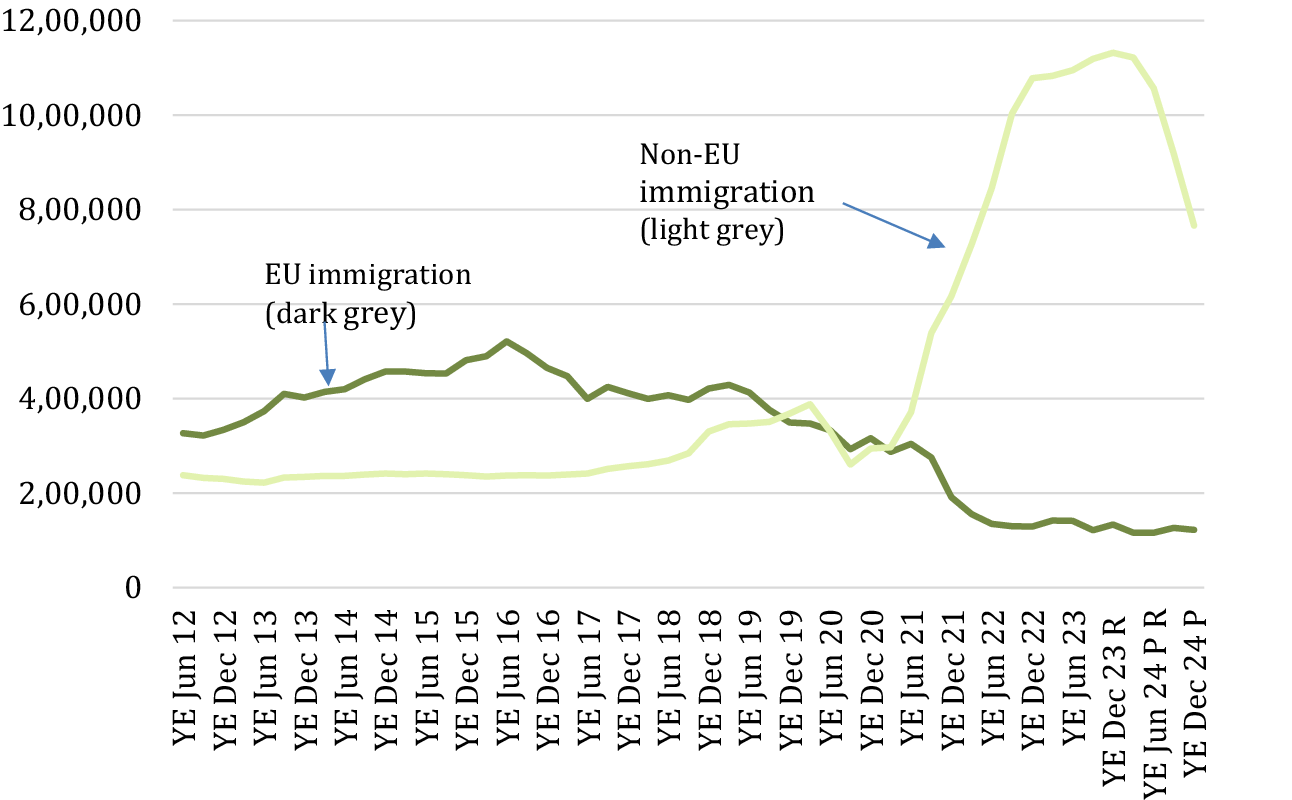
Brexit has provided considerable new material for xenophobic groups, because the UK’s leaving the EU has paradoxically led to a very significant increase in immigration. The country has exchanged primarily white (and largely Christian or post-Christian) European immigrants for far larger numbers of dark-skinned ones, many of whom are Muslims (see Figure 1). As can be seen from the figure, this change began abruptly at the start of 2021, which is when the UK’s formal withdrawal from the EU took place.
Immigration into the UK from EU and non-EU countries, quarterly, June 2012 to June 2024 (Source: ONS 2025)

Figure 1 Long description
The X axis represents time in quarterly intervals from Y E June 2012 to Y E December 2024. The Y axis represents the number of people, ranging from 0 to 1,200,000.
* E U immigration (dark green line): Starts at approximately 320,000 in 2012, peaks at roughly 520,000 in June 2016, and then steadily declines. A sharp drop occurs after June 2021, stabilizing at approximately 120,000 by 2024.
* Non E U immigration (light green line): Remains relatively flat between 200,000 and 300,000 from 2012 until late 2018. It begins a gradual rise, followed by an exponential increase starting in June 2021. It peaks at over 1,100,000 in late 2023 before showing a sharp downward turn toward 800,000 by June 2024.
The two lines cross in late 2019, after which non E U immigration becomes the dominant source of migration. Labels with blue arrows identify the dark green line as E U immigration and the light green line as non E U immigration.
That the number of EU immigrants dropped suddenly is easy to explain. More puzzling is the fact that they were not only replaced by non-EU citizens, but for several years by far larger numbers of them. The answer probably lies in the greater need of non-EU immigrants for long-term migration. These statistics show immigration for settlement, not temporary moves by seasonal workers, students, and other short-term visitors. Continental Europe is the UK’s neighbour, and cheap air travel connects the UK and many parts of Europe, especially Central and Easter Europe (CEE), where many seasonal workers had traditionally come from. They tended, therefore, not to bring their dependents with them, but to go home occasionally to visit them, and to return home themselves when the fruit-picking season or other seasonal work was over. Seasonal workers from outside Europe, coming from poorer countries located at the end of lengthy and expensive air links, cannot return home frequently and are thus more likely to bring dependents with them and to stay when their seasonal work is complete. Also, they tend to come from countries with higher birth rates and wider acceptance of responsibility for one’s extended family than Central and Eastern Europeans, whose family structures are more similar to those of the British. Considerably increasing immigration from third-world countries may not have been in any way an objective of the Brexit campaign, but it has been a result, and one that paradoxically strengthens the appeal of xenophobic groups further, as it enables them to run ever more virulent anti-immigrant campaigns.
“Long-term” migration does not include students, but data on this have moved in a similar way. For many years more students have come from non-EU countries than from EU member states, but this pattern became considerably exaggerated after 2021. Numbers coming from the EU declined, while those from outside Europe rose by a considerably larger amount than the EU decline [House of Commons Library 2025]. Perhaps strangely, UK political parties insist on using figures for immigration that include students as well as long-term migrants. It has also become the stance of most parties in the country that the numbers of international students should be reduced. This is the main social consequence of Brexit to date: a widespread intensification of hostility towards “foreigners” in the country. At the time of writing, the British government, aware of the “soft power” of the country’s former welcoming and multicultural reputation, is seeking to weaken some of the barriers that Brexit has erected between people, especially young people, in Britain and the rest of Europe. But they are doing so very cautiously, as they fear arousing the anger of an increasingly nationalistic part of the population.
A puzzle at the heart of Brexit continues to manifest itself: some British people, probably a small minority, see themselves as belonging to a global, cosmopolitan country that cannot be confined to the narrow bounds of a European identity, and which welcomes people from all over the world. A far larger number seem to want a more closed society, spared from facing the economic and cultural challenges of mixing with those from other backgrounds. From their opposite positions, these two groups unite in hostility to Europe. A third group, of indeterminate size, would be quite content to become Europeans again; but they lack any significant voice.
Conclusions: singular but not unique
Brexit seems to have changed Britain into a more xenophobic, less tolerant society than it was before. The hopes of some observers that, once out of the EU, the country could return to its self-image as a welcoming, multicultural place were disappointed. Hostility to immigrants and ethnic minorities, legitimized in relation to Europeans in the referendum campaign, was simply extended to other minorities and other international organizations. But virtually all the changes one would cite to support this argument can be found very generally in Europe and beyond—most virulently in the United States. Nationalist—and in particular anti-Muslim—parties are now growing in strength in all European countries; politicians of virtually all parties, aware of the growing popularity of these new movements, feel obliged to use nationalist rhetoric and to pose in front of the national flag whenever they appear in public. Almost everywhere, the xenophobic parties have two main geographical support bases: ex-industrial and ex-mining towns, and reasonably prosperous places that were never industrial but which stand outside the main centres of post-industrial growth—the capitals and other major cities, where xenophobic parties are particularly weak. Most nationalist parties have also adopted misogynist rhetoric to win the support of young men, and deny the importance of climate change. They tend to support Russia in the war against Ukraine, or at least do not want to do anything to help Ukraine. Reform UK’s position here has been ambiguous.Historically, the older parties among them were hostile to the welfare state, at a period when their support was concentrated among rural and small-town communities. As they have found a new support base in ex-industrial towns, some—very recently including Reform UK—have switched positions on this issue, provided the welfare state is limited to what they regard as true national citizens.
These relatively new characteristics of western polities have appeared at a particular historical conjuncture. The political party identities carried by postwar generations, rooted in the vast and often violent conflicts of the late 19th and early 20th centuries, have gradually worn out over time, fading from memories into the inherited memories of earlier generations [Crouch Reference Crouch2025]. Initially this left citizens without strong political identities. The situation might have remained like that, as it continues to do for the majority of citizens, leaving weak, increasingly meaningless but stable party systems. But major events intervened. Several countries in western Europe, and others, including the United States, experienced repeated acts of Islamist terrorism. These killed relatively small numbers of people, but sent shockwaves through populations. The financial crisis of 2008 shook faith in the stability of the economic system and the capacity of governments to protect citizens against its shocks, and set back living standards for a majority. As war and ecological disaster drove millions of people from their homes in the Middle East and North Africa—while in the case of the United States, poverty drove migration from Latin America— the numbers of immigrants and refugees seeking a new life in the prosperous western world grew, some of them from the same parts of the world from which the Islamist terrorists had come.
People living in cities central to the new economy are likely to feel more confident about surmounting these challenges and, being more future-oriented, are more likely to care about environmental disaster and climate change. Those outside these places will be more prone to seek a solution that looks back to a partly mythical past, when prosperity seemed easier to achieve and did not have to be shared with immigrants and their descendants. They respond to messages promising to make their world smaller, more manageable, and more nationally isolated. Foreigners must be excluded, including international organizations that interfere with the autonomy of the nation. Women should probably return to their traditional roles. They also argue that we should concentrate on saving everything for a present that tries to recapture the past, and not spend precious resources on protecting the environment for future generations. Ironically, despite the belief among many of the followers of these ideologies that their nation is different and special and can isolate itself from a troubled world, they are all moving along the same, shared path. There is considerably more international unity among the new xenophobic movements than among those claiming to believe in international cooperation. British people are caught up in all this just as much as others. Brexit has not made them special, but an extreme example of a more general phenomenon.



 Open access

