Since the 1920s, when French scholars discovered, in astonishment, that King Jayavarman VII's (r.1182–c.1218) great state temple, the Bayon, was originally Buddhist, there has been little work on how this king achieved the momentous shift of the ancient Khmers from four centuries of state Śaivism to state Buddhism. As the only texts from the period are a number of temple inscriptions, we are obliged to complement our search for clues to Jayavarman's imperial politico-religious agenda with close study of the decoration of his temples; and here, as Jean Boisselier says, even minor changes in form, size and motif can reveal messages of political and cosmological import:
To accord only a decorative role to all these suparnas [eagles, Garuḍas], particularly in the Bayon period, when the smallest scroll of foliage can recount so much history, would be to misunderstand the meaning of Khmer decorative sculpture.Footnote 1
This paper takes up the invitation to further research that Boisselier made in this pioneering paper of 1950Footnote 2 and looks at changes in icons and architecture to address the question of how the king achieved the historical turn to Buddhism; it argues that there are many overlooked signs in the sacred art that support Boisselier's tentative iconic observations and that point to a sustained campaign to achieve political legitimisation by imposing the Buddhist state.
The change in Jayavarman's Garuḍa icon that Boisselier detected, along with the widespread deployment of the new model around consecration platforms, when seen alongside other late changes in Jayavarman's temples, are found to signal a major religious event. The new icon points to an important background role in the new state Buddhism for the warrior Bodhisattva of Tantrism, Vajrapāṇi (‘thunderbolt-in-hand’), as the protector of all who turn to the Buddha. The deployment of this Garuḍa/Vajrapāṇi icon is then seen to align with both the appearance in the material record of a dozen bronze consecration conches embossed with the tantric Buddhist supreme deity Hevajra, and with the addition of large new sanctuaries in the king's existing temples that are emblazoned with a striking new dancing goddess motif. It is proposed that the sanctuaries were established to undertake large-scale tantric Buddhist initiations. Together, these and other overlooked iconic pointers are seen to disclose a well-planned and sustained campaign to get at least the ancient Khmer elite to accept the historical shift to state Buddhism.
Temples as the powerbase and the archives of the regime
The drive behind erecting temples on earth for the gods was to align the human state with cosmic forces capable of conferring legitimacy and power; political expediency could thus invoke religious authority and supernatural power. The temples became, as Davidson puts it, ‘testaments to royal legitimacy’ and the ‘archives of a ruling house’.Footnote 3 Jayavarman VII, a gifted communicator, was quick to exploit this means of projecting his regime's legitimacy and its new cosmic alignment with the Buddhas. In the tradition set by his own Mahīdharapura dynasty,Footnote 4 which established itself in the erection of the large tantric Buddhist-dominated temple complex at Phimai (modern northeast Thailand) between 1080 and 1107, the principal vehicle Jayavarman chose for conveying his regnal strategy was a series of large, walled temple complexes designed to regroup the capital's population under Buddhist administrations. Jayavarman VII took power by force in 1182Footnote 5 ‘to save the land heavy with crimes’Footnote 6 following a period when the Khmers were split into competing factions,Footnote 7 suffered a Cham incursion and regicide and underwent an embattled five-year interregnum. Jayavarman immediately marshalled Angkor's quarrying, transport, engineering, masonry and carving resources in a building programme that was to double the city's temple population within a generation. He erected more sandstone than all his predecessors combined and turned the royal sculpting workshops into a strategic asset of the realm.
The scale and intensity of the building programme have not however made its purpose a matter of easy modern consensus; even the transition to state Buddhism was not identified until the 1920s, when Coedès and Stern, elaborating on Parmentier's accidental discovery of a built-over Bodhisattva Lokeśvara, dislodged the earlier consensus for seeing the Bayon as a ninth-century Brahmanical foundation.Footnote 8 And the simplistic motivation offered most frequently for the scale of the programme – Jayavarman's megalomaniaFootnote 9 – is only being contested now.Footnote 10
One obstacle to understanding the temples is the damage they sustained in an iconoclastic campaign apparently conducted by one of Jayavarman VII's Brahmanical successors, when key historical evidence was surely destroyed. Another barrier to understanding the psychology of Jayavarman VII's temple construction effort is that there seems to be too little awareness of the precarious position the Khmer Buddhists endured through long periods of their history, before the twelfth century. The plight of the oppressed is often only traduced by silence in the historical record, and the silences of the Khmer Buddhists have not been tracked. Khmer sacred art and inscriptions show us that the Khmers had been only marginally Buddhist until Jayavarman VII ascended the throne. Buddhism flowered as a minority faith at certain times from at least the fifth century, but it was suppressed in the late seventh century and thereafter had to survive for substantial periods without royal patronage.
History of Khmer Buddhism
Because of the historical importance of the turn to Buddhism under Jayavarman VII, it is worth sketching here the little-known history of the Khmer Buddhists. The Buddhists flourished and then ran into crisis in the seventh century. In the mid-seventh century, Punyodaya, one of the early Indian Tantric Buddhist scholars to travel to China, spent 15 years among the Buddhist community of pre-Angkorian ‘Zhenla’ on a Chinese imperial mission to acquire Khmer expertise in medicinal herbs.Footnote 11 But when Chinese Buddhist scholar Yijing travelled through Zhenla at the end of the seventh century, he reported that Buddhism had entered the Khmer territory after Hinduism and fluoresced alongside it until, a few years before his visit, the Buddhist monks were expelled or killed by ‘a wicked king’.Footnote 12 Nancy Dowling's study of a series of large standing Buddhas in stone and wood in the Phnom Penh Museum concludes that they were all made between 610 and 665 CE.Footnote 13 The year 665 CE was the date of the last seventh-century Buddhist inscription, at Wat Prei Var.Footnote 14 Dowling noted that her findings appeared to support Yijing's report of what befell this Buddhist community. And Yijing's report of the suppression of the Khmer Buddhists is borne out by a century-long gap from 665 to 791 in the mainstream Khmer Buddhist material record, when there is no trace of any Khmer Buddhist icon, inscription, temple or ashram (it should be noted that in the non-Khmer world the Mahāyāna Punyodaya belonged to was making great advances in this period in western India, Pāla India, Sri Lanka, Tibet, Tang China, northern Champa, peninsular pre-Thailand and at Borobudur in Śrīvijaya). At the end of this undoubtedly bleak period for the Khmer Buddhists, Jayavarman II (r.c.802–835) founded the Śaiva state in the Angkor region in 802 and ushered in 260 years of monarchs erecting Śaiva state temples, culminating in the Baphuon temple of Udayādityavarman II. It is just possible, however, that Jayavarman II included the Buddhists in the Khmer alliance he formed against an external foe identified only as ‘Javā’, and from whom he asserted permanent Khmer independence. Close reading of the Wat Sithor inscription (K.111) of c.990 from near Phnom Penh, and of the Sab Bāk, Prakhon Chai, Nakhon Ratchasima province inscription (K.1158) dated 1066, shows that an (otherwise unknown) tantric Buddhist guru named Śrī Satyavarman (identified in both inscriptions) erected icons of Vajrapāṇi and Lokeśvara for Khmer Buddhist communities in what may have been the first Buddhist recovery from the seventh-century suppression. Neither inscription gives him a date but the Khmer language part of K.1158 says ‘Kamsteṇ Śrī Satyavarman, who obtained siddhi, had originally erected them … above Abhayagiri, to prevent Javā from invading the Khmer country.’Footnote 15 Śrī Satyavarman's purpose here is so close to the political banner of Jayavarman II that we cannot do better, on this evidence, than consider them to have been contemporaries. During Jayavarman II's rise to power, one fragment of a Lokeśvara inscription from what Finot calls ‘un sanctuaire sans importance’Footnote 16 is dated 791 and reused in the doorjamb of eleventh-century Prasat Ta Kam in Siemreap province. The first evidence of the Buddhists being active again after Jayavarman II's time comes after another long break in the record when Yośavarman I began building Yaśodhapura (Angkor) and constructed the Saugatāśrama for what Coedès, who translated the ‘Stela of Tep Pranam’, called ‘a small Buddhist community’ at the end of the ninth century.Footnote 17 The stela opens with praise for Śiva, reproduces many lines from other Brahmanical stelae, places the Buddhists firmly in the second division with this concession: ‘Let us honour, a little less than the Brahmin who possesses the vidyā, the ācārya versed in Buddhist doctrine and grammar …’ and closes with the king's promise that those who support the ashram will go (not to the Buddha's but) to Śiva's abode. One is left with the impression that the ashram was a Buddhist island in a Śaiva sea. Thus there was Buddhist shrine construction probably early in the ninth century and a Buddhist ashram received royal patronage near Angkor in the late ninth century, but in between the Buddhists were not able to maintain the shrines. The thin evidence we have therefore suggests that after being suppressed, the Buddhists were possibly allowed a respite under Jayavarman II, but altogether their fortunes waned more than they waxed from 665 to 944. The situation of the Buddhists was then strengthened under Rājendravarman and three kings who called themselves Jayavarman (the French historians numbered them Jayavarman V, Jayavarman VI and Jayavarman VII); the Buddhists would eventually became dominant, but not without further roller-coaster rides of fortune.
The Buddhists' sometimes difficult history, through centuries as a religious minority, must have weighed in the deliberations of Jayavarman VII. The prospect of achieving some degree of acceptance among the urban elite of how Buddhist teaching, ritual, liturgy and mythology could embrace and even surpass the long-established Śaiva rituals of state and the learning of the Brahmins must have seemed daunting. Yet it was achieved — and how is the subject of this paper. For the Khmers made their historical turn to state Buddhism at this time and – after a switch to the southern Buddhist vehicle – this is still in place today. Furthermore, there was indeed a Śaiva reaction. The desecration of Jayavarman's temples, quite unprecedented in Khmer history, destroyed an untold number of Jayavarman VII's icons and presumably some dedication stelae, which are the most concentrated records.Footnote 18 The reworking of Buddha icons into Śivalingas in the Bayon, and the chiselling off of thousands of Buddha images in Jayavarman VII's other temples, has often been attributed to the reign of Jayavarman VIII (r.1270–95 according to a recently adjusted reading of the Mańgalārtha inscription K.567 by EFEO Sanskritists),Footnote 19 whose posthumous title parameśvarapada indicates his religion was Śaiva. This king left no inscriptions and Jayavarman VII's giant faces on the Angkor Thom gates were still said to be Buddhas when Chinese envoy Zhou Daguan arrived in Angkor in the year after Jayavarman VIII abdicated, which suggests continuity if anything. My own view is that a Hindu-Buddhist clash, if that was the cause of the wide-scale desecration of Jayavarman's temples, is more likely to have occurred in the reign of Jayavarma Parameśvara (Skt. jayamādiparameśvara), the last king to leave an inscription in Angkor before the return of Ang Chan in the mid-sixteenth century. In 1327, in his first year on the throne, Jayavarma Parameśvara erected a Śivalinga in the (I would ask still Buddhist?) Bayon.Footnote 20 Erecting a Śivaliṇga in the central temple of Jayavarman's state Buddhism (there are several lingas set in sanctuaries in the Bayon today, but K.470 is the only surviving inscription mentioning one) immediately upon enthronement looks like a politico-religious act of significance. Did Jayavarma Parameśvara convert the whole Bayon for Śaiva ritual and then order the systematic desecration of Jayavarman VII's other temples in Angkor? These questions cannot be confidently answered, but from the little data we have, there is no stronger candidate for the desecration than Jayavarma Parameśvara.
Some major icons have been recovered and brilliantly restored but Jayavarman's temples were left almost empty of icons and substantially scarred. Recently, archaeologists have by chance uncovered a large number of damaged late thirteenth–early-fourteenth-century Buddha icons, carefully placed in beds of sand in what appears as a ritual burial, performed perhaps to preserve them against further attack.Footnote 21 Given the small amount of archaeological excavation yet undertaken within the large Angkor site, this may be only the first such find of ritually buried broken remnants from the iconoclasm. The way in which Jayavarman brought the Khmers to endorse his political strategy and religious predilections and how it was received remain open to interpretation.
Jayavarman's Buddhist strategy
Sanderson remarks on the ‘intense commitment to Buddhism manifest in Jayavarman VII's architectural undertakings’.Footnote 22 But what political agenda was being projected? Surely something was at work here that was more compelling than the drift of courtly fashion towards being Buddhist as suggested by Hawixbrock.Footnote 23 Rather, implanting state Buddhism seems to have laid the base for a sustained drive to stabilise the capital and direct the empire towards a longer-term apogee of power and influence. At court, the move to Buddhist dominance would imply a major power transfer from Brahmins to Buddhist monks.Footnote 24 Snellgrove's reflection on Khmer politics during a Buddhist revival in the tenth century probably applies to the situation faced by Jayavarman in the twelfth:
But Buddhism was clearly at a disadvantage, especially within the confines of the capital city of Angkor… [T]he lineages of influential Brahmins, often related to the leading aristocratic families, formed an essential part of the structure of the state at least from the time of Jayavarman II onwards.Footnote 25
The stakes for such a major change of regnal strategy must have been high, and one rebellion against the new king is recorded in inscriptions. We are probably entitled to detect the insecurity of the new Buddhist state in the fact that Jayavarman entrusted two Cham Buddhist princes, educated at the court in Angkor, with quelling the Malyang insurrection (recounted by the princes in Cham inscriptions C.92B-C and C.90D after they returned to Champa). The king must have had second thoughts about trusting Khmer generals or regional rulers. Jayavarman was anyway steeped in Cham culture. The future king's long sojourn in Champa in the 1160s and 1170s probably included his being engaged, as a militarily trained Khmer prince, in the ongoing strife there between rival Cham kings and in cross-border fighting between Cham and Khmer factions — where he may well have had to fight against Khmers.Footnote 26 We have only limited epigraphic clues to go on, but it is certain that immediately after he took the Khmer throne, he had loyal Cham princes at his side and he appeared well versed in militarised factional strife.
Jayavarman's response to the disarray he found in Angkor, after the interregnum and his victory in battle, was to immediately begin building massive defences to protect his capital against foreign and perhaps domestic foesFootnote 27 and to invoke the state protection offered by northern tantric Buddhism. His socio-politico-military re-engineering came with major impact for the city populace. Community-building under the guidance of monks, behind major physical defences, appears to have been his policy.Footnote 28 The ‘Angkor Thom’ centre around the royal palace and the Bayon construction site was being protected by a moat and 3-kilometre-long earth and laterite ramparts, pierced only by high stone gateways. Just outside the Angkor Thom walls, the large, walled temple complexes of Praḥ Khan, Tà Prohṃ and Banteay Kdei, and a dozen smaller temples, were rising. The statistics on the stela of the large Praḥ Khan temple record 14,000 residents housed within its outer enclosure walls and temple complex is indeed described as a city – nagari jayaśriḥ or ‘city of victorious fortune’.Footnote 29 Louis Finot memorably describes Jayavarman's new fortified Buddhist centres as ‘complex establishments that the inscriptions describe for us, at the same time temples, convents, universities, and no doubt fortresses when needed, capable of protecting the population and withstanding a siege’.Footnote 30 The Praḥ Khan and Tà Prohṃ temple stelae mention dance troupes and musicians, supplied with costumes and instruments, which were presumably funded to help instil new, royally decreed, religious festivals.Footnote 31 The perennial invocation of Śiva in Angkor's defence had failed with the Cham incursion and the regicide; the new Khmer defences were to be physical as well as spiritual and psychological, and this time they came under a supreme Buddhist pantheon: thus four centuries of state Śaivism were overnight supplanted by the Khmer equivalent of what in China had been earlier known as ‘state protection Buddhism’. The internationalist cast of Jayavarman's vision of empire may be indicated in his choice of Sanskrit, whose use we know he revived in his temple inscriptions and which we can assume was also revived in the liturgy of his temple rituals and festivals.Footnote 32 For his vision, reflected in his broad road and hospital network, clearly embraced the Mons and Chams in a Khmer-centred, Buddhist-led empire stretching the umbrella of its power from the Burmese border to the South China Sea. Maxwell has recently noted how Sanskrit was ‘a prime instrument of power’ in the medieval world.Footnote 33
Quite how Jayavarman managed to transfer power to the Buddhists has not been much inquired into, and how it was received by the Brahmins and the entrenched and wealthy Brahmanical families is not recorded — unless their reaction is shown in the later desecration of the Buddhist foundations already mentioned. Did Jayavarma Parameśvara's Śaiva activities in the Bayon express a long-lasting resentment among the Brahmanical elite of Jayavarman's imposition of Buddhism? As previous Khmer monarchs invariably respected the foundations of their predecessors, we are bound to seek an exceptional motive when temple desecration on this scale was the visible outcome. If there was a violent Hindu-Buddhist clash under Jayavarma Parmeśvara, we can imagine the dismaying social impact on a city, under Buddhist sway for 145 years, of a campaign to smash Buddhist icons in the temples and knock thousands of Buddhas from the temple walls.
Before turning back to the sustained and evolving investment in sacred art that underpinned Jayavarman's strategy, we should briefly recall the major historical fact that grounds our interpretation: the Khmers turned definitively to Buddhism during Jayavarman VII's reign. From earlier epigraphy and art, we can see that Buddhism reached the Khmers by the fifth century and flourished in the seventh, before being suppressed. In the eighth century, the Khmer Buddhists were either unable to participate in the international florescence of the Mahāyāna – in India, Sri Lanka, Tibet, China, Java, Champa – or they did it in exile. And until Jayavarman VII ascended the throne, the Buddhists had secure footing at only two courts — those of Jayavarman V in the tenth century and of Jayavarman VI, who inaugurated the Mahīdharapura dynasty in the eleventh century. From Jayavarman VII's reign until today however, Khmer regimes have all been Buddhist (except for the brief, destructive resurgence of Śaivism perhaps under Jayavarma Parameśvara). Khmer Buddhism at some as yet undetermined point subsequently switched from the northern to the southern vehicle, but the fundamental shift from state Śaivism to state Buddhism was made under Jayavarman VII, and it is this turn that stands out as one of the most abrupt and decisive in the country's religious history.Footnote 34 How was it achieved? In part it was done through the sacred art of the Bayon style, and it appears to have been done on a broad scale.
Nāga and Garuḍa
I now want to focus on the evolution of some mythical figures carved in Jayavarman's temples, and in particular on a mutation in the icons of Garuḍa. Jean Boisselier, in two pioneering articles in the early 1950s, studied the Khmer Garuḍa from its modest beginnings as the mythical heavenly eagle of Hinduism and Buddhism in temple lintels in seventh-century Sambor Prei Kuk, to its apogee as the most reproduced icon of all in Jayavarman VII's Angkor.Footnote 35 The adversary and prey of the classical mythical eagle and their king Garuḍa was the nāga, the chthonic serpent that is the Indian and Southeast Asian equivalent of the Chinese dragon and which appears to represent ancient ancestral cults. Boisselier reflected on the sudden mass production of Garuḍa icons under Jayavarman VII and wondered whether this could be associated with narratives in northern Buddhism of the fiery Bodhisattva Vajrapāṇi taking on the form of Garuḍa to protect nāga that converted to Buddhism. I believe Boisselier's feelers were picking up the right vibrations, but unlike him, I think the association with Vajrapāṇi and the protection of converts was only overlaid after Jayavarman's Garuḍa icon mutated.
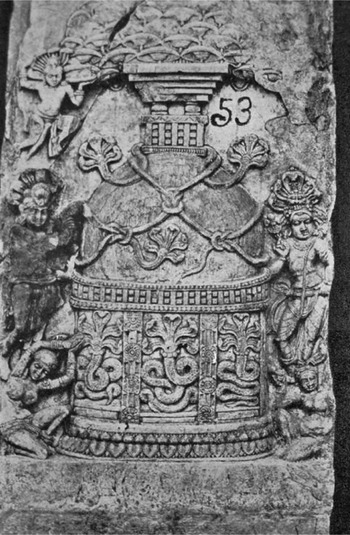
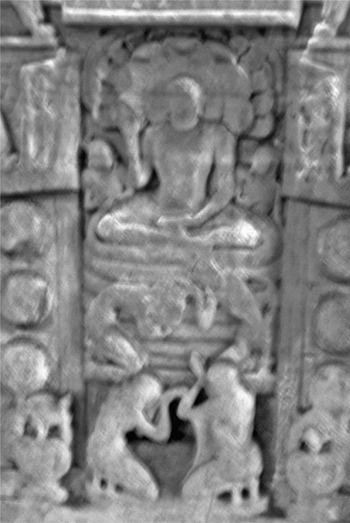
The primordial mythical role of nāga in the Indian subcontinent, where they were known as the fierce guardians of the treasures of the seas, as well as the producers of rain, was absorbed by all the Indic religions in the first millennium BCE. The early Buddhists evolved icons to respond to the problems they faced in attracting snake- and tree-worshipping hunter-gatherer peoples into a sedentary, vegetarian life of rice-growing around stūpa — in sufficient numbers to support a large community of mendicant, non-producing monks. At Amarāvatī and Nāgārjunakoṇḍa in the second/third centuries CE, the stūpa bears relief images of large nāga with multiple cobra hoods stretching in a web over model stūpa to protect the relics within.Footnote 36 The sculptors also developed an icon of the Buddha enthroned on the coils of a large nāga and protected by the nāga's multi-headed hood. Many modern historians have long taken this to be the incident in the early Buddha biographies when the nāga Mucalinda protected the meditating Gautama from an unseasonal storm beside the Nairañjanā River, a few weeks after his enlightenment.Footnote 37 In one Nāgārjunakoṇḍa relief, Longhurst believed that lines suggesting a river carved behind the nāga's hood invoked the Mucalinda episode — one of many other events from Gautama's life recorded there.Footnote 38 (A third–fourth century Gandharan relief at the Victoria and Albert Museum is closer to the text in showing the requisite seven coils mounting the Buddha's body hermetically to the neck and with Mucalinda's hood and seven heads reaching over him in a canopy). But if this is Mucalinda in just one Nāgārjunakoṇḍa relief, it should not be confused with the predominant Buddha enthroned by nāga at these stūpa. In the principal and much repeated image, the Buddha is seated on multiple nāga coils on the āyaka slab behind the railing of his own stūpa; here Gautama's life of teaching the dharma among men is over, and not about to begin after his enlightenment, as in the Mucalinda story. This Buddha has gone to nirvāṇa, leaving behind his teaching and relics, and so we see a transcendent Buddha, regally raising his right hand in ‘have no fear’ mudrā as his relics are venerated by visitors to the stūpa. The nāga's role here seems to be signifying the ascension or transcendence of the Buddha whose earthly mission is in the past and whose power on earth resides in dharma and relics. It is this icon of Buddhist transcendence, sometimes associated with relics, which then began a remarkable passage, as traced by Pierre DupontFootnote 39 through Sri Lanka, peninsular pre-Thailand, ‘Dvāravatī’ and finally Cambodia, where it was reproduced in uncountable numbers.Footnote 40 Pal, among other scholars, has pointed to Andhra Pradesh as the source for the first Buddhas enthroned on nāga.Footnote 41 Frédéric sees the Southeast Asian Garuḍa-nāga myths as ultimately harking back to the stūpa-protecting role developed in Amarāvatī:
In Buddhism, the Garuḍas are the mortal enemies of the nāgas; only nāgas possessing a Buddhist relic or converted to Buddhism could escape them.Footnote 42
Getty refers to texts where the Buddha divided his monastic robe into infinitesimal pieces, which he distributed among nāga who appealed for his help: ‘No nāga with this inviolable talisman could be harmed by a Garuḍa.’Footnote 43
Vogel 1926 pl.10 (Reproduced with the kind permission of Arthur Probsthain, London)

Amarāvatī transcendent Buddha

The nāga, as Mus and Coedès show, is linked in many Asian cultures with the rainbow and can be seen as a transcendent highway between the world of man and the world of the gods.Footnote 44 At the same time the image retains the missionary associations of embracing converts and according generous space, under the Buddhist umbrella, for ancestral beliefs. There are already abundant signs of ancient serpent cults in early Angkorian temple lintels and in temple moat balustrades, the most spectacular of which is the 0.7 metre radius nāga that stretches 100 metres across the moat at the ninth-century Bakong Śaiva temple at Roluos. The nāga here opens a path between the world of men and the palace of the gods that is the temple. However, the Khmer Buddha was only enthroned on a giant serpent, in the form Dupont traced back to Sri Lanka, when the Khmer Buddhists obtained the right to erect the small brick and stone Bat Cum temple in the rebuilt Śaiva capital of King Rājendravarman II in the mid-tenth century. The Bat Cum Buddha has not been identified but in all the Buddha statues and caitya reliefs from this period the Buddhas are enthroned on nāga with long, separated, striated necks and with multiple, crested heads. This image of the Buddha was to be reproduced thousands of times in the twelfth century, culminating in a 4-metre nāga Buddha being installed by Jayavarman VII in the central sanctuary of the Bayon.
Garuḍa enters the sacred art of Angkor in a minor way as Viṣṇu's mount at the Bakheng temple when Angkor was founded and then on a striking scale at the early tenth-century Vaiṣṇava shrine of Prasat Kravan. In a very physical image, his human body raised high on a giant bird's legs, Garuḍa holds Viṣṇu aloft on his shoulders. The impression of power is enhanced by the way the relief image in brick fills a whole wall of the small sanctuary crowded with large Viṣṇu images. The sacred eagle later takes a minor role in the lintels of East Mebon, Banteay Srei, Baphuon and is surprisingly not very prominent at the great twelfth-century Vaiṣṇava shrine of Angkor Wat. But in the Bayon period, the eagle suddenly becomes pervasive, in ways which demand explanation. The largest image of Garuḍa appears on the new temple walls in the early, imperial expansion phase of Jayavarman VII's reign. All association with Viṣṇu is dropped and the magical eagle grows into a towering, barrel-chested defender of Buddhism and the new temple enclosures built by the king.
‘Power Garuḍa’
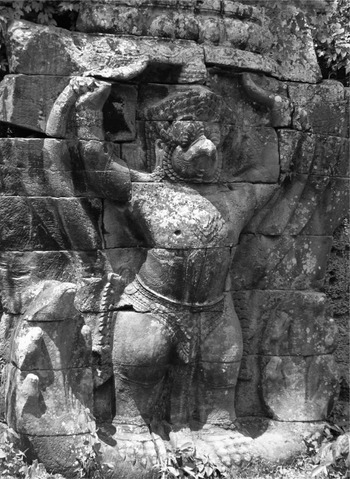
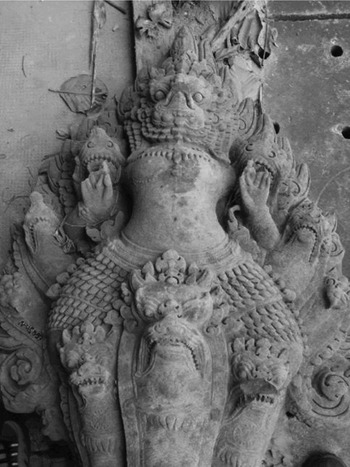
I will designate these early Garuḍas, twice the height of a man, as Jayavarman's ‘power Garuḍas’. They exude strength and military prowess like Dvarapāla door guardians, standing guard beneath large (defaced) icons of the Buddha. The king dedicated Praḥ Khan temple to his father in the image of the Bodhisattva Lokeśvara in 1191 and the 14,000 residents were ‘protected’ by 72 such martial Garuḍas carved into the walls of their complex. With their beaks thrust into the air, their talons hold down large, multi-headed cobras with unfolded hoods; their human hands hold the nāga tails triumphantly aloft. Garuḍa is transformed from Viṣṇu's mount into the protector of Buddhism, as Boisselier observes:
This reign … confers on Garuḍa his most important role. Reappearing in the decoration of pilasters and lintels, he replaces, united with the nāga, the previous decorative motif for temple balustrade ends, adorns the angles of gopuras, supports the gigantic heads of the face towers and alternates with the lion on royal terrace walls … though he certainly remains a symbol of victory, he appears above all as a protector of Buddhism.Footnote 45
Boisselier goes on to see the nāga beneath Garuḍa's talons at Praḥ Khan as resembling the multi-headed nāga that form the throne-back of the dominant Khmer nāga Buddha icon, and therefore, I believe wrongly on both counts, takes them to be representations of the ‘good’ nāga Mucalinda, who protected the meditating Gautama from an unseasonal storm.Footnote 46 I cannot agree with Boisselier here. I see the similarity he points to in the form of the nāga hood but not in the meaning of the nāga under the Praḥ Khan Garuḍa's talons. The Khmer Buddha enthroned on nāga coils, I have suggested, is a transcendent Buddha in nirvāṇa, not Gautama before the commencement of his earthly ministry being covered against a storm by Mucalinda. And the two Praḥ Khan nāga pinned down by Garuḍa do not look like nāga of transcendence but rather the eagle's traditional opponents pinned underfoot. The Praḥ Khan Garuḍas are surely a symbol of protection, but those being protected are the people inside the complex, not the nāga under Garuḍa's feet.
Praḥ Khan Garuda under effaced Buddha

The reason Boisselier brings up the Mucalinda story, is that he wishes to bring in the link made in northern Buddhism between the Bodhisattva Vajrapāṇi and Garuḍa in the protection of nāga that convert to Buddhism.
Garuda, while remaining the enemy of the nāgas, also becomes, somewhat paradoxically, the protector of some of those who, like Mucilinda, attached themselves to the person of the master or wanted to hear the teaching of his doctrine. It seems that from this point of view he was fairly closely linked to Vajrapāṇi, who even exceptionally takes on his form in late Buddhism. The thunderbolt clan Vajrapāṇi presides over is thus somehow in liaison with the solar cult and Garuḍa takes an enlarged role. It is without doubt this complex aspect which is illustrated in the statuary of the Bayon, where Garuḍa appears at the same time linked to the nāgas and as the protector of the Buddha.Footnote 47
Boisselier's associating Garuḍa with Vajrapāṇi is I think insightful and, despite his hesitations, has not since been challenged. But I find the association problematic in the Praḥ Khan period of the 1190s, when, I will shortly propose, Jayavarman VII had a different icon for Vajrapāṇi. But I find the association of the eagle and the Bodhisattva does fit the Garuḍa/nāga icon that emerges from a radical mutation in the icon that probably occurred in the early 1200s.
‘Gentle Garuḍa’Footnote 48
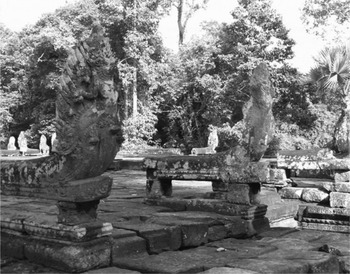
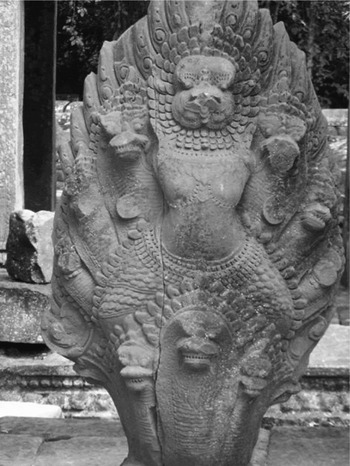
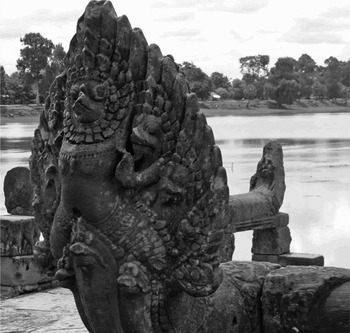
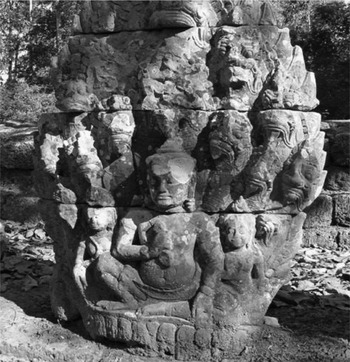
Jayavarman's Garuḍa/nāga icon was produced in far greater numbers towards the end of the reign when a mutated Garuḍa/nāga appears at the end of a large number of balustrades that mark out new sacred areas around the principal sanctuary buildings in the king's temple complexes. These eagles are smaller in size than the ‘power Garuḍas’ but they still look lordly and powerful. However, rather than trampling nāga, they softly embrace their multiple heads. The relationship has swung from hostility to tender care; they have become what I will call the ‘gentle Garuḍa’. Boisselier leaves out Mucalinda in his second paper and says of these later icons: ‘Their attitude in fact suggests much more the idea of a protector than a victor suppressing his enemies …’Footnote 49 The new balustrade Garuḍa, a quarter of the size of their predecessors, straddle one of the nāga's multiple heads and wrap their arms gently around others, while holding their human hands forward in the ‘have no fear’ mudrā. Sometimes their hands hold a flower. The mudrā is clear in exceptionally well-preserved Garuḍas from Praḥ Khan of Kompong Svāy that were recenty returned to the Siemreap Conservation depot after being looted and recovered from a truck by the Cambodian police.
Garuḍa platform at Banteay Kdei

Praḥ Khan Garuḍa

Garuḍa from Kompong Svāy

This dramatic change in the icon is striking and must, in the Angkorian context, betoken a message from the palace. Whatever its import, the message was well distributed, because these gentle Garuḍa also appear in numbers at Banteay Kdei, Ta Prohṃ, Sraḥ Srang, Banteay Chmar and Wat Nokor. Indeed the proliferation of Garuḍa in the late Bayon period took the familiar but not especially celebrated mount of Viṣṇu from relative obscurity to the status of the most reproduced icon of all, as Boisselier notes:
at the end of the first quarter of the thirteenth century, which corresponds to the apogee of Khmer power and the greatest construction effort the empire experienced, Garuḍa plays a role of steadily growing importance. Having made a modest debut in statuary, he came to occupy the first place in the Bayon period …Footnote 50
Frédéric says nāga only escaped the attacks of the heavenly eagles either by having Buddhist relics or by converting to Buddhism. As the nāga in Angkor show no sign of carrying relics in the balustrade ends, should we take them to be converts to Buddhism? If we now take up Boisselier's tip and digress briefly into the mythology of northern Buddhism, we find a better fit than Mucalinda for Jayavarman's new Garuḍa icon.
Sraḥ Srang Garuḍa

Vajrapāṇi/Vajrin/Trailokyavijaya
In northern Buddhism, Vajrapāṇi took over Ānanda's role in conversion and rapidly accumulated others, as Etienne Lamotte notes:
Dragon or nāga converting became a major activity in the final years of the Buddha's life, and Vajrapāṇi became his most effective and constant companion in this. Where Ānanda was the leading disciple, converter, text memorizer for the Theravāda, Vajrapāṇi had all these roles in the Mahāyāna.Footnote 51
In early Buddhism, Vajrapāṇi was the primitive and violent krodha-vignāntaka (‘wrathful destroyer of obstacles’) or ‘hit-man’ first known as the yakṣa (demigod) protector of the Rājagṛha on the ‘Vulture peak’ (Gṛdhrakūta).Footnote 52 He first appeared at the Buddha's side when the Buddha knew his death was near and wanted to undertake a number of difficult conversions, like that of the nāgarāja Apalāla in northern India. So he took Vajrapāṇi with him, rather than Ānanda, and the nāga's storms and hail were suppressed by Vajrapāṇi's fire and violence. His all-powerful vajra (previously Indra's thunderbolt) counters all monsters, snakes and other obstacles to conversion. Marcelle Lalou says the engagement of Vajrapāṇi in the Buddha's last conversion missions made ‘…Ānanda the first victim of a re-emergence of local cults, of which one finds traces elsewhere than in the Vinaya of the Mūlasarvāstivādin and in tantric Buddhism’.Footnote 53 Vajrapāṇi is immediately linked to conversion, violence and the exotic, as Buddhism expands into new areas.
The theme of conversion was present in such early Mahāyāna classics as the Lotus Sūtra, where a striking account is given of the powers of an eight-year-old converted nāga.Footnote 54 The rapid international expansion of tantric Buddhism in the eighth century boosted the career of the Bodhisattva endowed with Indra's thunderbolt, which could coerce the recalcitrant and protect the converted. Vajrapāṇi's role as chief converter to Buddhism is defined in chapter 6 of the sarvatathāgatatattvasaṃgraha (STTS), the root tantra of the Yoga class, which was the main textual platform for this phase of the international expansion of the Vajrayāna. The STTS was one of the primary Buddhist texts now thought to have been current in Cambodia from the mid-tenth century and this text immediately and indelibly links Vajrapāṇi with conversion.Footnote 55 He dominates chapters 6 to 10 after orchestrating his famous battle to bring Śiva into the Buddhism maṇḍala — a drama that disrupts the hitherto smooth flow of events in the celestial assembly in the adamantine jewelled palace at the summit of Mount Sumeru around the supreme, unifying, sun Buddha Vairocana. Vajrapāṇi says he cannot assemble his clan (kula) to participate in the Vajradhātu maṇḍala because some criminal elements, including the god Śiva-Maheśvara, refuse to submit:
‘O Lords, there are evil beings, Maheśvara and others, who have not been converted even by all of you Tathāgathas. How am I to deal with them?’Footnote 56
Vairocana endows Vajrapāṇi's vajra with special powers and the vajra bearer then proclaims:
‘Oho! I am the means of conversion, possessed of all great means. Spotless, they assume a wrathful appearance so that beings may be converted by these means.’Footnote 57
Another Vairocana spell brings Śiva and his host of gods into the assembly and an extended duel ensues in which Vajrapāṇi inflates himself into his wrathful Trailokyavijaya or ‘conqueror of the three worlds’ form, trades insults and intimidating displays with Śiva in his equally wrathful Mahābhairava shape, until the Bodhisattva tramples the pan-Indic Hindu god and his consort Umādevā and ‘kills’ them, before reviving Śiva in the Vajradhatu maṇḍala as the Tathāgata-bhasmeśvara-nirghosa (‘Buddha, soundless lord of ashes’). In the ninth century, this tantra established Trailokyavijaya as the principal deity of what Linrothe designates as phase two of tantric Buddhism; Heruka presides over the third expansion of international tantric Buddhism from the twelfth century.Footnote 58 The vajra was to propel Vajrapāṇi to the highest Bodhisattva rank and higher, as Lamotte says:
Bearer of the thunderbolt in the old Buddhist tradition, elevated to the rank of Bodhisattva of the 10th world by the Mahāyāna, Vajrapāṇi had his place ready-made in the Vajrayāna. But here the baton he holds is not only the weapon of fire brandished against the adversaries of the Buddha, it is also the immanent, adamantine essence of all beings and all things.Footnote 59
In Cambodia, images of Vajrapāṇi were erected by Buddhist leader Śrī Satyavarman perhaps, as already mentioned, in the early ninth century, when Jayavarman II founded the Angkorian state, but the Bodhisattva's surviving epigraphic dedications are concentrated in the mid–late tenth century. Boisselier concluded from Finot's work on late tenth-century Sanskrit inscriptions to Vajrin (‘possessor of the vajra’) or Vajrapāṇi (‘vajra-in-hand’) that this Bodhisattva ‘ranks third in the texts, after Lokeśvara and Tārā but equalling the Buddha himself’.Footnote 60 Icons of Vajrapāṇi, the Buddha and Divyadevī (Prajñāpāramitā) were erected in Bat Cum (inscription K.266), the first Buddhist temple built in Angkor in 953 CE, and the Wat Sithor inscription (K.111 B.39) refers to the guru Kīrtipaṇḍita's restoration of more than 10 images of Vajrin and Lokeśa first raised by Śrī Satyavarman. One of several caitya found at villages northwest of Angkor, beside the road to Phimai (Thma Puok inscription K.225 III, 66A, 4;C,6) is dated 989 CE and invokes the Buddha, Prajñāpāramitā, Lokeśvara, Vajrin, Maitreya and Indra. The Khmer language inscription (K.240) from Prasat Ta An dated 979 CE from this period and region invokes Vajrapāṇi in his wrathful form of Trailokyavijaya, which recurs later at Phimai.
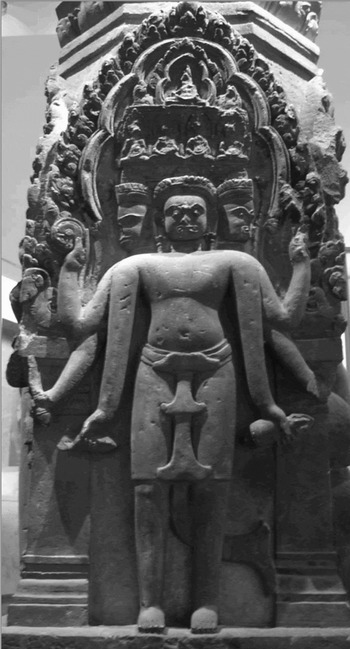
The icons of the Khmer Vajrapāṇi in the late tenth century mostly show the Trailokyavijaya form which projects his famous battle with Śiva in the STTS. In a striking relief on the Kbal Sre Yeay Yin caitya from the Phnom Srok village northwest of Angkor, and now in the Musée Guimet in Paris, the six-armed Bodhisattva has three visible crowned heads with fierce expressionsFootnote 61 and the crowns support the five Buddhas of the Vajradhātu maṇḍala. He holds the vajra and ghantā and other weapons and seems to depict Vairocana's final warning to the still arrogant Śiva that ‘Vajrapāṇi is the overlord of all the Tathāgatas’:
His brows tremble with rage, with a frowning face and protruding fangs; he has a great krodha appearance. He holds the vajra, ankuśa-hook, sharp sword, a pāśa-noose and other āyudha.Footnote 62
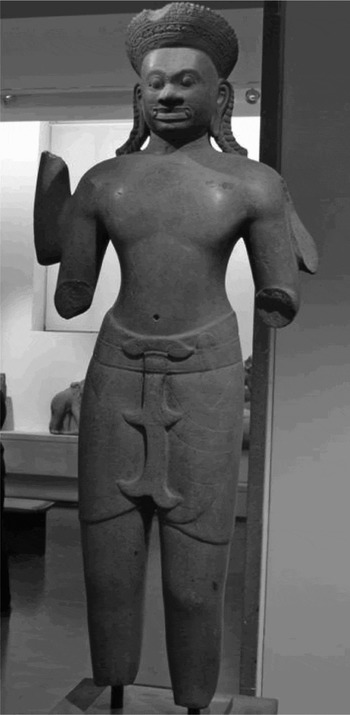
The contemporary Thma Puok caitya names Vajrin and gives him a single, fierce face with hair hanging to his shoulders and four arms, two of which grasp the vajra and ghantā to his waist. A similar, finely carved, life-size, Kleang-style statue in the Guimet has the same bulging yakṣa eyes, fangs and long hair below a regal tiara. Although all four hands of this regal icon are broken off, this also appears to be the same wrathful Vajrin. Woodward, I think rightly, identifies another fierce, dancing Vajrapāṇi on a tenth-century pink sandstone stela now in the Bangkok Musuem.Footnote 63 The one Vajrapāṇi image from this period without the fierce face appears on a slightly earlier Pre Rup style caitya from the Prasat Ta Moan in the Dangrek mountains in the reign of King Rājendravarman, where larger images of Prajñāpāramitā occupy the other three sides. The image, published in a Spink catalogue in 1997 and now in the Ashmolean, Oxford, has two of its four arms again grasping the vajra and ghantā at the waist.
Vajrapāṇi-Trailokyavijaya on Kbal Sre Yeay Yin caitya, Musée Guimet

Vajrin, Guimet

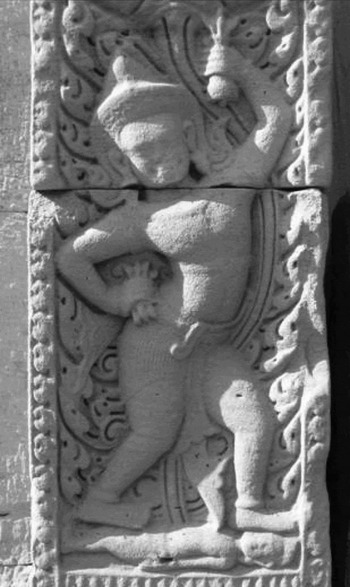
The next Khmer images of a deity dancing on a corpse and flourishing a vajra and ghantā in the air – as in the figure on the pink sandstone caitya Woodward identifies as Vajrapāṇi in the Bangkok Museum – appear at Phimai a century later, where the most likely identification is again Vajrapāṇi (contra Woodward's suggest that this is an early form of Bodhisattva Vajrasattva of the kind adopted in the 16 vajra beings of Shingon Esoteric Buddhism in Japan).Footnote 64 The Khmer language inscription at Phimai calls the god whose image was erected in 1108 CE ‘kaṃmrateng jagat senāpati Trailokyavijaya jā senāpati kaṃmrateng jagat vimāya’, an unusual Old Khmer construction, which seems to indicate that the newly raised god Trailokyavijaya is the ‘general’ of the principal god of Phimai,Footnote 65 who was probably an earlier image of a Buddha enthroned on a nāga. Such a military, protective role would indeed fit Vajrapāṇi/Trailokyavijaya, whose historical role ‘had always been called the ‘general of yaksas (yakṣaseṇāpapati)’.Footnote 66
Vajrapāṇi in Phimai

Vajrapāṇi/Vajradhara/Bhaiṣajyaguru
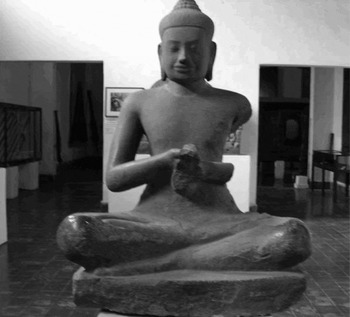
In his work on the Bayon period, Boisselier made yet another valuable contribution to the study of Khmer Buddhism when he separated out a group of seven Khmer ‘Buddhas’ from the rows of icons in the Siemreap Conservation Depot and identified them as ‘statues of Vajrapāṇi … the only ones we know in the statuary in the Bayon style’.Footnote 67 These seated, two-armed austere deities, with the calm faces and lowered eyes characteristic of Bayon style images of the 1180s and 1190s, all hold a vajra and ghantā crossed at the wrists before the diaphragm in a version of the prajñālinganābhinaya or prajñā-embrace mudrā that is the distinguishing mark of Vajradhara.Footnote 68 These deities are all seated in the half-lotus position, minimally dressed and unadorned; they have single heads with uṣṇīṣas covered with lotus petals. Boisselier comments: ‘We have said above that the personalities of Vajradhara and of Vajrapāṇi were not clearly defined and that they seem to be merged in Cambodia in Vajrapāṇi.’Footnote 69
The same mudrā that Boisselier identified in the depot is found in at least four larger Bayon style icons, one of which was found in the ruins of Jayavarman's Banteay Chmar temple. It is 80 centimetres high and the hands and left arm are damaged. Victor Goloubew saw it in situ in the temple in 1921Footnote 70 before it was removed from the remote and unprotected site to the security of the National Museum in Phnom Penh, which now labels it Vajrapāṇi, as a result of Boisselier's work.Footnote 71 The remnants of the damaged hands leave no doubt about the prajñā-embrace mudrā. On the art market in London, dealer John Eskenazi in 1995 published a 94-centimetre Vajrapāni/Vajradhara almost identical to the one found in Bantéay Chmàr but in almost perfect condition and with the mudrā quite clear.Footnote 72 Sotheby's auction catalogues offered two similar Khmer icons in the same year in London.Footnote 73
Vajrapāni/Vajradhara of Bantéay Chmàr

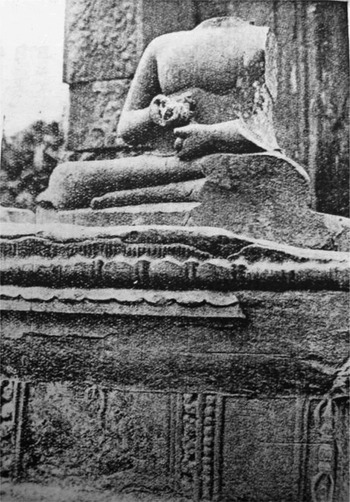
The Banteay Chmar find spot offers no help in clarifying the context in which this substantial series of Vajrapāṇi/Vajradharas was venerated, but others do. In the phase of imperial expansion, roughly corresponding with the 1190s, when a network of roads with rest-houses and hospitals was extended across Jayavarman's empire (and the army fought unsuccessfully to attach Champa), the icons of distributed Khmer power at the apogee of the empire were a powerful looking ‘radiating’ Lokeśvara from the kāraṇḍavyūhasūtra (KVS) with a Buddha and his universe in every pore of his skin — which Woodward surely correctly identifies as the Jayabuddhamahānātha commanded to be brought annually (in effigy?) to a festival in Angkor. This image of Lokeśvara is found on the rest-house chapels. The hospital stelae invoke Bhaiṣajyaguru, the Buddha of medicine, but the hospitals (ārogyaśāla) also had a quiet but intense holder of the vajra (Vajrapāṇi/Vajradhara) seated before their sanctuaries — in at least one case on a vajra-decorated pedestal. The hospitals were not, to Finot's surprise, put under the protection of Lokeśvara ‘the compassionate healer par excellence’Footnote 74 but were assigned to Vajrapāṇi/Vajradhara, identifiable in Khmer icons by the prajñā-embrace mudrā. Goloubew mentioned in his 1937 article a smaller, headless Vajrapāṇi/Vajradhara which was set on the only vajra-decorated pedestal in Angkor in front of the east chapel of the hospital complex near Takeo temple.Footnote 75 (The image has now disappeared though the vajra pedestal remains.) Goloubew published another image, this time with tiara, which is today in the depot marked with inventory number 308, but without its head. This series of Vajrapāṇi/Vajradhara in sandstone implies a significant cult of this deity and a strong link with medicine — a link reinforced by three other crowned icons with the same mudrā but in a more squat, provincial style recorded before the sanctuaries of hospital complexes at Nang Rong of Buriram, Prang Ku of Sisaket and Na Dun of Maha Sarakham in northeast Thailand.Footnote 76 And I have identified a fifth 40-centimetre headless image of Vajrapāṇi/Vajradhara standing beside the hospital stela in the Wàt Phra Keo museum in Vientiane (which I have not yet been authorised to photograph).
Vajrapāṇi/Vajradhara on a a vajra pedestal before the East Chapel, Angkor, after Goloubew 1937

The importance of Bhaiṣajyaguru to the Khmers can be seen from the 10 places reserved for him out of the 41 mentioned in small inscriptions left legible in the Bayon. But did Vajrapāṇi/Vajradhara also have a link with medicine, or was his role at the hospital sanctuaries again only protective? It is possible that the Khmers in the late Bayon period were associating Vajradhara with their hospitals because in the tantric version of the bhaiṣajyaguru-sūtra translated by Yijing in the Tang capital in 707, the Bodhisattva Vajradhara is given special prominence when he utters a concluding dhāranī for protection against all diseases. According to Pelliot, Vajradhara thus achieved eminence in the esoteric Buddhist communities of Tibet, China and Japan as a Bodhisattva associated with the Bhaiṣajyaguru Buddha.Footnote 77 As the ancient Khmers' expertise with medicinal herbs was known to the international Buddhist community from at least the seventh century, when China sent Indian Buddhist sage Punyodaya on a mission to ‘Zhenla’, as noted earlier, it seems possible that this association of Vajradhara with medicine was also maintained among the Khmer Buddhists into the twelfth century. And as we have five ‘Vajrapāṇi/Vajradhara’ with a firm contextual link to Jayavarman's ārogyaśāla, we may also speculate that, for this king, Bhaiṣajyaguru was also Vajrapāṇi/Vajradhara.
Sarvadurgatipariśodhana-tantra (SDPS)
Vajrapāṇi's role of protecting nāga who converted to Buddhism is also given weight in the eighth–century sarvadurgatipariśodhana-tantra (SDPS) ‘Tantra of the elimination of all evil destinies’. It is possible that the SDPS was one of the texts introduced into Cambodia in the tenth century along with the STTS. There are many similar themes in both texts, including a central 37-deity maṇḍala and Vajrapāṇi as master of ceremonies, and both are attributed to Buddhaguhya, a celebrated sage of Vikramaśila monastery in the Ganges valley whom Davidson considers the master of the tantric Buddhist revival ‘the pre-eminent exegete during the second half of the eighth century … [who] more than any other single individual represented the confluence of spirituality, esotericism, political insight, and promotional skill’,Footnote 78 Traces in the Khmer temple art may point to a borrowing from this text. In the SDPS, Vajrapāṇi introduces a series of maṇḍala centred on himself and Śākyamuni/Vairocana (the tantra makes an historical transition by having Śākyamuni appear as ‘Sarvavid’, the ‘omniscient’ Vairocana) in which the pan-Indic Hindu gods acknowledge the superiority of the Buddhas, as do the Eight Great Planets and the Eight Great Nāga. The astamahānāga (‘Eight Great Nāga’) maṇḍala section treats the theme of conversion from ancestral beliefs, when it says the maṇḍala is an antidote to the venom of snakes.Footnote 79 And the Tibetan translation of a commentary known as sNan bahi rgyan (‘Tibetan Tanjur’, vol. 76, no. 3454) takes the ritual removal of the venom of the snakes in the maṇḍala as a metaphor for ‘the conversion of unbelievers’.Footnote 80 In order to generate the Eight Great Nāga maṇḍala, Vajrapāṇi (called Vajradhara ‘vajra bearer’ in this passage) leads the nāga kings Ananta, Taksaka, Karkota, Kulika, Vāsuki, Śamkhapāla, Padma and Varuna into the maṇḍala while they display their cobra hoods. The nāga rejoice ‘holding their hands in añjali’ and promise to ‘provide that great being with constant protection, security and cover’:
We will act with great initiative, strength and vigour. We will render the venom ineffective. From time to time we will shower with rain. We will produce all crops. We will shower untimely rains on all the hostile kingdoms. Destroying all fears, we will ensure that the command of the Victorious One and of Vajradhara is carried out.
He [the adept] should recite the syllable PHUM one hundred thousand times meditating on the Lord Vajradhara with his head surrounded with snake-hoods and garlanded with beautiful white rays.Footnote 81
This vision of Vajrapāṇi/Vajradhara and nāga may also throw light on a mysterious series of Khmer sculptures located behind the Leper King Terrace in the Royal Plaza at Angkor. In these carvings, which from their construction functioned as the embellished ends of balustrades, a deity in the Bodhisattva sitting posture mahārājalīlāsana (‘at royal ease’), with right knee raised, holds a vajra to his chest and is surrounded by a group of crested nāga heads that tower above him. These Bayon-style icons were new to Angkor. A possible interpretation is that they represent Vajrapāṇi with the Eight Great Nāga. The icons should probably be dated to Indravarman II's reign, for their style is that of the Leper King Terrace, which Stern considered to be the last of the Bayon style, when figures are crowded together and their dress becomes heavily ornamented.Footnote 82 Under Jayavarman himself, we see other possible evidence for the Eight Great Nāga maṇḍala.
Balustrade ends

Vajrapāṇi and Tà Prohṃ
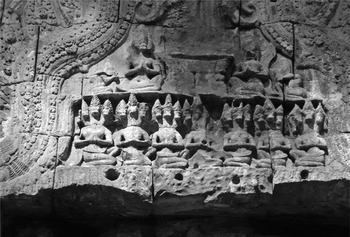
No Khmer icon has yet come to light showing the eight nāga reclining in añjali mudrā on the petals of a lotus, as described in the words of the tantra — the form seen in an eleventh-century Pāla dynasty stone from Nālandā, the other great centre of Vajrayāna having close relations with other Asian states. But the Khmers appear to have had their own version of the eight nāga kings being supported by Garuḍa, following their conversion to Buddhism. Boisselier, in his second pioneering paper, drew attention to a narrative lintel in Ta Prohṃ temple on a tower just outside the central sanctuary, which he thought was associated with Vajrapāṇi and the conversion stories.Footnote 83 The lintel shows eight nāga kings, each with three crested and crowned serpent heads and their human bodies kneeling in añjali mudrā beside and under the raised throne of a (defaced) Buddha. The leading nāga king kneels to one side of the Buddha's throne and on the other we find a winged Garuḍa kneeling with human hands in añjali mudrā. Boisselier made no mention of the astamahānāga but if we combine Boisselier's hints about Vajrapāṇi's presence permeating late Angkor and Lamotte's description of Vajrapāṇi's discrete ways of working – ‘Vajrapāṇi only shows himself to the Buddha and to his direct adversary and remains invisible to the mass of spectators’Footnote 84 – we come back to Boisselier's account of why Garuḍa becomes ubiquitous in the Bayon style:
The exceptional importance accorded the images of Garuḍa in the Bayon style … do not seem to us unrelated to the importance of the cult of Vajrapāṇi during this period.Footnote 85
Seventh-century Chinese pilgrim Xuanzang records oral accounts of how a group of nāga listened to the Buddha preaching and were converted. Alice Getty notes that as they entered the faith, the Buddha charged Vajrapāṇi with protecting them henceforth against their natural enemies, which they identified as the eagles. To do this, Vajrapāṇi transformed himself into Garuḍa, king of the eagles:
Hsüan-tsang mentions Vajrapāṇi as being with the Tathāgata when he subdued the gigantic snake in Udanya. It is also related that when the nāgas appeared before the Buddha to listen to his teachings, Vajrapāṇi was charged by the Tathāgata to guard them from the attacks of their mortal enemies the Garuḍas, and that in order to deceive and combat the Garuḍas, Vajrapāṇi assumed a form with head, wings, and claws like the Garuḍas themselves.Footnote 86
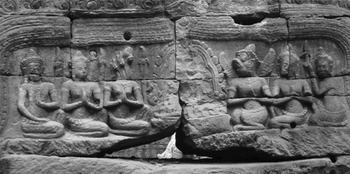
Getty says the ‘Garuḍa form’ of Vajrapāṇi ‘may have a human head with a beak or a head like a Garuḍa; he sometimes carries a sword and a gourd-shaped bottle, or his two hands may be in “prayer mudrā”’— the pose Garuḍa adopts in the Ta Prohṃ lintel. A somewhat saintly looking Garuḍa, crowned and dressed as a prince, suppresses his native power to submit to the commands of the Buddha. There is in fact a second Garuḍa/nāga narrative lintel in Ta Prohṃ, which does not show the eight nāga kings but which also appears to convey Xuanzang's version of the Buddha's command at Udanya. The second lintel is sited inside the large new ‘hall with dancers’ of the same temple. It shows Garuḍa kneeling, with feathered legs and talons, human torso and human hands in añjali mudrā, before the (effaced) Buddha and appearing to accept the Buddha's order to protect a three-headed nāga queen (with breasts and a slim, more elegant neck than the nāga kings on the other lintel) who also kneels in añjali mudrā. The positioning of the second lintel inside the ‘hall with dancers’ may show linkage between the convert protection theme and the late cycle of Buddhist rituals such halls were created to house.
Eight Great nāga at Ta Prohṃ

Ta Prohṃ lintel of Vajrapāṇi commanded to protect nāga converts

With this new image of Garuḍa in mind, it then comes as something of a shock to realise that we have all along been surrounded by just such gentle, partly anthropomorphised and princely eagles in Jayavarman's temples. For the Garuḍa icon on the balustrades that demarcate the open-air platforms and walkways outside the last halls that were added to Jayavarman's temples is also a princely ‘gentle Garuḍa’, with eagle's head, feathered legs and human torso and hands, who rides upon the necks of the nāga. Do these Garuḍa/nāga icons then mean that all who enter these areas come under the protection of Vajrapāṇi, in the form he takes to protect converts to Buddhism? The eagle's human hands open in the ‘no fear’ mudrā and often hold a flower, but otherwise it resembles the princely eagle that quietly kneels to do the Buddha's bidding in the Ta Prohṃ lintels.
In order to counter any impression that Xuanzang may leave that Vajrapāṇi's transformation into Garuḍa belonged only to the Gautama biographies of early Buddhism, it is perhaps worthwhile here briefly mentioning the broader and current Mahāyānist theme of Bodhisattva transformation. Ariane Macdonald's study of the maṇḍala of the mañjuśrīmulakalpa (MMK), tracks how branches of the Mahāyāna developed the transformational power of Bodhisattvas as a device for incorporating Hindu gods into tantric Buddhism, namely by claiming they had all been Bodhisattvas in disguise.Footnote 87 In this way, the Indian Buddhists projected the Buddhist mission back in time in order to appropriate intellectual property from their Brahmanical rivals. They claimed the Vedic and Hindu gods were earlier incarnations of Bodhisattvas who had appeared in the world in those forms in order to eventually direct people of sophisticated beliefs towards Buddhism. This was claimed as an application of the Bodhisattva capacity for self-transformation into any form in order to propagate Buddhism. Vajrapāṇi's taking the form of Garuḍa in order to protect converts from ancestral cultural beliefs to the Buddhist cause, as recounted by Xuanzang, was taken up into this tantric Bodhisattva doctrine in India. Macdonald builds on Jean Przyluski's earlier work on how minor deities and magicians or vidyārāja entered the Buddhist maṇḍala of the MMK, where they are described as ‘those who take the body of a woman to save living beings, and those who borrow the form of birds, yakṣa or raksaṣa in order to effect conversions’,Footnote 88 The major instance of a Bodhisattva self-metamorphosis made explicit in the MMK is not accomplished by Vajrapāṇi but by the Bodhisattva Mañjuśrī, who claims he had already adopted the form of Brahmā, Śiva, Viṣṇu and Garuḍa ‘to convert creatures susceptible to this method’. Macdonald hesitates to call the process ‘conversion’ as the claim is that it had all been pre-planned and the people were all along being gradually nurtured towards Buddhism:
It was not so much converting as rallying the devotees of Hinduism, viewed as a kind of preconception of the Mahāyāna, at least in its technical aspects.Footnote 89
In the MMK, Mañjuśrī claims the credit for the rites taught in the Hindu tantra of Garuḍa and says he appeared on earth as an eagle as the Bodhisattva ‘Garutma’.Footnote 90 When a ‘buddhicized’ Śiva enters the maṇḍala, Mañjuśrī claims to be the author of all the Śaiva tantras. Mañjuśrī is however unknown in Khmer Buddhism and so the conversion-by-transformation role presumably fell to the multi-faceted Khmer Bodhisattva Vajrapāṇi in his Garuḍa avatar.
Balustrades and temple access
The Garuḍa/nāga balustrades were raised in Ta Prohṃ, Praḥ Khan, Banteay Kdei and around a large platform beside the Sraḥ Srang pool opposite Banteay Kdei in Angkor; outside the capital they occur at Banteay Chmar, Praḥ Khan of Kompong Svāy and Wat Nokor. Thus the ‘gentle Garuḍa’ becomes pervasive in the late programme of additions to the king's temples. What purpose did it serve? If these platforms and walkways were erected with icons of Vajrapāṇi in his Garuḍa guise, for the protection of converts, do the widespread temple extensions they were contemporary withFootnote 91 signal a large-scale campaign of conversion to Buddhism?
The relatively open design of Jayavarman's temples also suggests participation in rituals on an unprecedented scale. Bernard Philippe Groslier pointed to the number of temples and the architectural concept of an open Bayon, which had a raised, visible, city-centre ceremonial platform. This design lent itself to wide participation in state rituals, rather than the distancing of the population from secret rites performed behind moats and high walls, as had been the case earlier in Angkor Wat,Footnote 92 or Baphuon. Groslier saw the design of the Bayon and the space allowed for small family sanctuaries in his other temples,Footnote 93 as a radical design departure and exoteric means for engaging the population in the royal cult:
religious fervour was unequalled and burned like a flame in this crowned old man … As well as the order and prosperity of the kingdom he seemed to take to heart the wellbeing of each of his subjects. We witness an eruption into the sanctuaries, formerly jealously reserved for the king and his entourage … It is not only the close or distant relatives of the king who partake of these privileges; they are extended to all … the temples of Jayavarman VII become veritable pantheons.Footnote 94
Some of the sacred spaces of the un-walled Bayon were exposed on a high platform around the central sanctuary at the heart of Angkor Thom and ceremonies, accompanied by music and dance, would have been observed by a mass of people congregated at the new city centre.
Ritual instruments
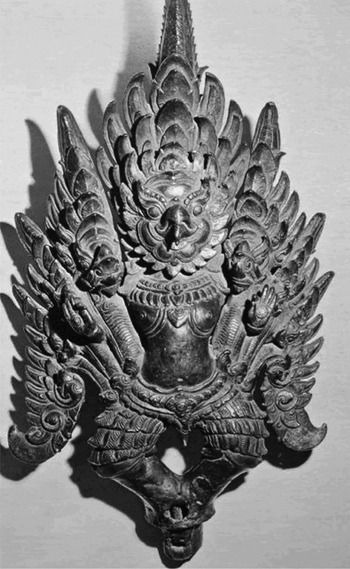
The ‘gentle Garuḍa’ icon alone is an indicator of a change on a notable scale in what was programmed in the temples, but it is not an indicator of specific ritual content. More clues to what was actually being undertaken in the king's temples emerge from studying the surviving bronze ritual paraphernalia cast for temple officiants, and the decoration of the new sanctuaries that the pathways with the Garuḍa/nāga icon surround. The material record from Jayavarman's time is in fact unusually rich in ritual instruments. Numerous items of Bayon-style bronze paraphernalia and a number of fine bronze palanquin finials that are now in the museum collections, especially in the bronze rooms of the Phnom Penh and Bangkok museums, also share the decorative theme of Garuḍas and nāga. Some items are bronze ritual vajras with the heads of Garuḍa, which, as Boisselier pointed out, support the link between Vajrapāṇi and Garuḍa and bring both into the ritual arena:
The vajras, whether they are authentic vajras or the handgrip on cultic bells, most often bear, as their only element of decoration, small heads or busts of Garuḍas. This union of the thunderbolt and Garuḍa seems to us to deserve special mention because it could represent a new aspect of the relationship that would seem to exist between Vajrapāṇi and Garuḍa.Footnote 95
The unusual volume of surviving Bayon style bronze paraphernalia reflects both the number of temples Jayavarman VII built – Jayavarman was the first Khmer king to construct multiple temples to propagate his strategy – but also surely the intensity of his ritual programme.
‘Gentle Garuḍa’ palanquin finial Bangkok Museum

What tantric Buddhist initiations are the most likely candidates for performance in Angkor late in Jayavarman VII's reign, say from 1200 to 1210? Historically this was still the period when cults of Hevajra, the fierce, dancing emanation of the supreme tantric Buddha, proliferated internationally in the monasteries of northern Buddhism and indeed beyond the monasteries — Khubilai Khan underwent the four consecrations to Hevajra in 1260.Footnote 96 And the ancient Khmers did create an exceptional number of ritual bronzes of Hevajra. Groslier exhumed a finely cast, 22-centimetre gilt bronze dancing Hevajra in the elaborate late Bayon styleFootnote 97 at his excavation site in the royal palace in Angkor Thom in 1952–53.Footnote 98 Wibke Lobo lists 40 Khmer bronze Hevajras in museum collections.Footnote 99 In the context of the Praḥ Khan dedicatory stela of 1191, it was recorded that more than 20,400 statues in gold, silver, bronze and stone had already been distributed throughout the ancient kingdom within a decade.Footnote 100 This does not seem a very large number, but it is still probably the largest group of Hevajra ritual bronzes found anywhere. These extant Khmer Hevajra bronzes tell us that this cult was active on an unusual scale under Jayavarman VII and suggest they may have had a role in political legitimisation. Such bronzes would have played a key role in Hevajra initiations, when they would be placed in maṇḍala prepared for the four consecrations as defined in some detail in the hevajra-tantra itself, and in greater detail in ritual handbooks extracted from the tantra. Henri Maspero in 1914 photographed a Sanskrit palm leaf (olla) volume of this kind entitled ‘The Hevajra consecration ceremony’ (hevajrasekaprakiyā) at the Puan temple in China's Zhejiang province, which Finot translated into French in 1934. Maspero was told by the Puan bonzes that the olla had been brought from India with other tantric texts by the monk Baoshang in 1057.Footnote 101 No such handbook has survived in Cambodia but it is more than likely that the Mahīdharapura Khmers, who were producing bronze Hevajra icons at the time Baoshang was using his text, had access to such documents.
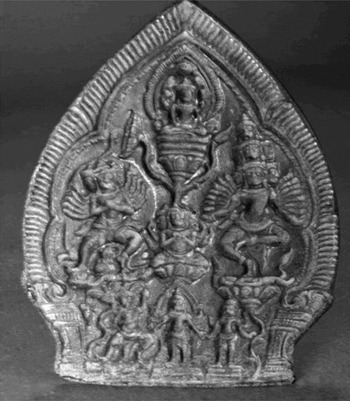
As well as the Hevajra bronzes, there are a number of bronze moulds for creating clay sealings that bear motifs of Hevajra and his circle of eight dancing goddesses or yoginī. We have little understanding of how such sealings were used in temples but according to a recent analysis by Peter Skilling, who dismisses as a modern misconception the theory that sealings were pilgrims' mementoes, they would have served a ritual purpose.Footnote 102 I have recorded six different moulds with Hevajra's image: the two most interesting are the large so-called ‘Trailokyavijaya’ moulds found in Lopburi and Angkor with Hevajra's maṇḍala in the centre below three tiers of seated Buddhas and above a row of standing Bodhisattvas; and a small one in the Phnom Penh Museum, which was found at Poipet and was published from a plaster cast in the Bangkok Museum by Woodward in his seminal 1981 paper.Footnote 103 The latter mould seems to record the underlying pantheon of the Mahīdharapura Khmers, with Vajrasattva at the centre, Hevajra and Saṃvara on each side, the nāga Buddha above and Bodhisattvas below. More obviously important to rituals are the many surviving bronze lustration conches or shankha, a dozen of which are embossed with motifs of Hevajra and his yoginī. These can only have been made for consecrations to Hevajra.
Poipet mould

‘Salles aux danseuses’
Most of Jayavarman's temples had additions late in the reign which included a large central room with lively friezes of dancers.Footnote 104 The early French scholars used the term ‘salles aux danseuses’ and left their purpose unexplained. The halls are given central locations and the hall added to Praḥ Khan temple was one of the largest spaces under a corbelled roof in Angkor; the dancers' hall in Banteay Chmar was even bigger, measuring 35 m × 15 m. The dancers that create a one-metre frieze around the double room in Banteay Chmar are distinctive in their size and in the fact that their arms are symbolically feathered and their legs are the legs of eagles. Why was so much covered space suddenly required in all the temples, under the aegis of these goddesses and five (effaced) Buddhas, who appear to be the Khmer version of Vajrayāna's Vajradhātu Pentad?Footnote 105 The new halls could have accommodated several dozen people at a time in each of Preah Khan, Ta Prohṃ, Banteay Kdei, Banteay Chmar and if the Bayon was involved that could have accommodated hundreds, so the new cult symbolised by the dancers could have engaged large numbers of people in temple rites.Footnote 106 If the ceremonies in Angkor were cyclical and repeated, it would be a reasonable assumption that, for example, the adults among the 14,000 residents of Preah Khan would have been involved, over time, but not the 208,532 villagers who supported the temple complex.
The Bayon too shares the motif of dancing goddesses — of the size of those in Banteay Chmar, but in far greater numbers. The demeanour of the Bayon dancers, whose bodies are braced and whose challenging eyes, with one foot raised to the opposite thigh in an extreme dance movement, suggests they are akin to the yoginī that whirl around the supreme dancing deity Hevajra in the late Bayon style bronzes. The emphatic use of the motif of dancing goddesses on the Bayon is unprecedented in Angkor, and yet it is what might be anticipated in a cult of Hevajra, who worked largely through the intercession of his eight ascetic goddesses. Friezes of goddesses enwrap all the outer approaches to the Bayon and dominate the temple entrances. They confront visitors with their stares and their sensuality. The Bayon alone, in its pristine state, had some 6,250 of these challenging goddesses on the pillars and gopura that led to its sacred spaces, according to my calculations at the site. Many of the entablature friezes in the entrances have collapsed with time, and the sandstone blocks bearing them are now buried in the piles of stone inside and outside the Bayon outer gallery walls. The original total number of dancers can be calculated from their positions in the eight gopura and from the two rows of pillars outside the outer gallery, as well as on internal friezes.
From a Chinese report written in the early thirteenth century, we glean a picture of a period when women were prominent in the temple rituals in Angkor. The Chinese source suggests Jayavarman's temples were particularly known for their focus on female officiants. The 1225 chronicle of Zhoarugua, the Chinese Superintendent of Maritime Trade in Canton, was based on hearsay rather than visits to the countries whose goods he taxed at the northern end of the maritime trade route, but his testimony contains a unique indication of what was taking place in Jayavarman's temples:
[In Chen-la, i.e. Cambodia] the people are devout Buddhists. In the temples there are 300 foreign women; they dance and offer food to the Buddha. They are called a-nan [Skt. ānanda (bliss)]. … The incantations of the Buddhist and Taoist [Śaiva yogin] priests have magical powers. Footnote 107
Zhoa's choosing of the term ‘a-nan’ (blisses) possibly indicates the use of the word in Bayon rituals. The hevajra-tantra, for example, defines four ‘blisses’ that an adept strives for in executing a four-stage consecration cycle (caturabhiṣekas). Women trained as ‘tantric assistants’Footnote 108 help sādhaka achieve the four blisses of spiritual emancipation through meditational and yogic-sexual initiations. The four rituals (ācārya, guhya, prajñājñāna, caturtha) generate four different blisses (ānanda = bliss, paramānada = perfect bliss, viramānanda = bliss of cessation, sahajānanda = innate bliss or natural ecstasy).Footnote 109 The halls with dancers (I have proposed we call them yoginī Footnote 110) suggest that a large investment in space for new consecrations was undertaken in the period when the Bayon was nearing completion, perhaps from 1200 to 1210. The function of the terraces and platforms outside the new consecration halls protected by the new ‘gentle Garuḍa’ icon could have accommodated large numbers of people, perhaps assembled to take Buddhist initiation vows and renew their allegiance to the king, perhaps on the model of the large tantric Buddhist consecrations led by Amoghavajra under the Tang.Footnote 111 There was indeed a precedent for this taking place in one of Cambodia's neighbours — the Đai Việt. Under the Ly Dynasty (1009–1224) Buddhism was elevated to the rank of official state religion in the mid-twelfth century, shortly before Jayavarman VII took the same step in Angkor. Zürcher says the Buddhist state established by the Ly rulers ‘was closely patterned after the Tang … prominent monks were admitted to the administration of the kingdom and came to play an important political role’.Footnote 112
Support for this argument for the existence of a royal Hevajra cult in Angkor comes from an unexpected source. Rob Linrothe, an authority on the texts and icons of tantric Buddhism in Tibet and China, who would not claim close acquaintance with the Buddhism of Jayavarman VII, makes a brief reference which captures the singularity of what appears to have been a politically driven Hevajra cult of Cambodia. Linrothe surveys the evolution and spread of tantric Buddhism through a ninth–eleventh century phase led by Vajrapāṇi-Trailokyavijaya and defines a further phase (the third, for him) dominated by texts and images of Heruka, Hevajra and Saṃvara. He perceives that something special happened with the deities of this phase in Phimai, Angkor and Java/Sumatra where Hevajra/Heruka was adopted politically into a royal cult and not only in monasteries: ‘Phase Three krodha-vighnāntaka [‘wrathful destroyers of obstacles’] especially Heruka and Hevajra, appear after the eleventh century in Southeast Asia as well [as in Tibet], in Java and in Thai and Khmer contexts.'Footnote 113 Outside of his principal focus on Tibet, Linrothe observes a clear political application of such a third phase cult:
If there was a Hevajra cult, it seems to have thrived in Southeast Asia. Hevajra imagery may have come overland to Thailand from eastern India, directly from Bengal via Burma. The transmission of Hevajra teachings was probably reinforced through contacts along the maritime routes from island Southeast Asia and eastern India. Whatever the route it clearly had considerable influence in the highest levels of society. Seemingly removed from his yogic and monastic origins, Hevajra was utilized in the royal cult, not, as in the Ming court, to improve relations with Tibet, but as part of an attempt at local political legitimisation … The compelling power of the Hevajra image seems to have contributed to the cult, which sponsored commemorative monuments more so than monasteries.Footnote 114
Linrothe formulates the central metaphor adopted by tantric Buddhism as dompteur/dompté (‘vanquisher/vanquished’). In yogic concentrations, the aim of destroying the ego and internal impurities originates in early Buddhism in Śākyamuni's victory over Māra and ‘esoteric Buddhism appropriated this trope and used the krodha-vighnāntaka to express it … Trailokyavijaya [the wrathful form of Vajrapāṇi] extends and refines the dompteur/dompté relationship by conquering not deities associated with the underworld, but the Lord of the Three Worlds above them, Śiva-Maheśvara.’Footnote 115 Hence Vajrapāṇi's epic battle to bring the submission and transformation of Śiva in the STTS and SDPS entails this logic: ‘the conquered is nothing less than the conqueror in a pre-enlightened state, and the conqueror is nothing more than the vanquisher transformed.’Footnote 116
Vajrapāṇi's role of crushing Śiva was transferred in the later yoginī tantra to Heruka (in the cakrasamvara-tantra) and to Hevajra in the hevajra-tantra — whose four feet trample and destroy Maheśvara, Mārā, Indra and Brahmā.Footnote 117 In twelfth-century Khmer political terms, the metaphor of the ‘vanquisher/vanquished’ translates into what is usually called religious syncretism under a Buddhist umbrella, in which sections of Jayavarman's Buddhist temples were reserved for Śaiva and Vaiṣṇava rites, but within a Buddhist framework or maṇḍala. State protection Buddhism replaced but also embraced Śaivism in the political arena. Some scholars (e.g. Stein and Iyanaga)Footnote 118 have questioned whether the historical opposition of Buddhism to Hinduism in India is reflected in the Buddhist tantras. Davidson has, I think, rightly resisted their attempts to dissociate the texts from the socio-political history of their times:
Buddhist monasteries at this period had become enormous landed institutions that controlled great economic resources but had a tenuous relationship to the wider society, somewhat like the medieval Christian monasteries and modern universities … Thus, at the socio-historical level, we should understand the Maheśvara myth in the Tattvasaṃgraha as a straight-forward defensive technique of the Buddhists to establish superiority of their gods over Maheśvara, Brahmā, Viṣṇu, etc., in an attempt to retrieve some of their lost position in unsophisticated circles in India, whether at Devīkoṭa, Vārāṇasī, Patna or wherever.Footnote 119
The Mahīdhara Khmers, as Linrothe perceptively observes, do indeed seem to be the archetype of an application of esoteric Buddhism for political legitimisation, in what he defines as the third and international phase of the Vajrayāna from the eleventh century onwards. Among the krodha-vighnāntaka that Linrothe focuses on, are in this mature phase Hevajra, Heruka and Saṃvara,Footnote 120 all of whom are forms of the ultimate truth expressed as the sixth transcendent Buddha, or primordial Vajrasattva.Footnote 121 These are the mature Vajrayānist deities we find in the icons and inscriptions of the Mahīdharas.
The ruins of Ta Prohṃ, today still partly overgrown with the trees of the forest that once engulfed it when the Khmers moved their capital south, seem to hold clues to a seminal message from the Buddhist king who apparently sought large-scale participation in rituals in his temples to consolidate and legitimise his Buddhist state. For only this level of engagement could have ended and absorbed the Śaiva state that first unified the Khmers in the ninth century and enabled them to eventually build one of the great Asian empires. Vajrapāṇi's ‘killing’ Śiva then reviving him in the Buddhist maṇḍala, in the classic dompteur/dompté metaphor of transformation, re-enacted in the mature Vajrayāna by Hevajra, reached its political dénouement in Jayavarman VII's royal strategy to transform the Śaiva state and implant Buddhism definitively among the Khmers.