Introduction
It has been estimated that rainfed agriculture covers 80% of the world's cultivated land where about 60% of crop production is harvested (Rosegrant et al., Reference Rosegrant, Cai, Cline and Nakagawa2002). However, due to over applications of nitrogen (N) fertilizer, grain N use efficiency (NUE) is generally low with estimates averaging 35% (Omara et al., Reference Omara, Aula, Oyebiyi and Raun2019) and varying to a high degree (Ladha et al., Reference Ladha, Pathak, Krupnik, Six and van Kessel2005). Furthermore, it has been found that the contribution of 0 N plots (or native soil N, Nyiraneza et al., Reference Nyiraneza, Ziadi, Zebarth, Sharifi, Burton, Drury, Bittman and Grant2011) often supply a greater amount of N than fertilizer applications (Mulvaney et al., Reference Mulvaney, Khan and Ellsworth2009) leading to negative NUE values which are particularly true in soils from the order of Mollisols (Khan et al., Reference Khan, Mulvaney, Ellsworth and Boast2007). Grain NUE of a cropping system has been estimated in different ways, one of them is the difference method. Its employment requires an adjustment to the treatment yield or N uptake by subtracting a corresponding value of a 0 N plot (Krobel et al., Reference Krobel, Campbell, Zentner, Lemke, Desjardins and Karimi-Zindashty2012). If the application of this approach is based on N uptake, the result is called NUE, if it is based on yield, the result is called agronomic efficiency (AE) (Krobel et al., Reference Krobel, Campbell, Zentner, Lemke, Desjardins and Karimi-Zindashty2012; Duan et al., Reference Duan, Shi, Li, Sun and He2014a). Thus, according to this definition and depending upon the effect of several factors on the 0 N plots, NUE and AE can be negative, which provides a good reason for concern about sustaining food production (Mulvaney et al., Reference Mulvaney, Khan and Ellsworth2009).
In general, low NUE values are a result of excess N present in the soil–plant system (Sharma and Bali, Reference Sharma and Bali2018). Low NUE and AE indicate a lower yield in fertilized treatments which could be attributed to an unbalanced fertilizer application referred to as ‘poor-responsive soils’ due to excessive N application (Vanlauwe et al., Reference Vanlauwe, Kihara, Chivenge, Pypers, Coe and Six2011). For example, the analysis of seven long-term experiments revealed that wheat yield in check plots was in some years greater than high N plots (Arnal et al., Reference Arnal, Mallarino, Ruark, Varvel, Solie, Stone, Mullock, Taylor and Raun2013) resulting in negative AE values. On the contrary, large yield values from fertilizer treatments in the study of Thomason et al. (Reference Thomason, Raun, Johnson, Freeman, Wynn and Mullen2002) lead to AE values over 100%. These variations could be mainly ascribed to weather conditions, particularly because it is highly variable (Krobel et al., Reference Krobel, Campbell, Zentner, Lemke, Desjardins and Karimi-Zindashty2012) and unpredictable (Arnal et al., Reference Arnal, Mallarino, Ruark, Varvel, Solie, Stone, Mullock, Taylor and Raun2013). Other factors such as crop management may also be important (Duan et al., Reference Duan, Xu, Gao, Yang, Huang, Liu and Wang2014b).
The negative NUE values reported by Thomason et al. (Reference Thomason, Raun, Johnson, Freeman, Wynn and Mullen2002) were attributed to dry conditions during the vegetative growth period and wet conditions at harvest. The poor response to applied N potentially was ascribed to large amounts of available soil NO3. These negative values, on the other hand, are difficult to explain unless there are mechanisms whereby fertilizer application reduces the relative availability of native soil N compared to the no-input control soil (Vanlauwe et al., Reference Vanlauwe, Kihara, Chivenge, Pypers, Coe and Six2011). Contrastingly, NUE has been shown to increase as soon as N fertilizer is applied in conditions of high crop demand and when N application is followed by rainfall (Ravier et al., Reference Ravier, Meynard, Cohan, Gate and Jeuffroy2017).
Among management factors, splitting N fertilizer application has been suggested as a strategy to improve NUE in cereals on the assumption that the timing of application has a significant effect on N uptake by the crop (Sharma and Bali, Reference Sharma and Bali2018). Meanwhile, conservation agriculture has shown lower NUE rates than conventional systems which seem largely due to N fertilizer immobilization through crop residues and increased fertilizer rates (Grahmann et al., Reference Grahmann, Verhulst, Buerkert, Ortiz-Monasterio and Govaerts2013). In addition, several reports have indicated that relative yield reductions may occur following the implementation of no-till practices such as permanent beds. This phenomenon has been named the stabilization period. This period can extend for up to five or six crop seasons (He et al., Reference He, Li, McHugh, Wang, Lu, Li and Zhang2015) and is mainly attributed to soil N immobilization (Lundy et al., Reference Lundy, Pittelkow, Linqiuist, Liang, van Groenigen, Lee, Six, Ventera and van Kessel2015) that will finally reach a balance point (Rong-Fang et al., Reference Rong-Fang, Xin-Ping, Fu-Suo, Hailin, Schroder and Romheld2006). Contrastingly, grain yield from 0 N plots in a system of clean tillage would be expected to be variable over years and unpredictable (Raun et al., Reference Raun, Dhillon, Aula, Eickhoff, Weymayer, Figueirdeo, Lynch, Omara, Nambi, Oyebiyi and Fornah2019).
Long-term experiments allow the assessment of the impact of granular N fertilizer application and weather conditions on rainfed wheat. The objective of this paper was to estimate the effect of N fertilizer rates and timing on grain yield, NUE and AE under the hypothesis that the effect of N treatments depends upon weather and soil conditions.
Materials and methods
This field experiment was conducted over five crop seasons from 2005 to 2009 under rainfed conditions and permanent beds (0.80 m wide) as a planting system. Crop residues were left as stubble and beds reshaped as needed. Wheat was grown in rotation with maize at the ‘Santa Lucia’ experimental station of INIFAP, Mexico (19°26.7′N, 98°53.2′W, 2280 m asl). Soil type is classified as fine loamy mixed thermic Cumulic Haplustoll. Average soil organic matter content is medium (24 g/kg), pH very slightly acid (6.8), low total N (1.1 g/kg), test high P (32 mg/kg) and K (470 mg/kg). Climate is temperate with dry winters.
Long-term average (47 years) annual rainfall is 562 mm; 0.64 is concentrated during the wheat crop season between Jun and Sep, average maximum and minimum temperatures within that period are 23.7 and 9.5°C, respectively. Weather data since the inception of the experiment were obtained from the research station's weather database. Accumulated precipitation was estimated for two growth stage periods; from planting to maturity (seasonal precipitation) and from heading to maturity. These two intervals were used to examine if accumulated precipitation in any of these two intervals was helpful to explain variability from year to year of grain yield, NUE and AE.
The experiment was arranged in a split plot and three replications; the main plot was the application of three N rates (25, 50 and 75 kg/ha) maintained in the same place every year. Subplot consisted of four N timing treatments that comprised two single basal applications; one after planting and one during the tillering stage, and two splits; one-third after planting and two-thirds during the tillering stage, and vice versa. This treatment structure, plus a control plot without N (0 N), summed 13 experimental units per replication.
Fertilizer treatments were top-dressed when weather forecast indicated rainfall within the following 24 h (Table 1). The plot size was four beds wide (0.8 m each) by 10 m long. Phosphorus was supplied at a rate of 45 kg/ha using triple superphosphate fertilizer on the top of the beds. Beds were reshaped every year after harvesting and before planting; crop residues were left as stubble on the soil surface. Application of glyphosate before planting, and conventional herbicides (thifensulfuron-methyl and clodinofop propargyl) during the growing season controlled weeds.
Planting dates, crop season precipitation and soil N content in control plots (0 N) at harvest from 2005 to 2009

a Not measured in 2005.
Plots were planted to variety Nahuatl F2000 at a rate of 120 kg/ha using modified drill equipment to plant two seed rows 20 cm apart on the top of the beds when soil moisture conditions were considered adequate. The two central beds were harvested after physiological maturity to estimate grain yield. A grain subsample was collected in each treatment to estimate N concentration and converted to a mass basis (kg/ha). Grain N concentration was measured with a Spectrophotometer NIR's 6500 (FOSS, Denmark). Estimation of grain N concentration and grain yield allowed the assessment of NUE based on grain N removal and AE, respectively, through the difference method. These two parameters were defined as follows:


where fertilized yield is the grain yield of fertilized plots; 0 N yield is the yield of check plots without fertilizer; grain N is the grain N removal;and N rate is the amount of N fertilizer.
Soil N-NO3 and total soil N were measured in control plots (0 N) from a composite sample to 30 cm depth after each harvest. An assumed soil bulk density of 1.44 mg/m3 was used to convert N-NO3 in ppm to a mass basis (kg/ha). Soil N-NO3 and total soil N were estimated following stem-distillation with MgO, Devarada's alloy and Kjeldhal procedures, respectively.
Grain yield, NUE and AE data were subjected to ANOVA using SAS (SAS Institute, 1999) to test the effects as modelling correlation of times with Proc Mixed statistical model approach. Nitrogen rates, N timing and years were considered fixed effects while replications within years and interactions with replications were considered random effects. Standard errors were estimated using the LSMEANS option of the mixed procedure. Linear regression analysis using the repeated option was performed to identify relationships between yield/NUE/AE and precipitation (estimated at two intervals; seasonal and from heading to maturity stages), and between NUE/AE and post-harvest soil N-NO3 content in control plots (0 N). The size of the intercepts and slopes was used to interpret differences among N rates as affected by the independent variables.
Results
Seasonal (~110 days) precipitation varied from a low of 229 mm in 2006 to a high of 420 mm in 2009 (Table 1). Meanwhile, the precipitation from heading to maturity stages (~45 days) from 93 mm in 2008 to 224 mm in 2007. Nitrogen fertilizer, according to rainfall conditions at planting and tillering growth stages, was presumably incorporated into the soil, except in 2007 and 2009 as moisture from precipitation was null at planting and these two stages, respectively (Table 1).
The lowest post-harvest soil N-NO3 content (21 kg/ha) in control plots (0 N) was measured in 2005, the onset of permanent beds as planting system. This measurement in the ensuing years varied from a low of 45 kg/ha in 2009 to a high of 129 kg/ha in 2008. The average total soil N in 0 N plots was 1.05 g/kg (Table 1).
Wheat grain yield
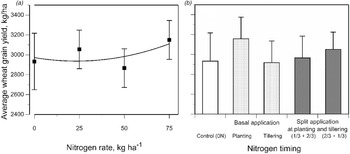
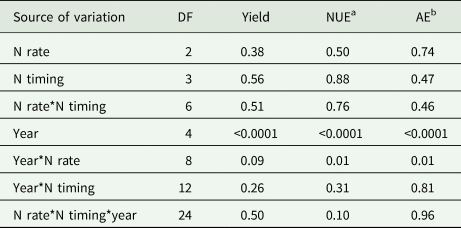
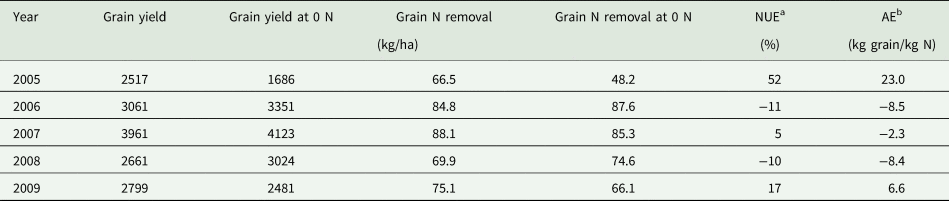
According to the analysis of variance (Table 2), grain yield variation was ascribed to the year's main effect. This yield variation ranged from a low of 2517 kg/ha in 2005 to a high of 3961 kg/ha in 2007 (Table 3) averaging 3000 kg/ha. The main effect of N rate, N timing and their interaction with year had a no-significant effect on yield. Irrespective of that result, the highest average grain yield was measured at 75 kg N/ha (3150 kg/ha) and basal application (3152 kg/ha) at planting (Fig. 1). According to Fig. 1, on the other hand, the largest grain yield difference among N rates and N timing treatments was <300 kg/ha. These differences accounted for response indexes (defined as maximum yield divided by control plot yield, 0 N) of 1.07 and 1.08 for N rate and N timing, respectively.
Average wheat grain yield response (a) to three N fertilizer rates and (b) to four N timing treatments plus a control plot (0 N). Error bars indicate the standard error of the least square means.

Probability values from the analysis of variance applied to three N rates and four N timings over 5 years (2005–2009) using modelling correlation of times on wheat grain yield, NUE and AE

a NUE, N use efficiency based on grain N removal estimated as 100*[(fertilized yield*grain N) – (0 N yield*grain N)]/N rate.
b AE, agronomic efficiency estimated as (fertilized yield – 0 N yield)/N rate.
Average wheat grain yield, N removal, NUE and AE averaged across N treatments from 2005 to 2009

a NUE, N use efficiency based on grain N removal estimated as 100*[(fertilized yield*grain N) – (0 N yield*grain N)]/N rate.
b AE, agronomic efficiency estimated as (fertilized yield – 0 N yield)/N rate.
Accumulated precipitation, on the other hand, from heading to maturity growth stages showed to be useful in estimating the effect of years on average grain yield. Regression analysis between precipitation and yield indicated that as accumulated precipitation increased from 93 to 224 mm, there was an estimated grain yield increase of 1140 kg/ha. This analysis indicated that precipitation explained 67% (R 2) of yield variation across seasons (Fig. 2).
Relationship between average wheat grain yield and accumulated precipitation from heading to maturity stage (R 2 = 0.67) from 2005 to 2009. Error bars indicate the standard error of the least square means.

Nitrogen use efficiency
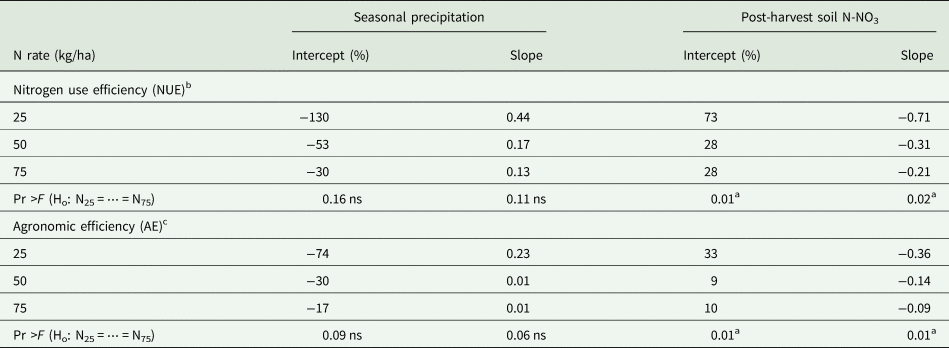
Variation of NUE based on grain N removal was attributed to the year main effect and year*N rate interaction. Nitrogen treatments main effect had no effect on this measurement (Table 2). Annual average NUE varied from a low of −11 in 2006 to a high of 52% in 2005 (Table 3). Seasonal precipitation and post-harvest soil N-NO3 content in control plots (0 N) were identified as factors to estimate the effect of years on NUE. Precipitation–NUE relationship was positive, whereas N-NO3–NUE relationship was negative. According to the size of slopes and intercepts from regression (Table 4), NUE response to precipitation and soil N-NO3 was greater for the application of 25 kg N/ha.
Regression coefficients and test of the null hypothesis (Ho: N25 = ⋯ = N75) for NUE and AE as affected by seasonal precipitation and post-harvest soil N-NO3 for three N rates

a Statistically significant at P < 0.05; ns, not significant.
b NUE, N use efficiency based on grain N removal estimated as 100*[(fertilized yield*grain N) – (0 N yield*grain N)]/N rate.
cAE, agronomic efficiency estimated as (fertilized yield – 0 N yield)/N rate.
As seasonal precipitation increased from a low of 229 to a high of 420 mm, NUE due to 25 kg N/ha application improved from negative to positive values. The inception point between positive and negative NUE values was about 335 mm seasonal precipitation (Fig. 3). In 2005, the inception of the permanent beds, NUE based on grain N removal as affected by precipitation was 100% for the application of 25 kg N/ha (Fig. 3). Seasonal precipitation in this year accumulated 385 mm, N fertilizer application at the planting and tillering stages was followed by precipitation (Table 1) and soil N-NO3 content in control plots (0 N) was 21 kg/ha, the lowest over the five crop seasons. Contrastingly, NUE in 2009 declined to 9% even though seasonal precipitation and N-NO3 content were relatively similar to 2005; 420 mm and 45 kg/ha, respectively, but precipitation conditions in 2009 following N fertilizer application at the planting and tillering stages were null.
Effect of seasonal precipitation on average (a) N use efficiency (NUE) based on grain N removal and (b) agronomic efficiency (AE) for the application of 25 kg N/ha over five crop seasons. Error bars indicate the standard error of the least square means.

The relationship between NUE and soil N-NO3 content indicated that NUE was negative at soil N-NO3 contents >90 kg/ha (Fig. 4). These NUE values were measured in 2006 (−32%) and in 2008 (−6%). In these 2 years, soil N-NO3 was similar; 107 and 129 kg/ha, respectively, N fertilizer application was followed by rainfall, but seasonal precipitation was greater by 106 mm in 2008 than in 2006.
(a) N use efficiency (NUE) based on grain N removal and (b) agronomic efficiency (AE) for 25 kg N/ha treatment as affected by post-harvest soil N-NO3 content. Error bars indicate the standard error of the least square means.

Agronomic efficiency
AE was mostly affected by the main effect of years and their interaction with the N rate (Table 2). Average AE as affected by years showed negative values in 3 years (Table 3). These results were measured in years when seasonal precipitation accumulated <335 mm (2006, 2007 and 2008). Meanwhile, the opposite occurred in crop seasons when seasonal precipitation was >335 mm (Fig. 3).
Similar to NUE, seasonal precipitation and post-harvest soil N-NO3 content in control plots (0 N) were identified as factors to estimate the effect of years on AE; precipitation–AE relationship was positive (Fig. 3), whereas for N-NO3–AE was negative (Fig. 4). According to the size of the slopes and intercepts from regression (Table 4), the effect of precipitation and soil N-NO3 on AE was greater for 25 kg N/ha treatment. As seasonal precipitation moved from a dry (229 mm, 2006) to a wet (420 mm, 2009) year, estimated AE from regression improved 42 kg grain/kg N. The highest average AE (48 kg grain/kg N applied) was measured at the onset of permanent beds (2005) when fertilizer application was followed by precipitation, seasonal precipitation accumulated 385 mm and soil N-NO3 was the lowest.
Discussion
This study consisted of the application of N rate and N timing treatments to rainfed wheat grown under permanent beds as a planting system. Treatments had no effect on grain yield; NUE and AE were affected by year–N rate interaction. Precipitation and soil N-NO3 were identified as factors to estimate the effect of years on NUE and AE. That effect was greater due to 25 kg N/ha application than due to 50 or 75 kg N/ha.
Wheat grain yield
The lack of yield response to N fertilizer treatments over five crop seasons was an indication that other factors add up to affect the yield of rainfed wheat in this environment. For example, regression procedures showed that precipitation during grain filling explains a large portion of yield variation. Certainly, rainfall has shown to be the weather factor that strongly influences yield (Ryan et al., Reference Ryan, Sommer and Ibrikci2012) but such an effect is not consistent (Verhulst et al., Reference Verhulst, Nelissen, Jespers, Haven, Sayre, Raes, Deckers and Govaerts2011). On the other hand, since the average response index due to N rates was 1.07, it is possible that N sources other than fertilizer contributed to yield formation. Nevertheless, according to Raun et al. (Reference Raun, Dhillon, Aula, Eickhoff, Weymayer, Figueirdeo, Lynch, Omara, Nambi, Oyebiyi and Fornah2019), this contribution for next years’ growing crop to added fertilizer is unpredictable. Conversely, as a wheat response to N over years was consistently negligible, the soil in this study could be defined as poor-responsive soil (Vanlauwe et al., Reference Vanlauwe, Kihara, Chivenge, Pypers, Coe and Six2011). Thus, the development of management practices should give serious consideration to maintain the current level of organic matter as this is an important source of soil N (Morris et al., Reference Morris, Murrell, Beegle, Camberato, Ferguson, Grove, Ketterings, Kyveryga, Laboski, McGrath, Meisinger, Melkonian, Moebius-Clune, Nafziger, Osmond, Sawyer, Scharf, Smith, Spargo, van Es and Yang2018).
Nevertheless, it is evident from grain yield and soil N-NO3 in control plots (0 N) that soil N immobilization occurred at the inception of the experiment. This phenomenon extended to only 1 year, which is opposite to reports that indicated periods of five to six seasons (He et al., Reference He, Li, McHugh, Wang, Lu, Li and Zhang2015). To overcome this phenomenon, however, the application of a small N rate (25 kg N/ha) was needed.
Nitrogen use efficiency and agronomic efficiency
Negative NUE and AE values were found indicating that grain N removal and yield were greater in control plots (0 N) than N removal and yield from fertilized plots, respectively. These results, according to Khan et al. (Reference Khan, Mulvaney, Ellsworth and Boast2007), are particularly true in soils from the order of Mollisols. Contrastingly, a positive NUE of 100% in 2005 suggested that more N was taken up in the grain than applied with the fertilizer. This result could be the effect of applying little fertilizer (25 kg N/ha treatment) on NUE but at risk of mining soil resources (Omara et al., Reference Omara, Aula, Oyebiyi and Raun2019) or the potential for utilization of N fertilization in the previous years or residue decomposition (Dessureault-Rompre et al., Reference Dessureault-Rompre, Zebarth, Burton, Gregorich, Goyer, Georgallas and Grant2013). The low and negative AE values, on the other hand, are difficult to explain unless there are mechanisms whereby fertilizer application reduces the relative availability of native soil N compared with the no-input control soil, e.g., when fertilizer scorches the seed when it is placed too close to the seed under relatively dry conditions (Vanlauwe et al., Reference Vanlauwe, Kihara, Chivenge, Pypers, Coe and Six2011).
Seasonal precipitation and soil N-NO3 content are factors that explain NUE and AE variations, particularly because weather is highly variable (Krobel et al., Reference Krobel, Campbell, Zentner, Lemke, Desjardins and Karimi-Zindashty2012; Chuan et al., Reference Chuan, He, Pampolino, Johnston, Jin, Xu, Zhao, Qiu and Zhou2013). The effect of precipitation and soil N-NO3 on NUE and AE was evident for 25 kg N/ha treatment. Seasonal precipitation of 335 mm, which is slightly lower than the long-term average for the wheat crop season (348–370 mm) and 90 kg N-NO3/ha appeared to be the inception point between positive and negative NUE and AE values. The foregoing points out the difficulty in making N recommendations to enhance these efficiency parameters as rainfall is an uncontrolled factor that in dryland areas is the primary driver of soil nutrient availability (Arnal et al., Reference Arnal, Mallarino, Ruark, Varvel, Solie, Stone, Mullock, Taylor and Raun2013).
Seasonal precipitation and soil N-NO3 content were relatively similar in 2005 and 2009 (385 and 420 mm; 21 and 45 kg/ha, respectively). However, NUE and AE were quite different from each other (100 and 9%; 48 and 3 kg grain/kg N, respectively). This differential result between these 2 years can be attributed to moisture conditions from precipitation following N fertilizer application (Ravier et al., Reference Ravier, Meynard, Cohan, Gate and Jeuffroy2017); in 2005 were wet while in 2009 were dry.
Although there is no ideal field-based measure of soil N supply, the most reliable index is N removal in unfertilized treatments (Nyiraneza et al., Reference Nyiraneza, Ziadi, Zebarth, Sharifi, Burton, Drury, Bittman and Grant2011). The differential grain N removal between fertilizer treatments and control plots (0 N) in this study, provides an indication about the key role of soil organic matter in supplying N and the potential sustainability (Dessureault-Rompre et al., Reference Dessureault-Rompre, Zebarth, Burton, Gregorich, Goyer, Georgallas and Grant2013) of the permanent beds as a planting system in rainfed environments.
Conclusions
This study identified two sets of factors that determine the extent of both NUE and AE variations; environmental and management factors. Precipitation and soil N-NO3 played an important role in the former issue, whereas N fertilizer rate applied at planting in the latter. On average, grain N removal and yield in control plots (0 N) surpassed fertilized treatments in 2 and 3 years out of five, respectively. The resulting NUE and AE variations, from negative to positive values over years, mainly for 25 kg N/ha treatment, were associated with seasonal precipitation and post-harvest soil N-NO3 content. This result indicated that the size of these two factors in this rainfed environment and planting system has a substantial effect on wheat NUE and AE. However, precipitation conditions following N fertilizer application appeared to have also an effect. For example, the similarity in the amount of precipitation and N-NO3 content in two different seasons, but dissimilar moisture conditions from precipitation following fertilizer application, showed large NUE and AE differences. However, further research is needed to assess, as alternative N management, the effect of foliar N fertilizers at different rates.
Financial support
This research received no specific grant from any funding agency, commercial or not-for-profit sectors.
Conflict of interest
The authors declare no conflicts of interest exist.