Introduction
While the importance of the famous female figurine of Hohle Fels for the origins of figurative art amongst Homo sapiens is widely understood, much debate has surrounded the use context and meaning of this enigmatic piece. Ideas have included the artefact acting as a religious icon, a fertility figure, a teaching tool for gynaecology and obstetrics, a somatosensory representation of pregnancy, childbirth, or stillbirth, and as a pornographic image (e.g. Conard Reference Conard2009; Conard & Wolf Reference Conard and Wolf2010; Mellars Reference Mellars2009; Morriss-Kay Reference Morriss-Kay and Clottes2012; Porr Reference Porr2010). Despite this extensive attention, however, not one researcher has considered whether she was constructed as a two-part figurine—the head simply not recovered or recognized. Instead, the figurine has been seen and read as a completed piece, the small bail or loop situated on top of her shoulders interpreted as simply a means for her to be strung as a pendant.
By exploring the possibility that this figurine did have a second part—a head—which has not survived owing to taphonomic factors, we investigate the value and use of plant and animal fibres along with tool and craft use by women and children in Palaeolithic art. This work joins that by researchers which have previously challenged existing conceptions of the significance of plant and soft animal materials in Palaeolithic contexts (e.g. Adovasio et al. Reference Adovasio, Soffer and Klíma1996; Hurcombe Reference Hurcombe2014; Owen Reference Owen1994; Soffer Reference Soffer2004), and provides a new perspective on this important Aurignacian find.
The female figurine of Hohle Fels
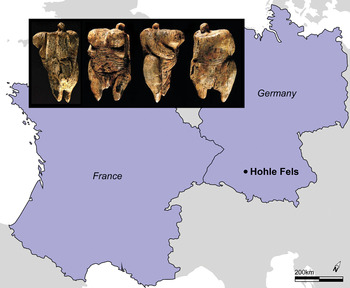
Hohle Fels [‘hollow rock’] is an Aurignacian (~45,000–~29,000 bp) cave site located not far from Ulm in the Swabian Jura of southwestern Germany (Fig. 1) (Hahn Reference Hahn1988; Saier Reference Saier1994; Schmidt Reference Schmidt1910; Reference Schmidt1912). Here, the figurine was recovered in six fragments, two of which were documented in situ, 3 m below the surface at the base of approximately 1 m of Aurignacian deposit dated to between 40,000 and 36,000 bp. All fragments were recovered from the southwest quadrant of a square located some 20 m from the cave's entrance (Conard Reference Conard2009). The close proximity of the pieces to each other on discovery indicates that the artefact experienced little taphonomic disturbance after deposition and no doubt also contributed to the excellent preservation of the piece (Conard Reference Conard2009).
Location of Hohle Fels in southwest Germany and the original ‘Venus’ of Hohle Fels. (Photograph: H. Jensen, University of Tübingen.)

Made of mammoth ivory, the artefact is 59.7 mm long, 34.6 mm wide and 31.3 mm thick and preserves numerous traces of manufacture and use (Fig. 1; Conard Reference Conard2009). Understanding this particular artefact began with her reconstruction, with Conard's initial (2009, 250) description stating that ‘the Venus of Hohle Fels lacks a head. Instead, an off-centre, but carefully carved, ring is located above the broad shoulders of the figurine. This ring, despite being weathered, preserves polish, suggesting that the figurine at times was suspended as a pendant.’ He observes here that ‘many of the features, including the extreme emphasis on sexual attributes and lack of emphasis on the head, face and arms and legs, call to mind aspects of the Venus figurines well known from the European Gravettian’ and that ‘the presence of a ring for suspension in place of the head, and the upright, oversized breasts and massive shoulders relative to the flat stomach and small, pointed legs are particularly noteworthy’. From first description, the lack of a head is therefore clearly noted as a significant aspect of this example of Palaeolithic art, and whether the excavators meant to or not, is presented as representing a deliberate design choice by the Aurignacian/s who made her.
Discussion of this carving thereafter continued to be interpreted where the lack of a head was an intentional part of the design. For example, Mellars (Reference Mellars2009, 176) states that ‘as if to emphasise the sexual characteristics, the figure's arms and legs are severely reduced in size, and the “head” has been reduced to the form of a carefully carved ring, evidently to allow the figure to be suspended from a string or thong’. Porr (Reference Porr2010, 152) similarly says:
the Hohle Fels ‘Venus’ shows the same characteristics, which are largely absent during the Gravettian. The missing head and face of the statuette shows that it was not intended to depict a specific individual human being. Rather, the place of the head and face, the locus of human individuality, was used to attach it to a real individual person during the Aurignacian.
Others simply note ‘It has no head; the small projection at the top of the figurine is a ring-shaped aperture. It is thought that this small figurine hung from a strap and may have been worn as a pendant’ (Dixson & Dixson Reference Dixson and Dixson2011, 8) and ‘the well-worn loop carved in place of a head suggests that the figurine was strung’ (Morriss-Kay Reference Morriss-Kay and Clottes2012, 1). While scholars have pointed out that prehistoric figurines may have had organic items attached to them (e.g. Meskell Reference Meskell and Insoll2017; Stevenson Reference Stevenson and Insoll2017), nowhere in the literature were we able to locate the suggestion that the female figurine of Hohle Fels may originally have been made with, or later acquired, a head at some point in its use life. Given that most other similar figurines have a head (some more realistic than others), and that a loop is instead present, we wondered if it was possible that the head was attached to this loop and made from something that would not survive the 40,000 years since deposition.
Methods
To reproduce the original Hohle Fels figurine faithfully, we obtained as many photographs of the artefact as possible from previous publications including online media surrounding the find. In addition, we also purchased a to-scale replica (TopGeo, Satteldorf, Germany). As we could not get access to mammoth ivory, we selected red deer (Cervus elaphus) antler as the closet raw material alternative (being an osseous material of large enough module to which we could get access) and proceeded to produce two copies.
The antler was carved using a Foredom flex-shaft, with the distinctive decorative incisions made using unretouched obsidian flakes. Each copy was lightly polished between the hands using a mixture of water, antler and bone dust and red ochre.
To assess the widest possible options for heads, we experimented with plant and animal raw materials which would have been available to Aurignacian artists (Adovasio et al. Reference Adovasio, Soffer and Klíma1996; Soffer et al. Reference Soffer, Adovasio and Hyland2000; Vanhaeren & d'Errico Reference Vanhaeren and d'Errico2006). These included: human hair, horse hair, canine hair, sedge (Carex apressa), pine needles (Pinus elliottii), nettle (Utrica dioica), white beech (Gmelina leichhardtii), spalted birch (Betula spp.), shell (Nerita and Harpa), red deer antler, bovine knuckle, bovine long bone, goat leather and horse tooth. We also used brushtail possum (Trichosurus vulpecula) fur (in place of lagomorphs) and kangaroo (Macropus giganteus) knuckle (in place of a knuckle from a small mammal). These raw materials were worked with either the flex-shaft tool, unretouched obsidian flakes, bare hands, or osseous points (see below).
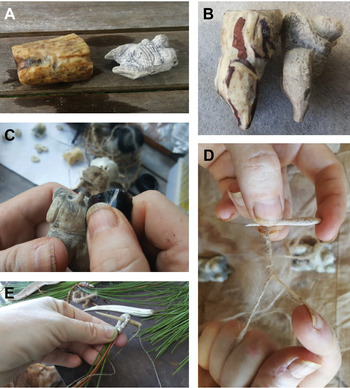
For attaching the heads to the body, cordage made from nettle fibres, red deer antler velvet, canine fur, horse hair, human hair and porcine sinew was produced (Fig. 2) using splicing, plaiting, finger-twining and thigh-rolling. These methods of manufacturing cordage are not only widely utilized by traditional artists worldwide, but are also evident in the Palaeolithic archaeological record (e.g. Adovasio et al. Reference Adovasio, Soffer and Klíma1996; Soffer et al. Reference Soffer, Adovasio and Hyland2000). Furthermore, tools thought to be used in the production of fibre and cordage—osseous points—were created for this project from bovine bone, kangaroo bone and red deer antler. A kangaroo-ulna awl in the style traditionally used by the Indigenous peoples of Australia and which is similar to other mammal-bone awls recovered from Hohle Fels itself (Conard & Malina Reference Conard and Malina2016) was part of this tool kit. Raw materials were either shop-bought or wild-harvested on the Sunshine Coast of Queensland.
Manufacturing copies of the female figurine of Hohle Fels and creating string. (A–B) exact copy of the Hohle Fels figurine was created out of red deer antler with the assistance of a resin replica for comparison; (C) unretouched obsidian flakes were used to incise her body markings; (D–E) string and cordage were made using Indigenous techniques and bone tools.

Photography of the manufacture and stringing process was undertaken using a Samsung Note 5, with the finished pieces photographed with a Canon EOS 400D. These photographs formed the basis of the figures presented herein.
Results
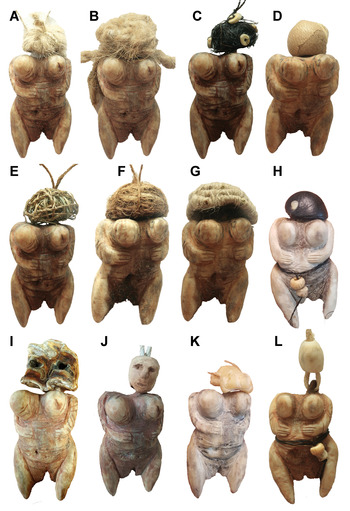
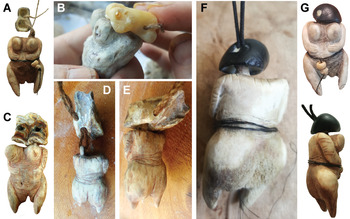
We first tried to find a natural element which would fit perfectly on the off-centred loop—therefore providing a simple explanation for its off-centred position. It was found that the aperture of turbo-shaped shells, such as Nerita, allowed the shell to appear centred when tied using a single piercing through the internal shell wall (Figs 3H & 4F–G). Similarly, a horse premolar sits centred when the loop is inserted into the natural pulp cavity (Figs 3I & Figs 4C–E). Knuckle bones were also investigated owing to their prevalence in material culture production across cultures (e.g. Gilmour Reference Gilmour1997; Koerper & Whitney-Desautels Reference Koerper and Whitney-Desautels1999; Sutton-Smith Reference Sutton-Smith1951). While the knuckle bone did not sit centrally, it did mirror the curve of the breast (Figs 3K & 4B), and interestingly, made a tapping noise when the figurine was lightly shaken. The only modification required to attach the knuckle to the loop was for a hole to be drilled through the bone either through the side (Fig. 4B) or through the base (Fig. 4A). Given these observations, it would appear possible that a different skeletal element available in the European context may be perfectly suited to the uneven alignment of the loop and curvature of the bust.
Experimenting with attaching heads. (A) human hair string; (B) canine fur string; (C) horsehair string with antler disc beads; (D) goat leather, stuffed with soft cattail bulrush seeds; (E) sedge-fibre string; (F) nettle-fibre string; (G) woven pine needles; (H) Nerita shell; (I) horse tooth; (J) white beech; (K) bovine knuckle bone; (L) red deer antler.

Head attachments with natural apertures: (A) kangaroo knuckle; (B) bovine knuckle; (C–E) horse tooth; (F–G) Nerita shell.

We next experimented with woven hair fibres. Surprisingly, it was discovered that cordage made from canine (shed) fur was not only easy to produce, but resulted in a string that was incredibly strong. While it is unknown exactly when the domestication of wolves occurred (Lee et al. Reference Lee, Merriwether, Kasparov, Nikolskiy, Sotnikova, Pavlova and Pitulko2015; Ovodov et al. Reference Ovodov, Crockford, Kuzmin, Higham and Hodgins2011), individuals could have collected shed fur from the landscape without direct interaction with wolves. Similarly, people could have collected shed wool fibres from mammoth, woolly rhino (etc.) to create felted works—a form of textile which is assumed to predate weaving and thus have a very ancient origin (Eiland Reference Eiland2005). The canine fur used here created a thick strand which wound easily to form a round head (Fig. 3B). In comparison to the human (fine) hair version (Fig. 3A), the canine fur string—because it was made from both the long and short fibres of a double-coated breed (golden retriever)—was more resilient. Since wolf fur is made up of both guard hairs (long and straight) and a soft undercoat (wavy), we expected that the two types of hair would bind together particularly effectively, and also create a resilient fur string.
Moving on to horsehair, which has a wiry and plastic texture and appearance (Fig. 3C), the resulting cordage was strong while remaining fine, which made it easier to thread through smaller perforations without the use of a needle or awl. Similarly, it was found to be easier to use for threading or attaching elements together and was more resilient than human hair.
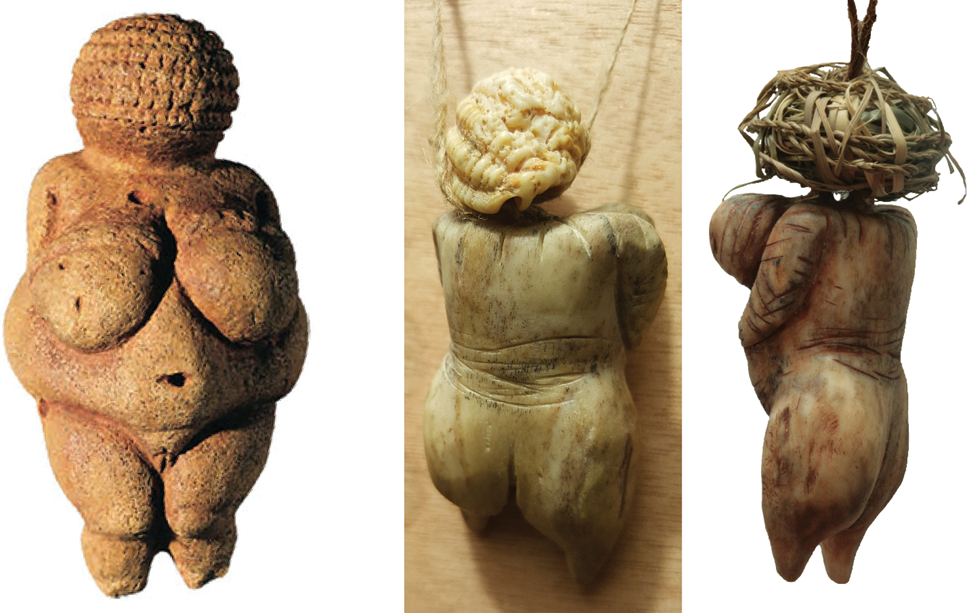
Three plant species were experimented with to create woven and bound heads. The first of these was sedge. The short waste fibres left over from processing and producing fibres (tearing the leaves into strips, then hand-rolling to soften, before splicing together) could be compressed and balled between the hands, providing a stable form for weaving onto and through. Because the waste fibres balled and kept their form, it allowed for looser, more decorative construction of the outer layer (Fig. 3E). Nettle cordage was also easy to produce using this same process (tearing, hand-rolling, splicing/twining), though it was easier to create a larger finished product than with the sedge (Fig. 3F). Last, pine needles were joined using an Indigenous interlocking coil-weaving technique (Figs 2E & 3G). This version resulted in a basket-like covering which has a strong resemblance to the head of the female figurine from Willendorf (among others). The comparison of the headdress worn by the Willendorf figurine to a coiled woven basket cap has previously been pointed out by Soffer et al. (2000, 518), who also connect woven arts with women's power and prestige. It has also been suggested that this particular figurine's head-piece may represent a cap made of shells (Abramova Reference Abramova1960), and interestingly, one of the shells experimented with here (a Harpa) provided a similar comparison with the Willendorf piece (Fig. 5).
Comparison of female figurine of Willendorf with organic head pieces made from a harp shell and woven sedge on the Hohle Fels copies.

Another common raw material that could have been used is leather or hide. Here we used goat hide to create a faceless head. A circular piece of hide was cut and notched to allow gathering into a ball shape. A bone awl was then used to pierce the hide and pig-gut sinew was used to sew the end closed. The ball was stuffed with soft cattail bulrush seeds (Typha latifolia) and the head was attached to the body using sinew (Figs 3D & 6D).
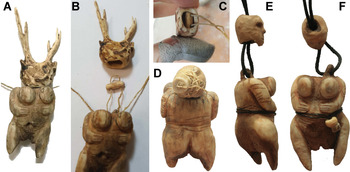
Experimenting with toggle attachments: (A–C) reindeer inspired; and (D–F) human inspired. A–C made from hoop pine with pig-gut sinew string. D is made from goat leather, stuffed with soft cattail bulrush seeds, and tied together with pig-gut sinew and a bovine bone disc bead. E–F is made from white beech with leather thong.

Finally, heads of any shape could be carved out of wood. As examples, one made from hoop pine (Araucaria cunninghamii) was carved into a reindeer head following the natural shape of the branch procured (Figs 6A–C), while a second—made of white beech—was carved into a human head shape which could face one of two ways. One face was featureless while the second showed more facial details; it could be rotated easily to show one or the other (Figs 6E–F).
These hide and wooden versions were attached using more sophisticated methods. One of the wooden heads was attached using a toggle system (Figs 6A–C). Here the toggle was carved from wood—ovoid with a perforation at each end—to allow the sinew to be threaded and attached to the bail on the top of the figurine body. The toggle inserts into the hollow of the wooden head at an oblique angle before straightening within the void to catch in place. The sinews are then pulled to attach the head to the body. For the second wooden head, no toggle was needed. Instead, the head is effectively a bead, with one opening larger (at the bottom to accommodate the bail) and the smaller at the top to allow the string to pass through (Figs 6E–F). The string passing through the head then allowed it to be hung or tied to someone or something. In this case, we covered the holes in the head with a fur outfit, along the lines of modern porcelain dolls which have a large opening at the back of the head which is then covered by hair to hide the opening (Steiner Reference Steiner1910).
As the experiment progressed, it became obvious that the possibilities for what the head could be made from—in terms of available raw materials—and how it could be attached were endless. Most importantly, most of these options, being made from archaeologically fragile materials, would not have survived 40,000 years and could provide an explanation for why the figurine from Hohle Fels was found ‘headless’.
A satisfactory explanation for the bail being placed intentionally off-centre by the Aurignacian artist could not be identified in our experimentation. In the recent practice of doll-making, the head must be centred if the finished doll is to be visually appealing, and we could find no examples of dolls with intentionally off-centred points of attachment in the ethnographic record. Similarly in jewellery making, the point of attachment is usually centred unless a specific design choice has been made resulting in a piece that would sit purposely off-centre. In terms of load bearing, where the bail is placed is important for both the way the pendant hangs and its longevity. In the case of the Hohle Fels figurine, if she is complete and was originally made as a pendant, she currently hangs slightly off-centre—begging the question: if they wanted her to hang at an angle, why not a more obvious one? And if they wanted her centred, why was the bail not carved in the centre? Its current position as a deliberate choice does not make sense in terms of human aesthetics, nor jewellery or doll-making design. Indeed, as a comparison, the human figurines recovered from the Palaeolithic contexts of Mal'ta (Siberia) were perforated at the bottom (centre) of the figurine, so that when the wearer held up the item, they would find themselves face-to-face with a right-way-up figurine (Demeschenko Reference Demeschenko2008).
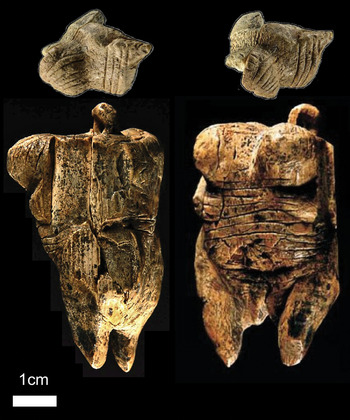
One suggestion we would like to put forward is that the Hohle Fels figurine was originally carved in one piece including a head (as are most female figurines recovered) and later broke (in either manufacture or use). The main piece (the body) retained a shard or area of ivory—off to one side—which the artist decided to rework into the loop seen today to continue the use of the artefact (i.e. Chapman Reference Chapman2000) as either a pendant or a two-piece doll. This circumstance would explain why the bail is off-centred from the doll- and jewellery-making point of view. If this suggestion was what happened in antiquity, a fragment of the original head may have survived at Hohle Fels—if she was broken at that site—and may still be recovered. Interestingly, Conard and Malina (Reference Conard and Malina2015) reported the discovery in 2014 of fragments attributed to a second ivory female figurine—reportedly part of a breast and arm. These pieces, like those of the first discovered figurine, also come from the lowest area of the stratigraphy (AH va) and these new fragments also bear deeply incised markings similar to those found on the original figurine (Conard & Kind Reference Conard and Kind2017). On viewing the photographs of these new fragments, we were struck with their likeness to a lion's head, and we thus wonder if this new artefact actually constitutes the broken original head of the figurine. Comparison of the scaled photographs found that it is of a suitable size (Fig. 7). In this case, what is proposed to be a portion of the breast would be the muzzle of the animal with the nose depicted as a raised and incised area. The pointed segment is then one cat-like ear (if turned 90° from the original drawing in Conard & Kind Reference Centner2007, 58, fig. 28). The differences in size between the original figurine and that of the second could then be explained in terms of the piece depicted as another part of the first figurine, rather than being part of a second and larger new figurine. Considering all of the similarities between the first and second figurines, as well as the presence of the miniature lion man found at this same site, and the presence of the famous Lion man at nearby Hohlenstein-stadel, it is not without precedent that this figurine may also originally have sported a zoomorphic head. Having said this, we have not observed the fragments in person, and they may prove ill suited on closer inspection.
Lion-Woman? The fragment of the second reported female figurine (above) next to the near-complete first figurine (below). (Photographs: J. Lipták, University of Tübingen, top images; H. Jensen, University of Tübingen, bottom images.)

Discussion
Thus far the oldest jointed doll identified in the archaeological record is the ‘mannequin’ of Brno II. Found in a Moravian Gravettian (c. 23,680 ± 200 bp) burial of a male with a chronic bone disease (Jelínek Reference Jelínek, Jelínek, Pelíšek and Valoch1959; Oliva Reference Oliva, Roebroeks, Mussi, Svoboda and Fennema2000; Pettitt & Trinkaus Reference Pettitt and Trinkaus2000; Valoch Reference Valoch, Jelínek, Pelíšek and Valoch1959), this artefact is made from mammoth ivory, as is the figurine central to this study. Three separate parts have been preserved: the head, trunk and left arm. While questions remain regarding how exactly the parts connected, visible use wear in the form of polish around perforations and notches suggests that the limbs were movable (Oliva Reference Oliva, Roebroeks, Mussi, Svoboda and Fennema2000). If our interpretation of the Hohle Fels figurine (as a two-piece doll) is correct, she would pre-date the Brno II mannequin by some 17,000 years—making her the oldest composite figurine known to date. Indeed, we would then have a record of multi-piece figurines moving from lesser to more sophisticated joining methods.
Taphonomic processes alone cannot be blamed for the possibility of an organic head-piece not having been considered before. Archaeology as a discipline—and particularly that area most concerned with human evolutionary contexts—has been heavily dominated by the male-centric view that stone tools (tools that were/are widely believed to be made by males) were the most important tool form for the developing human mind (and society). While it has been amply pointed out that there is no reason that women were not making and using stone tools for equally as long as men (i.e. Gero Reference Gero, Gero and Conkey1991), baskets and bags are frequently linked to ‘women's work’ and so have been seen as not as important or of interest in many areas of human evolutionary research (Soffer et al. Reference Soffer, Adovasio and Hyland2000). Furthermore, consideration of composite technologies in the Palaeolithic context has been dominated by research into hafting (e.g. Wragg Sykes Reference Wragg Sykes, Coward, Hosfield, Pope and Wenban-Smith2015; Zipkin et al. Reference Zipkin, Wagner, McGrath, Brooks and Lucas2014), and while perishables have seen focused attention (e.g. Adovasio et al. Reference Adovasio, Soffer and Klíma1996; Soffer Reference Soffer2004; Soffer et al. Reference Soffer, Adovasio and Hyland2000), considerations surrounding the connection of perishable elements to recovered art pieces (aside from threads for stringing) has been lacking.
We have suggested that the Hohle Fels female figurine may originally have been carved as a one-piece figurine, which later may have accidentally (or intentionally) broken leading to its reworking into a suspended or composite piece. If this was the case, the meaning and/or use of this particular artefact may have also changed at this time, but what meaning she had at any time in her use life is unknowable, though has long been debated. The meaning of any and all of the Upper Palaeolithic European female figurines has, in fact, seen much discussion and debate. Many have argued that the ‘clearly depicted sexual attributes suggest that they are a direct or indirect expression of fertility’ (Conard Reference Conard2009, 251). This interpretation was brought to bear on the Hohle Fels artefact on discovery. For example, Mellars (Reference Mellars2009, 176) stated of this artefact that
the figure is explicitly—and blatantly—that of a woman, with an exaggeration of sexual characteristics (large, projecting breasts, a greatly enlarged and explicit vulva, and bloated belly and thighs) that by twenty-first-century standards could be seen as bordering on the pornographic. As if to emphasize the sexual characteristics, the figure's arms and legs are severely reduced in size, and the ‘head’ has been reduced to the form of a carefully carved ring, evidently to allow the figure to be suspended from a string or thong.
And further, that ‘the feature of the newly discovered figure that will undoubtedly command most attention is its explicitly, almost aggressively, sexual nature, focused on the sexual characteristics of the female form’ (Mellars Reference Mellars2009, 176).
This sexualized interpretation of the Palaeolithic female figurines originated in the 1970s, with Collins and Onians (Reference Collins and Onians1978) proposing that they were representations of female bodies for the sake of male pleasure and education. They stated that ‘the whole figures are shown in the round or in high relief and so respond to the palm of the hand in much the same way as would the buttocks or breasts of a real woman’ (Collins & Onians Reference Collins and Onians1978, 13). They concluded that such objects must have been made by men, arguing that ‘the echoes of the hunt and of love-making both point in the direction of adolescent, or adult, males. The pursuit of game animals is usually the business chiefly of that group and clearly no other group would have such an interest in the female body’ (Collins & Onians Reference Collins and Onians1978, 14; see discussion by Dobres Reference Dobres1992). Later, Guthrie (Reference Guthrie, Bandi, Huber, Sauter and Sitter1984, 62–3) similarly argued that ‘the bulging Venus figurines with enormous buttocks and pendulous teats, along with vulva drawn on the cave walls were undoubtedly male art creations for themselves or for other men … the drawing or carvings were made, touched, carved, and fondled by men’.
More recently, researchers have been favouring the idea that the figurines may relate to birth and reproduction, both in a general (Conard & Wolf Reference Conard and Wolf2010) and specific (Morriss-Kay Reference Morriss-Kay and Clottes2012) sense. Morriss-Kay (Reference Morriss-Kay and Clottes2012, 1590–91) has suggested that the Hohle Fels example may have been a
somatosensory self-portrait of a woman who has recently given birth … from the viewpoint of this interpretation, the portrait of the carver's body is not based primarily on what she sees; instead, the perceptions interpreted by her somatosensory cortex have contributed more than those of her visual cortex to the form she has carved, and there is also a significant emotional input. Her breasts are engorged with milk: their gradual enlargement during pregnancy has not prepared her for the sudden shock and discomfort of lactiferous engorgement. They feel unfamiliarly tight and enormous, hence their exaggerated size and raised position. Her belly, having enlarged gradually during pregnancy and having contained an active child, is suddenly empty. She is aware of the loss from it of the child she was carrying. Although her belly is still somewhat swollen, the skin is now far too big, and wrinkled, hence the transverse striations firmly engraved into the ivory. The size and gash-like form of the vulva (which she has not herself seen) suggests considerable discomfort, probably arising from a perineal tear. Even taking into account the possibility of a torn perineum, the size of the vulva is visually unrealistic, but it makes complete sense when interpreted as the externalised expression of somatosensory information-processing.
She further argues that
the mother depicted in the Hohle Fels figurine has given birth and survived, but there are clues suggesting that her baby may not have done. The postpartum bodily changes are the same after a stillbirth as after a live birth, including lactiferous engorgement of the breasts a few days after the birth. The circumferential lines carved around the prominent breasts suggest a sensation of tightness unrelieved by suckling, as does the absence of clearly depicted nipples. The hormonally-induced bodily changes of pregnancy and the presence of a living child in her womb prepare the pregnant mother for the emotional bond of caring for a living child—if this were not so, babies would not survive after birth. The loss of a child through stillbirth is an emotional trauma that is hard to come to terms with. One can easily imagine how a bereaved mother who has already gained some skill in carving would be motivated to create a sensory image of her bereaved postpartum body as a way of expressing her profound sense of loss. Furthermore, the absence of the demands of maternal care and the need to recuperate physically would provide the necessary time for the many hours of carving required for creating this piece. (Morriss-Kay Reference Morriss-Kay and Clottes2012, 1592).
She also argues
This explanation is also consistent with the absence of a head. If the portrait is based on postpartum sensations from the body, the head is irrelevant. The creation of a loop where the head would have been, and the fact that it has been polished by wear, suggests to me that the woman who carved this sensory portrait made it for herself. She may have worn it as a pendant on a thong around her own neck for a long time afterwards, perhaps as a way of regaining possession of her body, or as a way of coming to terms with a stillbirth. (Morriss-Kay Reference Morriss-Kay and Clottes2012, 1591)
There exists extensive anthropological literature describing the manufacture, use and passing-down of female figurines or dolls in numerous cultures around the globe. For example, amongst the Baule of the Ivory Coast, when a girl is able to bear children, dolls protect and celebrate her fertility. When she marries, they enhance her ability to conceive. For barren women, dolls create the ability to conceive. They can even act as surrogates for deceased children, protecting the family from harm and encouraging the mother to conceive again (Cameron Reference Cameron1997). Cameron (Reference Cameron1997) reports that in Africa, dolls work to ingrain and reinforce a girl's desire to become a mother. Parents watch how their daughter treats her dolls as an indicator of her future fertility and maternal skills. In Zaire, at the birth of a new baby, a Luba mother gives her older daughter a doll so that she may pretend she is also a mother (Centner Reference Centner1962), while Tabwa girls make small dolls out of clay (watoto wa udongo ‘earthern children’) (Cameron Reference Cameron1997). Among the Nguni-speaking people of southern Africa, the community watches how a girl treats her dolls. If she constantly plays with them, they say she will have many children (Lange Reference Lange1961). If she mistreats her doll or does not protect it, her parents reprimand her for not being a good future wife and mother (Hechter-Schulz Reference Hechter-Schulz1966). To provide just a couple of examples from other continents, on Keppel Island (northeast Australia) Roth (Reference Roth1902, 49) reports that he ‘observed girls and women nursing dolls in their arms like babies. These dolls in the forms of cones, varied in length (up to 15 inches) and thickness, were coloured with red ochre and named “kamma” after the grass-tree … these cones are also intended as charms for begetting fine, strong children’. On the other side of the globe, in Alaska, the occasion of the first menstruation of a Yup'ik or Yakutat Tlingit girl was marked by a feast during which the girl gave away her dolls (Linn Reference Linn and Lee2006). Accounts also survive from the classical civilizations. In ancient Greco-Roman history, young girls of marriageable age were known to discard their childhood dolls and consecrate them to goddesses, while boys left their toys to Apollo and Hermes at the end of childhood (Elderkin Reference Elderkin1930; Langdon Reference Langdon, Cohen and Rutter2007; Young Reference Young1992). Dolls have therefore seen extensive use in many cultures as tools to prepare girls for their place and role within the community and prepare them for motherhood. Indeed, the Hohle Fels piece fits perfectly in the palm of your hand, or better still, in that of a small child.
The experimental project described above was undertaken as part of Griffith University's Kungullanji Indigenous Research Pathways programme (run by Wurundjeri woman Jennifer-Leigh Campbell), with the replica Hohle Fels figurines with their various organic heads presented to peers, mentors and Elders at the end-of-programme conference held in Brisbane in February 2019. This conference included not only the 15 Kungullanji (which is an Aboriginal word in the Yugambeh language meaning ‘to think’) students of that year, but their Indigenous mentors, academic mentors and Indigenous staff including community Elders, totalling around 60 people in attendance. The presentation of these figurines provoked warm interest, especially from the women attending, and one figurine which had been dressed in a possum-fur coat (we know that figurines in at least some cultures were wrapped in miniature textiles: e.g. Lau Reference Lau and Insoll2017) and which retained the heat of people's hands from being passed around the audience aroused strong emotional responses in particular. One woman stated that, on being passed the figurine and feeling the warmth of the fur, she found that it provoked a maternal and nurturing response for which she was unprepared. This spontaneous observation would appear to support the written ethnographic record regarding the power of dolls to elicit sometimes strong responses in their human users.
Finally, the combination of hard and soft materials mixed together to create one piece is worthy of discussion. Archaeologists commonly note that, while we are left only with the robust materials (i.e., stone, bone, antler), it appears certain that perishables made up a significant proportion of material culture in prehistory. However, we found that the possibility and related choices behind combining hard and soft materials is often not considered. Review of recent dolls from hunter-gatherer communities found that it is extremely common to combine numerous materials, both hard and soft. For example, many are dressed in miniature (soft) outfits and ornamentation (e.g. Cameron Reference Cameron1997; Fane et al. Reference Fane, Jacknis and Breen1991; Lee Reference Lee2006), leading us to suggest that the addition of these various components/decorations may add to the tactile nature of the artefact. Such a tactile quality would be of interest to both adults and children—though possibly for very different reasons. We would suggest this aspect is something worthy of further focused investigation in the future.
Conclusion
We may never know what the context surrounding the manufacture and use of the female figurine of Hohle Fels was, though we hope to have provided some alternatives to the traditional (androcentric) focus on her apparently overt sexuality. By omitting from consideration the activities of not only older individuals but also women and children—that is, the collection and use of perishable materials in the past—researchers have presented extremely limited and biased reconstructions of this particular Palaeolithic figurine.
No doubt these ideas will continue to be debated; however, the results of the experimental programme described herein support the possibility that the Hohle Fels figurine had a head. Whether she was originally made in one piece and then broken (either accidentally or intentionally) would explain the off-centre location of the loop now present. The attachment of a new head—made of organic perishable material (wood, plant fibre, fur, hair, etc.) would not only account for the observable use wear around the loop (polish and grooving), but also explain why no trace of a head has been found on site. In this form, she could have continued in use for a significant time period before final loss or discard.
Supplementary material
The supplementary material for this article can be found at https://doi.org/10.1017/S0959774320000207
Acknowledgements
We would like to thank the staff of the Gumurrii Student Support Unit and the Kungullanji Summer Research Program directed by Jennifer-Leigh Campbell, both of Griffith University. Without the support of many individuals within this unit and program, this project would not have been possible. We would also like to thank Prof. Nicholas Conard for supporting this project through providing high-quality photographs of the Hohle Fels artefacts and fielding our many questions.