

Introduction
Laterality has been found to occur in many species including humans (Homo sapiens) and horses (Equus caballus). Sensory and motor differences between dominant and non-dominant sides have been discovered in humans: the primary motor cortex is larger in the dominant hemisphereReference Hammond1, and finger movements are represented asymmetricallyReference Volkmann, Schnitzler, Witte and Freund2. Motor nerves in the dominant arm show higher conduction velocitiesReference Friedli, Fuhr and Wiget3, Reference Sathiamoorthy and Sathiamoorthy4 and an increased proportion of slow-twitch (type I) muscle fibres with reduced firing ratesReference Fugl-Meyer, Eriksson, Sjostrom and Soderstrom5, Reference Adam, De Luca and Erim6. Depending on the type of movementReference Diederichsen, Nørregaard, Dyhre-Poulsen, Winther, Tufekovic and Bandholm7, shoulder muscles of the dominant side, such as the Musculus trapezius, show less electromyographic muscle activityReference Bagesteiro and Sainburg8 and less fatigueReference Farina and Merletti9, Reference Mathiassen, Winkel and Hägg10. In the right-handed population, the dominant side usually shows more muscle mass and achieves about 10% more grip forceReference Steele11. Perception of hand-held objects such as reins often varies between left and right handReference Weber, Ross and Murray12. However, perception differences also depend on the structure of the object and the applied grip force that differs between static and dynamic, slippery and moving objectsReference Flanagan, Wing AM and Flanagan13, Reference Flanagan and Wing14.
In most studies related to equine laterality, the majority of horses were left-biasedReference McGreevy and Rogers15–Reference Murphy and Arkins17. The use of the horse's left eye was found to correlate with higher reactivityReference Austin and Rogers18, Reference Larose, Rogers, Richard-Yris and Hausberger19 and negative emotional reactionsReference De Boyer Des Roches, Richard-Yris, Henry, Ezzaouïa and Hausberger20. The direction of laterality in horses is indicated by a bias in advanced forelegs when grazingReference McGreevy and Rogers15 or approaching foodReference Van Heel, Kroekenstoel, Van Dierendonck, Van Weeren and Back21, the leg used for the initiation of movementReference Murphy, Sutherland and Arkins22 and the preferred canter leadReference Williams and Norris23. Although laterality is recorded in foalsReference Van Heel, Kroekenstoel, Van Dierendonck, Van Weeren and Back21, the majority of young horses have been found to be ambidextrousReference McGreevy and Rogers15, Reference Van Heel, Kroekenstoel, Van Dierendonck, Van Weeren and Back21. The incidence of laterality is suggested to increase with ageReference McGreevy and Rogers15, Reference McGreevy and Thomson16, Reference Van Heel, Kroekenstoel, Van Dierendonck, Van Weeren and Back21 and to be biased by genderReference Murphy, Sutherland and Arkins22.
The horse's balance is very important for its performance in many equestrian disciplines such as dressageReference Klimke24, Reference Miesner, Putz and Plewa25 and showjumpingReference Clayton26, Reference Powers, Harrison and Lindner27. It is an important aim in most riding theories to adjust the horse's ‘natural crookedness’ towards a symmetric pattern of movement. Still, even advanced dressage horses are often unbalancedReference Murphy and Arkins17, Reference Klimke24, and laterality-related problems are noted by riders at all levelsReference Hinnemann and van Baalen28.
Asymmetries, e.g. of the hindquarters, are one of the main triggers for poor performance in the equine athleteReference Dyson, Murray, Branch and Harding29, Reference Stashak30. Due to the unevenly distributed strain during races, outside limbs were recognized as more prone to severe injuries in ThoroughbredsReference Williams and Norris23, Reference Davies31–Reference Peloso, Mundy and Cohen33. Similarly in riders, handedness is suggested to increase the risk of microtrauma and repetitive strain injury especially of the shoulder region, e.g. due to asymmetric rein tensionReference Pugh and Bolin34.
Riding theories request that the rider's hands build a light and steady contact with the bit, which is independent from the rider's seatReference Miesner, Putz and Plewa25. Riders maintain contact with the bit through the reins by varying the angle of their shoulder and elbow jointsReference Terada, Clayton and Kato35. Their hands are utilized for a range of tasks such as controlling the horse's speed, impulsion, bend, position of head and neck and supporting the horse's balanceReference Miesner, Putz and Plewa25, Reference Podhajsky36. A varying range of rein tension (0–392 N) was found to occur when comparing different gaits, equestrian disciplines and horse handlingReference Clayton, Singleton, Lanovaz and Cloud37–Reference Warren-Smith, Curtis, Greetham and McGreevy41. Although only one rider was studied, Clayton et al. Reference Clayton, Singleton, Lanovaz and Cloud37 discovered an uneven and quite strong rein contact, which was experienced as even and smooth by the rider. Warren-Smith et al. Reference Warren-Smith, Curtis, Greetham and McGreevy41 reported asymmetries in rein tension, especially in turns during both ridden work and long reining with higher tensions during riding.
The relationship between the laterality of horse and the rider per se has not been investigated so far. The results of these previous studies, however, indicate that a correlation of handedness and uneven rein tension might exist. Therefore, the present study aimed at investigating the symmetry of rein tension in right-handed riders as well as the influence of a right- (RL) and left-lateralized (LL) horse.
Materials and methods
Eleven riders (female = 10, male = 1, age: 29 ± 15 years; riding experience: 18.5 ± 11.5 years) took part in the study. At the time of the study, the riders were trained to German riding level A–M. All the riders completed a modified version of the Edinburgh Handedness Inventory adopted from Westerhausen et al. Reference Westerhausen, Walter, Kreuder, Wittling, Schweiger and Wittling42. One question about the preferred hand for hammering was added to include the three best items to distinguish left- and right-handed subjects (eating, throwing and hammering)Reference Curt, Mesbah, Lellouch and Dellatolas43, Reference McManus, Porac, Bryden and Boucher44. The handedness test consisted of eight questions with five possible answers, each scored on a scale from − 2 to +2; thus, the maximum points were +16 (right-handed) and − 16 (left-handed), respectively. To participate in the study, riders were required to achieve a handedness index of >8 and to exhibit a riding level of at least ‘A’ according to German rider level classification45.
Two privately owned Trakehner geldings took part in the study. The RL horse was 19 years old and trained up to German dressage level M. The LL horse was 14 years old and trained up to German dressage level L. The horse's handedness was classified by their owner, using a questionnaire on their performance in several areas according to the methods validated previously by Murphy and ArkinsReference Murphy and Arkins17. Laterality was confirmed with a modified version of the preference test designed by Van Heel et al. Reference Van Heel, Kroekenstoel, Van Dierendonck, Van Weeren and Back21: horses had to approach a bucket of feed on the ground from 20 different distances varying between 3 and 25 m. Both horses achieved a laterality index of ± 2.23 for their preferred side, indicating a significant bias. During data collection, both horses wore a bridle with a flash noseband, flash strap and a single-jointed snaffle bit.
Rein tension was recorded continuously using the SignalScribe Rein Tension Meter system by Crafted Technology, Sydney, Australia. The data were sampled at a frequency of 100 Hz and stored to a 1 GB mini SD flash memory card inserted into the data logger.
Data collection took place in an outdoor arena with sand surface. A 20 m circle was ridden around two pylons at one half of the arena. The riders rode a standard protocol consisting of four walk–halt transitions and three circles in walk, sitting trot and canter in each direction. The protocol took 12 ± 2 min for each rider on each horse. The time differed slightly for each horse and rider since speed could not be controlled precisely. A maximum of three riders were measured on both horses per day. Each rider was given 5 min to warm up and familiarize with the horse. Riders were instructed to perform as they usually would in a dressage test. Further instructions, e.g. regarding rein tension, were not given. A stopwatch and a data recording sheet were used to identify gaits and directions. The protocol was ethically approved by the Ethics Committee of Hartpury College.
The recorded data were first opened with SignalScribe (SignalScribe; Crafted Software, Wentworth Falls, NSW, Australia) and then exported into Microsoft Excel 2002 (Microsoft Corporation, Redmond, WA, USA) onto a PC. The mean tension was calculated for each rein in each gait and direction. In addition, standard deviation, maxima and minima were calculated, and each was analysed separately as they were considered to be important, additional measurements for the evaluation of the rein contact. SAS 9.1 (SAS Institute, Inc., Cary, NC, USA) was used for data analysis. Where necessary, data were logarithmized, and outliers were removed to achieve a Gaussian distribution. These measures were not successful for the minimum rein tension due to a highly skewed distribution as a result of a large proportion of 0 s. Rein tension was analysed using a mixed model, accounting for unequal variances, if necessary, and considering horse (H), gait (G), familiarity (F), direction (D) and side of rein (R) and their interactions as fixed effects, and rider (P) as a random effect. The factor ‘familiarity’ for each horse and rider combination was false, if the horse was unknown to the rider, and true if the rider had ridden the particular horse at least once previously. The model was reduced if a term was not significant. P-values were adjusted using the Tukey–Kramer method for multiple comparisons. All figures were made using Microsoft Excel 2002 and imported into Microsoft Word 2002. Graphs showing examples of rein tension over the course of time were made by exponentially smoothing raw data with a smoothing factor of 0.15. These graphs were combined into one figure using Gimp 2.6.
Results
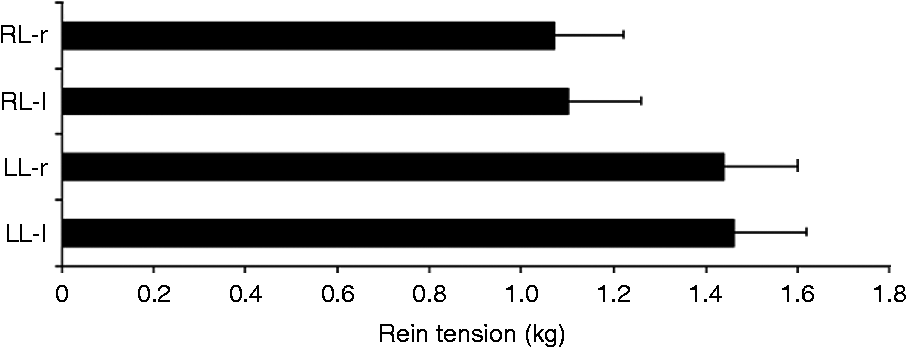
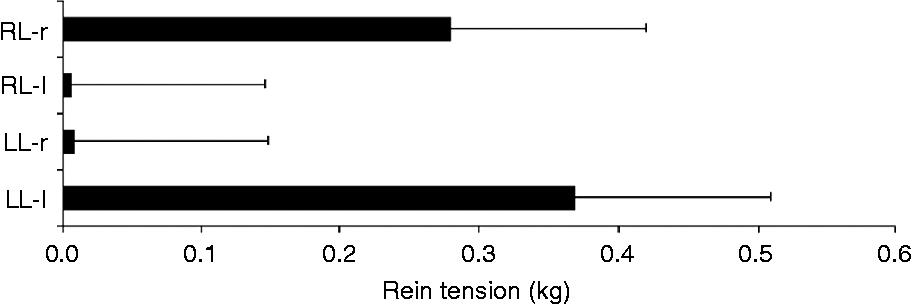
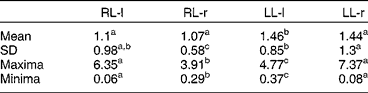
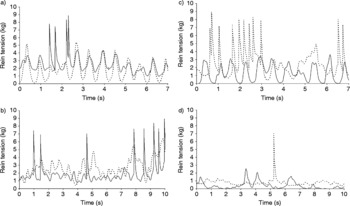
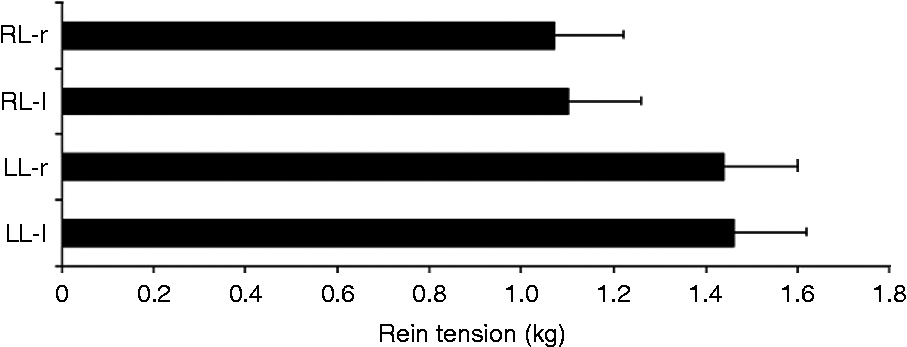
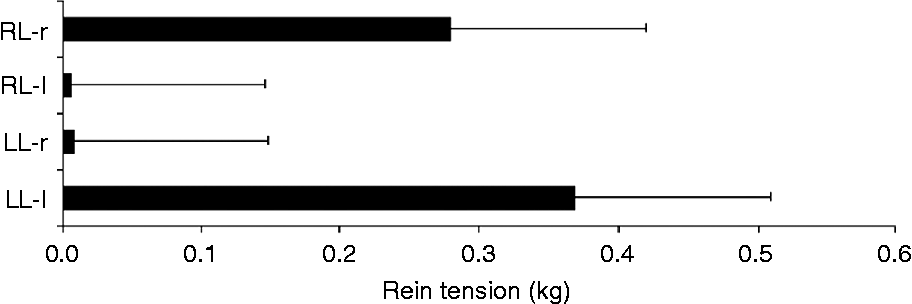
Compared with the RL horse, the LL horse required a higher overall mean rein tension (1.45 ± 0.15 vs. 1.09 ± 0.15 kg; P = 0.0001) with a greater standard deviation (1.07 vs. 0.78 kg; P = 0.0004). However, the LL horse was ridden with significantly (P = 0.0352) stronger mean tension in the left rein (1.46 ± 0.16 kg) than in the right rein (1.44 ± 0.16 kg). Significantly higher mean tension was applied to the left rein of the LL horse (1.46 ± 0.16 kg) than to both reins of the RL horse (1.1 ± 0.16 and 1.07 ± 0.15 kg, respectively; P = 0.0044; Fig. 1). In general, the minimum tension applied to the left rein was greater as opposed to that of the right rein (0.19 vs. 0.15 kg; P ≤ 0.0001). This highly significant difference occurred when comparing the minimum tension of the left and right reins within each horse as well as between both horses (Fig. 2 and Table 1). In both horses, regardless of the gait, direction or particular rider, continuous tension was most commonly applied to the rein of the horse's preferred side. In contrast, contact with the opposite rein was non-continuous, including bouts with a slacking rein (i.e. zero force measured). Furthermore, the peaks of rein tension on the preferred side were higher than those of the non-preferred side in both horses, causing a greater standard deviation and range of tension on this rein (Table 1). An example sequence of the LL and RL horse demonstrating these differences, each in trot and canter, is shown in Fig. 3a–d.
Mean rein tension and SE of the left and right reins. RL, right-lateralized horse; r, right rein; l, left rein; LL, left-lateralized horse
Mean minimum tension and SE of the left and right reins. RL, right-lateralized horse; r, right rein; l, left rein; LL, left-lateralized horse
Mean, SD, maximum and minimum rein tension in kg
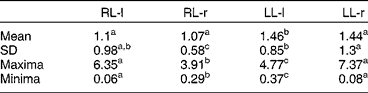
RL, right-lateralized horse; l, left rein; r, right rein; LL, left-lateralized horse.a,b,cValues with unlike superscript letters were significantly different (P < 0.05).
Example of rein tension sequences of the right-lateralized horse in (a) canter counterclockwise and in (b) trot clockwise direction and of the left-lateralized horse in (c) canter clockwise and in (d) trot counterclockwise direction. Dotted lines signify the left rein, and continuous lines signify the right rein

In a clockwise direction, more mean tension was applied to the left (outside) rein (1.35 ± 0.15 kg) than to the right (inside) rein (1.2 ± 0.16 kg; P = 0.02), regardless of the horse (Fig. 3b and c). In contrast, there was no significant difference between the left (inside, 1.21 ± 0.16 kg) and the right (outside) rein (1.32 ± 0.16 kg; P = 0.49) in a counterclockwise direction. Higher mean tension was applied to the right rein in a counterclockwise (outside rein, 1.32 ± 0.16 kg) as opposed to a clockwise (inside rein) direction (1.19 ± 0.16 kg; P = 0.02). No significant difference occurred for mean rein tension of the left rein in a clockwise (outside rein, 1.35 ± 0.15 kg) and counterclockwise (inside rein, 1.21 ± 0.16 kg; P = 0.48) direction.
Rein tension differed very highly significantly for each gait (0.7 kg in walk; 1.1 kg in trot; 1.65 kg in canter; 1.62 kg in halt transitions; P < 0.0001). Riders who were familiar with their horse applied significantly less minimum rein tension than those who were not familiar with it (0.15 vs. 0.19 kg, P = 0.04). A greater difference between the mean tension in the left and right reins occurred in riders who were not familiar with their horse (0.74 vs. 0.36 kg, P < 0.0001).
Discussion
The mean rein tension recorded in the present study was 0.7 kg in walk, 1.1 kg in trot, 1.65 kg in canter and 1.62 kg in halt transitions. These magnitudes lie within the range of tension reported by Warren-Smith et al. Reference Warren-Smith, Curtis, Greetham and McGreevy41.
The rein tension meter utilized in the present study was equipped with reins of inadequate length. Therefore, a web belt was attached to both reins with plastic clips and buckles to elongate the reins. Since the present study intended to compare the left and right reins, the additional material created an equal situation for both reins. It was attached in a way that interfered minimally with the position of the rider's hands. However, some riders took hold of both materials depending on the gait, which might have influenced their perception of gripReference Weber, Ross and Murray12, Reference Flanagan and Wing14. This could have led to differences between riders and horses, but not between the left and the right rein. Rein tension recorded in the present study is comparable to those of other studies using conventional reins and nylon reins of varying lengthsReference Clayton, Singleton, Lanovaz and Cloud38, Reference Warren-Smith, Curtis, McGreevy, McGreevy, McLean, Warren-Smith, Goodwin and Waran40, suggesting minimal influence from the adaptations of reins.
In the present study, a significant interaction between horses and rein tension was detected. Significantly more mean tension was applied to the left rein of the LL horse than to any rein of the RL horse. This result is likely to originate from the fact that the LL horse required higher rein tension in general. The LL horse was ridden with significantly stronger mean tension in the left rein than in the right rein, regardless of the direction.
Balance and symmetry are important preconditions for superior performance in most equestrian sportsReference Klimke24, Reference Clayton26. Training is aimed at transforming the horse's natural crookedness into a straighter movement patternReference Miesner, Putz and Plewa25. In equestrian sports, the rider applies a combination of seat, leg and rein aids to control the horse's gait, pace and posture. No type of aid is to be applied in a solitary fashionReference Miesner, Putz and Plewa25. Contact is described as the light and steady connection of the rider's hands to the horse's bit via the reinsReference Miesner, Putz and Plewa25. The ideal rein contact when bending the horse's head or flexing the entire horse to one side should be such that the outside rein remains in constant contact with the horse's mouth. The contact of the inner rein should be lighter compared with the outside rein. The horse's posture and movement pattern should not be affected when the contact with the inner rein is released. When a good contact is established, the horse is ridden mainly through seat and leg aids. The intensity of rein tension varies according to the situation, aiming at the lightest rein aids possibleReference Miesner, Putz and Plewa25.
In the riding literature, the preferred side is described as the ‘hollow’ sideReference Klimke24, Reference Miesner, Putz and Plewa25. According to this theory, the LL horse would tend to lean on the right rein (non-preferred side). Thus, avoiding contact with the left rein (preferred side), regardless of the direction, creates the impression of being ‘hollow’ on this sideReference Klimke24, Reference Müseler46. Therefore, this result would indicate that, to create even contact, riders overcompensated and applied higher tension to the left rein (preferred side). This riding theory furthermore suggests that a RL horse, in contrast, would tend to lean on the left rein (non-preferred side) and avoid contact to the right (preferred side)Reference Klimke24, Reference Miesner, Putz and Plewa25.
In fact, data of minimum rein tension revealed that most commonly in both horses, regardless of the direction, continuous and higher tension was applied to the rein of the horse's preferred side. In contrast, contact with the opposite rein was non-continuous (Fig. 3a–d) in both directions. These results contrast with the demands of the riding literatureReference Miesner, Putz and Plewa25, Reference Müseler46 to retain constant contact with the outside rein while keeping a more variable contact with the inside rein. This strongly suggests a relationship between rein tension and the horse's laterality.
In relation to mean rein tension, no significant uneven contact between the left and right rein was detected in the RL horse. These results indicate that rein tension comes close to an even contact if the reins of the horse's preferred side are in the rider's dominant hand. If the reins are in the non-dominant hand, however, a higher amount of tension is applied, thus making contact uneven with stronger tension towards the opposite, preferred side.
In humans, the perception of grip varies between the handsReference Weber, Ross and Murray12. The dominant hand has been reported to achieve approximately 10% more grip force than the non-dominant hand and to be advantaged when performing skilled tasksReference Steele11. The ability to ride with a light but constant contact with the bit is dependent on perception, sensitiveness and coordination, and could hence be considered as a skilled taskReference Terada, Clayton and Kato35, Reference Warren-Smith, Curtis, Greetham and McGreevy41, Reference McGreevy47. Consequently, these results indicate an advantage of the dominant hand, which is likely to be caused by human handedness. It could be caused by a difference in accuracy of perception of grip force or a more accurate motor control in the rider's dominant hand. The fact that asymmetry was greater when the horses were unfamiliar to the rider indicates that training a horse might adjust the accuracy of rein contact with this individual.
Significant interactions were discovered between the reins and the direction of the circle. On a circle, the rider weights the horse's back slightly more on the inside. He encourages the inner hind leg to step underneath the centre of gravity with his inside leg and controls the hindquarters with his outside leg. Increased tension of the inside rein indicates bend. The outside rein is released by the same amount to allow the horse to bend and prevent it from overbending and drifting over the outside shoulder. However, it also determines position and size of the circleReference Miesner, Putz and Plewa25. Riders applied higher mean tension to the outside left rein than the inside right rein in a clockwise direction (Fig. 3b and c), regardless of the horse. Accounting for this request to ride a horse from inside leg to outside rein on a circleReference Miesner, Putz and Plewa25, this result would be expected.
In a counterclockwise direction, however, a higher amount of tension was applied to the inside (left) rein than to the inside (right) rein in a clockwise direction. Thus, in a counterclockwise direction, no significant difference between the reins was found, which is demonstrated by the example sequences of the LL horse in Fig. 3b and d. Stronger tension was applied to the left rein of the LL horse regardless of the direction of the circle. In contrast, no significant differences between the mean tensions of the left and right reins were identified for the RL horse in either direction. This indicates that in both directions more tension was applied to the outside rein, hence in total resulting in even contact (Fig. 3a and c). Again, these results demonstrate asymmetric rein tension and suggest an advantage of the rider's dominant hand.
Training is a frequently suggested reason for the increased incidence of handedness in ridden horsesReference McGreevy and Thomson16, Reference Larose, Rogers, Richard-Yris and Hausberger19. The horses used in the present study support this view, as each had been trained to a fairly high level of dressage for a long period of time. An important aim of most riding theories is to adjust the horse's ‘natural crookedness’ towards a symmetric pattern of movement. Contradictions between riding theories and scientists concerning the definition and direction of equine laterality have been reportedReference Roepstorff, Egenvall, Rhodin, Byström, Johnston and Van Weeren48. Some scientific resultsReference Roepstorff, Egenvall, Rhodin, Byström, Johnston and Van Weeren48 support the impression that the majority of horses are right-biased, as described most commonly in the riding literatureReference Klimke24, Reference Miesner, Putz and Plewa25, Reference Müseler46. The more supple right is considered as the horse's preferred side, whereas the left is described as rather stiff with tensed musclesReference Klimke24, Reference Müseler46. These horses tend to lean on the left rein, which puts more strain on the left forelimb. They avoid the right rein, thus creating an uneven contactReference Klimke24, Reference Hinnemann and van Baalen28, Reference Müseler46. In particular the mean minimum rein tensions recorded in the present study revealed the avoidance of contact with one rein. Even though this avoidance pattern was laterally inverted in both horses proving a relation to laterality, it does not mirror the descriptions in the riding theories. However, accounting for the action and handedness of the riders, this can be explained by the attempt to adjust rein contact and overcompensation.
Laterality leads to asymmetries in muscle mass and strengthReference Diederichsen, Nørregaard, Dyhre-Poulsen, Winther, Tufekovic and Bandholm7, Reference Bagesteiro and Sainburg8, Reference Pugh and Bolin34, Reference Symes and Ellis49. Balanced horses are equally flexible on both reinsReference Miesner, Putz and Plewa25, whereas asymmetric horses load their limbs unevenly, thus being at higher risk of injuryReference Williams and Norris23, Reference Stashak30. However, the weight of the rider has been proved to create asymmetry of gait to some extentReference Roepstorff, Egenvall, Rhodin, Byström, Johnston and Van Weeren48–Reference De Cocq, Prinsen, Springer, Van Weeren, Schreuder and Muller50. In particular during rising trot, horses show a greater degree of lateral bend than in a natural trot sequence without a riderReference De Cocq, Prinsen, Springer, Van Weeren, Schreuder and Muller50. In total, the load on the left fore/right hind sitting diagonal is larger than that of the opposite sitting diagonalReference Roepstorff, Egenvall, Rhodin, Byström, Johnston and Van Weeren48. Riders, not being entirely symmetric themselves, usually tend to rotate their thorax counterclockwise, thus constricting the horse's movement in a clockwise directionReference Symes and Ellis49. This asymmetric movement pattern of the rider might further hamper a LL horse on its non-preferred right side. However, it might support a RL horse on its non-preferred left side.
In equestrian disciplines, horses are trained with negative reinforcement. They are supposed to yield to bit pressure applied through rein aids (i.e. cues) to avoid this unpleasant stimulusReference McGreevy47, Reference McLean51. The most important precondition for effective learning in equines is the utilization of consistent stimuliReference McGreevy52, Reference Murphy and Arkins53. Inconsistent stimuli, such as different, not laterally reversed rein aids for the same task in a clockwise versus counterclockwise direction as identified in the present study, complicate learning, thus diminishing and decelerating training resultsReference McGreevy52, Reference Murphy and Arkins53. These different signals produced by the rider's dominant and non-dominant side, therefore, seem to be more crucial to training success than the laterality of the equine athlete as such. The guiding principle that riders may need to improve their own symmetry before they are able to truly balance their horsesReference Pugh and Bolin34, Reference Symes and Ellis49 is supported by the results of the present study. The impression of improved symmetry between a right-handed rider and a RL horse might indicate that a RL horse is more suitable for a right-handed rider than a LL horse.
Conclusion
The results of the present study indicate that the different utilization of both reins is likely to be influenced by the laterality of both the horse and the rider. The combination of a right-handed rider and a LL horse seems to increase the asymmetry of rein tension, which may negatively influence training success. Therefore, a RL horse might be more suitable for a right-handed rider. However, to confirm these assumptions, further research including ambidextrous and left-handed riders and a greater sample of LL and RL horses is necessary.