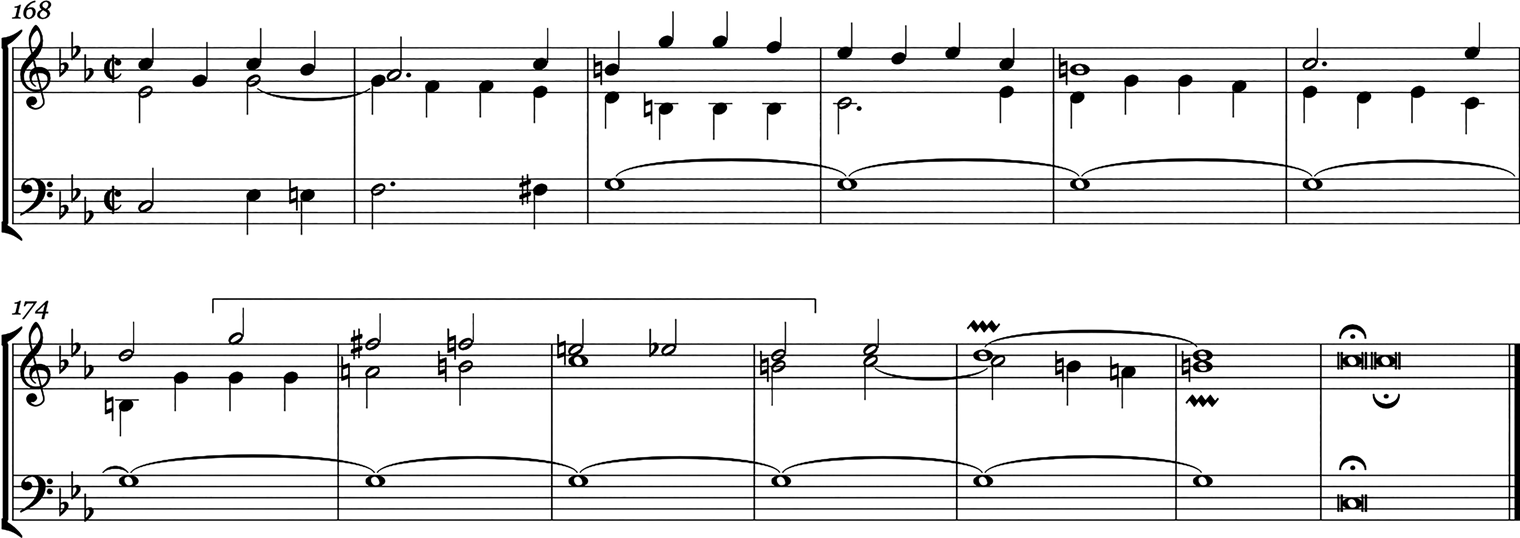
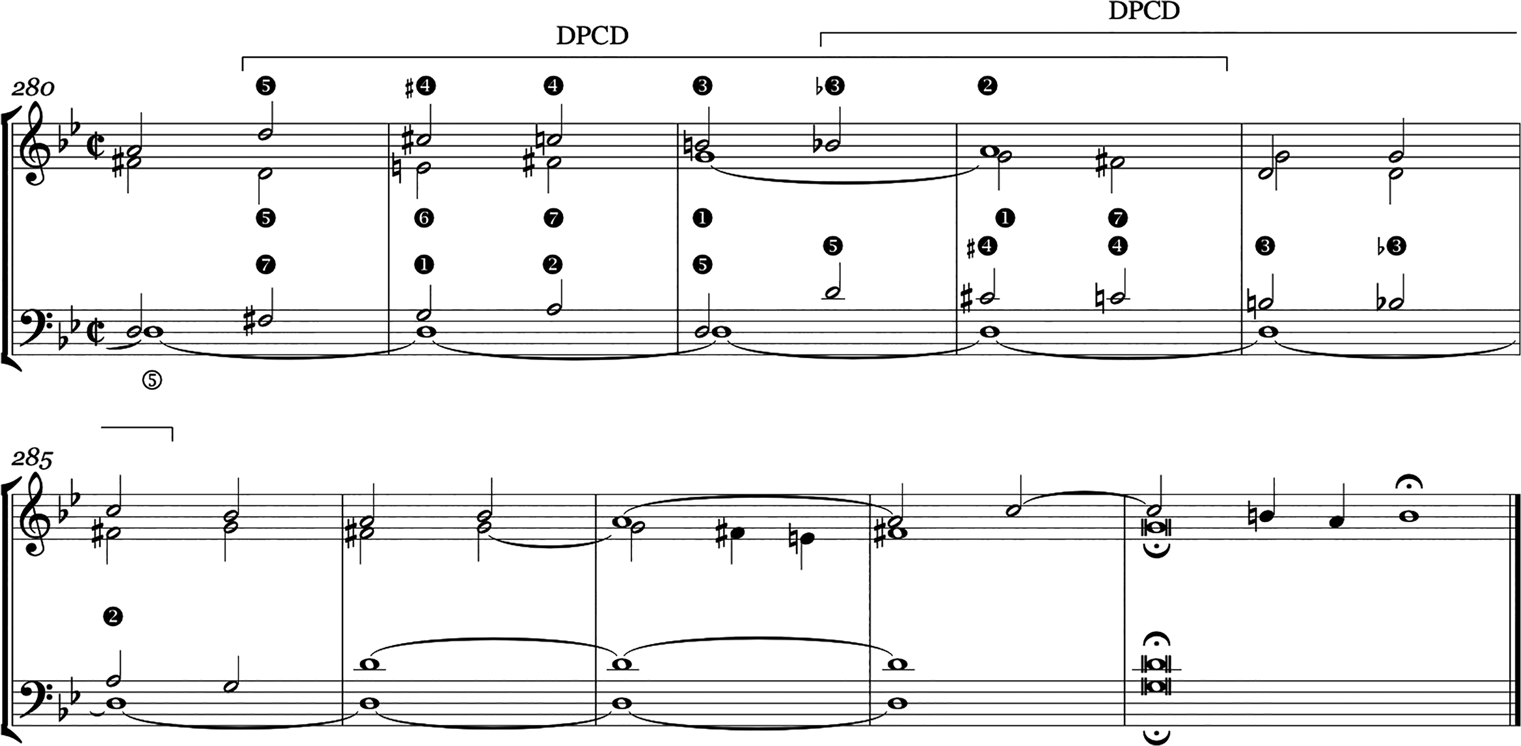
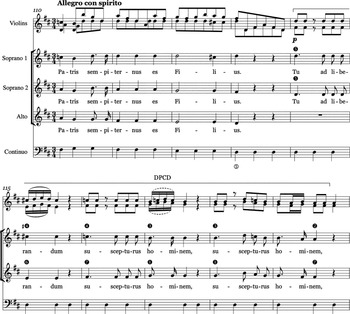
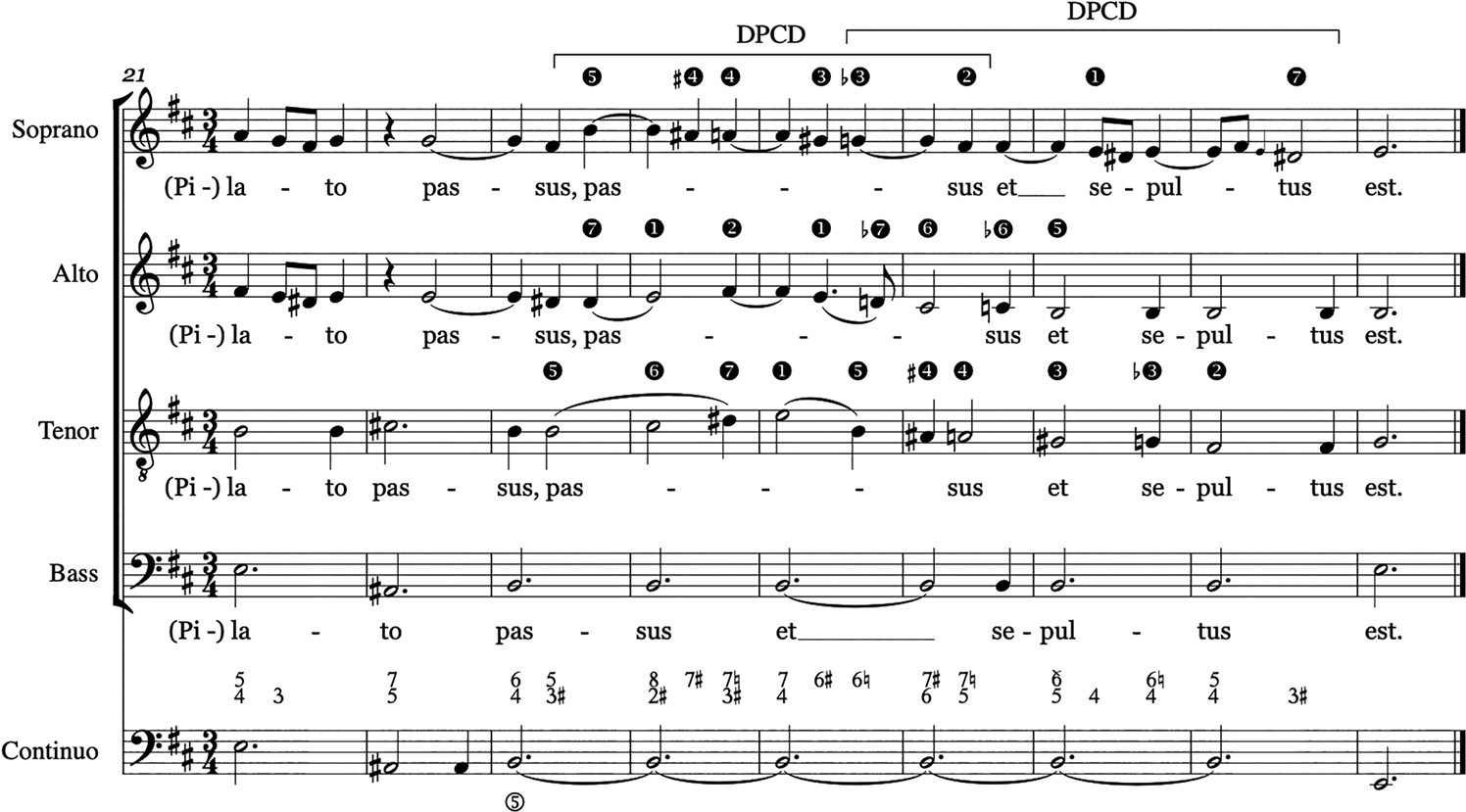
Before a student could embark on his study of counterpoint with maestro Fedele Fenaroli (1730–1818) and his assistants at the Conservatorio di Santa Maria di Loreto in Naples, he first had to work through what I have earlier called Fenaroli's ‘basic partimento course’, a course comprising the first three partimento books that deal with basic cadences, the rule of the octave, suspensions and the moti del basso (bass motions).Footnote 1 It was only if the student was judged competent enough in these matters that he could join the counterpoint class whilst at the same time realizing more complex, mostly polyphonic partimenti – Fenaroli's ‘advanced partimento course’. The surviving counterpoint books from Fenaroli's students – those by Biagio Muscogiuri (dates unknown) and Vincenzo Lavigna (1776–1836) are the most elaborate – demonstrate that, besides revisiting and expanding many partimento rules as thoroughly as possible, new patterns and patterns that had hardly been touched upon during the earlier training were taught and applied recurrently. Such a pattern – the focus of this study – can be seen towards the conclusion of a three-part fugue in C minor that Muscogiuri wrote in 1782 (Example 1; the pattern is bracketed).Footnote 2 It occurs as the second part of a large-scale dominant pedal point in the bass and consists, apart from the pedal, of two lines set in quasi-contrary motion. (Henceforth, I will use the term ‘pedal’ to designate ‘pedal point in the bass’, except in any case of possible confusion.) The soprano descends chromatically from scale steps 5 to 2, the first notes of both chromatic steps falling on ‘better’ beats than their second notes, with the concluding scale step 2 thus falling on a ‘good’ beat.Footnote 3 Simultaneously, the alto rises diatonically/melodically from scale steps 5 to 1, the latter accompanying both the chromatically raised and the diatonic third scale step of the soprano, before it descends a semitone to the leading note. As will become clear, though, this diatonic voice is only one of several possible counterpoints to the chromatically descending voice. To highlight that the latter voice, along with the pedal, acts as the paradigmatic voice of the pattern just described, I shall refer to this pattern as a dominant pedal accompanied by a chromatic descent, henceforth abbreviated as DPCD.Footnote 4 And while Example 1 shows the DPCD in a minor key, multiple examples in Muscogiuri's and Lavigna's counterpoint books illustrate that this voice-leading pattern suits a major key as well.
Biagio Muscogiuri, Fugue in C minor (Naples, 1782). Biblioteca del Conservatorio di Musica Luigi Cherubini, Florence (I-Fc), B.505, fol. 77v, bars 168–181. Used by permission

In this article I show that a DPCD belongs to the regularly used eighteenth-century voice-leading patterns in Italy and abroad, appears in both minor and major modes, exists in a number of variants, has common syntactic implementations and might therefore be considered a galant schema. The first section deals with the DPCD in eighteenth-century music pedagogy, while in the following section, I will explore examples of the DPCD from Italian and Italianate eighteenth-century repertory. Since the DPCD shares several features with other pedal-based schemata, sometimes even blurring the boundaries between them, the final section of this article consists of comparative commentaries on their voice leading. And wherever relevant in this article, I will also touch upon possible affective implementations of the DPCD.
To facilitate the reading of this article and the comparison of its musical examples, and to remain consistent with what other scholars have done in this field, I use Robert O. Gjerdingen's black-circled figures to indicate scale steps in all the parts except those in the bass, which I denote with white-circled figures.Footnote 5 And, as John A. Rice has done, I add an accidental to a figure when the specific designation of a diatonic or a chromatically altered scale step is required, although this symbolized notation can differ from the actual one.Footnote 6 The list below should suffice to make the system of indications clear. Regardless of the mode,
❸ always refers to the scale step a major third above ❶
♭❸ a minor third
❻ a major sixth
♭❻ a minor sixth
❼ a major seventh
♭❼ a minor seventh
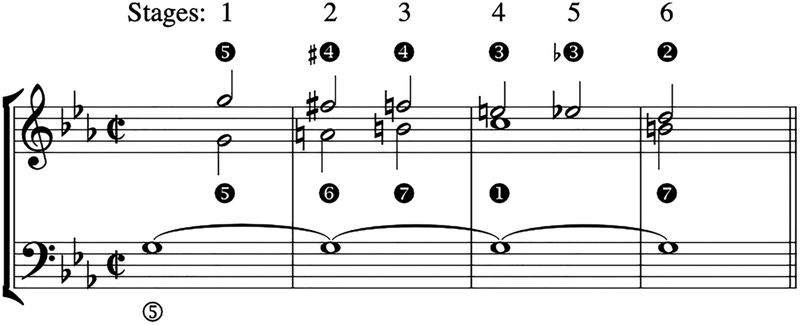
Using these circled figures, Example 2 shows the model of the DPCD as it appears in Example 1. Note further that I equate each note of the chromatic descent with one stage of the pattern, associations made concrete in the following list:
❺ corresponds to stage 1
♯❹ 2
❹ 3
❸ 4
♭❸ 5
❷ 6.
Model of a dominant pedal accompanied by a chromatic descent (DPCD) after Example 1

1. The DPCD in Eighteenth-Century Pedagogy
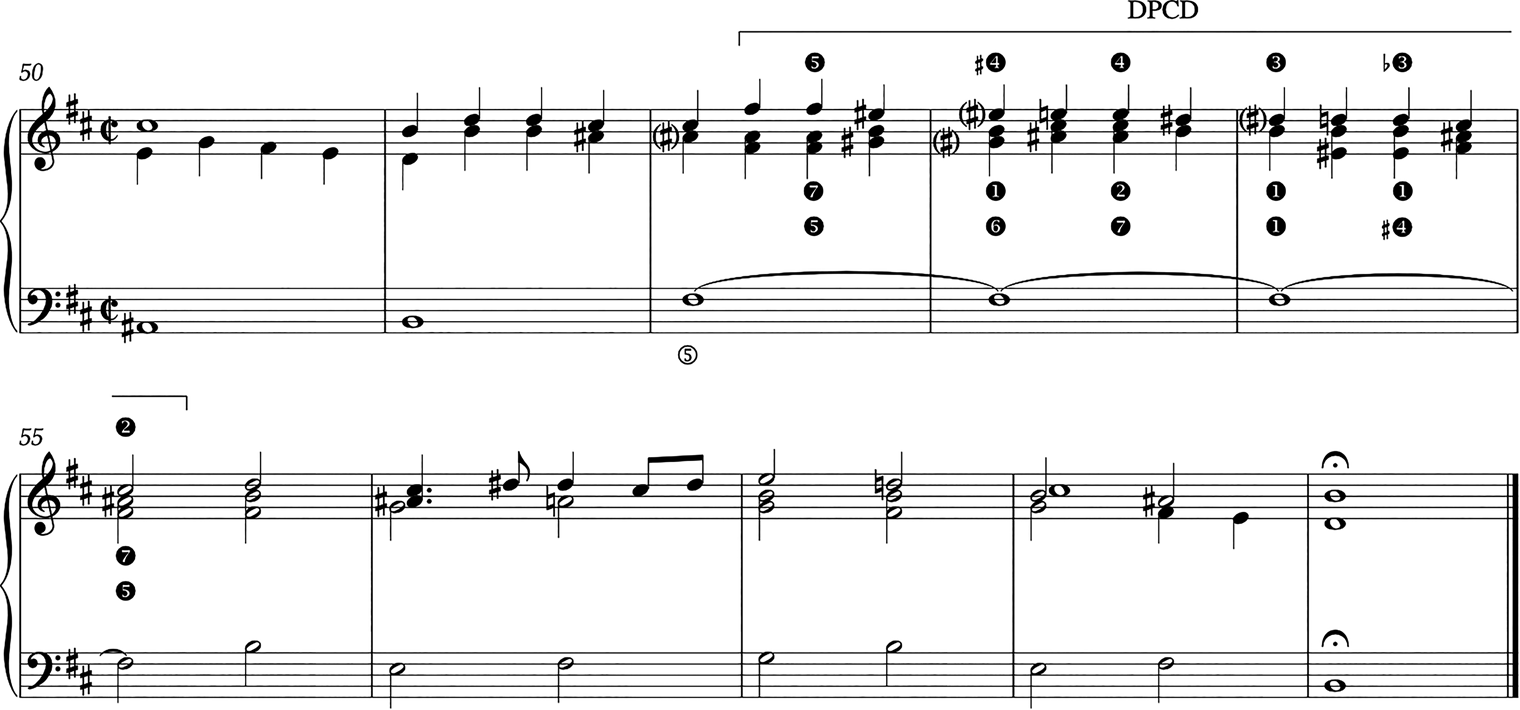
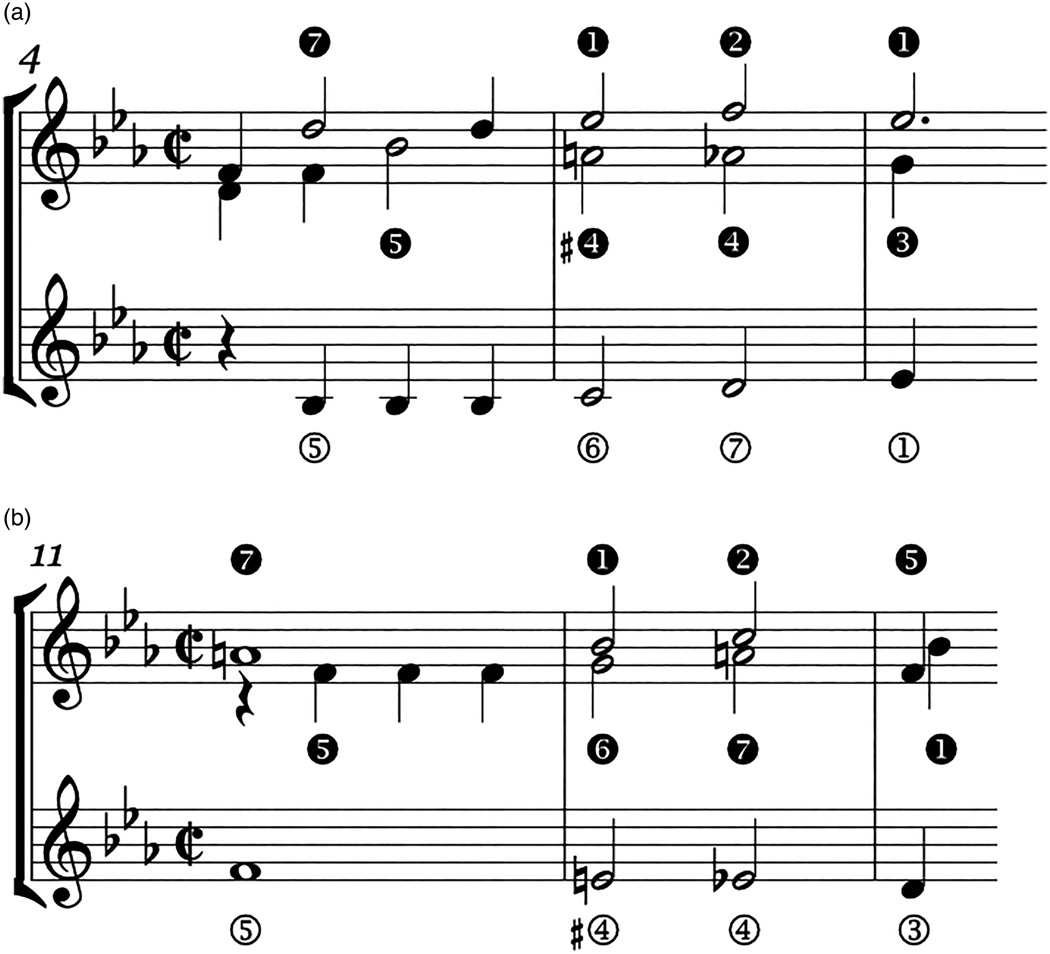
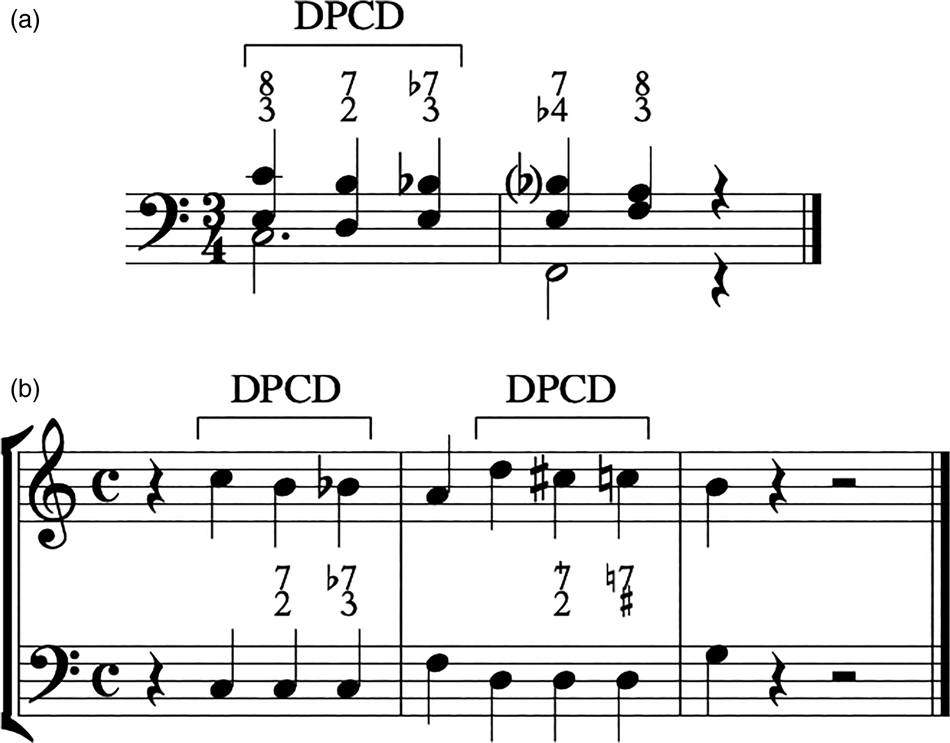
The DPCD is one of those voice-leading patterns that was not entirely new when students started Fenaroli's counterpoint training. To begin with, the version with the diatonic counterpoint starting on ❺ had already appeared in Fenaroli's basic partimento course, albeit only once and without being exemplified as a rule. Example 3 shows this sole exemplar of the DPCD, one that has been set in the minor mode and in which its upper voices are represented by figures.Footnote 7 Yet partimento students were encouraged to go beyond the figures, as illustrated by Example 4, which displays a realization of the same fragment from the earliest known collection of intavolature (fully written-out keyboard versions) of Fenaroli's book on the moti del basso.Footnote 8 This realization changes the implied original three-part setting of Example 3 into a four-part setting that includes three variants on the model, the last two of which are in fact common in eighteenth-century repertory. First, an anticipation has been added to each stage in every part of the pattern, creating a chain of sigh figures. Secondly, an additional diatonic counterpoint appears in the middle part of the right hand. Being arguably the first choice when expanding a three-part into a four-part setting of a DPCD, this counterpoint starts on ❼ and rises during the first three or four stages of the DPCD in stepwise motion and in parallel thirds with the counterpoint that starts on ❺.Footnote 9 Thirdly, although the three-part setting of the DPCD in Example 3 is perfectly satisfying in itself, the realization of the DPCD in Example 4 enhances the vertical sonority during stage 5 by adding ♯❹ to the prolonged six-four chord in the lowest part of the right hand, hence creating a ♯7/6/4 chord.
Fedele Fenaroli, Partimento in B minor, gj1357 (Naples, 1775 or before). Archivio Musicale della Biblioteca San Francesco, Bologna (I-Bsf), M.F. I-8, fol. 56r, bars 50–59. Used by permission

gj1357 in a realization from Biblioteca Palatina, Parma (I-Pac), F. Ms. 612.d (Naples, 1809), fols 8v–9r, bars 50–59 (based on The Parma Manuscript: Partimento Realizations of Fedele Fenaroli (1809), ed. Ewald Demeyere (Visby: Wessmans, 2021)). Used by permission

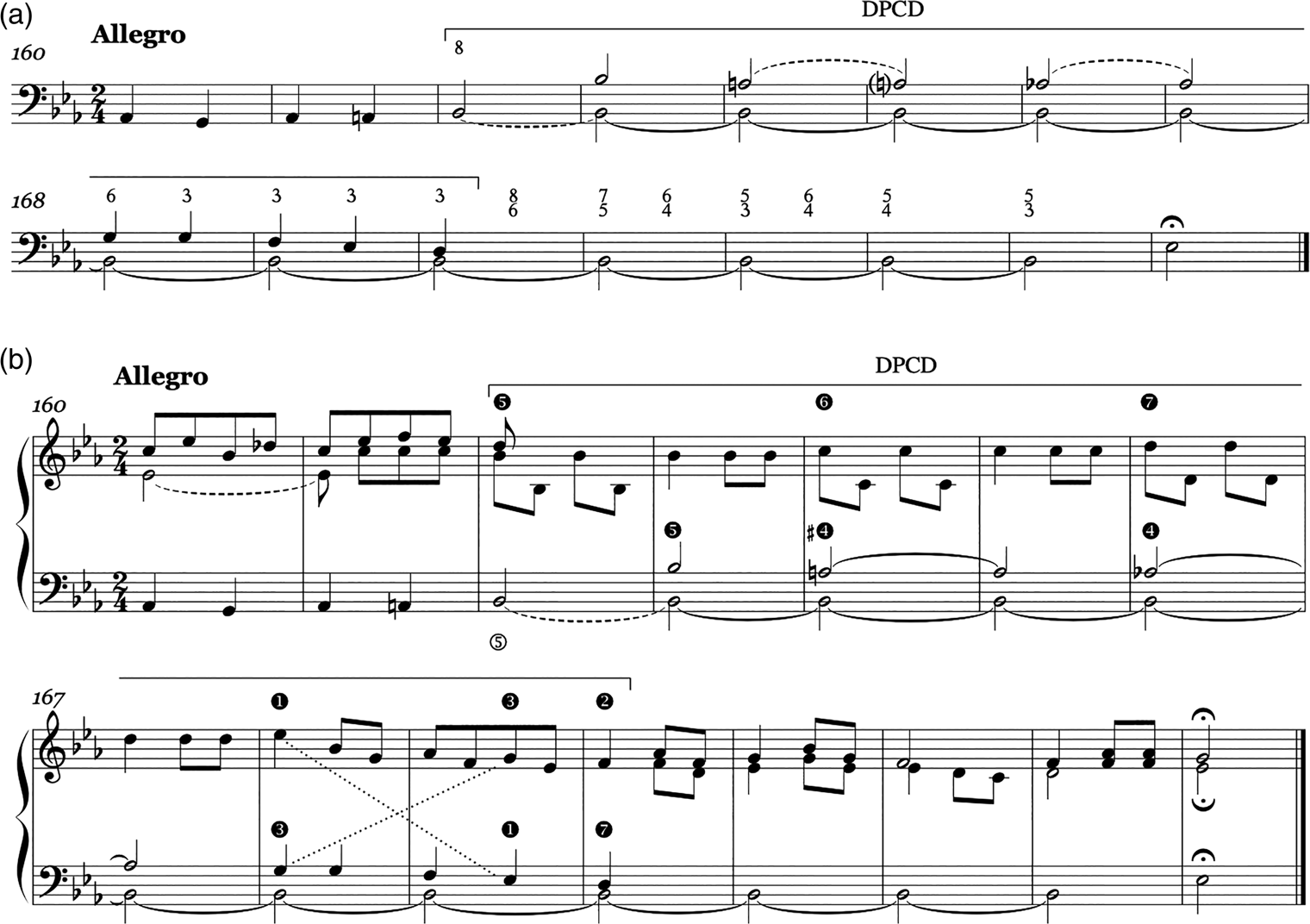
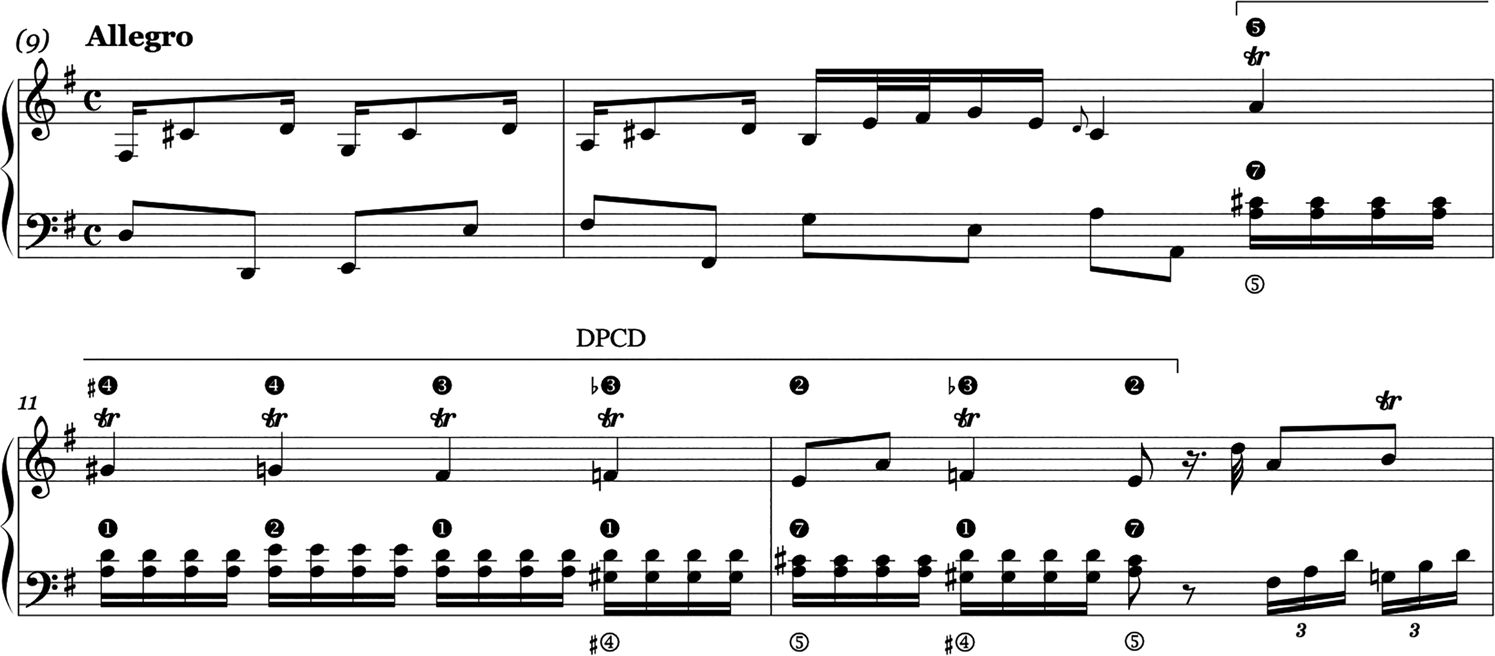
The DPCD appears in Fenaroli's ‘advanced partimento course’ as well, albeit also only once, this time in the major mode. Example 5a shows its partimento notation, Example 5b the realization that pupil Deodato Vietri (dates unknown) made of it under Fenaroli. While this DPCD includes again the counterpoint starting on ❺, it demonstrates three more variations that are common in eighteenth-century repertory. First, the chromatic line, while descending from ❺ to ❷, includes only the diatonic version of the third scale step, appearing not only during stage 4 but also during stage 5. Secondly, the chromatic descent is presented in the middle voice, the diatonic counterpoint in the upper voice – a straightforward application of invertible counterpoint rendered explicit in Example 5b. Thirdly, instead of keeping the fourth and the sixth of the six-four chords in the same voices during stages 4 and 5, a voice exchange occurs during the latter stage, a voice-leading option made possible by the absence of ♭❸ from the chromatic descent. (If ♭❸ were to occur at that point, such a voice exchange would result in a cross relation.)
(a) Fenaroli, Partimento fugue in E flat major, gj1392 (Naples, 1775 or before). Biblioteca del Conservatorio di Musica San Pietro a Majella (I-Nc), O(D).2.24 olim 45.1.30, fol. 137r, bars 160–175 and system 4; (b) gj1392 in a realization by Deodato Vietri (Naples). Diözesanbibliothek, Münster (D-MÜs), SANT Hs. 1500, fol. 24r, bars 160–174. Used by permission. Note that Vietri's realization is one bar shorter than the partimento version

The DPCD also builds on previously introduced partimento rules. Without the pedal and depending on their relative positions, stages 1 to 4 of the chromatic descent and the counterpoint starting on ❺ represent chromatic derivatives of two four-note segments of the rule of the octave, derivatives that are written in contrary motion and are each other's inversion. Syntactically, these derivatives (as do the diatonic versions) work as a small inflection, the one with ⑤–⑥–⑦–① in the bass as a clausula cantizans or what Gjerdingen calls a Long Comma, the one with ⑤–♯④–④–③ in the bass as a clausula altizans or, in Gjerdingen's terms, a Passo Indietro.Footnote 10 Observe that the clausula altizans with the chromatic descent in the lowest voice is also a transposition up a fifth of stages 1 to 4 of another rule that had already been inculcated, that rule being one of the two main ways of providing an upper part for a bass ‘che scende di semitone’ (that descends by semitone) from ① to ⑤.Footnote 11
While these chromatic derivatives of the two four-note segments of the rule of the octave seem to have been used only occasionally in Fenaroli's partimenti, they appear more regularly in Muscogiuri's and Lavigna's counterpoint books. Example 6 shows just one of each, two excerpts from a three-part disposizione (contrapuntal elaboration) in E flat major (the local key of Example 6b is B flat major) written by Lavigna in 1793, excerpts that include the counterpoint starting on ❼ as well.Footnote 12
(a) Vincenzo Lavigna, Disposizione in E flat major (Naples, 1793). Biblioteca del Conservatorio di Musica Giuseppe Verdi, Milan (I-Mc), Noseda Th.c.117, fol. 80v, bars 4–6; (b) Vincenzo Lavigna, Disposizione in E flat major (Naples, 1793), bars 11–131. Used by permission. A number in superscript attached to a bar number refers to the specific beat within that bar

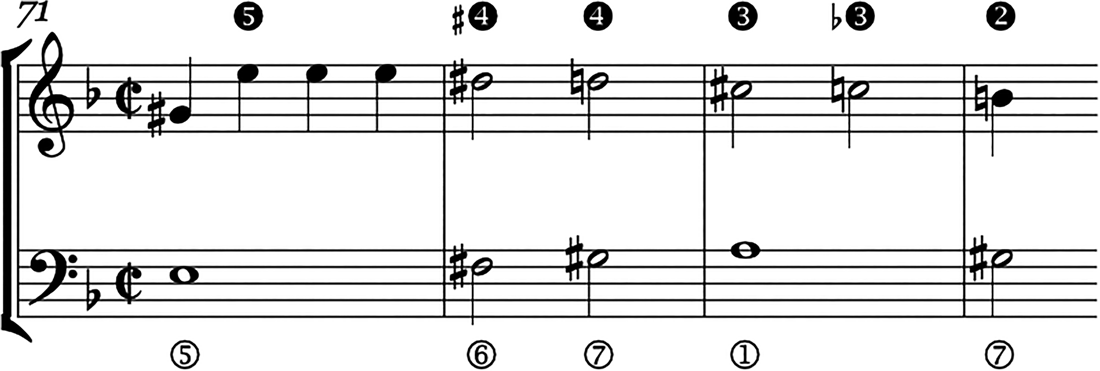
As mentioned above, most of the rules that had been dealt with in partimento class were expanded upon during the counterpoint lessons in order to exhaust their harmonic and contrapuntal possibilities, a teaching strategy that applied to the rules concerning the DPCD as well. Example 7, an excerpt in A minor from a two-part disposizione in F major written by Muscogiuri in 1781, illustrates, for instance, that the chromatic derivatives of the two four-note segments of the rule of the octave as described in relation to Example 6 could include even one more chromatic semitone. Not only the fourth but also the third scale step could appear in a diatonic and a chromatically altered version, resulting in a complete chromatic descent from ❺ to ❷.
Muscogiuri, Disposizione in F major (Naples, 1781). Accademia Filarmonica (Archivio Biblioteca), Bologna (I-Baf), MSGI-MUSC-MUS.1 (C. 1R), fol. 37v, bars 71–741. Used by permission

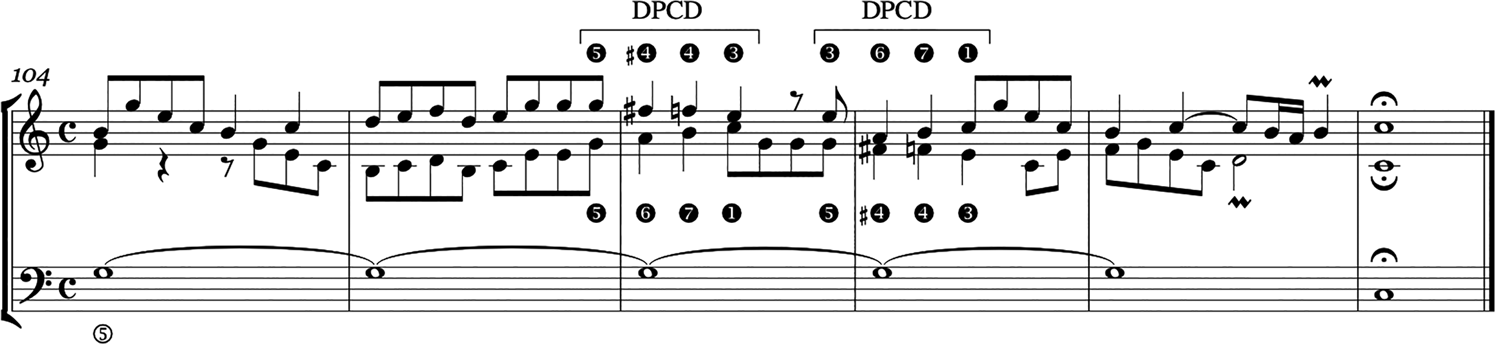
In addition, the DPCD itself was further explored during the counterpoint lessons. Above the dominant pedal at the end of a three-part disposizione in C major also dating from 1781, Muscogiuri wrote two consecutive statements of a four-stage instead of a six-stage version of the schema, inverting the chromatic descent and the counterpoint that starts on ❺ during the second statement (Example 8).Footnote 13 That the first four stages of the DPCD can form a distinct unit arises from the fact that stage 4, although holding an unstable six-four chord, contains the resolution of the vertical tritone or diminished fifth of stage 3. Note that, as we will see, writing two consecutive statements of a DPCD is common practice in the eighteenth century.
Muscogiuri, Disposizione in C major (Naples, 1781). I-Fc B.505, fol. 66v, bars 104–109. Used by permission

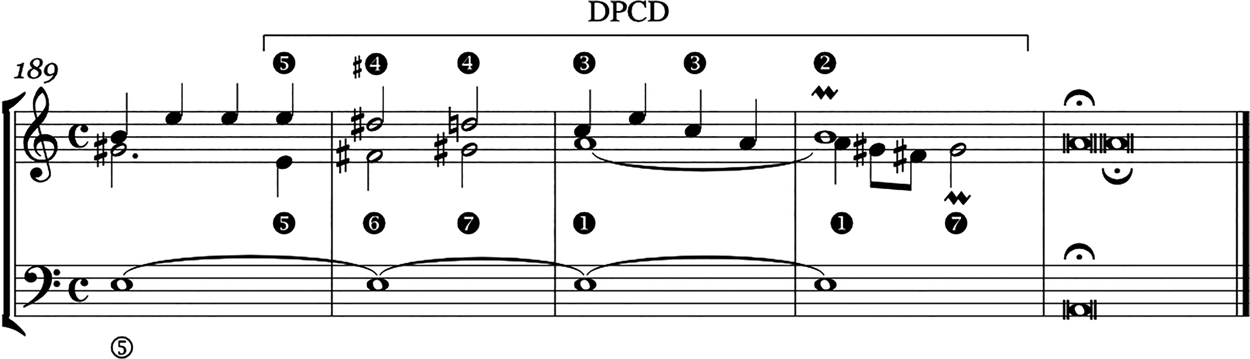
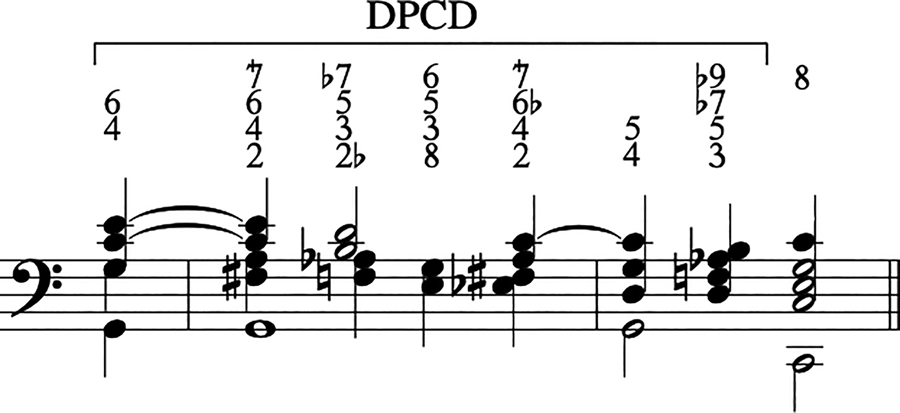
Fenaroli's counterpoint students also learned that a DPCD could be expanded by one stage, adding a suspension of a fourth to the triad of stage 6. Example 9 shows such a seven-stage DPCD at the end of another three-part disposizione, in A minor, again written by Muscogiuri in 1781.Footnote 14 In this case, the second half of the pattern merges with a cadenza doppia, a cadential formula that works as a short dominant pedal and that Fenaroli described as having four stages, these being 5/3 or 7/3, 6/4, 5/4 and 5/3 or 7/3. In fact, one could argue that the entire DPCD here works as an ornamented cadenza doppia. While any version of a DPCD shows an affinity with this type of cadence – yet another illustration of how the DPCD builds on earlier introduced rules – the resemblance between a seven-stage DPCD and a cadenza doppia is indeed unmistakable.
Muscogiuri, Disposizione in A minor (Naples, 1781). I-Fc B.505, fol. 68v, bars 189–194. Used by permission

Another means of refining students’ writing skills during counterpoint lessons was to explore imitative possibilities and stretto. Example 10, which displays the conclusion of a four-part fugue in G minor written by Lavigna in 1795, demonstrates such a possibility, using two overlapping statements of a DPCD – another habitual manipulation within galant repertory. The first entry of the pattern, again a seven-stage version, presents the chromatic descent in the soprano, the counterpoint starting on ❺ in the alto and the counterpoint starting on ❼ in the tenor. As for the second statement, it does not wait for the first to finish but enters on that version's fifth stage with the chromatic descent in the tenor, making the schema start, as do the two four-stage statements in Example 8, with a six-four sonority instead of a triad. (The second statement has no regular counterpoints.)
Lavigna, Fugue in G minor (Naples, 1795). I-Mc Noseda Th.c.117, fol. 115v, bars 280–290. Used by permission

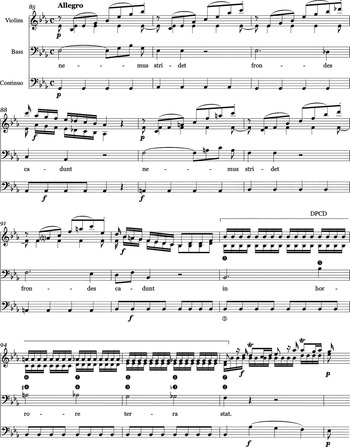
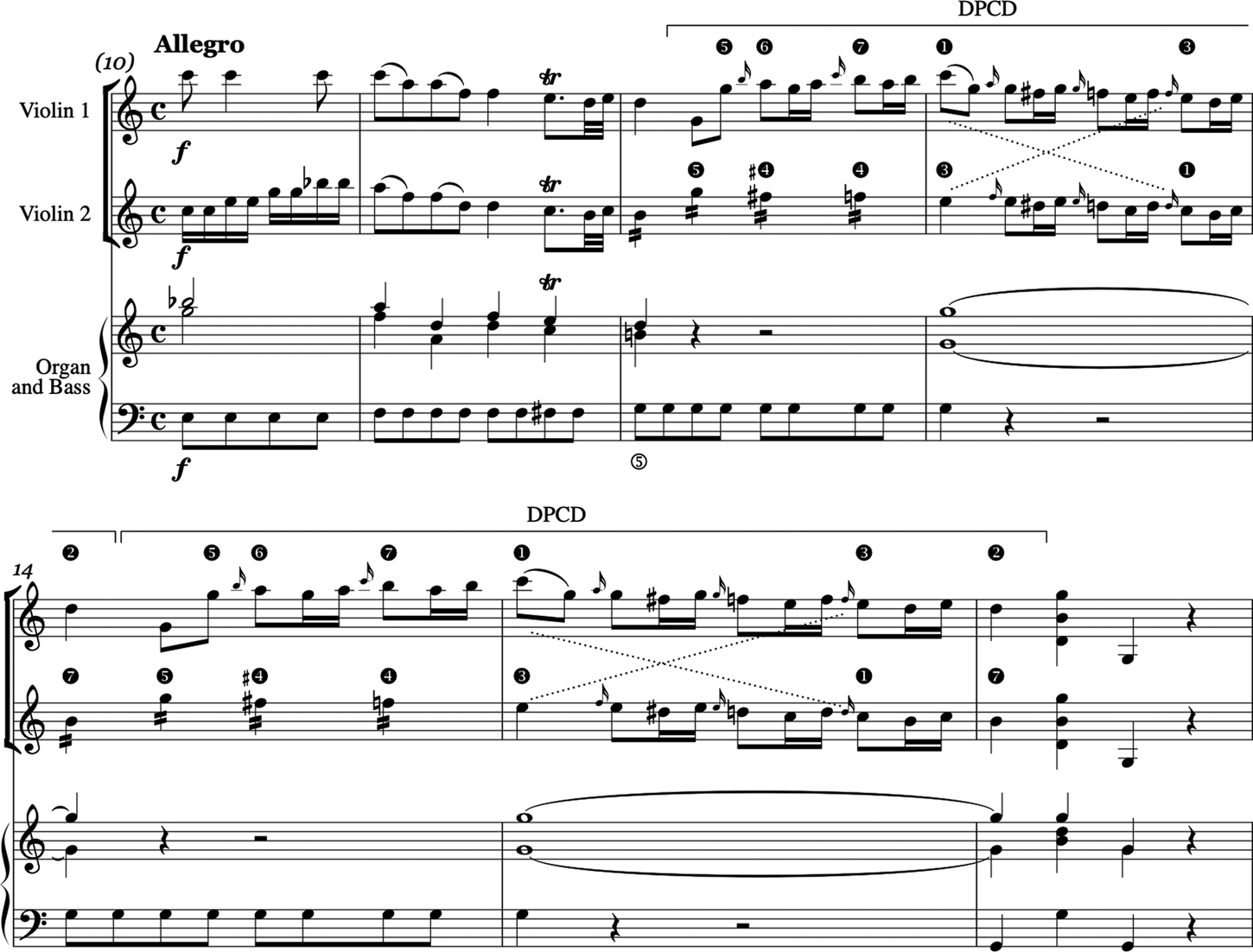
In all the examples that we have seen to this point, the DPCD has been used to prolong the dominant in the context of an authentic cadence.Footnote 15 The next sample, however, displays another syntactic function of the DPCD. Consider Example 11, an excerpt from the aria for bass ‘Quando cœlum fulmen vibrat’ in E flat major, itself part of the motet Cœli voces that Domenico Cimarosa (1749–1801) wrote in 1767 as a student at the Loreto.Footnote 16 In this case, the DPCD – a three-part exemplar including the counterpoint starting on ❺ – works as a dominant-pedal phrase extending a half cadence, that is, as a phrase that Gjerdingen, after Joseph Riepel (1709–1782), might call a Ponte (bridge). Broadly labelling it a ‘dominant pedal point’, Gjerdingen elaborates on its syntactic usage by explaining that ‘in the latter half of the eighteenth century the Ponte was part of various delaying tactics employed to heighten expectation prior to an important entry or return’.Footnote 17 As for the half cadence itself, it is arrived at, from bars 85 to 92, via a ③–④–♯④–⑤ scale-step progression in the bass, coinciding with what Gjerdingen and Riepel would probably call a Monte.Footnote 18 Observe further how the DPCD's chromatic sigh figures and vertical major seventh between the vocal bass (doubled by the first violin) and the continuo during stage 2 efficiently underline the text ‘in horrore terra stat’ (the earth lives in terror). (Although the DPCD is indeed well suited for expressing dramatic, burdensome circumstances, it does occur in more optimistic contexts as well; see below.Footnote 19)
Domenico Cimarosa, Cœli voces (Naples, 1767), ‘Quando cœlum fulmen vibrat’ (When the sky breaks out in thunder), fols 22v–23v, bars 85–971 (winds and viola omitted). Translation of the text in the excerpt: ‘the forests resound, the leaves fall, the earth lives in terror’ (based on the autograph score, Biblioteca del Conservatorio di Musica San Pietro a Majella, Naples (I-Nc), 20.5.11, available at Online Public Access Catalog/Servizio Bibliotecario Nazionale, opac.sbn.it). Used by permission

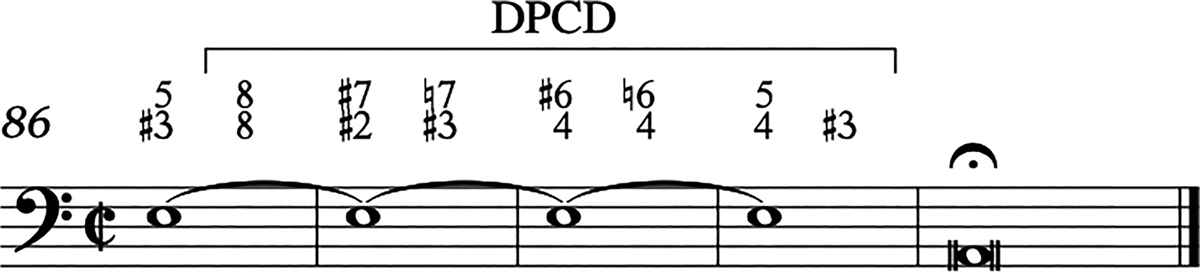
A complete overview of if and how the DPCD was integrated into music pedagogies all over eighteenth-century Europe would be far beyond the scope of this article, but a limited number of references should suffice here to illustrate that it was anything but restricted to teaching at the Loreto. To begin with, the DPCD also occurs in the pedagogical output of eighteenth-century maestri that taught at other Neapolitan conservatori, for instance in partimenti by Nicola Sala (1713–1801), who taught at the Conservatorio di Santa Maria della Pietà dei Turchini, and in disposizioni of Carlo Cotumacci (1709–1785), who taught at the Conservatorio di Sant'Onofrio a Capuana. Example 12 shows just one, seven-stage, exemplar from Cotumacci's fifth disposizione.
Carlo Cotumacci, Disposizione in A minor (Naples). I-Bsf M. C. IX-4, fol. 3v, system 6, bars 86–91. Used by permission

However, this schema was not only used in the music-pedagogical contexts of Naples and, more generally, of Italy. Amongst the German thoroughbass treatises of that period that contain illustrations of the DPCD are, for instance, the second volume of Versuch über die wahre Art das Clavier zu spielen from 1762 by Carl Philipp Emanuel Bach (1714–1788), Deutliche Anweisung zum General-Baß from 1772 by Christoph Gottlob Schröter (1699–1782) and Kurze Anweisung zum Generalbaßspielen from 1791 by Daniel Gottlob Türk (1750–1813).Footnote 20 Still, rather than giving the voice leading as typified in Example 2, these treatises propose variants of the DPCD. From Bach's treatise, Example 13 shows a seven-stage version in five parts with a significant counterpoint in the top voice, a version that Türk reproduced in his Kurze Anweisung.Footnote 21 Contrary to the counterpoints starting on ❺ and ❼, this counterpoint does not rise but descends diatonically. While producing a 7–6 sequential pattern against the chromatic descent, it starts on ❸, set as a six-four chord, and finishes on ❼.Footnote 22 Bach's treatise also contains the shortest version of a DPCD, a version that appears in Schröter's treatise as well (Example 14 shows the exemplars from both treatises). Being part of an authentic cadence, this type of DPCD comprises only three stages, the vertical diminished fifth of stage 3 not resolving above ⑤ as stage 4 of the pedal but above ①.Footnote 23
Carl Philipp Emanuel Bach, Versuch über die wahre Art das Klavier zu spielen, volume 2 (Berlin: Winter, 1762), chapter 24, unnumbered example, 183–184; reproduced in Daniel Gottlob Türk, Kurze Anweisung zum Generalbaßspielen (Leipzig: Schwickert and Halle: Hemmerde and Schwetschke, 1791), chapter 9, example 2, 251

(a) Carl Philipp Emanuel Bach, Versuch über die wahre Art das Klavier zu spielen, volume 2, chapter 16, section 2, unnumbered example, 155; (b) Christoph Gottlob Schröter, Deutliche Anweisung zum General-Baß (Halberstadt: Groß, 1772), chapter 19, section 3, example d, 147

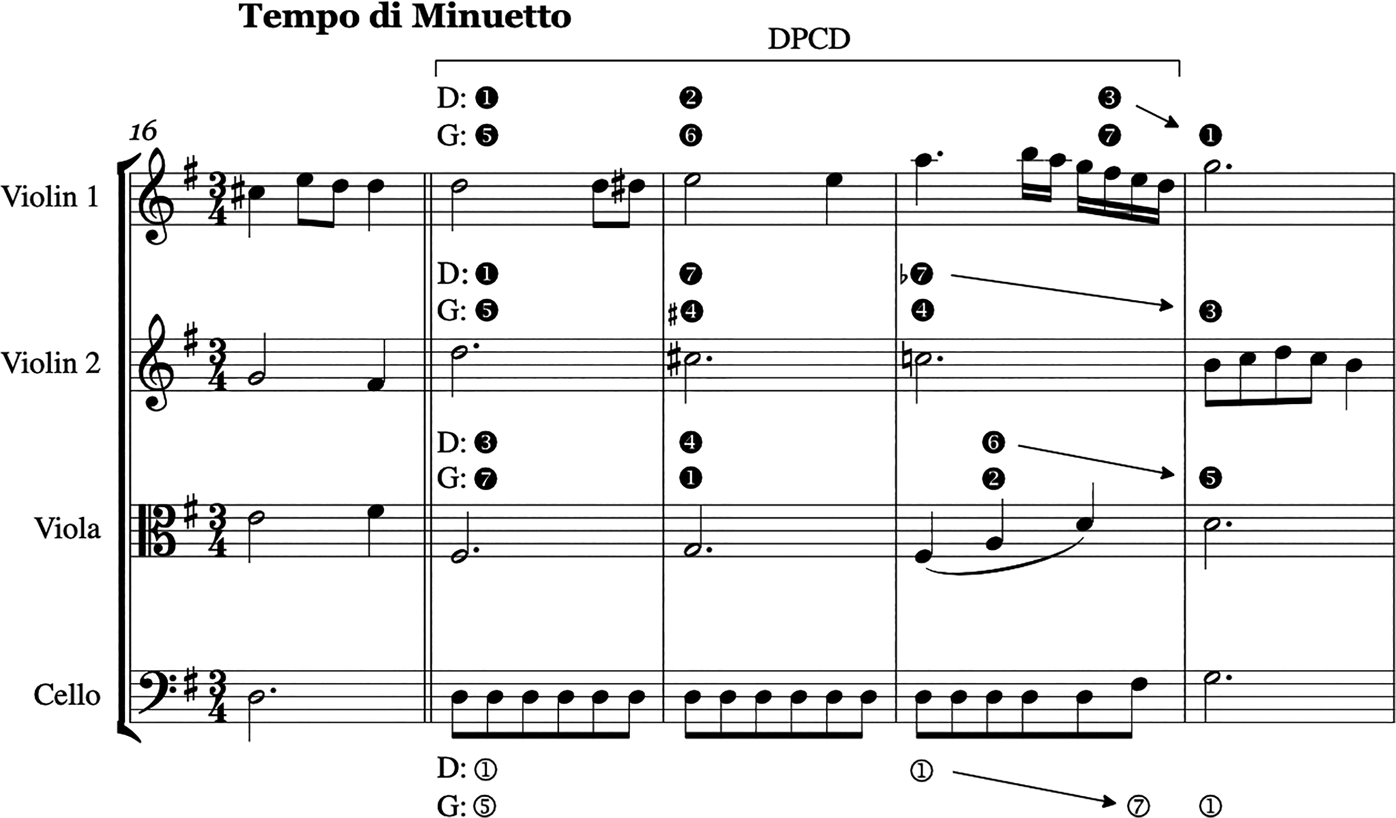
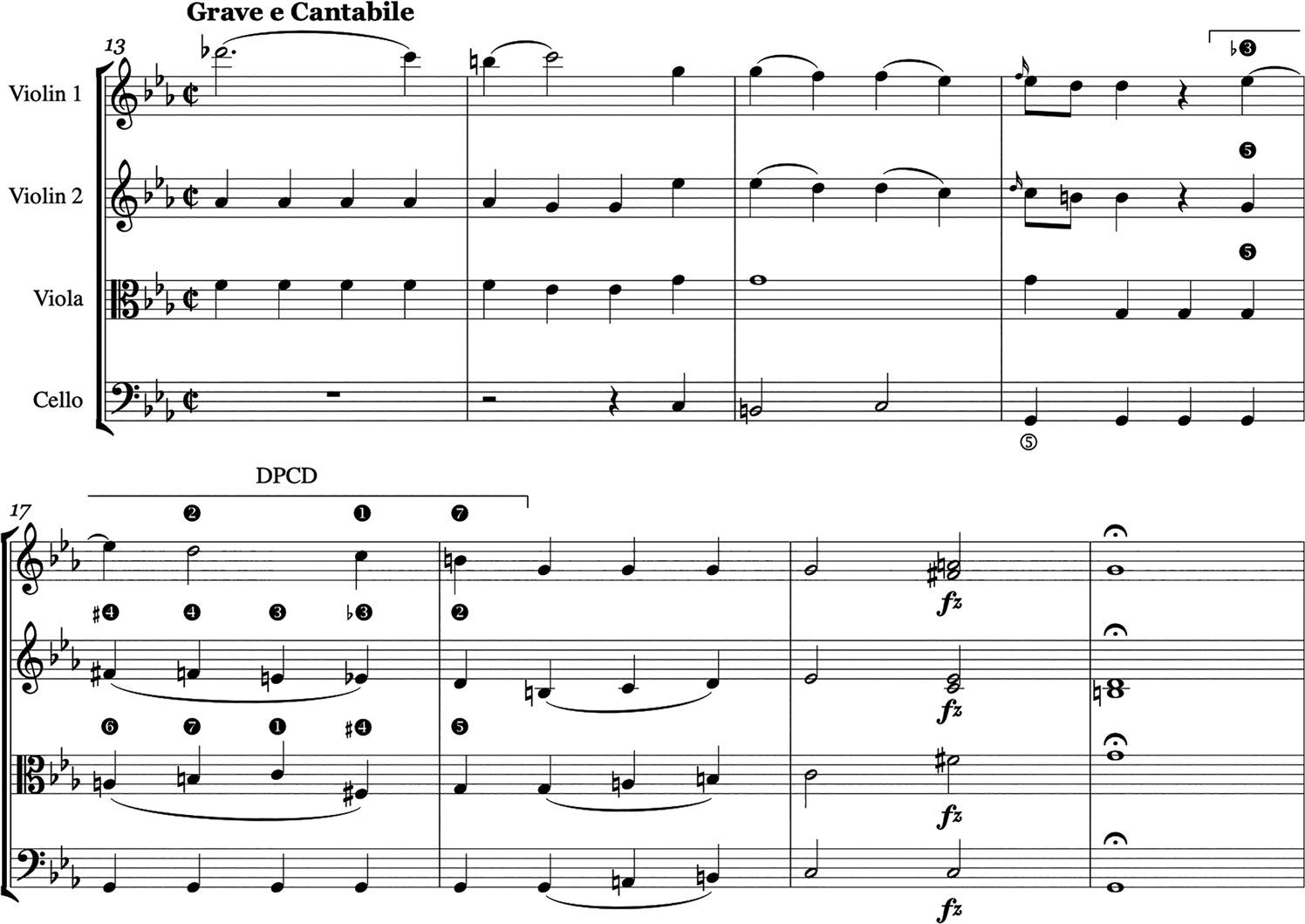
With regard to eighteenth-century Austrian music teaching, noticeable occurrences of a DPCD are those that Maria Anna Barbara Ployer (1765–1810) and Thomas Attwood (1765–1838) wrote under Wolfgang Amadeus Mozart.Footnote 24 Example 15 shows a four-part realization of this voice-leading pattern from a minuet in G major for string quartet from Attwood's notebook in the version corrected by Mozart. Structurally, it consists of three stages, including both the counterpoint that starts on ❺ (first violin) as well as the one that starts on ❼ (viola). Syntactically, it acts as what Gjerdingen calls ‘Riepel's archetypal Ponte’. He explains that this type of Ponte ‘can be found immediately following the double bar in a minuet’ and serves as a ‘bridge [connecting] the just-cadenced “second” key with a return to the original key’,Footnote 25 in this case by means of a dominant pedal that leads into a clausula cantizans. Still, ‘modulation of this type is implicit rather than explicit, and depends almost entirely on the listener's experience and expectations’, as Gjerdingen rightly points out.Footnote 26 In spite of the preceding authentic cadence in D major that concludes the first half of Attwood's minuet, does one hear bars 17–20 immediately as a dominant pedal in G major to introduce the next phrase in that key, knowing that this is indeed a likely scenario after the double barline? Or does one rather hear the beginning of the pedal in D major, continuing the key of the authentic cadence in bars 15–16, until the dominant seventh chord of bar 19, with c(♮)2, starts suggesting G major? The annotations in Example 15 schematize these possible listening scenarios. Note that the possibility of hearing bars 17–20 in D major demonstrates that the central voice-leading pattern investigated in this article can also be used at a tonic level, an option I will come back to below.
Thomas Attwood, Tempo di Minuetto, bars 16–20, version corrected by Mozart (Neue Mozart-Ausgabe, series 10, volume 30/2, ed. Hellmut Federhofer and Alfred Mann (Kassel: Bärenreiter, 1989)). Used by permission

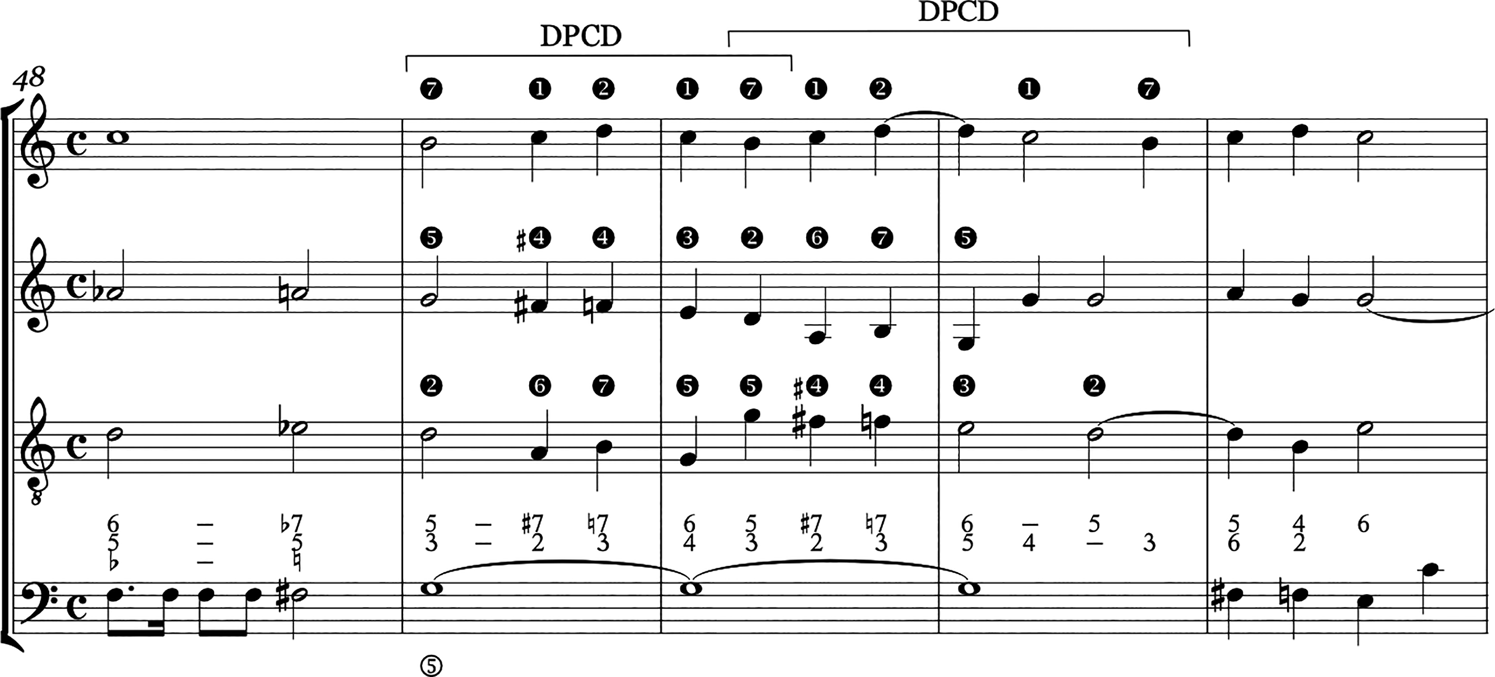
Another Austrian pedagogical source that makes use of the DPCD is the undated treatise Fundamenta Compositionis written by Anton Cajeton Adlgasser (1729–1777), who was a German composer and organist active at the Salzburg court and cathedral. This treatise includes two four-part elaborations in C major, each of which includes two overlapping statements of the DPCD.Footnote 27 Example 16 shows the second pair, which is almost identical to the first pair in terms of voice leading and structure. The first DPCD presents a five-stage version, a version that we have not yet encountered. As the stage that features ♭❸ is absent from the pattern, the last stage falls on the second instead of on the third beat of bar 50. As for the second statement of the DPCD, it enters after stage 4 of the first statement, as does the one written by Lavigna in Example 10. Observe further two particularities regarding the counterpoints that Adlgasser has used here. First, the counterpoint in the tenor during the first statement, a strand that the alto repeats during the second statement, consists of a ❷–❻–❼–❺ instead of a more regular ❺–❻–❼–❶ scale-step progression. Secondly, the line in the soprano during the second statement combines two counterpoints that we have already seen. During the first three stages, it acts as the counterpoint starting on ❼, rising by stepwise motion from ❼ to ❷. Once it has reached ❷, it continues as the descending counterpoint with suspensions, producing the second and third suspensions from that type of line. Syntactically, the statements of the DPCD in Example 16 lead into a clausula altizans.
Anton Cajeton Adlgasser, Fundamenta Compositionis (Vienna). Bayerische Staatsbibliothek, Munich (D-Mbs), Mus.ms. 1695, fol. 16r, bars 48–52 (available on IMSLP, www.imslp.org)

Although I have only been able to show a limited number of statements and variants of the DPCD in this section on eighteenth-century music pedagogy, they do cover the schema's basic structural possibilities, techniques of voice leading and syntactic usages. Summarizing its possible configurations, a DPCD can consist of three to seven stages, during which the chromatic descent is generally joined by one or more from the following diatonic counterpoints: an ascending counterpoint that starts on ❺, an ascending counterpoint that starts on ❼ and a descending counterpoint that starts on ❸. As for its normal syntactic implementations, a DPCD can be used first to prolong ⑤ leading up to an authentic or interrupted cadence, whether or not acting at the same time as ‘Riepel's archetypal Ponte’, a bridge that opens the second half of a minuet – or of any movement with two halves – whose role is to bring the music back from the dominant to the tonic key. Secondly, a DPCD used as a dominant-pedal phrase is another way to realize an archetypal Ponte. Thirdly, it can also be used as a dominant-pedal phrase to extend a half cadence, a dominant phrase that Gjerdingen describes as a more general type of Ponte, one employed to create a sense of anticipation.
2. The DPCD in Eighteenth-Century Compositions
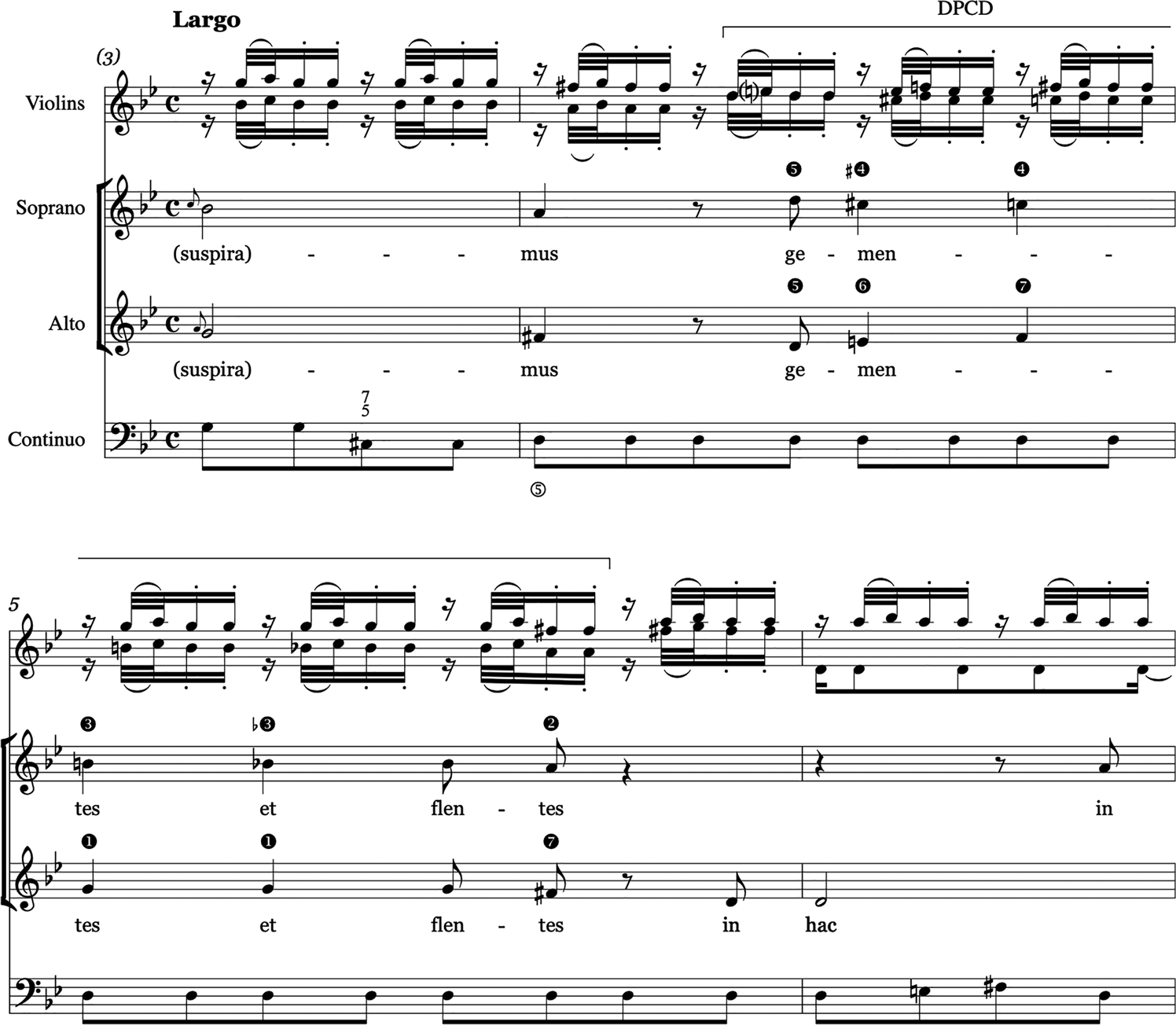
My first example of a DPCD in an actual eighteenth-century composition appears in an undated Salve Regina in F minor for soprano, alto, two violins and continuo (Example 17). It has been attributed to the Neapolitan composer and first-generation partimento maestro Alessandro Scarlatti (1660–1725); stylistically, however, it more resembles the works of Giovanni Battista Pergolesi (1710–1736). (Symétrie have published this Salve Regina with an unequivocal attribution to Alessandro Scarlatti.Footnote 28) In the third movement, the ‘Ad te suspiramus’ in G minor, the DPCD is used to set the words ‘gementes et flentes’ (mourning and weeping), a setting that fittingly enhances the meaning of the text, as does the one in Example 11. Syntactically, the DPCD works here as a Ponte extending a half cadence with a ♯④–⑤ scale-step progression in the bass.
Alessandro Scarlatti?, Salve Regina, ‘Ad te suspiramus’, bars 33–62. Translation of the text in the excerpt: ‘(we sigh,) mourning and weeping in this (valley of tears)’ (based on the full score, ed. Jean-Christophe Michel (Lyon: Symétrie, 2001)). Used by permission

Two years after Cimarosa wrote his Cœli voces, Antonio Sacchini (1730–1786), another Neapolitan-trained composer, wrote a Te Deum in D major that included two statements of a DPCD in the first movement of the same name. (Sacchini studied with Durante at the Loreto, as did Fenaroli. Before leaving that institution and becoming a composer of international repute, Sacchini taught there too, though briefly, counting Cimarosa amongst his students.Footnote 29) Example 18 shows the pattern's first statement, in a tonicized G major. While this DPCD again displays the six-stage model with the counterpoint starting on ❺,Footnote 30 its chromatic descent (first soprano and first violin) includes only one chromatic step – ♯❹–❹ – after which the diatonic version of the third scale step appears not only during stage 4 but also during stage 5 – a design that, as mentioned earlier, was common in the eighteenth century. Syntactically, both statements of the DPCD work here as a Ponte that extends a half cadence called a clausula vera by Gjerdingen, in this case, a ⑥–⑤ cadence.Footnote 31
Antonio Sacchini, Te Deum (Naples, 1769), ‘Te Deum Laudamus’, bars 110–119 (horns and viola omitted) (based on the full score, ed. Jolando Scarpa (Bologna: Ensemble Laura Conti, 2005), available on IMSLP, www.imslp.org)

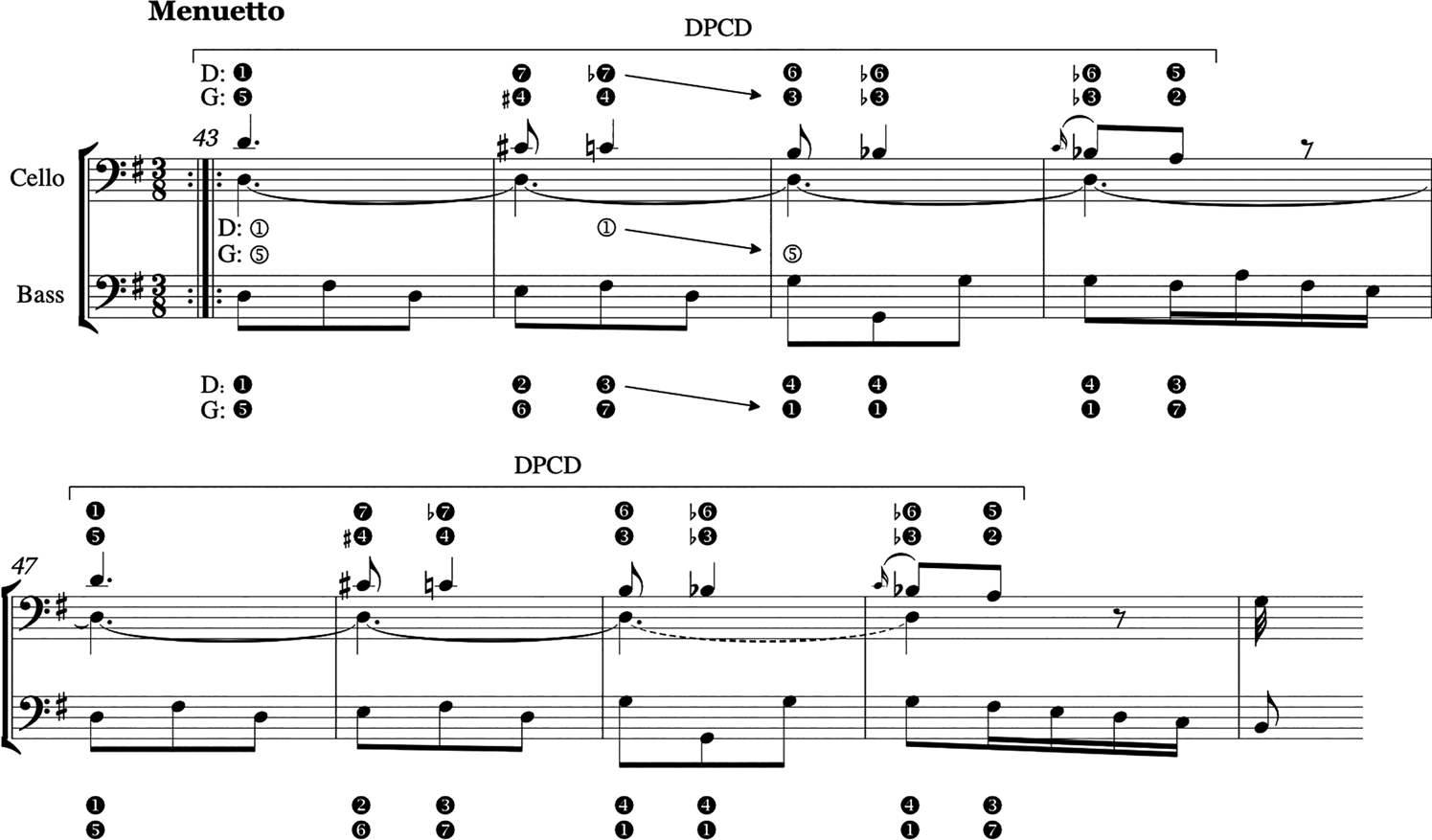
While Cimarosa and the composer of the undated Salve Regina in F minor used a DPCD to depict, respectively, terror (Example 11) and mourning and weeping (Example 17) in the context of a dramatic aria, Luigi Boccherini (1743–1805) included that pattern in the charming and highly diatonic minuet of his Cello Sonata in G major g5 (Example 19). (Probably in 1772 or 1773, the Scottish music editor Robert Bremner published in London Six Sonata's [sic] Pour le Violoncelle by Boccherini, g5 being the third of that collection.) Contrary to the previous examples, the DPCD appears here not in a six-stage, but in a seven-stage version. And contrary to the instances of a seven-stage DPCD seen in the section on music pedagogy, the one shown in Example 19 includes not only an onbeat dissonant fourth but also an onbeat minor sixth during stage 6, resulting in an appoggiatura six-four chord.Footnote 32 As a matter of fact, not one but two consecutive statements of a DPCD occur in this minuet – another common feature of the time, still only temporarily and slightly darkening the mood. These statements appear at the opening of the minuet's second half and act as ‘Riepel's archetypal Ponte’, providing a retransition from the (local) dominant key to the tonic key. As those do in Example 15, the annotations in Example 19 intend to schematize the possible ways for a listener to understand this Ponte.
Luigi Boccherini, Cello Sonata in G major g5, Menuetto, bars 43–511, Six Sonata's [sic] Pour le Violoncelle (London: Robert Bremner, 1772 or 1773)

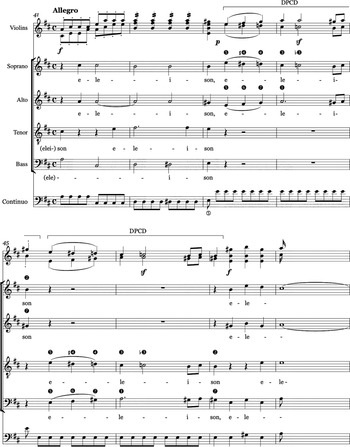
As one might expect, the DPCD occurs not only in the context of Fenaroli's teaching but also in his compositions. Just a few years after Cimarosa had finished studying at the Loreto, in 1774, Fenaroli wrote a Mass in D major with no fewer than nine statements of this schema, six of which appear in the outer sections of the Kyrie. Example 20 shows the first two from the first ‘Kyrie’, which follow each other immediately. Both statements of the DPCD in this example work as a Ponte extending a half cadence reached via a ③–④–♯④–⑤ scale-step progression in the bass, in this case in A major. As mentioned above, two consecutive statements of a DPCD are found regularly in eighteenth-century music, in which case the second one often undergoes some kind of variation. While Boccherini, in Example 19, kept – at least on paper – the second statement identical to the first, in Example 20 Fenaroli used the invertibility of the schema's upper voices and change of register for this purpose. The chromatic descent in the first statement of the DPCD is sung by the soprano, the diatonic counterpoint by the alto. Using a similar distribution of voices to that found in Example 17, the violins double these voices but do so in inversion, the first violin producing the diatonic counterpoint an octave higher than the alto. Once the soprano and the alto have finished their presentation of the schema, the tenor and the bass take over, reproducing it in the same registral position, that is, again with the chromatic line in the highest voice, in this case the tenor. Instead, however, of simply transposing the violin parts an octave down as well, and thus presenting once more the inversion of the upper voices of the DPCD, Fenaroli varied the setting of the violins by giving them the same registral position as that of the tenor and the bass, albeit an octave higher.
Fenaroli, Mass in D major (Naples, 1774), Kyrie 1, fol. 4r–v, bars 41–48 (winds and viola omitted) (based on the autograph score, I-Nc Rari 1.9.6 (8), available at Online Public Access Catalog/Servizio Bibliotecario Nazionale, opac.sbn.it). Used by permission

Example 20 also displays another, common variation of this pattern, one concerning the rhythmic distribution of stages 4 and/or 5. Both here and in Example 17 each of the first three stages lasts a crotchet, falling on beats 2 to 4 at the beginning of the pedal. In Example 17, the same harmonic rhythm is maintained in the next bar, reaching the end of the pattern on beat 3 of that bar. In Example 20, however, stage 5 lasts thrice as long, resulting in the pattern concluding on the next downbeat. While Fenaroli basically had three rhythmic options for distributing stages 4 and 5 over a semibreve – the option with two minims being probably the most self-evident one – the actual version gives special attention to the presence of ♭❸ in major mode thanks to the syncopation, which Fenaroli has rendered even more colourful in both violins by means of a sforzando.
A DPCD with a similar metrical distribution occurs four times during two identical pedals in the first movement of Mozart's Church Sonata in C major k263 from 1776. In this case, both pedals work as a Ponte that extends what Gjerdingen would probably call a Converging Cadence,Footnote 33 pedals that close off the C major section of the exposition and the recapitulation. Example 21 shows the first dominant pedal. Where Mozart's statements of a DPCD differ from Fenaroli's, however, is not only in the absence of ♭❸ from the chromatic descents, but also in a voice exchange of the upper voices once stage 4 has been reached on the downbeats of bars 13 and 15, a voice leading that is essentially identical to that in Example 5b.
Wolfgang Amadeus Mozart, Church Sonata in C major k263/i, bars 103–16 (Neue Mozart-Ausgabe, series 6, volume 16, ed. Minos E. Dounias (Kassel: Bärenreiter, 1957); trumpets omitted). Used by permission

In the examples of a DPCD we have seen up until now, stages 4 and 5 are both set as a six-four chord. While preserving that chord during stage 4, eighteenth-century composers also presented two other harmonic solutions for stage 5 by combining the pattern's upper voices with a chromatically raised fourth scale step that occurs either in the bass, thus temporarily interrupting the pedal, or in a third upper voice. In the first movement of the early Keyboard Sonata in G major hXVI:6, Joseph Haydn twice wrote a DPCD featuring ♯④ in the bass during stage 5, resulting in a diminished-seventh chord instead of a six-four chord.Footnote 34 Syntactically, both passages act as a Ponte that extends a half cadence ending with a ④–②–⑤ bass progression, the first of these occurring in the D major section of the exposition (Example 22), the second one in the recapitulation in G major. In fact, not one but two successive ♯④–⑤ scale-step progressions in the bass conclude these statements of a DPCD, a feature that adds to the emphasis this progression in itself already carries. Note further that the counterpoint starting on ❼ (middle voice) acts here as sole counterpoint to the chromatic descent (top voice).
Joseph Haydn, Keyboard Sonata in G major hXVI:6/i, bars 93–12 (Joseph Haydn, Sämtliche Klaviersonaten, volume 1, ed. Georg Feder (Munich: Henle, 2020)). Used by permission

An example of a DPCD with a raised fourth scale step at stage 5 in an upper voice occurs in the Second Sonata in C minor from Die sieben letzten Worte unseres Erlösers am Kreuze (The Seven Last Words of Our Saviour on the Cross) by Haydn. I use the string-quartet version for Example 23. In the context of a four-part setting, Haydn has integrated this type of DPCD into a Ponte that extends a half cadence ending with a ①–⑤ scale-step progression in the bass (bars 152–16), a Ponte that brings the first, tonic section of this sonata to an end before passing on to E flat major. Of the two possible counterpoints that rise diatonically, Haydn has retained here only the one that starts on ❺ (viola), yet opting for a different ending to the counterpoints of this type that we have seen up to this point: not a ❶–❼ but a ♯❹–❺ scale-step progression concludes this counterpoint. Instead of the first violin producing the counterpoint that starts on ❼, a viable option,Footnote 35 it imitates the descending ♭❸–❼ scale-step progression that the second violin plays on approach to the half cadence, changing the sigh figures into suspensions and as such becoming the descending counterpoint with syncopations starting on ♭❸ that we saw in relation to the seven-stage DPCD from Bach's treatise (Example 13). Contrary to Bach's version, however, Haydn's DPCD comprises six instead of seven stages, with the result that its descending counterpoint starting on ♭❸ includes two instead of three suspensions. Incidentally, during stages 5 and 6, this counterpoint does include the ❶–❼ scale-step progression that is absent at that point from the counterpoint that starts on ❺, ❶ acting as the resolution of the second suspension. Note also that, just as the first violin imitates the second violin of bars 142–161, so the chromatic descent in the second violin varies the diatonically descending ❺–❷ scale-step progression that the first violin produces on the approach to the half cadence.
Haydn, Die sieben letzten Worte unseres Erlösers am Kreuze, Sonata 2 in C minor, bars 13–20, ed. Christin Heitmann (Munich: Henle, 2008). Used by permission

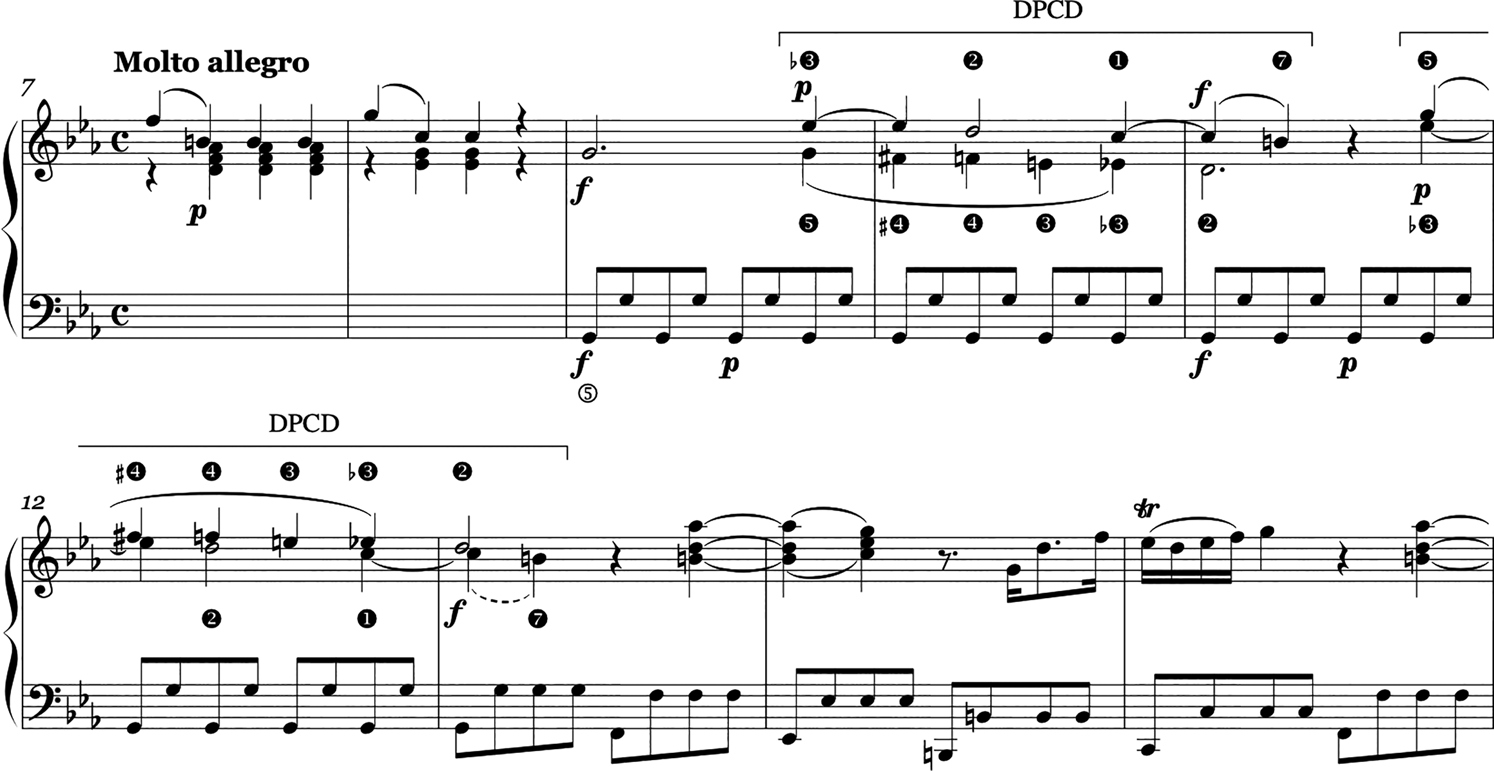
The descending counterpoint with suspensions and starting on (♭)❸ appears in three-part settings of a DPCD as well, where it acts as sole counterpoint to the chromatic descent. Example 24 displays two consecutive seven-stage statements of such a variant from the first movement of Mozart's Keyboard Sonata in C minor, k457, written in 1784. This DPCD starts the second part of this movement's main theme. It leads into a clausula altizans that proves to be the first cadential gesture of a variant of another schema defined by Gjerdingen, the Fenaroli.Footnote 36 Mozart opted here to vary the second statement of the DPCD by inverting the upper voices of the first statement. Indeed, just as the chromatic descent and the rising counterpoint that starts on ❺ are invertible, so are that chromatic descent and the descending counterpoint that starts on (♭)❸.
Mozart, Keyboard Sonata in C minor, k457/i, bars 7–15 (Neue Mozart-Ausgabe, series 9, volume 25/2, Klaviersonaten Band 2, ed. Wolfgang Plath and Wolfgang Rehm (Kassel: Bärenreiter, 1986)). Used by permission

I mentioned earlier that Cimarosa integrated the DPCD several times into works he wrote as a student at the Loreto. Yet he continued to use it as a professional composer. In the ‘Regina angelorum’ in B flat major from his Litanie dated 1775, for instance, Cimarosa penned two varied statements of a DPCD, the second of which is embedded in the first, both as part of a dominant prolongation of an imperfect authentic cadence (Example 25).Footnote 37 The first DPCD is a seven-stage version with a chromatic descent from which ♭❸ is absent (tenor and second violin).Footnote 38 During its first four stages, this DPCD is set in three parts with the counterpoint that starts on ❼ (alto and first violin) as sole complement to the chromatic descent, a setting that in terms of voice leading is similar to that of the first four stages of the DPCD in Example 22.Footnote 39 On stage 5 of the first DPCD, a second, three-stage DPCD starts and produces, as does the second DPCD in Example 10, the most common stretto with the chromatic descent, that is, stretto at the octave.Footnote 40 At that point, the setting becomes four-part, the fourth part being the entry of the second, truncated chromatic descent (soprano and first violin). This second statement of a DPCD further includes the counterpoint starting on ❺ (alto and second violin) and the concluding ❸–❷–❶ scale-step progression from the chromatic descent of the first statement as second counterpoint to the chromatic descent of the second statement – a suspension-free version of the descending counterpoint that starts on ❸.Footnote 41 Yet at the same time, looking at the soprano and the alto of the second DPCD from the perspective of the first chromatic descent, they work as two counterpoints accompanying its conclusion.
Cimarosa, Litanie, ‘Regina angelorum’ (Naples, 1775). I-Nc Rari 1.6.5/3, olim 20.5.13 (autograph score), fol. 15v, bars 43–48 (available at Online Public Access Catalog/Servizio Bibliotecario Nazionale, opac.sbn.it). Used by permission

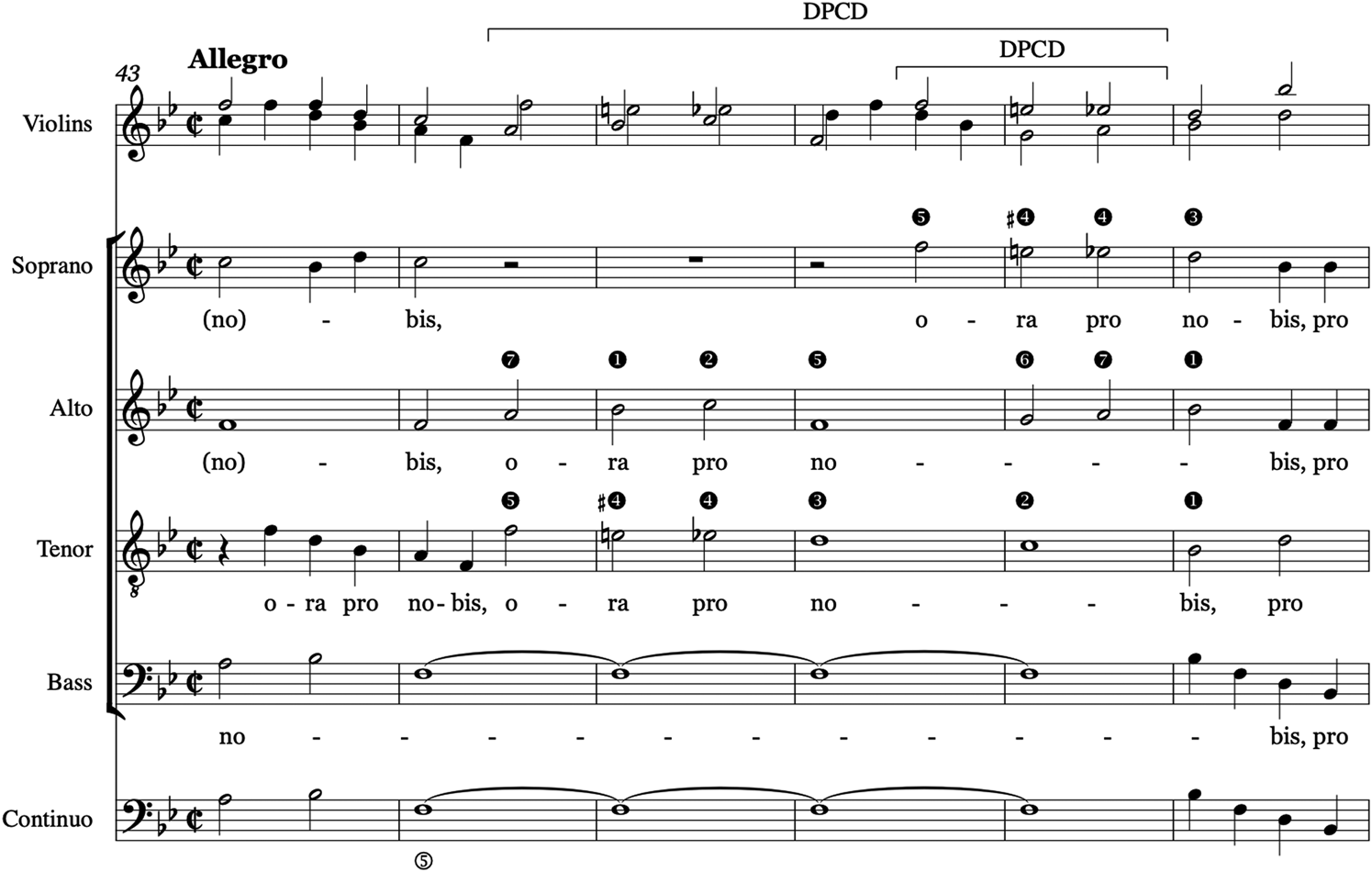
The final example in this section presents a perfect authentic cadence in an elaborate four-part setting with two overlapping, varied statements of a DPCD, including the three main counterpoints we have seen until now, introducing a fourth one and displaying further enhancements to the decoratio that we have not seen before. The excerpt in question is the conclusion of the ‘Et incarnatus/Crucifixus’ from the Mass in D minor by Johann Adolf Hasse (1699–1783). The ‘Et incarnatus’ section is set in B minor, and the ‘Crucifixus’ section is in E minor, while preserving the B minor key signature throughout (Example 26; only the singing voices and the basso continuo have been reproduced, the instruments merely doubling them). (Hasse had mastered his art in Naples with Alessandro Scarlatti before becoming one of the most celebrated composers of his time. In his capacity as Oberkapellmeister at the Dresden court, he wrote the Mass in D minor in 1751 for the inauguration of the Catholic court church.Footnote 42)
Johann Adolf Hasse, Mass in D minor, ‘Et incarnatus/Crucifixus’, bars 21–29 (based on Johann Adolf Hasse: Missa in d, ed. Wolfgang Hochstein (Stuttgart: Carus, 1987)). Used by permission

The first DPCD presents an enhanced version of the chromatic descent (soprano), its second, fourth and sixth stages being introduced with suspensions, and further includes both the counterpoint starting on ❺ (tenor) and the one starting on ❼ (alto). Moreover, the counterpoint starting on ❼ joins the decoratio of the chromatic descent during stage 4, inserting a suspension at that point as well. As for the second statement of the DPCD, it starts at the usual spot when entering ‘too soon’, that is, coinciding with ♭❸ of the first statement, a stage that is set as a six-four chord. While the chromatic descent of this latter statement (tenor) does not include any suspensions, the rhythm of its two pairs of chromatic semitones is varied, the first pair being set as a crotchet followed by a minim, the second as a minim followed by a crotchet.Footnote 43 And contrary to the first statement, it does not include two (mainly) ascending but two descending counterpoints. The counterpoint in the soprano is the one that starts on ♭❸, producing its three typical suspensions. Yet the designation ‘starting on’ is perhaps not entirely appropriate here since this counterpoint flows without interruption or clear articulation from the chromatic descent of the first statement, sharing the ♭❸–❷ scale-step progression with it and continuing its suspensions on each downbeat up to the penultimate bar. As for the counterpoint in the alto, it is one that we have not yet encountered. It starts on ❶, descends then to ♭❼, at which point it runs in parallel thirds with the chromatic descent until it reaches ❺, which then becomes a second pedal for the remainder of the pattern. Note one further refinement: while Hasse could have synchronized the chromatic semitones in the alto and the tenor of bar 26, he opted against it, hence subtly enriching the setting both harmonically and contrapuntally.
3. The DPCD and Other Schemata
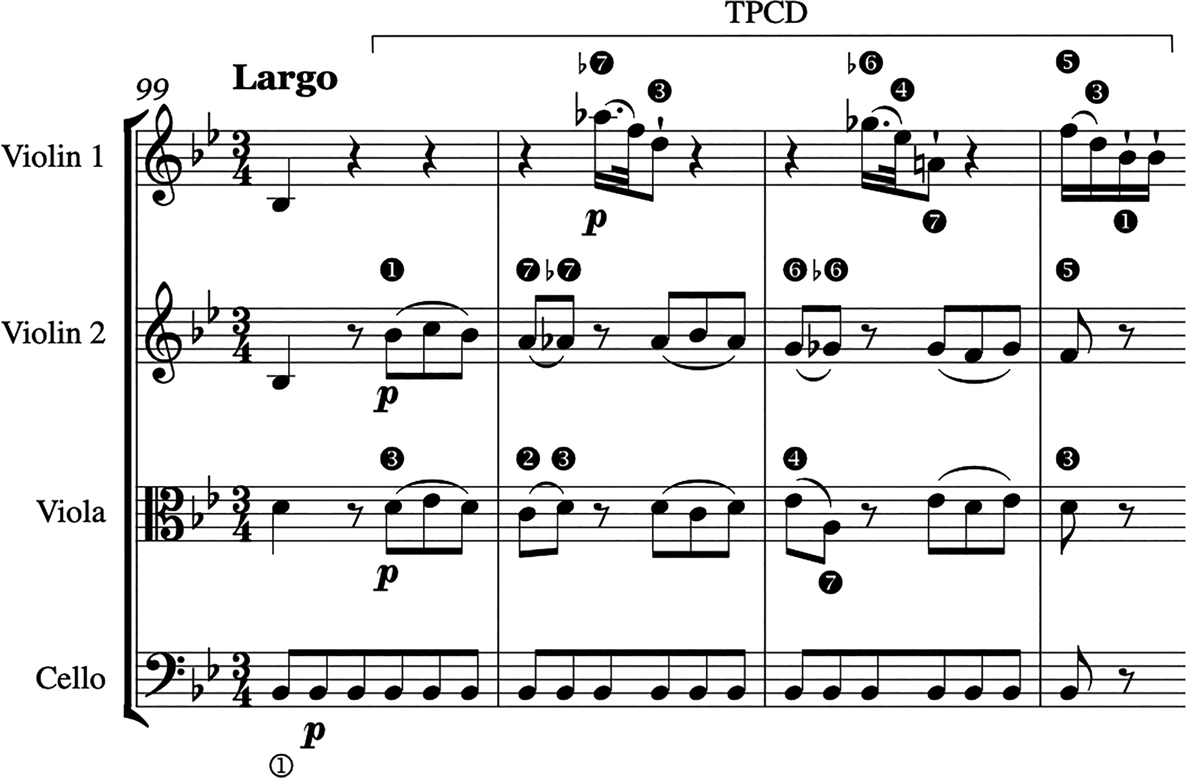
In this section I want to illustrate how the DPCD relates to other pedal-based patterns. First, however, I discuss the tonic pedal accompanied by a chromatic descent (TPCD) and how that in turn relates to other tonic-pedal schemata. A sample of such a TPCD is given in Example 27, which shows the conclusion of the First Sonata in B flat major from Haydn's Seven Last Words. (Again, the string quartet version is used here.) Functioning as an extension of the movement's final perfect authentic cadence, a tonic pedal starts in bar 99, set in essence with two upper lines as exemplified by Example 2, yet at the tonic level: a chromatic descent from ❶ to ❺ in the second violin and a diatonic ❸–❷–❸–❹–❹–❸ counterpoint in the viola.Footnote 44 As for the first violin, by means of compound melody, it includes elements of those two lines. During stages 5 and 6, this technique of compound melody, first in the viola and then the first violin, also results in the suggestion of a third snippet of counterpoint, a ❼–❶ scale-step progression that is the transposition of the ♯❹–❺ scale-step progression as an alternative ending to the counterpoint starting on ❺ in Example 23.
Haydn, Die sieben letzten Worte unseres Erlösers am Kreuze, Sonata 1 in B flat major, bars 99–1021, ed. Christin Heitmann (Munich: Henle, 2008). Used by permission

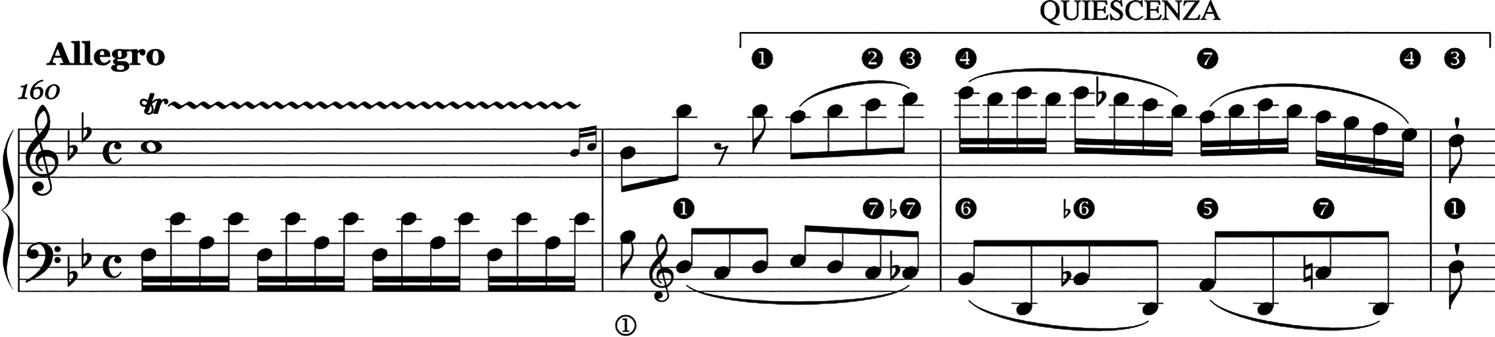
The TPCD, for its part, and even more the version including the ❼–❶ snippet, relates to two other tonic-pedal patterns defined within schema theory. The first one is a voice-leading pattern that Gjerdingen has labelled a Quiescenza. In addition to its tonic pedal, this schema is characterized by a ♭❼–❻–❼–❶ line.Footnote 45 When this line starts with ❶, as is mostly the case, it corresponds to the juxtaposition of the opening four-stage unit of a chromatic descent starting on ❶, yet without ❼, and the ❼–❶ fragment. So, contrary to a six-stage chromatic descent, the paradigmatic voice of a Quiescenza does not exclusively descend, but starts rising normally once ❻ is reached. Gjerdingen also discusses a version of a Quiescenza with ❼ as an optional scale step before ♭❼, a version that further enhances the resemblance with a TPCD.Footnote 46 He even gives a sample of a Quiescenza that is more or less identical to a TPCD with a diatonic counterpoint starting on ❶, an excerpt from the first movement of Mozart's Keyboard Sonata in B flat major k333, written in 1783 (Example 28).Footnote 47 It includes a complete chromatic descent from ❶ to ❺ in the (implied) middle voice and a ❶–❷–❸–❹–❹ scale-step progression from the diatonic counterpoint starting on ❶ in the top voice. Yet the way in which this pattern concludes does make it into a Quiescenza rather than a TPCD. After all, the stage during which the chromatic descent produces ❺ (bar 1623) has not been set as a triad – that would have been the endpoint of a TPCD – but as a 7/5(/4) chord, a chord that still needs to be resolved into a triad to bring the pattern to a close. Thus the ❼–❶ scale-step progression of this Quiescenza follows the ♭❻–❺ scale-step progression instead of coinciding with it in another voice, as it does when a TPCD includes the ❼–❶ counterpoint snippet.
Mozart, Keyboard Sonata in B flat major k333/i, bars 160–1631 (Neue Mozart-Ausgabe, series 9, volume 25/2, Klaviersonaten Band 2, ed. Plath and Rehm). Used by permission

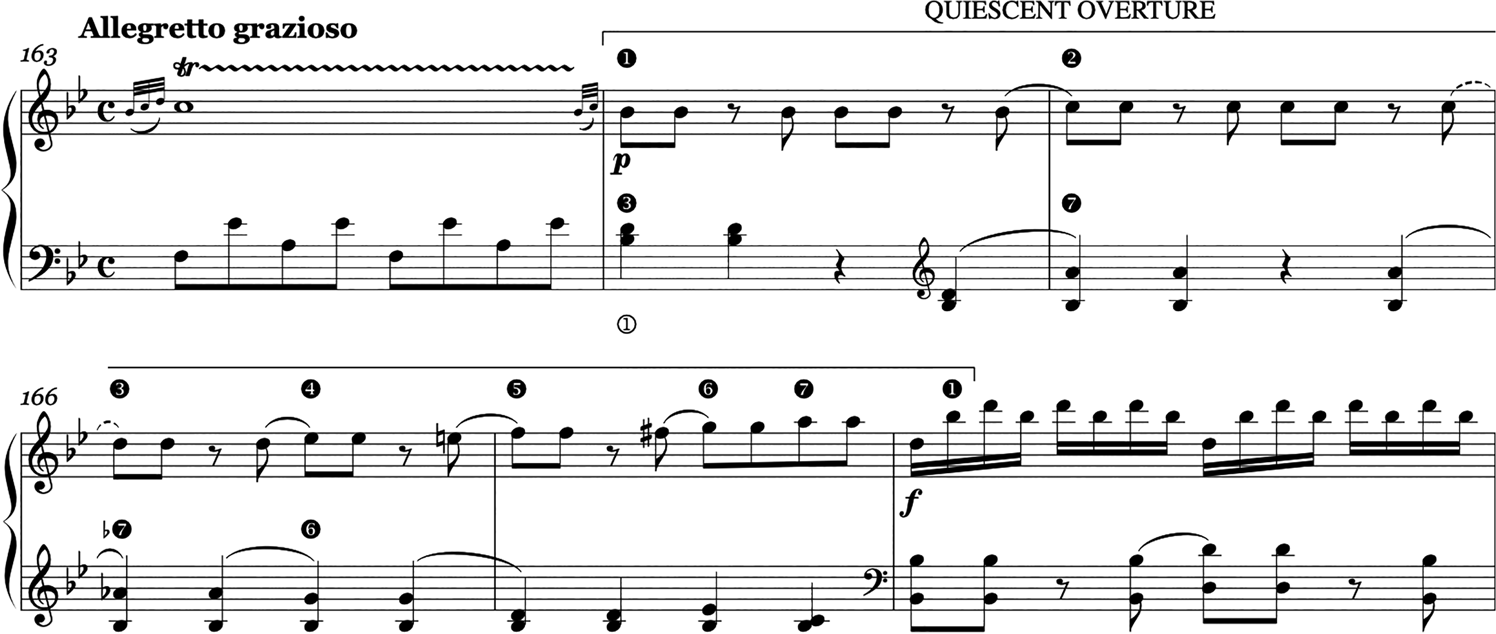
The second tonic-pedal schema showing similarities with a TPCD, and more specifically with the version used in Example 27, is a hybrid that Rice has labelled Quiescent Overture,Footnote 48 a schema that includes a Quiescenza melody embedded within a larger schema that W. Dean Sutcliffe had earlier termed Overture, defining it as ‘a schema, based on a tonic pedal above which a succession of scale steps rises from  $\hat{1}$ to a higher degree of the triad, sometimes . . . tracing a full octave scale to the upper tonic’.Footnote 49 Consider Example 29, a fragment from the third movement of Mozart's Keyboard Sonata in B flat major k333. Above the tonic pedal, the right hand presents the paradigmatic voice of the Overture, stretching a complete octave. During its opening ❶–❷–❸–❹ scale-step progression, the Overture's melody is accompanied in the middle voice by a ❶–❼–♭❼–❻ scale-step progression, which corresponds to both the first four stages of a Quiescenza's paradigmatic voice, including the optional ❼ as stage 2 and the first four stages of a chromatic descent starting on ❶.Footnote 50 The ❶–❷–❸–❹ scale-step progression of the right hand, in its turn, is identical to the diatonically rising counterpoint starting on ❶ of a TPCD. And as is the case in Example 27, the last two stages of the Quiescenza – the ❼–❶ snippet – are also present in this example, coinciding here with the conclusion of the rising scale in the right hand.
Wolfgang Amadeus Mozart, Keyboard Sonata in B flat major k333/iii, bars 163–168 (Neue Mozart-Ausgabe, series 9, volume 25/2, Klaviersonaten Band 2, ed. Plath and Rehm (Kassel: Bärenreiter, 1986)). Used by permission

Just as a DPCD also works at the tonic level, so do the Quiescenza and the Quiescent Overture also work at the dominant level. Hence the dominant versions of the Quiescenza and the Quiescent Overture share the same features with the DPCD as the Quiescenza and the Quiescent Overture share with the TPCD. In fact, the dominant versions of the Quiescenza and the Quiescent Overture have already been identified. First, Vasili Byros calls the transposition of the Quiescenza at the dominant level a Quiescenza-Ponte, a dominant pedal with a paradigmatic (❺–)❹–❸–♯❹–❺ scale-step progression.Footnote 51 Secondly, Rice calls the transposition of the Overture at the dominant level a Retransitional Overture, a schema that works as a Ponte as well. He explains that it ‘serves as a leadback to the tonic, or retransition, with the pedal . . . serving first as the local tonic, and then as the local dominant’.Footnote 52 And the examples that Rice gives of this schema start with an ascending ❺–❻–❼–❶ scale-step progression joined by a descending ❺–♯❹–❹–❸ scale-step progression, a voice leading that is identical to that of a DPCD during its first four stages. (I have labelled the scale steps in the previous sentence in relation to the main key, not to the dominant key.)
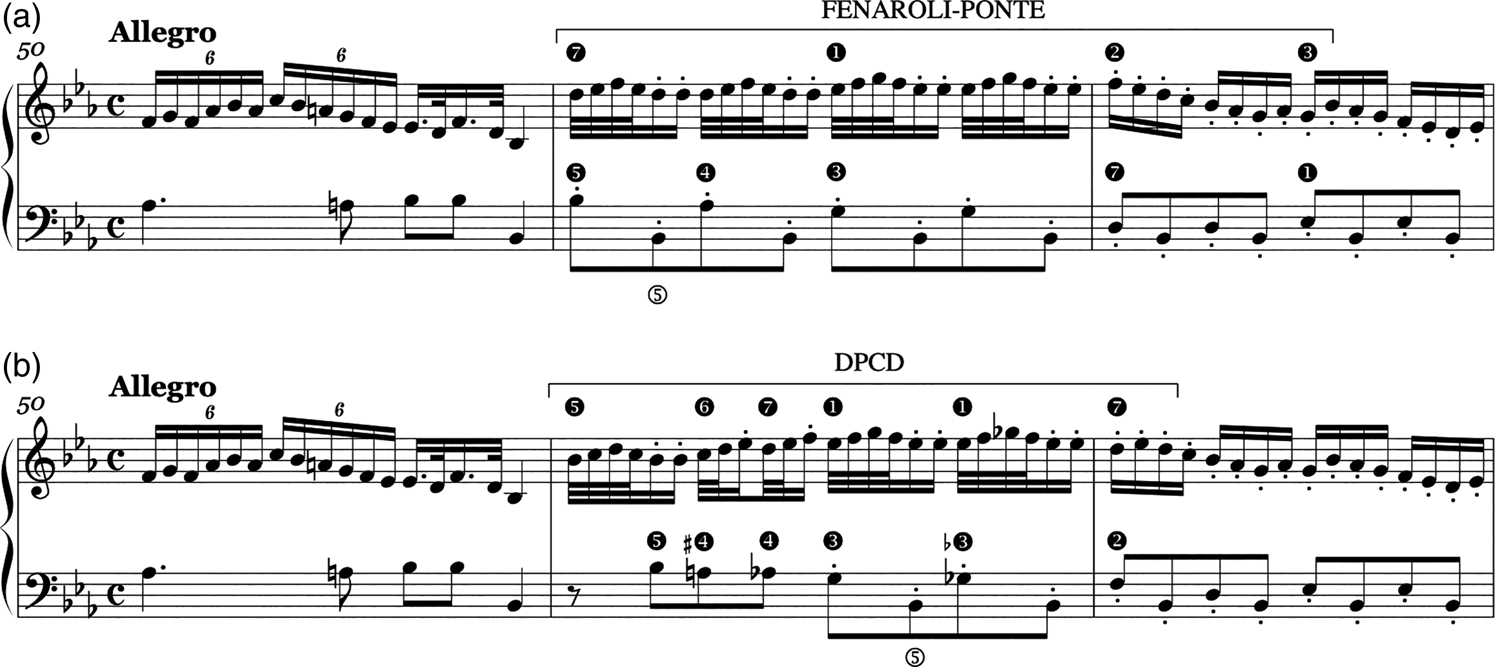
The DPCD also shares features with yet another dominant-pedal pattern from schema theory: what Gjerdingen calls a Fenaroli-style Ponte and Byros more succinctly labels a Fenaroli-Ponte, a hybrid that presents the Fenaroli schema with its dominant pedal in the bass instead of in one of the upper voices.Footnote 53 According to Byros, a Fenaroli-Ponte
is an explicit dominantizing of the standard fenaroli, which carries a latent potential to become a dominant pedal: normally contained in a “filler” or upper voice of the standard version, in the fenaroli-ponte the dominant is positioned in the bass, while the paradigmatic line 7–1–2–3 line and its countermelody are relocated to upper voices, typically the soprano and tenor, resulting in a soprano-tenor exchange.Footnote 54
When the countermelody of a Fenaroli-Ponte starts with ❺ – a regular feature not only of the Fenaroli but also of the Fenaroli-Ponte – the combination of its ❺–❹–❸ scale-progression and the ❼–❼–❶ scale progression of the Fenaroli-Ponte's paradigmatic voice represents a simpler, diatonic version of the opening four-stage unit of a DPCD with a rising counterpoint that starts on ❺. Example 30a shows a sample of such a Fenaroli-Ponte from Cimarosa's Keyboard Sonata in E flat major c74 dating from the 1770s, which is one of several illustrations that Byros gives of this schema.Footnote 55 And to make the relatedness of the Fenaroli-Ponte and the DPCD visual, I have created a hypothetical version in Example 30b, transforming the Fenaroli-Ponte of Example 30a into a DPCD. Note also that the upper voices during the penultimate stage of a Fenaroli-Ponte invert those found during the last stage of a DPCD with a rising counterpoint that starts on ❺.
(a) Domenico Cimarosa, Keyboard Sonata in E flat major c74, bars 50–52 (Domenico Cimarosa: Sonate per clavicembalo o fortepiano, volume 2, ed. Andrea Coen (Milan: Zanibon, 1992)). © 1992 Casa Ricordi Srl, a company of Universal Music Publishing Group. International Copyright Secured. All Rights Reserved. Reproduced by kind permission of Hal Leonard Europe BV (Italy); (b) hypothetical version of bars 50–52 of Example 30a

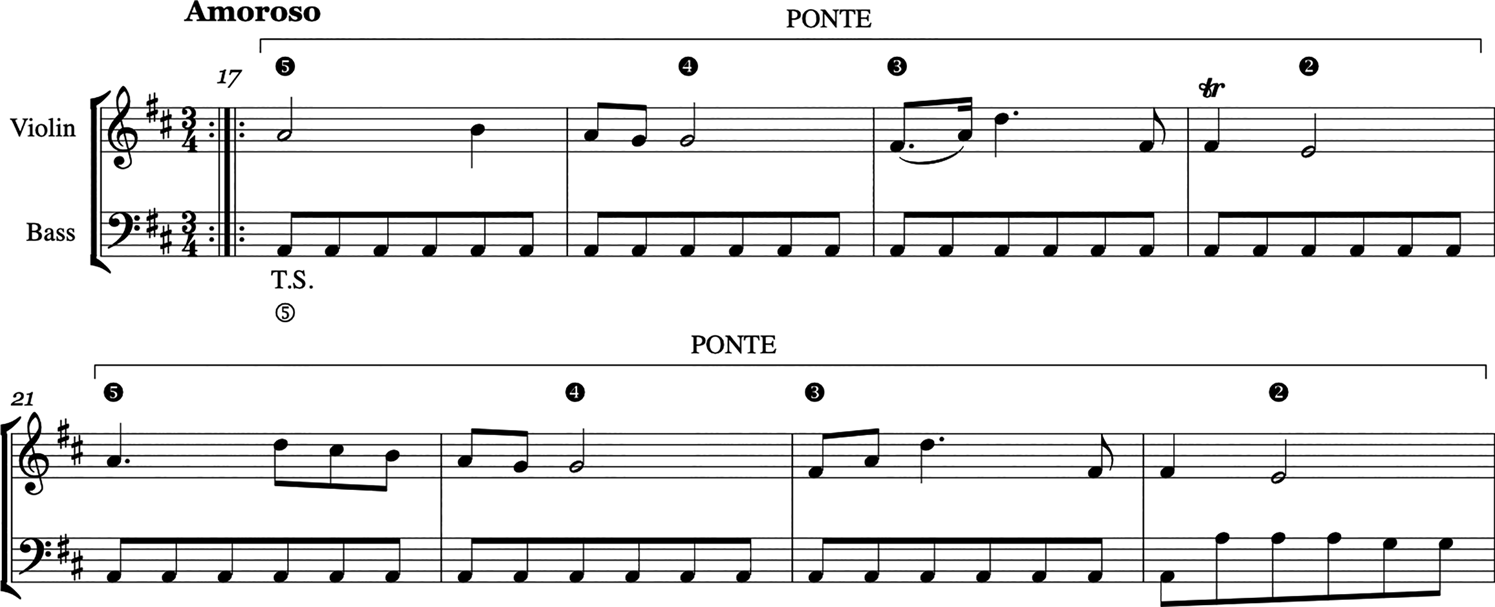
Gjerdingen has also identified a Ponte that includes a completely diatonic instead of chromatic descent from ❺ to ❷.Footnote 56 Example 31 reproduces the sample Gjerdingen chose to exemplify this model. It illustrates how Gaetano Pugnani (1731–1798) wrote two consecutive statements of this type of Ponte with a ❺–❹–❸–❷ scale progression as part of a larger archetypical Ponte following the double barline of the Amoroso from his Violin Sonata in D major Op. 8. No. 3. (Pugnani, a student of Giovanni Battista Somis (1686–1763), had a successful career as a violinist and composer in Turin, Paris and London.) The presence in this article of Example 19 makes a hypothetical version of Example 31 – a version that would transform both Pontes with a ❺–❹–❸–❷ scale progression into two statements of a DPCD for reasons of comparison – redundant, though. Indeed, comparing the archetypical Ponte at the beginning of Boccherini's Minuet in G major to Example 31 illustrates how closely both patterns are related and, moreover, how similarly both composers distributed their individual stages in a ternary bar, including the crotchet appoggiatura of the last stage.
Gaetano Pugnani, Violin Sonata in D major/iii, bars 17–24, Six Solos for a Violin and Bass ((London: William Napier, no date), available on IMSLP, www.imslp.org)

With Pugnani's example of a dominant pedal accompanied by a diatonic descent that is used as a Ponte we have come to the end of this article. Although this type of pedal, the DPCD and any dominant pedal share various similarities – most importantly because of the typical alternation between dominant and tonic sonorities – a number of those pedals are specifically identifiable as distinct voice-leading patterns and, in the light of their frequent appearance, as galant schemata. I hope to have shown this also to be the case for the central pattern of this study, the dominant pedal accompanied by a chromatic descent. That the use of schemata in the eighteenth century was anything but rigid is further emphasized by the wide range of variations composers applied to the DPCD. In fact, more variants of a DPCD, whether or not combined with other schemata, still await examination. Ultimately, I hope that this pattern may find its way to the current-day, ‘hands-on’ musician, whether it is to integrate it within the improvisation of a cadenza or of varied repeats, or when extemporizing an entire piece in the galant style.