Introduction
The rapid aging of populations around the world contributes to the incidence of illnesses related to age, such as dementia. With an estimated 29 million elderly people currently affected (WHO, 2011) and a projected 81 million cases to be diagnosed by 2040 (Ferri et al., Reference Ferri2005), or possibly more (WHO, 2011), dementia has become a worldwide concern. In Canada alone, over one million cases will be diagnosed by 2040 and close to half a million elderly people with dementia will live in long-term care facilities if no cure is found beforehand (Alzheimer Society of Canada, 2009).
Over the course of this health condition, 90% of people with dementia will experience one or more behavioral problems (Kverno et al., Reference Kverno, Rabins, Blass, Hicks and Black2008) often hindering the quality of life of both the individuals themselves and their caregivers (Chang et al., Reference Chang2009), as their demand for care can increase the burden placed on caregivers (Gaugler et al., Reference Gaugler2010). The overall prevalence of behavioral problems among people with dementia varies greatly by population (e.g. community vs. institution), operational definition, and method of measuring the behaviors (Kverno et al., Reference Kverno, Rabins, Blass, Hicks and Black2008), but the most frequently reported behavioral problems associated with dementia remain wandering, uncooperative behavior, aggression, hallucinations, sleep disorders, incontinence, and screaming (Pavlakovic, Reference Pavlakovic2001). These behavioral disturbances have been found to be the strongest predictors of placement in nursing homes among people with dementia (Gaugler, 2010), followed by, among others, the severity of dementia (Andrén and Elmståhl, Reference Andrén and Elmståhl2008) and the perceived level of caregiver burden associated with functional impairment (Etters et al., Reference Etters, Goodall and Harrison2008; Luppa et al., Reference Luppa, Luck, Weyerer, König, Brähler and Riedel-Heller2010). While informal caregivers may obtain a certain degree of relief in dealing with the behavioral sequela of dementia through placement, once in the long-term facility, disruptive behaviors continue to impact the life of residents. The trying experience of caring for a “vocally disruptive” resident can lead staff members to distance themselves from the resident, creating a cycle in which the resident becomes increasingly isolated and disruptive (Hallberg et al., Reference Hallberg, Norberg and Eriksson1990; McMinn and Draper, Reference McMinn and Draper2005).
In order to deal with these issues, an increasing number of long-term care homes have designed safe and supportive environments for individuals with dementia. Within the last decade, many solutions have been found through modification of the physical environment to better manage disruptive behaviors. Zeisel et al. (Reference Zeisel, Silverstein, Hyde, Levkoff, Lawton and Holmes2003) have demonstrated that privacy and personalization in bedrooms as well as residential environments were associated with reduced aggressive and agitated behavior. Reimer et al. (Reference Reimer, Slaughter, Donaldson, Currie and Eliasziw2004) reported that special care units employing less traditional hospital designs were associated with greater environmental awareness by residents, less decline in activities of daily living (ADL), and less negative affect. Marquardt and Schmeig (Reference Marquardt and Schmeig2009) showed that wandering behaviors are associated with the size and shape of the facility, the presence of alcoves, and the number of times a resident had to change direction in hallways, as they affected orientation. In fact, modified designs such as barrier-free rooms and homelike environments are now characteristic of specialized dementia units and consideration is increasingly given to designs that foster social interaction such as not placing chairs at dead-ends of corridors (Duffin, Reference Duffin2008). Slaughter et al. (Reference Slaughter, Calkins, Eliasziw and Reimer2006), using the Therapeutic Environment Screening Survey – 2+ (TESS 2+), were able to distinguish an environment designed for dementia from a regular unit with differences noted in orientation/cueing, privacy, quietness, and physical attractiveness. In specialized dementia units, community organizations, church groups, and families are welcome and staff members are encouraged to cook to create a homely environment. Such environments, which provide an open and homelike atmosphere, are now part of best practices to help manage disruptive behaviors while minimizing the use of medication or restraints (Fleming and Purandare, 2010).
Family concerns in relation to the lives of their loved ones in nursing homes are more often documented in relation to support for ADL, well-being, and medical care (Ducharme and Geldmacher, Reference Ducharme and Geldmacher2011). Despite the rich data on environmental designs of specialized care units for people with dementia in long-term care homes, family and staff perceptions of the environment's impact on disruptive behaviors and quality of life of residents remain more difficult to find. These perceptions are important to consider since behavior disturbances are frequent and often the first predictor of instutionalization. Families expect those behaviors will be better managed in specialized units. The goal of this multi-center study was to explore the perceptions of family and staff members on the potential contribution of environmental factors that influence disruptive behaviors and quality of life of residents with advanced dementia living in long-term care homes.
Methods
Using a qualitative research approach, data were collected through nominal focus groups with family and staff members in eight residential care units within six long-term care homes accommodating people with dementia in three Canadian cities.
Participants
In each of the eight participating units, two groups were formed: one included only family members while the other included only staff members. There were no restrictions for participation with regards to sex, age, education, or socio-economic status. Family members were included if they had visited a resident of one of the eight participating units at least once a week for the past four months or more. Since the mean length of stay of the residents in the homes was 3.5 years, families would have had ample experience with the units as they would have visited the resident since admission. Staff members performing any role were eligible to participate if they had been involved in the care of residents for at least six months. This included nursing and personal care staff as well as housekeeping staff. Family participants were kept separate from staff participants, as well as participants from different units, but the procedure was the same in all groups. In order to optimize transferability of the findings to other centers, participants were sampled from different cities (Calgary, Toronto, and Ottawa), from different relationships with residents (families and staff), from different language groups (French and English), from different staffing categories (registered nurses, housekeeping, attendants), from different sizes of centers (from nine to 48 beds), and from different care models (mixed units housing both residents with and without dementia vs. specialized dementia units). Ethical approval was obtained from all relevant university and city health research ethics boards. Written consent was obtained from all participants.
Units
Most units were small-scale homelike units that included design features to encourage person-centered care, normalization of daily life, and better quality of life for residents (Verbeek et al., Reference Verbeek, van Rossum, Zwakhalen, Kempen and Hamers2009). Such features included, but were not limited to, barrier-free rooms and corridors, homelike common areas, private bedrooms, and safe, self-contained outdoor areas or gardens. Three of the eight units were more traditional and did not include some of these features. For instance, they had barrier-free corridors but there were two residents to a room, whereas in newer designs, residents with dementia had private rooms. Some residences also had large multi-purpose rooms while others had smaller alcoves, living areas, and kitchens.
Eight units of care were thus included in the study:
• Unit 1 (Ottawa, Facility 1): specialized, primarily English, 48 beds in four sub units
• Unit 2 (Ottawa, Facility 1): traditional, primarily English, 42 beds in two sub units
• Unit 3 (Ottawa, Facility 2): specialized, primarily French, 40 beds in two sub units
• Unit 4 (Ottawa, Facility 2): traditional, primarily English, 40 beds in two sub units
• Unit 5 (Ottawa, Facility 3): traditional, primarily English, 31 beds in one sub unit
• Unit 6 (Toronto, Facility 1): specialized, primarily English, nine beds in one sub unit
• Unit 7 (Calgary, Facility 1): specialized, primarily English, 27 beds in four sub units
• Unit 8 (Calgary, Facility 2): specialized, primarily English, 36 beds in four sub units
Staffing ratios varied greatly from unit to unit. Day ratios were on average five residents per staff member and ranged from three to eight residents, the mean for evenings was six residents (ranging from two to nine residents), and for nights the resident/staff ratios ranged from five to 16 residents per staff member with a mean of 12. There was one registered nurse on the day shift in the units, with the exception of one unit that had one registered nurse working half-time and another that had two.
Procedure
With the consent of the executive officers, each facility was sent an initial contact letter that was distributed to families and staff members informing them briefly about the study and inviting them to an information session hosted at the facility. The investigators presented the study and addressed issues and concerns. Family and staff members unable to attend the presentation sessions were sent an explanation letter with a contact number for the study coordinators. Participants were invited to take the consent form and the information letter with them at the end of the presentation, and to return the consent form with signatures for inclusion in the study. Participants were also given the choice of providing their consent at the time of the presentation. Only family members and staff who met the inclusion criteria were invited to the project presentation. Hence, all attendees who were willing to participate in the study were included.
Following those presentations, nominal focus groups were organized. During group sessions, the discussions focused on participants’ perceptions of the effect of the physical and social environments on residents’ behavior and quality of life, including interpersonal interactions and care delivery. For each unit, family and staff members were invited to take part in separate discussion groups of six to ten participants lasting from one to 2.5 hours. The primary author facilitated all discussion groups using a nominal group technique (Brunelle and Tousignant, Reference Brunelle, Tousignant, Brunelle, Drouin, Godbout and Tousignant1988). Each participant was asked to write on paper their perceptions about important environmental factors. They were asked to:
• Identify the elements from the physical and social environment that hinder behavior and the quality of life of residents.
• Identify the elements from the physical and social environment that improve behavior and the quality of life of residents.
To help stimulate their thoughts, family members were asked to think about their current observations and, if helpful, compare the current unit to others where their family member might have once lived. Staff members were asked to share their observations and compare their current unit, if appropriate, to others where they might have once worked. In order to maximize the chances that participants would speak freely, no administrators or supervisor–subordinate pairs were involved in the groups of staff members.
The observations noted on paper by the participants were then shared with the group and discussed. This constituted the focus group portion of the procedure. Each element or factor proposed by participants was then reformulated in neutral terms on flip chart paper so that it could be perceived as either negative or positive by group members. For instance, “noise levels” could be perceived as positive (e.g. low noise levels) or negative (e.g. high noise levels). Once all elements were written on flip chart paper, the group facilitator, along with the participants, cleaned the list to eliminate any redundant information. From the resulting list, which often included between 30 and 60 elements, participants were asked to individually select and rank the nine most important elements that (1) hindered behavior and quality of life of residents, and (2) improved behavior and quality of life of residents (according to the technique described in Brunelle and Tousignant (Reference Brunelle, Tousignant, Brunelle, Drouin, Godbout and Tousignant1988): when a group generates more than 22 elements on their list, participants are asked to vote on the nine most important). This constituted the nominal portion of the procedure. Because participants were identifying elements privately and individually, they were not pressured by others to choose the same important factors. The result was a list of the nine most important environmental factors that facilitated or hindered residents’ quality of life for each center as perceived by each group of staff or family members. The combined (focus and nominal group) technique allows participants to first reflect openly as a group on issues related to the target question while subsequently requesting that they individually select and rank those elements they consider most important. The technique offers the advantage of capitalizing on group dynamics while, at the same time, benefiting from the influence of each participant through the ranking and selection process.
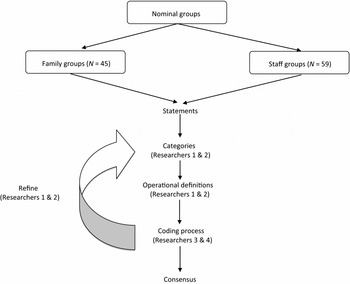
All top nine statements as decided by members of each group were then collated into one large list across groups. Each statement was then coded independently by two researchers (Researchers 1 and 2), grouped in categories, and operational definitions were then created for each category by these same researchers (Figure 1). Based on the category definitions, the statements were then coded by two additional researchers (Researchers 3 and 4) who were not involved in the original coding and descriptions. The feedback from this last coding led to modifications of the code categories and operational definitions. Once these were modified by Researchers 1 and 2, Researchers 3 and 4 then re-coded each statement using the new categories. An example might be the following: “Staff knowing the residents’ triggers, past interests, getting to know before, war history, beliefs.” This statement offered by one of the groups was coded as “individualized care.” When agreement was not reached among the four researchers, a meeting was called where researchers shared their viewpoints. After a brief discussion, consensus was sought.
Coding of focus group statements.

The code categories served as a common language across groups. Hence, following the categorization, it was possible to convert each prioritized list of statements from each group into a list of code categories. For instance, in the example above, it was possible to use the code category “individualized care” rather than the lengthier statement “Staff knowing the residents’ triggers, past interests, getting to know before, war history, beliefs” and tabulate the number of times “individualized care” was mentioned by the groups. It also became possible to determine the ranking given across groups for both facilitators and obstacles. For instance, for the code category “ratio of staff to resident/staffing levels,” one staff group might select it as a first priority, another as a second priority, and three groups might select it as a third priority.
In order to arrive at a weighting that would identify the top nine code categories identified overall by staff and families, the following system was developed: code categories which appeared in the first position of priority were given nine points (the top number of priority categories); those in second position were given eight points; those in third place received seven points, and so on. In other words, the higher the number, the higher the priority. In the example given above, the weighting for the code category “ratio of staff to resident/staffing levels” could be calculated as follows:
• One staff group placed it in first position as a potential obstacle = 9 points
• One staff group placed it in second position as a potential obstacle = 8 points
• Three staff groups placed it in third position as a potential obstacle (3 groups × 7 points) = 21 points
• The total points for that code category as perceived by staff groups overall would receive, therefore, a total of 38 points
Tables 2 and 3 summarize these weightings for all code categories for the top nine rankings.
Results
The nominal focus groups included 45 family members and 59 staff members in 15 focus groups. Seven groups of families and eight groups of staff members with each group having six to eight participants took part in discussions that lasted from one to 2.5 hours. Resident participants were accommodated in homes that were quite representative of the population of individuals with dementia living in long-term care homes. The mean age of residents across all homes was 83 years with a range from 68 to 96 years. In Ottawa, 68% of residents were women, compared with 75% of the residents in Calgary. The home in Toronto was not typical as it was designed primarily for veterans and accommodated only nine male residents. Due to the severity of their dementia, many residents could not be tested using standardized dementia scales. For half of the residents, severity scores were available from the charts and might have been noted at time of entry into the home. In three units, the mean of residents’ scores on the Global Deterioration Scale (GDS; Reisberg et al., Reference Reisberg, Ferris, de Leon and Crook1982) was 5.5. In the remaining five units, the mean of residents’ scores on the Mini-Mental State Examination (MMSE; Folstein et al., Reference Folstein, Folstein and McHugh1975) was 14.5/30 indicating moderate to severe dementia. Using the Functional Assessment Staging Test (FAST; Reisberg, Reference Reisberg1988) as a measure of functioning, the median score was 7a indicating that residents generally experienced difficulties with dressing, proper hygiene, using the toilet, had urinary and fecal incontinence, and had language often reduced to short phrases. Families and staff who participated in the nominal focus groups therefore had, as a frame of reference, individuals with moderate to advanced dementia with significant functional limitations.
Data collection started with the four Calgary groups followed by the two Toronto groups. By the time the investigators had reached the Ottawa groups, data saturation was becoming evident. Some items were added by the Ottawa groups but the elements that were selected in the top nine were basically the same.
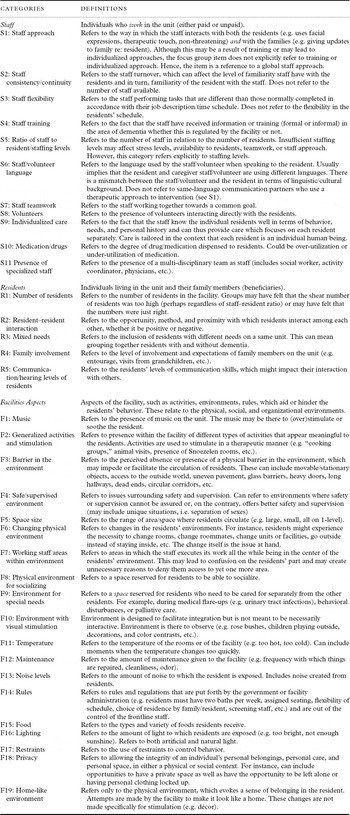
While both family and staff groups listed anywhere from 30 to 60 items each, the nine most important statements selected by each group were coded and regrouped into 19 categories relating to the facilities themselves, five categories relating to the residents and their families, and 11 categories relating to the staff (including volunteers). Table 1 lists these categories and their operational definitions.
Categories from nominal focus group data operational definitions

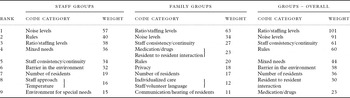
According to both staff members and families (Table 2) the most important environmental obstacles that increased disruptive behavior and hindered quality of life were the low ratio of staff to residents, the level of noise, the lack of consistency in the staffing, and the presence of rigid organizational rules/regulations. Six of the groups ranked noise as one of the top two factors increasing the likelihood of disruptive behavior. Many groups simply identified “noise” as a generic sound while others specified that the most irritating noise came from the television, music, or resident verbalizations.
Code categories in top nine ranks: obstacles

Other than noise, having sufficient personnel to manage large numbers of residents was by far the most important for managing disruptive behavior. Both families and staff mentioned how low staff numbers and high turnover rates negatively affected the homes’ abilities to manage this challenging group of residents. All groups stressed the importance of reducing staff turnover. Residents became accustomed to the staff which, when changed, resulted in behavioral triggers. Rigid government and facility rules and regulations were also perceived as contributing to the creation of conflict between staff and residents. Examples included requiring two baths per week, assigning seating plans in the dining room, and inability to access outside gardens.
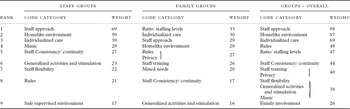
Among the environmental facilitators that improved quality of life (Table 3) and diminished behavioral disruptions, both staff and families identified the approach adopted by staff, the homelike environment, and the ability to attend to the residents’ individual needs. Both families and staff stressed the importance of taking the time to interact with residents. They noted that the best results were obtained when staff used comforting language, reassurance, faced the resident when speaking, knew when to withdraw, and interacted with residents in a respectful, gentle, positive manner. Both staff and families also noted that this approach could be achieved through training and staff consistency, thereby offering continuity in the staff-to-resident interactions. Through a deeper understanding of the residents’ backgrounds, the participants felt that staff could better avoid the triggers that led to disruptive behavior. The groups emphasized the impact of homelike environments in allowing residents to truly experience life in a relaxed setting. Participants made reference to safe fireplaces, the presence of familiar objects, places to visit, the presence of a central activity center, presence of a washer and dryer, and an outside design that was visually integrated into the neighborhood. Eight groups identified a homelike environment among their top three environmental facilitators. Families and staff also placed great emphasis on accommodating residents by offering generalized, meaningful activities and stimulation. The majority of groups identified this factor as an important facilitator, although only one of these groups voted it among the top three facilitators.
Code categories in top nine ranks: facilitators

Closer analysis of the results suggested that some environmental factors appeared more important for either the staff or the family groups. Staff groups, for instance, felt that it was important not to mix cognitively impaired with cognitively intact individuals. That is, staff participants believed that the needs of people with dementia required special attention and could conflict with the needs of people without dementia. It was felt that mixing the needs of residents from both cognitively impaired and cognitively intact groups on the same unit would increase the likelihood of behavioral issues. Families spoke about the negative effect of forced social groups within units, residents being bothered by other residents, and the proximity of other residents in common areas. There was a sense that being in such proximity increased the possibilities of violations of personal space, which could lead to undesirable behaviors. Four of the eight staff groups identified this factor as the most important environmental factor. Although more important for staff, families also felt this was important with three of the seven family groups voting this as an environmental obstacle in the top nine most important obstacles.
Staff also identified physical environmental barriers as very important in eliciting undesirable behaviors, although no group voted this factor among the top three obstacles. These included having homes with such design features as dead-end corridors, visible exits with no access, or movable objects in residents’ paths.
While families and staff groups generally seemed to stress the same items, it also became apparent during the data analysis that families also differed qualitatively on some items. For instance, some family groups highlighted the role of medication and its side effects in creating disruptive behaviors as well as the sheer number of residents in the homes as some of the most important obstacles. In terms of facilitators, three of the family groups voted training as the top factor facilitating the management of behavior. In addition, more than half of the family groups also rated the need for privacy among the top five facilitators. One last qualitative difference between families and staff is the great importance staff placed on the inclusion of music as a facilitating factor and the great importance families placed on both the staff's and the residents’ communication skills.
Discussion
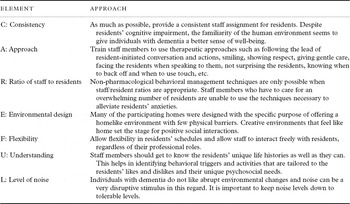
Both families and staff agreed that there are facility, staffing, and resident factors to consider when creating optimal environments for individuals with moderate to advanced dementia when behavioral disturbances are a concern. Social environments were perceived to be more important than the physical environments, and flexibility in these environments was perceived to be essential. The results of this study suggest that individuals with moderate to advanced dementia manifesting disruptive behaviors would best be suited in a home that offers a homelike environment with minimal barriers, a certain degree of privacy to residents, and, above all, a minimal level of noise. The administration and staff should make every effort to adapt the environment to the residents’ individual characteristics, thereby reducing the chances of eliciting disruptive behaviors and this escalating to unmanageable levels. According to the participants in this study, funding would need to take into account appropriate staff/resident ratios, flexibility in the application of government and administrative rules and regulations, consistent assignment of staff to residents, staff training, and an approach that is appropriate for this population (e.g. using facial expressions, therapeutic touch, non-threatening language). To facilitate this work, the ideal home would not only have a high staff-to-resident ratio but also a manageable number of residents overall. Lastly, those residents who do not have cognitive challenges would not be living in the same units as residents with dementia. A mnemonic – C.A.R.E.F.U.L. – was developed to help summarize the key elements that emerged from this study (Table 4).
Mnemonic for remembering the most important environmental factors (C.A.R.E.F.U.L.)

The study adds to the already large body of literature on the role of the environment and its influence on behavior and quality of life of individuals with dementia in long-term care homes. Our results support a review of the literature on non-pharmacological interventions in dementia (Cohen-Mansfield, Reference Cohen-Mansfield2001), and more recently, a study on the relationship between environment and neuropsychiatric behaviors (Zuidema et al., Reference Zuidema, de Jonghe, Verhey and Koopmans2010). Beyond caring for the physical needs of the residents, the literature suggests that social contact and meaningful activities are important foci for intervention in dementia care environments. This is not possible without sufficient staff numbers or without the assistance of volunteers. Cohen-Mansfield (Reference Cohen-Mansfield2001) found evidence to support the use of modeling to engage residents in the use of environmental stimuli. When engagement in these activities was affected by noise levels, indicating that residents are indeed influenced by their environments, residents interacted more with objects such as stuffed animals, squeeze balls, magazines, or folding towels when modeling of the activity occurred. Human interaction is important to help residents make sense of their environment. Physical environments are indeed only part of the story (Schwarz et al., Reference Schwarz, Chaudhury and Brent Tofle2004). In short, choosing a residence that is beautiful but understaffed may be less desirable than one that is less visually pleasing but has more individuals present contributing to care.
Staff and family participants in this study were not restricted a priori in what they chose to identify as environmental factors affecting behavior and quality of life. They came from large, small, traditional, innovative, French, and English units. They came from homes in different cities and had different roles within the homes. Yet, despite this heterogeneous sampling, after approximately four to six groups, we saw the same concepts emerge. Having mentioned many physical environmental factors during the nominal focus group discussions, when asked to select the most important elements, the choices of staff and family participants reflected factors mostly related to the social environments. It is intuitive to think that small, homelike environments would positively affect behavior and quality of life, but a review by Verbeek et al. (Reference Verbeek, van Rossum, Zwakhalen, Kempen and Hamers2009) found no overwhelming support for designing small living facilities. When compared to facilities with ward-like designs, they were unable to find convincing evidence to support the design of small-scale facilities to improve quality of life in residents. The majority of the participants in our study were associated with centers that included special design features but some were involved with homes that had more traditional designs such as those with multi-purpose rooms. Yet the discussion in all groups was focused on staff approach rather than the existence of small, cozy alcolves or wing-back chairs. Fleming and Purandare (Reference Fleming and Purandare2010), in reviewing the literature on long-term care for people with dementia, also found no support for size of residences but did find support for other physical features such as few physical barriers.
It was our experience that administrators of residential units for persons with dementia often refer to these dwellings as homes. Aminzadeh et al. (Reference Aminzadeh, Dalziel, Molnar and Garcia2010) explored the notion of home with individuals with dementia as they were contemplating being relocated to collective dwellings. They found that leaving their “home” meant leaving a repository of memories, a place where life was familiar and consistent, where they could express their personal interests, their achievements, their status, where they could connect with others and socialize, where they felt competent and could engage in meaningful activities. It was a place where they could be free and have choices. While some of these features can be achieved in long-term care environments, the perceptions of family and staff confirmed the importance of these elements in creating a sense of home. People who live in your home do not constantly change. They usually know you well and do not wear uniforms. Noise levels are kept to a reasonable level and there are no rules for when you must eat or take a bath.
The current results also highlight the importance of systemic changes to help improve quality of life in these homes. Much of the literature to date has placed a great deal of emphasis on the local changes that can be made in the homes themselves. Some of the items highlighted in the current results and supported by others suggest more systemic changes and interventions. The emphasis on social environments and individualized care begs for innovative funding formulas that place equal emphasis on the resources needed to manage behaviors as to those needed for more physical demands such as transfers and mobility. While it is challenging for governments to find more money for publicly funded facilities, emerging initiatives geared towards the redesign of funding allocations are to be encouraged. Similarly there is a call for more research on the regulations pertaining to these homes and the ways they can be revised to allow staff and administration more flexibility in adapting the care to the ever-increasing population with dementia. Last but not least, there is a strong message from the current results to support studies on the precursory role of physical environmental design that will support social design. The results of the current study suggest that it may be pointless simply to physically redesign our long-term care homes for people with moderate to advanced dementia without attending to the social design of these homes.
Strengths and limitations of the study
One strength of the current study is the purposive sampling of units, which included participation from three different cities, Anglophone and Francophone units, traditional and specialized dementia units, and participants in various roles. While it might be considered a study limitation that all categories of staff, including nursing, personal care staff, and housekeeping, participated in the staff nominal focus groups, we were careful not to include individuals with administrative responsibility over other members in the group. Despite this, some participants may have felt that some members had more power and may have felt they needed to be silent during the discussions. Contrary to more traditional focus groups, the procedure adopted in the current nominal focus groups allowed for each participant to rank confidentially, without undue influence, what they considered to be the most important elements improving and hindering behavior and quality of life. Every individual therefore influenced which factors were included in the top nine. The wide range of participants involved in this study increases the transferability of our findings to other long-term care units (Creswell, Reference Creswell1998).
Despite attaining data saturation (Strauss and Corbin, Reference Strauss and Corbin1990) after approximately six groups, we continued to investigate using an additional nine groups. The additional nine groups added variation in the participants, as it was in these groups that we recruited Francophones as well as families and staff from more traditionally designed homes. A notable strength of this study is the consistency of the results between families and staff about the most important environmental factors. Another strength of the study is the triangulation of investigators (Denzin, Reference Denzin1989). The first four investigators participated in the coding and recoding the nominal focus group data. This contributed to the rigor of the study. The coherence of the results, combined with the results in the literature, offer clear direction for future research targeting interventions to improve resident outcomes.
While the current study brings certain added strengths, it is not without limitations. It is not possible from the current results to identify which of the top rated environmental factors would be the most effective in reducing the behavioral manifestations of dementia experienced in these homes. The study did not permit a pre- and post-design and control of each of the environmental factors. The data are the results of perceptions rather than objective outcomes. This being said, the design and results do allow us to identify avenues of future research.
For instance, this study calls for an attention to the noise that residents are exposed to in nursing home settings. We were unable to find a single scientific article focusing specifically on the effect of noise on the behaviors of individuals with dementia in long-term care. A recent web-based seminar by the Alzheimer Knowledge Exchange (2011) stressed the importance of different types of noise and offers some suggestions for reducing the level to help foster better care. There remains, however, a dire need for scientific evidence that the impact is real and that reducing noise will lead to less disruptive behavior.
Conclusion
The results of the study indicate that specialized physical design features can be useful for maintaining quality of life and reducing disruptive behaviors, but they are not sufficient. Although they can ease some of the anxieties and set the stage for social interactions, our evidence suggests that individuals who make up the human environment of the residents (i.e. staff members and visitors) are just as important in promoting the psychosocial well-being of residents. Staff members play a key role in shaping the environment in which residents live. In designing environments for individuals with advanced dementia, we must have a facilitating physical environment, trained staff, and flexible organizational rules that will allow the staff to put into practice what they have learned through training.
We encourage policy-makers to devise new funding schedules that will take into account the psychosocial care so desperately needed by the population of individuals with advanced dementia. We recommend using the mnemonic C.A.R.E.F.U.L. to remember the factors needed to create a social environment within long-term care facilities. As their numbers will increase despite the system shift towards care at home, attention to the C.A.R.E.F.U.L. design elements will enable individuals with dementia to experience the best quality of life possible while reducing the care load on both formal and informal caregivers.
Conflict of interest
None.
Description of authors' roles
L. Garcia, M. Hébert, and J. Kozak were the principal investigators and designed the study following consultations with S. Slaughter, F. Aminzadeh, W. Dalziel, J. Charles, and M. Eliasziw. All three principal investigators guided the phases of the project. I. Sénécal coordinated the entire project and was directly involved in ethics applications and focus groups data collection and analysis. All authors attended group meetings to guide the project, provided feedback on the written product, and read and approved the final paper.
Acknowledgments
The authors thank the funders of this study: the Alzheimer Society of Canada, the Alzheimer Society of Ottawa and Renfrew County, the Canadian Institutes of Health Research, and the University of Ottawa. We also thank the staff and families of the eight residential care units for their thoughtful insights.