Introduction
The poultry red mite (PRM), Dermanyssus gallinae, (also called red poultry mite, poultry mite, red mite or chicken mite) is the most common and important blood sucking ectoparasite of layer and breeder flocks in many countries and probably the most widespread mite species found in birds in Europe (Chauve, Reference CHAUVE1998; Roy et al., Reference ROY, DOWLING, CHAUVE, LESNA, SABELIS and BURONFOSSE2009c). PRM does not permanently reside on its host, but only feeds there, spending 30-60 minutes on the hen during an average visit (Maurer et al., Reference MAURER, BIERI and FOLSCH1988). The rest of the time it hides in cracks and crevices in the environment of its host, seeking shelter where it can digest its blood meal, mate and lay eggs (Maurer et al., Reference MAURER, BIERI and FOLSCH1988). Nymphs and females suck blood while males do so very occasionally and larvae do not feed (Axtell and Arends, Reference AXTELL and ARENDS1990). Like many blood-sucking ectoparasites the consequences of PRM pose multiple: welfare issues for the birds, including anaemia, feather pecking, restlessness and aggression, reduced egg production (as a result of increased fragility of the egg shell), blood staining of the eggs, and transmission of pathogenic agents (Valiente-Moro et al., Reference VALIENTE-MORO, DE LUNA, TOD, GUY, SPARAGANO and ZENNER2009; Reference VALIENTE-MORO, FRAVALO, AMELOT, CHAUVE, SALVAT and ZENNER2010; Hamidi et al., Reference HAMIDI, SHERIFI, MUJI, BEHLULI, LATIFI, ROBAJ, POSTOLI, HESS, HESS and SPARAGANO2011).
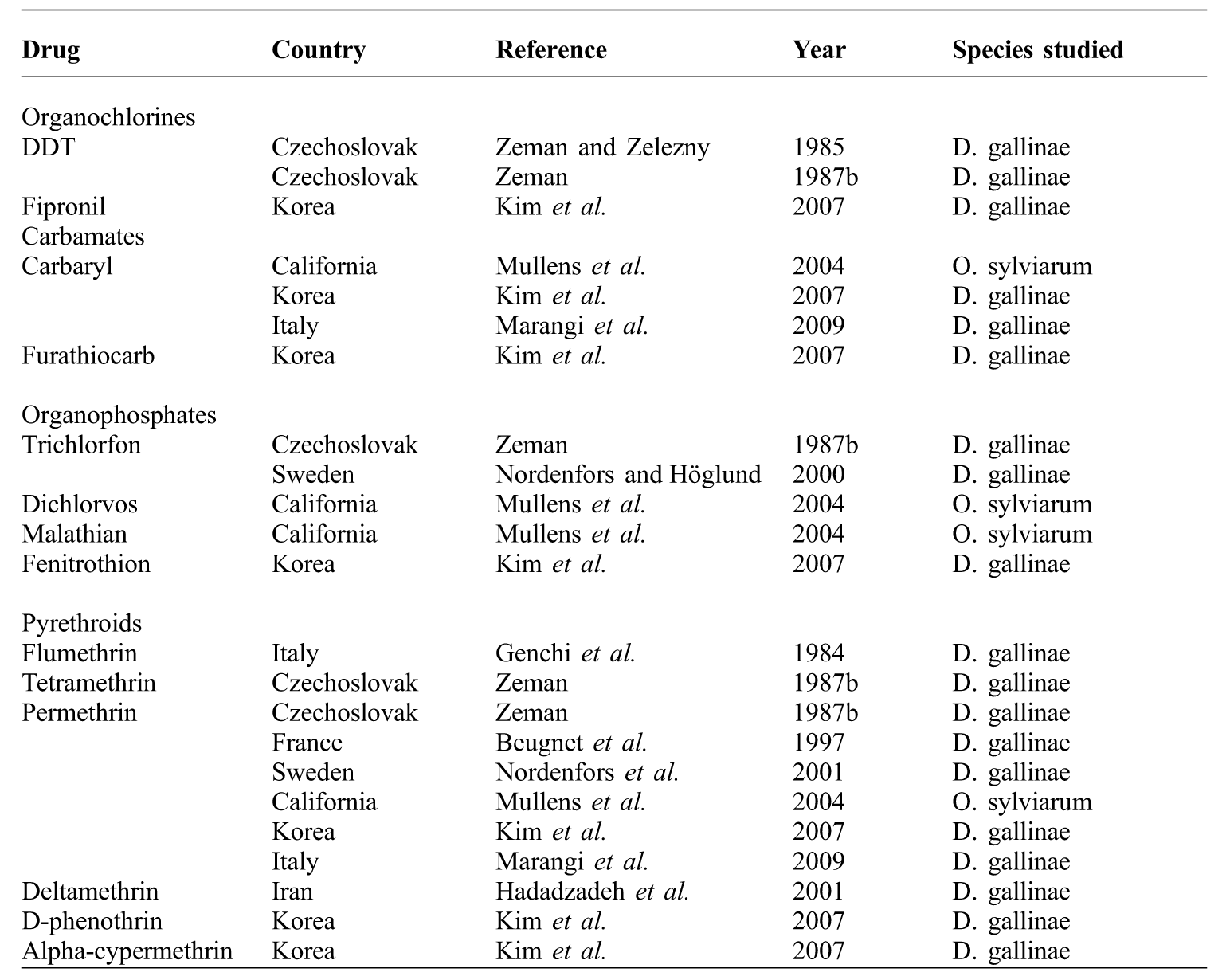
Control of PRM chiefly depends upon acaricide applications and relatively few are approved for the purpose worldwide. Organophosphates, carbamate, amidine and pyrethroid-based acaricides are the most widely used. Furthermore, many acaricides are not specifically labelled for use against PRM and if not properly applied, the development of resistance can be accelerated (Zeman, Reference ZEMAN1987b; Beugnet et al., Reference BEUGNET, CHAUVE, GAUTHEY and BEERT1997; Chauve, Reference CHAUVE1998; Nordenfors et al., Reference NORDENFORS, HOGLUND, TAUSON and CHIRICO2001; Marangi et al., Reference MARANGI, CAFIERO, CAMARDA, SPARAGANO and GIANGASPERO2009). Numerous classes of acaricides have been developed but resistance to all of them has been described in various parts of the world (Table 1). Periodic monitoring of the poultry mites for development of resistance against commonly used acaricides is, therefore, very important for economic poultry production. Increased awareness and improved socio-economic conditions of the farmers in addition to state sponsored animal health facilities in industrialised/developed countries have led to frequent reports on the failure of acaricidal treatments for managing PRM (Genchi et al., Reference GENCHI, HUBER and TRALDI1984; Beugnet et al., Reference BEUGNET, CHAUVE, GAUTHEY and BEERT1997; Chauve, Reference CHAUVE1998). This review discusses the different aspects of resistance for the better understanding and control of resistant poultry mites, comparing different treatments to determine if there is mutual resistance to them.
Reports of acaricidal drug resistance in poultry mites.

acquired resistance
Acquired resistance is defined as ‘a resistance that results from heritable decreases in sensitivity to drugs with the passage of time’ (Chapman, Reference CHAPMAN1997). Long term and repeated use of same acaricides to control PRM populations, may result in the development of heritable resistance in the mites. For example, resistance to DDT, organophosphates or pyrethroids has been suspected in Italy (Genchi et al., Reference GENCHI, HUBER and TRALDI1984), in former Czechoslovakia (Zeman and Zelezny, Reference ZEMAN and ZELEZNY1985; Zeman, Reference ZEMAN1987b), and in France (Beugnet et al., Reference BEUGNET, CHAUVE, GAUTHEY and BEERT1997). But, it is unclear whether treatment failures involve acquired mite resistance or inadequate acaricide treatment. A study on another mite, Tetranychus cinnabarinus, showed the development of acquired resistance against two acaricides abamectin and fenpropethrin. After 42 generations of selection with abamectin and 20 generations of selection with fenpropethrin in the laboratory, T. cinnabarinus developed 8.7 and 28.7-fold resistance respectively (Lin et al., Reference LIN, CHUAN-HUA, JIN-JUN, MING, WEN-CAI and ZHI-MO2009). In another study (Campos et al., Reference CAMPOS, DYBAS and KRUPA1995), laboratory selection of up to 38 generations of a single population of two-spotted spider mites with abamectin resulted in 100% increase in resistance, compared with a nonselected baseline colony. Levels of resistance were correlated with the amount and time of abamectin usage.
cross-resistance
Cross-resistance is the sharing of resistance genes for different acaricidal drugs which have a similar mode of action. Some studies (Li et al., Reference LI, DAVEY, MILLER and GEORGE2003; Reference LI, DAVEY, MILLER and GEORGE2004) have shown a significant occurrence of cross resistance between organophosphate and carbamate acaricides. Similar findings have been reported (Mullens et al., Reference MULLENS, VELTEN, HINKLE, KUNEY and SZIJJ2004) for the California strains of Northern fowl mites (NFM). Resistance to carbaryl and dichlorvos has been highly correlated, and cross resistance patterns between carbamate and organophosphates suggest the involvement of similar resistance mechanisms, usually due to selection of insensitive acetylcholinesterase (Hama, Reference HAMA1983). Rotation or alternation of different groups of acaricides that have no cross resistance reduces the selection pressure for resistance to any one treatment.
multiple resistance
Multiple resistance is a resistance to more than one drug, even though they may have different modes of action. Marangi et al. (Reference MARANGI, CAFIERO, CAMARDA, SPARAGANO and GIANGASPERO2009) found significant occurrence of multiple resistance in field populations of PRM in Italy to different classes of acaricide including carbamates (carbaryl) and pyrethroids (permethrin). Field PRM populations were found to be resistant even with the highest concentrations with carbaryl and permethrin for 86% and 42% of the investigated farms, respectively. Marangi et al. (Reference MARANGI, CAFIERO, CAMARDA, SPARAGANO and GIANGASPERO2009) suggested that reduced effectiveness may be due to the extensive and/or improper usage by farmers.
Mechanisms of acaricide resistance
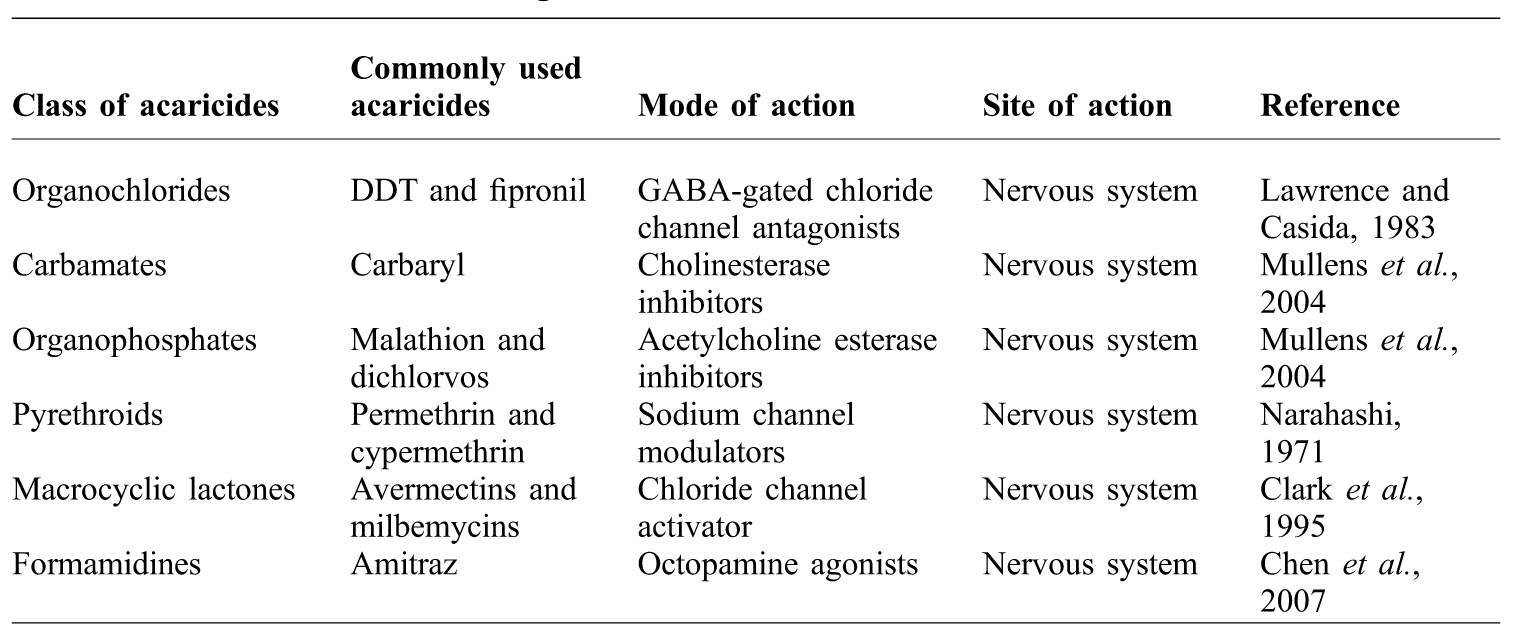
It is impossible to understand the mechanisms involved in the development of resistance in poultry mites without understanding basic knowledge of mode of action of acaricides. There is a diverse range of the mode of action of acaricides (summarised in Table 2), e.g., acetylcholine esterase inhibitors (organophosphates and carbamates), GABA-gated chloride channel antagonists (organochlorines) and sodium channel modulators (pyrethrins).
The common acaricidal drugs with their mode of action.
resistance against organochlorines
Organochlorines, introduced in 1946, were the first commercially available synthetic acaricides. Benzenehexachloride (BHC) and DDT were the first organochlorines to be used as acaricides (Maunder, Reference MAUNDER1949), but later, other organochlorines like aldrin, dieldrin, toxaphene and cyclodiene compounds were also recognised as acaricides and used widely. The mode of action of organochlorines is thought to involve binding at the picrotoxinin site in the γ-aminobutyric acid (GABA) chloride ionophore complex (Lawrence and Casida, Reference LAWRENCE and CASIDA1983) which inhibits Cl- flux into the nerve (Bloomquist and Soderlund, Reference BLOOMQUIST and SODERLUND1985), causing hyperexcitation and death. Other researchers (Casida and Lawrence, Reference CASIDA and LAWRENCE1985) have shown the binding of several organochlorines at the picrotoxinin site where t-butylbicyclophosphorothionate (TBPS) binds. It has been suggested that the mechanisms of resistance are primarily via enhanced metabolism and reduced absorption of the chemical (Brown, Reference BROWN1969).
resistance against organophosphates and carbamates
Organophosphates (OPs) were among the first chemical groups used to control arachnids. The OP compounds have been in use for the effective control of poultry mite since 1960s (Beesley, Reference BEESLEY1963) and, in spite development of resistance (Nordenfors and Höglund, Reference NORDENFORS and HÖGLUND2000), they are still among the most widely used acaricides for the control of poultry mite (Wang et al., Reference WANG, WANG, XU, LIANG and PAN2010). Both OPs and carbamate acaricides act at the synapse and inhibit the activity of cholinesterase. Cholinesterase breaks down the neurotransmitter acetylcholine, which carries impulses across the synapse from one nerve cell to another (Mullens et al., Reference MULLENS, VELTEN, HINKLE, KUNEY and SZIJJ2004). Cholinesterase inhibitors result in continuous nerve discharges leading to paralysis and death (Mullens et al., Reference MULLENS, VELTEN, HINKLE, KUNEY and SZIJJ2004).
Target-site insensitivity against OPs and carbamates in arachnids is thought to be the most common mechanism of resistance development. In 1964, Smissaert (Reference SMISSAERT1964) was the first to identify the involvement of acetylcholinesterase (AChE) insensitivity with organophosphate resistance. Insensitivity of AChE is considered the principle mechanism for the emergence of OP and carbamate resistance worldwide (Hama, Reference HAMA1983; Van Leeuwen et al., Reference VAN LEEUWEN, VONTAS and TSAGKARAKOU2009). Likewise, the differences in AChE susceptibility are thought to be the main cause of efficacy variations of organophosphates against different strains of PRM (Roy et al., Reference ROY, CHAUVE, DELAPORTE, INIZAN and BURONFOSSE2009a).
The molecular mechanisms of OP resistance are well understood in insects and have been extensively reviewed (Oakeshott et al., Reference OAKESHOTT, CLAUDIANOS, CAMPBELL, NEWCOMB and RUSSEL2005). Most insects and ticks, except higher Diptera, have at least two genes encoding acetycholinesterases, termed ace-1 and ace-2, encoding for AChE1 and AChE2, corresponding to the Drosophila paralogous and orthologous genes, but the main synaptic function is encoded by ace-1 (Weill et al., Reference WEILL, FORT, BERTHOMIEU, DUBOIS, PASTEUR and RAYMOND2002). To date, several point mutations have been identified as the cause of OP resistance in insects (Oakeshott et al., Reference OAKESHOTT, CLAUDIANOS, CAMPBELL, NEWCOMB and RUSSEL2005).
resistance against formamidines (Amitraz)
Amitraz is a formamidine compound with insecticidal and acaricidal activity. Amitraz has been in use for more than 30 years, and has been found most effective among different acaricides like organophosphates, carbamates and pyrethroids, in controlling PRM (Marangi et al., Reference MARANGI, CAFIERO, CAMARDA, SPARAGANO and GIANGASPERO2009). However, the emergence of field strains tolerant to amitraz has been reported from Italy, which could result in the development of resistance in the near future (Marangi et al., Reference MARANGI, CAFIERO, CAMARDA, SPARAGANO and GIANGASPERO2009).
The mode of action of amitraz is thought to be its toxic effects on a receptor for the neuromodulator octopamine. Resistance may arise from modifications of this receptor. The molecular basis of target-site resistance has been studied in other arachnids (cattle ticks) and two nucleotide substitutions, in the octopamine receptor, have been identified in the resistant strains of ticks (Chen et al., Reference CHEN, HE and DAVEY2007). Discovery of these mutations provided the first evidence for the possibility of an altered target site as a mechanism of amitraz resistance in ticks, but the exact mechanism is still unknown (Jonsson and Hope, Reference JONSSON and HOPE2007).
resistance against pyrethrins/pyrethroids
Pyrethrins are naturally-occurring compounds derived from members of Chrysanthemum family. While they have a quick knock-down effect against arachnids, they are unstable in the environment, and may not remain active long enough to kill mites. Pyrethroids are synthetic adaptations of pyrethrins, specifically designed to be more stable than the pyrethrums and thus have a longer lasting effect (Collison et al., Reference COLLISON, DANKA and KENNELL1981). Both pyrethrins and pyrethroids act as neurotoxins on sensory and motor nerves of the neuroendocrine and central nervous system of insects. All the pyrethroids are lipophilic and this property helps them to act as contact insecticides. They block sodium ion movement along the axon of the nerve fibre (Ware, Reference WARE2000). This stimulates repetitive nerve discharges that lead to paralysis and death (Narahashi, Reference NARAHASHI1971). Conserved point mutations in the voltage gated sodium channel gene are considered to be a principle mechanism involved in pyrethroid resistance, while metabolic resistance mediated by carboxylesterases or P450s is also well documented (Khambay and Jewess, Reference KHAMBAY and JEWESS2005). Zhu et al. (Reference ZHU, PARTHASARATHY, BAI, WOITHE, KAUSSMANN, NAUEN and HARRISON2010) showed that P450-mediated detoxification was the major mechanism involved in pyrethroid resistance. Recently, in other arachnids (cattle ticks), the involvement of esterases, p450s and glutathione S-transferases has been demonstrated in pyrethroid resistance (Enayati et al., Reference ENAYATI, ASGARIAN, AMOUEI, SHARIF, MORTAZAVI, BOUJHMEHRANI and HEMINGWAY2010).
resistance against macrocyclic lactones
The macrocyclic lactones (avermectin and milbemycin) are natural fermentation products or synthetic derivatives of natural products derived from actinomycetes, and are potent endo and ectoparasitic agents. The structure of these two series of compounds are closely related and they both share a complex 1,6-membered macrocyclic lactone ring; however, the milbemycins do not contain the disaccharide substituent in the 1,3-position of the lactone ring (Takiguchi et al., Reference TAKIGUCHI, MISHNA, OKUDA and TENAO1980). Mishima et al. (Reference MISHIMA, KURABAYASHI, TAMURA, SATO and KUWANO1975) first reported the acaricidal activity of milbemycins. One macrocyclic lactone parasiticide is Ivermectin, which has been used as an effective acricidal agent to treat PRM since the mid-1980's (Zeman, Reference ZEMAN1987a).
The mode of action of macrocyclic lactones initially proved difficult to define (Jackson, Reference JACKSON1989), but reports (Bloomquist, Reference BLOOMQUIST1993) indicate that they bind to multiple sites, including glutamate and GABA-gated chloride channels as well as other channels. The chloride ion flux, caused by these compounds opening chloride channels in nerves, results in disruption of activity and loss of function in these excitable cells and accounts for its potency (Raymond and Sattelle, Reference RAYMOND and SATTELLE2002).
The exact mechanism of resistance is still unknown in ticks and parasitic mites (Perez-Cogollo et al., Reference PEREZ-COGOLLO, RODRIGUEZ-VIVAS, RAMIREZ-CRUZ and MILLER2010). However, on the basis of the hypothesised mechanism of resistance in nematodes against macrocyclic lactones (Blackhall et al., Reference BLACKHALL, POULIOT, PRICHARD and BEECH1998), Van Leeuwen et al. (Reference VAN LEEUWEN, WITTERS, NAUEN, DUSO and TIRRY2010) concluded that resistance in mites might be due to target site insensitivity of the GABA or glutamate-gated chloride ion channels. Furthermore, in two spotted spider mites Tetranychus urticae resistance to macrocyclic lactones has been attributed to increased excretion and decreased absorption (Clark et al., Reference CLARK, SCOTT, CAMPOS and BLOOMQUIST1995), monooxygenases (Campos et al., Reference CAMPOS, KRUPA and DYBAS1996), esterases (Campos et al., Reference CAMPOS, KRUPA and DYBAS1996), glutathione-S-transferases and decreased penetration (Clark et al., Reference CLARK, SCOTT, CAMPOS and BLOOMQUIST1995).
Resistance management
using effective acaricides
In current systems of poultry production, PRM control cannot be attained without the use of acaricides. At present, there are few acaricides, such as phoxim 50% and spinosad, which are still providing promising effects against poultry mites. A single application (spraying) of spinosad, a biopesticide derived from fermentation of the micro-organism Saccharopolyspora spinosa, can achieve effective control of PRM (George et al., Reference GEORGE, SHIELA, APPLEBYB, KNOXC and GUY2010). Likewise, two applications of phoxim 50% (ByeMite), with a seven day interval between sprayings, have been highly effective in treating PRM infestation in poultry houses stocked with egg-laying hens kept in a cage system (Meyer-Kühling et al., Reference MEYER-KÜHLING, PFISTER, MÜLLER-LINDLOFF and HEINE2007). Furthermore, these acaricides have no negative effects on birds performance (weight gain and egg production), making them safe to use even when birds are in lay. Systemic control with Ivermectin is also effective for short periods (Zeman, Reference ZEMAN1987a), but the high dosages are expensive, close to toxic levels, and require repeated use.
Newer generation acaricides, targeting previously unexplored metabolic pathways, should be generated and these acaricides should be kept in reserve for any emergency situations caused by multi-acaricide resistant mite populations in future. Newer methodologies, including combinatorial chemistry and computational biology along with high throughput screening, could yield newer generation acaricides.
regular monitoring
Regular drug resistance monitoring tests are an important tool for early detection of a shifting in susceptibility against acaricides and insecticides in poultry mites which are known to be prone to resistance development (Kramer and Nauen, Reference KRAMER and NAUEN2011). It is recommended to conduct resistance monitoring studies on a routine basis, particularly in regions with extensive use of acaricides, in order to detect the signs of early emergence of drug resistance in PRM. Such resistance screening tests should be available for all acaricides used in the field. Early detection of the resistance, subsequent withdrawal and replacement with another treatment would sustain the susceptible mite population in the field.
using combinations of acaricides
The use of mixtures of acaricides is another attractive approach to delay the emergence of resistance (Kočišová and Plachý, Reference KOČIŠOVÁ and PLACHÝ2008). This approach is based on the likelihood that one individual will not have resistant alleles to chemicals with different modes of action. This strategy has been used in Slovak Republic with promising results (Kočišová and Plachý, Reference KOČIŠOVÁ and PLACHÝ2008). The potential for combinations using of chitin-synthesis inhibitor, triflumuron, synthetic pyrethroid, lambdacyhalothrin and carbamate, bendiocarb was assessed for effectiveness against PRM under practical conditions. Triflumuron alone showed almost 70% mortality of the PRM while its combination led to a dramatic increase (98.9%) in kill rate. But when applying this strategy, the chemicals in a combination product must be compatible and they must be used at recommended concentrations.
rotation of acaricides
Even without the emergence of resistance, the strategy of rotating chemicals has been suggested to preserve their efficacy. It is a well known fact that the usage of acaricides with different modes of action, in rotation or alternation, reduces the selection pressure for resistance to any one acaricide group. Some field reports (Kočišová and Plachý, Reference KOČIŠOVÁ and PLACHÝ2008; Kramer and Nauen, Reference KRAMER and NAUEN2011) show the beneficial effects of acaricides rotation in terms of delaying the development of resistance in PRM population. Therefore, the rotational use of acaricides is recommended in resistance management strategies (Chauve, Reference CHAUVE1998). However, some reports (Thind and Ford, Reference THIND and FORD2007) suggest that the rotation of acaricides alone cannot afford complete control of PRM, because it is difficult to meet the required conditions for acaricides to be effective in the field.
In other parasite systems it has been said that if a drug, for which the parasite has developed resistance, is withdrawn from use for some time, the sensitivity to that drug may return (Chapman, Reference CHAPMAN1997). However, further large scale experimentation is required to evaluate the beneficial effects of rotation/alternation of acaricides to preserve and prolong their efficacy against poultry mites.
environmental management: managing abiotic conditions
The manipulation of abiotic conditions, temperature and humidity in infested poultry houses is another possible strategy to reduce resistant mite populations. PRM is capable of surviving up to nine months without taking a blood meal if the microclimate is suitable. It thrives at relative humidity levels of 70 to 90% and moderate temperatures (10-37°C), and even can survive in cold temperatures to -20°C (Nordenfors et al., Reference NORDENFORS, HÖGLUND and UGGLA1999), but it does not thrive at low relative humidities and temperature extremes (less than -20°C and more than 45°C). Mul and Koenraadt (Reference MUL and KOENRAADT2009) investigated the potential of high temperature on infestation, heating the house to 55°C, for controlling PRM in empty houses. Similarly, Tucci et al. (Reference TUCCI, PRADO and ARAÚJO2008) reported significant mortality of PRM at 35°C. These reports suggest that maintenance of relative low humidity and high temperature can effectively reduce mite populations in infested poultry houses but it seems difficult to practice due to the high cost of maintaining high temperatures for long time.
Some researchers (Stafford et al., Reference STAFFORD, LEWIS and COLES2006) suggested the manipulation of lighting intervals for the control of PRM, as short-cycle intermittent lighting regimes can markedly reduce populations by reducing the availability of dark period hours mandatory for mite feeding. However, current EU legislation on hen welfare requires a statutory eight hour dark period, making it difficult to envisage how intermittent lighting regimes could be employed in practise.
house management
Poultry house management, along with the strategic use of acaricides, plays a significant role in minimising the establishment of PRM populations (Huber et al., Reference HUBER, ZENNER and BICOUT2011). Leaving the shed empty for a period between flocks allows the natural destruction of mites and provides sufficient time in which to perform sanitation procedures. A house should be clean and mite free before the arrival of new birds. It is well known that dust is the best environment for survival of the mites, therefore a thorough clean out between flocks using vacuum cleaning is pertinent for the efficient elimination of the PRM (Chauve, Reference CHAUVE1998). But mechanical cleaning and sanitary clearance alone cannot eradicate D. gallinae populations (Huber et al., Reference HUBER, ZENNER and BICOUT2011). After washing and disinfection of the house, spraying acaricide is the best approach for the destruction of mites in all crevices and corners, where the mites can hide. However, in a current survey conducted in China, it was found that insecticides or acaricides are used in empty houses between flocks in only 24.8% of commercial layer farms and 36.1% of parent hen farms (Wang et al., Reference WANG, WANG, XU, LIANG and PAN2010), making it necessary to educate the farmers about the importance of house management strategies. Using the Hazard Analysis and Critical Control Point method (HACCP), a panel of experts (Mul and Koenraadt, Reference MUL and KOENRAADT2009) identified hazards and risks concerning the introduction and spread of PRM in poultry facilities. HACCP has been successful tool to control hazards and reduce risks and ultimately proved beneficial in minimising the establishment of resistant D. gallinae population in some of the European countries.
biosecurity measures
Biosecurity measures are important in minimising the spread of resistant mites. Once the flock is in the house, care should be taken to prevent contamination from the clothing of workers and various equipment, as mites can survive off the host. It is well known that D. gallinae can be transferred from an infested poultry house to a mite free house by contaminated egg flats and cages (Roy and Buronfosse, Reference ROY and BURONFOSSE2011). Host specificity of D. gallinae appears very low, it is found on domestic birds as well as several orders of wild birds, therefore, the access of these birds should be avoided in poultry facilities because D. gallinae transfer between wild birds fauna and domestic fowl is not out of question (Roy et al., Reference ROY, DOWLING, CHAUVE and BURONFOSSE2009b).
improving resistance diagnostic tests
For an effective resistance management strategy, it is necessary to have a standardised suitable bioassay which fulfils the following requirements. The test should be sensitive enough to detect resistance in its early stages of development. Furthermore, if resistance is detected, the bioassay must be applicable for current resistance management programmes. It should also cover the full range of commonly available acaricides, including the most recently developed chemical groups. The diagnostic test should be simple, inexpensive, rapid, reliable and suitable for standardisation among laboratories in other countries.
Various acaricide bioassays have been reported in literature. Zeman and Zelezny (Reference ZEMAN and ZELEZNY1985) described a test in which the acaricide was coated on the inner walls of glass tubes. This technique has been widely used but could not differentiate whether the response to an acaricide was the result of contact or vapour toxicity, as this method does not allow gaseous exchange from the glass container. Another method reported by Beugnet et al. (Reference BEUGNET, CHAUVE, GAUTHEY and BEERT1997) used folded filter paper, but the design did not make it escape-proof for the mites.
An impregnated paper bioassay has been successfully used for studying the susceptibility of various storage mites to pesticides (Thind and Muggleton, Reference THIND and MUGGLETON1998), and Thind and Ford (Reference THIND and FORD2007) reported on the adaptation, application and validation of this bioassay for PRM. This study showed that the test cells described by Thind and Muggleton (Reference THIND and MUGGLETON1998) could be successfully used for studying susceptibility of PRM to acaricides. The adapted bioassay is simple to use, escape-proof and provides data that can be subjected to probit analysis. The reproducibility of the method provides consistent and repeatable results, suitable for statistical analysis. The consistency of data provided by the method can be used to establish a baseline whereby changes in response to acaricides can be measured. One of the main attributes of the test cells is that they allow gaseous exchange with no build-up of vapour and, hence, no vapour related toxicity. In addition, as the mites were not offered any sustenance in the test cells, there would be no systemic response and toxicity can be attributed directly to contact with the pesticide.
Through regular monitoring with effective tests, such as the adapted filter paper based bioassay (Thind and Ford, Reference THIND and FORD2007), the early emergence of acaricidal resistance could be predicted easily. This could form the basis of a successful management strategy, as detection of resistance at initial stages would allow for better selection and effective use of available acaricides before infestations become difficult to control or eradicate.
Conclusions
Various acaricidal application methods, ranging from spraying to injecting systemic acaricides, are available for the control and treatment of PRM, but regardless of any method used, farmers need to be trained in the application procedures to achieve maximum treatment benefits. Regular monitoring of PRM for the detection of drug resistance development in its early stages, against different classes of chemical acaricides, has a crucial role in the resistance management and making the correct choice of an effective treatment. Educating farmers about recommended mite control practices as strategic and/or tactical measures for the control of PRM would be useful. Integration of currently available options for the management of drug resistance is an important operational and research priority.