Implications
Dietary vitamin E has been shown to have numerous positive effects on meat quality, especially colour and lipid stability. However, there are concerns regarding tenderness and the lack of marketable payback to producers to cover the cost of vitamin E supplementation. This study was conducted to clarify the main effects of dietary vitamin E on beef quality. Quality enhancements can be used for new product differentiation strategies by the beef industry using a new trademark (‘E-Beef’), and provide return on investment for vitamin E supplementation.
Introduction
Vitamin E, due to its effects on nutritional myopathy, retinal degeneration, erythrocyte haemolysis and prostaglandin biosynthesis, is an essential nutrient for the growth and health of beef cattle. Vitamin E is also widely used as an antioxidant in biological systems and has a positive impact on colour and lipid stability of fresh and frozen beef (Liu et al., Reference Liu, Lanari and Schaefer1995). The discolouration of beef from bright red to brown, which occurs during retail display, is a combined function of myoglobin and lipid oxidation, and supplementation of vitamin E can result in an increasing retail display life of beef by 1.6 to 5 days (Gray et al., Reference Gray, Gomaa and Buckley1996; Morrissey et al., Reference Morrissey, Sheehy, Galvin, Kerry and Buckley1998). α-Tocopherol preserves the integrity of muscle cell membranes, inhibiting the passage of sarcoplasmic fluid through it, as well as acting as a radical-quenching antioxidant, consequently preventing drip loss and the oxidation of membrane phospholipids during storage (Asghar et al., Reference Asghar, Gray, Booren, Gomaa, Abouzied, Miller and Buckley1991; Gray et al., Reference Gray, Gomaa and Buckley1996; Faustman et al., Reference Faustman, Chan, Schaefer and Havens1998). Several studies have reported positive effects of dietary vitamin E supplementation in reducing the oxidation of lipids and myoglobin in modified atmosphere-packed beef (Gatellier et al., Reference Gatellier, Hamelin, Durand and Renerre2001; Houben et al., Reference Houben, Van Dijk and Eikelenboom2002) and steaks (Liu et al., Reference Liu, Lanari and Schaefer1995; Robbins et al., Reference Robbins, Jensen, Ryan, Homco-Ryan, McKeith and Brewer2003). Vitamin E effects on membrane integrity may also prevent the rapid dissipation of ion gradients within muscle reducing rates of tenderization, although previous studies have not found any effect of dietary vitamin E on beef texture (Robbins et al., Reference Robbins, Jensen, Ryan, Homco-Ryan, McKeith and Brewer2003). More recently, Rowe et al. (Reference Rowe, Maddock, Lonergan and Huff-Lonergan2004a and Reference Rowe, Maddock, Lonergan and Huff-Lonergan2004b) reported a significant increase in proteolysis in steaks from α-tocopherol-fed animals, indicating that the use of antioxidants in meat could improve tenderness.
Among several factors, ageing is known to affect beef colour stability during retail display. Supplementing 500 mg α-tocopheryl acetate/animal per day for 126 days was sufficient to obtain the colour-stabilizing effect of vitamin E for beef aged 14 days (Liu et al., Reference Liu, Lanari and Schaefer1995). When beef is to be aged for 56 days (e.g. export), 2000 mg of α-tocopheryl acetate/animal per day for 126 days is recommended (Liu et al., Reference Liu, Scheller, Arp, Schaefer and Frigg1996). In the meat distribution chain, during the process of shipping from packing plants to retail display, there is a time gap when the product is being submitted to ageing, a well-known process in which meat tenderness has improved. Therefore, a combination of beef ageing and feeding vitamin E could provide further benefits beyond maintaining colour and lipid stability. Thus, this study aimed to evaluate meat quality parameters of beef with different tissue α-tocopherol levels over extended ageing times.
Material and methods
Animals and sampling
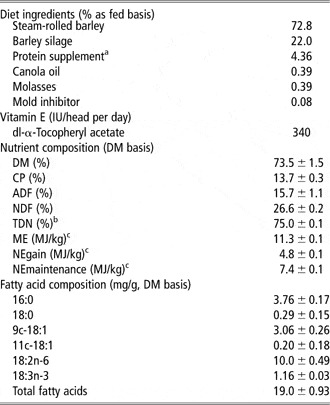
A total of 56 feedlot steers were housed in eight feedlot pens (four diets; two pens/dietary treatment; seven animals/pen, 14 animals/dietary treatment) at the Agriculture and Agri-Food Canada Lacombe Research Centre. All finisher diets contained 73% steam rolled barley and 22% barley silage (Table 1; as fed basis). Feed samples were collected weekly, pooled monthly and analysed for dry matter, crude protein, acid detergent fibre (ADF) and neutral detergent fibre (NDF) as described previously by Aldai et al. (Reference Aldai, Aalhus, Dugan, Robertson, McAllister, Walter and McKinnon2010) (n = 4). Fatty acid methyl esters from the finishing diets were prepared as described by Dugan et al. (Reference Dugan, Kramer, Robertson, Meadus, Aldai and Rolland2007). Results are shown in Table 1. The control diet provided 340 IU dl-α-tocopheryl acetate/animal per.day. Increasing vitamin E levels (0, 350, 700 and 1400 IU dl-α-tocopheryl acetate/animal per day) were top-dressed and mixed into the feed with a pitchfork to deliver four different treatments over the finishing period. Cattle were fed once daily to appetite in order to ensure that all feed provided each day was consumed. The dry matter intake was 10.3 ± 0.5 kg/day. Animals in each pen were group fed and were capable of feeding at the feed bunk at the same time. One animal from the 700 IU group died during the experiment (n = 13), reducing the total number to 55 feedlot steers.
Composition of the basal total mixed ration

DM = dry matter; TDN = total digestible nutrients; ME = metabolizable energy; NE = net energy.
aSupplement contained 93% DM, 23% CP, 2.7% crude fat, 4.0% crude fibre, 8.7% calcium, 2.2% phosphorus, 1.3% sodium, 0.7% potassium, 0.3% sulphur, 0.2% magnesium, 2800 mg/kg zinc, 2200 mg/kg manganese, 963 mg/kg iron, 907 mg/kg copper, 48.5 mg/kg iodine, 17 mg/kg cobalt, 14.5 mg/kg selenium, 241 000 IU/ kg vitamin A, 45 000 IU/kg vitamin D.
bFor finishing diets, TDN (%) = 92.2 – 1.12 × ADF (%).
cME and NE values were calculated according to National Research Council 1996. Nutrient requirements of beef cattle, 7th edition. National Academy Press, Washington, DC, USA.
Animals were fed experimental diets for an average of 120 days, and all dietary treatments and experimental procedures were approved by the Lacombe Research Centre Animal Care Committee and animals were cared for in accordance with guidelines established by the Canadian Council on Animal Care. Animals were slaughtered over three slaughter dates within a 1-month period (three animals/dietary treatment per slaughter day for the first and third kill, with six animals/dietary treatment for the second kill) at target ultrasound backfat measurements of 6 to 8 mm. At slaughter, live weights were recorded and animals were stunned and exsanguinated. Cooler shrink loss, full Canadian grade data, colour, final (24 h) pH and temperature were recorded as described by Aldai et al. (Reference Aldai, Aalhus, Dugan, Robertson, McAllister, Walter and McKinnon2010). The left longissimus thoracis (LT) and right and left longissimus lumborum (LL) were removed from carcasses for this study. From the LT, one steak (25 mm) was removed from the posterior end, the lean separated, and this was comminuted (Robot Coupe Blixir BX3; Robot Coupe USA Inc., Ridgeland, MS, USA) and frozen at −80°C for subsequent α-tocopherol determinations. The remaining LT was trimmed of all subcutaneous fat.
A second steak (25 mm) was removed for cooking loss and shear force determinations (2 days of ageing) and the remaining LT vacuum-packaged (Ultravac Model UV2100; Koch Instruments, Kansas City, MO, USA) and placed into a cooler at 2°C with a wind speed of 0.5 m/s for 6 days for subsequent meat quality and retail display analyses. Following the 6-day ageing period, seven steaks (25 mm) were removed from the cut surface of the LT. These steaks were used for 6, 14 and 21 days shear force, cooking loss determinations and retail study. Steaks for retail study were pre-weighed onto a polystyrene tray with a dri-loc pad (UZ Soaker Ultra Zap Pads, Paper Pak Industries Washington, GA USA), overwrapped with oxygen permeable film (8000 ml/m2 per 24 h vitafilm choice wrap; Goodyear Canada Inc., Toronto, ON, Canada) and put into a retail display case at 1°C for evaluation after 0, 2 and 4 days of retail ageing. Following the 4 days objective color measurements, the steaks were removed and final weights were recorded to determine drip loss.
From the left LL, ∼300 g of subcutaneous fat and 900 g of lean were vacuum-packaged for each animal and placed in a cooler for 6 days of ageing, as described previously, for subsequent preparation of ground beef patties. The entire vacuum-packaged right LL was aged for 21 days and after removing from the cooler, one steak from each animal was cut, packaged and put into the retail display case as described previously for the 6-day aged steak.
Ground beef patty preparation
At 6 days, the lean and subcutaneous fat from the left LL were removed from the cooler. The weighed lean and fat were ground through a Butcher Boy meat grinder Model TCA22 (Lasar Manufacturing Co., Los Angeles, CA, USA), initially with a 6-mm grind plate followed by a second grind using a 4-mm grind plate to achieve a 75/25 lean-to-fat grind. Fat content was verified by petroleum ether extraction on moisture-free grind (method 960.39; Association of Official Analytical Chemists (AOAC), 1995) using a Foss Soxtec System Model 2050 (Foss Analytical AB, Hoganas, Sweden). A 125-g patty (11.4 cm diameter × 1.3 cm thickness) was formed using a single hamburger press (Cabelas, Sydney, NE, USA). Five patties for colour and thiobarbituric acid-reactive substance (TBARS) analyses were put into a fan-assisted, horizontal (chest type) retail display case (Hill Refrigeration of Canada Ltd., Barrie, ON, Canada) under fluorescent room lighting (GE deluxe cool white, Mississauga, Ontario, Canada), supplemented with incandescent lighting directly above the display case (GE clear cool beam 150 W/120 V spaced 91.5 cm apart) to provide an intensity of 1076 lux at the meat surface for 12 h/day (Jeremiah and Gibson, Reference Jeremiah and Gibson2001).
α-Tocopherol analysis
Muscle levels of α-tocopherol were determined using normal phase HPLC with tocopherol acetate as an internal standard as described by Katsanidis and Addis (Reference Katsanidis and Addis1999) and adapted for fluorescence detection by Hewavitharana et al. (Reference Hewavitharana, Lanari and Becu2004).
Proximate analysis
Moisture content was determined by placing 100 g of the meat grind into stainless steel beakers in a gravity convection-drying oven at 102°C for a 24-h period (VWR Scientific Model 1370FM; Mississauga, ON, Canada). Crude fat content was determined as described previously. Nitrogen content (method 992.15; AOAC, 1995) was determined from fat-free grind (Nitrogen/Protein Determinator CNS2000; Leco Corp., St. Joseph, MI, USA).
Shear force and cooking loss
Shear force analysis was performed on cooked steaks as described by Aldai et al., (Reference Aldai, Aalhus, Dugan, Robertson, McAllister, Walter and McKinnon2010), using a TA-XT Plus Texture Analyzer equipped with a Warner–Bratzler shear blade at a crosshead speed of 200 mm/min and a 30-kg load cell using Texture Exponent 32 Software (Texture Technologies Corp., Hamilton, MA, USA). Cooking loss was determined through gravimetric weight difference of raw and final cooked weights of the same steaks before shear force analysis.
Retail case display study
All samples (steaks and ground beef patties) were placed into the display case to control for known temperature gradients within the case ensuring as little temperature variation among treatments as possible. On each specific retail ageing day, objective colour measurements using a Minolta CR-300 with Spectra QC-300 Software (Minolta Canada Inc., Mississauga, ON, Canada) were made at three locations across the surface of the 6- and 21-day aged steaks (Commission Internationale de l'Eclairage, 1978) and converted to hue (H ab = arctan[b*/a*]) and chroma (C ab = [a*2 + b*2]0.5). Spectral reflectance readings were also collected at the same time in order to calculate relative contents of metmyoglobin, myoglobin and oxymyoglobin (Krzywicki, Reference Krzywicki1979). One ground beef patty was placed on a pre-labelled polystyrene tray with a dri-loc pad, overwrapped and put into retail display case for an additional 4 days. Full spectral reflectance readings along with objective colour measurements were taken on the patty at 0, 2 and 4 days of retail display. A sub-sample (∼100 g) was comminuted with a Robot Coupe (Jackson, Mississipi, USA) and the concentration of TBARS (0 day in retail) was determined as described by Nielsen et al. (Reference Nielsen, Sørensen, Skibsted and Bertelsen1997). Two additional 125-g patties were placed onto pre-labelled trays with dri-loc pads, overwrapped and put into the retail display case for subsequent analyses of TBARS at 2 and 4 days in retail.
Statistical analyses
Statistical analyses were conducted using the MIXED procedure of Statistical Analysis Systems Institute (SAS Institute, 2009). The model included as a fixed effect of the original levels of dietary vitamin E (0, 350, 700 and 1400 IU vitamin E/kg) for carcass data and vitamin E groups, based on α-tocopherol tissue levels (<3 μg/g or low; 3 to 4 μg/g or low-medium; 4 to 5 μg/g or medium-high and >5 μg/g or high) for beef quality traits. When necessary, days of ageing and their interaction as fixed effects for meat quality traits were included in the model. Individual animal nested within group was included as a random effect. Group means were calculated as least square means and separated using the F-test protected LSD procedure (P ⩽ 0.05).
Results and discussion
Animal growth and carcass characteristics
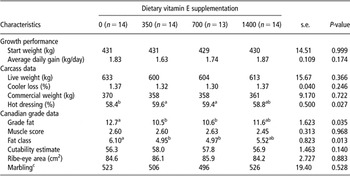
Dietary vitamin E levels did not affect (P > 0.05) growth performance, carcass weight and cooler loss, but hot dressing was affected (P = 0.027) by the dietary vitamin E supplementation (Table 2). In relation to grading data, grade fat and fat class were lower in the intermediate dietary vitamin E levels (P = 0.035 and 0.013, respectively). In a review about the effects of vitamin E on performance of feedlot cattle, Secrist et al. (Reference Secrist, Owens and Gill1997) found that indicators of fat deposition (fat thickness, marbling score and yield grade) tended to increase with vitamin E supplementation, but that was not observed in this study. Generally, vitamin E supplementation (vitamin E levels 224 to 1200 IU/animal per day) has not been found previously to affect carcass characteristics or quality and yield grades of beef cattle (Realini et al., Reference Realini, Duckett, Brito, Dalla Rizza and De Mattos2004; Montgomery et al., Reference Montgomery, Drouillard, Sindt, Greenquist, Depenbusch, Good, Loe, Sulpizio, Kessen and Ethington2005; Lee et al., Reference Lee, Panjono, Kim and Park2008). Effects of vitamin E supplementation depend on its level, previous nutritional history, vitamin E status of the cattle at the start, stress level of animals and vitamin E content of the basal diet, as well as genetics, which is related to the ability of individual animals to tolerate handling and feedlot conditions (Secrist et al., Reference Secrist, Owens and Gill1997). Liu et al. (Reference Liu, Lanari and Schaefer1995) recommend a supplementation strategy of 500 IU of supplemental vitamin E/animal per day for 126 days. Feeding at least 1300 IU/day for 44 days and 1200 IU/day for 38 days elevated the α-tocopherol concentration from 1.4 to 3.5 μg/g and 2.2 to 3.5 μg/g, respectively (Arnold et al., Reference Arnold, Scheller, Arp, Williams, Buege and Schaefer1992 and Reference Arnold, Arp, Scheller, Williams and Schaefer1993).
Effect of dietary vitamin E supplementation (IU dl-α-tocopheryl acetate/animal per day) on animal growth performance and carcass characteristics

a,bMeans within the same row with different superscripts are significantly different at P < 0.05.
cUS Department of Agriculture's marbling standards: 300 = traces; 400 = slight; 500 = small; 600 = modest; 700 = moderate; 800 = slightly abundant; 900 = moderately abundant; 1000 = abundant; and 1100 = very abundant.
Vitamin E grouping approach
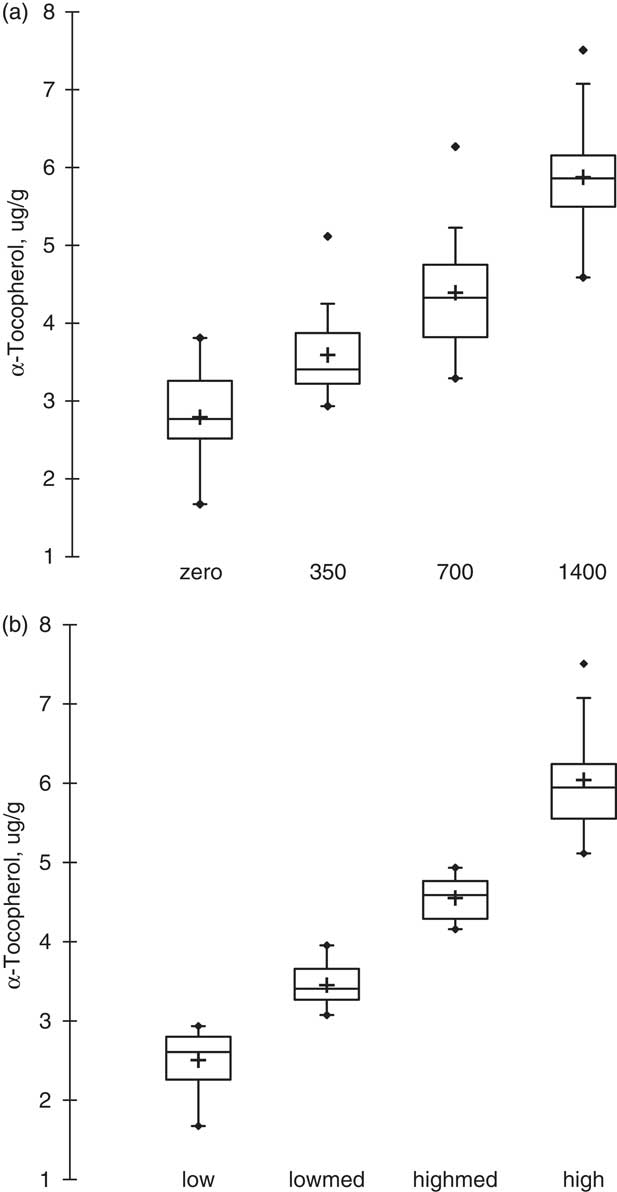
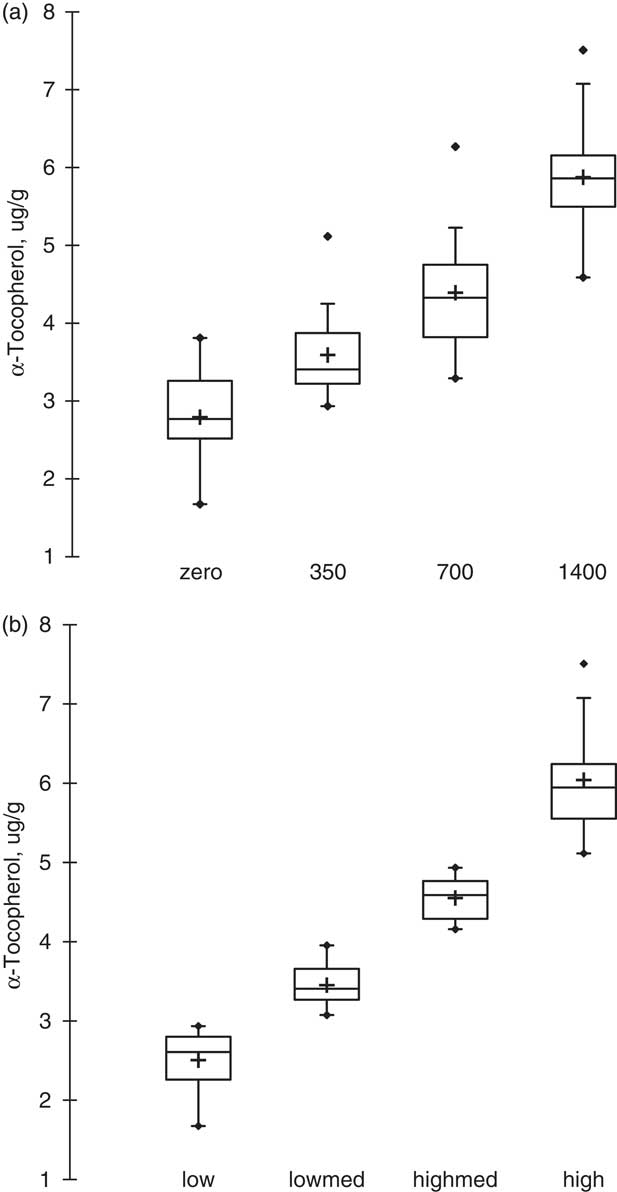
In studies concerned with the effects of beef cattle vitamin E supplementation on meat quality, determining the concentration of α-tocopherol in tissue is of great importance (Faustman et al., Reference Faustman, Chan, Schaefer and Havens1998). In this study, animals were grouped according to their actual tissue α-tocopherol levels, namely low (n = 10; <3 μg/g meat), low-medium (n = 20; 3 to 4 μg/g meat), high-medium (n = 11; 4 to 5 μg/g meat) and high (n = 14; >5 μg/g meat). Observing the tissue α-tocopherol levels from the dietary vitamin E treatments (Figure 1a), a clear overlap was evident due to the inter-animal variability. Therefore, grouping according to actual tissue levels of α-tocopherol would lead to more accurate results when studying effects on beef quality. Grouping the animals using this approach, the variability was reduced and significantly different values were found among groups (P < 0.001) (Figure 1b). All data obtained for meat quality discussed in this study used this approach.
Intramuscular α-tocopherol levels (a) from dietary treatments (b) grouped by tissue levels. Box plot shows the smallest observation (sample minimum), lower quartile, median (+), upper quartile and the largest observation (sample maximum). Outliers (*) are also indicated when present.
Meat quality
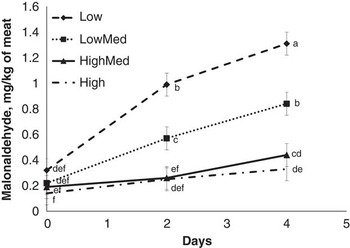
Prevention of lipid oxidation by α-tocopherol results from quenching free radicals, which protects highly unsaturated fatty acids mainly found in membrane phospholipids (Faustman et al., Reference Faustman, Cassens, Schaefer, Buege, Williams and Scheller1989; Burton and Traber, Reference Burton and Traber1990). In this study, there was an interaction (P < 0.001) for TBARS between time of ageing and tissue α-tocopherol levels in ground beef (Figure 2). TBARS from animals with high-medium and high levels of α-tocopherol did not significantly increase between days 0 and 4 of ageing, whereas the low group, followed by the low-medium group, showed higher TBARS values over time. Lower TBARS from vitamin E-supplemented beef have been reported by several authors (Eikelenboom et al., Reference Eikelenboom, Hoving-Bolink, Kluitman, Houben and Klont2000; Gatellier et al., Reference Gatellier, Hamelin, Durand and Renerre2001; Lee et al., Reference Lee, Panjono, Kim and Park2008) with variable effects on meat quality characteristics. A minimum of 3 to 3.5 μg of α-tocopherol/g meat has been reported to be necessary to prevent discolouration and lipid oxidation (Faustman et al., Reference Faustman, Cassens, Schaefer, Buege, Williams and Scheller1989; Arnold et al.; Reference Arnold, Arp, Scheller, Williams and Schaefer1993, Liu et al., Reference Liu, Lanari and Schaefer1995). Low and low-medium vitamin E groups had α-tocopherol values <4 μg/g meat, which explains the increasing TBARS values over time. Clausen et al. (Reference Clausen, Jakobsen, Ertbjerg and Madsen2009) reported that raw meat with approximately <2 mg α-tocopherol/g meat showed a very high degree of lipid oxidation measured by TBARS.
Thiobarbituric acid-reactive substances in ground beef (6 days of ageing) with different α-tocopherol tissue levels over 4 days of retail display (a,b,c,d,e,fmeans with different letters are significantly difference at P < 0.05; low: <3 μg/g meat; low-medium: 3 to 4 μg/g meat; high-medium: 4 to 5 μg/g meat; high: >5 μg/g meat).

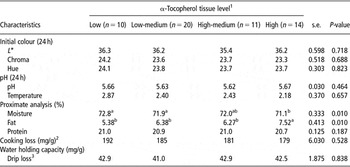
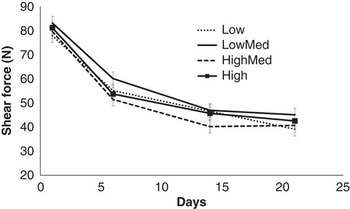
Lipid peroxidation is also known to cause damage to membrane proteins leading to a loss of muscle cell membrane integrity that can affect its ability to function as a semi-permeable barrier and may contribute to exudative losses from meat (Gray et al., Reference Gray, Gomaa and Buckley1996). α-Tocopherol can preserve the integrity of muscle cell membranes, reducing muscle cell disruption and this could inhibit the passage of sarcoplasmic fluid through the muscle cell membrane (Asghar et al., Reference Asghar, Gray, Booren, Gomaa, Abouzied, Miller and Buckley1991). In this study, tissue levels of α-tocopherol had no effect on drip loss (P = 0.838) and cooking loss (P = 0.528; Table 3), similar to results found by den Hertog-Meischke et al. (Reference den Hertog-Meischke, Smulders, Houben and Eikelenboom1997) and Eikelenboom et al. (Reference Eikelenboom, Hoving-Bolink, Kluitman, Houben and Klont2000). A reduction in drip loss, along with an increase in cooking loss in beef steaks was reported by Mitsumoto et al. (Reference Mitsumoto, Arnold, Schaefer and Cassens1995), but the α-tocopherol concentration reported by these authors (6.7 μg/g meat) was higher than other studies. Initial colour and pH were also not affected by tissue α-tocopherol levels (P > 0.05; Table 3), as reported in similar studies (Arnold et al., Reference Arnold, Scheller, Arp, Williams, Buege and Schaefer1992; Eikelenboom et al., Reference Eikelenboom, Hoving-Bolink, Kluitman, Houben and Klont2000). As expected, fat content increased with α-tocopherol tissue levels (P = 0.010; Table 3), as α-tocopherol is a fat-soluble vitamin. The higher content of fat associated with higher α-tocopherol could have an effect on other meat quality traits, such as tenderness. In addition, the use of antioxidants such as vitamin E could enhance tenderness in beef by preventing the inactivation of the calpain system (Huff Lonergan et al., Reference Huff Lonergan, Zhang and Lonergan2010). However, although shear force from all groups decreased with ageing (P < 0.001), no effect (P > 0.05) of tissue α-tocopherol level was found on shear force (Figure 3).
Effect of different tissue levels of α-tocopherol (μg/g meat) on meat quality characteristics

a,bMeans within the same row with different superscripts are significantly different at P < 0.05.
1Low: <3 μg/g meat; low-medium: 3 to 4 μg/g meat; high-medium: 4 to 5 μg/g meat; high: >5 μg/g meat.
2Average values from 1, 6, 14 and 21 days of ageing.
3From days 6 to 10.
Shear force values of steaks with different α-tocopherol levels aged for 21 days (low: <3 μg/g meat; low-medium: 3 to 4 μg/g meat; high-medium: 4 to 5 μg/g meat; high: >5 μg/g meat).

Ageing and retail display
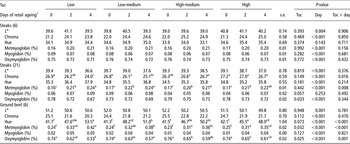
Vitamin E delays not only lipid oxidation in beef but also oxidation of ferrous to ferric iron in myoglobin located in sarcoplasm (Faustman and Cassens, Reference Faustman and Cassens1990; Arnold et al., Reference Arnold, Scheller, Arp, Williams, Buege and Schaefer1992 and Reference Arnold, Arp, Scheller, Williams and Schaefer1993). Various hypotheses have been tested to understand the mechanism of action of antioxidants and their relation to meat discolouration. Faustman et al. (Reference Faustman, Cassens, Schaefer, Buege, Williams and Scheller1989), based on earlier results from Greene (Reference Greene1969), suggested that antioxidants inhibit oxidation by protecting the pigment from reaction with oxidation intermediates such as free radicals. Vitamin E could inhibit lipid oxidation and consequently a reaction with secondary oxidation products such as α-, β-unsaturated aldehydes (Faustman et al., Reference Faustman, Liebler, McClure and Sun1999). However, a more recent study, by O'Grady et al. (Reference O'Grady, Monahan and Brunton2001), which has been supported by Monahan et al. (Reference Monahan, Skibsted and Andersen2005), indicated that in an oxidizing muscle system the depletion of dissolved oxygen as a result of lipid oxidation is the primary cause of oxymyoglobin oxidation. The mechanistic basis of myoglobin and lipid oxidation, as well as the relation between these two processes has been extensively reviewed by Faustman et al. (Reference Faustman, Sun, Mancini and Suman2010). In the present study, in steaks aged 6 (P = 0.004) or 21 days (P < 0.001), and ground beef (P < 0.001), L* decreased over time (Table 4). After a short ageing time (6 days), no effect (P > 0.05) on retail evaluation was found among samples with different tissue levels of α-tocopherol. However, there was an increase in metmyoglobin (P < 0.001) over time in retail display and decreases (P < 0.001) in the content of myoglobin and oxymyoglobin. In contrast, with meat that had been aged for 21 days, increased tissue α-tocopherol levels protected against formation of metmyoglobin over time in retail display (P = 0.008). The increase in metmyoglobin was smaller during retail display as α-tocopherol tissue levels increased. Oxymyoglobin levels on the last day of retail display were also higher (P = 0.033) in meat with a higher content of α-tocopherol. Consequently, chroma values of steaks with the high-medium and high levels of α-tocopherol were not affected by time in retail display, in contrast to observations for steaks with lower α-tocopherol levels (P = 0.016). A similar effect was found for the ground beef patties. An interaction between tissue α-tocopherol levels and days of retail display was observed for both oxymyoglobin (P = 0.001) and metmyoglobin (P < 0.001) in 21-day aged steaks; in low and low-medium α-tocopherol groups, oxymyoglobin decreased while metmyoglobin increased, whereas values for high-medium and high α-tocopherol groups did not change. In addition, the increase in hue was smaller in samples with higher tissue α-tocopherol levels (P < 0.001). In this study, chroma decreased over time, meaning less-intense colour in treatments with a lower level of tissue α-tocopherol. This protection with high α-tocopherol levels (P = 0.016) in 21-day aged beef is practically significant, as the time before boxed beef as primal cuts and manufactured/ground beef are displayed in commercial retail cases in Canada ranges from 5 to 80 days and 2 to 56 days, respectively (Gill et al., Reference Gill, Jones, Rahn, Campbell, LeBlanc, Holley and Stark2002). Higher initial tissue α-tocopherol levels are more protective during long periods of ageing as its concentration decreases over time (Clausen et al., Reference Clausen, Jakobsen, Ertbjerg and Madsen2009). Therefore, high tissue levels of vitamin E could lead to an improvement in colour and retail appearance of both lean and ground beef following long storage periods during distribution, which are commonly found in industry and would be particularly valuable in assuring colour stability in transoceanic shipment of chilled meat.
Effect of different tissue levels of α-tocopherol (μg/g meat) on retail evaluation of aged beef and ground beef

Toc = α-tocopherol tissue level.
a,b,c,d,e,fMeans within the same row with different superscripts are significantly different at P < 0.05.
1Low: <3 μg/g meat; low-medium: 3 to 4 μg/g meat; high-medium: 4 to 5 μg/g meat; high: >5 μg/g meat.
Dietary vitamin E recommendations
In this study, animals were fed a basal diet providing 340 IU supplemental α-tocopherol, and when >700 additional IU were supplemented per day for 120 days, this provided oxidative stability in aged samples. The level of α-tocopherol that must be supplemented in the diet to obtain oxidative stability is, however, dependant on the level naturally occurring in the diet. Given that we supplemented several levels of α-tocopherol to the diet, we were able to regress tissue α-tocopherol v. supplementation level. From the regression (y = 0.0023x + 1.7695, R 2 = 0.78, P < 0.05), where y = tissue level of α-tocopherol in μg/g and x = IU α-tocopherol added to the diet, when we set the tissue level to 0 μg/g this provided an estimate of the α-tocopherol available in the unsupplemented diet (770 IU). Consequently, the amount of α-tocopherol required for oxidative stability of aged meat in this study was 1810 IU/head per day (770 IU naturally in the diet + 340 IU in basal diet + 700 IU top dressed at feeding/head per day). Achieving this level in practice will, therefore, require knowledge of the amount and availability of vitamin E for all dietary ingredients.
Conclusions
Increased tissue levels of α-tocopherol protected against retail discolouration and lipid oxidation in steaks after ageing 21 days, but had no influence in steaks after ageing only 6 days. A similar protective effect was observed in ground beef (25% fat) when prepared using lean and fat tissues aged 6 days. Shear force was not affected by tissue α-tocopherol levels. To obtain oxidative stability, this required >1040 IU supplementary vitamin E added to 770 IU estimated to be naturally available in the diet. Shear force was not affected by tissue α-tocopherol levels. Further investigations are warranted to determine whether the protective effects of vitamin E against colour deterioration after long ageing periods also protects against lipid oxidation in steaks with subsequent potential positive effects on palatability.
Acknowledgements
Dr M. Juárez acknowledges the receipt of an Natural Sciences and Engineering Research Council (NSERC) fellowship funded through the Agriculture and Agri-Food Canada (AAFC) Agricultural Bioproducts Innovation Program – Feed Opportunities from the Biofuels Industries Program. Project funding from the Alberta Meat and Livestock Agency is gratefully acknowledged. The authors thank the staff of the the Beef Unit, AAFC-Lacombe Research Centre, Meat Processing staff and the Subjective & Objective Quality Technical team for their skilled assistance with this project.