Continuity of care for dialysis recipients, including end stage kidney disease (ESKD) patients, is critical as these patients are at heightened risk for increased morbidity and mortality if their typically 3-times-a-week hemodialysis treatment is interrupted. Natural disasters such as earthquakes and hurricanes can lead to disruptions in equipment, electricity, water, communication, and transportation. Reference Murakami, Siktel and Lucido1–Reference Kopp, Ball and Cohen6 The impact of these types of natural disasters on infrastructure, for example, facility closures due to damaged buildings or roads, or disruptions to electricity, water, and communications, would not differ substantially. However, earthquakes can increase the number of patients with acute kidney failure (AKF) due to crush syndrome, which is common among victims trapped under rubble. Reference Fukagawa5,Reference Kopp, Ball and Cohen6 Patients with crush syndrome require dialysis at least temporarily, which would increase the demand for and reduce access to those services for other ESKD patients. For example, in the month after Hurricane Katrina (2005), more than 50% of the dialysis facilities in Louisiana were still closed due to major damage caused by the hurricane. Reference Kenney7 These closures contributed to an increase in renal-related hospitalizations in the hurricane-affected areas. Reference Anderson, Cohen and Kutner8,Reference Howard, Zhang, Huang and Kutner9 Similarly, during Hurricane Sandy (October 29, 2012), 306 dialysis facilities in New York and New Jersey were closed right after the hurricane struck. Reference Lempert and Kopp2 Major disruptions in dialysis services caused by Sandy led to missed dialysis care during the first week post-Sandy for both US Department of Veterans Affairs (VA) and non-VA patients. Major disruptions in dialysis services might have contributed to an increase in the 30-day mortality rate of 1.83% in Sandy-affected areas compared to 1.6% for the same month in the preceding year. Reference Kenney7,Reference Lukowsky, Dobalian and Goldfarb10
Dialysis-dependent patients due to ESKD require established vascular access so they can receive dialysis treatments. Reference Santoro, Benedetto and Mondello11 There are 3 types of vascular access: arteriovenous fistula (AVF), arteriovenous graft (AVG), and central venous catheter (CVC). AVF is considered the safest and currently the most commonly used method. However, a placement of AVF requires surgery and requires usually 2 or more months before it can be used for treatment. Therefore, during emergency dialysis initiation, another vascular access method, most likely a CVC, needs to be used before switching to AVF in subsequent months. The vascular access site has to be monitored on a daily basis by the patient and medical personnel to prevent complications such as infections, stenosis, or thrombosis. Reference Santoro, Benedetto and Mondello11,Reference Yan, Ye and Yang12 Complications associated with all types of vascular access have been widely reported in the literature, and can arise at the time of access placement as well as during the maintenance period. Reference Suri, Larive and Sherer13–Reference Eslami, Zhu and Rybin16 While complications associated with vascular access are common among ESKD patients, during and immediately after a disaster, they can become exacerbated due to shortages of clean water, electricity, and transportation, as well as limited access to dialysis facilities.
In Puerto Rico, after Hurricanes Irma and Maria (September 2017), damage to major infrastructure caused delays in medical care throughout most of the island, and resulted in more than $50 billion dollars in damages. Reference Lopez-Cardalda, Lugo-Alvarez and Mendez-Santacruz17–Reference Alcorn20 The electrical grid suffered significant damage, leaving the majority of the island’s population without power until November 2017, although outages continued through May 2018. 18 Even though 48 out of 58 hemodialysis (HD) units opened almost immediately using generators and water tanks following hurricane Maria, Bonilla-Felix et al. (2019) Reference Bonilla-Felix and Suarez-Rivera3 reported that road damage, fallen power lines, and a shortage of fuel were major barriers accessing dialysis facilities. By October 2017, about 1 month after the hurricanes, all but 33 out of the 6000 ESKD patients on the island had at least 1 contact with their dialysis provider. Reference Alcorn20 It was also reported that 600 dialysis patients left the island within a year after Maria. Reference Bonilla-Felix and Suarez-Rivera3
Prior to the hurricanes, the dialysis unit at the San Juan VA Medical Center (SJVAMC) provided regular outpatient dialysis care to veterans with ESKD. Additionally, the SJVAMC dialysis unit provided inpatient dialysis to veterans with ESKD during their hospitalizations, as well as inpatient dialysis to patients with acute kidney failure (AKF). During and after the 2 hurricanes, the dialysis unit at the SJVAMC remained open and continued serving its veteran patient population. Some VA patients with ESKD who were not receiving maintenance hemodialysis at the SJVAMC prior the hurricanes were treated at the SJVAMC dialysis unit after the 2 hurricanes, most likely because they were unable to access their regular non-VA treatment sites.
This study examined how Irma and Maria affected access to dialysis care for VA ESKD patients at both the SJVAMC and non-VA community clinics. The study hypothesis was that SJVAMC experienced an increase in its volume of dialysis care after the hurricanes because of the aforementioned challenges to delivering care at non-VA dialysis clinics in Puerto Rico.
Methods
Cohort Description
A retrospective, longitudinal study was conducted using VA administrative and clinical data from the VA Corporate Data Warehouse. The Puerto Rico dialysis cohort of VA users was defined as VA patients who had at least 1 dialysis-related encounter in Puerto Rico or the US Virgin Islands 1 year before and 1 year after the 2017 hurricane season between September 6, 2016, and September 5, 2018. Current Procedural Terminology (CPT) codes 90935-90937, 90945-90947, 90960-90962, 90999, and G0257 were used to identify procedures related to dialysis treatments at the SJVAMC dialysis unit and non-VA dialysis centers. Visits related to vascular access for dialysis using 101 CPT codes associated with the placement of CVC, AVF, or AVG as well as with complications for vascular access were also examined.
Analysis
This study compared the annual number of dialysis encounters a year before to a year after the hurricanes at the SJVAMC and non-VA facilities. The number of visits to an emergency department (ED) was also examined 1 year before and 1 year after. Chi-square tests were used to analyze the differences between pre- and post-hurricane visits to the VA facilities. Additionally, the number of visits related to dialysis vascular access (either due to a placement, a change, or for complications associated with it) was assessed.
A random effect logistic regression model Reference Kuss21 for correlated binary outcomes comparing mortality between pre- and post-hurricane periods was fitted, accounting for the fact that some patients used SJVAMC during both periods, and therefore observations for those patients were not independent because they were included in both the before and after groups. The model adjusted for time-dependent covariates, including age as well as comorbidities (eg, hypertension, diabetes, heart failure [HF], chronic pulmonary disease[CPD], and sepsis). Models of this type are commonly used for outcomes that change over time to accurately estimate both subject-specific effect, accounting for multiple data points for the same subject, as well as between subject effects. Reference Lalonde, Nguyen and Yin22
All analyses were performed using the SAS 9.4 and SAS Enterprise Guide 7.1 software packages (SAS Institute, Cary, NC). Proc GLIMMIX was used to fit a random effect model. This study was approved by the VA of Greater Los Angeles Healthcare System (VAGLAHS) Institutional Review Board.
Results
Patient Characteristics
The study cohort included 330 dialysis patients who received at least 1 hemodialysis treatment in Puerto Rico: 195 received all dialysis services at the SJVAMC, 20 used only non-VA dialysis clinics, and 115 received dialysis care at both VA and non-VA clinics. This study identified 58 ESKD patients who received maintenance hemodialysis exclusively at SJVAMC during the study period (38 received hemodialysis a month before the hurricanes). Table 1 illustrates the demographic characteristics and comorbid diagnoses before and after the hurricanes. With regard to demographic characteristics, 98% were men, 59% were married, 22% were divorced or separated, 10% were never married, 9% were widowed, 81% were age 65 or older (mean age 73; range 38-98), and the average distance from patients’ home to SJVAMC was 19 km (12 miles) (see Table 1, column 3). With regard to comorbid diagnoses, 70% had diabetes, 79% had hypertension, 51% had heart failure, 39% had ischemic heart disease, 36% had sepsis, and 37% had at least 1 diagnosis of infection other than sepsis during the study period (see Table 1, Total column). Between September 2017 and January 2018, 3 ESKD, non-VA patients who had evacuated from the Virgin Islands after Hurricane Irma were treated at the SJVAMC. All 3 received inpatient dialysis in Puerto Rico and were included in this study. During the 2-year study period, there were 115 (35%) deaths and 8 (2%) patients who received a kidney transplant. Additionally, 224 (68%) patients had at least 1 outpatient encounter related to a vascular access (see Table 1, Total column).
VA ESKD patient characteristics in Puerto Rico, pre/post Hurricanes Irma and Maria (N = 330)

Chi-square tests: *P < 0.05; **P < 0.001.
a Encounters include establishing vascular access at time of dialysis initiation, changing the access, and visits for complications associated with vascular access.
During the year prior to the 2 hurricanes, 239 patients received dialysis care either at SJVAMC or at community clinics for which their care was paid by VA, compared to 251 patients in the year following the hurricanes (see Table 1, Pre and Post columns). There were 50 (21%) deaths during the pre-hurricane period (September 6, 2016–September 5, 2017), and 65 (26%) during the post-hurricane period (September 6, 2017–September 6, 2018). During the first year, there were 38 patients with AKD. Out of those, 10 progressed to ESKD, and 19 died (15 during the first year). During a second year, there were 45 patients with AKF. Out of those, 8 progressed to ESKD and 16 died during the study period (data not shown). There were no significant differences between patient characteristics during pre- and post-periods except for the number of patients with a heart failure diagnosis at 84 (33%) versus 120 (47%) (PF < 0.001), CPD at 7 (3%) versus 19 (8%) (P < 0.05), and hepatitis at 24 (10%) versus 11 (4%) (P < 0.05).
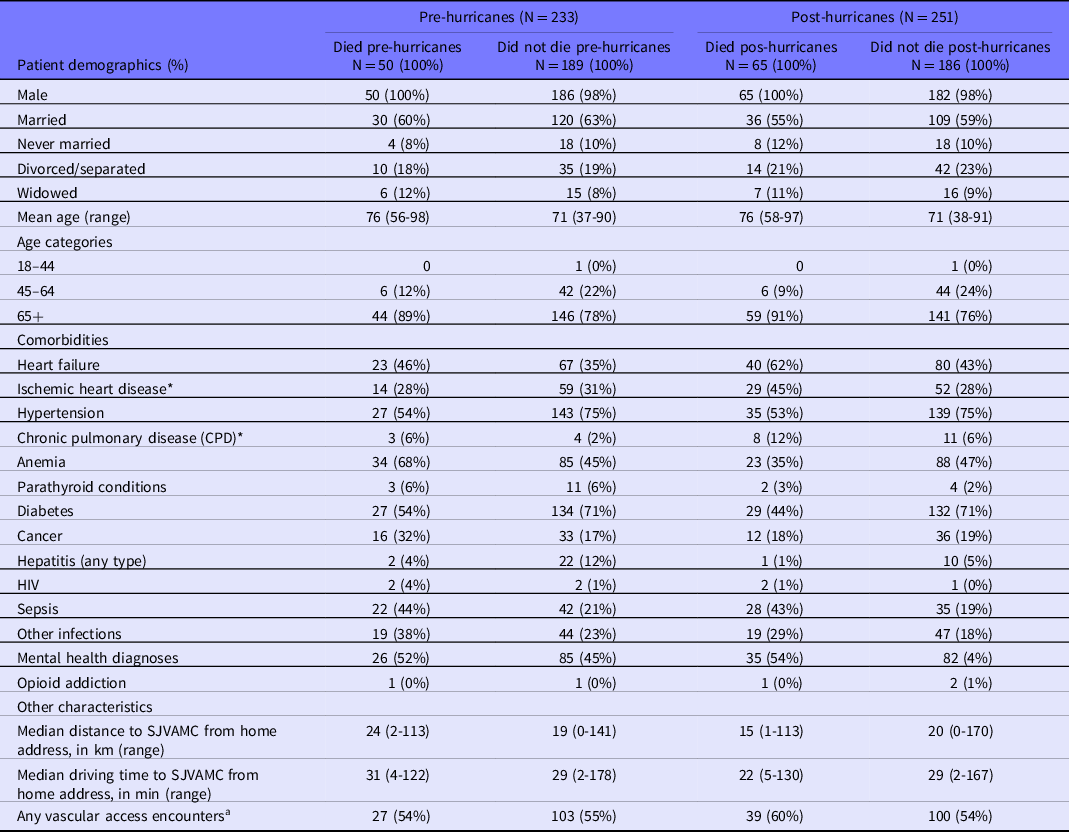
Table 2 provides information regarding patient characteristics based on mortality status during both pre- and post-hurricane periods. Diagnoses for ischemic heart disease (IHD) (14 [28%] vs 29 [45%], P < 0.05) and CPD (3 [6%] vs 8 [12%], P < 0.05) increased significantly for patients who died after the hurricane compared to patients who died before the hurricanes.
VA ESKD patient characteristics in Puerto Rico, pre/post Hurricanes Irma and Maria by mortality status (N = 330)

Chi-square tests: *P < 0.05; **P < 0.001.
a Encounters include establishing vascular access at time of dialysis initiation, changing the access, and visits for complications associated with vascular access.
Figure 1 examines changes between pre- and post-hurricane season, indicating a decrease in the total number of VA outpatient visits from 20 685 during the pre-hurricane period to 18 092 after the hurricanes (14% decrease). While the number of dialysis visits decreased from 7263 to 6948, the percent of dialysis visits out of the total number of visits increased from 35% to 38% (< 0.001). There was an increase in both the number of ED visits during the post-hurricane period from 1172 (5.7%) to 1195 (6.6%) (P < 0.001), and in ESKD-related ED visits from 200 (0.9%) to 227 (1.3%) (P < 0.05).
The number and percent of encounters for VA ESKD patients at SJVAMC, pre/post Hurricanes Irma and Maria.

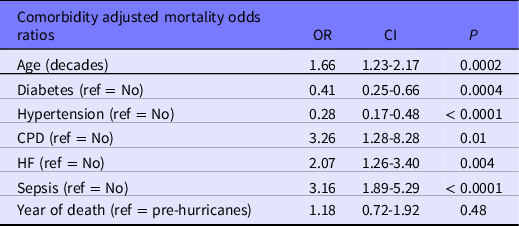
Table 3 shows age, period (pre- vs post-hurricanes), and comorbidity adjusted mortality odds ratios (ORs). Age (OR = 1.66; CI: 1.23-2.17), comorbid diagnoses such as heart failure (OR = 2.07; CI: 1.26-3.40), CPD (OR = 3.26; CI: 1.28-8.28), and sepsis (OR = 3.16; CI: 1.89-5.29) were associated with higher mortality. Diabetes and hypertension were associated with lower mortality, with ORs 0.41 (0.25-0.66) and 0.28 (0.17-0.48), respectively. Even though there was an 18% increase in mortality during the post-hurricane period, OR = 1.18 (0.72-1.92), it was not statistically significant (P = 0.48).
Adjusted mortality odds ratios for VA ESKD patients during pre- and post- Hurricanes Irma and Maria (N = 330)

Discussion
On September 6, 2017, Hurricane Irma made landfall in Puerto Rico and caused significant damage to some parts of the island. Two weeks later, on September 20, 2017, Hurricane Maria, a Category 4 hurricane, caused major destruction and devastation to the entire island. 18 Even though most dialysis facilities on the island were able to reopen within a few days using generators and by making their own clean water, Reference Bonilla-Felix and Suarez-Rivera3,Reference Norris, Harford and Flaque23 many ESKD patients encountered difficulties reaching their regular dialysis care sites because of road damage and transportation issues. Additionally, disruptions to power and telecommunication services made it impossible for many patients to communicate with their dialysis facilities. As in New York after Superstorm Sandy (2012), Reference Lin, Pierce, Roblin and Arquilla24 the absence of medical records and dialysis documentation made the use of alternative dialysis facilities challenging and inefficient, which in turn resulted in delayed or even missed treatments in the first few weeks and even months after Irma and Maria. Reference Norris, Harford and Flaque23
The dialysis unit at SJVAMC remained open during and after the hurricanes and continued providing services after the hurricanes. While other dialysis facilities reported about a 15% drop in their patient census through the month of December, Reference Norris, Harford and Flaque23 the SJVAMC dialysis unit saw an increase in the number of patients during the first month after the hurricanes (September–October 2017), indicating minimal or no interruption of dialysis services.
In total, this study observed an increase from 233 to 251 in the number of patients who used the SJVAMC dialysis clinic in the year following Irma and Maria, although there was a substantial decrease in the general population on the island during that period. An analysis of geocoded tweets by Puerto Rico residents revealed that about 8.3% of the island residents relocated in the months following the hurricanes, and 4% were still displaced by May 2018. Reference Martín, Cutter and Li25 These numbers were somewhat higher for ESKD patients as it was reported that about 10% (600 out of 6000) of ESKD patients left Puerto Rico shortly before or after the hurricanes, and a small number of ESKD patients were medically evacuated to the mainland after Maria. Reference Martín, Cutter and Li25,Reference Hick26 While the authors did not have information about how many ESKD VA patients relocated from the island post-hurricanes, it is not expected for this number to differ from non-VA dialysis patients. Therefore, the fact that more ESKD VA users sought care at the SJVAMC dialysis unit suggests that VA patients encountered difficulties accessing dialysis care at non-VA, community dialysis clinics after the hurricanes. Additionally, the fact that this study saw very little difference in pre- and post-hurricane attendance among regular VA ESKD patients suggests that the excess number of dialysis patients at SJVAMC after the hurricanes was mostly due to VA ESKD patients who previously received care in community settings before the hurricanes and instead received at least some of their dialysis care at SJVAMC after the hurricanes.
This study observed an increase in the number of ESKD VA patients who either permanently or temporarily switched to receiving care from the VA dialysis unit rather than their regular community clinics, especially during September–October 2017. These observations might indicate that many ESKD patients used SJVAMC on an emergency rather than regular basis, most likely due to limited access to care in community settings. Large integrated health care delivery systems may be better able to handle post-disaster increased demands, that is, surges, for care, even for extended periods lasting a few months than smaller, standalone facilities. Even though there was an increase in the number of ESKD patients after the hurricanes, the total number of outpatient encounters and the number of dialysis visits decreased in the year following the hurricanes, perhaps because of departures from the island. Nonetheless, the percentage of dialysis visits and ED visits increased significantly following the hurricanes, indicating an overall increase in the acuity level for care. Additionally, this study observed an increase in deaths among ESKD patients from 50 (21%) during the pre-hurricane period compared to 65 (26%) post-hurricanes, although this change was not statistically significant.
This study found that age and various comorbid conditions such as CPD and IHD were significantly associated with mortality. In fact, the study observed an increase from 6% to 12% for CPD and 28% to 45% for IHD. This study also observed an increase in HF diagnoses in patients who died during the post-hurricane period from 46% to 62%, and an increase from 35% to 47% in all patients. Missed or delayed dialysis can lead to volume overload and heart failure. Indeed, the study observed a significant increase in HF diagnoses in the post-hurricane period, which could be related to limited access to dialysis services for the ESKD patients receiving dialysis at non-VA facilities right after the hurricanes. This study found that hypertension and diabetes were associated with lower mortality. The U-shape association between hypertension and mortality where low blood pressure is associated with higher mortality was described previously, and the results are consistent with that finding. Reference Mayer, Matschkal and Sarafidis27 Previous studies also showed that obesity is associated with lower mortality in dialysis patients. Reference Kalantar-Zadeh, Abbott and Salahudeen28 Since the study did not have data on obesity, the association between diabetes and lower mortality might serve as a predictor of an obesity-mortality association, as there is an established positive link between obesity and diabetes.
This study did not observe any changes in dialysis schedules for the VA dialysis patients. That might be because SJVAMC remained open during the hurricanes. Most likely, ESKD patients receiving dialysis at the VA lived in relatively close proximity to SJVAMC and therefore were less affected by road closures and transportation issues.
This study also observed a significant association between sepsis diagnosis and mortality, which may be related to the problems associated with vascular access as it often leads to infection. More than 50% of the study participants had procedures associated with vascular access. Also, 60% of patients who died after the hurricanes had vascular access-related visits, compared to 54% of those who died before the hurricanes. This might at least partially explain an association between mortality and sepsis diagnosis. While there was no difference in sepsis diagnoses between the pre- and post-hurricane period, more than 40% of patients who died had a sepsis diagnosis compared to about 20% of those who did not.
Limitations
This study examined access to dialysis care by ESKD veteran patients after a major natural disaster. As the largest integrated health care system in the country, VA can provide resources to assist patients at a time when the local systems get overwhelmed after disasters.
For this study, VA administrative and clinical data that contain comprehensive information about all services VA users received at the VA health care system, as well as services received outside of the VA, but paid by the VA, were used. Additionally, data on patient demographic characteristics and diagnoses from hospitalizations and outpatient visits at the VA were used.
This study has a few limitations. The authors had access to data from the United States Renal Data System (USRDS) Reference Saran, Robinson and Abbott29 for calendar year 2016 through June 2017 because the availability of Medicare data usually lags in time. Accordingly, the authors were unable to use Medicare information in the analysis and, therefore, were unable to identify Puerto Rico ESKD cohort patients who were enrolled in Medicare after June 2017. Furthermore, the authors were unable to use the USRDS to determine the dates of dialysis initiation and the dialysis modalities at both the time of dialysis initiation and during the post-hurricane period. Additionally, the authors were unable to verify medical care for patients from the study cohort if they left the island or received care that was not paid by the VA.
Conclusions
This study examined the differences in outpatient encounters, dialysis care, and ED visits among ESKD patients who used VA or non-VA dialysis facilities during the year before and after Hurricanes Irma and Maria in Puerto Rico. There were minimal or no interruptions of services for ESKD patients who were receiving dialysis on a regular basis at SJVAMC during the year following the hurricanes. However, an increase was observed in the number of patients who received dialysis services at SJVAMC during the immediate post-hurricane period, most likely due to limited access to dialysis care at the non-VA clinics. This study shows that SJVAMC served as a safety net for VA ESKD patients after the hurricanes, regardless of whether they were receiving dialysis care at VA or non-VA facilities prior to the hurricanes. These findings have important implications for dialysis services and dialysis resources at VA, since they can assist non-veteran ESKD patients during disasters and pandemics.
Funding statement
This material is based upon work supported by the US Department of Veterans Affairs.
Conflict(s) of interest
The views expressed in this manuscript are those of the authors and do not necessarily reflect the position or policy of the Department of Veterans Affairs or the US Government.