




No CrossRef data available.
Discourse within a sentence: An exploration of postpositions in Japanese as an interactional resource
Published online by Cambridge University Press: 15 June 2004
Abstract
This study explores a phenomenon in Japanese conversation that might be regarded as “discourse-within-a-sentence,” or interpolating a sequence of talk during ongoing sentence construction. It explicates the way in which Japanese speakers use postpositional particles as a resource to incorporate an element in a parenthetical sequence into the syntax of a sentence-in-progress. It is shown that the usability of postpositions for achieving discourse-within-a-sentence comes from the situated workings of postpositions used in a wider range of interactional contexts. Through a detailed examination of relevant instances from transcribed Japanese conversations, this study addresses such issues as (i) “sentences” in interaction as both a resource for, and an outcome of, intricate interactional work; (ii) postpositions as resources for retroactive transformations of turn-shapes in Japanese; and (iii) the relationship between typological features of the grammar of a language and forms of interactional practices.I wish to thank the following people for valuable comments at various stages in the development of this article: William Bright, Cecilia Ford, Barbara Fox, Noriko Fujii, Charles Goodwin, Jane Hill, Junko Mori, Tsuyoshi Ono, Jerome Packard, Hiroko Tanaka, and Sandra Thompson. Remaining shortcomings are my responsibility.
Information
- Type
- Research Article
- Information
- Copyright
- © 2004 Cambridge University Press
INTRODUCTION
In a common understanding of the term, discourse is viewed as a level of linguistic structure “above” or “beyond” the boundaries of single sentences – that is, as structure composed of multiple sentences connected with one another (cf. Stubbs 1983:1; Chafe 1992:356; Schiffrin 1994:23–31).1
I must note here that this rather traditional definition of “discourse” is by no means adopted by all those who study discourse. As discussed by Schiffrin 1994, there are many other ways to conceptualize discourse, including the view of discourse as any aspect of language in use. My use of the term “discourse” in the traditional, “structural” sense (i.e., language above the sentence) is not meant to disregard these other views of discourse. It is employed here simply for a heuristic purpose, to best highlight the significant aspect of the phenomenon I explore in this article.
Throughout this article, the term “sentence” is used to refer to the “sentential turn-constructional unit” observed in naturally occurring conversations (cf. Sacks et al. 1974:702–3).

1979:266]
3The = signs at the end of line 3 and the beginning of line 4 indicate that the utterance in line 4 is produced immediately after that in line 3 without any beat of silence.
In this instance, a parenthetical exchange of turns in which the current speaker (K) attempts to check the recipient's understanding (line 4) and the recipient claims her understanding (line 5) occurs between a conditional clause (lines 1–3) and its “main” clause (line 6). We thus see “discourse” – that is, an exchange of turns at talk between two speakers – embedded within the boundaries of a single sentence.
Schegloff 1979 discusses this and other instances to explore the effects of interactional exigencies on the syntactic form of the sentence-in-progress produced under such exigencies. In excerpt (1), for example, the progressive development of a sentence of the form [If-X + (then)-Y] is halted in midcourse to accommodate a sequence of turns devoted to achieving mutual understanding of some specifics that is necessary for understanding what is being talked about in the sentence-in-progress. Thus, as Schegloff (1979:269) suggests, what is thought of as the “integrity” of syntax (in this case, the contiguous production of the [If-X] and [(then)-Y] components) is systematically subordinated to the requirements from the local contingencies of the moment in which the utterance is produced.
Exploring discourse-within-a-sentence thus sheds light on how a sentence, which many scholars of language think of as a monolithic unit produced by a single speaker, is in fact produced as an interactional achievement – that is, as an outcome of intricate interactional work performed by speaker and hearer in response to local exigencies of the moment of its production. The notion that a sentence is an interactional achievement has been explored and empirically demonstrated by a number of researchers who study actual language use in social interaction (e.g., Schegloff 1979, 1996a; C. Goodwin 1979, 1980, 1981, 1984; M. Goodwin 1980; C. Goodwin & M. Goodwin 1987, 1992; Lerner 1991, 1996; Fox & Jasperson 1995; Ford & Fox 1996; Ford, Fox & Thompson 1996; Ono & Thompson 1995, 1996a, 1996b; to name a few from studies on English). As far as I am aware, however, the phenomenon of discourse-within-a-sentence, in which a sequence of turns occurs within the boundaries of a coherent sentential unit, has not been explored to any substantial extent since Schegloff's (1979) initial observation.4
Mazeland 2000 explores similar phenomena in Dutch.
Another, closely related goal of the present study is to explicate one particular practice by which discourse-within-a-sentence is achieved in Japanese conversation. The practice involves the use of a particular linguistic resource available to speakers of Japanese: so-called postpositional particles. This study investigates how postpositional particles allow Japanese speakers to achieve the embedding of discourse (i.e., a sequence of turns) within the ongoing construction of a single sentence in a way that is not observed (and probably not possible) in English conversation. To be more specific, I demonstrate the following:
(i) After a parenthetical sequence of turns, Japanese speakers sometimes deploy postpositional particles utterance-initially to create a grammatical link between the emerging utterance and a nominal element in the parenthetical sequence.
(ii) By establishing such a grammatical link, speakers incorporate the “outcome” of a side activity performed in the parenthetical sequence (e.g., an understanding check, as in ex. 1) into the resuming syntax of the utterance that was being produced before the parenthetical sequence.
To the best of my knowledge, the interactional usability of postpositional particles of this sort has not received any analytic attention in grammatical analysis of Japanese. Thus, the examination of discourse-within-a-sentence in this study sheds light on this neglected aspect of postpositional particles as a resource for speakers to manage complex interactional work during the process of sentence production.
To illustrate this interactional use of postpositional particles in Japanese, I will discuss an instance in which a postpositional particle plays a crucial role in the achievement of discourse-within-a-sentence. This instance will be examined in detail in the third section below, and therefore I will only provide a brief description here. (See the Appendix for transcript symbols and abbreviations used in the interlinear glosses.)
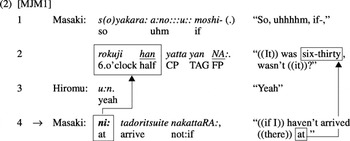
This instance involves a parenthetical sequence of turns occurring during the production of a single clause rather than a sentence. In line 1, Masaki initiates a conditional clause with the conditional marker moshi ‘if’ and then interrupts himself (cf. the hyphen after moshi indicating a cut-off, and the ‘(.)’ representing a brief pause). Following the brief pause, he produces a confirmation request about the time of a future get-together between the two participants (line 2), to which the recipient provides confirmation (line 3). After this confirmation-request sequence, Masaki deploys the postpositional particle ni utterance-initially (line 4), which would normally be produced immediately following a nominal element and would indicate, among other things, that the preceding nominal refers to a time when something takes place (roughly equivalent to the role played by the preposition at in English). By using the postposition ni utterance-initially, the speaker achieves “grammatical latching” of the subsequent utterance onto the nominal in his prior utterance in line 2, rokuji han ‘six-thirty’, as shown by the squares and the arrow in the transcript. That is, the nominal rokuji han and the utterance-initial ni form a constituent of the form [nominal (rokuji han) + postposition (ni)], which expresses the time of the action (or non-action) referred to by the subsequent predicate, tadoritsuite nakatta ‘has not arrived yet’. Finally, Masaki produces the clause-final conditional marker -tara at the end of line 4. By doing so, he shows that the utterance initiated with a postposition in line 4 is a resumption of the once-halted conditional clause projected by moshi ‘if’ in line 1. The result of this operation is that the confirmation-request sequence in lines 2–3 is embedded within the construction of a conditional clause: moshi rokuji han ni tadoritsuite nakattara ‘if (I) haven't arrived (there) at six-thirty’.
In this instance, the speaker uses a postpositional particle utterance-initially after a confirmation-request sequence to incorporate a part of that parenthetical sequence (i.e., the nominal rokuji han ‘six-thirty’) into the syntax of the utterance that achieves the resumption of the construction of a clause-in-progress. The present study, then, aims to explicate the workings of postpositions used at the beginning of utterances like that in line 4 of (2), and to demonstrate how postpositions allow Japanese speakers to achieve “blending back” into the construction of a sentence- or a clause-in-progress after engaging in a side activity, such as an understanding check or a confirmation request, in a parenthetical exchange of turns.
To fully understand the workings of postpositions as a resource for the achievement of discourse-within-a-sentence in Japanese, the present study also examines how postpositions are used as interactional resources in contexts other than achieving discourse-within-a-sentence. Through this examination, I demonstrate that the particular way in which the utterance-initial deployment of a postposition achieves discourse-within-a-sentence, as seen (2), is in fact made possible by recurrent practices for which postpositions are put to use in a wider range of interactional contexts.
The larger theoretical implication of the present study lies in providing us with an opportunity to explore the relationship between typological features of the grammar of a particular language, on the one hand, and the ways in which its speakers deal with situational needs arising from local contingencies of social interaction, on the other. In particular, the study demonstrates how the postpositional structure of Japanese allows speakers to accomplish the resumption of a sentence-in-progress after a parenthetical activity in a way that appears difficult to accomplish in prepositional languages like English because of the latter's lack of similar grammatical resources. We thus witness how the practices used in the same or similar interactional contexts (i.e., resuming an interrupted sentence after a parenthetical activity) are shaped and realized differently, at least partly because of the differential availability of grammatical resources to speakers of different languages. It is hoped that the findings of this study will contribute to our understanding of the relationship between grammar and social interaction (cf. Ochs, Schegloff & Thompson 1996; Ford & Wagner 1996; Couper-Kuhlen & Selting 1996; Selting & Couper-Kuhlen 2001).
The database for the present study consists of recordings of 13 naturally occurring conversations (four telephone and nine face-to-face) among adult peers who are native speakers of Japanese. The number of participants in the face-to-face conversations ranges from two to four. Some participants in the conversations in the database are speakers of the Tokyo variety of the language, and others of the Kansai variety. The length of the conversations ranges from 1 minute to 90 minutes, totaling approximately 11 hours. The recordings were transcribed according to the conventions used commonly in conversation analysis (cf. Ochs, Schegloff & Thompson 1996: 461–65; see the Appendix below). From this database, I have extracted ten instances of parenthetical exchanges embedded within ongoing construction of a sentence, five of which involve turns initiated with postpositions.
In what follows, I first provide some background for the present study, followed by a detailed examination of the practices whereby discourse-within-a-sentence is achieved. I then explore two aspects of the interactional utility of postpositions in contexts other than achieving discourse-within-a-sentence, and show that the usability of postpositions as a resource to achieve discourse-within-a-sentence in fact comes from more general workings of postpositions in social interaction. I conclude the study with a discussion of implications of its findings for our understanding of the relationship between grammar and social interaction.
BACKGROUND
This section briefly discusses the scope of the study and introduces relevant past literature on postpositional particles in Japanese.
Scope of the study – “case” and “adverbial” particles
One of the major grammatical characteristics of Japanese is that it is a postpositional, as opposed to prepositional, language. As Kuno (1973:4–5) states, “All case relations and other functional relations that would be represented in English by prepositions, subordinating conjunctions, and coordinating conjunctions are expressed in Japanese by ‘particles’ that are postpositional.” There are several types of postpositional particles in Japanese, and the following constructed sentences illustrate some instances of them. Consider the particles in boldface in each of these sentences:

The postpositional particles in boldface in (3a) are traditionally called “case particles,” and they indicate the case relations of the preceding nouns to the predicate of the sentence (i.e., ageta ‘gave’). Thus, ga as a nominative case particle shows that the preceding noun sensei ‘teacher’ is the subject of the verb ageta, while the dative particle ni and the accusative particle o mark gakusei ‘student’ and hon ‘book’ as indirect and direct objects, respectively.5
See Ono, Thompson & Suzuki 2000 and Fujii & Ono 2000 for discourse-based accounts of the particles ga and o, respectively. Examining use and non-use of these particles in naturally occurring conversations, these studies argue that their use is conditioned by discourse-pragmatic and cognitive factors.
In this article, I focus my exploration of the interactional utility of postpositions on so-called case particles and adverbial particles, those exemplified in (3a) and (3b), and thus exclude from analysis conjunctive and final particles, those exemplified in (3c). This selective focus on case and adverbial particles does not derive from some a priori theoretical assumption, but is rather a result of empirical examination of the data. As will become clear below, one important feature of postpositions that is crucial for their usability as a resource for achieving discourse-within-a-sentence turns out to be the grammatical linkage that postpositions create with the preceding nominal that they mark. Among the four types of postpositional particles introduced above, case and adverbial particles typically occur immediately after a nominal and establish a grammatical linkage with that nominal to form constituents of the form [nominal + postposition]. For instance, the nominative particle ga in (3a) creates a grammatical linkage with the preceding nominal sensei to form a constituent (i.e., a subject noun phrase) of the form [sensei ga]. Conjunctive and final particles, in contrast, typically occur after predicates (e.g., verbs) and do not appear to create a similar kind of grammatical linkage with a preceding nominal.6
In theory, it is conceivable that a grammatical linkage between a predicate and a conjunctive or final particle can be used as a similar resource to achieve discourse-within-a-sentence. At least in my database, however, no such instance is observed.
In the formal linguistics literature, the particles that are traditionally subsumed under case particles are divided into two types: those that mark grammatical arguments (e.g., subject, direct object, indirect object), and those that mark adjuncts (e.g., locative phrase, instrumental phrase). In this literature, only the latter are called “postpositions,” while the former are called “case markers” (cf. Tsujimura 1996, Miyagawa 1989). In my analysis of the interactional utility of postpositional particles, I do not find evidence that participants find such a distinction relevant, and therefore I will employ the term “postpositions” to refer to both types.
Previous studies
Postpositional particles have been studied extensively in Japanese linguistics as an important part of Japanese grammar (e.g., Hattori 1960, Konoshima 1966, Kuno 1973, Martin 1975, Miyagawa 1989, Shibatani 1990, Vance 1993, Tsujimura 1996, among many others). While the treatment of postpositions differs depending on the researchers' analytical standpoints, most of the previous studies approach postpositions from morphological/syntactic/semantic perspectives, usually through an examination of isolated sentences constructed by researchers or of samples taken from written language as relevant data. In other words, the utility and significance of postpositions for the moment-by-moment unfolding of speaker-hearer interaction in real-time social encounters have not received much attention in the literature until quite recently.
With rising interest in investigating the complex relationship between grammar and social interaction in recent years (e.g., Fox 1987, Ford 1993, Ochs et al. 1996, Ford & Wagner 1996, Couper-Kuhlen & Selting 1996, Selting & Couper-Kuhlen 2001), a number of researchers have started to explore postpositional particles in Japanese in naturally occurring language use (e.g., Mori 1999, Tanaka 1999, Fujii & Ono 2000, Ono, Thompson & Suzuki 2000, Hayashi 2001). Among them, the most relevant to the present study is Hiroko Tanaka's (1999) study on turn-taking in Japanese conversation. Through a careful analysis of turn-constructional practices and turn projection in Japanese, she demonstrates how postpositional case and adverbial particles play a significant role in projecting the unfolding course of an emerging utterance in real-time social interaction.
Tanaka (1999:155ff.) argues that case and adverbial particles deployed during the temporal unfolding of an utterance have the properties of (i) retroactively specifying the grammatical nature of the component immediately preceding the particle (typically a nominal), and (ii) simultaneously projecting some forthcoming component (e.g., a predicate or nominal component depending on the particle) in the emerging utterance. For instance, the occurrence of the case particle o in an unfolding utterance retroactively specifies the grammatical role of the preceding nominal as a direct object, and at the same time projects the occurrence at some later point (not necessarily immediately following the particle) of a predicate component which takes the o-marked nominal as a direct object. The following is a schematic representation of this process of “incremental projection” (Tanaka 1999:148ff.) through the deployment of postpositions during utterance construction in conversation:

Based on these observations, Tanaka shows how case and adverbial particles can serve as robust guides for participants in projecting the emerging shape that an utterance-in-progress is going to take.
The present study builds on Tanaka's and others' previous work on the interactional significance of case and adverbial particles in turn construction and turn projection. In particular, this study investigates how the interactional properties of postpositions outlined above provide a resource for Japanese speakers to encapsulate discourse (i.e., a sequence of turns) within the ongoing construction of a sentence in a way that is not observed in English. That is, postpositions allow speakers to incorporate the outcome of the side activity performed in the encapsulated sequence into the resuming syntax of the once-halted sentence. The next section provides a close look at the workings of postpositions in achieving discourse-within-a-sentence in Japanese.
A CLOSE LOOK AT DISCOURSE-WITHIN-A-SENTENCE IN JAPANESE
In this section, I present a detailed analysis of two instances of discourse-within-a-sentence in Japanese. The purpose of the “microscopic” analysis to be presented is to demonstrate empirically how participants in Japanese conversation mobilize grammatical resources to achieve an intricate balance between their orientation to attending to situational needs arising from local contingencies of the moment and their continued engagement in the construction of a turn-at-talk. It will be shown that discourse-within-a-sentence emerges as a result of such intricate interactional work by the participants.
The following excerpt presents a longer stretch of the telephone conversation from which (2) above is taken. In this segment, the two participants are discussing whether one of them can come to a future get-together on time. Our focus is on the sequence of turns in lines 5–8, particularly Masaki's use of the postpositional case particle ni in utterance-initial position in line 8.

To explicate the workings of the utterance initiated with the postpositional case particle ni in line 8, I will provide a detailed description of how the interaction of the two speakers transpires in lines 5–8. After stating (line 3) that he is not sure if he can come to the get-together on time, Masaki begins his next utterance (line 5) with the turn-initial connective s(o)yakara: ‘so’, projecting a telling of some sort of consequence of the uncertainty of his arrival on time. Following a:no:::u:: ‘uhhhhm’, he produces the clause-initial conditional marker moshi ‘if’, and thereby projects a conditional clause to be produced. Note that there is an observable disruption of the airstream at the end of the articulation of moshi (i.e., a cut-off represented by a hyphen), followed by a very brief beat of silence (represented by (.)). Speech perturbations of this sort often serve as initiators of so-called same-turn self-repair (cf. Schegloff, Jefferson & Sacks 1977, Schegloff 1979, Jefferson 1974, Jasperson 2002). Indeed, the bits of talk after these speech perturbations (line 6) reveal a syntactic disjunction between moshi ‘if’ and what follows it. That is, in Japanese, the syntax of a conditional clause is realized through the obligatory presence of one of the clause-final conditional expressions -tara, -nara, -ba, and -to (and the optional presence of the clause-initial moshi); therefore, if the utterance after the speech perturbations were to be constructed as a continuation of the conditional clause projected by moshi, it should have one of the clause-final conditional markers listed above, as in the following instance (the clause-initial and clause-final conditional markers are in boldface).

However, rokuji han yatta yan NA: in line 6 of (4) does not have an obligatory clause-final conditional marker. Rather, it is constructed as an utterance serving to request confirmation – specifically, confirmation about the speaker's understanding of the previously arranged time for the future get-together (‘(It) was six-thirty, wasn't (it)?’). In other words, the relevance of the occurrence of a conditional clause projected by moshi is abandoned or at least suspended by the initiation of same-turn self-repair, and the speaker instead produces an utterance which embodies an action that is different from what was projected by the element produced prior to the initiation of repair. The confirmation request in line 6 constitutes a first pair-part of an adjacency pair (cf. Schegloff & Sacks 1973), and it makes the addressee's response sequentially relevant on its completion. Indeed, immediately after Masaki's post-perturbation utterance comes to possible completion with the final particle NA: (roughly equivalent to ‘wasn't it?’), the addressee, Hiromu, provides an affirmative response (line 7).
Now, what makes the sequence of talk in (4) analytically significant is the way Masaki constructs his utterance following Hiromu's confirmatory response. Lines 5–8 of (4) are reproduced below for convenience:

Masaki begins his utterance with the postpositional case particle ni. From the perspective of prescriptive grammar, beginning an utterance with a postposition deviates from the norm, since postpositions are supposed to be placed after the elements that they mark (cf. 3a–c above). This deviant kind of utterance construction motivates both the co-participant and the analyst to consider how this utterance should be interpreted in the particular sequential and interactional juncture in which it is positioned. I argue that the utterance-initial postposition ni is designed to grammatically latch onto a specific nominal in the speaker's own prior utterance – that is, rokuji han ‘six-thirty’ in line 6 – and to form the constituent [rokuji han ni] ‘at six-thirty’. A schematic representation of this grammatical latching, already provided in (2) above, is reproduced below:

This analysis of grammatical latching is supported by two facts. One is that, according to recurrent syntactic-semantic patternings in discourse, the phrase X-ni tadoritsuiku ‘arrive at X’ regularly takes a nominal that indicates time (e.g., 3 p.m.) or location (e.g., a station) as ‘X’. The nominal rokuji han in line 6, thus, qualifies for the target of the grammatical latching by the utterance in line 8. The other fact is that, as I have shown elsewhere (Hayashi 2001), in the use of “postposition-initiated utterances” in other contexts, the utterance-initial postposition recurrently latches onto the closest nominal in a preceding utterance. In the case at hand, rokuji han again qualifies as the closest nominal in a preceding utterance. These facts thus lend support to the analysis that Masaki's utterance in line 8 is designed to latch onto the nominal rokuji han in his own prior utterance, and is so heard by the recipient.
Let us now discuss what this grammatical latching achieves interactionally. First, note that Masaki's utterance in line 8 has the conditional clause-ending -tara discussed above. Recall that the same-turn self-repair initiated at the end of line 5 and the subsequent confirmation request displaced the relevance of the occurrence of a conditional clause projected by moshi. We now see that this relevance is retroactively revived by the -tara ending in line 8. In other words, Masaki's utterance in line 8 makes visible that the production of a conditional clause that was projected by moshi in line 5 but had been suspended during the sequence in lines 6–7 is now resumed.
Note second that this “revival” of the conditional clause retroactively encapsulates the confirmation-request sequence in lines 6–7 within the construction of a single clause. To be more precise, the confirmation-request sequence is retroactively contextualized as a parenthetical sequence that serves to deal with the fulfillment of a precondition (i.e., collecting necessary information) for constructing the conditional clause. To see how this is achieved, consider the following schematic representation of the conditional clause constructed in lines 5, 6, and 8 without the parenthetical confirmation-request sequence:

Recall that, in line 5 of fragment (4), the glottal cut-off and an intra-turn pause occur after the production of moshi, followed by the initiation of the confirmation-request sequence. If we consider this fact with respect to the structure of the conditional clause presented in (6), it becomes clear that the perturbations and the subsequent confirmation-request sequence occur at the precise juncture at which the reference to the meeting time is due in the ongoing construction of the conditional clause. This is no accident; Jefferson 1974 points out that hesitations such as intra-turn pauses and uh are systematically used by speakers of English in advance of arrival at a problem, displaying to their co-participants that they are trying to avoid the problem. She refers to this subtle device, directed to avoiding a foreseeable error or inappropriateness, as an “Error Avoidance Format,” and argues that items produced after the Error Avoidance Format can be heard as a solution to the problem. If we apply this analysis to the case at hand, we can see that Masaki produces the post-perturbation confirmation request as a way to solve a foreseeable problem – uncertainty about the meeting time – before proceeding with the construction of the rest of the conditional clause. And this analysis is supported by the fact that Masaki resumes the construction of the conditional clause immediately after receiving a confirmation from Hiromu.
Third, note that the speaker chooses a rather peculiar way to do resumption of the conditional clause when there are other ways available that are grammatically less striking, such as by repeating rokuji han ‘six-thirty’ at the beginning of the resuming utterance, as in (7a), or by some sort of anaphoric reference (e.g., sono jikan ‘that time’), as in (7b).

What, then, is the significance of doing resumption with a postposition-initiated utterance? I argue that, by performing grammatical latching with the utterance-initial postposition and thereby incorporating the outcome (i.e., the information sought) of the confirmation-request sequence into the syntax of the resuming utterance, Masaki maximally displays that the continued construction of the once-halted conditional clause hinges crucially on the result of the negotiation between speaker and hearer performed in the confirmation-request sequence. In other words, by showing that the resuming utterance in line 8 is grammatically “parasitic” on an element in the confirmation-request sequence, the speaker achieves a maximal display of an “organic” relationship between the ongoing construction of the conditional clause and the parenthetical sequence embedded within it.
At the same time, the resumption of the conditional clause-in-progress with a postposition-initiated utterance after the parenthetical sequence shows a dynamic tension between the speaker's orientation to attending to situational needs arising from the local contingencies – that is, the need to achieve accurate understanding of the time of a future gathering – and his orientation to continuing the clause-in-progress by exploiting the grammatical trajectory projected by the bits of talk produced before the parenthetical sequence. Thus, by not initiating a new sentence after the confirmation-request sequence, as in (7a) or (7b), but instead grafting the resuming utterance onto the nominal in the prior sequence that contains the key information necessary for the successful production of the clause-in-progress, the speaker achieves an intricate balance between managing the speaker-hearer negotiation necessary for the successful production of the clause-in-progress and bringing off the utterance under construction as one with a coherent syntactic structure.
In order to show that such embedding of discourse within the construction of a sentence through a postposition-initiated utterance is indeed a recurrent practice, I examine another, similar instance briefly. The following excerpt presents a case in which a word search (lines 2 and 4) is retroactively contextualized as a parenthetical activity embedded within an ongoing sentence through the speaker's deployment of a postposition-initiated utterance (line 6). Prior to the beginning of this excerpt, the participants took turns telling one another what kinds of things they have received as hikidemono (gifts given to wedding guests by the bride's and groom's families). Consider how Kyoko initiates her telling in line 1, engages in a word search in lines 2 and 4, and then resumes the ongoing telling in line 6 with a postposition-initiated utterance:

As mentioned, Kyoko's utterances in this fragment are situated in a round of tellings by the three participants about gifts they have received at other people's weddings, and Kyoko's utterance in line 1 shows clear features of “It's my turn to tell you what I got before,” such as the explicit mention of the first-person pronoun atashi ‘I’,8
Japanese is a so-called zero-anaphora language in which the first-person reference is often left unexpressed.
The format of Kyoko's sentential utterance in line 4, X-ka, is often used to indicate that the speaker is talking to himself or herself (Chino 1991:40–1).
Then, following a continuer (see Schegloff 1982) by one of the recipients in line 5, Kyoko produces an utterance initiated with the postpositional particle ni (line 6), which is designed to grammatically latch onto the nominal in the preceding virtual Q-A sequence produced during the word search – akko chan toki ‘Akko's (wedding)’ in line 4. By performing this grammatical latching with a postposition-initiated utterance, then, Kyoko incorporates the outcome of the parenthetical activity of word search into the syntax of the subsequent utterance, while resuming the main activity that has been put on hold – that is, telling about a gift she received at a friend's wedding. The result of this process is the sentence nanka atashi mo MAE NA:: akko chan toki ni:: 〉nanka〈 (0.5) obon:? ‘Me, too, like, once before, at Akko's (wedding),〉like〈(0.5) (I got) a tray?’. Thus, just as in the previous instance, Kyoko in excerpt (8) accomplishes the resumption of a once-halted sentence-in-progress by (i) exploiting the grammatical trajectory projected by the bits of talk produced before a parenthetical activity (i.e., word search) as a “frame” for achieving the resumption, and (ii) using a postpositional case particle to retroactively incorporate the outcome of the word search directly into the syntax of the resuming sentence.
In this section, I have explicated two instances in which speakers of Japanese achieve discourse-within-a-sentence by mobilizing a particular linguistic resource – a postpositional case particle – after a parenthetical activity, and by skillfully managing the resumption of the construction of a once-halted clause in progress. The hallmark of this particular way of encapsulating discourse within a sentence in Japanese is the manner in which a postposition allows the speaker to incorporate the outcome of a side activity performed in the parenthetical sequence into the resuming syntax of the once-halted clause and thereby to achieve a fine balance between syntax (i.e., sentence construction) and interaction (i.e., speaker-hearer negotiation).10
Ono & Iwasaki 2002 describe other practices by which Japanese speakers make parenthetical comments during sentence construction, and they term such practices “interpolation.” Though the instances of interpolation that they examine do not involve the type of utterance-initial deployment of postpositions discussed in this article, one might regard the practice for achieving discourse-within-a-sentence explored here as a particular subtype of what Ono & Iwasaki 2002 call “interpolation.”
TWO ASPECTS OF THE INTERACTIONAL UTILITY OF POSTPOSITIONS IN JAPANESE
The examination in the previous section of two instances of discourse within a sentence in Japanese highlighted the crucial role played by postpositional particles in encapsulating a parenthetical sequence within the construction of a sentential unit of talk in a particular way. In this section, I further explore the interactional workings of postpositions by investigating how they are generally used as an interactional resource in contexts other than achieving discourse-within-a-sentence. I thus demonstrate that postpositions are commonly used by Japanese speakers in the following two ways:
(a) To propose retroactively a new grammatical framework for a nominal that has already participated in another grammatical framework, and to incorporate that nominal as part of the newly projected utterance.
(b) To resume the forward progress of utterance construction after speaker and hearer engage in a subsidiary activity to establish a nominal reference, such as a word search or recognition check.
The discussion of (a) will shed light on the process of grammatical latching described in the previous section. The discussion of (b) will show that the way in which the speaker resumes the construction of the clause-in-progress described in the previous section is, in fact, a slight variation of a fairly common practice. The exploration of the interactional utility of postpositions presented in this section will thus help us see that the particular way in which discourse-within-a-sentence is achieved in Japanese is in fact made possible by these general workings of postpositions in a wider range of interactional contexts.
Retroactive recontextualization of already-contextualized nominals
This subsection demonstrates how postpositions are used to propose retroactively a new grammatical framework for a nominal that has already participated in another grammatical framework, and thereby to recontextualize that prior nominal within a newly projected course of the unfolding talk.
In her study of turn-taking in Japanese conversation, Tanaka 1999 argues that postpositional case and adverbial particles produced in temporally unfolding talk have the following properties:
(i) They retroactively specify the grammatical nature of the nominal immediately preceding them (e.g., o marking the preceding nominal as direct object) and form a grammatical constituent with that nominal (e.g., a direct object noun phrase) of the form [nominal + postposition].
(ii) They simultaneously project some forthcoming component to be produced at a later point before the current utterance comes to completion (e.g., o projecting the occurrence, at some later point, of a predicate that takes the o-marked nominal as direct object), and thereby suggest an ongoing grammatical trajectory in which the [nominal + postposition] constituent participates.
In other words, postpositions serve to establish bidirectional (i.e., retrospective and prospective) relations with what has gone before and what is to come next in the temporal progression of talk in interaction. Given these properties, then, I show below that participants in Japanese conversation sometimes use postpositions to propose a new grammatical trajectory for a nominal whose role has already been designated within the framework of another grammatical trajectory (projected or realized), and, by doing so, they accomplish a range of interactional work within the contingencies of the moment.11
See also Tanaka (1999:157–62) for a discussion of this phenomenon.
Let us first examine a simple case of “retroactive recontextualization” through the replacement of one postpositional case particle with another. Consider line 1 of excerpt (9), in which the speaker replaces the nominative case particle ga with the dative case particle ni:

In line 1, Yoohei produces the nominal katee ‘household’ and marks it with the postposition ga, thereby contextualizing that nominal as the subject of some not-yet-produced predicate, and projecting a grammatical trajectory in which such a predicate (i.e., one that takes [katee + ga] as the subject) will be provided at some later point. However, immediately after he produces ga, Yoohei replaces it with another postposition, ni,12
The sequence of the particles ga and ni is not grammatical, and therefore, the production of ni immediately after ga is heard as replacement.

(a) “How households will accept that [= a new telecommunication system].”
(b) “How ((we)) will spread that [= a new telecommunication system] to households.”
At the point at which Yoohei produces ga, the unfolding utterance-so-far projects a predicate like ukeireru ‘accept’, which would take katee as the subject (i.e., sore o doo katee ga ukeireru ka ‘how households will accept that [= a new telecommunication system]’). However, by replacing ga with ni, Yoohei puts the nominal katee in a different grammatical framework and projects a different trajectory, such as the one actually produced, in which katee participates as a dative constituent (sore o doo katee ni hukyuusuru ka ‘how (we) will spread that to households’). This instance thus shows that a postposition (here, ni) can be deployed to “graft” a new grammatical trajectory onto a nominal (here, katee) that has already been placed in another grammatical framework without abandoning the whole utterance or even repeating the nominal.
This kind of retroactive recontextualization can be used to achieve intricate interactional work. Consider excerpt (11), in which two participants co-construct a single sentential utterance. Prior to this segment, Mika told Eiji about her frustration with her current job at a computer software company, as well as her desire to get some formal training in software engineering. In lines 1 and 2, then, Eiji produces an utterance that offers his tentative understanding of Mika's situation. Consider the way Mika takes over the utterance-in-progress and produces the rest of the utterance in line 3:

As the English translation does not capture what happens in this fragment, a commentary on the grammatical operation observed across the two speakers' utterances is in order. In lines 1–2, Eiji constructs a noun phrase, chanto oshiete kureru yoona tokoro::: ka nanka: ‘a place where (they) would teach (you software engineering) properly, or something’, and he marks it with the accusative case particle o, thereby indicating that the preceding noun phrase is built as direct object and projecting a grammatical trajectory in which some sort of transitive verb, such as sagasu ‘look for’ or mitsukeru ‘find’, will be produced at some later point. Then, Mika comes in with a repetition of o at the beginning of her utterance, thereby displaying to Eiji that her current utterance is built to be a continuation of his utterance-so-far. After a brief inbreath, however, Mika replaces o with another particle, ni.13
See note 12.
The interactional work achieved through this strategic replacement of postpositions is as follows. First, Mika achieves a display of the connectedness of her utterance to the prior speaker's through the utterance-initial repetition of the accusative particle o. When a speaker attempts to complete an utterance initiated by another speaker in a grammatically coherent fashion, she must show how her utterance is grammatically connected to the prior speaker's utterance (cf. Hayashi 2000). Mika's deployment of o immediately following Eiji's production of the same particle can be seen as a strategic move to achieve a display of this connectedness. Second, through the replacement of o with ni immediately after the display of connectedness, Mika retroactively transforms the grammatical nature of the noun phrase constructed by Eiji, and she grafts a new grammatical trajectory onto that noun phrase. By doing so, she redirects the trajectory of the utterance-so-far projected by another speaker and thereby completes in her own way the utterance initiated by another.
The next fragment shows another subtle way in which retroactive recontextualization through the deployment of postpositions can be mobilized as an interactional resource. Unlike the previous instances, this one does not involve the replacement of postpositions, but nonetheless a postposition plays a crucial role in achieving the retroactive transformation of what has transpired before it.
In excerpt (12), the three participants are talking while looking at several sets of photos that one of them, Seiji, has developed recently. Another participant, Harumi, asks Seiji whether he (Seiji) developed different sets of photos at different stores (line 1). We will focus on how Seiji responds to Harumi's question:

In response to Harumi's question in line 1, Seiji begins his answer in line 6 by referring to a particular set of photos in front of him (kocchi ga::: ‘These ones are:::’). In line 7, another participant, Akira, anticipatorily offers his candidate understanding of what Seiji is going to say – the price per print at which Seiji might have developed the set of photos he referred to in line 6. This candidate completion by Akira, however, is not acknowledged by Seiji – or at least not immediately. Instead, Seiji simply continues his utterance from line 6, and brings it to possible completion when he produces the nominal ieroo kamera ‘Yellow Camera,’ with falling intonation. Seiji's utterance-so-far at that point – kocchi ga::: ano::: (0.6) ieroo kamera ‘These ones are::: uhm (0.6) Yellow Camera.’ – is a possibly complete utterance not only prosodically (it has falling intonation) but also syntactically (ieroo kamera serves as an utterance-final predicate nominal for the subject kocchi ga) and pragmatically (responding to Harumi's question regarding whether the photos were developed at different stores).
What is of interest here is that Seiji deploys the postpositional genitive particle no immediately after producing the possibly complete utterance described above, and he thereby retroactively cancels its complete status. That is, by producing no (which is roughly equivalent to the apostrophe + s in English), he retroactively transforms what has just been contextualized as a predicate nominal into a genitive, and he projects another nominal with which ieroo kamera could be linked. With the projection of a new grammatical trajectory installed, then, Seiji produces a nominal referring to price per print, juu:::go en ‘fiftee:::n yen’, and thereby displays his rejection of Akira's earlier attempt of a candidate completion in line 7. The resultant utterance, kocchi ga::: ano::: (0.6) ieroo kamera no juu:::go en da ka ‘These ones are::: uhm (0.6) fiftee:::n yen or something at Yellow Camera’, can be seen as a single coherent sentence. This instance thus shows that retroactive recontextualization through the deployment of a postposition provides a resource for a speaker to respond consecutively to two different actions by two different interlocutors (here, a question by Harumi and a candidate completion by Akira), while bringing off the utterance as a single coherent grammatical unit.
The three instances I have examined in this subsection all show that Japanese speakers can mobilize postpositions as a resource to transform the grammatical status of a preceding nominal that has already been given another grammatical status, and to place that nominal in a new grammatical trajectory projected through the deployment of the postposition. One significant aspect of the interactional use of Japanese postpositions examined above lies in the fact that speakers do not need to (re-)produce the whole element [nominal + postposition] in order to transform the grammatical status of a previously produced nominal. All speakers need to do is to deploy a free-standing postposition and replace an existing one, or cancel a falling intonation, so to speak, as seen in (12), without having to repeat the prior nominal which the newly produced postposition is meant to mark. This observation highlights the relative “detachability” of Japanese case-marking particles from their nominals. That is, although case particles in Japanese are bound forms in the sense that they cannot constitute a complete utterance by themselves, they are deployable separately from the nominal that they mark, and that suggests that they are not as bound to the preceding nominal as case-marking affixes in other languages are normally considered to be.14
See Vance 1993 for an in-depth discussion, from phonological, morphological, and syntactic perspectives, of whether Japanese particles should be considered affixes or clitics. As I hope is clear from my discussion, the characterization of Japanese postpositions as being relatively “detachable” from prior nominals should not be taken to discount the fact that there is nonetheless a robust bond, both syntactic and semantic, between postpositions and the nominals they mark. In other words, saying that postpositions are detachable from prior nominals does not mean that their grammatical linkage to those nominals is somehow severed. On the contrary, it is precisely this grammatical tie with prior nominals created by postpositions that is exploited by Japanese speakers when they deploy “free-standing” postpositions to retroactively recontextualize the grammatical status of previously produced nominals.
We can now see how the interactional usability of free-standing postpositions for retroactive recontextualization of already-contextualized nominals contributes to shaping the particular way in which discourse-within-a-sentence is achieved in Japanese. That is, resuming a once-interrupted sentence while incorporating the outcome of the negotiation performed in a parenthetical sequence through the grammatical latching by a turn-initial postposition is possible precisely because speakers can deploy a free-standing postposition to retroactively recontextualize a prior nominal that has already participated in another grammatical framework (e.g., a nominal in another sentence in another sequence), and they can use that nominal as part of a newly implemented grammatical trajectory (e.g., as part of the resumed trajectory of the once-interrupted sentence). Thus, I have shown that the particular way in which utterance-initial postpositions help achieve discourse-within-a-sentence in Japanese is, in fact, a part of a general practice by which postpositions are put to use in interaction.
The next subsection examines another aspect of the interactional utility of postpositions in Japanese: how postpositions allow speakers to resume the forward progress of utterance construction after engaging in a speaker-hearer negotiation for reference establishment (such as a word search or recognition check). I will show that the way in which a postposition-initiated utterance resumes the previously interrupted sentence-in-progress in the achievement of discourse-within-a-sentence is in fact a slight variation of a fairly common practice observed in the interactional use of Japanese postpositions.
Resuming the forward progress of talk after reference negotiation
Referring in conversation is a collaborative process between speakers and hearers (Sacks & Schegloff 1979; Auer 1984; Schegloff 1988, 1996b; Clark & Wilkes-Gibbs 1986). It is a process in which the speaker provides a reference form (e.g., by presenting a nominal) for which mutual understanding between the speaker and hearers might be sought implicitly or explicitly. When there is a problem during this process, such as when the speaker has trouble in presenting a reference form, or hearers do not recognize the referent referred to by the speaker, the participants may engage in problem-solving activities for producing a reference form (e.g., word searches) or for establishing mutual understanding of the referent (e.g., recognition checks, ratification requests).
This subsection examines instances involving such reference negotiation during the construction of a nominal constituent (i.e., [nominal + postposition]) within the ongoing construction of utterances in Japanese. Through this examination, I demonstrate a recurrent way in which Japanese speakers use postpositions in such contexts. It is commonly observed that the speaker first engages in reference negotiation without indicating the grammatical status (e.g., grammatical case) of the reference form with a postposition, and that only after the speaker and hearers establish a mutual understanding of the reference (e.g., through ratification from the hearers) does the speaker proceed to produce a postposition and make the grammatical status of the nominal explicit. As discussed above, the deployment of a postposition not only marks the grammatical role of the preceding nominal to which it is attached, but it also creates a prospective link to what is to be produced in the subsequent development of the unfolding utterance. Thus, in the context of reference negotiation, a kind of division of labor is observed between [nominal] and [postposition] during the ongoing construction of a nominal constituent in an unfolding utterance. That is, a subsidiary activity of reference negotiation (“subsidiary” vis-à-vis the forward progress of an ongoing utterance to its completion) is devoted to establishing the [nominal] part, and when that activity is completed, the [postposition] part is deployed to resume the forward progress of the utterance-so-far.
Let us examine an instance that illustrates this practice. The following excerpt shows a word search (line 2) followed by a ratification-request sequence (lines 3–4) to establish a nominal reference, before the speaker resumes the forward progress of the ongoing utterance construction by deploying a postposition (line 5). Note how the genitive constituent [pakku + no] ‘face pack’ + ‘’s' is divided into two, of which the former is engaged in reference establishment (lines 3 and 4) while the latter initiates resumption of the progressivity of the utterance after the word search (lines 5–6 and 8):

In line 1, Asami begins to tell Chika her experience of buying a cosmetic product of the “Clarins” brand when she went to Hawaii in the past year. In line 2, then, the speaker displays trouble in formulating a reference to the product in the middle of her utterance, and she engages in a word search: an extensive sound stretch on sh, a self-addressed question for recollection, delaying devices like ano ‘uhm’ and nanka ‘like’. After a 1.5-second intra-turn silence, she finally produces the result of the word search, the nominal pakku ‘face pack’, with rising intonation, or a “try marker” (Sacks & Schegloff 1979), and she thereby offers it for the recipient's recognition and ratification (line 3). After the addressed recipient, Chika, ratifies that nominal reference in line 4, Asami resumes the sentence she began in line 1 through the deployment of the genitive case particle no, which projects an upcoming nominal component. Indeed, Asami produces another nominal, yatsu ‘stuff’, as projected, and goes on to complete the sentence in which she mentions that she bought a face pack at a noticeably lower price in Hawaii (lines 5–6 and 8).
In this instance, the forward progress of the sentence initiated in line 1 is put on hold while the speaker and the recipient engage in establishing a reference in lines 2–4. Notice that, when the speaker offers the result of the word search for the recipient's ratification, she does not present it with a postposition. That is, she does not provide the whole of a nominal constituent ([nominal + postposition]) as a “chunk” for the purpose of reference establishment. Instead, the postposition is withheld until the reference is mutually established between the speaker and the recipient, and it is then deployed not only to mark the grammatical role of the established nominal reference form but also to resume the activity that has been put on hold during the reference negotiation – the ongoing construction of a sentence.
The next excerpt, from a four-party conversation, presents a similar instance. One of the speakers initiates a sentence addressed to a particular recipient, but when a certain degree of uncertainty about a reference arises, he asks for ratification from a third party who shares the information that the speaker wishes to supply to the addressed recipient. On receiving ratification from the third party, the speaker resumes the ongoing sentence construction by deploying a postposition. Note how the direct object constituent [owakarekai ‘farewell party’ + o accusative particle] is divided in two, of which the former is involved in reference establishment (lines 2 and 3) while the latter resumes the progressivity of the utterance after the ratification-request sequence (line 4):

In line 1, Muneo begins a sentential utterance unit with a topical constituent, hamanaka sa:n te onnanoko wa ‘a girl named Ms. Hamanaka’, and addresses it to his wife Shoko (not shown in the transcript). The next bits of Muneo's talk in line 2 contain a number of speech perturbations (e.g., a sound stretch, intra-turn silence, and a word cut-off), which suggest that the speaker is having some trouble in producing an upcoming word. As he produces these speech perturbations, Muneo brings his gaze to another participant, Kanji, who works at the same company as Muneo and knows the person referred to in line 1. Facing Kanji, Muneo produces a nominal, owakarekai ‘farewell party’, with rising intonation, and thereby solicits Kanji's ratification. As he receives ratification from Kanji both vocally (line 3) and nonvocally (a head nod that slightly precedes the initiation of the vocal counterpart), Muneo resumes his telling addressed to Shoko by deploying the accusative particle o, which projects an upcoming increment of the sentence-in-progress. He then goes on to produce a transitive verb, yaroo ‘let's do’, which takes the preceding o-marked nominal as direct object, and he completes the sentence initiated in line 1.15
The resulting sentential utterance, hamanaka sa:n te yuu onnanoko wa raigetsu:: (0.8) owa- owakarekai? o yaroo to yutte(ru), means ‘a girl named Ms. Hamanaka is saying, “Let's have a fare- farewell party next month’”.
In this instance, as in the previous one, there is a subsidiary activity, here reference establishment through a ratification-request sequence, that takes place during the construction of a sentence. This instance differs from the previous one in that the ratification-request sequence involves another knowing participant rather than the addressed, unknowing recipient. Nonetheless, the way in which the speaker manages a division of labor between reference establishment and resumption of ongoing sentence construction within a nominal constituent ([nominal + postposition]) shows the same practice as in excerpt (13). That is, only the [nominal] component is involved in reference negotiation, and when ratification from another participant is achieved, the [postposition] part is deployed to resume the main activity, the telling of news to an unknowing recipient, by completing the sentence-in-progress.16
Ono, Yoshida & Banno 1998 discuss similar instances of the use of rising intonation within nominal constituents. In addition to cases in which rising intonation appears before postpositions, they also report on cases in which rising intonation appears at the end of the whole constituent, i.e., the whole of [nominal + postposition]. They suggest that the use of rising intonation at different positions may be related to the types of postpositions that the nominal constituents have. Based on observation of their data, they state: “Most of the particles separated from the NP are case particles such as ga and o and pragmatic particles such as tte and to ka mo. Particles which have a clear semantic content such as no ‘of’ and de ‘at’ are not separated from the NP” (1998:101). Further investigation is needed to see whether their observation holds up. (Excerpt 13 provides a counter-example to their claim that no would not be separated from the NP.)
The kind of division of labor within a nominal constituent [nominal + postposition] observed in the two instances examined above points to another interesting way in which typological features of the grammar of a language affect the forms of interactional practices employed by speakers of that language. Like the practice of retroactive recontextualization discussed earlier, the practice described in this subsection hinges crucially on the detachability of postpositions from the preceding nominals. That is, if postpositional particles were inseparable from to prior nominals (owing to, for example, phonological and morphological boundness to noun stems, as seems to be true of case-marking suffixes in some other languages), the kind of division of labor observed in the instances above would not be possible. The detachable character of Japanese postpositions once again appears to provide a potentially language-specific resource to achieve a particular kind of interactional work (reference establishment during ongoing sentence construction) in a particular way (resuming the main activity by grammatically continuing from the subsidiary activity).
This observation helps us see that the way in which the turn-initial postposition is deployed to resume the once-interrupted sentence-in-progress in the case of discourse-within-a-sentence discussed in the third section above is in fact part of a general practice observed in the use of postpositions in interaction. That is, in both the instances of discourse-within-a-sentence discussed above and those discussed in this subsection, a postposition is deployed on completion of the subsidiary activity of reference establishment to resume the forward movement of a once-halted sentence-in-progress. The only difference is that, in the case of discourse-within-a-sentence, the nominal reference form in question appears in a separate sentential unit devoted to reference establishment (e.g., the nominal rokuji han ‘six-thirty’ appears in a sentence that is devoted to confirmation request and that is grammatically independent of the conditional clause-in-progress), whereas in the cases discussed in this subsection, the reference form in question does not appear in another sentential unit that is grammatically separate from the ongoing sentence. Whether this difference is treated as a substantial difference by participants requires further empirical investigation. In any case, the discussion in this subsection reveals that the particular way of resuming a sentence-in-progress after reference establishment in the case of discourse-within-a-sentence is, in fact, a slight variation of a fairly common practice observed in the interactional use of Japanese postpositions.
In sum, the practices examined in this section reveal that the workings of postpositions as a resource for achieving discourse-within-a-sentence derive from the general workings of postpositions used in a wider range of interactional contexts. Larger implications of this and other findings reported in this article will be discussed in the next section.
IMPLICATIONS AND DISCUSSION
The analysis of discourse-within-a-sentence and of the interactional utility of postpositions in Japanese presented so far points to a number of important issues for our understanding of the complex relationship between grammar and social interaction. By way of conclusion, I address the following three issues as implications of the findings of this study: (i) “sentence” in interaction, (ii) postpositions as an interactional resource, and (iii) the relationship between language typology and interactional practices.
“Sentence” in interaction
The present analysis of discourse-within-a-sentence provides additional support for the view that a “sentence” in real-life social interaction is not a simple externalization of some abstract, monolithic unit written in the mind of an individual speaker, but rather that it is a product of moment-by-moment interactional negotiation performed by speaker and hearer in response to local contingencies of the moment of its production (cf. e.g. C. Goodwin 1979, 1980, 1981; M. Goodwin 1980; Lerner 1991, 1996; Schegloff 1979, 1996a). The instances of discourse-within-a-sentence examined in my third section revealed that a “sentence” is produced as an outcome of the speaker's attempt to achieve an intricate balance between his or her orientation to dealing with referential problems that arise in the midst of utterance production, on the one hand, and on the other, his or her orientation to continuing the engagement in the main activity (e.g., making a request, delivering news) for which the construction of the sentence was initiated in the first place. The grammatical manifestation of the “sentence” thus emerges as an embodiment of the organization of interactive activities in which participants engage in order to attend to the situational needs arising from the local here-and-now.
The analysis also showed that a “sentence” is not only an outcome of interactional work, but is also a resource for interactional work. It was demonstrated that, after working out a problematic reference with a hearer, the speaker makes use of the projection of previously interrupted sentence construction (whether the construction of an [If X, then Y] structure, or of a sentence telling about a gift received) to bring off the remainder of his or her utterance as a resumption of the earlier, once-halted sentence, rather than as a fresh start of a new sentence. By doing so, she or he manages to retroactively recontextualize the preceding sequence of talk as an “interpolation” encapsulated within an ongoing sentence – that is, as a mere digression in the course of something more important to which the speaker returns eventually. This, then, achieves a public display of the speaker's stance regarding how she or he engages in the two concurrent activities. That is, through the grammatical contextualization of the speaker-hearer reference negotiation as an interpolation, the speaker makes visible his or her engagement in it as a subsidiary activity performed in the service of executing another main activity. Thus, the instances of discourse-within-a-sentence exhibit one way in which speakers can make use of projection of the grammatical framework of a “sentence” as a vehicle for a public display of how they organize and engage in ongoing interactional activities.
What pertains to the issues raised here is the “activity-implication” of grammar in interaction; that is, grammar's intimate engagement with the social action that the participants perform as a form of participation in interaction (cf. Schegloff et al. 1996). Each utterance is a form of participation in the situated activity that the participants engage in at the moment, and its grammatical structuring makes visible how it advances, redirects, terminates, and so on, the trajectory of ongoing activity or activities. Instances of discourse-within-a-sentence offer conspicuous documentation of how the details of the grammatical structuring of an utterance are an outcome of delicately maneuvered participation in ongoing activities, on the one hand, and, on the other, how they provide a resource for the participants to organize and display their activity-relevant participation in particular ways. I hope the present study has contributed to showing that, in order to understand how grammar works in real-life social interaction, it is essential not to lose sight of the fact that utterances are produced, first and foremost, as a vehicle for executing social actions in interaction and achieving relevant participation in situated activities.
Postpositions as an interactional resource
This exploration of the interactional utility of postpositions casts light on a hitherto neglected aspect of postpositions in Japanese. In the traditional grammatical analysis of Japanese, postpositions are studied mostly from morphological/syntactic/semantic perspectives, usually through an examination of isolated invented sentences or samples taken from written language. Such an approach would never put us in a position to uncover the intricate processes through which postpositions are used as resources for organizing the moment-by-moment unfolding of speaker-hearer interaction as described here. This is so because it is only with a serious analytic attention to the details of interactive language use that we can begin to understand the dynamic yet intricate workings of postpositions in real-life language use in social interaction. This study thus underscores the importance of scrutinizing the details of language use in situ and in real time to gain insight into how grammar provides resources for accomplishing interactional practices.
The present analysis of the capability of postpositions to create a “long-distance” grammatical linkage with prior nominals and retroactively to revise the grammatical status of those nominals is particularly significant because it leads us to a distinct characteristic of turn construction in Japanese talk-in-interaction. Recent studies on turn construction and turn projection in Japanese (e.g., Tanaka 1999, 2000, 2001; Hayashi 2001, 2003a; Fox et al. 1996) have suggested that the postpositional structure of Japanese grammar provides readily available resources for participants to accomplish retroactive transformation of ongoing turn-shape during the course of producing a turn, as compared to languages like English, in which such grammatical features as the fairly rigid SV(O) clause structure and the use of prepositions tend to result in an early commitment to a particular turn-shape and to provide relatively less flexibility than Japanese does for participants to revise ongoing turn-shape without engaging in overt repair. Thus, Tanaka (1999: 141–45) argues:
Previous research indicates that English syntax facilitates an early projection (relative to Japanese) of the type of turn being produced because the social action performed by a turn is typically made available early in the progress of a turn. In other words, the substance of what is being talked about is commonly produced after the turn shape has already been projected…. [I]f the syntax of a language provides for an early production of the thrust – and therefore an early commitment to the kind of action performed in a turn (as in English), it may at the same time delimit the ensuing degree of maneuverability…. [T]he postpositional grammatical organization in Japanese allows for a high degree of revisability of a developing turn. Since a grammatical unit which has already been produced can be incrementally and retroactively converted into other grammatical objects as a turn progresses, the type of activity performed by a turn can likewise be subject to progressive transformations.
The retroactive operation facilitated through postpositions described in this study thus corroborates this general “revisability of a developing turn” owing to the postpositional structure of Japanese proposed in previous studies. It is important to note here that postpositions are not “special” grammatical objects used only in some “special” grammatical constructions; rather, they are among the most common elements used for turn construction in Japanese. This suggests that Japanese grammar does indeed appear to provide a robust resource that allows for a high degree of maneuverability during the developing course of a turn.
Compare this with English, for example. Although this should be tested on empirical materials, it is rather difficult to imagine that speakers of English accomplish the kind of retroactive operation that is facilitated by Japanese postpositions, latching grammatically onto a distant element and incorporating it into the syntax of a newly emerging syntactic unit. This speculation comes at least partly from the fact that English grammar does not appear to offer as readily available a resource as Japanese postpositions for achieving retroactive recontextualization of earlier elements. This potential cross-linguistic difference, if empirically established, would then provide us with a glimpse of how typologically disparate grammatical resources in different languages shape differential realizations of interactional practices in similar contexts.17
Consider, for example, the following excerpt from an English conversation, in which a speaker deals with a problem of reference formulation arising in the midst of turn construction. Speaker B is telling speaker A a story about a card game that she played earlier:

When speaker B launches into the construction of the second grammatical unit in her utterance in line 1, she initiates a word search for the last name of the person she is referring to. This word search develops into a collaborative endeavor in which the recipient, A, provides the searched-for item (Jones in line 4), and B accepts it (line 5). What is notable here is the way in which speaker B resumes telling the story about the card game after the word search is completed. Notice that, rather than retroactively contextualizing the outcome of the speaker-hearer negotiation as a part of the syntax of the resuming sentence, B restarts the previously interrupted sentence by constructing a new sentential unit that is syntactically disconnected from the bits of talk produced during the word search. To be sure, the new unit is not completely grammatically independent from what is produced during the word search in that the demonstrative that in line 7 indexes the outcome of the word search – that is, the mutual understanding of the identity of the person being referred to – and thereby makes a referential link to what has emerged through the word search. However, we do not observe in this instance the kind of retroactive grammatical recontextualization of the outcome of the parenthetical activity facilitated by postposition-initiated utterances in Japanese. (Could speaker B, for example, have started her utterance in line 7 with the verb had, as in Uh, had the ace king, thereby incorporating the outcome of the word search into the syntax of the resuming sentence?) Obviously, we cannot make any meaningful generalization based on one instance. To determine whether the difference observed between the case above and those we examined from Japanese points to a larger cross-linguistic difference, we must await further empirical research with a sufficiently large number of instances of discourse-within-a-sentence or similar practices from both Japanese and English.
The relationship between language typology and interactional practices
The last point raised above – the relationship between typologically different grammatical resources and realizations of interactional practices for dealing with the same kinds of situational needs – points to a vast and promising area of future research. I have shown how a particular grammatical resource (postpositions) plays a crucial role in the achievement of discourse-within-a-sentence in Japanese. We can then ask: How do speakers of other languages accomplish a similar task, that of attending to referential problems arising in the midst of an utterance, on the one hand, and on the other, of maintaining their engagement in advancing the progress of sentence construction? Are there any particular grammatical resources implicated in the process observed? Can speakers of other postpositional languages accomplish the kind of long-distance grammatical latching seen in Japanese?
In the analysis of postposition-initiated utterances above, I pointed out that the “detachability” of Japanese postpositions – the capability of speakers to deploy postpositions noncontiguously with the nominals that they are supposed to mark and still create a grammatical link with those nominals – plays a central role in achieving discourse-within-a-sentence. I suggested that it is this detachability of postpositions that enables Japanese speakers to perform the embedding of discourse within a sentence in the particular way described in this study. This then leads us to ask: Do other languages with case-marking systems on nominals show a similar degree of detachability of their case markers from the noun stems? Is there any relationship between the types of case-markers employed in given languages and the (im)possibility of long-distance grammatical latching to achieve the embedding of discourse within a sentence?
Consider, for example, languages like Russian, Finnish, and Turkish, which have rich systems of case-marking suffixes for nominals. Can their speakers deploy case-marking suffixes alone, without repeating the noun stems to which they are supposed to be attached, in order to accomplish retroactive recontextualization of the grammatical status of the previously produced noun stems? Or do they always have to repeat noun stems because the suffixes are much more tightly attached (phonologically and morphologically) to the noun stems than are Japanese postpositions? What happens when speakers of those languages deal with problems of reference formulation? Do they always present outcomes of word search in the form of explicitly case-marked nouns, or do they use a particular form of a noun when presenting an outcome of word search and then replace it with a properly case-marked form through the process of repair?
We can ask the same questions about Korean, which is said to be one of the closest languages to Japanese typologically and which employs postpositional particles akin to those of Japanese. Do postpositions in Korean show a similar degree of detachability from nominals they mark, and if so, would that allow speakers to perform the kind of retroactive transformation observed in Japanese? Inasmuch as the use of some postpositions in Korean is conditioned by the phonological form of the preceding nominal (e.g., the nominative particle takes the form ka when the prior nominal ends with a consonant, while it takes the form i when the prior nominal ends with a vowel; cf. Sohn 1999), it appears that Korean postpositions are phonologically less independent than their Japanese counterparts, which show no such phonological relationship with prior nominals. Does this prevent Korean speakers from producing free-standing postpositions?
All these questions are worth pursuing. And I believe trying to answer them with detailed, empirical analysis of interactional materials from a wide range of typologically different languages will lead us to a better understanding of the intricate and complex relationship between grammatical resources and interactional practices.
APPENDIX
1. Transcript symbols

2. Abbreviations used in the interlinear gloss

3. Parentheses in the translation lines: Elements in parentheses in the translation lines indicate those elements that are not expressed in the Japanese original but are supplied by the author for the reader's ease of understanding.
References
REFERENCES
Auer, J. C. P.
(1984).
Referential problems in conversation.
Journal of Pragmatics
8:627–48.Google Scholar
Chafe, Wallace
(1992).
Discourse: An overview. In
William Bright (ed.),
International encyclopedia of linguistics,
356–58.
New York & Oxford:
Oxford University Press.
Chino, Naoko
(1991).
All about particles.
Tokyo:
Kodansha International.
Clark, Herbert H., &
Wilkes-Gibbs, Deanna
(1986).
Referring as a collaborative process.
Cognition
22:1–39.Google Scholar
Couper-Kuhlen, Elizabeth, &
Selting, Margret (eds.)
(1996).
Prosody in conversation: Interactional studies.
Cambridge:
Cambridge University Press.
Ford, Cecilia E.
(1993).
Grammar in interaction: Adverbial clauses in American English
conversations.
Cambridge:
Cambridge University Press.
Ford, Cecilia E., &
Fox, Barbara A.
(1996).
Interactional motivations for reference formulation:
He had. This guy had, a beautiful, thirty-two O:lds.
In
Barbara Fox (ed.),
Studies in anaphora,
145–68.
Amsterdam & Philadelphia:
John Benjamins.
Ford, Cecilia E.;
Fox, Barbara A.; &
Thompson, Sandra A.
(1996).
Practices in the construction of turns: The ‘TCU’
revisited.
Pragmatics
6:427–54.Google Scholar
Ford, Cecilia E., &
Wagner, J. (eds.)
(1996).
Interaction-based studies of language.
Special Issue of
Pragmatics
6(3).Google Scholar
Fox, Barbara A.
(1987).
Discourse structure and anaphora: Written and Conversational
English.
Cambridge:
Cambridge University Press.
Fox, Barbara A.;
Hayashi, Makoto; &
Jasperson, Robert
(1996).
Resources and repair: A cross-linguistic study of syntax and
repair. In
Elinor Ochs et al. (eds.),
Interaction and grammar,
185–237.
Cambridge:
Cambridge University Press.
Fox, Barbara A., &
Jasperson, Robert
(1995).
A syntactic exploration of repair in English conversation. In
Philip W. Davis (ed.),
Alternative linguistics: Descriptive and theoretical modes,
77–134.
Amsterdam & Philadelphia:
John Benjamins.
Fujii, Noriko, &
Ono, Tsuyoshi
(2000).
The occurrence and non-occurrence of the Japanese direct object
marker o in conversation.
Studies in Language
24:1–39.Google Scholar
Goodwin, Charles.
(1979).
The interactive construction of a sentence in natural
conversation. In
George Psathas (ed.),
Everyday language: Studies in ethnomethodology,
97–121.
New York:
Irvington.
Goodwin, Charles
(1980).
Restarts, pauses, and the achievement of a state of mutual gaze at
turn-beginning.
Sociological Inquiry
50:272–302.Google Scholar
Goodwin, Charles
(1981).
Conversational organization: Interaction between speakers and
hearers.
New York:
Academic Press.
Goodwin, Charles
(1984).
Notes on story structure and the organization of participation.
In
J. Maxwell Atkinson &John Heritage (eds.),
Structures of social action: Studies in conversation analysis,
225–46.
Cambridge:
Cambridge University Press.
Goodwin, Charles &
Goodwin, Marjorie Harness
(1987).
Concurrent operations on talk: Notes on the interactive
organization of assessments.
IPrA Papers in Pragmatics
1:1–54.Google Scholar
Goodwin, Charles &
Goodwin, Marjorie Harness
(1992).
Assessments and the construction of context. In
Alessandro Duranti &
Charles Goodwin (eds.),
Rethinking context: Language as an interactive phenomenon,
151–89.
Cambridge:
Cambridge University Press.
Goodwin, Marjorie Harness
(1980).
Processes of mutual monitoring implicated in the production of
description sequences.
Sociological Inquiry
50:303–17.Google Scholar
Hattori, Shiro
(1960).
Gengogaku no hoohoo [Methods of linguistics].
Tokyo:
Iwanami.
Hayashi, Makoto
(2000).
Practices in joint utterance construction in Japanese conversation.
Dissertation,
University of Colorado at Boulder.
Hayashi, Makoto
(2001).
Postposition-initiated utterances in Japanese conversation: An
interactional account of a grammatical practice. In
Margret Selting &
Elizabeth Couper-Kuhlen (eds.),
Studies in interactional linguistics,
317–43.
Amsterdam & Philadelphia:
John Benjamins.
Hayashi, Makoto
(2003a).
Joint utterance construction in Japanese conversation.
Amsterdam & Philadelphia:
John Benjamins.
Hayashi, Makoto
(2003b).
Language and the body as resources for collaborative action: A
study of word searches in Japanese conversation.
Research on Language and Social Interaction
36:109–41.Google Scholar
Jasperson, Robert
(2002).
Some linguistic aspects of closure cut-off. In
Cecilia Ford
et al. (eds.),
The language of turn and sequence,
257–86.
Oxford:
Oxford University Press.
Jefferson, Gail
(1974).
Error correction as an interactional resource.
Language in Society
2:188–99.Google Scholar
Konoshima, Masatoshi
(1966).
Kokugo joshi no kenkyuu: Joshi-shi sobyoo [A study of
particles in Japanese: A sketch of their history].
Tokyo:
Oofuusha.
Kuno, Susumu
(1973).
The structure of the Japanese language.
Cambridge, Mass.:
MIT Press.
Lerner, Gene H.
(1991).
On the syntax of sentences-in-progress.
Language in Society
20:441–58.Google Scholar
Lerner, Gene H.
(1996).
On the ‘semi-permeable’ character of grammatical units
in conversation: Conditional entry into the turn space of another
speaker. In
Elinor Ochs et al. (eds.),
Interaction and grammar,
238–76.
Cambridge:
Cambridge University Press.
Martin, Samuel E.
(1975).
A reference grammar of Japanese.
New Haven:
Yale University Press.
Mazeland, Harrie
(2000).
Conversation analysis: The interactional construction of social
reality.
Paper presented at the EURESCO conference on Interactional Linguistics,
Spa, Belgium.
Miyagawa, Shigeru
(1989).
Structure and case marking in Japanese. (Syntax and Semantics 22.)
San Diego:
Academic Press.
Mori, Junko
(1999).
Negotiating agreement and disagreement in Japanese: Connective
expressions and turn construction.
Amsterdam & Philadelphia:
John Benjamins.
Ochs, Elinor;
Schegloff, Emanuel A; &
Thompson, Sandra A. (eds.)
(1996).
Interaction and grammar.
Cambridge:
Cambridge University Press.
Ono, Tsuyoshi, &
Iwasaki, Shoichi
(2002).
Toward an understanding of ‘sentence’ in spoken
Japanese discourse: Clause-combining and online mechanisms. In
Kuniyoshi Kataoka &Sachiko Ide (eds.),
Culture, interaction, and language,
103–31.
Tokyo:
Hituzi Syobo.
Ono, Tsuyoshi, &
Thompson, Sandra A.
(1995).
What can conversation tell us about syntax? In
Philip W. Davis (ed.),
Alternative linguistics,
213–71.
Amsterdam & Philadelphia:
John Benjamins.
Ono, Tsuyoshi &
Thompson, Sandra A.
(1996a).
The dynamic nature of conceptual structure building: Evidence from
conversation. In
Adele Goldberg (ed.),
Conceptual structure, discourse, and language,
391–99.
Stanford:
CSLI.
Ono, Tsuyoshi
Thompson, Sandra A.
(1996b).
Interaction and syntax in the structure of conversational
discourse. In
E. Hovy &D. Scott (eds.),
Discourse processing: An interdisciplinary perspective,
67–96.
Heidelberg:
Springer.
Ono, Tsuyoshi;
Thompson, Sandra A.; &
Suzuki, Ryoko
(2000).
The pragmatic nature of the so-called subject marker ga in
Japanese.
Discourse Studies
2:55–84.Google Scholar
Ono, Tsuyoshi;
Yoshida, Eri; &
Banno, Mieko
(1998).
It takes two to dance: The interactional determinants of NP
intonation units with a marked rising intonation
(hangimonkei) in Japanese conversation. In
Noriko Akatsuka
et al. (eds.),
Japanese/Korean linguistics,
vol. 7,
95–103.
Stanford:
CSLI.
Sacks, Harvey, &
Schegloff, Emanuel A.
(1979).
Two preferences in the organization of reference to persons in
conversation and their interaction. In
George Psathas (ed.),
Everyday language: Studies in ethnomethodology,
15–21.
New York:
Erlbaum.
Sacks, Harvey;
Schegloff, Emanuel A.; &
Jefferson, Gail
(1974).
A simplest systematics for the organization of turn-taking for
conversation.
Language
50:696–735.Google Scholar
Schegloff, Emanuel A.
(1979).
The relevance of repair to syntax-for-conversation. In
Talmy Givón (ed.),
Syntax and semantics 12: Discourse and syntax,
261–86.
New York:
Academic Press.
Schegloff, Emanuel A.
(1982).
Discourse as an interactional achievement: some uses of ‘uh
huh’ and other things that come between sentences. In
Deborah Tannen (ed.),
Georgetown University round table on languages and linguistics;
Analyzing discourse: Text and talk,
71–93.
Washington, DC:
Georgetown University Press.
Schegloff, Emanuel A.
(1988).
Description in the social sciences I: Talk-in-interaction.
IPrA Papers in Pragmatics
2:1–24.Google Scholar
Schegloff, Emanuel A.
(1996a).
Turn organization: One intersection of grammar and interaction.
In
Ochs
et al. (eds.),
Interaction and grammar,
52–133.
Schegloff, Emanuel A.
(1996b).
Some practices for referring to persons in talk-in-interaction: A
partial sketch of a systematics. In
Barbara Fox (ed.),
Studies in anaphora,
437–85.
Amsterdam & Philadelphia:
John Benjamins.
Schegloff, Emanuel A.;
Jefferson, Gail; &
Sacks, Harvey
(1977).
The preference for self-correction in the organization of repair in
conversation.
Language
53:361–82.Google Scholar
Schegloff, Emanuel A.;
Ochs, Elinor; &
Thompson, Sandra A.
(1996).
Introduction.
In their
Interaction and grammar,
1–51.
Cambridge:
Cambridge University Press.
Schegloff, Emanuel A., &
Sacks, Harvey
(1973).
Opening up closings.
Semiotica
7:289–327.Google Scholar
Schiffrin, Deborah
(1994).
Approaches to discourse.
Cambridge, Mass. & Oxford:
Blackwell.
Selting, Margret, &
Couper-Kuhlen, Elizabeth
(2001) (eds.).
Studies in interactional linguistics.
Amsterdam & Philadelphia:
John Benjamins.
Shibatani, Masayoshi
(1990).
The languages of Japan.
Cambridge:
Cambridge University Press.
Sohn, Ho-min
(1999).
The Korean language.
Cambridge:
Cambridge University Press.
Stubbs, Michael
(1983).
Discourse analysis.
Chicago:
University of Chicago Press.
Tanaka, Hiroko
(1999).
Turn-taking in Japanese conversation: A study in grammar and
interaction.
Amsterdam & Philadelphia:
John Benjamins.
Tanaka, Hiroko
(2000).
Turn-projection in Japanese talk-in-interaction.
Research on Language and Social Interaction
33:1–38.Google Scholar
Tanaka, Hiroko
(2001).
The implementation of possible cognitive shifts in Japanese
conversation: Complementisers as pivotal devices. In
Selting &Couper-Kuhlen (eds.),
Studies in interactional linguistics,
81–109.
Tsujimura, Natsuko
(1996).
An introduction to Japanese linguistics.
Cambridge, Mass., & Oxford:
Blackwell.
Vance, Timothy
(1993).
Are Japanese particles clitics?
Journal of the Association of Teachers of Japanese
27:3–33.Google Scholar
 You have
Access
- 18
- Cited by