Implications
Food sensory characteristics have a more important role than generally considered in the feeding behaviour of domestic ruminants. Producers could thus adapt their feeding management to influence preferences and palatability of food. Then, productivity (e.g. by increasing the acceptability of a new food) and animal welfare (e.g. by inducing pleasant stimuli) could be improved.
Introduction
At pasture, ruminants are faced with varied feeding situations, from monocultures to highly diversified permanent pastures. At pasture, they encounter a great variability of food items that differ in quality and availability, depending on the vegetal species present, their phenological stages and their general state (height, humidity, etc.). In housed systems, ruminants are faced to a lesser extent with food diversity since their diets are generally constituted by one or two types of forages and concentrates. Even when these different components are offered in a complete mixed diet, food diversity can play a role because of animals’ abilities to select food (Dumont, Reference Dumont1997).
As soon as they have choice opportunities, ruminants have to make decisions to select an adequate diet in quality and quantity. Animals can rely on two types of available information to evaluate foods: (i) pre-ingestive information, that is, food sensory characteristics perceived by the animal before swallowing the food, and (ii) post-ingestive information, that is, digestive and metabolic consequences felt by the animal after swallowing the food. This information is then integrated by the animal to evaluate food's palatability.
Palatability is a key concept to understand how pre- and post-ingestive information interact, but it encounters many definitions in the literature (Baumont, Reference Baumont1996; Forbes, Reference Forbes2010). In Merriam-Webster dictionary, a palatable food is described as agreeable to the palate or taste. Greenhalgh and Reid (Reference Greenhalgh and Reid1971) suggested that palatability reflects those characteristics of a food that invoke a sensory response in the animal. For Rogers (Reference Rogers1990), palatability is a hypothetical construct which is needed to account for the hedonic value of food sensory characteristics; palatability is influenced by innate factors and can also be modified by learning. Studies concerning the food learning theory have proved that ruminants, as other animals, can associate sensory characteristics and post-ingestive consequences during food learning processes (Provenza, Reference Provenza1995; Forbes and Provenza, Reference Forbes and Provenza2000). They can learn both positive (Villalba and Provenza, Reference Villalba and Provenza1997; Duncan and Young, Reference Duncan and Young2002) and negative (Zahorik et al., Reference Zahorik, Houpt and Swartzman-Andert1990) consequences when presented experimentally with simple conditioning procedures (i.e. one pre- and post-ingestive association at a time). Palatability is also influenced by the genetic background of the animal and its internal state (i.e. alliesthesia; Cabanac, Reference Cabanac1979; Brondel and Cabanac, Reference Brondel and Cabanac2007), as well as by environmental conditions and social context (Forbes, Reference Forbes2010). As a result, the concept of palatability integrates various components: (i) an ‘intrinsic or pre-conditioned palatability’, that is, innate like or dislike attributable to the sensory properties of the food as the result of evolution and/or in utero pre-conditioning, (ii) a ‘learned or conditioned palatability’, that is, response to food based on prior associations between its sensory characteristics and its post-ingestive consequences and (iii) an ‘organismic or reconditioned palatability’, that is, acclimatization to a new state, including changes in the physiology of the animal (e.g. deprivation), in the nutritive value of the food or in some aspects of the environment (Kissileff, Reference Kissileff1990; Forbes, Reference Forbes2010). As there are many methodological difficulties in separating the different components of the whole palatability concept, the term palatability will hereafter refer to the sensory pleasantness of food without any immediate effect of post-ingestive consequences and environmental factors, but with the probable effects of internal-state signals, genetic background and previous food learning.
The concept of palatability, which refers to the hedonic value of food sensory characteristics, appears to be interrelated with the post-ingestive consequences (Provenza, Reference Provenza1995) or even totally calibrated by them (Garcia, Reference Garcia1989). In studies on food preferences and aversions, it is normal to consider the post-ingestive consequences as the main force that influences preferences, and to relegate the pre-ingestive stimuli to the simple status of discriminatory agents. Sensory characteristics are actually important for animals to discriminate between various food items as this review will show, focusing on the different senses involved in this essential task.
However, sensory motivation to eat can override post-ingestive signals in some cases (Baumont et al., Reference Baumont, Malbert and Ruckebusch1990a), sensory characteristics can induce preferences in the absence of any immediate post-ingestive consequences (e.g. umami taste; Gherardi and Black, Reference Gherardi and Black1991), and ruminants show difficulties to learn in complex experimental feeding situation where the food sensory characteristics are just used as discriminating tools. It thus seems that the role of sensory characteristics in ruminants’ feeding behaviour have been underestimated and is more important than previously described in the literature. As a consequence, this review aims to emphasize some of the other roles of food sensory characteristics in the feeding behaviour of domestic ruminants.
Sensory characteristics: a way to discriminate between foods
The unique role that is consensually assigned to food sensory characteristics is the one that allows animals to be aware of their feeding environment and to discriminate between different food items using their different senses, either singly or in combination. Animals will use one sense or another depending on its distance with the food. Sight and smell are supposed to help animals in making a first sensory evaluation of food without any direct contact. Touch and taste are in use as soon as there is a direct contact between the lips and mouth of the animal and the plant. Taste and smell are, however, often mixed together resulting in a global stimulation of the oro-pharyngeal area, called flavour.
The sense of sight is supposed to be mainly used to orientate herbivores at pasture by a discrimination process at a large scale (Arnold, Reference Arnold1966a). At a smaller scale, sight can also allow them to discriminate between objects of different brightness (Bazely and Ensor, Reference Bazely and Ensor1989) and colours (Kendrick and Baldwin, Reference Kendrick and Baldwin1986), swards differing in height (Bazely, Reference Bazely1990), plant species (i.e. clover and ryegrass, Edwards et al., Reference Edwards, Newman, Parsons and Krebs1997) and different clover polymorphisms by recognizing white leaf marks (Cahn and Harper, Reference Cahn and Harper1976). Furthermore, Arnold (Reference Arnold1966a) showed that the diets selected by blinkered sheep were of lower quality than those of control sheep. Thus, sight is used by sheep to discriminate and identify foods, and this affects their diet selection to some extent.
The sense of touch is also of importance since grazing animals generally select against rough, harsh, sticky or spiny material (Baumont, Reference Baumont1996; Vallentine, Reference Vallentine2001). Conversely, goats can overcome physical defences of certain trees because they have hard mouth parts that are unaffected by spines and thorns (Cheeke and Dierenfeld, Reference Cheeke and Dierenfeld2010). Krueger et al. (Reference Krueger, Laycock and Price1974) determined that touch appeared primarily to supplement the sense of taste in selection of plant species, but plants selected, at least in part, on the basis of touch were all categorized as ‘low’ in coarseness (e.g. mountain knotweed, mountain sorrel). Physical characteristics and the sense of touch play a role in the acceptability of some food items as it is the case for various strains of Bromus grasses (Arnold, Reference Arnold1966b).
Taste is the last discriminating sense used by the animal before swallowing a food. It refers to the five basic tastes, namely the sweet, salty, bitter and sour tastes, incremented recently by the umami taste (Lindemann, Reference Lindemann2001). Various behavioural methods have been used to demonstrate that ruminants perceive and discriminate among tastes (Ginane et al., Reference Ginane, Baumont and Favreau-Peigné2011). For instance, two-bottle choice tests have shown that sheep, goats and cattle are sensitive to sweet, salty, sour and bitter tastes (Goatcher and Church, Reference Goatcher and Church1970c; Krueger et al., Reference Krueger, Laycock and Price1974). These sensitivities, measured as the lowest concentration discriminated by the animals, differed both between species (e.g. cattle > goats > sheep for the sweet taste) and between tastes within species (i.e. sweet < salty < sour < bitter for all studied ruminant species) (Goatcher and Church, Reference Goatcher and Church1970a and Reference Goatcher and Church1970c). Sensitivities for bitter taste vary with the grazer/browser dichotomy: grazers (domestic ruminants who eat grass, e.g. cattle and sheep) are more sensitive to bitter taste than browsers (domestic ruminants who also eat forbs, shrubs and trees, e.g. goats; Glendinning, Reference Glendinning1994). It was supposed that browsers have evolved to be less sensitive to bitter taste because they commonly encounter toxic plants that have a bitter taste (Glendinning, Reference Glendinning1994). The umami taste, induced by monosodium glutamate, is perceived by sheep since (i) it increased intake of sham-fed animals (Colucci and Grovum, Reference Colucci and Grovum1993) and (ii) it induced preferences when added to hay compared with the same untreated hay (Gherardi and Black, Reference Gherardi and Black1991). Recent studies, using either a non-caloric flavour or monosodium glutamate to induce the umami taste, showed that lambs are able to perceive umami taste in a feed, as they increased their preference for this feed (Favreau et al., Reference Favreau, Baumont, Ferreira, Dumont and Ginane2010a; Villalba et al., Reference Villalba, Bach and Ipharraguerre2011; Bach et al., Reference Bach, Villalba and Ipharraguerre2012).
Compared with taste, the sense of smell is supposed to be of lower importance in diet selection (Krueger et al., Reference Krueger, Laycock and Price1974). As it is difficult to differentiate between animals’ appreciation of smell (from volatile components of the food) and taste (from soluble components) because they both mix and form a flavour once the food enters the mouth (Forbes and Mayes, Reference Forbes and Mayes2002), smell is often considered to supplement the sense of taste. Natural or artificial flavours are frequently used in conditioning experiments by adding them to a common food so as to create distinct foods from the animals’ sensory perception (Provenza et al., Reference Provenza, Scott, Phy and Lynch1996; Favreau et al., Reference Favreau, Baumont, Duncan and Ginane2010b). Many experiments have thus shown that sheep discriminate between different artificial flavours, such as between orange and aniseed (Kyriazakis et al., Reference Kyriazakis, Papachristou, Duncan and Gordon1997), onion and coconut (Villalba et al., Reference Villalba, Provenza and Rogosic1999) or between onion flavour at different concentrations (Villalba and Provenza, Reference Villalba and Provenza2000). Sheep and goats were also shown to discriminate many different flavours (maple, strawberry, onion, etc.) from the same untreated food (Robertson et al., Reference Robertson, Gordon and Pérez-Barbería2006). Only a few experiments have used natural odours, such as plant aromatic extract or natural compounds (e.g. tannic acid, cedarwood oil, etc.), and these showed that ruminants are able to discriminate them by comparing intakes of normal v. anosmic sheep (Arnold et al., Reference Arnold, De Boer and Boundy1980) or by submitted goats to cafeteria trials (Rosa et al., Reference Rosa, Moio, Napolitano, Grasso, Gubitosi and Bordi2002).
Sensory characteristics: a way to get pleasure
From neuroscientists’ point of view, palatability corresponds to the ‘liking’ or hedonic component of the brain reward system (Berridge, Reference Berridge1996), which deals with affective responses to the food and induces pleasure (Berridge and Kringelbach, Reference Berridge and Kringelbach2008).
How to assess the palatability of food sensory characteristics?
A non-invasive and simple way to assess the hedonic value of food sensory characteristics is to observe the animals’ behavioural responses to these sensory characteristics, without any immediate effect of post-ingestive consequences.
This can be achieved by (i) measuring short-term preferences and/or intake since it can be assumed that the post-ingestive consequences of the food have not been felt by the animal yet (Favreau et al., Reference Favreau, Ginane and Baumont2010c), (ii) by using an ingredient able to modify the sensory properties of the food without adding any post-ingestive consequence (e.g. a calorie-free sweetener such as saccharin; Hellekant et al., Reference Hellekant, Hård Af Segerstad and Roberts1994), (iii) by offering the different food items simultaneously since it increases the difficulty for the animal to identify which food item is responsible for which consequence (Duncan and Young, Reference Duncan and Young2002; Favreau et al., Reference Favreau, Baumont, Duncan and Ginane2010b), and/or (iv) by checking, with a conditioning procedure, that the intake of the added sensory modifier does not cause any post-ingestive consequence at the dose rate involved in the study (Gherardi and Black, Reference Gherardi and Black1991; Favreau et al., Reference Favreau, Baumont, Ferreira, Dumont and Ginane2010a).
Two methods using fistulated animals could also be used to assess the hedonic value of food sensory characteristics by avoiding any influence of immediate post-ingestive consequences on animals’ behavioural responses to the food. The first one is the sham-feeding method which allows the oro-pharyngeal stimulation of the animal while ingesting the food but prevents the food ingested by the animal from entering into the rumen thanks to the presence of an oesophageal fistula (Grovum and Chapman, Reference Grovum and Chapman1988; Colucci and Grovum, Reference Colucci and Grovum1993). The second method consists in controlling both the oro-pharyngeal stimuli and the post-ingestive consequences of the diet. It can be achieved by offering one food to be orally consumed (o) while the same or another food is introduced in the rumen of the animal via a rumen fistula (r) in an equal amount to that of the food orally consumed. The palatability of the two tested food (A and B) could then be assessed by comparing feeding behaviour in reversed situations (i.e. comparison of Ao/Br and Bo/Ar situations), where the food sensory characteristics are different, but the diet composition and the post-ingestive consequences are similar (Greenhalgh and Reid, Reference Greenhalgh and Reid1971; Favreau et al., Reference Favreau, Ginane and Baumont2010c).
Operant conditioning can also be a way to assess food palatability. It consists of positive or negative reinforcements applied to the animal after it performs the appropriate behaviour. The animal thus decides to act or not in order to gain a reward or to avoid a punishment. Then, the amount of work an animal is prepared to perform in order to obtain food is used to assess its palatability. Sheep were thus trained to press a panel to receive a food reward which allowed Hutson and Van Mourik (Reference Hutson and Van Mourik1981) to show that the highest level of response was obtained for barley and wheat over peas, lucerne, lupins and oats. Animals were also trained to walk in order to obtain a good-quality food while a poor-quality food is freely available; the longer distance an animal is prepared to walk, the more the good-quality food is preferred (Dumont et al., Reference Dumont, Dutronc and Petit1998). Some studies used the walking distance index to determine how food palatability is increased by food restriction (Schütz et al., Reference Schütz, Davison and Matthews2006; Verbeek et al., Reference Verbeek, Waas, McLeay and Matthews2011).
Does the palatability of food sensory characteristics affect intake and feeding pattern?
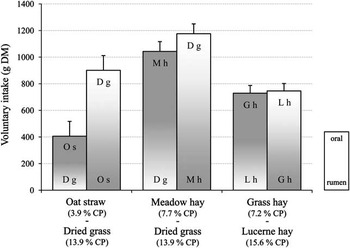
Using two good-quality forages (lucerne and grass hays) with different sensory characteristics, daily dry matter intake did not differ when controlling for post-ingestive consequences (Favreau et al., Reference Favreau, Ginane and Baumont2010c; Figure 1). Greenhalgh and Reid (Reference Greenhalgh and Reid1971) found similar results when offering two good-quality forages (dried grass and meadow hay), whereas they demonstrated that sensory characteristics influenced the daily intake of a low-quality forage (oat straw) compared with a good-quality forage (dried grass; Figure 1).
Voluntary intake (mean ± s.e.) measured in three studies involving the same methodology consists in offering one food at the trough to be orally consumed ad libitum (indicated on the upper part of the bars) while the same or another food is introduced in the rumen of the animal via a rumen fistula (indicated in the lower part of the bars). The first experiment (Greenhalgh and Reid, Reference Greenhalgh and Reid1971) used a good-quality forage (dried grass = Dg, 13.9% of CP in dry matter) and a low-quality forage (oat straw = Os, 3.9% CP). The second (Greenhalgh and Reid, Reference Greenhalgh and Reid1971) and third (Favreau et al., Reference Favreau, Ginane and Baumont2010c) experiments used two good-quality forages (meadow hay = Mh, 7.7% CP v. dried grass = Dg, 13.9% CP; lucerne hay = Lh, 15.6% CP v. grass hay = Gh, 7.2% CP, respectively).

These differences could be explained by an insufficient sensory contrast between the better-quality forages used in the first two studies which cannot influence daily intake regardless of post-ingestive consequences. In return, when the contrast is stronger, and even if previous knowledge about the respective post-ingestive consequences of the foods has surely participated in shaping their palatability, it appears that foods’ palatability can affect daily intake.
Food palatability can also influence intake in the short term. It has been shown that satiated sheep ate a substantial meal after a second distribution of a sufficiently palatable hay; this meal was then associated with an increase in rumen fill of up to 10% of the daily maximum observed without this second distribution (Baumont et al., Reference Baumont, Seguier and Dulphy1990b). The hedonic stimulation induced by the new distribution thus overrode the satiety signals due to rumen fill. In the same way, moderate energy preloads, combined with manipulations of palatability during a test meal, resulted in overconsumption in humans, thus demonstrating that the hedonic value of food sensory characteristics decreased the ability of short-term satiety cues to stop intake (Yeomans et al., Reference Yeomans, Lee, Gray and French2001). In sheep, when post-ingestive consequences were controlled, the intake of lucerne hay was higher than that of grass hay just after food distribution, indicating that the motivation to eat was then higher than the negative fill effect of the hay introduced in the rumen (Favreau et al., Reference Favreau, Ginane and Baumont2010c). Finally, the physical form (pellets or cubes) and the addition of monosodium glutamate (i.e. umami taste) increased the palatability of straw (a poor-quality food) which induced higher sham intakes in the short term (Colucci and Grovum, Reference Colucci and Grovum1993). On the contrary, a low palatability can decrease the short-term intake of a food in cattle (palm kernel expeller; Spörndly and Åsberg, Reference Spörndly and Åsberg2006).
Does the palatability of food sensory characteristics affect preferences?
As soon as ruminants have choice opportunities, they express preferences. These preferences are influenced by the effect of post-ingestive consequences (Provenza, Reference Provenza1995), but some results suggest that the relative hedonic value of food sensory characteristics is involved as well. Sensory characteristics were indeed able to induce food preferences by their own, that is, without any immediate positive post-ingestive reinforcement as it is the case with umami taste (Grovum and Chapman, Reference Grovum and Chapman1988; Gherardi and Black, Reference Gherardi and Black1991). The umami taste, induced by monosodium glutamate, seems to have a positive hedonic value in sheep, as it induced strong and constant preferences for the treated food over the same untreated food, regardless of the doses (Gherardi and Black, Reference Gherardi and Black1991; Favreau et al., Reference Favreau, Baumont, Ferreira, Dumont and Ginane2010a). In cattle, umami induced such a preference in young animals (e.g. in animals weaned at 3 weeks of age, and from 3 to 6 weeks of age; Waldern and van Dyk, Reference Waldern and van Dyk1971). In the same way, when different flavours are sprayed on the same food (i.e. to ensure similar post-ingestive consequences) and compared in short-term choice tests with the same unflavoured food, animals often express clear preferences. This was the case for sheep preferring an aniseed-flavoured orchard grass hay, at a rate of 80%, compared with an orange-flavoured orchard grass hay (Favreau et al., Reference Favreau, Baumont, Duncan and Ginane2010b), suggesting that the aniseed flavour has a higher hedonic value than the orange flavour in sheep. However, this result is inconsistent with those of other studies in which sheep did not express any preference between the two flavours (Kyriazakis et al., Reference Kyriazakis, Papachristou, Duncan and Gordon1997; Arsenos et al., Reference Arsenos, Hills and Kyriazakis2000). Such variability was also frequently reported in the literature concerning sweet taste (see Ginane et al., Reference Ginane, Baumont and Favreau-Peigné2011 for review). Individual variability in preferences between flavours or tastes in the absence of immediate post-ingestive influence are also widely encountered in different experiments (Goatcher and Church, Reference Goatcher and Church1970a and Reference Goatcher and Church1970b; Robertson et al., Reference Robertson, Gordon and Pérez-Barbería2006). In the absence of immediate post-ingestive consequences that usually calibrate food preferences, it appears logical to encounter a great individual variability since is known that individual characteristics, such as animal's physiological and emotional states (Brondel and Cabanac, Reference Brondel and Cabanac2007 and Tamashiro et al., Reference Tamashiro, Hegeman, Nguyen, Melhorn, Ma, Woods and Sakai2007, respectively) and previous experiences (Provenza, Reference Provenza1995) in utero (Simitzis et al., Reference Simitzis, Bizelis, Deligeorgis and Feggeros2008) or early in life (Miller-Cushon and DeVries, Reference Miller-Cushon and DeVries2010), can affect palatability. Experiences in utero and early in life cause neurological, morphological and physiological changes because of the interactions between genome, environment and post-ingestive consequences; this participates in the uniqueness of each individual (Provenza et al., Reference Provenza, Villalba, Dziba, Atwood and Banner2003). These differences in preferences can lead to variability in food selection in the field; as a consequence, it can result in less grazing pressure on individual vegetation species, which can represent an evolutionary advantage for social herbivore species (Goatcher and Church, Reference Goatcher and Church1970b).
The hedonic value of food sensory diversity
When ruminants are offered a choice between foods that differ in how long they have not been eaten, they generally prefer the one that was not consumed recently. This was true for sheep preferring the flavour presented first within a conditioning period over that presented second (Arsenos et al., Reference Arsenos, Hills and Kyriazakis2000), for ewes preferring the opposite species (i.e. white clover or ryegrass) to the one they had previously grazed (Newman et al., Reference Newman, Parsons and Harvey1992; Parsons et al., Reference Parsons, Newman, Penning, Harvey and Orr1994), and for heifers temporarily increasing their preference for the hay that had not been offered during the previous period (Ginane et al., Reference Ginane, Baumont, Lassalas and Petit2002). The authors suggested that the preference for the ‘new’ hay could be explained by (i) the animal's need to select a balanced diet that best meets its homeostatic requirements or (ii) the animals’ search for rarity for functional purposes, such as maintaining gut flora diversity or (iii) an attractive effect of novelty, considered as a search for diversity. On that last point, Scott and Provenza (Reference Scott and Provenza1998) demonstrated that a variety of flavours is preferred relative to monotony by lambs when food nutrient content was constant between the different food items available. Similarly, sheep always preferred in the short term the hay they were not used to eating, whatever its nature (lucerne or grass hay), even when the post-ingestive consequences associated with animals’ diet were similar (Favreau et al., Reference Favreau, Ginane and Baumont2010c). This preference for diversity suggests the existence of a hedonic dimension for food sensory characteristics. This is consistent with the concept of sensory specific satiety, which assumes that the hedonic value of food sensory characteristics will decrease as it is consumed (Rolls, Reference Rolls1986). This is also consistent with recent findings showing that lambs receiving a monotonous diet had higher cortisol levels 1 h after food presentation than lambs receiving a diverse diet, indicating a stressing effect of monotony (Villalba et al., Reference Villalba, Catanese, Provenza and Distel2012). Ruminants thus appear to search for diversity for their pleasure as well as for their needs. As a consequence, the absence of food diversity, encountered when animals are conducted outdoors on monoculture or fed indoors with the same diet over several weeks or months, may have negative implications on animal welfare.
Does the palatability of food sensory characteristics affect food learning?
As mentioned above, sheep showed a higher initial preference for aniseed-flavoured orchard grass hay compared with orange-flavoured orchard grass hay (Favreau et al., Reference Favreau, Baumont, Duncan and Ginane2010b). After conditioning, the preference for the flavoured hay associated with the negative post-ingestive consequence was still influenced by these initial preferences, that is, sheep negatively conditioned on aniseed expressed a lesser avoidance than sheep negatively conditioned on orange (0.53 ± 0.04 v. 0.25 ± 0.03, respectively; Favreau et al., Reference Favreau, Baumont, Duncan and Ginane2010b). Similar results were found with a higher initial hedonic preference for fenugreek flavour over garlic flavour which then influenced the conditioned responses of sheep (Arsenos et al., Reference Arsenos, Hills and Kyriazakis2000). Therefore, it appears that the initial palatability of a food influences its evaluation by sheep in a learning context. It then affects the animals’ propensity to make an associative learning between sensory characteristics and post-ingestive consequences. It may be easier for animals to associate a food initially preferred with a positive than with a negative consequence.
Sensory characteristics: a way to indicate the nature of the post-ingestive consequences of the food
The condition for a food sensory characteristic to become an informative signal is that animals are able to give it a meaning via evolution and/or by using individual learning processes. When animals encounter a new food and have no knowledge about it, they hesitate or even refuse to eat it. This neophobic response is considered as adaptive, as it helps animals to avoid eating harmful foods at the first encounter, and give them the opportunity to learn about their post-ingestive consequences (Birch, Reference Birch1999). At the individual learning level, it has been largely demonstrated that ruminants, such as sheep (du Toit et al., Reference du Toit, Provenza and Nastis1991; Burritt and Provenza, Reference Burritt and Provenza1992), cattle (Ralphs and Provenza, Reference Ralphs and Provenza1999) and goats (Duncan and Young, Reference Duncan and Young2002), are able to associate food sensory characteristics with post-ingestive consequences when the experimental learning procedure is simple (i.e. one association between sensory characteristics and post-ingestive consequences to learn at a time), and modify their diet selection accordingly. However, animals show difficulties to learn when the experimental learning procedure becomes more complex and closer to natural situations, which could be achieved experimentally either by offering several different foods simultaneously during the conditioning procedure (Duncan and Young, Reference Duncan and Young2002), by increasing the number of consequences associated with each food (Ginane et al., Reference Ginane, Duncan, Young, Elston and Gordon2005) or by modifying the length of feeding bouts and the rate of nutrient delivery (Duncan et al., Reference Duncan, Elwert, Villalba, Yearsley, Pouloupoulou and Gordon2007). In these studies designed to test food-learning abilities in ruminants, food sensory characteristics can only be used as discriminating tools because they are meaningless for the animals at the very first association, that is, they do not indicate to the animal the post-ingestive consequences associated with the food. Diverse sensory characteristics of plants could, however, act as crude indicators of their nutritional and toxic values in the field. For instance, several secondary plant compounds have a bitter taste and are toxic to herbivores (Garcia and Hankins, Reference Garcia and Hankins1975; Rogosic et al., Reference Rogosic, Estell, Ivankovic, Kezic and Razov2008), and a young green plant is generally more nutritious than a mature plant (Kühnle and Müller, Reference Kühnle and Müller2011). Further, other species use food sensory characteristics as indicators of their potential toxic or nutritive values, as shown with birds avoiding invertebrates’ aposematic colouring (Aronsson and Gamberale-Stille, Reference Aronsson and Gamberale-Stille2008; Skelhorn et al., Reference Skelhorn, Griksaitis and Rowe2008).
Edwards et al. (Reference Edwards, Newman, Parsons and Krebs1997) demonstrated that sheep could use visual and smelling cues (in turves of perennial ryegrass or white clover) to find rewards (highly preferred pelleted food). Sheep expressed an aversion for a familiar food when added with a cue, that is, a novel odour, which was previously associated with toxicosis; this was true for both artificial flavour (coconut) and natural odour (the odour of Astragalus bisulcatus; Provenza et al., Reference Provenza, Kimball and Villalba2000). In that study, it appears that the sensory characteristic has acquired a meaning, indicating a probable toxicity to the animal which, as a consequence, reduced its preference for the food associated with that cue. Conversely, sensory characteristics can be a positive cue. Food neophobia can be overcome by adding a familiar flavour or odour on a novel food (Launchbaugh et al., Reference Launchbaugh, Provenza and Werkmeister1997; Van Tien et al., Reference Van Tien, Lynch, Hinch and Nolan1999). Familiarity can be considered as a cue indicating that the food is safe (Burritt and Provenza, Reference Burritt and Provenza1989).
Further, a recent study demonstrated that the use of food sensory characteristics (flavours experimentally associated with negative or positive post-ingestive consequences) as indicators of the value of the food allowed sheep to improve their learning efficiency in a subsequent complex learning task compared with naïve sheep (Favreau et al., Reference Favreau, Baumont, Duncan and Ginane2010b). This also underlines their ability to generalize their knowledge about flavours to different situations varying in complexity and confirms previous results (Launchbaugh and Provenza, Reference Launchbaugh and Provenza1994; Ginane and Dumont, Reference Ginane and Dumont2006). So sheep can rely on sensory cues, which provide an essential help in learning about food especially in complex environments. Howery et al. (Reference Howery, Bailey, Ruyle and Renken2000) demonstrated that cattle can learn to associate visual cues (traffic barricades and traffic cones) with disparate food qualities and use this information to forage more efficiently in environments varying in complexity (fixed or variable locations of foods in the field).
Plants encountered in the field by animals differ in many sensorial characteristics and notably in their taste profiles; some of them are supposed to reveal the value of the food. Thus, they constitute an interesting natural cue to study the potential role of food sensory characteristics as an indicator of post-ingestive consequences. Hence, several plant secondary compounds that are toxic to herbivores have a bitter taste (Garcia and Hankins, Reference Garcia and Hankins1975; Rogosic et al., Reference Rogosic, Estell, Ivankovic, Kezic and Razov2008), whereas sweet and umami tastes are supposed to be associated with energy (Swithers and Davidson, Reference Swithers and Davidson2008) and protein (Naim et al., Reference Naim, Ohara, Kare and Levinson1991) contents, respectively. A recent study demonstrated that the umami taste would have a positive value, expressed by a high initial preference, whereas the bitter taste would have a negative value as shown by the reluctance of sheep to increase their preference for this taste once it is associated with positive consequences (Favreau et al., Reference Favreau, Baumont, Ferreira, Dumont and Ginane2010a). Thus, herbivores seem to attribute a priori values to natural basic tastes. Consequently, it is suggested that ruminants could use primary tastes as cues to anticipate food consequences and then to forage both more efficiently and more safely, although this still needs to be tested.
Conclusion
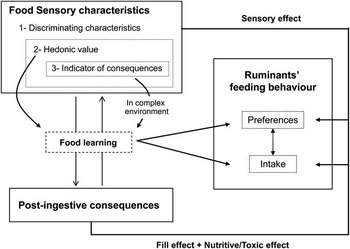
This review brings to light that the roles of food sensory characteristics have been previously underestimated or simplified, and underlines three important roles of food sensory characteristics on ruminants’ feeding behaviour (Figure 2). First, all sensory characteristics can be considered as discriminating characteristics that allow animals to distinguish between different food items. Second, some of these sensory characteristics possess a hedonic value that influences ruminants’ intake, preferences and food learning independently of any immediate post-ingestive consequences. Third, for some of them, the initial hedonic value has acquired a positive or a negative value either via previous individual food learning or via evolutionary processes. This value then makes possible for a sensory characteristic to become an indicator that allows ruminants to anticipate the post-ingestive consequences of a food and to improve their learning efficiency, which could be of interest for animals, especially in complex environments.
Diagram of the interrelated roles of food sensory characteristics and post-ingestive consequences in the feeding behaviour of domestic ruminants and its control. The post-ingestive consequences play a major role in ruminants’ feeding behaviour because of their fill effect and/or their nutritive/toxic effect. All sensory characteristics are discriminating characteristics (i.e. they help animals to distinguish between different food items). Some of them possess a hedonic value that influences food learning, intake and preferences at least on the short term. Then, some of them have acquired a positive or a negative value through individual learning or evolutionary processes. This value could play an indicator role that allows ruminants to anticipate the post-ingestive consequences associated with the food consumed, and then improve their food learning efficiency especially in complex environment.

Perspectives and significance
This review suggests some avenues to follow in order to improve animal welfare and productivity by taking into account these multiple roles of food sensory characteristics. For instance, food sensory characteristics could be used to improve palatability of poor quality or new foods, so as to increase their acceptability, at least in the short term. Further, animals seem to search for an absence of monotony in food sensory characteristics. This could represent an easy way to enrich their environment and improve their welfare. Sensory cues could also be created by animal managers to help animals anticipate the post-ingestive consequences of some toxic plants so that they avoid them in the field.
Acknowledgements
The authors are grateful to INRA and the Auvergne Region for their funding.