The Sardinian Hypertensive Adolescent Research Programme is a longitudinal long term study carried out in Sardinia, Southern Italy, with the aim of gathering information about the prevalence of paediatric hypertension and its anthropometric, biochemical and clinical determinants.Reference Marras, Bassareo and Ruscazio1 In this respect, childhood obesity is known to be a growing epidemic problem. The highest rates of obesity are observed in Southern Europe, where up to two-fifths are affected, compared to up to one-fifth in the North.Reference Livingstone2 Obesity is certainly known to be associated with elevated blood pressures in both adults and children, with approximately a 3-fold higher risk for hypertension in obese compared to non-obese children. The risk of hypertension in children, furthermore, increases across the entire range of values for the body mass index.Reference Sorof and Daniels3, Reference He, Ding, Fong and Karlberg4 A recent research carried out in a secondary Italian school in Rome, with the aim of evaluating the incidence of high blood pressure in adolescents by assessing their anthropometric measurements and diet, suggests that about three-tenths of hypertensive adolescents are obese.Reference Cairella, Menghetti and Scanu5 Furthermore, weight reduction is one of the most efficient ways of decreasing blood pressure.Reference He, Whelton, Appel, Charleston and Klag6 Potential risk factors for cardiovascular diseases, such as hyperinsulinaemia, impaired glucose tolerance, dyslipidaemia, and hypertension, already tend to cluster in childhood, and are strongly associated with obesity from adolescence.Reference Csàbi, Török, Jeges and Molnàr7, Reference Cook, Weitzman, Auinger, Nguyen and Dietz8 An increased body mass index during childhood is also known to be associated with an increased risk of coronary arterial disease in adulthood.Reference Baker, Olsen and Sørensen9 The aim of this part of our study of Sardinian children, extending the aims of our initial study,Reference Marras, Bassareo and Ruscazio1 was to search for any relationship between hypertension and increased weight, and to determine if the characteristics of this relationship can change according to the criterions used to define excessive weight.
Materials and methods
As explained in our first report,Reference Marras, Bassareo and Ruscazio1 we enrolled 839 children, of whom 441 were male, from 10 second-grade schools in Cagliari, the chief town of Sardinia, and its province. In this part of the study, we aimed to investigate the prevalence of both hypertension and excessive weight, again using prospective longitudinal assessments of blood pressure and weight over a period of 3 years. Each child had his or her blood pressure measured every 6 months from February, 2005, to June, 2007, their ages ranging from 11 to 14 years during this period. At the same times, we measured their height and weight, calculated their body mass index, and followed the cohort so as to detect any deemed overweight using internationally agreed cut-offs for obesity.
As explained in our initial report, we excluded 65 subjects who were not present on at least 4 of the 5 days of screening, and 57 subjects whose parents did not give informed written consent. The protocol was approved by the University of Cagliari Ethics Committee.
The technique for measurement of blood pressure has been described in detail in the first part of our study,Reference Marras, Bassareo and Ruscazio1 and follows accepted rules.Reference Hohn10, Reference Clark, Lieh-Lai, Sarnaik and Mattoo11 As also explained in our first report,Reference Marras, Bassareo and Ruscazio1 we plotted the reading to provide distribution curves specific for our study, comparing them with the criterions selected by Menghetti et al.Reference Menghetti, Virdis and Strambi12 to develop specific tables of blood pressure for Italian children, these proving much more accurate than use of the tables provided by those working in the United States of America.
All of the growing pubescent children were weighed while wearing underclothes, and their height was measured in bare feet. Weight was measured in kilograms using an electronic balance (model 770; Seca, Germany). Height was measured with a standing stadiometer (Holtain, Ltd). The uncertainty in weighing was up to 100 grams, whereas in height it was up to 5 millimetres.
There is no internationally acceptable definition that is entirely satisfactory for the estimation of excessive weight and obesity in children.Reference Cole, Bellizzi, Flegal and Dietz13 Accordingly, we used four different methods for screening excessive weight. The first was to use as a cut-off a body mass index exceeding 25 kilograms per square metre. Generally, a subject who has a body mass index between 25 and 29.9 kilograms per square metre is considered overweight, while obesity is considered to represent a body mass index in excess of 30. The island of Sardinia has a high prevalence of subjects with short stature. There is evidence that the criterion of body mass index used to diagnose obesity should be different in these subjects when compared with a population favouring tall stature. It is a fact that short people at the same body mass index have a greater body fat mass than tall ones. This finding supports the hypothesis that, in those with short stature, the body mass index used for a diagnosis of obesity must be re-evaluated. Specifically, it is suggested that excessive weight in these subjects should be defined in those with a body mass index of 25,Reference Lòpez-Alvarenga, Montesinos-Cabrera, Velàzques-Alva and Gonzàles-Barranco14 those with an index equal to or greater than the 85th percentile,Reference Nader, O’Brien and Houts15 those with a body mass index exceeding the 90th percentile using the tables prepared in France by Rolland-Cachera,Reference Rolland-Cachera, Sempè, Guilloud-Bataille, Patois, Pèquignot-Guggenbuhl and Fautrad16 or those with a body weight more then 20% higher than the ideal weight for the relative height.Reference Tanner and Whitehouse17
We expressed the results obtained as mean plus or minus standard error for each group. Hypertension is defined as an average systolic and/or diastolic pressure equal to or greater than the 95th percentile for age and sex.Reference Menghetti, Virdis and Strambi12 We used the Spearman correlation coefficient to evaluate the dependence between age and weight. This non-parametric statistic was chosen because these two variables were not normally distributed. The Cochran-Mantel-Haenszel test was used to compare the overweight between genders. Correlations between high blood pressure and excessive weight were sought by chi-squared analysis. To estimate the dependence between absolute blood pressure value and weight, we used the age-adjusted partial Spearman correlation coefficient instead of the simple one, thus eliminating the possible simultaneous influence of age on both blood pressure and weight. Values of p less than 0.05 were set as the minimum level of statistical significance. All statistical analysis was performed using SPSS for Windows version 11.0 (SPSS Inc., Chicago, Il, USA).
Results
On the basis of our distribution curves, we found that 4.2% plus or minus 1.4% of our cohort had isolated systolic hypertension, with 4.9% or minus 1.5% having isolated diastolic hypertension, and 1.5% plus or minus 0.8% having both a systolic and diastolic hypertension. As described in our first report,Reference Marras, Bassareo and Ruscazio1 there was no statistical difference between these numbers and those derived for the same cohort using the tables calculated by Menghetti.
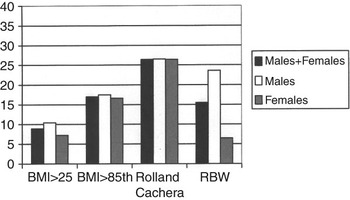
In Figure 1, we show the prevalence of children in our cohort deemed overweight on the basis of the four definitions used, and stratified according to gender. The highest number of those deemed overweight was found when using the tables of Rolland – Cachera, specifically 26.4% plus or minus 24.6%, while the lowest number was shown when using the criterion of body mass index exceeding 25 kilograms per square metres, namely 8.9% plus or minus 1.9%.
Bar graph shows the percentages of subjects whose weight remained elevated in the subsequent screenings, according to the four different criterions we used to define the children as overweight, the results being stratified according to gender. Abbreviations: BMI > 25: body mass index exceeding 25 kilograms per square metres; BMI > 85th: body mass index equal to or greater than the 85th percentile; Rolland-Cachera: French references by Rolland-Cachera; RBW: relative body weight.

When seeking trends for excessive weight, we observed both an increase in those deemed overweight when using this last definition, from 7.8% at the first measurement to 11.0% at the final one, and a decrease on the basis of all the other criterions.
Using the 4 different definitions failed to reveal any significant differences between the children, be they male or female, deemed overweight at the different ages from 11 to 12 years, from 12 to 13 years, and from 13 to 14 years. In other words, we found no relationship between age and the class of weight.
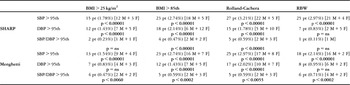
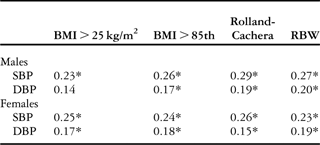
More males proved to be overweight than females, albeit that the proportions varied considerably according to the method used to define excessive weight. For the males, the proportions varised from 5.5% plus or minus 1.6% to 12.9% plus or minus 2.3%, whereas for females the proportions varied from 3.6% plus or minus 1.3% to 11.6% plus or minus 2.2%. This difference proved to be statistically significant only when expressed on the basis of relative body weight (p less than 0.00001). In Table 1, we show the overweight children in our hypertensive population, with their statistical correlations. When not taking account of the presence or absence of values for blood pressure above the 95th percentile, overall systolic and diastolic values were higher in those deemed overweight when compared with comparable children of normal weight of both genders (Table 2).
The percentages (%) of overweight patients (pt) with elevated values for blood pressure analysed by gender.

Abbreviations: pt: patients; SBP: isolated systolic hypertension; DBP: isolated diastolic hypertension; SBP/DBP: combined systolic and diastolic hypertension; Menghetti: previous Italian blood pressure paediatric tables; SHARP: blood pressure distribution curves of our study; BMI > 25 kg/m2: body mass index exceeding 25 kilograms per square metre; BMI > 85th: body mass index equal to or greater than the 85th percentile; Rolland-Cachera: French references by Rolland-Cachera; RBW: relative body weight; M: males; F: females.
Spearman partial correlation coefficient between weight, normal versus overweight subjects, and systolic and diastolic blood pressure values in males (upper panel) and females (lower panel).

*p < 0.0001.
Abbreviations: SBP: isolated systolic hypertension; DBP: isolated diastolic hypertension; BMI > 25 kg/m2: body mass index exceeding 25 kilograms per square metre; BMI > 85th: body mass index equal to or greater than the 85th percentile; Rolland-Cachera: French references by Rolland-Cachera; RBW: relative body weight.
Discussion
The different methods used to define excessive weight produce different estimates regarding its prevalence. This variation displayed when we used 4 different methods surely indicates a discernible need for a single definition with which to identify the overweight and obese child. The findings, nonetheless, show a high prevalence of both excessive weight and obesity in our children. The increase in prevalence of these features during recent years highlights this growing public health issue.
We followed our population of children longitudinally to establish the strong relationship of levels of blood pressure with excessive weight. Even if this has already been shown in many studies, the lack of uniformity in defining excessive weight again complicates the exact definition of this type of correlation.
Our Sardinian study showed that isolated systolic hypertension was present in all those children defined as being overweight, irrespective of the method used to define excessive weight. Only when defined in terms of a body mass index equal to or greater than the 85th percentile, or when using the methods of Rolland-Cachera, however, was weight significantly correlated to both systolic and diastolic hypertension in adolescence (Table 1). Our results, nonetheless, show that, even in students with systolic and/or diastolic pressures under the 95th percentile, the values for blood pressure are more elevated in those who are overweight when compared to their peers of the same age, sex, and height who are of normal weight (Table 2). Adolescents who are overweight frequently carry this burden into adulthood. Worryingly, up to four-fifths of adolescents may prove to be overweight in adult age, particularly if severely overweight, or having an obese parent.Reference Must and Strauss18, Reference Dietz19
Although excessive weight is associated with important haemodynamic disturbances, and in adolescence it is a more powerful predictor of a broad range of adverse health effects than when occurring in adults, there is little data on the distribution of the blood pressures in Southern European populations of children and adolescents in this era of endemic paediatric excessive weight.Reference Must, Jacques, Dallal, Bajema and Dietz20
On the other hand, the potential to prevent adult hypertension starts in childhood, and depends on the knowledge of the determinants of childhood blood pressure, and on the aspects of its short- and long-term variability. Thus, as childhood excessive weight has already reached epidemic proportions all over the world, and is associated with the development of high blood pressure, specially isolated systolic hypertension, reducing excessive weight should also cut down on the number of our children who are hypertensive.Reference Muntner, He, Cutler, Wildman and Whelton21 Simple weight reduction, therefore, could reduce the probability that an initial and simple disposition in childhood would presage a fatal destiny in adult age.
Our study has its limitations. We found a reluctance of patients enrolled in our programme to agree with our proposed programmes for improvement in health, and to become involved with preventive measures aimed at reducing the epidemic of obesity and its haemodynamic consequences. We also recognise the need to increase the number of students examined, and to extend the screening to other age ranges.
Acknowledgments
This research was supported by Regione Autonoma della Sardegna – Assessorato alla Sanità. We gratefully thank Professor Rinaldo Vallascas (Laboratory of mechanical and clinical measurements – University of Cagliari), the assistants who collected the data (Silvia Marras, psychologist; Carla Matta, psychologist), and especially the families who took part in the study.