





Introduction
Before one enters the cell, the geography of the prison already defines the terms of survival. Kondengui Principale Prison is organised into blocs, corridors and a central yard, each marked by hierarchy, density and reputation. Some blocs house political detainees or influential inmates; others, such as the Kosovo block, are associated with overcrowding and violence. Movement across these spaces is formally regulated but informally negotiated through money, connections and influence. At the centre lies the prison yard: a stretch of cracked concrete enclosed by high walls. At 6:45 a.m., cell doors open and bodies spill into the yard. Here, inmates cook, exercise and cluster into groups defined by language, region or affiliation. The yard offers temporary expansion, but it is not free space; it is a stage where reputation, alliances and hierarchies are performed. By 6:45 p.m., a whistle signals the end of this openness. Inmates return to their cells, where they remain locked until morning. From that moment, the cell becomes the total world.
The cells themselves are large rectangular enclosures filled with tightly packed three-tier bunk beds, separated by a narrow passage. At the back, a small cubicle functions as both toilet and washing area, often divided only by cloth partitions. Late evening meals, washing and defaecation collapse into the same confined environment. In this setting, space is not simply physical but a form of social capital. Where one sleeps, stands or breathes reflects access to money, power or protection. It is within this compressed geography between fleeting openness in the yard and proximity in the cell that struggles over dignity, survival and power unfold.
As I entered the cell on my first night, I was met by a silence that pressed in from all sides. The air was heavy with sweat, urine, damp clothes and concrete that never seemed to dry. There was no space to move freely; bodies pressed together, each carving out a fragile patch of ground. Some men lay curled on mats, others sat upright against the wall, while latecomers dozed standing, leaning on whoever was closest. Snoring mingled with whispered prayers, the scrape of metal cups and restless coughs of men struggling for air. This was the world I would share for five years, the world behind the prison cell door that most research and reports never reach.
Most knowledge about prisons comes from official records, formal interviews or brief observations in communal spaces. Rarely do researchers gain sustained access to the intimate spaces where inmates live, eat, sleep, argue and endure one another, a limitation long noted in convict criminology literature, which highlights how much prison research is produced from positions removed from incarceration (Richards & Ross Reference Richards and Ross2001; Ross & Richards Reference Ross and Richards2003; Newbold et al. Reference Newbold, Ross, Jones, Richards and Lenza2014). Much prison literature privileges institutional perspectives or public domains, while the cell itself, the core site of imprisonment, remains under-explored, particularly in its relational and sensory dimensions. This article takes a different approach. It does not emerge from a short visit; it grows out of the five years I spent inside Kondengui Principale Prison from 2020 to 2025, sharing those cells. From that vantage point, I argue that one cannot fully grasp how dignity, power and survival are negotiated without attending to the relational dynamics within the shared cell.
The prison cell is not a marginal feature of incarceration; it is the most immediate and inescapable arena where survival, humiliation and resistance are played out daily. This is not to deny the importance of yards, workshops or relations with staff. Yet the shared cell produces a distinct condition defined by forced intimacy, constant exposure and the collapse of personal boundaries. Every detail of who sleeps where, who bathes first, who snores too loudly, who owes whom a favour becomes subject to negotiation and often conflict. The indignities I suffered, including loss of privacy, fear, shame and the erosion of dignity, were shaped above all by cell sharing.
Prison research has long documented overcrowding, neglect and systemic failures in African penal systems (Tertsakian Reference Tertsakian2014; Le Marcis Reference Le Marcis2019; Jefferson et al. Reference Jefferson, Feika and Jalloh2014). Recent scholarship has moved beyond abstract accounts by attending to sensory and lived dimensions. Schmidt and Jefferson (Reference Schmidt, Jefferson, Herrity, Schmidt and Warr2021), for instance, show how confinement is experienced through the body and the senses. Yet sustained attention to the shared prison cell as a dense relational micro-world remains limited. Few studies describe what it means to endure such proximity over time: to negotiate space, air and intimacy under constant exposure. It is this level of interaction that this article foregrounds.
This article makes three contributions. First, it foregrounds the shared cell as the under-examined arena of incarceration in African contexts, showing how proximity structures dignity, survival and everyday relations of power. Rather than treating power as purely vertical, it shows how it is also produced horizontally among prisoners, even as these relations remain entangled with institutional structures. Second, it advances an analytical framework showing how life under constraint produces forms of cooperation, conflict and moral ambiguity that extend beyond the prison cell. Third, it offers an embedded account grounded in sustained lived experience and extensive interaction. By situating everyday strategies of coexistence within broader logics of scarcity and inequality, the article illuminates both suffering and fragile solidarities that emerge in shared cells.
The article proceeds as follows. It begins with a focused review of existing scholarship, followed by a methodological discussion grounded in extended incarceration and embedded ethnographic engagement. The analysis then turns to the Cameroonian context, situating overcrowding as the condition within which cell life unfolds. From there, the article moves into the cell, first examining the erosion of dignity through shared confinement, illustrated through Case Study 1. The next section deepens this analysis by unpacking everyday indignities such as bodily exposure, institutional intrusion, sensory overload, sleep deprivation and micro-conflicts through Case Studies 2 and 3. The discussion then shifts to individual strategies of survival, where Case Studies 4 and 5 show how trust, theft and restraint structure the moral economy of cell life. The final analytical section examines collective strategies and the production of order, where Case Study 6 illustrates how informal governance operates through negotiated power relations. The article concludes by reflecting on what the shared cell reveals about everyday social dynamics, power and survival under conditions of extreme constraint.
The paradox of the prison cell: intimacy, proximity and relational life
Scholarship on prison cells has long recognised a central paradox: the cell is simultaneously a site of confinement and a space of enforced closeness. While classical prison studies have emphasised isolation, surveillance and institutional control, more recent work highlights the dense social worlds that emerge within shared confinement, where inmates must negotiate relationships, boundaries and survival (Crewe et al. Reference Crewe, Warr, Bennett and Smith2014; Jewkes Reference Jewkes2002). In overcrowded settings, the loss of privacy is not simply a structural condition but an ongoing social process. Proximity collapses distinctions between public and private life, forcing inmates into continuous exposure to one another’s bodies, habits and emotions. Everyday acts such as sleeping, eating, washing or grieving become collectively experienced, producing what Goffman (Reference Goffman1961) describes as ‘contaminative exposure’. Yet such exposure does not generate uniform outcomes. Rather, it creates a dynamic field of interaction in which intimacy, cooperation, tension and violence coexist (Muirhead et al. Reference Muirhead, Butler and Davidson2023; Laws & Crewe Reference Laws and Crewe2016; Schliehe & Crewe Reference Schliehe and Crewe2022).
A substantial body of literature shows that overcrowding is associated with stress, insecurity, deteriorating prison climates and increased risks of violence and self-harm (Haney Reference Haney2012; Huey & McNulty Reference Huey and McNulty2005; Lawrence & Andrews Reference Lawrence and Andrews2004). These studies have been crucial in establishing structural consequences of congestion. However, they often treat the cell in abstract or numerical terms, leaving under-explored how such conditions are lived and negotiated in everyday interactions. As a result, the cell frequently appears as a passive backdrop rather than an active social arena.
Emerging work in prison ethnography, particularly in African contexts, has begun to address this gap by foregrounding the relational and negotiated character of prison life. Rather than viewing authority as purely vertical, these studies show how power is distributed, shared and contested among inmates and between inmates and officials (Martin & Jefferson Reference Martin and Jefferson2019; Jefferson & Martin Reference Jefferson and Martin2014; Akoensi Reference Akoensi2014; Ayete-Nyampong Reference Ayete-Nyampong2014). Research further highlights how everyday governance operates through informal arrangements, exchanges and shifting alliances, often blurring boundaries between control and complicity (Jefferson & Martin Reference Jefferson and Martin2014; Morelle Reference Morelle2014; Jefferson Reference Jefferson2007; Jefferson Reference Jefferson2010). In this sense, survival depends not only on institutional rules but also on negotiated moral economies structured by scarcity, dependency and risk.
Recent contributions have pushed the analysis further by emphasising prisons as social worlds that illuminate broader societal dynamics. Schneider’s work on Sierra Leone, for example, conceptualises prisoners’ experiences as insights into both prison and society, showing how confinement intensifies patterns of relationality, power and inequality (Schneider Reference Schneider2014; Schneider Reference Schneider2020). Similarly, geographically grounded studies of African prisons demonstrate how confinement reshapes space, subjectivity and everyday life, foregrounding embodied and sensorial dimensions (Morelle Reference Morelle2019; Morelle Reference Morelle, Morelle, Le Marcis and Hornberger2021; Jefferson & Martin Reference Jefferson, Martin, Jewkes, Bennett and Crewe2016). These studies move beyond institutional accounts to reveal prisons as dynamic, socially productive environments.
Building on these insights, this article centres the shared cell not simply as one site among others, but as the most immediate and inescapable arena in which these dynamics are lived. While existing scholarship shows that prison life in Africa is negotiated and relational, it has paid less sustained attention to the shared cell as a dense micro-social world where proximity is continuous rather than episodic. Drawing on extended lived experience, this article shows how dignity, violence, intimacy and cooperation are actively produced through everyday interactions under conditions of extreme congestion. In doing so, it advances the analysis of African prisons by demonstrating how proximity within the shared cell operates as a structuring force shaping relational life, moral boundaries and strategies of survival over time.
Methodology: embedded ethnography and lived experience
This article draws on over five years of incarceration, amounting to 1,889 days in Kondengui Principale Prison in Yaoundé, complemented by over one hundred interviews with inmates, prison administrators and visitors. Participants included men and women, pre-trial detainees and convicted prisoners, serving sentences ranging from a few months to life imprisonment. Alleged offences ranged from terrorism, murder and embezzlement to minor infractions. Many participants were recidivists who had experienced multiple prisons across Cameroon, providing a comparative perspective on carceral life. Access to prison cells remains a challenge in prison ethnography, as interactions are mediated by institutional constraints and surveillance, leaving the intimate and relational dynamics of shared confinement under-explored (Schliehe & Crewe Reference Schliehe and Crewe2022; Ugelvik Reference Ugelvik2014).
This study addresses this gap through embedded ethnography (Adebanwi Reference Adebanwi, Boswell and Nyamnjoh2016) grounded in lived experience. Unlike conventional prison research, where the researcher enters and exits the field, this account is written from within confinement. As an inmate, I did not negotiate access; I inhabited the same spaces, routines and constraints as those I studied. Observation was a condition of survival. The study is situated in relation to convict criminology, which challenges the distance between academic representations and lived realities of imprisonment (Richards & Ross Reference Richards and Ross2001; Ross & Richards Reference Ross and Richards2003; Jones et al. Reference Jones, Ross, Richards and Murphy2009). Much prison research has been produced from positions removed from incarceration, often privileging institutional perspectives while neglecting prisoners’ knowledge (Ross & Richards Reference Ross and Richards2003; Jones et al. Reference Jones, Ross, Richards and Murphy2009). Convict criminology responds by incorporating experiential knowledge into analysis, producing accounts grounded in an ‘inside perspective’ (Newbold et al. Reference Newbold, Ross, Jones, Richards and Lenza2014; Richards et al. Reference Richards, Ross, Newbold, Lenza, Jones, Murphy, Grigsby, Ekunwe and Jones2011).
However, this study does not treat lived experience as the sole route to knowledge. Rather, it aligns with debates in convict criminology and auto-ethnographic research, which emphasise that insider perspectives offer a partial form of insight (Newbold et al. Reference Newbold, Ross, Jones, Richards and Lenza2014; Jones et al. Reference Jones, Ross, Richards and Murphy2009). While experiential proximity can enrich understanding, it also requires reflexivity to avoid uncritical subjectivity (Jewkes Reference Jewkes2012; Damsa & Ugelvik Reference Damsa and Ugelvik2017). Lived experience is therefore mobilised not as a stand-alone epistemological authority, but as a vantage point that complements other forms of inquiry. The aim is not to claim exclusive access to truth but to illuminate sensory, relational and affective dimensions of shared cell life that remain difficult to capture through conventional methodologies.
My positionality as both inmate and researcher shaped every aspect of the research process. Interviews often unfolded as conversations between peers rather than formal encounters, allowing openness that might otherwise be difficult to achieve. In a context where time is one of the few abundant resources, extended conversations structured daily life, often evolving organically rather than following rigid formats. This facilitated trust but required careful ethical and analytical navigation. The boundary between participation and observation was never fixed; it was negotiated in everyday interaction.
Methodologically, the study draws on ethnography and sensory engagement. Following approaches to sensory ethnography (Pink Reference Pink2009), knowledge was generated not only through observation and interviews but also through embodied participation: sharing meals; negotiating sleeping space; enduring heat, noise and overcrowding; and experiencing the rhythms of confinement. These practices provided insight into how prison life is organised, felt, negotiated and endured. Data collection combined interviews, participant observation and reflexive note-taking. Because recording devices were restricted, I relied on discreet note-taking and, where possible and with consent, occasional recordings. Notes were organised into observational, theoretical and methodological reflections, enabling analysis of social interactions and my positionality. Memory played a central role, with field notes often composed retrospectively when writing was not possible. In this sense, memory functioned as an archive and analytical tool, shaping how events were recalled and interpreted.
Ethical considerations were central. Participation was based on informal consent, and all identifying details have been anonymised. Given the risks associated with exposure, care was taken to avoid harm, especially when discussing sensitive practices or conflicts. Undertaking research from within confinement also required reflexivity. My position afforded unique access but also introduced limitations. Proximity could obscure as much as it revealed, and emotional involvement required analytical distance. Following work on reflexive prison ethnography (Jewkes Reference Jewkes2012; Crewe Reference Crewe2009), emotions such as fear, empathy and frustration were treated not as biases to be eliminated, but as resources for understanding affective dimensions of prison life. This study should therefore be understood as a situated account, grounded in a specific prison and shaped by a particular positionality. While not universally generalisable, it offers insight into broader patterns of social life in African prisons, particularly in relation to proximity, power and survival.
Life compressed: proximity, power and survival in Cameroon’s prisons
Prisons in Cameroon are chronically overcrowded. Cells rarely allow lying down, sitting upright or even standing freely. In Kondengui Central Prison, a sister facility opposite the Kondengui Principale Prison where I was held, built for fewer than 1,500 inmates but holding around 9,000, many prisoners sleep outside, exposed to sun and rain, waiting for shaded corners to rest (Prison Insider 2016; VOA 2021; The Guardian 2025). At the Yaoundé Principale Prison, 12–20 men are squeezed into three-tier bunks. The poorest sleep beneath beds in spaces known as sumandat, or in the corridors, pressed against concrete.
The harshest conditions are found in holding cells: transitional spaces for remand prisoners or those awaiting allocation. Here, a hundred or more men may be crowded into a bare room with no beds, toilets or running water. They are forced to sleep seated or standing on bare floors, bodies pressed tightly together, waiting for redistribution. Allocation is never neutral. As studies of African prisons have shown, access to space is structured through informal economies of money, influence and social networks (Morelle Reference Morelle2014). Those with resources secure better placement; the poor are pushed into the worst quarters. In this sense, the notorious Kosovo block epitomises a pattern found across African prisons: marginal spaces, often overcrowded, unsanitary and violent, reserved for those with the least means (Le Marcis Reference Le Marcis2019).
The Yaoundé Principale Prison, where I was held, housed a diverse population. Boko Haram detainees and Ambazonian separatists formed some of the largest blocs, alongside officials accused of embezzlement, as well as robbers and drug traffickers. Until 2024, Boko Haram detainees were reportedly shackled for extended periods, sometimes exceeding two years, before rights groups intervened. Space itself is a scarce and contested resource. Although beds are officially assigned free of charge upon arrival, in practice, a bunk can cost between 15,000 and 300,000 CFA francs, with scarcity often maintained through informal arrangements involving inmates and staff (Morelle Reference Morelle2014). In my case, I paid 25,000 francs for a space. Cells reflect the prison’s internal hierarchies. Some are reserved for political detainees, long-term prisoners or those considered high-risk; others function as punishment blocks. But most are vast dormitories designed for a handful of occupants yet holding many times that number (Johnstone-Robertson et al. Reference Johnstone-Robertson, Lawn, Welte, Bekker and Wood2011).
Only a privileged minority: ministers, business elites or high-profile detainees occupy what are referred to as ‘VIP cells’. These spaces house fewer inmates, sometimes only 1–4 individuals, and offer advantages such as reduced congestion, improved ventilation, greater control over noise and more secure storage of personal belongings. Yet, despite these differences, they remain embedded within the same carceral environment and rarely escape broader conditions of confinement. Within ordinary cells, privilege is expressed through placement. Those with money or influence secure positions near doors or windows, where air circulates; the poor are pushed into upper bunks or interior spaces, where heat and suffocation are most intense.
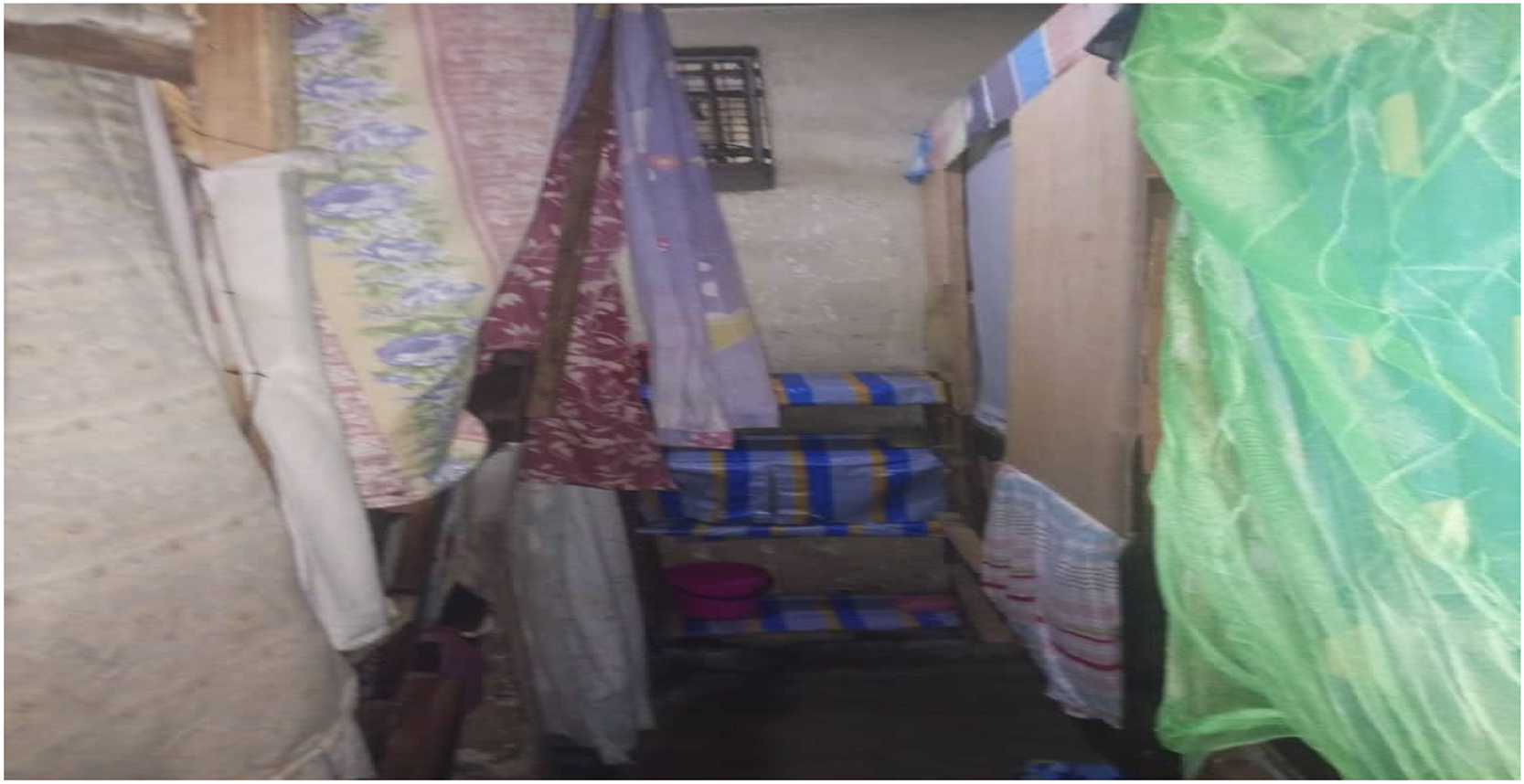
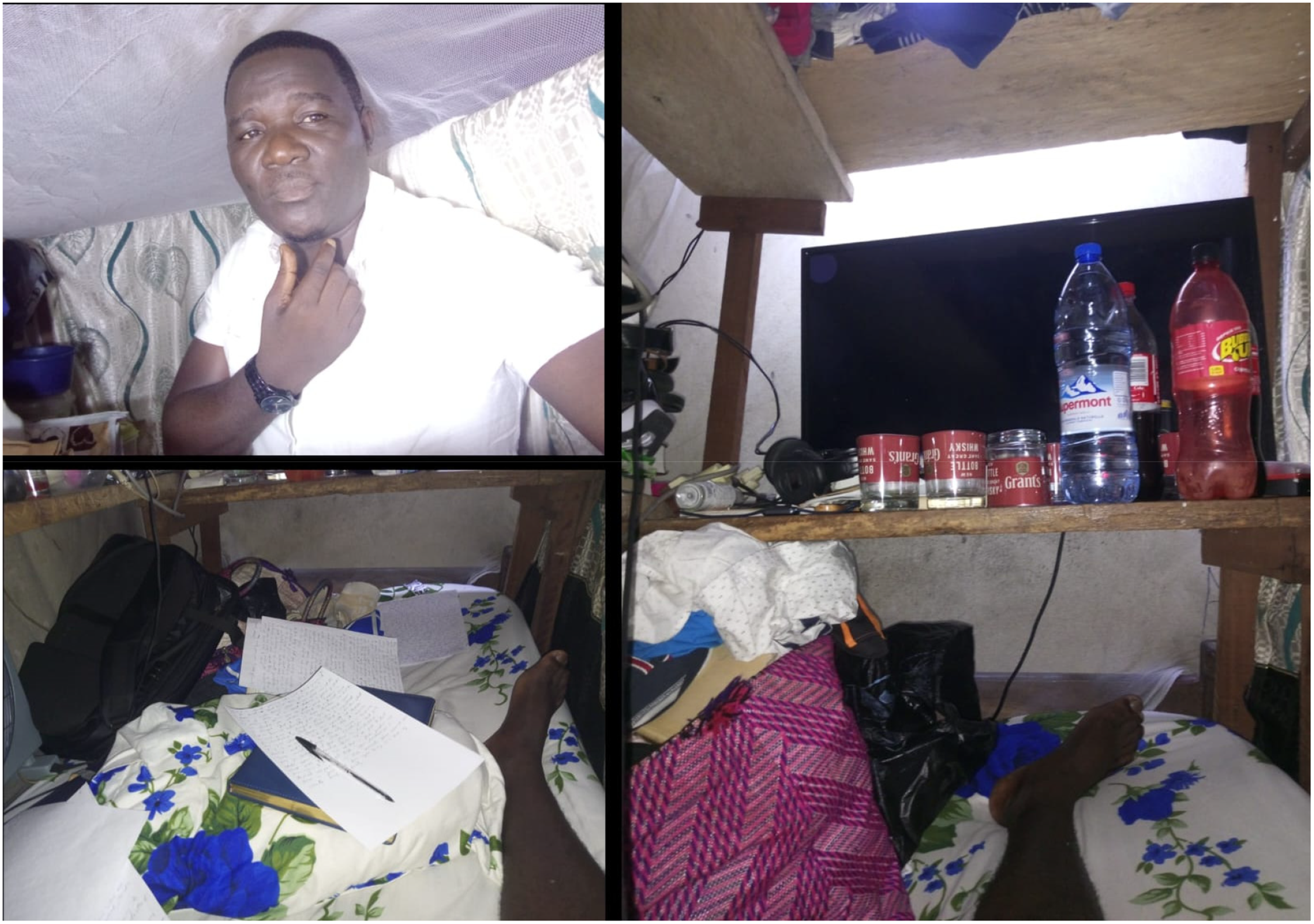
As Morelle (Reference Morelle2019) demonstrates in her spatial analysis of Yaoundé’s prison, these arrangements produce a micro-geography of inequality, where space is continuously negotiated and stratified. Figure 1 captures the corridor of Cell 12, where two rows of three-tier bunks defined the living space. As illustrated in Figure 2, my bed space was on the third tier of a bunk, which I occupied for five years. Although I could have afforded a lower bunk, I chose the upper tier. It offered protection: its relative inaccessibility required time and planning for theft, reducing my vulnerability as someone perceived as a ‘responsible man’ and therefore an easy target.
Corridor view of Cell 12 showing two rows of three-tier bunks.
Source: Photograph by author, taken with mobile phone.

Figure 1. Long description
A corridor view of Cell 12 showing two rows of three-tier bunks. The cell is cramped with various personal items and bedding hanging and placed around the bunks. The walls are bare and the space appears tightly packed, indicating overcrowding.
The author’s bed space on the third tier of a bunk, occupied for five years.
Source: Photograph by author, taken with mobile phone.

These images illustrate the material realities of confinement, where space is scarce and bodies are stacked. Yet beyond the bunks and walls, hierarchies and inequalities shape daily survival. Administrators often claim that ‘in prison, there is no small or big crime and no small or big man’, echoing Ugelvik’s (Reference Ugelvik2014: 118) observation that depersonalised cells express institutional power: ‘you are all the same to us’. In practice, distinctions emerge everywhere: between those who can pay and those who cannot, between those who secure space through force or influence and those who retreat into the margins. As in other African prison contexts, inequality is not erased by confinement; it is reconfigured within it (Morelle Reference Morelle2019; Jefferson & Martin Reference Jefferson and Martin2014). Survival therefore demands resourcefulness, endurance and luck. The most vulnerable: the newly arrived, the sick, the elderly and the disabled suffer most. For many, the first nights are the most terrifying, haunted by gangs, disease, hunger and uncertainty. It was within this uncertainty that I entered the cell for the first time, confronting directly what that fear meant in practice.
Cell sharing and the daily erosion of dignity in prison life
Nothing captures the erosion of dignity in shared prison cells more than my first night inside. This section examines how dignity is undermined not only through material deprivation – filth, overcrowding and lack of privacy – but also through exposure to others. It does so through Case Study 1, the case of Musa, which shows how inmates negotiate dignity, concealment and moral identity under conditions of constant observation. In such conditions, the boundaries between personal and public collapse and even the most intimate acts are performed under observation. As prison scholarship suggests, proximity produces forms of ‘contaminative exposure’ that reshape social life (Goffman Reference Goffman1961). Within this environment, dignity is not simply lost, but negotiated.
That day, alongside the day of my sentencing to five years’ imprisonment, remains among the worst of my life. I had just emerged from thirty-one days of incommunicado detention in the Judicial Police cell in Yaoundé. When the examining magistrate ordered my remand at Kondengui Principale Prison, I naively hoped conditions might be less brutal. Escorted by police at 8 p.m., I was anxious and afraid. Rumours of what awaited ‘secessionists’ like me weighed on my mind. I feared hostility, violence or worse. At the penitentiary administration, three warders processed my admission. One officer searched my luggage and demanded 10,000 francs, which I handed over. The most senior intervened, insisting that any money be voluntary. I gave it nonetheless. I was then led to Cell 11 (locale 11), my temporary home. Two rows of three-tier bunk beds filled the cramped space.
The cell was an enclosure, thick with the stench of unwashed bodies, mildew and sewage. Cobwebs clung to walls darkened with dirt. Torn mosquito nets hung as flimsy partitions. The floor was wet with sewage water from a faulty toilet. Between the bunks lay a corridor cluttered with dirt, remnants and refuse. Dim light filtered through tattered nets, casting ghostly shadows.
I soon needed to use the toilet. Hoping for some privacy, I found it located beside the living area, separated only by old clothes and bags strung together. Inmates ate while others defaecated, a humiliation that stripped us of dignity. The toilet was a rusted metal bowl caked with grime and bodily residue, its stench permeating the cell. Faulty plumbing caused leaks, spreading foul water across the floor. Overcome by disgust, I forced myself to withhold the urge. That night, Omar, a young man jailed for robbery, offered me his bed until I was assigned a space in Cell 12. I wept silently, suppressing any sound for fear of offending strangers whose reactions I could not predict. I longed to cry out, but even that basic release was denied. As one inmate, Ngonda (pseudonym) remarked: ‘It feels like a concentration camp… everything is designed to debilitate, to demoralise us’.Footnote 1
Many inmates spoke of the congestion, where bodies were packed so tightly that even sitting or lying down became a struggle. Yet beyond these constraints, it was the forced cohabitation with strangers, each carrying their own histories, habits and temperaments, that profoundly eroded one’s sense of self. The cell brought together men who would otherwise never have lived side by side, compelling negotiation of difference under conditions of exposure. Privacy, in this setting, was not limited but undermined. Inmates often felt unable to show grief or vulnerability. As Beckoncho (pseudonym) recalled, ‘No one wants to cry when everyone is watching. Either they mock you or tell you to be strong’.Footnote 2 Yet total exposure does not eliminate concealment; it produces new forms of negotiated privacy, where secrecy, complicity and silence become essential for managing identity. It is within this coexistence that moral boundaries are both performed and transgressed, as the following case illustrates.
Case Study 1: Musa and the management of morality
The case of Musa (pseudonym) illustrates how negotiated privacy operates within the shared cell. Musa, a Muslim scholar, built his reputation on strict opposition to alcohol. He avoided drinkers and spoke openly against it, reinforcing an image of moral discipline. On Christmas Eve, when inmates were allowed to purchase alcohol, I shared whisky and beer with others in my cell. Musa was excluded. Later, however, a cellmate approached my bunk with an empty cup, whispering that Musa had sent him. When I looked in his direction, Musa gave a subtle nod. What followed was a coordinated routine. The intermediary would collect the drink and place it on a nearby shelf. When attention shifted, Musa would quietly retrieve it and drink. He never approached me directly; his participation depended on the silence and movements of others. Another Muslim cellmate adopted a similar strategy: publicly requesting soft drinks, but later approaching my bunk to whisper that whisky be added enough to last, so he would not have to return often and raise suspicion. By the end of the night, both had fully participated in what they publicly condemned.
The following morning, I was approached with the same warning from both men: what had happened must remain secret. If exposed, they would deny everything and could mobilise others against me. This reveals that privacy in shared cells is not absent but collectively produced. Proximity reorganises secrecy through complicity, silence and selective disregard. It also exposes the instability of moral identities under confinement, where individuals navigate between public performance and private desire in ways reminiscent of Goffman’s (Reference Goffman1961) account of self-presentation under conditions of exposure, where individuals must manage how they appear while constantly being observed. In this sense, what appears as a contradiction becomes a strategy of survival, where dignity is not openly asserted but carefully protected through concealment.
As one recidivist reflected, ‘the vivre ensemble’ (coexistence) the president speaks about is most visible in prison… we are condemned to live together in our differences’.Footnote 3 Yet this enforced closeness is more invasive than anything outside. It demands adaptation, reshaping habits, relationships and self-perception. Cell sharing magnifies the erosion of dignity not only through material deprivation but also through relentless proximity. Every act – sleeping, grieving or simply existing – unfolds under the gaze of others. In such conditions, survival is reduced to endurance, and dignity becomes fragile, constantly negotiated and never fully secure.
Understanding the complexities of indignities in shared cells
While the previous section examined how dignity is eroded through constant exposure and forced cohabitation within the shared cell, this section shifts focus to how that erosion is lived in everyday practice. Existing scholarship has shown how overcrowding and proximity produce stress, degradation and forms of ‘contaminative exposure’ that blur boundaries between public and private life (Goffman Reference Goffman1961; Haney Reference Haney2012). Emerging work in African prison studies highlights how such conditions are shaped through relationality, sensoriality and everyday negotiation (Morelle Reference Morelle2019; Martin & Jefferson Reference Martin and Jefferson2019; Schneider Reference Schneider2020). Building on these insights, this section shows how indignity is not simply experienced as deprivation but lived and managed through the body, the senses and relations with others under conditions of enforced proximity. It extends existing work by foregrounding how these processes are negotiated at the micro-level of the shared cell, where exposure, discomfort and vulnerability are actively organised and endured in everyday interaction.
Rather than treating indignity as a singular experience, this section shows how it unfolds through layered practices of exposure, discomfort, intrusion and negotiation that define the texture of cell life. These dynamics are illuminated through two case studies: the first demonstrates how bodily necessity and waste become organised through scarcity and exchange, while the second reveals how intimacy, desire and violence become entangled through acts of sexualised humiliation and violation under conditions of exposure. In doing so, the section shows how the prison cell reveals broader social dynamics, where inequality, relational tension and survival shape basic aspects of human existence.
Bodily exposure and the collapse of privacy
The spatial arrangement of the cell ensured that acts typically considered private became public performances. Toilets were located within the living space, often separated only by improvised cloth partitions. To relieve oneself was to do so under observation. As Ndip (pseudonym) explained, ‘the stench and sight of your own feces is not exclusive to you’.Footnote 4 The body could not be withdrawn from others; it was continuously exposed, producing a condition where privacy collapsed into co-presence and dignity became difficult to sustain.
Institutional intrusion: cell searches and the violation of the body
Beyond exposure to fellow inmates, prisoners were subjected to routine intrusions by prison authorities. Cell searches, conducted in the name of security, were among the most invasive of these practices. Officers regularly entered cells to search for prohibited items: mobile phones, weapons or other suspicious objects. What might appear as a routine procedure carried a deeper significance. Officers climbed onto bunks with muddy shoes, scattering belongings and leaving sleeping spaces in disarray. Mattresses were overturned, containers opened and every object scrutinised. In a space where inmates struggled to maintain control over their environment, these acts reinforced the fragility of personal space and dignity.
For many, the violation extended beyond objects to the body itself. Searches sometimes involved deeply invasive bodily inspections, with women subjected to vaginal searches and men forced to expose their genital and anal areas under torchlight as warders searched for concealed items. Elderly inmates, women and even VIP detainees were not exempt. Such practices blurred the boundary between security and humiliation, transforming the body into an object of suspicion and control. Equally significant was the anticipation of these searches. The sound of footsteps on cement floors or the jangling of keys was often enough to trigger anxiety. As inmates described it, one became constantly alert: ‘they are coming to my cell’. This anticipation produced a form of psychological surveillance, where individuals monitored their actions and possessions in expectation of intrusion, echoing what Foucault (Reference Foucault1977) describes as the internalisation of surveillance. Over time, some inmates claimed to become accustomed to these practices. Yet this adaptation reflected not acceptance, but resignation. The cell remained a space where privacy was never secure, where both the body and its surroundings were subject to scrutiny.
Sensory overload: smell, heat, air and noise
Indignity was also experienced through the senses. The cell was saturated with smells: sweat, urine, damp clothes and sewage that never dissipated. Heat intensified these conditions, while poor ventilation ensured that air became heavy and oppressive. Smoking added another layer, forcing non-smokers to inhale fumes in a space where avoidance was impossible. These sensory conditions were central to how confinement was experienced, embedding discomfort into the atmosphere of everyday life and reinforcing how confinement is lived through the body and the senses (Morelle Reference Morelle2019).
Night offered no relief. Instead, it amplified the pressures of confinement. The cell became an echo chamber of coughing, movement, whispered conversations and sudden disturbances. Sleep was fragmented and often impossible. Fire was not an isolated incident but a recurring threat; in my five years in the cell, we experienced more than seven outbreaks. In one instance, a faulty electrical connection ignited my mattress, filling the cell with smoke. With the doors locked and warders nowhere nearby, there was no escape. In panic, I dived from my upper bunk, landing blindly and tearing my toe as I ran towards a door that led nowhere. In such moments, inmates would beat on the walls with plates, pots or metal objects, often joined by neighbouring cells in a show of solidarity to summon attention. Intervention could take over an hour. In the meantime, we clustered near the door, smoke thickening, flames spreading, using pieces of cloth, limited water or whatever was at hand to contain the fire. The fear of being trapped by fire, illness or violence was constant.
Living in such proximity meant that even minor irritations could escalate into conflict. Disputes over hygiene, noise or shared resources were frequent. As one inmate remarked, ‘Even if you don’t shower, at least brush’,Footnote 5 capturing how everyday bodily practices became sources of tension. These frictions reflected deeper struggles over control, respect and survival in an environment where personal space did not exist. It is through such tensions, particularly those tied to the body, that indignity becomes most visible, as the following case illustrates.
Case Study 2: COVID-19, bodily urgency and indignities
The cumulative pressures described above become most visible when the management of the body itself is pushed to its limits. The COVID-19 period offers a stark illustration of how these layered indignities intensify under crisis conditions. During this time, everyday indignities escalated dramatically. Illness spread quickly through overcrowded cells, and symptoms such as diarrhoea made access to the toilet urgent. Queues formed along the narrow passage between bunk beds, with inmates marking positions on the floor in an attempt to impose order. Yet urgency quickly disrupted these arrangements. The pandemic was no respecter of status or qualification; in that cell, with one toilet for many, I endured the same humiliating urgency and queues as everyone else, except that money could sometimes buy quicker access when it was not yet one’s turn. Those with resources paid to move ahead, offering cigarettes, food or small amounts of money. Others, unable to wait, resorted to using plastic bags near their sleeping spaces. The toilet itself frequently overflowed, merging waste with the already congested living environment.
What emerged was not simply disorder but a reorganisation of bodily necessity into a form of exchange. Even the most basic human functions became subject to negotiation and inequality. This case captures abjection in its most extreme form, where distinctions between body, waste and environment collapse. At the same time, it reveals how scarcity transforms biological urgency into an economic and relational process. In this sense, the prison cell offers insight into broader social dynamics, showing how inequality structures even the most fundamental aspects of human life. In the African prison cell, the management of the body itself becomes organised through hierarchy, proximity and survival, extending existing accounts of deprivation by showing how even bodily urgency becomes embedded within systems of exchange and inequality.
Case Study 3: sexualised humiliation and violence – the Oyongo–Musongo confrontation
If the previous case reveals how bodily necessity becomes structured by scarcity, this case shows how emotional life is equally transformed under conditions of forced proximity. Masturbation itself became grotesque in such crowded, unsanitary conditions: men moaned openly, using torn female clothing, worn towels or stolen underwear. A particularly vicious form of humiliation emerged when an inmate fixated on your visitor or a female warder glimpsed during rounds. At night, he would retreat to his bunk, invoking her image for release. In prison life, even the smallest tokens of intimacy could acquire outsized meaning. A photograph, a lock of hair or a garment worn by a lover became not only a substitute for affection but also a contested object vulnerable to envy and violation. Oyongo and Musongo had arrived in prison together, transferred on the same day, charged on the same case file for aggravated theft with murder, and both had spent twelve years behind bars already. They exercised together in the yard, shared jokes and, by prison standards, were close. Oyongo cherished a pair of women’s underwear worn by his girlfriend, whom he had asked to wear it for several days so that it carried traces of her presence before sending it to him, a fragile bridge to intimacy beyond the prison walls. He kept it carefully hidden, bringing it out only at night. To him, it was not just fabric; it was presence. He would sometimes refer to it, half-jokingly and half-seriously, as ‘my wife’.
The rupture came suddenly. One evening, Oyongo discovered the garment mutilated, the crotch cut out. His reaction was immediate and explosive. ‘You have slept with my wife!’ he shouted, his voice cutting through the noise of the cell. ‘You have stolen my wife!’ He accused Musongo, the only person who knew of its existence. What began as an accusation turned rapidly into confrontation. Fists flew. The narrow corridor between the bunks became a battleground. A blade appeared. Bodies scrambled to the edges of the cell, but there was nowhere to go. Blood spattered against the walls as the two men lunged at each other. None of us intervened; the risk of becoming the next target was too high. In that confined space, violence spread quickly, and hesitation could be fatal.
What began as an attempt to preserve intimacy became a violent struggle for dignity and control. The object itself, once a source of comfort, became a trigger for humiliation and aggression. This case demonstrates how proximity transforms intimacy into vulnerability. In conditions of forced cohabitation, personal attachments are exposed to collective scrutiny and potential violation. Desire, degradation and violence become entangled, revealing how emotional life itself is reshaped under confinement. More broadly, it shows how the prison cell operates as a dense relational space where the boundaries between care, envy and aggression are constantly negotiated, offering a window into how similar tensions unfold in wider social contexts marked by scarcity and proximity, highlighting how intimacy under confinement becomes a site where vulnerability, desire and violence are simultaneously produced and contested.
Everyday negotiations of survival: coping, calculation and the moral economy of cell life
Life in the shared prison cell is not only endured; it is actively managed. Under conditions of overcrowding, exposure and uncertainty, survival depends on continuous calculation, adjustment and self-discipline. Existing scholarship on prison life, particularly in African contexts, has shown how survival is structured through informal governance, negotiated authority and moral economies of exchange (Morelle Reference Morelle2014; Martin & Jefferson Reference Martin and Jefferson2019; Akoensi Reference Akoensi2014). This section builds on these insights by shifting the analytical focus to the micro-dynamics of the shared cell, showing how such processes are lived at the level of everyday interaction. It demonstrates that coping is neither passive nor uniform but organised through individual strategies such as compliance, negotiation, withdrawal and calculated restraint. In doing so, it extends existing work by foregrounding how risk is anticipated and managed in conditions of enforced proximity, where survival depends not only on navigating authority but also on calibrating action in relation to those one cannot escape.
These practices form part of a broader moral economy of cell life, where decisions are shaped by dependency, vulnerability and the anticipation of harm. This dynamic is further illuminated through two case studies: the first explores how trust, theft and justice are negotiated within fragile systems of interdependence, while the second demonstrates how restraint becomes a critical strategy for managing violence and avoiding escalation. In this sense, the prison cell reveals broader social realities in which individuals must navigate uncertainty, manage relationships and balance cooperation with self-preservation.
For newcomers, the first rule of survival is simple: respect everyone, fear everyone and apologise quickly. On my first day in Cell 12, a fellow inmate, Tanyi (pseudonym), advised me: ‘Just respect everybody. If you offend anyone, even by mistake, apologise quickly before it escalates’.Footnote 6 In that moment, my education, status and experience outside the prison meant nothing. What mattered was the ability to read the environment and avoid confrontation. As Fujua (pseudonym), a young inmate, explained, ‘better to lose money than lose blood’.Footnote 7 Appeasement was not weakness but strategy, a way of navigating uncertainty in a space where conflict could escalate rapidly and unpredictably.
Other inmates relied on communication to manage tensions. Small negotiations structured everyday life: who used the toilet first, how noise was controlled and how shared spaces were maintained. As Ngongbi (pseudonym) noted, ‘talking prevents small things from escalating’.Footnote 8 These micro-negotiations created fragile forms of order within a volatile environment. Even humour played a role, helping normalise discomfort and diffuse tension. For some, survival depended on withdrawal. Avoiding attention through silence, lowered visibility and emotional restraint reduced the risk of becoming a target. Tanyi described it; invisibility was the only reliable form of protection. This strategy required constant vigilance: reading moods, anticipating tensions and knowing when not to speak.
Case Study 4: Mbesinaku – theft, trust and calculated justice
These strategies become most visible when trust is tested and must be renegotiated under conditions of risk. My experience with Mbesinaku (pseudonym) illustrates this dynamic. Mbesinaku slept directly beneath my bunk and regularly assisted me, washing my sportswear and helping manage my space for a weekly pay and other benefits like food and clothes. Though I never fully trusted him, I allowed a degree of proximity. Over time, small items went missing, but without evidence, I chose not to accuse him. One day, I hid 300,000 CFA francs in a place I believed secure. When I returned, more than half had disappeared. Suspicion immediately fell on Mbesinaku, but I hesitated. Accusing him without proof risked escalating the situation in ways I could not control. Soon after, however, he began spending openly, purchasing goods, setting up a small business within the prison and even sending money outside. The source of his sudden wealth raised questions, but still no one confronted him directly. The truth emerged through a fracture in another relationship. A fellow cellmate who had witnessed the theft had remained silent after being promised a share, which Mbesinaku never delivered. When Mbesinaku later refused him even a small favour – a pinch of chilli for his soup – he took offence. The fragile alliance collapsed, and in anger, he revealed everything.
What followed was spontaneous. Other inmates dismantled Mbesinaku’s business, seizing his goods and demanding an explanation. Under pressure, he claimed his wife had sent the money, but this collapsed when prison authorities verified the claim with her, forcing him to repay the stolen amount. At this point, I intervened to stop further punishment and asked that his goods be returned. This was not an act of forgiveness, but calculation. Escalating the situation further could provoke retaliation, including the possibility of being poisoned through food or drinks left on my bed in my absence. This case shows that life in the shared cell is governed by a fragile moral economy shaped by proximity, dependency and risk. Trust is never absolute; it is provisional, tested and easily broken.
While existing scholarship has shown that prison order is negotiated (Morelle Reference Morelle2014; Akoensi Reference Akoensi2014; Jefferson & Martin Reference Jefferson and Martin2014), this case demonstrates how such negotiation is structured by the immediacy of shared confinement, where individuals must account not only for present actions but also for future vulnerability. Theft in prison is embedded within networks of silence, complicity and opportunism. Justice, in turn, is not fixed but calibrated. Sanctions are shaped not only to address wrongdoing but also to manage ongoing coexistence and anticipate retaliation. In this sense, the shared cell reveals broader social dynamics, where cooperation, punishment and trust are continuously reworked under conditions of uncertainty, inequality and enforced proximity.
Case Study 5: Ngobefou and Achebefou – restraint, risk and the calculus of violence
This dynamic becomes even clearer in moments where action is possible but deliberately withheld. The confrontation between Ngobefou (pseudonym) and Achebefou (pseudonym) illustrates how restraint becomes a critical strategy of survival. Ngobefou was physically imposing, disciplined and widely respected. Achebefou, by contrast, was slight, erratic and socially marginal, a known petty thief with little standing in the cell. After a dispute earlier in the day, Achebefou continued provoking Ngobefou late into the night, escalating insults into a direct challenge. When Ngobefou finally stood up, the atmosphere shifted immediately. Achebefou produced a knife. The room fell silent.
Ngobefou could easily have overpowered him. But the decision he faced was not physical; it was strategic. A full retaliation risked killing Achebefou and inviting new charges. Yet even a measured beating carried its own danger: it could provoke retaliation later, at a moment when Ngobefou was most vulnerable, particularly at night. In the shared cell, where adversaries sleep within reach of one another, violence does not end with the confrontation but lingers into moments of proximity and vulnerability. Achebefou’s strength lay in his marginality. With little to lose, he could provoke confrontation without bearing the same consequences. We intervened, not to protect Achebefou but to restrain Ngobefou. The provocation was recognised as a trap. After a tense standoff, Ngobefou stepped back. The fight did not happen, but the tension lingered.
This encounter shows that violence in the shared cell is not simply explosive but structured by unequal risk. Masculinity must be performed, yet calibrated. Strength alone does not determine outcomes; what matters is one’s position within networks of consequence, vulnerability and accountability. Unlike in the wider prison, where distance can separate adversaries, the shared cell collapses space and time, forcing individuals to account for the risks of future retaliation within the same environment. Those with little to lose can destabilise those with something to protect. In this sense, restraint is not passivity but strategy: a deliberate refusal to act in order to preserve future safety. The prison cell thus reveals a social logic in which power operates not only through action but also through the capacity to hold back under pressure.
Finally, these practices show that survival in the shared prison cell is structured by a delicate balance between action and restraint, trust and suspicion and engagement and withdrawal. Individuals must constantly assess their relationships, manage their visibility and anticipate potential threats. The moral economy that emerges is neither stable nor predictable; it is continuously produced through everyday decisions about when to comply, when to act and when to hold back. In this sense, the prison cell is not only a site of confinement but also a space where broader social logics of survival are condensed and intensified, revealing how individuals navigate uncertainty, inequality and interdependence in everyday life.
Collective strategies, power and the negotiation of order
While the previous section examined how individuals navigate the pressures of shared confinement, this section shifts focus to how order is collectively produced within the cell. Life in the shared cell is shaped not only by personal strategies of survival but also by informal systems of regulation through which inmates manage entry, behaviour, conflict and access to resources. These arrangements do not eliminate tension; they organise it, producing a fragile order. In line with scholarship on everyday prison governance in Africa, where authority is distributed and negotiated rather than imposed (Morelle Reference Morelle2014; Jefferson & Martin Reference Jefferson and Martin2014), the shared cell emerges as a micro-political space in which power circulates through relationships and alliances. This dynamic is illustrated through a case study of informal governance, showing how order is maintained through negotiated arrangements between inmates and prison authorities. In this sense, the prison cell reveals social logics in which power, authority and survival are co-produced under conditions of scarcity and uncertainty.
Coping within the cell was therefore not only individual but also collective. Inmates developed informal systems of regulation that governed who entered the cell, how conflicts were managed and what behaviours were tolerated. As Ndam (pseudonym)Footnote 9 explained, ‘we screen newcomers… we want to know if they are violent or troublesome’. These practices were less about formal authority than about preserving internal order in a volatile environment. Cells acted as self-regulating units, where inclusion depended not only on official allocation but also on the approval of existing occupants based on criteria such as crime history, hobbies and hygiene.
Cells could be spaces not only of tension and suspicion but also of empathy and shared endurance. Inmates supported one another through legal uncertainty, family struggles and the psychological weight of confinement. Moments of humour and conversation helped sustain a sense of collective survival. Even the release of a cellmate, while celebrated, carried an undercurrent of comparison: happiness for the other was accompanied by the reminder that it was not yet one’s own turn. These tensions between cooperation, control and competition become most visible in the management of illicit economies and authority within the cell, where collective order depends on negotiated arrangements rather than formal rules. The following case illustrates how these arrangements are contested and maintained.
Case Study 6: informal governance and the politics of control
The dynamics of collective regulation become most visible in the management of illicit economies that depend on cooperation between inmates and prison authorities. The conflict between Njomo (pseudonym) and Tim (pseudonym), the administrative auxiliary (chef local) of the cell, illustrates how order is negotiated, contested and strategically maintained. Tim, a prominent drug dealer, operated within a well-established network sustained through tacit cooperation with warders. Njomo, officially responsible for maintaining discipline, was also embedded in this system, receiving payments in exchange for tolerance. Yet this position was precarious: a cell leader who strictly enforced rules, particularly by reporting those using illicit substances, risked collective backlash and could be strategically framed through coordinated narratives designed to depose him.
One morning, however, the balance shifted. A drug delivery, facilitated by the warder on duty, was intercepted by Njomo before it reached Tim. Njomo demanded an equal share, threatening to expose the operation if refused. Tim attempted to negotiate, offering a larger portion than usual, but the demand crossed an unspoken boundary. Accepting it would destabilise the informal system on which many depended. He refused.
What followed was not simply a confrontation over drugs, but a struggle over narrative control. Because the warder who facilitated the delivery could be implicated, the outcome depended on who framed the incident first. As tensions escalated, the story was rapidly recast: Njomo was now portrayed as the one trafficking drugs, an administrative auxiliary caught in wrongdoing and refusing to report himself. This version was relayed to the same warder who had enabled the transaction, ensuring his interest aligned with sustaining the revised account. Other cellmates reinforced this narrative, ready to act as witnesses if required. In this context, Njomo’s position became untenable. Any attempt to resist could be interpreted as aggression, further legitimising the accusation. When the administration intervened, the outcome followed the reframed script. The drugs were confiscated, and Njomo was punished. The broader network, however, remained intact.
This case shows that governance within the shared cell is neither purely formal nor informal, but symbiotic and contingent on narrative control. Authority is distributed across cellmates and officials, sustained through shared interests, selective enforcement and strategic alignment (Morelle Reference Morelle2014; Jefferson & Martin Reference Jefferson and Martin2014). Crucially, power operates not only through material control but also through the ability to define what counts as truth in moments of conflict. Order emerges not from strict rule enforcement but from negotiated arrangements in which actors mobilise alliances, testimonies and institutional complicity to secure favourable outcomes. This reflects broader patterns identified in African prison studies, where governance is enacted through everyday practices of negotiation and co-production rather than formal authority alone (Akoensi Reference Akoensi2014; Morelle Reference Morelle2014). More broadly, this reveals how authority is exercised through the management of perception as much as through enforcement, offering insight into wider social dynamics where legitimacy and power are continuously produced through negotiation and strategic representation (Schneider Reference Schneider2020).
Conclusion
This article moves beyond treating overcrowding as a structural condition to examine how it is lived, negotiated and made meaningful within the shared prison cell. Based on five years of incarceration, it shows that the cell is a dense relational world in which proximity organises social life. By shifting focus from institutional structures to everyday interaction, it shows how life under confinement is produced through embodied experience, relational negotiation and anticipation of risk. Across the cases, a consistent pattern emerges: survival in the shared cell is structured through the calibration of intimacy, power and vulnerability under constraint. The loss of privacy does not eliminate sociality; it transforms it. Inmates are compelled into proximity that generates fragile solidarities and tensions. Trust is provisional and tested; violence is strategically managed; and even basic aspects of existence, such as sleep, bodily functions and personal attachments, become sites of negotiation and conflict. These dynamics are not simply effects of overcrowding but processes organised through everyday practices of calculation, restraint and adaptation.
In doing so, the article extends work on African prisons that emphasises informal governance, negotiated authority and relational life (Morelle Reference Morelle2014; Jefferson & Martin Reference Jefferson and Martin2014; Akoensi Reference Akoensi2014; Schneider Reference Schneider2020). While this literature shows that prisons operate through co-produced order, this study shows how such dynamics are lived at the level of the cell, where proximity collapses distance and forces individuals to account for consequences. The shared cell thus emerges as the primary analytical site: a micro-political environment in which power and order are produced through interaction. More broadly, the article shows the prison cell as a lens into wider social dynamics. Patterns of negotiated coexistence, moral ambiguity and the balancing of cooperation with risk reflect social logics shaped by scarcity, inequality and uncertainty, where survival depends less on formal rules than on navigating relationships.
Methodologically, the article situates itself at the intersection of ethnography and convict criminology, showing how lived experience captures sensory, affective and relational dimensions of confinement often inaccessible through conventional methods. Combined with reflexive analysis, this approach shows how insider knowledge deepens analytical frameworks.
The article makes three contributions. First, it reconceptualises the shared prison cell as the central arena of incarceration in African contexts, showing how proximity structures everyday life through the negotiation of intimacy, power and survival. Second, it advances an analytical framework showing how life under constraint produces forms of cooperation, conflict and moral ambiguity beyond the prison cell. Third, it demonstrates the value of embedded, lived experience for understanding the embodied and relational dimensions of confinement. Finally, the shared prison cell emerges as a space where dignity is neither fully destroyed nor securely maintained, but contested.
Acknowledgements
The author is deeply grateful to fellow inmates, warders and court officials who, often at personal risk, shared their experiences and insights anonymously. Special thanks also go to colleagues and friends who offered encouragement and critical feedback on early drafts. The support of institutions that facilitated access is sincerely appreciated.
Competing interests
The author declared no potential conflicts of interest with respect to the research, authorship and/or publication of this article.
Funding statement
This research received no external funding.
Ethical standards
The author confirms that this study was conducted in accordance with established ethical standards for research involving human participants. Given the sensitive nature of the prison environment, informed consent was obtained verbally and/or in writing after explaining the research objectives in accessible language. Participation was entirely voluntary, with assurances of confidentiality and anonymity provided to all respondents.
Data availability statement
The data for this article are qualitative, drawn from courtroom observations, inmate testimonies and auto-ethnographic field notes. All notes were recorded and processed manually. Consequently, no dataset is available for public access.

 Open access

