The Second World War in the Balkans led to radical changes in the borders of all states in the region. In April 1939 Italy occupied and annexed Albania.Footnote 1 With the war looming, Bulgarian revisionism steadily pushed the country to the side of similarly revisionist Germany.Footnote 2 The precarious Romanian position – between the Soviet Union claiming Bessarabia and Northern Bukovina and Hungary claiming Transylvania – also thrust the country towards the Axis. With German mediation, in September 1940 Romania ceded to Bulgaria Southern Dobrudja.Footnote 3 In the meantime, following a failed Italian invasion of Greece, Greek troops entered southern Albania (Northern Epirus for the Greeks) in December 1940, prompting a German intervention in the region. Bulgaria officially sided with the Axis on 1 March 1941, allowing Germany to use its territory to invade Greece and Yugoslavia. Once the German troops completed their operations Bulgarian authorities followed them into northern Greece (Western Thrace and parts of Aegean Macedonia) and Yugoslav (Vardar) Macedonia in April 1941. In the end, triple German, Italian and Bulgarian occupation dismembered Greece while large parts of Yugoslavia were either occupied or annexed by Germany, Italy, Hungary and Bulgaria; the puppet Independent State of Croatia took over the rest of Yugoslavia.Footnote 4
Given the scale of the wartime territorial changes, the issue of borders permeated political debates concerning the post-war Balkans. Focusing on political exchanges between 1944 and 1947, this article examines how Bulgaria, Greece and Yugoslavia debated the question of borders in the last stages of the Second World War and the early post-war years. The issue of how to delineate the ‘strategic frontiers’ of the post-war Balkans was rooted in a complex pre-1939 history of territorial claims and counterclaims in relation to borderland areas, including Macedonia, Thrace and Epirus, among others.Footnote 5 In many ways the negotiations at the Paris Peace Conference of 1946 echoed territorial disputes previously debated in Paris in 1919–20, but the emerging Cold War added new dimensions to the talks. Whereas Greece and Yugoslavia had been close allies ever since they signed an alliance treaty in 1913, following the Second World War, despite the common experience of Bulgarian occupation, there was a sharp divergence in their political agendas. In the context of the looming Cold War, ideological commitment undermined traditional alliances and determined the rapprochement of Bulgaria and Yugoslavia at Greek expense. After 1945 the territorial disputes among the Balkan states became connected to the agendas of the Big Three (the Soviet Union, the United States and Great Britain) and the imminent division of Europe into competing ideological blocs.
Based predominantly on Bulgarian archival records, supported by evidence from Greek archives as well as published Yugoslav and other international sources, this article details the interactions between Bulgarian, Greek and Yugoslav statesmen during this time of extreme fluidity in the Balkans. The article reveals the complex interplay between political and national factors in the resolution of the border disputes in the region, a settlement that created the contemporary borders of Bulgaria, Greece and the (former Yugoslav) Republic of Macedonia. There were multiple layers in the articulation of the positions of each state. The new communist-affiliated politicians in charge of Bulgaria promulgated commitment to a ‘New Bulgaria’ that rejected interwar nationalism but also hoped for the acquisition of new lands. The British- and US-supported leaders of Greece, a cobelligerent country, pointed to security concerns and national rights, asking to be rewarded with new, advantageous frontiers. Finally, the Partisan leadership of resurrected Yugoslavia claimed unique prerogatives to reshape the borders and the mentalities of the ‘old Balkans’ by creating a Balkan Federation. At the Paris Peace Conference of 1946 Greece employed the rhetoric of historical rights to claim territories from Bulgaria (Thrace), Albania (Epirus) and Italy (the Dodecanese Islands) but, being in a state of civil war, avoided debates over democratic practices. By contrast, Bulgaria and Yugoslavia used the opportunity to defend the political changes in their countries by emphasising their ‘people's will’, while promoting their territorial aspirations as the expression of international justice and economic common sense.
While rooted in their Balkan context, these debates had larger implications because they anticipated the nature of post-war political interactions in the European continent. In the end, geopolitical considerations and agreements between the Big Three connected to the looming Cold War determined the outcome of the border controversies; by 1947, as Western powers prioritised the reconstruction of Europe, Soviet efforts to shore up communist control in much of the Balkans paid dividends. With hindsight, knowing the history of the Cold War makes these interactions predictable, but the evidence presented here – which focuses on the extremely volatile period between 1944 and 1947 – reveals many uncertainties in the immediate post-war years. These dynamics shifted again in 1948, following the Yugoslav–Soviet split and the Yugoslav expulsion from the Cominform. At that point the internal Soviet bloc politics were transformed for the rest of the Cold War, yet the borders negotiated in 1946 remained untouched.Footnote 6
To illustrate the tremendous fluidity of the post-war situation in the Balkans, this article integrates several scholarly debates on national and political developments in Eastern Europe that are not always brought into conversation. Many historians have been exploring the ‘impossible borders’ that emerged in Europe after the Great War – from Germany's problematic eastern border to the contested areas of Transylvania, Istria and Alsace-Lorraine, to mention a few – which hindered the pacification of interwar Europe.Footnote 7 In the Balkans a vast literature in English has tackled the importance of Macedonia, but equally important for developments in the region were Thrace, Epirus and Dobrudja.Footnote 8 New research on the Eastern European experience of the Second World War has demonstrated the crucial importance of territorial and national considerations rather than ideological positions or racial priorities in the evolution of the conflict in the area.Footnote 9 Studies of other Eastern European ‘shatterzones’ – such as Istria and the city of Trieste or Transylvania – show that the question of borderlands remained an important debate throughout the 1940s.Footnote 10 Given the enormous potential of the national rhetoric to mobilise politically, it is no surprise that it reemerged with such force after the war.
But the mid-1940s were also the time of communist consolidation in Eastern Europe, and while matters remained in flux until 1948, the immediate post-war years demonstrate the ability of left-wing politicians to use the evolving situation to their advantage.Footnote 11 A large literature presents the dynamic interaction between international and domestic factors that paved the road for the communist takeovers in 1948.Footnote 12 Political and diplomatic historians have focused on the larger international framework for the political developments in Eastern Europe after the war, with an emphasis on the Soviet role for the establishment of communist regimes.Footnote 13 A flourishing literature by social and cultural historians has paid attention to the grassroots dynamics and social preconditions for the communist takeovers, offering an important corrective to an exclusive emphasis on the Red Army factor.Footnote 14 Increasingly, historians have also analysed the skilful ability of Eastern European communists to coopt the national(ist) rhetoric and reinvent nationalism into ‘socialist patriotism’.Footnote 15 Recent studies of the use of nationalism by the Czechoslovak, Bulgarian and Hungarian Communist Parties, for example, suggest the continued importance of national symbols and arguments in the consolidation of the regimes.Footnote 16
This article seeks to integrate debates on the post-war borders, the peace treaty negotiations, and the clash of competing visions for Europe after the Second World War to reconstruct the story of political consolidation in one important area of Europe. While this synthesis is unable to engage the complex historiographical issues in each country, it attempts to come closer to an integrated view of the political debates permeating the post-1945 period.Footnote 17 The article thus offers a new interpretation of the post-war developments in the Balkans that incorporates the perspectives of most of the major parties involved, rather than tell the story from one national viewpoint.Footnote 18 The ultimate goal is to present the ‘entangled histories’ of the Balkan neighbours and their allies after the Second World War through the multiple dimensions of the debates about national borders and political sovereignty.Footnote 19
To present those interactions the article interweaves several complex narratives, some of which are told for the first time in the English language. First, it explains the conflict between Bulgaria and Greece over Western Thrace following the Bulgarian occupation of the area in the Second World War and the post-war Greek demands for a new frontier. Second, it analyses how Bulgaria and Yugoslavia reached a compromise over the issue of Macedonia and began negotiations about a Balkan Federation. Third, it charts the place of these territorial disputes in the main diplomatic conferences convened by the Allies after the war. Next, it follows the debates about the Balkan frontiers at the Paris Peace Conference in 1946 where Bulgaria, Greece and Yugoslavia clashed. Finally, the article discusses the relationship between the peace treaty talks and the process of communist consolidation in Bulgaria. By 1947, in the process of debating the post-war Balkan borders, Bulgaria, Greece, Yugoslavia and the Big Three had forged a new Cold War political status quo in the Balkans and, by extension, in Europe. The debates among the three states had begun with the issue of ‘strategic frontiers’, but they evolved in the ‘strategic positioning’ of each country in the Cold War.
The Greek-Bulgarian Confrontation
In the first half of the twentieth century Bulgaria and Greece each had territorial claims over the contested areas of Macedonia and Thrace. After fighting against each other in the Second Balkan War in 1913 and during the Great War between 1916 and 1918, disputes over minority issues in the interwar period became a major motivation for the Bulgarian occupation of Western Thrace and parts of Aegean Macedonia during the Second World War. National issues thus re-emerged as the priority in the post-war encounter between the two states, complicated by the Soviet and British determination to preserve their control over Bulgaria and Greece, respectively.Footnote 20
September 1944 was a chaotic month for the Axis ally Bulgaria.Footnote 21 Its ever-changing governments first declared neutrality and demanded the evacuation of German troops, then declared war on Germany and, finally, when the Soviet Union declared war on Bulgaria, the country found itself at war with all belligerents for several hectic hours on 7 September. A major political change took effect in the country when Soviet troops crossed the Danube on 8 September, and the following day the Fatherland Front, which included the Bulgarian Communist Party (BCP), formed a new government headed by Kimon Georgiev.Footnote 22 In early October Georgiev agreed that the most pressing foreign policy question was the incorporation of (Greek) Western Thrace following the wartime occupation of the area. Political change to the left did not lead to the abandonment of the nationalist agenda that had thrust the country into war on the side of the Nazis.Footnote 23 The government briefly contemplated the possibility of asking for the cession of Northern Dobrudja from Romania but decided that this request would distract from Thrace. In respect to Macedonia, Georgiev believed that an alliance between Bulgaria and Yugoslavia would resolve the question and ‘create a federation of all Balkan peoples’.Footnote 24 It was clear to the new leadership that Bulgaria had to focus its diplomacy on its relations with Greece and its demands in Western Thrace.
During the war, triple occupation (Germany, Italy and Bulgaria) dismembered Greece. But British interest in the eastern Mediterranean guaranteed the decisive Allied involvement in the region in the last stages of the war. In August 1944, with the Allied pressure against Germany and Italy intensifying, the Greek government-in-exile declared that after the war it would seek a new, ‘strategic frontier’ with Bulgaria to secure a ‘strong and defensible’ border and prevent another Bulgarian ‘aggression’. Greek leaders requested reparations for damages during the Bulgarian occupation, punishment of officials implicated in crimes against Greece and Allied occupation of Bulgaria to secure its compliance with the armistice.Footnote 25
But the new left-leaning Bulgarian leaders were taking proactive measures to change the reputation of their Axis-affiliated country. On 5 October Bulgaria signed a military agreement with Tito's Partisans in Yugoslavia, and Bulgarian troops joined Marshall Tolbukhin's Third Ukrainian Front fighting the Germans in Yugoslavia, Hungary and Austria. The Fatherland Front government hoped that the participation of 450,000 Bulgarian troops in the Allied campaigns would transform Bulgaria into a cobelligerent country and guarantee a better position in the peace treaty negotiations.
In the meantime the evacuation of Bulgarian troops from Greece was completed by 11 October.Footnote 26 When the armistice between Bulgaria and the Allies was signed on 28 October, Greek Prime Minister Georgios Papandreou complained that no Greek forces participated in the Allied Control Commission that implemented the agreement.Footnote 27 To Greek disappointment, instead of castigating Bulgaria for her participation in the war on the side of the Axis, Article Two of the armistice simply mandated the withdrawal of Bulgarian officials and colonists from Greece and Yugoslavia and the annulment of legislative and administrative provisions in the former occupied territories.Footnote 28
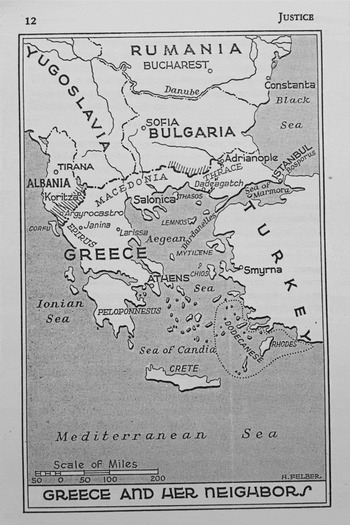
To remind the Allies of Bulgaria's Axis affiliation, Greek politicians began a well-coordinated international campaign that built heavily on national(ist) rhetoric. In February 1945 the British Prime Minister Winston Churchill paid a visit to Athens and delivered a speech in front of 20,000 people, followed by the Greek regent Archbishop Damaskinos whose oration led to exclamations from the crowd of ‘To Sofia! In arms! Great Greece!’. When the regent visited Salonica later that month, his speech stressed that Greece should be rewarded for its contribution to the Allied victory while Bulgaria punished as an Axis ally; these words produced exclamations: ‘we want Greek occupation of Bulgaria!’ and ‘We want borders beyond the Struma River!’. Over the following months anti-Bulgarian rallies occurred in Athens, Salonica, Florina/Lerin and Drama, requesting a new frontier to the Balkan Mountains and disseminating maps that included in Greece large portions of the Bulgarian Black Sea coast.Footnote 29 The newly founded Committee of the Unredeemed Northern Greeks organised public lectures, published articles in major newspapers and composed petitions explaining the necessity of the border revision.Footnote 30 Overseas organisations, such as the Greek War Relief Association and the Justice for Greece Committee in the United States, rallied support through the dissemination of posters and memoranda claiming: ‘no Greek could be free . . . given the constant thread of invasion [from the north].’Footnote 31 (See Figure 1.) As the war was drawing to a close nationalism remained an effective mobilising tool.
Map of Greece and her neighbors, marking the three areas of Greek territorial claims in Northern Epirus (Albania), the Dodecanese Islands (Italy) and Thrace (along the Bulgarian-Greek border). All three cases were argued based on historical rights and security concerns.

Greek territorial demands vis-à-vis Bulgaria sought ‘the greatest possible strategic security’ by incorporating all mountain heights in Greek territory.Footnote 32 The current border followed the natural watershed and could become the ‘basis of [Bulgarian] aggression’.Footnote 33 Greece insisted that Bulgaria had used the vulnerability of the border to attack Greece thrice, in 1913, 1916 and 1941. The interwar use of historical arguments thus re-emerged as the best strategy for advancing the interests of the Greek nation. But Greek politicians also contested Bulgarian attempts to recast the most recent military conflict, chastising the political change in Bulgaria following the Fatherland Front's accession to power as a ‘diversion’ from Bulgarian responsibility for the war. By contrast, they continued to emphasise Bulgaria's role as an Axis ally.Footnote 34 Greek propaganda also sought to undermine Bulgarian claims over Western Thrace by pointing to the importance of the area for the overall geopolitical situation in the eastern Mediterranean, a key British concern, and stressing the danger of a Bulgarian outlet to the Aegean.Footnote 35 Greek diplomats astutely took advantage of the political divisions between the Big Three by playing off Western concerns about the left-wing political changes in the Balkans.
The official position taken by Greece was in stark contrast to the opinion of the Greek Communist Party, which considered the territorial demands as an attempt to ‘divert the people's attention from urgent internal issues’. General Secretary Nikos Zachariadis blamed the territorial claims on ‘Greek chauvinists and their imperialist patron’ and, by contrast, proclaimed, ‘we do not want a fistful of foreign land, but we will not surrender a fistful of ours either’.Footnote 36 This difference of opinions is striking on the eve of the Greek civil war.
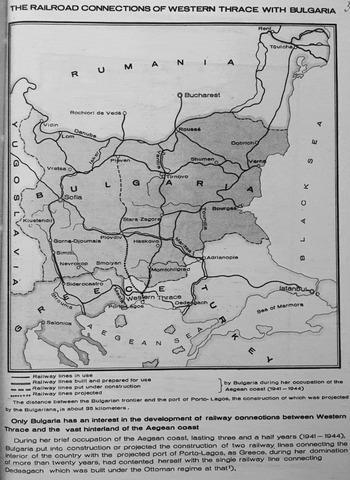
In Bulgaria, the government of Georgiev countered Greek claims by using economic arguments. Bulgarian Foreign Minister Petko Staĭnov accused Greece of wanting to annex the tobacco-rich Arda Valley; in his Marxist interpretation, the newly proposed border was ‘not a strategic but a tobacco frontier’ that would transform Bulgaria into a ‘beggar country’.Footnote 37 From the Bulgarian perspective, the Greek territorial demands possessed ‘more offensive than defensive’ objectives, aimed at destabilising security in areas with ‘purely Bulgarian population’, and served ‘Greek goals of further territorial expansion’ that would deliver ‘a fatal blow on Bulgarian economy’.Footnote 38 Based on economic considerations, the only fair border change involved the cession of Western Thrace, a province of ‘vital necessity’ to Bulgaria that was ‘not essential’ to Greece, which would facilitate economic recovery in the entire Balkans.Footnote 39 (See Figure 2.) Bulgarian communists suggested that ‘only good relations and the free exchange and mutual exploitation of the natural resources of the two countries’ would overcome the current border deficiencies.Footnote 40
Map of the existing and planned railroad connections between Western Thrace and Bulgaria, used to advance Bulgarian claims vis-à-vis the area, based on economic arguments that emphasized that marginal economic significance of the region for Greece.

But Bulgarian politicians also hastened to emphasise that under new leadership their country had taken decisive steps to abandon past political mistakes. According to one Bulgarian representative, while ‘the ruling circles in the neighbouring kingdom have remained committed to prewar ideas’ and ‘old platitudes of hatred and self-destruction’, ‘New Bulgaria . . . aspires to live in complete and sincere cooperation with its neighbours’.Footnote 41 The Bulgarian head of parliament, Vasil Kolarov, similarly maintained that ‘New Bulgaria found a common language with New Yugoslavia and New Romania, and these three states solved or are on the way of solving peacefully their disputes. . . . [New Bulgaria] is convinced that it will find a common language with [the Greek people] notwithstanding the efforts of Greek reactionaries and jingoists’.Footnote 42 Instead of national arguments, Bulgarian leaders focused on economic and political justifications to demonstrate that they had abandoned the nationalism of old elites. With the political change in 1944, the national incorporation of Thrace remained a firm commitment of the left-leaning government, but the BCP argued this national goal in new political and economic terms.
The Yugoslav–Bulgarian Alliance
The controversies between Bulgaria and Greece were in sharp contrast to the widely showcased ‘brotherhood, comradeship, and cooperation’ between Bulgaria and Yugoslavia following the post-war success of the communists in both countries. This difference is striking given the similar historical trajectory of the long-term territorial disputes between the two states; Serbia had acquired significant parts of Macedonia in 1913 and then again in 1919, and Bulgaria's ‘return’ of Yugoslav (Vardar) Macedonia was one of the main reasons for the country's entry into the Second World War.Footnote 43 Yet, the new communist leaders of both countries radically changed the tone of the debates.
In early October 1944 a Bulgarian delegation visiting Belgrade to discuss an agreement for military alliance against Germany conveyed the desire of ‘the Bulgarian people’ to correct the injustices that ‘fascist’ politicians had inflicted on Yugoslavia during the war. The two parties agreed that all questions between the two countries should be solved in the spirit of ‘friendly cooperation’ and ‘mutual interest’. To confirm their departure from the policies of the past, Bulgarian leaders declared: ‘our chief enemy is Great Bulgarian chauvinism [velikobâlgarski shovinisâm]’. As early as December 1944 the two countries initiated discussions on a treaty for mutual help and cooperation, which proceeded in an ‘exceptionally favourable atmosphere’.Footnote 44 Only a few months earlier Bulgaria still had occupation troops in (Yugoslav) Vardar Macedonia. But while this restoration of mutual relations was framed in the rhetoric of ‘people's will’, it was clearly high-profile leaders in both countries, and their communist affiliations, that determined the spectacular political change.
Despite political will at the highest level, differences nevertheless emerged over the newly proposed idea of a Balkan Federation.Footnote 45 Josip Broz Tito, the Yugoslav leader, wanted to create a federation between Bulgaria and Yugoslavia based on the principles of ‘pan-Slavism’ and ‘proletarian internationalism’, hoping to resolve the contentious issue of Macedonia while also boosting Yugoslav prestige. The two countries were already discussing the issue in October 1944, but in January 1945, after Georgi Dimitrov, the Bulgarian communist, wartime Comintern leader, and close associate of Josef Stalin, consulted with ‘our big friend’ in Moscow, the Bulgarians started expressing misgivings. Dimitrov was concerned that Yugoslavia was showing ‘tendencies of absorption’ because Tito wished to create a Yugoslav-centred Balkan Federation with Bulgaria appended as a Yugoslav republic. Instead, Dimitrov, in consultations with Stalin, envisioned ‘the possibility of a dual federalist state of Yugoslavia and Bulgaria sharing equal rights’. Dimitrov thus proposed to Tito the alternative of a ‘dual allied (federal) state on equal principles’. Stalin interpreted the Balkan Federation as a development with ‘enormous consequences not only in the Balkans but the entire Europe’, and the three communist leaders were trying to convince Britain and the United States to support the idea.Footnote 46 The Western powers, however, opposed the proposal at the Yalta conference of February 1945. In March Bulgarian and Yugoslav leaders abandoned the project of a federation until after a peace treaty had been signed and focused on establishing a framework of mutual relations instead.Footnote 47
The proposed alliance with Bulgaria seemed to divide the leadings members of the Communist Party of Yugoslavia (CPY). In March 1945 Politburo members and close wartime associated of Tito's, Milovan Đilas and Edvard Kardelj, declared that Yugoslavia was not interested in an alliance, while another key figure in post-war Yugoslavia, Moša Pijade (who would become the Yugoslav delegate at the Paris Peace Conference), considered a potential agreement as a strategy ‘to impress the masses’. Even Tito declared that he was ‘somewhat pessimistic’ about the possibility for an alliance and ‘bitter’ that he had not managed to offer to the Yugoslav people the ‘political asset’ of a federation.Footnote 48 When in early April 1945 Tito visited Moscow to meet with Stalin and also talked to Dimitrov, the Bulgarian and Yugoslav leaders confirmed that they wanted to reach a political agreement. But Dimitrov was becoming increasingly sceptical, remarking that the Bulgarian position had to be ‘extremely friendly but also firmly principled and wholly honourable’. Both Dimitrov and Tito were proceeding carefully; for the time being the two leaders agreed on the resumption of diplomatic relations between the two countries.Footnote 49 Bulgarian and Yugoslav communists cleverly appropriated the language of the nation and employed the possibility of a federation to boost their legitimacy domestically and explore new options for political cooperation internationally.Footnote 50
Bulgarian relations with the People's Republic of Macedonia (PRM) were particularly strained. Since 1941 the Yugoslav Partisans had proposed the unification of all parts of Macedonia in a socialist republic within the Yugoslav federation. When the republic was established in late 1944 Yugoslav communists promoted the idea that PRM would incorporate all ethnic Macedonians, including those in (Bulgarian) Pirin Macedonia (The inclusion of Greek Macedonia was no longer feasible after the Percentage Agreement in October 1944). In November 1944 Dimitrov informed his Yugoslav comrades that in Blagoevgrad, the capital of Pirin Macedonia, the local Communist Party organisation was designated as Macedonian, rather than Bulgarian.Footnote 51 As good communists, both Tito and Dimitrov opposed ‘Great Serbian and Great Bulgarian chauvinistic moods’.
But tensions appeared between Macedonian and Bulgarian communists, showing that political decisions at the highest level could not overcome national(ist) loyalties cultivated locally for decades. The leaders of the Macedonian Communist Party (MCP) wanted to see the immediate incorporation of Pirin Macedonia (Petrich region) into the PRM. In contrast, Bulgaria recognised ‘the right of the Macedonian people to unite in its own country’ but insisted that the Petrich region would remain in Bulgaria until a Balkan Federation was finalised. Instead, Bulgaria promised to publicise in Pirin Macedonia the objectives of the PRM, publish a Macedonian-language newspaper, allow a Macedonian-language radio programme, encourage Macedonian émigrés to return and provide financial help to the PRM.Footnote 52 Despite opposition from BCP leaders (particularly Traĭcho Kostov), in July 1946, on the eve of the peace treaty talks, Dimitrov, with Stalin's endorsement, confirmed that Pirin Macedonia would become part of PRM once the Balkan Federation was created.Footnote 53 This decision was never implemented and was decisively abandoned following the Yugoslav–Soviet split of 1948, but it would cause many difficulties in the long-term relations between Bulgaria and Yugoslavia during the rest of the Cold War and beyond.Footnote 54
Tensions over Macedonia notwithstanding, by summer 1945 Bulgaria and Yugoslavia had agreed to start negotiations for the preliminary settlement of all financial issues. The two countries had to show a ‘united position’ at a future peace conference, which was ‘the first step toward . . . facilitating agreement among all Balkan peoples’. In September 1945 the two countries agreed to conclude a treaty of alliance, accompanied by trade and cultural conventions, to promote political independence and economic development in the Balkans.Footnote 55 In February 1946 Bulgaria and Yugoslavia officially declared the resolution of all outstanding issues. What made reconciliation possible were, first, ‘the new political framework’ of their relations, and, second, ‘the strong brotherly relations resulting from the mutual struggle . . . against Germany’.Footnote 56 Communist visions helped overcome past national(ist) misgivings, so Bulgarian and Yugoslav leaders proclaimed their ‘mutual desire to eliminate everything that hinders a future rapprochement between New Yugoslavia and New Bulgaria’.Footnote 57 While the question of a Balkan Federation remained to be discussed, the two countries had put past demands behind them, and by mid-1945 their leaders agreed to forge a unified political agenda in anticipation of the peace treaty negotiations.
Geopolitics
In addition to the national dimensions of the debates about Balkan borders, the new post-war political situation in Europe after 1945 and the emerging ideological divisions among the Big Three determined the evolution of Balkan border controversies. The evidence presented here confirms that, over the course of time, the Anglo-Americans gradually stopped pushing back against Soviet demands in the area. Specifically, the need to finalise the peace treaties and commence post-war reconstruction in Europe determined the compromises that the United States and Britain were ready to make vis-à-vis Bulgaria under Soviet insistence.Footnote 58 These debates thus had larger geopolitical implications linked to international developments in early Cold War Europe.
At the Yalta Conference in February 1945, Stalin, Churchill and the US president, Franklin D. Roosevelt, agreed to ‘the earliest possible establishment through free elections of governments responsive to the will of the people’ in Eastern Europe, including Bulgaria. This stipulation was important to Britain and the United States because in early 1945 the Bulgarian communists were starting to tighten control over the country through their domination over the Fatherland Front by purging rival political formations from it. The Yalta meeting also raised, and agreed to settle in future discussions, the issues of Bulgarian reparations, its territorial controversy with Greece and the possibility for a Yugoslav–Bulgarian alliance; the Big Three declined to discuss the issue of a Balkan Federation. The resolution of all these questions, however, was contingent upon the holding of free elections.Footnote 59
The Potsdam Conference from 17 July to 2 August 1945, while focused on Germany and Poland, also saw a confrontation between the Big Three in regards to Bulgaria. The British firmly opposed Bulgarian requests for a territorial outlet to the Aegean, something that would have undermined British plans in the eastern Mediterranean. All parties agreed that the Greek demands for expansion in Bulgaria served as a tactical measure against Bulgarian aspirations in Thrace. In keeping with the Yalta decisions, Churchill and the new US president Harry Truman proposed free elections be held in Bulgaria, Romania and Greece under Allied control. When Stalin insisted that Bulgaria was a democratic country fully compliant with the Yalta accords, Truman produced a letter from the Bulgarian opposition leader, Agrarian National Union chief Nikola Petkov, which ‘had a bomb-like effect’ because it disputed this claim. As a compromise, the Big Three decided to expedite the signing of a peace treaty with Bulgaria while continuing talks about elections.Footnote 60
The American and British insistence on free elections was the most important stumbling block. After Potsdam Dimitrov worried that elections under Allied control meant that ‘subversive agents’ supporting the opposition would circulate in the country.Footnote 61 The Soviet Foreign Minister Andrey Vyshinsky reassured him that, despite British and American allegations of dictatorial tendencies within the entire region, ‘they understand that Eastern Europe is lost for their influence’.Footnote 62 During the first meeting of the Council of Foreign Ministers (CFM), convened in London from 11 September to 2 October 1945 to prepare the framework of the peace treaty negotiations, the Soviet delegation voiced its disappointment with the British and US reluctance to recognise the Bulgarian government.Footnote 63 In November 1945 elections were held in Bulgaria; even though the opposition boycotted them, the Soviet Union restored diplomatic relations with Bulgaria to show its satisfaction with developments in the country.Footnote 64
Despite evidence that the November elections were rigged, Britain and the United States appeared willing to compromise. On 24 December 1945 the three foreign ministers, James Byrnes, Ernest Bevin and Vyacheslav Molotov, met at an interim meeting in Moscow and announced their agreement a special conference to discuss the peace treaties with all former Axis allies, but included ‘friendly advice’ to Bulgaria regarding the inclusion of two opposition members in the Fatherland Front government.Footnote 65 In early 1946 the Bulgarian government was yet to appoint opposition leaders as under-secretaries in the Ministry of the Interior, as advised in Moscow. The United States and Britain voiced concern over the situation in Bulgaria but proceeded with the planning for the peace treaty conference.Footnote 66 During the second meeting of the CFM in Paris from 25 April to 16 May 1946, discussions regarding Bulgaria were brief and focused on reparations.Footnote 67 The two Western allies's priority was to speed up signing the peace treaties and to begin the reconstruction of Europe.Footnote 68
The Paris Peace Conference
The Paris Peace Conference was held from 29 July to 15 October 1946 to finalise the treaties with Romania, Bulgaria, Hungary, Italy and Finland.Footnote 69 As agreed in Moscow, the draft peace treaty with Bulgaria was drawn up by the Foreign Ministers of the Soviet Union, the United States and Britain.Footnote 70 In Paris, the Commission on Procedure determined the process of debating the draft treaties for all five states. Disputed provisions were presented for discussion to relevant commissions; in addition to the Military and Economic Commissions, five Political-Territorial Commissions handled the frontier disputes related to each state. The Political and Territorial Commission for Bulgaria was charged with the territorial dispute between Greece and Bulgaria. The Greek demands via-a-vis Albania were debated in the Political and Territorial Commission for Italy.Footnote 71
Throughout the conference, the newly emerged ideological and political (dis)agreements among the Balkan countries informed the spirit of the discussions. On the eve of the Paris Peace Conference, the Greek Prime Minister Konstantinos Tsaldaris had declared: ‘we cannot talk about security if the [Bulgarian–Greek] border remains the same’.Footnote 72 In Paris, the Greek delegation insisted that, during its occupation of Greece in 1941–4, Bulgaria had designed ‘a systematic plan for the wholesome extermination of the Greek population . . . to denationalise those predominantly Greek regions’. Greece maintained that ‘Bulgarian invasion would always be a menace to Greece’ because ‘the Bulgarian people, owing to ingrained psychological causes, are ever prone to aggression and violence’. During the discussions at the Political and Territorial Commission for Bulgaria, the Greek representatives requested ‘rectification of the frontier’ in Bulgarian territory to bring to the country ‘a feeling of security’. In the Greek opinion, this territorial change was urgent given discussions between Bulgaria and Yugoslavia for a Balkan Federation.Footnote 73 By contrast to such harsh territorial claims vis-à-vis Bulgaria, urged by Britain and the United States, Greek representatives scaled down their demands from Italy at the meetings of the Political and Territorial Commission for Italy.Footnote 74 With the looming Greek civil war in 1946, ideological commitment coincided with national interest because the royalist Greek government relied heavily on Western support to keep the communists in check.
The Bulgarian delegation at the Political and Territorial Commission for Bulgaria countered the Greek demand for border revision by maintaining that the current border, outlined in 1919 when Bulgaria was defeated, had ‘strategic advantages of offensive character’ for Greece. Bulgaria castigated Greek nationalism and highlighted the new political realities in the Balkans, explaining that ‘New Bulgaria and New Yugoslavia have freed themselves from the national policy of extreme jingoism . . . [but] this is not the case on the other side of the Rhodope Mountains’. The reduction of the Bulgarian armed forces, the lack of Greek population in the requested areas and the economic value of the region only betrayed Greek intension to ‘stifle Bulgaria economically’. Bulgaria accepted responsibility for its role in the war and called the occupation of Greece and Yugoslavia ‘criminal lunacy . . . tantamount to stabbing a kindred people in the back’ but denied accusations of crimes against the Greek population. Instead, the Bulgarian delegation presented its case for Western Thrace claiming that the Aegean Sea constituted ‘an integral part of [Bulgaria's] geographical and economic zone’ whereas it had always been peripheral to Greece. In an attempt to publicise the new, communist inspired interpretation of the Second World War, the Bulgarian representatives reminded the delegates of ‘the vast resistance movement’ against Germany and repeated that no Bulgarian troops had ever fought against the Allies. Most importantly, ‘for Bulgaria, what might be called the real war . . . began in . . . 1944’.Footnote 75 For that reason the Bulgarian delegates at the Political and Territorial Commission vehemently insisted that their country should not be treated as Romania, Hungary, Finland or Italy, but, having suffered 32,000 military casualties after 1944, it should be recognised as a cobelligerent state.Footnote 76 This view of the Second World War would remain the basis of official Bulgarian interpretations of the conflict throughout the communist period.Footnote 77
Newly reconstituted Yugoslavia demanded Istria and coastal Slovenia from Italy and Austria but had no claims on Bulgaria or Albania.Footnote 78 Prior to the Paris talks Bulgaria and Yugoslavia had agreed to conduct preliminary consultations between the two delegations concerning all mutual questions.Footnote 79 Yet, tensions emerged over the newly forged Bulgarian interpretation of the Second World War, after the Bulgarian Foreign Minister Georgi Kulishev declared in Paris that Bulgaria had not waged a war against Yugoslavia or Greece between 1941 and 1944 but only against Germany after 1944.Footnote 80 Still, Yugoslavia unambiguously supported Bulgaria at the meetings of the Political and Territorial Commission for Bulgaria; the head of the Yugoslav delegation, Moša Pijade, corroborated the Bulgarian view that during the war its ‘fascist authorities’ were unable to secure compliance with Nazi military plans while the Bulgarian people heroically fought together with their Yugoslav comrades to defeat the Germans after 1944. By contrast, Pijade characterised the Greek demands from Bulgaria as ‘unclear, strategically unfounded, and ultimately imperialistic’.Footnote 81 For Yugoslavia, the causes of pan-Slavism and proletarian internationalism – together with the possibility of a Balkan Federation – redefined the scope of its national interests in the Balkans.
The disagreement between Yugoslavia and Greece developed into a full-blown confrontation over Albania. As a part of its visions for a new northern frontier, in Paris Greece also demanded the incorporation of southern Albania (Northern Epirus) on the grounds of Albanian collaboration with Italy. Yet, during the initial discussions in the Commission on Procedure, Yugoslavia proposed that Albania be invited to participate at the Paris talks. Next, the Yugoslav delegate Pijade presented the undocumented assertion that the Greek Prime Minister Tsaldaris had approached him with a proposal to split up Albania between Greece and Yugoslavia. In response, Tsaldaris accused the Yugoslav delegate of deception and called his claims ‘phantasmagorical’. But thanks to the Yugoslav intervention, Albania was invited to present its case in the Political and Territorial Commission for Italy.Footnote 82 On 31 August, during dicusssions in that commission, Pijade declared that his country would defend Albania should any other state impinge upon its territorial integrity. The British representative tried to defend the Greek position, but the Greek delegate left the session to protest the insinuation that his country had unjust territorial claims on Albania. Ultimately, the Political and Territorial Commission for Italy rejected Greek demands for the incorporation of Northern Epirus.Footnote 83 For Yugoslavia, its diplomatic intervention on behalf of Albania was a step toward securing Albanian participation in the eventual Balkan Federation.
As far as the Bulgarian–Greek frontier was concerned, the final debates in the Political and Territorial Commission for Bulgaria reflected the newly emerged political divisions in the Balkans. Greece proposed a change in the Greek–Bulgarian frontier that would follow the line of the Pirin and Rhodope Mountains and assign the Arda Valley to Greece.Footnote 84 Yugoslavia countered that the current Bulgarian–Greek frontier, first outlined in 1913, was ‘completely just’.Footnote 85 The Soviet Union defended Bulgaria as a ‘democratic country’ that had rejected the crimes of pre-war ‘fascist’ cliques and contributed to the German defeat.Footnote 86 The United States, while ‘not impressed with Bulgarian arguments of commitment to democratic government’ and considering Greece a ‘valiant ally’, nevertheless remained ‘unconvinced that a change in the Greek–Bulgarian frontier would contribute to the general cause of peace and understanding in Southeast Europe’. Britain went along with the preservation of existing frontiers, even though it insisted that Greece was ‘fully justified in claiming full guarantees for strategic security of her frontiers’.Footnote 87 On 3 October 1946 the Greek proposal for a new ‘strategic frontier’ was rejected by eight votes (Australia, Belarus, Czechoslovakia, France, the Soviet Union, Ukraine, the United States and Yugoslavia) to two (Greece and South Africa) with three abstentions (Britain, New Zealand and India).Footnote 88 Prime Minister Tsaldaris bitterly concluded that, while Axis ally Bulgaria had emerged from the war retaining Southern Dobrudja, Allied Greece had been denied the opportunity to ‘regain security and peace behind the shelter of a defensible frontier’.Footnote 89 In the end, unlike the Paris Peace settlement of 1919–20 that punished all Central Power allies, considerations related to the reconstruction of Europe and the emerging Cold War determined the relatively mild attitude vis-à-vis some Axis allies, such as Bulgaria.
Peace Treaties and Free Elections
The developments in Paris had important consequences for the domestic situation in Bulgaria. As the international community finalised the peace treaties, the Bulgarian communists continued to consolidate their power at home. During the Paris talks, on 30 August 1946 US Secretary of State Byrnes warned the Bulgarian Foreign Minister Kulishev that, given the political persecutions in the country, he could not sign the peace treaty or ask the US Senate to ratify it because ‘Bulgaria [wa]s in a state of full communization’. Byrnes then renewed proposals that opposition leaders – the Agrarian Nikola Petkov, the Social Democrat Kosta Lulchev as well as Regent Ganev – be invited for consultations in Paris. That same day, a visibly concerned Kulishev talked to Molotov, who reassured him that ‘of course you should decide your internal affairs as a sovereign state’. The Soviet foreign minister expressed confidence that the United States would sign the treaty because it wanted to ‘resolve the issue quickly’ rather than delay peace with Italy. Following these consultations, Kulishev, Kolarov and Dimitrov decided that to satisfy the United States they should secure opposition participation in the upcoming referendum and election.Footnote 90
On 8 September 1946 Bulgarians voted in a referendum which sought to abolish the monarchy and declare a republic. The vote was deliberately timed to coincide with the Paris talks to show the Bulgarian people's desire to distance itself from the old ‘fascist’ circles that had discredited Bulgaria in the war. Next, the country held elections for a constituent assembly to draft a new constitution on 27 October, after the peace treaties had been agreed upon in Paris. The Fatherland Front secured 78 per cent of the vote in the elections and 364 seats in parliament (the opposition had 101), while Dimitrov came back from Moscow and became prime minister. In early 1947 the opposition leader Petkov, encouraged by American and British diplomats, intensified his attacks against the communist dominated Fatherland Front. In the meantime, the Paris Peace Treaties were signed in February 1947, and the United States ratified the Bulgarian treaty on 4 June 1947. Petkov was arrested the following day, on 5 June, and subjected to a show trial in August.Footnote 91 By that point the disagreement between the Big Three at Paris served well BCP attempts to solidify its rule domestically. Bulgaria expressed disappointment at the US and British refusal to recognise the country as cobelligerent and emphasised ‘the sincere gratitude of the Bulgarian people to the Soviet delegation’ during the negotiations in Paris.Footnote 92 On 20 September 1947 the Bulgarian Peace Treaty came into effect. Three day later, on 23 September, Petkov was executed.Footnote 93 Much to the satisfaction of Bulgarian communist leaders and their Soviet supporters, the discussion of peace treaties and free elections ended with Western acceptance of their political control in Bulgaria and the Cold War division of the Balkans.
From the Balkans to East vs. West
At the Paris Peace Conference Bulgaria had the status of an Axis satellite while Yugoslavia and Greece were recognised as cobelligerent Allied countries. It would have been logical to expect that Greece and Yugoslavia would seek partnership as countries with similar experiences and common demands from the defeated countries that had occupied their territories. In July 1945 Prime Minister Dimitrios Voulgaris stated that ‘the Greek people have always felt strong bonds of unalienable friendship with the Yugoslav people’, but the two countries failed to synchronise their interests in Paris.Footnote 94 The new communist leadership of Yugoslavia acted as a guardian of the pro-Soviet ‘people's republics’ emerging in Romania, Bulgaria and Albania against pro-Western ‘democratic’ Greece under British military control. The emerging Cold War split undermined the importance of traditional alliances and determined the confrontation between the two cobelligerents in Paris.
More than just the signing of peace treaties, the solving of territorial disputes and the acceptance of the political status quo in the Balkans occurred between 1944 and 1947. In those three momentous years a mental shift transformed much of the Balkans, already marginalised in the mind of the European powers, into ‘Eastern Europe’, a place Western governments would assign to oblivion during the Cold War.Footnote 95 In the Iron Curtain speech from 5 March 1946 the now former British Prime Minister Churchill had already indicated a distinction between Eastern Europe and Greece; he had warned of the ‘increasing measure of control from Moscow’ in the Eastern European states, while pointing out that, ‘Athens alone – Greece with its immortal glories – is free to decide its future’.Footnote 96 If the histories of Bulgaria, Yugoslavia and Greece had been inextricably linked from the Ottoman to the independence periods, in 1944 their historical destinies departed. With the announcement of the Truman Doctrine on 12 March 1947 the Western belief crystallised that ‘assistance is imperative if Greece is to survive as a free nation’, in contrast to ‘a number of countries of the world [that] have recently had totalitarian regimes forced upon them against their will’ (Poland, Romania and Bulgaria used as examples). The Truman administration spoke of two ‘alternative ways of life’, one involving ‘free institutions, representative government, free elections, guarantees of individual liberty, freedom of speech and religion, and freedom from political oppression’, the other serving as an example for ‘terror and oppression, a controlled press and radio, fixed elections, and the suppression of personal freedoms’.Footnote 97 According to this straightforward Cold War political thinking, Greece had become firmly aligned with the ‘free’ West while Bulgaria, Yugoslavia, Romania and Albania were assigned to the ‘totalitarian’ East.Footnote 98
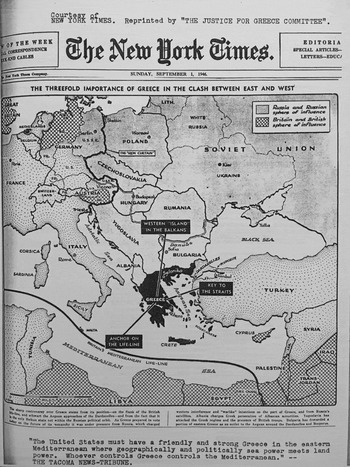
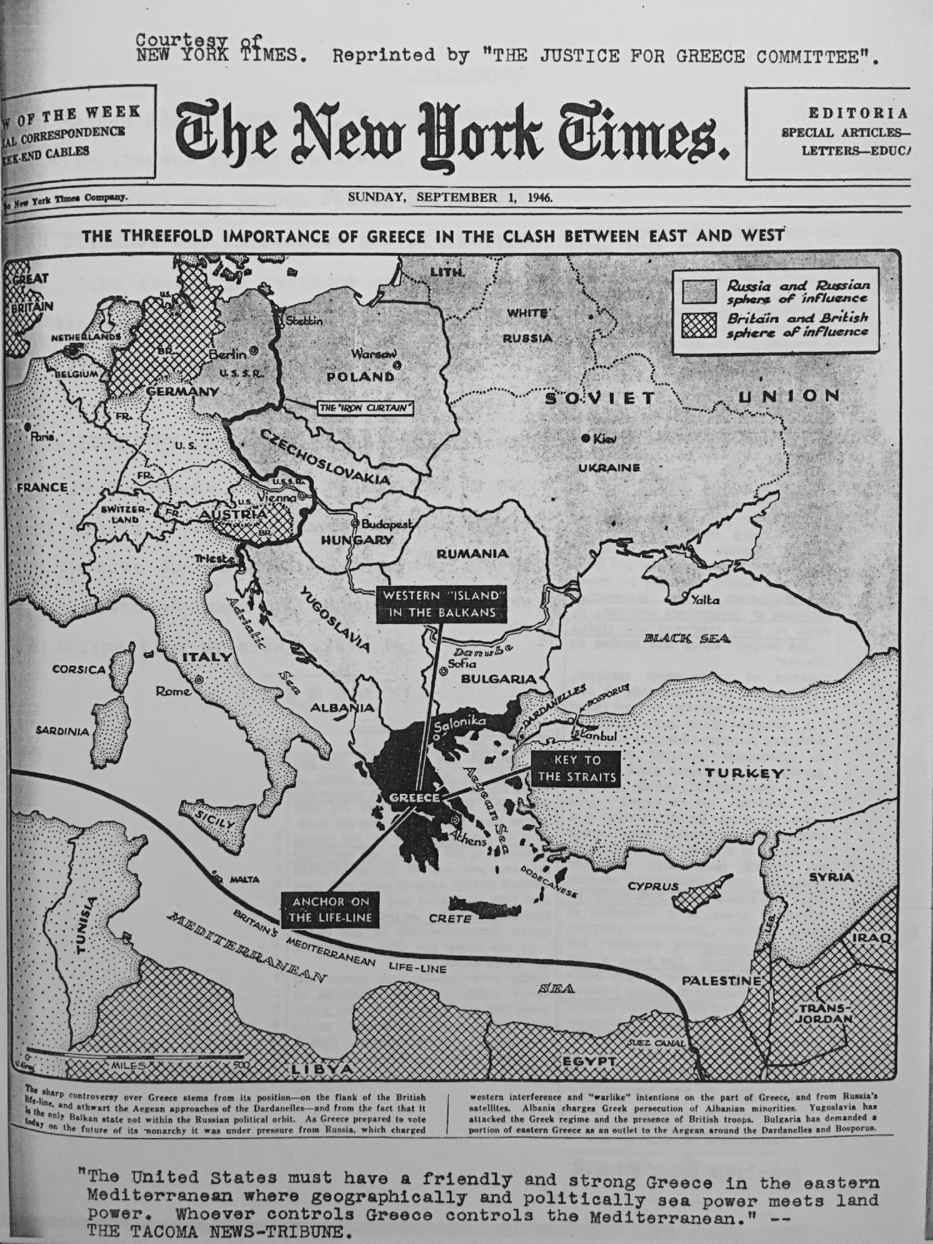
As local dynamics confirm, shortly after the Paris negotiations closed the Cold War engulfed the Balkans. If the initial debates among Bulgaria, Greece and Yugoslavia were about ‘strategic frontiers’, by 1947 the three countries were in a situation of active ‘strategic positioning’ between ‘alternative ways of life’. In early 1947 Greece officially accused Bulgaria, Albania and Yugoslavia of instigating civil war and supporting the communist insurgency in her northern areas.Footnote 99 Bulgaria called the allegations ‘false and unrestrained Greek provocation’ and ‘contrived chauvinist propaganda’ of ‘reactionary’ politicians who sought distraction from the ‘cruel internal civil war . . . in which thousands of truly heroic, patriotic and democratic sons of our neighbour perish’.Footnote 100 Bulgaria and Greece did not resume diplomatic relations until 1964.Footnote 101 Similarly, soon after the Paris talks Greece and Yugoslavia exchanged a number of harshly worded declarations related to border incidents, spies, refugees and abducted children, which brought the two to a situation of ‘undeclared war’. Only after 1949, following the Yugoslav–Soviet split of 1948 and the end of the Greek civil war, did the two countries start normalising relations.Footnote 102 But in 1947, months after the peace treaty negotiations in Paris, the relations between the three countries had escalated into a full-blown political showdown over the legitimacy of the political transformations in the area. Delineating the new frontiers was only the first step in declaring political orientation between ‘East’ and ‘West’ in the Balkans. (See Figure 3.)
‘The Threefold Importance of Greece in the Clash Between East and West’, New York Times, 1 Sept. 1946.
The concept of ‘strategic frontiers’, originally advanced by Greece, had more than one meaning in the contentious debates about the future of the Balkans after the Second World War. At a very basic level, the conversations engaged contested territorial claims and issues of border security, demonstrating that anxieties about the nation dominated the immediate post-war period. The matter of borders, however, also influenced economic debates on reparations, economic reconstruction and control over outlets to the Aegean and Adriatic. Finally, the talks also became an arena for exchanging competing visions on ‘democracy’ and ‘free elections’ (in the Western concept) versus ‘people's republics’ and ‘popular will’ (in the Soviet concept). While starting from the issue of ‘borders’, Bulgaria, Greece, Yugoslavia and their supporters in the Big Three engaged in a complex balancing act of forging the peace, through painful compromise over national issues and determining the political makeup of the new governments in charge of the post-war Balkan states. By 1947 each Balkan state had also ‘strategically positioned’ itself in the Cold War divide of Europe.