1. Spontaneous Symmetry Breaking
Even though spontaneous symmetry breaking (SSB) as a technical concept first gained its currency in the studies of superconductivity, superfluidity, and quantum fields (Coleman Reference Coleman and Zichichi1975), it is now recognized that the phenomena it refers to are quite common in physics. Many classical systems also exhibit SSBs; the better known of which include Euler's rod, which buckles in an arbitrary direction when the vertical load on it crosses a threshold weight, and Poincaré's rotating “nebula” in self-gravitating equilibrium, which separates into a two-body system when a critical value of its angular velocity is passed. There are even simpler classical systems whose SSBs can be studied thoroughly with no more than high-school mathematics. Elsewhere (Liu Reference Liu2003), I have given a detailed study of a simple mechanical model (the ring-bead model), from which the metaphysical nature of classical SSB is laid bare. I now give in this section a sketch of the same model with enough details for the main tasks of this essay: the senses of SSB and the connection between SSB and deterministic chance.
To those who are skeptical about the scope and significance of such a simple mechanical model for the study of SSB in physics, let us hope the following brief remarks suffice. Indeed, not only does SSB occur in radically different systems, mainly in condensed-matter physics and high-energy physics, but there are also different types of SSB: the symmetries that may be spontaneously broken are either external (i.e. spatial and/or temporal) or internal symmetries, and for each, either global or local symmetries, and again for each, either discrete or continuous; and the symmetries may be applied to a classical or a quantum system; and the systems in which SSBs occur may be of finite or infinite dimension and/or number of degrees of freedom. What our simple model harbors is a spontaneous breaking of either a global external discrete symmetry or—by a simple extension of the model—a global external continuous symmetry in a finite classical system. For various rather obvious reasons that I will not enumerate here, a comprehensive treatment of all the varieties of SSB in this short essay is not feasible; a division of labor is thus inevitable: the quantum SSBs—the more recondite ones—will have to be studied separately from classical SSBs; and what else could be better than starting from a simple and typical classical model? I doubt anyone would say that a study of classical SSB is irrelevant to our general understanding of SSB (could a study of classical physics be irrelevant to our understanding of physics in general)? And if one doubts that there is anything philosophically interesting about classical SSB, then let the rest of this essay show how wrong s/he is.
That said, let me give a sketch of the model (Greenberger Reference Greenberger1978; Sivardiere Reference Sivardiere1983).Footnote 1
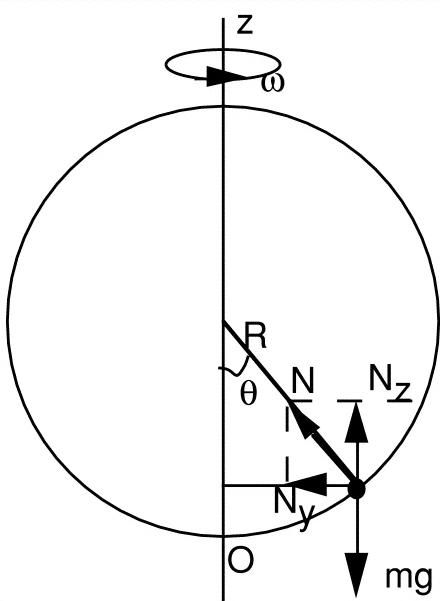
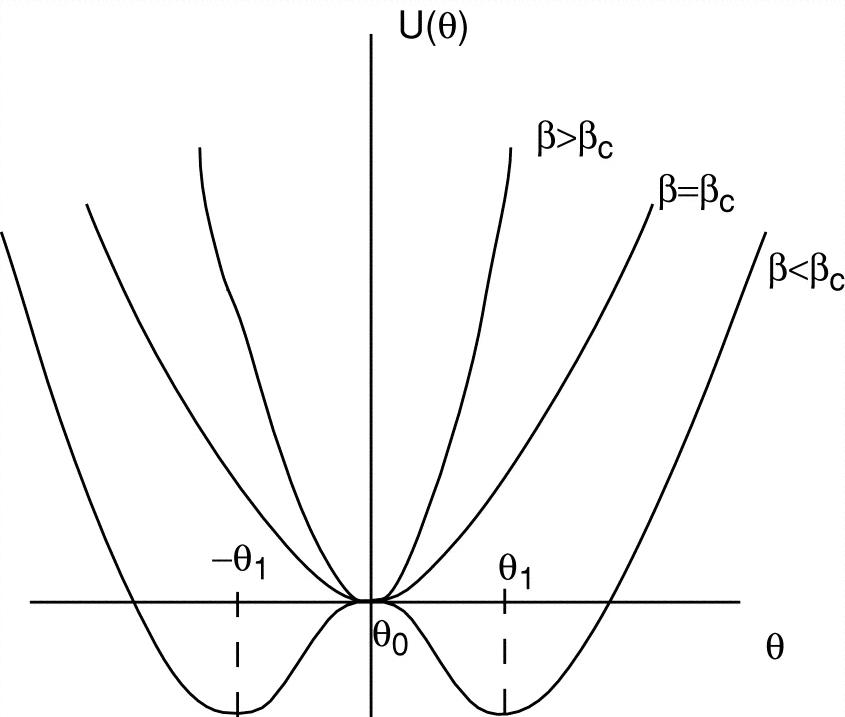
The model comprises a metal ring vertically suspended and free to rotate (without friction) and a bead frictionlessly threaded on it (see Figure 1). Imagine that we set the ring into rotation and very slowly (i.e. at equilibrium every step of the way) increase its angular velocity ω. A complete story of the system's mechanical behavior can be told in classical mechanics. At first when ω is low, the ground state of the system—the state at which the bead has the lowest energy—is the one with the bead resting at the lowest point of the ring (i.e. at O or θ = 0). This situation remains until ω passes a certain value—henceforth the “critical value”—when O stops being the ground state of the system. Instead, the ground state begins to “split” and “climb” the ring as ω continues to increase. From Figure 1 it means that the bead will be in its ground state at successive values of θ or −θ, where |θ| ≠ 0, with corresponding values of ω. The position of the bead's ground state will become higher and higher on the ring (i.e. the angle θ will become larger and larger as ω increases, and it approaches 90° (or −90°) when ω approaches infinity) (see Figure 2).
A bead with mass, m ≠ 0, is free to move frictionlessly on a circular wire of radius, R, which rotates around the z-axis with variable ω.

The dimensionless potential, ∪(θ), against θ. Note, β = ω 2R/g and β c = ω 12R/g = 1.

Therefore, the bead, originally resting at O, will, in seeking the new ground state, depart from O and ascend one or the other side of the ring; and because this rotating system initially possesses the reflectional symmetry between the two sides of the ring with respect to the z-axis (to an observer who is co-moving with the ringFootnote 2), this symmetry is said to be broken by its ground states after ω passes its critical value (Wigner Reference Wigner1979, pp. 3–50). The symmetry appears to be spontaneously broken because there are no apparent causes (asymmetries) in the model that are responsible for the breaking. The results can be easily transplanted to a similar model that spontaneously breaks a continuous symmetry of rotation (Liu Reference Liu2002; see also the case of Poincaré's top in Section 4 below).
2. The Two Senses of SSB
Are the symmetries truly broken spontaneously in SSB—i.e. without any causes in the form of asymmetrical antecedents? The answer is no, for if one thinks that the bead will inevitably climb the ring from O in our simple model—exactly as it is described—then one is mistaken. If there were a physical system in reality that was exactly like our model, we would have no reason to believe that the bead would budge at all however fast the ring rotates. This is because even though the point O is no longer the ground state of the system beyond the critical point, it is still an equilibrium point in the following sense: there is nothing in the mathematical argument which indicates that O is not a state in which the bead will remain forever unless bumped or disturbed, however slightly, toward another state. Therefore, it seems that the actual breaking of a symmetry is only attributable to some impact, external or internal to the system, large or small. In our model, the bead won't actually ascend the ring unless something at O causes it to do so (Reference PoincaréPoincaré 1952, 64–90; Ismael Reference Ismael1997, 179–180).
However, there is a sense of SSB in which the symmetry-breaking is obviously spontaneous (as uncaused). In our model in which no asymmetrical elements are considered, the symmetrical ground state at O is “broken up”—i.e. rendered unstable—when the angular velocity passes the critical value. The bifurcation of the ground state which provides the possibility for a breaking of the symmetry is present without any asymmetrical antecedents. This is connected to the following general feature of SSB. What the initial unique ground state breaks into after the parameter crosses its critical value is always a set of more than one ground state—in our model they are those at θ and −θ —which are degenerate, meaning that they have the same value (e.g. energy) so that any transformation—of the same symmetry they are supposed to have broken—from one state to another within the set does not change the value (see Figure 2). Hence one may say that the ground states together as a set still preserve the symmetry which each breaks.
Therefore, two senses of SSB should be distinguished:
SSB 1 which gives us its formal/mathematical aspect and which is therefore about the possibility of SSB;
and
SSB 2 which gives us its causal/physical aspect—e.g. symmetry-breakings caused by perturbationsFootnote 3—and which is therefore about the actual breakings.
Which of the above should one take for SSB? SSB1 seems right because some of the salient formal features of SSB, as described above, are captured by it: the control parameter, its critical value, the bifurcation (or the spread) of the ground state, etc.; but should one not adopt SSB2 instead? Some may argue that one should not because all SSB means, and could mean, in physics is SSB1.
There indeed seems to be some support in the physics literature on SSB for this view. All those who insist that “spontaneous symmetry-breaking” is a misnomer and a better alternative would be “hidden symmetry” would presumably be taking such a position (Coleman Reference Coleman and Zichichi1975; Aitchison Reference Aitchison1982). For them, no symmetry is broken in these cases; rather the system in question is such that the symmetry of its Lagrangian is different from (usually more general than) the one of its ground states and is thus hidden by the ground states. Or, one may argue that only in SSB1 is the use of ‘spontaneous’ appropriate, because in SSB2 the actual breakings turn out to be caused and therefore can no longer be regarded as spontaneous. Or, most importantly, one may argue that as long as a case satisfies SSB1, it is SSB regardless of how the symmetry is actually broken. There are indeed cases regarded as SSBs in the physics literature in which the systems satisfy SSB1 but the breakings are done not by perturbations but by explicit initial/boundary (i/b) conditions. So it is incorrect to single out perturbations as relevant to the meaning of SSB.
Despite its initial plausibility, this—SSB1 being sufficient for the meaning—is not a defensible position. For a starter, it runs into the following general philosophical problem. To say a symmetry is spontaneously broken just because the system has the potential of breaking it is like saying a person is spontaneously dead whenever he or she has the potential of dying (and therefore, everyone is spontaneously dead). (Remember that the above view says “… regardless of how the symmetry is actually broken.”) Or in general: x is spontaneously φ if x has the potential of being (or becoming) φ, which does not seem an appropriate way of stretching the meaning of “being spontaneously φ.”
However, more specifically from the physics literature, it is clear that ‘SSB’ is used to refer to a physical phenomenon, such as a phase transition, rather than to some theoretical aspect of it; and the phenomenon it refers to does involve the actual breakings of some symmetries. Moreover, many physicists prefer to use instead the term “spontaneously broken symmetry” (Weinberg Reference Weinberg1996), which cannot be understood as only referring to the possibility (but not the actuality) of the symmetry breaking. It seems that the physics literature also contains strong evidence to support the adoption of SSB2.
However, it would not do to simply identify the meaning of SSB with SSB2 either. If one only includes the perturbations as the legitimate causes of SSB, then SSB2 is too restrictive, as mentioned above, for there are SSBs that are caused by non-perturbative influences. If one includes non-perturbative elements, then would one not have to admit all symmetry breakings as SSBs? What then does “spontaneous” refer to in the notion of SSB? Hence, SSB2 may be sufficient for SSB but it is not necessary.
At this point, it seems that SSB1 is necessary but not sufficient for the notion of SSB, while SSB2 is sufficient by not necessary. The real meaning of SSB must lie in an extension of SSB1 in the direction of SSB2. We may start from the following observation. The difference between SSB and other types of symmetry breakings seems to be that in the latter both the possibilities of and the actual breakings are produced (or caused) by the same agent, while in the former they are not. That which produces the possibility of SSB (and also maintains the broken symmetry) is different from that which causes the actual breakings. In our model, the possibility—the bifurcation of the ground state—is caused by the crossing of the critical value of , while an actual breaking is the result of (mostly) perturbations at O. This suggests that a symmetry breaking is an SSB if, and only if, the system in which the symmetry is broken satisfies SSB1 and the causal agent responsible for that breaking does not override whatever creates the possibility of, and maintains, it. For an illustration, let us look at the case of a modified ring-bead model. The model can be modified by either or both of the following conditions:
A: having a device on the right lower quarter of the ring that can catch and hold the bead (a boundary condition)
B: a hammer striking the bead at O to the right at a certain time and imparts to it a speed sufficient to send it to the location of the device even if the ring is stationary (an initial condition)
In one situation, only B is introduced at an greater than its critical value (i.e. the hammer strikes but no device is attached to catch the bead). In this case, we would regard the result as a case of SSB, because even though the hammer's strike is non-perturbative, it does not override the system's potential to have a broken symmetry. In other words, had the ring been rotating below the critical , the symmetry would not have been broken at all. Now, in another situation where both B and A are introduced at an greater than its critical value, we would not regard the result a case of SSB, because whether the system is ready for SSB (i.e. whether it satisfies SSB1) the symmetry will be broken when the device catches the bead. In this case, that which actually breaks the symmetry does override the system's potential to have a broken symmetry.
If the meaning of SSB should refer to actual breakings and the latter are not without asymmetrical antecedents, why should such a symmetry breaking be regarded as spontaneous? Two reasons make up the answer to this question. First, the perturbations—the main contributors to the actual SSBs—are, contrary to other types of asymmetrical antecedents, cannot be theoretically accounted for either as extra terms in a system's Lagrangian (or Hamiltonian) or as i/b conditions. Second, and more importantly, the new ground states of an SSB system always form a set that is closed under the symmetry each of its members breaks and the chance of the system falling into any one of these states, as I will show later, must be equal. (Systems with such features are said to be unstable—an important technical term one usually runs into in the study of chaotic systems (Smith Reference Smith1998); and indeed another way of defining the instability of a system is to say that it is in such a state in which perturbations alone are sufficient to make it leave the state and (practically) never return.) As a consequence, it is not possible to predict either when—i.e. at what instant of time—such a breaking will take place or into which of a set of degenerate ground states the system will fall when an SSB happens. Hence, it does not seem inappropriate to call such a breaking of symmetry spontaneous.
3. Curie's Principle and SSB
One may wonder whether Curie's principle of symmetry—which in slogan form reads: “asymmetry out only if asymmetry in”—holds in SSB? From the previous section it seems that the answer is yes; despite the sense of spontaneity, the breakings are caused by asymmetrical antecedents. However, if the existence of a possibility for symmetry-breaking is already symmetry-breaking enough, i.e. if SSB1 is the meaning of SSB, one may say that Curie's principle is violated. There is, of course, a question of whether Curie's principle even applies to SSB in this case. If one is justified in regarding a theoretical bifurcation (or spread) of a ground state into a set of symmetry-breaking states as an asymmetrical “effect”, one can indeed say that the principle no longer holds. I take this to be another reason against identifying SSB with SSB1.
What if SSB should be treated as an indeterministic phenomenon? Does Curie's principle hold in indeterministic processes? The answer, I will argue here, is yes and no, depending on which aspects of an indeterministic process one is concerned with. The upshot of the argument is that the principle is violated in indeterministic processes as far as the individual effects are concerned, while it holds among the probabilistic regularities—some of which are natural laws—in the processes.
The idea that Curie's principle does not hold in indeterministic processes is briefly explained in van Fraassen Reference van Fraassen1989 (239–243) and 1991 (23–24). Here is an argument in the spirit of van Fraassen's. Suppose that we have a system that radiates particles one at a time along a single spatial dimension—in the positive or the negative direction with respect to the emitter—and the chance of one particle in either direction is 1/2. And suppose that the state of the system before any emission is reflectionally symmetrical. The resulting system after any emission—the emitter and the emitted—would be a state that is not reflectionally symmetrical. Given the emissions are indeterministic, namely, there is no hidden mechanism in the system that determines which particle is emitted in which direction, the Curie's principle is violated by this model: no asymmetry in but some asymmetry out.Footnote 4
However, at the level of chance distribution, the system before and after any such emissions is always reflectionally symmetrical. Indeed, were the chances in the two directions not equal, we would be entirely justified to assume that some asymmetrical elements exist in the emitter which cause the unequal chances. I know of no instance of a scientific theory in which an asymmetrical probabilistic distribution is not accounted for by any asymmetrical antecedents or, failing that, is regarded as an entirely satisfactory result. But such a request must be distinguished from the request for hidden variables in quantum mechanics. The former is at the level of determining chance distributions and the latter individual measurement results. In fact, at least in quantum mechanics, chance distributions evolve deterministically because the evolution, of either state functions (in the Schrödinger representation) or observables (in the Heisenberg representation), which determines such distributions at any instant, given an initial distribution, is entirely deterministic. Indeed, one may say, vulgarly as it were, the principle holds in any processes that are treated deterministically, whether they are in fact classical or quantum processes.
The above should be sufficient to resolve an apparent dispute between van Fraassen and Ismael, where van Fraassen (Reference van Fraassen1989, Reference van Fraassen1991) claims that Curie's principle fails, while Ismael (Reference Ismael1997) claims that it holds, in the contexts of indeterminism. They ask different questions and, not surprisingly, get different answers. Van Fraassen's question is whether the principle holds in any indeterministic processes, and the answer, as one can see from the above, is clearly no. Ismael's question is “does Curie's principle have any application where the laws in question are indeterministic … ” (176) and the answer, also in accord with what is just said, is yes. The application of the principle, as Ismael explains in detail, is indeed on the level of probabilistic distributions.Footnote 5
4. Chance and SSB
Given that at least many SSBs happen in deterministic systems, e.g. our model and most of the thermo-systems in which phase transitions take place, we now ask first whether and in what sense we are justified to call the actual breakings a matter of chance; and secondly, why the breakings in SSB are equally probable?
The first question is, as we will see, a special case of a more general question, namely, how is chance compatible at all with determinism? David Lewis and Karl Popper are famously known to have rejected the compatibility of the two, but more recent works (Clark Reference Clark1987; Loewer Reference Loewer2001) have argued for the opposite from two different directions. While Clark (Reference Clark1987) argues for how ergodicity can ground chance in a deterministic world, Loewer (Reference Loewer2001) suggests an alternative solution from a Best System account (á la Lewis) of laws and the Past Hypothesis (á la Albert Reference Albert2000). Since it is neither the aim nor within the scope of this essay to continue that discussion, it suffices to mention that I am more sympathetic to Clark's approach and take what follows to be in a sense providing further support to it. Very roughly put, Clark poses two connected questions for the compatibility of chance and determinism: (i) whether chance can be regarded as “real”, and (ii) if it can, whether it can be made consistent with the underlying deterministic processes. Clark's answer to (i) is that chance is real even though its probability measures are ultimately reducible to 1 or 0; or “ … reducibility does not imply unreality or non-objectivity” (Clark Reference Clark1987, 204). And the ergodic theory provides an affirmative answer to question (ii). Loewer's complaints about this solution evokes both technical and conceptual objections to ergodicity: few systems, if any real ones, are proven ergodic and some are proven non-ergodic, and even for those proven ones, how does ergodicity gives us any reason to believe the probability it gives for finding a single outcome at a certain moment? I hope the following discussion will show how the notion of ergodicity can help to answer my two questions even though SSB systems are obviously non-ergodic.
Moreover, I want to mention before our in-depth analysis what might be the first case in which a connection between chance and SSB is made in a deterministic context, although to my best knowledge it was not recognized as such. To my surprise (and delight) the first example in Poincaré's now famous discussion of chance (Reference PoincaréPoincaré 1952) is a special case of SSB: a stationary cone balanced on its point on a flat surface. It will topple towards an unpredictable direction since rotational symmetry is already “broken” in that the upright position of the cone in balance is an unstable equilibrium state and the stable one (i.e. the ground state) is one of the infinite number of states, [0,2π), in which the cone lies on its side. The toppling of the cone towards any particular direction may be caused by a particular “very slight trepidation, or a breath of air” (67).Footnote 6 Again, why is the toppling of the cone in any direction a matter of (equal) chance, even though it is determined by a specific perturbation?
Those who are familiar with the literature of the foundations of statistical mechanics (SM) (Sklar Reference Sklar1993; Guttmann Reference Guttmann1999) may think that the answers to our questions are, details aside, simple and straightforward. To put it roughly, if the use of objective probabilities (i.e. chances) among observable (macro-)states (i.e. the coarse-grained states) is consistent with the assumed underlying determinism among dynamical (micro-)states (i.e. the fine-grained states) in SM, then one can simply say the same (again details aside) for the chance in SSB. That is however not true, even if we assume that the antecedent of the above conditional is unproblematic (e.g. assuming that we are dealing with ergodic systems; more on this later). The case of SSB is similar to, but not the same as, those in standard SM. First, some important differences (i.e. the ones that are relevant to the treatment of chance in deterministic contexts), and then, a direct answer to our questions.
To begin with, SSB systems are not the ones in thermo-equilibrium; instead they are in transitions from one equilibrium state to another (i.e. from the old ground state to one of the new ground states). Therefore, the appearance of chance in them cannot be justified in the same way as is the appearance of chance in systems of equilibrium. Even if ergodicity is what we now know justifies with rigor the consistency of chance in the observable states with determinism in the dynamical states in equilibrium SM, it would not be directly applicable to SSB systems.
That leaves us with the possibility of regarding SSB as non-equilibrium phenomena, as processes that eventually approach equilibrium. We may think of the new ground states (the states obtained when the parameter is beyond the critical value) as equilibrium states and the transfer from the unstable state to one of them as analogous to what one encounters in the transport phenomena in the kinetic theory. Again, that is not the case.
The kinetic theory—at whose core is the Boltzmann equation of the one-particle density function—does not apply straightforwardly to SSB systems either. First of all, it is one of the main challenges of the theory to show that for a thermo-system the equilibrium state at which the Boltzmann distribution—the most probable distribution—holds is indeed the state to which all systems in other (non-equilibrium) states will eventually approach and from which they, once there, will never permanently leave. The other challenge is to show that the approach to equilibrium is irreversible regarding observable states despite the fact that the laws that govern the dynamical states are completely time-reversible. But none of these is a problem for the SSB systems. An SSB system when regarded as a thermo-system—considering the ring-bead system and its immediate environment as a collection of molecules strictly obeying the dynamical laws of classical mechanics—is ‘attracted’ towards one of its new ground states, θ or −θ, not because of its tendency of becoming “one of the most probable state,” as in the kinetic theory case, but rather because—in a simpler sense of attraction—its tendency of moving to a lower energy state. This is true at both the observable and the dynamical level, because even if we look exclusively at the individual trajectories in the phase space of the ring-bead system, all of them should be “deterministically” attracted towards the subspaces defined for θ or −θ and the corresponding potential energy.Footnote 7 In other words, the transition of the ring-bead system from the former ground state at the bottom of the ring to one of the latter ground state higher up is not really a probabilistic phenomenon; it is a mechanical one with an energy gap. Essentially the same holds for the case of Poincaré's cone. It is not a matter of “becoming more probable” that the upright cone topples, but rather it is mechanically determined to do so.Footnote 8 Because of this feature, there is no good sense in which one may talk about the physical possibility that a large fluctuation, for instance, may return the system, the bead on the ring or the Poincaré cone, to its old ground state, while this would certainly be possible if the system were a case of the kinetic theory. In other words, while it is only an overwhelming probability that prevents the cream from suddenly separating on its own from the coffee once the two are well mixed, there is an energy gap—a difference at the observable level—that prevents the system in question from going back to the previous (symmetrical) ground state in SSB.
Therefore, we cannot directly borrow from SM to answer our questions, and yet a combination of some notions there, perhaps slightly modified, may just get us what we wanted. The rest of the section provides a conception of such an attempt. I first give the answer in intuitive but imprecise terms, and then try to precisify it by connecting it, wherever possible, to what is well established in the foundations of SM.
The breaking of a symmetry in a case of SSB is a matter of chance partly because they may be caused by perturbations that are randomly distributed in the neighborhood of the unstable equilibrium point, and partly because the stable equilibrium states are symmetrically distributed around (but not close to) it. Our ring-bead model may be conceived as a system composed of a large number of molecules and surrounded by air. When the angular velocity goes beyond the critical value, the state at O (see Figure 1) becomes unstable, which when translated into the language of ensembles means that of all the possible systems in the ensemble in the phase-space neighborhood of that state, only those with configurations that make them occupy exactly the position O will not depart permanently from O and make the transition to one of the new ground states, θ or −θ. Any system whose configuration makes it deviate from O will, because of the energy gap, make the transition. And since the possible states in which such departures will end up are all degenerate, meaning that they all have the same value for the macroscopic quantity, e.g. the energy, there is no reason why the system should not end up in any of them with equal probability.
Let me now make this answer to our two questions more accurate, first in the structure of the answer.
1. An SSB system acquires a chancy character when its symmetrical ground state becomes unstable. The values of the chance—the probabilities—are determined by how the perturbations, if present, are distributed before the state becomes unstable, i.e. in the system's pre-SSB stage.
2. The characters of the breakings are entirely determined by such individual perturbations via individual dynamical processes.
3. The symmetrical arrangement of the asymmetrical ground states and the degeneracy of the values of the SSB-causing property, such as the energy gap, ensure that the actual breakings have the same probability distribution as the distribution of the perturbations.
To fill out the structure, we begin with the question of how the perturbations are distributed. We can simply say as I did earlier that the perturbations are randomly distributed and then go on to give a precise sense of randomness, if the latter turns out to be good enough to justify the equal-chance character of the symmetry breakings. It is beyond the scope of this essay to even touch on the various approaches to, and controversies over, a precise definition of randomness (Earman Reference Earman1986, chs. 8–9; Emch and Liu Reference Emch and Liu2001, 188–215); it suffices to predict that no satisfactory answer is forthcoming if one seeks a direct connection between randomness and the equal chances of perturbations in all directions from O in the ring-bead model. Further, even if such a connection can be figured out accurately, we are still left with the more difficult question of how we know that the perturbations are indeed random.
We do not have such a (double) problem with the notion of ergodicity, for we know exactly what ergodicity means; the question—and a difficult one—is how we know whether or not a certain system is ergodic. We know that before an SSB becomes possible, the system in question is in a stable ground state. If it can be suitably modeled as a thermo-system—systems with a large number of degrees of freedom—there is a possibility that we can employ the notion of ergodicity, or comparable notions such as quasi-ergodicity, to justify the uniform distribution of the perturbations we intuitively suspect.
First, can we model SSB systems as thermo-systems? Some of them obviously can readily be so modeled, e.g. the systems in which such SSB as ferromagnetism, superconductivity, and superfluidity take place. One may worry that the SSB systems in quantum field theories are not thermo-systems in any straightforward sense. However, there is so many similarities between the SSB in quantum SM and in quantum field theory (Aitchison Reference Aitchison1984, ch.6), and from a certain ontological perspective quantum fields are many-body systems of infinite degrees of freedom (Strocchi Reference Strocchi1985), that there is no reason to doubt that what accounts for the chance of SSB in the former case cannot be applied to the latter.
More importantly, the question is whether or not such SSB systems as our ring-bead system or Poincaré's cone can be modeled as thermo-systems. Prima facie, they are modeled as rigid-body systems, which are not amenable to thermo-statistical laws. But that is only true when no “very slight trepidation, or a breath of air” is considered. Once we include perturbations as the chief causes of the SSBs in these systems, they should indeed be treated as thermo-systems.
Second, how do we know that such pre-SSB systems are ergodic? For those who know the story of the struggle with ergodicity, it should be obvious that it is practically impossible to give a rigorous proof here that the SSB systems in question are or are not ergodic. And for those who share Reference LoewerLoewer's (2001) skepticism of ergodicity, the question may seem a conundrum. But let us not give up so easily.
Theorists only know how to construct such a proof for physical systems that do not remotely look like thermo-systems, and yet many simple thermo-systems seem obviously ergodic from an intuitive point of view (Emch and Liu Reference Emch and Liu2001, chs. 8–9, especially 317ff.; Reference Earman and RédeiEarman and Rédei 1996; Reference Toda Morikazu and SaitôToda, Kuba, and Saitô 1995, ch. 5). At the intuitive level what would prevent a system from being ergodic is for a possible trajectory of it to wander into a region of its phase space and stay there (practically) forever. The reason for this is quite simple. For ergodicity to hold for a system, the time average of a function of its variables (as t → ∞) must equal its ensemble average, so that it justifies the idea that the probability that the system will be found in a certain region of its phase space is proportional to the phase area of that region (in Lebesgue measure). But for this to be true, it is obviously necessary that the system's trajectory should not stay in a certain region for a disproportionally long time. Such islands in which trajectories may wander in and never leave are called KAM tori in the literature, and to be an ergodic system is not to have KAM tori in the system's phase space. It is usually very difficult to prove the absence of KAM tori even if it is rather obvious from a direct inspection.
Our models when in the symmetrical state of stable equilibrium seem indeed to be ergodicFootnote 9 from an intuitive point of view in the same way that many simple thermo-systems are. It appears rather obvious that it is not possible to have islands or subspaces in the neighborhood of the state (except the state itself) into which any phase trajectory of the system—either the ring-bead or the cone—would wonder and stay forever. Because of the energy constraint, any trajectory starting away from (or leading out of) the ground state would eventually, if not quickly, come (return) to that state. This analysis shows a couple of possibilities that are of interest to the problem of chance and determinism. First, this system may well be ergodic even though we cannot produce a rigorous proof of it; second, even if it is not ergodic, it may be close enough to be ergodic (e.g. quasi-ergodicity in the sense of Vranas Reference Vranas1998), and that is good enough to make chance compatible with determinism.
Given that the systems can be modeled as thermo-systems and they are intuitively ergodic, we are able to conclude that the probability of having a particular perturbation occur in a certain region of the phase-space neighborhood of the unstable equilibrium state should be proportional to the area of that region. This implies that perturbations are uniformly distributed around that state, namely, a small deviation from it in one direction is equally likely as one in another direction. (To put it more accurately, think of a phase-space ring around the unstable equilibrium state. Given that the pre-SSB system is ergodic, the probability that a perturbation occurs in one finite section of the ring must be the same as the probability of its occurring in any other section of the same size. The result is the same even if we let the size of the section approach zero. Hence a perturbation from the equilibrium state is equally likely in any directions.)
The second element (number 2 above) in our answer is the transitions from the unstable equilibrium state to the stable ones, which are caused by the perturbations. When the systems in question reach a state in which their SSB-parameter is beyond the critical value, the state becomes unstable—which means that the systems will not return to it when they acquire however small a perturbation from it—and yet the distribution of the perturbations for these systems should not be affected. It is so because, as we have seen earlier, making a system capable of SSB introduces no causal asymmetry with respect to the equilibrium state although it renders it unstable. Hence, when symmetry breaking becomes possible for a system, the system will be disposed to make a transition from one state to another with the presence of any perturbation. But since the distribution of the perturbations is the same, the probability of the system departing in one direction should be the same as its departing in any other possible direction.
Furthermore, how the symmetry in question is actually broken also depends on what the ground states (the new stable equilibrium states) are and how they are situated (number 3 above). If they do not form a set of degenerate states which together has the same symmetry—i.e. one being transformable into another by the same symmetry group, then the distribution of actual breakings may not agree with the system's probabilistic disposition for SSB. For example, if in our ring-bead system the perturbations from O are equally distributed between the left and the right direction and yet only one of the ground states, say, θ (but not −θ), is allowed (never mind how this can actually be the case, but it is certainly physically possible), then the probability of the bead to deviate from O would be 0.5 in either direction while the probability of it settling into the ground state is unity; and therefore, the two probabilities do not match. (Here I assume that every perturbation deterministically leads to a transition of the system to its (or one of its) ground state(s).)Footnote 10
In sum, the three elements together do seem to provide an adequate—though short of a proof—and unified answer to the two questions I posed in the beginning of this section, namely, they provide reasons for us to believe that SSB is a chancy process and actual breakings are equally probable. Moreover, seeing how the three elements fit together to provide a simple and realistic answer to our questions should tell us something about the adequacy of each element, the most controversial being the first, namely, the ergodicity of the pre-SSB ring-bead system in the manifold of O's phase-space neighborhood. I will not speculate on how much the above argument contributes to the status of ergodic theory in general, but it ought not be dismissed as insignificant when it provides one of its crucial elements. I also think that it goes some way in calming the qualm about ergodic theory caused, for example, by Loewer's questions, as mentioned above. For instance, it does show, once we are convinced that the pre-SSB system is ergodic or quasi-ergodic, why the chance of SSB is proportional to the phase area in the phase neighborhood of O.
As a final point, let me speculate on the idea that SSB may have something to do with making chance work in a deterministic world. Even though complexity or a large number of degrees of freedom is not necessary for chance in a deterministic world (Sinai Reference Sinai1970), experience tells us that the more complex a system is the more likely it will harbor chancy observable processes. There are many different ways for a system (or a universe) to become complex (or more complex); but they all have the general feature of bringing about stable (or more stable) observable states that “cover”Footnote 11 more and more dynamical states. One of the simplest examples of such a process is the free expansion of a gas from one volume to another bigger volume. Imagine a gas first confined in one of the two halves of a container, which is separated by a door in the middle. When the door is suddenly lifted, the gas molecules will rush into the empty chamber, and by that is the number of their possible positions and momenta increased. When the gas finally permeates the whole container and reaches the equilibrium, the system has become more complex in exactly the sense I have given above.
Now, SSB is not unlike the free expansion of gas. The crossing of the critical value of the parameter is analogous to the lifting of the door, for when either happens, the space of possible observably distinct states is widened (in the ring-bead model, having the bead at rest at positions other than O); and with the parts of the system in question occupying the possible states, the system becomes more complex. Of course, the free-expansion case of gas is not a case of SSB (because, inter alia, it is a Boltzmann transport phenomenon), so SSB is only one of the ways of making the world more complex. One may say that an SSB is a process by which new observable states are produced, which have distinct symmetries, each being different from the one of the initial observable state.
5. Conclusion
To summarize, the justification of the use of (equal) chance in SSB—a unified answer to two separate questions—turns out to have a three-element structure: (1) the uniform distribution of the perturbations that holds even when the ground state becomes unstable; (2) the deterministic transition from the unstable state to the stable states; and (3) the symmetrical (of the same symmetry) arrangement of the symmetry-breaking states. The first is again justified when we realize that the system, including the perturbations, before the SSB becomes possible can be regarded as an ergodic (or quasi-ergodic) thermo-system; and the second when we see that the SSBs are transitions that break that ergodicity. We then see how SSB may be a type of instability which is responsible for producing diverse chancy processes in our universe that contributes to its complexity.