Introduction
Many multilinguals share the experience that, with each language they master, learning the next one seems to become easier. Support for this intuition comes from classroom studies showing more successful third language acquisition in bilingual versus monolingual schools (Cenoz & Valencia, Reference Cenoz and Valencia1994; Sanz, Reference Sanz2000) as well as laboratory studies using behavioural word-learning paradigms (for a review, see Hirosh & Degani, Reference Hirosh and Degani2018). Many of these experiments have revealed enhanced performance of bilinguals in memorising associations between novel words and translations or pictures (e.g., Kaushanskaya & Marian, Reference Kaushanskaya and Marian2009a; Reference Kaushanskaya and Marian2009b; Kaushanskaya, Reference Kaushanskaya2012; Papagno & Vallar, Reference Papagno and Vallar1995; Van Hell & Candia Mahn, Reference Van Hell and Candia Mahn1997; Yoshida, Tran, Benitez & Kuwabara, Reference Yoshida, Tran, Benitez and Kuwabara2011), although not all studies reported better learning for bilinguals across different performance measures (e.g., Bradley, King & Hernandez, Reference Bradley, King and Hernandez2013).
Moreover, neurocognitive studies have reported that bilingualism is associated with structural brain changes. For example, increased grey matter density and white matter integrity has been found in bilingual children and adults (for reviews, see Grundy, Anderson & Bialystok, Reference Grundy, Anderson and Bialystok2017; Li, Legault & Litcofsky, Reference Li, Legault and Litcofsky2014; Pliatsikas, Reference Pliatsikas2020). These anatomical changes induced by bilingual experience add to the body of research showing that specific experiences, such as musical training (e.g., Herholz & Zatorre, Reference Herholz and Zatorre2012), juggling (Draganski et al., Reference Draganski, Gaser, Busch, Schuierer, Bogdahn and May2004), experience with spatial navigation (e.g., Maguire et al., Reference Maguire, Gadian, Johnsrude, Good, Ashburner, Frackowiak and Frith2000) and action video gaming (e.g., Bavelier & Davidson, Reference Bavelier and Davidson2013) can modify brain structure and induce long-term changes in cognitive behaviour. Functional neuroimaging studies have also studied the impact of bilingual experience on linguistic function and on non-linguistic cognitive and executive function (e.g., Bradley, King & Hernandez, Reference Bradley, King and Hernandez2013; Kovelman, Baker & Petitto, Reference Kovelman, Baker and Petitto2008; for a recent review, see Bialystok, Reference Bialystok2017). The fMRI study reported in this paper examined how bilingual experience may alter neural mechanisms associated with learning novel foreign language words, and the extent to which these mechanisms are different for bilinguals and monolinguals. More specifically, the current study aimed to shed light on this question from a memory integration perspective, testing the hypothesis that experience with learning a second language may alter the integration process of novel lexical-semantic information with prior knowledge.
Researchers who observed enhanced performance of bilinguals on learning and memorising novel words have proposed different explanations for this effect. One explanation is based on the idea that the experience of developing two language systems leads to better developed phonological abilities. For example, bilingual children outperform their monolingual peers on measures of phonological awareness, such as phoneme substitution in a task like “take away the first sound of the word ‘cat’, and put in the /m/ sound of the word ‘mop’” (e.g., Bialystok, Majumder & Martin, Reference Bialystok, Majumder and Martin2003). This advantage may benefit learning of new phonological forms. However, the phonological awareness advantage only occurs in bilinguals whose languages share the same print-to-sound conversion principles (Bialystok et al., Reference Bialystok, Majumder and Martin2003; Reference Bialystok, Luk and Kwan2005). If phonological awareness underlies the bilingual advantage in word learning, only bilinguals whose languages share print-to-sound conversion principles should perform better than monolinguals on word learning tasks. In contradiction of this prediction, a word learning advantage has been demonstrated both in bilinguals speaking alphabetic languages (English and Spanish) and in speakers of English and Mandarin, which have different print-to-sound conversion systems (Kaushanskaya & Marian, Reference Kaushanskaya and Marian2009a).
Relatedly, it has been argued that phonological memory may underlie the bilingual advantage in word learning, given that multilingual experience is correlated with higher performance on auditory digit span and non-word repetition tasks (Papagno & Vallar, Reference Papagno and Vallar1995). In order to test this hypothesis, Kaushanskaya (Reference Kaushanskaya2012) compared monolinguals and bilinguals on a digit span task. Monolinguals were divided into a low-span and high-span group. Bilinguals were matched to the high-span monolinguals (as it proved impossible to find low-span bilinguals). High-span monolinguals performed better than low-span monolinguals on phonologically unfamiliar novel words, but the bilinguals outperformed both groups of monolinguals on both familiar and unfamiliar words. Thus, even when matched on phonological memory, bilinguals exhibited a word learning advantage over monolinguals. These findings suggest that phonological memory and awareness may be beneficial in word learning, but cannot account completely for the bilingual advantage.
A second line of research proposes that the bilingual advantage in word learning is driven by enhanced cognitive control, which reduces native-language interference (Bartolotti et al., Reference Bartolotti, Marian, Schroeder and Shook2011; Bartolotti & Marian, Reference Bartolotti and Marian2012; Bradley, King & Hernandez, Reference Bradley, King and Hernandez2013; Kaushanskaya & Marian Reference Kaushanskaya and Marian2009a). Because lexical items in the bilingual lexicon compete both within and across languages (e.g., Marian & Spivey, Reference Marian and Spivey2003; Van Heuven, Dijkstra & Grainger, Reference Van Heuven, Dijkstra and Grainger1998), bilinguals have more experience in resolving competition and suppressing irrelevant information than monolinguals. This has been claimed to reduce the interference of native-language competitors during retrieval of newly learned words, which may result in facilitated access to novel words and thus better memory performance (Bartolotti & Marian, Reference Bartolotti and Marian2012). Similarly, bilinguals have been shown to be less hindered than monolinguals by novel orthography-phonology mappings that are inconsistent with their native languages, possibly because of their experience with inhibiting irrelevant rules (Kaushanskaya & Marian, Reference Kaushanskaya and Marian2009b). In line with this view, Bradley et al. (Reference Bradley, King and Hernandez2013) found that bilinguals engaged a less extensive network of brain regions implicated in cognitive control than monolinguals during retrieval of newly learned words, which they suggested reflects more efficient and automatic access to novel representations in bilinguals. More specifically, between-groups comparisons revealed that the monolingual word learners showed activation of the right dorsolateral prefrontal cortex (DLPFC), right supplementary motor area (SMA), left anterior cingulate cortex (ACC), and the left caudate in response to newly learned words, whereas the bilinguals showed activation of the left putamen in response to newly learned words. Increased activation of the left putamen for a non-native language in multilinguals, as well as increased grey matter density in the left putamen of multilinguals relative to monolinguals, has also been found by Abutalebi et al. (Reference Abutalebi, Rosa, Castro Gonzaga, Keim, Costa and Perani2013). The DLPFC, SMA, ACC, caudate, and putamen are part of the language control network proposed by Abutalebi and Green (Reference Abutalebi and Green2007; Reference Abutalebi and Green2016), the Adaptive Control Hypothesis, in which the left putamen is typically associated with motor processes and control of articulatory processes (for a comparable model emphasizing frontal-striatal pathways, see Stocco, Yamasaki, Natalenko & Prat, Reference Stocco, Yamasaki, Natalenko and Prat2014. Accordingly, Bradley et al. (Reference Bradley, King and Hernandez2013) proposed that in novel word learning, monolinguals rely on a higher-level mode of cognitive control by recruiting a set of prefrontal cognitive control regions and the caudate, whereas bilinguals show more localised activity within the subcortical striatum, in particular the putamen, which is associated with more direct motor control of language.
A third approach to explain word learning benefits in bilinguals focuses on the semantic nature of the bilingual lexicon and on the way novel words are encoded. Studying how semantics affects word learning, Kaushanskaya and Rechtzigel (Reference Kaushanskaya and Rechtzigel2012) taught monolinguals and early bilinguals translations of concrete words such as ‘daisy’, and abstract words such as ‘virtue’. They found that concrete words were better remembered than abstract words, and this concreteness effect was larger in bilinguals than in monolinguals. Concreteness effects are generally interpreted to reflect richer semantic processing of concrete words: for instance, because storage of concrete words involves both verbal and perceptual information (Paivio, Walsh & Bons, Reference Paivio, Walsh and Bons1994) or because their representations contain more conceptual information than abstract words (De Groot, Reference De Groot1989). Kaushanskaya and Rechtzigel (Reference Kaushanskaya and Rechtzigel2012) argued that their observed larger concreteness effect in bilinguals may reflect increased semantic activation elicited by concrete words in the bilingual lexicon, as concrete words have more similar semantic representations across languages (De Groot, Reference De Groot, Frost and Katz1992)Footnote 1. The richer semantic network associated with concrete words in bilinguals as compared to monolinguals, and higher levels of semantic activation in the bilinguals' versus monolinguals' lexical-semantic network, may thus benefit the formation of connections between novel and existing words in bilinguals, leading to enhanced memory for novel words with concrete referents (as used in the present study).
This possibility resonates with the idea that the integration of novel words into the existing mental lexicon is crucial to their lexical functioning (Davis & Gaskell, Reference Davis and Gaskell2009; Gaskell & Dumay, Reference Gaskell and Dumay2003; Leach & Samuel, Reference Leach and Samuel2007). This integration process is thought to involve a representational shift from the hippocampal system to a widely distributed neocortical network (Davis & Gaskell, Reference Davis and Gaskell2009; Frankland & Bontempi, Reference Frankland and Bontempi2005; Marr, Reference Marr1970; McClelland, McNaughton & O'Reilly, Reference McClelland, McNaughton and O'Reilly1995; Squire & Alvarez, Reference Squire and Alvarez1995; Takashima, Bakker, Van Hell, Janzen & McQueen, Reference Takashima, Bakker, van Hell, Janzen and McQueen2014; Takashima, Bakker-Marshall, Van Hell, McQueen & Janzen, Reference Takashima, Bakker-Marshall, Van Hell, McQueen and Janzen2019). This neocortical network entails posterior and anterior temporal regions (with left hemisphere bias) that overlap with the ventral speech processing pathway proposed by Hickok and Poeppel (Reference Hickok and Poeppel2007), including the posterior and anterior middle temporal gyri (pMTG and aMTG) and posterior and anterior inferior temporal sulci (pITS and aITS), as well as regions overlapping with the (left-dominant) dorsal speech processing pathway (Hickok & Poeppel, Reference Hickok and Poeppel2007), including pars opercularis and pars triangularis of the inferior frontal gyrus (Broca's area; for more details, see Davis & Gaskell, Reference Davis and Gaskell2009); originally proposed for spoken words, the Davis and Gaskell's (Reference Davis and Gaskell2009) neocortical network also entails regions involved in phonological processing, including the superior temporal gyrus (STG). In this view, the hippocampus rapidly binds the components of a memory trace during encoding, and is essential for immediate retrieval. In the hours, days or even weeks after the learning event, a gradual process of integrating the new information into the existing neocortical memory network unfolds. Ultimately, the novel representation becomes completely neocortically represented and no longer engages the hippocampus during retrieval. As information in the hippocampus decays more rapidly than cortico-cortical connections, this offline process consolidates the novel memory and protects it from forgetting.
The integration of a novel word with existing neighbouring form- and meaning-related words allows it to interact with those neighbours during language processing. For instance, novel words that overlap phonologically with existing words (e.g., ‘cathedruke’ overlaps with ‘cathedral’) slow down recognition of those neighbours after a consolidation period of several hours or days, but not immediately after training (e.g., Bakker, Takashima, Van Hell, Janzen & McQueen, Reference Bakker, Takashima, Van Hell, Janzen and McQueen2014; Dumay & Gaskell, Reference Dumay and Gaskell2007; Reference Dumay and Gaskell2012; Gaskell & Dumay, Reference Gaskell and Dumay2003). Secondly, meaningful novel words start to facilitate recognition of semantically related existing words after a consolidation period (Tamminen & Gaskell, Reference Tamminen and Gaskell2013; Van der Ven, Takashima, Segers & Verhoeven, Reference Van der Ven, Takashima, Segers and Verhoeven2015). The emergence of lexical-semantic integration effects has been proposed to rely on the formation of a lexical representation in the posterior middle temporal gyrus (pMTG) (Bakker-Marshall, Takashima, Schoffelen, Van Hell & McQueen, Reference Bakker-Marshall, Takashima, Schoffelen, Van Hell, Janzen and McQueen2018; Takashima et al., Reference Takashima, Bakker, van Hell, Janzen and McQueen2014). Many current models of word processing view the pMTG as a lexical hub that mediates the mapping of word forms onto distributed semantic information (Gow, Reference Gow2012; Hickok & Poeppel, Reference Hickok and Poeppel2004; Reference Hickok and Poeppel2007; Lau, Phillips & Poeppel, Reference Lau, Phillips and Poeppel2008).
Recent findings suggest that encoding factors can influence the success and pace of this lexicalisation trajectory. For instance, interleaved exposure to novel words and their existing phonological neighbours during training accelerates the emergence of competition (Lindsey & Gaskell, Reference Lindsey and Gaskell2013), suggesting that activation of the existing lexical-semantic network during encoding stimulates the integration of novel words. These observations are in line with rodent studies showing that when novel information can be related to a coherent network of prior knowledge, newly formed representations can rapidly become neocortically integrated and independent of the hippocampus (Tse et al., Reference Tse, Langston, Kakeyama, Bethus, Spooner, Wood and Morris2007).
An interesting possibility therefore is that the enhanced lexical-semantic activation in the bilingual lexicon during processing of a novel word suggested by Kaushanskaya and Rechtzigel (Reference Kaushanskaya and Rechtzigel2012) leads to faster and more successful lexicalisation, giving the increased opportunity for integration by formation of neocortical connections. This hypothesis leads to several specific predictions. Firstly, bilinguals should exhibit the largest word learning benefit relative to monolinguals shortly after training, as monolinguals may reach the same level of lexicalisation after an opportunity for offline consolidation. This prediction is borne out by a number of studies showing a bilingual advantage at immediate test but smaller or no effects after a week (Kaushanskaya & Marian, Reference Kaushanskaya and Marian2009a; Reference Kaushanskaya and Marian2009b; but cf. Kaushanskaya, Reference Kaushanskaya2012; Van Hell & Candia Mahn, Reference Van Hell and Candia Mahn1997). Secondly, bilinguals may be expected to show larger semantic priming effects between novel and existing words than monolinguals, and priming effects may require less of a delay in bilinguals than in monolinguals. Thirdly, retrieval of recently learned novel words should be supported by a more neocortical lexical-semantic network (as outlined above) in bilinguals as compared to monolinguals.
The current study aimed to put these predictions to the test. A group of English monolinguals and a group of early Spanish–English bilinguals learned two sets of Swahili–English translation pairs on two consecutive days, followed by a testing session on the second day. This design made it possible to contrast a recent condition (words learned just before testing on the second day) with a remote condition (words learned on the first day) within the same testing session. We used a semantic priming task to probe immediate and delayed lexical-semantic integration effects. Furthermore, blood-oxygen-level-dependent (BOLD) responses during word retrieval were measured to examine group differences in the contribution of neocortical areas involved in lexical-semantic processing to the retrieval of recent and remote words. Additionally, we investigated whether, as suggested by Bradley et al. (Reference Bradley, King and Hernandez2013), monolinguals rely more on cognitive control areas while recognising learned words (showing enhanced activation in the DLPFC, SMA, ACC, and caudate nucleus) relative to bilinguals, and whether this pattern changes with consolidation.
We furthermore tested whether the monolingual and bilingual groups differed on non-linguistic cognitive control by means of a Flanker task (Eriksen & Eriksen, Reference Eriksen and Eriksen1974). Bilinguals have often been reported to outperform monolinguals on tasks requiring inhibition and attention switching (e.g., Costa, Hernández & Sebastián-Gallés, Reference Costa, Hernández and Sebastián-Gallés2008; for review see Bialystok, Craik & Luk, Reference Bialystok, Craik and Luk2012), although it has been argued that this bilingual advantage is less robust in young adults (Bialystok, Reference Bialystok2017), or may only be observed under restricted circumstances (e.g., Hilchey & Klein, Reference Hilchey and Klein2011; Lehtonen et al., Reference Lehtonen, Soveri, Laine, Järvenpää, Bruin and Antfolk2018; Paap, Johnson & Sawi, Reference Paap, Johnson and Sawi2015).
Methods
Participants
Twenty-four English monolingual participants (nine males, aged 18–24 years, mean 20) and 24 Spanish–English bilingual participants (eleven males, aged 18–34 years, mean 24) were recruited from the Penn State University community. Participants reported having no history of learning- or language-related problems, had normal or corrected-to-normal vision and hearing, and were right-handed. One monolingual participant was excluded from all analyses due to extremely poor performance on the fMRI and memory tasks. One further monolingual participant was excluded due to experimenter error.
Monolingual participants were selected to have no experience with a foreign language apart from beginner-level courses in high school or university. A total of 15 monolinguals reported having some experience learning a foreign language (Spanish, French, Italian or Latin). Self-rated proficiency in this language was 1.9 on average on a scale of 1 (none) to 10 (native-like), and current frequency of use was 0.25 on average on a scale of 0 (never) to 10 (constantly).
The bilingual group consisted of early, mostly sequential Spanish–English bilinguals. All bilingual participants acquired Spanish from birth, and started learning English between the ages of 0 and 10 years (mean 5). Proficiency in English was self-rated between 8 and 10 (mean 9.3), and in Spanish between 7.3 and 10 (mean 9.5), on a scale of 1 (none) to 10 (native-like). Six participants considered themselves most proficient in English, fourteen in Spanish, and four reported equal proficiency in both languages. A Boston Naming Test (BNT) was performed in English by the monolinguals and in English and Spanish by the bilinguals (see Procedure). Naming data for one monolingual and one bilingual participant was lost for the English BNT, and for one bilingual for the Spanish BNT due to technical problems. Monolinguals scored better than bilinguals on the English BNT (51 versus 42 words correct out of 60, t(42) = 4.952, p < .001). Bilinguals did not score differently on the English and Spanish versions (42 versus 41 words correct, t(21) = .551, p = .588). Analyses of their self-rated proficiency showed that bilinguals who reported that English was their most proficient language or that both languages were equally proficient scored higher on the English BNT than the bilinguals who reported being most proficient in Spanish (t(21) = 4.037, p < .001) and only marginally lower than the monolinguals (t(29) = 1.934, p = .063). These outcomes suggest that self-ratings corresponded well with objective language proficiency measures.
On a scale of 1 (never) to 10 (always), bilingual participants reported using English most when reading (9.6), speaking with friends (7.5) and at work or school (9.8). Sixteen participants used English with their families, with an average frequency of 5.5. Spanish was most commonly spoken when interacting with family (8.6), but was also used with friends (5.5), when reading (6.3), and at school or work (3.1). Participants estimated using English 40–90% of the time (mean 73%) and Spanish 10–55% (mean 26%). All participants reported using both languages on at least one day a week (English: mean 6.6 days a week; Spanish: mean 5.0 days a week). Six participants considered their current dominant language to be English, ten Spanish, and eight considered both languages equally dominant.
Fifteen bilinguals reported having experience with an additional (third) language (French, German, Italian or Catalan). They rated their proficiency in this language as 3.4 on average on a scale of 1 (none) to 10 (native-like) and reported an average usage frequency of 1.5 on a scale of 0 (never) to 10 (constantly).
Procedure
On day 1, participants were trained on a set of 30 Swahili–English word pairs. Additionally, they performed a Flanker task and a set of language proficiency tasks and completed a language history questionnaire. On day 2, approximately 24 hours later, participants were trained on a second set of 30 Swahili–English word pairs. Immediately afterwards, they performed a recognition task in the MRI scanner. This task included the Swahili words learned the day before (‘remote’), the Swahili words learned the same day (‘recent’), Swahili words that were not part of the trained set (‘untrained’) and existing English words (‘existing’). Following the scanning session, semantic integration was assessed by means of a lexical decision task in which the learned Swahili words primed semantically related or unrelated English words. Finally, participants were tested on explicit memory for the studied words with four memory tasks of varying difficulty.
Language proficiency
Monolingual participants performed the BNT, consisting of 60 pictures, in English. Black-and-white line drawings of objects were presented on the screen one by one, and participants were instructed to name each picture as quickly and as accurately as possible. Each picture was presented for 5 seconds or until the participant pressed a button. Bilingual participants performed the BNT in English first. They then did the Flanker task (see below) and subsequently performed the BNT in Spanish.
Flanker task
A version of the Flanker task (Eriksen & Eriksen, Reference Eriksen and Eriksen1974) containing a go/no-go element as developed by Luk (Reference Luk2008) was used as a measure of cognitive control, and was administered to the monolingual and bilingual participants. Participants pressed one of two buttons to indicate the direction a red chevron was pointing. In the control condition, only the target chevron was presented. In the congruous condition, the red chevron was flanked by four black chevrons pointing in the same direction. In the incongruous condition the four distractor chevrons pointed in the opposite direction. In the neutral condition the four distractors were diamonds, and in the no-go condition the four distractors were crosses indicating that the participant should refrain from giving a response. Conditions were presented in a blocked design consisting of seven blocks: a control block, a congruous/incongruous block, a neutral/no-go block, a mixed block containing all conditions except the control condition, a second neutral/no-go block, a second congruous/incongruous block, and a second control block. Control blocks were always presented first and last, the mixed block was always presented in the middle, and the order of the congruous/incongruous and neutral/no-go blocks was counterbalanced across participants. Trials consisted of a 500 ms fixation screen followed by stimulus presentation for 2000 ms or until button press. The type of trial, number of left and right responses, and target position (second, third or fourth symbol) was counterbalanced within each block. The order of trials within blocks was randomised per participant.
Training
The novel word training procedure comprised four ‘encoding’ blocks and four active tasks. In the encoding blocks a Swahili word was presented visually alongside its English translation, both in lower case letters, for four seconds. Participants were instructed to say both words out aloud once. The active tasks were 1) four-alternative forced-choice (4AFC) matching of a Swahili cue to its English translation, 2) typing the English translation in response to a Swahili word, 3) 4AFC matching of an English cue to its Swahili translation, and 4) typing of the Swahili translation in response to an English word. There was no time pressure, and the correct answer was presented for two seconds after a response was given. The four active tasks were presented in the order listed above, with an encoding block preceding every active task block. Each word was presented once in each block, giving a total of eight exposures per word.
fMRI task
The fMRI task on day 2 contained Swahili words from both days (recent and remote), untrained Swahili words, and existing English words. Each word was presented once, for a total of 120 trials, interspersed with 30 null events of four seconds. The recognition memory task was split into three runs, with each run containing an equal number of trials from each condition. The order of items within a run was randomised per subject and the order of runs was counterbalanced.
A trial started with presentation of a single word in the centre of the screen for two seconds. After a variable interstimulus interval (ISI) of one to three seconds, a question prompt appeared on the screen. Participants indicated whether or not the presented word was part of the set of Swahili words they learned. Responses were given by pressing one of two buttons on a button box held in the left hand. The response prompt remained on the screen for two seconds. After an ISI of one second, a second response screen appeared prompting participants to indicate whether or not they knew the meaning of the word. The response options again remained on the screen for two seconds. The next trial started after a variable inter-trial interval (ITI) of three to seven seconds.
Semantic priming
The priming task on day 2 required participants to make a lexical decision to English words and pseudo-English nonwords presented in capital letters, as fast and as accurately as possible. Each target was preceded by a learned Swahili prime word, presented in lower case letters. Each target word had one semantically related prime (e.g., farasi (horse) – SADDLE) and one unrelated prime (e.g., kijiko (spoon) – SADDLE). Each Swahili word, in turn, primed two different semantically related targets (e.g., farasi – SADDLE and DONKEY). The task thus consisted of 240 word trials (60 learned Swahili words with two unrelated and two related target words each). For the purpose of the lexical decision task, 240 pseudo-word targets were added which were also primed by the 60 learned Swahili words. Repetitions of the same prime were separated by at least 30 trials, and repetitions of the same target by at least 60 trials. Each trial started with a 500 ms fixation, followed by the prime for 250 ms, a blank screen for 250 ms, and the target for 1500 ms or until the participant responded. Responses were given by pressing the right index finger button for ‘yes’ and the left index finger button for ‘no’ on a button box.
Memory tasks
A series of four tasks of decreasing difficulty measured the strength of novel word memories on day 2. In the free recall task, presented first, participants were instructed to write down as many Swahili words as they could remember, without their translation, in five minutes. The other tasks, in order of presentation, were: typing the Swahili translation of an English word (identical to training task 4), typing the English translation of a Swahili word (identical to training task 2), and matching of a Swahili word to one of four English words (4AFC task; identical to training task 1). No feedback was given in these tasks.
Stimuli
Training and fMRI task
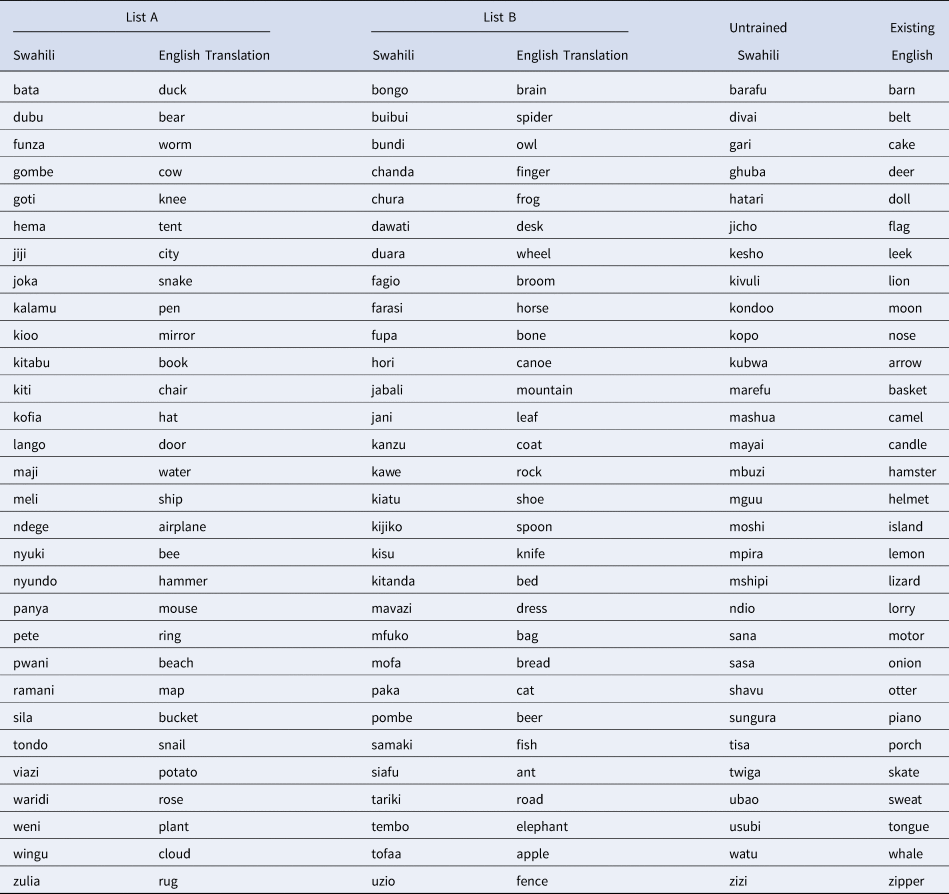
Two lists of 30 Swahili–English word pairs were created. The allocation of lists to training sessions (recent/remote) was counterbalanced across subjects within each group (monolinguals/bilinguals). Each word referred to a common, concrete object. Swahili words were 4–6 letters long (mean 5). Although not all words obeyed English phonotactics, they were easily pronounceable for English speakers. None of the Swahili words were cognates of English or Spanish words. The 30 untrained Swahili words used in the fMRI task were selected to match the learned Swahili words in length (4–7 letters, mean 5) and orthographic features. The existing English words used in the fMRI task were 4–7 letters long (mean 5), had a CELEX (Baayen, Piepenbrock & Gulikers, Reference Baayen, Piepenbrock and Gulikers1995) frequency of 2–45 occurrences per million (mean 26) and were not closely semantically or orthographically related to any of the learned word pairs. The full set of stimuli is listed in Table 1.
Novel, untrained and existing stimuli sets. List A and B were counterbalanced across subjects as either the recent or remote condition.

Priming task
Word targets in the priming task were 3–8 letters long (mean 5) and had a CELEX frequency of 1–288 (mean 44) per million. Orthographically and phonologically legal pseudo-word targets were derived by substitution of one letter from English words that were not part of the stimulus set, and matched in length with the word targets.
fMRI acquisition
fMRI data were recorded in a Siemens Magnetom Trio 3T MRI scanner at the SLEIC center at Penn State, using a 12-channel head coil. Functional images were acquired using a T2*-weighted gradient planar imaging sequence with TR= 2.01 s, TE=30 ms, 34 slices, descending slice order, slice thickness 3.0 mm, slice gap 0.5 mm, matrix size 64 × 64, field of view (FOV) 224 × 224 mm, flip angle 90°, and voxel size 3.5 × 3.5 × 3.0 mm. Slices were angulated in an oblique axial manner. T1-weighted anatomical scans at 1 mm isotropic resolution were acquired with TR 1650 ms, TE 2.03 ms, 160 slices, flip angle 9°, matrix size 256 x 256.
fMRI analysis
Preprocessing was performed using SPM8 (www.fil.ion.ucl.ac.uk). Functional images were first realigned and resliced to the first volume of the first run, and the mean functional image was co-registered with the subject's structural MRI using the mutual information optimization function implemented in SPM8. Images were slice-time corrected to the 17th slice using Fourier pane shift interpolation. The structural MRI was segmented and normalized to SPM8's T1 template in Montreal Neurological Institute (MNI) space. Functional images were normalized to MNI space and smoothed with an 8 mm full-width half maximum Gaussian filter.
Data were modelled using a general linear model (GLM) with four experimental regressors: 1) remote Swahili words that were correctly matched to their English translation in the 4AFC memory task, 2) recent Swahili words correct in the 4AFC task, 3) untrained Swahili words, and 4) existing English words. Two other regressors were also included: recent/remote Swahili words that were incorrectly responded to in the 4AFC task (‘misses’), and null events. For the two participants that scored 100% correct on the 4AFC task, a dummy trial of the ‘misses’ regressor was inserted 20 seconds after the last real trial to keep the GLM model consistent across all participants. A stick function (time-locked to the onset of word presentation) representing the explanatory variables was convolved with the canonical hemodynamic response function provided by SPM8. Six motion parameters were added as additional regressors to account for motion artefacts. Data was high-pass filtered using a 128s cut-off to reduce the effects of low-frequency drift. Each experimental condition was contrasted against an implicit baseline on the first level. The resulting images were entered into a full-factorial second-level model with factors Group (monolingual, bilingual) and Condition (remote, recent, untrained, existing).
For whole-brain analyses, voxels were thresholded at p = .001 uncorrected (punc) and cluster statistics were evaluated at p = .05 family-wise error corrected (pFWE, Hayasaka & Nichols, Reference Hayasaka and Nichols2003). The contrast existing > untrained words with a stricter voxel threshold of pFWE = .05 was used to define regions involved in lexical processing. The significant clusters of this contrast were used as lexicality regions of interest (ROIs) to examine the orthogonal effects of training and consolidation, and differences between the groups within the restricted areas of the brain that are responsive to lexicality. ROI analysis was performed using an initial voxel threshold of punc = .001 and applying a small volume correction (SVC; psvc) for multiple comparisons, evaluated at cluster-level at pFWE = .05 for each of the clusters. To investigate the contribution of areas related to cognitive control, ROIs were created by drawing a 15 mm sphere around the peak voxels of the group differences reported by Bradley et al. (Reference Bradley, King and Hernandez2013). These included the right inferior/middle frontal gyri (IFG/MFG; labelled DLPFC by Bradley et al. [42 23 16]), right SMA ([15 -1 49]), left caudate ([-15 23 10]) and left putamen/pallidum ([-27 -7 -2]). Since the peak voxel of the cluster observed in the ACC ROI by Bradley et al. was in white matter lateral to the ACC, we defined the ACC ROI anatomically based on the AAL atlas (Tzourio-Mazoyer et al., Reference Tzourio-Mazoyer, Landeau, Papathanassiou, Crivello, Etard, Delcroix and Joliot2002).
Results
Cognitive control (Flanker task)
Errors and response times below 50 ms or above 1500 ms were excluded from the reaction time (RT) analysis (10%). Data for one monolingual participant were lost due to experimenter error.
Overall accuracy did not differ between groups (F(1,43) = .242, p = .625) and there was no Group by Condition (blocked congruent, blocked incongruent, blocked go, blocked no-go, mixed congruent, mixed incongruent, mixed go, mixed no-go, control) interaction (F(1.1,47.7) = .01, p = .938).
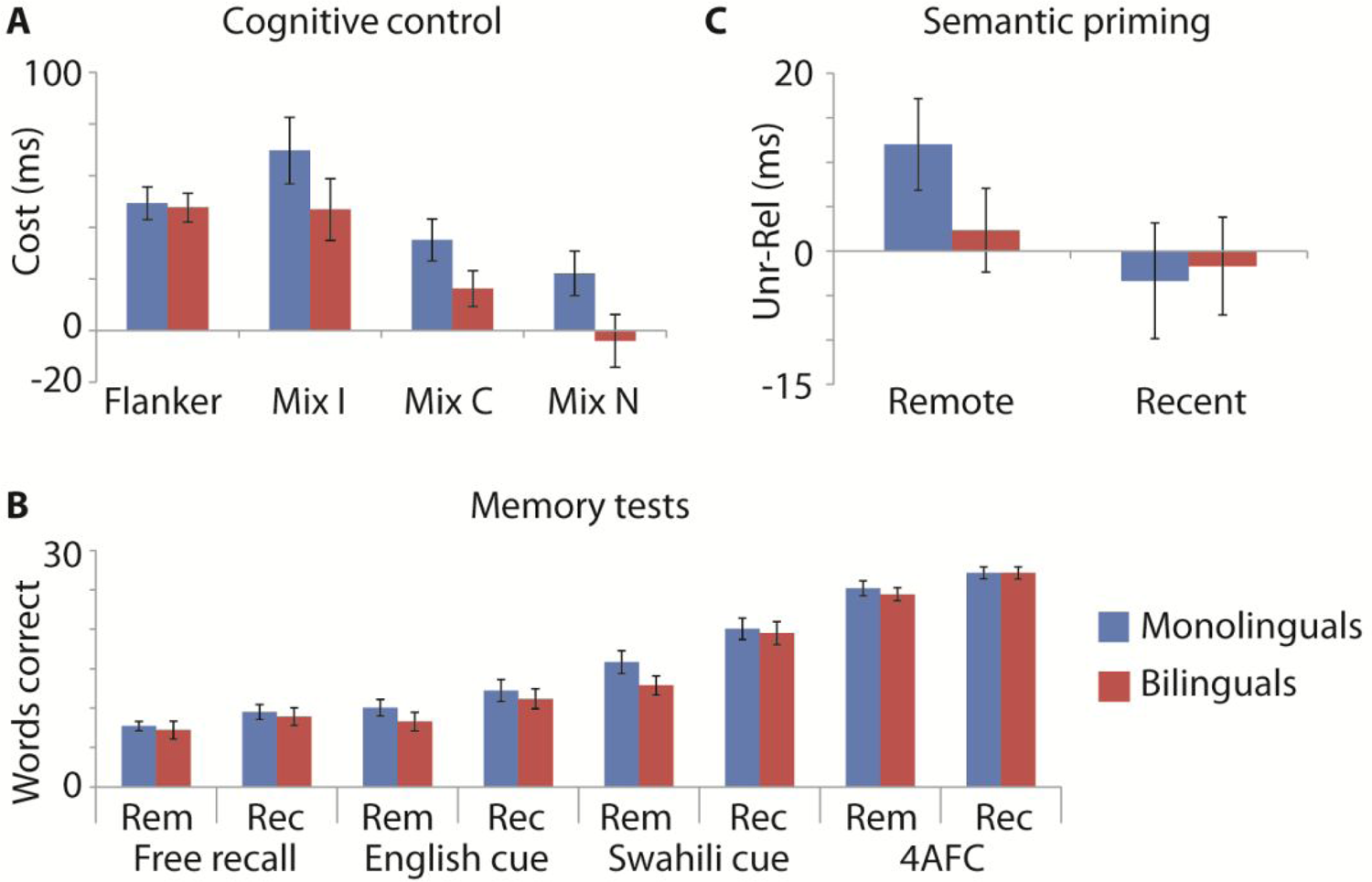
The change in RT relative to the control condition was computed for the congruent and incongruent trials in the congruent/incongruent blocks; see Figure 1, panel A. Incongruent trials were responded to slower (F(1,43) = 132.733, p < .001), reflecting the basic Flanker effect. There was no effect of Group (F(1,43) = .07, p = .792) nor an interaction (F(1,43) = .039, p = .845).
Behavioural results. A: Left-most bars indicate the Flanker effect (congruent – incongruent trials in the blocked conditions) for monolinguals (blue) and bilinguals (red). The next three bar clusters indicate the mixing cost (trials in the mixed block relative to the same trial type in the blocked conditions) for incongruent (I), congruent (C), and neutral (N) trials. B: Memory performance for recently learned (Rec) and remote (Rem) words on the Free recall task, typing the Swahili word in response to an English cue, typing the English word in response to a Swahili cue, and 4AFC Swahili-to-English matching. The total number of words learned on each day was 30. C: Semantic priming effects (unrelated – related prime-target pairs) for the remote and recently learned words. Error bars denote standard error of the mean.

For the congruent, incongruent and neutral trials in the mixed block, the change in RT relative to the same trial type in the blocked conditions was computed; see Figure 1, panel A. This mixing cost reflects participants’ response flexibility in responding when trial types are intermixed, and the cost of monitoring and coordinating multiple streams of information. Bilinguals exhibited smaller mixing costs than monolinguals across conditions (20 ms and 42 ms, respectively; F(1,43) = 4.143, p = .048). This effect has been taken to reflect bilinguals' experience of monitoring and coordinating two simultaneously active languages (e.g., Barac & Bialystok, Reference Barac and Bialystok2012; Gold, Kim, Johnson, Kryscio & Smith, Reference Gold, Kim, Johnson, Kryscio and Smith2013; Yang, Hartanto & Yang, Reference Yang, Hartanto and Yang2016; Wiseheart, Viswanathan & Bialystok, Reference Wiseheart, Viswanathan and Bialystok2016). A main effect of Condition (F(2,86) = 21.324, p < .001) reflected significant overall mixing costs in the incongruent condition (57 ms, t(44) = 6.503, p < .001) and the congruent condition (25 ms, t(44) = 4.613, p < .001) but not in the go condition (8 ms, t(44) = 1.179, p = .245). There was no interaction of Condition by Group (F(2,86) = .113, p = .893). See Figure 1 for an illustration of the Flanker effect and mixing costs by group.
Training and memory (behavioural results)
Training
Training data for one monolingual participant was lost due to technical problems. Performance on the training tasks was generally good, with scores on the most difficult task (typing the Swahili word cued by its English translation) reaching over 50% on average on both days. The English-Swahili 4AFC matching task produced the highest scores; 85% on day 1 and 87% on day 2. The Swahili–English 4AFC matching task was performed better on day 2 (67%) than on day 1 (61%, F(1,43) = 8.7, p = .005). No other tasks exhibited any differences between days or groups.
fMRI old/new recognition task
For one monolingual participant, behavioural data was not analysed because button presses were not recorded in one of the runs. An ANOVA with factors Day (remote, recent) and Group (monolinguals, bilinguals) did not reveal any effects of Day or Group on old/new recognition for the learned words. Remote words were recognised in 89% of trials, recent words in 91% of trials. A main effect of Day was found on responses to the second question (‘Do you know the meaning of this word?’), with the meanings of recent words being remembered better than those of remote words (72% versus 50%; F(1,43) = 76.39, p < .001). No effect of Group or an interaction was observed.
Memory tasks
Participants freely recalled more words from the recent (25%) than the remote (21%) condition (F(1,44) = 4.08, p = .049). Similarly, when asked to type the Swahili word in response to an English word, participants scored higher on the recent (39% correct) than on the remote (30% correct) condition (F(1,44) = 10.32, p = .002). Typing the English word when cued by its Swahili translation was also easier for the recent (66% correct) than the remote (48% correct) condition (F(1,44) = 62.78, p < .001), as was Swahili–English 4AFC matching (recent 90%, remote 83% correct; F(1,44) = 24.41, p < .001). In none of the memory tasks was an effect of Group or an interaction of Group by Condition observed (see Figure 1, Panel B).
Semantic priming
Errors and responses below 200 or above 1700 ms were removed (10%). Data for one bilingual participant was lost. This final data set is summarised in Figure 1 Panel C. An ANOVA with factors Day (remote, recent) x Relatedness (related, unrelated) and between-subjects factor Group (monolinguals, bilinguals) revealed a main effect of Day (F(1,43) = 4.42, p = .041), reflecting overall slower responses in the remote condition. A main effect of Group indicated a small overall reaction time advantage for monolinguals (F(1,43) = 4.1, p = .049). No main effect of Relatedness was observed, though there was a modest trend towards an interaction of Relatedness x Day (F(1,43) = 2.57, p = .12). There was no three-way interaction. Planned paired t-tests of the related versus unrelated conditions within each group suggested a small priming effect in the remote condition for the monolinguals (12 ms, t(21) = 2.33, p = .03), but not in the recent condition (-3 ms, p = .61). In the bilingual group no evidence of priming was observed in the remote (-2 ms, p = .62) or recent (2 ms, p = .76) condition.
fMRI results
Lexicality effects
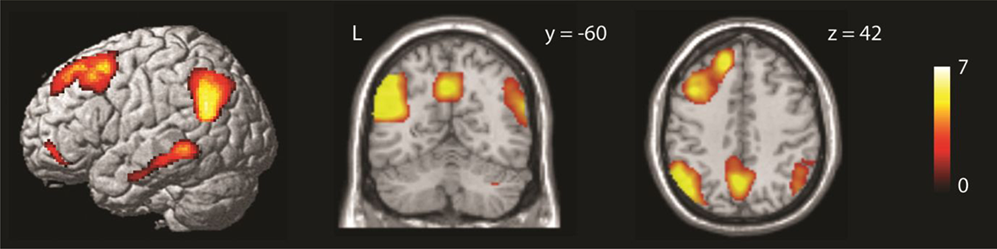
Existing English words elicited more activation than untrained Swahili words in the left middle temporal gyrus (MTG), bilateral angular gyrus (AG), left dorsal and orbital parts of the middle frontal gyrus (MFG), and bilateral precuneus with a left-lateralised peak (see Figure 2). The reverse contrast did not reveal any significant clusters. There was no interaction with Group. These areas, identified as responsive to lexicality, were used as lexicality ROIs to examine the effects of learning and consolidation and differences between the monolingual and bilingual groups in the next analyses.
Greater activation for existing English words than untrained Swahili words (lexicality effect), across both groups. Thresholded at voxel pFWE = .05.

Learning and consolidation
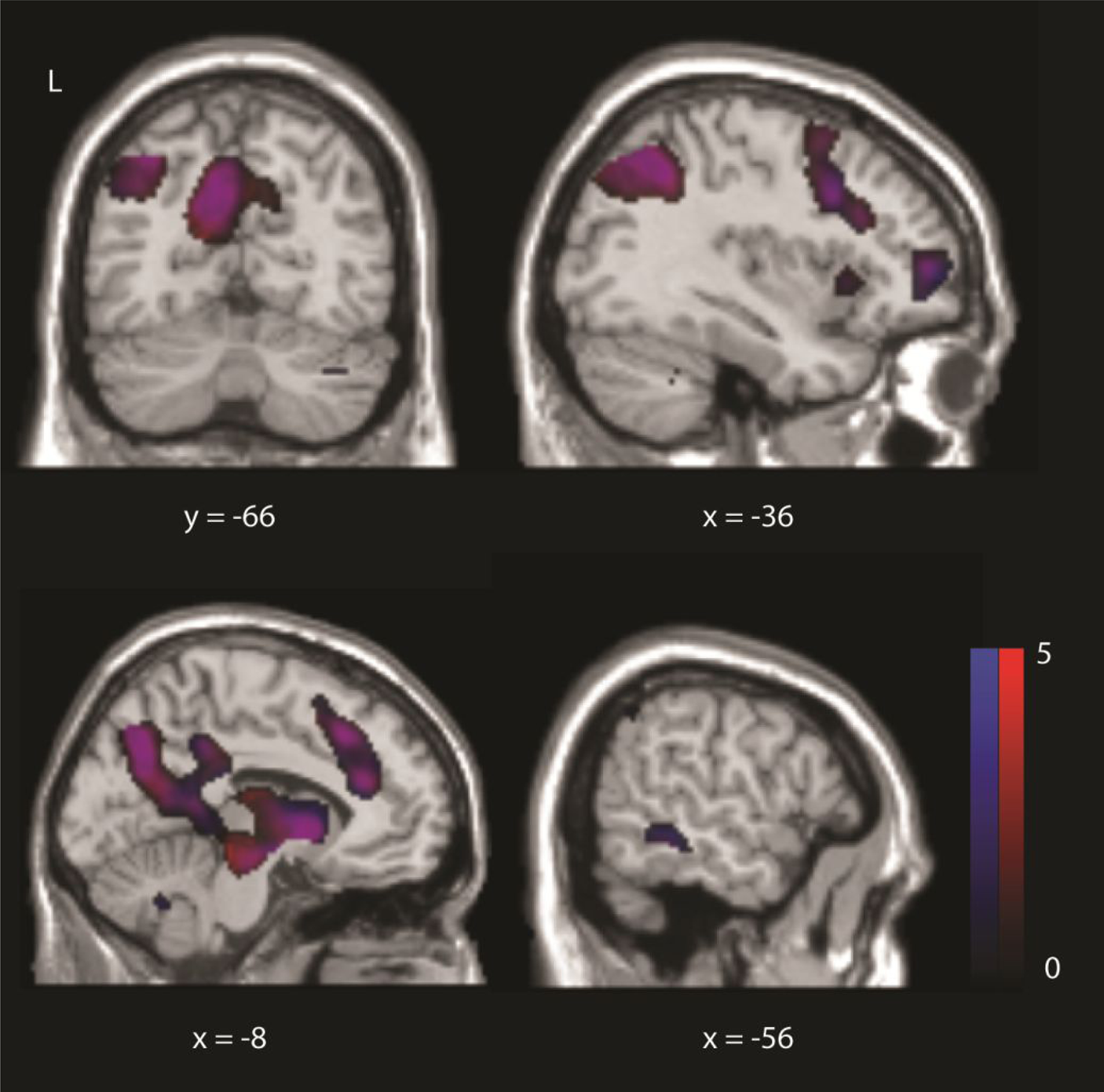
Recently learned words elicited more activation than untrained Swahili words in the left inferior parietal lobe (IPL) and AG, anterior cingulate cortex (ACC), superior frontal gyrus (SFG), dorsal and orbital parts of the MFG, pars triangularis of the inferior frontal gyrus (IFG), precuneus and posterior cingulate cortex, and bilateral caudate. The identical pattern was observed for remote versus untrained Swahili words (see Figure 3). ROI analysis of regions where a lexicality effect was observed, but which did not show learning effects (contrast of learned-untrained words) at the whole-brain level (the left MTG and right AG), revealed a learning effect in the left MTG for both recent ([-58 -40 -10], cluster-size k = 52 voxels, pSVC = .012) and remote ([-45 -38 -12], k = 66, pSVC = .01) words. There was no interaction with Group in either condition. Neither the contrasts remote-recent and recent-remote nor the interactions of these contrasts with group revealed any suprathreshold voxels. No correlation was found between lexical activation and behavioural priming effects for recent or remote words.
Enhanced activation for recent (blue) and remote (red) words (overlap in purple) versus untrained Swahili words, across groups. Thresholded at voxel punc = .001, except for the bottom right panel which depicts the MTG cluster at punc = .01 for illustration purposes.

Group differences
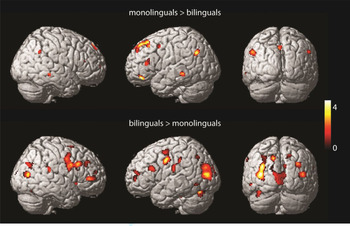
For the contrast of all words relative to baseline, monolinguals showed greater activation than bilinguals in several of the lexicality ROIs: the left precuneus ([0 -64 44], k = 25, pSVC = .016), MFG ([-14 46 48], k = 85, pSVC = .016), and MTG ([-62 -36 -8], k = 11, pSVC = .029). Within the cognitive control-related ROI, in line with Bradley et al. (Reference Bradley, King and Hernandez2013), monolinguals also engaged a right IFG/MFG region more ([36 30 18], k = 62, pSVC = .018). None of the other control-related ROIs showed an effect. The group difference appeared to be caused mostly by the learned Swahili words (see Figure 4), for which monolinguals showed more activity in the precuneus ([-2 -64 40], k = 25, pSVC = .016), left MFG ([-14 46 48], k = 32, pSVC = .037), left MTG ([-62 -36 -6], k = 8, pSVC = .031), and a trend in the left AG ([-50 -64 34], k = 12, pSVC = .054). No suprathreshold voxels for the group contrast were observed in the existing and untrained conditions.
Activation differences between monolinguals and bilinguals in response to learned (recent and remote) Swahili words. Thresholded at voxel punc = .01 for illustration purposes.

Bilinguals showed more overall activation than monolinguals on the whole brain level in the pars opercularis of the right IFG extending into the precentral gyrus, right fusiform gyrus, left middle occipital lobe and left calcarine sulcus. Analysis of the control-related ROIs showed enhanced activation in the left pallidum ([-20 -6 -4], k = 25, pSVC = .034). Again, the overall group difference was mainly found in response to the learned Swahili words (see Figure 4): this condition showed a significant cluster in the bilateral middle occipital lobe on the whole brain level and an effect in the left pallidum in the control-related ROI analysis ([-20 -6 -4], k = 22, pSVC = .037). No effect was found in any of the lexicality ROIs. Additionally, bilinguals showed more activation than monolinguals to existing English words in the left orbital MFG lexicality ROI ([-38 50 -4], k = 21, pSVC = .007). No interaction was observed between Group and Day (recent/remote).
Discussion
The current study investigated whether bilingual experience alters neural mechanisms associated with learning novel words. More specifically, this study tested the hypothesis that bilinguals' experience with learning and using a second language may alter the integration of novel lexical-semantic information with prior knowledge, which may account for the bilingual advantage in word learning that has often been reported in behavioural studies (e.g., Kaushanskaya & Marian, Reference Kaushanskaya and Marian2009a; Reference Kaushanskaya and Marian2009b; Kaushanskaya, Reference Kaushanskaya2012; Papagno & Vallar, Reference Papagno and Vallar1995; Van Hell & Candia Mahn, Reference Van Hell and Candia Mahn1997; Yoshida et al., Reference Yoshida, Tran, Benitez and Kuwabara2011; but see Bradley et al., Reference Bradley, King and Hernandez2013). In the Introduction, we discussed three explanations that have been proposed in this literature: bilingual experience may increase sensitivity to semantic information associated with novel words, it may enhance phonological abilities, or it may affect the involvement of cognitive control. English monolinguals and early Spanish–English bilinguals were trained on two sets of Swahili–English word pairs, one set on each of two consecutive days. After training on the second day, participants performed a retrieval task in the fMRI scanner followed by several behavioural memory tests. A primed lexical decision task in which Swahili words primed semantically related English target words was conducted to probe novel words’ semantic integration.
The present study showed that bilinguals did not perform better than monolinguals on explicit recall or recognition of novel words, either during training, immediately after training, or after a 24-hour delay. Consistent with previous word learning studies reporting findings of delayed semantic integration (e.g., Bakker, Takashima, Janzen, Van Hell & McQueen, Reference Bakker, Takashima, Van Hell, Janzen and McQueen2015; Liu & Van Hell, Reference Liu and Van Hell2020; Tamminen & Gaskell, Reference Tamminen and Gaskell2013), a small priming effect from learned Swahili words to semantically related English words was observed for the remote set, learned 24 hours before testing, but not for the recent set, learned just before testing. This pattern is thought to reflect the contribution of an offline integration process, which allows novel words to acquire lexical representations that can form stable neocortical connections with existing words, in line with the Complementary Systems account of word learning (Davis & Gaskell, Reference Davis and Gaskell2009). While this effect only reached significance in the monolingual group, we did not observe a Group interaction. So, the behavioural data do not provide support for the hypothesis that bilingual experience leads to faster or stronger lexical integration in bilinguals than in monolinguals, as measured by novel words’ ability to prime semantically related existing words.
Before discussing the fMRI data and observed differences in the neural structures recruited by monolinguals and bilinguals in more detail, we first outline possible explanations for the absence of group differences in the behavioural data.
First, it could be argued that our extended training procedure obscured any bilingual advantage on novel word recall. However, while recognition performance was at ceiling, average scores on the Swahili-cued and English-cued recall tasks ranged between 30% and 66% with large standard deviations, suggesting that there was in principle enough variation to detect group differences. Furthermore, there was no group difference in any of the training blocks, which would be expected if the bilingual advantage contributes mainly to early learning effects or fast-mapping (i.e., the initial link made between a novel word and its referent; Kan, Sadagopan, Janich & Andrade, Reference Kan, Sadagopan, Janich and Andrade2014). Therefore, the explanation that the extended training procedure obscured differences in the behavioural data of the bilingual and monolingual groups does not seem very likely.
A second explanation for the absence of a group difference on the recall and recognition of novel words, and no semantic priming effect in the bilinguals, relates to the fact that novel words have more orthographic neighbours in the bilinguals’ two lexicons combined than in a monolingual's single lexicon; note that none of the Swahili words were cognates of English or Spanish words to ensure that lexical overlap of the Swahili words with known languages would not differentially impact novel word learning and consolidation in bilinguals versus monolinguals. Our bilinguals were highly proficient, balanced bilinguals (their BNT scores in English and Spanish did not differ), which implies that the novel Swahili words will have orthographic neighbours in both their English and Spanish mental lexicons. Even though the Swahili words’ orthographic neighbourhood density with English and Spanish was fairly low (mean density for the remote, recent, and untrained lists ranged from 0.83–1.80 for English and from 0.90–2.33 for Spanish; Clearpond database, Marian, Bartolotti, Chabal & Shook, Reference Marian, Bartolotti, Chabal and Shook2012), the summed neighbourhood density is approximately twice as high in bilingual as in monolingual learners. A higher number of orthographic neighbours possibly causes more interference and less stable lexical-semantic representations for newly learned words, yielding a smaller (and nonsignificant) semantic priming effect in bilinguals relative to monolinguals.
A third potential explanation for the absence of group differences in the behavioural measures is that the current paradigm involved only visual exposure to the novel words, due to the restrictions on auditory tasks in the scanner, whereas previous behavioural work reporting a bilingual advantage in word learning has used auditory or auditory-visual paradigms (Kaushanskaya, Reference Kaushanskaya2012; Kaushanskaya & Marian Reference Kaushanskaya and Marian2009a; Reference Kaushanskaya and Marian2009b; Papagno & Vallar, Reference Papagno and Vallar1995; Van Hell & Candia Mahn, Reference Van Hell and Candia Mahn1997; Yoshida et al., Reference Yoshida, Tran, Benitez and Kuwabara2011). In line with this explanation, Bradley et al. (Reference Bradley, King and Hernandez2013) report equal accuracy in monolinguals and bilinguals on a behavioural semantic decision task with newly learned words which had been acquired visually. This pattern raises the possibility that although phonological awareness and memory may not explain the bilingual advantage entirely (Kaushanskaya, Reference Kaushanskaya2012; Kaushanskaya & Marian Reference Kaushanskaya and Marian2009a), behavioural observations of word learning differences related to bilingual experience may be restricted to spoken word learning or combined auditory-visual word learning.
We now discuss the neural findings, and the observed differences in neural structures recruited by monolinguals and bilinguals. As we will see, these data indicate that monolinguals and bilinguals recruit overlapping but non-identical neural systems to acquire novel words, in line with the proposal put forward by Bradley et al. (Reference Bradley, King and Hernandez2013) that monolinguals and bilinguals employ different strategies in word learning that rely on distinct neural mechanisms. Bradley et al. report increased activation for monolinguals in areas related to cognitive control, in the right inferior/middle frontal gyri, an effect that was replicated in our data. This pattern was interpreted as a signature of more controlled response selection and competitor inhibition in monolinguals, following Abutalebi and Green (Reference Abutalebi and Green2007). Our observation of stronger IFG activation in monolinguals compared to bilinguals is consistent with this view and, combined with the finding that bilinguals showed smaller mixing costs than monolinguals on the Flanker task – taken to reflect bilinguals’ experiences in monitoring and coordinating two languages (e.g., Barac & Bialystok, Reference Barac and Bialystok2012; Gold et al., Reference Gold, Kim, Johnson, Kryscio and Smith2013; Yang et al., Reference Yang, Hartanto and Yang2016; Wiseheart et al., Reference Wiseheart, Viswanathan and Bialystok2016) – suggests that the bilinguals' response system is more flexible and better equipped to monitor and coordinate multiple streams of information without so much conscious effort. The bilingual experience of learning and using multiple languages may thus change the recruitment of brain regions in novel word learning, analogous to the recently proposed bilingual anterior-to-posterior and subcortical shift (BAPSS) associated with nonlinguistic cognitive and executive function tasks (Grundy, Anderson & Bialystok, Reference Grundy, Anderson and Bialystok2017). This shift takes the form of less recruitment of frontal and executive regions and greater recruitment of posterior/subcortical regions by bilinguals relative to monolinguals. In line with the BAPSS proposal, our data also seem to suggest that bilinguals recruit less frontal regions than monolinguals and more recruitment of the basal ganglia region. Based on their extensive review of the literature, Grundy et al. further argue that this pattern reflects efficiency rather than functional dedifferentiation, because studies have observed different neural patterns between bilinguals and monolinguals, but no behavioural differences (as did the present study).
Furthermore, the bilinguals in Bradley et al.'s study exhibited more activation in the left putamen, as was also observed in the current data. (Note that while Bradley et al. label their cluster as putamen, its peak voxel is just within the AAL-defined pallidum on the pallidum/putamen border. The peak voxel in our data is slightly more medial in the pallidum.) They argued that this pattern reflects bilinguals’ greater reliance on articulatory motor processes in mapping novel and existing words, given the known involvement of the putamen/pallidum in motor processes and control of articulatory processes (e.g., Wildgruber, Ackermann & Grodd, Reference Wildgruber, Ackermann and Grodd2001; Wise, Greene, Buchel & Scott, Reference Wise, Greene, Buchel and Scott1999; for review, see Viñas-Guasch & Wu, Reference Viñas-Guasch and Wu2017), and the finding of increased grey matter density in the left putamen for multilinguals relative to monolinguals (Abutalebi et al., Reference Abutalebi, Rosa, Castro Gonzaga, Keim, Costa and Perani2013; see also Burgaleta, Sanjuán, Ventura-Campos, Sebastián-Gallás & Ávila, Reference Burgaleta, Sanjuán, Ventura-Campos, Sebastián-Gallás and Ávila2016). If bilinguals’ long-term experience navigating two languages and controlling articulatory processes in two languages induced structural changes in the putamen and has prepared bilinguals to rely on articulatory motor processing when integrating novel words into their existing mental lexicon, then this may also explain why a bilingual advantage in word learning is prevalent in behavioural studies employing auditory or combined auditory-visual word learning strategies, and why studies using visual-only learning strategies (the present study and Bradley et al., Reference Bradley, King and Hernandez2013) did not observe a bilingual advantage. A direct, within-subjects comparison of auditory and visual word learning in monolinguals and bilinguals is necessary to establish whether bilingual experience enhances both auditory and visual word learning, or whether experience-induced changes are restricted to auditory word learning.
Several regions that responded selectively to existing words, as compared to untrained Swahili words (i.e., pseudowords), also showed enhanced responses to learned Swahili words in monolinguals versus bilinguals. This network included the left precuneus, middle frontal gyrus (MFG) and middle temporal gyrus (MTG), and less reliably the left angular gyrus (AG). Previous work indicates that the left MTG in particular is important for the lexicalisation and semantic integration of novel words (e.g., Bakker-Marshall et al., Reference Bakker-Marshall, Takashima, Schoffelen, Van Hell, Janzen and McQueen2018; Takashima et al., Reference Takashima, Bakker, van Hell, Janzen and McQueen2014), in line with the idea that this region houses lexical representations that bind word-form information to distributed semantic knowledge (Gow, Reference Gow2012; Hickok & Poeppel, Reference Hickok and Poeppel2004; Reference Hickok and Poeppel2007; Lau, Phillips & Poeppel, Reference Lau, Phillips and Poeppel2008). The increased activation in areas sensitive to lexicality in monolinguals, especially the left MTG, may therefore reflect stronger lexical representations of newly learned words, possibly underlying the differences in behavioural priming across groups.
One potential explanation for this difference in lexical activation patterns lies in the difference in English vocabulary size between the monolingual and bilingual groups. The bilinguals scored lower on the English naming task than monolinguals, consistent with a large-sample comparison of monolingual and bilingual adults on a similar standardised picture-naming task (Bialystok & Luk, Reference Bialystok and Luk2012). Their smaller English vocabulary size may have impaired bilinguals’ ability to encode and integrate the Swahili words with their English translations, either through increased task demands or because fewer representations were available for novel words to form connections with, thus counteracting any positive effects of bilingualism on word learning (including the notion that bilingual experience may increase sensitivity to semantic information associated with novel words (e.g., Kaushanskaya and Rechtzigel, Reference Kaushanskaya and Rechtzigel2012), as discussed in the Introduction). However, we did not find a correlation between bilinguals’ English naming scores and any of the explicit novel word memory measures (all p > .12) or the priming effect for remote words (p = .877), although some caution is warranted in interpreting these findings since these correlation analyses may be underpowered. Furthermore, the enhanced activation in the MTG for monolinguals versus bilinguals remained significant when controlling for naming performance (pFWE = .04), although the precuneus and MFG effects no longer reached significance (possibly due to a loss of power, as naming data was not available for two participants).
An alternative, and tentative, explanation we propose here is that novel words may be incorporated in the monolingual and bilingual lexicons in fundamentally different ways. One of the main computational arguments for offline consolidation is that temporarily encoding novel information separately from prior knowledge circumvents the problem of catastrophic interference: the erasing of existing memories in a distributed connectionist network by the sudden introduction of new information (McClelland et al., Reference McClelland, McNaughton and O'Reilly1995; McClosky & Cohen, Reference McClosky, Cohen and Bower1989). If the neural networks supporting lexical-semantic representations overlap across a bilingual's languages, the denser bilingual lexicon may be more vulnerable to catastrophic interference than the monolingual lexicon. To overcome this problem, bilinguals more so than monolinguals may need to prioritise slower and more gradual interleaving of novel and existing words into the neocortical network, and rely more strongly and possibly for a longer period of time on hippocampal encoding of novel words. Given the faster decay of hippocampal information (see Frankland & Bontempi, Reference Frankland and Bontempi2005 for a discussion of possible mechanisms), this is consistent with the finding in prior behavioural work that the bilingual advantage observed immediately after learning dissipates over time (Kaushanskaya & Marian, Reference Kaushanskaya and Marian2009a; Reference Kaushanskaya and Marian2009b; Kaushanskaya, Reference Kaushanskaya2012).
Thus, as observed in behavioural work (particularly in studies using auditory or combined auditory-visual word learning strategies), bilinguals may generally have an advantage on immediate explicit memory tasks for novel words (e.g., Kaushanskaya & Marian, Reference Kaushanskaya and Marian2009a; Reference Kaushanskaya and Marian2009b; Kaushanskaya, Reference Kaushanskaya2012; Papagno & Vallar, Reference Papagno and Vallar1995; Van Hell & Candia Mahn, Reference Van Hell and Candia Mahn1997; Yoshida et al., Reference Yoshida, Tran, Benitez and Kuwabara2011), which can be performed based on an episodic, hippocampally bound memory trace. Monolinguals on the other hand may integrate novel words more rapidly into the neocortical lexicon bound by the left MTG, which in the current paradigm could have enabled novel words to interact with existing words in the semantic priming task (which only reached significance in the monolingual group). Our data did not reveal increased hippocampal activation for bilinguals, but hippocampal effects are not always readily observed and straightforward to interpret during word retrieval (e.g., Davis, Di Betta, MacDonald & Gaskell, Reference Davis, Di Betta, McDonald and Gaskell2009; Takashima et al., Reference Takashima, Bakker, van Hell, Janzen and McQueen2014). Future work employing paradigms optimised to test this hypothesis, perhaps investigating hippocampal activity during associative encoding rather than retrieval, may start to address this issue.
In conclusion, the current study indicates that monolinguals and bilinguals reach largely comparable behavioural performance levels in novel word learning, but do so by recruiting partially overlapping but non-identical neural systems to acquire novel words. Depending on which features of novel word knowledge are emphasised by a particular experimental paradigm, bilingual experience may induce both advantages and disadvantages in novel word learning.
Acknowledgements
This research was funded by The Netherlands Organization for Scientific Research (NWO) Brain and Cognition Grant No. 433-09-239. The authors are grateful to Sarah Fairchild, Marlijn Beek and Desirae Scott for help with data collection. We would also like to thank the Penn State Social, Life, and Engineering Sciences Imaging Center, 3T MRI facility for the use of in-kind hours for data collection.