Introduction
The idea that, for most people, left hemisphere (LH) structures are involved in expressive and receptive language functions has a history going back to the early 19th century. Yet the size of that majority was not estimated until much later. In a highly cited study of language dominance by Rasmussen and Milner (Reference Rasmussen and Milner1977) using the intracarotid amobarbital test (“Wada” procedure), LH dominance was reported in 96% of the right-handed and in 70% of the left-handed patients with epilepsy. However, these proportions may not be considered as representative of the normal population. A more valid estimate of LH language dominance in the normal population could be obtained on the basis of the prevalence of language impairment in cases of acute unilateral brain injury, such as stroke or trauma, where the odds of functional reorganization are minimized. Assuming a random occurrence of left- versus right-sided injury, the differences in the number of patients with aphasia who have left- versus right-sided lesions should reflect hemispheric language dominance in the normal population.
Several large-scale studies have reported that unilateral LH stroke resulted in aphasia in 82.3% (Bryden, Hécaen, & DeAgostini, Reference Bryden, Hécaen and DeAgostini1983), 89.7% (Pedersen, Jørgensen, Nakayama, Raaschou, & Olsen, Reference Pedersen, Jørgensen, Nakayama, Raaschou and Olsen1995), and 96.0% (Geschwind, Reference Geschwind1970) of the patients. Similar percentages have been found in patients with unilateral head injury (e.g., missile injury), in which LH damage was found to result in aphasia in 89.0% of the patients (Newcombe & Ratcliff, Reference Newcombe and Ratcliff1973). The mean proportion of LH dominance across these studies is 89.3% (with a range of 13.7%), suggesting that approximately 90% of normal individuals may be considered as LH dominant for language. This high estimate for LH dominance can be corroborated by neuroimaging studies involving various techniques and language tasks in normal participants (Knecht et al., Reference Knecht, Deppe, Dräger, Bobe, Lohmann, Ringelstein and Henningsen2000; Pujol, Deus, Losilla, & Capdevila, Reference Pujol, Deus, Losilla and Capdevila1999; Springer et al., Reference Springer, Binder, Hammeke, Swanson, Frost, Bellgowan and Mueller1999; Vikingstad, George, Johnson, & Cao, Reference Vikingstad, George, Johnson and Cao2000). For example, using functional magnetic resonance imaging (fMRI) during a word generation task, Pujol et al. (Reference Pujol, Deus, Losilla and Capdevila1999) found that among right-handed individuals, 96% demonstrated greater LH activation and 4% bilateral activation; whereas, among left-handed individuals, 76% demonstrated greater LH activation, 14% bilateral activation, and 10% greater right hemisphere (RH) activation. When the proportion of left- versus right-handed individual in the population is considered, this study would suggests that 94% of individuals are LH dominant. Likewise, Knecht et al. (Reference Knecht, Deppe, Dräger, Bobe, Lohmann, Ringelstein and Henningsen2000) suggested typical (LH) language dominance in 92.5% and atypical dominance (bilateral or RH) in 7.5% of normal individual using functional transcranial Dopppler-ultrasonography (fTCD).
However, in patient samples sustaining long-term LH pathology, such as that typically associated with seizures, substantial deviations in the proportion of typical language organization can be found (Gaillard et al., Reference Gaillard, Berl, Moore, Ritzl, Rosenberger, Weinstein and Theodore2007; Kurthen et al., Reference Kurthen, Helmstaedter, Linke, Solymosi, Elger and Schramm1992, Reference Kurthen, Helmstaedter, Linke, Hufnagel, Elger and Schramm1994; Papanicolaou et al., Reference Papanicolaou, Simos, Breier, Zouridakis, Wilmore, Wheless and Gormley1999; Pataraia et al., Reference Pataraia, Simos, Castillo, Billingsley-Marshall, McGregor, Breier and Papanicolaou2004; Springer et al., Reference Springer, Binder, Hammeke, Swanson, Frost, Bellgowan and Mueller1999; Risse, Gates, & Fangman, Reference Risse, Gates and Fangman1997). For example, Springer et al. (Reference Springer, Binder, Hammeke, Swanson, Frost, Bellgowan and Mueller1999) found differences in lateralization using a dominance classification criterion for fMRI data during semantic processing in persons with epilepsy compared to normal participants. In the control group, 94% showed LH dominance and 6% showed bilateral (symmetric) activity. However, in the epilepsy group, only 78% showed LH dominance, 16% showed a symmetrical representation, and 6% showed RH dominance. Although this reorganization is not fully understood, it appears that if hemispheric dominance changes from typical to atypical, it does so for both expressive and receptive language function regardless of whether the regions of pathology are in the vicinity of the left frontal lobe or the left temporal lobe (i.e., brain regions typically associated with each of these language functions, respectively). This tentative conclusion follows from the fact that observations of dissociated lateralization are rare in which functional cerebral reorganization appears to occur in only part of the language system. A careful review of the relevant literature of focal lesion studies (Kamada et al., Reference Kamada, Sawamura, Takeuchi, Kuriki, Kawai, Morita and Todo2007; Lee et al., Reference Lee, Swanson, Sabsevitz, Hammeke, Scott Winstanley, Possing and Binder2008; Maestú et al., Reference Maestú, Saldaña, Amo, González-Hidalgo, Fernandez, Fernandez and Ortiz2004; Rutten, Ramsey, van Rijen, Alpherts, & van Veelen, Reference Rutten, Ramsey, van Rijen, Alpherts and van Veelen2002; for review, see Kamada et al., Reference Kamada, Takeuchi, Kuriki, Todo, Morita and Sawamura2006) enabled us to identify a total of less than 20 such cases of dissociated lateralization for expressive and receptive language function.
To examine how closely these two language functions are “yoked” and to assess the proportion of dissociations of the two systems resulting from functional reorganization in the presence of developing focal pathology, we studied language performance during the Wada procedure in a group of patients with epilepsy who were undergoing pre-surgical evaluation with particular interest in those with either left temporal or left frontal pathology. Using archived data collected during the past 15 years in the epilepsy center of our institution, we tested the following predictions: First, that focal pathology in the vicinity of either the expressive or the receptive language mechanism (i.e., left frontal and left temporal lobe, respectively) would result in significantly higher frequencies of atypical language performance during the Wada procedure than the frequencies estimated to occur in the normal population or in patients with RH pathology. Second, on the assumption that the two language functions are tightly yoked, we predicted that atypical lateralization would occur with the same frequency for both receptive and expressive language, independent of the location of the pathology. In addition, we were interested in reporting any cases of dissociated lateralization that were observed within our sample.
Method
Participants
Participants included 296 patients with intractable seizures who were candidates for surgical resection. In each patient, the specific hemisphere and lobe of damage were specified based on preoperative plans for resection following an extensive pre-surgical evaluation protocol. In most cases, event-related (brain) potential, magnetoencephalography, and MRI were used to localize epileptiform discharges and indentify structural damage (e.g., the presence of mesial temporal sclerosis). Based on the epileptogenic zone designated for resection, 137 patients were classified as having either left temporal (n = 137), left frontal (n = 23), right temporal (n = 119), or right frontal (n = 17) pathology. The patients ranged in age from 9 to 65 years (mean = 32; SD = 12 years). Consistent with handedness estimates in the normal population, our sample included 264 right-handed (89%), 30 left-handed (10%), and 2 ambidextrous individuals (1%). LH pathology was noted for 52% of the right-handed group, 73% of the left-handed group, and 100% of the ambidextrous group. This research was conducted in compliance with institutional research standards for human research and in accordance with the Helsinki Declaration.
Wada Procedure
During the Wada procedure, a standard protocol was completed for the determination of language dominance following an injection of sodium amytal to each hemisphere. Before injection, patients laid supine and were asked to extend both arms toward the ceiling. As the injections were administered, hemiparesis was noted in all cases. The language testing included: (1) comprehension of simple instructions (“Stick out your tongue”), (2) comprehension of one- and two-step commands (token test—patient was presented with a card containing a blue circle, blue square, red circle, and red square and was asked to point to a specific item, and then to two specific items, based on color and shape), (3) confrontation naming of objects or parts of objects presented in line drawings (patient was presented with a picture of coat and asked to name the coat, sleeve, collar, and button), (4) reading of sentences (“The car backed over the curb;” “The rabbit hopped down the lane.”), and (5) repetition of simple phrases (“Mary had a little lamb;” “No ifs, ands, or buts.”). For each subtest, performance was graded on a 4-point scale indicative of no errors (score = 0), mild deficits (score = 1), moderate deficits (score = 2), or severe deficits (score = 3), based on the clinical judgment of a neuropsychologist.
Data Analysis
For the present purpose, lateralization of language was determined by comparing test performance when mediated by the un-injected hemisphere. The language competence of each hemisphere was deemed good if performance was without error (i.e., score of 0) or mildly deficient (i.e., score of 1) and poor if performance was moderately or severely impaired (e.g., score of 2 or 3; paraphasias, speech arrest, or inability to produce accurate response to commands). To provide the clearest measures for receptive and expressive language organization, we chose to focus specifically on performance on the task of confrontational naming and comprehension of one- and two-step commands, respectively.
Patients were categorized as having typical language lateralization (i.e., LH dominance) for each language system (expressive and receptive) when performance of the LH was good and performance of the RH was poor. Patients were categorized as having atypical lateralization (i.e., not LH dominance) when they presented with any other pattern of performance (i.e., good performance with either hemispheres = bilateral competence; poor performance with each hemispheres = partial reliance; and poor performance with LH/good performance with RH = RH dominance). Thus, atypical lateralization included bilateral competence, partial reliance, and RH dominance. However, it should be noted that impairment in performance on the language tests administered during the Wada procedure can occur due to factors other than language deficits, such as mutism or inhibited initiation/intention. Although good clinical judgment can usually differentiate the root of this disruption, caution is still warranted, particularly in cases where marked impairment was noted during injection on both hemispheres (i.e., partial reliance).
Chi-square (χ2) tests were used to evaluate the prevalence of typical and atypical language lateralization: (1) within the observed sample between LH and RH patients, (2) with comparisons to estimates in the normal population, and (2) between expressive and receptive language measures within the LH patients. Moreover, to assess deviations of our sample from population rates, a conservative approach of using the lower end of the range, namely 82%, instead of using the mean estimates of typical lateralization over all the reviewed studies. Therefore, we compared the observed prevalence in our sample, to an expected rate of 82% typical and 18% atypical lateralization in the population.
Results and discussion
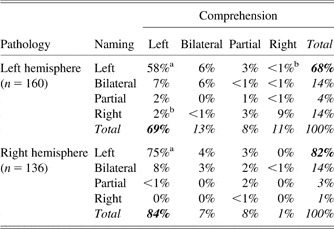
Table 1 displays the relative frequencies for lateralization during comprehension and naming for patients with LH and RH pathology. Of the 296 patients in this study, 220 individuals (74%) presented with LH dominance for confrontational naming (expressive) and 222 individuals (76%) presented with LH dominance for comprehension of one- and two-step commands (receptive). Among the 160 patients with LH pathology, LH dominance was observed in 108 individuals (68%) for naming and 110 individuals (69%) for comprehension. Among the 136 patients with RH pathology, LH dominance was observed in 112 individuals (82%) for naming and 114 individuals (84%) for comprehension. However, only 93 individuals (58%) with LH pathology and 102 individuals (75%) with RH pathology presented with typical LH language lateralization for both the expressive and receptive measures.
Relative frequencies of typical (LH dominance) and atypical (bilateral competence, partial reliance, and RH dominance) hemispheric lateralization for expressive (naming) and receptive (comprehension) language tasks

Note. LH = left hemisphere; RH = right hemisphere.
The portion of patients within each LH lesion group who were LH dominant for one of the language measures (regardless of lateralization on the other) are indicated in bold.
aCases of LH dominance on both expressive and receptive language. bCases of dissociated lateralization for expressive and receptive language.
The χ2 comparisons revealed a significantly higher prevalence of atypical language organization in LH patients compared to the estimated rates in the normal population for both the expressive (χ2(1) = 22.79, p < .0001) and receptive (χ2(1) = 19.03, p < .0001) language measures (i.e., naming and sentence comprehension) and compared to RH patients (expressive: χ2(1) = 22.79, p < .0001; receptive: χ2(1) = 19.03, p < .0001). There was no difference between the RH patient and the normal population estimates for either language measure (expressive: χ2(1) = 0.01, p = .92; receptive: χ2(1) = 0.31, p = .58). In addition, no difference was found in the prevalence of typical/atypical organization between expressive and receptive language measures in LH patients (χ2(1) = 0.17, p = .68). These findings confirm our hypothesis that progressive pathology in the LH leads to higher rates of atypical language organization across language tasks, and tentatively suggests that expressive and receptive language organization are yoked.
However, equal rates of typical/atypical lateralization on one task compared to another task do not necessarily suggest that the same patients presented with atypical lateralization on both tasks. For example, if an individual demonstrates typical lateralization on naming, but atypical lateralization on comprehension, then it can be argued that they should be considered “atypical” for language processing in general. Thus, we also chose to complete χ2 comparisons based strictly on the number of patients who demonstrated typical dominance on both the receptive and expressive measures. These results were similar to those for the individual subtest in that patients with LH pathology showed a significantly lower prevalence of typical lateralization compared to the normal population estimates (χ2(1) = 61.79, p < .0001) and compared to patients with RH pathology (χ2(1) = 24.30, p < .0001). However, an additional difference immerged: a significantly lower prevalence of typical lateralization was observed in patients with RH pathology compared to the normal estimates (χ2(1) = 4.52, p = .03). These findings suggest that although patient with RH pathology may demonstrate higher rates of LH dominance compared to their LH pathology counterparts, their organization may not be equivalent to that observed in the normal population. While there is not sufficient evidence in the literature to make assumptions about lateralization patterns across tasks in the normal population, it is plausible that the prevalence of atypical language organization and/or reorganization may increase as a result of disruption in the brain, even in the RH. Clearly, there is a gap in knowledge regarding the variability in language organization, not only in the patient population, but also in normal individuals.
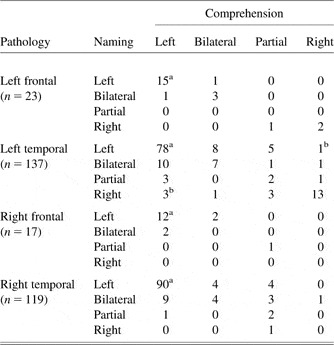
Table 2 provides additional detail from our data which can aid in drawing more specific conclusions about organizational trends. In our sample, atypical lateralization on both naming and comprehension was observed in 35 patients with LH pathology (22%) and 12 patients with RH pathology (9%). In the group with LH pathology, the majority of these individuals showed either RH dominance (n = 15) or bilateral (redundant) competence (n = 10) across both tasks (with varying results across the other 10 individuals). In contrast, within the group with RH damage, none of these individuals showed RH dominance on both task. Instead, these individuals primarily presented with either bilateral competence across both tasks (n = 4), partial reliance across both tasks (n = 3), or a combination of bilateral competence and partial reliance across the two tasks (n = 3). This group of patients represents two types of individuals: those which may have had atypical language organization independent of pathology and those in which reorganization occurred in such a way that it affected both language domains. As predicted, there were a disproportionate number of patients with LH pathology in this group compared to RH pathology (approximately three times as many). Furthermore, this disproportion is most striking for the classification of RH dominance on both tasks (with the ratio 15:0). These findings are in accord with what would be expected for patients with RH pathology assuming that most individuals are LH dominant for language. That is, the cortices primarily responsible for language processing should not be disrupted by RH pathology; and, therefore, should be much less likely to result in a hemispheric shift in language processing. This is not to say that RH dominance cannot occur in patients with RH pathology, but rather, it is logical to predict a lower prevalence of RH dominance in patients with RH pathology than in the normal population because rare persons who might otherwise be RH dominance may actually undergo reorganization to the LH. There are a few cases of dissociated lateralization in the literature related to RH pathology that support this theory (Kurthen et al., Reference Kurthen, Helmstaedter, Linke, Solymosi, Elger and Schramm1992; Rutten et al., Reference Rutten, Ramsey, van Rijen, Alpherts and van Veelen2002).
Number of patients who demonstrated typical (LH dominance) and atypical (bilateral competence, partial reliance, and RH dominance) hemispheric lateralization for expressive (naming) and receptive (comprehension) language tasks based on side (i.e., left/right) and lobe (i.e., frontal/temporal) of pathology

Note. LH = left hemisphere; RH = right hemisphere.
aCases of LH dominance on both expressive and receptive language. bCases of dissociated lateralization for expressive and receptive language
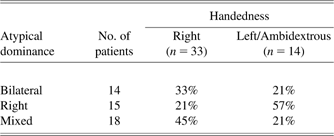
In addition, it is interesting to note that of the patients demonstrating atypical lateralization for both naming and comprehension, right-handedness was reported in 92% of those with RH pathology and only 63% of those with LH pathology. Further distinctions regarding handedness were revealed when subgroups were considered based on the type of atypical organization that was observed (Table 3). Of the 47 patients who showed atypical language organization on both naming and comprehension (regardless of lesion location), 70% were right-handed, 26% were left-handed, and 4% were ambidextrous. Of the right-handed patients, 21% were RH dominant on both measures, 33% were bilaterally competent on both measures, and 45% showed some combination of atypical classification across the two tasks. In contrast, for the left-handed and ambidextrous patients, 57% were RH dominant on both measures, 21% were bilaterally competent on both measures, and 21% showed some combination of atypical classification across the two tasks. Taken together, these data suggest a higher prevalence of RH language dominance in the presence of LH pathology, particularly in persons who are not right-handed. These findings are consistent with the higher proportion of RH language dominance in left-handed individuals compared to right-handed individuals in the general population (Pujol et al., Reference Pujol, Deus, Losilla and Capdevila1999), but also suggest an interaction between handedness and atypical lateralization in the presence of neural pathology.
Handedness of patients with atypical lateralization on both expressive and receptive measures, including the proportions of right- and left-handed patients who demonstrated either bilaterally competent, RH dominant, or a combination of the atypical classifications across the two tasks

The remaining 54 patients (18% of the total sample) presented with typical lateralization on one of the targeted measures and atypical on the other measure. This group consisted primarily of individuals who were LH dominant for one task and bilaterally competent for the other task. For example, of those with LH pathology, 11 patients showed LH dominance for comprehension and bilateral competence for naming, whereas 9 patients showed bilateral competence for comprehension and LH dominance for naming. Similarly, in the RH patients, 11 individuals showed LH dominance for comprehension and bilateral competence for naming, whereas 6 patients showed bilateral competence for comprehension and LH dominance for naming. Although these cases demonstrate the variation in organization that can occur across different language functions, these instances do not represent cases of dissociated lateralization. In fact, bilateral competence may be more prevalent than previously expected, and many of these cases may actually reflect normal variability that could be present in the general population. This is consistent with findings from fMRI studies of bilateral symmetry during language tasks in normal participants (Pujol et al., Reference Pujol, Deus, Losilla and Capdevila1999; Springer et al., Reference Springer, Binder, Hammeke, Swanson, Frost, Bellgowan and Mueller1999). Furthermore, it is debatable whether bilateral competence should be grouped with the other “atypical” classifications. Bilateral competence suggests that the left hemisphere can still support adequate language processing, similar to LH dominance. Regarding handedness, only 4 of the 54 patients in this group were left-handed, similar to the proportion of left-handedness in our sample and in the general population.
To determine how many participants demonstrated dissociated lateralization for expressive and receptive language, we identified all participants who were LH dominant on naming or comprehension, but RH dominant on the other (see Table 2). We observed four cases, which represented only 1% of our sample. This is consistent with the rarity of these observations by others, yet reiterates the importance of individual testing of lateralization across various language tasks before brain resection. Only one participant presented with RH dominance for comprehension and LH dominance for naming. This individual was a left-handed 40-year-old with left temporal lobe pathology. Because the shifted function in this case is one that would typically be associated with the region of pathology, this pattern of dissociated lateralization is fairly straightforward. In contrast, three participants were identified with the opposite lateralization pattern of RH dominance for naming, but LH dominance for comprehension. Each of these participants was a young (15, 15, and 19 years old) right-handed individual with left temporal lobe pathology. Although this pattern of dissociated lateralization is not as straightforward as the previously mentioned one, similar cases have been reported in the literature. In light of such observations, it is important to consider the overlap in processing that exists across language tasks. For example, we were primarily focused on naming and comprehension in this study, as these tasks provided a good measure of expressive and receptive language functions; however, both of these tasks required lexico-semantic and phonological processing. Research clearly supports that competent language function is mediated by the operation and interaction of a number of cognitive processes housed in several anatomical locations throughout the brain. Thus, to better understand the “atypical” patterns in which language may organize/reorganize, it is important to consider how the language system interacts. Although both of these tasks share some language functions (e.g., lexico-semantic and phonological processing), there are distinct processes related to language expression and reception that occur for each of these tasks and are associated with different anatomical regions. For example, naming requires phonological output, motor-speech planning, and activation of the motor cortex (i.e., functions associated with regions in and projections to the frontal lobe); whereas comprehension requires auditory analysis and phonological input (i.e., functions associated with more posterior regions in temporal and parietal lobes). In these three cases of RH dominance for naming and LH dominance for comprehension, our data suggest that LH pathology in the temporal lobe affected the organization/lateralization of the anterior circuits associated with expressive language function, although the more posterior circuits associated with comprehension remained LH lateralized.
For further consideration, it is interesting to examine the lateralization of other language tasks that share some distinct processes with naming and comprehension. For example, repetition requires both phonological input and phonological output, but not lexico-semantic processing. In the four cases of dissociated lateralization in our sample, the patients were bilaterally competent for repetition. These data suggest that the phonological processor was represented bilaterally, but that the semantic connections for input and output into the processor were reliant on the cortices in opposite hemispheres for each of these individuals. Thus, there was consistency for the lateralization of repetition across the 4 patients who showed dissociated lateralization for naming and comprehension. Similarly, when all patients who showed atypical dominance on at least one measure were considered, repetition was most often categorized as bilateral competent (51%). Repetition was LH dominant for some individuals (30%), but only in cases where LH dominance was also observed on either naming or comprehension. Repetition was RH dominant for some individuals (15%), but only when RH dominance was observed for naming and/or comprehension. Partial reliance for repetition was rarely observed (4%) and only occurred when partial reliance was also observed for both naming and comprehension. These data suggest that when atypical language lateralization occurs for naming and comprehension, repetition is most commonly organized either bilaterally or in direct reflection of the lateralization observed in one of these tasks. This is consistent with the overlap of function between naming, comprehension, and repetition.
Our final question was whether the site of pathology (frontal vs. temporal) made a difference in the prevalence of typical/atypical organization for expressive and receptive measures. More specifically, is LH frontal pathology associated with a higher prevalence of atypical organization for naming compared to comprehension (and vice versa for LH temporal pathology)? The χ2 comparisons showed no difference in the prevalence of atypical lateralization between naming and comprehension for patients with LH frontal pathology (χ2(1) = 0.002, p = .96) or LH temporal pathology (χ2(1) = 0.22, p = .64). These results further suggest that reorganization of language function is not strictly tied to the specific area of pathology, but rather reflects the complex interaction that occurs between functions as well as the variability in language organization across individuals.
The overall findings of the study clearly indicate that the presence of pathology in the LH does lead to a much higher rate of atypical cerebral organization (almost double) than the rates estimated for the normal population for both the expressive and receptive language systems. This finding is in accord with previously established findings regarding the effects of epilepsy-related pathology (Gaillard et al., Reference Gaillard, Berl, Moore, Ritzl, Rosenberger, Weinstein and Theodore2007; Kurthen et al., Reference Kurthen, Helmstaedter, Linke, Solymosi, Elger and Schramm1992, Reference Kurthen, Helmstaedter, Linke, Hufnagel, Elger and Schramm1994; Papanicolaou et al., Reference Papanicolaou, Simos, Breier, Zouridakis, Wilmore, Wheless and Gormley1999; Pataraia et al., Reference Pataraia, Simos, Castillo, Billingsley-Marshall, McGregor, Breier and Papanicolaou2004; Risse et al., Reference Risse, Gates and Fangman1997). This suggests a functional reorganization (i.e., complete or partial hemispheric shift) of language in response to the progressive pathology associated with epilepsy, but should not be generalized to other types of pathologies. Furthermore, the data also support the hypothesis that when a hemispheric shift does occur (whether partial or complete), it most often involves a shift in mechanisms that affect both expressive and receptive language abilities, regardless of whether the lesion is anterior or posterior. This suggests that, although they have some distinct processes independent of one other, the organization/reorganization of the two systems is tightly yoked due to the shared processes between them. This neurophysiologic overlap in function is supported by clinical evidence of persons with aphasia. For example, LH temporal lobe damage is most often associated with Wernicke’s aphasia and characterized by marked deficits in auditory comprehension; however, these patients also have dysfunctional speech output in the form of jargon, empty speech, and neologisms. Likewise, LH frontal lobe damage is typically associated with Broca’s aphasia and characterized by marked deficits in speech output; however, these patients often demonstrate impairment in comprehending complex syntax. The purpose of the current study was to determine how closely these two language entities are linked and to report trends in lateralization across these language measures in persons with epilepsy. The data clearly indicate that although expressive and receptive language abilities may involve different brain structures, they should be viewed as parts of a single functional unit. In cases of dissociated lateralization, a bilateral link was found for language processing between the two hemispheres (i.e., phonological processing as measured by repetition). In addition, RH dominance in the presence of LH pathology was most pronounced in persons who were not right-handed; thus suggesting a relationship between these two factors.
Acknowledgments
This work was supported by the National Institutes of Health/National Institute of Neurological Disorders and Stroke (NIH/NINDS) Grant P51-NS046588 to A.C. Papanicolaou. Information in this manuscript has never been published elsewhere, and no conflict of interest exists.