Introduction
McMurdo Sound in the Ross Sea is the southernmost marine ecosystem where benthic macroalgae can survive and develop extensive beds. Extremely low levels of light available for photosynthetic organisms during winter and spring are further reduced by the presence of sea ice-cover and overlying snow. Even in summer, snow, ice and ice-associated algae may significantly limit light penetration to the benthic communities (Horner & Schrader Reference Horner and Schrader1982, McMinn et al. Reference McMinn, Martin and Ryan2010). Near the southern limit of the seaweed distribution, only two non-crustose macroalgal species are found: Iridaea cordata (Turner) Bory de Saint Vincent and Phyllophora antarctica (Gepp & Gepp) (Miller & Pearse Reference Miller and Pearse1991).
It has been postulated that these macroalgae play an important role in shallow-water ecosystems of the Ross Sea, providing habitats for diverse macrofaunal communities and large amounts of biomass (Miller & Pearse Reference Miller and Pearse1991). Antarctic seaweeds are a significant source of particulate and dissolved organic matter after degradation, but only around 10% of their primary production is consumed directly by grazers (Norkko et al. Reference Norkko, Thrush, Cummings, Funnell, Schwarz, Andrew and Hawes2004). There are no reports of substantial grazing on Antarctic seaweeds, and several studies have shown that macroalgae defend themselves against herbivory by chemical and physical means (Amsler et al. Reference Amsler, McClintock and Baker1998 and references therein). Apparently, polar macroalgae represent a large potential food source that is largely unavailable to many herbivorous organisms that probably feed mainly on benthic diatoms (e.g. Pearse & Giese Reference Pearse and Giese1966, Miller & Pearse Reference Miller and Pearse1991, Amsler et al. Reference Amsler, McClintock and Baker1998, Zacher et al. Reference Zacher, Hanelt, Wiencke and Wulff2007, Siciński et al. Reference Siciński, Jażdżewski, De Broyer, Presler, Ligowski, Nonato, Corbisier, Petti, Brito, Lavrado, Blazewicz-Paszkowycz, Pabis, Jazdzewska and Campos2011). Miller & Pearse (Reference Miller and Pearse1991) found small gastropods associated with I. cordata, but no evidence of feeding on the macroalgal thalli. Pearse & Giese (Reference Pearse and Giese1966) examined the gut content of the sea urchin, Sterechinus neumayeri (Meissner), commonly found within macroalgal beds, and determined that diatoms were the main source of food for this species. Diatom growth in the shallow benthic zone is probably limited by various disturbances (such as sediment movement) and shading by sea ice, snow cover, water column and macroalgal beds (Horner & Schrader Reference Horner and Schrader1982). However, the situation can be very different for epiphytes. Extensive colonies of large, leafy macroalgae provide submerged surfaces that constitute safe micro-niches for invertebrates and epiphytic microalgae. Our previous surveys indicated that epiphytic diatoms may entirely cover macroalgal thalli, developing rapidly, and building complex and dynamic communities, despite the high grazing pressure (Majewska et al. Reference Majewska, Gambi, Totti and De Stefano2013a, Reference Majewska, Gambi, Totti, Pennesi and De Stefano2013b). In shallow coastal waters, epiphytic species are often present in great numbers in the water column, which may reflect their high productivity (Ahn et al. Reference Ahn, Chung, Kang and Kang1997, Majewska, personal observations). Although surface-associated diatoms are apparently one of the most efficiently grazed group of the Antarctic primary producers and any shift in their abundances, community composition or growth form structure may affect the local food web, little is known about their ecology, biodiversity and distribution. Diatoms are widely used in a broad range of applications, in particular in environmental assessment surveys (Smol & Stoermer Reference Smol and Stoermer2010), but the success of such studies relies on the knowledge of the present species. With so many unknown and undescribed taxa, monitoring of biological diversity and potential changes in species richness and abundance is not possible.
The goal of this study was to provide a detailed description of the diatom communities associated with Antarctic macroalgal species to learn more about the relationships between epiphytic components and their habitat. Other topics, such as critical evaluation of the sampling and observation techniques employed, have also been considered. The present study is a continuation and extension of previous investigations and reports on marine Antarctic epiphytic diatoms (Majewska et al. Reference Majewska, Gambi, Totti and De Stefano2013a, Reference Majewska, Gambi, Totti, Pennesi and De Stefano2013b). The data presented here provide new insights into the examined communities. A direct observational approach was used to investigate the complex architecture of epiphytic assemblages through the application of scanning electron microscopy (SEM). Previous analyses have shown that macroalgal hosts may significantly influence associated diatom assemblages. Therefore, to limit the number of factors affecting epiphytic diatoms, we thoroughly investigated thalli of one macroalga, P. antarctica, found at the same depth in all studied localities.
Phyllophora antarctica, a foliose macroalga with strap-shaped blades, has a circumpolar distribution and is endemic to the Antarctic and sub-Antarctic region. In the Ross Sea, its distribution is limited by the availability of hard, relatively stable substrate. In the waters adjacent to Cape Evans and Terra Nova Bay, P. antarctica is the dominant primary producer in terms of biomass in the shallow benthic zone between 10–30 m. The dense beds of P. antarctica provide shelter for one of the most diverse and abundant communities of the Antarctic micro- and macrofauna (Gambi et al. Reference Gambi, Lorenti, Russo and Scipione1994, Cormaci et al. Reference Cormaci, Furnari and Scammacca2000, Norkko et al. Reference Norkko, Thrush, Cummings, Funnell, Schwarz, Andrew and Hawes2004). Miller & Pearse (Reference Miller and Pearse1991) noted that at Cape Evans blade size and biomass decreased dramatically with increasing depth. They identified 12 m as the ‘centre of the species’ vertical range’.
To explore diatom communities at the microscale, four sampling stations were chosen and analyses were performed on a large number of P. antarctica samples from each site.
Materials and methods
Material collection
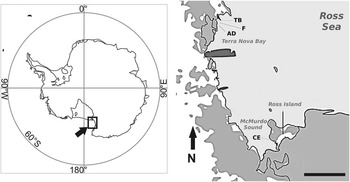
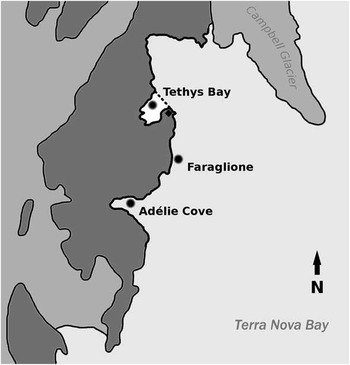
The specimens of P. antarctica used in this study were collected in mid-January 2010 from Cape Evans (77°38.066'S, 166°24.847'E) in McMurdo Sound and in mid-January 2012 from three locations in Terra Nova Bay: Adélie Cove (74°46.470'S, 163°59.328'E), Faraglione (74°43.048'S; 164°06.425'E), and Tethys Bay (74°41.923'S, 164°01.670'E) (Figs 1 & 2).
Study area and sampling sites. AD=Adélie Cove, CE=Cape Evans, F=Faraglione, TB=Tethys Bay. Scale: 100 km.

Sampling sites in Terra Nova Bay, Ross Sea. Black diamond indicates location of the Italian Mario Zucchelli station.

At Cape Evans macroalgae were sampled through 1-m diameter holes made in the sea ice with a Reed drill. At the time of sampling the ice thickness did not exceed 1 m. The water temperature and salinity were measured with a SBE25 Sealogger CTD (Sea Bird Electronics).
Material from Adélie Cove and Faraglione sampling sites was collected around one month after ice break-up. Samples from Tethys Bay, which usually remains ice-covered until January (Gambi, personal communication 2010), were gathered two days after ice break-up. SCUBA divers collected individuals of Phyllophora of a similar size randomly from an area of c. 50 m2. The water temperature and salinity in Terra Nova Bay were measured in situ three times per month in one location in the vicinity of Faraglione Station using an Idronaut Ocean Seven 304 CTD probe (General Oceanics). All samples were collected by SCUBA diving to a depth of c. 10 m.
Sample preparation
Immediately after collection, all Phyllophora thalli were fixed in 4% formaldehyde solution in seawater and stored in separate air-tight plastic containers. Prior to observation with the SEM, ten pieces of at least four different specimens collected at each of the four sampling sites were processed by dehydration in alcohol solution at increasing gradation, followed by critical point drying treatment (Critical Point Dryer K850 EMITECH). Dried samples were finally mounted on aluminium stubs with adhesive carbon tabs and sputter-coated with gold-palladium or platinum in a sputter-coating unit (DESK V HP TSC Cold Sputter Coater).
Scanning electron microscope observations
Diatoms associated with Phyllophora blades were identified to genus, species or variety (when possible) and counted at a high magnification (400–1000 times) on the surface of at least 2 mm2 of each replicate using a SUPRA 40 (Zeiss) SEM. As in our previous studies (Majewska et al. Reference Majewska, Gambi, Totti and De Stefano2013a, Reference Majewska, Gambi, Totti, Pennesi and De Stefano2013b), each identified taxon was assigned to one of the following groups based on its growth form: erect diatoms (attached to the substrate by mucilage stalks, pads or peduncles), adnate diatoms (relatively sessile species attached by one raphid valve face to the substrate surface), motile diatoms (biraphid diatoms which can move freely across unstable substrates), tube-dwelling diatoms (raphid forms living in mucilage tubes of their own making), planktonic diatoms (settled true plankton species), and plocon (loosely attached species living within a biofilm matrix) (terminology by Round Reference Round1981).
Statistical analyses
Statistical analyses were carried out using the PRIMER v6 computer program (Clarke & Gorley Reference Clarke and Gorley2006). The Bray-Curtis similarity index, calculated on species abundance (number of cells per 1 mm2), was used to produce a matrix for non-metric multidimensional scaling (nMDS) ordination. Direct gradient analyses were not used because they require measurements of the environmental factors. The nMDS is a distance-based ordination method and its biggest disadvantage is that all information about the species identities is hidden once the distance matrix is built. However, in this case it does not create a serious problem as the analysis is complemented by other statistical methods. The nMDS analysis maximizes the rank order instead of linear correlation, and it is more suitable when species composition is determined by factors that differ by more than position along a gradient. Moreover, nMDS analysis is able to cope with sparse community data matrices (i.e. when most species are infrequent and when there is a lot of noise; due to contingency and stochastic events, replicates vary from each other even under ideal conditions). Using nMDS analysis, graphical results, which suggest partially intuitive interpretations of the relationships between the species and their environment, are obtained. When the number of factors affecting the examined communities is large, but the important factors are few, this ‘intuitive approach’ that uses a biologist’s experience and knowledge is often very helpful. The pure objectivity may negatively influence the ability to distinguish important gradients. The result is low dimensionally, but each of the dimensions represents important and potentially interpretable environmental gradient. In addition, it is possible to indicate the relative importance of the gradients. The samples are shifted slightly in a direction that allows decreases in ‘stress’, i.e. the misfit between the rank order of the distances in the data and in the ordination. The optimal solution is found by minimizing the stress value.
To test for significant differences between the diatom communities from different locations, the analysis of similarities (ANOSIM) was conducted. Being performed on the similarity matrix itself, this non-parametric test does not depend on the ordination dimensions or the number of samples. The R statistic calculated by ANOSIM lies in the range (-1, 1). R is equal to 1 only if all elements within the set are more similar to each other than any elements from any other set, and R approximates 0 if similarity between and within sets is the same on average. To detect the main diatom species responsible for major dissimilarities between investigated communities, similarity percentage analysis (SIMPER) was conducted. Taxon accumulation curves (Mao Tau) were computed using a sample-based rarefaction method in EstimateS version 9.1 (Colwell et al. Reference Colwell, Chao, Gotelli, Lin, Mao, Chazdon and Longino2012) with the analytical formulas of Colwell et al. (Reference Colwell, Mao and Chang2004). In addition, the estimated total species richness was calculated by functional extrapolation in EstimateS using the Michaelis–Menten function (Colwell & Coddington Reference Colwell and Coddington1994).
Results
Physical parameters
Water temperatures measured in January at Cape Evans and in Terra Nova Bay differed by c. 2–3.5°C. For the ice-covered sampling station at Cape Evans water temperature was much more stable during the sampling period (January) and always lower (-1.36°C) than temperatures measured at the ice-free sites in Terra Nova Bay (0.61–2.24°C). Salinity recorded in situ for the Cape Evans station was 33.9. Salinity measured in Terra Nova Bay during the study period was only slightly higher ranging from 34.5–34.6.
Growth form structure and diatom abundance
Mean total diatom cell abundance ranged from 1312 cells mm-2 for the samples from Tethys Bay to 3955 cells mm-2 for those from Adélie Cove (Table I). Abundance of diatoms found in the material collected from the two above-mentioned stations was characterized by especially high standard deviation (SD) values, which can be directly attributed to uneven distribution of diatoms on macroalgal thalli. Moreover, epiphytic sessile fauna (mainly calcareous bryozoans and hydroids) were found associated with macroalgae from Terra Nova Bay, covering from 5% (Tethys Bay) to 21% (Adélie Cove) of the surface of examined samples. On Phyllophora thalli collected at Cape Evans, sessile fauna were not observed.
Mean total diatom abundance values and host macroalga coverage by epiphytic sessile fauna (n=10).

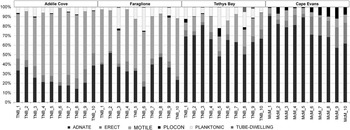
In general, adnate forms dominated in material collected from Cape Evans (57.2–90.7%) and Tethys Bay (48.1–81.1%), while motile diatoms were the most numerous group in samples from Adélie Cove (47.1–78.1%) and Faraglione (35.1–61.0%; Fig. 3). Erect diatoms and loosely attached forms (plocon) reached their highest relative contribution to the diatom community in samples from Cape Evans (2.5–21.7% and 0.6–11.7%, respectively). An opposite trend was observed for planktonic forms, which were rarely present in Cape Evans material, but accounted for 1.0–9.9%, 2.4–24.4% and 5.7–21.9% of total diatoms epiphytic on Phyllophora from Adélie Cove, Faraglione and Tethys Bay, respectively (Fig. 3).
Growth form percent contribution to total diatom abundance.

Species composition
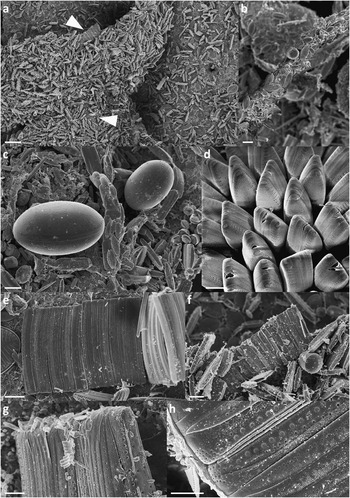
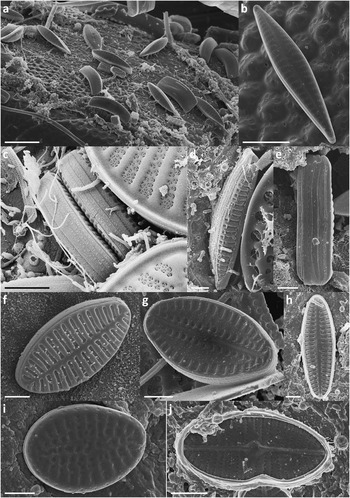
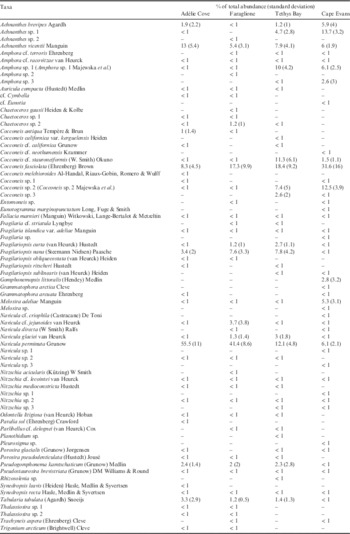
Seventy-two diatom taxa (30 genera) were found in this study (Table II, Figs 4 & 5). Forty-five taxa (21 genera) were noted in material collected from the vicinity of Cape Evans (McMurdo Sound), while 60 taxa (26 genera) were present in samples from Terra Nova Bay (Adélie Cove, Faraglione and Tethys Bay). Twenty-two taxa were common to all four sampling sites.
Epiphytic diatoms from the Ross Sea. a.–c. Diatoms covering all available surfaces. a. Adnate and erect diatoms on Phyllophora blades; arrowheads indicate Eunotogramma marginopunctatum. b. Epiphytic diatoms growing on mucilage tubes of Parlibellus cf. delognei. d. Fragilaria sp. e.–h. E. marginopunctatum. e. & f. Girdle view of E. marginopunctatum forming chains on Phyllophora blades. g. & h. Details of apex and girdle bands. Scale: a.=100 μm, b. & e.=10 μm, c. & f.=20 μm, d., g. & h.=2 μm.

Epiphytic diatoms from the Ross Sea. a. Achnanthes sp. 2 and A. vicentii epiphytic on Trigonium arcticum. b. Achnanthes sp. 2, external view of raphless-valve. c., d. & e. Amphora sp. 3 cells in dorsal view, external valve view and view of ventral surface. f., g. & h. Achnanthes sp. 1 in external view of raphless-valve, external view of raph-valve and internal view of raph-valve. i. & j. Cocconeis sp. 3 in external view of raphless-valve and internal view of raph-valve. Scale: a.=10 μm, b. & c.=5 μm, d., e. & j.=2 μm, f.–i.=1 μm.

List of the diatom taxa found and the mean relative abundance (n=10).

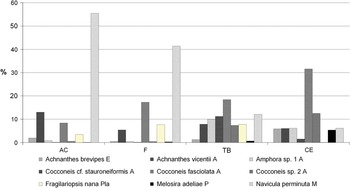
Among the identified taxa, only 20 constituted over 1% of the diatom cells found in the material from any of the four sampling sites, and only 13 constituted over 3%. The five dominant taxa (Achnanthes vicentii Manguin, Cocconeis cf. stauroneiformis, C. fasciolata (Ehrenberg) Brown, Cocconeis sp. 2, Navicula perminuta) comprised over 10% of diatoms counted in the material from at least one sampling station. However, 20 taxa were present at every sampling site, among them only nine species (A. brevipes, A. vicentii, Amphora sp. 2, C. cf. stauroneiformis, C. fasciolata, Cocconeis sp. 2, Fragilariopsis nana, Melosira adeliae, N. perminuta) attained the threshold of 5% of total diatom abundance (Fig. 6). The small motile diatom, N. perminuta, was dominant at Adélie Cove and Faraglione, while C. fasciolata, along with other adnate forms, dominated samples from Tethys Bay and Cape Evans. Higher abundances of erect diatom A. brevipes and loosely attached M. adeliae were noted at Cape Evans than at the other sampling sites. The opposite pattern was observed for planktonic F. nana (Fig. 6).
Mean relative abundances (n=10) of diatoms dominating at the four sampling sites. A=adnate, AC=Adélie Cove, CE=Cape Evans, E=erect, F=Faraglione, M=motile, P=plocon, Pla=planktonic, TB=Tethys Bay.

Statistical analyses
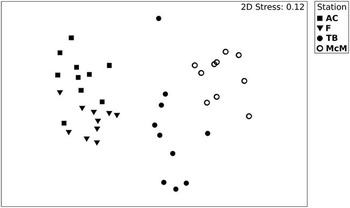
A 2-D solution was obtained for the nMDS ordination (Fig. 7). The nMDS plot revealed some variability between samples collected at certain sampling sites, which was especially marked in the case of Tethys Bay samples. Community composition found in samples from Adélie Cove and Faraglione overlapped to a small extent. Otherwise communities from different sites were distinctly different from one another. ANOSIM results indicated significantly greater variability in the diatom assemblage among analysed sites than within (P=0.001) and confirmed significance of the observed pattern (global R=0.856).
Non-metric multidimensional scaling (nMDS) plot based on species abundance data showing the relationship between the diatom communities from different locations. AC=Adélie Cove, F=Faraglione, McM=Cape Evans (McMurdo Sound), TB=Tethys Bay.

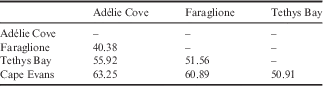
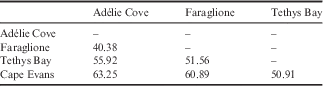
Similarity percentage (SIMPER) analysis allowed identification of taxa important in discriminating between the community structure at the four sample sites. Clear differences were recorded among the more common taxa: A. vicentii, Achnanthes sp. 1, Amphora sp. 1, C. cf. stauroneiformis, C. fasciolata, Cocconeis sp. 2, F. nana, M. adeliae, N. cf. jejunoides, N. perminuta (see supplemental Tables S1–S6 found at http://dx.doi.org/10.1017/S0954102014000327). Based on SIMPER results, the most similar were diatom communities from Adélie Cove and Faraglione (40.38% of dissimilarity; Table III). However, diatoms from Adélie Cove were characterized by higher abundances of N. perminuta and A. vicentii, while C. fasciolata and N. cf. jejunoides were more abundant on macroalgae from Faraglione. The most substantial differences were for communities from Adélie Cove and Cape Evans (63.25% of dissimilarity). The main differences were due to N. perminuta and A. vicentii, which were more abundant at Adélie Cove, and to Achnanthes sp. 1 and Cocconeis sp. 2, found in abundance in samples from Cape Evans (see supplemental Tables S1–S6). Conducted analysis revealed higher levels of similarity between diatom communities from Tethys Bay and Cape Evans (50.91% of dissimilarity) than between those from Tethys Bay and Faraglione (51.56%) or Adélie Cove (55.92%; Table III).
Average dissimilarity (%) between diatom communities associated with Phyllophora antarctica collected from four sampling sites.
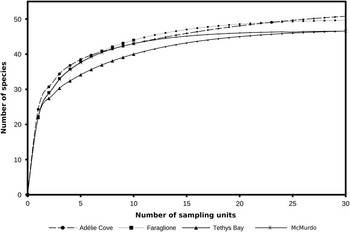
To assess the adequacy of the sampling effort, as well as its effect on the number of diatom types (species) found, the accumulation curves for samples from the four sampling sites were plotted (Fig. 8). The datasets have been standardized by the number of sampling units (sampling unit=2 mm2), which allowed for comparison of the shapes of the curves. All communities are composed of a finite number of species. If one continued to sample, a theoretical asymptote would eventually be reached by the curves at the level of the actual community richness. Generally, the more convex the curve, the better surveyed the community. According to the model, our survey allowed us to detect taxa which accounted for >95% of the estimated actual community richness in the case of the Cape Evans community, but for only 85–90% for communities from Adélie Cove and Faraglione.
Interpolation (data marked with bigger symbols) and extrapolation (data marked with smaller symbols) from the abundance reference sample. The reference sample of ten sampling units reveals a certain number of taxa. Interpolation (rarefaction) indicates the estimated number of species found in a certain number of sampling units (< 10). Extrapolation presents the estimated number of species found in an augmented number of sampling units (> 10).

Discussion
Diatom abundance
The highest values of total diatom abundance were found in the samples from Adélie Cove. Also our previous studies showed that this sampling site was characterized by especially abundant and complex epiphytic communities, which were associated with effects from the nearby penguin rookery (Majewska et al. Reference Majewska, Gambi, Totti and De Stefano2013a, Reference Majewska, Gambi, Totti, Pennesi and De Stefano2013b). The least abundant diatom communities were observed in Tethys Bay samples. Phyllophora thalli collected from this site had large bare areas, not covered by living organisms. It seems possible that this condition might be caused by movements of ice fragments during ice break-up which coincided with stormy weather and rough sea conditions. It was demonstrated that ice alters benthic communities through scouring of hard surfaces and mechanically damaging macroscopic organisms (Clark et al. Reference Clark, Stark, Perrett, Hill and Johnston2011). Although no direct reports exist, such catastrophic events are probably not without consequences for surface-associated microscopic forms.
According to our results, diatom abundances in Terra Nova Bay were comparable to those at Cape Evans, suggesting that the ice-cover and low light levels did not significantly affect diatom biomass. In fact, low temperature values measured at Cape Evans may have depressed respiration rates and favoured survival and growth during periods of low light (Miller & Pearse Reference Miller and Pearse1991).
While epiphytic diatoms from Cape Evans showed relatively high homogeneity and even distribution covering the entire available surface of macroalgal blades, communities from other stations demonstrated certain patchiness and clumping of cells in the vicinity and on the surface of sessile microfauna associated with the same host seaweed. This difference was partially due to the fact that epiphytic sessile fauna were not found on macroalgal thalli from Cape Evans, unlike samples from Terra Nova Bay. As a consequence, surfaces available for epiphytes from Cape Evans were topographically uniform, which increased the competitiveness between co-occurring diatoms and resulted in a limited richness and diversity of associated microalgae, as well as their more even distribution on the substrate surface. Clustering in the vicinity of sessile invertebrates may also indicate a trophic relation between diatoms and epiphytic microfauna. The existence of microscale nutrient patches created by zooplankton and their importance for microbial ecology has been demonstrated in pelagic communities (Blackburn et al. Reference Blackburn, Fenchel and Mitchell1998). Therefore, it is conceivable that epiphytes profit from nutrients released from microfauna associated with macroalgal hosts.
The other reason for the relatively high patchiness in diatom communities from Terra Nova Bay may be extensive grazing by various groups of herbivorous organisms with different feeding modes and, therefore, feeding on a wide range of diatoms. It was reported that a rich benthic fauna was found in the shallow waters of Terra Nova Bay and that many of these, both micro- and macro-organisms, most probably feed on benthic diatoms (Gambi et al. Reference Gambi, Lorenti, Russo and Scipione1994, Povero et al. Reference Povero, Chiantore, Misic, Budillon and Cattaneo-Vietti2001).
Growth form structure and ice-cover influence
The analyses showed that the diatom communities from the four sampling sites differed significantly in diatom abundance and taxonomic structure. Interestingly, communities from Tethys Bay were more similar to those from the remote site at Cape Evans than to those from nearby Faraglione station (c. 5 km away from Tethys Bay sampling site). This observation suggests a strong influence of the ice-cover and the ice edge on the colonization patterns and growth of epiphytic diatoms.
Adnate diatoms dominated at the site covered by ice (Cape Evans) and at that recently freed from ice (Tethys Bay), whereas motile forms (mainly small N. perminuta) were most abundant in samples from sites where ice retreated a few weeks earlier (Adélie Cove and Faraglione). It was assumed that adnate diatoms, due to their close contact with the associated plant tissue, may particularly benefit from nutrient exchange with their host (Totti et al. Reference Totti, Romagnoli, De Stefano, Di Camillo and Bavestrello2011). Horizontally growing forms are often early colonizers, typical for an early stage successional development of epiphytic communities. The adpressed algae are resistant to the physical disturbance and either resistant or only slightly susceptible to grazing (Cardinale et al. Reference Cardinale, Hillebrand and Charles2006). Many of them are probably highly tolerant to low light and may dominate in habitats where shade intolerant species are not competitive (e.g. under the ice-cover) and the epiphytic community does not develop into complex 3-D and well-established diatom biofilm. On the other hand, both erect and motile diatoms become superior competitors for space in nutrient-rich, low disturbance and relatively high light habitats (e.g. Hardwick et al. Reference Hardwick, Blinn and Usher1992, Cardinale et al. Reference Cardinale, Hillebrand and Charles2006, Totti et al. Reference Totti, Romagnoli, De Stefano, Di Camillo and Bavestrello2011, Majewska, personal observations).
The higher contribution of erect diatoms to the total microalgal community characterized samples from Adélie Cove and Cape Evans. Moreover, planktonic taxa were almost entirely absent in the material collected from the latter sampling site. It has been suggested that the erect position of some diatoms is an adaptation to unfavourable light conditions. Benthic forms growing vertically may more easily collect sufficient amount of light from the small fraction of solar radiation which penetrates through thick ice (Cape Evans) or through the dense layers of the macroalgal beds (Adélie Cove) (Lotter & Bigler Reference Lotter and Bigler2000). In addition, the vertical structure of diatom communities closely reflects physical conditions of the habitat, such as current velocity and the morphology of the shoreline. Weakly attached erect forms are more susceptible to current-induced shear stress and other physical disturbances than species tightly attached to the substrate (Liu et al. Reference Liu, Soininen, Han and Declerck2013). Therefore, erect forms would find more desirable conditions for their development at the sheltered sites of Cape Evans (where damage by wind-generated waves and surge is limited due to ice-cover; Miller & Pearse Reference Miller and Pearse1991) and Adélie Cove (a sheltered inshore bay; Povero et al. Reference Povero, Chiantore, Misic, Budillon and Cattaneo-Vietti2001), but not in more open Faraglione and highly disturbed Tethys Bay. The absence of the planktonic forms at Cape Evans may be explained by the fact that plankton development is strongly inhibited by the ice coverage and planktonic diatom blooms occur after or during the ice break-up (Lannuzel et al. Reference Lannuzel, Schoemann, Dumont, Content, de Jong, Tison, Delille and Becquevort2013). It was postulated that the Antarctic sea ice contains considerably high amounts of organic matter and iron, which leads to ice-edge blooms during the ice melting and breaking-up (Lannuzel et al. Reference Lannuzel, Schoemann, de Jong, Pasquer, van der Merwe, Masson, Tison and Bowie2010). Moreover, small algae (< 10 μm; pennate diatoms belonging mainly to Fragilariopsis, Navicula and Nitzschia genera) which had been trapped in sea ice and survived growing within a largely restricted space are released from the melting ice during spring and summer (Różańska et. al. Reference Różańska, Poulin and Gosselin2008, Paterson & Laybourn-Parry Reference Paterson and Laybourn-Parry2012). These species are highly adapted to the extremely harsh conditions of winter ice habitats (including low temperature and high salinity), but many of them are able to thrive in seawater (e.g. Fragilariopsis) and/or grow rapidly on the surfaces of hard substrates such as macroalgal thalli (e.g. Navicula and Nitzschia). Moreover, small cells have a lower iron demand and usually much higher growth rates than the large ones (Sunda & Huntsman Reference Sunda and Huntsman1995). Large area to volume ratio makes them effective competitors for nutrients, while high motility (e.g. Navicula and Nitzschia) allows migration in response to a wide variety of environmental factors such as gradients of biogenic substances or irradiance (McLachlan et al. Reference McLachlan, Brownlee, Taylor, Geider and Underwood2009). Owing to these characteristics, small motile pennates are effective early colonizers and re-colonizers even in nutrient-rich systems. Their populations can rapidly recover from disturbances (e.g. grazing or biofilm removal by mechanical forces) and spread over exposed bare surfaces (Majewska, personal observations). Our results clearly indicate the general pattern in seasonal change: adnate and erect diatoms dominate in conditions of complete ice-cover, but small motile diatoms (mainly N. perminuta) attain dominance over other forms as the ice-cover retreats.
Diatom community species composition and methodological remarks
A total of 72 diatom taxa were found during this study, which is comparable to our previous surveys on Antarctic marine epiphytes (Majewska et al. Reference Majewska, Gambi, Totti and De Stefano2013a, Reference Majewska, Gambi, Totti, Pennesi and De Stefano2013b), but significantly exceeds the number of species reported in other studies examining epiphytic diatoms from the Southern Ocean (Thomas & Jiang Reference Thomas and Jiang1986, Al-Handal & Wulff Reference Al-Handal and Wulff2008, Sutherland Reference Sutherland2008). This discrepancy is mainly due to differences in methodology. Traditional methods (e.g. Aloi Reference Aloi1990) of sampling epiphytic diatoms employ boiling acids and other corrosive substances that may result in dramatic modification of samples. Some less silicified valves may dissolve or be damaged with treatment by aggressive reagents. However, observations showed that this is probably minimal in the case of epiphytic forms. Much more important in altering the results and providing a misleading picture of the diatom species composition, as well as their abundance, may be ineffective laboratory practices and processing techniques. Many of the small cells present in the sample do not form aggregates and do not settle to the bottom of the tube during the traditional cleaning procedure. These taxa may be easily overlooked and removed with the visibly clear supernatant (Majewska & Antonucci unpublished data). Moreover, in the case of some minute or lightly ornamented forms (e.g. Fragilaria, Navicula and Nitzschia genera), the resolution of the light microscope may not be sufficient to distinguish species. Inadequate sample size is another limitation and methodological challenge.
In this study, we tried to assess the influence of the sampling effort on the observed biodiversity of epiphytic diatoms. As a rule, the number of taxa found increases with sampling effort until all taxa are detected. Plotting an accumulation curve shows the relationship between the number of taxa noted and increasing sampling effort and indicates the total diversity of the examined community. Furthermore, it gives information on inventory completeness (i.e. how well the community has been surveyed and what fraction of the taxa belonging to the community has been found) (Hughes et al. Reference Hughes, Hellmann, Ricketts and Bohannan2001). The convex shape of the curves obtained indicates that the epiphytic communities examined were well sampled and that the large fraction (c. 85% to > 95%) of the co-existing taxa had been detected. This extensive survey allowed us to find many rare, unknown or poorly known, but functionally interesting taxa. Nonetheless, calculated curves confirmed that diatom biodiversity may be higher in communities from Terra Nova Bay (Adélie Cove, Faraglione and Tethys Bay) than in those from Cape Evans, and that increased sampling effort would result in an even higher number of detected taxa especially in the case of the densely packed communities presenting uneven distribution of diatoms with different growth forms (Adélie Cove and Faraglione).
Sutherland (Reference Sutherland2008), in her study on surface-associated diatoms from Cape Evans, found 31 diatom taxa associated with P. antarctica collected from under the ice in November. Reported diatom species composition and the relative abundance of each taxa differ significantly from our results, which may indicate strong seasonality in the growth and abundance of Antarctic epiphytic diatoms. Although we believe that Antarctic epiphytes present pronounced seasonality, influence of the previously mentioned methodological differences cannot be ruled out. Sutherland described living specimens of Eunotogramma marginopunctatum Long, Fuge & Smith, noting that the species occurred only in material collected from depths of 20 and 25 m, and its relative abundance increased with depth. The author suggested that this observation might indicate that E. marginopunctatum has facultative heterotrophic, photoheterotrophic or mixotrophic nutrition. In our samples E. marginopunctatum was found at Cape Evans, but its mean relative abundance did not exceed 1% of the total. It must be noted that diatom communities from the remote site of Cape Evans differed to some degree from those collected from Terra Nova Bay in species composition: some of the rare, but morphologically distinct diatom taxa found at Cape Evans have probably been observed for the first time (e.g. cf. Eunotia, Navicula sp. 1, Navicula sp. 3). On the other hand, some species (e.g. A. vicentii, C. fasciolata, N. perminuta) constituted important epiphytic community components in both the ice-covered site at Cape Evans and ice-free sampling stations in Terra Nova Bay. According to McMinn et al. (Reference McMinn, Runcie and Riddle2004), maximum mid-day irradiance within an area examined at Casey (eastern Antarctica) varied from c. 2 μmol photons m-2 s-1 under the ice-cover to 308 μmol photons m-2 s-1 at the depth of c. 10 m when the ice was absent, which may suggest that the above mentioned diatoms are well adapted to the large changes in light conditions. Considering the extreme environment (McMurdo is the southernmost marine system not covered by glacial ice and the southern limit of the macroalgal distribution; Schwarz et al. Reference Schwarz, Hawes, Andrew, Norkko, Cummings and Thrush2003), it seems possible that we might find locally endemic microepiphytes, adapted to especially harsh conditions (i.e. cold and light-limited). Furthermore, year-round studies would definitely help to resolve many general questions concerning Antarctic benthic diatoms and their survival strategies.
Acknowledgements
We acknowledge financial support from the Second University of Naples (SUN) and from the Italian National Program of Research in Antarctica (PNRA). We are deeply grateful to Deneb Karentz who collected samples from Cape Evans, provided invaluable feedback, constructive comments, important suggestions as well as linguistic revision of the manuscript. We thank Enrico Olivari and Paolo Povero who generously provided data on salinity and water temperature from Terra Nova Bay. Thanks are also due to Alessandra Antonucci for her kind assistance with the preparation of the material. We would also like to thank the reviewers for their comments on the manuscript.
Author contribution
Both authors contributed significantly to the presented work. Majewska, R.: conception, design, execution and interpretation of the findings, drafting and revising the article. De Stefano, M.: conception and design of the study.