

Introduction
In 2007, three sex workers from Ontario, Canada, launched a constitutional challenge to the country's prostitution laws. Terri-Jean Bedford, Amy Lebovitch and Valerie Scott challenged sections of the Criminal Code of Canada concerning activities related to prostitution, including keeping or being found in a common bawdy house, living off the avails of a person in prostitution and communicating in a public place for the purposes of prostitution. Upon considering the extensive evidence, the Supreme Court reached a unanimous decision to strike down these provisions because they represented an unjustifiable infringement of sex workers’ rights to life, liberty and security of the person enshrined in the Canadian Charter of Rights and Freedoms (Attorney General of Canada v. Bedford, 2013). The decision, reached in December 2013, was suspended for a period of 12 months to give the government an opportunity to respond with a new legal framework.
In Canada and beyond, academic researchers, legal experts, and sex worker activists have over decades been amassing evidence that they hoped and continue to hope will inform prostitution policy (Allen et al., Reference Allen, Bennett, Chettiar, Jackson, Krüsi, Pacey, Porth, Price, Shannon and Taylor2014; Amnesty International, Reference International2016; Atchison et al., Reference Atchison, Benoit, Burnett, Jansson, Kennedy, Ouellet and Vukmirovich2015; Atchison, Vukrimovich, and Burnett, Reference Atchison, Vukmirovich and Burnett2015; Benoit and Millar, Reference Benoit and Millar2001; Bowen, Reference Bowen2006; Canadian Alliance for Sex Work Law Reform, 2014; Chu and Glass, Reference Chu and Glass2013; Cler-Cunningham and Christensen, Reference Cler-Cunningham and Christensen2000; Csete and Cohen, Reference Csete and Cohen2010; Dodillet and Östergren, Reference Dodillet and Östergren2011; Krüsi et al., Reference Krüsi, Pacey, Bird, Taylor, Chettiar, Allan, Bennett, Montaner, Kerr and Shannon2014; Lazarus et al., Reference Lazarus, Deering, Nabess, Gibson, Tyndall and Shannon2012; Lowman,Reference Lowman1989, Reference Lowman2000, Reference Lowman2004; Lowman and Fraser, Reference Lowman and Fraser1995; Pivot, 2004, 2006; Shannon, Reference Shannon2010; Shannon and Csete, Reference Shannon and Csete2010; Shannon et al., Reference Shannon, Kerr, Allinott, Chettiar, Shoveller and Tyndall2008; Skarhed, Reference Skarhed2010; Skilbrei and Holmström, Reference Skilbrei and Holmström2013; UNAIDS, 2016; World Health Organization, 2012; Wright et al., Reference Wright, Heynen and van der Meulen2015). Members of these epistemic communities hoped specifically that parliamentarians in Canada would engage in a careful consideration of evidence and arguments in developing a new legal frame for prostitution. Beyond these specific hopes, there is a broader normative—if not empirical—expectation that democratic governments engage in deliberation with experts, stakeholders, and members of the public on important policy decisions and that their deliberations are respectful, fair, and non-partisan. At least in principle, the committee system within representative governments ought to provide forums for such deliberation.
We evaluate the parliamentary hearings on Bill C-36 to determine whether this kind of deliberation occurred. We justify our examination of the bill on two interrelated grounds. First, while prostitution laws are a timely and important topic, not much has been written about them from a policy studies perspective that includes how they are formulated (see Wagenaar and Altink, Reference Wagenaar and Altink2012).Footnote 1 In addition to the academic literature concerning the impact of criminal laws on the health and safety of sex workers (see Allen et al., Reference Allen, Bennett, Chettiar, Jackson, Krüsi, Pacey, Porth, Price, Shannon and Taylor2014; Atchison et al., Reference Atchison, Benoit, Burnett, Jansson, Kennedy, Ouellet and Vukmirovich2015; Benoit and Millar, Reference Benoit and Millar2001; Bowen, Reference Bowen2006; Chu and Glass, Reference Chu and Glass2013; Csete and Cohen Reference Csete and Cohen2010; Cler-Cunningham and Christensen, Reference Cler-Cunningham and Christensen2000; Dodillet and Östergren, Reference Dodillet and Östergren2011; Lazarus et al., Reference Lazarus, Deering, Nabess, Gibson, Tyndall and Shannon2012; Lowman,Reference Lowman1989, Reference Lowman2000, and Reference Lowman2004; Lowman and Fraser, Reference Lowman and Fraser1995; Krüsi et al., Reference Krüsi, Pacey, Bird, Taylor, Chettiar, Allan, Bennett, Montaner, Kerr and Shannon2014; Shannon, Reference Shannon2010; Shannon and Csete, Reference Shannon and Csete2010; Shannon et al., Reference Shannon, Kerr, Allinott, Chettiar, Shoveller and Tyndall2008; Skarhed, Reference Skarhed2010; Skilbrei and Holmström, Reference Skilbrei and Holmström2013; Wright et al., Reference Wright, Heynen and van der Meulen2015), certain research focuses on sex workers as they face barriers when accessing health and social services (see Csete and Cohen, Reference Csete and Cohen2010; Krüsi et al., Reference Krüsi, Pacey, Bird, Taylor, Chettiar, Allan, Bennett, Montaner, Kerr and Shannon2014; Lazarus et al., Reference Lazarus, Deering, Nabess, Gibson, Tyndall and Shannon2012; Shannon and Csete, Reference Shannon and Csete2010; Shannon et al., Reference Shannon, Kerr, Strathdee, Shoveller, Montaner and Tyndall2009) and in their relationships with clients, partners, and family members (see Atchison et al., Reference Atchison, Benoit, Burnett, Jansson, Kennedy, Ouellet and Vukmirovich2015; Benoit and Millar, Reference Benoit and Millar2001; Bowen, Reference Bowen2006; Bowen and Bungay, Reference Bowen and Bungay2016; Clancey and MacKenzie, Reference Clancey and MacKenzie2015). All of this is important research, which can be complemented by a policy studies perspective. Through a policy lens, we see that prostitution is a classic case of morality policy, which often vexes researchers for not being based on sound arguments and evidence (Wagenaar and Altink, Reference Wagenaar and Altink2012). Examining this case, we can develop insights into how committee members deliberate on issues that are deeply polarized and polarizing and how they interact with and respond to witnesses who may strongly agree or strongly disagree with them.
Second, this case offers an opportunity to develop a methodological framework from an underresearched policy area that may be used by other researchers. Although there are several recent studies of parliamentary committees, they often focus on evaluating impacts (see, for instance, Hindmoor et al., Reference Hindmoor, Larkin and Kennon2009; Monk, Reference Monk2010; Russell and Cowley, Reference Russell and Cowley2016; Tolley, Reference Tolley2009). Little analysis has been done on the interactions between committee members and witnesses, especially witnesses from, or witnesses representing or allying with, historically marginalized and stigmatized populations (in this case, sex workers and survivors of sexual violence), and their engagement in deeply contentious policy debates.Footnote 2
Because we do not have examples of past work on similar data, and thus were not able to apply an a priori model, we took an inductive approach based on grounded theory (see Bryant and Charmaz, Reference Bryant, Charmaz, Bryant and Charmaz2007; Corbin and Strauss, Reference Corbin and Strauss2008; Hood, Reference Hood, Bryant and Charmaz2007; Kuckartz, Reference Kuckartz2014; Moghaddam, Reference Moghaddam2006; Suddaby, Reference Suddaby2006; Tan, Reference Tan2010). We established coding categories and rules as we progressed with our data collection and analysis and refined them as we became more familiar with the hearing transcripts. An important contribution of this essentially exploratory work is that our coding scheme can be developed, applied and tested by other researchers interested in similar projects (see Appendix B in Johnson et al., Reference Johnson, Mary and Kerry2017 for more detail).
We qualitatively analyzed the transcripts from the hearings of the Standing Committee on Justice and Human Rights and the Senate Standing Committee on Legal and Constitutional Affairs, which took place in the summer and fall of 2014. Our focus was on the content, tone, and nature of each question posed by committee members to witnesses either in favour of (pro witnesses) or in opposition to (con witnesses) the bill. We found that the vast majority of questions were respectful, neutral, and fair but that committee members were biased toward witnesses in agreement with their position and against witnesses in opposition to it. While this may not be surprising to observers of parliamentary politics, this finding is derived from a systematic analysis that makes contributions to the literatures on prostitution, morality policy, and qualitative methodologies. Before turning to a discussion of our study, we briefly review the literature on parliamentary committees.
Parliamentary Committees in Canada and Beyond
Parliamentary committees play an important role in policy development. As Schofield and Fershau write, “the committee of the whole House, which consists of all elected members of an assembly,” is responsible for reviewing draft legislation and spending estimates (Reference Schofield, Fershau, Dobuzinskis, Howlett and Laycock2007: 355). Parliamentary committees meeting outside the chamber are smaller groups of private members who together represent officially recognized parties in proportion to their respective total seats. According to Franks, committees “offer the prospect of more channels for processing legislation…[and] getting more business through parliament” (Reference Franks1987: 161). Activities include studying bills, which involves examining evidence and hearing from witnesses. As Pedersen and colleagues write, committees “function as an important linkage between state and civil society” (Reference Pedersen, Halpin and Rasmussen2015: 409).
Docherty argues that parliamentary committees are valuable in large part because of their non-partisan tendencies (Reference Docherty2005). In his words, they “operate outside the more formal atmosphere and media glare of the chamber,” in a “more relaxed mood,” where there is “often less overt partisan tension” and greater co-operation; they “are more directly engaged in policy discussions than the legislature as a whole”; they encourage specialization, which can result in members being less inclined to participate in “partisan heckling”; they have greater authority over activities under their remit, “particularly regarding the calling of witness testimony and documents;” and they are “staffed with employees of the legislature” who are non-partisan (Reference Docherty2005: 165–66). However, despite the general tenor of committees being more collegial than that of the chamber (Docherty, Reference Docherty2005; Franks, Reference Franks1987; Hindmoor et al., Reference Hindmoor, Larkin and Kennon2009; Samara, 2011a, 2011b; Skogstad, Reference Skogstad1985; Stewart, Reference Stewart1977), they are often characterized by intense debate and entrenched positions.
Skogstad notes that committees fulfill two overarching roles, conflict management among groups and representation of individuals, and that both can be derailed by partisan politics (Reference Skogstad1985). Partisan manoeuvres by committee members and deep divisions among their client groups may bring these two roles into conflict. The representation of specialist interests on committees decreases the likelihood of conflict management. In such circumstances, “the intense adversarial relationship between government and opposition committee members is unlikely to promote consensus-building between divergent groups” (Reference Skogstad1985: 771). Other factors inhibiting non-partisan deliberation within committees include party discipline, which is often enforced by member substitution and rotation. The non-profit organization Samara finds in a recent study of former Canadian parliamentarians that “many MPs complain that their parties directly interfered with their Parliamentary work by disrupting committees” (2011a: 17). As Atkinson and Nossal write, “the pervasiveness of party discipline means that committee members will never be entirely willing or able to insist on the integrity of committee proceedings” (Reference Atkinson and Nossal1980: 290). Park also notes the prevalence of party politics within committees (Reference Park2011). Similarly, Hindmoor and colleagues discuss the role of politics in committee deliberations (Reference Hindmoor, Larkin and Kennon2009).
Despite the interest group politics and party influences, the epistemic communities centring on prostitution law reform hoped that the new policy would be based on a serious consideration of the evidence in a respectful, fair, and non-partisan manner. Moreover, harking back to Franks, there remains a normative expectation that committees should be a place for collective deliberation by committee members and witnesses with a diversity of expertise and insights. In the following sections, we outline the parliamentary hearings on Bill C-36, discuss our methodology, and present our findings.
Parliamentary Hearings on Bill C-36
In June 2014, the Standing Committee on Justice and Human Rights invited individuals and groups to submit briefs concerning Bill C-36. The Standing Committee included seven members of Parliament from the governing Conservative Party of Canada (CPC), two from the opposition New Democratic Party (NDP) and one from the Liberal party, although during these hearings, eight CPC members, three NDP members, and one Liberal party member participated at various times. The committee's chair was a CPC MP and the vice-chair was from the NDP. The hearings were held in Ottawa on July 7, 8, 9, 10, and 15, 2014. On average, each session had seven witnesses representing either an organization or as individuals. Organizations could have multiple witnesses but were given a total of 10 minutes for their opening statement. As Senate appointments can only be made by the Government of Canada, the Senate Standing Committee on Legal and Constitutional Affairs included eight Senators appointed by the Conservatives, three appointed by the Liberals, and one appointed by the Conservatives but who was sitting as an independent. A Conservative appointee chaired the committee and a Liberal appointee was the vice-chair. The hearings were held in Ottawa on September 9, 10, 11, and 17 and October 29 and 30, 2014. The bill passed in the House on October 6 and in the Senate on November 4. It received Royal Assent on November 6 and came into force and effect on December 6, 2014.
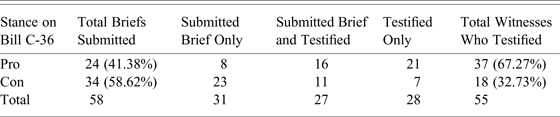
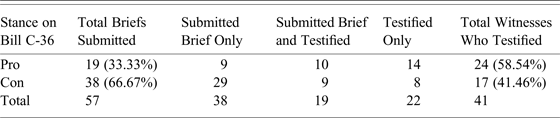
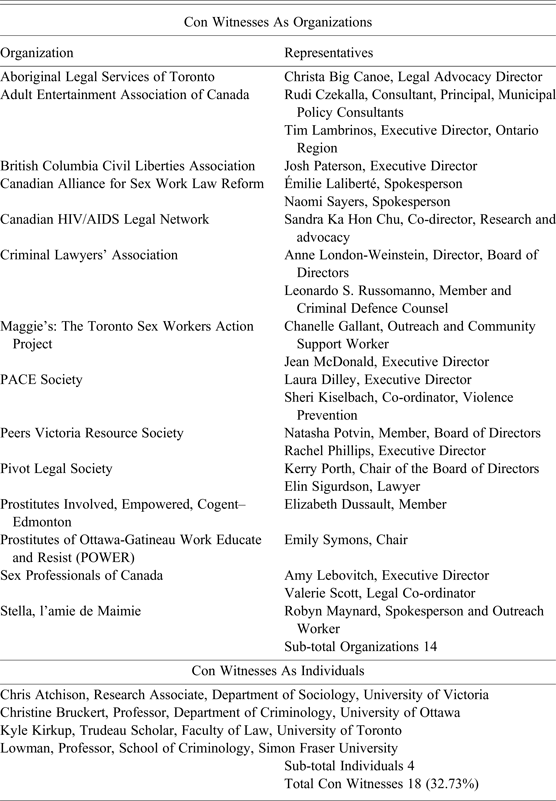
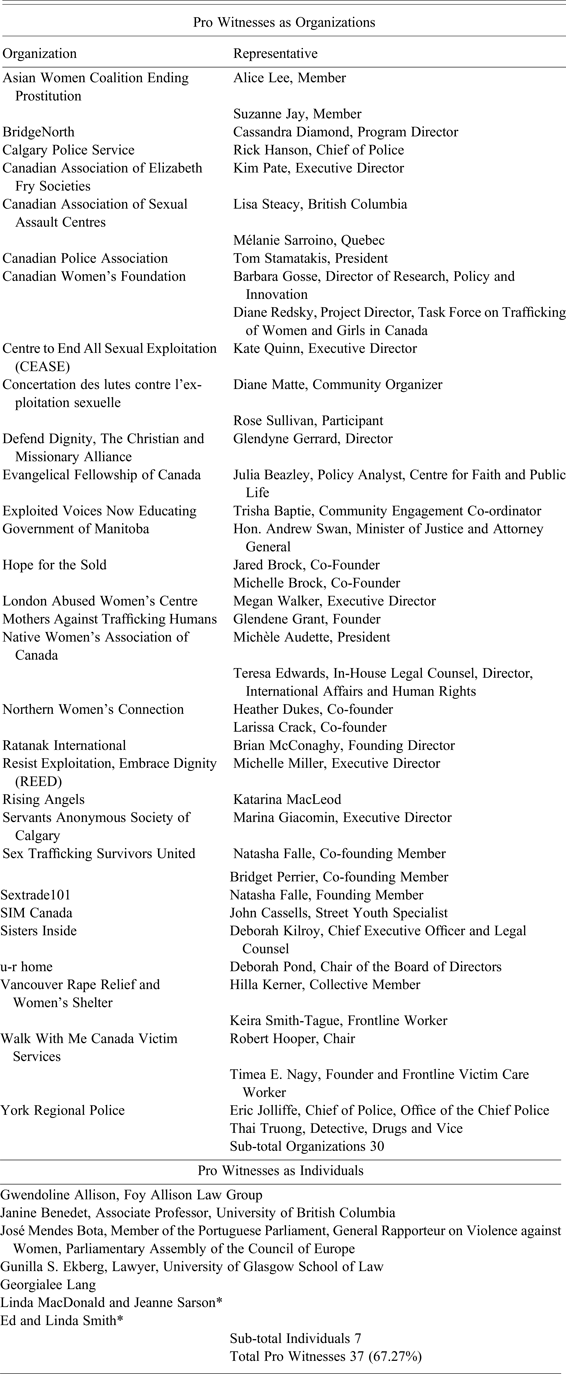
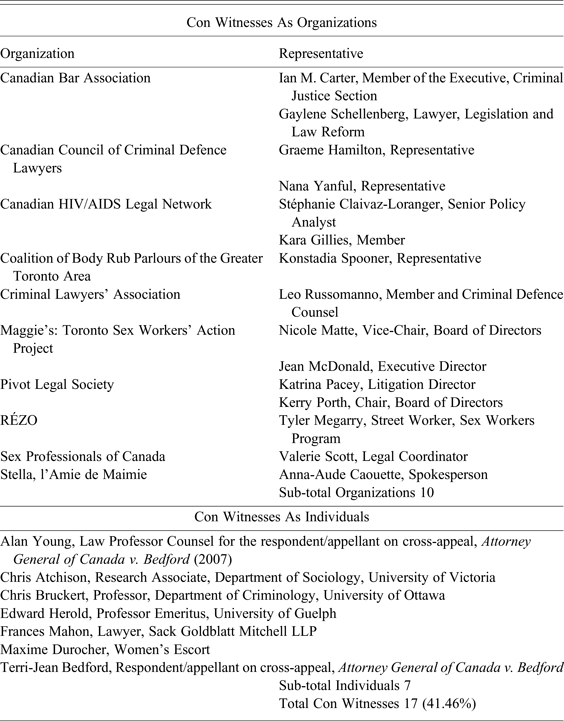
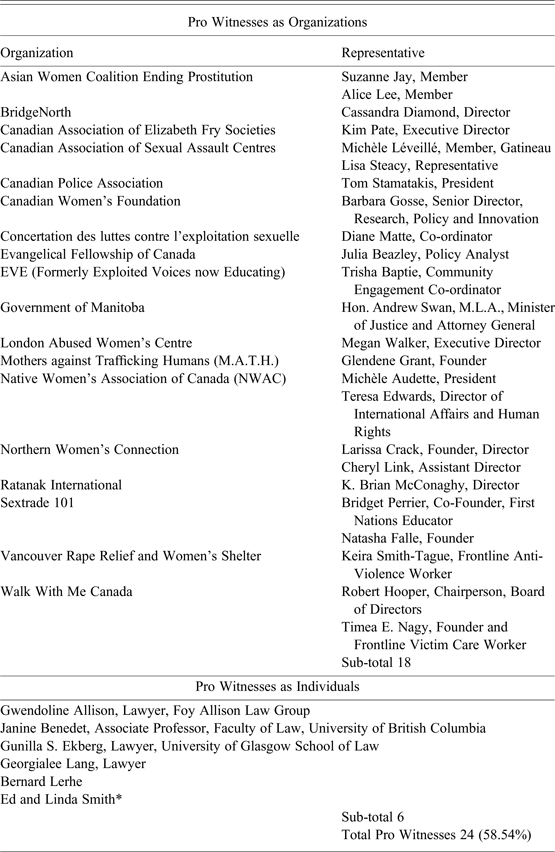
In terms of the numbers of witnesses either against or in favour of the bill, there was an imbalance (Tables 1a and 1c; for more details, see appendix A).Footnote 3 For the commons committee, the total number of individual and organizational witnesses in favour of the bill was 37 (67.27%), whereas the total number of witnesses against it was 18 (32.73%). For the Senate committee, there was a more equal distribution of witnesses but still a larger number of those in favour: 24 (58.54%) to 17 (41.46%) (Tables 2a and 2c).
Standing Committee on Justice and Human Rights—Summary by Pro and Con Witnesses

Standing Committee on Justice and Human Rights—Summary by Pro and Con Briefs Submitted

Standing Committee on Justice and Human Rights—Briefs and Witnesses

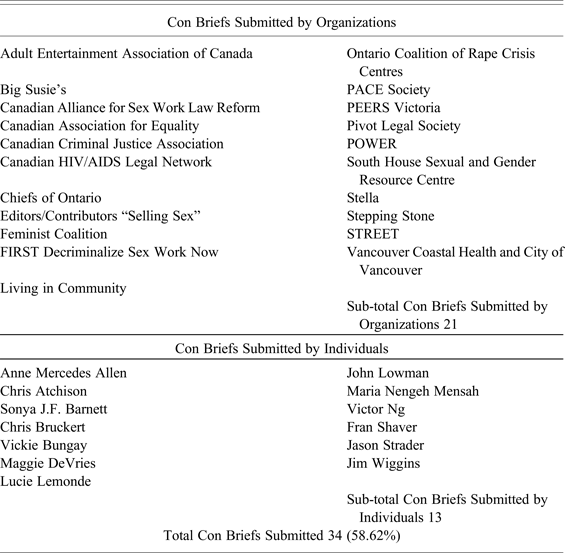
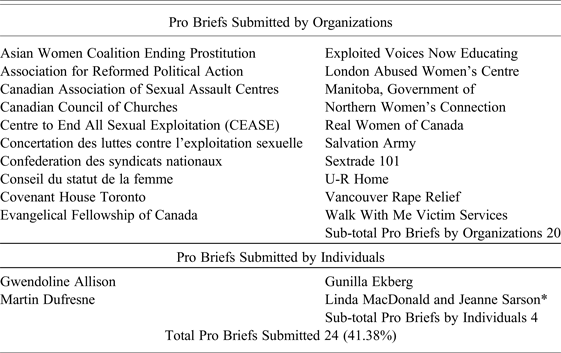
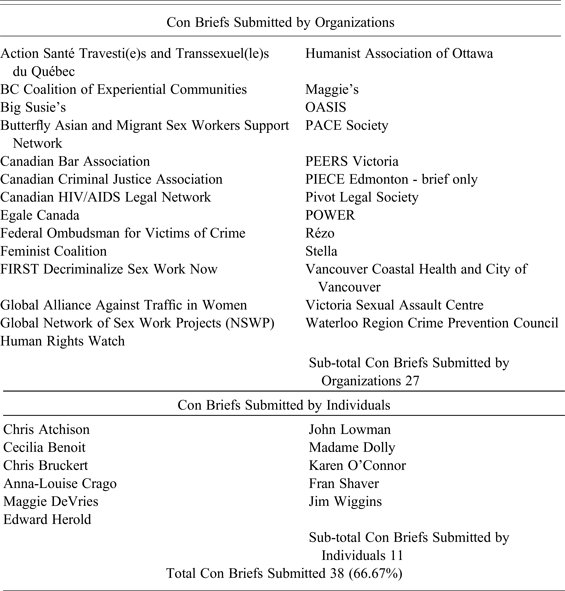
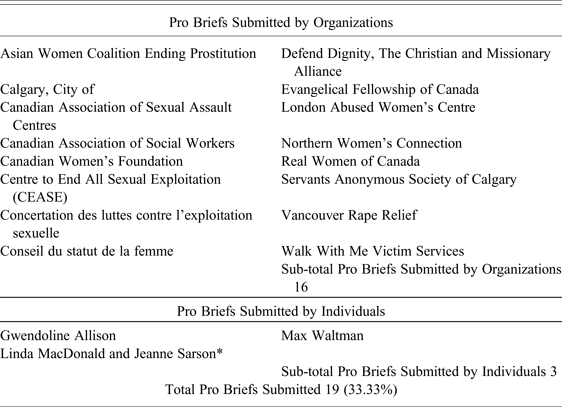
Looking at the pool of prospective witnesses who submitted briefs to both committees (Tables 1b and 2b), we find that the inequality of representation was not based on the initial distribution of perspectives for and against the bill. There were more prospective witnesses articulating serious criticisms of the bill than those highlighting its strengths. Thirty-four (58.62%) who were against the bill and 24 (41.38%) who were in favour of it submitted briefs to the commons committee, and 38 (66.67%) who were against and 19 (33.33%) who were in favour submitted briefs to the senate committee. Of the 24 individuals and organizations in favour that submitted briefs to the commons committee, 16 (66.67%) testified. Of the 34 individuals and organizations against, 11 (32.35%) testified. In addition, the committee invited 21 individuals and organizations favouring the bill and 7 opposing it that had not submitted briefs (Table 1c). The senate committee heard from 10 (52.63%) of the 19 pro individuals and organizations that submitted briefs and 9 (23.68%) of the 38 con individuals and organizations from the group who submitted briefs. An additional 14 pro and 8 con individuals and organizations that did not submit briefs were invited (Table 2c).
Standing Senate Committee on Legal and Constitutional Affairs—Summary by Pro and Con Witnesses

Standing Senate Committee on Legal and Constitutional Affairs—Summary by Pro and Con Briefs Submitted

Standing Senate Committee on Legal and Constitutional Affairs—Briefs and Witnesses

Description of Methodology and Analysis
Our overarching question centres on whether committee members treated witnesses testifying on Bill C-36 respectfully and fairly. It is important to highlight that our methodology is interpretative and qualitative but that our findings are expressed in numeric terms amenable to statistical analysis. Like most qualitative analyses, ours is inductive (see Hood, Reference Hood, Bryant and Charmaz2007; Maxwell, Reference Maxwell2005). Our justification for taking an inductive approach derives from the fact that we cannot find in the academic literature any content analyses of parliamentary hearings involving policy issues that are polarized and that involve marginalized populations, and their representatives and allies. Little, if any, study has been done on the content, tone, and nature of committee member questioning of witnesses.Footnote 4 Our approach is appropriate because we are engaging in exploratory research (Campos, Reference Campos2004) into a phenomenon about which “little is known” (Gerbic and Stacey, Reference Gerbic and Stacey2005: 50; see also Chong and Yeo, Reference Chong and Yeo2015; Robson, Reference Robson2002; Wright, Reference Wright2009).
Our analysis of the hearing transcripts is informed by grounded theory. Grounded theory approaches build and refine coding categories as researchers become more immersed in the data. As Hood writes, drawing from Glaser and Strauss, the key components of grounded theory include a “spiral of cycles” of data collection, coding, analysis, writing, design, and categorization; “constant comparative analysis” of theoretical categories throughout each cycle; theoretical sampling of categories developed from ongoing data analysis; codes that emerge from the data and that are not imposed a priori on it; and resulting theory that is “developed inductively from data rather than tested by data” and that is “continuously refined and checked by data” (Reference Hood, Bryant and Charmaz2007: 154).
In mid-fall of 2014, the three authors began reading the transcripts, examining the micro level of single words and phrases with the intention of identifying macro level patterns. Working consensually, we identified questions as our unit of analysis, as they stood out as the most common form of communication between committee members and witnesses. Most were easily identified by a question mark at the end. On occasion, questions would appear as statements and not contain a question mark. We identified these implicit questions by asking ourselves if they could be followed by “Is that what you meant?” “Do you agree or disagree?” or “Do you care to comment?” If these statements still made sense, and if the witness or witnesses responded as though they believed these statements were questions, we counted them as such.
Our initial reading of the transcripts led us to conceptualize three dimensions for questions; we saw that each question could be understood in terms of its content, tone, and nature. We refined questions as our unit of analysis by incorporating a focus on these dimensions, which we developed into both measurable and generalizable core categories and evaluative codes. Our process resulted in three categories and eight codes. For content, we evaluated each question as either respectful or disrespectful; for tone, we evaluated each question as positive, negative, or neutral; and for nature, we evaluated each question as either sympathetic, combative, or fair.
As we became increasingly familiar with the content of the transcripts, we refined our core categories and began defining evaluative codes. We then began coding the transcripts in the chronological order of the sessions. It is important to point out that we coded each question in terms of content, tone, and nature. Kuckartz writes that “qualitative text analysis tends to use a procedural approach that aims at minimizing coding differences by discussing and resolving any questionable or conflicting codings as a research team” (Reference Kuckartz2014: 46). Kuckartz notes that coders do not have to calculate coder-reliability coefficients but that they must use appropriate procedures, such as consensual coding, to ensure that they “agree in their understanding of how to apply the category system.” (Reference Kuckartz2014: 47). We engaged in consensual coding, which involved weekly meetings to check our individual coding of session transcripts, confirm our consistent application of codes, resolve differences among our applications, and further tweak our codes. We viewed validation as an ongoing comparison of our established interpretations against new data emerging from the session transcripts, and we conducted a continuous comparison of our codes to validate our interpretations and ensure generalizability across the entirety of the transcripts. While we focused primarily on the print transcripts, we often referred to the video and audio recordings of meetings.
Seventeen months after we finished our consensual coding, two authors repeated the coding of the entire set of transcripts to test and refine our coding scheme.Footnote 5 For this second round in 2016, we were careful to code separately and to record our individual coding before consensually deciding on the final codes. We were thus able to test the inter-coder reliability and agreement between our individual coding (that is, before the final coding). In addition, we compared the results of the 2014 and 2016 final rounds of (consensual) coding. We refer to the comparison of the two rounds of coding as an inter-transcript reliability and agreement test. For both tests, we provide kappa coefficients and per cent agreements (see Tables 3 and 4).

Inter-Transcript Reliability (between 2014 and 2016 rounds of coding)

*Weighted kappa (Cohen, Reference Cohen1968).
We have very high percent agreements, and the weighted kappa coefficients show substantial to “almost perfect” values for the 2016 round.Footnote 6 We have high percentages for inter-transcript agreement but moderate to low weighted kappa coefficients between the 2014 and 2016 rounds. These findings are very interesting, suggesting that our coding scheme became more refined and robust. Moreover, they suggest that we more consistently applied it in 2016. The following paragraphs provide a basic description of each of our core categories and evaluative codes (see Appendix B in Johnson et al., Reference Johnson, Mary and Kerry2017 for more detail).
Content
On our initial analysis of the transcripts, we observed that the content of questions, that is, the phrases used by committee members, was generally respectful but, on occasion, disrespectful. We thus developed a core category for content and evaluative codes for respectful and disrespectful. Respectful content includes careful and sensitive language that communicates deference to and appreciation of the experience, insights, and knowledge of witnesses as they pertain to the hearings. The following example includes clear indicators of respectful language, which we have bolded.
Mr. Sean Casey (Charlottetown, Lib.): Thank you. Back to you, Dr. Bruckert. I know you were here this morning when we heard the chief of the Calgary police say that a conviction under a summary offence does not result in a criminal record. I don't know if you shared my reaction, but I'd be interested in yours first. Secondly, can you share your experience on what actually does happen when there's a sweep or when people involved in the sex trade are criminally charged? (Standing Committee on Justice and Human Rights, July 8, 2014, Meeting 37)
To Christine Bruckert, Professor, Department of Criminology, University of Ottawa (con witness)Conversely, we developed an evaluative code for disrespectful content to include gratuitous or inflammatory language that dismisses, diminishes, or trivializes the experience and experiences of witnesses as they pertain to the hearings. The following is an example.
Mr. Bob Dechert (Mississauga-Erindale, CPC): A commercial enterprise, for your edification, refers to an organized brothel, a massage parlour, a strip club; it is not the individual prostitute providing her services or a co-operative between two, three, or more prostitutes working together in their own space, where they're sharing expenses equally. That's what you're not understanding, and to say anything different would, in my view, be absurd. (Standing Committee on Justice and Human Rights, July 8, 2014, Meeting 37)
To Elin Sigurdson, Lawyer, Pivot Legal Society (con witness)Tone
Also on our initial analysis of the hearings, we found that there were variations in the tone of questions. There were questions that were expressed in either friendly, “snarky,” or matter-of-fact tones. We thus created and developed a core category based on the tone of the question, that is, how the question sounds, and evaluative categories of positive, negative, and neutral.
As an adjective describing a person's disposition, positive refers to someone having constructive attitudes or taking constructive action. It expresses a willingness to engage productively with others, hear their perspectives, and receive their insights. It involves an affirmation of someone's views. The following is an example of a positive tone question, in which we see expressions of praise and goodwill.
Mrs. Joy Smith (Kildonan-St. Paul, CPC): Thank you so much. I would like to ask some questions now of Chief Hanson. I have to congratulate you and the Calgary Police Service. They are doing amazing work in terms of human trafficking and this whole issue. Your coming here today and your thoughtful comments mean a great deal on this committee. I have a couple of questions. You were talking about the exit strategies and the need for more money, and that has come out very comprehensively. You've also talked about the overrepresentation of Aboriginal women and the need to reduce the gender bias in our society. I thought that very compelling because 10 years ago we would not have heard that from police forces. Can you expand a little bit more clearly on what you've seen on the streets in terms of underage girls on the streets and also about the idea of how women are expected to be treated and accepted and this kind of involvement in the sex trade? Could you expand on what you were saying a little earlier more fully? (Standing Committee on Justice and Human Rights, July 8, 2014, Meeting 35)
To Rick Hanson, Chief of Police, Calgary Police Service (pro witness)Conversely, the adjective negative expresses, conveys, or implies a denial, refusal, or dismissal of something or someone. It expresses a lack of affirmation. Thus negative tone questions sound irritated, dismissive, or discouraging and use phrases to indicate these meanings. Negative tone questions are often expressed repeatedly or persistently in ways that cut off the witness. In the following example, we see a committee member almost haranguing witnesses.
Mrs. Stella Ambler (Mississauga South, CPC): Do you agree that johns should be criminalized and that the buying of sex should be illegal in Canada?
Ms. Christa Big Canoe: That would be our opposition to the bill, that the criminalization—[cut off]
Mrs. Stella Ambler: In principle you disagree that we should criminalize the mostly men who buy sex.
Ms. Christa Big Canoe: Yes, because of the adverse impact it will have on sex workers. The adverse impact it will have on sex workers is the driving of the most vulnerable, the street-level sex workers or survival sex workers, into darker corners or into places where they become unsafe. Contrary to what the Supreme Court had to say about them having the measures—and I don't say “screening” in quotations because it's an actual valid exercise. In doing that, you've pushed— [cut off]
Mrs. Stella Ambler: We've had witnesses here who've said there is no such thing as “underground” or “in dark corners” because when johns want to purchase sex, they have to find the prostitutes. (Standing Committee on Justice and Human Rights, July 10, 2014, Meeting 41)
To Christa Big Canoe, Legal Advocacy Director, Aboriginal Legal Services of Toronto (con witness)We also created an evaluative code for neutral tone questions. The adjective neutral implies something or someone not belonging to either of two established categories. On our reading of the transcripts, questions expressed in a neutral tone sound neither discouraging nor encouraging. They generally include phrases indicating impartiality and dispassion. In the following example, we do not include bold formatting because the entire passage indicates a neutral tone, containing neither explicitly positive nor negative phrases.
Mr. Bob Dechert: If we don't do anything, what do you think Canada will look like in terms of the prostitution business in 10 years? (Standing Committee on Justice and Human Rights, July 10, 2014, Meeting 42)
To Mélanie Sarroino, Quebec, Canadian Association of Sexual Assault Centres (pro witness)Nature
Finally, on our initial analysis of the transcripts, we noticed that the nature of questions also varied. Some seemed to be “softball” questions. Some appeared to be designed to confuse or provoke the responder. Some tended to be open-ended, inquisitive questions. We therefore created a core category for the nature of questions and corresponding evaluative codes for sympathetic, combative, and fair questions.
The word sympathetic refers to an affinity or correspondence between individuals. We defined sympathetic questions as those intending to elicit or highlight an agreement between a committee member and witness. These questions appear to reinforce the argument of the committee member asking the question. They are often expressed in the same language as the witness used in her or his opening statement. The following is an example of a sympathetic question, with key phrases in bold.
Mrs. Joy Smith: Thank you very much. Keira and Hilla, you've been amazing over the years. I've just loved partnering with you in so many ways, and you are in the real world, on the ground. For the committee today, what is the most important message this committee has to get, because you deal with trafficking victims every day of the week? That's for either one of you. (Standing Committee on Justice and Human Rights, July 10, 2014, Meeting 41)
To Hilla Kerner, Collective Member, and Keira Smith-Tague, Front Line Worker, Vancouver Rape Relief and Women's Shelter (pro witnesses)Conversely, we define combative questions as those appearing to highlight disagreement between a committee member and witness, to bring out contradictions in the witness's position, to put him or her in a difficult position, to confuse him or her, or to shut him or her down. Combative questions appear to be attempts to force witnesses to respond in particular ways, casting them in an unfavorable light. Like negative tone questions, combative questions are often persistent or repeated and can contain a demand for a closed response. The following is an example of a combative question, with key phrases in bold.
Senator Donald Plett [CPC appointed]: You have been emphatic here on saying that you haven't been able to find where people actually want to be violent. Senator Frum asked you and Senator Batters asked you. We had a lady here yesterday who said that at the age of 15 she had to have 15 stitches in her cervix and could not have children because of the way she had been abused. We have heard over and over and over about this. And then you sit here and you somehow self-righteously say that we shouldn't be calling those people perverts. We haven't called one person around this table a pervert, nor have we any of the other sex workers present here this week. I don't believe they are. I believe they are trying to eke out a living. These two men right here are trying to make a living. I haven't called them perverts. Robert Pickton is a pervert. He's a killer. I won't apologize for calling him that. And for you to suggest that we should somehow call them something else and for you to sit here and suggest that we don't have violence, continued violence, I find objectionable. Is this the way you usually conduct yourself when people disagree with your point of view? (Standing Senate Committee on Legal and Constitutional Affairs, September 11, 2014)
To Chris Atchison, Research Associate, Department of Sociology, University of Victoria (con witness)Fair questions, as we define them, seek to explore or clarify a witness's position. They are open-ended and exploratory and typically expressed in qualified language. They encourage the responder or responders to elaborate. They tend to be discursive, in the sense of carrying on a conversation with no pre-established conclusion in mind. The following example contains no bolding because the entire passage is expressed in fair manner.
Mr. Sean Casey: Thank you, Mr. Chair. Ms. Phillips, we've heard from a couple of lawyers who have expressed some concern over the reverse-onus provisions. You describe it in your brief as an assumption of guilt in regard to persons who live with or are habitually in the company of persons. I know you talked about that in your opening statement. I get the sense, however, that your concern over this provision is more from a policy perspective than from a legal and constitutional one. So tell me whether or not that is the case, and feel free to expand on why you find this offensive outside of the legal constitutional context. (Standing Committee on Justice and Human Rights, July 10, 2014, Meeting 42)
To Rachel Phillips, Executive Director, Peers Victoria Support Society (con witness)Each question was coded three times, corresponding to the three core categories and their evaluative codes. The following is an example of how we did this for a respectful (bold), positive (bold and italics), and sympathetic question (bold and underscore):
Mrs. Joy Smith: Thank you, Mr. Chair. Thank you to all the witnesses for coming here today to give us your opinions. Mr. Swan, I applaud you for all the work you do in Manitoba. I really applaud your support of Bill C-36, and your advice on some amendments. For the first time in Canada, the purchase of sex will be illegal, and that will help a lot of things. First-time advertising by third parties will be addressed, and for the first time we have compassion in the bill. Having said that, could you expand a bit on what a victim actually needs? With living in the part of Winnipeg you live in and being on some of the streets that both of us have been on, perhaps you could give the committee insight as to what really happens. (Standing Committee on Justice and Human Rights, Meeting 34, July 7, 2014)
To Hon. Andrew Swan, Minister of Justice and Attorney General, Government of Manitoba (pro witness)Findings
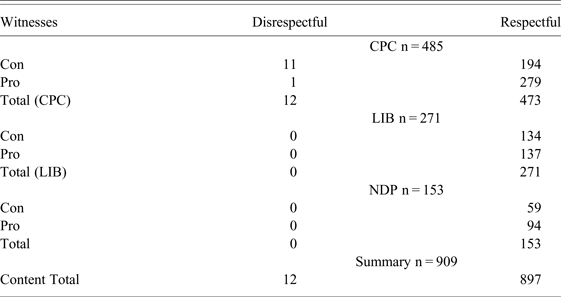
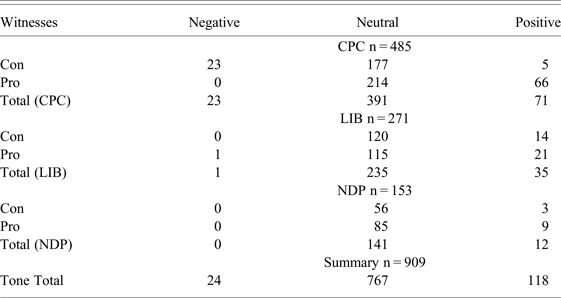
We present our findings from our 2016 coding. We coded 909 questions, with the CPC asking 485, Liberals 271, and NDP 153. The pro witnesses were asked more questions than the con witnesses at a ratio of approximately 3:2 in both absolute numbers (Table 5) and percentages (Figure 1). The CPC and the NDP asked significantly more questions to pro than to con witnesses. Liberal members asked questions to both witnesses in favour and against at an equal ratio. This distribution of more questions to pro witnesses than to con witnesses can be explained by the distribution of witnesses either for or against the bill. Again, there were more witnesses in favour than against; a bias toward those favourable to the bill was effectively built into the lineup of witnesses.
The distribution of questions addressed to pro and con witnesses for each party

Total Questions by Party and Witness

In terms of the content of the questions (see Table 6 and Figure 2), we found that nearly all questions were respectful (CPC = 97.53%; LIB = 100%; NDP = 100%). The only disrespectful questions were asked by the CPC (n = 12), amounting to 2.47 per cent of the party's overall questions. When looking at the distribution of respectful and disrespectful questions to either witnesses in favour or against, we see that 91.67 per cent of disrespectful questions asked by the CPC were directed to con witnesses (n = 11 disrespectful questions to con witnesses and 1 disrespectful question to a pro witness).
The distribution, measured in terms of percentage (%), of disrespectful and respectful questions addressed to con and pro witnesses by each party

Content–Total Questions by Party and Witness

With respect to tone (Table 7 and Figure 3), we found that the vast majority of questions asked by all parties to all witnesses were neutral (CPC = 80.62%; LIB = 86.71%; NDP = 92.16%). All parties asked positive tone questions. Negative tone questions were asked infrequently. CPC members addressed all of their 23 negative tone questions to con witnesses, while a Liberal member addressed his one negative tone question to a pro witness. Of the positive tone questions asked by the CPC, almost all were directed to the witnesses in favour (92.96%; n = 66 positive tone questions asked by the CPC to pro witnesses and 5 to con witnesses). NDP members posed 9 positive tone questions to witnesses in favour of the bill and three to those against it (75% to pro witnesses and 25% to con witnesses). The Liberals posed 21 positive tone questions to witnesses in favour and posed 14 to witnesses against (60% to pro witnesses and 40% to con witnesses).
The distribution, measured in terms of percentage (%), of negative, neutral and positive questions addressed to con and pro witnesses by each party

Tone: Total Questions by Party and Witness

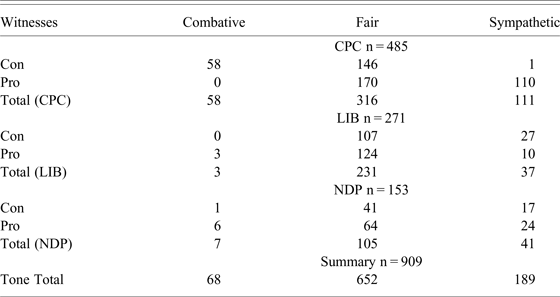
Concerning the nature of questions (Table 8 and Figure 4), a substantial majority of questions asked by all parties to all witnesses were of a fair nature (CPC = 65.15%; LIB = 85.24%; NDP = 68.62%). All parties asked combative questions, but the CPC asked the most. All parties asked sympathetic questions, but the NDP and the CPC asked the most. All combative questions asked by the CPC were directed to con witnesses (n = 58 combative questions). Nearly all combative questions asked by the NDP were directed to pro witnesses (n = 6 to pro witnesses and 1 to a con witness). The three combative questions asked by Liberals were directed to pro witnesses. Virtually all sympathetic questions asked by the CPC were directed to the pro witnesses (99.09%; n = 110 sympathetic questions asked by the CPC to pro witnesses and 1 to a con witness). Sympathetic questions by NDP members were more evenly distributed between witnesses in favour and against, with 58.54 per cent to pro witnesses and 41.46 per cent to con witnesses (n = 24 sympathetic questions to pro witnesses and 17 to con witnesses). Of the sympathetic questions asked by the Liberal party, 72.97 per cent were directed to con witnesses and 27.02 per cent to pro witnesses (n = 27 sympathetic questions asked by the Liberal party to con witnesses and 10 to pro witnesses).
The distribution, measured in terms of percentage (%), of combative, fair, and sympathetic questions addressed to con and pro witnesses by each party

Nature: Total Questions by Party and Witness

Conclusion
In such an ideologically charged area as prostitution policy, there is a normative expectation that elected politicians will deliberate with experts, stakeholders, and members of the public, and that these deliberations will be fair and respectful. Deliberations on Bill C-36 were, on the whole, fair and respectful, but they were also significantly biased.
We found an inequality in the distribution of pro and con witnesses. Despite the larger number of potential witnesses articulating serious criticisms of the bill in their written submissions, more witnesses praising the bill were selected to testify. Since the CPC held a majority of seats on the committee, they were able to select more witnesses than the NDP and Liberal members and to vote down witnesses proposed by the NDP and Liberal members. The decisions concerning the participation of witnesses reveal both an inclusionary bias toward those in favour of the bill and a representational exclusion of those in opposition to it thus building partisanship into the very foundations of the hearings.
Moreover, our findings indicate bias in the content, tone, and nature of questions, especially those from CPC members. When looking at the content of questions, nearly all questions were respectful. However, all disrespectful questions were asked by members of the CPC, and all but one were posed to individuals testifying against the bill. The tone of the vast majority of questions was neutral, but CPC members asked the largest percentage of negative tone questions, all of which were directed to con witnesses. CPC members also asked the largest percentage of positive tone questions, nearly all of which were directed to pro witnesses. Although a substantial majority of questions asked were fair, we see biases in the nature of questions as well. CPC members posed all of their combative questions to witnesses opposing their position and virtually all of their sympathetic questions to witnesses favouring their position. The NDP and Liberal members showed similar biases but not nearly as pronounced.
Our study provides insights into how committee members deliberate on deeply polarized issues and how they interact with witnesses with whom they strongly agree or disagree. It provides insight into what witnesses can expect when invited to appear before a parliamentary committee. This is important especially for witnesses who are, or have been, marginalized or stigmatized, and for those representing them or allying with them. Such individuals engaging on these kinds of issues can expect to be treated consistently well insofar as they support the bill for which they are appearing. However, those expressing more critical views can expect a few disrespectful questions, some negative tone questions, and a few more combative questions. Numerically, these types of questions may not be significant, but from a qualitative perspective, they can seriously affect the experiences of witnesses. Witnesses opposing a contentious bill may experience a deep unease with regard to a process that should be respectful, fair, and non-partisan, as well as focused on sound evidence and arguments, but that is in fact not. This can be very upsetting, indeed traumatic, for certain individuals and it may cause them to disengage from important policy discussions. This is an important conclusion, especially for public hearings on morally contentious policy, in which we hope a broadly inclusive diversity of actors—representing different epistemic communities—participate.
In addition to our substantive findings, we provide a methodology for qualitative analysis and consensual coding that can systematically capture three dimensions of text: content, tone, and nature. We hope that our core and evaluative categories, our grounded theory approach, will inspire other qualitative researchers to further this kind of analysis.
Appendix A
Briefs and Witnesses
Standing Committee on Justice and Human Rights Con Witnesses

Standing Committee on Justice and Human Rights Pro Witnesses

Standing Senate Committee on Legal and Constitutional Affairs Con Witnesses

Senate Standing Committee on Legal and Constitutional Affairs Pro Witnesses

Standing Committee on Justice and Human Rights Con Briefs

Standing Committee on Justice and Human Rights Pro Briefs

Senate Standing Committee on Legal and Constitutional Affairs Con Briefs

Senate Standing Committee on Legal and Constitutional Affairs Pro Briefs