Technological development, globalization and transformations in the structure and composition of the labor market and organizations (Janta et al., Reference Janta, Ratzmann, Ghez, Khodyakov and Yaqub2015) are some of the background affecting the transition from the traditional, serialized and progressive, to discontinuous, nonlinear labor trajectories (Sullivan & Baruch, Reference Sullivan and Baruch2009). This poses the challenge to today’s worker in terms of managing actively their career in order to bolster their employability and develop a satisfactory career.
Perceived employability (PE) is understood as the worker’s appreciation of their chances of getting a new job similar to the one they currently have (Williams et al., Reference Williams, Dodd, Steele and Randall2016), and an external and internal perspective is recognized, i.e., the perception of opportunities inside (Internal PE) or outside (External PE) the current organization (Rothwell & Arnold, Reference Rothwell and Arnold2007). Career satisfaction (CS) is the subjective dimension of career success, and it refers to the perception of the achievement of desirable work-related results and career progress at any point in a person’s work experience over time (Arthur et al., Reference Arthur, Khapova and Wilderom2005; Ng & Feldman, Reference Ng and Feldman2014). In short, EP and CS refer to self-perception, and to a person’s position in internal and external labour markets (Rothwell & Arnold, Reference Rothwell and Arnold2007). Consequently, employability has been sometimes considered as the path to future career success (Bloch & Bates, Reference Bloch and Bates1995).
The studies on PE and CS have essentially investigated their relation with work experience and individual resources (Kirves et al., Reference Kirves, Kinnunen and De Cuyper2014). For example, employability has been associated with gender and age (van der Heijden, Reference van der Heijden2002), socioeconomic level (Berntson et al., Reference Berntson, Sverke and Marklund2006), education level and current level of job skills (Berntson et al., Reference Berntson, Sverke and Marklund2006; van der Heijde & van der Heijden, Reference van der Heijde and van der Heijden2006). On the other hand, Ng et al. (Reference Ng, Eby, Sorensen and Feldman2005) found that variables associated with human capital –work centrality, education level, career planning and social capital– as well as the opportunities for training and skills development are positively related to subjective and objective career success. Subjective career success has also been linked to age, education, income, management position (Maslić Seršić & Tomas, Reference Maslić Seršić and Tomas2014), protean career attitude and boundaryless career orientation (De Vos & Soens, Reference De Vos and Soens2008; Rodrigues et al., Reference Rodrigues, Butler and Guest2019), proactive personality, openness to experience, internal and external networks, career or work-related skills and career identity (Eby et al., Reference Eby, Butts and Lockwood2003), authenticity, growth and development, influence, meaningful work, personal life, quality work, recognition and satisfaction (Shockley et al., Reference Shockley, Ureksoy, Rodopman, Poteat and Dullaghan2016), management position (Maslić Seršić & Tomas, Reference Maslić Seršić and Tomas2014) or willingness to mobility (Eby et al., Reference Eby, Butts and Lockwood2003).
The study of career and employability has focused on understanding them mainly from personal attributes and has ignored the influence of the organizational attributes. In particular, there is little evidence regarding the influence of the employee’s perception of the organization itself, such as its social capital (Nahapiet & Ghoshal, Reference Nahapiet and Ghoshal1998; Rodrigues et al., Reference Rodrigues, Butler and Guest2019) and organizational prestige (Perrow, Reference Perrow1961).
Organizational social capital (OSC) is an organizational resource that informs the type and nature of social relations within and between workgroups and in the organization as an entirety (Ben-Hador & Eckhaus, Reference Ben-Hador and Eckhaus2018; Leana & Pil, Reference Leana and Pil2006; Leana & van Buren, Reference Leana and van Buren1999). These relations are organized on the structural, relational and cognitive levels (Nahapiet & Ghoshal, Reference Nahapiet and Ghoshal1998). The structural level refers to the network connections among the members of the organization, i.e., with whom and with what frequency information is shared; the relational level alludes to the characteristics and qualities of the relationships among the individuals, being the level of trust its main attribute; and the cognitive level refers to the presence of a vision, goals and values shared among individuals (Nahapiet & Ghoshal, Reference Nahapiet and Ghoshal1998). Besides personal SC (the employee’s social relationships linked to their internal or external social network) and external SC (the interactions of organizational representatives, such as the CEO and the top management team members, with external entities and stakeholders that affect the organization, such as investors, clients, suppliers, allies, or competitors), OSC constitutes one of the most important intangible assets in organizational contexts (Hador, Reference Hador2017).
Perceived organizational prestige (POP) is an evaluative construct which alludes to the degree to which the organization is perceived as having a good reputation and is well regarded, generated from the workers’ beliefs compared to the evaluations and judgments of customers, competitors and suppliers (Carmeli, Reference Carmeli2005). Consequently, POP provides the employees with information about what the people outside the organization – i.e., the social context – think of them for belonging to this organization (Mignonac et al., Reference Mignonac, Herrbach, Serrano Archimi and Manville2018).
From the social identity perspective (e.g., Hogg & Abrams, Reference Hogg, Abrams, Abrams and Hogg1990; Tajfel & Turner, Reference Tajfel, Turner, Worchel and Austin1986), employees’ satisfaction of the need for self-enhancement and positive self-perceptions can be facilitated by POP and OSC. These relations are based on the consideration that POP reflects the categorical social self, i.e., the value of the attributes of the organization seen by the agents outside it (Mignonac et al., Reference Mignonac, Herrbach, Serrano Archimi and Manville2018), whereas the perception of OSC reflects the inclusive social self, i.e., the value of the social context that the organization provides the employees to feel included in a network of quality relationships based on trust and shared values. Consequently, employee need satisfaction derived from POP and OSC will reinforce their social self (categorical and inclusive) related to their organizational membership (Kramer, Reference Kramer2006; Pratt, Reference Pratt, Whetten and Godfrey1998), strengthening their organizational identification (OI) (Broch et al., Reference Broch, Lurati, Zamparini and Mariconda2018; Smidts et al., Reference Smidts, Pruyn and van Riel2001), which in turn will be related to valued work results such as PE and CS.
Using Social Identity Theory (SIT) (Hogg & Abrams, Reference Hogg, Abrams, Abrams and Hogg1990; Tajfel & Turner, Reference Tajfel, Turner, Worchel and Austin1986) as a starting point, this study endeavors to identify how the employees’ subjective lens shapes and gives meaning to the organizational antecedents that contribute to their OI as well as to work outcomes (Haslam, Reference Haslam2004). For this, the main objectives of this study are, first, to analyze the relations between the predictor variables, OSC and POP, with criterion variables, PE and CS; second, to analyze the role of socio-demographic data and occupational antecedents as predictors of PE and CS; and third, to analyze the potential mediating effect of OI in the relations between OSC and POP and PE and CS.
In Chile, where this study was conducted, HE has undergone important changes in the last decade resulting from massive student admissions, diversification of institutions, growing demands for quality, changes in governance structures and financial restrictions, which have turned it into a dynamic and highly competitive industry (Brunner & Ferrada, Reference Brunner and Ferrada2011). This scenario demands that HE institutions optimize their people management and have skilled workers, who, in turn, have modified the traditional form of bonding with their institution: they are exposed to new employability demands and the need to manage their own career. The growing worldwide trend by universities towards hybrid organizational forms that combine institutional rationales in possible friction – professionalism (normative) and managerialism (utilitarian) (Denis et al., Reference Denis, Ferlie and van Gestel2015) – also cause changes and tension in the experiences of their employees. So, this study endeavors to identify the relations between organizational variables and personal variables and their influence on results assessed by employees in HE institutions.
Theoretical Background and Hypotheses Development
Organizational Social Capital as Antecedents for Perceived Employability, Career Satisfaction and Organizational Identification
There is solid prior evidence showing the relationship between OSCs and interpersonal, group and task processes (Ben-Hador & Eckhaus, Reference Ben-Hador and Eckhaus2018), such as mutual objectives (Leana & van Buren, Reference Leana and van Buren1999), reciprocity (Kuznetsova & Matveeva, Reference Kuznetsova and Matveeva2015), or sharing of information and knowledge (Hu & Randel, Reference Hu and Randel2014); between OSC and organizational effectiveness and outcomes (Andrews, Reference Andrews2010; Jiang & Liu, Reference Jiang and Liu2015; Leana & Pil, Reference Leana and Pil2006), particularly with innovative performance and growth via knowledge transfer (Maurer et al., Reference Maurer, Bartsch and Ebers2011); whereas there is fewer evidence providing insights into relationships between CSO and employee outcomes, such as PE and CS, although it has been found that social capital reduces absenteeism and turnover and increases job satisfaction (Sørup & Jacobsen, Reference Sørup and Jacobsen2013). The available findings indicate that OSC is positively associated with PE (Direnzo et al., Reference Direnzo, Greenhaus and Weer2015), and that it moderates the relation between career commitment and PE, both internal and external (Creed & Gagliardi, Reference Creed and Gagliardi2014). The multidimensional model on employability of Fugate et al. (Reference Fugate, Kinicki and Ashforth2004) also considers OSC as one of the three dimensions of PE.
A positive relation has also been reported between OSC and career success (Seibert et al., Reference Seibert, Kraimer and Liden2001), and in particular, that social trust, a dimension of social capital, predicts all the components of subjective career success (Chen, Reference Chen2011). When an organization manages to create a high OSC, members would expect stronger reciprocity norms, greater trust and less self-serving behaviors (Jiang & Liu, Reference Jiang and Liu2015), which can in turn facilitate the achievement of better outcomes (for individuals and for the company) and greater career satisfaction. There is solid evidence that a high CSO, which empowers bonding (intra-workteams), bridging (between workteams), and linking (between workteams and management), is positively associated with work engagement and job satisfaction (Jutengren et al., Reference Jutengren, Jaldestad, Dellve and Eriksson2020; Meng et al., Reference Meng, Clausen and Borg2018; Strömgren et al., Reference Strömgren, Eriksson, Bergman and Dellve2016), which can be considered proxies for career satisfaction. On the other hand, some characteristics of the work environment, such as work quality, which could correspond to a component of social capital, are antecedents for employability (Berntson et al., Reference Berntson, Sverke and Marklund2006). This scant evidence would confirm the association between the OSC as antecedent of PE and CS.
Moreover, based on the SIT (Hogg & Abrams, Reference Hogg, Abrams, Abrams and Hogg1990), it is assumed that people are defined in terms of their membership in certain valued groups in search of positive self-perceptions and self-enhancement. In the career context, people are assigned to groups and categorized in terms that grant them positive distinctiveness and social recognition. The perception of being attractive in the labor market and having a satisfactory career can, based on this theory, contribute to forming the social self (Kramer, Reference Kramer2006), and to being ways in which people recognize and appear to others so as to reinforce their self-worth and their career identity. In this process, OSC allows people to be assigned self-representations based on the nature and quality of the social connections of the organization to which they belong (collective self), which is reflected in the inclusive social self, as we propose here. Indeed, insofar as OSC contributes to strengthening positive self-perceptions and career identity, it will in turn contribute to increasing OI (Broch et al., Reference Broch, Lurati, Zamparini and Mariconda2018; Smidts et al., Reference Smidts, Pruyn and van Riel2001), as we mentioned above; moreover, it will be positively related to valued work outcomes as IPE, external perceived employability (EPE), and CS.
Based on these rationales and the previous evidence, this study proposed the following hypothesis:
H 1.1 There is a positive relation between OSC and IPE and EPE.
H 1.2 There is a positive relation between OSC and CS.
H 1.3 There is a positive relation between OSC and OI.
Perceived Organizational Prestige as antecedents for Perceived Employability, Career Satisfaction and Organizational Identification
Behind POP or the perception that the organization has a good reputation and is well regarded (Dutton & Dukerich, Reference Dutton and Dukerich1991) is the visibility of the organization, the degree to which it has successfully achieved its goals and the mean level of status of the workers in the organization (Fuller et al., Reference Fuller, Hester, Barnett, Frey, Relyea and Beu2006). POP is the set of employees’ beliefs reflecting the value they assign to their organizational membership based on external information derived from outsiders, such as clients, the media or competitors, as well as family, friends, and professional colleagues (Mignonac et al., Reference Mignonac, Herrbach, Serrano Archimi and Manville2018). Consequently, when organization’s outsider agents have a positive image of the organization, employees internalize that information, transfer it to their self-image, and use it to take pride in their organizational membership, building or reinforcing a positive social self from their professional activity (Mignonac et al., Reference Mignonac, Herrbach, Serrano Archimi and Manville2018; Tyler & Blader, Reference Tyler and Blader2003). Prior research has found that POP predicts the workers’ intentions to stay in the organization (Hausknecht et al., Reference Hausknecht, Rodda and Howard2009; Shim et al., Reference Shim, Park and Eom2017) and turnover intentions (Herrbach et al., Reference Herrbach, Mignonac and Gatignon2004); as well as it extends the commitment and promotes the organizational identification of the workers (Carmeli, Reference Carmeli2005; Fuller et al., Reference Fuller, Hester, Barnett, Frey, Relyea and Beu2006; Smidts et al., Reference Smidts, Pruyn and van Riel2001).
On the other hand, POP also informs the social self every time social recognition of the organization is transferred to people’s experience of success and career options, which is reflected in the categorical social self (Mignonac et al., Reference Mignonac, Herrbach, Serrano Archimi and Manville2018), and it favors the self-perceptions of having a good reputation and improves identity (Ashforth & Mael, Reference Ashforth and Mael1989). Supporting these relationships, Carmeli et al. (Reference Carmeli, Gilat and Waldman2007) found that perceived social responsibility and development and perceived market and financial performance are associated with employees’ organizational identification, although the former had a larger effect on OI, which in turn resulted in enhanced employees’ behavioral and performance outcomes. For its part, Farooq et al. (Reference Farooq, Rupp and Farooq2017) found that external corporate social responsibility actions -focusing on external stakeholders- enhanced perceived organizational prestige and influenced employee identification. Finally, Gkorezis et al. (Reference Gkorezis, Erdogan, Xanthopoulou and Bellou2019) found the moderating role of close social ties’ perceptions of external organizational prestige in the relationships of employee perceived overqualification with both perceived career performance and employee life satisfaction.
Based on these rationales and the previous evidence, we proposed the following hypothesis:
H 2.1 There is a positive relation between POP and IPE and EPE.
H 2.2 There is a positive relation between POP and CS.
H 2.3 There is a positive relation between POP and OI.
Socio-demographic and Occupational Factors as Antecedents for Perceived Employability and Career Satisfaction
There is evidence that both human capital (i.e., individual factors) and the dual labor market (i.e., contextual factors) predict perceived employability (Berntson et al., Reference Berntson, Sverke and Marklund2006). As previously indicated, among the individual antecedents of employability are age and education level (Berntson et al., Reference Berntson, Sverke and Marklund2006; van der Heijden, Reference van der Heijden2002; van der Heijde & van der Heijden, Reference van der Heijde and van der Heijden2006). Specifically, education, competence development, and current level of job-related qualifications are the most important investments in human capital (Wanberg et al., Reference Wanberg, Hough and Song2002; Wittekin et al., Reference Wittekind, Raeder and Grote2010). Prior research has found that the possession of a college or university degree and current level of job-related qualifications positively predicts perceived employability (Wittekin et al., Reference Wittekind, Raeder and Grote2010). On the other hand, meta-analytical results have shown that both the socio-demographic and the hierarchical level one has reached in his/her current job are antecedents of objective and subjective career success (Ng et al., Reference Ng, Eby, Sorensen and Feldman2005). For instance, job alienation (personal and social), a proxy of low job-related status, was found negatively related to CS (Chiaburu et al., Reference Chiaburu, Diaz and De Vos2013). Based on these rationales and prior evidence we assume that, in HE institutions, the type of role, academic or administrative, with or without leadership, contract type, gender, and educational level will have differential effects on the perception of PE and CS, given that they differ in type of specialization, career trajectory and centrality.
On this basis, the following hypothesis is suggested:
H 3.1 Socio-demographic and occupational antecedents predict IPE and EPE.
H 3.2 Socio-demographic and occupational antecedents predict CS.
The Mediating Role of Organizational Identification in the relation between Organizational Social Capital, Organizational Prestige, Perceived Employability and Career Satisfaction
Finally, this study posits that the identification of the worker with their organization comes into play in the previous associations. As suggested before, OI is a specific form of social identification (Mael & Ashforth, Reference Mael and Ashforth1992), in which members experience similarities between organizational identity and their own individual identity (Dutton et al., Reference Dutton, Dukerich and Harquail1994), and they define themselves in terms of their membership in the organization. Although in the literature on organizations there is a paucity of studies linking OSC and OI, there is evidence that formal relations of power and informal relations of friendship and trust are positively related to OI (Kuipers, Reference Kuipers2009).
The Group Engagement Model (GEM; Tyler & Blader, Reference Tyler and Blader2003), proposes that OI is largely based on the employee’s assessment of the status of the organization to which they belong, i.e., perceived external prestige. There are antecedents that established that POP predicts OI (Bartels et al., Reference Bartels, Pruyn, de Jong and Joustra2007; Mael & Ashforth, Reference Mael and Ashforth1992; Smidts et al., Reference Smidts, Pruyn and van Riel2001). Fuller et al. (Reference Fuller, Hester, Barnett, Frey, Relyea and Beu2006) also found support in the GEM (Tyler & Blader, Reference Tyler and Blader2003) by identifying that both perceived external prestige and internal respect (i.e., the perception of status within the organization) are directly related to OI.
From the SIT perspective, OI responds to the process of forming the social self, i.e., the process of assigning the self to a certain group or organization, incorporating in the self-definition the attributes assigned to the organization to which one belongs (Ashforth & Mael, Reference Ashforth and Mael1989). Motivation towards positive self-enhancement underscores this process, and since the perceived organizational identity by those outside is about prestige, it is more likely that organizational identity is transferred to one’s own social identity. In the same vein, the assessment of this organizational identity from the worker’s point of view, for example, of its social capital (i.e., quality of relationships, sense of community and shared vision), promotes OI. The scarce previous research (Mishra, Reference Mishra2013) has found a partial mediation effect of OI on the relationship between POP and turnover intentions, and a complete mediation effect of OI on the relationship between POP and emotional exhaustion. On this basis, this study proposes that OI is an active process that takes part in the effect of the perception of the organization variables, OSC and POP, on the perception of one’s career.
On this basis, the following hypothesis is suggested:
H 4.1 OI will mediate the relationship between OSC and IPE and EPE.
H 4.2 OI will mediate the relationship between OSC and CS.
H 4.3 OI will mediate the relationship between POP and IPE and EPE.
H 4.4 OI will mediate the relationship between POP and CS.
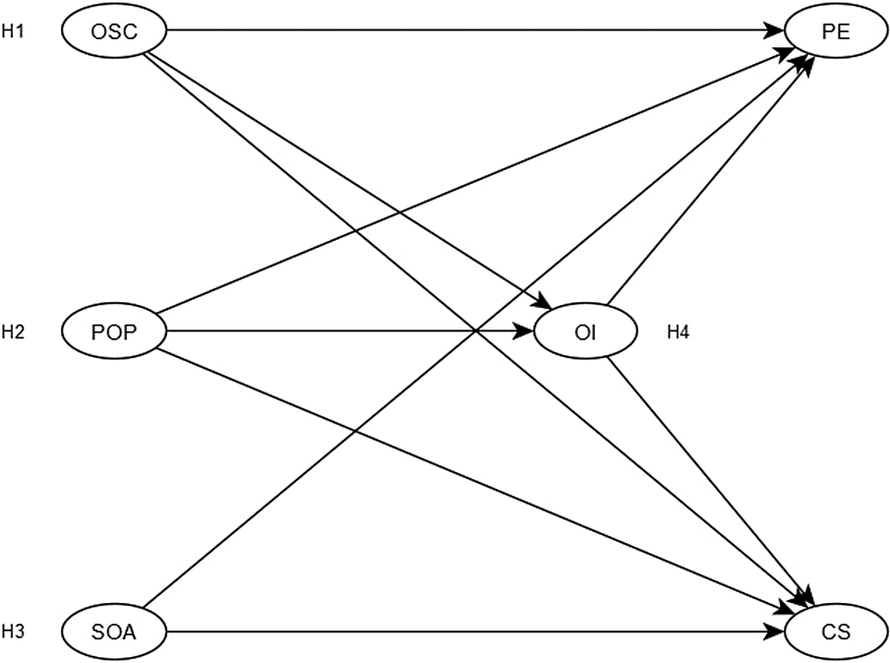
Figure 1 illustrates the hypotheses proposed.
Diagram of the Hypotheses Proposed
Note. OSC = Organizational Social Capital; POP = Perceived Organizational Prestige; SOA = Sociodemographic and occupational antecedents; PE = Perceived employability; OI = Organizational Identification; CS = Career Satisfaction.

Method
A cross-sectional correlational study was conducted on a non-probabilistic sample of university workers in Chile.
Participants
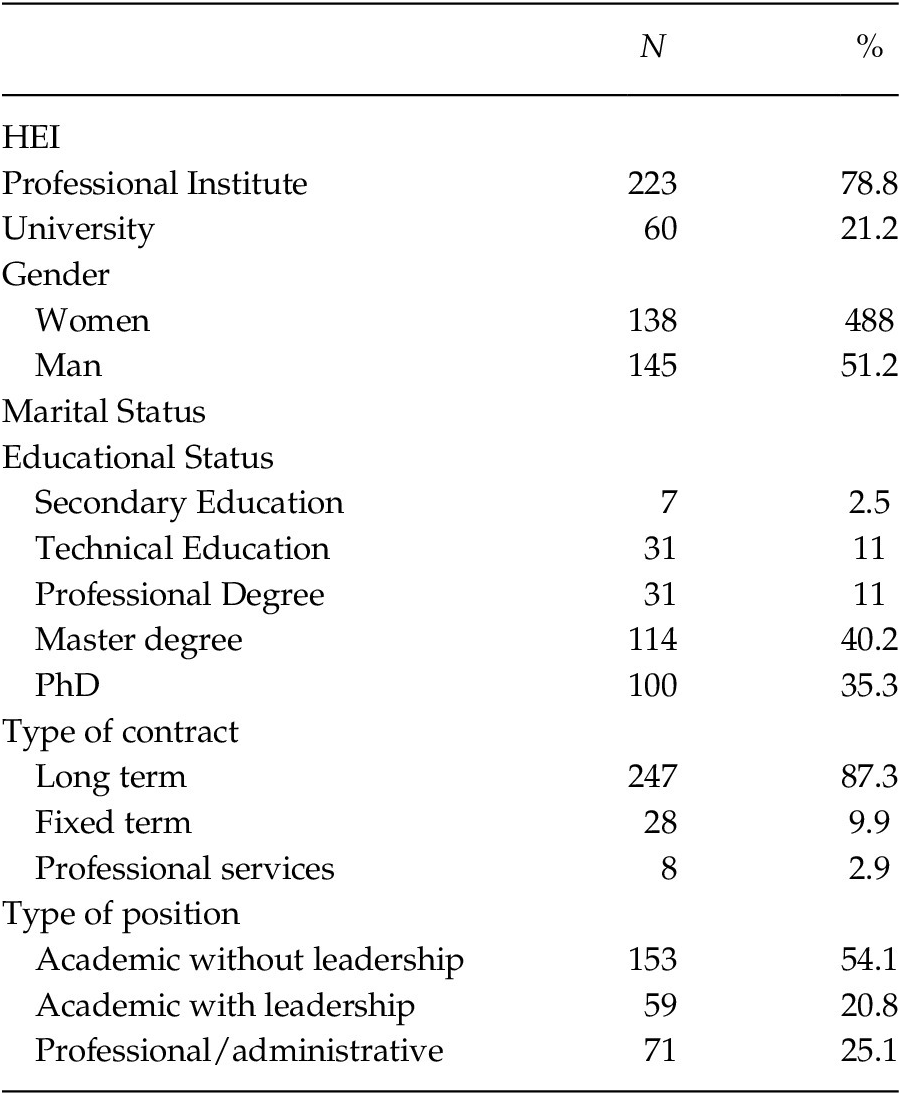
The participants were 283 workers with academic and professional/administrative roles of two private HE institutions in central-southern Chile. Participants ages ranged between 22 and 86 years, with an average of 45.48 years (SD = 11.844). Socio-demographic and occupational antecedents of the sample are presented in Table 1.
Socio-demographic Antecedents and Occupational Antecedents

Variables and Instruments
Perceived employability (PE): The scale developed by Rothwell and Arnold (Reference Rothwell and Arnold2007) was used, with 11 items measuring internal perceived employability (IPE), 4 items, sample items are: “In this institution, I am recognized among the people who do the same work as me”, “Even if there was downsizing in this institution I am confident that I would be retained”; and external perceived employability (EPE) with 7 items, sample items are: “I could easily get a similar job to mine in almost any organization”, “Anyone with my level of skills and knowledge, and similar job and organizational experience, will be highly sought after by employers”.
Career satisfaction (CS): The subscale of the instrument developed by Rothwell and Arnold (Reference Rothwell and Arnold2007) was used, with 8 items. Sample items are: “I am satisfied with the success that I have had in my career”; “I am satisfied with the progress I have made toward meeting my goals for advancement”.
Organizational social capital (OSC): The instrument developed by Leana and Pil (Reference Leana and Pil2006) was used, composed of three sub-scales: structural, sample items are: “Workers from this institution engage in open and honest communication with one another”, “Workers discuss personal issues if they affect job performance”; relational, sample items: “Workers in this institution trust each other”, “Workers have confidence in one another in this institution”) and cognitive social capital, sample items: “Workers share the same ambitions and vision for the institution”, “Workers enthusiastically pursue collective goals and mission”), with six items each.
Organizational prestige (POP): The scale developed by Herrbach et al. (Reference Herrbach, Mignonac and Gatignon2004) was used, with six items. Sample items are: “My organization is considered one of the best”, “Employees of other organizations would be proud to work in my organization”.
Organizational identification (OI): The scale developed by Smidts et al. (Reference Smidts, Pruyn and van Riel2001) was used, containing 5 items. Sample items are: “I feel a strong connection to this school”; “I am glad to be a member of my organization”.
The five scales had a response range from 1 to 5, from strongly disagree to strongly agree. Internal consistency of the scales measured using Cronbach’s Alpha coefficient are presented in Table 3, in the intersection of equal variables.
Procedure
In order to access to the participants, different higher education institutions (HEI) were contacted. After authorizations, academics and professional and administrative staff, were invited to participate answering an anonymous on-line questionnaire through Survey Monkey platform. The objectives of the research were stated and the confidentiality, absence of identifiable risk and possibility to drop out the study were guaranteed. The research project received the approval of the Department of Psychology Ethic Committee and all the participants were asked to sign an informed consent. Data collection was undertaken in the first semester of 2017 and lasted for three months.
Data Analysis
The one-factor test (Podsakoff et al., Reference Podsakoff, MacKenzie, Lee and Podsakoff2003) was performed to check the possible effect of the common variance. All items of the perceived employability and career satisfaction scales were subjected to an Exploratory Factor Analysis (EFA) using the principal components method with Varimax rotation, forcing the extraction to a single factor. The criterion to consider if there were a variance problem associated with the common method, if that the extracted factor should explain more than 50%. Considering the above, the result of the EFA applied yielded a factor that explained 32.21% of the common variance, so, even though the effect of the common variance cannot be totally ruled out, it does not seem to have a significant impact on the relationships between the target variables.
In order to test the factor structure of the instruments, CFAs was performed. As seen in Table 2, the goodness of fit indices used (χ2/df, SRMR, CFI, TLI) show an acceptable general good fit for the structure of the instruments.
Results of the CFA for the Instruments

Note. OSC-S = Organizational Social Capital-Structural; OSC-R = Organizational Social Capital-Relational; OSC-C = Organizational Social Capital-Cognitive; POP = Perceived Organizational Prestige; OI = Organizational Identification; IPE = Internal Perceived Employability; EPE = External Perceived Employability; CS = Career Satisfaction.
Bivariate correlations and linear regressions were run to identify explanatory variables of PE and CS. Then, a mediation analysis was performed with the PROCESS macro (Preacher & Hayes, Reference Preacher and Hayes2004). The data were analyzed with the R statistics software.
Results
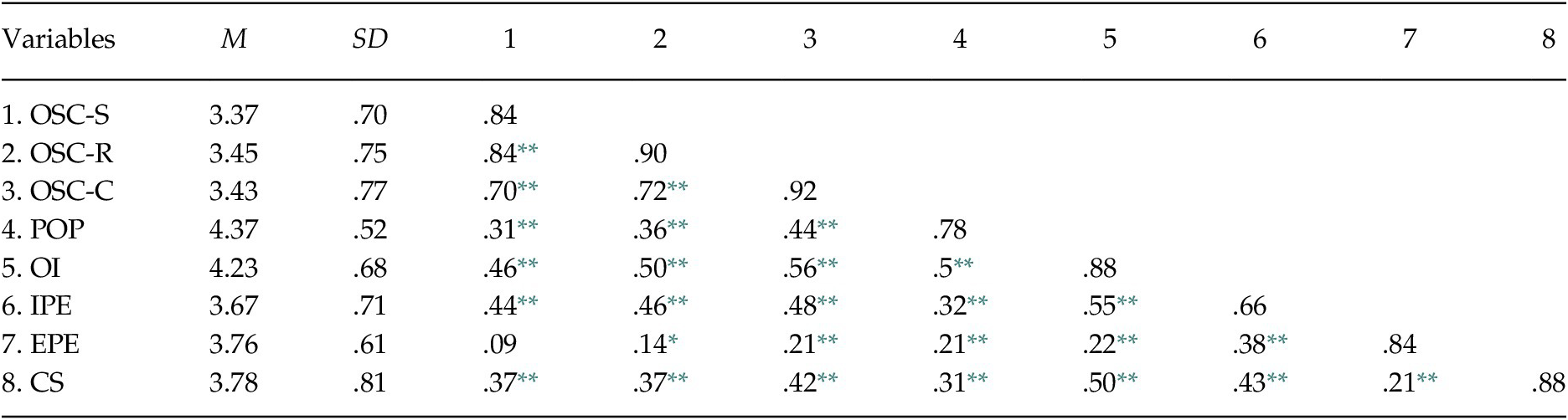
Table 3 shows the bivariate correlations, all of which are significant with the exception of organizational social capital-structural (OSC-S) and EPE (Table 1), which makes it possible to verify H 1 and H 2 almost in its entirety.
Descriptive Statistics, Correlations for Study Variables and Alfa Cronbach´s coefficient

Note. OSC-S = Organizational Social Capital-Structural; OSC-R = Organizational Social Capital-Relational; OSC-C = Organizational Social Capital-Cognitive; POP = Perceived Organizational Prestige; OI = Organizational Identification; IPE = Internal Perceived Employability; EPE = External Perceived Employability; CS = Career Satisfaction.
* p < .05.
* p < .01.
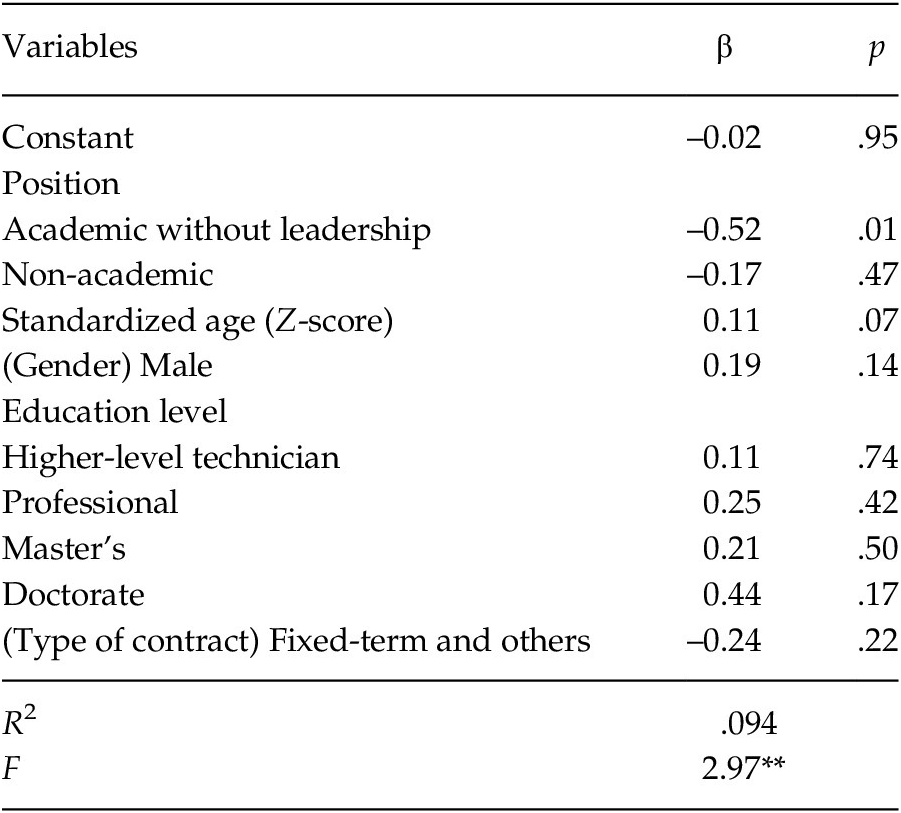
For the verification of H 3, a multiple linear regression analysis was performed for the dependent variables and their predictor socio-demographic and occupational variables: Gender, educational level, type of position and type of contract. As shown in Table 4, the explanatory model was significant, F(9, 259) = 2.97, p = .002 and predicts 9.4% of its variance. The type of position is the only variable that presents a significant coefficient. In particular, the academic without leadership position presents lower levels of IPE than the academic without leadership (b = 0.52, p < .001). When assumptions were verified, it was noted that the relation between the predicted and observed values is linear. The residuals are approximately normal, although they present a slightly negative asymmetry, and there is a slight decrease in the variance when the predicted values increase.
Regression Model of IPE based on Socio-demographic and Work History

On the other hand, the explanatory model of EPE and its socio-demographic and occupational predictor variables were not significant, F(9, 259) = 0.59, p = .806.
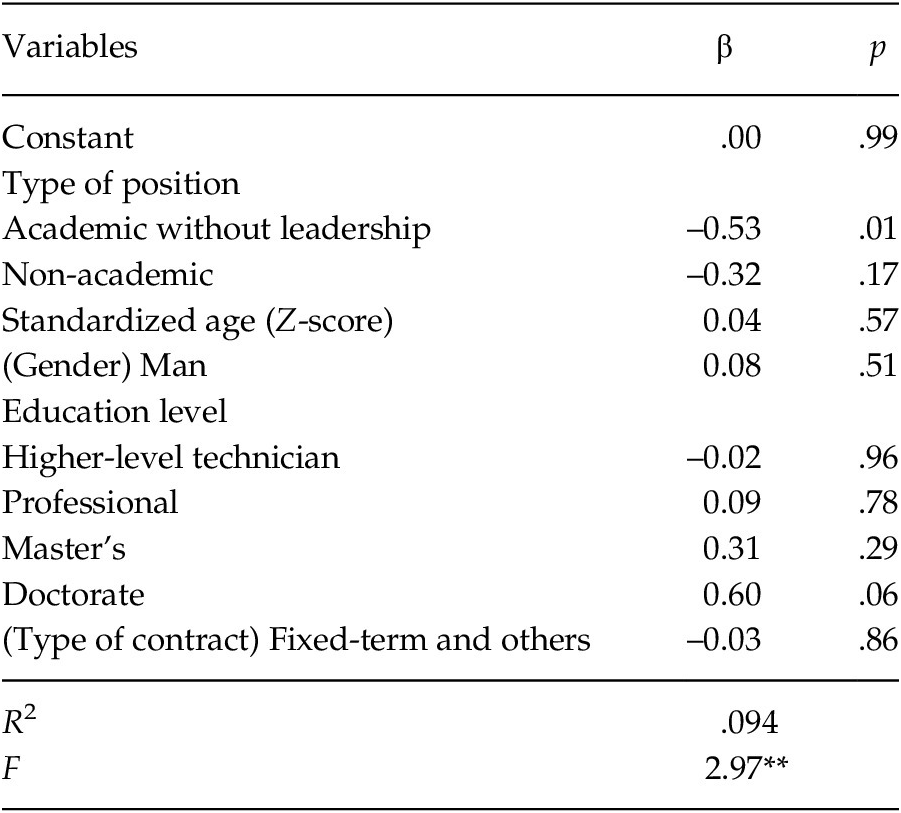
For CS, the explanatory model of the socio-demographic and occupational predictor variables (Table 5) was significant, F(9, 259) = 2.97, p = .002, and predicted 9.4% of its variance, with type of position being the only significant variable. In particular, the academic without leadership presented lower levels of CS than the academic with a leadership, b = –0.53, p < .001. The assumptions of linearity, normality and homoscedasticity of residuals were fulfilled.
Regression Model of CS based on Socio-Demographic and Work History

Based on the previous results, H 3 was partially supported.
In order to test H 4, the predictor effect of OSC and POP on PE and CS was run. To begin, a graphical analysis was made of the bivariate relation between each dependent variable and its antecedents and then using multiple linear regression models.
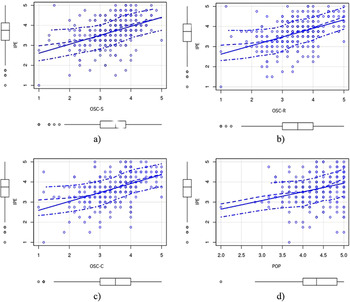
Figure 2 shows a practically linear relation between IPE and its antecedents OSC-S, OSC-R and POP.
Scatter Plot between IPE and its Antecedents a) OSC–S, b) OSC–R, c) OSC–C and d) POP

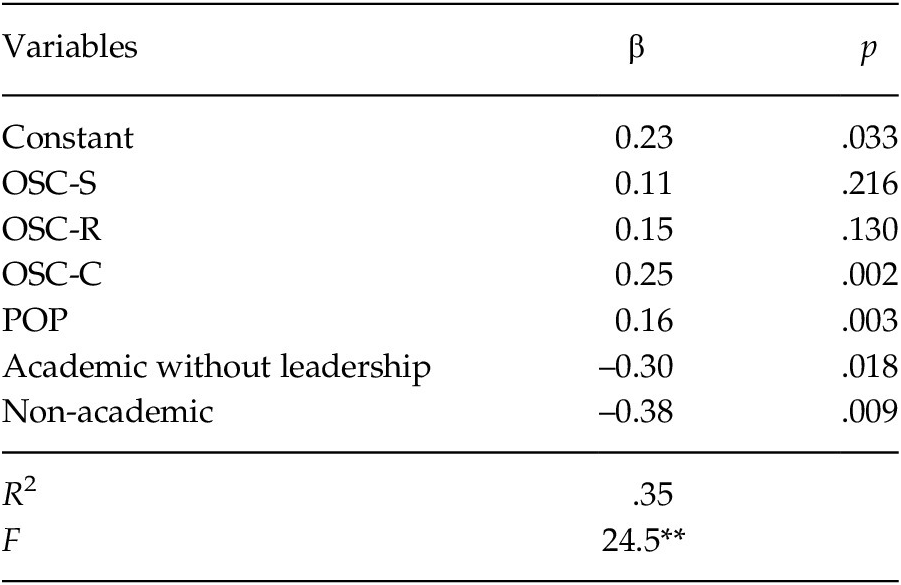
The type of position was included in the explanatory model of IPE and its predictor variables OSC-S, organizational social capital-relational (OSC-R), organizational social capital-cognitive (OSC-C), and POP, resulting in the model being significant, F(6, 273) = 24.5, p < .001), with a prediction of 35% of the variance of IPE. OSC-C (b = 0.25, p = .002), POP (b = 0.16, p = .003) and type of position presented significant coefficients (Table 6). In particular, the academic without leadership position presented lower levels of IPE than the academic with leadership (b = –0.30, p = .018), whereas the non-academic had lower levels of IPE than the academic without leadership (b = –0.38, p = .009) When verifying the assumptions, the absence of linearity was noted for low predicted values and residuals with strong negative asymmetry; therefore, different transformations were tested on IPE, which made it possible to generate normal residuals and a variance that works in a linear model for the squares of IPE. When the model was verified again, a high level of prediction was obtained with a more linear model, with residuals that approach normality and a homogenous variance.
Explanatory Model of IPE and its Antecedents OSC-S, OSC-R, OSC-C, POP and Type of Position

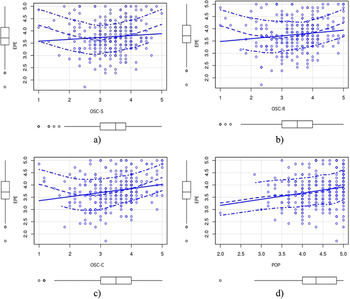
Figure 3 shows a direct relation between EPE and POP (see Figure 3d), whereas between EPE and its antecedents OSC-E, OSC-R, OSC-C the relations were U-shaped (see Figures 3, a, b, c). For this, the quadratic regression models were tested.
Scatter Plot between EPE and its Antecedents a) OSC–S, b) OSC–R, c) OSC–C and d) POP

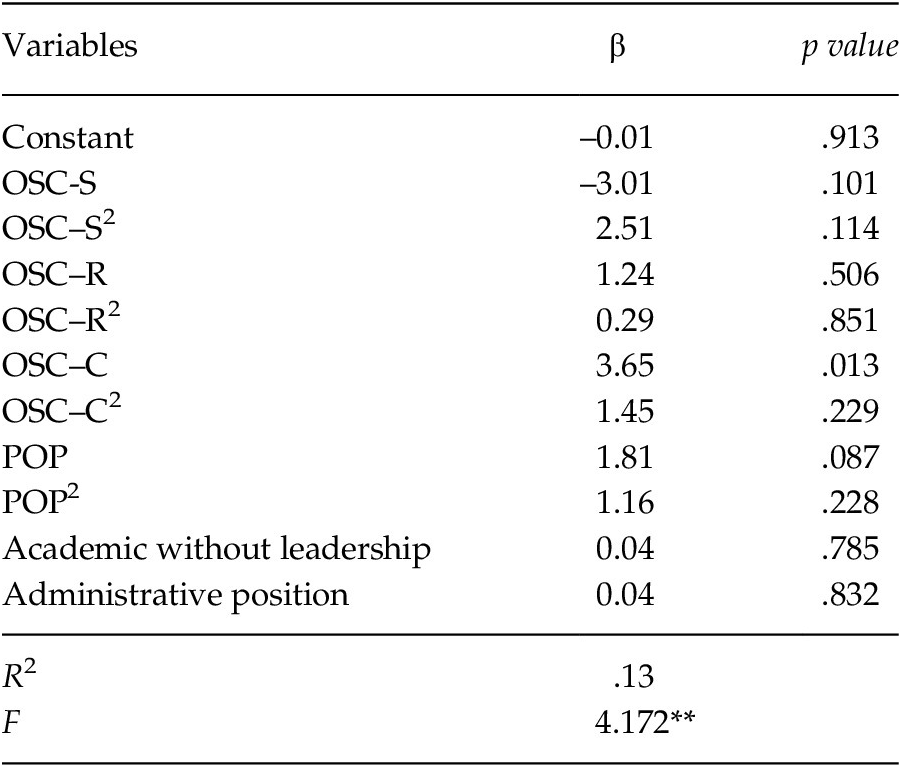
As shown in Table 7, the explanatory model of EPE and its predictor variables OSC-S, OSC-R, OSC-C, POP and type of position was significant, F(10, 270) = 4.172, p < .001, with a prediction of 13% of its variance. Only OSC-C presented significant coefficients (b = 3.65, p = .013).
Explanatory Model of IPE and its Antecedents OSC-S, OSC-R, OSC-C, POP and Type of Position

Note. OSC–S = Organizational Social Capital–Structural; OSC–R = Organizational Social Capital–Relational; OSC–C = Organizational Social Capital–Cognitive; POP = Perceived Organizational Prestige.
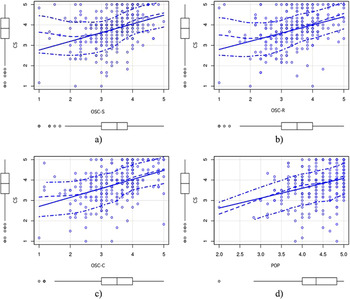
In order to analyze the relations between CS and its antecedents OSC-S, OSC-R, OSC-C and POP, a graphical analysis was made of the bivariate relations, which showed linear relations (Figure 4).
Scatter Plot between CS and its Antecedents a) OSC–S, b) OSC–R, c) OSC–C and d) POP

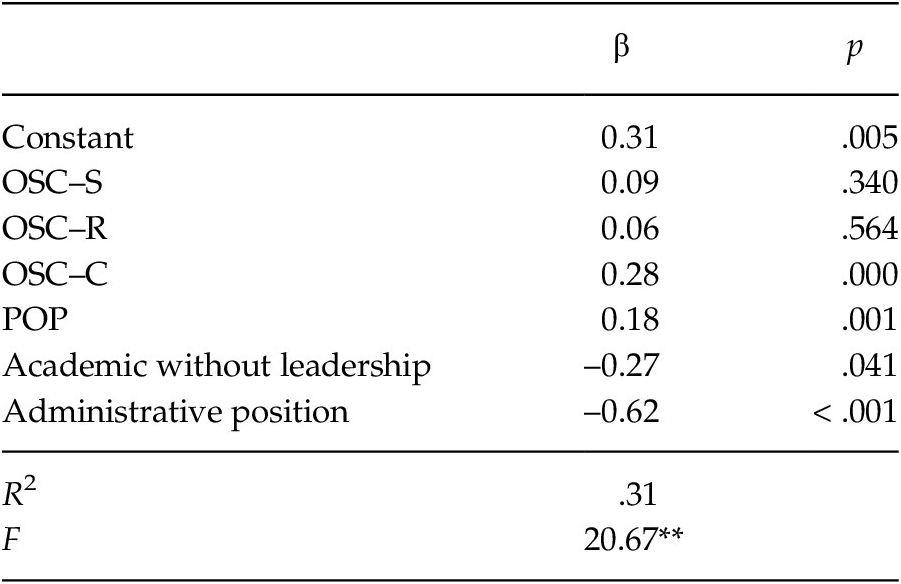
As shown in Table 8, the prediction model of CS and its variables OSC-S, OSC-R, OSC-C, POP and type of position is significant, F(6, 273) = 20.67, p < .001), and explains 31% of its variance. OSC-C (b = 0.28, p < .001) as well as POP (b = 0.18, p = .001) and type of position presented significant coefficients (academic without leadership: b = –0.27, p = .041). When verifying the assumptions, a clear ceiling effect was observed of the important residuals and outliers (175, 211 y 217), which is why those cases were not included.
Explanatory Model of CS and its Antecedents OSC–S, OSC–R, OSC–C, POP and Type of Position

Having confirmed the assumptions for the mediation model, this was tested for each dependent variable using Lavaan. To test if a mediation was significant, the 95% confidence interval created using an accelerated bootstrap of 1,000 replicates not including 0 was used as a criterion. As effect size for mediation the proportion of total effect mediated (ab/c), the ratio between indirect effect and total effect was used. This index, although have some shortcomings, is appropriate to evaluate the contribution of specific mediators on multiple mediations when direct and indirect effects have the same sign (MacKinnon, Reference MacKinnon2008).
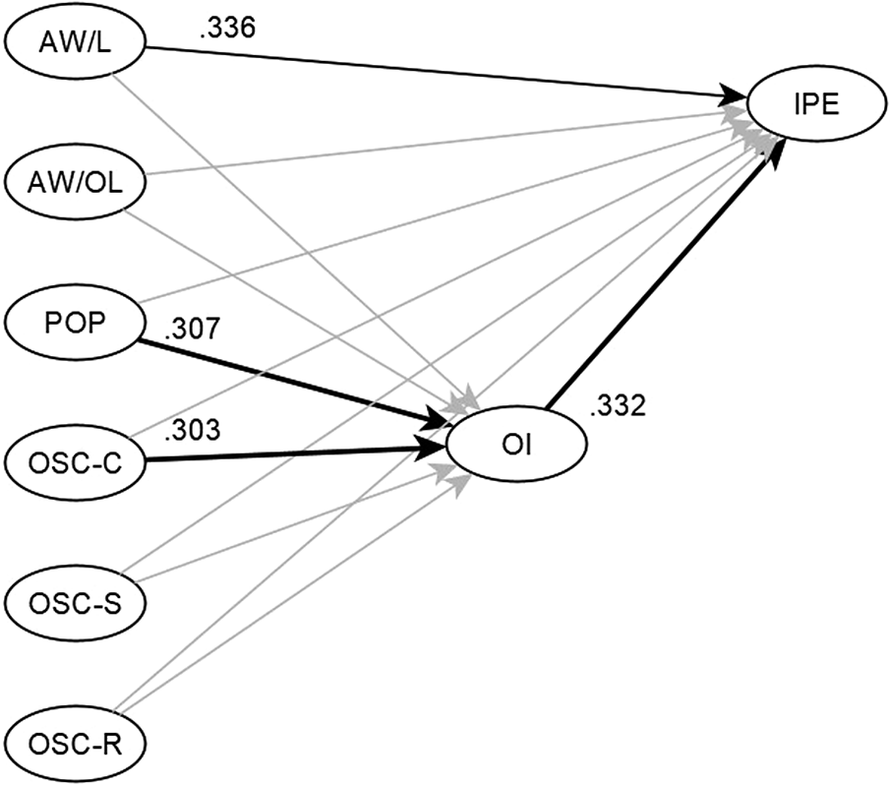
For the case of IPE, it was observed that the total mediation effect of OI was significant, abt = 0.363, 95% CI [0.181, 0.576] abt/c = 31.98%, to explain the relation between IPE and its predictor variables POP, abpo= 0.102, CI 95% [0.056, 0.160], abpo/c = 9.01%, and OSC-C, abcsoc = 0.101, CI 95% [0.053, 0.183], abcsoc/c = 8.89%, while the mediation effect of OI was not significant to predict the relation between IPE and its predictor variable type of position, but rather the effect is direct between type of position, academic with leadership position, and IPE (b = 0.336, p = .011) (see Figure 5).
Mediation Model of OI on IPE and its Predictor Variables OSC, POP and Type of Academic Position
Note. AW/L = Academic with leadership position; AW/OL = Academic without leadership position; POP = Perceived Organizational Prestige OSC–C = Organizational Social Capital–Cognitive; OSC–S = Organizational Social Capital–Structural; OSC–R = Organizational Social Capital–Relational; OI = Organizational Identification; IPE = Internal Perceived Employability.

For the case of EPE, it was noted that the total mediation effect of OI is not significant; abt = 0.129, 95% CI[–0.054, 0.325], abt/c = 50.1%, nor for any of the partial effects.
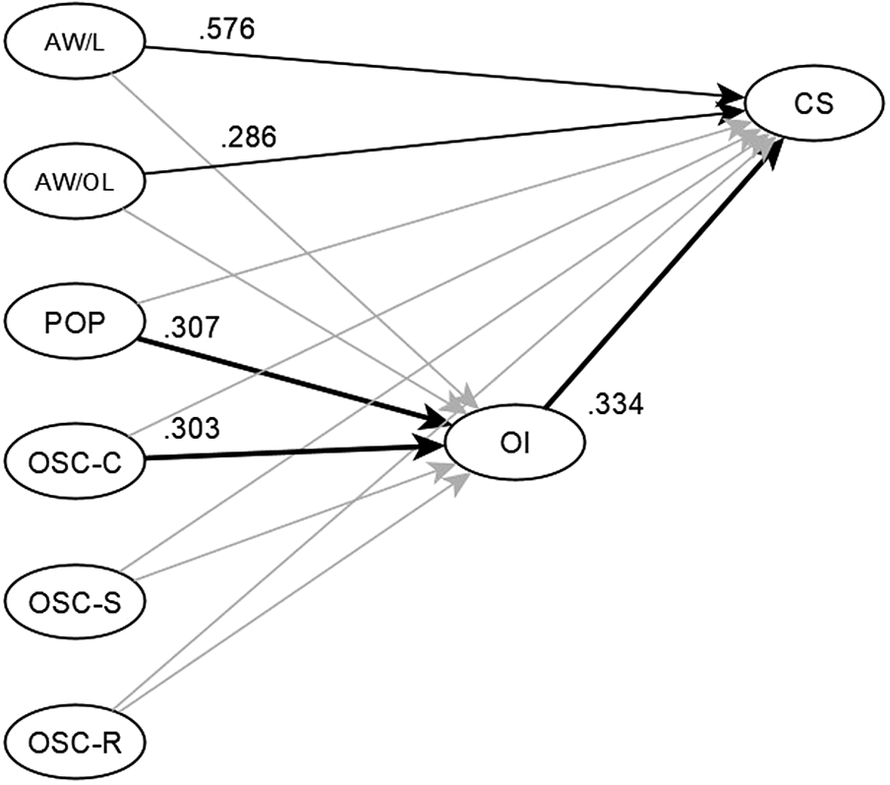
Regarding to CS, it was observed that the total mediation effect was significant, abt = 0.36, 95% CI [0.196, 0.585] abt/c=24.17%. The mediation effect of OI was significant to explain the relation between CS and its predictor variables POP, abpo = 0.103, 95% CI [0.055, 0.175], abpo/c = 6.81%; and OSC-C abosc-c = 0.101, 95% CI [0.044, 0.178], abosc-c/c = 6.72%, whereas the mediation effect of OI is not significant to predict the relation between CS and its predictor variable type of position, but the effect is direct between CS and its predictor variables type of position: Academic with leadership position (b = 0.576, p < .001) and academic without leadership position (b = 0.286, p = .013) (see Figure 6). Based on the results above, H 4 is partially confirmed.
Mediation Model of OI on CS and its Predictor Variables OSC, POP and Type of Position
Note. AW/L = Academic with leadership position; AW/OL = Academic without leadership position; POP = Perceived Organizational Prestige; OSC–C = Organizational Social Capital–Cognitive; OSC–S = Organizational Social Capital–Structural; OSC–R = Organizational Social Capital–Relational; OI = Organizational Identification; CS = Career Satisfaction.

Discussion
The aim of this study was to examine the association between socio-demographic and occupational antecedents, PE and CS, and the perception of the organization, particularly OSC and POP, as well as to establish the role of OI in these relations, in a sample of HE workers.
First, it was found that generally all the variables studied correlate positively and significantly to each other. This result coincides with prior evidence that suggest an association between PE and CS (De Vos et al., Reference De Vos, De Hauw and van der Heijden2011; Maslić Seršić & Tomas, Reference Maslić Seršić and Tomas2014) and between these two and POP and CS (Direnzo et al., Reference Direnzo, Greenhaus and Weer2015; Rothwell et al., Reference Rothwell, Herbert and Rothwell2008). The fact that only the relation between OSC-S and EPE was not significant may be because OSC is perceived as useful only inside the organization, i.e., for IPE, whereas relational and cognitive social capital are perceived as useful for both types of employability.
When examining the predictor effect of OSC and POP on PE and CS, it was found that for IPE and CS both predictors, along with the type of position, explain more than a third of their variance. Previous studies provide evidence that support these results. For example, Rothwell et al. (Reference Rothwell, Herbert and Rothwell2008) found that the external prestige of their university as perceived by students predicts their levels of PE. On the other hand, Chen (Reference Chen2011) found that in public relations professionals, networking and social trust predicted their success in subjective career, measured as work and career satisfaction. At present, universities are permanently exposed to public scrutiny through rankings or other systems of comparison, and these findings could indicate that the social value assigned to the employing institution is transferred to some extent to the value that the worker perceives they have in the labor market and to their CS, as well as their quality of working life (Fontinha et al., Reference Fontinha, van Laar and Easton2018). These results are also consistent with the SIT principles (Hogg & Abrams, Reference Hogg, Abrams, Abrams and Hogg1990), since the organizational prestige to which one belongs contributes to satisfying the needs of positive self-perceptions –and identities– and of self-enhancement (Ashforth & Mael, Reference Ashforth and Mael1989), and reinforces the categorical social self (Mignonac et al., Reference Mignonac, Herrbach, Serrano Archimi and Manville2018).
In addition, the findings confirm the association between OSC and OI. Different studies suggest that the structural characteristics of the social network in the organization, among them its size, strength of the interaction, proximity among members of the network and the degree of interconnection between people is positively related to OI (Jones & Volpe, Reference Jones and Volpe2011; Kuipers, Reference Kuipers2009). The assumption that we posited based on the SIT that the perception of OSC reinforces the inclusive social self is therefore confirmed. Indeed, the social self is formed by the combination of the perceptions of the organization’s prestige (categorical social self) and social capital (inclusive social self), which represents a significant contribution to the value of the perspective of social identity to understand the psychological processes of individuals in organizations (Haslam, Reference Haslam2004).
Regarding the role of OI in the relation between the antecedent and result variables, it is confirmed that OI plays a mediating role in these relations and that it contributes to explaining the predictor effect of OSC and POP on PE and CS. Specifically, it was found that OSC-C and POP predict IPE, mediated by OI. It is possible to suppose that the recognition of the organization by external agents –which contributes to shaping organizational identity– influences the perception of worker’s value within their organization, inasmuch as the worker shares those external judgments. This means that organizational identity is closely related to OI (Ashforth & Mael, Reference Ashforth and Mael1989; He & Brown, Reference He and Brown2013). This confirms that the perception of the organization demands that there be the subjective experience of ownership of the organization’s identity, so that, this perception does indeed impact on worker satisfaction. This in turn acts on CS, as the worker identifies with their organization. These findings confirm the assumptions of the SIT in the sense of how the social self is formed from membership in groups with social recognition and the search for self-enhancement (Mael & Ashforth, Reference Mael and Ashforth1992), and this also affects the subjective experience of the career.
Our results have important practical implications. First of all, the interest of organizations in having a good reputation and an image of prestige can have positive effects not only on its clients, users, suppliers and stakeholders, but also internally, since it contributes to shaping a positive self-image in the employees and to increasing their OI and IPE, and this can also translate into positive results for the organization, as a greater affective commitment and organizational citizenship behaviors (Carmeli, Reference Carmeli2005), task and job performance (He & Brown, Reference He and Brown2013) or lower intention to leave (Herrbach et al., Reference Herrbach, Mignonac and Gatignon2004). Organizations can also use their OSC to encourage OI in their employees (Kramer, Reference Kramer2006; Leana & van Buren, Reference Leana and van Buren1999); and insofar as the organization is integrated in their social self and their self-concept, they will need to be more concerned about the organization’s well-being, interests and goals (Ashforth & Mael, Reference Ashforth and Mael1989), in the same sense as the GEM suggests (Tyler & Blader, Reference Tyler and Blader2003). Finally, organizations can contribute to their employees’ career development and facilitate the retention of valuable members by jointly strengthening OSC (Seibert et al., Reference Seibert, Kraimer and Liden2001) and POP (Rathi & Lee, Reference Rathi and Lee2015), since directly and through the increase of OI they contribute to greater IPE and CS, which supposes a relevant implication for HRM practices.
This study has some limitations. First, given its cross-sectional design, it informs the associations that are largely bidirectional and for which conclusions of causality cannot be drawn. Despite of that, the study addresses variables that, as far as we know, have not been analyzed jointly recently, therefore an exploratory analysis that states the existence of covariation among variables is a necessary step previous to the analysis of a potential causal link. Moreover, in this case our findings are consistent with our hypothesized causal relationship. On the other hand, the specificity of the sample and its non-randomization does not prevent extrapolation of the conclusions to other groups of workers and professionals. Future studies will have to analyze these relations in other employment sectors and in longitudinal studies, where the possible reciprocal relations between variables can be assessed and the effects of events such as, for example, the loss of reputation and prestige of a company due to fraud, corruption or bad business practices can be analyzed. Nevertheless, it is considered that these findings contribute to understand the complexity of careers in sectors like education that are experiencing growing dynamism and explains the importance of identification with the organization when the impact of organizational attributes on one’s career is analyzed.