INTRODUCTION
Greenhouse gases (GHGs), such as carbon dioxide (CO2), methane (CH4) and nitrous oxide (N2O), contribute about 80% to the current global radiative forcing (Myhre et al., Reference Myhre, Shindell, Bréon, Collins, Fuglestvedt, Huang, Koch, Lamarque, Lee, Mendoza, Nakajima, Robock, Stephens, Takemura, Zhang, Stocker, Qin, Plattner, Tignor, Allen, Boschung, Nauels, Xia, Bex and Midgley2013). Agricultural activities contribute approximately 20% of the present concentrations of atmospheric GHGs (Hütsch, Reference Hütsch2001), especially the emissions of CH4 and N2O from paddy fields (Myhre et al., Reference Myhre, Shindell, Bréon, Collins, Fuglestvedt, Huang, Koch, Lamarque, Lee, Mendoza, Nakajima, Robock, Stephens, Takemura, Zhang, Stocker, Qin, Plattner, Tignor, Allen, Boschung, Nauels, Xia, Bex and Midgley2013), so minimizing the release of these GHGs from paddies, and thus mitigating their adverse impacts on climate change, is of the utmost importance. As a main cereal crop, rice currently feeds more than 50% of the global population (Haque et al., Reference Haque, Kim, Ali and Kim2015), and rice production will need to increase by 40% by the end of 2030 to meet the demand for food from the growing population worldwide (Food and Agricultural Organization of the United Nations, 2009).
Fertilization is important for sustainable rice production (Linquist et al., Reference Linquist, Liu, van Kessel and van Groenigen2013), and numerous studies have been devoted to the development of suitable practices of fertilizer management for both improving rice yields and mitigating GHG emissions, including the application of fertilizers such as straw mulch (Dossou-Yovo et al., Reference Dossou-Yovo, Brüggemann, Jesse, Huat, Ago and Agbossou2016) and silicate fertilizer (Wang et al., Reference Wang, Sardans, Lai, Wang, Zeng, Tong, Liang and Peñuelas2015), and the establishment of the most adequate nitrogen (N), phosphorus (P) and potassium (K) fertilizers (Thao et al., Reference Thao, Hong, Tuyen, Van Toan and Quyen2015). Fertilizers are key for rice productivity, but the amounts needed for maintaining rice yield and minimizing environmental effects are unknown. Chemical fertilizers are necessary to keep the world's population fed, but their overuse threatens the safety of the soil, water and air (Zhang et al., Reference Zhang, Dou, He, Ju, Powlson, Chadwick, Norse, Lu, Zhang, Wu, Chen, Cassman and Zhang2013a). China has become the world's largest consumer of fertilizer, and its fertilizer-use efficiency is much less than half the amendment amount (Cheng and Li, Reference Cheng and Li2007). Determining the amount suitable for supporting rice productivity and reducing nutrient losses is therefore very important (Zhao et al., Reference Zhao, Yue, Sha, Li, Deng, Zhang, Gao and Cao2015).
Chemical fertilizers, especially N fertilizers, influence the dynamics of GHGs the most (Zhong et al., Reference Zhong, Wang, Yang, Zhao and Ye2016). Zhao et al. (Reference Zhao, Yue, Sha, Li, Deng, Zhang, Gao and Cao2015) reported that N2O emissions increased but CH4 emissions decreased with the level of fertilization. Zhong et al. (Reference Zhong, Wang, Yang, Zhao and Ye2016) indicated that the global warming potential (GWP) and rice yields increased with the rate of application of N fertilizer. In contrast, Zhang et al. (Reference Zhang, Dou, He, Ju, Powlson, Chadwick, Norse, Lu, Zhang, Wu, Chen, Cassman and Zhang2013a) showed that N fertilization could reduce GHG emissions. Some studies have showed that maintaining soil fertility and crop productivity and at the same time reducing GHGs emissions have several trade-off questions to be taken into account (Bhatia et al., Reference Bhatia, Pathak, Jain, Singh and Singh2005). The substitution of inorganic N fertilizers by organic crop manure residues improves yield and soil health but can increase CH4 emissions (Bhatia et al., Reference Bhatia, Pathak, Jain, Singh and Singh2005; Reference Bhatia, Pathak, Jain, Singh and Tomer2012). In the medium to long term, the substitution of inorganic by organic residues as fertilizers improves soil aggregate stability, soil water holding capacity and soil microbial activity (Sihi et al., Reference Sihi, Gerber, Inglett and Inglett2016a; Reference Sihi, Dari, Sharma, Pathak, Nain and Sharma2017) without any significant decrease in yield production (Sihi et al., Reference Sihi, Sharma, Pathak, Singh, Sharma, Chaudhary and Oari2012). Thus, establishing suitable fertilization rates to ensure rice yields and reduce GHG emissions is important for field management (Zhong et al., Reference Zhong, Wang, Yang, Zhao and Ye2016). The control of water inundation management and the time to plant and sow rice plants (Dari et al., Reference Dari, Sihi, Bal and Kunwar2017) or the use of crop manure and/or urea plus dicyanamide has reduced N2O emissions in paddy soils without reducing yield (Pathak et al., Reference Pathak, Bhatia, Prasad, Singh, Kumar, Jain and Kumar2002) and increased the recovery efficiency of N added by fertilizers (Pathak, Reference Pathak2010). Anyway, fertilization management influences soil properties, which affects GHG emissions in wetland areas (Davidson and Janssens, Reference Davidson and Janssens2006), and there is not a general consensus in the adequate fertilization management for equilibrated soil fertility and rice production without increased GHG emissions.
China has the world's second largest area of rice cultivation, and the associated GHG emissions account for about 40% of the total agricultural GHG emission. In China, 90% of paddies are in the subtropics, such as in Fujian, Jiangxi and Hunan Provinces. Developing effective strategies to increase the cost-effectiveness of rice agriculture, enhance crop yield and mitigate GHG emissions from paddies in subtropical China to minimize future food shortages and adverse climate change is thus a global objective of national importance. We pursued this objective by (1) determining the emissions of CO2, CH4 and N2O in response to the application of different amounts of fertilizers in paddy fields; (2) exploring the effect of amendment amount on the concentrations of porewater nutrients; and (3) assessing the impacts of the fertilizer applications on crop productivity. The results obtained in this study will provide a scientific basis for the suitable management of fertilization for rice agriculture, and the evaluation of most current fertilization strategies for increasing yield and decreasing GHG emissions.
MATERIALS AND METHODS
Study site
Our study was conducted at the Wufeng Agronomy Field of the Fujian Academy of Agricultural Sciences in Fujian Province, southeastern China (26.1°N, 119.3°E) (Supplementary Figure S1, available online at https://doi.org/10.1017/S0014479718000078). A field experiment was carried out during the early paddy season (16 April to 16 July) in 2014. Air temperature and humidity during the study period are shown in Figure S2. The soil of the paddy was poorly drained, and the proportions of sand, silt and clay particles in the top 15 cm of the soil were 28%, 60% and 12%, respectively (Wang et al., Reference Wang, Sardans, Lai, Wang, Zeng, Tong, Liang and Peñuelas2015). Other properties of the top 15 cm of soil at the beginning of the experiment were bulk density, 1.1 g cm−3; pH (1:5 with H2O), 6.5; organic carbon (C) content, 18.1 g kg−1; total nitrogen (TN) content, 1.2 g kg−1 and total phosphorus (TP) content, 1.1 g kg−1 (Wang et al., Reference Wang, Sardans, Lai, Wang, Zeng, Tong, Liang and Peñuelas2015). The water level was maintained at 5–7 cm above the soil surface throughout the growing season by an automatic water-level controller, and the paddy was last drained 2 weeks before harvest.
We established triplicate plots (10 × 10 m) for two treatments and a control in which rice seedlings (cultivar, Hesheng 10) were inserted to a depth of 5 cm with a spacing of 14 × 28 cm using a rice transplanter. The age of the rice seedlings was 21 days when they were transplanted. The two treatments consisted of standard fertilization and fertilization with a double amount of the standard fertilization. The control plots were not fertilized. The standard fertilization treatment consisted of three applications of N–P2O5–K2O (16–16–16%; Keda Fertilizer Co., Ltd. Jingzhou, China) and urea (46% N) fertilizers. The first application was 1 day before transplantation at rates of 42 kg N ha−1, 40 kg P2O5 ha−1 and 40 kg K2O ha−1. The second application was broadcasted during tiller initiation [7 days after transplanting (DAT)] at rates of 35 kg N ha−1, 20 kg P2O5 ha−1 and 20 kg K2O ha−1. The third application was broadcasted during panicle initiation (56 DAT) at rates of 18 kg N ha−1, 10 kg P2O5 ha−1 and 10 kg K2O ha−1. These doses are the most commonly used in paddy fields in subtropical China (with annual doses of 95 kg N ha−1, 70 kg P2O5 ha−1 and 70 kg K2O ha−1), which constitute about 90% of the paddy fields in China (Wang et al., Reference Wang, Sardans, Lai, Wang, Zeng, Tong, Liang and Peñuelas2015). The double-fertilization treatment consisted of twice the amounts of the standard fertilization but the same schedule. The plots had previously been fertilized with amounts equal to the standard fertilization during a period of about 20 years (Wang et al., Reference Wang, Sardans, Lai, Wang, Zeng, Tong, Liang and Peñuelas2015). All control and treatment plots received the same amount of water. The field was plowed to a depth of 15 cm with a moldboard plow and was levelled 2 days before rice transplantation.
Measurement of CO2, CH4 and N2O emissions
Static closed chambers were used to measure CO2, CH4 and N2O emissions. The chambers were made of polyvinyl chloride (PVC) and consisted of two parts, an upper transparent compartment (100 cm high, 30 cm wide, 30 cm long) placed on a permanently installed bottom collar (10 cm high, 30 cm wide, 30 cm long). Each chamber had two battery-operated fans to mix the air inside the chamber headspace, an internal thermometer to monitor temperature changes during gas sampling and a gas-sampling port with a neoprene rubber septum at the top of the chamber for collecting gas samples from the headspace. We deployed three replicate chambers in each plot. A wooden boardwalk was built for accessing the plots to minimize the disturbance of the soil during gas sampling. The chambers were installed on soil with plants inside. The temperature increase inside the chambers was measured and taken into account in the calculations.
Gas flux was measured weekly in all the chambers. Gas samples were collected from the chamber headspace using a 100-mL plastic syringe with a three-way stopcock 0, 15 and 30 min after the deployment of the upper compartment. The samples were immediately transferred to 100-mL air-evacuated aluminium foil bags (Delin Gas Packaging Co., Ltd., Dalian, China) sealed with butyl rubber septa and transported to the laboratory for the analysis of CO2, CH4 and N2O.
CO2, CH4 and N2O concentrations in the headspace air samples were determined by gas chromatography (Shimadzu GC-2010 and Shimadzu GC-2014, Kyoto, Japan) using a stainless steel Porapak Q column (2 m long, 4 mm outer diameter and 80/100 mesh). A methane conversion furnace, flame ionization detector (FID) and electron capture detector (ECD) were used for the determination of the CO2, CH4 and N2O concentrations, respectively. The operating temperatures of the column, injector and detector for the determination of CO2, CH4 and N2O concentrations were adjusted to 45, 100 and 280 °C; to 70, 200 and 200 °C and to 70, 200 and 320 °C, respectively. These temperatures were the optimum temperatures for the different parts of the instrument. Helium (He) (99.999% purity) was used as a carrier gas (30 mL min−1), and a make-up gas (95% argon and 5% CH4) was used for the ECD. The gas chromatograph was calibrated before and after each set of measurements using 503, 1030 and 2980 μL CO2 L−1 in He; 1.01, 7.99 and 50.5 μL CH4 L−1 in He and 0.2, 0.6 and 1.0 μL N2O L−1 in He (CRM/RM Information Center of China) as primary standards. CO2, CH4 and N2O fluxes were then calculated as the rate of change in the mass of CO2, CH4 and N2O per unit of surface area and per unit of time by using a closed-chamber equation (Ali et al., Reference Ali, Ok and Kim2008):
 $$\begin{eqnarray*}
F = ((M/V) \times (dc/dt)) \times H \times (273/(273 + T)),
\end{eqnarray*}$$
where F is the corresponding gas flux (mg/mg m−2 h−1), M is the molecular weight, V is the height of the chamber above the water surface (m) and T is the air temperature inside the chamber (°C).
Global warming potential
GWP is typically estimated using CO2 as the reference gas, and a change in the emission of CH4 or N2O is converted into ‘CO2-equivalents’ (Hou et al., Reference Hou, Peng, Xu, Yang and Mao2012). The GWP for CH4 is 34 (based on a 100-year time horizon and a GWP for CO2 of 1), and the GWP for N2O is 298 (Myhre et al., Reference Myhre, Shindell, Bréon, Collins, Fuglestvedt, Huang, Koch, Lamarque, Lee, Mendoza, Nakajima, Robock, Stephens, Takemura, Zhang, Stocker, Qin, Plattner, Tignor, Allen, Boschung, Nauels, Xia, Bex and Midgley2013). The GWP of the combined emission of CH4 and N2O was calculated as (Ahmad et al., Reference Ahmad, Li, Dai, Zhan, Wang, Pan and Cao2009) GWP = (cumulative CO2 emission × 1 + cumulative CH4 emission × 34 + cumulative N2O emission × 298).
Collection of soil porewater
Porewater was sampled in situ once a week from 16 April to 16 July 2014. Three specially designed PVC tubes (5.0 cm inner diameter) were installed to a depth of 15 cm in each plot. Porewater samples were collected using 50-mL syringes and then separated into two parts: About 10 mL was injected into pre-evacuated 20-mL vials and the remaining 40 mL was injected into 100-mL sample vials. The samples were stored in a cool insulated box in the field until transported to the laboratory where they were stored at −20 °C until the analysis of nutrients and GHG concentrations.
Measurement and calculation of dissolved CO2, CH4 and N2O concentrations
The sample vials were thawed at room temperature and then vigorously shaken for 5 min to equilibrate the CH4 concentrations between the water and the headspace. Gas samples were collected from the headspaces of the vials and analysed for CO2, CH4 and N2O concentrations by gas chromatography (Shimadzu GC-2010 and Shimadzu GC-2014, Kyoto, Japan; see above for more details).
The concentrations (C) of CO2, CH4 and N2O dissolved in the water were calculated following Ding et al. (Reference Ding, Cai, Tsuruta and Li2003): C = (Ch × Vh)/(22.4 × Vp), where Ch is the CO2, CH4 and N2O concentration (μL L−1) in the air samples from the vials, Vh is the volume of air in the vial (mL) and Vp is the volume of the water in the vial (mL).
Measurement of soil, porewater properties and rice yield
The soil temperature, pH, salinity, redox potential (Eh) and water content of the top 15 cm of soil were measured in triplicate in situ in each plot on each sampling day. Temperature, pH and Eh were measured with an Eh/pH/temperature meter (IQ Scientific Instruments, Carlsbad, USA), salinity was measured using a 2265FS EC meter (Spectrum Technologies Inc., Paxinos, USA) and water content was measured using a TDR 300 meter (Spectrum Field Scout Inc., Aurora, USA). The concentrations of NH4+, NO3−, TN and TP in the porewater were determined using a sequence flow analyser (San++, SKALAR Corporation production, Breda, The Netherlands). The concentration of dissolved organic carbon (DOC) was determined using a Total Organic Carbon (TOC) analyser (TOC-V CPH, Shimadzu Corporation, Kyoto, Japan) and a filter paper of pore diameter 60 μm. Rice yield was determined at the harvesting stage by manual harvest (Wang et al., Reference Wang, Sardans, Lai, Wang, Zeng, Tong, Liang and Peñuelas2015).
Statistical analysis
Differences in soil properties; CO2, CH4 and N2O emissions; dissolved porewater CO2, CH4 and N2O concentrations and porewater nutrient concentrations among the treatments and control were tested for statistical significance by repeated-measures analyses of variance (ANOVAs). The relationships between mean GHG emissions and the soil properties, dissolved porewater GHG concentrations and porewater nutrient concentrations were determined by Pearson correlation analysis. These statistical analyses were performed using SPSS Statistics 18.0 (SPSS Inc., Chicago, USA). We analysed the effects of multiple soil variables as fixed factors on the production rates of the three GHGs using general linear models with and without spatial correlation. We used linear (lm) and mixed (lme) functions with the ‘nlme’ and ‘lme4’ R packages. We chose the best model for each dependent variable using the Akaike information criterion. We used the MuMIn R package in mixed models to estimate the percentage of variance explained by the model.
RESULTS
GHGs dissolved in porewater and emitted from the paddy
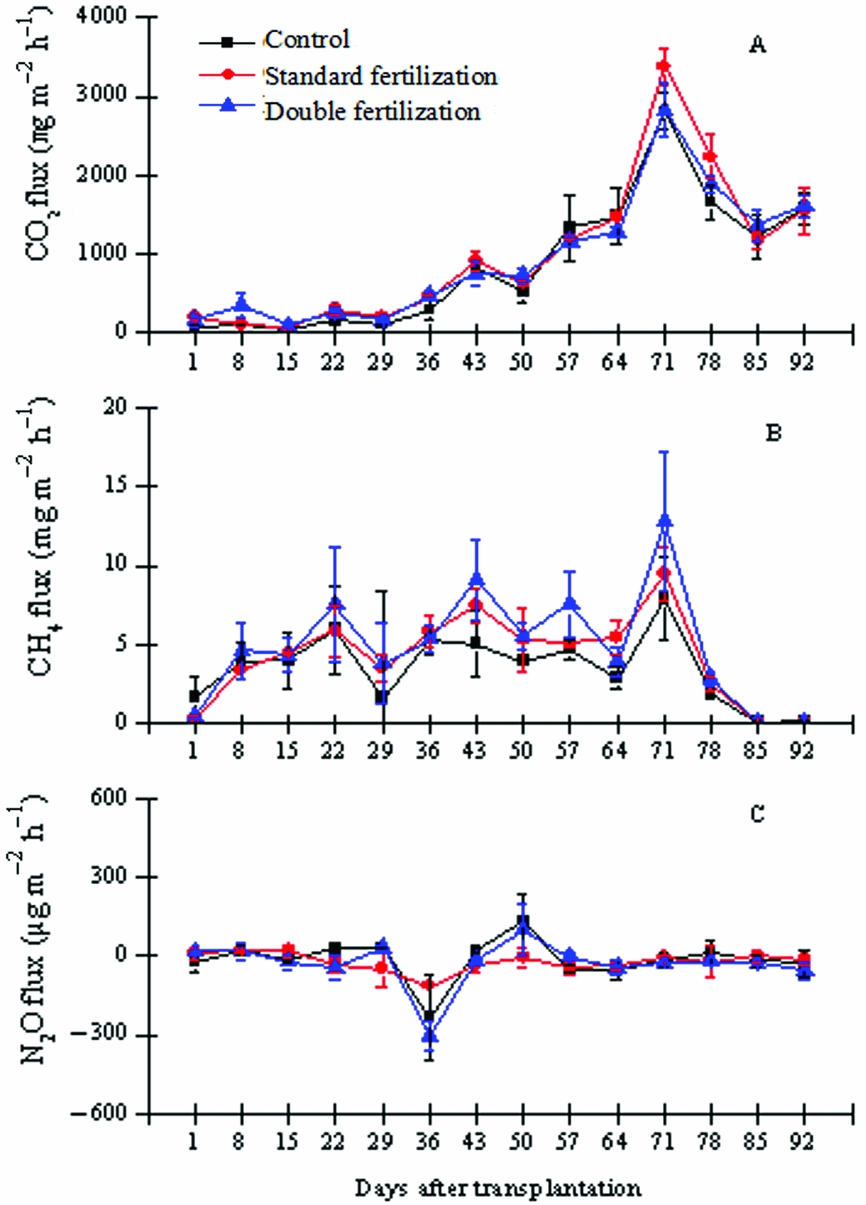
CO2, CH4 and N2O emissions varied significantly among most sampling dates (p < 0.01; Table S1), but the treatments and the interaction of sampling date and treatment were not significant (p > 0.05). CO2 flux generally remained low (< 354 mg m−2 h−1) during the first 29 DAT but then increased to a seasonal peak (> 2811 mg m−2 h−1) between 29 and 71 DAT (Figure 1a). The rice was nearly ripe by 71 DAT, with a corresponding decrease in CO2 emissions until harvesting in July. The CH4 emissions were low soon after rice transplantation and peaked by 71 DAT in all treatments (Figure 1b). The paddy was drained after the rice reached maturity, with a corresponding decrease in CH4 emissions until harvesting in July.
Seasonal variation of CO2 (A) and CH4 (B) emissions and N2O (C) fluxes from the control and treatment plots. Error bars indicate one standard error of the mean of triplicate measurements.

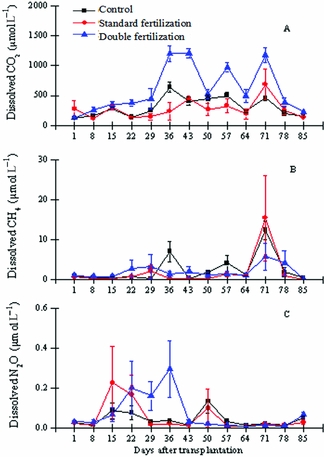
Mean CO2 emissions were 13.5% and 7.4% higher for the standard and double fertilizations, respectively, than the control. Mean CH4 emissions were 20.4% and 39.5% higher for the standard and double fertilizations, respectively, than the control. Mean N2O soil depositions were 61% and 101% higher for the standard and double fertilizations, respectively, than the control, mostly due to the lower (negative) values at 36 DAT (Figure 1c), despite no overall effect of the treatments on N2O emission determined by the mixed linear models (Table 1). Dissolved CO2, CH4 and N2O concentrations varied significantly among sampling dates (p < 0.01; Table S1). Treatments and the interaction between date and treatment were significant for the dissolved CO2 concentration but not for dissolved CH4 and N2O concentrations (p > 0.05; Table S1; Figure 2).
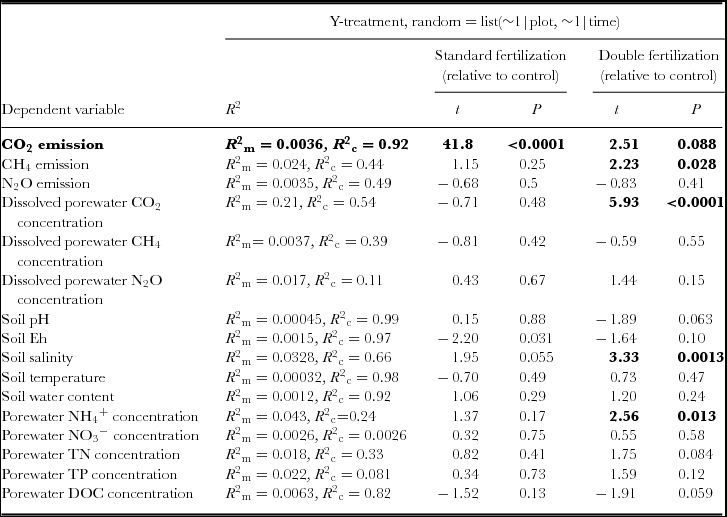
Results of the linear analysis of the effects of the mixed models, with treatment as a fixed factor, plot and time as random factors on GHG emissions and porewater GHG concentrations, and other soil variables as dependent variables.

R 2m is the variance explained by the fixed factors, and R 2c is the variance explained by the overall model (fixed + random). Statistical significant values are in bold type.
Seasonal variation of dissolved porewater CO2 (A), CH4 (B) and N2O (C) concentrations for the control and treatment plots. Error bars indicate one standard error of the mean of triplicate measurements.
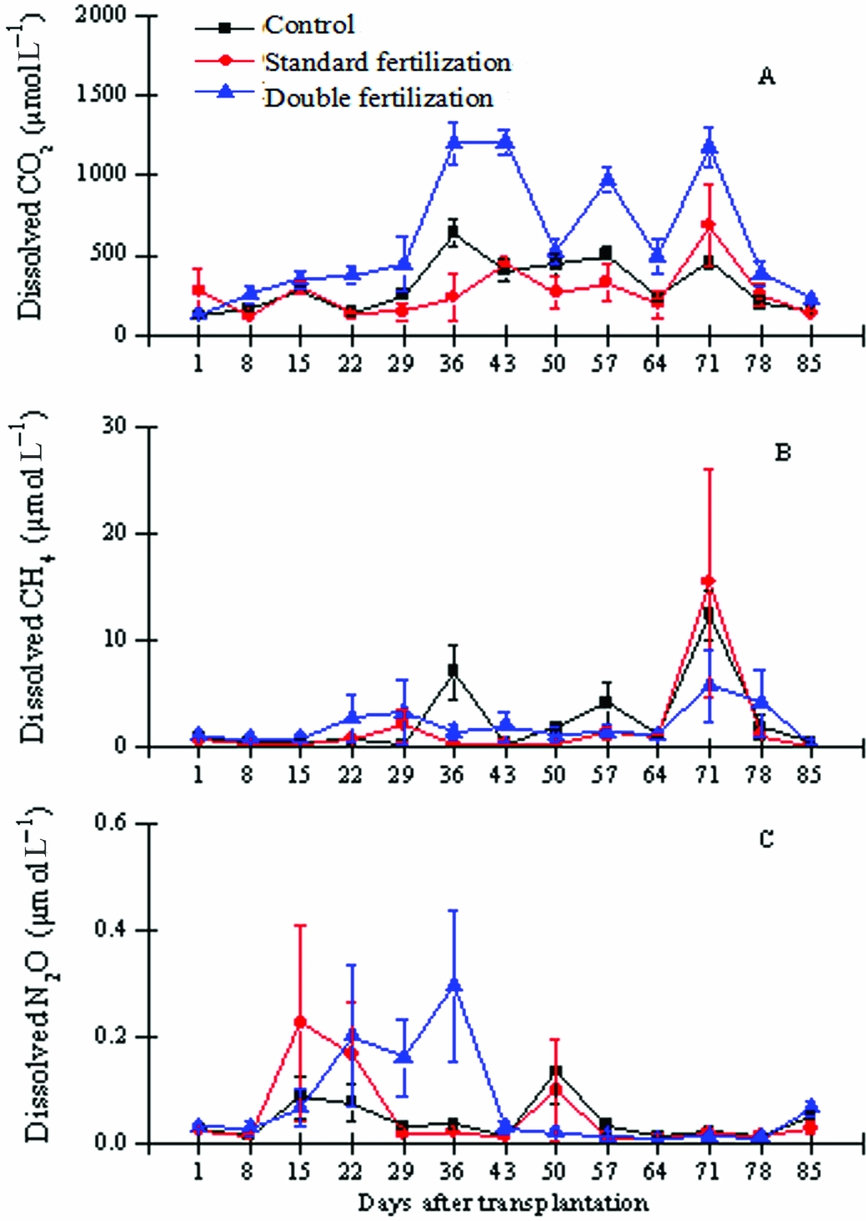
Mean dissolved CO2 concentration was 11.4% lower for the standard fertilization and 95.0% higher for the double fertilization than the control. Mean dissolved CH4 concentrations were 25.8% and 18.9% lower for the standard and double fertilizations, respectively, than the control. Mean dissolved N2O concentrations were 21.0% and 73.5% higher for the standard and double fertilizations, respectively than the control.
The mixed linear models (with plot and time as random factors) showed that standard fertilization increased CO2 emissions and soil Eh and salinity, whereas double fertilization increased CH4 emission, porewater CO2 concentration, soil salinity and porewater NH4+ and DOC concentrations (Table 1). This mixed linear model analysis is more robust to detect the effects of treatments than the previously commented ANOVA. CO2 emission was correlated positively with soil Eh, temperature, water content and porewater NH4+ concentration and negatively with soil pH and porewater TN, TP and DOC concentrations (Table S2).
Soil and porewater properties of the paddy
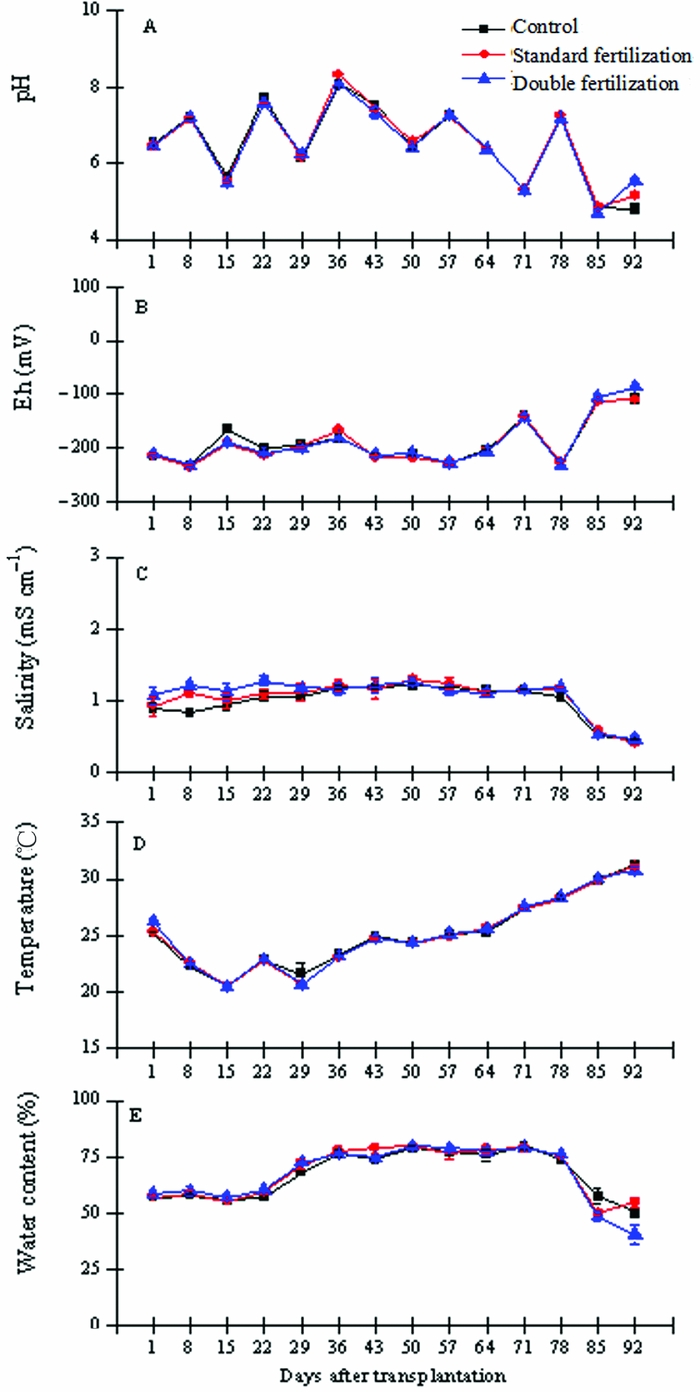
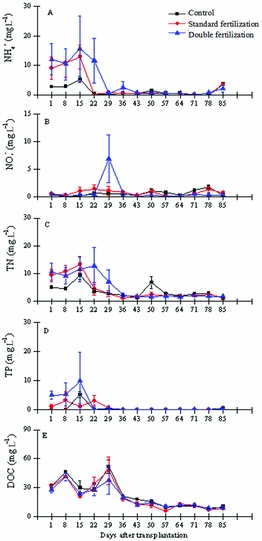
Soil Eh, salinity and porewater NH4+, TP and DOC concentrations, soil pH, temperature, water content and porewater NO3− and TN concentrations varied significantly among sampling dates (p < 0.01; Table S3; Figures 3 and 4). The interaction between sampling date and treatment had significant effects on soil pH, temperature, water content and porewater NO3− and TN concentrations (p < 0.05). Mean soil pH, Eh, salinity, water content and temperature for the standard and double fertilizations differed by <10% from the control. Mean porewater NH4+ concentrations were 114.8% and 213.7% higher for the standard and double fertilizations, respectively, than the control. Mean porewater NO3− concentrations were 17.8% and 30.9% higher for the standard and double fertilizations, respectively, than the control. Mean porewater TN concentrations were 19.7% and 42.0% higher for the standard and double fertilizations, respectively, than the control. Mean porewater TP concentrations were 45.7% and 213.3% higher for the standard and double fertilizations, respectively, than the control. Finally, mean porewater DOC concentrations were 9.3% and 11.7% higher for the standard and double fertilizations, respectively, than the control.
Seasonal variation of soil pH (A), Eh (B), temperature (C), salinity (D) and water content (E) for the control and treatment plots. Error bars indicate one standard error of the mean of triplicate measurements.

Relationships among GHG emissions, dissolved GHG concentrations and soil and porewater properties
The mixed linear models (with plot and time as random factors) showed that CH4 emissions were positively correlated with soil water content (Table S2). N2O emission was positively correlated with porewater total TN concentration and negatively with soil pH. Porewater CO2 concentrations were positively correlated with soil salinity and water content and negatively with porewater TN, TP, NH4+ and DOC concentrations. Porewater CH4 concentrations were positively correlated with soil water content, and porewater N2O concentrations were positively correlated with soil temperature and porewater NH4+ concentrations.
Soil relationships varied between the treatments (Tables S4 and S5). Seasonal CO2 emission was positively correlated with soil Eh (p < 0.05; Table 2) and temperature (p < 0.01; Table S4) in all plots. Seasonal CH4 emission was positively correlated with soil salinity (p < 0.01) and water content (p < 0.05) in all plots. Dissolved CO2 concentration was positively correlated with soil water content (p < 0.05), while dissolved N2O concentration was negatively correlated with soil temperature (p < 0.05; Table S4) in all plots.
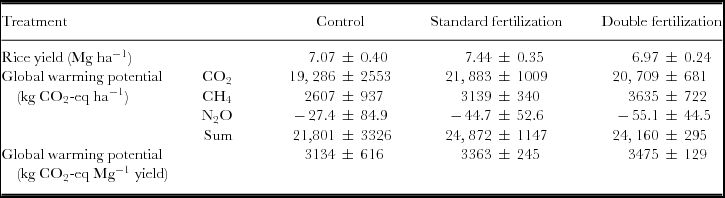
Effect of the fertilizations on the global warming potential.

Seasonal CO2 emission was positively correlated with CH4 emission (p < 0.05; Table S5) and dissolved CO2 concentration (p < 0.01). Seasonal CH4 emission was positively correlated with dissolved CH4 concentration (p < 0.01), and dissolved CO2 concentration was positively correlated with dissolved CH4 concentration (p < 0.01).
Rice productivity and GWP
The average rice yield was about 5.2% higher for the standard fertilization and about 1.4% lower for the double fertilization than the control, which were not significantly different (Table 2). The contribution of CO2 to total GWP (> 85%) was higher than that of CH4 and N2O. The total GWPs for all emissions were 14.1% and 10.8% higher for the standard and double fertilizations, respectively, than the control. The total GWPs per unit yield were significantly higher by 7.3% and 10.9% for the standard and double fertilizations, respectively, than the control.
DISCUSSION
Effects of fertilization on CO2 emissions
Mean CO2 emissions were higher for the standard and double fertilizations than the control, for several potential reasons. First, fertilization, such as N fertilization, promotes the deposition of photosynthetically derived C into soil organic carbon (SOC) pools. Then, soil respiration increases when inputs of active C substrates increase (Ge et al., Reference Ge, Liu, Yuan, Zhao, Wu, Zhu, Brookes and Wu2015). Second, fertilizer can provide many nutrients for microbial growth (Inselsbacher et al., Reference Inselsbacher, Wanek, Ripka, Hackl, Sessitsch, Strauss and Zechmeister-Boltenstern2011), and the increase in microbial activity promotes soil respiration and thus CO2 emission (Adewopo et al., Reference Adewopo, Silveira, Xu, Gerber, Sollenberger and Martin2015). Third, NH4+ from fertilizers can be oxidized to NO3− when paddies are drained, increasing the soil NO3− concentration. This NO3− would be reduced when the paddies are reflooded, producing CO2 (Wang et al., Reference Wang, Sardans, Lai, Wang, Zeng, Tong, Liang and Peñuelas2015). Moreover, NH4+ amendment in our study would be associated with ferric reduction, increasing the production and release of CO2 (Luo et al., Reference Luo, Zeng, Tong, Huang, Chen and Liu2016). Ferric reduction should also decrease the number of iron plaques (by the higher solubility of Fe2+ than Fe3+) on the rice roots, which would increase the transport of gases throughout the rice plants (Huang et al., Reference Huang, Chen and Liu2012). Transport by rice plants is the most important pathway of gas emission to the atmosphere (Wassmann and Aulak, Reference Wassmann and Aulakh2000). Decreases in the number of iron plaques will promote root ventilation, so more CO2 is produced and transported through the internal system of interconnected gas lacunae in plants. The positive correlation between soil redox reactions and CO2 emission is consistent with this result.
CO2 emission varied seasonally, increasing with rice growth and temperature. Temperature controls CO2 production and emission not only by increasing soil microbial activity (Vogel et al., Reference Vogel, Bronson, Gower and Schuur2014), but also by altering plant respiration (Slot et al., Reference Slot, Wright and Kitajima2013), substrate availability and quality, species composition, water availability and aerobic/anaerobic conditions (Davidson and Janssens, Reference Davidson and Janssens2006; Inglett et al., Reference Inglett, Inglett, Reddy and Osborne2012; Sihi et al., Reference Sihi, Gerber, Inglett and Inglett2016a, Reference Sihi, Inglett and Inglettb). Higher temperatures increase CO2 soil emissions in subtropical wetlands (Inglett et al., Reference Inglett, Inglett, Reddy and Osborne2012). C quality primarily influences Soil Organic Matter (SOM) decomposition at low temperatures, while at high temperatures nutrient availability controls SOM decomposition in subtropical wetlands (Sihi et al., Reference Sihi, Inglett and Inglett2016b). In our study, we have obtained consistent results with these previous reports. Soil CO2 concentration in porewater increased with temperature, especially in double-fertilized soils (Figures 3 and 4), showing higher organic matter decomposition with temperature, mainly in double-N-fertilized soils. Given that the major fraction of rice croplands in Southeast Asia corresponds to puddled/wetland conditions, understanding complex interactions in such environments is important for improving our capacity for future projections under a warming climate for both natural and agricultural systems.
Seasonal variation of dissolved porewater NH4+ (A), NO3− (B), TN (C), TP (D) and DOC (E) concentrations for the control and treatment plots. Error bars indicate one standard error of the mean of triplicate measurements.

Effects of fertilization on CH4 emissions
Mean CH4 emissions were 20.4% and 39.5% higher for the standard and double fertilizations, respectively, than the control. As stated above, fertilization promotes the deposition of photosynthetically derived C into SOC pools (Ge et al., Reference Ge, Liu, Yuan, Zhao, Wu, Zhu, Brookes and Wu2015). Such C can contribute up to 52% of the CH4 emissions from paddy soils by the exudation of labile organic C from roots to the rhizosphere, which will then produce methane. These results are consistent with the lack of fertilization effects on rice yield. While fertilization can enhance photosynthesis, more photosynthates are allocated to root exudates, and this reduces allocation to growth and yield. The other 48% of the CH4 is emitted from old soil C (Minoda et al., Reference Minoda, Kimura and Wada1996), promoting CH4 production and emissions (Minoda et al., Reference Minoda, Kimura and Wada1996). Fertilization, especially N fertilization, will also increase the availability of nutrients, which will promote CH4 production and emissions from microbes (Naik et al., Reference Naik, Krishnamurthy, Ramachandra, Hareesh, Jayadeva and Mavarkar2015). Since N fertilizer was provided in NH4+ form, it could have inhibited CH4 oxidation because of their structural resemblance and thus enzymatic substrate competition (Gulledge and Schimel, Reference Gulledge and Schimel1998). Nevertheless, most studies testing for different methods and substances for N fertilization have observed enhancement of CH4 production and emission (Pathak, Reference Pathak2010), which is in agreement with our results.
CH4 emission varied seasonally and emissions were low soon after rice transplantation when soil was not strictly anaerobic. The correlation of soil redox reactions with CH4 emission supported this finding (Data not shown). CH4 emissions were also low during the final ripening and drainage periods. These results agreed with those by Minamikawa et al. (Reference Minamikawa, Fumoto, Itoh, Hayano, Sudo and Yagi2014), in which a lowering of the water table decreased the abundance of the methanogenic archaeal population and hence CH4 production and increased the abundance of methanotrophs and thus CH4 oxidation.
Effects of fertilization on N2O emissions
N2O emission was low throughout the growing season, with no obvious pattern of seasonal variation (Figure 2). The paddies in our study region are strongly N limited (Wang et al., Reference Wang, Sardans, Lai, Wang, Zeng, Tong, Liang and Peñuelas2015), so together with low levels of soil O2, most of the N2O produced is likely reduced to N2, and this would lead to very low emissions or even a net uptake of N2O (Zhang et al., Reference Zhang, Cui, Pan, Li, Hussain, Zhang, Zheng and Crowley2010). Pulses in ammonium and nitrate availability after a fertilization have been related to N2O production (Pathak et al., Reference Pathak, Bhatia, Prasad, Singh, Kumar, Jain and Kumar2002). Specific N2O fluxes and the contribution of nitrifying and denitrifying bacteria are controlled mainly by soil moisture (Davidson et al., Reference Davidson, Matson, Vitousek, Riley, Dunkin, García-Mendez and Maass1993). However, the results of our study showed that the N added by fertilization had not been sufficient to raise N2O emissions in these paddies with low N concentrations.
Best management practices to reduce GWP
Our results suggested that the application of fertilizer had increased the impacts of rice agriculture on climate change, with higher total GWPs per unit yield compared to the controls. The fertilizations did not significantly increase the rice yield but they increased the soil porewater nutrient concentrations, which has the potential risk of nutrient loss, eutrophication and higher costs. Judicious use of fertilization should be reconsidered in a sustainable agriculture, and our results provide strong evidence that the current strategy of fertilization in most rice croplands in subtropical China over several years will saturate the soil fertility, increasing the release of nutrients to continental water and favouring CH4 and CO2 production and emission without increasing rice yield. Our findings suggest that alternating years of standard and low fertilizations could decrease water pollution and mitigate GHG emissions without decreasing rice yield, an issue to be further studied.
Acknowledgements
The authors thank Hongchang Ren, Xuming Wang and Dongping Zeng for their assistance with field sampling. Funding was provided by the National Science Foundation of China (41571287, 31000209), Natural Science Foundation Key Programs of Fujian Province (2018R1101006-1), Fujian Provincial Outstanding Young Scientists Program (2017), the European Research Council Synergy Grant ERC-SyG-2013-610028 IMBALANCE-P, the Spanish Government Grant CGL2013-48074-P and the Catalan Government Grant SGR 2014-274.
SUPPLEMENTARY MATERIAL
To view supplementary material for this article, please visit https://doi.org/10.1017/S0014479718000078