Examining meaningful relations between different aspects of children's behavior has been the focus of developmental research for decades. Recently, however, researchers studying developmental processes underlying the continuity and change of children's adaptation have started to examine longitudinal relations among indices of competence and psychopathology using more rigorous and sophisticated methodologies (Dodge & Pettit, Reference Dodge and Pettit2003; Eisenberg, Zhou, et al., Reference Eisenberg, Zhou, Spinrad, Valiente, Fabes and Liew2005; Kim & Cicchetti, Reference Kim and Cicchetti2004; Mesman, Bongers, & Koot, Reference Mesman, Bongers and Koot2001). In a series of studies examining relations among multiple domains of adaptation across various developmental periods, Masten and colleagues have demonstrated that functioning in one domain of adaptation can influence the longitudinal change in a different domain of adaptation, controlling for the well-established longitudinal stability of functioning as well as concurrent associations between different domains of adaptation (Burt, Obradović, Long, & Masten, Reference Burt, Obradović, Long and Masten2008; Masten et al., Reference Masten, Roisman, Long, Burt, Obradović and Riley2005; Obradović, Burt, & Masten, Reference Obradović, Burt and Masten2010). Prior success or failures in one domain seem to spill over to other domains of adaptation, which in turn can influence subsequent adjustment, triggering what Masten and colleagues termed a developmental cascade.
However, these longitudinal cross-domain influences must be replicated using designs that are more sensitive to the timing of effects. Extant studies, which are primarily long-term longitudinal studies that have large, uneven gaps between assessment waves or short-term longitudinal studies that have only two or three assessment waves, shed very little light on the developmental timing of these cascading effects. Yet identifying the windows of time during which these effects occur is a crucial step toward translating this research into interventions designed to target domains with known spreading effects. Furthermore, longitudinal associations among indices of competence and psychopathology must be examined together with repeated measures of contextual influences known to affect children's adaptation at particular stages of development. The current study was designed to extend previous work by examining associations among externalizing symptoms, social competence, and internalizing symptoms in an urban sample of girls during their transition to adolescence. The study design employs annual assessments of adaptation in the hopes of discovering the timing of developmental cascades during a developmental period of heightened opportunity and vulnerability when behaviors may be particularly susceptible to change (Arnett & Tanner, Reference Arnett and Tanner2006; Dahl & Spear, Reference Dahl and Spear2004). In addition to testing developmental cascade effects among the three salient domains of adolescent adaptation, we investigated how family adversity and pubertal status affect continuity and change in adaptation.
Relations between children's externalizing behavior problems and their ability to get along with peers and form stable prosocial friendship have been examined extensively across various developmental periods. Two domains of functioning seem to be interdependent starting at a very young age (Dishion & Patterson, Reference Dishion, Patterson, Cicchetti and Cohen2006). Aggressive children are more likely to be rejected by their peers and have poor social skills (Coie, Dodge, & Kupersmidt, Reference Coie, Dodge, Kupersmidt, Asher and Coie1990; Hinshaw & Lee, Reference Hinshaw, Lee, Barkley and Mash2003), as they tend to be impulsive and lack good self-regulatory abilities (Eisenberg, Sadovsky, et al., Reference Eisenberg, Sadovsky, Spinrad, Fabes, Losoya and Valiente2005; Hanish et al., Reference Hanish, Eisenberg, Fabes, Spinrad, Ryan and Schmidt2004). At the same time, various measures of peer rejection and low social competence have been found to contribute to increases in externalizing behavior problems across childhood and adolescence (Coie, Terry, Lenox, & Lochman, Reference Coie, Terry, Lenox and Lochman1995; Deater-Deckard, Reference Deater-Deckard2001; Hymel, Rubin, Rowden, & LeMare, Reference Hymel, Rubin, Rowden and LeMare1990; Nansel, Craig, Overpeck, Saluja, & Ruan, Reference Nansel, Craig, Overpeck, Saluja and Ruan2004; Sørlie, Amlund Hagen, & Ogden, Reference Sørlie, Amlund Hagen and Ogden2008). Lacking positive experiences with peers, socially marginalized children tend to interpret ambiguous social cues as hostile and react in an aggressive, relationship-damaging way that puts them on a vicious cycle of being further rejected (Crick & Dodge, Reference Crick and Dodge1994). Moreover, rejected children may choose to associate with other antisocial peers forming networks that may encourage and exacerbate development of aggressive behaviors (Dishion & Patterson, Reference Dishion, Patterson, Cicchetti and Cohen2006). Because both externalizing symptoms and rejection status tend to be stable over time, it becomes difficult to disentangle whether externalizing symptoms are more likely to predict changes in social competence later in adolescence or vice versa. Moreover, many studies examining associations between externalizing behavior problems and social competence were initially conducted with boys (Dishion, French, & Patterson, Reference Dishion, French, Patterson, Cicchetti and Cohen1995; Dishion, Loeber, Stouthamer-Loeber, & Patterson, Reference Dishion, Loeber, Stouthamer-Loeber and Patterson1984; Patterson, Reid, & Dishion, Reference Patterson, Reid and Dishion1992), with the focus only recently turning to examining processes leading to the development of externalizing symptoms that are unique to girls (Hipwell et al., Reference Hipwell, Keenan, Kasza, Loeber, Stouthamer-Loeber and Bean2008; Miller-Johnson, Loeber & Hipwell, Reference Miller-Johnson, Loeber and Hipwell2009).
Extensive literature indicates that both low levels of social competence and decline in social competence predict longitudinal increases in internalizing symptoms during childhood and adolescence (Chen, Li, Li, Li, & Liu, Reference Chen, Li, Li, Li and Liu2000; Cole, Martin, & Powers, Reference Cole, Martin and Powers1997; Hymel et al., Reference Hymel, Rubin, Rowden and LeMare1990; Kiesner, Reference Kiesner2002; Mesman et al., Reference Mesman, Bongers and Koot2001). For example, social competence was found to predict 6-month change in depressive symptoms, controlling for the stability of the two domains and their covariation at both assessment waves (Cole, Martin, Powers & Truglio, Reference Cole, Martin, Powers and Truglio1996). Of interest, low social competence predicted an increase in depressive symptoms only in sixth graders and not in third graders, providing some information about the timing of this cascade effect. Using a similar analytical design, Burt and colleagues (Reference Burt, Obradović, Long and Masten2008) reported that social competence in 8- to 12-year-olds predicted changes in internalizing symptoms in adolescence, 7 years later. However, a lack of intervening assessment waves made it difficult to ascertain whether the negative effect of social competence on changes in internalizing symptoms was a phenomenon unique to early adolescence that was carried forward to later adolescence, because of the longitudinal stability of this domain. Given the well-established rise in internalizing symptoms among girls during adolescence and growing evidence indicating that girls are more negatively influenced by interpersonal stressors (Crick & Zahn-Waxler, 2002; Little & Garber, Reference Little and Garber2004), it is especially important to examine these associations in girls transitioning to adolescence. In a recent cross-sectional study of young adolescent girls, peer stress was related to internalizing symptoms, but not to externalizing symptoms (Sontag, Graber, Brooks-Gunn, & Warren, Reference Sontag, Graber, Brooks-Gunn and Warren2008).
Development of internalizing symptoms has also been linked to previous levels of externalizing behavior problems in both community and clinically referred samples (Capaldi, Reference Capaldi1992; Kiesner, Reference Kiesner2002; Lahey, Loeber, Burke, Rathouz, & McBurnett, Reference Lahey, Loeber, Burke, Rathouz and McBurnett2002; Panak & Garber, Reference Panak and Garber1992). In a study of midadolescents, Wiesner (Reference Wiesner2003) reported that delinquency predicted an increase in symptoms of depression in girls, controlling for the longitudinal stability and within-time covariation of both domains. Based on their work with preadolescent boys at risk for psychopathology, Patterson and colleagues proposed that conduct problems compromised successful achievement of social and academic competence and that failure in these two domains contributed to the development of depressive symptoms (Patterson & Capaldi, Reference Patterson, Capaldi, Rolf, Masten, Cicchetti, Neuchterlein and Weintraub1990; Patterson et al., Reference Patterson, Reid and Dishion1992; Patterson & Stoolmiller, Reference Patterson and Stoolmiller1991). Social competence has been found to mediate the effect of externalizing symptoms on internalizing symptoms (Mesman et al., Reference Mesman, Bongers and Koot2001; Panak & Garber, Reference Panak and Garber1992). Again, because many of these studies were based on male samples, it is important to explicitly examine whether externalizing symptoms in girls have a direct effect on change in internalizing symptoms or whether this association is mediated by a decline in social competence. Given that girls are socialized away from expressions of overt externalizing symptoms, it is possible that as girls enter adolescence, they begin to internalize the distress and frustration they previously expressed overtly. Mesman and colleagues (Reference Mesman, Bongers and Koot2001) reported that models linking internalizing, social, and externalizing problems varied across sex.
Extant empirical evidence suggests that social problems and externalizing symptoms contribute to an increase in internalizing symptoms, rather than other way around (Burt et al., Reference Burt, Obradović, Long and Masten2008; Capaldi, Reference Capaldi1992; Cole et al., Reference Cole, Martin, Powers and Truglio1996). However, a few longitudinal studies demonstrated that at least in boys internalizing symptoms predict social problems (Capaldi & Stoolmiller, Reference Capaldi and Stoolmiller1999; Mesman et al., Reference Mesman, Bongers and Koot2001). Moreover, in a recent study of 9- to 13-year-olds, depressive symptoms was found to predict 6-month change in children's report of social self-worth, social skills, and peer relationships, controlling for within-time covariation and the longitudinal stability of the two domains, whereas the opposite was not true (Zimmer-Gembeck, Hunter, Waters, & Pronk, Reference Zimmer-Gembeck, Hunter and Pronk2009). Finally, some studies show that high levels of anxiety symptoms can prevent male children and adolescents from developing higher levels of externalizing symptoms (Kerr, Tremblay, Pagani, & Vitaro, Reference Kerr, Tremblay, Pagani and Vitaro1997; Mesman et al., Reference Mesman, Bongers and Koot2001; Moffitt, Caspi, Harrington, & Milne, Reference Moffitt, Caspi, Harrington and Milne2002). Given that these processes have rarely been examined in girls, the longitudinal effects that internalizing symptoms can have on the development of externalizing and social problems are unclear. Yet, understanding the punitive or protective effects of internalizing problems can have far-reaching consequences, given sex differences in internalizing problems during adolescence.
Examining the effect of family adversity on processes linking competence and psychopathology is an important next step in understanding how developmental cascades operate within the context in which children are growing up. Although numerous studies have linked high levels of adversity exposure to both internalizing and externalizing symptoms, most studies generally focus on single indices of adversity and do not examine reciprocal, dynamic relations between children's functioning and adversity exposure (Obradović, Shaffer, & Masten, in press). In a rare longitudinal study of transactional effects between adversity exposure and behavioral problems, Kim, Conger, Elder, and Lorenz (Reference Kim, Conger, Elder and Lorenz2003) found reciprocal effects between stressful life events and externalizing symptoms across six annual assessment waves from age 12 to 18. The effect of adversity on change in externalizing symptoms was stronger in early adolescence, whereas by late adolescence externalizing symptoms had a stronger effect on change in adversity exposure. In contrast, internalizing symptoms predicted longitudinal change in adversity exposure, but the opposite was not true. As Kim and colleagues tested externalizing and internalizing symptoms in two separate models, more research is needed to examine the reciprocal effects that adversity can have on multiple domains of adaptation, controlling for their concurrent covariation and longitudinal associations.
In addition to negotiating more frequent peer interactions, growing independence and responsibility, and romantic relationships, preadolescent and adolescent girls need to adjust to the profound bodily changes associated with puberty. Most studies examining effects of puberty on symptoms of psychopathology have focused on the timing of puberty, showing that early pubertal maturation relative to sample or national norms predicts increases in depression and anxiety (Ge et al., Reference Ge, Kim, Brody, Conger, Simons and Gibbons2003; Hayward et al., Reference Hayward, Killen, Wilson, Hammer, Litt and Kraemer1997; Siegel, Yancey, Aneshensel, & Schuler, Reference Siegel, Yancey, Aneshensel and Schuler1999). Growing evidence indicates that girls’ pubertal status (e.g., degree of maturation) is also significantly related to both higher concurrent and longitudinal levels of internalizing symptoms in girls (Angold, Costello, & Worthman, Reference Angold, Costello and Worthman1998; Benjet & Hernández-Guzmán, Reference Benjet and Hernández-Guzmán2002; Conley & Rudolph, Reference Conley and Rudolph2009; Ge, Brody, Conger, & Simons, Reference Ge, Brody, Conger and Simons2006; Hayward, Gotlib, Schraedley, & Litt, Reference Hayward, Gotlib, Schraedley and Litt1999). In addition, several studies have reported significant associations between early pubertal status and various externalizing symptoms (Caspi, Lynam, Moffitt & Silva, Reference Caspi, Lynam, Moffitt and Silva1993; Ge et al., Reference Ge, Brody, Conger and Simons2006; Graber, Brooks-Gunn, & Warren, Reference Graber, Brooks-Gunn and Warren2006). However, less is known about how annual changes in pubertal maturation during the transition to adolescence predict changes in girls’ adjustment.
Current Study
The current study was designed to examine the association between externalizing symptoms, social competence, and internalizing symptoms in a community sample of girls. This study aims to extend previous research by examining the timing of developmental cascade effects using six annual assessments spanning the important developmental transition to adolescence. Longitudinal associations among three domains of adaptation were tested by comparing a series of nested structural equation models. Based on the existing literature reviewed above, six models were set to test (a) longitudinal interindividual stability of each domain as well as within-time associations among domains, (b) transactional effects between externalizing symptoms and social competence, (c) the longitudinal effect of social competence on internalizing symptoms, (d) the longitudinal effect of externalizing symptoms on social competence, (d) the longitudinal effect of internalizing symptoms on social competence, and (e) the longitudinal effect of internalizing symptoms on externalizing symptoms. The order of models was determined based on existing literature with more empirical evidence favoring the significance of pathways tested in initial models. We hypothesized that all three domains would show strong stability across 6 years, with externalizing symptoms showing the highest stability, in accordance with previous studies (Capaldi, Reference Capaldi1992; Obradović, van Dulmen, Yates, Carlson, & Egeland, Reference Obradović, van Dulmen, Yates, Carlson and Egeland2006). Based on previous literature, we expected to detect transactional effects between social competence and externalizing symptoms as well as longitudinal effects of social competence and externalizing symptoms on internalizing symptoms. Given the paucity of studies testing the longitudinal effect of internalizing symptoms on social competence and externalizing symptoms in girls, the final two models were considered exploratory. Last, we conducted a follow-up analysis examining developmental cascade effects controlling for the reciprocal effects between family adversity and adaptation, as well as the effect of pubertal status on adjustment.
Methods
Sample and procedure
Participants for this study were drawn from the Pittsburgh Girls Study (PGS), a longitudinal study of four age-based cohorts that was initiated when girls were 5, 6, 7, and 8 years of age. The girls were selected to participate in PGS using a two-step procedure. First, based on 1990 Census data, 23 neighborhoods in the city of Pittsburgh were identified as “disadvantaged” because they had at least 25% of households living at or below poverty, and the other 66 neighborhoods were identified as “nondisadvantaged.” Second, all households in disadvantaged neighborhoods and a random selection of 50% of households in nondisadvantaged neighborhood were contacted to determine if they contained an eligible girl. This procedure identified 3,118 households with an eligible girl. Of the 2,876 girls who were of eligible age at the beginning of the study and who could also be located, 2,451 agreed to participate in the longitudinal study (for further details, see Hipwell et al., Reference Hipwell, Loeber, Stouthamer-Loeber, Keenan, White and Kroneman2002).
As the emphasis of the current study is on the transition to adolescence, it focuses on the oldest cohort of girls, for whom data are available through age 14, including self-report of internalizing symptoms starting at age 10. The oldest PGS cohort consists of 622 girls who were 8 years old at the onset of the study (M = 8.8, SD = 0.36). Representative of the catchment community, the oldest cohort was 41.8% Caucasian, 53.1% African American, 0.3% Asian, and 4.7% multiracial. To maximize the available data on the constructs of interest, the current study employed data from six annual follow-up assessments from age 9 to age 14. At the first follow-up (age 9), 43.2% of girls lived in a single-parent household and 29.4% of families received some form of public assistance (e.g., welfare, WIC Program, food stamps). These percentages stayed relatively consistent across the six assessment waves employed in the current analyses.
Separate interviews with girls and their primary caregivers were conducted in the family's home by trained interviewers using a laptop computer. Because most primary caregivers were biological parents (90.5%), primary caregivers are referred to as parents in this paper. In addition to the home interview, parents completed a pen-and-paper booklet containing various questionnaires. Teacher report of children's adjustment in the school context was collected by mailing or dropping off scannable booklets of questionnaires. Until the girls reached Grade 5, parents identified the primary teacher. In middle and high school, parents identified the teacher of an academic subject (i.e., math, English, science, social studies, foreign language) suitable to provide an assessment of the girl's adjustment. All participants were reimbursed for their involvement in the study. Approval for all study procedures was obtained from the University of Pittsburgh Institutional Review Board. Written informed consent from the caregiver and written assent from the child were obtained prior to data collection.
Measures
Externalizing symptoms
Externalizing symptoms were assessed using parent and teacher reports of conduct disorder (CD) and oppositional defiant disorder (ODD) symptoms on the Child Symptom Inventory—Fourth Edition (CSI-4; Gadow & Sprafkin, Reference Gadow and Sprafkin1994). The CSI-4 items are consistent with Diagnostic and Statistical Manual for Mental Disorders—Fourth Edition (DSM-IV) criteria for CD and ODD (American Psychiatric Association, 1994). The severity of clinical symptoms was scored on 4-point scales ranging from 0 (never) to 3 (very often). Both parent and teacher reports have shown good sensitivity and specificity in distinguishing youth with clinical diagnoses from healthy controls (Gadow & Sprafkin, Reference Gadow and Sprafkin1994). From age 9 to age 11, parent report of CD symptoms was based on 13 CSI-4 items, whereas teacher report of CD symptoms was based on 7 CSI-4 items. In addition, teacher report of CD symptoms was supplemented with two items—physical fights and destruction of property—from the Self-Reported Antisocial Scale (Loeber, Green, Lahey, & Stouthamer-Loeber, Reference Loeber, Green, Lahey and Stouthamer-Loeber1989). At age 11, the number of CD items increased to include developmentally appropriate indices of truancy (parent and teacher report) and running away overnight (parent report). In contrast, parent and teacher report of ODD symptoms were consistently based on eight analogous CSI-4 items.
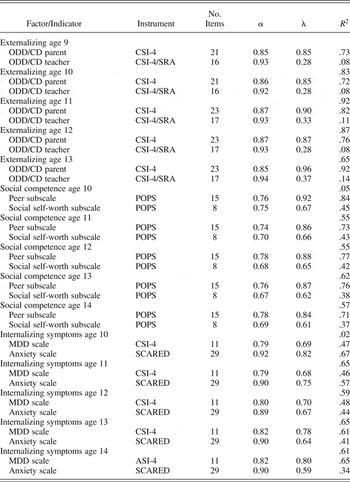
A recent factor analysis of PGS data showed that CD and ODD were not well differentiated in preadolescent girls (Loeber, Pardini, Stouthamer-Loeber, Hipwell, & Sembower, Reference Loeber, Pardini, Stouthamer-Loeber, Hipwell and Sembower2009), so CD and ODD items were combined to produce a single measure of externalizing symptoms for each informant. Combining CD and ODD items also reduced the skewness of the externalizing symptoms construct. Teacher and parent measures of externalizing symptoms were used as manifest variables to derive latent measures of externalizing symptoms. Table 1 indicates the number of items and the current sample's alpha statistics for parent and teacher report of externalizing symptoms from age 9 to age 13. The last assessment wave (age 14) does not include the measure of externalizing symptoms, as teacher report of this construct is not yet available for analysis.
Descriptions, reliability statistics, factor loadings, and variance of indicators and latent variables from the best fitting, final model (Model 5)

Note: ODD/CD, combined symptoms of oppositional defiant disorder (ODD) and conduct disorder (CD); CSI-4, Child Symptom Inventory (4th ed.); SRA, Self-Reported Antisocial Scale; POPS, Perception of Peers and Self Inventory; MDD, major depressive disorder; SCARED, Self-Report of Childhood Anxiety Related Disorders; ASI-4, Adolescent Symptom Inventory (4th ed.).
Social competence
Social competence, which is conceptualized as a broad adaptive domain that includes indices of peer relationships, friendship quality, and social self-worth, was assessed starting at age 10 using child reports on the Perception of Peers and Self-Inventory (Rudolph, Hammen, & Burge, Reference Rudolph, Hammen and Burge1995). The 15-item peer subscale assessed children's perceptions of peers and friendships across different dimensions, including support (e.g., “Friends usually stick up for you when you're in trouble”), mistreatment (e.g., “Other kids can sometimes be pretty mean”), empathy (e.g., “Friends will take your side when other kids make fun of you”) and acceptance (e.g., “Other kids usually like you, even if you have some faults”). The 8-item self-subscale assessed children's evaluations of their social self-worth within the context of peer relationships (e.g., “Kids like to be around me because I can be a very good friend”). The third Perception of Peers and Self-Inventory subscale, designed to assess children's perceptions of their social skills, was excluded from these analyses because of low reliability across all six assessment waves. The children responded to each item on a 4-point scale ranging from 1 (not at all) to 4 (very much), such that high scores reflected high social competence. The two subscales were used as manifest variables to derive latent measures of social competence. Table 1 indicates the number of items and current sample's alpha statistics for the two subscales from age 10 to age 14.
Internalizing symptoms
Internalizing symptoms were assessed starting at age 10 using child report of depression and anxiety symptoms. The severity of clinical symptoms of major depressive disorder (MDD) was assessed using 11 items on CSI-4. During the last assessment wave, when girls were 14 years old, CSI-4 items were replaced with analogous items on the Adolescent Symptom Inventory—Fourth Edition (Gadow & Sprafkin, Reference Gadow and Sprafkin1999). CSI-4 and Adolescent Symptom Inventory items were consistent with DSM-IV criteria for MDD (American Psychiatric Association, 1994), and the severity of clinical symptoms was scored on 4-point scales ranging from 0 (never) to 3 (very often). The severity of anxiety symptoms was assessed using the Screen for Childhood Anxiety Related Disorders (Birmaher et al., Reference Birmaher, Khetarpal, Brent, Cully, Balach and Kaufman1997). This screen consists of 41 items designed to assess symptoms of separation anxiety, school phobia, social anxiety, somatic/panic anxiety, and generalized anxiety on a 3-point scale ranging from 0 (not true/hardly ever true) to 2 (very true). Birmaher and colleagues (Reference Birmaher, Khetarpal, Brent, Cully, Balach and Kaufman1997) reported that the test–retest interclass correlation was .86 for the total score. For the purposes of the current study, 29 items assessing panic/somatic anxiety, social anxiety, and generalized anxiety symptoms were used to calculate a total score. The depression and anxiety total scores were used as manifest variables to derive the latent measures of internalizing symptoms. Table 1 shows the number of items and the current sample's alpha statistics for MDD and anxiety scales from age 10 to age 14.
Adversity exposure
To examine developmental cascades within the context of family adversity, annual measures of cumulative adversity exposure were created. Because the current study examines transactional effects between children's functioning and adverse family context, five indices were selected that have potential to change with time and be influenced by child functioning: (a) maternal depression, (b) stressful life events, (c) harsh parental punishment, (d) low parental warmth, and (e) perceived parental stress. Parental depression was assessed using a parent report on the Beck Depression Inventory—II (BDI-II; Beck, Steer, & Brown, Reference Beck, Steer and Brown1996). BDI-II consists of 21 items designed to measure the severity of MDD symptoms consistent with DSM-IV criteria (American Psychiatric Association, 1994) in both clinical and community populations. All items were scored on 4-point scales and summed to create a total score. Stressful life events were assessed using a parent report on the Difficult Life Circumstances Questionnaire (Barnard, Reference Barnard1994). This questionnaire consists of 28 negative life events, such as conflict with partner, financial difficulties, problems with drug or alcohol use, and long-term illness in family. Harsh parental punishment was assessed by parent report on the Conflict Tactics Scale: Parent–child version (Straus, Hamby, Finkelhor, Moore, & Runyan, Reference Straus, Hamby, Finkelhor, Moore and Runyan1998). As some girls had only one caregiver, only items relating to the primary caregiver were used to calculate this construct. The five items measuring psychological aggression (e.g., “In the past year, if your daughter did something that she is not allowed to do or something that you didn't like, how often did you shout, yell, or scream at her?”) were combined with a single item on spanking to generate a construct of harsh punishment. All items were scored on a 3-point scale ranging from 1 (never) to 3 (often). Straus and colleagues (Reference Straus, Hamby, Finkelhor, Moore and Runyan1998) reported adequate discriminant and construct validity for the psychological aggression subscale. The coefficient alpha values for the current sample ranged from 0.72 to 0.78 across six assessment waves. Low parental warmth was assessed by parent report using six items of the Parent–Child Rating Scale (Loeber, Farrington, Stouthamer-Loeber, & Van Kammen, Reference Loeber, Farrington, Stouthamer-Loeber and Van Kammen1998). The items (e.g. “How often have you wished she would just leave you alone”) were scored on a 3-point scale ranging from 1 (almost never) to 3 (often). The coefficient alpha values for the current sample ranged from 0.66 to 0.79 across six assessment waves. Perceived parental stress was assessed by parent report on the Perceived Stress Scale (Cohen, Kamarck, & Mermelstein, Reference Cohen, Kamarck and Mermelstein1983). This scale consists of 14 items designed to assess the parent's sense of control, feelings of stress and irritation, and coping ability. All items were scored on 3-point scales ranging from 1 (almost never) to 3 (often) with some items reverse scored to produce a total score that reflected high levels of perceived stress. The internal reliability of this construct ranged from 0.86 to 0.88 across six assessment waves.
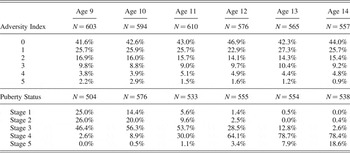
To identify girls who are exposed to high, potentially deleterious levels of adversity, the measures of adversity were dichotomized into binary factors using meaningful cutoff points or upper quartile values. BDI-II scores were dichotomized using a cutoff value of 14, which reflect exposure to at least mild depression. The percentages of parents who reported at least mild depression ranged from 15.1% (N = 557) to 18.5% (N = 594) across six waves. Difficult Life Circumstances Questionnaire scores were dichotomized using a cutoff of five events, which approximated the upper quartile value across six waves. The continuous scales measuring harsh punishment, low warmth, and perceived stress were dichotomized using top quartile values. A cumulative adversity index was created for each assessment wave by summing the five binary factors. The percentages of girls who were exposed to various levels of adversity are presented in Table 2.
Percentages of girls in each adversity category and pubertal status stage across six assessment waves

Pubertal status
Pubertal status was assessed using child report on the five-item Pubertal Development Scale (Petersen, Crockett, Richards, & Boxer, Reference Petersen, Crockett, Richards and Boxer1988). Girls were asked to rate development of their underarm and pubic body hair, skin changes, breast development, and growth spurt on 4-point scales: 1 = has not yet begun; 2 = has barely started; 3 = is definitely underway; and 4 = growth or development is complete. In addition, they were asked to dichotomously score the onset of menarche. In accordance with the approach outlined by Crockett (Reference Crockett1988), responses on the five items were used to categorize girls to into five pubertal status categories: (a) prepubertal, (b) beginning pubertal, (c) midpubertal, (d) advanced pubertal, and (e) postpubertal. Pubertal status derived using this approach is consistent with pubertal stages identified by Tanner (Reference Tanner1962). In addition, Robertson and colleagues (Reference Robertson, Skinner, Love, Elder, Conger and Dubas1992) reported good reliability and validity of this approach in urban and rural girls. The percentages of girls in five pubertal stages across six waves of assessment are presented in Table 2.
Statistical analyses
The statistical analyses in the current study parallel the procedures outlined by Masten and colleagues in previous publications (Burt et al., Reference Burt, Obradović, Long and Masten2008; Masten et al., Reference Masten, Roisman, Long, Burt, Obradović and Riley2005). First, an appropriate measurement model was obtained, comprising 15 latent variables across three domains of adaptation: (a) externalizing symptoms (ages 9–13), (b) social competence (ages 10–14), and (c) internalizing symptoms (ages 10–14). The measurement model also included correlated residuals to control for errors because of shared method variance. Second, a series of nested structural models was tested according to the theoretically based hypotheses outlined above. In baseline Model 1, stability paths between adjacent assessment waves were examined for each latent construct, and correlations among three latent constructs were examined within each assessment wave. In Model 2, cross-domain paths were added between externalizing symptoms and social competence. In Model 3, cross-domain paths were added from social competence to internalizing symptoms. In Model 4, cross-domain paths were added from externalizing symptoms to internalizing symptoms. In Model 5, cross-domain paths were added from internalizing symptoms to social competence. In Model 6, cross-domain paths were added from internalizing symptoms to externalizing symptoms. Cross-domain paths were estimated only between adjacent time points because of power considerations. Following the establishment of a best-fitting model from the series above, the significance of that developmental cascade model was examined within the context of family adversity and pubertal maturation. In this follow-up analysis, paths were added between the adversity index and the three domains of functioning, as well as paths from puberty status to the three domains of functioning. In addition, correlations between adversity and pubertal status were included at each assessment wave.
All structural equation models were examined using the Mplus 5.2 program (Muthén & Muthén, Reference Muthén and Muthén2007). In all analyses, an MLR estimator was employed to account for nonnormal distribution of manifest variables. Common model fit indices are reported: (a) comparative fit index (CFI), (b) Tucker–Lewis index (TLI), and root mean square error of approximation (RMSEA). However, the relative fit of proposed nested models was evaluated primarily based on a scaled chi-square difference test, using adjusted chi-square values based on an algorithm for nonnormal data (Satorra, Reference Satorra, Heijmans, Pollock and Satorra2000).
The average percentage of missing data across all indicators and assessment waves was 10.0%. Because most of the missing data were from missing teacher reports, we examined whether girls who did and did not have a teacher report differed in terms of parent report of externalizing symptoms and self-reported indices of social competence and internalizing symptoms at each assessment. Results of multivariate analysis indicated no overall effect of missing teacher data at age 10, F (5, 549) = 1.12, ns, age 11, F (5, 577) = 0.70, ns, and age 12, F (5, 568) = 1.85, ns. At age 13, there was a significant overall effect, F (5, 561) = 2.50, p < .05, with girls missing teacher report having higher levels of parent-reported externalizing symptoms, F (1, 565) = 11.49, p < .01, η = 0.02). However, all available data were modeled using maximum likelihood estimation in order to best approximate the processes found in the population.
Results
The measurement model comprising indices of externalizing symptoms, social competence, and internalizing symptoms showed a good absolute fit (CFI and TLI > 0.95, RMSEA < 0.05; McDonald & Ho, Reference McDonald and Ho2002) with CFI = 0.972, TLI = 0.952, and RMSEA = 0.034. The standardized indicator loadings (range = 0.27–0.99) were statistically significant at p < .001. Because of space limitations, standardized loadings for the measurement model and correlation matrix of all manifest indicators are not presented but are available from the first author upon request.
A chi-square comparison of the six nested models described above are presented in Table 3, where c represents a scaling coefficient used to account for skewed distribution of manifest variables (Satorra, Reference Satorra, Heijmans, Pollock and Satorra2000). All nested models had an acceptable overall fit according to absolute fit indices (CFI and TLI > 0.90, RMSEA < 0.05; McDonald & Ho, Reference McDonald and Ho2002). However, incremental improvements of model fit were achieved by adding new cross-domain paths based on the hypotheses for the study. Results of adjusted chi-squares indicate that Model 2 fits better than Model 1, Δχ2 (8) = 29.70, p < .001; Model 3 fits better than Model 2, Δχ2 (4) = 14.17, p < .01; Model 4 fits better than Model 3, Δχ2 (5) = 21.90, p < .001; and Model 5, Δχ2 (6) = 11.19, p < .05, fits better than Model 4. In contrast, the relative fit was not improved by addition of the last set of hypothesized cross-domain paths in Model 6, Δχ2 (3) = 2.69, ns. Thus, Model 5 was adopted as the best-fitting model.
Fit statistics and model comparisons for nested structural equation models

Note: The final selected model is in bold. c, weighting constant for computing the chi-square statistic using robust estimation method; CFI, comparative fit index; TLI, Tucker–Lewis Index; RMSEA, root mean square error of approximation; cd, weighting constant for the difference between two chi-square values using robust estimation.
aNumber of cross-domain paths.
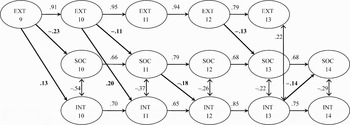
Model 5 also showed a good absolute fit (CFI = 0.964, TLI = 0.949, RMSEA = 0.035). Factor loadings and explained variance (R 2 values) of indicator and latent variables for Model 5 are presented in the right-hand columns of Table 1. Standardized path estimates (β) for significant within-time correlations, stability paths, and cross-domain paths are shown in Figure 1. As expected, within-time associations between indices of social competence and internalizing symptoms were consistently significant during all assessment waves. Hypothesized within-time correlations between externalizing and internalizing problems emerged only at age 13 (the last wave at which both constructs were measured). Consistent with the hypotheses, all three domains of adaptation showed significant longitudinal stability between all annual assessment waves. As expected, externalizing symptoms was the most stable domain, with a slight drop in stability between the two final assessment waves (age 12 and age 13). Social competence and internalizing also showed strong stability across all annual assessments between ages 10 and 14, although to a lesser degree than externalizing symptoms.
Standardized path coefficients for significant paths of final structural model (Model 5). All displayed paths are significant at p < .05. EXT, externalizing symptoms; INT, internalizing symptoms; SOC, social competence. Numbers denote the age of participants at each assessment wave of data collection; χ2 (310, N = 610) = 535.55, comparative fit index = 0.964, Tucker–Lewis index = 0.949, root mean square error of approximation = 0.035.

Several significant cross-domain paths emerged in Model 5 consistent with hypotheses outlined in the introduction. First, three significant cross-domain paths from externalizing symptoms to social competence emerged: (a) from age 9 to age 10 (β = −0.23), (b) from age 10 to age 11 (β = −0.11), and (c) from age 12 to 13 (β = −0.13). Although the first of these paths reflects the effect that prior levels of externalizing symptoms has on social competence over and above concurrent correlation with externalizing symptoms, the latter two paths indicate the effect that prior levels of externalizing problems have on a 12-month change in social competence. In contrast, there were no significant cross-domain paths from social competence to externalizing symptoms. Second, a significant cross-domain path from social competence to internalizing symptoms emerged between ages 11 and 12 (β = −0.18). Third, two significant cross-domain paths from externalizing symptoms to internalizing symptoms emerged: (a) from age 9 to age 10 (β = 0.13), and (b) from age 10 to age 11 (β = 0.20). The second path that indicates the effect of prior levels of externalizing symptoms on 12-month change in internalizing symptoms was stronger than the second path that did not account for the stability of internalizing symptoms. Fourth, a significant cross-domain path from internalizing symptoms to social competence emerged between the last assessment waves, age 13 and age 14 (β = −0.14), and a marginally significant pathway was also detected between ages 12 and 13 (β = −0.13, p = .07).Footnote 1 Fifth, there were no significant cross-domain paths from internalizing symptoms to externalizing symptoms.
Follow-up analysis
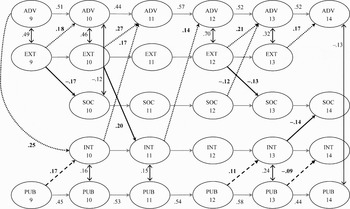
The significance of the cross-domain effects between indices of competence and psychopathology was further examined, controlling for interplay between family adversity and child's functioning as well as the effects of pubertal status on adaptation. Thus, Model 5 was expanded to include bidirectional longitudinal paths between cumulative indices of family adversity and all three domains of adaptive functioning, as well as the effects of pubertal status on all indices of adaptation. In addition, we estimated bidirectional within-time paths between adversity exposure and pubertal status. Inclusion of additional paths yielded a model with acceptable overall fit (CFI = 0.940, TLI = 0.921, RMSEA = 0.038). Standardized estimates for significant cross-domain paths and stability of adversity exposure and pubertal status are shown in Figure 2. To simplify this figure, stability estimates for adaptation domains are omitted; however, they all remained significant and did not change substantially from the standardized estimates presented in Figure 1. For the same reason, the previously reported within-time correlations among the three domains of adaptation are omitted, as they remained relatively unchanged in this follow-up analysis.
Standardized path coefficients for significant paths of follow-up model including adversity index and pubertal status. All displayed paths are significant at p < .05. ADV, cumulative adversity index; EXT, externalizing symptoms; INT, internalizing symptoms; PUB, puberty status; SOC, social competence. Numbers denote the age of participants at each assessment wave of data collection. (—) Original cascade pathways, (• • •) bidirectional effects with adversity, and (- - -) effects of puberty status. All stability estimates for EXT, SOC, and INT are significant but are omitted because of the complexity of this figure; χ2 (649, N = 610) = 1209.03, comparative fit index = 0.940, Tucker–Lewis index = 0.921, root mean square error of approximation = 0.038.

As shown in Figure 2, both adversity exposure and pubertal status were fairly stable across all assessment waves, from age 9 to age 14. As expected, within-time positive associations between family adversity and externalizing symptoms were consistently significant during all assessment waves, except at age 11. In addition, a negative association between family adversity and social competence emerged at age 10. Pubertal status was correlated only with internalizing symptoms when girls were 10, 11, and 13 years old. Finally, indices of family adversity and pubertal status were correlated only at age 14; lower levels of adversity were related to more advanced pubertal status.
After inclusion of adversity exposure and pubertal status, the effect of externalizing symptoms at age 9 on internalizing symptoms at age 10 became nonsignificant, whereas two cross-domain paths became marginally significant: (a) externalizing symptoms at age 10 to social competence at age 11 (β = −0.11, p = .08), and (b) social competence at age 11 to internalizing symptoms at age 12 (β = −0.15, p = .07). However, the follow-up model also yielded new cross-domain paths (see Figure 2). First, contrary to expectations, the effect of adversity on adaptation was detected only between the adversity index at age 9 and internalizing problems at age 10 (β = 0.25). Second, the consistent significant cross-domain effect of externalizing symptoms on adversity index was found across all assessment waves (β range = 0.17–0.27), except between age 11 and age 12 when this path reached marginal significance (β = 0.10, p = .06). In addition, the effect of internalizing symptoms on adversity index was significant between age 10 and 11 (β = 0.17) and between age 11 and 12 (β = 0.14). Third, a negative cross-domain effect emerged from social competence at age 12 on adversity index at age 13 (β = −0.12).
Significant cross-domain effects of pubertal status were detected on the initial levels of internalizing symptoms at age 10 (β = 0.17) and on the increase in internalizing symptom from age 12 to age 13 (β = 0.11), whereas the effect between age 10 and 11 was marginally significant (β = 0.08, p = .06). In contrast, a negative cross-domain effect emerged between pubertal status at age 13 and internalizing at age 14 (β = −0.09), indicating that slower pubertal development is related to an increase in internalizing symptoms.
Discussion
The focus of the current study was to examine longitudinal associations among externalizing symptoms, social competence, and internalizing symptoms in girls during their transition to adolescence from age 9 to age 14. Among the three domains of adaptation, the most consistent longitudinal pathway emerged from externalizing symptoms to social competence. Externalizing symptoms predicted lower initial levels of social competence at age 9 as well as a decrease in social competence from age 10 to 11 and from age 12 to 13. In addition, externalizing symptoms predicted higher initial levels of internalizing symptoms at age 10 and a subsequent increase in internalizing symptoms from age 10 to 11. These findings are consistent with the conclusion advanced by Masten and colleagues that externalizing symptoms seem to initiate a series of developmental cascade effects that spread to other domains of adaptation (Masten et al., Reference Masten, Roisman, Long, Burt, Obradović and Riley2005; Obradović et al., Reference Obradović, Burt and Masten2010). Although Masten and colleagues have reported that the effects of externalizing symptoms may spread to other domains by compromising successful academic achievement in early childhood, this study indicates that externalizing symptoms in girls seem to persistently undermine social competence during the important developmental transition.
Although the effect of externalizing symptoms on social competence does not appear to be unique to a particular age within the range of this study, the effect of externalizing on internalizing symptoms seems to be constrained to early, preadolescent assessments. This finding is consistent with the notion that as social expectations for gender-typed behaviors are reinforced and externalizing symptoms are socially sanctioned in girls during middle to late childhood, externalizing behavior problems may contribute to an increase in girls’ feelings of internal distress. In contrast to a recent study of young Norwegian adolescents (Sørlie et al., Reference Sørlie, Amlund Hagen and Ogden2008), social competence did not predict changes in externalizing symptoms. However, the lack of significant findings could be because of the high longitudinal stability of externalizing symptoms. Together, these findings suggest that intervention aimed at promoting successful transition to adolescence among urban girls should focus on ameliorating externalizing symptom in preadolescent years.
In addition to the direct effects of externalizing on social competence and internalizing symptoms, the study revealed a developmental cascade initiated by the negative longitudinal effect of externalizing symptoms on social competence, which in turn affected a change in internalizing symptoms. This finding corroborates studies demonstrating that peer rejection and social problems mediated the effect of externalizing symptoms on internalizing symptoms (Mesman et al., Reference Mesman, Bongers and Koot2001; Panak & Garber, Reference Panak and Garber1992) using a more optimal analytical model for testing mediating effects (Cole & Maxwell, Reference Cole and Maxwell2003). The timing of the effect of social competence on internalizing symptoms was similar to findings reported by Cole et al. (Reference Cole, Martin, Powers and Truglio1996) and Chen et al. (Reference Chen, Li, Li, Li and Liu2000) in different samples of sixth graders. Furthermore, the transition to middle school and the establishment of new peer groups may partially explain the timing of the developmental cascade effect from externalizing symptoms to internalizing symptoms via social competence. Girls who exhibit higher levels of externalizing symptoms may find it particularly difficult to adjust to new settings and fit into new social networks, resulting in more negative perceptions of peer relationships and social self-worth, which in turn contribute to higher internalizing problems at this age.
Furthermore, results indicate a transactional interplay between social competence and internalizing symptoms, in that internalizing symptoms also predicted changes in social competence. The reciprocal relations between social competence and internalizing symptoms are remarkable, given the significant within-time covariation of the two domains during all assessment waves and the significant annual stability of both domains. The current study provides initial insights into specific processes linking social competence and internalizing symptoms in girls who seem to be more vulnerable to interpersonal stressors than boys (Crick & Zahn-Waxler, 2002; Little & Garber, Reference Little and Garber2004). The timing of internalizing symptoms’ effect on social competence only partially corroborates the findings of Zimmer-Gembeck and colleagues (Reference Zimmer-Gembeck, Hunter and Pronk2009), who found a similar effect in 9- to 10-year-olds and 11- to 13-year-olds. Studies need to further examine how internalizing symptoms undermine successful adaptation in other domains in girls who suffer from higher levels of internalizing symptoms in adolescence. This process has been relatively underexplored, because early studies of competence and psychopathology predominantly focused on boys, for whom there was little empirical support that internalizing symptoms influence development of social competence.
Developmental cascade effects are often interpreted as if high levels of initial symptoms undermine the development of competence, which in turn leads to even higher levels of symptoms. However, it is equally plausible that low levels of symptoms enable children to achieve higher levels of competence, which protects them against the escalation of future symptom levels. The analyses in the current study do not examine which end of the distributions is driving these spillover effects. Future studies need to explicitly address this issue, because it will be important to know whether interventions should be targeted at interrupting developmental cascades by ameliorating problems that trigger them, promoting positive developmental cascades, or both.
The current study demonstrated the importance of taking concurrent contextual influences into account when examining developmental cascade effects, as some of the effects linking the three domains of functioning changed once the effects of family adversity and pubertal maturation were considered. First, the significant effects of family adversity exposure and pubertal status on initial internalizing symptoms fully mediated the original effect of externalizing symptoms. In keeping with risk and adversity literature (Obradović et al., in press), exposure to family adversity emerged as the most powerful predictor of future internalizing symptoms, in the absence of controls for previous levels of internalizing symptoms. Second, the effect of externalizing symptoms at age 10 on social competence at age 11 and the effect of social competence at age 11 on internalizing symptoms at age 12 became marginally significant. The tenuousness of these effects highlights the need for replication studies with large sample sizes that can support tests of longitudinal associations across multiple levels of functioning and contextual influences. Although the size of our sample is relatively large, the power to detect significant effects in a more complex follow-up test may have been limited.
The follow-up analysis also revealed some important processes by which social and biological experiences are linked to girls’ behavioral adjustment. The current study only partially supported the findings reported by Kim and colleagues (Reference Kim, Conger, Elder and Lorenz2003), in that girl's externalizing symptoms systematically predicted annual increases in family adversity, but exposure to family adversity did not predict changes in externalizing symptoms. Internalizing symptoms and social competence also predicted an increase in family adversity, although these effects were less consistent. These findings underscore the importance of not treating adversity as a static construct, but rather a process of moderate stability that can change over time and should be repeatedly assessed (Obradović et al., in press). Moreover, these results underscore the fact that girls actively shape their family context and are not only passively influenced by environmental risk and adversity.
In accordance with growing evidence about the effects of pubertal status on the development of psychopathology (Angold et al., Reference Angold, Costello and Worthman1998; Benjet, & Hernández-Guzmán, Reference Benjet and Hernández-Guzmán2002; Conley, & Rudolph, Reference Conley and Rudolph2009; Ge et al., Reference Ge, Brody, Conger and Simons2006), more advanced stages of puberty were associated with higher initial levels of internalizing symptoms in preadolescent girls. The current findings also extend previous studies by demonstrating that the prospective report of absolute pubertal maturation predicted an increase in internalizing symptoms. The addition of pubertal status revealed a new developmental cascade, with puberty status at age 12 contributing to an increase in internalizing symptoms at age 13, which in turn predicted the decline of social competence at age 14. In contrast to studies showing the effect of pubertal timing on externalizing symptoms (Ge et al., Reference Ge, Brody, Conger and Simons2006; Graber et al., Reference Graber, Brooks-Gunn and Warren2006), an absolute measure of pubertal status as well as longitudinal changes of pubertal status did not predict externalizing problems. Although more studies are needed to better understand how pubertal maturation and accompanying psychobiological processes can trigger complex changes in adaptation, the practical implications of such research can be far-reaching.
It is interesting that the effect of puberty status on internalizing symptoms was completely reversed between the last two assessments, with a more mature pubertal status predicting the decline of internalizing symptoms between ages 13 and 14. The negative effect of pubertal status on internalizing symptoms at this age supports recent findings (Dorn, Susman, & Ponirakis, Reference Dorn, Susman and Ponirakis2003) and underscores the importance of considering normative trends when examining pubertal development. It is not surprising that girls with delayed pubertal development would show an increase in symptoms of depression and anxiety at the time when most of their peers have reached more mature pubertal status. Analogous findings have been reported by Neemann, Hubbard, and Masten (Reference Neemann, Hubbard and Masten1995), who showed that early romantic relationship involvement in late childhood and middle adolescence was a negative predictor and correlate of competence in middle adolescence, but that by late adolescence, when such relationships became more normative, this negative effect was not present. Moreover, Roisman, Masten, Coatsworth, and Tellegen (Reference Roisman, Masten, Coatsworth and Tellegen2004) reported that when these participants reached young adulthood, romantic relationship involvement was positively related to concurrent academic, work, and conduct competence. As the significance of certain experiences (e.g., puberty, romantic involvement, and pregnancy) changes dramatically across different developmental periods, future studies must consider the dynamic nature of the developing organism, relationships, and contexts when examining longitudinal relations between environmental influences and adaptive functioning (Obradović et al., in press).
Furthermore, such a reversal in the direction of the longitudinal association between the two domains brings up the question of an optimal time interval between assessments for testing developmental cascade effects. Longer time intervals between assessments may be better for detecting cumulative longitudinal effects that would be missed across more frequent assessment waves. As Cole and Maxwell (Reference Cole and Maxwell2003) point out, longer time intervals may maximize the longitudinal cross-domain effect when two domains show high longitudinal stability. In contrast, shorter time intervals may be better for identifying the exact onset of developmental cascades as well as inflection points for reversal effects. Based on additional exploratory analyses that are beyond the scope of this paper, testing proposed models across 2-year intervals (i.e., using only odd or even assessment waves) yielded an incomplete picture of processes reported in this paper. Although all significant cross-domain paths detected in such reduced models were consistent with the full model reported here, models with longer periods between assessments seemed to miss some of the important cross-domain paths, the reversal effect of puberty on internalizing symptoms, and the consistency of the effects of externalizing symptoms on social competence and adversity. It is not surprising that more frequent, annual assessment waves should better capture spillover effects during the transition to adolescence, given that this dynamic developmental period offers many opportunities and vulnerabilities for changes in adaptive functioning (Arnett & Tanner, Reference Arnett and Tanner2006; Dahl & Spear, Reference Dahl and Spear2004). According to Cole and Maxwell (Reference Cole and Maxwell2003), researchers should empirically determine optimal time intervals for one domain to have an effect on the other domain of functioning. Future studies, thus, need to focus on identifying the most favorable timeframes for detecting developmental cascades and determining how the strength of developmental cascades varies across different developmental periods.
Conclusion
In sum, this study revealed that externalizing symptoms in girls can have a significant and pervasive effect on their social competence and exposure to family adversity during the transition to adolescence. In addition, changes in pubertal status seem to relate to changes in internalizing symptoms, but the developmental timing matters, in that advanced pubertal status is linked to increased symptoms before age 13 and decreased symptoms after that age. Finally, there is some evidence that, in addition to concurrent associations, social competence and internalizing symptoms are reciprocally linked across the transition to adolescence.
Although the current study has many strengths, such as its large, representative sample with multiple informants and annual assessments, there are some important limitations that need to be addressed. First, teacher participation was harder to maintain than the participation of girls and their families, resulting in a larger percentage of missing teacher data. Second, parent and teacher report of externalizing symptoms explained an uneven amount of variance in the latent measure. Third, the lack of availability of data prevented examination of all three domains of adjustment across all six assessment waves. Despite these limitations, the current study addresses some important gaps in the current literature by studying processes linking competence and psychopathology in urban girls.
Future studies need to explore these processes in greater detail, extending analysis to include measures of various contextual influences across biological and societal levels. Such measures will allow researchers to examine how physiological and emotional arousal predisposes girls to contextual influences in their surroundings (Graber et al., Reference Graber, Brooks-Gunn and Warren2006). Furthermore, developmental cascade models need to incorporate the interactive effects between different indices of individual development and environmental influences. For example, early maturing girls are particularly at risk for the development of psychopathology if they are also exposed to high levels of adversity (Obeidallah, Brennan, Brooks-Gunn, & Earls, Reference Obeidallah, Brennan, Brooks-Gunn and Earls2004). Finally, studies focusing on the interplay between competence and psychopathology in girls should examine the longitudinal role of relational aggression in adjustment. The charting of developmental cascade effects has only recently begun and individual studies can reveal only small aspects of very complex processes, which may seem to be idiosyncratic findings, dependent on the characteristics of individual samples, measures, and study design. However, our hope is that with more studies using this rigorous analytical design a more complete picture of developmental processes underlying the development of competence and psychopathology will emerge.